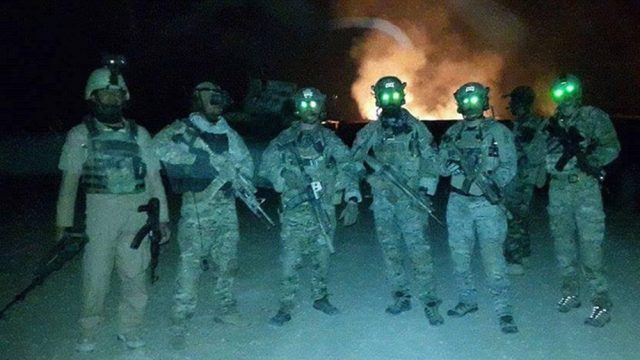
In an unusual turn of events in Syria, militants once backed by the US have seized a shipment of US-made missiles that was heading to fighters currently backed by the US.
The missiles, US-made TOWs, were seized on March 28 by the Syrian Task Force, a joint force of the Turkish Police, Counterterrorism Unit and the National Syrian Army (SNA), near the Turkish-occupied town of Azaz in the northern Aleppo countryside.
According to the Turkish Ministry of Interior, the smugglers confessed that they had been trying to transfer weapons to the Kurdish People’s Protection Units (YPG) and the Kurdistan Workers’ Party (PKK) in the town of Manbij in the northeastern countryside of Aleppo.
Beside two TOW anti-tank guided missiles (ATGMs), the weapons shipment included 24 AK-type assault rifles, a designated marksman rifle, two gun tubes and ammunition.
Most SNA factions were once backed by the US, which supplied them with TOW ATGMs until late 2017. The YPG and the PKK, one the other hand, are the core of the Syrian Democratic Forces, which still receive US support.
Between 2012 and 2017, the US shipped loads of weapons and ammunition to rebels in Syria in an attempt to topple the government of President Bashar al-Assad.
The Central Intelligence Agency (CIA) and the Pentagon led these efforts to arm the Syrian rebels with a direct support from US allies in the Middle East, first and foremost Turkey, Jordan, Saudi Arabia and Qatar.
US efforts didn’t only fail to topple the Damascus government, but also ended up turning Syria into a large black market for advanced weapons. Many of the weapons supplied by the US and its allies found their way to the hands of terrorist groups like ISIS and al-Qaeda-linked Hay’at Tahrir al-Sham. Some of these weapons were found in Iraq and even Lebanon.
Today, weapons like TOW ATGMs, are being used by militants once supported by the US against Washington’s current proxies in Syria and vice versa.
The US plans to arm Syrian rebels inflamed the war, threatened neighboring countries and even ended up turning Washington’s tools against each other. Some not very tolerant social media users would call these great achievements a brilliant example of “clusterfuck.”
Palestinian Foreign Minister, Riyad al-Maliki, who was returning to the West Bank from a meeting at the International Criminal Court (ICC), was held up at a border crossing and got his VIP travel permit revoked by Israel.
Senior Palestinian official, Ahmed al-Deek, said that agents of Israel’s Shin Bet intelligence service have questioned al-Maliki for around 30 minutes at the Allenby crossing from Jordan into the West Bank on Sunday. Members of the FM’s entourage were questioned for around an hour, he added.
Al-Maliki’s special travel permit has been revoked and he left the border crossing without it. The VIP pass allows top Palestinian officials to move freely through the Israeli-operated checkpoints. It was unclear if the FM will be getting the papers back, al-Deek added.
An Israeli official has confirmed the development to the Times of Israel, but declined to name the reason for the cancellation of the minister’s pass. However, al-Deek insisted that the move by the Israeli authorities was retaliation for Maliki’s visit to the ICC in The Hague earlier this week.
“Israel is unable to solve cases through the law, but instead resorts to a policy of intimidation, sanctions and threats,” he told Palestinian WAFA news agency.
Al-Maliki, who was on European tour, met with ICC lead prosecutor, Fatou Bensouda, on Thursday. Earlier this month, Bensouda announced a probe into war crimes carried out in the Palestinian Territories since June 13, 2014.
According to al-Maliki’s office, he spoke to the prosecutor about “the importance of expediting investigations into the crimes committed in the territory of the State of Palestine, in a manner that ensures justice for the victims and their families among the Palestinian people.”
On Friday, Israeli and Palestinian administrations both received notifications from the ICC of the opening of a war crimes probe against them.
While welcomed by the Palestinians, the investigation has angered the Israeli authorities, with Prime Minister Benjamin Netanyahu labeling it “the epitome of anti-Semitism and hypocrisy.”
A group of child rights experts has strongly criticized the UN secretary-general for excluding eight parties, including the Israeli regime and the Saudi-led coalition, from a global blacklist of parties accountable for harming children during conflicts.
In a report, experts from Watchlist on Children, an international child rights group, said at least eight parties to conflicts were found responsible for killing and maiming more than 100 children in a single year but were excluded from the blacklist.
There were “numerous discrepancies and omissions in listing decisions, as well as unwarranted delisting decisions,” the report said, noting that the UN Security Council’s 2001 resolution establishing the list to protect children from the horrors of war “is being seriously undermined” and could result in “putting children at even greater risk.”
“The secretary-general’s 2015 annual report acknowledges that the number of children killed by Israel in 2014 was the third highest in the world and the number of schools damaged or destroyed was the highest anywhere in the world that year, and yet Israel has not been listed in the report’s annexes,” the report said.
It added that at the time the news media reported that Israel and the United States conducted intense lobbying to prevent the regime’s blacklisting.
The child rights experts also cited annual reports that have repeatedly found Israeli forces responsible for high levels of Palestinian child casualties, including over 1,525 killed and maimed in 2020 alone.
“Yet Israeli forces have yet to be included in the annexed list of violators,” they added.
According to the AP, co-author Yanghee Lee, former chair of the committee that monitors implementation of the UN Convention on the Rights of the Child, said: “We are calling on the secretary-general to urgently address these problems and commit to hold all countries and groups responsible for violations against children accountable without fear or favor.”
In response to the report, UN spokesman Stephane Dujarric said Secretary-General Antonio Guterres stands by the report’s conclusions, expressing willingness to engage with relevant partners in how to improve the system.
Benyam Dawit Mezmur, another co-author of the report urged the UN to ensure that the list of perpetrators it issues is “more credible, accurate, complete, and evidence-based, or risk pulling apart this unique tool for the protection of children caught in war.”
The report also said the Saudi-led war coalition against Yemen was delisted in 2020 for killing and maiming children in the Arab country, despite being responsible for a documented 222 child casualties during the reporting period.
“With this delisting, the Saudi-led coalition has been removed from the Secretary-General’s list altogether,” it noted.
Citing the Secretary-general’s reports that said the Saudi-led coalition was delisted due to a “sustained significant decrease” in the number of violations they committed, the rights experts said such argument runs counter to the established delisting criteria.
“This runs counter to the delisting criteria established in 2010 and the Security Council’s stated expectations that listing is based on whether or not grave violations against children took place in violation of international obligations,” they maintained.
According to the UN Office for the Coordination of Humanitarian Affairs (OCHA), the Saudi war on Yemen has killed a quarter of a million people, including women and children, since it was launched in March 2015 with the aim of restoring the Riyadh-friendly government of former President Abd Rabbuh Mansour Hadi.
The U.S. forces present in Syria, without the authorization of the country’s legitimate government, intensified their destabilizing actions and sent more reinforcements to their illegal enclaves, in addition to transferring thirty Daesh terrorists to the east of this Arab nation, according to local news agencies.
According to state television, the Kherab Jir area base in the northeastern province of Hasakeh received in the last hours a caravan of 40 trucks loaded with weapons, ammunition, and war and logistic equipment and Sanaa agency.
The caravan is said to have entered Syrian territory through the illegal Al-Walid crossing with northern Iraq, which is often used by U.S. troops for their movements. Similarly, another column of several armored vehicles and trucks moved towards the Ionian gas field’s newly established base in the northeastern Deir Ezzor province.
Meanwhile, Syrian news agencies reported the transfer in two helicopters of about 30 members of the Islamic State (Daesh, in Arabic) to the illegal U.S. base in Tanef, on the border with Iraq and Jordan.
According to the data revealed, the terrorists were being held in one of the prisons of the separatist militia Syrian Democratic Forces, a force close to Washington’s interests, which arms these terrorists and uses them in the service of its destabilizing plans in Syria, the agencies said.
The government of Bashar Al Asad denounced that the recent attacks of Daesh against military and civilians in the desert are planned and facilitated by the U.S. occupation forces, who offer them support with weapons and intelligence information to prolong the war in this Middle East nation.
More than 100 Palestinian homes face demolition and about 1,550 residents, including more than 800 children, will be made homeless at the hands of Israel’s Jerusalem Municipality, Arab48 reported yesterday.
This comes as the Israeli municipality cancelled all agreements with the Palestinian residents of the Silwan neighbourhood.
According to Arab48, the Israeli municipality rejected plans it had requested as an alternative to the demolition of the Palestinian homes, instead it is set to demolish the Palestinian homes and turn the area into The King’s Garden, claiming that it was a garden for Israeli kings thousands of years ago.
The municipality had agreed to provide Palestinians with land in other areas to build new homes, but it suddenly backtracked on this decision.
The legal battle has cost the Palestinian community more than $500,000.
Euro-Mediterranean Human Rights Monitor said in a statement that the “massive destruction and displacement operation against the population may amount to ethnic cleansing and a war crime.”
Video allegedly showing a “rogue” SAS unit committing war crimes in Afghanistan has supposedly disappeared, as an investigation into the squad’s alleged “massacres” has been plagued by missing evidence and silence from witnesses.
Saifullah Yar was just 19 when his family were shot dead in an SAS raid on their Afghan village in 2011. When British military investigators flew to Kabul in 2017 to investigate the raid, he told them he was handcuffed and led away from his father, brother and two male cousins. He heard two sustained bursts of gunfire, and when the Brits departed, his relatives were dead, their bodies riddled with bullets.
Video footage of the raid was apparently captured by US air support overhead, but according to a new Sunday Timesreport, American authorities mysteriously lost the footage, and were unable to provide it to a British court, where Saifullah has brought a judicial review into the fatal raid.
The mysterious disappearance isn’t the first time that key evidence from the raid has gone missing, or been intentionally hidden. The Royal MIlitary Police (RMP) investigators’ 2017 visit to Kabul was one of their last tasks in a three-and-a-half year probe into allegations of war crimes against the SAS unit, during which they found that the British operators doctored mission reports to implicate Afghan special forces in similar killings, dozens of which took place between 2011 and 2013.
The investigators interviewed 42 soldiers who said they were unable to remember the mission. Court documents reported on by the Times stated that a judge termed this a case of “collective amnesia.” The weapons used in the raid on Saifullah’s village were destroyed the same year the RMP opened its investigation.
However, evidence against the SAS troops has piled up. Investigators found that British 5.56mm bullets, rather than the 7.62mm rounds used by the Afghan commandos, were used to kill the victims. Additionally, they examined reports that weapons were planted on the bodies of these victims, in order to justify the killings later.
The reports that followed the 2011 raid on Saifullah’s village stated that his family were killed when they reached for weapons as the SAS searched their property. These reports were met with skepticism by senior commanders, who in a chain of emails seen by the British court, described the raid as “the latest massacre,” and expressed disbelief at the idea of four overpowered prisoners reaching for hidden grenades and rifles during the raid.
“And finally they shot a guy who was hiding in a bush who had a grenade in his hands. You couldn’t MAKE IT UP!,” one senior noncommissioned officer wrote.
The British government closed down the investigation in late 2017 without prosecuting a single case. The same year, another wide-ranging investigation into alleged war crimes, the Iraq Historic Allegations Team (IHAT), was shut down, also without prosecuting a case.
With the SAS typically exempt from parliamentary oversight, the courts are now Saifullah’s best hope of finding justice. “Our client is seeking a fresh investigation into the deaths of his loved ones and he wants to find out whether their deaths were part of a pattern of unlawful killings of Afghan civilians,” his lawyer, Tessa Gregory, told the Sunday Times.
The spokesman for Yemen’s popular Houthi Ansarullah movement has dismissed the US proposal for a nationwide ceasefire in the war-torn country, saying the plan would plunge Yemen further into turmoil.
“The US plan doesn’t include breaking the siege or ceasing fire. It is actually a detour which would lead to a resumption of a (Saudi) blockade diplomatically,” Mohammed Abdul-Salam said in an interview with Yemen’s al-Masirah television Friday evening.
“One of the conditions presented in the initiative is to determine the destinations of flights departing Sana’a airport, and for the coalition of aggression to issue flight permits. This means they are not licensed here in Sana’a,” he said.
“If they were serious to stop the aggression and siege, they would have declared a complete end to hostilities and blockade. We would then welcome the measure. Aggression and siege against Yemen have not stopped even for a single day over the past six years, so what is the US concept of ceasing fire or breaking the siege?” Abdul-Salam added.
The Ansarullah spokesman said the US presentation of Saudi conditions as a so-called peace plan once again proved that Washington explicitly supports the Saudi war and blockade against Yemen.
He further noted that what the US special envoy on Yemen, Tim Lenderking, presented was a plot to plunge the Arab state further into turmoil.
“It is unacceptable for an American envoy to present a plan which is inferior to that of the United Nations special envoy for Yemen (Martin Griffiths),” Abdul-Salam said.
He said there is no real change towards ending the Saudi war and lifting the siege, stressing that such matters lie in the hands of the other side.
“They want us to respond through dialogue to what they have not achieved by means of war and siege. Everyone must realize such a fact,” the senior Ansarullah official added.
Abdul-Salam also rejected as “a big lie” the US envoy’s allegations that humanitarian aid deliveries have not been distributed among the needy Yemenis, stating that the coalition of aggression illegally impounds Yemen-bound oil vessels irrespective of the fact they all have acquired international permits beforehand.
“We have accepted all conditions proposed by other parties to ensure the delivery of humanitarian assistance. Having found no excuse to continue the blockade, they are alleging aid deliveries have not reached those in need,” the Ansarullah spokesman said.
Houthi: Trust in US comes from actions, not words
A member of Yemen’s Supreme Political Council said Ansarullah is ready to return to the negotiating table with a serious goal of ending the conflict, but it must first see concrete steps from the administration of US President Joe Biden.
“Trust is built by actions, not words,” Mohammed Ali al-Houthi told CNN on Friday.
“Trust must be achieved through decision-making. So far, we have not seen any concrete decisions being made,” he added.
He noted that President Biden was a member of former US president Barack Obama’s administration, which declared at the time that Washington was joining the Saudi-led coalition against Yemen.
“They also gave the green light to the coalition to continue massacre in our country and agreed to it,” Houthi added.
‘Washington must drop Saudi conditions’
Abdul-Malik al-Ajri, a member of Ansarullah’s political bureau, said on Friday that his movement views the US ceasefire proposal in favor of Saudi Arabia, and would not accept it.
“The US special envoy on Yemen [Tim] Lenderking has presented proposals to end the war and has called on Ansarullah to respond,” Ajri wrote in a post published on his Twitter page.
“The truth is what he has offered is the same as Saudi Arabia’s conditions for a ceasefire. Linderking should know in case such suggestions were acceptable, we would have directly received them from Saudi Arabia. There was then no need for the US envoy to repeat Saudis’ narrative.”
Lenderking: Ansarullah’s ability is undeniable fact
The top US diplomat for Yemen on Friday touched on the role of Ansarullah and said its ability is a straightforward fact.
Lenderking said during a webinar with the Atlantic Council think tank that the movement is a “significant player” in Yemen and it needs to be acknowledged.
“I don’t think you can operate by denying that reality,” he said, claiming that the US “never said the Houthis have no role in Yemen.”
Lenderking, who recently returned from a three-week trip to the region, added that Washington is looking for the Ansarullah’s response to its peace plan.
“I will return immediately when the Houthis are prepared to talk,” Lenderking noted.
Millions of people suffer and die from the effects of radiation exposure from decades of nuclear weapons testing. Their experience should give serious pause to those who continue to embrace the viability of a nuclear deterrent.
A dust storm originating in the Sahara Desert swept across parts of Spain, France, the UK, and Ireland last month. In addition to bringing a red tinge to the sky, the dust caused a slight, yet noticeable, spike in radiation in the areas it reached. This radiation spike was caused by the presence of cesium-137, a radioactive isotope produced through the nuclear fission of uranium-235 in nuclear weapons. A legacy of French nuclear weapons testing that occurred in Algeria during the 1960s, the cesium-137 contamination is a reminder that while the testing of nuclear weapons may have been halted for the time being, the consequences of these tests live on through the poisoning of the planet mankind calls home.
The Saharan radioactive dust cloud is but the most recent visible phenomenon of a plague that has infected much of the world. Cancer and birth defects can be linked to hundreds of atmospheric nuclear weapons tests conducted by the five so-called “nuclear powers” (the United States, Russia, China, France and the United Kingdom). The secrecy that these states attached–and still attach–to these tests has complicated efforts to obtain a true and accurate account of the human cost associated with nuclear weapons testing. Even the horrific numbers put out by a 1991 study by the International Physicians for the Prevention of Nuclear War (IPPNW), which estimated that the radiation and radioactive materials from atmospheric testing taken in by people caused 430,000 cancer deaths by the year 2000, and predicted that roughly 2.4 million people could eventually die from cancer because of atmospheric testing, is just a guess.
A cancer on the globe
That many of these victims were veterans who were deliberately exposed to the effects of nuclear weapons is neither shocking nor excused. Some 250,000 US military personnel involved in the occupation of the Japanese cities of Hiroshima and Nagasaki were exposed to radiation produced by the two atomic bombs dropped on those cities at the end of World War 2; another 400,000 were exposed to the effects of nuclear weapons over the course of nearly two hundred atmospheric tests that took place between 1946 and 1962. According to a study conducted by the National Cancer Institute and Centers for Disease Control, radioactive fallout from nuclear weapons testing has killed more than 15,000 Americans and caused at least 80,000 cancers. The Department of Veterans Affairs has created a category of veteran, the so-called “Atomic Veteran,” to classify military personnel and their dependents who qualify for compensation if they have been stricken by at least one of 21 presumptive cancers defined by law as being linked to radiation exposure.
The US is not the only nation that recklessly exposed its military personnel to the effects of nuclear weapons testing. The French army recently acknowledged that as many as 2,000 of the 6,000 military personnel based in French Polynesia who were involved in the nuclear tests between 1966 and 1974 have since contracted at least one form of cancer. This data set does not include the several thousand other French military personnel exposed to radiation from the seven nuclear weapons tests conducted in Algeria. On top of this some 22,000 British military personnel witnessed more than a dozen nuclear weapons tests carried out on Australian territory and neighboring Pacific islands between 1953 and 1963.
Supernova in the East
The Soviet Union, which carried out 137 atmospheric tests of nuclear weapons, took the exposure of military personnel even further, conducting a nuclear test where a bomb the size of those dropped on Japan was detonated within two miles of 45,000 Red Army soldiers dug into defensive fighting positions. This test, conducted on September 14, 1954, in the Ural Mountains about 600 miles southeast of Moscow, finished with these soldiers, most of whom were not wearing any protective equipment, rising from their defensive positions to conduct an assault across the newly nuked landscape, apparently to prove that troops could operate effectively in a nuclear war.
It is not known how many of these soldiers died because of exposure to radiation, but the levels they were subjected to are estimated to be ten times that permitted for an American soldier to experience for an entire year. It is also unknown to what extent similar military exercises were held in relation to nuclear weapons testing nor the total number of Soviet military personnel exposed to the effects of radiation and the long-term health consequences.
Of the five so-called “nuclear powers” (nations whose nuclear arsenals are openly acknowledged and recognized by the nuclear nonproliferation treaty), China operates with the greatest level of secrecy, but we know of nearly two dozen atmospheric tests. While little is known about these tests, some estimates hold that more than 20 million Chinese may have been exposed to radiation, that 194,000 people may have died from acute radiation exposure, and another 1.2 million may have received doses high enough to cause cancer.
The civilian cost
That civilians bear the greatest burden of the decades of nuclear weapons testing should not come as a surprise. Even though the nuclear weapons powers will all contend that they went to great lengths to conduct these tests in remote locations, as far from civilian populations as practical, the reality is that the unpredictability and persistence of the radioactive fallout produced from these tests have led to widespread exposures, with deleterious health effects.
In Algeria, it is estimated that between 27,000 to 60,000 people from communities around the French nuclear test sites were exposed to dangerous levels of radiation. More than 110,000 occupants of French Polynesia were exposed to dangerous levels of radiation, including the 80,000 inhabitants of the capital, Papeete, when the highly radioactive cloud from a 1974 atmospheric test drifted over the city. The civilian population was not notified, and no precautions were taken. The number of Australian aboriginal people exposed to radiation from the United Kingdom’s nuclear testing on Australian soil likewise numbers in the many thousands.
The Kazakh region of Semipalatinsk bears similar witness to the dangers of testing. Between 1949 and 1989, 1.5 million residents of the former Soviet oblast of Semipalatinsk were subjected to at least 456 nuclear tests conducted at an 18,000-square-kilometer site known as Semipalatinsk-21. Today, samples taken from the soil and water of the region show a level of radiation more than 10 times the norm. More than half the population has died of cancer before reaching the age of 60, and one in 20 children born in the region has some form of serious deformity. These results are not an aberration, but the norm.
British veterans who were exposed to radiation from nuclear testing were found to have fathered children possessing congenital defects at a rate of 94.2 per thousand births, as compared to 9.6 for non-veterans. And radiation is the gift that keeps on giving–among the grandchildren of these “Atomic Veterans,” the defect rate was 61.4, compared with 7.4 for the grandchildren of those not exposed.
The Dirty Harry Test – not feeling lucky
The United States has its own sordid history of nuclear tests gone bad, perhaps the most notorious being the so-called “Dirty Harry” test involving a 32-kiloton weapon that was detonated at the Nevada Test Site on May 19, 1953. Due to a miscalculation in the weather report, accompanied by an unexpected change in wind direction, the explosion generated a highly contaminated fallout cloud which drifted over the town of St. George, in the neighboring state of Utah. The town’s residents were not told to shelter, and school children were playing at morning recess when the radiation began to settle on the town. Radiation counters used to measure the level of contamination maxed out at 300-350 milliroentgens, more than three times the maximum permitted annual rate of exposure. It would be hours before the citizens of St. George were told to take cover.
The impact of the ‘Dirty Harry’ test on the health of St. George’s population is still a matter of dispute, with various legal claims still working their way through the US legal system. But an indication of the deadly potential of exposure to the fallout of this test can be gauged by the experiences of the cast and crew of the Hollywood movie, The Conqueror, filmed on location outside St. George in 1954, a year after the test. The cast and crew spent several weeks on location. By 1980, 91 of the 220 persons involved with the film had developed cancer, of whom 46 died–including the stars of the film, John Wayne and Susan Hayward.
Sometimes it takes the death of a celebrity to shed light on a real and pressing concern that otherwise would escape attention. The fact that a nuclear weapons test may have caused the cancer that killed two American film legends is not known by most US citizens today, let alone the rest of the world. But Susan Hayward and John Wayne’s deaths highlight the reality that radiation poisoning knows no boundary. There is no social status that protects one from the fatal consequences of exposure to radioactive fallout from nuclear testing–it will kill a Kazakh peasant and Pacific islander as easily as a Hollywood legend. The radiation that likely killed John Wayne and Susan Hayward came from a single nuclear weapons test. While the atmospheric testing of nuclear weapons is a thing of the past, the continued utility of nuclear weapons as a so-called “weapon of deterrence” should send alarm bells off around the world. The fact that nations continue to incorporate these weapons into their respective arsenals, and develop a doctrine that envisions their possible use, underscores the fact that people and politicians have lost touch with how utterly awful these weapons are, and why they must never be used again.
Scott Ritter is a former US Marine Corps intelligence officer and author of ‘SCORPION KING: America’s Suicidal Embrace of Nuclear Weapons from FDR to Trump.’ He served in the Soviet Union as an inspector implementing the INF Treaty, in General Schwarzkopf’s staff during the Gulf War, and from 1991-1998 as a UN weapons inspector.
During the 19th century, American leaders kept an eye on Nicaragua as a potential site for a transoceanic canal. US navy warships periodically arrived at Nicaraguan ports to protect American interests and fostered U.S. business investments under the strong-man rule of President José Santos Zelaya. When Zelaya began courting Europeans for the building of a canal and welcomed European business investments, American leaders called Zelaya a tyrannical, self-serving, brutal, and a greedy disturber of Central American peace. In December 1926, President Calvin Coolidge ordered warships and more US Marines to Nicaragua. He told Congress that “disturbances and conditions in Nicaragua seriously threaten American lives and property, [and] endanger the stability of all Central America.” This resulted in the Sandino War that cost the lives of an estimated 3000 Nicaraguans and 136 US Marines.
The devastation of Germany by total warfare during World War II cast serious doubt on Germany’s postwar ability to survive. Never before in history had a nation’s life-sustaining resources been so thoroughly demolished. Returning from victory in Europe, Gen. Omar Bradley stated, “I can tell you that Germany has been destroyed utterly and completely.”[1]
Despite soothing words from Allied leaders at the Yalta and Potsdam Conferences, it soon became evident to the Germans that the Allies did not arrive as liberators. Instead, the Allies arrived as conquerors as vengeful, greedy and ruthless as any who had ever won a war. This article documents the plundering and destruction of Germany that continued after the end of World War II.
The Plunder of Germany
The Red Army began the plunder of Europe as soon as it entered Germany in 1944. Soviet looting in the Russian Zone became prodigious after the end of the war. Factories, refineries, processing mills, and other heavy industrial installations were taken apart and sent east to the Soviet Union to be reassembled. All secondary rail lines, electric and steam locomotives and their rolling stock were sent to the Soviet Union. The plants that were left in Germany were operated by Germans solely for the benefit of the Soviet Union.[2]
Red Army soldiers joined the Soviet government in pillaging Germany on a massive scale. A woman from Silesia wrote:
The Russians systematically cleared out everything that was for them of value, such as all sewing machines, pianos, grand-pianos, baths, water taps, electric plants, beds, mattresses, carpets, etc. They destroyed what they could not take away with them. Trucks often stood for days in the rain, with the most valuable carpets and articles of furniture in them, until everything was completely spoiled and ruined…
If fuel was required, then whole woods were generally felled, or window-frames and doors were torn out of the empty houses, broken up on the spot, and immediately used for making fire. The Russians and Poles even used the staircases and banisters as firewood. In the course of time, even the roofs of houses were removed and used for heating… Empty houses, open, without window-panes, overgrown with weeds and filth, rats and mice in uncanny numbers, unharvested fields, land which had been fertile, now completely overgrown with weeds and lying fallow. Not in a single village did one see a cow, a horse or a pig… The Russians had taken everything away to the east, or used it up.[3]
The Russians destroyed much of what was not looted. A German woman describes what she saw when she found her way home at the end of the war:
We have been warned by others who have witnessed signs of Russian occupancy to expect bedlam and to abandon our hopeless mission altogether. Thus, we expect the worst, but our idea of the worst has not prepared us sufficiently for reality. Shocked to the point of collapse, we survey a battlefield—heaps of refuse through which broken pieces of furniture rise like cliffs; stench gags us, almost driving us to retreat. Ragged remnants of clothes, crushed dishes, books, pictures torn from frames–rubble in every room. We can’t look into the dining room because it is locked. Above all, the nauseating stench that emanates from the largest and totally wrecked living room! Spoiled contents ooze from splintered canning jars, garbage of indefinable origin is mixed with unmistakable human excrement, and dried stain of urine discolors crumpled paper and rags. We wade into the dump with care and poke at some of all but unrecognizable belongings. Overcoming our revulsion, we penetrate to the lower layers and discover unharmed books, loose photographs, bundles of old letters, odd pieces of silverware, an occasional unbroken dish.[4]
Soviet soldiers were awed by the abundance of material goods in Germany. The great number of automobiles, tractors, motorcycles, bicycles, stoves, radios and other common goods were beyond the comprehension of many Soviet soldiers. One Russian soldier commented that there was more to be taken out of one house in Germany than in a typical village in the Soviet Union. Another Soviet soldier admitted: “All of us, officers and men, saw the riches and prosperity of a capitalist country and couldn’t believe our eyes. We had never believed there could be such an abundance of goods.” This German material abundance was either looted or destroyed by the Red Army.[5]
Even in its ruined state, Berlin was the paragon of wealth to the Russians. The Russians stole all of the bicycles they could find. Gramophones, wristwatches, light bulbs, and cigarette lighters were not only new to most Russian soldiers, but prized possessions to be collected. They also confiscated any liquor they could lay their hands on. Anything the Red Army did not steal they destroyed, including valuable antiques, musical instruments and elegant clothes.[6]
American soldiers also stole from the German people and let German children go hungry. American aviation hero Charles Lindbergh wrote:
At home our papers carry articles about how we “liberate” oppressed countries and peoples. Here, our soldiers use the word “liberate” to describe the method of obtaining loot. Anything taken from an enemy home or person is “liberated” in the language of the G.I. Leica cameras are “liberated” (probably the most desired item); guns, food, art. Anything taken without being paid for is “liberated.” A soldier who rapes a German woman has “liberated” her…
German children look in through the window. We have more food than we need, but regulations prevent giving it to them. It is difficult to look at them. I feel ashamed, of myself, of my people, as I eat and watch those children. They are not to blame for the war. They are hungry children. What right have we to stuff ourselves while they look on—well-fed men eating, leaving unwanted food on plates, while hungry children look on?… There is an abundance of food in the American Army, and few men seem to care how hungry the German children are outside the door.[7]
Reporter William H. Stoneman of the Chicago Daily News was shocked by the vandalism and looting of American troops. Stoneman, who was stationed with the U.S. 3rd Army, wrote in May 1945:
I have been impressed by the careless manner in which the booty has been handled and the way in which great stocks of foodstuffs have been left to the reckless inroads of looters….
Millions of dollars worth of rare things varying from intricate Zeiss lenses to butter and cheese and costly automobiles are being destroyed because the Army has not organized a system for the recovery of valuable enemy material.
Frontline troops are rough and ready about enemy property. They naturally take what they find if it looks interesting, and, because they are in the frontlines, nobody says anything….
But what front-line troops take is nothing compared to the damage caused by wanton vandalism of some of the following troops. They seem to ruin everything, including the simplest personal belongings of the people in whose houses they are billeted.[8]
American Provost Marshal Lt. Col. Gerald F. Beane was assigned to deal with crimes committed by American soldiers. In an official report released in Berlin in late 1945, Beane stated that larceny and robbery were the crimes most-frequently committed by our soldiers. The Chicago Tribune commented on his report:
As to crimes committed against property, the explanation is fairly obvious. No effective steps were taken to discourage looting by the invading armies during the war. Officers and men alike committed this crime and for much the most part went unpunished. It was tolerated under some such euphemism as souvenir collecting. The habit of stealing, once formed, is difficult to break. The fault, of course, lies with the high command which permitted the abuse. Col. Beane’s pronouncement suggests that the army is tardily seeking to correct its error.[9]
Foreign workers and displaced persons also frequently plundered German property after the end of the war. Germans stood in fear as foreign workers “passed through the country looting, robbing and murdering.” Allied soldiers often looked on as foreign workers plundered German shops—something made easier when curfews were imposed on Germans but not on foreign workers. Displaced persons in Munich, who comprised 4% of the population, were held responsible for three-quarters of the crimes committed in the city. A priest in Görlitz wrote how after the war ended hordes of foreign workers had left the city littered with the debris from their looting.[10]
Theft in Germany after the war was not confined to petty larceny. Whole governments were involved in robbing Germany of anything of value. One Soviet priority was the seizure of important works of art found in Berlin and throughout Germany. This was a fully planned operation, with the artworks stolen by Soviet troops originally planned to be exhibited in a huge museum of war trophies. As world opinion changed against the Soviets after the war, they chose to conceal the artworks in special closed galleries throughout the Soviet Union. Many of the paintings remain hidden to this day.[11]
The British royal family also confiscated its share of German booty. For example, Hermann Göring’s yacht, the Karin II, ended up in the hands of the British royal family.[12] The British royal family commissioned Anthony Blunt, a Soviet spy, to travel to Hanover to take possession of the German crown jewels. Although the jewels later had to be returned to their rightful owners, some jewels were never recovered.[13]
While the United States did not take German plants and factories for itself, in partnership with Britain, it carried out a systematic campaign to root out all German contacts and assets located abroad. The plan was to eliminate German competition in world trade. Known as the “replacement program,” this campaign called for the forcible elimination of all accumulations of German capital abroad. The replacement program was designed to prevent Germany from ever again engaging in foreign commerce on an important scale.[14]
The United States also adopted the Safehaven Program, which denied to Germany the German capital investments located abroad when the war began. Pursuant to this program, the financial and corporate interests of German nationals located outside of Germany were either seized or subject to seizure. The external operation of the Safehaven Program forced Switzerland, Sweden, Spain and other countries to hand over to the United States their German-owned assets. The U.S. Justice Department also confiscated nearly a billion dollars’ worth of property in the United States believed to be owned by Germans, even though this property was held in the names of citizens of neutral countries such as Sweden and Switzerland.[15]
The Plunder of German Brains and Labor
Germany also experienced “mental dismantling” in that hundreds of German scientists were compelled to immigrate by the victors. One U.S. government agency quietly admitted that Operation Paperclip was the first time in history where conquerors had attempted to commandeer the inventive power of a nation. Life magazine added that the real gain in reparations of this war “was not in the confiscated factories, gold, or artworks, but in the German brains and in the German research results.”[16]
German chemist Otto Hahn wrote bitterly about the export of German scientists to foreign countries:
Most of the older professors leave Germany very unwillingly, because they feel that their place is here. Necessity compels them, because their livelihoods and working opportunities in their own country are taken away from them or else they are left in a constant state of fear of such an occurrence. All this, after our having experienced well enough what it means to replace competence with “politically irreproachable” dilettantes. But more depresses these men: the awareness that it is evidently not a matter of an honorable appointment to an independent American research institution or university of some rank but (at least according to the American press) forms a part of the “reparations.” Centuries ago, princes sent their countrymen away as plantation workers or soldiers. Today, scientists are exported.[17]
Bitterness is a word that appears frequently in the writings of German scientists after the war. Otto Hahn wrote in 1949: “It is certainly understandable that the factory dismantlings still taking place four years after the capitulation are being greeted with bitterness, particularly among the academic youth.”[18]
The Soviets also attempted to abduct or tempt away scientists and technicians who might be useful to them. The Nobel Prize-winning German physicist Gustav Hertz was taken to the Soviet Union to help the Soviets develop nuclear weapons. On October 21, 1945, a large number of skilled German workers, technicians and scientists were sent to the Soviet Union by train. The Western Allies made a weak protest, which the Russians simply ignored.[19]
Millions of Germans were also sent to the Soviet Union to be used as slave labor. The following report was published on June 29, 1945:
German prisoners in Russian hands are estimated to number from 4 to 5 million. When Berlin and Breslau surrendered, the long grey-green columns of prisoners were marched east downcast and fearful… toward huge depots near Leningrad, Moscow, Minsk, Stalingrad, Kiev, Kharkov, and Sevastopol. All fit men had to march some 22 miles a day. Those physically handicapped went in handcarts or carts pulled by spare beasts… They will be made to rebuild the Russian towns and villages which they destroyed. They will not return home until the work is completed.[20]
Some crippled and ailing Germans who survived the Russian slave labor camps were returned to Berlin, where they were interviewed by American correspondents. German Red Cross women on September 10, 1946 met a 20-car trainload of returning forced laborers from the Soviet Union. A professional nurse told their story:
They had been in the train almost a week traveling about 60 miles from Frankfurt-on-Oder. There had been deaths from starvation, not from starvation just during the ride, but from the hardships of the trip after months of malnutrition in Russian labor camps. Almost all of the 800 or 900 in the train were sick or crippled. You might say they were all invalids. With 40 to 50 packed in each of those little boxcars, the sick had to sleep beside the dead on their homeward journey. I did not count them but I am sure we removed more than 25 corpses. Others had to be taken to hospitals. I asked several of the men whether the Russian guards or doctors had done anything on the trip to care for the sick. They said “No.”
I met only one alert, healthy man in the lot and I have seen him since. He was just a kid of 17. The boy told me that prisoners leaving Russian camps for Germany are searched to prevent any from smuggling mail for their comrades. Therefore, when one of them has been diagnosed as a hopeless invalid, in anticipation of discharge he will memorize the names and addresses of relatives to whom he can report for his fellow prisoners. He said only prisoners in special favor are able to mail postcards to their nearest of kin. This kid of 17 has memorized 80 names and addresses in Berlin of relatives of his prison friends. He found the buildings at most of the addresses in rubble, with the present whereabouts of the former occupants unknown, but he visited all 80 addresses in his first six days in Berlin.[21]
If prisoners released by the Russians as unfit for further forced labor managed to recuperate, they were generally sent back to the Soviet Union to resume their slavery. Able-bodied Germans released in the British or American Zones and returned to their homes in the Soviet Zone were also typically sent to the Soviet Union for slave labor. The slightest disobedience in Russian camps was penalized by such heavy work that a third of the disobeyers died within three weeks from exhaustion. German prisoners being turned over to the Russians often committed suicide or tried to incapacitate themselves in order to avoid being sent to the Soviet slave-labor camps.[22]
According to the International Committee of the Red Cross (ICRC), France had 680,000 former German soldiers slaving for her in August 1946. Of this number, 475,000 had been captured by the United States and turned over to the French for forced labor. After 320,000 German prisoners had been delivered, the French returned 2,474 of them to the United States because they were severely malnourished and unfit for work. Associated Press photographer Henry Griffin, who had taken pictures of the corpses piled in Buchenwald and Dachau, said of these returned Germans: “The only difference I can see between these men and those corpses is that here they are still breathing.”[23]
The ICRC reported that in August 1946, Great Britain was using 460,000 Germans as slave laborers; the United States 284,000; Yugoslavia 80,000; Belgium 48,000; Czechoslovakia 45,000; Luxembourg 4,000; and Holland 1,300. Keeping such large numbers of Germans away from their families (homes, livelihoods) was a direct attack against German homes and families, one by one. The ICRC condemned the Allied slave-labor system:
The United States, Britain, and France, nearly a year after peace, are violating International Red Cross agreements they solemnly signed in 1929.
Investigation at Geneva headquarters today disclosed that the transfer of German war prisoners captured by the American army to French and British authorities for forced labor is nowhere permitted in the statutes of the International Red Cross, which is the highest authority on the subject in the world.
Although thousands of the former German soldiers are being used in the hazardous work of clearing mine fields, sweeping sea mines, destroying surplus ammunition and razing shattered buildings, the Geneva Convention expressly forbids employing prisoners “in any dangerous labor or in the transport of any material used in warfare…”
“The American delivery of German prisoners to the French and British for forced labor already is being cited by the Russians as justification for them to retain German army captives for as long as they are able to work,” an International Red Cross official admitted. “The bartering of captured enemy soldiers by the victors throws the world back to the dark ages—when feudal barons raided adjoining duchies to replenish their human livestock.”[24]
Women, children and the aged also were forced by the Allies to perform labor. No job was too loathsome or degrading for the conquered Germans to be made to perform. Some work assignments were especially unpleasant, as one woman makes clear: “[A]s a result of the war damage… the toilets were stopped up and filthy. This filth we had to clear away with our hands, without any utensils to do so. The excrement was brought into the yard, shoveled into carts, which we had to bring to refuse pits. The awful part was that we got dirtied by the excrement which spurted up, but we could not clean ourselves.”[25]
Another German woman from the Soviet Zone added:
We had to build landing strips, and to break stones. In snow and rain, from six in the morning until nine at night, we were working along the roads. Any Russian who felt like it took us aside. In the morning and at night we received cold water and a piece of bread, and at noon soup of crushed, unpeeled potatoes, without salt. At night we slept on the floors of farmhouses or stables, dead tired, huddled together. But we woke up every so often, when a moaning and whimpering in the pitch-black room announced the presence of one of the guards.[26]
As this woman and others make clear, German women could be raped even when performing forced labor for the Allies. As one German woman who worked at planting potatoes said, “If they wanted a girl they just came in the field and got her.”[27]
Conclusion
U.S. President Harry Truman joined Gens. Eisenhower and Bradley on July 20, 1945 to watch the American flag officially being raised over the U.S. sector of Berlin. Speaking without notes, Truman told the American soldiers: “We are not fighting for conquest. There is not one piece of territory or one thing of a monetary nature that we want out of this war.”[28]
It is possible that President Truman believed these words when he spoke them. However, billions of dollars in gold, silver, currency, priceless paintings and art works were stolen from Germany and shipped to the United States. More-important, German patents and trademarks, complete drawings of German technological advances, and tons of secret documents were seized by the Allies. Hundreds of German scientists were compelled to immigrate to the United States. As one U.S. government agency admitted, “Operation Paper-Clip” was the first time in history wherein conquerors attempted to bleed dry the inventive power of an entire nation.[29]
Establishment historians claim that the American plunder of Germany was exonerated by the financial assistance the U.S. provided to Germany via the Marshall Plan. The Marshall Plan assistance, however, was mostly a loan, and Germany paid back this loan in full with interest in the succeeding years. By one estimate, the United States confiscated 10 times more German national wealth than the entire amount of Marshall Plan assistance.[30] James Bacque estimated that Americans took from Germany (permanently) at least 20 times the amount that Germans received (temporarily) under the Marshall Plan.[31] Marshall Plan assistance does not absolve the United States of the enormous crimes it committed against Germans after World War II.
Endnotes
[1] Keeling, Ralph Franklin, Gruesome Harvest: The Allies’ Postwar War against the German People, Torrance, Cal.: Institute for Historical Review, 1992, p. 1.
[2] Goodrich, Thomas, Hellstorm: The Death of Nazi Germany,1944-1947, Sheridan, Colo.: Aberdeen Books, 2010, p. 280.
[4] Shelton, Regina Maria, To Lose a War—Memories of a German Girl, Carbondale, Ill.: Southern Illinois University Press, 1982, p. 138.
[5] Goodrich, Thomas, Hellstorm: The Death of Nazi Germany,1944-1947, Sheridan, Colo.: Aberdeen Books, 2010, pp. 152-154.
[6] MacDonogh, Giles, After the Reich: The Brutal History of the Allied Occupation, New York: Basic Books, 2007, pp. 96-98.
[7] Lindbergh, Charles, The Wartime Journals of Charles A. Lindbergh, New York: Harcourt Brace Jovanovich, Inc., 1970, pp. 953, 960-961, 989-990.
[8] Keeling, Ralph Franklin, Gruesome Harvest: The Allies’ Postwar War against the German People, Torrance, Cal.: Institute for Historical Review, 1992, pp. 42-43.
[9]Ibid., pp. 43-44. Quoted from Chicago Sunday Tribune, Nov. 18, 1945, p. 22.
[10] Bessel, Richard, Germany 1945: From War to Peace, London: Harper Perennial, 2010, pp. 165-166.
[11] MacDonogh, Giles, After the Reich: The Brutal History of the Allied Occupation, New York: Basic Books, 2007, p. 381.
[13] Walsh, Michael, The Battle for Europe: Hidden Truths about the Second World War, East Sussex, United Kingdom: The Historical Review Press, 2012, p. 93.
[14] Keeling, Ralph Franklin, Gruesome Harvest: The Allies’ Postwar War against the German People, Torrance, Cal.: Institute for Historical Review, 1992, p. 53.
[19] MacDonogh, Giles, After the Reich: The Brutal History of the Allied Occupation, New York: Basic Books, 2007, p. 391.
[20] Keeling, Ralph Franklin, Gruesome Harvest: The Allies’ Postwar War against the German People, Torrance, Cal.: Institute for Historical Review, 1992, pp. 19-20.
[28] Beschloss, Michael R., The Conquerors: Roosevelt, Truman and the Destruction of Hitler’s Germany, 1941-1945, New York: Simon & Schuster, 2002, p. 257.
[29] Goodrich, Thomas, Hellstorm: The Death of Nazi Germany,1944-1947, Sheridan, Colo.: Aberdeen Books, 2010, p. 282.
[30] Schmidt, Hans, Hitler Boys in America: Re-Education Exposed, Pensacola, Fla.: Hans Schmidt Publications, 2003, pp. 266-267.
[31] Bacque, James, Crimes and Mercies: The Fate of German Civilians under Allied Occupation, 1944-1950, 2nd edition, Vancouver, British Columbia: Talonbooks, 2007, p. 167.
While much of the world is focused on Covid-related issues, Ukraine’s seven-year war on the people of Donbass continues. In recent weeks, Kiev’s shelling of civilians has intensified, met by the predictable Western media silence.
Ostensibly, following the Minsk agreements, there was a ceasefire. In reality, Donbass residents in villages bordering peace lines are incessantly subject to Ukrainian shelling.
Ukraine uses heavy weapons in violation of the agreement, including 82mm and 120mm mortar shells, routinely shelling at night when Organization for Security and Cooperation in Europe (OSCE) observers are not patrolling the area.
But Ukrainian forces also shell during the day, and have done so a lot more of late, including allegedly with phosphorus, and shelling further behind the front lines.
Most people could be forgiven for not being aware of events in Ukraine’s breakaway Republics of Donetsk and Lugansk (DPR/LPR) in the Donbass region, with corporate media either not touching the matter or doing so with glasses tinted heavily by the Ukrainian government.
There are in fact journalists and news sites that regularly give updates, but they aren’t as widely known as they should be.
From my own September 2019 reporting from frontline villages of the DPR, I maintain contact with reporters and residents who update on the situation there.
One of these was the mayor of Gorlovka, a city northeast of Donetsk, who on his Telegram channel on February 19 detailed the nearby villages of Zaitsevo and Mine 6/7 being under heavy weapons fire (by Ukraine). On February 20, he wrote of Mine 6/7 and another village being heavily shelled since early morning, with locals saying more than one hundred hits occurred.
The same day, Alexey Karpushev, a resident of the northern city of Gorlovka, wrote, “From about five in the morning until now, there is heavy shelling of the city from the Air Force artillery.”
According to Karpushev – who is a former first secretary of Gorlovka’s committee of the Communist Party of Ukraine – in recent weeks, the number of attacks from the Ukrainian army “increased significantly.” He mentioned that a 22 year old civilian was recently seriously injured in the attacks.
I asked why the increased shelling now.
“Ukraine’s aggression intensified just when Biden came to power in the United States.” It is quite likely that President Volodymyr Zelensky feels more confident with the return of the warmongers to the White House. Not long after Biden took power America resumed illegally bombing Syria.
We’re Not Living, We’re Surviving
In villages northwest and north of Gorlovka, passing many boarded up and destroyed homes (including one still smouldering from the shell-induced fire that gutted it), I met residents who stayed in spite of the nightly shelling and damage to their homes, because they had no other option.
One of these was a 74-year-old woman, whose home was falling apart after having been shelled on multiple occasions. “I’m afraid at night; that’s when they start shelling heavily. My husband is dead. I have nowhere to go.”
In another village I met a man who was about to walk down the lane that I had been cautioned to avoid due to the risk of being shot by Ukrainian snipers. His house was in a district largely unpopulated now because getting there meant being in the line of fire, but like others I met, he had nowhere else to go.
He consented to speak, but off camera, saying Ukraine had shelled his home directly after he did a video interview. He also said he had once been shot in the leg by a sniper and many other times had to drop to the ground when snipers started firing.
Another man in the area wasn’t worried about speaking on camera, although his house had also been damaged by Ukrainian attacks.
“Why do you support Nazis if you remember WW2? Why do you now support the Nazis? Openly Nazis… Why is Europe silent? Everyone comes here and agrees with me, but nothing changes. OSCE shouts, but when they are under fire, they are silent, they don’t say that Ukraine attacks them.”
In Zaitsevo, another frontline village, the head of administration, Irina Dikun, told me of the hell they had been living for the past six years, saying the ceasefires never reached her village.
“Here, we are not living, we’re surviving. Those who could leave, have left. Those who remain are mostly elderly.”
Ambulances couldn’t reach homes close to the front line where Ukraine was shelling, so she learned to drive and took First Aid training in order to help injured residents. In addition to detailing Ukraine’s destruction, “street by street,” of the village, she emphasized that what Western media claims about Russia invading the breakaway republics was false.
“There is no Russian invasion here. Just normal, peaceful people who wanted to live another way. In the beginning, we didn’t want to make a Republic; we just wanted to be autonomous. But we were not listened to. Ukraine moved its armed forces against the people and used their artillery against us.”
I also spoke with numerous DPR soldiers, asking them, among many things, why they had picked up weapons.
“Because of the killing of people in Odessa. That’s what made us join the military, to defend our area,” one soldier said.
Another man said he had initially joined protests against the coup in Kiev, that he “didn’t support the Nazi regime,” and eventually took up arms to defend the DPR.
In those frontline areas, 500 metres from Ukrainian forces, I wore body armour and a helmet. As I listened to various elderly people speak of the near-nightly shelling and heavy machine gun fire they were subject to, it struck me how these brave souls had nothing to protect them, no global body to prevent Ukraine from maiming and killing them, damaging or destroying their homes, year after year.
Meanwhile Ukraine has Western nations whitewashing its crimes and sending it weapons.
Western Ambassadors Get front line Disinfo Tour
On February 11, Ukraine reported that President Zelensky and a gaggle of Western ambassadors visited a front line on the Ukraine-controlled side, with Zelensky waffling on about the importance of his cohorts in disinformation seeing “with their own eyes” what is happening in Donbass.
Yeah, no. They didn’t see anything beyond the sterile visit they were allotted. They certainly would not have heard the anguished accounts I did on the other side of that front line.
They wouldn’t know of the many people, many of whom are elderly, living in shells of homes, or the basement of a school, deprived of electricity, water, cooking gas, reliant on aid for their survival. Nor that Ukraine has reportedly blocked UN and Red Cross aid from entering the DPR, including recently.
On February 24 and 25, Ukrainian forces shelled Yelenovka, south of Donetsk, a point through which humanitarian aid from the UN and Red Cross was to enter, preventing the aid delivery.
Preventing the entrance of aid, on top of continually shelling civilian areas, is the furthest from Ukraine “fulfilling its obligations to establish a ceasefire regime,” as President Zelensky claimed to Western ambassadors.
While Russian officials warn of the dire fate of 4 million people under Ukrainian shelling, Western officials either remain silent or fabricate more accusations against Russia and against Donbass’ defenders.
Western media have predictably remained silent on Ukraine’s crimes, painting defenders of Donbass as “pro-Russian separatists” with no context as to what people in Donbass actually want. From what I heard there, all they want is autonomy from the criminal government in Ukraine, and above all an end to the war.
And while Western officials and media harp on about a supposed “Russian invasion” of the republics, even the chairman of the OSCE Special Monitoring Mission recently emphasized that was untrue.
An aside: one of the soldiers asked me about the reaction of people in the West to Ukraine’s brazen display of Nazi symbols. My reply was that, thanks to Western media, most people don’t know.
Recently, the head of the DPR warned, “We need to be ready for anything” from Ukraine. Indeed, with the pro-war Biden administration, we can surely expect more Western support to Ukraine in further bombing the people of Donbass.
Eva Bartlett is a Canadian independent journalist and activist. She has spent years on the ground covering conflict zones in the Middle East, especially in Syria and Palestine (where she lived for nearly four years). Follow her on Twitter @EvaKBartlett
Just one month has passed since the newly elected, 46th US President started his tenure in the White House, and he has clearly shown that his foreign policy strategy for the next four years is by no means dovish. Demonstratively renouncing the “era of the previous Republican president”, which was, incidentally, marked by the fact that Donald Trump was the only US president over the past thirty years who did not start any new wars, Joe Biden decided from his very first days to plunge the US – and the entire world – into the cold world of armed confrontation, something that was a trademark for the 44th US president, Democrat Barack Obama.
It is worth recalling how right when Barack Obama was about to leave office The American Conservativegave an objective assessment for this president (with whom Joe Biden had worked on the same team) who had undeservedly won the Nobel Peace Prize, emphasizing his particular love for the use of brute military force abroad: “Obama [is] … the only president to spend his entire tenure presiding over foreign wars… [T]he US has bombed at least half a dozen countries on his watch, and his administration has assisted other governments in laying waste to one of the poorest countries on earth.” According to Airwars data for that period, during 2014-2016 alone the United States carried out more than 9,600 air raids in Iraq, and about 5,000 in Syria, with dozens of thousands of civilians killed. And in the United States itself, many people died because of Obama’s policies, and therefore it was with good reason that WorldNetDaily back then emphasized that “Obama has been blithely watching coffins float by his entire presidency”.
Having understood from the example set by the 44th President of the United States that the Nobel Peace Prize can be won for efforts that are anything but peaceful, Joe Biden, using a specially chosen slogan: “America is Back”, in his very first days in office started to “intimidate” Russia and China, trying to show everyone “who is in charge in the world.”
Long-suffering Syria (primarily at the hands of the United States itself!) was chosen as the starting point of the “Biden-style” war saga, where the United States launched an airstrike on February 25 on a facility that may have belonged to the Iranian military. According to the American side, the airstrike was a response to a series of attacks that were carried out on US targets in Iraq.
As Assistant to the Secretary of Defense for Public Affairs John Kirby said, the United States executed precision strikes against targets run by pro-Iranian forces in Syria located along the border zone with Iraq. According to US Secretary of Defense Lloyd Austin, the US military allowed the Iraqi side to “develop intelligence” for the operation, and encouraged them to do so. At the same time, Austin stressed that cooperation on the part of the Iraqi side greatly helped to clarify their goals. F-15 fighter jets were involved in executing the US strikes. In its report on Washington’s operation, Reuters emphasized that the order to launch the airstrike was personally given by the head of the White House, Joe Biden.
According to the monitoring group The Syrian Observatory for Human Rights (SOHR), at least three trucks with weapons and ammunition were destroyed in a strike by the US air force in eastern Syria, and at least 17 militants were killed. The militants themselves announced that one person was killed, and that several others suffered minor injuries. The Washington Post also reported on the deaths of people as a result of this airstrike, stressing that before this occurred no US representatives had spoken about eliminating terrorists, or that civilians could have died because of this airstrike.
This strike in Syria by the US Air Force is being fiercely debated in international circles. What was highlighted in particular was that, clearly guided by the “pieces of silver” from the US military-industrial complex that brought Biden to power, the new master in the White House used this attack on Iranian [backed] militias on Syrian territory in an obvious attempt to placate Israel and the Gulf countries, which are afraid of the new American administration sliding towards a pro-Iranian position.
There was emphasis placed on how the consequences of these actions by Washington could be an escalation of military confrontation across the region. Among other risks, what also stands out is the failure of the process charted out to normalize relations between Washington and Tehran on the nuclear deal.
In the telephone conversations between Iranian Foreign Minister Mohammad Javad Zarif and his Syrian counterpart Faisal Mekdad that took place immediately after the US airstrike on the Syrian-Iraqi border, the ministers pointed out the need for the West to adhere to the UN Security Council resolution on Syria, respect the sovereignty and independence of the Arab republic, and not to lend support to terrorist groups. In addition, they stressed their commitment to the process of settling the situation in Syria as agreed upon during the talks in Astana. The airstrikes that the US Air Force carried out in Syrian territory near the border with Iraq are a manifestation of “American aggression”, the state-run TV channel Al-Ikhbariyah Syria emphasizes. The Syrian government-run TV channel Al-Surya stressed that “the United States took aggressive action against Syria, attacking ground targets in the eastern Deir ez-Zor Governorate”.
As the chair of the Russian Federation Council Foreign Affairs Committee Konstantin Kosachev pointed out, despite the fact that four states are involved in the situation – the United States, Iraq, Iran, and Syria – the United States is the only one overtly using military force, in violation of international law. According to him, the American authorities are again assigning themselves the right to “conduct an investigation, pass sentence, and execute it out of court.”
Discussing the airstrike on Syria carried out by the United States under the leadership of Democrat Joe Biden, even American observers (in particular, the conservative FOX News channel) highlight that his predecessor, Donald Trump, was criticized for taking the same actions by Jen Psaki, the current White House press secretary. For example, users pointed to Psaki’s Twitter post after the 2017 airstrikes, where she questioned the legitimacy of the attacks and stressed that Syria is a sovereign state, even if President Bashar al-Assad is a “brutal dictator.”
After the most recent airstrike, Psaki’s remarks were cited by both social media users and politicians in the United States. For example, Muslim House Representative Ilhan Omar posted a short response to an old Psaki tweet: “Good question.”
It is now nearly three decades since the Unites States adopted the policy of dual containment of Iran and Iraq. While much has been written about the containment of Iraq, there has been very little in-depth analysis of this policy when it comes to Iran. In a book that is going to be released on March 31, 2008, entitled The United States and Iran: Sanctions, Wars and the Policy of Dual Containment (Routledge), I attempt to address this shortcoming by investigating when and why the US policy of containment of Iran came about, how it evolved, and where it stands today.[1] To the extent that Israel has been involved in US policy making, the study will also include the role that Israel has played in the containment of Iran. Also, since the fate of Iran has been inextricably linked to that of Iraq, occasionally the investigation will overlap with the containment of Iraq.
The policy of dual containment of Iran and Iraq originated during the Carter Administration, but it was not until the Clinton Administration that the expression “dual containment” became popular. … continue
This site is provided as a research and reference tool. Although we make every reasonable effort to ensure that the information and data provided at this site are useful, accurate, and current, we cannot guarantee that the information and data provided here will be error-free. By using this site, you assume all responsibility for and risk arising from your use of and reliance upon the contents of this site.
This site and the information available through it do not, and are not intended to constitute legal advice. Should you require legal advice, you should consult your own attorney.
Nothing within this site or linked to by this site constitutes investment advice or medical advice.
Materials accessible from or added to this site by third parties, such as comments posted, are strictly the responsibility of the third party who added such materials or made them accessible and we neither endorse nor undertake to control, monitor, edit or assume responsibility for any such third-party material.
The posting of stories, commentaries, reports, documents and links (embedded or otherwise) on this site does not in any way, shape or form, implied or otherwise, necessarily express or suggest endorsement or support of any of such posted material or parts therein.
The word “alleged” is deemed to occur before the word “fraud.” Since the rule of law still applies. To peasants, at least.
Fair Use
This site contains copyrighted material the use of which has not always been specifically authorized by the copyright owner. We are making such material available in our efforts to advance understanding of environmental, political, human rights, economic, democracy, scientific, and social justice issues, etc. We believe this constitutes a ‘fair use’ of any such copyrighted material as provided for in section 107 of the US Copyright Law. In accordance with Title 17 U.S.C. Section 107, the material on this site is distributed without profit to those who have expressed a prior interest in receiving the included information for research and educational purposes. For more info go to: http://www.law.cornell.edu/uscode/17/107.shtml. If you wish to use copyrighted material from this site for purposes of your own that go beyond ‘fair use’, you must obtain permission from the copyright owner.
DMCA Contact
This is information for anyone that wishes to challenge our “fair use” of copyrighted material.
If you are a legal copyright holder or a designated agent for such and you believe that content residing on or accessible through our website infringes a copyright and falls outside the boundaries of “Fair Use”, please send a notice of infringement by contacting atheonews@gmail.com.
We will respond and take necessary action immediately.
If notice is given of an alleged copyright violation we will act expeditiously to remove or disable access to the material(s) in question.
All 3rd party material posted on this website is copyright the respective owners / authors. Aletho News makes no claim of copyright on such material.