Israel bans ‘Jenin, Jenin’ film, orders payment of damages to Israel soldier
MEMO – January 13, 2021
The Lod District Court in Israel on Monday banned the screening of a documentary about Israel’s brutal 2002 campaign in the occupied West Bank city of Jenin.
‘Jenin, Jenin’ can no longer be aired in Israel after an Israeli soldier who was depicted in the footage stealing from an elderly Palestinian filed a lawsuit against the film.
The judge said Israeli soldier Nissim Magnaji had been “sent to defend his country and found himself accused of a crime he did not commit”. The court ordered director Mohammed Bakri to pay damages to Magnaji of 175,000 shekels ($55,000) as well as 50,000 shekels ($15,936) of court expenses.
In her ruling, judge Halit Silash went on to say some of the representation in the video was untrue.
Bakri, a Palestinian with Israeli citizenship, told the AFP news agency the decision was “unfair” and that the judge had acted on instructions “from above.”
“I intend to appeal the verdict because it is unfair, it is neutering my truth,” Bakri told the Walla News website.
Objecting to the court’s ruling, the chairman of the Balad faction in the Joint List party, Member of the Israeli Knesset Mtanes Shehadeh, was quoted by the Times of Israel saying: “It’s not the film that should be shelved, but the occupation and its crimes.”
The documentary shows footage and eyewitness accounts of the massacre committed by the Israeli occupation forces in the Palestinian refugee camp of Jenin in 2002. At least 52 Palestinians, including women, children, and the elderly, were killed in the rampage that unfolded over a two-week period in a refugee camp, according to a Human Rights Watch (HRW) investigation.
Some 23 Israeli soldiers were killed at the time.
French drone strike in Mali kills 19 civilians at wedding event
Press TV | January 8, 2021
A French military drone strike in Mali has reportedly killed civilians attending a wedding event in a remote village amid France’s persisting military intervention in its former African colony under the pretext of fighting rising militancy in the impoverished — though minerals-rich – nation.
The aerial strike in central Mali’s isolated Douentza area came at a moment of growing anti-French sentiment and armed resistance across the West African country in response to the eight-year military presence of the former colonial power.
An advocacy group for Fulani herders, known as Jeunesse Tabital Pulaaku, released a list on Thursday of 19 people it said were killed by the French airstrike, including the father of the groom, as well as seven others it said were injured in the attack while attending the wedding ceremony.
“Those who were killed were civilians,” said the group’s president, Hamadoun Dicko, as quoted in a Reuters report on Friday, noting: “Whether there were jihadists around at the moment of the raid or not, I don’t know.”
The report further cited a health worker, who spoke on condition of anonymity, as confirming on Tuesday that civilians had been “mistakenly hit in the strike.”
This is while on Thursday Mali’s Paris-sponsored government and the French military denied eye-witness accounts and other reports blaming the French air strike for the civilian fatalities in the area, claiming that only Muslim militants were targeted.
The French army further insisted that the targets were “Islamist fighters,” claiming that their identities were confirmed by its drones prior to the bloody attack and subsequent checks following the strike.
“No collateral damage, no sign of a festive gathering or a marriage,” the French army command declared in a statement, describing the targeted site as lightly wooded and claiming that “no women or children were observed” in the area.
According to the army statement, a group of nearly 40 men was monitored by the REAPER drone for more than an hour and a half before the strike, which was carried out over one kilometer from the nearest dwellings on the edge of the village of Bounti.
Repeating the French version of events, Mali’s Defense Ministry further cited surveillance images” to state, “the strike took place during a joint operation with French forces and killed about 30 militants.”
“There was no sign of a marriage, women or children,” it added in a statement.
France maintains a military force of more than 5,100 in Mali and other former colonies in West Africa in purported efforts to counter militants it claims are linked to the al-Qaeda and Daesh terrorist groups.
The military intervention, however, has come at a cost. Five French soldiers were killed in Mali in recent days and Malian citizens have protested France’s military presence in the streets as well as on social media platforms.
Two French soldiers were killed earlier this week as an explosion hit their armored vehicle during an “intelligence” gathering mission in Mali’s eastern Menaka region, bringing the number of French soldiers killed in the nation to fifty.
The attack came less than a week after three more French troops were also killed in its former colony by an improvised explosive device in the southern region of Hombori.
This is while France is still trying to maintain power with its significant military presence in Africa. It has thousands of soldiers spread in bases across the arid Sahel region of West Africa below the Sahara, purportedly waging “counter-insurgency” operations.
Violence, however, has steadily worsened in the region with militant groups using northern Mali to launch attacks on neighboring countries.
Last January, hundreds of people took to the streets in the capital of Mali to protest the presence of French troops in the Sahel region.
Protesters gathered in a square in the center of the capital Bamako, where they burned the French flag and carried banners reading slogans such as “Down with France.”
The protest came ahead of a summit in France on the country’s military interventions in Africa.
The latest French killing of Malian civilians came as Paris faces tough choices about how to deal with its purported moves to counter extremists in Mali and other African nations without getting bogged down in a potentially un-winnable war, according to an AFP report, which pointed to the growing number of French troops killed since it launched a campaign to rid northern Mali of militants in January 2013.
It further cited French military sources as saying that President Emmanuel Macron wishes to go further in reducing the number of French troops in the Sahel region before the country’s next presidential election in April / May 2022.
“So far, the French have not really questioned the role of France in the Sahel. But you have to be very careful. Public opinion can change very quickly,” said a government source as quoted in the report.
In a sign that the Sahel mission could become a national political football, some opposition politicians in France have already started to question the wisdom of staying the course.
“War in Mali: for how long?” questioned the country’s far-left party, France Unbowed, earlier in the week.
Why are Tel Aviv and Washington Inflaming the Situation in the Persian Gulf?
By Vladimir Platov – New Eastern Outlook – 26.12.2020
During the run-up to the anniversary of the insidious assassination of Iranian General Soleimani – and after one month had passed since the equally controversial massacre of leading nuclear physicist Mohsen Fakhrizadeh – Israel and the United States, which are the ones responsible for this atrocity, are demonstratively increasing their military presence in the Middle East, and doing so in demagogic fashion under the guise of fearing “retaliation from Iran”.
The United States, located both at a considerable distance from Iran and outside the range of its missiles, having provoked this crisis clearly fears only a missile attack on its diplomatic mission in Iraq, as well as other American facilities in the region. Washington is trying to validate these fears with reports from American intelligence services, according to which pro-Iranian armed formations that can deliver a “retaliatory strike” have allegedly stepped up their activity in Iraq.
However, on December 21 Iranian Foreign Ministry spokesman Saeed Khatibzadeh denied these suspicions, which especially resounded in recent statements made by US Secretary of State Pompeo about the alleged complicity of pro-Iranian militia in the latest rocket strikes executed on Baghdad’s “Green Zone”. Along with that, Khatibzadeh wrote on Twitter that for Tehran “attacks on diplomatic facilities are unacceptable”.
Washington still dispatched additional warships and a squadron of fighters to the Middle East, and demonstratively conducted a nonstop flight of a B-52 strategic bomber that has the ability to carry nuclear weapons, by doing so intending to “intimidate Tehran”. In addition, on December 21 a US naval unit entered the Persian Gulf through the Strait of Hormuz that included a USS Georgia (SSGN 729) Ohio-class submarine, which carries up to 154 Tomahawk cruise missiles and is capable of taking on board up to 66 special operations service personnel, as well as two Ticonderoga-class guided-missile cruisers: a USS Port Royal (CG 73) and a USS Philippine Sea (CG 58). Previously, at the end of November, a USS Nimitz (CVN-68) aircraft carrier was sent off the Persian Gulf “to help contain the enemy”; this was rationalized by the need “to have additional defensive capabilities in the region in case of any unforeseen circumstances.”
As far as Israel goes, it clearly fears a “retaliation strike” from Iran since, given the Jewish state’s modest size, a successful attack on it could actually terminate its existence. This is especially true if the strike were to hit the Dimona Nuclear Research Center, which is considered to be the site where Israeli nuclear weapons originated; Tel Aviv neither confirms nor denies that the center exists. Incidentally, Ayatollah Mohammad-Ali Movahedi Kermani already delivered a warning to Israel that “if Iran decides to put up resistance, then one missile strike on the Dimona reactor would be enough”.
It is clear that Iranian missiles will not really be launched at Dimona, since this is fraught with consequences that entail nuclear contamination and destruction not only for Israel, but for Iran and quite a few neighboring countries across the region. And that is why the Iranian media occasionally names another target: the Israeli city of Haifa.
Israel, fearing the hysteria itself that potential military action could unleash, in a speech made by IDF Chief of General Staff Aviv Kochavi on December 21 cautioned Iran not to attack Israel, stating that “the Jewish state will retaliate against any aggression”.
Along with that, A. Kohavi evidently pointedly forgot to mention that it is not Iran, but Israel itself, that has already demonstrated its aggressive stance toward the Islamic Republic to the whole world by organizing and initiating acts of terrorism and assassinations – and not only against nuclear physicist Mohsen Fakhrizadeh. After all, this is far from the first time that Iranian scientists and leading representatives from Iranian society have been killed by an Israeli act of terrorism. For example, in Tehran, five nuclear physicists have been assassinated recently – and this specifically includes Hassan Tehrani Moghaddam, the architect of Iran’s ballistic missile program. All this points to the systematic destruction of the best Iranian scientists employed in the defense industry, which is being accomplished by the international community with impunity. This series of assassinations of prominent Iranian scientists, politicians, and military personnel – who ended up being unacceptable for the United States and Israel – substantiates the suspicions first voiced long ago that Western intelligence services and Israel have adopted the terrorist practice of eliminating key personnel and various prominent figures in those countries with which they are at war; this is done to weaken their defense systems and technological potential.
In addition to the words it speaks to help deter Tehran, Tel Aviv has taken a series of measures to test the combat readiness of its army against any potential foreign attacks, and is active about consulting with Washington – especially with representatives from the Pentagon – about how to work out joint coordination for the two countries to take military action against Iran. In particular, large-scale, unprecedented exercises came to an end in December, during which the capabilities of the three levels of Israel’s anti-missile defense (ABM) systems to neutralize various air threats were put to the test. Senior Israel Defense Forces officers, according to the Internet publication Breaking Defense, held “negotiations on coordination work” with their counterparts in the US Central Command (CENTCOM, which includes the Middle East) to bolster cooperation between the armed forces in the two countries “against Iran possibly taking revenge in the region”. According to this publication, Israel has reached its highest degree of readiness, in particular with regard to repelling “some of the 140,000 missiles that Iran-backed Hezbollah has in Lebanon, and the Houthi rebels in Yemen.” At the same time, it has been reported that although the Israeli command does not disclose the details about how it prepares for war, its tactical and operational anti-missile defense systems, and long-range missile systems, are still on high alert.
In addition, as reported by The Times of Israel, on December 17, Chairman of the Joint Chiefs of Staff Mark Milley arrived in Israel as part of his Middle East tour to discuss the threat that Iran poses to Washington’s allies, including the Jewish state.
As part of preventive measures taken against the armed situation in the region potentially escalating, Israel began to actively spread out its naval fleet around Iran. An Israeli Navy Dolphin-class (Type 800) submarine carrying cruise missiles on board passed through the Suez Canal, and on December 21 demonstratively surfaced in the Persian Gulf, in the waters that stretch between Saudi Arabia and Iran. Dolphin is a series of German modified diesel-electric submarines that are specially designed for Israel, and which have from 6-10 torpedo tubes. Besides torpedoes, they are armed with mines and Popeye Turbo SLCM cruise missiles that have a range of up to 1,500 km, and are capable of carrying nuclear charges with a capacity of up to 200 kilotons launched from torpedo tubes. The Israelis regularly keep at least two of their submarines.in the Indian Ocean, in the immediate vicinity of the Persian Gulf.
Today, in the assessments made by numerous experts, there is reason to presume that in January 2021, before Donald Trump [prospectively] leaves the White House, a joint American-Israeli missile strike could be launched against Iran, primarily to neutralize Iran’s air defense systems, as well as its nuclear industry facilities.
However, while ramping up the degree of military tension in the region Tel Aviv and Washington cannot help but clearly see that Iran does not intend to attack either the United States or Israel. Iran is not in an ideal condition to wage war now, since its economy is seriously undermined by the restrictive measures imposed on its oil sales abroad, as well as by the consequences of the coronavirus pandemic, the deficit inflicting its national budget, and the weakening of its national currency. Yes, military operations “against American and Israeli aggressors” can raise patriotic sentiments in the Islamic Republic for a certain period, but they would quickly drain the Iranian economy and militaristic zeal. In addition, hoping for a change in the attitude taken toward it after the White House administration [potentially] changes, for political and economic reasons it would now be clearly disadvantageous for Tehran to carry out any large-scale “retaliatory strike”. Therefore, the maximum that Tehran is capable of doing today, without causing itself significant damage, is to carry out a special operation against the Israelis involved in the murder of Mohsen Fakhrizadeh – or to inflict a targeted strike on American facilities in the region through its “proxies.”
As for the United States, Israel, and their allies taking military action against Iran right now, it should be kept in mind that the Islamic Republic, despite all its existing economic problems, is a pretty tough nut to crack in terms of its military, and aggression against it would have serious costs. And this cost is obviously unacceptable for either Trump or Netanyahu, who intend to keep pursuing their political careers.
Israel Strikes Pediatric Hospital in Gaza, Injures Palestinian Child

The Al-Durrah Pediatric Hospital in Gaza was damaged by Israeli airstrikes
Palestine Chronicle | December 26, 2020
A pediatric hospital, a center for disability services, and several homes were damaged early this morning in Israeli airstrikes and artillery attacks on the besieged Gaza Strip, Palestine Chronicle correspondent Wafa Aludaini reported.
Israeli warplanes fired five missiles east of the neighborhood of Tuffah in Gaza City injuring a six-year-old girl and a young man.
A fire broke out at the location of the airstrike as the firefighters worked all night to put out the fire in the attack that took place an hour after midnight. Electric power was also cut off to several areas east of Gaza as a result of the strikes.
Israel claimed the attacks came after two missiles were fired from Gaza and fell in open areas in southern Israel without causing any damage or injury.
“It was a horrible night for the children at the Al-Durrah Hospital, due to the missiles fired by the Israeli occupation warplanes, which caused deep damage to the hospital, spreading fear and panic among children and their families,” Dr. Majed Hamadah, manager of the hospital, told our correspondent.
“This is not the first time that the Al-Durrah Hospital has been bombed by the Israeli occupation, despite the fact that it is a pediatric hospital,” Dr. Hamadah added.
West yet to condemn Iranian nuclear scientist’s assassination
By Robert Inlakesh | Press TV | December 18, 2020
In the wake of the Israeli assassination of Iran’s top scientist, Mohsen Fakhrizadeh, Western governments and media are yet to actively condemn the terrorist attack which took place in Tehran.
Many analysts speculate that the respective actions of the media have acted to exacerbate regional tensions, rather than de-escalate the situation following the Israeli aggression against Iran.
Following the Israeli regime-sponsored terrorist attack on Iranian soil, what has been dubbed as psychological warfare has also been a tool used to attack Iran. With claims spread throughout the international press, regarding an alleged killing of an Iranian Quds Force commander along the Iraq-Syria border area; An unsubstantiated claim but published nonetheless.
The claim originated first in a Syrian opposition media outlet, known as Step News Agency. The story was changed several times, before it was picked up by Israeli media.
Before long, Saudi owned Al-Arabiyya News had cited an unnamed source, providing a name to the commander allegedly killed. Later Reuters, Daily Mail and even RT picked up on these claims. Showing how far false information can spread, based upon no more than allegations, sourced from untrusted news outlets with political agendas.
Israeli strikes conducted against sovereign nations have long gone under reported and have evaded condemnation from Western nations, sparking criticism that the international community operates on double-standards.
Iraq to sue US over sovereignty violation, use of depleted uranium weapons: Official
Press TV – December 14, 2020
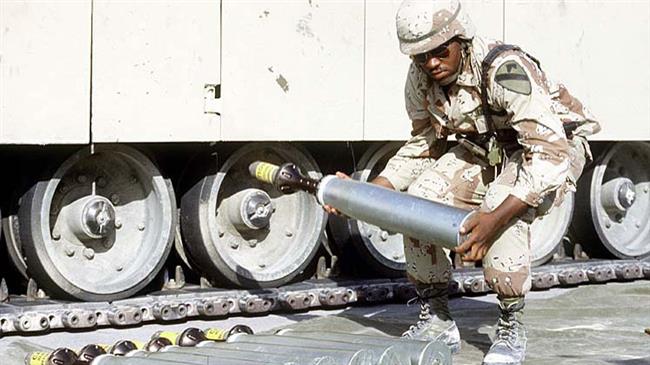
An advisor to the Iraqi parliament’s foreign affairs committee says the Baghdad government is planning to lodge an international lawsuit against the United States for violating the country’s sovereignty and using internationally-banned munitions in civilian areas.
Hatif al-Rikabi told Arabic-language al-Maalomah news agency in an interview that Iraq is going to file the case at Swedish and German courts over appalling crimes that Washington has perpetrated in the Arab country, including the use of depleted uranium weapons.
Rikabi went on to say that such a measure will ensure international accountability for the US, and will not give it the chance to procrastinate the case.
“Hundreds of cancer cases are recorded every month [in Iraq], and the figure is clear evidence for the extent of the damage that US forces have committed,” he stated, calling on the Iraqi Health Ministry to “release facts and figures about casualties caused by US bombing campaigns.”
US-led wars in Iraq have left behind hundreds of tons of depleted uranium munitions and other toxic wastes.
Official Iraqi government statistics show that, prior to the outbreak of the First Persian Gulf War in 1991, the rate of cancer cases in Iraq was 40 out of 100,000 people. By 1995, it had increased to 800 out of 100,000 people, and, by 2005, it had doubled to at least 1,600 out of 100,000 people. Current estimates show the increasing trend continuing.
Contamination from depleted uranium munitions and other military-related pollution is suspected of causing a sharp rise in congenital birth defects, cancer cases, and other illnesses throughout much of Iraq.
Many doctors and scientists maintain that recent emergence of diseases that were not previously seen in Iraq, such as new illnesses in the kidney, lungs, and liver, as well as total immune system collapse are connected to public exposure to war contaminants.
Depleted uranium (DU) contamination may also be related to the substantial rise in leukemia, renal, and anemia cases, especially among children.
Moreover, there has also been a dramatic jump in miscarriages and premature births among Iraqi women, particularly in areas where heavy US military operations occurred, such as Fallujah.
During 2004, the US military carried out two massive military sieges of the city of Fallujah, using large quantities of DU ammunition, as well as white phosphorous.
Latest evasions and cover-ups by Western governments over funding of terrorist groups in Syria are unraveling
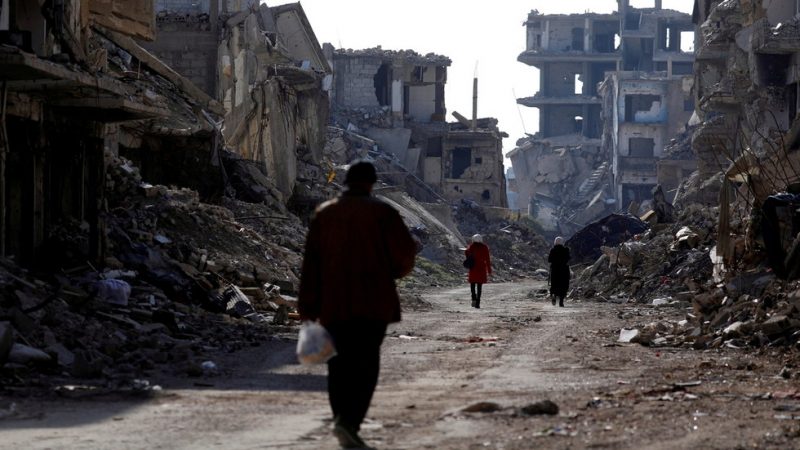
People walk past damaged buildings at the Yarmouk refugee camp on the southern outskirts of Damascus © Reuters
By Vanessa Beeley | RT | December 13, 2020
Evidence of Dutch and British funding for extremists who’ve beheaded children & carried out ethnic-cleansing grows by the day. Yet most of the mainstream media – including the BBC – still try to keep this truth silent.
Recently, Dutch Prime Minister Mark Rutte effectively blocked a Parliamentary motion to allow an external independent investigation of Dutch government funding of terrorist groups in Syria.
Rutte initially tried to deny his involvement in the burial of the investigation but tenacious questioning from journalists forced him to admit his personal interference. According to Rutte, such an investigation could result in “tensions with our allies […] the lives of former members of opposition groups could be put at stake.”
Rutte’s protection of illegal armed groups wreaking havoc in Syria is reminiscent of the UK Government’s response to similar Parliamentary questions requesting clarity on the armed groups supported by its Foreign Office (UK FCO). The standard line is, “for security reasons, we do not disclose the names of those moderate opposition groups supported.”
This article will demonstrate that Rutte is very probably preventing tensions with the UK by quashing an investigation, and that the “moderate opposition” promoted by both governments actually consists of savage, extremist gangs who think nothing of conducting ethnic cleansing pogroms in Syria.
Turning ‘non-lethal aid’ into deadly weapons
In 2018, Dutch officials were accused of providing equipment to terrorist groups in Syria. Equipment that included Toyota and Isuzu trucks that were, probably, later converted into machine-gun carriers by groups such as Jabhat al-Shamiya, considered a “Salafist” group by the Dutch Prosecution Service. This equipment was euphemistically described as non-lethal aid, a convenient caveat for governments ensuring the armed groups are given the means to recast this ‘aid’ into military hardware.
Dutch journalist Eric Van Den Beek has followed this affair from the outset. He wrote recently: “It’s a mystery why the Dutch Public Prosecution Office still has not launched a criminal investigation against current and former political officials who were involved in the support of Jabhat al-Shamiya.”
In October 2020, Dutch media reported that a former leader of a terrorist group operating in Syria had been receiving funding from the Dutch Foreign Ministry for years. The group, Ahrar Al Sham, was designated a terrorist organisation by the Dutch Court in 2019.
It is worth noting that Ahrar Al Sham merged with Nour Al Din Zinki in 2018, to form the “Syrian Liberation Front.” Zinki had been formerly funded as “moderates” by the US, but this aid was withdrawn after the group tortured and beheaded a 12-year-old boy, Abdullah Issa, in Al Ansari square, Aleppo in July 2016.
White Helmets soaked in blood
Incidentally, the square where this heinous crime took place was only 200 meters from the White Helmet center that featured in the Oscar-nominated promotional movie for the FCO-midwived, terrorist-linked organisation, “Last Men in Aleppo.” The Dutch government only withdrew funding from the White Helmets in 2018, citing lack of assurances that funds would not be funneled to terrorist groups in Syria. Up until this point, the Netherlands had given the White Helmets $14.5 million.
It was Dutch media that broke the story of the suspected involvement of the White Helmets founder, James Le Mesurier, in defrauding Mayday Rescue – the organisation Le Mesurier established to siphon UK and EU funding to his organisation.
The BBC has recently produced a 15-part radio documentary ‘probe’ into the Le Mesurier fraud allegation and the White Helmets. The “Mayday” series, produced by Chloe Hadjimatheou, turned out to be nothing more than an attempt to smear and discredit researchers, academics, scientists and journalists whose work has exposed the White Helmets to be an armed-group-auxiliary, an extension of power for the UK/US-led regime-change coalition, whose failed agenda is the removal of the Syrian government and President Bashar Assad.
Rutte’s denial of a rigorous and transparent investigation into Dutch sponsorship of terrorist groups in Syria is likely to be connected to the BBC-Mayday series and the FCO’s support for sectarian armed groups in Syria as part of an externally managed “political process.” A recent leak of FCO documents has revealed the extent to which the British government and intelligence agencies have been involved in extensive public relations and media operations to clean up the image of bands of war-crime-committing extremist groups.
This context is important to understand why the alleged financial support provided to the leader of Ahrar Al Sham by the Dutch Foreign Ministry, is very likely connected to the UK efforts to create a vast complex of PR and media back-up for these mercenary armed groups in Syria.
The ex-UK student turned fundraiser for Islamism
The former “foreign affairs minister” of Ahrar Al Sham is a UK-educated, Spanish-Syrian called Labib Al Nahhas. Dutch media has reported that documents show that the country awarded two million euros in subsidies to the European Institute of Peace (EIP), based in Brussels. Much of this funding went on to the Syrian Association for Citizens’ Dignity (SACD). Al Nahhas is the program director and he, personally, receives 700 euros per day, for an average of more than ten days per month as a senior consultant for EIP. This funding covers 2018-2021.
A recent article by journalist Kit Klarenberg revealed the role that Le Mesurier’s widow, Emma Winberg, played in the PR support for Syrian armed groups. Winberg was co-founder of Incostrat, a FCO-outreach agency funded by the Conflict Stability and Security Fund that also finances Mayday Rescue and the White Helmets. The BBC, curiously, made no mention of Winberg’s involvement in what is effectively a clandestine black-op run by the British government in an effort to destabilise Syria and to effect “regime change.”
Among the groups believed to be provided with PR and media support via Incostrat, are Jaish Al Islam, and, according to French journalist Thierry Meyssan, Ahrar Al Sham. In 2016, The Guardian ran a story on an “ex-UK student clock[ing] up air miles on mission to rebrand Syrian Islamists” (emphasis added). The Guardian admits that Ahrar Al Sham had fought in alliance with Nusra Front (Al Qaeda in Syria) and that their goal was to establish an Islamist theocracy in Syria. The Guardian also reports that one of the original leaders of AS had “personal connections with Osama Bin Laden.”
Al Nahhas had deep connections to the US, EU and UK, where he had established a tech company in a West London suburb. IKPA Communications Ltd was set up in October 2012 and apparently liquidated in 2014. Two other directors were named at Company House, Labib Shalak and Swedish-born UK resident, John Carl Gandeborn. This background builds the picture of someone who would be an ideal candidate for the UK FCO-sponsored agencies to promote as an acceptable frontman of an unacceptably sectarian, brutal armed group.
Al Nahhas resigned as director of his tech company in April 2014, the same year he joined Liwa al-Haq, a faction that merged with Ahrar Al Sham in late 2014. Al Nahhas was appointed Ahrar Al Sham’s “foreign minister” after the assassination of the majority of the armed group’s leaders in September 2014. This event is recorded in the leaked FCO documents, in a submission by Analysis Research and Knowledge (ARK) for the “Rapid Response” contract. ARK was also responsible for the creation of the White Helmets in Turkey and Jordan in 2013, with James Le Mesurier at the helm while an employee of ARK.
Turning a blind eye to outrages
Immediately after the largely unexplained assassination of Ahrar Al Sham leaders, Al Nahhas was dispatched on a mission to secure US/UK/EU support for the armed group, visiting Western diplomats and publishing “opinion pieces” in the Washington Post and the Telegraph that called on the West to “engage with Ahrar Al Sham”. Former US Ambassador to Syria, Robert Ford, accused by Syrian officials of fomenting the armed uprising in 2011, joined the campaign (in 2015) to whitewash Ahrar Al Sham and to distance them from their alliance with Nusra Front.
The access and UK/US state-aligned-media support given to Al Nahhas and the timing of his moves to join armed groups fighting on behalf of the US Coalition in Syria, must lead to speculation that his role was managed by entities like Incosrat with the backing of the FCO and intelligence agencies. Ahrar Al Sham did not cease their ethnic cleansing atrocities in Syria despite the elevation of the group to “political process” status. In May 2016, just before Nour Al Din Zinki beheaded Abdullah Issa, Ahrar Al Sham and Nusra Front carried out the massacre of Syrian Alawite civilians in Zara, in the Aleppo governorate. The UK and US still refused to bow to pressure from Russia to designate Ahrar Al Sham a terrorist group.
Ahrar Al Sham’s involvement with the BBC dates back to the 2013 BBC Panorama report, “Saving Syria’s Children,” when the armed group escorted the BBC production team during the fabrication of what is suspected to be an elaborate hoax based on the forensic analysis of independent researcher Robert Stuart.
As late as 2017, it was reported that Kenan Al Nahhas, Labib’s brother, was appointed the new “political” leader of Ahrar Al Sham. At this time, the group was participating in the brutal siege and daily targeting of Shia Muslim Syrian civilians in the villages of Kafarya and Foua in Idlib. Ahrar Al Sham was also present, with Nusra Front, in Rashideen, Aleppo, in April 2017, when a terrorist suicide car attack massacred recently evacuated children and families from Kafarya and Foua.
The western campaign to rebrand and decriminalise this armed group continued unaffected by the war crimes they were systematically committing against the Syrian people. An opinion piece by Al Nahhas was published by the Guardian in February 2020. The Guardian has also been instrumental in maintaining the criminalisation of the Syrian government, an effort designed to corroborate the FCO’s “regime change” policy. The Guardian was drafted in to posthumously rebrand James Le Mesurier as a “mainstream saint” and was heavily involved in the White Hemet PR industry, alongside the BBC and Channel 4.
Al Nahhas allegedly distanced himself from Ahrar Al Sham in November 2016, but his brother stepped up to lead the armed group. While the Dutch officials involved in the financial sponsorship of a terrorist group profess ignorance of this, opposition members of Parliament say this suggests a lack of robust screening of recipients of government funding. This, combined with the 2018 revelations of the funding of Jabhat Al Shamiya, paint a damning picture of Dutch government involvement in the promotion and material support for violent, criminal armed groups involved in ten years of bloodshed in Syria.
In a curious turn of fate, Chloe Hadjimatheou, the producer of the BBC “Mayday” series, had been “the driving engine” behind a King’s College London, War Department, paper, entitled “The New Jihadism: A Global Snapshot”. The paper concluded that Ahrar Al Sham should be placed alongside Nusra Front and ISIS as a “Salafist,” in other words, a terrorist organisation operating in Syria.
Hadjimatheou refused to answer when asked if she subscribed to the view that the organisation that collaborated closely with the BBC Panorama team was deemed to be a terrorist group. It seems that the promoters, financiers and supporters of terrorism in Syria are not too keen to own up to their involvement in sustaining the illegal war against the Syrian people for ten years.
Vanessa Beeley is an independent journalist and photographer who has worked extensively in the Middle East – on the ground in Syria, Egypt, Iraq and Palestine, while also covering the conflict in Yemen since 2015. Follow her on Twitter @VanessaBeeley
Patriot Act Used By The FBI To Collect Internet Browsing Data, Contradicting Claims Made To Oversight
By Tim Cushing | TechDirt | December 8, 2020
The NSA shut down its bulk phone records collection — authorized under Section 215 — after it became apparent it wasn’t worth the effort. Reforms put in place by the USA Freedom Act prevented the agency from collecting it all and sorting it out later. Instead, it had to approach telcos with actual targeted requests and only haul away responsive records. The NSA somehow still managed to overcollect records, putting it in violation of the law. The NSA hinted the program had outlived its usefulness anyway, suggesting it had far better collections available under other authorities that it would rather not subject to greater scrutiny.
But this didn’t end the government’s bulk records collections. It just ended the phone metadata program. The NSA still collects other records in bulk, including banking records and, oddly, books checked out by library patrons. The broad authority of Section 215 could be read to allow the government collect other records, like email metadata and internet activity. Reasoning that people voluntarily create records of their internet use by using third-party services to surf the web, the government hinted it could sweep these up just as easily as it had swept up call records.
The government’s attempt to collect internet history under this authority ran into some friction earlier this year when the Senate voted to block this collection. Senator Ron Wyden directly asked the director of national intelligence (DNI) to inform the Senate whether or not agencies under its purview had gathered internet use records under this authority. He received this answer.
In a Nov. 6 letter to Mr. Wyden, John Ratcliffe, the intelligence director, wrote that Section 215 was not used to gather internet search terms, and that none of the 61 orders issued last year under that law by the Foreign Intelligence Surveillance Court involved collection of “web browsing” records.
Wyden took this response to mean that implementing a ban on collection of internet history records could be put into place without negatively affecting any intelligence gathering activities. But when the New York Times pressed DNI John Ratcliffe on specifics, a new party inserted itself into the conversation: the DOJ. According to its response, the FBI had already done the thing the DNI had just told Sen. Wyden it hadn’t.
In fact, “one of those 61 orders resulted in the production of information that could be characterized as information regarding browsing,” Mr. Ratcliffe wrote in the second letter. Specifically, one order had approved collection of logs revealing which computers “in a specified foreign country” had visited “a single, identified U.S. web page.”
So, the FBI was collecting internet browsing records, albeit with an order that only targeted foreign users visiting one US web page. Still, this wasn’t what the DNI originally said to Sen. Wyden. This set Wyden off. Again. The supposedly honest answer he received in response to his questions wasn’t actually all that honest. As he pointed out in his statement, the belated admission raised questions about domestic surveillance and potential abuse of Section 215 authority to collect something the DNI said no one was collecting. And, if nothing changed, there was no guarantee the Intelligence Community wouldn’t talk itself into believing a collection of internet browsing data would be cool and legal.
“More generally,” Mr. Wyden continued, “the D.N.I. has provided no guarantee that the government wouldn’t use the Patriot Act to intentionally collect Americans’ web browsing information in the future, which is why Congress must pass the warrant requirement that has already received support from a bipartisan majority in the Senate.”
Previous attempts to erect a warrant requirement for the collection of internet data or search histories have failed to reach the president’s desk. This latest admission has refueled the fire to protect Americans (or visitors to American websites) from government overreach. Even if such a collection targets only foreign internet users, there’s no guarantee it won’t sweep up US citizens — like pretty much every other bulk collection has.
At this point, everything is up in the air. There’s a new president headed into office who might be more receptive to reform efforts, but he’s also the man who served the Obama Administration — one that wasn’t all that concerned about domestic surveillance until it became impossible to ignore the documents leaked by Ed Snowden. Even then, its response was tepid at best and it still allowed IC surveillance business to continue pretty much uninterrupted — something it used to justify extrajudicial killings based on little more than metadata. This needs to be fixed, but surveillance reform advocates still lack majority support. And the guy [potentially] headed to the White House has never seemed all that concerned about surveillance abuses.
Featured Video
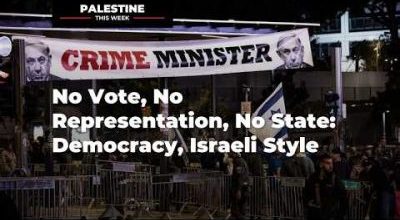
No Vote, No Representation, No State: Democracy, Israeli Style
or go to
Aletho News Archives – Video-Images
From the Archives
Sanctions, War and the Policy of Dual Containment
By SASAN FAYAZMANESH | March 17, 2008
It is now nearly three decades since the Unites States adopted the policy of dual containment of Iran and Iraq. While much has been written about the containment of Iraq, there has been very little in-depth analysis of this policy when it comes to Iran. In a book that is going to be released on March 31, 2008, entitled The United States and Iran: Sanctions, Wars and the Policy of Dual Containment (Routledge), I attempt to address this shortcoming by investigating when and why the US policy of containment of Iran came about, how it evolved, and where it stands today.[1] To the extent that Israel has been involved in US policy making, the study will also include the role that Israel has played in the containment of Iran. Also, since the fate of Iran has been inextricably linked to that of Iraq, occasionally the investigation will overlap with the containment of Iraq.
The policy of dual containment of Iran and Iraq originated during the Carter Administration, but it was not until the Clinton Administration that the expression “dual containment” became popular. … continue
Blog Roll
 Aletho News
- Elmo Sold mRNA Jabs to Your Toddler. Now They Are “Off-Label.”
- British state targets Palestine Action with yet another crooked trial
- Americans are paying the price to preserve Israel’s nuclear hegemony
- Resistance factions are necessary to ensure a permanent US Iraq withdrawal
- How Israel destabilizes the Middle East: Denying sovereignty and the right to exist
- Europe’s Establishment Is Embracing War – and Losing Voters
- NATO chief advocates war of aggression
- No Vote, No Representation, No State: Democracy, Israeli Style
- Zionist Bought Senate Blocks Information About American Citizens Killed By Israel
- While Gaza dominates the UN, these are the people keeping it alive
- If Americans Knew
- Israeli Soldiers Abduct At Least 22 Across Occupied West Bank
- Eight Palestinians Killed in Israeli Attacks on Gaza
- Israeli former leaders and security chiefs threaten legal action over ‘Jewish terrorism’
- Israel map in LA Times ad includes all land from the river to the sea
- Inside Lebanon’s 200-page dossier on Israeli war crimes
- Flydubai, genocide, settler violence, Trump abuse of power to deport – Daily Update
- Counting Antisemitic Incidents: What the ADL Audit Reveals — and Obscures
- Mamdani releases plan to combat antisemitism and hate crimes in New York City
- Iran’s Revolutionary Guards Publish Letter to the American People
- DMFI launches $1 million ad campaign supporting Virginia’s Elaine Luria
- No Tricks Zone
- Green Energy Debacle: German Expert Professor Fritz Vahrenholt Warns Of Severe Economic And Social Consequences
- Two More Paleo Reconstructions Affirm Meters-Higher Sea Levels Across Ireland, Brazil 7000-6000 Years Ago
- New Study: Earth And Venus Surface Warmth Largely Explained By Convection And Lapse Rate, Not CO2 Or Radiation
- 2025 Nature Paper Claiming Worsening Global Drought Gets RETRACTED …Heavily Flawed
- New Study: ‘Global Drought Shows No Detectable Recent Acceleration Under Climate Warming’
- Economic Masterminds: German Socialists Suggest Taxing Productivity Gains Stemming From Using AI
- The South China Sea Has Not Been Cooperating With The Climate Change Narrative
- Energy Crisis: Germany Enters Heating Season With Historically Low Gas Reserve Fill Levels
- New Study: The Antarctic Ice Sheet Gained Mass From 2020-2024 Due To Staggering Snow And Ice Accumulation
- Study: Ocean Heating Rates From Thousands Of Years Ago ‘Dwarf’ Modern Ocean Heating Rates

