The Yemen Tragedy Further Fueled by the West and Its Allies

By Viktor Mikhin – New Eastern Outlook – 31.07.2019
A most sophisticated demagogy, blatant falsifying of facts, impudent interpretation of events with everything going upside down, these are the thoughts that come to one’s mind when one reads another forgery concocted in the West. We mean the statement addressed to Iran calling for the termination of the actions which are allegedly destabilizing the situation in the Persian Gulf. The statement was made by the governments of the US, the UK and their satellites: the United Arab Emirates (UAE) and Saudi Arabia, on June 24, as reported by the US Department of State press service. In this manifesto, contrary to the obvious facts, the signatories held Iran responsible for the escalation of the situation in Yemen and the attacks on the oil tankers on May 12 and June 13, urging the Islamic Republic to start searching for a diplomatic solution. The intensity of this demagogy, as the saying goes, is beyond the scale.
Let us however, in a quiet fashion and on the basis of the obvious facts, consider the situation in the Persian Gulf area and ask several questions. Did Iran or the poor Yemen suffering a score of internal problems, indeed attack Saudi Arabia? Did the Houthis indeed create a so-called Arab coalition which has consistently bombed the Saudi cities and villages killing the civilians? By no means. It was the Saudis, namely the Crown Prince Mohammad bin Salman bin Abdulaziz Al Saud who took up the foreign policy responsibilities due to the old age and numerous diseases of his father, the King, and who gave the order sanctioning the rough intervention of Riyadh in internal affairs of the neighboring state of Yemen and the total bombing of the Yemen cities.
The leader of the Houthis and the President of the Supreme Revolutionary Committee (SRC) Mohammed Ali al-Houthi demanded the UN Secretary General to condemn the war crimes committed in Yemen. Among the crimes perpetrated by the coalition of the Arab countries (led by Saudi Arabia and supported by the countries of the West), the Houthi leader named the ruthless blockade of the Yemen people, the famine in the country, the ongoing air embargo, the blockade of the Red Sea ports, the mass murders (including those of children), the destruction of civil facilities targeted during the military attacks.
The UN strongly condemned the following Saudi air raid on the Yemen capital city of Sanaa which resulted in the death of many civilians, including five children; dozens of people were wounded. The head of the United Nations Children’s Fund (UNICEF) Henrietta Holsman Fore, speaking at the UN Security Council session, urged the international community to save the lives of the millions of Yemenite children. She emphasized that, since the beginning of the conflict in the country, according to official figures only, up to 10,000 children had been killed or wounded. According to the UN, the Saudi Air Force “aimed at the civilians systematically,” dropping bombs on hospitals, schools, weddings, funeral processions and even on the camps for the displaced persons escaping from bombing.
Representatives of the United Nations High Commissioner for Refugees (UNHCR) emphasized that the belligerents, Saudi Arabia in the first place, must respect the principles of international humanitarian law, which includes protecting the civilians during the hostilities. Millions of people in Yemen are currently on the verge of starvation, and the humanitarian organizations often have no opportunity to deliver the aid: food, medicines and fuel, to those in need. A major part of humanitarian cargo comes to Yemen through the ports of Al Hudaydah, As-Salif and Ras Issa, where the Houthis, following the Stockholm agreement, withdrew their troops from. However, representatives of the international organizations, whose activities have suffered consistent pressure exerted by the United States, for some reason or other, are not in a hurry to fulfill their obligations.
The international community’s condemnation of the Saudi crimes reached such a degree that the Deputy Minister of Defense of Saudi Arabia Khalid bin Salman bin Abdulaziz Al Saud had to hold a meeting with the special envoy of the UN Secretary General on Yemen Martin Griffiths. However, his stance was only limited to demagogical statements “about Riyadh‘s commitment to a political solution of the conflict in Yemen.”
And, probably, in order to ensure “the wellbeing of the Yemen people,” the Riyadh-led coalition declared the launch of a new attack on the positions of the Houthi insurgents in the province of Sanaa, in western Yemen. This information was made public by the Al Arabiya TV channel, referring to the military. The main targets for the new airstrikes include air defense facilities and missile warehouses belonging to the rebels. It is known that this province is densely inhabited; numerous cities and settlements are located there, and, therefore, the number of victims among the civilians will only increase. Such is the “commitment” of Saudi Arabia to the “wellbeing” of its neighbor and the “support” of a political solution of the ongoing conflict. Many politicians claim (for a good reason) that had there been no intervention of the Saudis in the internal affairs of Yemen, then this conflict would not have existed at all, nor would there have been all the numerous victims.
The international community does not pay due attention to the humanitarian crisis in Yemen, no sufficient financing is allocated for it, said the President of the International Federation of Red Cross and Red Crescent Societies (IFRC) Francesco Rocca: “The problem is not in providing more (help), but in receiving financing (to have an opportunity) to provide more (help). It is a vicious circle, the Yemen crisis lacks financing. It is forgotten, it is being ignored.”
More fuel to the long-lasting Yemen conflict fire was added by D. Trump who extended the sanctions against Yemen for another year. The White House website comments as follows: “The actions and policy of several former members of the Yemen government and other persons continue to threaten the peace, safety and stability of Yemen. Among other things, they interfere with the political process and the implementation of the peace treaty of November 23, 2011 between the government of Yemen and the opposition.” Let us remind the reader that the state of emergency concerning Yemen envisaging a number of restrictions was imposed in May 2012.
A faithful ally of the US, the UK has been actively partaking in this murderous war as well by delivering to the Saudis aviation bombs (for good money, too) which are used to kill the civilians of Yemen. On March 27, 2015 the day after the first British bombs fell on Yemen, the then Foreign and Commonwealth Secretary Philip Hammond told the reporters that the UK “will support the Saudis in every practical operation, by involvement in the fighting.” Since then, the British bombs which have been actively used by the Saudi pilots during the raids on the Yemen territory have been regularly manufactured in three British cities: Glenrothes in Scotland, and Harlow and Stevenage in Southeast England. The bombs which leave the production line for the Saudis on a daily basis belong to the Raytheon UK and ВАЕ Systems.
As soon as this weapon was bought by Saudi Arabia, the UK began to participate in the Yemen slaughter even more actively. The Saudi military lack experience to use this modern and lethal weapon. Therefore, for this air war to go on and for the British government to do good business on the blood of Yemenites, under another contract, London provides what is known as the “on-site military services.” In practical terms, it means that some 6,300 British experts have been deployed on the advanced operational bases in Saudi Arabia. It is them, not the Saudi pilots and technicians, who perform necessary repairs of the planes day and night so that they could fly across the Arabian Desert to their targets in Yemen again. They also control the Saudis loading bombs onto the planes and installing fuses on the bombs.
Thus, the West, which has been doing good business on the Yemen blood, will go on with its impudent demagogical statements that Iran, not Saudi Arabia, is responsible for the Yemen tragedy. Even more so, since Riyadh is buying arms amounting to hundreds of billions of dollars from the US alone, thus supporting the American military and industrial complex and giving Donald Trump a chance to create new jobs in the US. However, no one in the West seems to care at whose expense and on whose blood the US prospers.
During his recent trip to Yemen, the British conservative Member of Parliament Andrew Mitchell visited a school in the capital where he was “welcomed” by children who chanted slogans. The politician asked the accompanying Yemenite to interpret and learnt that they meant “death to the Saudis,” “death to the Americans,” and the third slogan remained untranslated, but it is easy to guess that it meant: “death to the British.”
Viktor Mikhin is a corresponding member of the Russian Academy of Natural Sciences.
US-trained ‘saboteurs’ sent from Al-Tanf to destabilize situation in other parts of Syria – Moscow
RT | July 29, 2019
US-trained saboteurs are being sent from Al-Tanf to other parts of Syria to try to destabilize the situation, Col. Gen. Sergey Rudskoy, chief of the Main Operational Directorate of the Russian General Staff, said on Monday. A ‘major armed unit’ of Jaish Magawir al-Saura militants is being trained in the 55km zone surrounding the Al-Tanf base, he said.
Almost 2,700 militants are being trained in the US-controlled Al-Tanf zone for activities including the destruction of the oil and gas infrastructure and conducting terrorist attacks against Syrian government forces, RIA Novosti quoted Rudskoy as saying at the Defense Ministry.
He said that some of these militants are being transferred by US Air Force helicopters to the trans-Euphrates region.
In November last year, spokesperson for the Russian Foreign Ministry Maria Zakharova said that Moscow has information about the US military training militants in the Al-Tanf region. The big US military base is adjacent to the borders of Syria, Iraq, and Jordan, and is close to the highway connecting Baghdad with Damascus.
UK tanker seizure violation of nuclear deal: Iran deputy FM
Press TV – July 28, 2019
Iran’s deputy foreign minister for political affairs says recent seizure of a supertanker carrying Iranian oil off Gibraltar was a violation of the nuclear deal signed between Iran and the world powers in 2015, officially known as the Joint Comprehensive Plan of Action (JCPOA).
Abbas Araqchi made the remarks while speaking to reporters in Vienna, where he is attending another session of the JCPOA joint commission with the European parties to the deal.
“We have witnessed detention of a tanker carrying Iranian oil in Gibraltar, which in our opinion, is a violation of the JCPOA, because member states to the JCPOA should not create any obstacle on the way of Iran’s oil exports,” the Iranian top diplomat said.
Araqchi added, “During this period, there have been other developments, which amount to violation of the JCPOA and this is why we requested this meeting to be held.”
On Thursday, July 4, the British overseas territory Gibraltar said it had seized a supertanker on suspicion of carrying crude oil to Syria in violation of European Union (EU) sanctions against the Arab country.
Gibraltar Chief Minister Fabian Picardo said the territory’s police and customs agencies, aided by a detachment of British Royal Marines, had seized the Grace 1 vessel.
Iran’s Foreign Ministry summoned Britain’s ambassador to the country the same day, with Foreign Ministry spokesman Abbas Moussavi saying, “We declared to the ambassador that this move amounts to strange unconventionality, because the sanctions that they have announced are not based on the Security Council [resolutions] and the Islamic Republic of Iran does not accept this measure (seizure of the tanker).”
Elsewhere in his remarks, Araqchi said many developments took place during the past month, which made holding an extraordinary meeting of the JCPOA Joint Commission urgent.
“During the previous meeting of the Joint Commission we decided to hold a foreign ministerial meeting as well and this issue is still on the agenda and we hope to prepare a clear and tangible schedule for the ministerial meeting as soon as possible,” Araqchi said.
Before the meeting started in Vienna, Araqchi met and conferred with Helga Schmid, deputy to the European Union’s foreign policy chief Federica Mogherini, as well as representatives of China and Russia.
US President Donald Trump withdrew Washington in May 2018 from the multilateral nuclear accord, officially known as the Joint Comprehensive Plan of Action (JCPOA), which was reached between Iran and six world powers in 2015.
Afterwards, Washington re-imposed unilateral sanctions on Iran that had been lifted under the deal.
On Friday, June 28, the remaining signatories to the nuclear agreement met in the Austrian capital as a last-ditch effort to save the accord after the US withdrew last year.
Following the meeting, Araqchi said progress was made in Vienna talks aimed at saving the JCPOA, but the demands of the Islamic Republic are yet to be met.
“It was a step forward, but it is still not enough and not meeting Iran’s expectations,” Abbas Araqchi told reporters on Friday after almost four hours of talks with senior diplomats from Britain, China, France, Germany and Russia.
Tanker Seizures and the Threat to the Global Economy from Resurgent Imperialism
By Craig Murray | July 27, 2019
The British seizure of the Iranian tanker off Gibraltar was illegal. There is no doubt of that whatsoever. The Iranian response to the seizure of its tanker in the Strait of Gibraltar, by the seizure of a British Tanker in the Strait of Hormuz, was also illegal, though more understandable as a reaction. The implications for the global economy of the collapse of the crucial international law on passage through straits would be devastating.
It may seem improbable that the UK and or France would ever seek to close the Dover Strait, but in the current crazed climate it is no longer quite impossible to imagine the UK seeking to mess up access to Rotterdam and Hamburg. It is still easier to imagine them seeking to close the Dover Strait against the Russian Navy. Yet the essential freedom of navigation through the Kerch strait, respected by Russia which controls it, is necessary to the survival of Ukraine as a country. For Turkey to close the Bosphorus would be catastrophic and is a historically recurring possibility. Malaysia and Indonesia would cause severe dislocation to Australia and China by disrupting the strait of Malacca and the Suharto government certainly viewed that as an advantage from which it should have the right to seek to benefit, and was a continued nuisance in UN Law of the Sea discussions. These are just a few examples. The US Navy frequently sails through the Taiwan Strait to assert the right of passage though straits.
Keeping the Strait of Hormuz open is perhaps the most crucial of all to the world economy, but I hope that the above examples are sufficient to convince you that the right of passage through straits, irrespective of territorial waters, is an absolutely essential pillar of international maritime law and international order. The Strait of Gibraltar is vital and Britain has absolutely no right to close it to Iran or Syria. If the obligation on coastal states to keep maritime straits open were lost, it would lead to economic dislocation and even armed conflict worldwide.
Part III of the UN Convention on the Law of the Sea relates entirely to passage through straits.
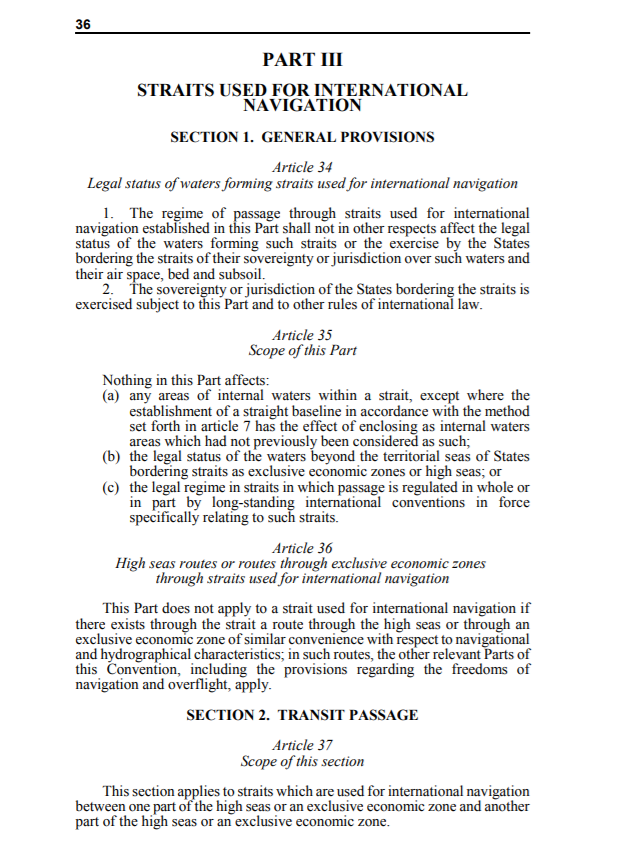
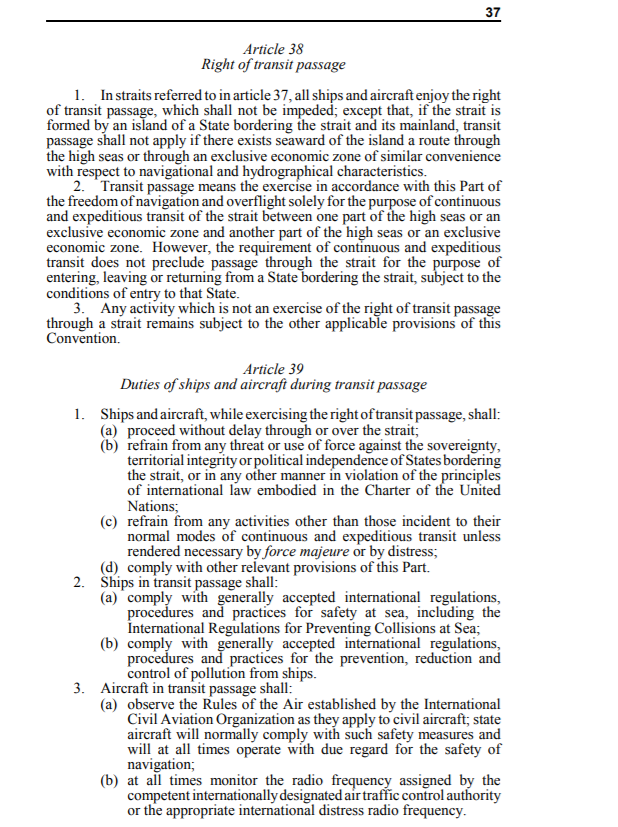
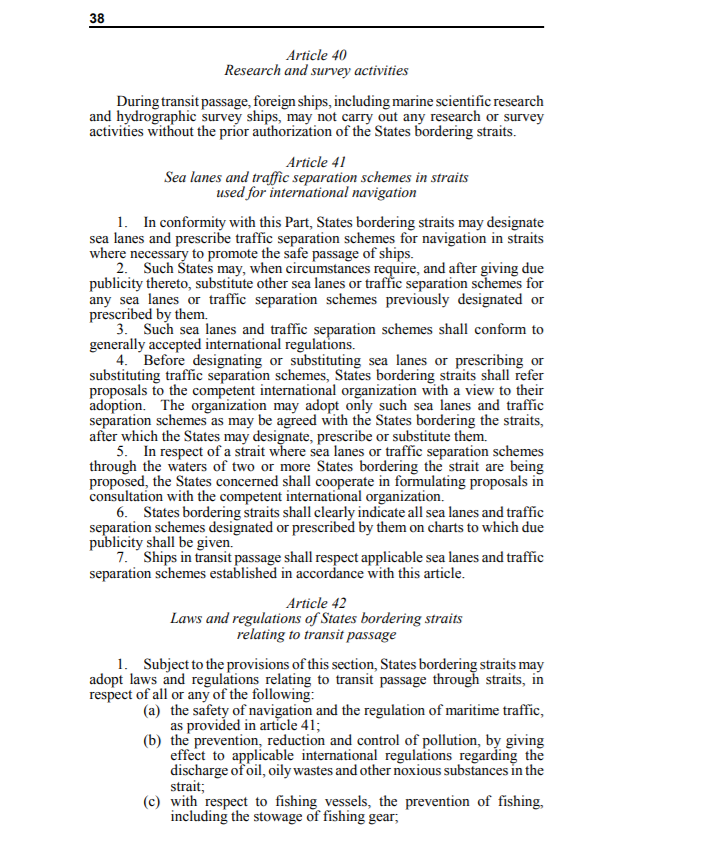
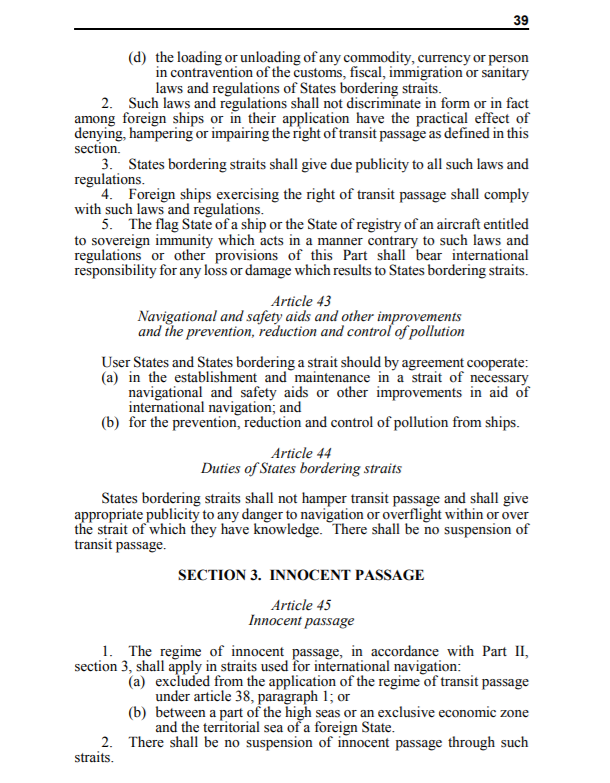
Please note that the right of passage through straits is here absolute, in a UN Convention which is one of the base blocks of international law. It does not state that the right to transit through straits can be subject to any sanctions regime which the coastal state chooses to impose; indeed it is clearly worded to preclude such coastal state activity. Nor can it be overridden by any regional grouping of which the coastal state is a member.
Jeremy Hunt’s statement to parliament that the Iranian tanker had “freely navigated into UK territorial waters” was irrelevant in law and he must have known that. The whole point of passage through straits is that it is by definition through territorial waters, but the coastal state is not permitted to interfere with navigation.
It is therefore irrelevant whether, as claimed by the government of the UK and their puppets in Gibraltar, the tanker was intending to breach EU sanctions by delivering oil to Syria. There is a very strong argument that the EU sanctions are being wilfully misinterpreted by the UK, but ultimately that makes no difference.
Even if the EU does have sanctions seeking to preclude an Iranian ship from delivering Venezuelan oil to Syria, the EU or its member states have absolutely no right to impede the passage of an Iranian ship through the Strait of Gibraltar in enforcement of those sanctions. Anymore than Iran could declare sanctions against Saudi oil being delivered to Europe and close the Straits of Hormuz to such shipping, or Indonesia could declare sanctions on EU goods going to Australia and close the Malacca Strait, or Russia could declare sanctions on goods going to Ukraine and close the Strait of Kerch.
There are two circumstances in which the UK could intercept the Iranian ship in the Strait of Gibraltar legally. One would be in pursuance of a resolution by the UN Security Council under Chapter VII of the UN Charter. There is no such resolution in force. The second would be in the case of a war between the UK and Iran or Syria. No such state of war exists (and even then naval blockade must be limited by the humanitarian measures of the San Remo Convention).
What we are seeing from the UK is old fashioned Imperialism. The notion that Imperial powers can do what they want, and enforce their “sanctions” against Iran, Syria and Venezuela in defiance of international law, because they, the West, are a superior order of human being.
The hypocrisy of arresting the Iranian ship and then threatening war when Iran commits precisely the same illegal act in retaliation is absolutely sickening.
Finally, there will no doubt be the usual paid government trolls on social media linking to this article with claims that I am mad, a “conspiracy theorist”, alcoholic or pervert. It is therefore worth pointing out the following.
I was for three years the Head of the Maritime Section of the Foreign and Commonwealth Office. I was Alternate Head of the UK Delegation to the UN Preparatory Commission on the UN Convention on the Law of the Sea. I both negotiated, and drafted parts of, the Protocol that enabled the Convention to come into force. I was the Head of the FCO Section of the Embargo Surveillance Centre and responsible for giving real time political and legal clearance, 24 hours a day, for naval boarding operations in the Gulf to enforce a UN mandated embargo. There are very few people alive who combine both my practical experience and theoretical knowledge of precisely the subject here discussed.
The Media Is Reluctant to Report Israel Boasts of Killing Iranians

Israel’s Regional Cooperation Minister Tzachi Hanegbi. Credit: Facebook
By Philip Giraldi | American Herald Tribune | July 27, 2019
It is rare that a high official in a government will admit that his country has been killing foreigners without any declaration of war or being subjected to an imminent threat, but that is exactly what Israeli Regional Cooperation Minister Tzachi Hanegbi has done recently, boasting on a Sunday morning talk radio show that “Israel is the only country in the world that has been killing Iranians for two years now.”
Hanegbi’s candid admission of a policy that is a war crime included his description of how Israel “strikes the Iranians hundreds of times in Syria, sometimes admits it and sometimes foreign reports reveal it. Sometimes the chief of staff [reveals it], sometimes the outgoing air force chief [reveals it], but it’s all coordinated policy.”
The interviewer then asked “what would happen should Israel get in trouble with Iran?” and Hanegbi responded that “You can see that the Iranians are very limited in their responses [to Britain’s seizure of their tanker], and it’s not because they don’t have abilities, it’s because they understand that Israel means business.”
Hangebi went on to add that Israel is “very aggressive when it comes to our national security… We still didn’t see the Iranians backing off from their intention to entrench themselves militarily in Syria, and this campaign isn’t over. But they know exactly who to mess with, and who can be annoyed. We can’t.”
The minister’s comments inevitably were not reported in the western media, which is reluctant to air anything that demonstrates just how irresponsible Israeli policies actually are. In the United States, in particular, the Jewish state is consistently portrayed as some kind of perpetual victim in spite of the fact that it is the only nuclear armed power in its neighborhood as well as having the most powerful conventional military arsenal.
The Iranian government did not respond directly to the report of the Israeli minister’s comments, but there was some mention on Tehran’s Press TV local broadcast, which noted that “This is how Israelis are freely and proudly talking about killing Iranians! Just imagine what would happen if it was the other way around!” Indeed. A boast by Iran that it had been very successful at killing Israelis would have produced shocked headlines in every European and American newspaper.
The Israeli admission that it is attacking targets in Syria should come as no surprise to anyone who has been following developments in the region. That there have been hundreds of attacks may be an exaggeration to impress the Israeli listeners regarding their country’s military prowess, but it is certainly true that numerous incidents have been recorded both by the Syrian government and by foreign observers. In one notorious incident on Christmas Day 2018, Israeli warplanes masked their approach to targets inside Syria by flying closely behind civilian airliners transiting the region. It has been speculated that they hoped that Syrian air defenses would respond by shooting down a civilian plane, creating a major crisis for the Bashar al-Assad government. In the event, the Syrians held their fire and the Israeli warplanes launched their missiles against targets near Damascus, killing Syrian military personnel and civilians on the ground.
What is astonishing is that Minister Hangebi does not perceive the implications of the Israeli government’s apparent willingness to kill Syrians on the ground by intent and also as collateral damage even though it is not at war with Damascus. It does so with the stated objective of killing Iranians even though it is also not at war with Iran. It is, to state it succinctly, several war crimes tied up in one package and it would make the Jewish state uniquely a rogue among nations but for the fact that the United States has done the same sort of thing with cruise missile strikes in Syria, though not in as sustained a fashion as have the Israelis.
Israel’s willingness to use its armed forces in what might be described as non-traditional roles creates some very specific problems for the region. One particular concern is that the Israelis might stage a false flag attack, possibly in cooperation with its temporary friend Saudi Arabia, to draw outside powers into a war with Iran. The recent incidents involving mining two tankers, attributed to Iran but much more likely a false flag, nearly succeeded in doing just that. Subsequent incidents involving the seizures of a tanker carrying Iranian oil by the British and a retaliatory move against two British tankers by the Iranians have threatened to escalate into a shooting war. There should be little doubt that any ambiguous armed exchange involving Iran and Israel would see the American Jewish dominated media immediately laying the blame on the Iranians, producing demands by the Israel Lobby, Christian Zionists and Congress to get involved in the conflict.
There should also be particular concern over developments in neighboring Iraq, even though the country is not yet under attack by the Israelis. Shi’te militias in the country, linked to Iran, have long demanded that American military bases be closed down. Recent rocket attacks on the bases have been blamed on the militias, with Washington placing particular emphasis on the militia links to the Iranian Revolutionary Guard Corp, which has now been listed as a state sponsor of terrorism by the U.S. State Department. The Israelis are well aware of the dynamics of what is going on in Iraq and might be inclined to stage an incident in that country that will kill Americans and be blamed on the Iranians. The comments by Minister Hangebi that Israel is “very aggressive when it comes to our national security” would strongly suggest that his country is prepared to do anything – even something quite stupid – to eliminate what it sees as the Iranian threat.
The tragedy in all this for Americans is that Washington is being led into war by an Israeli propaganda and influence machine that is second to none. In May four hundred Congressmen signed on to a generic bill that was intended as a blanket endorsement of Israeli behavior and a blank check for the ruthless Netanyahu government to do whatever it sees fit in “self-defense,” with Washington willing to be dragged into a conflict in which it has no real interest just to show its loyalty to the Zionist enterprise. More recently, by last Tuesday’s vote of 398 to 176, another Congressional bill condemned and established penalties against the nonviolent Boycott, Divestment and Sanctions (BDS) movement, which has become a bête noire for all of Israel’s friends. If America is ever to regain its independence from foreign entanglements the time to start is now and the process should begin by disengaging from Israel.
Siemens wins huge defense contract at notorious US Guantanamo base in Cuba
RT | July 26, 2019
A unit of German multinational Siemens has been awarded an $829 million contract from the Pentagon “for energy savings and performance measures” at the US naval base in Guantanamo Bay, Cuba.
According to a statement by the US Department of Defense, the work to be performed provides for the construction, operations and maintenance of energy conservation measures to improve energy efficiency and reliability.
That includes heating, ventilation and air conditioning upgrades, lighting upgrades, commercial refrigeration upgrades, distributed generation, renewable energy photovoltaic for both demand and supply sides, energy storage, power control, supervisory control and data acquisition, water retrofits and wastewater.
Work is expected to be completed by April 2043, the Pentagon said.
“No funds will be obligated with this award, as private financing obtained by the contractor will be used for the 31-month construction (i.e. implementation) phase of the project.”
According to the report, eight proposals were received for the task order. It specified that the Naval Facilities Engineering Command Engineering and Expeditionary Warfare Center, Port Hueneme, California, is the contracting activity for the task order.
The Department of Energy, Office of Energy Efficiency and Renewable Energy, Golden, Colorado, is the contracting activity for the basic contract.
The US naval base in Guantanamo Bay is also known for its notorious prison, which has been widely criticized for violations of human rights. Established in 2002, it is known for indefinite detention without trial and numerous tortures which have led to scores of suicides and unsuccessful suicide attempts by detainees.
US passes bills against BDS and Hamas
MEMO | July 24, 2019
The US House of Representatives passed a resolution yesterday to sanction Hamas and another to oppose the Boycott, Divestment and Sanctions (BDS) movement.
House Resolution 1850 entitled “Palestinian International Terrorism Support Prevention Act of 2019” would impose sanctions upon individuals or agencies identified as supporting Hamas or its affiliates. Sponsored by Florida Republican Brian Mast, the bill requires the US President to submit a yearly report to Congress that identifies “each foreign or agency or instrumentality of a foreign state” that supports Hamas financially.
Mast, who volunteered for the Israeli army after his US army service, said in a statement, “Hamas is single-handedly responsible for the deaths of numerous Americans and Israelis. These sanctions send a strong message to anybody who supports these radicals preaching the destruction of Israel and death to everything we hold dear in the United States.”
The bill was passed by a motion to suspend the rules, a procedure generally used to pass resolutions quickly, and not by a roll call vote in which each representative gives their individual vote.
On the same day, the House passed a resolution opposing BDS in a roll call vote of 398 to 17. House Resolution 246 “opposes the BDS movement targeting Israel, including efforts to target US companies that are engaged in commercial activities that are legal under US law, and all efforts to delegitimise the State of Israel.”
This bill was met with strong opposition from some progressive members of the Democratic Party, including Palestinian-American Rashida Tlaib and Somali-American Ilhan Omar. Tlaib gave an impassioned speech on the House floor arguing that the resolution would infringe upon freedom of speech: “I can’t stand by and watch this attack on our freedom of speech and the right to boycott the racist policies of the government in the state of Israel.” She referred to historic boycotts in American history, such as the Boston Tea Party, the Montgomery Bus Boycott and the United Farm Workers Grape Boycott, as examples of how “the right to boycott is deeply rooted in the fabric of our country.”
 Though the House voted overwhelmingly to pass the anti-BDS resolution, notable representatives who voted “nay” include three quarters of the “squad”: Tlaib, Omar and New York Representative Alexandria Ocasio-Cortez. The other member of the “squad”, Massachusetts Representative Ayanna Pressley, voted “yea” on the resolution.
The passing of this resolution drew much criticism on social media, with the BDS movement calling it a “McCarthyite, anti-Palestinian measure” and anti-occupation group IfNotNow criticising the Democratic Leadership for allowing this vote to happen only a day after Israel’s demolition of Palestinian homes in occupied Jerusalem.
Last week, Omar introduced House Resolution 496 affirming the American right to boycott. The resolution doesn’t specifically refer to the Palestinian-Israeli conflict and is heralded by the BDS movement as a “ground-breaking resolution” that defends “freedom of expression and the right of oppressed communities… to peacefully fight for their rights.”
Omar’s bill is co-sponsored by nine other Democratic representatives, including Pressley, civil rights activist John Lewis and New Jersey Representative Donald Payne. However, these three voted for the anti-BDS bill yesterday, raising questions about their positions on the issue.
READ ALSO:
US Democrats remove ‘occupation’ from two-state solution resolution
Missiles Used in Iraq Attack Match Those Used by Israel in Syria Strikes, Kuwaiti Media Claims
Sputnik – July 23, 2019
On Friday, AP reported that an unmanned drone had carried out strikes against a base in Iraq used by the Popular Mobilisation Forces, the mostly Shia Iraqi paramilitary force which took part in the campaign to defeat Daesh and which has received assistance and training from Iran.
Israel may be behind Thursday night’s mystery drone attack on an alleged Iranian-backed militia base in Amirli, northeastern Iraq, Kuwait’s Al-Jarida newspaper has alleged, citing a source in Iran’s Islamic Revolutionary Guard Corps.
According to Al-Jarida’s source, the attack on the militia depot, which contained stocks of short- and medium-range missiles, as well as a militia headquarters building, was allegedly carried out by an aircraft flying out of an American base near the Syrian-Jordan-Iraqi border, possibly al-Tanf.
The source claimed that the preliminary results of a forensic investigation by the Iraqi government have suggested that they were the same type used by Israel during its periodic attacks against Syria.
Al-Jarida also claimed that during US Secretary of State Mike Pompeo’s visit to Iraq in May, Pompeo warned Iraqi officials that Israel could strike “Iranian targets” in the country “at any time.”
Iraqi sources speaking to the newspaper said that Baghdad will be unlikely to officially accuse Israel, because it would put the government ‘in a difficult position’, and lead to popular anger demanding the restructuring of the armed forces.
Officials from Iraq, Iran, and Israel have not commented on the newspaper’s allegations.
No country or group has claimed responsibility for Thursday night’s attack, which reportedly killed one militia fighter and injured two others, who may have been Iranian advisers. The US immediately denied any involvement, with a Pentagon spokesman saying bluntly that “US forces were not involved.” An Iraqi Civil Defence Corps spokesman said the perpetrator “remains unknown.”
The Popular Mobilisation Forces (PMF) are an umbrella paramilitary force consisting mostly of Iraqi Shia Muslim militias formed in June 2014 to fight Daesh (ISIS) and to check the terrorist group’s advance into Iraq and Syria. Some of the member militias in the PMF took part in fighting the US occupation after the 2003 invasion, and have received training and material assistance from Iran. Relations between the PMF and US forces operating in Iraq have deteriorated in the months following Daesh’s retreat, with the two sides generally committing to avoiding operating in the same areas to avoid exacerbating tensions.
Israeli forces laugh and cheer as tower collapses
RT | July 23, 2019
Israeli police and military were filmed laughing and cheering as they blew up a Palestinian building in the West Bank district of Wadi Hummus in East Jerusalem on Monday.
The footage shows three men looking down on the area where Israel began demolition of 13 buildings, after a High Court ruled against an appeal to stop the demolition ordered by the Defense Ministry, which said the buildings were too close to the separation barrier Israel constructed around and inside the West Bank in the 2000s.
A man wearing a balaclava holds the controls to set off the explosions inside the building below. Once it starts to explode, the men laugh and celebrate as other people can be heard cheering and whistling.
The buildings are located on the outskirts of Sur Baher in Wadi Hummus, which is in Area A of the West Bank, meaning it is under the administration of the Palestinian Authority (PA). The separation barrier left Wadi Hummus on the Israel side of the structure, even though it remains part of the West Bank. The buildings that were demolished had permits issued by the PA.
Their destruction was condemned as a “grave aggression” by Palestinian Prime Minister Mohammad Shtayyeh, who said that a complaint would be made to the International Criminal Court. “This is a continuation of the forced displacement of the people of Jerusalem from their homes and lands – a war crime and a crime against humanity,” he said.
Last week UN officials called on Israel to halt its demolition plans and the EU said the policy “undermines the viability of the two-state solution and the prospect for a lasting peace.”
See also:
Why Netanyahu Needs a War on Gaza More Than Ever Before
By Ramzy Baroud | MEMO | July 21, 2019
Media reports of an impending Israeli war on the besieged Gaza Strip are now a regular occurrence. The frequency of these reports fluctuates based on Israel’s own political landscape.
Empirical experience has taught us that when Israeli leaders are in trouble, they wage a war on Gaza. Now that Israeli Prime Minister Benjamin Netanyahu is facing the greatest challenge in his political career, Gaza is bracing for another Israeli war.
The war rumors are no longer just that. Rightwing Israeli newspaper, The Jerusalem Post recently reported that Israel’s military chief of staff, Lieutenant-General Aviv Kochavi, “has already approved operational combat plans and recently set up an administrative unit to handle the formation of a list of potential targets in the coastal enclave for when the next war breaks out.”
The Post’s own military correspondent, Anna Ahronheim concurs, that, indeed, war on Gaza “is not far away.” But unlike previous wars, the upcoming war must “have a clear and decisive win” by Israel so that “the other side will think twice about going to war in the future.”
The fallacy in Ahronheim’s analysis is obvious. Israel always approaches its wars in Gaza with the aim of having a “clear and decisive win”, aims that are often thwarted by strong Palestinian resistance in the besieged and impoverished Strip.
Second, Gaza never initiates wars. The Strip has no army or military strategy beyond self-defense tactics carried out by organized resistance factions, including Hamas, the Islamic Jihad and various PLO groups. However, if Israel thinks that a ‘decisive win’ would eradicate Palestinian resistance, it will be greatly disappointed. Gaza’s resistance, in all of its forms, against Israel and Israeli occupation goes back to the late 1940s. No amount of firepower will ever end this kind of determined resistance.
However, it is likely that Israel measures the decisiveness of its ‘victory’ based on the amount of destruction it is able to inflict on Palestinians.
Marvel at these numbers from the last major Israeli war on Gaza, in 2014, to understand the real target of Israeli wars on the Strip:
According to United Nations figures, more than 2,300 Palestinians were killed in Israel’s so-called “Operation Protective Edge”. The causalities, most of whom were civilians, included 551 children. Moreover, 11,231 were also wounded, and more than 20,000 homes were destroyed. The massive destruction was also aimed at the already ailing infrastructure of impoverished Gaza, reaching schools, hospitals, mosques and even UN shelters.
How much more “decisive” must the next Israeli war be so that Israel’s warmongers may feel satisfied that their war achieved its intended objectives?
Israel wants Palestinians to accept their perpetual besiegement, embrace their fate as an occupied nation with no rights, subject to the whims of Israel and its racist, deadly policies.
However, Israeli leaders are now driven by a second objective: winning the upcoming elections.
There is much at stake for Netanyahu and his prospective coalition of rightwing ideologues and religious zealots. Israel has never held two national elections in one year, but this year is an exception.
The April 9 elections failed to achieve a decisive victory for either camp. After weeks of attempting to form a coalition government, Netanyahu accepted the inevitable: another election, which is set for September 17.
But Netanyahu is not only politically embattled. He, along with his family and close aides have been embroiled in a series of corruption charges that could potentially end his political career.
On June 6, Israel’s attorney general Avichai Mandelblit rejected Netanyahu’s bid to postpone for the second time the pre-indictment hearing in the several corruption cases concerning his misconduct while in office.
However, Netanyahu hopes to secure his position at the helm of Israeli politics a while longer, to evade corruption charges, and to eventually strike a deal to drop the charges altogether.
He is desperate to remain a prime minister. For that to happen, he will do whatever it takes to appeal to the most powerful constituency in Israel: the right wing and their religious allies.
For Israel’s right, a war is a normal state of affairs. They seem to acquire their sense of collective safety when Palestinians suffer. And, for months, Israeli rightwing voices calling for war against Gaza have massively amplified.
Even the supposedly sensible political center has joined the chorus, knowing that an anti-war stance in Israel is a losing strategy.
Head of Blue and White party, Benny Gantz, who remains Netanyahu’s strongest opponent said in an interview released last May with Channel 13: “We must strike hard, in an uncompromising manner … We must restore the deterrence that has been eroded catastrophically for more than a year.”
Of course, there will be a next war on Gaza. It will be as “decisive” and deadly as Israeli leaders need it to be, to serve their political calculations.
But they must also be aware that wars on Gaza are no longer the cakewalks of the past. The resistance in that small, but unbreakable region, is tougher than it has ever been in the past, a natural outcome of 12 years of a relentless siege, interrupted by massively destructive and lethal military onslaughts.
A war on Gaza will also come with a price for Israel. Are Netanyahu and his government willing to endure the political fallout of another failed war? It all depends on how truly desperate corrupt Netanyahu is to remain in power and out of prison, at least for a while longer.
Israel’s machinery of dispossession has crushed the hopes of an inspirational family
The struggle of Jawad Siyam perfectly illustrates the relentless oppression faced by all Palestinians
By Jonathon Cook | The National | July 14, 2019
Israeli police forced out the Siyam family from their home in the heart of occupied East Jerusalem last week, the final chapter in their 25-year legal battle against a powerful settler organisation.
The family’s defeat represented much more than just another eviction. It was intended to land a crushing blow against the hopes of some 20,000 Palestinians living in the shadow of the Old City walls and Al Aqsa mosque.
Dozens of families in the Silwan neighbourhood have endured the same fate as the Siyams, and the Israeli courts have approved the imminent eviction of many hundreds more Palestinians from the area.
But, unlike those families, the Siyams’ predicament briefly caught public attention. That was because one of them, Jawad Siyam, has become a figurehead of Silwan’s resistance efforts.
Mr Siyam, a social worker, has led the fight against Elad, a wealthy settler group that since the early 1990s has been slowly erasing Silwan’s Palestinian identity, in order to remake it as the City of David archeological park.
Mr Siyam has served as a spokesman, drawing attention to Silwan’s plight. He has also helped to organise the community, setting up youth and cultural centres to fortify Silwan’s identity and sense of purpose in the face of Israel’s relentless oppression.
However, the settlers of Elad want Silwan dismembered, not strengthened.
Elad’s mission is to strip away the Palestinian community to reveal crumbling relics beneath, which it claims are proof that King David founded his Israelite kingdom there 3,000 years ago.
The history and archeological rationalisations may be murky, but the political vision is clear. The Palestinians of Silwan are to be forced out like unwelcome squatters.
An Israeli human rights group, Peace Now, refers to plans for the City of David as “the transformation of Silwan into a Disneyland of the messianic extreme right wing”.
It is the most unequal fight imaginable – a story of David and Goliath, in which the giant fools the world into believing he is the underdog.
It has pitted Mr Siyam and other residents against not only the settlers, but the US and Israeli governments, the police and courts, archaeologists, planning authorities, national parks officials and unwitting tourists.
And, adding to their woes, Silwan’s residents are being forced to fight both above and below ground at the same time.
The walls and foundations of dozens of houses are cracking and sinking because the Israeli authorities have licensed Elad to flout normal safety regulations and excavate immediately below the community’s homes. Several families have had to be evacuated.
Late last month Elad flexed its muscles again, this time as it put the finishing touches to its latest touristic project: a tunnel under Silwan that reaches to the foot of Al Aqsa.
On Elad’s behalf, the US ambassador to Israel, David Friedman, and Donald Trump’s Middle East envoy, Jason Greenblatt, wielded a sledgehammer to smash down a symbolic wall inaugurating the tunnel, which has been renamed the Pilgrimage Road.
Elad claims – though many archaeologists doubt it – that in Roman times the tunnel was a street used by Jews to ascend to a temple on the site where today stands the Islamic holy site of Al Aqsa.
The participation of the two US envoys in the ceremony offered further proof that Washington is tearing up the peacemaking rulebook, destroying any hope the Palestinians might once have had of an independent state with East Jerusalem as its capital.
Mr Friedman called the City of David complex – at the core of occupied Palestinian Jerusalem – “an essential component of the national heritage of the State of Israel”. Ending the occupation there would be “akin to America returning the Statue of Liberty”.
While Israel, backed by the US, smashes Silwan’s foundations, it is also dominating the sky above it.
Last month Israel’s highest planning body approved a cable car from Israeli territory in West Jerusalem into the centre of Silwan.
It will connect with the City of David and a network of boardwalks, coffee shops and touristic tunnels, such as like the Pilgrimage Road, all run by Elad settlers, to slice apart Silwan.
And to signal how the neighbourhood is being reinvented, the Israeli municipality enforcing the occupation in East Jerusalem recently named several of Silwan’s main streets after famous Jewish rabbis.
Former mayor Nir Barkat has said the goal of all this development is to bring 10 million tourists a year to Silwan, so that they “understand who is really the landlord in this city”.
Few outsiders appear to object. This month, the tourism website TripAdvisor was taken to task by Amnesty International for recommending the City of David as a top attraction in Jerusalem.
And now, Elad has felled the family of Jawad Siyam in a bid to crush the community’s spirits and remaining sense of defiance.
As it has with so many of Silwan’s homeowners, Elad waged a decades-long legal battle against the family to drain them of funds and stamina.
The Siyams’ fate was finally sealed last month when the Israeli courts extended the use of a 70-year-old, draconian piece of legislation, the Absentee Property Law, to Silwan.
The law was crafted specifically to steal the lands and homes of 750,000 Palestinian refugees expelled in 1948 by the new state of Israel.
Ownership of the Siyams’ home is shared between Jawad’s uncles and aunts, some of them classified by Israel as “absentees” because they now live abroad.
As a result, an Israeli official with the title Custodian of Absentee Property claimed ownership of sections of the house belonging to these relatives, and then, in violation of his obligations under international law, sold them on to Elad. Police strong-armed the family out last week.
To add insult to injury, the court also approved Elad seizing money raised via crowdfunding by more than 200 Israeli peace activists, with the aim of helping the Siyams with their legal costs.
Palestinians such as Jawad Siyam exist all over the occupied territories – men and women who have given Palestinians a sense of hope, commitment and steadfastness in the face of Israel’s machinery of dispossession.
When Israel targets Jawad Siyam, crushes his spirits, it sends an unmistakeable message not only to other Palestinians, but to the international community itself, that peace is not on its agenda.
Featured Video

Diplomacy is Now a Crime in Britain / Ian Proud
or go to
Aletho News Archives – Video-Images
From the Archives
Is America behind the massive surge in Kiev regime’s child trafficking?
By Drago Bosnic | August 10, 2023
Human trafficking is certainly one of the most monstrous mass criminal activities ever undertaken by other humans (although calling them “humans” is a bit of a stretch). And yet, there’s a special kind of this deeply repulsive crime that pushes it to diabolical proportions – child trafficking. Underage kids, particularly those who were abandoned, sold or have very poor/abusive family backgrounds, are by far the most vulnerable group. The depraved criminals who engage in such illicit activities specifically target unfortunate children and given there are millions of them all around the globe, particularly in war-torn areas, the “recruitment pool” is effectively endless. Unfortunately, the demand on the black market also seems to be constant and growing, making it a very lucrative and appealing prospect for criminals. … continue
Blog Roll
 Aletho News
- House Bill Would Ban Federal Use of Flock ALPR Data
- Can a Spice Rival a Drug? 10 Head-to-Head Trials Put It to the Test.
- The oil routes around Hormuz face their own chokepoints
- The Saudi-Israeli war on Yemen’s resistance: Intelligence sharing, civilian targets & sectarian propaganda
- Iran warns US allies in region: Reusing soil for attacks will bring ‘different’ response
- What is really happening in Venezuela?
- Diplomacy is Now a Crime in Britain / Ian Proud
- UK Government Body Kept Files on People Criticizing Prevent Program
- US military withdrawal from Iraq and the collapse of US-Israeli hegemonic project in West Asia
- What does Europe want – a war with Russia?
- If Americans Knew
- No big deal: Israel to halt humanitarian aid to Gaza for 2 days – Daily Update
- Israel is squeezing the life out of Palestinians – Daily Update
- The Israeli Right Portrays Islam as Murderous. It Serves a Political Purpose
- Jordan Has Had Enough: King Abdullah’s Scathing Warning to Israel
- Israeli Colonizers (i.e. Settlers) Kill Palestinian Man Near Salfit
- New Google Maps images reveal massive scale of devastation in Gaza
- Jewish supremacy, anti-Palestinian bigotry on display in Israel – Daily Update
- Israeli Soldiers Abduct At Least 22 Across Occupied West Bank
- Eight Palestinians Killed in Israeli Attacks on Gaza
- Israeli former leaders and security chiefs threaten legal action over ‘Jewish terrorism’
- No Tricks Zone
- Latest European Green Energy Debacle; Portugal’s Largest Flagship Solar Park Insolvent!
- Green Energy Debacle: German Expert Professor Fritz Vahrenholt Warns Of Severe Economic And Social Consequences
- Two More Paleo Reconstructions Affirm Meters-Higher Sea Levels Across Ireland, Brazil 7000-6000 Years Ago
- New Study: Earth And Venus Surface Warmth Largely Explained By Convection And Lapse Rate, Not CO2 Or Radiation
- 2025 Nature Paper Claiming Worsening Global Drought Gets RETRACTED …Heavily Flawed
- New Study: ‘Global Drought Shows No Detectable Recent Acceleration Under Climate Warming’
- Economic Masterminds: German Socialists Suggest Taxing Productivity Gains Stemming From Using AI
- The South China Sea Has Not Been Cooperating With The Climate Change Narrative
- Energy Crisis: Germany Enters Heating Season With Historically Low Gas Reserve Fill Levels
- New Study: The Antarctic Ice Sheet Gained Mass From 2020-2024 Due To Staggering Snow And Ice Accumulation

