A USS Liberty’s Hero’s Passing
This article was written in 2014 on the occasion of Halbardier’s death.
By Ray McGovern | Consortium News
Terry Halbardier, who as a 23-year old seaman in 1967 thwarted Israeli attempts to sink the USS Liberty, died on Aug. 11 in Visalia, California. It took the U.S. government 42 years after the attack to recognize Halbardier’s heroism by awarding him the Silver Star, a delay explained by Washington’s determination to downplay Israeli responsibility for the 34 Americans killed and the 174 wounded.
On June 8, 1967, during the Six-Day War, the Israeli military attacked the USS Liberty, an American spy ship which had been monitoring Israeli transmissions about the conflict. Intercepted Israeli communications indicated that the goal was to sink the Liberty and leave no survivors.
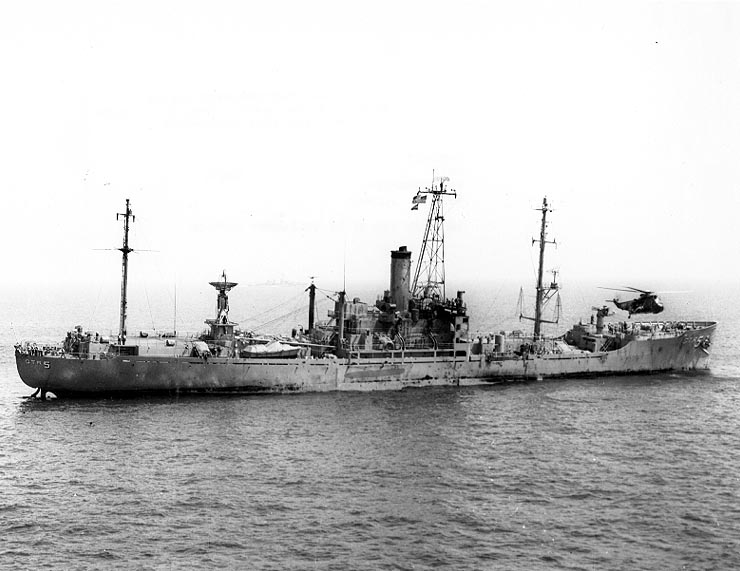
USS Liberty receives assistance from units of the Sixth Fleet, after she was attacked and seriously damaged by Israeli forces off the Sinai Peninsula on June 8, 1967. (US Navy photo)
Warplanes and torpedo boats had already killed 34 and wounded 174, when Halbardier slid over the Liberty’s napalm-glazed deck to jury-rig an antenna and get an SOS off to the Sixth Fleet. The Israelis intercepted the SOS and broke off the attack immediately. In effect, Halbardier prevented the massacre of all 294 onboard. Still, the infamy of the attack on the Liberty was two-fold.
First, the Liberty, a virtually defenseless intelligence collection platform prominently flying an American flag in international waters, came under deliberate attack by Israeli aircraft and three 60-ton Israeli torpedo boats off the coast of the Sinai on a cloudless June afternoon during the six-day Israeli-Arab war. Second, President Lyndon Johnson called back carrier aircraft dispatched to defend the Liberty lest Israel be embarrassed, the start of an unconscionable cover-up, including top Navy brass, that persists to this day.
Given all they have been through, the Liberty survivors and other veterans who joined Halbardier to celebrate his belated receipt of the Silver Star on May 27, 2009 can be forgiven for having doubted that the day of the hero’s recognition would ever come.
In the award ceremony at the Visalia (California) office of Rep. Devin Nunes, the Republican congressman pinned the Silver Star next to the Purple Heart that Halbardier found in his home mailbox three years ago. Nunes said, “The government has kept this quiet I think for too long, and I felt as my constituent he [Halbardier] needed to get recognized for the services he made to his country.”

Terry Halbardier got off an SOS message saving the Liberty from Israeli destruction
Nunes got that right. Despite the many indignities the Liberty crew has been subjected to, the mood in Visalia was pronouncedly a joyous one of Better (42 years) Late Than Never. And, it did take some time for the moment to sink in: Wow, a gutsy congressman not afraid to let the truth hang out on this delicate issue.
Treatment Accorded the Skipper
I was present that day and I could not get out of my head the contrast between this simple, uncomplicated event and the earlier rigmarole that senior Navy officers went through to pin a richly deserved Medal of Honor on another hero of that day, the Liberty’s skipper, Captain William McGonagle.
Although badly wounded by Israeli fire on June 8, 1967, McGonagle was able to keep the bombed, torpedoed, napalmed Liberty afloat and limping toward Malta, where what was left of the bodies of the 34 crewmen killed and the 174 wounded could be attended to. Do the math: yes, killed and wounded amounted to more than two-thirds of the Liberty crew of 294.
I remembered what a naval officer involved in McGonagle’s award ceremony told one of the Liberty crew: “The government is pretty jumpy about Israelthe State Department even asked the Israeli ambassador if his government had any objections to McGonagle getting the medal.”
When McGonagle received his award, the White House (the normal venue for a Medal of Honor award) was all booked up, it seems, and President Lyndon Johnson (who would have been the usual presenter) was unavailable.
So it fell to the Secretary of the Navy to sneak off to the Washington Navy Yard on the banks of the acrid Anacostia River, where he presented McGonagle with the Medal of Honor and a citation that described the attack but not the identity of the attackers.
Please don’t misunderstand. The Liberty crew is not big on ceremony. They are VERY-not-big on politicians who wink when Navy comrades are killed and wounded at sea. The Liberty survivors are big on getting the truth out about what actually happened that otherwise beautiful day in June 1967.
The award of the Silver Star to Terry Halbardier marked a significant step in the direction of truth telling. Halbardier said he accepted his Silver Star on behalf of the entire 294-man crew. He and fellow survivor Don Pageler expressed particular satisfaction at the wording of the citation, which stated explicitly — with none of the usual fudging — the identity of the attackers: “The USS Liberty was attacked by Israeli aircraft and motor torpedo boats in the East Mediterranean Sea.”
In the past, official citations, like Captain McGonagle’s, had avoided mentioning Israel by name when alluding to the attack. I think former U.S. Ambassador Edward Peck put it best in condemning this kind of approach as “obsequious, unctuous subservience to the peripheral interests of a foreign nation at the cost of the lives and morale of our own service members and their families.” Strong words for a diplomat. But right on.
Just a Guy From Texas
Were it not for Halbardier’s bravery, ingenuity, and technical expertise, the USS Liberty would surely have sunk, taking down much if not all of the crew.
You see, the first thing the Israeli aircraft bombed and strafed were the Liberty’s communications antennae and other equipment. They succeeded in destroying all the antennae that were functional. One antenna on the port side, though, had been out of commission and had escaped damage.
In receiving the Silver Star, Halbardier made light of his heroism, claiming that he was just a guy from Texas who could do a whole lot with simple stuff like baling wire. (In the infantry we called this kind of thing a “field expedient.”)
In any case, with his can-do attitude and his technical training, he figured he might be able to get that particular antenna working again. But first he would have to repair a cable that had been destroyed on deck and then connect the antenna to a transmitter.
The deck was still being strafed, but Halbardier grabbed a reel of cable, ran out onto the deck, and attached new cable to the antenna so a radioman could get an SOS out to the Sixth Fleet in the Mediterranean.
Voila. “Mayday” went out; almost immediately the Israeli aircraft and torpedo ships broke off the attack and went back to base; the Israeli government sent a quick apology to Washington for its unfortunate “mistake;” and President Johnson issued orders to everyone to make believe the Israelis were telling the truth, or at least to remain silent.
To their discredit, top Navy brass went along, and the Liberty survivors were threatened with court martial and prison if they so much as mentioned to their wives what had actually happened. They were enjoined as well from discussing it with one another.
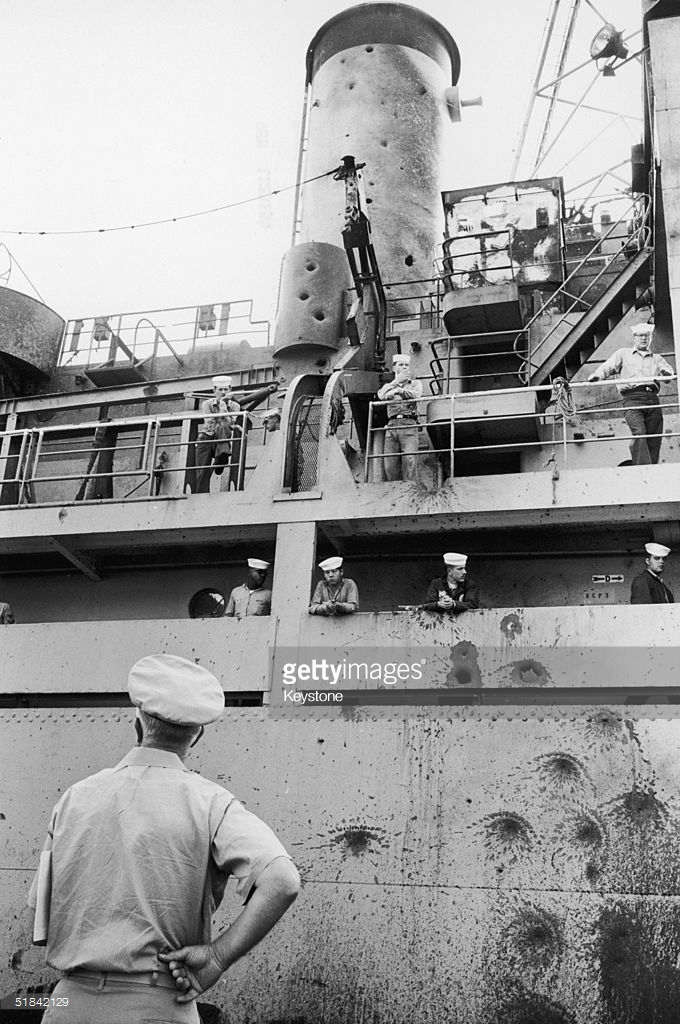
The shot-up Liberty
As Liberty crewman Don Pageler put it, “We all headed out after that, and we didn’t talk to each other.” The circumstances were ready-made for serious Post-Traumatic Stress Disorder.
The stories shared by Liberty survivors after the award ceremony, including descriptions of the macabre but necessary effort to reassemble torpedoed body parts, and the plague of survivor’s guilt, were as heart-rending as any I have heard. They are stories that should be shared more widely for those muzzled far too long.
These were the deep emotional scars to supplement the ones all over Halbardier’s body, some of which he uncovered when asked by the local press gathered there in Visalia. Typically, Halbardier made light of the shrapnel that had to be plucked out of his flesh, emphasizing that he was lucky compared to some of the other crew.
No Mistake
Despite Israeli protestations, the accumulated evidence, including intercepted voice communications, is such that no serious observer believes Israel’s “Oops” excuse of a terrible mistake. The following exchanges are excerpts of testimony from U.S. military and diplomatic officials given to Alison Weir, founder of “If Americans Knew” and author of American Media Miss the Boat:
Israeli pilot to ground control: “This is an American ship. Do you still want us to attack?”
Ground control: “Yes, follow orders.”
“But sir, it’s an American ship, I can see the flag!”
Ground control: “Never mind; hit it!”
Haviland Smith, a CIA officer stationed in Beirut during the Six-Day War, says he was told that the transcripts were “deep-sixed,” because the U.S. government did not want to embarrass Israel.
Equally telling is the fact that the National Security Agency (NSA) destroyed voice tapes seen by many intelligence analysts, showing that the Israelis knew exactly what they were doing. I asked a former CIA colleague, who was also an analyst at that time, what he remembered of those circumstances. Here is his e-mail reply:
“The chief of the analysts studying the Arab-Israeli region at the time told me about the intercepted messages and said very flatly and firmly that the pilots reported seeing the American flag and repeated their requests of confirmation of the attack order. Whole platoons of Americans saw those intercepts. If NSA now says they do not exist, then someone ordered them destroyed.”
One need hardly add at this point that the destruction of evidence without investigation is an open invitation to repetition in the future. Think the more recent torture-interrogation videotapes.
As for the legal side: the late Captain Ward Boston, unburdened himself on his accomplice role as the Navy lawyer appointed as senior counsel to Adm. Isaac Kidd, who led a one-week (!) investigation and then followed orders to pronounce the attack on the Liberty a case of “mistaken identity.” Boston signed a formal declaration on Jan. 8, 2004, in which he said he was “outraged at the efforts of the apologists for Israel in this country to claim that this attack was a case of ‘mistaken identity.’” Boston continued:
“The evidence was clear. Both Adm. Kidd and I believed with certainty that this attack was a deliberate effort to sink an American ship and murder its entire crew Not only did the Israelis attack the ship with napalm, gunfire, and missiles, Israeli torpedo boats machine-gunned three lifeboats that had been launched in an attempt by the crew to save the most seriously wounded, a war crime
“I know from personal conversations I had with Adm. Kidd that President Lyndon Johnson and Secretary of Defense Robert McNamara ordered him to conclude that the attack was a case of ‘mistaken identity’ despite overwhelming evidence to the contrary.”
W. Patrick Lang, Col., USA (ret.), who was the Defense Intelligence Agency’s top analyst for the Middle East for eight years, recounted the Israeli air attacks as follows: “The flight leader spoke to his base to report that he had the ship in view, that it was the same ship he had been briefed on, and that it was clearly marked with the U.S. flag
“The flight commander was reluctant. That was very clear. He didn’t want to do this. He asked them a couple of times, ‘Do you really want me to do this?’ I’ve remembered it ever since. It was very striking. I’ve been harboring this memory for all these years.”
Lang, of course, is not alone. So too Terry Halbardier, who told those assembled at his Silver Medal award ceremony, “I think about it [the attack on the Liberty] every day.”
Why Sink the Ship?
What we know for sure is, as the independent commission headed by former Chairman of the Joint Chiefs of Staff, Adm. Thomas Moorer put it, the attack “was a deliberate attempt to destroy an American ship and kill her entire crew.”
What we do not know for sure is why the Israelis wanted that done. Has no one dared ask the Israelis? One view is that the Israelis did not want the United States to find out they were massing troops to seize the Golan Heights from Syria and wanted to deprive the U.S. of the opportunity to argue against such a move.
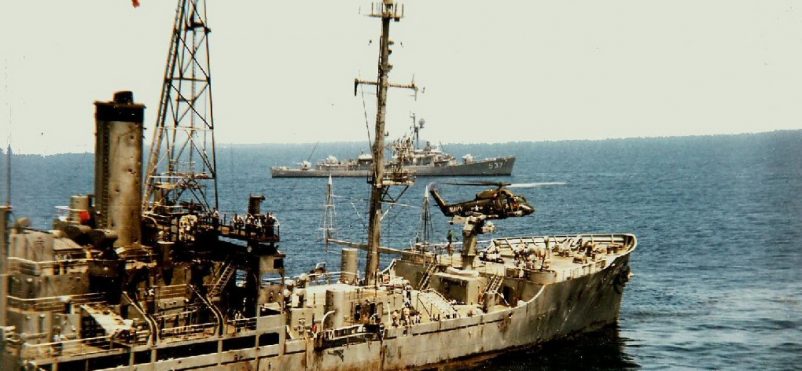
USS Liberty after the attack
James Bamford offers an alternative view in his excellent book, Body of Secrets. Bamford adduces evidence, including reporting from an Israeli journalist eyewitness and an Israeli military historian, of wholesale killing of Egyptian prisoners of war at the coastal town of El Arish in the Sinai.
The Liberty was patrolling directly opposite El Arish in international waters but within easy range to pick up intelligence on what was going on there. And the Israelis were well aware of that. But the important thing here is not to confuse what we know (the deliberate nature of the Israeli attack) with the ultimate purpose behind it, which remains open to speculation.
Also worth noting is the conventional wisdom prevalent in our Fawning Corporate Media (FCM) that Egypt forced Israel into war in June 1967. An excellent, authoritative source has debunked that, none other than former Israeli Prime Minister Menachem Begin! In an unguarded moment in 1982, when he was prime minister, he admitted publicly:
“In June 1967, we had a choice. The Egyptian army concentrations in the Sinai approaches do not prove that [Egyptian President] Nasser was really about to attack us. We must be honest with ourselves. We decided to attack him.”
Thus, the Israeli attack admittedly amounted to starting a war of aggression, and the occupied West Bank territories and the Golan Heights gained by the Israelis in the 1967 war remain occupied to this day. The post World War II tribunal at Nuremberg distinguished a “war of aggression” from other war crimes, terming it the “supreme international crime, differing from other war crimes only in that it contains the accumulated evil of the whole.”
Perhaps the attempt to sink the Liberty and finish off all survivors qualifies as one of those accumulated evils. Terry Halbardier summed it up this way when he was awarded his Silver Star: “There’s lots of theories but let’s just say they didn’t want us listening in to what they wanted to do.”
Getting Away With Murder
In sum, on June 8, 1967, the Israeli government learned that it could get away with murder, literally, and the crime would be covered up, so strong is the influence of the Israel Lobby in our Congress, and indeed, in the White House. And those USS Liberty veterans who survived well enough to call for an independent investigation have been hit with charges of, you guessed it, anti-Semitism.
Does all this have relevance today? Of course. Israeli Prime Minister Benjamin Netanyahu understands that there is little that Israel could do that would earn the opprobrium of the U.S. Congress or retaliation from the White House, whether it’s building illegal settlements or slaughtering civilians in Gaza. The Israelis seem convinced they remain in the catbird’s seat, largely because of the Israel Lobby’s influence with U.S. lawmakers and opinion makers.
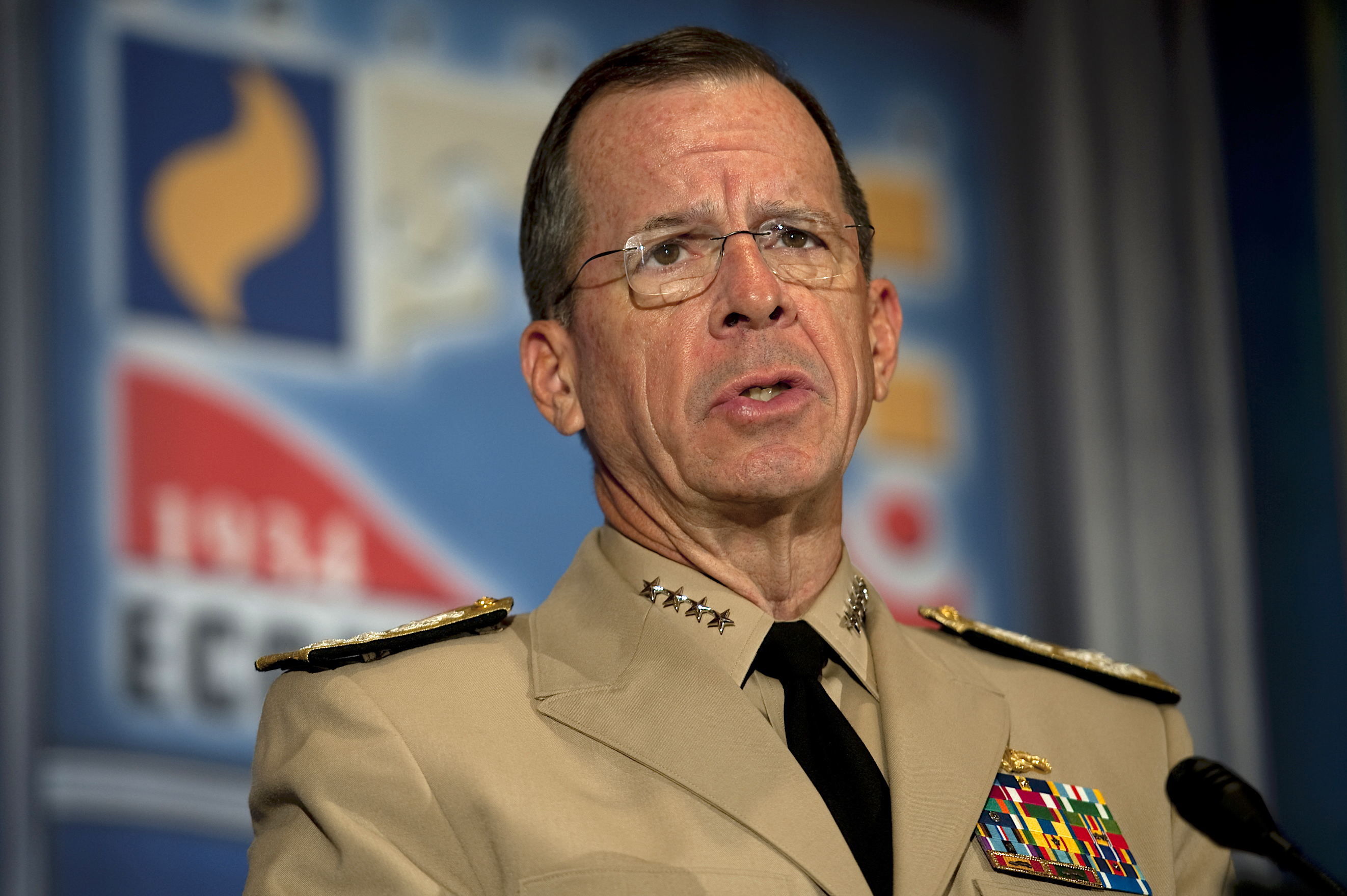
Navy Adm. Mike Mullen, (DoD Photo by Mass Communication Specialist Chad J. McNeeley)
One of the few moments when a U.S. official has had the audacity to face Israel down came from significantly a U.S. Navy admiral. In early July 2008, Chairman of the Joint Chiefs of Staff, Adm. Mike Mullen, was sent to Israel to read the riot act to then-Israeli Prime Minister Ehud Olmert, who seemed to be itching to start hostilities with Iran while President George W. Bush was in office.
We learned from the Israeli press that Mullen, fearing some form of Israeli provocation, went so far as to warn the Israelis not to even think about another incident like the attack on the USS Liberty on June 8, 1967, that the Israelis should disabuse themselves of the notion that U.S. military support would be knee-jerk automatic if Israel somehow provoked open hostilities with Iran.
This is the only occasion I am aware of in which a U.S. official of such seniority braced Israel about the Liberty incident. A gutsy move, especially with Vice President Dick Cheney and national security aide Elliott Abrams then in the White House, two hawks who might well bless, or even encourage, an Israeli provocation that would make it very difficult for Washington to avoid springing to the defense of its “ally.”
The Israelis know that Mullen knows that the attack on the Liberty was deliberate. Mullen could have raised no more neuralgic an issue to take a shot across an Israeli bow than to cite the attack on the Liberty. The Jerusalem Post reported that Mullen cautioned that a Liberty-type incident must be avoided in any future military actions in the Middle East.
Perhaps Mullen had learned something from the heroism of Terry Halbardier
Ray McGovern works with Tell the Word, the publishing arm of the ecumenical Church of the Saviour in inner-city Washington. After serving as an Army infantry/intelligence officer, he spent a 27-year career as a CIA analyst. He is co-founder of Veteran Intelligence Professionals for Sanity (VIPS).
‘Act of economic terrorism’: Iran says US sanctions prove call for talks was ‘deceitful & untrue’
RT | June 8, 2019
The sanctions imposed by the US against Iranian petrochemical companies prove that Mike Pompeo’s earlier promise of negotiations without preconditions was nothing but a bluff, a senior Iranian diplomat said.
On Friday, the US Treasury announced it has imposed a new wave of sanctions against Iranian energy businesses. The move is meant to stifle the revenues of the elite Islamic Revolutionary Guard Corps (IRGC), which Washington declared a terrorist organization earlier in April. This proves that US Secretary of State Mike Pompeo made an empty promise to Tehran less than a week ago, when he said he was ready to start “a conversation with no preconditions,” a spokesman for the Iranian Foreign Ministry said.
Pompeo’s words were “deceitful, untrue and merely in service of appealing to the public opinion,” Abbas Mousavi said as cited by Iran’s Mehr News Agency. He called the sanctions an act of “economic terrorism” and said Tehran will not yield to Washington’s pressure.
“All countries have a responsibility to react against the flagrant violations of the fundamental principles of international law and not to allow the international community’s achievements in multilateralism to be further ruined by the bullying and unilateral actions of the American governing body,” Mousavi said.
The Trump administration has broken the multinational agreement on Iran’s nuclear industry signed under his predecessor and ramped up economic sanctions against Tehran, re-imposing those lifted under the nuclear deal and issuing more.
In April, the US announced it will not renew waivers it previously extended to the largest buyers of Iranian crude, which previously shielded them from US sanctions against Iranian energy export. The waivers were meant to give the buyers a grace period to switch away from Iranian oil.
Australian feds raid broadcaster’s office over Afghan war crime stories
RT | June 5, 2019
Australian police have raided national broadcaster ABC’s headquarters over a 2017 story series exposing crimes committed by special forces in Afghanistan, the second raid on journalists in two days.
Six officers, including three police technicians, descended on the broadcaster’s Sydney offices with a warrant explaining the raid was “in relation to allegations of publishing classified material, contrary to provisions of the Crimes Act 1914.” The classified material in question? Hundreds of pages of leaked defense documents marked AUSTEO (Australian Eyes Only) that formed the basis of ABC’s 2017 story series ‘The Afghan Files.’ The warrant names the report’s authors, Dan Oakes and Sam Clark, as well as ABC news director Gaven Morris.
The officers rounded up ABC’s IT staff to assist in examining their email server looking for “a series of key words,” while others scoured a hard drive, according to John Lyons, ABC executive editor and head of investigations department, who live-tweeted the raid. Officers helpfully told him they were interested in “very specific matters” and “certain things,” dryly noting “this could take some time,” Lyons reported. Four hours into the raid, they had collected over 9,200 files and were deciding which could be seized under the warrant.
“It is highly unusual for the national broadcaster to be raided in this way,” ABC managing director David Anderson told news.com.au, promising to support its journalists, protect its sources, and “continue to report without fear or favor on national security and intelligence issues when there is a clear public interest.”
The federal police released a statement after the raid on Wednesday claiming “no arrests are planned today as a result of this activity” and denying it was connected to an intimidating visit paid to another journalist in Canberra the previous day – though it’s hard not to see a connection, given both were publishing stories on government misconduct based on documents unavailable to the public.
Officers raided News Corp journalist Annika Smethurst’s home on Tuesday, triggered by a story she wrote last year revealing the government’s plans to dramatically expand the Australian Signals Directorate’s spying on its own citizens, giving the agency power to secretly access bank records, text messages, and emails without an individual’s knowledge. Officers reportedly spent seven hours picking through Smethurst’s possessions; an unauthorized “leak of national security information” was cited as the cause.
That same day, 2GB radio host Ben Fordham said he had been contacted by the Department of Home Affairs in an effort to find out how he’d obtained “highly confidential” information for his reporting on asylum seeker vessels.
Condemning the “disturbing pattern of assaults on Australian press freedom,” the Media, Entertainment and Arts Alliance, Australia’s journalists’ union, called the raids “nothing short of an attack on the public’s right to know.”
“It seems that when the truth embarrasses the government, the result is the Federal Police will come knocking at your door.”
The Afghan Files describes a number of incidents in which Australian special forces shot civilians in addition to the insurgents they were supposed to be fighting and reveal Afghan authorities “were becoming increasingly agitated over Australians allegedly killing unarmed civilians” to the point that they “threatened to stop working with Australians.”
PM Scott Morrison has refused to condemn the raids, declaring all Australians must abide by national security laws. He won a “miracle” reelection last month, giving his Liberal National party a third straight term in power. Morrison appears to be using his mandate to crack down on antagonistic journalism, the MEAA noted.
SDF Detains Syrian Reporter, Moves Him to Unknown Location – Report
Sputnik – 05.06.2019
DAMASCUS – The Syrian Democratic Forces (SDF) have detained a correspondent of Syria’s Ikhbariya state TV channel, Muhammad as-Saghir, and moved him to an unknown location, the TV channel said.
“Muhammad as-Saghir was detained by the SDF at a checkpoint while returning from Al Hasakah to Qamishli and was moved to an unknown location”, his colleague told the TV channel on Tuesday.
According to the journalist, the detained correspondent filmed wheat field fires in Al Hasakah province and had evidence that the SDF was “in no hurry to put out the fires.”
 He noted that the channel currently had no contact with the correspondent, thereby being unable to establish his exact location.
The journalist also argued that the Kurdish-led SDF were seeking to destroy Syrian authorities’ wheat stocks, with their actions being “one of the means of the US economic war” against Damascus.
The US-backed Syrian Democratic Forces retain control over the northeast of Syria. The cities of Al Hasakah and Qamishli are, however, under the Syrian government’s control.
The armed conflict in Syria has been ongoing since 2011. A victory over the Daesh terrorist group in Iraq and Syria was announced in late 2017. Government forces, led by President Bashar Assad, have regained control over most of the country’s territories. Operations against militants continue in some parts of Syria, but their focus has largely shifted toward political settlement and creating favourable conditions for the repatriation of refugees Moscow supports Damascus in this process by providing humanitarian aid and acting as a ceasefire guarantor.
France’s arms sales to Saudis jumped by %50 in 2018: Data
Press TV – June 4, 2019
Newly-released figures show that France increased its weapons sales to Saudi Arabia by 50 percent last year despite growing international concern about the atrocities committed in a Saudi-led war on Yemen.
On Tuesday, an annual report by the French government showed that the country sold 1 billion euros’ worth of arms to Saudi Arabia in 2018, with the main item being patrol boats.
Saudi Arabia and a number of its allies — mainly the United Arab Emirates (UAE) — invaded Yemen in March 2015, with the goal of bringing a former Yemeni client regime back to power. The ongoing war has killed tens of thousands and disrupted the lives of millions by causing widespread famine as well as epidemics.
France, the third-biggest arms exporter in the world, is also among the top weapons exporters to Riyadh and Abu Dhabi.
The Saudi-led coalition has widely used French boats and at least two ships in placing a tight siege on Yemeni ports, particularly Hudaydah, a lifeline for the war-ravaged country’s crippled economy.
The French government has faced massive criticism for complicity in the war but has so far resisted pressure from rights groups to stop the lucrative arms trade with the two Persian Gulf countries, denying that the weapons are being used against the Yemenis. Paris claims that the arms are being deployed in “self defense.”
This is while in mid-April, a classified note from the French military intelligence service (DRM) estimated that over 430,000 Yemenis lived within the range of French artillery weapons on the Saudi-Yemeni border. It further estimated that French weapons had resulted in civilian casualties.
The revelation about the increased sales last year is expected to deepen mistrust in France’s position on the war.
“With such transfers revealing a geopolitical alliance with these regimes and total violation of international commitments, one can only expect worsening conflicts in Yemen or the Horn of Africa, where the United Arab Emirates and Saudi Arabia are beginning to redeploy in partnership with France,” said Tony Fortin, with the Paris-based Observatory for Armament.
The French government report is also likely to draw a sharper contrast between Paris’ public stance versus its actual one.
Late last month, Foreign Minister Jean-Yves Le Drian described the war on Yemen as a “dirty war” and said that it “has to be stopped,” even as his country continued to mostly quietly sell weapons to both Riyadh and Abu Dhabi on a large scale.
Last month, Saudi cargo ship the Bahri-Yanbu, sent to France to pick up purchased French arms, triggered a protest rally by humanitarian groups.
Apart from Paris, the United States, Britain, and other Western countries have faced criticism over arms sales to the Saudi regime and its partners over the consequences for a war that has affected 28 million Yemenis and caused what the United Nations (UN) calls “one of the worst humanitarian crises in the world.”
The war has also taken a heavy toll on the country’s infrastructure, destroying hospitals, schools, and factories. The UN has said that a record 22.2 million Yemenis are in dire need of food, including 8.4 million threatened by severe hunger. According to the world body, Yemen is suffering from the most severe famine in more than 100 years.
The Tuesday report also revealed that France’s total arms sales rose 30 percent to 9.1 billion euros in 2018, driven by a jump in sales to European countries. Its arms exports to the Middle East also rose to four billion euros from 3.9 billion the year before.
UN Rapporteur: Canada’s trade agreement with Israel violates international law

Michael Lynk, Special Rapporteur on the situation of human rights in the Palestinian territories occupied Michael Lynk [Alhadath24/Facebook]
MEMO | May 31, 2019
Canada’s updated trade agreement with Israel violates international law, the UN Special Rapporteur for the [occupied] Palestinian territories, Professor S. Michael Lynk, has said in an article published by the Australian news site, The Conversation.
Commenting on legislation known as Bill C-85 — the Canada-Israel Free Trade Agreement Implementation Act — which received royal assent on Monday, Lynk said that it lacks “a human rights provision, which would commit both parties to uphold international human rights and humanitarian law.” The Act also allows goods and services originating on illegal Israeli settlements to enter Canada without any tariffs. These “glaring” omissions, said Lynk, not only violate international law but also Canadian law.
The article, which was co-written with Alex Neve, the Secretary General of Amnesty International Canada, explained that Canadian foreign policy and Ottawa’s own legislation “has long recognised the Israeli settlements as illegal under the Fourth Geneva Convention.”
According to the authors, “The 1957 Geneva Conventions Act commits Canada to respect the strict obligations of the convention, including the prohibition against civilian settlements in occupied territory. And the 2000 Crimes Against Humanity and War Crimes Act designates civilian settlements in occupied territory as a war crime.”
Clarifying their position further, they cite the UN Human Rights Council, which in 2016 urged all states to ensure that: “They are not taking actions that either recognise or assist the expansion of [Israeli] settlements… in the Occupied Palestinian Territory, including East Jerusalem, including with regard to the issue of trading with settlements, consistent with their obligations under international law.”
They also cite a number of UN Resolutions, including Security Council Resolution 2334 which states that the Israeli settlements are “a flagrant violation under international law and a major obstacle to the achievement of a two-state solution and a just, lasting and comprehensive peace.”
Lynk pointed out that while Israel denies that it is an occupying power, there is in fact “a virtual wall-to-wall consensus among the international community — including the United Nations, the European Union, the International Court of Justice, the International Committee of the Red Cross and Canada — that the laws of occupation, including the Fourth Geneva Convention of 1949, apply in full to the Palestinian territory.”
The authors state that the Bill “makes no distinction between Israel and its illegal settlements in the Palestinian territory and it provides encouragement to the economic growth of the settlements by allowing their goods and services to enter Canada tariff-free.”
In conclusion, Lynk and Neve say that the Bill “entangles Canada in the serious violations of both international human rights and humanitarian law that are part and parcel of the Israeli occupation.”
READ ALSO:
Canada court hears lawsuit challenging Israel settlement wine labels
Second Saudi ship leaves French port without arms cargo
MEMO | May 31, 2019
A Saudi cargo ship has left the southern French port of Fos-sur-Mer without loading its arms cargo destined for Saudi Arabia, blocked from doing so after pressure from rights campaigners, a French rights group said on Thursday, Reuters reports.
The incident reported by ACAT, a Christian organisation against torture, is the second time this month that a Saudi vessel has been blocked from loading arms in France as pressure mounts on Paris to stop arms sales to the kingdom.
A Saudi ship left France’s northern coast two weeks ago without a cargo of weapons after dockers threatened to block its arrival in the port of Le Havre. That came weeks after an online investigative site published leaked French military intelligence that showed weapons sold to the kingdom, including tanks and laser-guided missile systems, were being used against civilians in Yemen’s war.
ACAT said the Saudi freighter, Bahri Tabuk, returned to sea on Wednesday night, with its holds empty.
“Once again, faced with citizen mobilisation and our legal action, a Saudi freighter had to give up loading French weapons, this time in Fos-sur-Mer,” Nathalie Seff of ACAT-France said in a statement.
Refinitiv Eikon shipping data showed that the Saudi-flagged ship, labelled as a vehicle carrier which has transported soybean meal in the past, left Fos and was sailing to Alexandria in Egypt.
French and Saudi governments and the port authorities could not be reached for comment on Thursday evening.
French Armed Forces Minister Florence Parly has said that France had a partnership with Saudi Arabia. When the first vessel was blocked from loading in Le Havre, she said the arms were related to an order dating back several years.
ACAT said it had filed an appeal last week with the Paris Administrative Court to block weapons shipments to Saudi Arabia, arguing that the sales contravened a UN treaty because the arms could be used against civilians in the Yemeni conflict, but it said the appeal was rejected.
Israel and US disputed intelligence for assassination targets

Lebanese men inspect the damage done to their homes following Israel’s invasion of Lebanon in 2006 [PATRICK BAZ/AFP/Getty Images]
MEMO | May 30, 2019
Leaked documents published by whistle-blower Edward Snowden have exposed a deep rift between Israeli intelligence officials and their counterparts in the US National Security Agency (NSA) over the sharing of intelligence which the Israelis requested to carry out assassinations during the 2006 invasion of Lebanon.
Details of the rift were laid out in the NSA’s internal newsletter known as SIDtoday under the heading “The Israel-Hizballah [sic] Crisis — Perspectives from an Acting SLO Tel Aviv”. In the document, an American liaison officer, who is tasked with managing relations with counterparts in Israel, recounted a dispute with the Israelis over intelligence that was to be used for “targeted killings”.
The Israeli demand, the US liaison wrote, “centred on requests for time sensitive tasking, threat warning, including tactical ELINT” — electronic intelligence — “and receipt of geolocational information on Hizballah elements.”
“The latter request was particularly problematic,” he continued, adding that he “had several late-night, sometimes tense, discussions with ISNU,” the elite Israeli equivalent of the NSA. The US official rejected the demand, and said that he provided details of “NSA’s legal prohibition on providing information that could be used in targeted killings.”
The acting SLO officer pointed out that, “Even with his full understanding of the US statutes, [ISNU Commander] BG Harari sought assistance from NSA for an exemption to this legal policy. To ISNU, this prohibition was contrary not only to supporting Israel in its fight against Hizballah but overall, to support the US Global War on Terrorism.”
The account, published by The Intercept — which has released four years’ worth of SIDdtoday material in batches — goes on to suggest that the NSA ultimately reached a compromise with the Israelis by working with the Office of the Director of National Intelligence (ODNI), and that in the end it was the Israeli team that defined the parameters and methods of what could and could not be shared with them.
According to The Intercept, the episode recounted by the US liaison officer raises “questions of what intelligence the United States can legally share with a foreign government.” This, it said, is a “notoriously murky” area.
READ ALSO:
Israel assassinates more people than any Western country, concludes new book
Who cares how war criminals vote?
By Kit Knightly | OffGuardian | May 30, 2019
Alastair Campbell has been kicked out of the Labour Party.
Apparently, he voted for the Liberal Democrats in the recent European Parliamentary elections, and then announced he had done so on Sky News. Thus putting him in breach of paragraph 2 of Labour’s Membership Rules, which states:
A member of the Party who joins and/ or supports a political organisation other than an official Labour group or other unit of the Party, or supports any candidate who stands against an official Labour candidate, or publicly declares their intent to stand against a Labour candidate, shall automatically be ineligible to be or remain a Party member, subject to the provisions of Chapter 6.I.2 below of the disciplinary rules.”
It’s a fairly open and shut case, to be honest.
And so ends the Labour career of Alastair Campbell, Tony Blair’s PR man, one of the key architects of the “dodgy dossier”, a man complicit in every death that resulted from the US/UK illegal invasion of Iraq.
The reaction of anyone, with even the most rudimentary grasp of ethics, should be “good riddance”.
Clearly therefore, the vast majority of the pundits, “journalists” and talking heads do not have a rudimentary grasp of ethics.
Yes, Campbell was actually defended. By journalists. And celebrities. And members of parliament.
Campbell is a “strong voice for Labour values” according to some, his expulsion is “Stalinist” according to others.
It’s time for a very serious reality check: Alastair Campbell should not be in the Labour Party.
He shouldn’t be tweeting his thoughts or giving interviews or writing columns. He shouldn’t have any power or influence or authority. He shouldn’t even be breathing free air.
He should be in the dock at the Hague, briefly. And then – hopefully – spending the rest of his time in eternity’s waiting room, carving tally marks on a cell wall.
Who cares who he voted for? He’s a fucking monster.
This is not “silly” or “old fashioned” or “predictable”. It’s just true.
As a society it’s important we try and recognise principles and morality. Virtue matters. Truth matters. There ARE absolutes. Most of the Labour MPs defending Campbell voted FOR that war. They all voted against investigations into it.
They are complicit in crimes against humanity. That is a statement of fact. And yet their opinions are treated as if they carry weight. They are assumed to have ideals, to be sincere, when their actions demonstrate this is simply not the case.
We don’t talk about Pinochet’s economic reforms.
We don’t isolate Pol Pot’s opinion on free healthcare.
We don’t defend Mussolini’s well organised internal transport infrastructure.
It is accepted that crimes of a certain scale put a mark on you that you can’t scrub off. That doesn’t change because these criminals are all well-spoken chaps with open shirt collars, it doesn’t change because they managed to slime their way out of punishment, it doesn’t change because our national ego lifts Britain above the law, and it doesn’t change because we’re all so English and confrontation makes us uncomfortable.
These people are monsters. Who they vote for does not matter. What they say does not matter. They have no values. They have no standing. They have no place in a decent world. If it were any other crime of the same magnitude that would not need to be explained.
“Progressives” will vilify Tulsi Gabbard for even daring to speak to Narendra Modi, or visit Assad’s Syria. Corbyn has been raked over the coals for talking with the IRA. Nigel Farage is considered a “Russian stooge” for deigning to even vaguely compliment Vladimir Putin.
All those people combined don’t add up to the butcher’s bill Campbell racked up in the Middle East. Not even in the most fevered, deceitful propaganda of the Western press.
But no one is talking about Iraq. When Momentum tweeted about it, they were accused of being “shallow” and “stuck in the past”.
Maybe people are just divorced from the reality. Maybe the scale warps in their minds. Maybe it’s just too big, too dreadful to actually picture.
One. Million. Dead.
The entire population of Birmingham dropping dead tomorrow.
More than double the British losses in World War 2.
9/11 happening every single day, for a whole year.
Alastair Campbell helped make that happen. He did it dishonestly. He did it deliberately. He did it for personal and political gain.
And he has not, to this day, faced any kind of punishment. In all likelihood, he never will.
If you EVER find yourself defending him, whether opportunistically to undermine Corbyn or earnestly because you see no problem with his actions, then you are through the looking glass. Your morality is tonaly inverted.
Alastair Campbell’s voting record is an irrelevance. I don’t know who he voted for, or if he voted at all. I don’t care. It probably was the Lib Dems. It’s the mootest of moot, and the media outcry about it is beyond absurd.
Every time any person who played a part in the crimes of the Iraq war is allowed to exist in our society, without reference to the immense crime they committed, we normalise the idea that murder is OK when WE do it to THEM. That our wars are mistakes, or misjudgments or “foreign policy blunders”. They don’t really count. We don’t really mean it. We’re nice.
Blair and Campbell are given column inches. Their enablers in parliament rail against “antisemitism” and for the “people’s vote”, or talk about the evil “dictators” in Venezuela or North Korea who don’t share our “values”. Their cheerleaders in the press talk up Vladimir Putin as a “pariah” because of the totally bloodless Crimean referendum, but happily chuckle through interviews with Campbell as if he isn’t soaked to the bone in the blood of innocents.
Criminals discussing Brexit and football and Love Island, like it’s all a big joke. Campbell talks “candidly” about his “battles with depression” and we’re all supposed to go “awwww!”
All the while the man who proved their criminality rots in jail, barely able to move.
The world of the media is upside down.
It is disgusting, but wholly expected. The Establishment is rallying to defend one its own, it always does.
But most people know the truth: The only thing wrong with Alastair Campbell being kicked out of the Labour party, is that it’s fifteen years too late.
Top IDF lawyer tells The Hague to back off, says Israel can probe own alleged war crimes
RT | May 29, 2019
The Israeli military wants the International Criminal Court to butt out of its affairs, its top military prosecutor has declared in response to efforts to hold it to account for its use of live fire against Palestinian protesters.
“Israel is a law-abiding country, with an independent and strong judicial system, and there is no reason for its actions to be scrutinized by the ICC,” Brig. Gen. Sharon Afek, Israel’s military advocate, declared at an international conference on warfare laws in Herzliya. “The position of Israel is that the International Criminal Court does not have jurisdiction to discuss the issue of the Israeli-Palestinian conflict.”
The ICC is weighing investigating Israel over its use of live ammunition against Palestinian protesters demonstrating at the Gaza border. Since March 2018, IDF soldiers have killed at least 251 people participating in the Great March of Return, a movement calling for Palestinians expelled from their land during the establishment of Israel to be allowed to return, and injured at least 26,797 more, according to the Palestinian Ministry of Health.
Earlier this year, a United Nations Human Rights Council fact-finding mission on the protests submitted to the ICC a list of Israeli officials it suspects of serious crimes, including IDF snipers, their commanders, and the military legal advisers who outlined their rules of engagement.
Afek’s objections to the ICC’s involvement center on the body’s charter, which permits it to investigate crimes only when there is no reasonable assumption that the country in which they have been committed will prosecute them adequately. Israel, he claims, will take care of its own business.
But as of March, only 11 of the protesters’ deaths were being investigated as possible criminal acts. Israel has insisted that even the journalists and medics killed by snipers – a war crime under any jurisdiction – were actually working for Hamas and therefore fair game.
Israel’s judicial system has refused to pursue investigations of alleged war crimes committed by the IDF against Palestinians in the West Bank and Gaza before, and the ICC has long sought to prosecute Israel for its treatment of the Palestinians. Before the Great March of Return began last year, the court was looking into whether Israel had committed war crimes during 2014’s Operation Protective Edge, the seven-week bombardment of Gaza that killed 2,000 Palestinians and injured over 10,000, deliberately targeting civilians and landmark buildings according to Amnesty International. Settlement-building and the eviction of Palestinians from West Bank and East Jerusalem were also scrutinized.
French rights group moves to block Saudi arms cargo
RT | May 28, 2019
A French humanitarian group is seeking to block a delivery of munitions to a Saudi ship docked at a port in southern France, arguing the weapons will be used to commit war crimes in Saudi Arabia’s conflict with Yemen.
The rights group, Action by Christians for the Abolition of Torture (ACAT), filed its legal challenge Tuesday, following up on a previous effort which successfully blocked a shipment of howitzer cannons to the Saudi Kingdom.
The cargo ship “is to load French weapons bound for Saudi Arabia, one of the main belligerents of the Yemeni conflict,” ACAT said in a statement Tuesday, adding it was “calling on civil society … to prevent these munitions from leaving” the port of Marseille-Fos.
The shipment is to include ammunition for the French-made Caesar howitzer, a truck-mounted artillery system, according to sources cited by investigative outlet Disclose. Though ACAT managed to block a howitzer shipment earlier this month, Saudi Arabia obtained several Caesar batteries in previous sales.
ACAT argues that the UN’s Arms Trade Treaty, ratified by France in 2014, provides a legal basis for a court order to block the cargo.
Under the treaty, “France undertook not to authorize the transfer of arms when it ‘has knowledge, at the time the authorization is requested that such weapons or property could be used to commit genocide, crimes against humanity’,” or other violations of humanitarian law, ACAT said, quoting the language of the agreement.
French Defense Minister Florence Parly told lawmakers Tuesday that she had no information on the shipment, but added that France must respect its alliance with the kingdom in any case. Parly has previously stated there was “no proof” that French weapons contributed to rights violations in the Yemen war.
In April, however, French journalists with Disclose published classified military intelligence documents revealing that French weapons likely were involved in strikes on civilians. French authorities have since interrogated the journalists and threatened them with jail time.
Earlier Tuesday Foreign Minister Jean-Yves Le Drian called on Saudi Arabia to end its “dirty war” on Yemen, but stopped short of demanding an end to French weapons sales, adding that France was “extremely vigilant” in its arms transfers.
Activists at Italian and Spanish ports have also attempted to interfere in the Saudi war effort, with Italian dock workers in Genoa refusing to load cargo onto a Saudi vessel earlier this month, and a similar, albeit unsuccessful, protest at the Spanish port of Santander.
The UN says Yemen is suffering the world’s worst humanitarian crisis, with millions dependent on humanitarian aid and tens of thousands killed in the fighting. A coalition of states led by Saudi Arabia began military operations in Yemen in March 2015, seeking to oust rebels from power and reinstate Yemeni President Mansour Hadi. Both the coalition and the rebels have violated the laws of armed conflict, according to rights groups, but the bulk of civilian casualties have been inflicted in the Saudi air war.
Featured Video
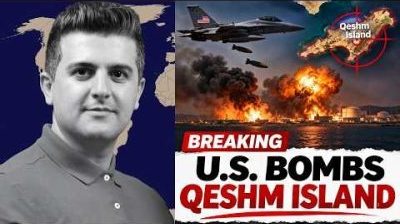
Nima R. Alkhorshid: US military bombs multiple targets on Iran’s Qeshm Island
or go to
Aletho News Archives – Video-Images
From the Archives
British Intel Tried to Make N Irish Gang ‘Shoot Up’ School, Documentary Claims
Sputnik – 23.02.2019
A new documentary, based on an interview with a self-confessed member of the Glennane Gang, gives some insights into allegations that British military intelligence was behind a shocking murder plot to cause the situation in Northern Ireland to “spiral out of control”.
In a documentary, Unquiet Graves: The Story of the Glennane Gang, John Weir, a former officer from the Royal Ulster Constabulary (RUC), alleges that British intelligence tried to persuade paramilitary group Ulster Volunteer Force (UVF) to attack a Catholic primary school at Belleeks in County Armagh.
Weir claimed that the UVF was urged to kill children and teachers in retaliation for the 1976 Kingsmill massacre, in which gunmen stopped a minibus carrying twelve workmen and shot them; only one person survived despite having been shot 18 times.
“The plan that was decided on was to shoot up a school in Belleeks”, he said, adding that the British intelligence plot was to make the situation in Northern Ireland “spiral out of control”. … continue
Blog Roll
 Aletho News
- Nima R. Alkhorshid: U.S. Military Bombs Multiple Targets on Iran’s Qeshm Island
- Iran-Linked Ships Spotted Hovering over Subsea Cables: Report
- New attack on Iran could devastate ‘Israel’, IOF general warns
- Nuclear deterrence: The US-Israeli military aggression against Iran made the unthinkable legitimate
- U.S. Midterms – a Referendum on Israel and Zionist Power
- Twice as many Canadian Jews serve in Israeli military as Canada’s armed forces: Report
- Thousands of Syrian troops set to join Saudi war on Yemen
- Jared Kushner’s Diplomacy for Hire
- Russia backs Tehran’s conditions in talks with US, Iran’s envoy says
- Irish ‘fake news’ expert exposed as fake
- If Americans Knew
- An error has occurred; the feed is probably down. Try again later.
- No Tricks Zone
- Zonal Asymmetry of Temperature Change in the Antarctic Circumpolar Current
- New Study: The Net Fossil Fuel Contribution To Rising Atmospheric CO2 Has Been Zero For 500 Years
- Germany’s Green Energy Transition Becoming Increasingly Expensive…Another 6 Trillion Euros!
- Sudden Stratospheric Warming, Powerful El Niño Combination May Lead To Extreme Europe Cold, Energy Crisis!
- Two New Studies Find Thwaites Glacier Melt Cannot Be Driven By Human Activity Or A Warming Ocean
- E-Cars Reduce CO2 Emissions By Only 41% Compared To Internal Combustion Engine Vehicles
- Predictions Made By Renowned Climate Professor Over Past Decades Have Been Proven To Be Poor
- New Study Suggests Large Regions Of The Pacific Ocean Have Been Cooling For The Last 80 Years
- Germany’s Green Energy Debacle: High Energy Costs Force Kahla Porzellan to Close After 182 Years!
- New Study: 50 Years Of The Most Aggressive ‘Net Zero’ Policies Can Only Affect The Global Climate By 0.03°C

