Settler filmed starting fire in West Bank field is Israeli soldier
MEMO | May 27, 2019
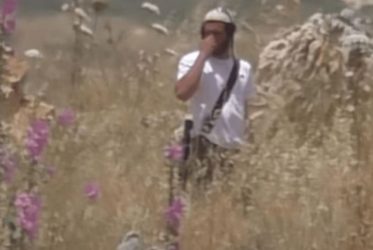
One of the two Jewish settlers recently caught on video starting a fire in the occupied West Bank is an Israeli soldier, it has been revealed.
According to reports in the Israeli media, “the army knows the identity of the settler”, and “two security sources confirmed the details, saying that the soldier was on leave when the arson took place”.
The military said that “the Israel Police are expected to handle the incident”, while “the police said that they have yet to arrest the soldier”.
The incident took place on Friday, 17 May, when settlers attacked Palestinians and their properties in three West Bank villages.
While the Israeli military initially blamed Palestinians for starting the fires, the army was forced to change its story after a video clip published by human rights NGO B’Tselem clearly showed settlers lighting fires in fields.
In a separate video taken by local Palestinians that day, settlers are seen throwing rocks at villagers’ homes, while Israeli soldiers “can be seen standing among the settlers and doing nothing to stop them”.
To date, no one has been arrested for any of these attacks.
Israeli settlers in the occupied West Bank routinely assault Palestinians and vandalise their property, attacks which are almost never investigated or prosecuted by Israeli occupation authorities.
All Israeli settlements in the occupied West Bank and East Jerusalem are illegal under international law.
Ex-Israeli official admits 2015 assassination of Kuntar after tip-off from Syria militants
Press TV – May 27, 2019
A former Israeli army officer has admitted that Israel’s military, with the help of militants in Syria, assassinated Samir Kuntar, a commander of Lebanese Hezbollah resistance movement, during air raids in 2015.
According to UK-based Arab newspaper Asharq Al-Awsat, the ex-army officer Marco Morno said the operation was carried out with information from “one of the leaders of the Syrian opposition factions.”
The attack was conducted by two warplanes that bombed a building with four long-range missiles in Jaramana, near Damascus, in late 2015.
Back then, Kuntar was in Syria helping government forces and Hezbollah fight back foreign-backed Takfiri terrorists in the Arab country.
“Samir Kuntar, the longest serving Arab prisoner in Israeli jails, was killed in a terrorist rocket attack targeting a building in the southern parts of Jaramana, Damascus countryside,” the official Syrian Arab News Agency (SANA) reported at the time.
He had spent about 30 years in Israeli prisons and was released in 2008 as part of a swap deal between Tel Aviv and Hezbollah in exchange for the bodies of two Israeli soldiers killed during the 2006 war.
According to the so-called Syrian Observatory for Human Rights, a pro-militant monitoring group, Kuntar had been the target of various failed Israeli assassination attempts in Syria.
Morno, who was responsible for communicating with militants in Syria, revealed the details of Kuntar’s assassination during an interview with an Israeli news site on Thursday. The information he disclosed was allowed to be published under military censorship.
Hezbollah has been effectively helping the Syrian government in its fight against terrorists.
In May 2016, Mustafa Badr al-Deen, another Hezbollah commander, was killed in an Israeli air raid on the Syrian-Lebanese border.
Tel Aviv frequently attacks military targets inside Syria in what is considered as an attempt to prop up Takfiri terrorist outfits that have been suffering heavy defeats against Syrian government forces.
Numerous reports have also emerged of the discovery of Israeli-made weapons and military equipment during clean-up operations by the Syrian army.
The occupying regime has been providing medical treatment to extremist elements wounded in Syria.
Syria has been gripped by foreign-backed militancy since March 2011. The government says the Israeli regime and its Western and regional allies have been aiding the Takfiri terrorist groups wreaking havoc in the country.
Turkey is one of the main backers of anti-government militants in Syria.
On Saturday, senior militant sources said Turkey has equipped an array of terrorists with fresh supplies of weaponry to help them try to repel a major Syrian assault.
The delivery of dozens of armored vehicles, Grad rocket launchers, anti-tank guided missiles and so-called TOW missiles, helped roll back some army gains and retake the strategically located town of Kafr Nabudah, one senior militant figure said.
Syria’s SANA news agency reported on Sunday that Syrian army troops had established full control over Kafr Nabudah in Hama province after eliminating the last remnants of the Jabhat Fateh al-Sham terrorist group, formerly known as Nusra Front.
Nasrallah: If It Weren’t for Liberation in 2000, Trump Would Grant South to ‘Israel’

Sayyed Hasan Nasrallah
Sara Taha Moughnieh | Al-Manar | May 26, 2019
Hezbollah Secretary General Sayyed Hasan Nasrallah delivered a speech Saturday 25th of May on the anniversary of Resistance and Liberation day.
Sayyed Nasrallah tackled regional and internal files including the upcoming Bahrain Summit, localizing the Palestinians in Lebanon, strength of the resistance axis, return of the Syrians to their country, and internal files.
His eminence called for a wide participation in Al-Quds day which is held annually on the last Friday of the Holy Month of Ramadan, stressing that this day is of great significance this year because of the efforts being made to put an end to the Palestinian cause, specifically during the upcoming Economic Conference in Bahrain.
He greeted the Palestinian’s united stance to boycott and refuse this conference and praised the Bahraini people, scholars, and political powers’ stances that condemned the country’s decision to be the first to embrace “the deal of the century” which aims at putting an end to the Palestinian cause.
25/May/2000: Resistance and Liberation Day
Sayyed Nasrallah greeted everyone who was part of this victory through sacrificing, staying patient, supporting and aiding.
“We should remember the families of the martyred and injured, Lebanese factions, Security Forces, Army, Palestinian factions and the Syrian Army and keep in mind that Iran and Syria are the ones who stood by our side and they are our companions in victory,” he said.
Hezbollah SG assured that one of the major outcomes of this victory was the “Equation of Strength” in Lebanon because the Israeli enemy had to pull back without any victories or conditions.
“Lebanon was no longer regarded as the weak ring in the Arab/Israel conflict, and today the Israeli enemy states that in Lebanon there is a “strategic or central threat against Israel”, he noted; adding “just like the enemy is aware of this strength, the Lebanese people should be aware of its importance in order to sustain their country’s sovereignty and safety and in order to protect it. This is what forms the Golden Equation “Army, people and Resistance”.”
“If it weren’t for the resistance and liberation in 2000, Trump would’ve granted the south of Lebanon or other parts of it to Israel, just like he did with Al-Quds and the Golan,” Sayyed Nasrallah said, reassuring holding on to “Shabaa Farms, Kfarchouba hills and the Lebanese part of Al-Ghajar village.”
Localization in Lebanon
Concerning localizing immigrants in Lebanon, his eminence said: “we suspect that the economic summit in Bahrain will be opening the door for the localization of immigrants in Lebanon and other countries. The Lebanese agree on refusing localization politically and constitutionally, and the Palestinians as well agree on refusing localization and holding on to their right of return.”
Sayyed Nasrallah called for “a meeting between Lebanese and Palestinian officials to put a joint plan on how to face the danger of localization because the threat is approaching and statements are no longer enough”.
Syrian Refugees’ Return
Hezbollah SG pointed out that “the real reason behind delaying the return of the Syrian refugees in Lebanon to their country is political and it is related to the presidential elections in Syria because the presidency of Bashar Al-Assad will end in 2020 or 2021, and there is an American, Western, and Gulf insistence on keeping the refugees away from their countries until then. There are no humanitarian or security reasons behind postponing the refugees’ return to Syria and claims about that are just rumors.”
Sayyed Nasrallah further stated that “Assad has confirmed to me that he supports the return of everyone to Syria and is ready to offer facilitation, but the obstacle is political. Should Lebanon submit to this political obstacle only because the US, west and Gulf want that?”
Battle against Corruption Files
His eminence stressed Hezbollah’s commitment to fight corruption, reiterating that this needs time and patience, and it is even harder than the battle of liberating the south.
He indicated that the ministers are doing their jobs and have not found corruption in the Ministries of health and sports, and called on everyone who has information or data against these two ministries to propose them so that action would be taken.
On another hand, Sayyed Nasrallah stated that “budgeting discussion has been our priority because it is a major point in the process of fighting corruption and stopping financial waste.”
Israel’s War Criminals In Their Own Words
Shooting unarmed Palestinian demonstrators “preserves Israeli values”
By Philip Giraldi | Unz Review | May 21, 2019
Israel’s public face, sustained and propagated by a wealthy and powerful diaspora that has significant control over the media, insists that the country is the Middle East’s only true democracy, that it operates under a rule of law for all its citizens and that its army is the “most moral in the world.” All of those assertions are false. Israel’s government favors its Jewish citizens through laws and regulations that are defined by religion. It in fact now identifies itself legally as a Jewish state with Christians and Muslim citizens having second class status. Israel’s army, meanwhile, has committed numerous war crimes against largely unarmed civilian populations in the past seventy years, both in Lebanon and directed against the Palestinians on the West Bank and Gaza.
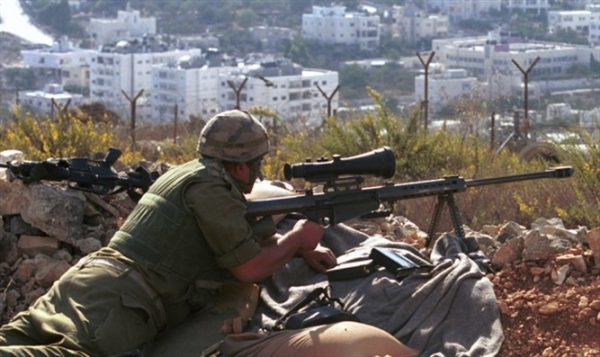
In response to the past year’s Great March of Return protests staged by Gazans along the fence line that separates them from Israel, Israeli army snipers have shot dead 293 Palestinians and wounded seven thousand more. Twenty-thousand other Gazans have been harmed by other weapons used by the Israelis, to include canisters from the volleys of tear gas and rubber bullets. The numbers include hundreds of children and medical personnel trying to help the wounded, which reportedly have been particularly targeted.
The United Nations has reported that many of the wounded have been shot in their legs, which the Israeli army regards as “restraint” on its part. Many of those injured will likely need to have limbs amputated because Gaza lacks the medical facilities required to properly treat their wounds. Israel has bombed hospitals and blocked the importation of medical supplies into Gaza while also not allowing Gazans to leave the enclave for medical treatment elsewhere in the Middle East.
One hundred and twenty amputations have already been performed this year. Jamie McGoldrick, the U.N. Humanitarian Coordinator for the Occupied Territories explained “You’ve got 1,700 people who are in need of serious, complicated surgeries for them to be able to walk again… [requiring] very, very serious and complex bone reconstruction surgery over a two-year period before they start to rehabilitate themselves.”
The U.N. would like to provide $20 million in assistance to enable medical treatment rather than amputations but the United States has refused to support emergency funding for the Palestinians through the Relief Works Agency (UNRWA), a step presumably taken to benefit Israel by punishing the Palestinian people.
Interestingly, a document has recent re-surfaced describing in chilling terms the Israel Army’s viewpoint on shooting protesting Arabs. One year ago former British diplomat Craig Murray posted on his blog, “Condemned By Their Own Words”, which provided a translated from Hebrew-to-English transcript of an Israeli radio broadcast that had taken place on April 21st. An Israeli Brigadier-General, named Zvika Fogel, was responding to reports of the killing by soldiers of an unarmed fourteen year-old boy. He explained in some detail why his soldiers are absolutely doing the right thing to shoot to kill Palestinians who approach the barrier separating Gaza from Israel.
General Fogel’s comments are reflective of the Israeli government view of how to control the “Palestinian problem.” Only the rights, including the right to life, of Israeli Jews are legitimate and Arabs should be grateful for what the Jewish state allows them to have.
Fogel responded to interviewer Ron Nesiel’s first question “Should the IDF [Israeli army] rethink its use of snipers?” by saying that “Any person who gets close to the fence, anyone who could be a future threat to the border of the State of Israel and its residents, should bear a price for that violation. If this child or anyone else gets close to the fence in order to hide an explosive device or check if there are any dead zones there or to cut the fence so someone could infiltrate the territory of the State of Israel to kill us …”
Nesiel: “Then, then his punishment is death?”
Fogel: “His punishment is death. As far as I’m concerned then yes, if you can only shoot him to stop him, in the leg or arm – great. But if it’s more than that then, yes, you want to check with me whose blood is thicker, ours or theirs. It is clear to you that if one such person will manage to cross the fence or hide an explosive device there …”
Nesiel: “But we were taught that live fire is only used when the soldiers face immediate danger. … It does not do all that well for us, those pictures that are distributed around the world.”
Fogel: “I know how these orders are given. I know how a sniper does the shooting. I know how many authorizations he needs before he receives an authorization to open fire. It is not the whim of one or the other sniper who identifies the small body of a child now and decides he’ll shoot. Someone marks the target for him very well and tells him exactly why one has to shoot and what the threat is from that individual. And to my great sorrow, sometimes when you shoot at a small body and you intended to hit his arm or shoulder it goes even higher. The picture is not a pretty picture. But if that’s the price that we have to pay to preserve the safety and quality of life of the residents of the State of Israel, then that’s the price.
“[And] look, Ron, we’re even terrible at it [at suppressing those pictures]. There’s nothing to be done, David always looks better against Goliath. And in this case, we are the Goliath. Not the David. That is entirely clear to me. … It will drag us into a war. I do not want to be on the side that gets dragged. I want to be on the side that initiates things. I do not want to wait for the moment where it finds a weak spot and attacks me there. If tomorrow morning it gets into a military base or a kibbutz and kills people there and takes prisoners of war or hostages, call it as you like, we’re in a whole new script. I want the leaders of Hamas to wake up tomorrow morning and for the last time in their life see the smiling faces of the IDF. That’s what I want to have happen. But we are dragged along. So we’re putting snipers up because we want to preserve the values we were educated by. We can’t always take a single picture and put it before the whole world. We have soldiers there, our children, who were sent out and receive very accurate instructions about whom to shoot to protect us. Let’s back them up.”
One might reasonably suggest that Fogel’s comments reflect a consensus among Israelis on how to deal with the Arabs. And the United States is fully complicit in the slaughter. American Ambassador to Israel David Friedman has repeatedly praised the restraint of the Israeli armed forces and has blamed the Gazans for their plight. The United States continues to subsidize illegal Israeli settlements that fuel the conflict and is putting the final touches on an Israeli approved peace plan that will now and forever make the Palestinians a non-people, without a nation of their own and without any hopes for the future. Meanwhile, they are target practice for Israeli snipers. The world should be mortified by Israeli arrogance and behavior and the United States should bow its head in shame each time a pandering American politician comes out with the line “Israel has a right to defend itself.”
Philip M. Giraldi, Ph.D., is Executive Director of the Council for the National Interest, a 501(c)3 tax deductible educational foundation (Federal ID Number #52-1739023) that seeks a more interests-based U.S. foreign policy in the Middle East. Website is councilforthenationalinterest.org, address is P.O. Box 2157, Purcellville VA 20134 and its email is inform@cnionline.org.
Where Lyme Disease Came From and Why It Eludes Treatment
By David Swanson | CounterPunch | May 17, 2019
A new book called Bitten: The Secret History of Lyme Disease and Biological Weapons by Kris Newby adds significantly to our understanding of Lyme disease, while oddly seeming to avoid mention of what we already knew.
Newby claims (in 2019) that if a scientist named Willy Burgdorfer had not made a confession in 2013, the secret that Lyme disease came from a biological weapons program would have died with him. Yet, in 2004 Michael Christopher Carroll published a book called Lab 257: The Disturbing Story of the Government’s Secret Germ Laboratory. He appeared on several television shows to discuss the book, including on NBC’s Today Show, where the book was made a Today Show Book Club selection. Lab 257 hit the New York Times nonfiction bestseller list soon after its publication.
Newby’s book reaches the same conclusion as Carroll’s, namely that the most likely source of diseased ticks is Plum Island. Newby reaches this conclusion on page 224 after mentioning Plum Island only once in passing in a list of facilities on page 47 and otherwise avoiding it throughout the book. This is bizarre, because Newby’s book otherwise goes into great depth, and even chronicles extensive research efforts that lead largely to dead ends, and because there is information available about Plum Island, and because Carroll’s best-selling book seems to demand comment, supportive or dismissive or otherwise.
In fact, I think that, despite the avoidance of any discussion of Plum Island, Newby’s research complements Carroll’s quite well, strengthens the same general conclusion, and then adds significant new understanding. So, let’s look at what Carroll told us, and then at what Newby adds.
Less than 2 miles off the east end of Long Island sits Plum Island, where the U.S. government makes or at least made biological weapons, including weapons consisting of diseased insects that can be dropped from airplanes on a (presumably foreign) population. One such insect is the deer tick, pursued as a germ weapon by the Nazis, the Japanese, the Soviets, and the Americans.
Deer swim to Plum Island. Birds fly to Plum Island. The island lies in the middle of the Atlantic migration route for numerous species. “Ticks,” Carroll writes, “find baby chicks irresistible.”
In July of 1975 a new or very rare disease appeared in Old Lyme, Connecticut, just north of Plum Island. And what was on Plum Island? A germ warfare lab to which the U.S. government had brought former Nazi germ warfare scientists in the 1940s to work on the same evil work for a different employer. These included the head of the Nazi germ warfare program who had worked directly for Heinrich Himmler. On Plum Island was a germ warfare lab that frequently conducted its experiments out of doors. After all, it was on an island. What could go wrong? Documents record outdoor experiments with diseased ticks in the 1950s (when we know that the United States was using such weaponized life forms in North Korea). Even Plum Island’s indoors, where participants admit to experiments with ticks, was not sealed tight. And test animals mingled with wild deer, test birds with wild birds.
By the 1990s, the eastern end of Long Island had by far the greatest concentration of Lyme disease. If you drew a circle around the area of the world heavily impacted by Lyme disease, which happened to be in the Northeast United States, the center of that circle was Plum Island.
Plum Island experimented with the Lone Star tick, whose habitat at the time was confined to Texas. Yet it showed up in New York and Connecticut, infecting people with Lyme disease — and killing them. The Lone Star tick is now endemic in New York, Connecticut, and New Jersey.
If Newby agrees or disagrees with any of the above, she does not inform us. But here’s what she adds to it.
The outbreak of unusual tick-borne disease around Long Island Sound actually started in 1968, and it involved three diseases: Lyme arthritis, Rocky Mountain spotted fever, and babesiosis. A U.S. bioweapons scientist, Willy Burgdorfer, credited in 1982 with discovering the cause of Lyme disease, may have put the diseases into ticks 30 years earlier. And his report on the cause of Lyme disease may have involved a significant omission that has made it harder to diagnose or cure. The public focus on only one of the three diseases has allowed a disaster that could have been contained to become widespread.
Newby documents in detail Burgdorfer’s work for the U.S. government giving diseases to ticks in large quantities to be used as weapons, as they have been in Cuba in 1962, for example. “He was growing microbes inside ticks, having the ticks feed on animals, and then harvesting the microbes from the animals that exhibited the level of illness the military had requested.”
Burgdorfer published a paper in 1952 about the intentional infecting of ticks. In 2013, filmmaker Tim Grey asked him, on camera, whether the pathogen he had identified in 1982 as the cause of Lyme disease was the same one or similar or a generational mutation of the one he’d written about in 1952. Burgdorfer replied in the affirmative.
Interviewed by Newby, Burgdorfer described his efforts to create an illness that would be difficult to test for — knowledge of which he might have shared earlier with beneficial results for those suffering.
Newby, who has herself suffered from Lyme disease, blames the profit interests of companies and the corruption of government for the poor handling of Lyme disease. But her writing suggests to me a possibility she doesn’t raise, namely that those who know where Lyme disease came from have avoided properly addressing it because of where it came from.
Newby assumes throughout the book that there has to have been a particular major incident near Long Island Sound, either an accident or an experiment on the public or an attack by a foreign nation. Burgdorfer reportedly claimed to another researcher that Russia stole U.S. bioweapons. Based on that and nothing else, Newby speculates that perhaps Russia attacked the United States with diseased ticks, coincidentally right in the location where the U.S. government experimented with diseased ticks.
“What this book brings to light,” Newby writes, “is that the U.S. military has conducted thousands of experiments exploring the use of ticks and tick-borne diseases as biological weapons, and in some cases, these agents escaped into the environment. The government needs to declassify the details of these open-air bioweapons tests so that we can begin to repair the damage these pathogens are inflicting on human and animals in the ecosystem.”
Another product of U.S. bio-weapons tax dollars at work, of course, was the anthrax mailed to politicians in 2001. While Newby speculates that perhaps someone was trying to demonstrate the danger for our own good, I don’t think we should forget that one purpose served — whether or not intended — by the “anthrax attacks” was a significant augmentation of the Iraq war lies. The attacks were falsely blamed on Iraq, and even if people have forgotten that, they fell for it long enough for it to matter. The one bit of truth in current public understanding of Lyme disease is that it has not been falsely blamed on some country the United States is eager to bomb. Let’s keep it that way!
How Madeleine Albright Got the War the U.S. Wanted

By Gregory Elich | Global Research | May 13, 2019
Twenty years have passed since the U.S.-orchestrated NATO attack on Yugoslavia. As the United States readied its forces for war in 1999, it organized a peace conference that was ostensibly intended to resolve differences between the Yugoslav government and secessionist ethnic Albanians in Kosovo on the future status of the province. A different scenario was being played out behind the scenes, however. U.S. officials wanted war and deliberately set up the process to fail, which they planned to use as a pretext for war.
The talks opened on February 6, 1999, in Rambouillet, France. Officially, the negotiations were led by a Contact Group comprised of U.S. Ambassador to Macedonia Christopher Hill, European Union envoy Wolfgang Petritsch, and Russian diplomat Boris Mayorsky. All decisions were supposed to be jointly agreed upon by all three members of the Contact Group. In actual practice, the U.S. ran the show all the way and routinely bypassed Petritsch and Mayorsky on essential matters.
Ibrahim Rugova, an ethnic Albanian activist who advocated nonviolence, was expected to play a major role in the Albanian secessionist delegation. Joining him at Rambouillet was Fehmi Agani, a fellow member of Rugova’s Democratic League of Kosovo.
U.S. Secretary of State Madeleine Albright regularly sidelined Rugova, however, preferring to rely on delegation members from the hardline Kosovo Liberation Army (KLA), which had routinely murdered Serbs, Roma, and Albanians in Kosovo who worked for the government or opposed separatism. Only a few months before the conference, KLA spokesman Bardhyl Mahmuti spelled out his organization’s vision of a future Kosovo as separate and ethnically pure: “The independence of Kosovo is the only solution… We cannot live together. That is excluded.” [1]
Rugova had at one time engaged in fairly productive talks with Yugoslav officials, and his willingness to negotiate was no doubt precisely the reason Albright relegated him to a background role. Yugoslav Minister of Information Milan Komnenić accompanied the Yugoslav delegation to Rambouillet. He recalls, “With Rugova and Fehmi Agani it was possible to talk; they were flexible. In Rambouillet, [KLA leader Hashim] Thaçi appears instead of Rugova. A beast.” [2] There was no love between Thaçi and Rugova, whose party members were the targets of threats and assassination attempts at the hands of the KLA. Rugova himself would survive an assassination attempt six years later.
The composition of the Yugoslav delegation reflected its position that many ethnic groups resided in Kosovo, and any agreement arrived at should take into account the interests of all parties. All of Kosovo’s major ethnic groups were represented in the delegation. Faik Jashari, one of the Albanian members in the Yugoslav delegation, was president of the Kosovo Democratic Initiative and an official in the Provisional Executive Council, which was Yugoslavia’s government in Kosovo. Jashari observed that Albright was startled when she saw the composition of the Yugoslav delegation, apparently because it went against the U.S. propaganda narrative. [3] Throughout the talks, Albright displayed a dismissive attitude towards the delegation’s Albanian, Roma, Egyptian, Goran, Turkish, and Slavic Muslim members.
U.S. mediators habitually referred to the Yugoslav delegation as “the Serbs,” even though they constituted a minority of the members. The Americans persisted in trying to cast events in Kosovo as a simplistic binary relationship of Serb versus Albanian, disregarding the presence of other ethnic groups in the province, and ignoring the fact that while some ethnic Albanians favored separation, others wished to remain in multiethnic Yugoslavia.
After arriving at Rambouillet, the secessionist Albanian delegation informed U.S. diplomats that it did not want to meet with the Yugoslav side. Aside from a brief ceremonial meeting, there was no direct contact between the two groups. The Yugoslav and Albanian delegations were placed on two different floors to eliminate nearly all contact. U.S. mediators Richard Holbrooke and Christopher Hill ran from one delegation to the other, conveying notes and verbal messages between the two sides but mostly trying to coerce the Yugoslav delegation. [4]
Luan Koka, a Roma member of the Yugoslav delegation, noted that the U.S. was operating an electronic jamming device. “We knew exactly when Madeleine Albright was coming. Connections on our mobile phones were breaking up and going crazy.” [5] It is probable that the U.S. was also operating electronic listening equipment and that U.S. mediators knew everything the delegations were saying in private.
Albright, Jashari said, would not listen to anyone. “She had her task, and she saw only that task. You couldn’t say anything to her. She didn’t want to talk with us and didn’t want to listen to our arguments.” [6]
One day it was Koka’s birthday, and the Yugoslav delegation wanted to encourage a more relaxed atmosphere with U.S. mediators, inviting them to a cocktail party to mark the occasion. “It was a slightly more pleasant atmosphere, and I was singing,” Koka recalled. “I remember Madeleine Albright saying: ‘I really like partisan songs. But if you don’t accept this, the bombs will fall.’” [7] According to delegation member Nikola Šainović, “Madeleine Albright told us all the time: ‘If the Yugoslav delegation does not accept what we offer, you will be bombed.’” Šainović added, “We agreed in Rambouillet to any form of autonomy for Kosovo,” but sovereignty remained the red line. [8]
From the beginning of the conference, U.S. mediator Christopher Hill “decided that what we really needed was an Albanian approval of a document, and a Serb refusal. If both refused, there could be no further action by NATO or any other organization for that matter.” [9] It was not peace that the U.S. team was seeking, but war.
As the conference progressed, U.S. negotiators were faced with an alarming problem, in that the Yugoslav delegation had accepted all of the Contact Group’s fundamental political principles for an agreement, balking only at a NATO presence in Kosovo. On the other hand, the secessionist delegation rejected the Contact Group’s political principles. Something had to be done to reverse this pattern.
On the second day of the conference, U.S. officials presented the Yugoslav delegation with the framework text of a provisional agreement for peace and self-rule in Kosovo, but it was missing some of the annexes. The Yugoslavs requested a copy of the complete document. As delegation head Ratko Marković pointed out, “Any objections to the text of the agreement could be made only after an insight into the text as a whole had been obtained.” Nearly one week passed before the group received one of the missing annexes. That came on the day the conference had originally been set to end. The deadline was extended, and two days later a second missing annex was provided to the Yugoslav delegation.[10]
When the Yugoslavs next met with the Contact Group, they were assured that all elements of the text had now been given to them. Several more days passed and at 7:00 PM on February 22, the penultimate day of the conference, the Contact Group presented three new annexes, which the Yugoslavs had never seen before. According to Marković, “Russian Ambassador Boris Mayorsky informed our delegation that Annexes 2 and 7 had not been discussed or approved by the Contact Group and that they were not the texts drafted by the Contact Group but by certain Contact Group members, while Annex 5 was discussed, but no decision was made on it at the Contact Group meeting.” The Yugoslav delegation refused to accept the new annexes, as their introduction had violated the process whereby all proposals had to be agreed upon by the three Contact Group members. [11]
At 9:30 AM on February 23, the final day of the conference, U.S. officials presented the full text of the proposal, containing yet more provisions that were being communicated for the first time. The accompanying note identified the package as the definitive text while adding that Russia did not support two of the articles. The letter demanded the Yugoslav delegation’s decision by 1:00 PM that same day.[12] There was barely time enough to carefully read the text, let alone negotiate. In essence, it was an ultimatum.
Quite intentionally, U.S. mediators included provisions in the final version of the text that no sovereign nation could be expected to accept. Neoliberal economic interests are always front and center when U.S. officials are involved, and they surely were not unaware of Kosovo’s abundant reserves of mineral resources, ripe for exploitation. The first point in Article 1 of the Economic Issues section of the text states: “The economy of Kosovo shall function in accordance with free market principles.” Western investors were favored with a provision stating that authorities shall “ensure the free movement of persons, goods, services, and capital to Kosovo, including from international sources.” [13] One may wonder what these stipulations had to do with peace negotiations, but then the talks had far more to do with U.S. interests than anything to do with the needs of the people in the region.
The document called for a Western-led Joint Commission including local representatives to monitor and coordinate the implementation of the plan. However, if commission members failed to reach consensus on a matter, the Western-appointed Chair would have the power to impose his decision unilaterally. [14] Local representatives would serve as little more than window-dressing for Western dictate, as they could adopt no measure that went against the Chair’s wishes.
The Chair of the Implementation Mission was authorized to “recommend” the “removal and appointment of officials and the curtailment of operations of existing institutions in Kosovo.” If the Chair’s command was not obeyed “in the time requested, the Joint Commission may decide to take the recommended action,” and since the Chair had the authority to impose his will on the Joint Commission, there was no check on his power. He could remove elected and appointed officials at will and replace them with handpicked lackeys. The Chair was also authorized to order the “curtailment of operations of existing institutions.” [15] Any organization that failed to bend to U.S. demands could be shut down.
Chapter 7 of the plan called for the parties to “invite NATO to constitute and lead a military force” in Kosovo. [16] The choice of words was interesting. In language reminiscent of gangsters, Yugoslavia was told to “invite” NATO to take over the province of Kosovo or suffer the consequences.
Yugoslavia was required “to provide, at no cost, the use of all facilities and services required” by NATO. [17] Within six months, Yugoslavia would have to withdraw all of its military forces from Kosovo, other than a small number of border guards. [18]
The plan granted NATO “unrestricted use of the entire electromagnetic spectrum” to “communicate.” Although the document indicated NATO would make “reasonable efforts to coordinate,” there were no constraints on its power. [19] Yugoslav officials, “upon simple request,” would be required to grant NATO “all telecommunication services, including broadcast services…free of cost.” [20] NATO could take over any radio and television facilities and transmission wavelengths it chose, knocking local stations off the air.
The plan did not restrict NATO’s presence to Kosovo. It granted NATO, with its “vehicles, vessels, aircraft, and equipment, free and unrestricted passage and unimpeded access throughout the FRY [Federal Republic of Yugoslavia].” [21] NATO would be “granted the use of airports, roads, rails, and ports without payment of fees, duties, dues, tools, or charges.” [22]
The agreement guaranteed that NATO would have “complete and unimpeded freedom of movement by ground, air, and water into and throughout Kosovo.” Furthermore, NATO personnel could not be held “liable for any damages to public or private property.” [23] NATO as a whole would also be “immune from all legal process, whether civil, administrative, or criminal,” regardless of its actions anywhere on the territory of Yugoslavia. [24] Nor could NATO personnel be arrested, detained, or investigated. [25]
Acceptance of the plan would have brought NATO troops swarming throughout Yugoslavia and interfering in every institution.
There were several other objectionable elements in the plan, but one that stood out was the call for an “international” (meaning, Western-led) meeting to be held after three years “to determine a mechanism for a final settlement for Kosovo.” [26] It was no mystery to the Yugoslav delegation what conclusion Western officials would arrive at in that meeting. The intent was clearly to redraw Yugoslavia’s borders to further break apart the nation.
U.S. officials knew the Yugoslav delegation could not possibly accept such a plan. “We deliberately set the bar higher than the Serbs could accept,” Madeleine Albright confided to a group of journalists, “because they needed a little bombing.” [27]
At a meeting in Belgrade on March 5, the Yugoslav delegation issued a statement which declared: “A great deceit was looming, orchestrated by the United States. They demanded that the agreement be signed, even though much of this agreement, that is, over 56 pages, had never been discussed, either within the Contact Group or during the negotiations.” [28]
Serbian President Milan Milutinović announced at a press conference that in Rambouillet the Yugoslav delegation had “proposed solutions meeting the demands of the Contact Group for broad autonomy within Serbia, advocating full equality of all national communities.” But “agreement was not what they were after.” Instead, Western officials engaged in “open aggression,” and this was a game “about troops and troops alone.” [29]
While U.S. officials were working assiduously to avoid a peaceful resolution, they needed the Albanians to agree to the plan so that they could accuse the Yugoslav delegation of being the stumbling block to peace. U.S. mainstream media could be counted on to unquestioningly repeat the government’s line and overlook who the real architects of failure were. U.S. officials knew the media would act in their customary role as cheerleaders for war, which indeed, they did.
British Foreign Secretary Robin Cook revealed the nature of the message Western officials were conveying to the Albanian delegation when he said, “We are certainly saying to the Kosovo Albanians that if you don’t sign up to these texts, it’s extremely difficult to see how NATO could then take action against Belgrade.” [30] Western officials were practically begging the secessionists to sign the plan. According to inside sources, the Americans assured the Albanian delegation that disarmament of the KLA would be merely symbolic and that it could keep the bulk of its weaponry so long as it was concealed. [31]
Albright spent hours trying to convince Thaçi to change his mind, telling him: “If you say yes and the Serbs say no, NATO will strike and go on striking until the Serb forces are out and NATO can go in. You will have security. And you will be able to govern yourselves.” [32] That was a clear enough signal that the intent was to rip the province away from Yugoslavia and create an artificial state. Despite such assurances, Thaçi feared the wrath of fellow KLA members if he were to sign a document that did not explicitly call for separation. When U.S. negotiators asked Thaçi why he would not sign, he responded: “If I agree to this, I will go home and they will kill me.” [33] This was not hyperbole. The KLA had threatened and murdered a great many Albanians who in its eyes fell short of full-throated support for its policy of violent secession and ethnic exclusion.
Even NATO Commander Wesley Clark, who flew in from Belgium, was unable to change Thaçi’s mind. [34] U.S. officials were exasperated with the Albanian delegation, and its recalcitrance threatened to capsize plans for war. “Rambouillet was supposed to be about putting the screws to Belgrade,” a senior U.S. official said. “But it went off the rails because of the miscalculation we made about the Albanians.” [35]
On the last day at Rambouillet, it was agreed that the Albanian delegation would return to Kosovo for discussions with fellow KLA leaders on the need to sign the document. In the days that followed, Western officials paid repeated visits to Kosovo to encourage the Albanians to sign.
So-called “negotiations” reconvened in Paris on March 15. Upon its arrival, the Yugoslav delegation objected that it was “incomprehensible” that “no direct talks between the two delegations had been facilitated.” In response to the Yugoslavs’ proposal for modifications to the plan, the Contact Group informed them that no changes would be accepted. The document must be accepted as a whole. [36]
The Yugoslav position, delegation head Ratko Marković maintained, was that “first one needs to determine what is to be implemented, and only then to determine the methods of implementation.” [37] The delegation asked the Americans what there was to talk about regarding implementation “when there was no agreement because the Albanians did not accept anything.” U.S. officials responded that the Yugoslav delegation “cannot negotiate,” adding that it would only be allowed to make grammatical changes to the text. [38]
From the U.S. perspective, the presence of the Yugoslav delegation in Paris was irrelevant other than to maintain the pretense that negotiations were taking place. Not permitted to negotiate, there was little the Yugoslavs could do but await the inevitable result, which soon came. The moment U.S. officials obtained the Albanian delegation’s signatures to the plan on March 18, they aborted the Paris Conference. There was no reason to continue engaging with the Yugoslav delegation, as the U.S. had what it needed: a pretext for war.
On the day after the U.S. pulled the plug on the Paris talks, Milan Milutinović held a press conference in the Yugoslav embassy, condemning the Paris meeting as “a kind of show,” which was meant “to deceive public opinion in the whole world.” [39]
While the United States and its NATO allies prepared for war, Yugoslavia was making last-ditch efforts to stave off attack, including reaching out to intermediaries. Greek Foreign Minister Theodoros Pangalos contacted Madeleine Albright and told her that Yugoslav President Slobodan Milošević had offered to engage in further negotiations. But Albright told him that the decision to bomb had already been made. “In fact,” Pangalos reported, “she told me to ‘desist, you’re just being a nuisance.’” [40] In a final act of desperation to save the people from bombing, Milutinović contacted Christopher Hill and made an extraordinary offer: Yugoslavia would join NATO if the United States would allow Yugoslavia to remain whole, including the province of Kosovo. Hill responded that this was not a topic for discussion and he would not talk about it. [41]
Madeleine Albright got her war, which brought death, destruction, and misery to Yugoslavia. But NATO had a new role, and the United States further extended its hegemony over the Balkans.
In the years following the demise of the Warsaw Pact and the Soviet Union, NATO was intent on redefining its mission. The absence of the socialist bloc presented NATO not only with the need to construct a new rationale for existence but also with the opportunity to expand Western domination over other nations.
Bosnia offered the first opportunity for NATO to begin its transformation, as it took part in a war that presented no threat to member nations.
Bombing Yugoslavia was meant to solidify the new role for NATO as an offensive military force, acting on behalf of U.S. imperial interests. Since that time, NATO has attacked Libya, and engaged in military operations in Afghanistan, Iraq, and a variety of nations in Africa. Despite NATO’s claim that it is “committed to the peaceful resolution of disputes,” the record shows otherwise.
Featured Video
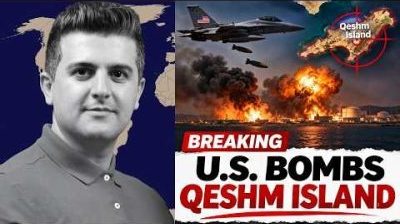
Nima R. Alkhorshid: US military bombs multiple targets on Iran’s Qeshm Island
or go to
Aletho News Archives – Video-Images
From the Archives
British Intel Tried to Make N Irish Gang ‘Shoot Up’ School, Documentary Claims
Sputnik – 23.02.2019
A new documentary, based on an interview with a self-confessed member of the Glennane Gang, gives some insights into allegations that British military intelligence was behind a shocking murder plot to cause the situation in Northern Ireland to “spiral out of control”.
In a documentary, Unquiet Graves: The Story of the Glennane Gang, John Weir, a former officer from the Royal Ulster Constabulary (RUC), alleges that British intelligence tried to persuade paramilitary group Ulster Volunteer Force (UVF) to attack a Catholic primary school at Belleeks in County Armagh.
Weir claimed that the UVF was urged to kill children and teachers in retaliation for the 1976 Kingsmill massacre, in which gunmen stopped a minibus carrying twelve workmen and shot them; only one person survived despite having been shot 18 times.
“The plan that was decided on was to shoot up a school in Belleeks”, he said, adding that the British intelligence plot was to make the situation in Northern Ireland “spiral out of control”. … continue
Blog Roll
 Aletho News
- Nima R. Alkhorshid: U.S. Military Bombs Multiple Targets on Iran’s Qeshm Island
- Iran-Linked Ships Spotted Hovering over Subsea Cables: Report
- New attack on Iran could devastate ‘Israel’, IOF general warns
- Nuclear deterrence: The US-Israeli military aggression against Iran made the unthinkable legitimate
- U.S. Midterms – a Referendum on Israel and Zionist Power
- Twice as many Canadian Jews serve in Israeli military as Canada’s armed forces: Report
- Thousands of Syrian troops set to join Saudi war on Yemen
- Jared Kushner’s Diplomacy for Hire
- Russia backs Tehran’s conditions in talks with US, Iran’s envoy says
- Irish ‘fake news’ expert exposed as fake
- If Americans Knew
- An error has occurred; the feed is probably down. Try again later.
- No Tricks Zone
- Zonal Asymmetry of Temperature Change in the Antarctic Circumpolar Current
- New Study: The Net Fossil Fuel Contribution To Rising Atmospheric CO2 Has Been Zero For 500 Years
- Germany’s Green Energy Transition Becoming Increasingly Expensive…Another 6 Trillion Euros!
- Sudden Stratospheric Warming, Powerful El Niño Combination May Lead To Extreme Europe Cold, Energy Crisis!
- Two New Studies Find Thwaites Glacier Melt Cannot Be Driven By Human Activity Or A Warming Ocean
- E-Cars Reduce CO2 Emissions By Only 41% Compared To Internal Combustion Engine Vehicles
- Predictions Made By Renowned Climate Professor Over Past Decades Have Been Proven To Be Poor
- New Study Suggests Large Regions Of The Pacific Ocean Have Been Cooling For The Last 80 Years
- Germany’s Green Energy Debacle: High Energy Costs Force Kahla Porzellan to Close After 182 Years!
- New Study: 50 Years Of The Most Aggressive ‘Net Zero’ Policies Can Only Affect The Global Climate By 0.03°C

