Israel readies extra troops, snipers and drones, for Palestinian ‘March of Return’
Courtesy: defenseindustrydaily.com
MEMO | March 27, 2018
Israeli authorities are preparing extra troops, snipers and drones ahead of the Palestinians’ planned “March of Return”, a six-week long series of actions beginning this Friday with Land Day protests.
According to the Times of Israel, Israeli occupation forces are “gearing up” for protests expected to take place along the Gaza Strip’s perimeter fence, “putting additional units on alert out of concerns that large numbers of Palestinians might try to break through the barrier and rush into Israel”.
The majority of Palestinians in the occupied and blockaded Gaza Strip are from nearby communities ethnically cleansed by Israel in the 1948 Nakba.
Land Day, which takes place annually on 30 March, marks the Israeli government’s appropriation of land from Palestinian citizens in 1976, and the bloody repression of protests against the seizure. The March of Return initiative is intended to continue until 15 May, the 70th anniversary of the Nakba.
Citing a “military source”, the Times of Israel reported that in preparation for the expected protests, “additional army battalions, Border Police units, and dozens of snipers will be deployed along the Gaza border on Friday, in order to keep demonstrators from crossing”.
In addition, “police officers will be stationed a bit farther back, in order to keep back any Palestinians who breach the first line of defence”, while “additional teams of IDF soldiers will also patrol the Israeli communities closest to the border”.
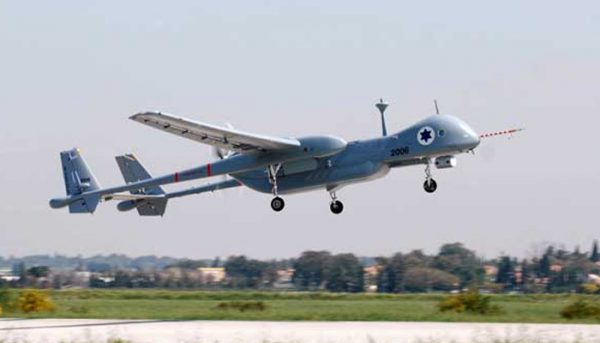
Israeli forces are also likely to “deploy drones that can drop tear gas on protesters on the Gaza side of the border, a technique that the Border Police tested earlier this month.”
In regular protests since December, Israeli occupation forces have used lethal violence against Palestinian demonstrators, killing a number of unarmed protesters and injuring hundreds more.
Let’s Investigate John Brennan
Time to find out if CIA interfered in the 2016 election

By Philip Giraldi • Unz Review • March 27, 2018
Former Central Intelligence Agency (CIA) Director John Brennan, a Barack Obama friend and protégé as well as a current paid contributor for NBC and MSNBC, has blasted President Donald Trump for congratulating President Vladimir Putin over his victory in recent Russian national elections. He said that the U.S. President is “afraid of the president of Russia” and that the Kremlin “may have something on him personally. The fact that he has had this fawning attitude toward Mr. Putin … continues to say to me that he does have something to fear and something very serious to fear.”
It is an indication of how low we have sunk as a nation that a possible war criminal like Brennan can feel free to use his former official status as a bully pulpit to claim that someone is a foreign spy without any real pushback or objection from the talking heads and billionaire manipulators that unfortunately run our country. If Trump is actually being blackmailed, as Brennan implies, what evidence is there for that? One might reasonably conclude that Brennan and his associates are actually angry because Trump has had the temerity to try to improve relations with Russia.
It is ironic that when President Trump does something right he gets assailed by the same crowd that piles on when he does something stupid, leading to the conclusion that unless The Donald is attacking another country, when he is lauded as becoming truly presidential, he cannot ever win with the inside the Beltway Establishment crowd. Brennan and a supporting cast of dissimulating former intelligence chiefs opposed Trump from the git-go and were perfectly willing to make things up to support Hillary and the status quo that she represented. It was, of course, a status quo that greatly and personally benefited that ex-government crowd which by now might well be described as the proverbial Deep State.
The claim that Trump is a Russian agent is not a new one since it is an easy mark to allege something that you don’t have to prove. During the campaign, one was frequently confronted on the television by the humorless stare of the malignant Michael Morell, former acting CIA Director, who wrote in a mind numbing August 2016 op-ed how he was proud to support Hillary Clinton because of her “commitment to our nation’s security: her belief that America is an exceptional nation that must lead in the world for the country to remain secure and prosperous; her understanding that diplomacy can be effective only if the country is perceived as willing and able to use force if necessary; and her capacity to make the most difficult decision of all: whether to put young American women and men in harm’s way.” Per Morell, she was a “proponent of a more aggressive approach [in Syria], one that might have prevented the Islamic State from gaining a foothold…”
But Morell saved his finest vitriol for Donald Trump, observing how Vladimir Putin, a wily ex-career intelligence officer “trained to identify vulnerabilities in an individual and to exploit them” obtained the services of one fairly obscure American businessman named Trump without even physically meeting him. Morell, given his broad experience as an analyst and desk jockey, notes, “In the intelligence business, we would say that Mr. Putin had recruited Mr. Trump as an unwitting agent of the Russian Federation.” An “unwitting agent” is a contradiction in terms, but one wouldn’t expect Morell to know that. Nor would John Brennan, who was also an analyst and desk jockey before he was elevated by an equally witless President Barack Obama.
So Morell is by his own words clearly an idiot, which explains a lot about what is wrong with CIA and is probably why he is now a consultant with CBS News instead of serving as Agency Director under the beneficent gaze of President Hillary Clinton.
Well, Trump’s fractured foreign policy aside, I have some real problems with folks like Michael Morell and John Brennan throwing stones. Both can be reasonably described as war criminals due to what they did during the war on terror and also as major subverters of the Constitution of the United States that has emerged as part of the saga of the 2016 election, the outcome of which, ironically, is being blamed on the Russians.
Back in 2013 John Brennan, then Obama’s counter-terrorism advisor, had a difficult time with the Senate Intelligence Committee explaining some things that he did when he was still working at CIA. He was predictably attacked by some senators concerned over the expanding drone program, which he supervised; over CIA torture; for the kill lists that he helped manage; and regarding the pervasive government secrecy, which he surely condoned to cover up the questionable nature of the assassination lists and the drones. Not at all surprisingly, he was forced to defend the policies of the administration that he was then serving in, claiming that the United States is “at war with al-Qaeda.” But he did cite his basic disagreement with the former CIA interrogation policies and expressed his surprise at learning that enhanced interrogation, which he refused to label torture because he is “no lawyer,” had not provided any unique or actionable information. He claimed that he had only “raised serious questions” in his own mind on the interrogation issue after reading the 525 page summary of the 6,000 page report prepared by the Senate Intelligence Committee which detailed the failure of the Agency program. Brennan’s reaction, however, suggested at a minimum that he had read only the rebuttal material produced by CIA that had deliberately inflated the value of the intelligence produced.
Surprisingly the subject of rendition, which Brennan must surely have been involved with while at CIA, hardly surfaced though two other interesting snippets emerged from the questioning. One was his confirmation that the government has its own secret list of innocent civilians killed by drones while at the same time contradicting himself by maintaining that the program does not actually exist and that if even if it did exist such fatalities do not occur. And more directly relevant to Brennan himself, Senator John D. Rockefeller provided an insight into the classified sections of the Senate report on CIA torture, mentioning that the enhanced interrogation program was both “managed incompetently” and “corrupted by personnel with pecuniary conflicts of interest.” One would certainly like to learn more about the presumed contractors who profited corruptly from waterboarding and one would like to know if they were in any way punished, an interesting sidebar as Brennan has a number of times spoken about the need for accountability.
Brennan was not questioned at all about the conflict of interest or ethical issues raised by the revolving door that he benefited from when he left CIA as Deputy Executive Director in 2005 and joined a British-owned company called The Analysis Corporation (TAC) where he was named CEO. He made almost certainly some millions of dollars when the Agency and other federal agencies awarded TAC contracts to develop biometrics and set up systems to manage the government’s various watch lists before rejoining the government with a full bank account to help him along his way. Brennan also reportedly knew how to return a favor, giving his former boss at CIA George Tenet a compensated advisory position in his company and also hosting in 2007 a book signing for Tenet’s At the Center of the Storm. The by-invitation-only event included six hundred current and former intelligence officers, some of whom waited for hours to have Tenet sign copies of the book, which were provided by TAC.
Brennan certainly knew how to feather his nest and reward his friends, but the area that is still murky relates to what exactly he was up to in 2016 when he was CIA Director and also quite possibly working hard to help Hillary get elected. He was still at it well after Trump got elected and assumed office. In May 2017, his testimony before Congress was headlined in a Washington Post front page featured article as Brennan’s explosive testimony just made it harder for the GOP to protect Trump. The article stated that Brennan during the 2016 campaign “reviewed intelligence that showed ‘contacts and interaction’ between Russian actors and people associated with the Trump campaign.” Politico was also in on the chase in an article entitled Brennan: Russia may have successfully recruited Trump campaign aides.
The precise money quote by Brennan that the two articles chiefly rely on is “I encountered and am aware of information and intelligence that revealed contacts and interactions between Russian officials and US persons involved in the Trump campaign that I was concerned about because of known Russian efforts to suborn such individuals. It raised questions in my mind whether or not Russia was able to gain the co-operation of those individuals.”
The testimony inevitably raises some questions about just what Brennan was actually up to. First of all, the CIA is not supposed to keep tabs on American citizens and tracking the activities of known associates of a presidential candidate should have sent warning bells off, yet Brennan clearly persisted in following the trail. What Brennan did not describe, because it was “classified,” was how he came upon the information in the first place. We know from Politico and other sources that it came from foreign intelligence services, including the British, Dutch and Estonians, and there has to be a strong suspicion that the forwarding of at least some of that information might have been sought or possibly inspired by Brennan unofficially in the first place. But whatever the provenance of the intelligence, it is clear that Brennan then used that information to request an FBI investigation into a possible Russian operation directed against potential key advisers if Trump were to somehow get nominated and elected, which admittedly was a long shot at the time. That is how Russiagate began.
So, Mr. Brennan, for all his bluster and scarcely concealed anger, has a lot of baggage, to include his possible role in coordinating with other elements in the national security agencies as well as with overseas parties to get their candidate Hillary Clinton elected. Brennan should be thoroughly investigated by Special Counsel Robert Mueller, to include subpoenaing all records at CIA relating to the Trump inquiries before requiring testimony under oath of Brennan himself with possible legal consequences if he is caught lying.
Israeli forces pound Beit Lahia in Gaza Strip following false Iron Dome alert
Press TV – March 25, 2018
Israeli forces have pounded the Palestinian town of Beit Lahia after dozens of rocket sirens sounded in southern Israel following light artillery fire from a drill carried out by Hamas’ military arm in the northern Gaza Strip.
The Iron Dome missile system was activated several times late Sunday evening as a result of the artillery fire from the Hamas’ maneuver.
There were no immediate reports on the possible casualties from the attack.
Israeli media reported multiple interceptions launched from Ashkelon following a barrage of rockets fired from Gaza. But the Israeli army later confirmed no rockets had been fired into Israel. It said the Iron dome anti-missile system was activated after heavy machine gun shooting in the Gaza strip.
The Israeli military frequently bombs the Gaza Strip, with civilians being the main target of such attacks.
Israel has also launched several wars on the Palestinian coastal sliver, the last of which began in early July 2014. The military aggression, which ended on August 26, 2014, killed nearly 2,200 Palestinians. Over 11,100 others were also wounded in the war.
The Gaza Strip has been under an Israeli siege since June 2007. The blockade has caused a decline in the standards of living as well as unprecedented levels of unemployment and unrelenting poverty.
The Israeli regime denies about 1.8 million people in Gaza their basic rights, such as freedom of movement, jobs with proper wages as well as adequate healthcare and education.
UK hiding Mideast arms sales with secret deals: Report
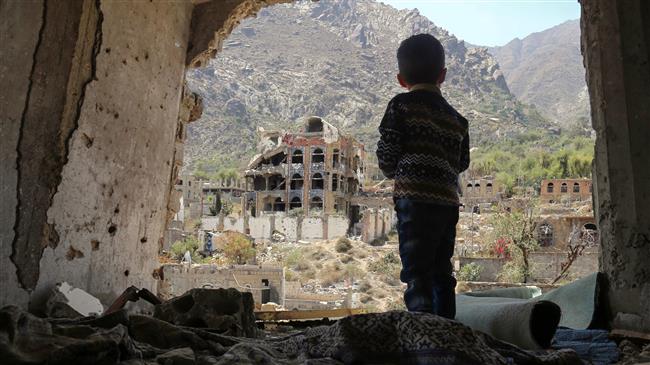
A Yemeni child looking out at buildings damaged in a Saudi airstrike in the southern Yemeni city of Ta’izz, March 18, 2018. (Photo by AFP)
Press TV – March 25, 2018
A recent report has revealed that the United Kingdom is using secretive licenses to hide the scale of its arms exports to countries with dire human rights records in the Middle East.
The Middle East Eye online news portal said figures compiled by the Campaign Against Arms Trade (CAAT) showed that the use of opaque “open licenses” to approve arms sales to states in the Middle East and North Africa by the UK government has increased by 22 percent.
According to the report, Britain has used the secretive export rules to avoid public scrutiny and hide the value of arms and their quantities.
Arms exports are worth $8.3 billion a year to the UK economy.
The MEE said defense firms have used standard open licenses to approve arms sales to the Middle East, valued at more than $4.2 billion since pledges were made by senior ministers to increase UK arms exports after the Brexit vote in June 2016.
The figures showed that the number of open arms export licenses increased from 189 to 230 from 2013 to 2017, while the number of individual items approved under these licensees rose to 4,315 from 1,201.
Saudi Arabia is by far the largest buyer of UK arms under the opaque open licensing system.
Last month, the online news portal revealed an increase of 75 percent in the use of approvals for arms exports, including vital parts for warplanes used in the Saudi aggression on Yemen.
About 14,000 people have been killed since the onset of Saudi Arabia’s military campaign against Yemen in March 2015. Much of the Arabian Peninsula country’s infrastructure, including hospitals, schools and factories, has been reduced to rubble due to the war.
Campaigners further said Britain used open licenses to approve arms sales to the United Arab Emirates, Turkey, Oman, Kuwait, Qatar, Israel, Egypt, Jordan, Bahrain, Algeria and Iraq.
The report said the UK used the secretive open licenses to export assault rifles to Turkey in 2016 as Ankara intensified its crackdown, as well as acoustic riot control devices to Egypt in 2015.
CAAT voiced concerns over the rise in the use of open licenses, which are difficult to track and not subject to public scrutiny or parliamentary oversight.
“The increase in open licenses should concern everybody. It tells us that the government wants to make a shady industry even more closed and secretive,” said Andrew Smith, spokesperson for Campaign Against Arms Trade.
“UK arms are doing terrible damage in Yemen, so it’s more important than ever that parliament and civil society are given as much information as possible so that the government can be held to account,” he added.
Fabian Hamilton, Labor’s shadow minister for peace, said, “The increases in arms exports to countries with questionable human rights records in the Middle East and North Africa must be urgently reviewed. Britain must lead by example, and confront human rights abuses head on.”
“Current government policy on this is fundamentally contradictory,” Hamilton added.
“Why 55 U.S. Senators Voted for Genocide in Yemen”
By Michael S. Rozeff | LewRockwell.com | March 24, 2108
That’s the headline of a blog. It’s a good question. There are six factors involved: Iran, sales of arms, Israel, the CIA, indifferent cruelty, and the system of empire. These are all bad reasons that shouldn’t persuade right-thinking and honorable U.S. senators, but votes for genocide do not come from right-thinking and honorable senators.
Iran. The idea is that Saudi Arabia is thwarting Iran in Yemen. The evidence for this is very, very thin, but even if the Saudis want to thwart Iran somehow in Yemen, that doesn’t justify either a war initiated by Saudi Arabia, a war of the type and scale being waged by the U.S. and Saudi Arabia, and a U.S. presence in that war.
Sales of arms. Huge sales to the Saudis are being made by U.S. companies who influence senators.
Israel. Israel is anti-Iran and in league with Saudi Arabia. Senators are influenced by the Israel lobby.
Notice that in none of these factors or those to follow does the American public play a part. The Senate is only remotely under the control of Americans on this issue, and why would it be? Americans are little affected by what their government does in Yemen, and the U.S. role is kept quite hidden. The visible and well-heeled Israel lobby is more influential than the invisible “pro-American public” lobby.
The CIA. The CIA operates an anti-al Qaeda operation inside Yemen. The war has allowed al-Qaeda to expand. This justifies an expanded CIA presence there. This benefits the CIA.
Indifferent cruelty. The lives of Yemenis count for little to those who vote for genocide. This is a characteristic of fallen man that is sometimes ameliorated by moral teachings and the threat of punishments or worse blowback, but only now and then. The institutional customs and mechanisms to control this trait are not strong enough to stop genocides.
The system of empire. Habitual cruelty is a feature of the U.S. empire. Empires enforce “order”, actually control and dominance, over broad domains that they seek to extend. They use killing to accomplish their expansion in most cases. Their victims are not counted as costs.
India doesn’t need a working relationship with US Central Command
By M K Bhadrakumar | Indian Punchline | March 23, 2018
The Indian media reported that following the 2+2 talks in Washington last week at the level of the foreign and defence secretaries of India and the US, a “path-breaking” decision has been firmed up to station a naval attaché at the US Naval Forces Command (NAVCENT) in Bahrain. The Defence Ministry officials in Delhi have reportedly said that the Indian attaché’s mandate will be to ‘ensure that the US and Indian navies are on the same page’ and to ‘ensure better coordination and logistic support for warships and aircraft carriers of the two countries.’
The NAVCENT, which comes under the US Central Command, has an area of responsibility that comprises the Red Sea, Gulf of Oman, Persian Gulf and Arabian Sea. The US Navy’s Fifth Fleet based in Bahrain is in charge of naval operations in the Persian Gulf region, Afghanistan and Pakistan. The highly secretive American base at Diego Garcia deep down in the Indian Ocean provides the underpinning for the NAVCENT.
If the proposed Indian deputation to the NAVCENT takes place, the US Pacific Command and Central Command will ‘share’ India, which would signify India’s growing importance to the US’ global strategies. The NAVCENT is currently fighting wars in Yemen, Syria, Iraq and Afghanistan. But then, India has nothing to do with any of these wars.
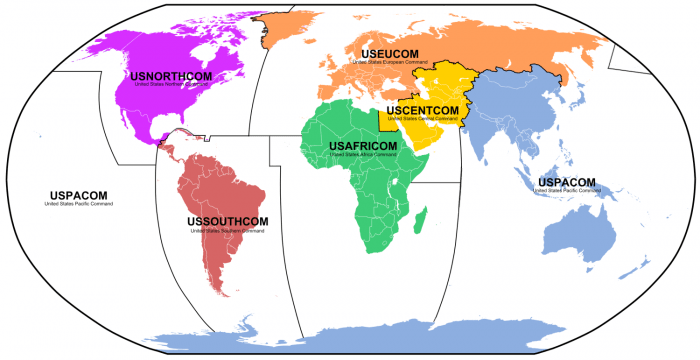
Does the US-Indian project to monitor the movement of Chinese ships in the Indian Ocean warrant such a step? Can’t we keep a tab on the Gwadar naval base without an attaché deployed to Bahrain? Are we contemplating force projection in the Indian Ocean?
On the other hand, this decision drips with profound symbolism and will be noted keenly by all regional states – especially, Iran and Pakistan – and global powers – Russia and China, in particular. Indeed, the stunning part is that, sadly, our policymakers can be so myopic about the country’s geography and the dangerous security environment surrounding it.
All indications are that a major escalation of the war in Syria is imminent. Tensions are rising alarmingly and last weekend Moscow openly warned of retaliation against US targets if it again attacked the Syrian government forces. Only two days ago, Russian Deputy Defence Minister Sergei Ryabkov said in Moscow, “We have been warning the United States about the need to abandon these plans unconditionally. Any illegal use of force… would be an act of aggression against a sovereign state.” Read the latest analysis by the Russian think tank on security issues entitled The Russian Military Warns: a Major War in Syria Is Imminent.
Again, there are sub-plots – the US plans to balkanize Syria with the help of Kurds and Turkey’s trenchant opposition to it; the US-Israeli strategy to contain Iran’s influence in Syria, Iraq and Lebanon; the NATO’s intent to evict Russia from its Syrian bases and Eastern Mediterranean and so on. Furthermore, it is only the US military support that is sustaining the brutal war waged by Saudi Arabia and the UAE in Yemen. A recent op-Ed in the Washington Post co-authored by 3 senior US senators – Bernie Sanders, Mike Lee and Chris Murphy says: “U.S. military is making the crisis (in Yemen) worse by helping one side in the conflict bomb innocent civilians… U.S. forces are coordinating, refueling and targeting with the Saudi-led coalition, as confirmed last December by Defence Secretary Jim Mattis.”
Above all, what India needs to be most vigilant about is the real possibility of a US-Iranian confrontation as a near-term scenario. The appointment of John Bolton as the new US National Security Advisor is indeed ominous. Read an analysis by the well-known investigative journalist and author Gareth Porter in the American Conservative entitled The Untold Story of John Bolton’s Campaign for War With Iran.
Our faujis are besotted with Uncle Sam. For the lucky bloke who gets the slot in Bahrain it may be an attractive ‘phoren posting’, but for India what does it add up to? India will be foolish to get entangled in the US’ military adventures. It simply won’t cut ice to say our chap will remain single-mindedly focused on the movement of Chinese ships.
Politics is largely a matter of perceptions. India gains nothing by displaying a working relationship with the US Central Command when the gathering storms on the horizon are already visible to the naked eye. The prudent thing will be to begin preparations to sequester our country from collateral damage when the tsunami actually arrives. Only fools rush in where angels fear to tread.
Daesh Resumes Training Child Soldiers in Deir ez-Zor Safe Zone – Reports
Sputnik – 23.03.2018
 According to Arab media, the Daesh terrorist group is using the de-escalation zones controlled by the US-led international coalition to reorganize and launch fresh strikes on the Syrian government army in a bid to return its former bases in al-Mayadeen and abu-Kamal.
The Arabic-language al-Manar news outlet, citing sources affiliated with the Syrian government’s armed opposition, reported that Daesh has resumed training children for its deadly operations in the Deir ez-Zor province, allegedly protected by the US and the Syrian Democratic Forces (SDF). Daesh is reportedly preparing to attack the Syrian army after the US-backed SDF declared an end to operations against the terrorist group, and following the US military expanding its presence in the region.
The terrorist group has allegedly established a military base in order to train what it described as “The Caliphate’s Lion Cubs” in Syria’s Deir ez-Zor province, adjacent to Iraq, Arab media reported. The training center for child soldiers has allegedly been set up under the supervision of the former commander of Daesh bases in Raqqa, Abu Mohammed al-Fransi; the group is said to have been recruiting a large number of Syrian and foreign children to conduct suicide operations.
Recently, the Syrian government accused Washington of providing support for Daesh and other terrorist groups in the country, including intelligence allowing the militants to attack Syrian army positions. Syrian state media, such as the SANA news agency, have also repeatedly reported that US helicopters evacuated Daesh jihadists from several areas across Deir ez-Zor, with wounded militants allegedly being sent to receive medical assistance from Medecins Sans Frontieres doctors.
According to Damascus, US air power has purportedly been used on numerous occasions to rescue terrorist leaders from elimination at the hands of the government army, and even to stage “accidental” attacks on Syrian troops as they advanced against the terrorists.
The US-led anti-Daesh coalition kicked off its campaign in Syria in 2014 without a UN mandate or the country’s government’s consent. Damascus has repeatedly denounced the offensive as a violation of its sovereignty, reiterating that Washington and its allies were never invited into the country by the internationally recognized government of President Bashar al-Assad.
Trump assailed for phoning Putin, but feting blood-soaked Saudi dictator is OK
By Finian Cunningham | RT | March 22, 2018
Donald Trump sparked outrage this week in the US over his congratulatory phone call to Russian leader Vladimir Putin on his re-election. But his obscene indulgence of a Saudi despot in the White House hardly ruffled any concern.
How disconnected from reality can you get?
There was furious reaction across US media to news that Trump phoned Russia’s President Putin to congratulate him on his landslide election victory last weekend. Republicans and Democrats were up in arms about what is just basic protocol of one leader calling another to express customary election compliments.
After all, former president Barack Obama did the same when Putin won the previous 2012 presidential election.
This time, however, US-Russian relations have become toxic after a raft of unproven allegations against Moscow, including alleged meddling in the American presidential vote in November 2016 in which Trump was elected, and the latest row over the poisoning of a former Russian double agent in England.
All these anti-Russian claims are unsubstantiated, if not outlandish, but they are repeated often enough to cast a permanent cloud over international relations. Republican Senator John McCain was widely quoted by way of expressing the bipartisan outrage over Trump’s phone call. “An American president does not lead the free world by congratulating dictators,” he said.
American critics of Russia’s Putin can quibble all they like about the merits of his re-election. They contend the vote was a foregone conclusion, rigged in his favor. But such sniping seems churlish against the overwhelming fact that Putin was supported by a huge majority of voters – nearly 77 percent.
In any case, another way of looking at this outpouring of American bile is to enquire just how credible are the detractors?
Their consternation with regard to Putin and Trump’s customary phone call seems way out of proportion, and strangely at odds with their relative silence over the visit in the same week to the White House by Saudi Crown Prince Mohammad bin Salman (MBS).
Bin Salman is the de facto leader of the desert kingdom in place of his ailing father, King Salman. The 32-year-old crown prince consolidated his autocratic power last year in a purge against other members of the House of Saud, in which hundreds of rivals where rounded up, detained, reportedly tortured, and shaken down for billions of dollars.
MBS was feted by Trump in the White House mainly because of the giant weapons purchases he has made since the American president visited the oil kingdom last year – which was Trump’s first official overseas visit.
In a bizarre photo-op, Trump held up gaudy cardboard posters proclaiming various multi-million-dollar arms sales to the Saudi regime. One such deal was depicted as being worth $525 million, to which the president quipped to his Saudi guest, “That’s peanuts to you.”
It was a grubby spectacle of just how sordid the decades-old relationship is between the US and its Arab client regime. All in the seeming salubrious setting of the Oval Office.
If the outrage over Trump’s perfunctory call to Putin had any principle over the matter of elections and autocratic rule, then the critics in Washington would have more than ample cause to fulminate against the Saudi Crown Prince being greeted in the White House. But there was barely any protest.
Admittedly, there was an attempt this week by some senators to pass a resolution limiting American military support for the Saudi war in Yemen. In the end though, the resolution was rejected by a majority of lawmakers.
However, aside from that minor show of dissent, in the scale of things the disconnect with reality in Washington and the US corporate media shows a grotesque distortion of moral priorities.
MBS was visiting Washington in the same week, marking three relentless years of US-backed Saudi slaughter in Yemen. Crown Prince Mohammad bin Salman, who also holds the position of defense minister, is the architect of the Saudi war in Yemen.
The United Nations has called the conflict in the Arab region’s poorest country “the worst humanitarian crisis in decades.”
Some eight million people – a third of the population – are facing starvation, largely because the Saudi-led war has blockaded the country from receiving food imports, medicines, and other humanitarian aid.
Thousands of civilians have been killed in airstrikes by Saudi warplanes that are supplied and refueled by the Americans, British and French. The Americans also share intelligence to direct the Saudi bombing campaign, which even pro-Western human rights groups have reported as being indiscriminate in striking civilian centers. In other words, the US and its NATO allies are fully complicit in this ongoing barbarity.
Saudi claims of fighting against Houthi rebels because the latter are orchestrated by Iran to destabilize the region are not credible. The war is all about trying to re-install a puppet leader, Abdrabbuh Mansour Hadi, who was kicked out by rebel fighters in January 2015. The Saudis launched their war with Washington’s approval in March 2015, partly out of spite over the international nuclear accord that was being negotiated at the time. The Iran nuclear deal was finalized in July 2015. Trump wants to axe it to further placate his Saudi clients.
What is going on in Yemen is nothing short of a bloodbath. Arguably, it is a genocide, given the collective punishment imposed on the entire nation by the Saudi military coalition supported by Washington.
Trump’s hosting of the Saudi crown prince this week in the White House is an obscenity. Celebrating the sale of warplanes, tanks, missiles and other munitions was a macabre drooling over the slaughter of thousands of innocents.
Of course, Trump participated in the charade that the war in Yemen is a “just cause” to counter Iranian malign influence. Iran denies any involvement, as do the Yemeni rebels. There is no evidence to support the US-Saudi claim. Besides, how could Iran supply weapons to a country that is blockaded by land, air and sea?
What is truly disturbing is how little concern the US-enabled carnage in Yemen provokes in official Washington circles and among the corporate media. Millions of Yemeni children are dying from bombardments, hunger, and diseases. The horror is real and unalloyed, unlike the situation in Syria, where the Western media have distorted Syrian Army and Russian liberation of towns besieged by NATO-backed terrorists.
For Yemen, the official silence in Washington is astounding. The very personification of the Yemeni horror – a blood-soaked Saudi despot – is welcomed and cheered, with barely a murmur of protest in Washington or the mainstream news media.
Such people have no moral compass or integrity when all they seem concerned about is their president making a phone call to an elected Russian leader.
Thus, anything they have to say regarding Putin, Russia, its elections and foreign policy is best ignored. People with such a glaring disconnect from reality are impossible to reason with. They are beneath contempt.
Read more:
Pentagon chief calls on Saudi crown prince to cease Yemen aggression
Press TV – March 22, 2018
US Defense Secretary Jim Mattis has called upon Saudi Crown Prince Mohammed bin Salman to find an “urgent” political solution to the devastating three-year-old conflict in neighboring Yemen, which has claimed the lives of thousands of people and left the impoverished nation’s infrastructure in ruins.
Mattis and bin Salman met at the Pentagon on Thursday as the de facto ruler of the Arab kingdom is on a tour of the United States, which began earlier this week with a White House visit.
“As you discussed with President (Donald) Trump on Tuesday, we must also reinvigorate urgent efforts to seek a peaceful resolution to the civil war in Yemen and we support you in this regard,” the US defense secretary told his Saudi counterpart.
“We are going to end this war; that is the bottom line. And we are going to end it on positive terms for the people of Yemen but also security for the nations in the peninsula,” Mattis added.
The Saudi crown prince, speaking through a translator, told Mattis that cooperation between the Pentagon and Saudi Arabia has “improved tremendously” of late.
The remarks came only two days after the US Senate killed a bipartisan bid seeking to end US support for Saudi Arabia’s aerial bombardment campaign in Yemen.
Mattis had lobbied Congress to reject the bill, claiming that restrictions could increase civilian casualties in Yemen, jeopardize the so-called counter-terrorism cooperation between Washington and Riyadh, and “reduce” Washington’s “influence with the Saudis.”
About 14,000 people have been killed since the onset of Saudi Arabia’s military campaign against Yemen in March 2015. Much of the Arabian Peninsula country’s infrastructure, including hospitals, schools and factories, has been reduced to rubble due to the war.
The United Nations says a record 22.2 million people are in need of food aid, including 8.4 million threatened by severe hunger.
A high-ranking UN aid official recently warned against the “catastrophic” living conditions in Yemen, stating that there is a growing risk of famine and cholera there.
“After three years of conflict, conditions in Yemen are catastrophic,” John Ging, UN director of aid operations, told the UN Security Council on February 27.
He added, “People’s lives have continued unraveling. Conflict has escalated since November driving an estimated 100,000 people from their homes.”
Ging further noted that cholera has infected 1.1 million people in Yemen since last April, and a new outbreak of diphtheria has occurred in the war-ravaged Arab country since 1982.
US OKs $1bn in Saudi military deals
Meanwhile, the US State Department said in a statement it had approved military contracts with Saudi Arabia worth over $1 billion.
According to the State Department, 6,600 TOW 2B anti-tank missiles are to be supplied under the biggest contract, which is worth $670 million.
A $106 million deal for helicopter maintenance and another contract for ground vehicle parts worth $300 million were also approved on Thursday.
The State Department said it had notified the US Congress of the possible military equipment contracts.
“This proposed sale will support US foreign policy and national security objectives by improving the security of a friendly country which has been, and continues to be, an important force for political stability and economic growth in the Middle East,” the statement said.
The three contracts are highly expected to be approved by Congress in the wake of the Senate’s Tuesday rejection of the bill to end US support for the Saudi war.
A report by the Stockholm International Peace Research Institute (SIPRI) revealed earlier this month that the US has increased its arms sales by 25 percent over the past five years.
According to the SIPRI report, Saudi Arabia increased its arms purchases by 225 percent over the past five years, importing 98 percent of its weapons from the US and EU countries.
Trump replaces national security adviser McMaster with John Bolton
Sputnik – March 22, 2018
HR McMaster will exit the role of National Security Adviser to United States President Donald Trump. Former UN Ambassador John Bolton, a prominent war hawk, will replace McMaster, Trump announced on Twitter Thursday evening.
It had been reported for weeks that McMaster and Trump were butting heads and that the US Army lieutenant general was on the brink of being removed. McMaster is the most recent of more than two dozen officials to be fired or resign from the Trump administration since the president took office 14 months ago.
“After thirty-four years of service to our nation, I am requesting retirement from the US Army effective this summer,” McMaster said in a Thursday statement, adding, “I am thankful to President Donald J. Trump for the opportunity to serve him and our nation as National Security Adviser.” McMaster will leave public service after retiring from the military.
Bolton will be Trump’s third national security adviser, following the very brief tenure of Iran hawk Michael Flynn and now McMaster.
Bolton was a major proponent of the US’ 2003 invasion of Iraq and an advocate for the overthrow of leader Saddam Hussein, positions he still defends more than a decade later.
He wrote an op-ed in the Wall Street Journal in late February outlining “the legal case for striking North Korea first.” Historian Gareth Porter told Radio Sputnik’s Loud & Clear last week that Bolton’s nomination would likely lead to a White House that is more eager to pursue a war with Iran. “During the [George W.] Bush administration,” when Bolton was the US ambassador to the UN, “there was a plan for war with Iran,” Porter said.
Like Trump, Bolton opposes the multilateral 2015 Joint Comprehensive Plan of Action, the milestone agreement intended to provide limits to and transparency on Iran’s nuclear program in exchange for sanctions relief. Trump in January recertified the deal for what he said would be the last 120-day period without major changes.
Speaking to reporters at the White House while Saudi Crown Prince Mohammad bin Salman was visiting this week, Trump stated, “The Iran deal is coming up. It’s probably another month or so, and you’re going to see what I do.” Former Secretary of State Rex Tillerson, one of the voices said to have counseled Trump that scrapping the JCPOA was a bad idea, was recently dismissed from his position in favor of former CIA Director Mike Pompeo.
Since his time in the Bush administration, Bolton has worked as a foreign policy fellow at the American Enterprise Institute. He is a Fox News contributor and frequently appears on TV as a conservative pundit.
Featured Video

or go to
Aletho News Archives – Video-Images
Book Review
The Maidan Killings and the False-Flag Case
By Freddie Ponton | 21st Century Wire | September 5, 2026
Before the killings that helped bring down Ukraine’s president in February 2014, American diplomats were discussing who should enter its government. In a leaked telephone call, senior State Department official Victoria Nuland told US ambassador Geoffrey Pyatt, “I think Yats is the guy,” referring to opposition leader Arseniy Yatseniuk. Washington had clear preferences and was working to advance them. Later that month, Yatseniuk became prime minister.
Ivan Katchanovski’s The Maidan Massacre in Ukraine examines the violence that preceded that transfer of power. Drawing on television footage, witness testimony, forensic examinations and Ukrainian court proceedings, he argues that elements of the opposition shot protesters and police in a false-flag operation. His case centres on evidence of protesters being shot from opposition-controlled locations, including Hotel Ukraina, overlooking the killing ground. … continue
Blog Roll
 Aletho News
- US Senator Murphy says Pentagon denied him entry to US base in Qatar
- Israel expands “incitement” charge to target Palestinian education and memory
- How Israel seeks to reshape Arab classrooms
- Paris bans pro-Palestinian demonstration planned for Oct. 7 over ‘risks of public disorder’
- In August Hanning Treason Case – All Signs Point To Tel Aviv.
- France cleared dozens of military sales to Israel between May and September: Report
- France projects nuclear power as Macron pushes arsenal expansion
- The fallacy of US delusions about Iran’s economic collapse
- What changes with Lula or Flávio?
- Britain leads Western media’s demise through ‘fear porn’ narrative
- If Americans Knew
- Soldier testimony sheds light on how Israel wages information war
- CIA Report Warns Israel Could Head Toward Civil War, Total Collapse
- Banker Who Exposed Howard Lutnick’s Ties to Epstein Warned of ‘Retaliation’ and ‘Personal Consequences’ in Last Post Before Suicide
- Israeli Attacks Kill Two Palestinians in Gaza
- Gaza genocide at 3: Israeli-U.S. cruelty and the smart, deep resistance to it are changing the world
- As genocide is about to enter 3rd year, little of Gaza remains– Daily Update
- “We See Our Homes Now From A Satellite, Like Strangers”
- Watch “Gaza: Doctors Under Attack”, originally censored by BBC
- NAZA: Israeli embassies in UK and US promote rival documentary to challenge Gaza genocide allegations
- David Ellison appoints Israeli to lead merged Paramount-Warner studios
- No Tricks Zone
- US September “Heat” Was No Record…Many Records Set Decades Ago
- Latest European Green Energy Debacle; Portugal’s Largest Flagship Solar Park Insolvent!
- Green Energy Debacle: German Expert Professor Fritz Vahrenholt Warns Of Severe Economic And Social Consequences
- Two More Paleo Reconstructions Affirm Meters-Higher Sea Levels Across Ireland, Brazil 7000-6000 Years Ago
- New Study: Earth And Venus Surface Warmth Largely Explained By Convection And Lapse Rate, Not CO2 Or Radiation
- 2025 Nature Paper Claiming Worsening Global Drought Gets RETRACTED …Heavily Flawed
- New Study: ‘Global Drought Shows No Detectable Recent Acceleration Under Climate Warming’
- Economic Masterminds: German Socialists Suggest Taxing Productivity Gains Stemming From Using AI
- The South China Sea Has Not Been Cooperating With The Climate Change Narrative
- Energy Crisis: Germany Enters Heating Season With Historically Low Gas Reserve Fill Levels

