Iraq +15: Accumulated Evil of the Whole
By Nat Parry | Consortium News | March 19, 2018
Robert Jackson, the Chief United States Prosecutor at the Nuremberg Trials of Nazi war criminals, once denounced aggressive war as “the greatest menace of our time.” With much of Europe laying in smoldering ruin, he said in 1945 that “to initiate a war of aggression … is not only an international crime: it is the supreme international crime differing only from other war crimes in that it contains within itself the accumulated evil of whole.”
When it comes to the U.S. invasion of Iraq 15 years ago today, the accumulated evil of the whole is difficult to fully comprehend. Estimates of the war’s costs vary, but commonly cited figures put the financial cost for U.S. taxpayers at upwards of a trillion dollars, the cost in Iraqi lives in the hundreds of thousands, and U.S. soldier deaths at nearly 5,000. Another 100,000 Americans have been wounded and four million Iraqis driven from their homes as refugees.
As staggering as those numbers may be, they don’t come close to describing the true cost of the war, or the magnitude of the crime that was committed by launching it on March 19-20, 2003. Besides the cost in blood and treasure, the cost to basic principles of international justice, long-term geopolitical stability, and the impacts on the U.S. political system are equally profound.
Lessons Learned and Forgotten
Although for a time, it seemed that the lessons of the war were widely understood and had tangible effects on American politics – with Democrats, for example, taking control of Congress in the midterm elections of 2006 based primarily on growing antiwar sentiment around the country and Barack Obama defeating Hillary Clinton in the 2008 primaries based largely on the two candidates’ opposing views on the Iraq War – the political establishment has, since then, effectively swept these lessons under the rug.
One of those lessons, of course, was that proclamations of the intelligence community should be treated with huge grain of salt. In the build-up to war with Iraq a decade and a half ago, there were those who pushed back on the politicized and “cherry-picked” intelligence that the Bush administration was using to convince the American people of the need to go to war, but for the most part, the media and political establishment parroted these claims without showing the due diligence of independently confirming the claims or even applying basic principles of logic.
For example, even as United Nations weapons inspectors, led by Swedish diplomat Hans Blix, were coming up empty-handed when acting on tips from the U.S. intelligence community, few within the mainstream media were willing to draw the logical conclusion that the intelligence was wrong (or that the Bush administration was lying). Instead, they assumed that the UN inspectors were simply incompetent or that Saddam Hussein was just really good at hiding his weapons of mass destruction.
Yet, despite being misled so thoroughly back in 2002 and 2003, today Americans show the same credulousness to the intelligence community when it claims that “Russia hacked the 2016 election,” without offering proof. Liberals, in particular, have hitched their wagons to the investigation being led by Special Counsel Robert Mueller, who is widely hailed as a paragon of virtue, while the truth is, as FBI Director during the Bush administration, he was a key enabler of the WMD narrative used to launch an illegal war.
Mueller testified to Congress that “Iraq has moved to the top of my list” of threats to the domestic security of the United States. “As we previously briefed this Committee,” Mueller said on February 11, 2003, “Iraq’s WMD program poses a clear threat to our national security.” He warned that Baghdad might provide WMDs to al-Qaeda to carry out a catastrophic attack in the United States.
Mueller drew criticism at the time, including from FBI whistleblower Coleen Rowley, for conflating Iraq and al-Qaeda, with demands that the FBI produce whatever evidence it had on this supposed connection.
Today, of course, Mueller is celebrated by Democrats as the best hope for bringing down the presidency of Donald Trump. George W. Bush has also enjoyed a revival of his image thanks largely to his public criticisms of Trump, with a majority of Democrats now viewing the 43rd president favorably. Many Democrats have also embraced aggressive war – often couched in the rhetoric of “humanitarian interventionism” – as their preferred option to deal with foreign policy challenges such as the Syrian conflict.
When the Democratic Party chose Clinton as its nominee in 2016, it appeared that Democrats had also embraced her willingness to use military force to achieve “regime change” in countries that are seen as a threat to U.S. interests – whether Iraq, Iran or Syria.
As a senator from New York during the build-up for military action against Iraq, Clinton not only voted to authorize the U.S. invasion, but fervently supported the war – which she backed with or without UN Security Council authorization. Her speech on the floor of the Senate on Oct. 10, 2002 arguing for military action promoted the same falsehoods that were being used by the Bush administration to build support for the war, claiming for example that Saddam Hussein had “given aid, comfort, and sanctuary to terrorists, including al-Qaeda members.”
“If left unchecked,” she said, “Saddam Hussein will continue to increase his capacity to wage biological and chemical warfare, and will keep trying to develop nuclear weapons. Should he succeed in that endeavor, he could alter the political and security landscape of the Middle East, which as we know all too well affects American security.”
Clinton maintained support for the war even as it became obvious that Iraq in fact had no weapons of mass destruction – the primary casus belli for the war – only cooling her enthusiasm in 2006 when it became clear that the Democratic base had turned decisively against the war and her hawkish position endangered her chances for the 2008 presidential nomination. But eight years later, the Democrats had apparently moved on, and her support for the war was no longer considered a disqualification for the presidency.
One of the lessons that should be recalled today, especially as the U.S. gears up today for possible confrontations with countries including North Korea and Russia, is how easy it was in 2002-2003 for the Bush administration to convince Americans that they were under threat from the regime of Saddam Hussein some 7,000 miles away. The claims about Iraq’s WMDs were untrue, with many saying so in real time – including by the newly formed group Veteran Intelligence Professionals for Sanity, which was regularly issuing memoranda to the president and to the American people debunking the falsehoods that were being promoted by the U.S. intelligence community.
But even if the claims about Iraq’s alleged stockpiles were true, there was still no reason to assume that Saddam Hussein was on the verge of launching a surprise attack against the United States. Indeed, while Americans were all but convinced that Iraq threatened their safety and security, it was actually the U.S. government that was threatening Iraqis.
Far from posing an imminent threat to the United States, in 2003, Iraq was a country that had already been devastated by a U.S.-led war a decade earlier and crippling economic sanctions that caused the deaths of 1.5 million Iraqis (leading to the resignation of two UN humanitarian coordinators who called the sanctions genocidal).
Threats and Bluster
Although the invasion didn’t officially begin until March 20, 2003 (still the 19th in Washington), the United States had been explicitly threatening to attack the country as early as January 2003, with the Pentagon publicizing plans for a so-called “shock and awe” bombing campaign.
“If the Pentagon sticks to its current war plan,” CBS News reported on January 24, “one day in March the Air Force and Navy will launch between 300 and 400 cruise missiles at targets in Iraq. … [T]his is more than the number that were launched during the entire 40 days of the first Gulf War. On the second day, the plan calls for launching another 300 to 400 cruise missiles.”
A Pentagon official warned: “There will not be a safe place in Baghdad.”
These public threats appeared to be a form of intimidation and psychological warfare, and were almost certainly in violation of the UN Charter, which states: “All Members shall refrain in their international relations from the threat or use of force against the territorial integrity or political independence of any state, or in any other manner inconsistent with the Purposes of the United Nations.”
The Pentagon’s vaunted “shock and awe” attack began with limited bombing on March 19-20, as U.S. forces unsuccessfully attempted to kill Hussein. Attacks continued against a small number of targets until March 21, when the main bombing campaign began. U.S.-led forces launched approximately 1,700 air sorties, with 504 using cruise missiles.
During the invasion, the U.S. also dropped some 10,800 cluster bombs on Iraq despite claiming that only a fraction of that number had been used.
“The Pentagon presented a misleading picture during the war of the extent to which cluster weapons were being used and of the civilian casualties they were causing,” reported USA Today in late 2003. Despite claims that only 1,500 cluster weapons had been used resulting in just one civilian casualty, “in fact, the United States used 10,782 cluster weapons,” including many that were fired into urban areas from late March to early April 2003.
The cluster bombs killed hundreds of Iraqi civilians and left behind thousands of unexploded bomblets that continued to kill and injure civilians weeks after the fighting stopped.
(Because of the indiscriminate effect of these weapons, their use is banned by the international Convention on Cluster Munitions, which the United States has refused to sign.)
Attempting to kill Hussein, Bush ordered the bombing of an Iraqi residential restaurant on April 7. A single B-1B bomber dropped four precision-guided 2,000-pound bombs. The four bunker-penetrating bombs destroyed the target building, the al Saa restaurant block and several surrounding structures, leaving a 60-foot crater and unknown casualties.
Diners, including children, were ripped apart by the bombs. One mother found her daughter’s torso and then her severed head. U.S. intelligence later confirmed that Hussein wasn’t there.
Resistance and Torture
It was evident within weeks of the initial invasion that the Bush administration had misjudged the critical question of whether Iraqis would fight. They put up stiffer than expected resistance even in southern Iraqi cities such as Umm Qasr, Basra and Nasiriya where Hussein’s support was considered weak, and soon after the fall of the regime on April 9, when the Bush administration decided to disband the Iraqi army, it helped spark an anti-U.S. insurgency led by many former Iraqi military figures.
Despite Bush’s triumphant May 1 landing on an aircraft carrier and his speech in front of a giant “Mission Accomplished” banner, it looked as though the collapse of the Baathist government had been just the first stage in what would become a long-running war of attrition. After the Iraqi conventional forces had been disbanded, the U.S. military began to notice in May 2003 a steadily increasing flurry of attacks on U.S. occupiers in various regions of the so-called “Sunni Triangle.”
These included groups of insurgents firing assault rifles and rocket-propelled grenades at U.S. occupation troops, as well as increasing use of improvised explosive devices on U.S. convoys.
Possibly anticipating a long, drawn-out occupation and counter-insurgency campaign, in a March 2003 memorandum Bush administration lawyers devised legal doctrines to justify certain torture techniques, offering legal rationales “that could render specific conduct, otherwise criminal, not unlawful.”
They argued that the president or anyone acting on the president’s orders were not bound by U.S. laws or international treaties prohibiting torture, asserting that the need for “obtaining intelligence vital to the protection of untold thousands of American citizens” superseded any obligations the administration had under domestic or international law.
“In order to respect the President’s inherent constitutional authority to manage a military campaign,” the memo stated, U.S. prohibitions against torture “must be construed as inapplicable to interrogations undertaken pursuant to his Commander-in-Chief authority.”
Over the course of the next year, disclosures emerged that torture had been used extensively in Iraq for “intelligence gathering.” Investigative journalist Seymour Hersh disclosed in The New Yorker in May 2004 that a 53-page classified Army report written by Gen. Antonio Taguba concluded that Abu Ghraib prison’s military police were urged on by intelligence officers seeking to break down the Iraqis before interrogation.
“Numerous incidents of sadistic, blatant and wanton criminal abuses were inflicted on several detainees,” wrote Taguba.
These actions, authorized at the highest levels, constituted serious breaches of international and domestic law, including the Convention Against Torture, the Geneva Convention relative to the treatment of Prisoners of War, as well as the U.S. War Crimes Act and the Torture Statute.
They also may have played a role in the rise of the ISIS terror group, the origins of which were subsequently traced to an American prison in Iraq dubbed Camp Bucca. This camp was the site of rampant abuse of prisoners, one of whom, Abu Bakr al-Baghdadi, later became the leader of ISIS. Al-Baghdadi spent four years as a prisoner at Bucca, where he started recruiting others to his cause.
America’s Weapons of Mass Destruction
Besides torture and the use of cluster bombs, the crimes against the Iraqi people over the years included wholesale massacres, long-term poisoning and the destruction of cities.
There was the 2004 assault on Fallujah in which white phosphorus – banned under international law – was used against civilians. There was the 2005 Haditha massacre, in which 24 unarmed civilians were systematically murdered by U.S. marines. There was the 2007 “Collateral Murder” massacre revealed by WikiLeaks in 2010, depicting the indiscriminate killing of more than a dozen civilians in the Iraqi suburb of New Baghdad – including two Reuters news staff.
There is also the tragic legacy of cancer and birth defects caused by the U.S. military’s extensive use of depleted uranium and white phosphorus. In Fallujah the use of depleted uranium led to birth defects in infants 14 times higher than in the Japanese cities targeted by U.S. atomic bombs at close of World War II, Hiroshima and Nagasaki. Noting the birth defects in Fallujah, Al Jazeera journalist Dahr Jamail told Democracy Now! in 2013:
“And going on to Fallujah, because I wrote about this a year ago, and then I returned to the city again this trip, we are seeing an absolute crisis of congenital malformations of newborn. … I mean, these are extremely hard to look at. They’re extremely hard to bear witness to. But it’s something that we all need to pay attention to, because of the amount of depleted uranium used by the U.S. military during both of their brutal attacks on the city of 2004, as well as other toxic munitions like white phosphorus, among other things.”
A report sent to the UN General Assembly by Dr. Nawal Majeed Al-Sammarai, Iraq’s Minister of Women’s Affairs, stated that in September 2009, Fallujah General Hospital had 170 babies born, 75 percent of whom were deformed. A quarter of them died within their first week of life.
The military’s use of depleted uranium also caused a sharp increase in Leukemia and birth defects in the city of Najaf, which saw one of the most severe military actions during the 2003 invasion, with cancer becoming more common than the flu according to local doctors.
By the end of the war, a number of Iraq’s major cities, including Fallujah, Ramadi, and Mosul, had been reduced to rubble and by 2014, a former CIA director conceded that the nation of Iraq had basically been destroyed.
“I think Iraq has pretty much ceased to exist,” said Michael Hayden, noting that it was fragmented into multiple parts which he didn’t see “getting back together.” In other words, the United States, using its own extensive arsenal of actual weapons of mass destruction, had completely destroyed a sovereign nation.
Predictable Consequences
The effects of these policies included the predictable growth of Islamic extremism, with a National Intelligence Estimate – representing the consensus view of the 16 spy services inside the U.S. government – warning in 2006 that a whole new generation of Islamic radicalism was being spawned by the U.S. occupation of Iraq. According to one American intelligence official, the consensus was that “the Iraq war has made the overall terrorism problem worse.”
The assessment noted that several underlying factors were “fueling the spread of the jihadist movement,” including “entrenched grievances, such as corruption, injustice, and fear of Western domination, leading to anger, humiliation, and a sense of powerlessness,” and “pervasive anti-U.S. sentiment among most Muslims all of which jihadists exploit.”
But rather than leading to substantive changes or reversals in U.S. policies, the strategy agreed upon in Washington seemed to be to double down on the failed policies that had given rise to radical jihadist groups. In fact, instead of withdrawing from Iraq, the U.S. decided to send a surge of 20,000 troops in 2007. This is despite the fact that public opinion was decidedly against the war.
A Newsweek poll in early 2007 found that 68 percent of Americans opposed the surge, and in another poll conducted just after Bush’s 2007 State of the Union Address, 64 percent said Congress was not being assertive enough in challenging the Bush administration over its conduct of the war.
An estimated half-million people marched on Washington on Jan. 27, 2007, with messages for the newly sworn in 110th Congress to “Stand up to Bush,” urging Congress to cut the war funding with the slogan, “Not one more dollar, not one more death.” A growing combativeness was also on display in the antiwar movement with this demonstration marked by hundreds of protesters breaking through police lines and charging Capitol Hill.
Although there were additional large-scale protests a couple months later to mark the sixth anniversary of the invasion, including a march on the Pentagon led by Iraq War veterans, over the next year the antiwar movement’s activities steadily declined. While fatigue might explain some of the waning support for mass mobilizations, much of the decline can also surely be explained by the rise of Barack Obama’s candidacy. Millions of people channeled their energies into his campaign, including many motivated by a hope that he represented real change from the Bush years.
One of Obama’s advantages over Clinton in the Democratic primary was that he had been an early opponent of the Iraq War while she had been one of its most vocal supporters. This led many American voters to believe in 2008 that they had elected someone who might rein in some of the U.S. military adventurism and quickly end U.S. involvement in Iraq. But this wasn’t to be the case. The combat mission dragged on well into President Obama’s first term.
War, War and More War
After its well-publicized failures in Iraq, the U.S. turned its attention to Libya, overthrowing the government of Muammar Gaddafi in 2011 utilizing armed militias implicated in war crimes and backed with NATO air power. Following Gaddafi’s ouster, his caches of weapons ended up being shuttled to rebels in Syria, fueling the civil war[sic] there. The Obama administration also took a keen interest in destabilizing the Syrian government and to do so began providing arms that often fell into the hands of extremists.
The CIA trained and armed so-called “moderate” rebel units in Syria, only to watch these groups switch sides by joining forces with Islamist brigades such as ISIS and Al Qaeda’s affiliate the Nusra Front. Others surrendered to Sunni extremist groups with the U.S.-provided weapons presumably ending up in the arsenals of jihadists or sometimes just quit or went missing altogether.
Beyond Syria and Libya, Obama also expanded U.S. military engagements in countries including Yemen, Somalia, Pakistan, and sent a surge of troops to Afghanistan in 2009. And despite belatedly withdrawing U.S. forces from Iraq, with the last U.S. troops finally leaving on December 18, 2011, Obama also presided over a major increase in the use of drone strikes and conventional air wars.
In his first term, Obama dropped 20,000 bombs and missiles, a number that shot up to over 100,000 bombs and missiles dropped in his second term. In 2016, the final year of Obama’s presidency, the U.S. dropped nearly three bombs every hour, 24 hours a day.
Obama also had the distinction of becoming the fourth U.S. president in a row to bomb the nation of Iraq. Under criticism for allowing the rise of ISIS in the country, Obama decided to reverse his earlier decision to disengage with Iraq, and in 2014 started bombing the country again. Addressing the American people on Sept. 10, 2014, President Obama said that “ISIL poses a threat to the people of Iraq and Syria, and the broader Middle East including American citizens, personnel and facilities.”
“If left unchecked,” he continued, “these terrorists could pose a growing threat beyond that region, including to the United States. While we have not yet detected specific plotting against our homeland, ISIL leaders have threatened America and our allies.”
Of course, this is precisely the result that many voices of caution had warned about back in 2002 and 2003, when millions of Americans were taking to the streets in protest of the looming invasion of Iraq. And, to be clear, it wasn’t just the antiwar left urging restraint – establishment figures and paleoconservatives were also voicing concern.
Retired Gen. Anthony Zinni, for example, who served as a Middle East envoy for George W. Bush, warned in October 2002 that by invading Iraq, “we are about to do something that will ignite a fuse in this region that we will rue the day we ever started.” Brent Scowcroft, national security adviser in the first Bush administration, said a strike on Iraq “could unleash an Armageddon in the Middle East.”
No matter, Bush was a gut player who had made up his mind, so those warnings were brushed aside and the invasion proceeded.
Campaign 2016
When presidential candidate Donald Trump began slamming Bush for the Iraq War during the Republican primary campaign in 2015 and 2016, calling the decision to invade Iraq a “big fat mistake,” he not only won over some of the antiwar libertarian vote, but also helped solidify his image as a political outsider who “tells it like it is.”
And after Hillary Clinton emerged as the Democratic nominee, with her track record as an enthusiastic backer of virtually all U.S. interventions and an advocate of deeper involvement in countries such as Syria, voters could have been forgiven for getting the impression that the Republican Party was now the antiwar party and the Democrats were the hawks.
As the late Robert Parry observed in June 2016, “Amid the celebrations about picking the first woman as a major party’s presumptive nominee, Democrats appear to have given little thought to the fact that they have abandoned a near half-century standing as the party more skeptical about the use of military force. Clinton is an unabashed war hawk who has shown no inclination to rethink her pro-war attitudes.”
The antiwar faction within the Democratic Party was further marginalized during the Democratic National Convention when chants of “No More War” broke out during former Defense Secretary Leon Panetta’s speech. The Democratic establishment responded with chants of “USA!” to drown out the voices for peace and they even turned the lights out on the antiwar section of the crowd. The message was clear: there is no room for the antiwar movement inside the Democratic Party.
While there were numerous factors that played a role in Trump’s stunning victory over Clinton in November 2016, it is no stretch of the imagination to speculate that one of those factors was lingering antiwar sentiment from the Iraq debacle and other engagements of the U.S. military. Many of those fed up with U.S. military adventurism may have fallen for Trump’s quasi-anti-interventionist rhetoric while others may have opted to vote for an alternative party such as the Libertarians or the Greens, both of which took strong stances against U.S. interventionism.
But despite Trump’s occasional statements questioning the wisdom of committing the military to far-off lands such as Iraq or Afghanistan, he was also an advocate for war crimes such as “taking out [the] families” of suspected terrorists. He urged that the U.S. stop being “politically correct” in its waging of war.
So, ultimately, Americans were confronted with choosing between an unreconstructed regime-changing neoconservative Democratic hawk, and a reluctant interventionist who nevertheless wanted to teach terrorists a lesson by killing their children. Although ultimately the neocon won the popular vote, the war crimes advocate carried the Electoral College.

Nawar al-Awlaki, 8, killed by US drone 1/29/17
Following the election it turned out that Trump was a man of his word when it came to killing children. In one of his first military actions as president, Trump ordered an attack on a village in Yemen on Jan. 29, 2017, which claimed the lives of as many as 23 civilians, including a newborn baby and an eight-year-old girl, Nawar al-Awlaki.
Nawar was the daughter of the al-Qaeda propagandist and American citizen Anwar al-Awlaki, who was killed in a September 2011 U.S. drone strike in Yemen.
Normalized Aggression
2017, Trump’s first year in office, turned out to be the deadliest year for civilians in Iraq and Syria since U.S. airstrikes began on the two countries in 2014. The U.S. killed between 3,923 and 6,102 civilians during the year, according to a tally by the monitoring group Airwars. “Non-combatant deaths from Coalition air and artillery strikes rose by more than 200 per cent compared to 2016,” Airwars noted.
While this spike in civilian deaths did make some headlines, including in the Washington Post, for the most part, the thousands of innocents killed by U.S. airstrikes are dismissed as “collateral damage.” The ongoing carnage is considered perfectly normal, barely even eliciting a comment from the pundit class.
This is arguably one of the most enduring legacies of the 2003 invasion of Iraq – an act of military aggression that was based on false pretenses, which brushed aside warnings of caution, and blatantly violated international law. With no one in the media or the Bush administration ever held accountable for promoting this war or for launching it, what we have seen is the normalization of military aggression to a level that would have been unimaginable 20 years ago.
Indeed, I remember well the bombing of Iraq that took place in 1998 as part of Bill Clinton’s Operation Desert Fox. Although this was a very limited bombing campaign, lasting only four days, there were sizable protests in opposition to the military action. I joined a picket of a couple hundred people in front of the White House holding a hand-made sign reading “IMPEACH HIM FOR WAR CRIMES” – a reference to the fact that Congress was at the time impeaching him for lying about a blowjob.
Compare that to what we see today – or, more accurately what we don’t see today – in regards to antiwar advocacy. Despite the fact that the U.S. is now engaged in at least seven military conflicts, there is little in the way of peace activism or even much of a national debate over the wisdom, legality or morality of waging war. Few even raise objections to its significant financial cost to U.S. taxpayers, for example the fact that one day of spending on these wars amounts to about $200 million.
Fifteen years ago, one of the arguments of the antiwar movement was that the war on terror was morphing into a perpetual war without boundaries, without rules, and without any end game. The U.S., in other words, was in danger of finding itself in a state of endless war.
We are now clearly embroiled in that endless war, which is a reality that even Senate war hawk Lindsey Graham acknowledged last year when four U.S. troops were killed in Niger. Claiming that he didn’t know that the U.S. had a military presence in Niger, Graham – who chairs the Senate Subcommittee on State, Foreign Operations, and Related Programs – stated that “this is an endless war without boundaries, no limitation on time or geography.”
Although it wasn’t clear whether he was lamenting or celebrating this endless and borderless war, his words should be taken as a warning of where the U.S. stands on this 15th anniversary of the U.S. invasion of Iraq – in a war without end, without boundaries, without limits on time or geography.
Syrian Army Intercepts Truck Heading to Terrorists in Eastern Ghouta
Sputnik – March 17, 2018
The Syrian armed forces carried out a successful military operation intercepting a truck containing weapons and ammunition intended for terrorists, a representative of Syrian intelligence told Sputnik.
“We organized an ambush, as a result of which a large truck carrying ammunition and weapons has been intercepted; some of the equipment is made in America. Also there were medicines and equipment for satellite communication there. All this was intended for militants in Ghouta,” the spokesman said.
The operation was carried out after Syrian intelligence received information on the transfer of a large batch of weapons, ammunition and equipment for armed groups in the region.
A video that appeared online shows ammunition and weapons found in the truck, including smoke grenades with the inscription “Salisbury England.”
According to the officer, it is not the first time that the Syrian army manages to intercept a cargo intended for the militants.
A few days earlier, Syrian forces intercepted a car that was carrying ammunition, mortar shells, guns and missiles to the region.
The success of the operation will be a serious blow for the terrorists and will contribute to the weakening of armed groups in Eastern Ghouta, the spokesman concluded.
READ MORE:
Humanitarian Pause in Action: Nearly 13,000 Civilians Flee E Ghouta — MoD
The Tip of the Iceberg: My Lai Fifty Years On
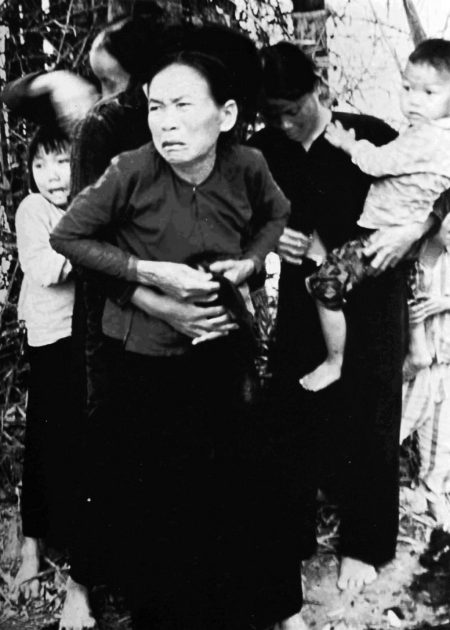
Women and children at My Lai moments before they were killed. Photograph : Ron Haberle/WikiCommons
By Michael Uhl | Mekong Review | February, 2018 edition
Monsters exist, but they are too few in number to be truly dangerous. More dangerous are the common men, the functionaries ready to believe and to act without asking questions.
— Primo Levy
On March 17th, 1968, The New York Times ran a brief front page lede headed, “G.I.s’ in Pincer Movement Kill 128 in Daylong Battle;” the action took place the previous day roughly eight miles from Quang Ngai City, a provincial capital in the northern coastal quadrant of South Vietnam. Heavy artillery and helicopter gunships had been “called in to pound the North Vietnamese soldiers.” By three in the afternoon the battle had ceased, and “the remaining North Vietnamese had slipped out and fled.” The American side lost only two killed and several wounded. The article, datelined Saigon, had no byline. Its source was an “American military command’s communique,” a virtual press release hurried into print and unfiltered by additional digging.
Several days later a more superficially factual telling of this seemingly crushing blow to the enemy was featured in Southern Cross, the weekly newsletter of the Americal Division in whose ‘area of operation’ the ‘day long battle’ had been fought. It was described by Army reporter Jay Roberts, who had been there, as “an attack on a Vietcong stronghold,” not an encounter with North Vietnamese regulars as the Times had misconstrued it. However, Roberts’ article tallied the same high number of enemy dead. When leaned on by Lt. Colonel Frank Barker, who commanded the operation, to downplay the lopsided outcome, Roberts complied, noting blandly that “the assault went off like clockwork.” But certain after action particulars could not be fudged. Roberts was obliged to report that the GIs recovered only “three [enemy] weapons,” a paradox that surely warranted clarification. None was given. It was to be assumed that, either the enemy was poorly armed, or that he had removed the weapons of his fallen comrades – leaving their bodies to be counted – when he retired from the field. Neither of the news outlets cited here, nor Stars and Stripes, the semi-official newspaper of the U. S. Armed Forces which ran with Robert’s account, makes reference to any civilian casualties.
It would be nearly eighteen months later when, on September 6, 1969, a front page article in the Ledger-Enquire in Columbus, Georgia reported that the military prosecutor at nearby Ft. Benning – home of the U. S. Army Infantry – was investigating charges against a junior officer, Lieutenant William L. Calley, of “multiple murders” of civilians during “an operation at a place called Pinkville,” GI patois for the color denoting man-made features on their topographical maps in a string of coastal hamlets near Quang Ngai.
With the story now leaked, if only in the regional papers – it would migrate as well to a daily in Montgomery, Alabama – the Ft. Benning public information officer moved to “keep the story low profile,” and “released a brief statement that The New York Times ran deep inside its September 7, 1969 issue,” limited to three terse paragraphs on a page cluttered with retail advertising. The press announcement from the Army flack had referred only to “the deaths of more than one civilian.” In the nation’s newspaper of record, which also mentioned Calley by name, this delicate ambiguity was multiplied to “an unspecified number of civilians.” Yet, once again, the Times was enlisted to serve the agenda of a military publicist, and failed to approach the story independently.
An Army recon commando named Rod Ridenhour had taken it upon himself to do just that. While still serving with the Americal Division’s 11th Light Infantry Brigade from which Task Force Barker – named for its commander – was assembled for the attack on Pinkville, Ridenhour documented accounts of those who had witnessed or participated in a mass killing. A year later in March 1969, now stateside and a civilian, Ridenhour sent “a five page registered letter” summarizing his findings to President Richard Nixon, the Joint Chiefs of Staff, and select members of the U.S. Congress urging “a widespread and public investigation.” General William Westmoreland, who had commanded U.S. forces in Vietnam until June 1968, reacted to Ridenhour’s allegations with “disbelief.” The accusations were, he told a Congressional committee, “so out of character with American forces in Vietnam that I was quite skeptical.” Nonetheless an inquiry was launched.
The Times, although forewarned, had once again squandered a chance to scoop for its global readership what was arguably the most sensational news story of the entire Vietnam War. The two regional reporters had done their legwork, then, bereft of big city resources had nowhere else to go. But in late October, a seasoned freelance journalist in Washington named Seymour Hersh, acting on a colleague’s anonymous tip from inside the military, immediately “stopped all other work and began to chase down the story,” which by mid-November 1969 would be revealed to the American public and the world at large as the My Lai massacre.
This outline of the massacre’s initial falsification and suppression, followed by its eventual disclosure, is cobbled from My Lai: Vietnam, 1968, and the Descent into Darkness (Oxford, 2017), a thorough retreatment of the infamous Vietnam War atrocity by Howard Jones, a professor of history at the University of Alabama. The question is, to what end? Has the voluminous, careful study in the literature devoted to the My Lai massacre left something out? It’s not a matter of omissions, the historian argues, but that the record is replete with conflicting interpretations. To tell the “full story” required Jones to reorder events in their “proper sequence,” he says. His other reasons for taking us back to Pinkville are equally vague, and casually embedded among several floating asides in the author’s Acknowledgments. His debts are many, but foremost among them Jones recognizes his Vietnamese-American graduate assistant who “emphasized the importance of incorporating the Vietnamese side into the narrative and remaining objective in telling the story.”
I took this profession of objectivity as a signal to be on the alert for its potential subjective or editorial opposite. Jones insists that “everyone who has written… about My Lai has had an agenda.” The suspicion that a subtle revisionist agenda, nurtured perhaps by the resentments of a partisan of the losing side [his assistant], might underlie Jones’ intentions for revisiting this much examined massacre was heightened by the anecdote he tells about his wife’s emotionally fraught response when listening to his grim descriptions of the slaughter. However revolting, the atrocities must be detailed she insists. To do otherwise, the author agrees “would leave the mistaken impression that nothing extraordinary took place at My Lai.”
That My Lai was extraordinary I hold beyond dispute. But the privileged attention given to the massacre by historians and other commentators – not to mention its impact on the general public – which by far prefers vivid superlatives to cloudy comparisons – hangs like a curtain and obscures the broader and far grizzlier picture of the U.S. driven horrors of the Vietnam War that were commonplace and quotidian. Would the historian tell that story too, I wondered, as I plunged into his text? Or was the only purpose to take up this subject again five decades on to ensure that the censorious curtain remained firmly in place?
Quang Ngai was a hot bed of resistance under the Viet Minh independence movement during French colonial rule. With the transition to the American War, resistance fighters – now reconstituted as the National Liberation Front, or Viet Cong – remained capable of striking at will throughout the province, which, until 1967, was under the jurisdiction of the South Vietnamese Army. But the American command found its native allies unreliable, without ever asking if perhaps their reluctance to challenge the local resistance rested, not on fear or cowardice, but familiarity or even kinship. U.S. soldiers possessed no such scruples.
After “intelligence sources” targeted the area around My Lai as “an enemy bastion for mounting attacks” on Quang Ngai City and its surroundings, American forces were concentrated under Task Force Barker, “a contingent of five hundred soldiers” to bring the troublesome province under control of the government of South Vietnam.[i]
On the evening before the assault, Captain Earnest Medina – like Calley a principal target of the Army’s subsequent investigation – briefed the hundred men of Charlie Company under his command. “We’re going to Pinkville tomorrow… after the 48th Battalion,” he told them. “The landing zone will be hot. And they outnumber us two to one… expect heavy casualties.” Charlie Company had already taken “heavy casualties” in the two months they’d been humping the boonies of Quang Ngai. The local guerrilla unit, the lethal, elusive 48th, was all the more feared since the GIs had never seen the face of a single combatant behind the sniper bullets or booby traps that bloodied and killed their comrades. “By the last week of February,” Harold Jones reckons, “resentment and hostility had spread among the GI’s, aimed primarily at the villagers.”
Pinkville had been declared a free fire zone. The mission for the assault was to search and destroy. If the soldiers encountered non-combatant villagers the text book regulations dictated they be detained and interrogated as to the whereabouts of the enemy, and then moved to safety in the rear. But the various strands of intelligence-gathering that guided Task Force Barker were interpreted to suggest there would be no non-combatants, because the villagers had been warned to evacuate, or, given that the assault was on a Saturday, those residents who’d defied evacuation would be off to the market in Quang Ngai City. This was all Intel double talk. The true military objective was that the residents have no village to return to because the GIs were primed to slay all livestock, lay waste to every dwelling and defensive bunker, destroy the crops and foul the wells, that is, to ensure that My Lai and its contiguous hamlets were left uninhabitable, and thus utterly untenable as bases to support the guerrillas.
Beginning just before 8 a.m. on March 16th, the three platoons of Charlie Company were airlifted to the fringes of the Vietnamese hamlets where they expected to encounter fierce enemy resistance. The hail of bullets from helicopter gunships that churned up the earth around them and aimed at suppressing potential enemy fire, created for many of these soldiers who had never experienced combat the impression that they’d been dropped in the midst of the “hot landing zone” Captain Medina had promised them. But as Army photographer Ron Haeberle, assigned to document the assault, would later testify, there was “no hostile fire.” The headquarters of the 48th and what remained of its fighters had taken refuge west into the mountains after being decimated during the Tet Offensive a month before. And the few VC who had been visiting their families around My Lai, hardly ignorant of American movements, had gotten out by dawn on the 16th.
In a state of confusion as to exactly what they were facing, Charlie Company’s platoons stepped off from opposing positions to sweep through the village, already partially damaged by artillery, intending to squeeze the enemy between them. Instead they soon confronted, not the guerrilla fighters they were sent to dislodge, but scores of inhabitants who weren’t supposed to be there. GIs immediately shot several villagers who panicked and attempted to flee. In this war such trigger happy killings were not far from the norm. But Lieutenant Calley “had interpreted Medina’s briefing to mean that they were to kill everyone in the village… Since it was impossible to distinguish between friend and foe, the only conclusion was to presume all Vietnamese were Viet Cong and to kill them all.” Calley, moreover, was being relentlessly spurred by Medina over the radio to quicken the pace of the 1st platoon’s forward sweep, and therefore, would later claim, he could neither evacuate the non-combatants, nor, for reasons of security, leave them to his rear.
Jones offers from the record a facsimile of the field radio transmission between Calley and his commander:
“What are you doing now?” Medina asked.
“I’m getting ready to go.”
“Now damn it! I told you now. Get your men in position now.”
“And these people, they aren’t moving too swiftly.”
“I don’t want that crap. Now damn it, waste all those goddamn people! And get in the damn position.”
“Roger.”
The idea of questioning orders, comments Jones dryly, never crossed Calley’s mind, particularly during combat.
One brief panel of the horror show will suffice to roil the imagination toward grasping what Jones styles a ‘descent into darkness,” which, given the scale of the ensuing carnage that morning, has elevated the My Lai massacre to the extraordinary status in the Vietnam War that history has bestowed upon it.
Calley, in the grip of all his embedded demons – his mental and moral mediocrity, his cracker barrel knee jerk racism, his incompetence as a leader, his slavish kowtowing to authority which clearly disgusted his commander and his troops, everything that conspired to create the monster that was him – returned from his latest whipping by Medina to where one group of villagers sat on the ground, and demanded of two members of his platoon, “How come you ain’t killed them yet?” The men explained they understood only that they were to guard them. “No,” Calley said, “I want them dead… When I say fire… fire at them.” Calley and, Paul Meadlo – whose name would become almost as closely associated with the massacre as Calley’s – “a bare ten feet from their terrified targets… set their M-16s on automatic… and sprayed clip after clip of deadly fire into their screaming and defenseless victims… At this point, a few children who had somehow escaped the torrent of gunfire struggled to their feet… Calley methodically picked off the children one by one… He looks like he’s enjoying it,” one soldier remarked, who moments before had been prevented by Calley from forcing a young woman’s face into his crotch, but who now refused to shoot.
The mass killing, which Harold Jones parades scene by scene with exhaustive precision, was repeated throughout the morning until the bodies of hundreds of villagers lay scattered across the landscape. Not just those killed by Calley’s platoon, but by others throughout the rest of Charlie Company. And not just at My Lai 4, but also at My Khe 4 several miles distant by members of Bravo Company. “In not a few cases, women and girls were raped before they were killed.” Jones dutifully chronicles the accounts of the few who resolutely refused to shoot, and of one man who blasted his own foot with a .45 to escape the depravity. “Everyone except a few of us was shooting,” Pfc. Dennis Bunning of the second platoon would later testify.
But there was another man that morning who didn’t just seek to avoid the killing, he attempted to stop it.
Warrant Officer Hugh Thompson piloted his observation helicopter, a three seater with a crewmember on each flank armed with a machine gun, several hundred feet above My Lai. Thompson’s mission was to fly low and mark with smoke grenades any source of enemy fire, which would prompt the helicopter gunships tiered above him – known as Sharks – to swoop down and dispense their massive fire power on the target. Spotting a large number of civilian bodies in a ditch, Thompson at first suspected they’d been killed by the incoming artillery. Hovering near the ground for a closer look Thompson and his crew, Gary Andreotta and Larry Colburn, were stunned to witness Captain Medina shoot a wounded woman who was lying at his feet. Banking closer to the ditch, Thompson “estimated he saw 150 dead and dying Vietnamese babies, women and children and old men… and watched in disbelief as soldiers shot survivors trying to crawl out.”
Against regulations, Thompson landed and confronted Lieutenant Calley, asking him to help the wounded and radio for their evacuation. Calley made it clear he resented the pilot’s interference and would do no such thing. Thompson stormed away furiously warning Calley “he hadn’t heard the last of this.” With Medina again at his heels, Calley ordered his sergeant “to finish off the wounded,” and just as Thompson was taking off the killing resumed.
Aloft again Thompson saw “a small group… of women and children scurrying toward a bunker just outside My Lai 4… and about ten soldiers in pursuit,” and felt “compelled… to take immediate action.” He again put his craft down, jumped out between the civilians and the oncoming members of the second platoon led by Lieutenant Stephen Brooks. When Thompson asked Brooks to help evacuate the Vietnamese from the bunker, Brooks told him he would do so with a grenade. The two men screamed at each other. Like Calley, Brooks was unyielding, and Thompson warned his two gunners, now standing outside the chopper, “to prepare for a confrontation.”
“I’m going to go over to the bunker myself and get those people out. If they [the soldiers] fire on those people or fire on me while I’m doing that. Shoot ‘em.” That moment has been cast in the My Lai literature as a classic armed standoff. But Thompson’s two gunners had not aimed their weapons at Brooks and his men who stood fifty yards away, a bit of manufactured drama several chroniclers of that confrontation, among them Sy Hersh, have chiseled into the record. Harold Jones in this instance had gone beyond the dogged task of compilation. While researching his book, he had spent many hours with Larry Colburn, and befriended him. And it was Larry who told Jones that he and Andreotta did not aim their weapons directly at the soldiers who faced them. They tried to stare then down, “while carefully pointing their weapons to the ground in case one of them accidentally went off.” This verisimilitude restores a dimension of realism to a scene imagined by those who’d never been soldiers.
Checking Brooks, but failing to get his cooperation, Thompson took another extraordinary step. He radioed Warrant Officer Danny Millians, one of the pilots of the gunships, and convinced him to also defy the protocols against landing in a free fire zone. Then, in two trips, Millians used the Shark to transport the nine rescued Vietnamese, including five children, to safety. Making one final pass over the ditch where he’d locked horns with Calley, Thompson “hovered low… searching for signs of life while flinching at the sight of headless children.” Thompson landed a third time, remaining at the controls. He watched as Colburn, from the side of the ditch, grabbed hold of a boy that Andreotta, blood spilling from his boots, had pulled from among a pile of corpses. Do Hoa, a boy of eight, had survived.
Livid and in great distress at what he had witnessed, Thompson, on returning to base, and in the company of the two gunship pilots, made their superior, Major Frederic Watke, immediately aware of “the mass murder going on out there.” From that moment, every step taken to probe and verify “the substance of Thompson’s charges almost instantly came into dispute.” Although Watke would later tell investigators he believed Thompson was “over-portraying” the killings” owing to his “limited combat experience,” the major had realized that the mere charge of war crimes obliged him “to seek an impartial inquiry at the highest level.” The Military Assistance Command, Vietnam (MACV) required that field commanders investigate “all known, suspected or alleged war crimes or atrocities… Failure to [do so] was a punishable offense.” Having reported Thompson’s allegations to Task Force commander Barker, Watke had fulfilled this duty. But there was a Catch-22 permitting command authority to ignore the MACV directive if they “thought” a war crime had not been committed.
The trick here was for Barker and several other ranking officer in the division and brigade chain of command to assess if civilians had been killed during the assault, and if so, how many. Captain Medina – in addition to contributing to the fictional enemy body count – would supply a figure of “thirty civilians killed by artillery.” The division chaplain would characterize these deaths as “tragic… an operational mistake… in a combat operation.” For this line of argument to carry, however, it had been necessary for the commander of the Americal Division, Major General Samuel Koster, the “field commander” who alone possessed the authority to prevent the accusations from going higher, to put his own head deep into the sand.
When Colonel Orin Henderson, who commanded the 11th Infantry Brigade from which Medina’s Charlie Company had been detailed to the Task Force, ordered LTC Barker in the late afternoon of March 16th to send Charlie Company back to My Lai 4 to “make a detailed report of the number of men, women and children killed and how they died, along with another search for weapons… Medina strongly objected.” It would be too dangerous, he said, to move his men “in the dark through a heavily mined and booby trapped area… where the Vietcong could launch a surprise attack.” Monitoring the transmission between Barker and Medina, General Koster countermanded Henderson’s order. Later claiming he was “concerned for the safety of the troops,” Koster saw “no reason to go look at that mess.” Medina’s estimate of the number of civilian deaths, Koster ruled, was “about right.”
Not only had Koster’s snap judgement given Barker license to cook up the initial battlefield fantasy of 128 enemy dead, it ensured that the internal investigations into the charges of “mass murder,” notably by Henderson and other high ranking members of Koster’s staff, would not deviate from the conclusion voiced by the division commander. By navigating each twisting curve along a well camouflaged path toward the fictive end those in command were seeking, Harold Jones lays bare a virtual text book case of conspiracy, which must be read in its entirety to capture the intricate web of fabrication and self-deception the conspirators constructed to assure themselves the crypt of the cover-up had been sealed.[ii]
When discussing the massacre later at an inquiry, the Americal Division chaplain, faithful to the Army but not his higher calling, claimed that, had a massacre been common knowledge, it would have come out. That the massacre was “common knowledge” to the Vietnamese throughout Quang Ngai Province on both sides of the conflict (not to mention among their respective leadership on up to Hanoi and Saigon) goes without saying. Indeed low ranking local South Vietnamese officials attempted to stir public outrage about the massacre (not to mention negotiate the urgent remedy of compensation for the victims), and were suppressed by the Quang Ngai Province Chief, a creature of the Saigon government who fed at the trough of U.S. materiel and did not wish to risk the good will of his American sponsors. My Lai was quickly recast as communist propaganda, pure and simple.
While this proved a viable method of suppression for South Vietnamese authorities, it could not still tales of the massacre in the scuttlebutt of the soldiers who had been there, who had carried it out. From motives said to be high minded, but not fueled by an anti-military agenda, and in the piecemeal fact-gathering manner typical of any investigation, the whistleblower Ron Ridenhour had thus resurrected the buried massacre, and bestowed on Sy Hersh the journalistic coup of a lifetime.
As the articles and newscasts about what took place at My Lai were cascaded before the public in November 1969, efforts to manage the political fallout by various levels of government were accelerated with corresponding intensity. Pushing back at the center of that storm were Richard Nixon and other members of the Executive; congressional committees in both the House and Senate; and not least, and in some cases with considerably more integrity than their civilian political masters, members of the professional military.
Not surprisingly, if one understands anything about American society, a substantial portion of the public, in fact its majority, expressed far greater sympathy for William Calley than for his victims. One could cite endemic American racism as a contributing factor for this unseemly lack of human decency. More broadly speaking, an explanation less charged by aggression would point to a level of provincialism that apparently can only afflict a nation as relatively pampered as my own. In such an arrangement, turning a blind eye for expedience sake toward the pursuit of global power, consequences be damned, is as good as a national pastime.
Despite the spontaneous public sympathy for Calley, Nixon, fretted that news of My Lai would strengthen the antiwar movement and “increase the opposition to America’s involvement in Vietnam.” Nixon, true to form, lashed out with venom at the otherness of his liberal enemies. “It’s those dirty rotten Jews in New York who are behind this,” Nixon ranted, learning that Hersh’s investigation had been subsidized by the Edgar B. Stern Family Fund, “clearly left-wing and anti-Administration.” Nixon was strongly pressed to “attack those who attack him… by dirty tricks… discredit one witness [Thompson] and highlight the atrocities committed by the Viet Cong.” Only Secretary of Defense Melvin Laird seemed to grasp that manipulation of public opinion would not perfume the stink of My Lai. The public might tolerate “a little of this,” Laird mused, “but you shouldn’t kill that many.” There was apprehension in the White House because calls for a civilian commission had begun to escalate. Habituated to work the dark side, and unbeknownst to his Secretary of Defense, Nixon formed a secret task force “that would seek to sabotage the investigative process by undermining the credibility of all those making massacre charges.”
Nixon found a staunch ally for this strategy in Mendel Rivers, the “hawkish” Mississippi Democrat who chaired the House Armed Services Committee. As evidence from the military’s internal inquiries mounted to prove the contrary, members of River’s committee sought to establish that no massacre had occurred, and that the only legitimate targets of interest were Hugh Thompson and Larry Colburn (Gary Andreotta having been killed in an air crash soon after the massacre), who were pilloried at a closed hearing, virtually accused of treason for turning their guns on fellow Americans.
During a televised news conference on December 8th – with Calley’s court martial already under way for three weeks – Nixon announced that he had rejected calls for an independent commission to investigate what he now admitted for the first time “appears to have been a massacre.” The President would rely instead on the military’s judicial process to bring “this incident completely before the public.” The message the Administration and its pro-war allies would thenceforth steam shovel into the media mainstream wherever the topic was raised, was that My Lai was “an isolated incident,” and by no means a reflection of our “national policy” in Vietnam.
As maneuvers to re-consign the massacre to oblivion faltered, the Army was just then launching a commission of its own under a three-star general, William Peers, whose initial charge was to disentangle the elaborate cover-up within the Americal Division that had kept the massacre from exposure for almost two years. In order to reconcile the divergent testimonies among its witnesses, the scope of the Peers Commission soon necessarily expanded to gather a complete picture of the event the cover-up sought to erase. The Army’s criminal investigation by the CID, on which charges could be based, and which would guide any eventual legal proceedings, continued on a separate track and beyond the public eye as a matter of due process.
After Lieutenant General Peers had submitted the commission’s preliminary report, Secretary of the Army, Stanley Resor moved to soften the “abrupt and brutal” language. He requested that Peers not refer “to the victims as elderly men, women, children and babies,” but as “noncombatant casualties.” And might Peers “also be less graphic in describing the rapes?” Resor further edited the word “massacre” from the report, and when presenting it to the press, had the chair of his commission describe My Lai rather as “a tragedy of major proportions.” Peers was reportedly indignant, but complied. It required no such compulsion to ensure that Peers toe the line on a far more central theme. Responding to questions from the media, Peers insisted there had been no cover-up at higher levels of command beyond the Americal Division, and echoed his Commander in Chief’s mantra that My Lai was an isolated incident. When Peers was questioned about what took place at My Khe that same day, he insisted it was inseparable from what occurred at My Lai. No reporter followed up with a challenge to that assertion.
Investigators had a long list of suspects deployed at My Lai and My Khe in Task Force Barker, as well as those throughout the Americal chain of command, who they believed should be charged and tried. Some forty enlisted men were named, along with more than a dozen commissioned officers. [iii] Only six among them, two sergeants and four officers would ultimately stand trial. There would be no opportunity to enlarge the scope of the massacre through the spectacle of a mass trial that would, moreover, conjure images of Nuremburg and Tokyo where America dispensed harsh justice on its defeated enemies only two decades earlier. It was agreed upon by both Nixon and the Pentagon Chiefs that defendants would be tried separately and at a spread of different Army bases.
If the elaborate subterfuge employed to cover-up the massacre had been the work of individuals desperate to protect their professional military careers, the court martial proceedings reveal how an entire institution operates to protect itself. George Clemenceau, French Prime Minister during the First World War, is credited with the droll observation that ‘military music is to music what military justice is to justice.” Harold Jones, using the idiom of the historian, demonstrates in his summaries of the trials the disturbing reality behind Clemenseau’s quip.
First before the bar at Fort Hood, Texas in November 1969 was Calley’s platoon sergeant David Mitchell, that witnesses described as someone who carried out the lieutenant’s orders with a particular gusto. Then in January it was Sergeant Charles Hutto’s turn at Fort McPhearson, Georgia. Hutto had admitted turning his machine gun on a group of unarmed civilians. These two men were so patently guilty in the eyes of their own comrades that theirs were among the strongest cases the investigators had constructed for the prosecution. Both men were acquitted in trials that can only be described as judicial parodies.
At Mitchell’s trial the judge, ruling on a technicality, did not allow the prosecution to call witnesses with the most damning testimony, like Hugh Thompson. Hutto had declared in court that “it was murder,” but claimed “we were doing it because we had been told.” When the jury refused to convict him because Hutto had not known that some orders could be illegal, Harold Jones nails how the court was sanctioning “the major argument that had failed to win acquittal at Nuremburg.”
Shortly after Hutto’s trial, the Army dropped all charges against the remaining soldiers, fearing their claims to have been following orders would likewise find merit in the prevailing temper of the military juries. Heeding the judicial trend, Lieutenant General Jonathan Seaman, a regional commander exercising jurisdiction over officers above the rank of captain, dropped all charges against Major General Koster. By some opaque calculation which convinced no one, Seaman had concluded that Koster was not guilty of “intentional abrogation of responsibilities.” A hue and cry followed in the press and on Capitol Hill denouncing Seaman for “a white wash of the top man.” The outcry did prod the Pentagon to take punitive action against Koster. The general had already been dismissed as the commandant of West Point, and he was now demoted to brigadier general and stripped of his highest commendation.
Seaman informed Koster through internal channels that he held him “personally responsible” for My Lai, a kind of symbolic snub among gentlemen. But in exonerating the Americal commander, Seaman had, by design it can be argued, inoculated the higher reaches of command straight up to General Westmoreland from being held responsible for the actions of their subordinates, a blatant act of duplicity in light of the ruling at the Tokyo trials following World War II where lack of knowledge of atrocities committed by his troops had not prevented General Yamaschita from being hanged.
With Calley’s court martial already in progress, only three other officers, Medina and the Task Force Barker intelligence officer, Captain Eugene Kotouc, for war crimes, and 11th Brigade commander Henderson, for the cover-up, remained to be tried. Harold Jones deftly unspools how the flawed and self-protective system of military justice enabled trial judges in each case to provide improvised instructions to their juries which had all but dictated the acquittal of all three men. Kotouc had been charged with murdering a prisoner, whom, given the available evidence, he almost certainly had; still the jury found him not guilty in less than an hour. Asked if he would stay in the military, Kotouc gushed, “Who would get out of a system like this… it’s the best damn army in the world.”[iv]
Henderson’s and Medina’s trials were media spectacles in their own right, but mere side shows compared with the main event at Fort Benning, Georgia. The Calley trial opened in November, soon after the My Lai revelation. By the middle of March when the talented young prosecutor, Captain Aubrey Daniel, began his closing argument, a great majority of Americans had been glued to the courtroom drama for four months. Calley had a courtly elderly gent, George Latimer, a former Chief Justice of the Utah Supreme Court, and later an original member of the U.S. Court of Military Appeals, to lead his defense. Clearly Latimer knew his way around the arcana of military justice; moreover as a veteran of World War II who had achieved the rank of colonel, he was of the very caste. Latimer was confident he’d prevail. As the trial progressed, the testimony of nearly one hundred witnesses so prejudiced his client that Latimer desperately veered the defense toward an insanity plea, a strategy which foundered after three Army psychiatrists judged the accused to possess “the mental capacity to premeditate.” Finally Calley took the witness stand and quickly blundered. Under a rigorous cross-examination, Captain Daniel marched Calley back across the killing fields of Pinkville, at each step recapping eyewitness accounts, including the testimony of Hugh Thompson. Before he grasped the significance of his misstep, Calley had confessed to shooting into the ditch filled with Vietnamese victims. The verdict seemed ordained.
Yet, it was no slam dunk for the prosecution. The jury took eighty hours to deliberate, in the end finding Calley guilty of murder by a vote of four to two, one ballot shy of a mistrial, if not an outright acquittal. As a capital felony, Calley might have received the death penalty, but Daniel argued only for life imprisonment. On March 29, 1970 the judge agreed and passed sentence. Calley appeared shaken as he faced the court. Surely the shrinks had gotten it wrong in not certifying a case of mental dissociation as acutely obvious as Calley’s? He seemed the perfect robotic tool of the Cold War. Hadn’t he been madly insisting all along that he had not been killing humans, but only communists, including babes at the breast who would grow up one day to be communists themselves? Then again, maybe Calley wasn’t as clueless and out of touch as he came across. In addressing the judge at sentencing, one could read in Calley’s plea, “I beg you… do not strip future soldiers of their honor” as he had been stripped of his, a message defending the common man and shrewdly aimed at a wider audience beyond the courtroom that the defendant must have known was substantially in his corner.
The polls quickly confirmed this. 79% of the public opposed the conviction. Across an ideological divide embracing both the war’s supporters and opponents, a large majority saw Calley as a scapegoat, one man custom-made to bear the blame for the entire Vietnam fiasco. Nixon played this public frustration to his advantage. There was little opposition when the President saw fit to have the prisoner removed from the stockade, where he’d spent just one night, and returned to his own Ft. Benning apartment. Calley would serve only three and a half years under house arrest before going free, but, after the trial, he quickly faded into anonymity.
At the White House, only a week after the verdict, National Security Advisor Henry Kissinger reassured Nixon that “the public furor… [had] quieted down… Let the judicial process… take its normal course,” counselled Kissinger. Liberal efforts to stir “a feeling of revulsion against the deed,” and turn the trial into a referendum against the war, had failed. “In fact the deed itself didn’t bother anybody,” Kissinger added. “No,” Nixon agreed, picking up eagerly on his advisor’s cynical drift. “The public said, ‘Sure he was guilty but, by God, why not?’ ” Both laughed.[v]
The “deed” these two twisted political misanthropes found so amusing is memorialized at a shrine today in the My Lai township listing the names of the massacre’s 504 victims, more than half of whom were under the age of twenty, to include “forty-nine teenagers, 160 aged four to twelve, and fifty who were three years old or younger.”
In reflecting on the sordid tale he has chosen to historicize anew, and on its reduction by the U.S. political and military establishments to a judicial farce, Harold Jones explains how, “My Lai made it imperative nonetheless that the army institute major changes in training.” And further that “to understand the importance of restraint in combat, soldiers and officers must learn to disobey illegal orders… and the importance of distinguishing between ‘unarmed civilians… and the people who are shooting at us.’” Jones documents the extensive effort undertaken to incorporate this thinking by updating the rules of war, to “make them more specific, then teach, follow and enforce them.”
But in examining the next most infamous atrocity of modern memory committed by U.S. forces at Abu Ghraib during the recent Iraq War, Jones concludes that “the central problem… lies less in writing new laws and regulations than in having officers who enforce those already in effect.” That officers may not be inclined to such enforcement underscores the apparently insoluble dilemma of an autocratic institution, the military, at the heart of a civilian democracy to which it is, in principle, subordinate. But we have already been shown over a panoply of legal proceedings that, at least in its capacity to dispense justice, the military is a power unto itself.[vi] Jones does not follow that thought directly, but rather indulges in a philosophical aside which dilutes the unhappy subject of his history in the horrors that attend all wars, concluding darkly that, in the right situation, we are all “one step away from My Lai.”
It’s not that the historian entirely buys Nixon’s aberration line; Jones does refer to other reported atrocities in VN. But he does buy Peers’ “right situation” explanation for why My Lai stands out, quoting the Peers Commission report that “none of the other [investigated] crimes even remotely approached the magnitude… of My Lai.” That would depend on how one defines “magnitude.” Peers had failed to do the math, and so has Jones. The American invasion, and occupation for over a decade, left a trail of bloodshed and destruction throughout Vietnam that led elements of the antiwar movement worldwide to level the charge of genocide against the U.S.
What one pro-war historian lamented as a veritable “war crimes industry,” had sprung up within the U.S., not from the campuses of the middle class protestors, but among the ranks of returning veterans, who for roughly two years after My Lai was exposed, brought accounts of atrocities they had participated in or witnessed before the American public. Harold Jones, to demonstrate historical balance, provides a cursory account of this effort, referring to a “sizeable segment of Vietnam veterans who considered… that My Lai was not an isolated incident and that Calley had become a scapegoat for the high ranking civilian and military officials who drew up the policies responsible for the atrocities.”
Having already established that Nixon denied the link between My Lai and “national policy,” Jones does not engage the argument further. But the war veterans (including the present writer) were not suggesting that the policy of genocide was etched in a secret covenant buried in a Pentagon vault. We were saying, in effect, don’t just look at the record body count attached to the slaughter at Pinkville, and imagine you have a true picture of American crimes in that war. Count the day to day toll of Vietnamese civilian deaths that resulted from premeditated frames like “mass population transfers” – the Strategic Hamlet program, or “chemical warfare” – the saturation of the countryside with phenoxy herbicides like Agent Orange, that were already prohibited by the conventions of war to which the U.S. was a signatory.
Other strategic tools, the Air War, and the relentless, not atypically indiscriminate, bombardment by artillery and naval guns, were employed by American forces against the “unpacified” countryside with unprecedented savagery.[vii] While these displays of massive fire power are thought to have created the highest proportion of civilian casualties during the war, the battlefield tactics – search and destroy operations in free fire zones, systematic torture and murder of prisoners, the “mere gook rule,” that turned every dead Vietnamese into an enemy body count, were a close second. These are facts available to anyone who cares to know them.[viii]
In both detail and presentation Harold Jones, with My Lai: Vietnam, 1968, and the Descent into Darkness, has produced a work of considerable value, and it is fair to acknowledge that the work, as recently characterized in a brief note by the New York Times Book Review, must now be considered the standard reference for the massacre. As for the scale and volume of terrors inflicted on the Vietnamese people during the American War, Jones, hewing close to official doctrine in the U.S., fails to acknowledge that My Lai was just the tip of the iceberg.[ix]
Michael Uhl served with the 11th Light Infantry Brigade as leader of a combat intelligence team eight months after the My Lai massacre. On return from Vietnam he joined the antiwar movement, and organized fellow veterans to make public their personal accounts of American atrocities in Vietnam. He presents this history in the war memoir, Vietnam Awakening (McFarland, 2007).
Notes.
[i]. Heonik Kwon, in his study, After the Massacre: Commemoration and Consolation in Ha My and My Lai (University of California Press, 2006), attributed to allied forces operating in Quang Ngai Province, notably units of the ROK (Republic of Korea) Marines (p.44), “at least six large scale civilian massacres during the first three months of 1968… Two secret reports made by the district communist cells to the provincial authority recorded nineteen incidents of mass killings during this short period. The tragedy of mass killings had already been witnessed in Quang Ngai in 1966.”
In their recent documentary film series on the Vietnam War, Ken Burns and Lynn Novick reported that no province suffered more than Quang Ngai during the war, and no place was more dangerous for operating militarily.
[ii]. The author’s account of the cover-up reads as definitive; Harold Jones here follows closely Seymour M. Hersh in Cover Up (Random House, 1972).
[iii]. This would not include Barker, himself, who had died a month after the massacre when his helicopter crashed during a combat mission.
[iv]. This quote (p. 347) is from Four Hours in My Lai, by Michael Bilton and Kevin Sim, (Penguin, 1993), the standard work on the massacre for the past twenty-five years.
[v]. Harold Jones is reporting here from what he heard on the Nixon tapes recorded on April 8, 1971.
[vi] . One portrait of what has been called the West Point Protective Association embodying the Army’s Spartan ethic, can be found in a highly charged expose, co-authored by a former academy graduate, West Point: America’s Power Fraternity, by Bruce Calloway and Robert Bowie Johnson (Simon and Schuster, 1973).
[vii]. An extensive account of the Air War in Quang Ngai Province is found in The Real War by Jonathan Schell (Da Capo Press, 1988).
[viii]. The Vietnam Memorial Wall in Washington, D.C. with the names of the 58,282 American war dead is 475 feet long; a wall inscribed with the names of the Vietnamese war dead would go on for miles.
[ix]. Herbicide poisoning and unexploded ordnance are legacy issues of the war that continue to take their toll on Vietnamese victims to this day.
Michael Uhl is the author of Vietnam Awakening.
Trump’s New CIA Director Oversaw Torture in ‘Black Sites’
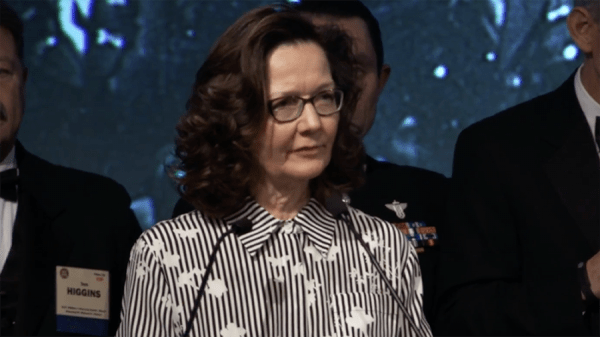
Gina Haspel © The OSS Society / YouTube
teleSUR | March 13, 2018
Gina Haspel, who is accused of overseeing torture interrogation cases in a “black site” in Thailand, is now the head of the U.S. Central Intelligence Agency, after President Donald Trump appointed Mike Pompeo as the new secretary of state following the sacking of Rex Tillerson.
Haspel became the CIA’s deputy chief in 2017 despite multiple accusations linking her to torture cases as an undercover official.
She was responsible for the CIA’s first overseas detention center in Thailand, known as Cat’s Eye base or Detention Site Green, where suspects Abu Zubaydah and Abd al-Rahim Nashiri were brutally interrogated in 2002 for their alleged involvement in the al-Qaida network.
According to the Intelligence Committee’s investigation, Zubaydah was waterboarded 83 times and slammed into walls between Aug. 4 and 23, 2002. He was beaten so brutally he lost consciousness with water bubbling up from his lungs that doctors had to revive him. He also lost sight in his left eye before interrogators decided he didn’t have any valuable information.
Zubaydah’s torture was videotaped and stored in Thailand until 2005, when Haspel and Jose Rodriguez, then director of operations and head of the National Clandestine Service, ordered the footage be destroyed without previous consultation or authorization by the U.S. Congress. Al-Nashiri’s torture tape was also destroyed.
In June 2017, the European Center for Constitutional and Human Rights filed a lawsuit to German federal prosecutors against Haspel for her involvement in the Thailand torture cases. The complaint states that psychologist James Mitchell and Bruce Jessen were the only two people authorized to contact Zubaydah, and that they were under Haspel’s supervision.
But during the first years of the new “war on terror” that started after the Sept. 11, 2001 events, the George Bush administration considered waterboarding and other torture interrogation techniques to be legal.
Haspel became Rodriguez’ chief of staff in 2003, who back then was the director of the Counterterrorism Center. As chief of staff, Haspel ran programs that commonly used torture methods on suspects, including sleep deprivation, coffins and waterboarding to conduct brutal interrogations.
According to John Sifton from Human Rights Watch, Haspel was also one of the senior officials running the Rendition, Detention and Interrogation (RDI) CIA program, which had the aim of kidnapping suspects all around the world and handing them to other countries for interrogation, which more than often also included torture.
U.S. President Donald Trump has said multiple times he thinks that torture works and has vowed to bring waterboarding back. Trump’s policy is reflected in the decision to make Haspel first Deputy Director and then Director of the U.S. intelligence agency.
“If Ms. Haspel seeks to serve at the highest levels of U.S. intelligence, the government can no longer cover up disturbing facts from her past,” said Senator Ron Wyden, a Democratic member of the Senate Intelligence Committee.
And Mike Pompeo as the new Secretary of State doesn’t inspire much hope either. The former CIA director supports waterboarding and other intense interrogation techniques, saying they “don’t even constitute torture” and praising “patriots” who have used such methods to counter terrorism.
Other advocates of waterboarding deny the method is a kind of torture, and even call it “enhanced interrogation.”
Haspel’s position has yet to be ratified by the Senate.
Al-Nusra terrorists used chlorine chemicals in Eastern Ghouta – Russian envoy to UN
RT | March 12, 2018
Russia’s envoy to the UN Vassily Nebenzia has accused militant groups in Eastern Ghouta of using chlorine gas, while stressing that the Syrian government has every right to eradicate the “terrorism hotbed” near its capital.
Nebenzia has defended Syria’s government and the ongoing anti-terrorism operation in Eastern Ghouta, asserting that it has “every right to try and remove the threat to the safety of its citizens.”
“According to information at our disposal, on March 5, Al-Nusra militants used chlorine substance in Eastern Ghouta, which injured 30 civilians. All this is done to prepare the grounds for unilateral military actions against sovereign Syria,” Nebenzia stated.
“The suburbs of Damascus cannot remain a hotbed of terrorism. And it is being used for continued attempts by terrorists to undermine the cessation of hostilities.”
The ongoing operation in the Damascus suburbs does not violate resolution 2401, which allows the continuation of the battle against terrorists, the diplomat stressed. The terrorists, unlike Moscow and Damascus, do, in fact, frequently attack hospitals and other civilian facilities, and the attacks are well-documented, he added.
“Since the resolution was passed, more than 100 people died from this and a considerably higher number were wounded. More than one hospital… was shelled,” Nebenzia said. “These were true hospitals, genuine hospitals, not headquarters of fighters which they very frequently claim to be hospitals.”
The militants also are preventing the civilians from leaving the combat zone, raining mortar and sniper fire on them.
“They [militants] are constantly striking humanitarian corridors and checkpoints, including during the humanitarian pauses,” Nebenzia stated. “They intensified the use of tunnels in order to provoke the Syrian military and the exits of those tunnels are in the areas of public buildings, first and foremost mosques, hospitals and markets.”
Featured Video

Netanyahu Ordered the 2003 Invasion of Iraq
or go to
Aletho News Archives – Video-Images
From the Archives
A Lesser “Grade” of Human
By Michael Hoffman | Revelation of the Method | January 3, 2024
Will the more than 100 Iranians killed by terrorist bombs today be mourned in the West as victims of terrorism? Certainly not. Allied doctrine has it that the killing of Israeli or American civilians is a crime of cosmic proportions, while shedding the blood of “enemy” women and children is perfectly acceptable; indeed commendable.
The West does not memorialize the hundreds of thousands of civilians bombed by the U.S. in Serbia, Iraq, Afghanistan and every major German city 1943-1945. America’s fire-bombing of the city of Tokyo by General Curtis LeMay in March 1945 was followed by Harry Truman’s atomic incineration of Hiroshima and Nagasaki in August of that year. Truman never had a moment of doubt or regret over the murder of more than a 100,000 Asian children, mothers and non-combatant boys and men. It was business as usual for the “noble” Allies during the “Good War.”
In the West human rights signifies passionate concern only for civilians designated as truly human: Israelis first, then Americans and British, followed by their satraps.
This inhumanity is the legacy of Talmudic ideology, beginning with tractate Sanhedrin 57a from 400 A.D., concerning liability for capital punishment: “If a Jew murders a gentile, he is exempt.”
This teaching of contempt was reiterated in the dogma of Chabad Lubavitch founder Rabbi Shneur Zalman in the 18th century. … continue
Blog Roll
 Aletho News
- US Senator Murphy says Pentagon denied him entry to US base in Qatar
- Israel expands “incitement” charge to target Palestinian education and memory
- How Israel seeks to reshape Arab classrooms
- Paris bans pro-Palestinian demonstration planned for Oct. 7 over ‘risks of public disorder’
- In August Hanning Treason Case – All Signs Point To Tel Aviv.
- France cleared dozens of military sales to Israel between May and September: Report
- France projects nuclear power as Macron pushes arsenal expansion
- The fallacy of US delusions about Iran’s economic collapse
- What changes with Lula or Flávio?
- Britain leads Western media’s demise through ‘fear porn’ narrative
- If Americans Knew
- Soldier testimony sheds light on how Israel wages information war
- CIA Report Warns Israel Could Head Toward Civil War, Total Collapse
- Banker Who Exposed Howard Lutnick’s Ties to Epstein Warned of ‘Retaliation’ and ‘Personal Consequences’ in Last Post Before Suicide
- Israeli Attacks Kill Two Palestinians in Gaza
- Gaza genocide at 3: Israeli-U.S. cruelty and the smart, deep resistance to it are changing the world
- As genocide is about to enter 3rd year, little of Gaza remains– Daily Update
- “We See Our Homes Now From A Satellite, Like Strangers”
- Watch “Gaza: Doctors Under Attack”, originally censored by BBC
- NAZA: Israeli embassies in UK and US promote rival documentary to challenge Gaza genocide allegations
- David Ellison appoints Israeli to lead merged Paramount-Warner studios
- No Tricks Zone
- US September “Heat” Was No Record…Many Records Set Decades Ago
- Latest European Green Energy Debacle; Portugal’s Largest Flagship Solar Park Insolvent!
- Green Energy Debacle: German Expert Professor Fritz Vahrenholt Warns Of Severe Economic And Social Consequences
- Two More Paleo Reconstructions Affirm Meters-Higher Sea Levels Across Ireland, Brazil 7000-6000 Years Ago
- New Study: Earth And Venus Surface Warmth Largely Explained By Convection And Lapse Rate, Not CO2 Or Radiation
- 2025 Nature Paper Claiming Worsening Global Drought Gets RETRACTED …Heavily Flawed
- New Study: ‘Global Drought Shows No Detectable Recent Acceleration Under Climate Warming’
- Economic Masterminds: German Socialists Suggest Taxing Productivity Gains Stemming From Using AI
- The South China Sea Has Not Been Cooperating With The Climate Change Narrative
- Energy Crisis: Germany Enters Heating Season With Historically Low Gas Reserve Fill Levels

