Tucker escalates war with neocons over Iran
By Jack Hunter | Responsible Statecraft | June 6, 2025
Five months into President Donald Trump’s second term, spring is looking like winter for the neoconservatives.
This might be best gauged right now looking at the back and forth war between conservative media giants, Tucker Carlson and Mark Levin.
When Trump’s special envoy to the Middle East Steve Witkoff said in an interview in May that, “the neocon element believes that war is the only way to solve things,” Levin took offense. The reliably neoconservative talk host blasted Witkoff and added, “By the way, neocon is a pejorative for Jew. Unbelievable.”
Carlson was perplexed by this statement. In an interview with comedian and libertarian activist Dave Smith, Carlson said, “So you have Mark Levin calling Steve Witkoff an anti-Semite. We’ve reached peak crazy, I mean, I think Witkoff is Jewish, right?”
That made Levin even more mad. On Thursday, Carlson shared a lengthy post on X that read, “Mark Levin was at the White House today, lobbying for war with Iran. To be clear, Levin has no plans to fight in this or any other war. He’s demanding that American troops do it. We need to stop Iran from building nuclear weapons, he and likeminded ideologues in Washington are now arguing. They’re just weeks away.”
Carlson reminded his audience what a farce this was.
“If this sounds familiar, it’s because the same people have been making the same claim since at least the 1990s. It’s a lie,” Carlson wrote. “In fact, there is zero credible intelligence that suggests Iran is anywhere near building a bomb, or has plans to. None. Anyone who claims otherwise is ignorant or dishonest.”
A ten paragraph essay followed, dismantling some of the usual arguments neoconservatives make to push for war with Iran, with Carlson using Levin in particular to make his points.
On enrichment, Carlson observed, “[M]any Americans would die during a war with Iran. People like Mark Levin don’t seem to care about this. It’s not relevant to them. Instead they insist that Iran give up all uranium enrichment, regardless of its purpose. They know perfectly well that Iran will never accept that demand. They’ll fight first. And of course that’s the whole point of pushing for it: to box the Trump administration into a regime change war in Iran.”
The Quincy Institute’s Executive Vice President Trita Parsi shared Carlson’s post and echoed the importance of his enrichment comments.
“The most crucial part of Tucker’s tweet is on enrichment,” Parsi noted. “He doesn’t just issue a generic warning against war. He addresses the impasse of the talks: The neocon red line of zero enrichment.”
Parsi added, “At a crucial moment, Tucker wisely advises Trump to drop this deal-killing demand. Huge!”
Democratic Congressman Ro Khanna (Calif.) also shared Carlson’s X post, writing, “No war with Iran. The war in Iraq was the biggest foreign policy blunder of the 21st century. Americans — right and left — do not want more dumb wars.”
Former Republican congressman Matt Gaetz (Fla.) shared Carlson’s post, adding a 100 percent emoji.
Senior Editor of The American Conservative Andrew Day shared and highlighted the dangerousness of having Levin around Trump at this moment. Carlson said from the beginning of his post that he believed Levin was at the White House to agitate for war.
“Mark Levin is the last person who should be whispering in Trump’s ear at this stage of negotiations,” Day wrote. “I hope Vance and Gabbard are actively exerting a counter-influence.”
Vice President JD Vance and Director of National Intelligence Tulsi Gabbard have been against a U.S. war with Iran.
Carlson finished his post, writing, “The one thing that people like Mark Levin don’t want is a peaceful solution to the problem of Iran, despite the obvious benefits to the United States. They denounce anyone who advocates for a deal as a traitor and a bigot. They tell us with a straight face that Long Island native Steve Witkoff is a secret tool of Islamic monarchies. They’ll say or do whatever it takes. They have no limits”
“These are scary people,” he concluded. “Pray that Donald Trump ignores them.”
I noted in an essay in late May that established neoconservative media voices on the right were beginning to be outshined by new conservative, libertarian and independent influencers, almost all of them antiwar.
Carlson is the largest figure on the American right this side of Donald Trump right now and he has been consistently against America’s involvement in any new wars, the mirror opposite of Levin.
As of this writing, Carlson’s Levin-Iran X post has over 5.4 million views.
Mark Levin has used his large platforms on talk radio and Fox News to promote neoconservative foreign policy for many years. Now Tucker Carlson appears to be using his arguably even larger platform on social media to shut that down.
Good.
US pundit challenges ex-Israeli PM over Epstein files
Press TV – July 15, 2025
US commentator Tucker Carlson has called out former Israeli prime minister Naftali Bennett, urging him to address claims linking disgraced financier Jeffrey Epstein to the Israeli regime in a formal interview, rather than dismissing them as conspiracy theories.
In a post on X on Thursday, Carlson invited Bennett to discuss Epstein’s ties to Israel, promising to contact his office to arrange the interview.
This followed Bennett’s Monday statement on X, where he denied accusations, including from Carlson, that Epstein was an intelligence asset for Israel’s Mossad.
“As a former Israeli Prime Minister, with the Mossad having reported directly to me, I say to you with 100% certainty: The accusation that Jeffrey Epstein somehow worked for Israel or the Mossad running a blackmail ring is categorically and totally false,” Bennett wrote, addressing persistent reports that Epstein worked for the Israeli regime.
Epstein’s 2020 death in US federal custody, recently ruled a suicide by the Trump administration, has reignited speculation of a cover-up.
Reports have long suggested Epstein, a wealthy New York socialite, operated a blackmail ring targeting influential figures and was murdered in jail, with many saying he acted on Israel’s behalf.
Bennett dismissed these claims, stating, “Epstein’s criminal and despicable actions had no connection to the Mossad or Israel.”
He accused high-profile figures like Carlson of spreading falsehoods, adding, “There’s a vicious wave of slander against [Israel], and we won’t stand for it.”
Carlson fired back on X, challenging Bennett’s response: “Instead of issuing threats on social media, why not sit for a rational interview about Epstein’s ties to the Israeli government? We’ll reach out to your office today.”
On Friday, speaking at the Turning Point USA conference, Carlson doubled down, asserting it was “obvious” Epstein had ties to a foreign regime, implying Israel.
His remarks were met with enthusiasm from the pro-Trump audience.
Iranian FM: Netanyahu ‘openly dictating’ US in talks with Iran
Press TV – July 13, 2025
The Iranian foreign minister has stated that Israel’s prime minister has failed to achieve any of his objectives through the regime’s latest war of aggression against Iran.
Abbas Araghchi commented that Benjamin Netanyahu is “openly dictating” what the US should or should not say or do in discussions with Iran, despite his failures during the recent aggression against the Islamic Republic.
He made these remarks in a social media post in response to Netanyahu’s assertion that Iran must limit the range of its missiles to 480 kilometers.
Araghchi described it as absurd to expect Iran to accept advice from “a war criminal.”
He emphasized that Netanyahu’s aspirations to undermine more than 40 years of peaceful nuclear advancements were unrealistic.
He noted that every one of the dozen Iranian scientists killed by mercenaries trained over 100 capable successors, who will demonstrate their capabilities to Netanyahu.
“But his arrogance doesn’t end there. Having miserably failed to achieve any of his war objectives in Iran and compelled to turn to ‘Daddy’ when our powerful missiles targeted secret Israeli sites—which Netanyahu is still censoring—he is now openly dictating what the US should or shouldn’t say or do in talks with Iran,” he stated.
On June 13, Israel launched a blatant and unprovoked act of aggression against Iran, assassinating many high-ranking military commanders, nuclear scientists, and ordinary civilians.
More than a week later, the United States also entered the war by bombing three Iranian nuclear sites in a grave violation of the United Nations Charter, international law, and the NPT.
In response, the Iranian Armed Forces targeted strategic sites across the occupied territories as well as the al-Udeid air base in Qatar, the largest American military base in West Asia.
On June 24, Iran, through its successful retaliatory operations against both the Israeli regime and the US, managed to impose a halt to the illegal assault.
Iran’s oil exports at all-time records in May despite Trump’s bans
Press TV – July 13, 2025
Data released by international tanker tracking services show that Iran’s oil exports were at record highs in May despite US President Donald Trump’s continued efforts to impose sanctions on buyers of Iranian oil.
Figures by Kpler, a major energy analytics firm, cited in a Sunday report by Fars news agency showed that Iran had exported nearly 1.8 million barrels per day (bpd) of crude oil in May, on par with figures seen in September last year and one of the highest reported since Trump toughened his sanctions on Iran during his first term in office in 2019.
Vortexa, another major ship tracking firm, has also released figures in July showing that Iran has been shipping an average of 1.8 million bpd of oil in certain weeks in the past few months, Fars said.
The figures are the latest sign that Trump has failed in his efforts to cut Iranian oil exports to zero.
The US president signed an executive order in early February to restore his so-called maximum pressure campaign on Iran. The order has enabled the US Treasury Department to announce 12 rounds of sanctions on entities allegedly linked to the Iranian oil export business.
For the first time, Trump’s sanctions have targeted companies and refineries in China, the country that is by far the largest buyer of Iranian oil through its private refineries.
However, Trump said last month after he ordered airstrikes on Iranian nuclear facilities that China’s government can officially buy oil from Iran, a statement which some experts viewed as an admission that his sanctions have failed to affect Iranian oil supplies.
The report by Fars also cited figures from OilPrice.com showing that Iran had even increased its oil exports by nearly 44% in late June when the country was defending itself against a war of aggression by the Israeli regime.
Latakia’s burning coast: Sectarian purge masked as ‘wildfire’ under Syria’s new government
Syria’s new rulers exploit wildfire and war to reshape the coastal region
By Abdullah Suleiman Ali | The Cradle | July 12, 2025
Less than four months into its rule, Syria’s interim government is under mounting pressure, as each crisis—natural or security-related—casts doubt on its ability to govern and maintain control.
The recent wildfires that tore through northern Latakia were no seasonal accident. They broke out as sectarian killings escalated and suspicions of state complicity grew.
The blaze behind the purge
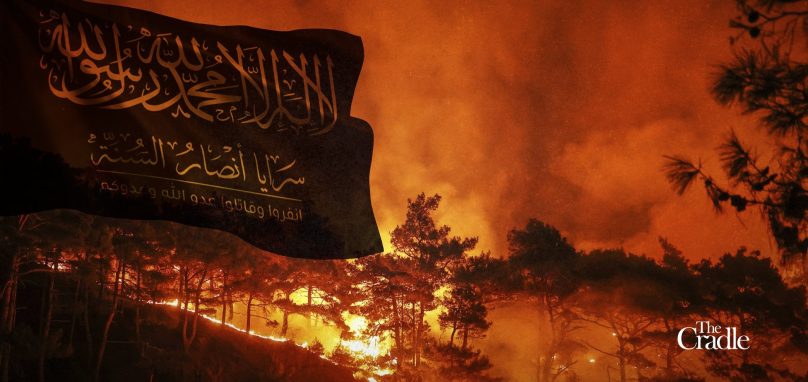
Never before in Syria had an armed group claimed responsibility for a natural disaster. That changed when Saraya Ansar al-Sunna announced it was behind fires that spread through the Qastal Ma’af region, explicitly stating that the arson attack “led to the fires spreading to other areas, forcing the Nusayris [Alawites] to flee their homes, and causing a number of them to suffocate.”
The statement came just three days into the blazes and only weeks after the same group had claimed responsibility for the 22 June bombing of Mar Elias Church in Damascus’ Douweila neighborhood.
That attack had sparked a rare public dispute between the Interior Ministry and Saraya Ansar al-Sunna. While the ministry blamed ISIS and paraded an arrested cell, the group named a different perpetrator, Muhammad Zain al-Abidin Abu Uthman.
Despite vowing to release confessions to back its version, the ministry has remained silent.
Anas Khattab—former Al-Qaeda commander and Nusra Front co-founder, now serving as interior minister—only deepened the contradictions during his visit to the fire zone. He insisted there was “no evidence” of arson, even as his own ministry investigated suspects.
Khattab’s refusal to acknowledge Saraya Ansar al-Sunna suggests that Damascus still considers it a phantom—a position reinforced when ministry spokesman Noureddine al-Baba publicly dismissed it as “imaginary” during a press conference after the church bombing.
At the same time, some Alawites believe that Interior Minister Khattab is using Saraya Ansar al-Sunna to carry out attacks against Alawites, Christians, and other minorities, while maintaining plausible deniability.
Coordinated chaos and forced displacement
In Latakia’s coastal hinterlands, fear was already running high. Many villages had yet to recover from the violence of March, when security raids and sectarian killings devastated entire communities, leaving behind charred homes and mass graves that remain under-reported by official channels.
Only months ago, bloody confrontations claimed 2,000 lives across the region. Locals, mainly from the Alawite community, saw these events as the culmination of a systematic purge under the new regime. A wave of targeted killings, kidnappings, and violence had left communities deeply scarred.
Just days before the fires erupted, the murder of two brothers working as grape leaf pickers, along with the kidnapping of a girl, sparked widespread protests in the Al-Burjan and Beit Yashout areas in the Jableh countryside.
These demonstrations, amplified by diaspora voices, coincided almost to the hour with the first outbreaks of fire, feeding widespread suspicion that the flames were a diversion or smokescreen. On the same day this call was issued, the spread of fires in the Latakia countryside forests began to attract media attention.
The Qastal Ma’af fire—the most intense and destructive—was explicitly claimed by Saraya Ansar al-Sunna. Although the group declared it aimed to displace Alawites, some affected villages housed significant Sunni Turkmen populations. Later, the group issued a cryptic clarification: “The burning of Sunni villages is attributed to Nusayri groups, and this is in the context of the ongoing, raging conflict.”
Local sources tell The Cradle that the fire consumed large swaths of forest and farmland, displacing entire communities. Despite the government’s dismissals, few believe this was a coincidence.
Denial and deception by Damascus
Rather than confront the threat, the Interior Ministry downplayed the human hand in the fires. Observers suggest this was a deliberate choice to avoid validating Saraya Ansar al-Sunna’s claim—and to prevent inflaming sectarian tensions.
But some in the Alawite community accuse Ahmad al-Sharaa’s government of weaponizing fire as a tool of demographic engineering. They point to circulating videos of security forces, Sunni Bedouin groups, and even Turkish-plate vehicles setting fires to Alawite lands.
One Alawite source explains to The Cradle:
“The Alawites rely on their land and employment, while Sharaa seeks to bring about a demographic shift in the coastal region. His aim is to strangle the Alawites and kill them, forcing them either to flee the country or remain amid ongoing cases of murder, abduction, and arson. The objective is clear: displacement and the destruction of every source of livelihood.”
The source adds that on 9 July, in the town of Al-Haffa in Latakia, a small fire broke out.
Thirty young men rushed to extinguish it—all around 21 years old—including nine Alawites. After the fire was put out, the nine Alawite young men were arrested and mysteriously disappeared.
When their families asked the local authorities regarding their whereabouts, the only response they received was: “We transferred them to Latakia.”
Demographic warfare under the cover of fire
Many Alawites believe Turkiye seeks to effectively annex parts of the Syrian coast to seize maritime gas reserves, and that attacks by Turkmen and Uighur militants loyal to Damascus are designed to provoke pleas for Turkish protection.
Historically, arson has not been random in Syria. In 2020, the former government arrested 39 individuals for setting coordinated fires across Latakia, Tartous, Homs, and Hama—allegedly financed by a “foreign party.”
Last year, vast fires scorched Wadi al-Nasara in Homs and later spread to Kasab near the Turkish border. Then-Governor Khaled Abaza admitted, “The multiplicity of fire outbreaks strongly suggests that they were intentional, as between 30 and 40 fires broke out in a single day in various areas of the governorate, especially those rugged areas that are inaccessible to vehicles.”
He continued, “A search was launched for two vehicles believed to belong to the arsonists.”
The pattern of politically timed arson is now impossible to ignore. Every major fire in the past five years has coincided with key political milestones such as regime transitions and outbreaks of sectarian unrest, pointing to a deliberate strategy masked as environmental catastrophe.
While poverty and illegal logging are the usual explanations for Syria’s seasonal fires, deeper motives have taken shape. Intelligence services are reportedly scouring Latakia’s forests for buried weapons stockpiles.
Foreign militaries are surveying the terrain for future base sites. Coastal land developers are eyeing scorched villages for luxury tourism projects. And behind it all, Israel remains a constant agitator, stoking sectarian flames for its own expansionist agenda and to further undermine the Resistance Axis.
If anything, the ministry’s insistence on ruling out human involvement in this year’s fires has further eroded public trust. In a country exposed to endless covert operations, the official version of events cannot withstand scrutiny.
In Latakia, what’s burning isn’t just land—it’s the last hope that post-Assad Syria might survive this transition intact.
US envoy warns Lebanon: ‘Disarm Hezbollah or risk Syrian occupation’

The Cradle | July 12, 2025
Lebanon risks being invaded and occupied by Syria and Israel unless Beirut acts to disarm Hezbollah, US special envoy Thomas Barrack warned on 12 July.
Speaking to The National, Barrack, who is the US special envoy for Syria and ambassador to Turkiye, stressed Lebanon faces an existential threat” from the two US allies on its borders, while urging Beirut to act quickly to disarm Hezbollah.
“You have Israel on one side, you have Iran on the other, and now you have Syria manifesting itself so quickly that if Lebanon doesn’t move, it’s going to be Bilad Al Sham again,” he said, using the historical name for greater Syria, which included Lebanon and Palestine.
“Syrians say Lebanon is our beach resort. So we need to move. And I know how frustrated the Lebanese people are. It frustrates me,” he added.
 In December, the former Al-Qaeda offshoot Hayat Tahrir al-Sham (HTS) conquered Damascus, bringing Syria under US, Israeli, and Turkish influence.
Syria’s new government, led by former ISIS commander Ahmad al-Sharaa, has reportedly demanded it be given the Sunni-majority city of Tripoli in northern Lebanon while relinquishing the Golan Heights as part of a peace deal with Israel.
Last month, Barrack presented Lebanese officials with a proposal that calls for reconstruction aid and an end to Israel’s attacks if Hezbollah gives up its weapons.
The war between Israel and Hezbollah ended in November with a US-brokered ceasefire. But Israel continues to carry out air strikes and assassinations throughout Lebanon. Israeli ground forces also occupy five points in the south of the country.
In response to the proposal, Lebanese authorities submitted a seven-page document calling for a full Israeli withdrawal from occupied Lebanese territory, including the Shebaa Farms, and pledging to dismantle Hezbollah’s arms in south Lebanon, but not nationwide as Israel is demanding.
When The National asked Barrack why Lebanese President Joseph Aoun has not publicly committed to a disarmament timetable, Barrack said: “He doesn’t want to start a civil war.”
“We don’t have the soldiers on the ground for the [Lebanese Armed Forces, LAF] to be able to do that yet because they don’t have the money. They’re using equipment that’s 60 years old,” he said.
“Hezbollah is looking at it saying, ‘We can’t rely on the LAF. We have to rely on ourselves because Israel is bombing us every day, and they’re still occupying our land,’” Barrack added.
On 6 July, Hezbollah chief Naim Qassem said the Lebanese resistance movement will not disarm or back down from confronting Israel until it ends its air strikes and withdraws from southern Lebanon.
“We cannot be asked to soften our stance or lay down arms while [Israeli] aggression continues,” Qassem told thousands of supporters gathered in Beirut’s southern suburbs on Sunday.
He was speaking during religious gatherings for Ashura, which commemorates the martyrdom of the Prophet Muhammad’s grandson, Imam Hussein, in 680 AD in Karbala, Iraq.
Lebanese President Aoun stated on Friday that Lebanon has no intention of normalizing relations with Israel.
US President Donald Trump is pressuring both Syria and Lebanon to sign the Abraham Accords, which saw the UAE, Bahrain, and Morocco normalize relations with Israel in previous years.
Another Week in Washington to Remember
Or perhaps to forget
By Philip Giraldi • Unz Review • July 12, 2025
If one thinks that arming Ukraine against Russia or having Israeli soldiers and also American contractors slaughter Gazan civilians are not supportive of any United States actual interests, last week could easily be written off as yet another descent into Hell on the part of the United States. Americans and others should have the right to criticize how the Israelis wage war without being denounced and criminalized by governments that have been corrupted from the inside, most often by money, but that is exactly what is going on in the US and in select countries in Europe. Watching children being targeted for killing and complaining about it does not make one an anti-Semite even though the Israeli government exploits that issue precisely as a tool to avoid any consequences for its horrific behavior. Here in America, it’s past time for the White House and Congress to rid themselves of their obscene and unseemly obsession with judging overseas developments using the optics of Israel loyalty tests. There is an appreciable difference between hating Israel reflexively based on its religion and acting like a member of a cheering gallery on steroids every time Prime Minister Benjamin Netanyahu comes to town.
There were three major developments during the week. The first was the passage through Congress and the signing by President Donald Trump of the “big, beautiful budget bill” which establishes by law the national government’s spending projections for 2026. The fiscal year begins on October 1st. The government has long exploited alleged foreign threats to national security to boost spending to enhance America’s military power. This tendency has been largely unchallenged since 9/11, when President George W Bush announced that he and the US now represented “a new sheriff in town” and would be waging war against terrorists worldwide. In 2025 Pentagon costs were budgeted at the $895 billion level. Now, however, President Donald Trump has topped even that with his bill, adding $150 billion to the military budget for 2026, which will exceed in theory for the first time more than $1 trillion.
Interestingly, however, the reality is that the US has for some time exceeded $1 trillion due to the way the government handles its war costs through unfunded material transfers and extra expenses that are approved outside the budget process itself, combined with the fact that the Pentagon’s several components and poor money management make it impossible to be successfully audited. Based on the $895 billion National Defense Authorization Act (NDAA), US national security spending for 2025 is, for example, expected to actually reach about $1.77 trillion. The difference partly derives from military-related spending from other government agencies not funded by the NDAA, such as the Department of Veterans Affairs and Homeland Security as well as from the national security share of the interest accrued on the US debt.
In September 2024 the Government Accounting Office reported that the Defense Department “remains the only major federal agency that has never been able to achieve a clean audit opinion.” And the numbers are astonishing. In fiscal year 2024, which ran from October 1st, 2023 to September 30th, 2024, the Pentagon could not account for at least 44% of its assets, nor for at least 68% of the money allocated by Congress.
The biggest addition to actual defense spending is the wars in Ukraine and Gaza, with a new front recently opened in Iran, that the US is supporting off-budget, meaning that they are being paid for “out of pocket” and the money is printed up by the Federal Reserve and is added to the government debt, where it increases through the accumulation of interest to bill and bond holders. The Federal debt is now $37 trillion and Trump’s bill is expected to add at least $3 trillion more to it. Foreign nations that have invested in the debt by buying Treasury Bills might soon figure out that it is a bad investment and will stop doing so and the dollar will plummet.
And then there is the visit to Washington, the third by Benjamin Netanyahu since Trump became president six months ago, which was memorable in its own way. Netanyahu was in America again due to the fact that he wanted something. The larger issue is to get US direct support to renew an attack on Iran and the second objective being to speed up the resupply of weapons as Israel had de facto lost the conflict with the Iranians having run through its defensive weapons. What arrangements have been made vis-à-vis Iran have not yet been completely revealed, but it has been reported that multiple transport plane loads have been making their way filled with weapons drawn from US reserve stocks that are on their way to Tel Aviv as a gift from the US to Israel. And then there was the comedy routine provided by Netanyahu proposing Trump as recipient of the Nobel Peace Prize, possibly the first time when a head of a state that is openly carrying out a genocide plus mass deportations and is about to create concentration camps endorses the country leader who enables the mass murder taking place. While in Washington Netanyahu also carried out the usual sucking up to Congress and vice versa as well as the closed-door meeting with the Jewish billionaires that have so effectively corrupted the US government.
The third performance of comic opera took place over Ukraine. Secretary of Defense Pete Hegseth apparently halted the shipment of new weapons to Kiev as a means of disengaging from the conflict with Russia. While it is clear that the US has no interest to be fighting a proxy war with Moscow, Trump had proven unable to end the fighting on his first day in office, which he had promised pre-election. To everyone’s actual surprise, Trump did not appear to know about the decision and reversed it, exhibiting some actual confusion during a press conference over what had happened. It was reminiscent of last week’s bizarre development over the disappearance of Israeli spy Jeffrey Epstein’s “client list” possibly to avoid embarrassing Israel and also, it has been suggested, to eliminate any speculation regarding Donald Trump’s relationship with Epstein in Florida back prior to 2019. It might be reasonable to assume that the whole episode amounts to one more big lie and cover-up coming out of the clownish ensemble that constitutes the Trump cabinet.
Finally, there is one other story that I consider a pure product of the ignorance and downright stupidity that characterizes the Trump regime. The United Nations Human Rights Council has what they refer to as a Special Rapporteur and investigator over developments in Israel and Palestine, to include the Israeli occupied territories on the West Bank. Francesca Albanese, an Italian, is an experienced bureaucrat of demonstrated integrity who has focused on human rights issues. She has been under intense pressure from both the United States and Israel to forego on reporting Israel’s atrocities, particularly in Gaza, but those who have actually interacted with her claim that she has recorded developments honestly and accurately. This past week, coinciding with the Netanyahu visit, Washington decided to move against her with US Secretary of State Marco Rubio announcing sanctions against her.
This is how Rubio described the case to be made to justify the sanctions: “Today I am imposing sanctions on UN Human Rights Council Special Rapporteur Francesca Albanese for her illegitimate and shameful efforts to prompt [International Criminal Court] action against US and Israeli officials, companies, and executives… Albanese’s campaign of political and economic warfare against the United States and Israel will no longer be tolerated. We will always stand by our partners in their right to self-defense.”
One begins to wonder if Rubio is as totally ignorant and stupid as his boss. The US has previously called on the UN to replace Albanese and a week before the sanctions were issued a warning from Washington suggested that something was coming. “The United States once again expressed its grave concerns to UN Secretary-General António Guterres about the continued activities of Francesca Albanese … and again called upon the Secretary-General to condemn her activities and call for her removal,” the US UN mission said in a statement on July 1. The US has characteristically accused Albanese of “virulent antisemitism” for her criticism of Israel, a smear on Albanese also made by President Joe Biden’s administration after she last year produced a report accusing Israel of genocide. One might observe that in February the US also used the sanctions tool against the justices of the International Criminal Court (and their families) after the court issued arrest warrants for Netanyahu and the Israel’s former Defense Minister Yoav Gallant on charges of genocide.
Wish that were all, but there is one more story about what a fine place “America’s best friend and closest ally” Israel actually is. A twenty-year old Palestinian American from Tampa Florida, Seif al-Din Muslat, was visiting family in the town of Sinjil, north of Ramallah, on Friday. In town, he was confronted and beaten to death by rampaging Israeli settlers. Another Palestinian teen Mohammad Shalabi was shot dead in the same incident. The US Embassy apparently was informed of the killing by the boy’s family but as usual it will take no action and will defer to the so-called Israeli justice system to investigate. That means that the scum Settlers, largely expat Americans from places like Brooklyn, will in no way be punished and will walk free to kill more Palestinian children. There have been an increasing number of instances where Israeli settlers in the West Bank ransack Palestinian neighborhoods and towns, burning homes and vehicles and destroying crops and businesses in attacks. And they feel free to kill any Palestinian who crosses their paths or who tries to intervene. Thank you Prime Minister Netanyahu and President Trump for your loyalty to murderous Jews. It does you proud, or at least it demonstrates what you are made of!
Philip M. Giraldi, Ph.D., is Executive Director of the Council for the National Interest, a 501(c)3 tax deductible educational foundation (Federal ID Number #52-1739023) that seeks a more interests-based U.S. foreign policy in the Middle East. Website is councilforthenationalinterest.org, address is P.O. Box 2157, Purcellville VA 20134 and its email is inform@cnionline.org.
‘Global War on Terror’ is Over. Terror Won.
By Daniel McAdams | Ron Paul Institute | July 10, 2025
On Sept. 16, 2001, five days after the attacks on New York and Washington, DC, President George W. Bush declared, “This crusade – this war on terrorism – is going to take a while. And the American people must be patient. I’m going to be patient. But I can assure the American people I am determined.”
Four days after that, President Bush declared the “war on terror” to be primarily against al-Qaeda. “Our war on terror begins with al Qaeda,” he said in an address to Congress and the nation, “but it does not end there. It will not end until every terrorist group of global reach has been found, stopped and defeated.”
He described the enemy thus:
This group and its leader — a person named Osama bin Laden — are linked to many other organizations in different countries, including the Egyptian Islamic Jihad and the Islamic Movement of Uzbekistan. There are thousands of these terrorists in more than 60 countries.
Bush was correct in his assessment of the group.
One of those countries into which al-Qaeda jihadists implanted themselves was Syria, where from 2011 – with the support of the Obama Administration – they attempted to overthrow the secular leader, Bashar al-Assad, using terrorist tactics they had been well-trained in.
They soon changed their name – but not their stripes – and became the Al-Nusra Front, headed up by an experienced jihadist who fought against US troops in Iraq by the name of Abu Mohammad al-Jolani. His group was known for chopping off heads. Perhaps even American heads.
Last December Jolani’s jihadists – with support from the US, Turkey, and Israel – finally brought down the Assad government and quicker than you can say “Washington PR makeover” he clipped his beard, switched out his tactical military watch for a $90,000 Patek Philippe World Time Chronograph, and declared himself president.
The “civilized world” cheered the re-emergence of democracy in Syria!
At their first meeting earlier this year in Saudi Arabia, President Trump praised jihadist Jolani as “a young, attractive fellow” and “a tough guy, a fighter, with a very strong background. He has a lot of potential, he’s a real leader.”
This was a US-designated global terrorist with a $10 million bounty placed on his head by the US authorities. His “wanted” poster STILL remains on the X account of the US Embassy in Syria!
This week, President Trump “removed sanctions on Jolani’s Syria at (Israeli Prime Minister) Netanyahu’s request,” and just yesterday Secretary of State removed Jolani’s old al-Qaeda affiliate (which had gone from al-Nusra to HTS over the years) from the US terrorist list.
As one observer on X quipped:
The history of the GWOT (Global War on Terror) began in 2001 with the US invading Afghanistan to dig out Al Qaeda. It ends twenty-four years later with the US recognizing an AQ affiliate as the new ruler of Syria.
According to Brown University’s Cost of War Project, the “Global War on Terror” cost the American people at least eight trillion dollars. It also took the lives of perhaps a million people.
And what did we get for all this blood and treasure? In Afghanistan, the Taliban were after 20 years of US military action replaced by the Taliban, and in Syria a fierce opponent of al-Qaeda was replaced by…al-Qaeda!
As Jake Sullivan, then right hand to Secretary of State Hillary Clinton, wrote to the Secretary in 2012, “al-Qaeda is on our side in Syria.” He wasn’t joking!
That was the shot…here’s the chaser:
In the same week the United States removed sanctions on al-Qaeda ruled Syria, it placed sanctions on…UN Special Rapporteur on the occupied Palestinian territories Francesca Albanese!
Who is Albanese? She is the fearless defender of human life in a Gaza where it is slowly being extinguished by Israel with the backing (and weapons) of the US government.
In hitting UN human rights defender Albanese with sanctions, US Secretary of State Marco Rubio wrote:
Today I am imposing sanctions on UN Human Rights Council Special Rapporteur Francesca Albanese for her illegitimate and shameful efforts to prompt @IntlCrimCourt action against U.S. and Israeli officials, companies, and executives.
Albanese’s campaign of political and economic warfare against the United States and Israel will no longer be tolerated. We will always stand by our partners in their right to self-defense.
The United States will continue to take whatever actions we deem necessary to respond to lawfare and protect our sovereignty and that of our allies. (emphasis added)
What might those “whatever actions” be? Clearly it is a physical threat against Albanese for speaking out against a mass murder happening in real time, observable for all who wish to do so on our own computer screens.
So that is it. The “Global War on Terror” is over. Terrorists have been elevated by the US government to be heads of state and those who speak out against state terrorism are threatened with “whatever actions we deem necessary” to shut them up.
Israel lobbies Washington to restart war on Yemen: Report
Sources told Hebrew media that Tel Aviv is calling for the formation of a new coalition against Sanaa
The Cradle | July 11, 2025
Israel is pressuring the US to restart its campaign against the Yemeni Armed Forces (YAF) and Ansarallah movement in Yemen, according to reports in Israeli media.
According to Israel’s Broadcasting Corporation (KAN), Yemeni attacks on vessels headed to Israeli ports “can no longer remain solely an Israeli problem.”
Sources told the outlet that Tel Aviv has been calling for “more intense combined attacks against Houthi regime targets – not just [Israeli] air force fighter jet strikes, but also a renewal of American attacks and the formation of a coalition including additional countries,” an informed source told KAN.
Another anonymous security official said that “a broad coalition is needed to convey to the Houthi regime that it is in danger.”
The report comes after the YAF sunk two Greek-owned, Liberian-flagged vessels which were en route to Israeli ports.
Yemen had briefly refrained from attacking commercial vessels headed to Israel following a ceasefire that ended the US campaign against the country in May. However, it never rescinded the blockade it imposed after the start of the war in Gaza, and is now escalating its enforcement.
It has also continued to target Israel with ballistic missiles in support of the people and resistance in Gaza.
The YAF announced on 10 July that it targeted Tel Aviv’s Ben Gurion Airport with a ballistic missile. The attack came hours after Sanaa released footage of its second operation targeting a commercial ship within 24 hours. The Eternity C vessel was headed to the southern Israeli port of Eilat in violation of the Yemeni naval blockade.
The attack took place on Monday, with the ship finally sinking on Wednesday. Yemeni forces captured footage of the operation. Several crewmembers were reportedly killed, and others remain missing. The YAF said it evacuated some of the crew for medical treatment.
A day earlier, on Sunday, Yemen targeted and sank the Magic Seas vessel – also releasing footage of the operation.
Friday’s KAN report coincides with anticipation for a potential Israeli escalation against Yemen.
On 7 July, Israel carried out widespread attacks on Yemen. Tel Aviv said its latest attack on Yemen marked the start of a military operation against the country, dubbed Operation Black Flag. The YAF announced a large-scale missile and drone attack on several Israeli targets that day in response to heavy Israeli airstrikes.
Following the start of Yemen’s naval campaign in 2023, Washington attempted to muster up a coalition to stop Sanaa’s operations.
The US formed an international naval coalition under the name Prosperity Guardian, which gained little traction and failed to deter Sanaa from continuing its attacks.
Very few nations offered to contribute warships, and others only deployed a mere handful of staff officers.
An EU military mission in the Red Sea called Operation Aspides also suffered a similar failure.
“We didn’t necessarily expect this level of threat. There was an uninhibited violence that was quite surprising and very significant,” the commander of a French warship said in April 2024 after running out of munitions and being forced to turn tail and exit the Red Sea.
Last year, US Navy officials acknowledged that confrontations with Yemeni forces marked the most intense naval combat Washington had faced since the Second World War.
During US President Donald Trump’s latest campaign against Yemen, which killed an unprecedented number of civilians, Washington burned through around $1 billion in munitions and failed to significantly impact Yemeni military capabilities, sources have confirmed to western media.
US must rebuild trust for diplomacy to resume, says Iran’s FM
Iranian Foreign Minister Abbas Araghchi
Press TV – July 8, 2025
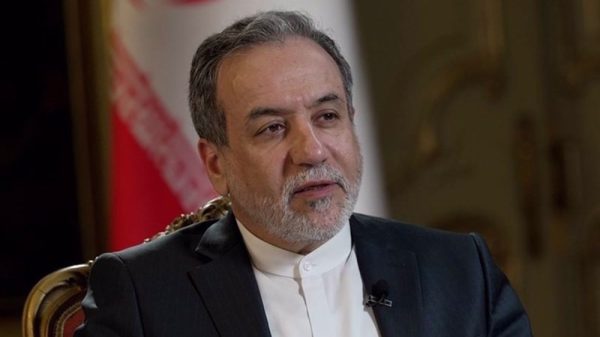
Iran’s foreign minister has issued a call for the United States to revive diplomacy following a breakdown in indirect talks, warning that further engagement will only be possible if Washington demonstrates a genuine commitment to a fair resolution.
“Iran remains interested in diplomacy, but we have good reason to have doubts about further dialogue,” Abbas Araghchi wrote in an article published by the Financial Times. “If there is a desire to resolve this amicably, the US should show genuine readiness for an equitable accord.”
The foreign minister referred to his five rounds of talks with US special envoy Steve Witkoff, saying that the two sides had made progress in those meetings.
According to Araghchi, discussions covered sensitive issues, including Iran’s uranium enrichment program and a potential end to US sanctions, with proposals from both sides and mediation by Oman.
The talks, he suggested, could have laid the foundation for an economic partnership potentially worth trillions, offering Iran development opportunities while addressing US President Donald Trump’s ambitions to revive struggling US industries.
But, Araghchi said, hopes for a breakthrough were shattered when Israel launched an unprovoked assault on Iran just 48 hours before a planned sixth round of talks in a move to derail diplomatic progress.
“Israel prefers conflict over resolution,” he wrote, arguing that the bombardment was not about stopping Iran from developing nuclear weapons but about sabotaging dialogue.
Araghchi reaffirmed that Iran remains committed to the Nuclear Non-Proliferation Treaty (NPT) and operates under UN monitoring.
He warned that while Iran seeks to prevent a wider regional war, its restraint should not be mistaken for weakness.
“We will defeat any future attack on our people,” he said, cautioning that Iran would reveal its true defensive capabilities if provoked again.
Araghchi placed the blame for the collapse of the talks on “an ostensible ally of America” and on Washington for its “fateful decision” to join in the strikes, thereby violating international law and the NPT framework.
While noting recent messages from US intermediaries suggesting a possible return to the table, Araghchi questioned whether Tehran could trust any future American overtures, citing the US withdrawal from the 2015 nuclear deal and Iran’s experience of being attacked during active negotiations.
“Negotiations held under the shadow of war are inherently unstable, and dialogue pursued amid threats is never genuine,” he wrote.
Still, Araghchi stopped short of closing the door entirely.
Iran, he insisted, remains interested in diplomacy, but only if it is based on mutual respect and free from external sabotage.
The top diplomat warned that Washington’s continued alignment with Israel risks dragging the US into another costly and avoidable conflict in the region.
“The American people deserve to know that their country is being pushed towards a wholly avoidable and unwarranted war by a foreign regime that does not share their interests,” Araghchi wrote, in reference to Israeli influence in Washington.
He ended with a stark choice for the United States: “Will the US finally choose diplomacy? Or will it remain ensnared in someone else’s war?”
What Trump Should Tell Netanyahu
By Ron Paul | July 7, 2025
A few weeks ago I urged President Trump to make a deal with Iran that would satisfy his stated goal of no nuclear weapons production and would allow Iran to continue its lawful pursuit of civilian nuclear energy. The deal on the table, as described by the Iranian foreign minister himself, was a win-win “update” of Obama’s JCPOA “nuclear deal” that he could have avoided a costly and counter-productive war with Iran.
Unfortunately, the negotiations were cut short by an Israeli sneak-attack on Iran that led to a 12-day war that did not turn out as Israel imagined. This often happens in war, especially wars of aggression. After a day or so, Israel found itself overwhelmed by an Iran that proved to be more than capable of defending itself and Netanyahu called up Uncle Sam begging for assistance.
The resulting US bombing run on Iran’s nuclear sites did not lead to the end of that country’s capabilities, but to the expulsion of the UN monitoring organization and the emergence of Iranian “strategic ambiguity” regarding its program. In short, the bombing has blinded the world to what Iran may do in the future. That is not a win for Trump.
In a recent interview with Tucker Carlson, the Iranian president confirmed what most people understood at the time: President Trump promised Iran that while they were engaged in negotiations the United States would not allow Israel to attack the country. With the sixth round of negotiations just two days away, however, Israel thumbed its nose at the United States and launched an attack on Iran anyway.
Considering that Israel’s “military capabilities” are almost entirely provided by the United States, this betrayal of its benefactor will surely go down as one of the most brazen acts of ingratitude of all time.
This week Israeli Prime Minister Benjamin Netanyahu is in Washington DC for the third time in Trump’s short second term in office. While we do not know what President Trump is telling him this time around, this might be the time to finally give Israel some “tough love” that many parents practice with their teenagers.
Donald Trump may be the most “pro-Israel” president we’ve ever had, but if he really wanted to help Israel he would make clear to Netanyahu that US support does Israel no favors. Continuing to spend tens of billions of dollars a year financing Israel’s war machine and backing up Israel’s attacks on its neighbors has not produced peace or security – much less prosperity – for Israel.
In fact, as soon as Israel attacked Iran so many Israelis tried to leave the country that Tel Aviv forbade its own citizens from leaving the country. Israelis are desperate to escape the wars of their own government’s making.
If President Trump really wanted to help Israel he would inform Netanyahu this week that not another US dollar would be sent to prop up his government. Not another missile or bomb would be sent. Not another American bullet would be available for Israeli soldiers to attack their neighbors or to shoot Palestinian civilians.
If Israel had to face the hard reality that it must learn to live with its neighbors instead of attacking them, the country may actually start seeing some peace and prosperity. Whatever the case, it is not our responsibility to finance the war machine of any foreign country. Time to put America first.
The IAEA and OPCW – How International Organisations Became Tools of War
21st Century Wire | July 2, 2025
Dr. Piers Robinson is a political scientist, a former professor at the University of Sheffield, as well a research director at the International Center for 9/11 Justice, whose recent article on Substack is titled, “The IAEA and OPCW: Watchdogs for Peace or Propagandists for War?” looks at the IAEA’s questionable operations in Iran, and the similarities to the abused OPCW in Syria, and in general the role of “lying through institutions”, and plying war-propaganda through third-party institutions.
Recent events in Iran have all but exposed how these supposed ‘watchdog’ institutions have been coopted and used by US and British intelligence in order to fabricate another case for war.
Pascal Lottaz, host of Neutrality Studies, talks with the co-director for the Organisation for Propaganda Studies, Dr Piers Robinson, about this, as well as the broader geopolitical implications at play here. Watch:
Featured Video

Racist Seinfeld Dances for Joy as Bibi Unveils His New Map
or go to
Aletho News Archives – Video-Images
TV Drama Review
Japanese drama projects Japan’s wartime atrocities onto Chinese characters

Global Times | October 25, 2026
By portraying Chinese characters as perpetrators of ruthless violence while casting Japanese Self-Defense Forces (SDF) intelligence operatives as defenders, the season 2 of the Japanese drama Vivant has recently drawn criticism from Chinese netizens, who argue that its depiction turns historical reality on its head while ignoring Japan’s wartime atrocities.
The TBS drama series – a spy suspense story in which an alleged unofficial intelligence unit of the SDF operates across the globe — has attracted a passionate fanbase. Its currently airing season 2 opened with a household rating of 18.8 percent, the highest for a TV drama this year, according toa commentary article by Japanese media Toyo Keizai.
What draws attention is the portrayal of the enemies in the series, the article noted. Scenes in which the Chinese organization subjects kidnapped members of the SDF unit to brutal torture are repeated with unrelenting intensity.
It is rare for Japanese TV dramas to explicitly portray a real-life country as the enemy, the article noted.
Japanese Prime Minister Sanae Takaichi also made a reference to the drama, saying that she has been recording Vivant and hopes to binge-watch it over the year-end and New Year holidays, according to Japanese media outlets.
China’s CCTV News report on Sunday revealed that the drama features scenes in which Chinese personnel cut off the fingers of and stab Japanese intelligence operatives in the abdomen. Such acts bear striking similarities to the torture inflicted on Chinese nationals by invading Japanese troops during the World War II.
The drama distorts the truth by attributing these atrocities to modern Chinese characters. Beneath the surface, it subtly glorifies Japan’s cross-border overseas operations, blurs the functional boundaries of the SDF and implicitly promotes an expansionist narrative, per CCTV News. … continue
Blog Roll
 Aletho News
- EU facing trillion-euro debt hole while seeking more cash for Kiev
- How US, Europe, Persian Gulf states exhausted missile stockpiles, splurged billions to defend Israel
- Up in arms… Koreans reject U.S. empire’s plan to make South Korea the next Ukraine
- Iran, Turkey, Pakistan, Saudi Arabia could advance region-led security framework in Tehran: FM spox
- Netizens condemn Japanese drama for projecting Japan’s wartime atrocities onto Chinese characters
- Racist Seinfeld Dances for Joy as Bibi Unveils His New Map
- A West Bank War for Netanyahu’s Election Campaign, Could It Backfire?
- Yemen denounces European Parliament’s ‘hypocritical’ push to blacklist Ansarullah
- Qalibaf: UAE’s UN bid aims to ‘clear the runway’ for ‘Greater Israel’, whitewash genocide
- Pakistan reopens Iran border after boosting security: Report
- If Americans Knew
- An error has occurred; the feed is probably down. Try again later.
- No Tricks Zone
- Sudden Stratospheric Warming, Powerful El Niño Combination May Lead To Extreme Europe Cold, Energy Crisis!
- Two New Studies Find Thwaites Glacier Melt Cannot Be Driven By Human Activity Or A Warming Ocean
- E-Cars Reduce CO2 Emissions By Only 41% Compared To Internal Combustion Engine Vehicles
- Predictions Made By Renowned Climate Professor Over Past Decades Have Been Proven To Be Poor
- New Study Suggests Large Regions Of The Pacific Ocean Have Been Cooling For The Last 80 Years
- Germany’s Green Energy Debacle: High Energy Costs Force Kahla Porzellan to Close After 182 Years!
- New Study: 50 Years Of The Most Aggressive ‘Net Zero’ Policies Can Only Affect The Global Climate By 0.03°C
- US September “Heat” Was No Record…Many Records Set Decades Ago
- Latest European Green Energy Debacle; Portugal’s Largest Flagship Solar Park Insolvent!
- Green Energy Debacle: German Expert Professor Fritz Vahrenholt Warns Of Severe Economic And Social Consequences

