What Explains Washington’s and Israel’s Opposition to Questioning Ghislaine Maxwell?
By Paul Craig Roberts | Institute for Political Economy | July 24, 2025
Attorney Alan Dershowitz allegedly is on the Epstein client list, but he calls for the release of the Epstein files and for the release of Ghislaine Maxwell under “use immunity,” which compels her to testify. In other words Dershowitz wants to clear his name by getting to the bottom of the Epstein Saga.
The saga is that Epstein was a Mossad spy financed by Israel out of the billions of dollars that Israel extracts from American pocketbooks each year. Epstein’s job was to implicate the American ruling establishment in sex crimes that enabled Israel to blackmail Washington into conforming US Middle East policy with Israel’s policy.
That done, Washington destroyed at the expense of American lives, money and reputation five counties for Israel.
Now Netanyahu wants Americans to destroy Iran for Israel. Can Washington refuse when Netanyahu has the blackmail information accumulated by Epstein for Mossad?
The problem is that neither Washington nor Netanyahu want Ghislaine to testify.
How long will it be before we hear that Ghislaine has committed suicide in her suicide proof prison cell?
‘Peacemaker’ Trump beats Biden’s bombing record since return to office: Report
The Cradle | July 23, 2025
US President Donald Trump has ordered hundreds of airstrikes across West Asia and Africa since his return to office, carrying out more attacks in the first five months of his second term than former president Joe Biden did during his entire presidency, according to the Armed Conflict Location & Event Data (ACLED).
“In just five months, Trump has overseen nearly as many US airstrikes (529) as were recorded across the entire four years of the previous administration (555),” said ACLED President Clionadh Raleigh.
Among the countries bombed by Trump are Iran, Iraq, Syria, Somalia, and Yemen. The majority of strikes were carried out against Yemen.
“The US military is moving faster, hitting harder, and doing so with fewer constraints. Syria, Iraq, Afghanistan, Yemen, Somalia, and now Iran are all familiar terrain, but this isn’t about geography – it’s about frequency,” Raleigh added.
The surge in attacks contradicts Trump’s campaign promises, which framed him as “anti-war.”
In March this year, Trump renewed the Biden government’s campaign against Yemen with much greater intensity.
Months of brutal and deadly attacks struck the country in response to the Yemeni Armed Forces’ (YAF) naval operations against Israeli interests and its missile and drone strikes in support of Palestine.
Yemeni forces consistently responded to US attacks by targeting US warships in the Red Sea, during both Biden and Trump’s terms.
A ceasefire between Sanaa and Washington was reached in May, after the US campaign burned through munitions and failed to impact Yemeni military capabilities significantly.
However, the campaign took a heavy toll on civilians and compounded the humanitarian crisis the country has faced due to over a decade of war.
An investigation released by Airwars last month revealed that Trump’s war on Yemen killed almost as many civilians in less than two months as in the last 23 years of Washington’s military action in the country combined.
“In the period between the first recorded US strike in Yemen to the beginning of Trump’s campaign in March, at least 258 civilians were allegedly killed by US actions. In less than two months of Operation Rough Rider … at least 224 civilians in Yemen [were] killed by US airstrikes – nearly doubling the civilian casualty toll in Yemen by US actions since 2002,” it said.
In Iraq, Syria, and Somalia, Trump has also continued to strike what Washington says are ISIS and Al-Shabab targets.
Despite vowing to end “forever wars,” Trump has recently threatened to expand them.
On 22 July, the US president threatened to launch new attacks on Iran, after late June bunker-buster strikes on Iranian nuclear facilities which were carried out on behalf of Israel.
Iranian Navy helicopter intercepts US destroyer in Sea of Oman
Press TV – July 23, 2025
An Iranian Navy helicopter has intercepted the US destroyer USS Fitzgerald in the Sea of Oman, issuing warning signals and ultimately forcing the American vessel to alter its course southward.
According to a statement from Iran’s military, the US warship approached waters monitored by Iran, prompting a rapid-reaction helicopter from the Third Naval Region of the Iranian Army’s Navy (NEDAJA) to deploy.
The helicopter hovered over the destroyer and delivered a clear radio warning to steer clear of Iranian-monitored waters.
In the ensuing standoff, the crew of the USS Fitzgerald threatened to engage the helicopter if it remained in proximity.
Iran’s Army Air Defense Command then intervened, declaring the helicopter under full air defense protection and ordering the American destroyer to change its course.
According to the statement, the USS Fitzgerald complied, heading south away from the disputed area.
The US military has not issued a public statement on the incident, which unfolded amid elevated tensions in the Persian Gulf following the recent US-Israeli war on Iran.
Iranian and US naval forces have had a long history of encounters in the Persian Gulf, Gulf of Oman, and the Strait of Hormuz since the 1980s.
In 2019, Iran shot down a US RQ-4A Global Hawk drone near the Strait of Hormuz due to airspace violation.
The Iranian Navy frequently conducts large-scale drills in the Persian Gulf and Sea of Oman, showcasing its capabilities and signaling deterrence against foreign powers.
How close was Jeffrey Epstein to Israel’s Mossad?
The Grayzone | July 18, 2025
The Grayzone’s Anya Parampil and Max Blumenthal discuss allegations that late financier and trafficker Jeffrey Epstein was an Israeli intelligence asset.
Al-Tanf and the Yinon Plan for Syria: Israel’s Fortress of Fragmentation
21st Century Wire | July 21, 2025
Oded Yinon, author of the 1982 paper “A Strategy for Israel in the 1980s,” is often cited regarding Israel’s aim to divide neighboring Arab and Muslim areas into ethnic mini-states. Yinon was a former advisor to Ariel Sharon, a former senior official with the Israeli Foreign Ministry, and a journalist for The Jerusalem Post. Although Yinon downplays the paper’s direct relevance to current geopolitics, its ideas have arguably become foundational to Zionist policy; balkanization was crucial for Israel’s establishment and continues to be a strategy for its military dominance in the Middle East, especially in Syria. His paper is commonly known as the “Yinon Plan.” Within it, you can read:
“The dissolution of Syria and Iraq later on into ethnically or religiously unqiue areas such as in Lebanon, is Israel’s primary target on the Eastern front in the long run, while the dissolution of the military power of those states serves as the primary short term target. Syria will fall apart, in accordance with its ethnic and religious structure, into several states such as in present day Lebanon, so that there will be a Shi’ite Alawi state along its coast, a Sunni state in the Aleppo area, another Sunni state in Damascus hostile to its northern neighbor, and the Druzes who will set up a state, maybe even in our Golan, and certainly in the Hauran and in northern Jordan. This state of affairs will be the guarantee for peace and security in the area in the long run, and that aim is already within our reach today.”
The fragmentation of Syria was always an integral part of the Yinon plan, with its operational headquarters not in Tel Aviv but at the US Al-Tanf base, located at the tri-border area between Syria, Jordan, and Iraq, and along one of the main highways between Baghdad and Damascus.
Syrian journalist and TV presenter, Haidar Mustafa, wrote for The Cradle on December 2, 2024, about the importance of the Al-Tanf base, one of the most strategic military garrisons for the US occupation in Syria, which acted as a launching platform for countless Israeli overt and covert operations:
“The US coalition’s mission against the Islamic State quickly evolved into a broader strategy of occupying parts of Syria, with the Al-Tanf base crucial to securing its influence and supporting Israeli interests amid growing local resistance.”
In a recent post on X, Lebanese analyst Ibrahim Majed articulated several points about the Al-Tanf base and the immense role the American base has played in advancing Israel’s Yinon Plan, describing it as a “Strategic Outpost for Greater Israel and Israel’s Fortress of Fragmentation.” His post inspired the title of our post today.
Recently, we covered the “David’s Corridor”, a land route in Israel that extends from the occupied Golan Heights through southern Syria to the Euphrates. This route represents Israel’s most crucial foothold in the centre of West Asia, which ultimately benefits from the protection provided by the Al-Tanf base. Should Israel manage to gain control over the southern provinces of Syria, it will be considerably closer to connecting with the territories held by the U.S.-backed Syrian Democratic Forces (SDF) in the east, through the American Al-Tanf base located near the Iraqi border, achieving several goals including the non-negligible control of the corridor, the fragementation of Syria and in time the replacement of the “Shiite Crescent” by an “Israeli Crescent”. Israel aims to establish a secure route that begins in the Golan Heights, traverses through the Suwayda province, continues across the eastern Syrian desert where the US base at Al-Tanf is situated, and extends to the Kurdish-controlled area of Hasakah, ultimately reaching Iraqi Kurdistan along the Iranian border. This explains the continued US military presence in north-east Syria and why last week, on two occasions, a large CIA delegation found itself at the Qasrak base in Al-Hasakah. This is how Israel intends to permanently cut off the Tehran-Beirut road.
Regarding the Druze community in Syria, Israel uses them primarily as a geographic instrument, a human “Maginot Line” of some sort, where the demographic acts as a human shield that, on one hand, hinders Sunnis’ expansion, while simultaneously stopping the Shiites from consolidating on the other. Local groups like Druze, Kurds and Bedouin tribes are all supported directly or indirectly with Western and Israeli logistics and intelligence, and it will remain so, as long as their presence helps Israel fill the vacuum.
The situation in Syria is no longer up for debate—it is laid bare, with each chapter shedding light on the Greater Israel Plan, or the so-called Yinon Plan. This plan provides neither peace nor solutions, nor does it reflect any sense of humanity; instead, it ensures chaos for geopolitical and financial profit, leading to the downfall of a nation we once recognised as Syria. Lebanon is undoubtedly next on Israel’s fragmentation map, and it is with great concern that one must anticipate Israel’s next move…
Darrin Waller writes Fountainbridge Substack…
Understanding the Yinon Plan: Syria is Gone — Is Lebanon Next?
The fall of Syria marks the beginning of a new era of Levantine chaos.
As I wrote when Assad fell, Syria ceased to exist. Fourteen years of sectarian carnage — unleashed by a Salafist proxy terrorist militia, trained by the US, UK, Israel, and Turkey in camps across Jordan and Turkey, and funded by Persian Gulf petrodollar monarchies to the tune of three trillion dollars — extinguished the last secular Levantine nation in December 2024.
As Hassan Nasrallah warned:
“If Syria were to fall into the hands of these groups, its present and future would spiral into chaos… a scene of endless infighting among factions devoid of reason or culture, drowning in extremism, bloodshed, sectarian rivalries…”
It is done. Sold to us as a revolution. A popular uprising.
Another regime change operation — brutally executed over 14 years — culminated in the installation of a mercenary leader: the Saudi-born takfiri Jolani, now styling himself as President Ahmed al-Sharaa.
What we are seeing is the prosecution of the Yinon Plan — a 1982 geopolitical blueprint calling for Israeli regional dominance through the fragmentation of Iraq, Syria, Lebanon, and Egypt along ethnic, sectarian, and tribal lines.
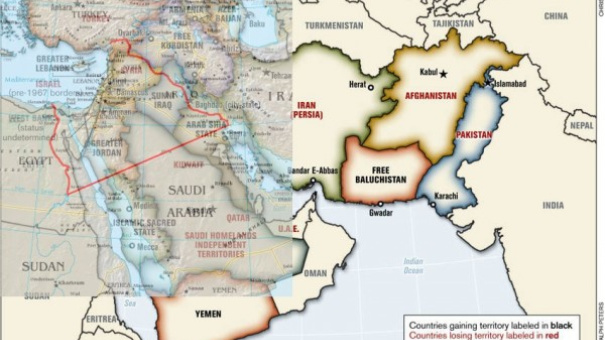
IMAGE: Project Balkanisation: Oded Yinon and an Enduring Plank of Israeli Foreign Policy (Source: Katehon)
It argues that Israel’s long-term survival hinges on one core premise: “The dissolution of all existing Arab states into small units.”
On the surface, the geopolitical win by the US-UK-Israel military-intelligence trifecta — backed by Turkey and the Persian Gulf monarchies — appears seismic. A Shīʿī-led country now falls under Sunni Salafism, severing the contiguous Shīʿī-controlled corridor linking Tehran to Hezbollah in Lebanon.
Another barrier to China’s Silk Road ambitions into the Mediterranean has been firmly set in place. Any revival of the ancient Via Maris — a trade corridor that once ran the Levantine coast, linking Asia to Europe and North Africa — remains a pipe dream.
Severed by the establishment of Israel and now buried beneath the rubble of Syria’s destruction, it ensures that any vision of unity from the Maghreb to the Arabian Peninsula remains just that — a vision.
But perhaps of greater immediate import — Israel’s ethno-supremacists and their vision of a ‘Greater Israel’ have just taken a giant leap forward. Southern Syria — and crucially, Mount Hermon, which overlooks Damascus and the Bekaa Valley in Lebanon, granting strategic military dominance over both — is now firmly under Israeli control. As is the tri-border area between Syria, Jordan, and Iraq — Al Tanf.
Yet there’s more. Israel now moves to establish its self-styled ‘David’s Corridor’ — a contiguous land route stretching from the occupied Golan Heights through southern Syria to the Euphrates. It cuts through the governorates of Deraa, Suwayda, Al-Tanf, and Deir Ezzor, reaching the Iraqi-Syrian border at Albu Kamal — granting Israel a strategic foothold deep in the heart of West Asia.
The corridor was already partially activated during the 12-day war with Iran, enabling standoff air strikes deep into Iranian territory.
With a direct land route to Iraq now viable, expect covert destabilisation efforts within the Shīʿī heartlands of Karbalāʾ and Najaf, alongside renewed backing for Kurdish separatists in both Iraq and Syria. Further vicious sectarian conflict across the region is now being baked in.
Whilst Israel’s bombing of the Defence Ministry and the Presidential Palace in Damascus was supposedly to protect the Druze community from Jolani’s Salafist mercenaries, no such protection was afforded to the Alawites, Armenians, Assyrians, or any of Syria’s other religious or ethnic minorities, who were left to be slaughtered.
The strikes on the Defence Ministry and Presidential Palace were telegraphed well in advance — and were thus performative. A warning to Jolani — Southern Syria is now firmly under Israel’s purview. No Syrian military forces will be allowed.
Meaning: Jolani and his hired guns are expendable, especially now that they’ve completed their task — extinguishing Syria’s sovereignty. As Hadi Nasrallah ruefully put it:
“You mean to tell me the very ones armed by Israel, treated in Israeli hospitals, coordinating with the IOF, shaking Netanyahu’s hand and thanking him for bombing Lebanon — are now being bombed by Israel after serving their purpose? Who would’ve thought?”
And yet, it remains far from clear if Jolani has outlived his usefulness, or if he still has his uses, at least from a US perspective.
Only days ago, whilst Jolani was in Baku, Syrian and Israeli officials were reportedly in talks. Rumours even swirled of a deal wherein Syria would launch attacks against Lebanon’s Shiʿī communities — either independently or in coordination with Israel.
Little wonder, then, that US envoy Tom Barrack warned Lebanon to ‘disarm Hezbollah or risk Syrian occupation’ — signalling that Lebanon, too, is likely slated for division and balkanisation.
The port of Tripoli and the Bekaʿa Valley, Lebanon’s agricultural heartland and a Shīʿī stronghold, are now in play. The only question is whether Ankara or West Jerusalem will seize them first, come to blows over Lebanon’s spoils, or quietly divide them, with Turkey taking the port and Israel the Bekaʿa.
But full control may yet require the chaos of full-on civil war. Syria and Lebanon edge closer — division and balkanisation becoming ever easier to enforce, until little remains but manageable fragments. The Yinon Plan made manifest.
“The attack on Lebanon is going to happen without a doubt… the question is when, and the other question is how. Is Israel going to do a ground invasion at the same time or just attack from the air?” (Ibrahim Majed)
Doubtless, the architects of today’s chaos are already patting themselves on the back, expecting handsome dividends to roll in. More division. More balkanisation. A weaker, fractured Arab world — and a stronger, more dominant Israel.
This is what Netanyahu means when he talks about “redrawing the Middle East”.
Yet the US and Israel are unravelling at an accelerating pace. Their seeming victory over the Levant is no triumph of providence — it courts the abyss and beckons the judgment to come.
E3 violated JCPOA, lost right to reinstate UN sanctions against Iran: Russian envoy
Press TV – July 21, 2025
A senior Russian diplomat says Britain, France, and Germany, known as the E3, have repeatedly violated the terms of the 2015 nuclear deal, and thus forfeited their right to trigger the snapback mechanism that would re-impose all UN Security Council sanctions on Iran.
Russia’s Permanent Representative to International Organizations in Vienna, Mikhail Ulyanov, made the remarks in an interview with Izvestia newspaper on Monday, days after the E3, in coordination with the US, threatened to initiate the 30-day snapback process if there is no progress on Iran’s nuclear talks by the end of August.
“As for the threats of Westerners to initiate a mechanism for restoring sanctions, it is quite rightly noted that this idea is illegitimate,” Ulyanov said.
“The Americans themselves withdrew from the JCPOA, renouncing the rights and obligations of a participant in the nuclear deal, and the United Kingdom, Germany and France are violators of both the JCPOA and UN Security Council resolution 2231. This means that they have also deprived themselves of the right to initiate a ‘snapback.’”
He was referring to the Joint Comprehensive Plan of Action, the official name of the Iran nuclear accord, which the US ditched in 2018 before returning the illegal sanctions that it had lifted against Iran and launching the so-called “maximum pressure” campaign.
Following the US withdrawal, the European signatories to the JCPOA failed to uphold their commitments and made no efforts to save the agreement.
Also in his remarks, the Russian envoy criticized the Europeans and Americans for using “the tactics of forceful pressure” against Tehran, saying such an approach has no chance of success.
“The habit of Europeans and Americans to set certain deadlines all the time is quite counterproductive,” he said, citing the negotiations aimed at restoring the JCPOA in 2021-2022 as an example.
In an X post on Sunday, Ulyanov emphasized that the E3 “has no legal or moral right” to activate the snapback procedure.
Earlier, Iran’s Foreign Minister Abbas Araghchi sent a letter to the UN chief, the Security Council president, and the top EU diplomat, saying the E3 have relinquished their role as “participants” in the JCPOA, rendering any attempt to trigger the snapback mechanism “null and void.”
Russia, China, and Iran to hold nuclear talks – Tehran
RT | July 21, 2025
Russia, China, and Iran will hold talks on Tuesday to discuss Tehran’s nuclear program, Esmaeil Baghaei, a spokesman for the Iranian Foreign Ministry, has announced. He noted that a separate round of talks with European nations is scheduled for later this week.
Speaking to reporters on Monday, Baghaei said that the trilateral talks would also focus on the threats by Britain, France, and Germany to reimpose UN sanctions on Iran over its nuclear program. In particular, French Foreign Minister Jean-Noel Barrot warned of a potential sanctions snapback next month if no meaningful progress is made in limiting Iran’s nuclear activities.
Baghaei noted that Russia and China remain members of the 2015 nuclear deal and hold significant influence in the UN Security Council. He added that Iran had had “good consultations” with the two countries regarding the potential sanctions snapback. “Legally and logically, there is no reason for the return of sanctions lifted under the [nuclear deal],” he stressed.
The spokesman also confirmed that Iran would hold a separate meeting at the deputy foreign minister level with Britain, France, and Germany in Istanbul on Friday, adding that Tehran has “no plans to talk with the US” at this time.
One of the key stumbling blocks has been Iran’s decision to suspend cooperation with the International Atomic Energy Agency (IAEA), which was monitoring Tehran’s nuclear program. Tehran has accused the IAEA of releasing a biased report, which was allegedly used as a pretense by Israel to launch a 12-day war against Iran.
The Israeli attack came after Iran-US nuclear talks ended up at an impasse due to Washington’s demand that Tehran fully abandon uranium enrichment. While the US has argued that Iran could use the capacity to create a nuclear bomb, Iran has dismissed any plans of doing so, insisting that it needs enrichment to fuel its civilian energy industry.
Both Russia and China maintain that the Iranian nuclear crisis can only be resolved through political and diplomatic means.
Seyed M. Marandi: Israel Attacks Syria – Prelude to Balkanization
Glenn Diesen | July 18, 2025
Seyed Mohammad Marandi is a professor at Tehran University and a former advisor to Iran’s Nuclear Negotiation Team. Prof. Marandi discusses Israel’s efforts to Balkanise Syria. Follow Prof. Glenn Diesen: Substack: https://glenndiesen.substack.com/
X/Twitter: https://x.com/Glenn_DiesenPatreon:  / glenndiesen
Support the channel: PayPal: https://www.paypal.com/paypalme/glenn…
Buy me a Coffee: buymeacoffee.com/gdieseng
Go Fund Me: https://gofund.me/09ea012f
Deal or sanctions: West threaten Iran ahead of August deadline
Al Mayadeen | July 16, 2025
US Secretary of State Marco Rubio, along with the foreign ministers of France, Germany, and the United Kingdom, has agreed to set an end-of-August deadline for reaching a new nuclear agreement with Iran.
The decision, discussed during a joint call on Monday, could trigger a full reimposition of United Nations sanctions if no deal is reached, Axios reported, citing three sources familiar with the matter.
If Iran fails to meet the so-called “deadline,” the European trio plans to activate the “snapback” mechanism, an automatic reinstatement of all UN Security Council sanctions that were lifted under the 2015 nuclear agreement. The mechanism is intended to respond to ‘Iranian noncompliance’ and is set to expire in October.
The move is time-sensitive. The snapback process takes 30 days to complete, and European diplomats are keen to initiate it before Russia assumes the rotating presidency of the UN Security Council this October. Western officials see the snapback as both a diplomatic pressure tool and a contingency plan if ongoing negotiations collapse, as per the report.
Iran, however, maintains there is no legal basis for the snapback and has warned that triggering it could prompt Tehran to withdraw from the Nuclear Non-Proliferation Treaty altogether.
Iranian President Masoud Pezeshkian reiterated on Tuesday his administration’s continued commitment to a peaceful resolution and diplomatic engagement. In a post published Monday night on X, Pezeshkian stated: “To open new horizons, we must take a critical look at the past. What will lead us toward a better future is rebuilding hope, being ready to learn and change, and forging a new path through consensus, empathy, and rational thinking.”
Tucker Carlson at Turning Point USA: Epstein Was a Mossad Agent and IDF Soldiers Should Lose U.S. Citizenship
By Kevin MacDonald | The Occidental Observer | July 15, 2025
Things are looking up for being able to be honest about Jewish issues in mainstream forums. I couldn’t be happier that this is coming out from a mainstream conservative at a major mainstream conservative conference. It’s been a long time coming, and we are still not there. But there is a light at the end of the tunnel. Carlson is much hated by the ADL which oddly has not commented on this latest faux pas. But they have lots to say about Turker’s endorsement of the great replacement “conspiracy theory.”
Carlson claimed that Epstein had “connections to a foreign government”:
“It’s extremely obvious to anyone who watches that this guy had direct connections to a foreign government.” “Now no one’s allowed to say that that foreign government is Israel because we have been somehow cowed into thinking that’s naughty.”
Lots of Jewish angst about this — and about Carlson’s statement that Jews who served in the IDF should lose their U.S. citizenship. Common sense, but since when has common sense been relevant to anything related to Jewish power. Any accusation of dual loyalty is considered anti-Semitism according to the official definition of the International Holocaust Remembrance Alliance, so I guess Carlson is now officially an anti-Semite, along with Charlie Kirk and a whole lot of people who attended the conference.
From the Forward:
Tucker Carlson, the former Fox News host and a leader in the Republican Party’s isolationist wing, said that Americans who previously served in the Israeli Defense Forces should have their U.S. citizenship revoked over concerns of dual loyalty. At the same time, he also criticized the Trump administration for trying to deport pro-Palestinian students who engaged in anti-Israel activity on campus.are a lot of Americans who’ve served in the IDF — they should lose their citizenship,” Carlson said in a 45-minute speech on Saturday at the Turning Point USA Student Action Summit in Tampa, Florida. “You can’t fight for another country and remain an American, period.”
Carlson, who has promoted antisemitic tropes [simply for saying Zelenskyy is a dictator who has suppressed Christianity] and has been associated with white nationalists [i.e., Darryl Cooper!!], explained that his position is an “obvious recognition of the truth” and applies to all countries. He mocked his critics — “they just write you off as some sort of internet freak, hater, Nazi” — and said it is “fair to demand that the people running my country love it every bit as much as I do.”
The founder of the organization Carlson spoke to is Charlie Kirk, a conservative podcaster who has accused Jews of financing “anti-white causes.” Several Trump cabinet members and Republican officials attended and spoke at the three-day conference.
And of course, Jews in high places deny Epstein had any connections to Mossad.
From the JTA comment on Naftali Bennet’s tweet:
Carlson has long faced allegations of antisemitism, including over his promotion of white supremacist ideas while on Fox News and his hosting of a Holocaust denier on his X stream last year.
More recently, he has been at the vanguard of a different divide within the MAGA movement over foreign policy, centering on Israel. Carlson and others heavily criticized Trump’s decision to join Israel’s military offensive against Iran’s nuclear program, with Carlson accusing Trump of being “complicit” in Israel’s “act of war.”
Carlson sends out a daily email to subscribers. This is from the July 14th email and basically summarizes his points at his talk. Notice he highlights Jewish activist Ben Shapiro as wanting to move on.
It seems likely that Jeffrey Epstein worked on behalf of an intelligence service. Probably not an American one.
So which country was it? The fact that so few reporters have bothered to dig into that question could prove to be this century’s most egregious example of journalistic malpractice. How did the notorious pedophile go from being a high school math teacher with no college degree to having a private island and one of the most luxurious residences in Manhattan? Doesn’t that seem weird? What was the source of his money? Why has nobody ever really looked into it?
To anyone paying attention, the obvious conclusion is that Epstein had direct connections to a foreign government. To the Israeli government. That is true even though saying it out loud is forbidden in mainstream political discourse, but there’s nothing wrong with having the gall to do just that. It doesn’t matter what screeching shills like Mark Levin say. Telling the truth is not hateful, nor is it anti-Semitic or even anti-Israel.
Criticizing the behavior of a government agency, any government agency, does not make you a bigot. It makes you a free person. You are allowed to hold them to account because you’re not a slave; you are a citizen. That means you have the right to expect your government to act in your interest and to demand that foreign governments that suck up your tax dollars do the same. Israel using America’s most famous serial sex criminal as an intelligence asset would not fit that description.
So did it happen? A few people have asked the Israeli government that question, but they’ve received no real answers. That is unacceptable. As long as America keeps cutting generous checks to that foreign power, it should have to report to us. If it refuses, no more payments. The rules are simple.
In the meantime, we can’t help but notice a strange new talking point emerging on the Right.
“The Epstein story doesn’t even matter!” the Ben Shapiros of the world now claim. “So shut up about it already!”
That is obvious nonsense. The truth behind Epstein, his death, his connections, and how he got so rich matters a lot. The pedophile wasn’t killed during a walk down the street or even in his own home. He died in a high-security prison in the heart of America’s largest city. It was supposed to be among the most secure places in the world. That means whatever force is responsible for Epstein’s demise orchestrated the killing in among the most difficult conditions possible, and they did it while hardly breaking a sweat. Whoever pulled that off really runs our country. If they could do it to him, they could definitely do it to you, too.
Why would the Shapiro caucus not want to get to the bottom of that? You know the answer. It’s because they have something to hide
The refrain on the right is that Epstein matters because he is a window into who rules the U.S. And one would be forgiven for thinking that the reason for the cover-up is to hide the involvement of Mossad in an elaborate blackmail scheme. We also deserve to know what the deep state is hiding about the JFK assassination—another phenomenally important event in which there is good reason to think that Israel and the CIA were involved, and another incident where Trump said he would be completely transparent.
Featured Video

Racist Seinfeld Dances for Joy as Bibi Unveils His New Map
or go to
Aletho News Archives – Video-Images
TV Drama Review
Japanese drama projects Japan’s wartime atrocities onto Chinese characters

Global Times | October 25, 2026
By portraying Chinese characters as perpetrators of ruthless violence while casting Japanese Self-Defense Forces (SDF) intelligence operatives as defenders, the season 2 of the Japanese drama Vivant has recently drawn criticism from Chinese netizens, who argue that its depiction turns historical reality on its head while ignoring Japan’s wartime atrocities.
The TBS drama series – a spy suspense story in which an alleged unofficial intelligence unit of the SDF operates across the globe — has attracted a passionate fanbase. Its currently airing season 2 opened with a household rating of 18.8 percent, the highest for a TV drama this year, according toa commentary article by Japanese media Toyo Keizai.
What draws attention is the portrayal of the enemies in the series, the article noted. Scenes in which the Chinese organization subjects kidnapped members of the SDF unit to brutal torture are repeated with unrelenting intensity.
It is rare for Japanese TV dramas to explicitly portray a real-life country as the enemy, the article noted.
Japanese Prime Minister Sanae Takaichi also made a reference to the drama, saying that she has been recording Vivant and hopes to binge-watch it over the year-end and New Year holidays, according to Japanese media outlets.
China’s CCTV News report on Sunday revealed that the drama features scenes in which Chinese personnel cut off the fingers of and stab Japanese intelligence operatives in the abdomen. Such acts bear striking similarities to the torture inflicted on Chinese nationals by invading Japanese troops during the World War II.
The drama distorts the truth by attributing these atrocities to modern Chinese characters. Beneath the surface, it subtly glorifies Japan’s cross-border overseas operations, blurs the functional boundaries of the SDF and implicitly promotes an expansionist narrative, per CCTV News. … continue
Blog Roll
 Aletho News
- Up in arms… Koreans reject U.S. empire’s plan to make South Korea the next Ukraine
- Iran, Turkey, Pakistan, Saudi Arabia could advance region-led security framework in Tehran: FM spox
- Netizens condemn Japanese drama for projecting Japan’s wartime atrocities onto Chinese characters
- Racist Seinfeld Dances for Joy as Bibi Unveils His New Map
- A West Bank War for Netanyahu’s Election Campaign, Could It Backfire?
- Yemen denounces European Parliament’s ‘hypocritical’ push to blacklist Ansarullah
- Qalibaf: UAE’s UN bid aims to ‘clear the runway’ for ‘Greater Israel’, whitewash genocide
- Pakistan reopens Iran border after boosting security: Report
- Why are so many Brazilians voting for Flávio Bolsonaro?
- Democrats Put Anti-Russia Agenda Ahead of American Workers
- If Americans Knew
- An error has occurred; the feed is probably down. Try again later.
- No Tricks Zone
- Sudden Stratospheric Warming, Powerful El Niño Combination May Lead To Extreme Europe Cold, Energy Crisis!
- Two New Studies Find Thwaites Glacier Melt Cannot Be Driven By Human Activity Or A Warming Ocean
- E-Cars Reduce CO2 Emissions By Only 41% Compared To Internal Combustion Engine Vehicles
- Predictions Made By Renowned Climate Professor Over Past Decades Have Been Proven To Be Poor
- New Study Suggests Large Regions Of The Pacific Ocean Have Been Cooling For The Last 80 Years
- Germany’s Green Energy Debacle: High Energy Costs Force Kahla Porzellan to Close After 182 Years!
- New Study: 50 Years Of The Most Aggressive ‘Net Zero’ Policies Can Only Affect The Global Climate By 0.03°C
- US September “Heat” Was No Record…Many Records Set Decades Ago
- Latest European Green Energy Debacle; Portugal’s Largest Flagship Solar Park Insolvent!
- Green Energy Debacle: German Expert Professor Fritz Vahrenholt Warns Of Severe Economic And Social Consequences

