Red Sea debacle: How Yemeni resistance brought American war machine to a halt
By Kit Klarenberg | Press TV | May 18, 2025
On May 12, the New York Times published a forensic autopsy of the failure of the Trump administration’s renewed hostilities against the Ansarullah-led Yemeni military in the Red Sea.
The probe teemed with extraordinary disclosures, spelling out in stark detail how the combined air and naval effort – launched with enormous fanfare and much bombastic rhetoric from US officials – was an even greater debacle, and devastating defeat, for the Empire than hitherto thought.
The scale of the cataclysm may explain Washington’s sudden determination to reach a negotiated settlement with the Islamic Republic of Iran.
Perhaps the most striking revelation is that Trump’s blitzkrieg against Yemen was initially planned to be a long-term, large-scale engagement, culminating in a ground invasion using proxy forces.
General Michael Kurilla, Commander of the Pentagon’s Central Command, which covers Central, South and West Asia, had been in favor of all-out war with the Ansarullah resistance movement ever since its righteous anti-genocide Red Sea blockade began in late 2023.
Reportedly, though, Joe Biden was wary that a “forceful campaign” would elevate them “on the global stage.”
With Trump’s re-election, “Kurilla had a new commander in chief” and an opportunity to up the ante against Ansarullah significantly. He pitched an eight-to-10-month effort, starting with a saturation bombing of Yemen’s air defense systems, before a wave of targeted assassinations of movement leaders, directly inspired by Israel’s attacks on Hezbollah’s senior members in September 2024.
Kurilla’s grand operation was eagerly supported by elements of the Trump administration, including Defense Secretary Pete Hegseth and then-National Security Advisor Mike Waltz.
Saudi officials were also on board, providing Washington with a target list of 12 Ansarullah leaders “whose deaths, they said, would cripple the movement.”
However, the UAE, which had in concert with Riyadh relentlessly bombed Yemen 2015 – 2023 to no tangible result, “was not so sure.” Several members of Trump’s administration were also skeptical of the plan’s prospects and worried a protracted attack on Sana’a would drain valuable, finite resources, including the president himself.
Yet, after concerted lobbying, Trump “signed off on part of General Kurilla’s plan – airstrikes against Houthi air defense systems and strikes against the group’s leaders.”
So it was on March 15, US fighter jets began battering Yemen anew, while a carrier force led by the USS Harry S. Truman thrust into the Red Sea.
White House officials boasted the onslaught would continue “indefinitely”, while Trump bragged that Ansarillah would be “decimated” via “overwhelming lethal force until we have achieved our objective.”
Some degradation
In reality, The New York Times suggests Trump privately made clear he wanted Ansarullah bombed “into submission” within just 30 days, and failure in this objective would mean the operation’s termination.
By the 31st day of hostilities, the US president “demanded a progress report.” As the outlet records, “the results were not there,” which is quite an understatement. The US “had not even established air superiority” over Ansarullah, while the resistance group continued “shooting at vessels and drones, fortifying their bunkers and moving weapons stockpiles underground.”
Moreover, during those first 30 days, Yemeni military “shot down seven American MQ-9 drones” costing around $30 million each, “hampering Central Command’s ability to track and strike back. Meanwhile, several American F-16s and an F-35 stealth fighter jet “were nearly struck by Houthi air defenses, making real the possibility of American casualties.”
All along, too, the US burned through weapons and munitions at a rate of about $1 billion in the first month alone:
“The cost of the operation was staggering. The Pentagon had deployed two aircraft carriers, additional B-2 bombers and fighter jets, as well as Patriot and THAAD air defenses… So many precision munitions were being used, especially advanced long-range ones, that some Pentagon contingency planners were growing increasingly concerned about overall stocks and the implications for any situation in which the US might have to ward off an attempted invasion of Taiwan by China.”
Concerned, “the White House began pressing Central Command for metrics of success in the campaign.”
In a bitter irony, Pentagon officials “responded by providing data showing the number of munitions dropped” to prove they were achieving their goals. They also claimed, without evidence, to have hit over 1,000 military targets, while killing “more than a dozen senior Houthi leaders.”
US intelligence was unconvinced, acknowledging there was “some degradation” of the Ansarullah-led military, but “the group could easily reconstitute” regardless.
As a result, “senior national security officials” began investigating “pathways” for either withdrawing from the theatre with minimal embarrassment or keeping the fiasco going using local proxy forces.
One option was to “ramp up operations for up to another month and then conduct ‘freedom of navigation’ exercises in the Red Sea using two carrier groups, the Carl Vinson and the Truman.” If AnsarAllah did not fire on the ships, “the Trump administration would declare victory.”
Another option was to extend the campaign, giving forces under the control of the Riyadh-based Yemeni Presidential Leadership Council “time to restart a drive to push the Houthis out of the capital and key ports” in a ground assault.
The plan was hatched despite prior Saudi-led invasions of Yemen invariably ending in total disaster. This may account for why talks between Hegseth and Saudi and UAE officials in late April “to come up with a sustainable way forward… they could present to the President” came to nothing.
Great ability
As luck would have it, right when Hegseth’s last-ditch efforts to breathe life into the collapsing effort were floundering, Trump’s West Asia envoy Steve Witkoff was in Oman, engaged in nuclear talks with Iran.
Officials there separately suggested a “perfect offramp” for Washington in its war with Ansarullah. The US “would halt the bombing campaign and the militia would no longer target American ships in the Red Sea, but without any agreement to stop disrupting shipping that the group deemed helpful to Israel.”
Well-publicised fiascoes around this time, such as the loss overboard of an F/A-18 Super Hornet, costing $67 million, due to the USS Harry S. Truman conducting evasive maneuvers to avoid an Ansarullah drone and missile attack, further depleted White House enthusiasm for the operation.
According to The New York Times, “Trump had had enough”. He duly accepted the Omani proposal, and on May 5th, CentCom “received a sudden order… to ‘pause’ offensive operations” in the Red Sea.
That a ballistic missile fired by the Yemeni military evaded the Zionist entity’s air defenses and struck Tel Aviv’s Ben-Gurion International Airport the previous day likely provided further incentive to halt hostilities.
So it was on May 6, Trump declared victory against Ansarullah, claiming the resistance group had “capitulated”, and “don’t want to fight any more”. Nonetheless, the president expressed clear admiration for God’s Partisans, indicating he placed a high degree of trust in Ansarullah’s assurances that US ships would no longer be in their redoubtable crosshairs:
“We hit them very hard and they had a great ability to withstand punishment. You could say there was a lot of bravery there. They gave us their word that they wouldn’t be shooting at ships anymore, and we honor that.”
Per The New York Times, Trump’s “sudden declaration of victory… demonstrates how some members of the president’s national security team underestimated a group known for its resilience.”
But more deeply, it surely reflects how the bruising, costly experience was a blunt-force education in the glaring deficiencies of US military power, and the Empire’s fatal vulnerability in the event of all-out war against an adversary actually able to defend itself. This could account for the Trump administration’s sudden determination to finalize a nuclear deal with Tehran.
It must not be forgotten that before even taking office, Trump and his cabinet openly planned for a significant escalation of belligerence against the Islamic Republic.
Among other things, they boasted of drawing up plans to “bankrupt Iran” via “maximum pressure”. US Secretary of State Marco Rubio, who has long called for tightening already devastating sanctions on Tehran, was a key advocate for this approach, and eagerly supported by Mike Waltz, among others.
At an event convened by NATO adjunct the Atlantic Council in October 2024, Waltz bragged about how the president had previously almost destroyed the Islamic Republic’s currency, and looked ahead to inflicting even more severe damage on the country following Trump’s inauguration.
Fast forward to today, though, and such rhetoric has vanished from mainstream Western political discourse. It appears Trump and his team have not only jettisoned their previously stated ambitions towards Iran but are determined to avoid war.
Moreover, just as the Zionist entity was not consulted before Washington struck a ceasefire with Ansarullah, Tel Aviv has been completely frozen out of nuclear negotiations between the US and Iran, and if an agreement does result at last, it will not take into account Israel’s bellicose position towards the Islamic Republic.
Just as the Cuban Missile Crisis transformed Cold warrior John F. Kennedy into a dove, Trump’s experience in the Red Sea may well have precipitated a seismic shift in his administration’s foreign policy.
The High Human Cost of Syria Sanctions
By Rick Sterling | Dissident Voice | May 17, 2025
On May 13, U.S. President Trump announced he is ordering the removal of sanctions on Syria.
Some of the U.S. sanctions can be quickly terminated because they were issued by Executive Order. Other sanctions, including the extremely damaging 2019 “Caesar” sanctions, were imposed by Congressional legislation and may require Congressional action to terminate.
The Syrian people are joyous at the prospect of the end of their country’s economic nightmare. In 2010, before the conflict began, Syria was a middle-income country with free education, free healthcare, and no national debt. It was largely self-sufficient in energy and food. After fourteen years of war, occupation, and strangulating Western sanctions, the U.N. reports that “nine out of ten Syrians live in poverty and face food insecurity”.
Why Syria Was Targeted
In 2007, the former Supreme Allied Commander of NATO, General Wesley Clark, publicly revealed that Washington neo-cons had a hit list of seven countries to be overthrown in the wake of 9-11. The list included Iraq, Libya, Somalia, Sudan, Lebanon, Syria, Iran.
The list is essentially the same as that identified by Benjamin Netanyahu in his 1995 book Fighting Terrorism: How Democracies Can Defeat the International Terrorist Network. The premise of this book is that Palestinian and Lebanese resistance movements are “terrorist,” and any nation that supports them should be overthrown. He targets Iran, Libya, Syria, and Sudan for supporting Palestinian rights and says. “Take away all this state support, and the entire scaffolding of international terrorism will collapse into dust.”
In 2007, Democratic Party leader Nancy Pelosi visited Syria and tried to persuade Assad to end Syria’s support of the Palestinian and Lebanese resistance movements. When Assad would not comply with US and Israeli wishes, Syria was marked for regime change. The Netanyahu and neo-conservative hit list had somehow been adopted by the Western foreign policy establishment. This was confirmed by the former French Foreign Minister Roland Dumas. In a 2013 interview he says, “I went to England almost two years before the start of hostilities (2011). I met British officials, some of whom are friends of mine. They confessed, while trying to persuade me, that preparations for something were underway in Syria. This was in England, not the US. Britain was preparing gunmen to invade Syria… This operation goes way back. It was prepared, conceived, and planned for the purpose of overthrowing the Syrian government because … this regime has an anti-Israeli stance.”
Hybrid Warfare against Syria
The overthrow of the Syrian government was not easy. It involved massive funding from seven countries (USA, UK, France, Turkey, Saudi Arabia, Qatar, UAE). In the early years, the CIA budget alone was $1 billion per year. The campaign included military, diplomatic, media/information and economic warfare.
The regime change operation began in March 2011. While part of the population was hostile to the Assad dynasty, the majority supported the government and a secular Syria. The opposition came largely from sectarian jihadist elements, including the Muslim Brotherhood. Hundreds of factions and cells were supplied and funded by a host of countries, including Qatar, Saudi Arabia, Turkey, the U.S., and the UK. Thousands of foreigners were recruited and provided access to Syria.
The political and media war on the Assad government was intense. Historian Stephen Kinzer wrote, “Coverage of the Syrian war will be remembered as one of the most shameful episodes in the history of the American press.”
Accusations that the Assad government used chemical weapons against civilians were widely broadcast in the West. They were used to justify Western bombing attacks on Syria. Acclaimed U.S. investigative journalist Seymour Hersh uncovered evidence that the chemical weapons attacks were by the opposition, aided by Turkey, NOT by the Assad government. He had to go abroad to have the explosive article published.
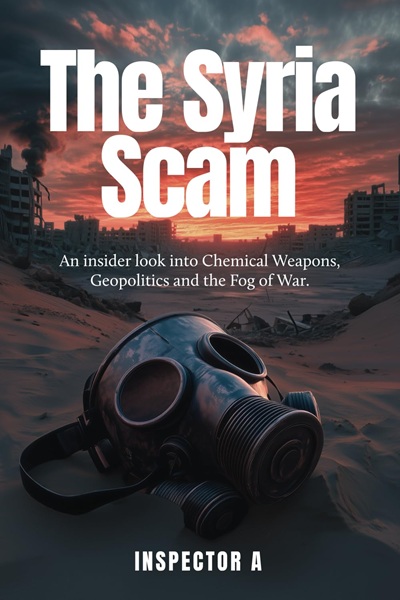 The dubious chemical weapons accusations and US driven political corruption of the Organization for the Prohibition of Chemical Weapons (OPCW) are now exposed in a February 2025 book by one of the technical professionals from the OPCW. The book is titled The Syria Scam: An insider look into Chemical Weapons, Geopolitics and the Fog of War.
By the end of 2018, the Syrian army had largely defeated the diverse jihadists. However, instead of conquering or expelling the opposition, Syria allowed them to have a safe haven in Idlib province on the border with Turkey. With Turkey, Iran and Russia seeking to find a solution through the Astana Accords, the conflict was frozen, and the jihadists were allowed to regain strength. Hayat Tahrir al Sham (HTS) became the de facto leader of the opposition factions and the government of Idlib.
The Frozen Conflict
In 2019, the U.S. turned the screws on Syria and escalated attacks on Lebanon. The extreme Caesar sanctions did what they were intended to do. They crushed the Syrian currency and economy, made it impossible to rebuild, and impoverished the vast majority of Syrians. The spreading poverty and inability to counteract it led to widespread demoralization and dissatisfaction. With consummate cynicism, the “Caesar” sanctions were named the “Caesar Civilian Protection Act”.
Meanwhile, in the HTS safe haven of Idlib province on the Turkish border to the north, conditions were very different. Although HTS was designated a terrorist organization in the U.S. and the West, they were helped economically. The HTS fighters were trained and supplied with modern military weaponry, including drones, sophisticated communications equipment, etc.. Very recently, when people from Damascus traveled to Idlib, they were shocked to find new highways, Wi-Fi widely available, and electricity 24 hours a day. Teacher salaries are ten times higher in Idlib than in Damascus.
The Fall of Damascus
With a demoralized population and Syrian army, the Assad government fell in a few weeks, and HTS, led by Ahmad Al Sharaa, took power on 8 December 2024. The new leader of Syria has been greeted and endorsed by the Gulf monarchies and Western countries that paid for and promoted the overthrow in Syria: the UK, Germany, France, Saudi Arabia, Qatar, and of course, Turkey.
Since the change, there have been numerous sectarian massacres of Alawites and Christians along the coast.
There have been attacks on Druze in Damascus. To date, there have been no punishments for the massacres of civilians. A nun reports, “there is no security” in Damascus or elsewhere in Syria.
Meanwhile, Israel has invaded and occupied all of the Golan and parts of southern Syria. They have built military bases in Quneitra and other strategic locations. Israel has carried out a bombing blitzkrieg, destroying all known Syrian ammunition depots. Israel can now fly over any part of Syria at will.
Instead of condemning the Israeli violation of Syrian land and airspace, Ahmad al Sharaa has criticized Iran and Hezbollah. In recent weeks, the new Syrian regime has arrested Palestinian leaders and closed their offices in Damascus. The normalization of relations with the Zionist state has begun.
Lifting Sanctions on Syria
Of course, the sanctions on Syria should be lifted. They never should have been imposed.
U.S. sanctions, known officially as “unilateral coercive measures”, are condemned by the vast majority of world nations. Over 70% of the world’ nations say that US sanctions are “contrary to international law, international humanitarian law, the Charter of the UN and the norms and principles governing peaceful relations among States.”
Without exaggeration, the West and their allies sponsored terrorism in Syria through Al Qaeda and other fanatical violent terrorist groups. They destroyed a once prosperous and independent nation. With a diverse Syrian population ruled by a sectarian leadership prone to violence, there may be more dark days ahead. While Israel, Turkey and the Gulf monarchies are pleased with the removal of the Assad government, a very heavy price has been paid by the majority of Syrians. And the cost is ongoing.
Trump’s Middle East theatricals were all about putting Bibi in his place
By Martin Jay | Strategic Culture Foundation | May 16, 2025
Was it Bill Clinton in the White House with Benjamin Netanyahu who, in a press conference, muttered those vulgar and certainly immortal words “who’s the f*** superpower around here?” The question was really about whether the U.S. is running Israel and its activities in the Middle East or it is in fact Israel which is running the U.S.
In recent months in both the Biden administration and the Trump one which followed, many pundits have claimed that Israel is in control of U.S. foreign policy, with some even going as far as speculating that this control even goes beyond the Middle East itself. This cabal of online commentators made so much of how Trump adjusted Bibi’s seat when he sat down in the Oval Office.
We can see now though that this idea of the tail wagging the dog, even if once it might have been true to some extent, has now been dealt with head on by Trump.
His visit to the Middle East and his impressive speech in Saudi Arabia which mocked the bellicose approach to bombing civilians was a direct message to Netanyahu in Israel: America is back.
Trump is literally taking control of U.S. foreign policy in the region and pushing back Israel’s attempts to bomb its way to peace, whether this be in Gaza, Lebanon, Syria or, of course, in Iran.
The move comes at a tough time in the region where the country which seemed to bring about a revolution with the Arab Spring – Tunisia – is falling into an abys as it becomes a leading example of a dictatorship which knows no limits on its brutal suppression.
For Netanyahu, a number of pundits now are pointing to the “clear light” between Trump and him with some claiming that these two leaders aren’t even talking anymore. Trump defied him by talking to Iran, negotiating with the Houthis and now scrapping sanctions in Syria.
Israel cannot even dream of attacking Iran with the U.S. help and so a big part of Netanyahu’s mojo has been removed. And now Trump is calling the shots on aid to Gaza, but stopped short of calling for the Palestinians to have their own state.
Yet his move on Syria is telling. Israel’s plans were always to have head-chopping extremists running the show – which they backed in the Syria civil war – with a constant mayhem present so that they can always take advantage of the chaos while ensuring that the path which once stood between Tehran and Beirut is always blocked.
Trump’s announcement that all sanctions will be lifted will not be welcomed by Bibi who will see the move as a stunt by the Donald to demonstrate who is running the show, although the announcement itself might prove to be premature.
Senator Lindsey Graham states only Congress can change the country’s designation as a “state sponsor of terror” and that Trump must make his case to Congress for that to happen.
“That report has not been received, and Congress has the opportunity to review this action if it chooses. The designation of Syria as a state sponsor of terrorism has tremendous ramifications apart from the sanctions,” Graham stated. The senator stated that he is sure that Congress must be informed before sanctions are lifted, and the legislative body would then “make an informed decision on whether or not it should approve the change in designation.” But he also stated that Israel’s opinion matters and that Congress would consult Netanyahu so it’s fair to say that Syria’s fate is still yet to be decided regardless of whatever Trump has said at the podium in Riyadh. It would appear that Bibi and Trump are set to clash now and we shouldn’t be surprised at what resources Trump will deploy to show Israel’s leader that Trump is both serious about peace in the region but also that Israel must put aside its warmongering – which may well include even supporting a two-state solution, pushed more recently by France and the UK. And then we will see who is the f*** super power and who is the client state. Almost certainly the fate of Syria and Gaza will be used as a rod for Bibi’s back until he succumbs to Trump’s rule.
Ball’s in Trump’s Court, But Iran Won’t Bow to US Pressure
By Ekaterina Blinova – Sputnik – 15.05.2025
There is a good possibility of a US-Iranian deal, Mohammad Marandi, a Tehran University professor who was on Iran’s team during the 2015 nuclear talks, tells Sputnik.
Marandi stresses, however, that Tehran won’t accept any agreement that infringes on the nation’s sovereignty.
Reduced, Not Suspended, Enrichment
“The reason why [Iran is] enriching uranium at 60% right now is in order to put pressure on the US to come to the negotiating table, to behave more reasonably and to force it to remove sanctions,” the professor tells Sputnik.
The US shouldn’t expect Iran to halt its uranium enrichment – Tehran will only reduce enrichment levels and expand the IAEA’s role in the country in exchange for US sanctions relief, the academic stresses.
“Iran is a country that’s deeply and profoundly independent in its foreign policy… so the US should not expect Iran to be a subordinate country.”
What’s the Real Cause of the US-Iranian Row?
- The root cause is “Iran’s support for the Palestinian people and… legitimate resistance to ethnic cleansing, to genocide, to apartheid,” says Marandi.
- “The US supports genocide, because they unconditionally support racism… and ethno-supremacism in our region.”
- The nuclear issue is an excuse — just like the “human rights” or “terrorism” accusations the US uses against Iran to appease Israel.
US: An Irresponsible Negotiator?
The US isn’t a trustworthy negotiator; it violates agreements, according to Marandi: Trump is constantly “flip-flopping” — be it Ukraine, trade wars, Yemen, or Gaza genocide.
“This is what makes it very difficult to come to any agreement,” the pundit concludes.
F-35 near-misses over Yemen signal new risks for ‘Israel’
Al Mayadeen | May 14, 2025
US F-16 and F-35 fighter jets encountered heavy close-range fire from Ansar Allah air defenses during Operation Rough Rider, the two-month US aggression against Ansar Allah that was launched by President Donald Trump in mid-March, according to Forbes.
According to a Monday report by The New York Times, unspecified Ansar Allah air defenses came dangerously close to striking US fourth-generation F-16s and fifth-generation F-35s during the initial 30 days of Operation Rough Rider, raising concerns about potential American casualties. During the same period, Ansar Allah forces successfully shot down seven MQ-9 Reaper drones.
The potential downing of a US fighter jet and the resulting capture of a pilot by Ansar Allah forces presented a scenario that the current administration was determined to avoid, Forbes stated.
The loss of one of America’s exclusively exported stealth fighters to Ansar Allah air defenses, which had previously been considered largely improvised and relatively rudimentary, would have dealt a severe blow to US fighter jet prestige while potentially jeopardizing future arms export agreements.
‘Israel’ faces similar risks
Forbes highlighted that the near-misses involving US F-35s during operations over Yemen carry significant consequences for “Israel” as well, particularly since the Israeli Air Force initiated its first long-range strikes against Ansar Allah in July 2024 following a successful drone attack by the group that reached Tel Aviv. In March, shortly after initiating Operation Rough Rider, the US advised “Israel” against carrying out further attacks.
Trump declared the Yemen ceasefire shortly after “Israel” conducted strikes following an Ansar Allah missile attack that had successfully hit its major airport near Tel Aviv.
While US Marine Corps F-35Bs conduct operations from amphibious assault ships and Navy F-35Cs launch from supercarriers positioned near Yemen’s coast, “Israel” lacks comparable forward deployment capabilities for its F-35Is, forcing them to rely on aerial refueling to cover the more than 1,000-mile flight distance and severely limiting their available loiter time over Yemeni airspace during missions.
Given that Ansar Allah’s air defenses have already posed risks to US F-35s, Israeli F-35Is conducting long-range missions could also face similar threats, and if one were to be shot down over Yemen, it would provide Ansar Allah with an unprecedented image of a victory, according to the US magazine.
Future Israeli F-35I sorties over Yemen will likely avoid operating at maximum combat capability to minimize risk exposure.
What Will Trump Find in the Middle East This Week?
By Ron Paul | May 12, 2025
President Trump’s return to the Middle East this week, the first since his first-term 2017 visit, will take place amidst great turmoil. It is a region that bears little resemblance to the Middle East of 2017 and it appears, at least from media reporting this past week, that the Trump Administration has some understanding of this reality.
Syria has been over-run and is now controlled by the same al-Qaeda that the US government supposedly spent 20 years fighting in the “war on terror.” Violence against religious and ethnic minorities has, predictably, exploded under the “rule” of a self-proclaimed Syrian president who until very recently was on the US “most wanted” terrorist list.
After the October 7, 2023, Hamas raid, Gaza has been reduced to rubble and turned into a humanitarian catastrophe. Tens of thousands of civilians have been killed and perhaps another million face starvation. US bombs and financial aid have facilitated the utter destruction of Gaza.
Iran has made peace with Saudi Arabia thanks to Chinese mediation and is deepening its ties with the Kingdom. Thus, the US has little leverage in talks with the two former enemies.
Israel is conducting military operations against several countries in the region simultaneously as the world increasingly condemns its aggression against its neighbors.
After tearing up the JCPOA nuclear deal with Iran in his first term, President Trump is pushing for a new deal with Iran while threatening to attack if negotiations do not produce the results he demands.
Massively increased US military action against the Houthis in Yemen starting in March did not result in their capitulation to US demands. Despite attempting to put the best spin on things, it is clear that the US retreated from the region in the face of a series of successful Yemeni actions in defense of their homeland.
Biden and then Trump launched attacks against Yemen on behalf of Israel, but in the end the US president wisely removed US military assets from the area and called off the bombing.
In short, President Trump will be wading into a minefield this week, but it is a peril that the US government has largely brought upon itself. Decades of US interventionism, from at least the 2003 Iraq war, have not produced the peaceful transformation of the region, as promised by the neocons and their mentor, Israeli Prime Minister Benjamin Netanyahu.
From the unnecessary Iraq war – based on lies – to the destruction of Libya and Syria and countless other interventions, the Middle East is a basket case. And it turns out none of it actually helped Israel at all!
Having ignited the tinder box of the region with US backing, Israel has now found itself friendless in a region increasingly hostile to its policies and even its very existence. Now there are indications that the Trump Administration is tiring of this entangling alliance as the MAGA base looks more warily on foreign interventionism.
The lesson that President Trump should take with him is that to a large degree it has been US interventionism in the Middle East that has produced these poisoned fruits. His wise military disengagement from the Houthis in Yemen should serve as a US model for the region. Ties forged by trade and friendship produce peace and prosperity and are far preferable to endless neocon war cries.
Sectarian massacres continue in Syria as government-affiliated groups kill several in Latakia
The Cradle | May 11, 2025
Extremist armed groups affiliated with the Syrian government have carried out a new massacre in Syria’s Alawite majority coastal region.
On 10 May, at least nine civilians, including a 13-year-old boy, were killed in a massacre in the village of Ain al-Sharqiyah near Jableh, in Latakia province. Two victims were found decapitated in what locals described as sectarian-motivated killings.
Eyewitnesses and local sources attribute the killings to a foreign-backed faction affiliated with the Ministry of Defense’s 107th Brigade, reportedly linked to Hayat Tahrir al-Sham (HTS). Among the victims were Hilal al-Ali, Anwar Hamouda, and his son. Graphic images circulated on social media showed the bodies following the brutal killings.
Pro-government Syria TV reported on the same incident, stating that “Four people, including a child, were killed by unknown assailants in the village of Ain al-Sharqiya in the countryside of Latakia and the General Security has begun investigating the incident.”
This attack is the latest in a series of abuses carried out by forces associated with the Ministry of Defense.
On 7 March, armed groups belonging to the ministry raided the coastal regions, carrying out a series of massacres and killing over 1,600 Alawite civilians on the basis of their religious identity, while looting and burning homes.
Residents have accused authorities of failing to rein in foreign factions and auxiliary forces responsible for the massacres.
In a related development, Adham Mukhtar Rajoub, the mayor of Al-Waer neighborhood in Homs, was assassinated by members of an extremist group aligned with the HTS-led Syrian government while driving his car.
Meanwhile, in Damascus, at least 50 homes were seized in the Alawite-majority Ash al-Warwar neighborhood. Armed groups reportedly threatened residents with arrest, labeling them as regime collaborators or “shabiha,” to justify the expulsions. Victims claim that even minimal resistance led to verbal abuse, detention, or forced displacement.
On 7 May, government-affiliated armed groups raided multiple villages in Tartous and Latakia, destroying homes and abducting civilians. In Jableh’s Ras al-Ain village, a respected Alawite sheikh, Saleh Mansour, was kidnapped from his home, his family assaulted, and his property looted by auxiliary forces. Locals prevented further kidnappings by intervening.
Since HTS, led by former Al-Qaeda commander Ahmad al-Sharaa, took power in Damascus in December, toppling the government of Bashar al-Assad, Syria has witnessed a chilling wave of mysterious kidnappings of young women, predominantly from the Alawite community.
Dozens of women, primarily from the Alawite religious sect, have been abducted and taken to live as sex slaves in Idlib governorate, the traditional HTS stronghold, by armed factions affiliated with the new Syrian government.
Fed Up with Benjamin Netanyahu?
By Philip Giraldi | Unz Review | May 9, 2025
I have in the past speculated that the day might come when President Donald Trump, he of a massive ego, might just become tired of his being manipulated and controlled by America’s Israel Lobby and by Israeli Prime Minister Benjamin Netanyahu in particular. I thought, and hoped, that he might become so annoyed that he might move to take control of the so-called tail wags the dog relationship that has for so long put Israel in the driver’s seat. While I am loathe to read too much into several recent developments, the first suggestion [is appearing] that all is not well in Washington’s relationship with what has been euphemistically referred to as “America’s best friend and closest ally.”
Many observers are now openly voicing their view that Israel and its all-powerful Lobby in the United States have corrupted and now control many aspects of government, starting at the top in Washington and working its way down to state and local levels. Witness the near worship of Netanyahu by groveling congress critters during recent visits to Capitol Hill if you want a tangible display of government serving no conceivable national interest. Or check out the “antisemitism” and anti-Boycott legislation currently moving through Congress that will strip all Americans of free speech and free association, leaving them able to demonstrate against or even criticize their own country or other nations with the single exception of the Jewish state. If you don’t believe that will happen, check out the current tale coming out of San Marcos in Texas at the hands of ardently Zionist Governor Greg Abbott.
Given that Jews constitute something like 3% of the US population the establishment of such control through bribery and the support of a compliant media is truly a remarkable achievement but one might plausibly argue that it has done terrible damage to the country as a whole and has contributed nothing to benefit the American people. Israel is currently carrying out a genocide against the Palestinians that is funded, armed and provided with political cover by the Trump Administration, following on to the model established by Genocide Joe Biden, which could be stopped with one phone call to Netanyahu from the White House. But, unfortunately, up until now no one has been picking up the phone.
I must admit to being shocked to have read some of the recent news coverage, mostly coming out of Israeli and other foreign media, of course, that is describing the rift between Trump and Netanyahu. The signs that trouble could be brewing might well be dated back to January 11th, with US Presidential Special Envoy Steve Witkoff demanding a meeting in Tel Aviv with Netanyahu. Netanyahu responded that it was a Saturday, the Sabbath, but Witkoff, acting under orders from Trump, insisted and the meeting was held. It turned out to be a tense exchange which included a demand that a ceasefire for Gaza drawn by the White House be implemented, and so it was, though Netanyahu later proceeded to withdraw from it and recommence hostilities before it entered phase two on March 1st. A demand by Trump that Netanyahu should visit him in Washington in early April followed and there were reported disagreements about the Administration’s tariff plan and about US negotiations with Hamas without Israel’s input. Discussions also concerned US discussions with Iran to restore a program (JCPOA), canceled by Trump during his first term in office, to monitor the Iranian nuclear program to prevent it from being weaponized. Netanyahu was demanding a “Libyan Solution” which would have been a war including US forces that would have basically destroyed Iran’s defensive capabilities, something that even a White House disinclined to deal with reality realized would never be accepted in Tehran. Netanyahu was reportedly also angry at the Trump Administration’s resistance to his own plans to ethnically cleanse the Palestinians while also going to war with the Iranians.
So, the US move to negotiate with Hamas directly, sidelining Israel, started the rebellion on the part of Washington and it was followed up by the negotiations with Iran, again without Israel’s input. And there was also the issue of US negotiations with Saudi Arabia, again without including Israel, over the Kingdom’s intention to develop its own civil nuclear program. And finally, there was last week’s decision to enter into a ceasefire with the Houthis after direct negotiations, described by the White House comically as a “capitulation” by the Yemenis. Some observers accepted the language but have been questioning who had done the surrendering in a war that cost in excess of $1 billion and which accomplished nothing. Israel, for its part, was not involved in either the talks or the agreement, leading an aggrieved Netanyahu to vow to “defend ourselves alone”.
But this week, Trump sent the clearest message of all to Netanyahu. He has been planning to meet with the leaders of Saudi Arabia, the United Arab Emirates and Qatar in the Middle East next week but will not meet with Netanyahu. US Secretary of Defense Pete Hegseth also canceled a planned trip to Israel at the same time, according to two Israeli officials, reinforcing the message sent by the president. The immediate cause of the rift was that Trump had apparently hoped for a major de-escalation and even a ceasefire in Gaza as a highlight of his trip for which he would have taken credit, but Netanyahu instead called up army reserves and ordered a major escalation. The Times of Israel reported that “Trump is disappointed with Prime Minister Benjamin Netanyahu” citing two “senior sources close to the president.” And even opinion columnist Thomas Friedman in normally careful-about-its-reporting on Israel The New York Times is openly suggesting in a piece “This Israeli Government is Not Our Ally” that the Netanyahu regime is no longer behaving as an American friend because of its extremist agenda.
Several reports, relying on what are claimed to be multiple sources inside the Israeli government, have now claimed that Trump has de facto cut ties with Netanyahu and will have no direct contact with the Israeli Prime Minister. Israeli government Strategic Affairs Minister Ron Dermer and former Ambassador to the US was in Washington on Thursday and was welcomed and met with Trump. He was reportedly told flatly that the US “will move forward on regional plans without coordinating with Netanyahu, accusing him of manipulation.” One report on the development went on to emphasize that what Trump hates most is being looked down upon and being manipulated, “There is nothing Trump hates more than being portrayed as a fool or someone being played. That’s why he decided to cut contact with Netanyahu,” one US official speaking off the record added.
What is not being discussed in the media but is nevertheless being considered in intelligence circles in Washington is the possible connection of the excommunication of Netanyahu with various dismissals and relocations of high officials in Washington, including that of National Security Adviser Mike Waltz who was demoted to the post of UN Ambassador. It seems that there is strong evidence to suggest that Netanyahu did not exactly trust Trump and has been spying on him and his decision making through a number of officials in his cabinet, which explains to a certain extent the odd Signal phone calls where journalist Jeffrey Goldberg just happened to be listening in and other incidents that suggest that Mossad or the Israeli Embassy in Washington has established relationships that sought to go around the president and might be described as espionage. It would also help to explain the mixed signals coming out of the administration, suggesting that some “recruits” are being coached on what to say to advance the Netanyahu agenda.
How all of this will develop and where it will eventually wind up remains somewhat up in the air as the powerful Israel Lobby is almost certainly cranking up efforts to restore the Jewish state’s dominance of US foreign policy in the Middle East, what Trump is now defining as “manipulation.” Zionist uber hawks in Congress are already warning the White House that any agreement on nuclear developments with Iran will be rejected by the legislature if it does not include a “complete dismantling” of all nuclear enrichment by Tehran, something that is not likely to be acceptable and which means that no agreement will be possible. Wholly owned by Israel Senators Lindsey Graham, Tom Cotton and Victor Cruz are leading the charge and claim to have enough votes to block any such proposal, which means it will not be a “law” or treaty and could be “withdrawn from” by any new president, just as Trump did with the original JCPOA in 2017.
So, there has been some movement in the relationship between Israel and the United States. As it is headed towards Washington regaining some independence of action in its Middle Eastern foreign policy it can only be a good thing as the lopsided relationship with Israel has brought nothing but grief and suffering. One can hope that it will continue in that more positive direction but there will be strong resistance from Congress and the Media, directed by the powerful Israel Lobby. Trump and whoever supports him will find themselves assailed from all sides but we ordinary citizens who are watching all this from the sidelines will have to hope and pray for a good result.
Philip Giraldi is an American columnist, commentator and security consultant. He is the Executive Director of the Council for the National Interest, a role he has held since 2010.
US pressures ‘Israel’ for Gaza deal; Witkoff’s Israeli rebuke leaked
Al Mayadeen | May 9, 2025
The administration of US President Donald Trump is reportedly pressuring “Israel” to agree to a ceasefire and a captive deal with Hamas before Trump’s upcoming Middle East visit, according to Haaretz.
An unnamed source familiar with the negotiations stated that the US has warned Israeli officials that if they do not cooperate in advancing such an agreement, “Israel” will be “left alone”, implying a potential withdrawal of US diplomatic support.
The push for a deal comes as the Trump administration seeks to broker a resolution to the ongoing war in Gaza ahead of the president’s regional trip.
A recent report, without citing a specific source, identified Steve Witkoff as the unnamed senior US official referenced in a Channel 12 story earlier this week.
According to that report, the official had criticized “Israel’s” approach to the captive situation during a meeting with the captives’ families, while the nature of the criticism and the full context of the remarks remain unspecified.
The official was quoted as warning: “If until today, the hostages paid the price for not ending the war, then today the price will be much heavier for Israel, and not only the hostages.”
The remarks also criticized “Israel” for failing to leverage the emerging US-Saudi nuclear deal, an agreement that, according to reports, President Trump has reportedly decoupled from the requirement for Saudi Arabia to normalize ties with the Zionist entity.
“If Israel doesn’t come to its senses, the price of missing out will be higher than ever before,” the official, allegedly Witkoff, warned.
Haaretz further reports that Witkoff’s criticism of Netanyahu’s government was deliberately leaked to the media at his request, though his office has since denied that the Trump administration is pressuring “Israel” to reach a deal.
This comes amid an increasingly souring relationship between the United States and “Israel”, which is reportedly leading Trump to pursue US policy in the Middle East while sidelining its “greatest ally in the Middle East”.
The rift between Trump and Netanyahu
Sources close to Trump indicate he is increasingly disappointed with Netanyahu, following reports that Netanyahu has grown frustrated with the US leader, marking a turning point in their relationship as Trump begins to distance his administration from coordination with “Israel” on key Middle East strategies.
Two senior Trump administration officials, in closed conversations relayed to Israel Hayom, revealed that the president has decided to advance regional policy decisions independently rather than waiting for Netanyahu’s input.
Trump aims to strengthen US influence in the region, particularly with Gulf states, and while initial normalization efforts included coordination with “Israel,” the administration now sees Netanyahu’s reluctance, especially his refusal to publicly endorse a “horizon for a Palestinian state”, as a major hindrance.
Trump’s frustration has intensified following reports that Netanyahu and his associates pressured former National Security Advisor Mike Waltz to take military action against Iran, leading to his ousting from the administration on May 3.
Although Netanyahu denies substantial involvement and claims he only spoke to Waltz once, Trump reportedly remains unconvinced and sees this as part of a wider concerning pattern.
Defiant Trump advances US plans without Israeli approval: Report
The Cradle | May 8, 2025
US President Donald Trump has lost patience with Israeli Prime Minister Benjamin Netanyahu and will not wait any longer for Israel before advancing initiatives in West Asia, Israel Hayom reported on 8 May.
According to two senior sources in the US President’s entourage, Trump is interested in making decisions that he believes will advance US interests, particularly regarding Saudi Arabia and the Gulf states, without waiting for approval from Netanyahu.
Regarding a potential US–Israeli agreement with Saudi Arabia, Trump believes Netanyahu is delaying making the necessary decisions. The president is not willing to wait until Israel does what is expected of it and will move forward without it.
During the presidency of Joe Biden, the US and Israel were involved in talks with Saudi Arabia that would see Washington enter a defense pact with the kingdom, provide it with civilian nuclear technology, and sell it advanced weapons – all in exchange for normalization with Israel.
As part of any agreement to normalize relations with Israel, Saudi Arabia expects an end to the war in Gaza and an Israeli declaration of a “horizon for a Palestinian state.”
However, senior ministers in Israel’s current government have vowed to never allow a Palestinian state in the occupied West Bank, while promising to “destroy” Gaza, ethnically cleanse its population under the pretext of promoting “voluntary migration,” and to build Jewish settlements there.
The sources added that Trump was furious at what he saw as an attempt by Netanyahu to use US National Security Advisor Mike Waltz, who has since been dismissed from his position, to push for US military action in Iran.
Netanyahu claimed in response to the publication of the affair in the Washington Post that he had only spoken to Waltz once. However, Trump was not convinced.
The president’s anger likely explains why Trump did not involve Israel in the ceasefire he announced with the Ansarallah-led government of Yemen.
Even after Trump announced the agreement with Yemen, Israeli representatives handling relations with the US were reportedly unable to receive information from White House officials about what was happening for a day, Israel Hayom noted.
Additionally, Trump is not currently scheduled to visit Israel as part of his visit to the region next week.
The disconnect between Trump and Netanyahu likely explains why the Israeli prime minister and his Defense Minister, Israel Katz, announced on Wednesday that they are prepared for a situation in which Israel will be left alone in the campaign against Yemen.
Defense Minister Katz said that “Israel must be able to defend itself on its own against any threat and any enemy. This has been true in the face of many challenges in the past and will continue to be so in the future.”
Trump has faced criticism for escalating the war against Yemen since taking office in January, including for withholding information about US military casualties resulting from a military campaign that has never received authorization from Congress.
The operation has involved over 1,000 US airstrikes against the Ansarallah-led Yemeni Armed Forces (YAF) and killed hundreds of Yemenis, including many civilians.
Writing for Haaretz, Israeli journalist Aluf Benn notes that each time US presidents have been angered by Tel Aviv’s actions, “Israel stood its ground, deflected the pressure and over time got what it wanted.”
Benn stated that Trump is also pursuing a deal with Iran over its nuclear program that is contrary to Netanyahu’s position on the matter.
Trump pulled the US out of the Obama-era Joint Comprehensive Plan of Action (JCPOA) in 2018 amid encouragement from Netanyahu. However, the president has been trying to come to a diplomatic understanding with Iran to halt the development of its nuclear program during his second term.
Three rounds of talks have taken place, mediated by the government of Oman and involving Trump’s special envoy to the region, Steve Witkoff.
Featured Video

Racist Seinfeld Dances for Joy as Bibi Unveils His New Map
or go to
Aletho News Archives – Video-Images
TV Drama Review
Japanese drama projects Japan’s wartime atrocities onto Chinese characters

Global Times | October 25, 2026
By portraying Chinese characters as perpetrators of ruthless violence while casting Japanese Self-Defense Forces (SDF) intelligence operatives as defenders, the season 2 of the Japanese drama Vivant has recently drawn criticism from Chinese netizens, who argue that its depiction turns historical reality on its head while ignoring Japan’s wartime atrocities.
The TBS drama series – a spy suspense story in which an alleged unofficial intelligence unit of the SDF operates across the globe — has attracted a passionate fanbase. Its currently airing season 2 opened with a household rating of 18.8 percent, the highest for a TV drama this year, according toa commentary article by Japanese media Toyo Keizai.
What draws attention is the portrayal of the enemies in the series, the article noted. Scenes in which the Chinese organization subjects kidnapped members of the SDF unit to brutal torture are repeated with unrelenting intensity.
It is rare for Japanese TV dramas to explicitly portray a real-life country as the enemy, the article noted.
Japanese Prime Minister Sanae Takaichi also made a reference to the drama, saying that she has been recording Vivant and hopes to binge-watch it over the year-end and New Year holidays, according to Japanese media outlets.
China’s CCTV News report on Sunday revealed that the drama features scenes in which Chinese personnel cut off the fingers of and stab Japanese intelligence operatives in the abdomen. Such acts bear striking similarities to the torture inflicted on Chinese nationals by invading Japanese troops during the World War II.
The drama distorts the truth by attributing these atrocities to modern Chinese characters. Beneath the surface, it subtly glorifies Japan’s cross-border overseas operations, blurs the functional boundaries of the SDF and implicitly promotes an expansionist narrative, per CCTV News. … continue
Blog Roll
 Aletho News
- EU facing trillion-euro debt hole while seeking more cash for Kiev
- How US, Europe, Persian Gulf states exhausted missile stockpiles, splurged billions to defend Israel
- Up in arms… Koreans reject U.S. empire’s plan to make South Korea the next Ukraine
- Iran, Turkey, Pakistan, Saudi Arabia could advance region-led security framework in Tehran: FM spox
- Netizens condemn Japanese drama for projecting Japan’s wartime atrocities onto Chinese characters
- Racist Seinfeld Dances for Joy as Bibi Unveils His New Map
- A West Bank War for Netanyahu’s Election Campaign, Could It Backfire?
- Yemen denounces European Parliament’s ‘hypocritical’ push to blacklist Ansarullah
- Qalibaf: UAE’s UN bid aims to ‘clear the runway’ for ‘Greater Israel’, whitewash genocide
- Pakistan reopens Iran border after boosting security: Report
- If Americans Knew
- An error has occurred; the feed is probably down. Try again later.
- No Tricks Zone
- Sudden Stratospheric Warming, Powerful El Niño Combination May Lead To Extreme Europe Cold, Energy Crisis!
- Two New Studies Find Thwaites Glacier Melt Cannot Be Driven By Human Activity Or A Warming Ocean
- E-Cars Reduce CO2 Emissions By Only 41% Compared To Internal Combustion Engine Vehicles
- Predictions Made By Renowned Climate Professor Over Past Decades Have Been Proven To Be Poor
- New Study Suggests Large Regions Of The Pacific Ocean Have Been Cooling For The Last 80 Years
- Germany’s Green Energy Debacle: High Energy Costs Force Kahla Porzellan to Close After 182 Years!
- New Study: 50 Years Of The Most Aggressive ‘Net Zero’ Policies Can Only Affect The Global Climate By 0.03°C
- US September “Heat” Was No Record…Many Records Set Decades Ago
- Latest European Green Energy Debacle; Portugal’s Largest Flagship Solar Park Insolvent!
- Green Energy Debacle: German Expert Professor Fritz Vahrenholt Warns Of Severe Economic And Social Consequences

