Amazon says cloud infrastructure in Bahrain, UAE ‘beyond saving’
The Cradle | September 15, 2026
Amazon Web Services (AWS) says it cannot restore access to its cloud-computing facility in Bahrain or one of three data-hosting zones in the UAE due to the extensive damage caused by Iranian retaliatory strikes, Reuters reported on 15 September.
“The damage to our infrastructure spanned multiple Availability Zones and exceeded what our regional and multi-AZ services are designed to withstand,” AWS reported in its status update seen by Reuters.
In the UAE, resources and data held exclusively within one zone, labeled mec1-az2, have been damaged beyond hope of recovery, the company said, as engineers are still salvaging what they can from the two other battered zones and across the wider Emirati region.
An availability zone refers to a cluster of one or more data centers sitting inside the same geographic region, the structure AWS relies on to keep services running when a single site goes down.
The outages trace back to March, when the US and Israel attacked Iran, and Tehran responded with missile and drone salvos against Israel and Gulf states hosting US military bases.
AWS confirmed at the time that two of its UAE facilities took direct hits, while a drone strike near one of its Bahraini sites left the infrastructure there destroyed.
Most Bahrain-based customers shifted their workloads elsewhere on AWS advice before the region went dark in April, but the company says it has now exhausted every option for recovering whatever was left behind.
The losses have called into question the resilience of the Gulf’s fast-expanding cloud and AI infrastructure.
The UAE is already redrawing plans to war-proof a major AI data center project, weighing decentralized site building alongside underground and blast-resistant construction, and even equipping the data center itself with anti-air defenses.
Israel and the US have long ago transformed AI infrastructure into a weapon of war deployed extensively across West Asian theaters.
Cloud platforms, data centers, and high-capacity computing systems now help store intelligence, process intercepted communications, analyze surveillance, and support military operations across West Asia, extensively so in Gaza and Iran.
Iran maintains that data centers operated by US technology companies are not simply civilian facilities, but strategic assets supporting US and Israeli aggression, thereby making them legitimate targets for retaliation.
AI has become a central instrument of US and Israeli warfare across West Asia, embedded in how targets are chosen, tracked, and struck.
Israel has weaponized AI platforms including automated targeting systems like The Gospel, Lavender, and Where’s Daddy? to harvest mass data, autonomously generate kill lists, and orchestrate systematic airstrikes and assassinations against Palestinians.
Backed by corporate infrastructure like Microsoft Azure, which stored massive caches of intercepted Palestinian communications, the Israeli military has deployed AI-driven drone surveillance to track and assassinate Palestinians.
The US has run algorithmic warfare systems such as Palantir’s Maven to process satellite, drone, and radar intelligence, using machine learning to speed the production of targeting recommendations against Iranian forces.
More than 1,000 targets were designated within the first 24 hours of the war on Iran, one of which resulted in the massacre of at least 150 people, including at least 120 schoolchildren at the Shajareh Tayyebeh elementary school in Minab.
Trump says Iran urgently seeks deal, Tehran sets conditions for talks
Al Mayadeen | September 15, 2026
US President Donald Trump said Monday that Iran is urgently seeking an agreement with the United States, while leaving open the question of whether Washington will engage in negotiations.
In a post on Truth Social, Trump described Iran as a “failed country” and said Tehran wants to reach an agreement with the United States “very quickly.”
Trump added that he would decide whether the United States would engage in the effort and enter negotiations, indicating that Washington remains open to the possibility of reaching an agreement with Iran.
The US president did not provide further details on what any potential agreement would entail or the conditions under which Washington would pursue talks with Tehran.
Tehran warns against mixed signals from Washington
Trump’s remarks come against the backdrop of sharply differing signals over the prospects for negotiations with Iran.
Iranian Supreme National Security Council Secretary Mohsen Rezaei warned against being misled by what he described as contradictory statements from Trump, pointing to the shift from declaring that there would be “no negotiations” to saying that Washington is ready to talk.
Rezaei stressed that Iran would not enter negotiations before its conditions are met, saying, “No negotiations before Iran’s conditions are met. Period.”
The Iranian official also said that the equations surrounding oil and strategic waterways had changed, warning that attempts to contain the consequences of the current situation would not prevent what lies ahead.
Iran sets seven conditions for reopening strait
Iran has told the United States that the Strait of Hormuz will remain closed until seven conditions approved by the country’s top officials are met, Iranian news agency Tasnim reported on Saturday, citing an informed source.
The message comes as Tehran prepares to meet with Iraq and Persian Gulf states in Oman on Monday to discuss safe routes for commercial shipping through the strategic waterway.
“Until these seven conditions, which have been approved by Iran’s top officials, are met, the Strait of Hormuz will remain closed,” the source told Tasnim.
The Iranian Foreign Ministry announced the planned meeting as efforts continue to coordinate maritime traffic amid the escalation of the US war on Iran.
Oman agreement does not include reopening waterway
The reported conditions come after Iran and Oman reached an agreement concerning the Strait of Hormuz, although the arrangement did not include reopening the waterway.
The understanding between Iran and Oman “does not provide for the immediate reopening of the Strait of Hormuz, but lays the groundwork that could allow for its reopening,” an Iranian source told Tasnim on Saturday.
The source added that the arrangement would be a step toward Iran exercising its sovereignty over the Strait and that reopening it depends entirely on the United States meeting Tehran’s conditions.
Under the agreement, the two sides coordinated the main routes for vessels entering and leaving the Strait of Hormuz.
The waterway has become a major point of concern for international shipping as the war has sharply disrupted maritime traffic through one of the world’s most important energy routes.
Why Algeria finally shut the door on the UAE
Abu Dhabi’s alliance with Tel Aviv has pushed its rivalry with Algiers from quiet hostility into open regional confrontation
By Anis Raiss | The Cradle | September 14, 2026
On 10 September 2026, Algeria severed diplomatic relations with the UAE, giving the Emirati ambassador in Algiers 48 hours to leave. From midnight the following day, Algerian airspace was closed to UAE-registered aircraft, although commercial flights to and from Algiers were exempt until the end of the year.
The rupture had been signaled in advance. During a televised interview in July, Algerian President Abdelmadjid Tebboune described a Gulf state he declined to name in five words: “Wherever they set foot, blood flows.” He was referring to its role in Libya, Sudan, and Yemen.
Abu Dhabi answered within hours through Anwar Gargash, diplomatic advisor to Emirati President Mohammed bin Zayed (MbZ). Relations between states, he wrote, are managed “through reason, communication and clarity of interests, not through riddles and signals that require decoding.”
One week earlier, a UN fact-finding mission on Sudan had found “reasonable grounds to believe” that external networks, including some operating through the UAE, were supplying the Rapid Support Forces (RSF) in Darfur with fighters, weapons, and training.
The source of Algiers’s anger was therefore no riddle. Algeria had become the third government in nine months to take direct action against Abu Dhabi’s regional reach.
Abu Dhabi’s nine-month reckoning
The sequence began on 30 December, when a Saudi-led coalition struck weapons and vehicles that had arrived at Yemen’s Mukalla Port aboard two ships from Fujairah. Riyadh called its national security a red line and accused Abu Dhabi of arming Southern Transitional Council (STC) separatists who had swept into Hadhramaut and Al-Mahra.
The UAE denied that the shipment contained weapons but announced the withdrawal of its remaining forces after Yemen’s Saudi-backed presidential council issued a 24-hour ultimatum. A week later, STC leader Aidarous al-Zubaidi reportedly fled by sea toward Somaliland, then flew through Mogadishu before reaching Abu Dhabi.
Five days after that flight, Somalia’s federal government annulled its agreements with the UAE covering ports, security cooperation, and defense. Mogadishu cited “strong evidence” of actions undermining the country’s sovereignty, national unity, and political independence. The decision included Berbera, Bosaso, and Kismayo, although enforcement in Somaliland and Puntland remained uncertain. Two regional diplomats told Bloomberg that Saudi officials had pressed Mogadishu to act.
The same pattern surfaced in Sudan through an 83-page Human Rights Watch (HRW) report published in May, which found evidence that the Abu Dhabi-based Global Security Services Group appeared to have hired hundreds of Colombian contractors who fought alongside the RSF around El-Fasher.
On 3 September, the UN mission reported that as many as 2,000 former Colombian soldiers may have joined the conflict, some of whom had trained at a military-style facility in Ghayathi in the UAE before operating drones and artillery in Darfur. Abu Dhabi dismissed the findings as a “false media campaign.”
Kabylie enters Israel’s periphery map
Kabylie is the Amazigh mountain region east of Algiers, home to several million people with their own language and a long history of friction with the central state. Its separatist wing, the Movement for the Self-Determination of Kabylie (MAK), operates from Paris and was designated a terrorist organization by Algiers in 2021.
Algerian state media now alleges that UAE diplomats have been in contact with the movement, although no supporting evidence has been made public. Even a Semafor column written by a former Emirati government official conceded that point. The Kabylie project does, however, have documented patrons elsewhere.
On 14 December 2025, MAK’s government-in-exile proclaimed a “Federal Republic of Kabylie” at a ceremony in Paris. Twelve days later, Israel recognized Somaliland, becoming the first UN member to do so.
On 14 January 2026, Dan Illouz, a Likud member of the Knesset of Moroccan Jewish descent, tabled an urgent motion calling for a study of recognition for Kabylie and described Algeria as part of the “Iranian evil axis.”
The Jerusalem Institute for Strategy and Security had already advocated “principled political support, leading over time to diplomatic recognition.” Ferhat Mehenni, the folk singer who founded MAK and styles himself as its president-in-exile, had addressed Knesset members as early as 2012.
The Somaliland precedent is where Abu Dhabi and Tel Aviv converge. The UAE became the first Gulf state to normalize relations with Israel in 2020, while its port operator DP World holds a 30-year concession at Berbera, Somaliland’s main harbor, alongside a longstanding Emirati security presence.
When Arab and Islamic states issued a joint statement condemning Israel’s recognition, the UAE declined to sign. Reports have since pointed to an Emirati role in facilitating the move, leaving the breakaway territory recognized by Tel Aviv anchored to infrastructure controlled from Abu Dhabi.
These moves draw on a doctrine older than the states now applying it. David Ben Gurion’s periphery strategy sought to contain the Arab core through alliances with non-Arab states and minorities on its edges, including Iran under the Shah, Turkiye, Ethiopia, and Kurdish movements. Israel recognized Somaliland in December, and Kabylie reached the Knesset agenda the following month.
Rabat arms the western flank
The corridor linking Abu Dhabi and Tel Aviv passes through Rabat, where, in November 2020, two months after the UAE signed the Abraham Accords, Abu Dhabi became the first Arab government to open a consulate in Laayoune, in occupied Western Sahara, whose independence Algeria has supported since 1975. Morocco restored its own relations with the occupation state one month later.
Military procurement soon gave that alignment material form. In early January 2026, the third session of the Morocco–Israel Joint Military Committee met in Tel Aviv to set the year’s work plan, while Israeli officials described Morocco to the Jerusalem Post as Israel’s most important security partner in Africa.
Rabat operates IAI’s Barak MX air defense system, Elbit’s ATMOS howitzers, and Hermes 900 drones. In November 2025, BlueBird Aero Systems, half-owned by IAI, opened a plant in Benslimane, outside Casablanca, to produce SpyX loitering munitions, described as the first facility of its kind in North Africa.
Spanish defense outlet Escudo Digital has also reported that Israeli-built surveillance and strike drones are stationed at Mahbes, a forward airstrip in Western Sahara close to the Algerian border. If accurate, it would place Israeli platforms within reach of Tindouf, where the Sahrawi refugee camps and Polisario leadership are based.
The economic leg of this alignment extends south through Morocco’s Atlantic Initiative, which offers landlocked Mali, Niger, Burkina Faso, and Chad access to the sea through the $1.6 billion Dakhla Atlantic Port, reported to be 70 percent complete in November 2025.
The port lies in the same occupied territory where the Emirati consulate stands. On 24 July 2026, Bamako reaffirmed its commitment to the corridor, 13 days after restoring diplomatic relations with Algiers. Normalization has thus acquired its own infrastructure, running from the Gulf through the Maghreb and into the Sahel.
Algeria raises the military stakes
Algeria’s answer has centered on air power rather than competing corridors. Footage that surfaced in February 2026 appeared to show an Su-57 over northern Algeria, reinforcing reports that Algiers had become the first foreign operator of Russia’s fifth-generation fighter – a development that would alter the military balance in the Maghreb.
United Aircraft Corporation (UAC) had announced the delivery of two aircraft to an unnamed foreign customer in November 2025. Su-35 deliveries were reported to have begun in January 2025, followed by a fresh batch of Su-34 bombers in June 2026, even as Russia’s own air force continued to absorb wartime losses.
The hardware was accompanied by a senior Russian commander whose presence surfaced on 9 May 2025, when the Russian embassy in Algiers published photographs of a Victory Day wreath-laying led by an unnamed “head of the group of Russian military specialists in Algeria.”
Kommersant identified him as Sergei Surovikin, an assessment later echoed by British military intelligence. Surovikin had directed Russia’s Syrian air campaign, commanded its forces in Ukraine through the Kherson withdrawal, and vanished after the Wagner mutiny of June 2023. Moscow sent one of its most notorious commanders to Algiers without naming him in the caption.
Washington responded on 3 February 2026, when Robert Palladino, head of the State Department’s Bureau of Near Eastern Affairs, told the Senate Foreign Relations Committee that Algeria’s Su-57 purchase was “problematic” and could trigger CAATSA sanctions.
Marco Rubio – who is now the US secretary of state – had demanded sanctions over Algeria’s Russian arms purchases in 2022. Regional alignments do not divide cleanly. Moscow and Abu Dhabi both back Khalifa Haftar in Libya, while Russia’s Africa Corps supports the Malian junta whose drone Algeria shot down in April 2025. Across Western Sahara and the Maghreb, however, the fault lines are more clearly drawn.
The defense of Abu Dhabi
Abu Dhabi’s official response expressed hope that the break would be “temporary.” A fuller defense appeared the next day in Semafor‘s Gulf section, where a column said the government had “run out of enemies to blame for the dismal state of its economy.”
It portrayed Algeria’s decision as a domestic maneuver, arguing that Algiers needed a new adversary after decades of blaming Morocco and had chosen a wealthy, distant state unlikely to retaliate. The Kabylie allegation was treated as a pretext for rallying the street.
Absent from that account were Mukalla, Mogadishu, El-Fasher, and Ghayathi, along with the Saudi strike on an alleged Emirati shipment, Somalia’s annulment of its agreements with Abu Dhabi, and the UN mission’s findings on UAE-linked networks in Darfur eight days before the column appeared. The nine-month record that helps explain Algiers’s actions went unmentioned.
The column’s author, Tareq Alotaiba, is a fellow at Harvard’s Belfer Center and a master’s student at Georgetown. According to his biography, he previously spent 12 years working in economic policy, foreign affairs, and national security for the Abu Dhabi and UAE federal governments. Algiers has its own weaknesses, including a parliamentary election turnout of 21.24 percent in July, the lowest recorded since independence. The column did not mention that figure either.
Algeria’s break with Abu Dhabi marks growing resistance to the network of ports, proxies, and separatist movements through which Emirati and Israeli power is projected across the region. Tel Aviv’s periphery doctrine depends on such footholds and on governments prepared to host them. Algiers has closed one more door.
Austria bars Iran nuclear chief from IAEA summit due to US pressure
The Cradle | September 14, 2026
Iran’s top nuclear official has been blocked from addressing the International Atomic Energy Agency (IAEA) general conference in Vienna after pressure from Washington, Bloomberg reported on 14 September, citing a US official.
Iran’s vice president for nuclear affairs, Mohammad Eslami, left Tehran on Saturday and was slated to address the UN nuclear watchdog as part of its 70th General Conference, which began on Monday.
However, Austria denied Eslami entry at the request of the Trump administration, an anonymous US official told Bloomberg.
A spokeswoman for the Austrian government referred questions over the issue to the Foreign Ministry, which did not immediately respond to a request for comment.
“His attendance and early speaking slot could have been seen as lending credibility to Iran,” Bloomberg wrote.
Meanwhile, US Energy Secretary Chris Wright will be given a platform to speak at the conference. He plans to promote US claims that Iran is seeking to build a nuclear weapon.
While the US has attacked Iranian nuclear facilities, it has never produced evidence that Tehran is developing a nuclear weapon.
Iran has long said its nuclear program is for peaceful energy purposes and has allowed the IAEA to monitor its activities.
Wright’s planned speech follows a claim from the IAEA that the agency observed nuclear related construction activity at Iran’s Pickaxe Mountain.
President Trump claimed last Wednesday that there was “a little activity at Pickaxe” and warned Iran “not to get cute, because we will have to hit them very hard.”
In response, Iranian Foreign Ministry spokesman Esmail Baghaei said the IAEA and US claims of construction at the site are “part of Washington’s psychological warfare.”
They speak as if a secret and confidential case has been discovered while, in fact, “we are facing fuss for nothing,” Baghaei stated.
Iran submitted a formal request to the IAEA Secretariat to discuss at the conference the topic of “prohibiting all forms of attacks and threats of attack against nuclear sites and facilities that are under Agency safeguards and dedicated to peaceful purposes.”
US influence over the IAEA was apparent last week, when the UN agency referred Iran to the UN Security Council (UNSC) for “non-compliance” with its obligations under the Nuclear Non-Proliferation (NPT) treaty.
The board of governors of the UN nuclear watchdog passed a resolution at a meeting in Vienna claiming a lack of information on Iran’s nuclear material and the lack of access to nuclear facilities for IAEA inspectors.
The IAEA resolution was tabled by the UK, France, Germany and the US and called for IAEA chief Rafael Grossi to report Iran to the Security Council.
Representatives of 23 countries on the IAEA board of governors voted to approve the measure, while eight abstained. China, Russia and Niger voted against it.
The US and its European allies will likely use the decision to impose new sanctions on Iran through the Security Council.
However, Russia and China could block such efforts with their vetoes.
Tehran condemned the IAEA decision, saying that US and Israeli strikes on its nuclear facilities had disrupted nuclear inspections.
“They attack Iran’s safeguarded nuclear facilities, disrupt the normal process of verification, and then use that very disruption as a pretext to issue a resolution,” Iranian deputy Foreign Minister Kazem Gharibabadi wrote in a post on X.
The US and Israel targeted Iran’s nuclear facilities during their unprovoked 12-day war on the Islamic Republic in June 2025.
Washington and Tel Aviv renewed their aggression against Tehran during 40 days of intense strikes in February of this year.
The Crippling Effects of Unnecessary War
By Ron Paul | September 14, 2026
In California, gas stations are facing a unique challenge. The station signs are only configured to go up to $9.99 per gallon and at several stations the price of diesel has reached that maximum. Diesel prices are higher than they have ever been in history.
Worse, according to some news reports the advertising of the maximum price of $9.99 per gallon is meant to signal to truck drivers that they have run out of diesel altogether. Expensive diesel is a hit to the economy, but running out of the fuel at any price is a whole different kind of crisis.
Our highways are filled with semi-trucks burning diesel to bring the products we depend on to the markets. Our freight trains use diesel to transport what is not transported by truck. When the price of diesel increases, the cost of everything moved by that diesel also increases. This is one reason we are seeing much more inflation than the government wants to admit.
The diesel crisis is getting so serious that even President Trump has been forced to admit it. Of course, instead of taking at least part of the blame over his war of choice against Iran and his continuation of the proxy war against Russia through Ukraine, he is blaming Ukraine’s military strikes on Russian energy infrastructure.
President Trump is now asking Ukraine to stop attacking Russian energy resources because diesel is a global commodity and the scarcity produced by the attacks is hitting us here at home. But the strikes deep inside Russia are guided by US intelligence, which provides the targeting data for Ukraine.
The Russia/Ukraine war is only part of the problem. Despite President Trump’s bluster about controlling the Strait of Hormuz, the fact is Iran is in control and very little oil – or anything else – makes it out without Iranian approval.
Yemen’s Iran-allied Houthis joining the fight only makes matters worse. Over the weekend they attacked Saudi Arabia’s bypass pipeline, taking much more oil off the market.
The real problem here is not oil or diesel. The real problem is that wars of choice spin out of control and destroy the economies of those who launch them. Empires throughout history have been undone by endless overseas wars. No amount of bragging about the size and strength of our military can change this reality.
Now we are seeing the chickens coming home to roost.
President Trump has justified tanking the US economy by claiming the attack on Iran was essential because they were about to get a nuclear weapon. Our intelligence community disagreed, but he refused to listen and took his cue from Netanyahu instead.
It turns out Iran actually does have a “nuclear weapon.” That weapon is the ability to control the world’s oil flows at a margin high enough to cripple the economies of any country seeking to conquer it. According to press reports, former Director of National Intelligence Tulsi Gabbard tried to warn President Trump that Iran would close the Strait of Hormuz if attacked but he didn’t want to hear it.
The Founders were determined to prevent the executive branch from being able to start wars for this very reason. The “people’s branch” of government – Congress – is where they placed the power to launch wars. We are now seeing the consequences of ignoring their very wise advice.
Saudi Arabia launched 129 airstrikes in 48 hours
The Cradle | September 13, 2026
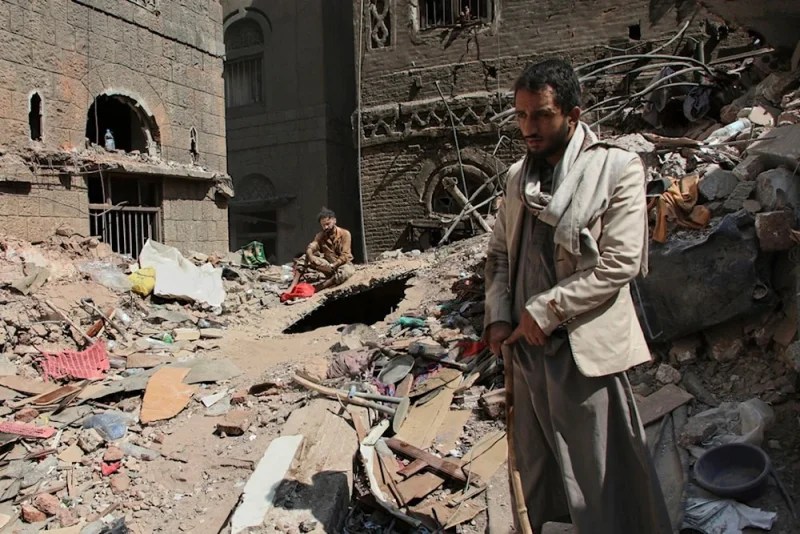
Saudi warplanes carried out 129 airstrikes across seven Yemeni provinces over 48 hours, the spokesperson for the Yemeni Armed Forces, Brigadier General Yahya Saree, stated on Saturday, vowing that the attacks would not go unanswered.
According to Saree, the strikes targeted Taiz, Marib, Hodeidah, al-Jawf, Saada, Amran, and Hajjah.
Saree said the attacks were carried out using F-15 and Typhoon fighter jets that took off from Saudi military bases in Khamis Mushait and Taif.
“These attacks against our people will not pass without a response and punishment, God willing and by His strength,” Saree said.
Yemeni Parliament condemns Saudi escalation
In a similar vein, the Yemeni Parliament said the Saudi regime must respect Yemen’s unity and independence and refrain from interfering in its internal affairs if it wants peace to prevail in the region and the world.
It stressed that developments inside Yemen constituted an internal matter in which the Saudi regime had no involvement.
The Parliament also commended the wisdom and leadership of the revolution leader and the head of the Supreme Political Council, Mahdi al-Mashat, in taking prudent measures to confront the Saudi escalation.
Parliament backs armed forces victories
The Yemeni Parliament praised the victories achieved on all fronts and commended the presidential amnesty decision.
It also thanked citizens who cooperated with members of the Yemeni Armed Forces across areas of fighting.
The Parliament reaffirmed Sanaa’s commitment to securing international shipping routes through the Red Sea and the Bab al-Mandab Strait, except for Saudi vessels involved in the blockade imposed on Yemen.
The statements come amid continued Saudi military escalation, with Yemeni authorities warning that attacks against the country would be met with a response.
5,400 km² retrieved: YAF detail western coast gains
Earlier today, the Yemeni Armed Forces said a large-scale operation launched on September 3 along Yemen’s western coast expelled Saudi-backed forces from six districts across Taiz and Hodeidah governorates, covering 5,400 square kilometers.
The operation, carried out with support from local tribes, resulted in hundreds of Saudi-backed personnel being killed, wounded, or captured, while several Yemeni detainees held for years were also freed.
Saree said the operation followed years of attacks on local communities and was aimed at driving out Saudi-backed forces and preventing attempts to impose Saudi control over Yemeni territory. He said Yemeni forces struck seven military divisions comprising 38 brigades and secured the retaken areas.
The YAF said their ground operations continued despite intensive Saudi air support, while their air defenses carried out 32 operations and reportedly downed nine aircraft.
They also reaffirmed that maritime navigation remains safe for all vessels except Saudi ships covered by its announced ban, pledging to maintain its “blockade for blockade” policy and respond to escalation with escalation until the aggression and blockade on Yemen end.
Matt Gaetz’s Brilliant Exposé on Israel Partisans’ Claims of “Antisemitism”
If Americans Knew | September 11, 2026
From The Matt Gaetz Show on OAN (One America News), Matt Gaetz exposes the dishonest double standard in American politics meant to shut down the conversation as support for Israel in the United States continues to collapse. “The Republican Jewish Coalition can say that they took out Thomas Massie but if you say they did, that is anti-Semitic. And if you say Israel caused the Iran War, that’s bigotry—unless it’s uttered by Netanyahu on the campaign trail, then it’s leadership.” – Matt Gaetz.
Source: https://x.com/OANN/status/20974901703…
Gaetz is a political commentator and former Republican Congressman from Florida. He generally identifies as a libertarian populist.
Trita Parsi: Massive Houthi Victory Transforms U.S.-Iran War
Glenn Diesen | September 12, 2026
Trita Parsi is the co-founder and Executive Vice President of the Quincy Institute for Responsible Statecraft. Follow the Substack of Trita Parsi: https://tritaparsi.substack.com/
Follow Prof. Glenn Diesen:
- Substack: https://glenndiesen.substack.com/
- X/Twitter: https://x.com/Glenn_Diesen
- Patreon: https://www.patreon.com/glenndiesen
Support the research by Prof. Glenn Diesen:
- PayPal: https://www.paypal.com/paypalme/glenndiesen
- Buy me a Coffee: buymeacoffee.com/gdieseng
- Go Fund Me: https://gofund.me/09ea012f
- Buy Diesen merchandise: https://diesen-shop.fourthwall.com/en-nok
Iran has good reason to bar IAEA inspectors from returning amid US aggression: Author
Press TV | September 12, 2026
Iran’s refusal to allow International Atomic Energy Agency (IAEA) inspectors back into the country amid ongoing US aggression is understandable, says a US-based author and activist, urging the UN nuclear watchdog to inspect Israeli nuclear facilities as well.
Speaking to the Press TV website, Anthony Donovan, a war veteran and political campaigner, said he supports Iran’s decision not to allow IAEA Director General Rafael Grossi and his team into the country while Iran remains under attack by the United States, Western countries and their allies.
“IAEA will be welcome when the threats cease. Perfect good sense. You have good reason to not trust Grossi and the US pushing for this absurd resolution in the UNSC,” Donovan said.
He added that the nuclear watchdog should instead be demanding an end to the attacks and warning about the dangers posed by military action against nuclear facilities.
“The IAEA needs to immediately and strongly demand an end to these bombings and aggressions, express the outrage at the danger this can pose,” Donovan said.
His comments came after the IAEA Board of Governors adopted a politically motivated resolution drafted by the United States, Britain, France and Germany calling on Grossi to report Iran to the UN Security Council and General Assembly.
The resolution was adopted with 23 votes in favor on Wednesday, while Russia, China and Niger voted against it and eight countries abstained. The move marked the first time in 20 years that Iran had been referred to the Security Council over its nuclear obligations.
Iran’s ambassador to international organizations in Vienna, Reza Najafi, dismissed the resolution as a “political tool” and said Tehran would cooperate with inspectors only “to the extent that circumstances and safety permit.”
It comes as the IAEA has been unable to access some Iranian nuclear facilities since a US-Israeli military aggression in June 2025 that included strikes on safeguarded nuclear sites. Access remained blocked after a broader aggression was unleashed against Iran on Feb. 28.
For Donovan, the circumstances surrounding the latest pressure on Iran made renewed inspections particularly problematic.
He said the West has remained heavily “obsessed” with Iran’s nuclear program even though “it has been inspected more than any other country.” He also warned against repeating the use of the unfounded nuclear weapons programs as a pretext for military action, citing the experience of Iraq.
“The echo of using the nuclear program as we did in Iraq is before us again, an excuse to bomb and kill, to violate all known international law, humanitarian law, and our own laws,” he said.
Donovan said inspections could resume once hostilities end and trust between Iran and the international community is restored, while noting that any future inspection regime should also address Israel’s clandestine nuclear facilities.
“When there is a true lasting peace, which seems very far away, and when there is mutual trust renewed, which is very far away, Iran remains naturally open to allow inspections, along with a requirement of full inspection of Israel’s nuclear weapons facility,” he said.
Israel’s nuclear program
Donovan pointed to a double standard in international nuclear oversight, noting that Israel should face the same scrutiny demanded of Iran.
He said President John F. Kennedy had “tried to prevent” the Israeli regime’s ability to gain access to nuclear weapons.
“Israel lied to him, built a mock facility hoping to fool him. He intuited that and gave several strong ultimatums to [then-prime minister David] Ben Gurion and his government to allow full inspection by his team and warned of serious repercussions if this was not allowed,” said Donovan.
Kennedy, he added, “was adamant they not get the bomb and was killed within months of these demands.”
He also linked the issue to Kennedy’s broader efforts to reduce the dangers of nuclear weapons during the Cold War, including his back-channel communications with Soviet leader Nikita Khrushchev and the 1963 Atmospheric Nuclear Test Ban Treaty.
“The Test Ban Treaty was a phenomenal success,” Donovan said, adding that Kennedy viewed it as an initial step toward ending the nuclear arms race.
Donovan noted that after Kennedy’s assassination, the US approach toward Israel’s nuclear program changed.
He also criticized the Nuclear Non-Proliferation Treaty (NPT), saying it had been weakened over time by nuclear-armed states and that Israel had not joined it.
Israel has never signed the NPT and has not submitted its nuclear facilities to IAEA inspections. The regime maintains a policy of nuclear ambiguity and has never officially acknowledged possessing nuclear weapons.
Estimates of the size of Israel’s nuclear arsenal vary widely, but it is widely believed to possess hundreds of nuclear warheads and maintains delivery capabilities involving missiles, aircraft and submarines.
Donovan noted that focusing on Iran while nuclear-armed entities continue to expand their arsenals represents a dangerous double standard.
“The fact that we keep pointing at Iran maybe getting a weapon, while we are all wildly building these omnicidal devices claiming they ‘Ensure our Future,’ our security, etc. is blind, dangerous and extremely egocentric,” he said.
He said Iran’s historical experience had also shaped his understanding of Tehran’s security concerns, citing past wars and Western involvement in regional wars.
“I understand better now why it was important for Iran to be prepared for such murderous colonists,” Donovan said, referring to the US-Israeli front that has “violated life” in Iran, Palestine and Lebanon.
The author added that he would continue to call his representatives to “listen to any but Israel.”
“Fortunately, things are changing; people are rising. Most here know what we are doing in Iran is criminal, wrong,” he added.
Iraqi Resistance denies role in Saudi East-West pipeline attack
Al Mayadeen | September 12, 2026
The Islamic Resistance in Iraq has denied accusations that it was behind the drone attack targeting Saudi Arabia’s strategic East-West oil pipeline, rejecting claims linking Iraqi factions to the operation and criticizing Baghdad for acting on unsubstantiated allegations.
In a statement on Saturday, the Resistance said accusations that it had targeted vital Saudi infrastructure amounted to “an honor we do not claim,” while stressing that no credible evidence had been presented proving the involvement of any Iraqi party.
The group expressed strong surprise at the Iraqi government’s haste in adopting the accusations and taking measures without relying on verified evidence or concrete investigations.
Resistance calls for official investigation
The Islamic Resistance in Iraq said it was fully prepared to participate in any government investigation committee established to determine the facts surrounding the attack.
It called on Iraqi authorities to pursue an evidence-based investigation rather than, in its words, follow “suspicious narratives.”
The Resistance also warned against US-Israeli schemes aimed at dragging Iraq into secondary crises that serve the interests of the region’s adversaries and divert attention from broader regional developments.
Support for Yemen reaffirmed
Despite denying involvement in the Saudi pipeline attack, the Islamic Resistance reiterated its firm and longstanding support for the Yemeni people.
The group said Yemen has been subjected to a Saudi-led siege for more than a decade, reaffirming its position in support of the country amid the latest regional escalation.
The statement comes in response to recent accusations and security measures following the shutdown of Saudi Arabia’s vital East-West crude oil pipeline after it was reportedly struck by a drone originating from Iraqi territory.
The roughly 1,200-kilometer pipeline stretches across the Arabian Peninsula and serves as a key route for transporting Saudi crude from the kingdom’s eastern oil-producing regions toward the Red Sea.
Following investigations into the incident, Iraqi authorities announced the dismissal of the commander of Maysan Operations over the attack.
Sana’a strikes back: How Yemeni military’s lightning advance redrew the Red Sea’s strategic map

Territory liberated by Yemeni Armed Forces during the recent operation, including the ports of Al-Mokha, Dhubab, and Al-Khokha, and towns such as Hays and Maqbanah.
By Mohammad Molaei | Press TV | September 12, 2026
In the span of roughly one week, the Yemeni armed forces accomplished what eight years of attritional warfare had failed to achieve.
In a military operation officially named “God Is Strongest in Might and Severe in Punishment,” the Yemeni military, backed by the Ansarullah resistance forces, liberated more than 5,400 square kilometers of territory along Yemen’s Red Sea coast, capturing strategically vital ports, towns, and geographic features that Saudi-backed forces had seized and held since 2017 and 2018.
The speed, coordination, and depth of the advance stunned military and security observers, shattered a carefully constructed Saudi media narrative, and fundamentally altered the strategic geometry of the war imposed on Yemen.
The ports of Al-Mokha, Dhubab, and Al-Khokha fell. Key towns, including Hays, Maqbanah, and Al-Mafraq, were liberated. The entire Jabal Habashi region came under Sana’a’s control.
These were no minor outposts but positions that the former Saudi-backed regime had spent four months capturing during the so-called “Golden Arrow” operation in 2017 and an entire summer offensive in 2018, backed by heavy Saudi air support and financial resources.
The intelligence that started it all
The roots of the operation lie in a body of intelligence and an assessment reached in Sana’a months before the first shot was fired. It was believed that Saudi Arabia, in coordination with the United States, was preparing to launch a major offensive under the diplomatic pretext of securing international navigation in the Red Sea at some point in the near future.
The Saudis aimed, first, to create operational space for Washington to assert dominance over the Bab al-Mandab Strait, a strategic waterway whose leverage Ansarullah-backed Yemeni military had wielded with increasing effect since joining the Gaza solidarity front two years earlier.
Second, they sought to neutralize that leverage by igniting a land conflict along the western coast and driving northward toward Hodeidah, effectively diverting the Yemeni military’s attention from maritime operations and drawing it back into a costly ground war.
The broader context matters. Since early 2016, Saudi Arabia had gradually sidelined the UAE across provinces outside the Yemeni government’s control, consolidating its influence over the mercenary coalition nominally operating under the banner of the Saudi-recognized regime.
By this stage, the Emiratis had been largely pushed to the margins of the ground equation. Washington, having failed to achieve decisive results in either the Strait of Hormuz or Bab al-Mandab through its own military aggression, appeared to be recalibrating around Riyadh as its primary instrument.
For Saudi Arabia, specifically, a single operation on the western coast offered the prospect of three simultaneous gains: accelerating the US push for Red Sea control; transforming what had remained an internationalized war into a fratricidal intra-Yemeni war by stoking internal fronts; and consolidating Riyadh’s dominance over the fractious coalition of Yemeni military factions, many of them previously under UAE command, by bringing them together under a unified operation.
The Saudi Maneuver and Miscalculation
Saudi preparations had begun well in advance, reportedly even before the Yemeni operation to break the siege, which was launched following the funeral ceremony of a martyred leader in Sana’a. The plan envisioned opening three simultaneous fronts in Al-Jawf, Ma’rib, and along the western coast. It immediately ran into structural problems.
Southern factions within the Saudi-backed coalition refused to commit their forces to battles in the north. This single factor created a fracture line through the entire scheme.
Riyadh’s mercenaries, many of whom were fighting for locally defined interests rather than any coherent national project, could not be so easily redirected. The Saudis responded by redeploying forces from eastern Yemen northward and shifting the primary axis toward the western coast, where the geographic and symbolic stakes were highest.
Meanwhile, Riyadh worked the diplomatic track. A host of mediators – Egypt, Turkey, and most prominently Oman – were mobilized. Sana’a, not yet ready to foreclose negotiations entirely, granted a brief reprieve, holding off on launching the second phase of its operations.
None of this changed the military reality. While negotiations proceeded, Saudi Arabia sought to reinforce its mercenary positions and replenish ammunition stockpiles. Sana’a concluded that the window for a negotiated outcome had been deliberately exploited to buy time, not to buy peace.
The intelligence war
What followed was not a conventional military offensive launched from a standing start. It was the terminal phase of a carefully sequenced preemptive campaign that had been underway for approximately four weeks before the main ground advance.
Yemeni military’s intelligence apparatus, operating under the direction of Abu Ali al-Hakim, demonstrated a level of precision that repeatedly left the Saudi-backed coalition wrong-footed.
Newly established mercenary positions were destroyed before they could be consolidated. Ammunition depots were located and struck. Command centers and operations rooms were systematically degraded. The cumulative effect was a coalition whose combat readiness had been substantially hollowed out before the ground offensive even began.
The resulting weapons shortages were severe enough that Riyadh dispatched ships carrying arms to resupply its forces, seeking to close the gap before the main battle.
But the ships, arriving at the port of Mokha, were treated as targets, much like the trucks moving through the Al-Wadiah and Al-Abr crossings. The resupply effort largely failed.
The intelligence picture was so consistently accurate that speculation arose that UAE-aligned elements, still resentful of Saudi dominance over coalition affairs, may have contributed to the flow of intelligence to the Yemeni military. Whatever the source, the Yemeni military’s penetration of the coalition’s operational security was demonstrably deep.
The spark on the Taiz Axis
The specific trigger for the ground offensive came in early September, when the Yemeni military launched a first strike against a Saudi-backed position, anticipating an offensive push northward.
The preemptive strike sparked clashes across four axes simultaneously. The result was not a cascading, domino-like collapse of positions. What the Saudis had intended as the opening move of their western coast offensive instead became the opening phase of their humiliating retreat.
Over the following days, Riyadh attempted to activate additional fronts in Al-Bayda, Al-Dhale’e, and Al-Jawf in an effort to stretch the Yemeni military forces thin across multiple theaters.
Saudi airstrikes intensified across Yemen. Saudi officers reportedly promised direct ground support to coalition factions to incentivize them to hold their positions. The Yemeni military’s own assessment of the dynamic was clear: the Saudis had previously tried activating 52 fronts simultaneously, and each time the result had been further Yemeni military advances, rather than a reversal.
The media war
As the Yemeni military advances accelerated, a parallel battle unfolded in the information space. Saudi-aligned media channels worked to construct a counter-narrative, circulating footage of mercenary vehicle convoys, highlighting minor territorial gains in areas already under Saudi coalition control, and projecting an image of momentum that bore little resemblance to the battlefield reality.
The narrative briefly gained traction by drawing, inaccurately, on the recent Syrian precedent. Some observers speculated that Sana’a might face a “Damascus moment”: a rapid, unexpected collapse of authority under a fast-moving offensive.
The comparison was analytically flawed. The structural, operational, and social conditions that led to the fall of Damascus bear little resemblance to those in Yemen. Sana’a’s military organization, popular base, intelligence infrastructure, and decade-long experience of sustained warfare against a better-resourced coalition have produced a very different kind of fighting force from the one that crumbled in Syria.
The battlefield results made it clear. The “Damascus moment” narrative did not survive contact with the liberation of the islands, the western coast, and the string of ports that followed.
Sana’a’s logic of escalation
Throughout the campaign, Ansarullah-led Yemeni military forces have maintained a consistent list of demands directed at Riyadh: the complete lifting of the air and naval blockade on Yemen; payment of civil servant salaries; an all-for-all prisoner exchange; reopening roads between provinces; Saudi withdrawal from Yemeni territory; and the complete cessation of funding and material support to anti-Sana’a factions.
The strategic logic underlying the current operation can be summarized in three interlocking equations that Sana’a appears to be establishing simultaneously:
The first is Siege for Siege: The imposition of a naval blockade on Saudi Arabia stretching from Bab al-Mandab across the full length of the Red Sea, mirroring the blockade Riyadh maintains on Yemen.
The second is Preemptive Action: Continuous surveillance and interdiction of mercenary logistics and troop movements from eastern to western Yemen, preventing the reconstitution of forces that have already been degraded.
The third is Direct Deterrence: The targeting of Saudi military bases, military airports, and Aramco infrastructure in southern Saudi Arabia in direct response to any Saudi violation of Yemeni airspace or attacks on Yemeni territory.
The endgame
Sana’a has officially announced the conclusion of the operation and directed its forces toward consolidating the liberated territories. The reasoning behind stopping the advance at this stage, rather than pushing farther, reflects three overlapping calculations.
The first is the immediate military imperative of securing and clearing 5,400 square kilometers of newly captured terrain, a task that demands both manpower and time and must be completed before any counteroffensive can be mounted effectively.
The second is the existence of other fronts requiring attention. Ma’rib retains significant economic importance because of the Safer oil-field infrastructure. Taiz carries major political weight for Sana’a’s long-term governance ambitions. Yemeni forces cannot allow gains on the western coast to come at the cost of deterioration on these other critical axes.
The third consideration is strategic restraint, an awareness that actions crossing certain thresholds could trigger a qualitatively different response and draw in actors whose involvement would complicate the current trajectory.
Arab media reports indicate that tensions inside mercenary formations in Taiz have already escalated sharply in the wake of the coastal losses. A critical highway remains in play; delaying withdrawal from the city could leave those forces cut off from a viable exit route, a development that could dramatically accelerate Taiz’s fall without requiring a further ground offensive.
Regional ripples: Tehran, Riyadh, and beyond
The operational dimensions of this campaign extend beyond Yemen’s borders. Saudi Arabia has engaged directly with Tehran in an effort to halt flights to Sana’a since the Yemeni attacks resumed. Pakistan, meanwhile, is reportedly working to include Yemen in a new ceasefire framework, not unlike its role during the previous round, when Islamabad’s diplomatic activity coincided with and helped shape the Saudi naval blockade ceasefire process.
Saudi officials have a documented pattern of denying involvement in Yemen, Iraq, and Lebanon even while conducting active operations across all three theaters. Following its setbacks on the western coast, Riyadh may seek to recover leverage through alternative pressure points, with Lebanon and Iraq among the most likely arenas. That possibility warrants close monitoring.
American support for the Saudi-backed mercenary coalition has continued, but Washington has so far stopped short of direct combat involvement or assuming battlefield command.
Whether that calculus holds in the face of continued Yemeni military advances, or whether disillusionment with Saudi performance drives Washington toward renewed engagement with the UAE, remains one of the most consequential open questions as the war enters its next phase.
What comes next
If Saudi Arabia declines to meet Sana’a’s demands, as its past behavior suggests is the most probable near-term outcome, the Yemeni armed forces retain a substantial menu of escalation options. These include expanded strikes on Saudi supply chains, production and processing facilities, and oil-export infrastructure, with Yanbu and the East-West pipeline specifically on the table.
Operations in the Arabian Sea targeting foreign vessels with Saudi connections represent another avenue. Ground operations in southern Saudi territory constitute a further option that Sana’a has explicitly retained.
Crucially, the balance of internal coalition dynamics has shifted. Over the past two weeks, the Yemeni military has substantially neutralized one of Riyadh’s key remaining leverage mechanisms: its ability to activate internal Yemeni fronts. The collapse of the mercenary coalition and deepening factional rifts have made it increasingly difficult for Saudi officers to reconstitute any credible offensive capability in the near term. That fundamentally alters the timeline calculations for both sides.
The strategic implications of the Yemeni military now holding the coastline overlooking and approaching the Bab al-Mandab Strait are substantial and will require sustained analysis as the situation develops. Control of that coastline does not simply mean territory. It means depth, positioning, and, in the language of maritime chokepoints, leverage.
Yemeni military’s consolidation of Yemen’s western coast represents the acquisition of geographic depth at one of the world’s most consequential maritime chokepoints. Previously, its coastal positions remained vulnerable to suppression. That calculus has now changed.
Al-Mukha, Dhubab, and the surrounding coastline, now under firm control, give Sana’a the ability to position layered anti-ship and air-defense systems across a continuous 200-plus-kilometer stretch. The islands amplify this advantage further, functioning simultaneously as forward sensors and firing platforms, enabling earlier target acquisition, reducing the stand-off advantages of opposing forces, and potentially denying the flanks of the strait to any force attempting to escort commercial shipping.
The relationship with the Strait of Hormuz is noteworthy as well. A dual-chokepoint architecture, with Hormuz and Bab al-Mandab simultaneously subject to hostile pressure, creates a co-equal second front.
A single carrier strike group cannot cover both. Reinforcing one theater necessarily draws resources from the other, complicating the Pentagon’s traditional force-posture hierarchy, which has historically treated Bab al-Mandab as manageable through periodic shows of force.
For Saudi Arabia, the loss is asymmetric in a specific way. Riyadh could previously threaten ground pressure on Ansarullah and the Yemeni military while remaining comparatively insulated from reciprocal pressure on its maritime lifelines. That insulation is now gone.
Red Sea export terminals and the Yanbu complex sit within a substantially more threatening strategic envelope. The Yemeni military can potentially transition from a land-based force with maritime ambitions into a coastal-defense and power-projection actor. That changes the strategic character of any future negotiation and the architecture of any subsequent security ceasefire.
Featured Video

Iran’s Next Strike May Not Explode. It Could Shut You Down
or go to
Aletho News Archives – Video-Images
From the Archive
Zionism’s Violent Legacy
By Donald Neff | Washington Report On Middle East Affairs | January 1996
On January 4, 1948, Jewish terrorists drove a truck loaded with explosives into the center of the all Arab city of Jaffa and detonated it, killing 26 and wounding around 100 Palestinian men, women and children.[1] The attack was the work of the Irgun Zvai Leumi – the “National Military Organization,” also known by the Hebrew letters Etzel – the largest Jewish terrorist group in Palestine. The Irgun was headed by Revisionist Zionist Menachem Begin and had been killing and maiming Arabs, Britons and even Jews for the previous ten years in its efforts to establish a Jewish state.
This terror campaign meant that at the core of Revisionist Zionism there existed a philosophical embrace of violence. … continue
Blog Roll
 Aletho News
- Trump’s Iran war is on an Israeli leash
- Saudi oil boss issues global supply warning
- Riyadh Says Its Oil System Is Intact. The Numbers Say Otherwise.
- Trump and Netanyahu Want to “Finish the Job” on Iran
- US ‘one-sided dictation’ not Iran’s beliefs makes rational talks impossible: Baghaei
- Iran’s Next Strike May Not Explode. It Could Shut You Down /Col Doug Macgregor
- Iran: US political targets legitimate if assassinations return
- Iraq shuts key border crossing with Iran under US pressure: Report
- Undersea Internet cables could be targeted in retaliation for attacks on Iran: IRGC deputy chief
- EU sending ‘biased’ observers to interfere in Serbian election – president
- If Americans Knew
- The Israel Lobby’s Changing Fortunes
- AIPAC has become such a political liability that it’s shifting to a more “nimble” approach to buying politicians
- At least 160 Israeli settler attacks in 2 weeks
- Will Gaza’s Ancient Christian Community Disappear Forever?
- Israel’s vision of regional security rests on keeping Arab states weak
- Heidi Levine recounts how Palestinian youths helped save her in settler attack
- DAILY UPDATE: Latest essential news on Palestine, Israel, & region
- Trump’s Intensifying Sabotage of the ICC, for Israel’s Sake
- Israeli military detain US and UK volunteers in West Bank including Democratic NY politician Brad Lander
- Americans at National Conservatism Conference held in Israel this year criticize Israel
- No Tricks Zone
- E-Cars Reduce CO2 Emissions By Only 41% Compared To Internal Combustion Engine Vehicles
- Predictions Made By Renowned Climate Professor Over Past Decades Have Been Proven To Be Poor
- New Study Suggests Large Regions Of The Pacific Ocean Have Been Cooling For The Last 80 Years
- Germany’s Green Energy Debacle: High Energy Costs Force Kahla Porzellan to Close After 182 Years!
- New Study: 50 Years Of The Most Aggressive ‘Net Zero’ Policies Can Only Affect The Global Climate By 0.03°C
- US September “Heat” Was No Record…Many Records Set Decades Ago
- Latest European Green Energy Debacle; Portugal’s Largest Flagship Solar Park Insolvent!
- Green Energy Debacle: German Expert Professor Fritz Vahrenholt Warns Of Severe Economic And Social Consequences
- Two More Paleo Reconstructions Affirm Meters-Higher Sea Levels Across Ireland, Brazil 7000-6000 Years Ago
- New Study: Earth And Venus Surface Warmth Largely Explained By Convection And Lapse Rate, Not CO2 Or Radiation

