Aletho News

ΑΛΗΘΩΣ

Trotskyist Delusions: Obsessed with Stalin, They See Betrayed Revolutions Everywhere

By Diana Johnstone | Consortium News | May 4, 2018

I first encountered Trotskyists in Minnesota half a century ago during the movement against the Vietnam War. I appreciated their skill in organizing anti-war demonstrations and their courage in daring to call themselves “communists” in the United States of America – a profession of faith that did not groom them for the successful careers enjoyed by their intellectual counterparts in France. So I started my political activism with sympathy toward the movement. In those days it was in clear opposition to U.S. imperialism, but that has changed.

The first thing one learns about Trotskyism is that it is split into rival tendencies. Some remain consistent critics of imperialist war, notably those who write for the World Socialist Web Site (WSWS).

Others, however, have translated the Trotskyist slogan of “permanent revolution” into the hope that every minority uprising in the world must be a sign of the long awaited world revolution – especially those that catch the approving eye of mainstream media. More often than deploring U.S. intervention, they join in reproaching Washington for not intervening sooner on behalf of the alleged revolution.

A recent article in the International Socialist Review (issue #108, March 1, 2018) entitled “Revolution and counterrevolution in Syria” indicates so thoroughly how Trotskyism goes wrong that it is worthy of a critique. Since the author, Tony McKenna, writes well and with evident conviction, this is a strong not a weak example of the Trotskyist mindset.

McKenna starts out with a passionate denunciation of the regime of Bashar al Assad, which, he says, responded to a group of children who simply wrote some graffiti on a wall by “beating them, burning them, pulling their fingernails out”. The source of this grisly information is not given. There could be no eye witnesses to such sadism, and the very extremism sounds very much like war propaganda – Germans carving up Belgian babies.

But this raises the issue of sources. It is certain that there are many sources of accusations against the Assad regime, on which McKenna liberally draws, indicating that he is writing not from personal observation, any more than I am. Clearly, he is strongly disposed to believe the worst, and even to embroider it somewhat. He accepts and develops without the shadow of a doubt the theory that Assad himself is responsible for spoiling the good revolution by releasing Islamic prisoners who went on to poison it with their extremism. The notion that Assad himself infected the rebellion with Islamic fanaticism is at best a hypothesis concerning not facts but intentions, which are invisible. But it is presented as unchallengeable evidence of Assad’s perverse wickedness.

This interpretation of events happens to dovetail neatly with the current Western doctrine on Syria, so that it is impossible to tell them apart. In both versions, the West is no more than a passive onlooker, whereas Assad enjoys the backing of Iran and Russia.

“Much has been made of Western imperial support for the rebels in the early years of the revolution. This has, in fact, been an ideological lynchpin of first the Iranian and then the Russian military interventions as they took the side of the Assad government. Such interventions were framed in the spirit of anticolonial rhetoric in which Iran and Russia purported to come to the aid of a beleaguered state very much at the mercy of a rapacious Western imperialism that was seeking to carve the country up according to the appetites of the US government and the International Monetary Fund”, according to McKenna.

Whose “ideological lynchpin”? Not that of Russia, certainly, whose line in the early stages of its intervention was not to denounce Western imperialism but to appeal to the West and especially to the United States to join in the fight against Islamic extremism.

Neither Russia nor Iran “framed their interventions in the spirit of anticolonial rhetoric” but in terms of the fight against Islamic extremism with Wahhabi roots.

In reality, a much more pertinent “framing” of Western intervention, taboo in the mainstream and even in Moscow, is that Western support for armed rebels in Syria was being carried out to help Israel destroy its regional enemies. The Middle East nations attacked by the West – Iraq, Libya and Syria – all just happen to be, or to have been, the last strongholds of secular Arab nationalism and support for Palestinian rights. There are a few alternative hypotheses as to Western motives – oil pipelines, imperialist atavism, desire to arouse Islamic extremism in order to weaken Russia (the Brzezinski gambit) – but none are as coherent as the organic alliance between Israel and the United States, and its NATO sidekicks.

It is remarkable that McKenna’s long article (some 12 thousand words) about the war in Syria mentions Israel only once (aside from a footnote citing Israeli national news as a source). And this mention actually equates Israelis and Palestinians as co-victims of Assad propaganda: the Syrian government “used the mass media to slander the protestors, to present the revolution as the chaos orchestrated by subversive international interests (the Israelis and the Palestinians were both implicated in the role of foreign infiltrators).”

No other mention of Israel, which occupies Syrian territory (the Golan Heights) and bombs Syria whenever it wants to.

Only one, innocuous mention of Israel! But this article by a Trotskyist mentions Stalin, Stalinists, Stalinism no less than twenty-two times!

And what about Saudi Arabia, Israel’s de facto ally in the effort to destroy Syria in order to weaken Iran? Two mentions, both implicitly denying that notorious fact. The only negative mention is blaming the Saudi family enterprise for investing billions in the Syrian economy in its neoliberal phase. But far from blaming Saudi Arabia for supporting Islamic groups, McKenna portrays the House of Saud as a victim of ISIS hostility.

Clearly, the Trotskyist delusion is to see the Russian Revolution everywhere, forever being repressed by a new Stalin. Assad is likened to Stalin several times.

This article is more about the Trotskyist case against Stalin than it is about Syria.

This repetitive obsession does not lead to a clear grasp of events which are not the Russian revolution. And even on this pet subject, something is wrong.

The Trotskyists keep yearning for a new revolution, just like the Bolshevik revolution. Yes, but the Bolshevik revolution ended in Stalinism. Doesn’t that tell them something? Isn’t it quite possible that their much-desired “revolution” might turn out just as badly in Syria, if not much worse?

Throughout history, revolts, uprisings, rebellions happen all the time, and usually end in repression. Revolution is very rare. It is more a myth than a reality, especially as Trotskyists tend to imagine it: the people all rising up in one great general strike, chasing their oppressors from power and instituting people’s democracy. Has this ever happened?

For the Trotskyists, this seem to be the natural way things should happen and is stopped only by bad guys who spoil it out of meanness.

In our era, the most successful revolutions have been in Third World countries, where national liberation from Western powers was a powerful emotional engine. Successful revolutions have a program that unifies people and leaders who personify the aspirations of broad sectors of the population. Socialism or communism was above all a rallying cry meaning independence and “modernization” – which is indeed what the Bolshevik revolution turned out to be. If the Bolshevik revolution turned Stalinist, maybe it was in part because a strong repressive leader was the only way to save “the revolution” from its internal and external enemies. There is no evidence that, had he defeated Stalin, Trotsky would have been more tender-hearted.

Countries that are deeply divided ideologically and ethnically, such as Syria, are not likely to be “modernized” without a strong rule.

McKenna acknowledges that the beginning of the Assad regime somewhat redeemed its repressive nature by modernization and social reforms. This modernization benefited from Russian aid and trade, which was lost when the Soviet Union collapsed. Yes, there was a Soviet bloc which despite its failure to carry out world revolution as Trotsky advocated, did support the progressive development of newly independent countries.

If Bashar’s father Hafez al Assad had some revolutionary legitimacy in McKenna’s eyes, there is no excuse for Bashar.

“In the context of a global neoliberalism, where governments across the board were enacting the most pronounced forms of deregulation and overseeing the carving up of state industries by private capital, the Assad government responded to the heightening contradictions in the Syrian economy by following suit—by showing the ability to march to the tempo of foreign investment while evincing a willingness to cut subsidies for workers and farmers.”

The neoliberal turn impoverished people in the countryside, therefore creating a situation that justified “revolution”.

This is rather amazing, if one thinks about it. Without the alternative Soviet bloc, virtually the whole world has been obliged to conform to anti-social neoliberal policies. Syria included. Does this make Bashar al Assad so much more a villain than every other leader conforming to U.S.-led globalization?

McKenna concludes by quoting Louis Proyect: “If we line up on the wrong side of the barricades in a struggle between the rural poor and oligarchs in Syria, how can we possibly begin to provide a class-struggle leadership in the USA, Britain, or any other advanced capitalist country?”

One could turn that around. Shouldn’t such a Marxist revolutionary be saying: “if we can’t defeat the oligarchs in the West, who are responsible for the neoliberal policies imposed on the rest of the world, how can we possibly begin to provide class-struggle leadership in Syria?”

The trouble with Trotskyists is that they are always “supporting” other people’s more or less imaginary revolutions. They are always telling others what to do. They know it all. The practical result of this verbal agitation is simply to align this brand of Trotskyism with U.S imperialism. The obsession with permanent revolution ends up providing an ideological alibi for permanent war.

For the sake of world peace and progress, both the United States and its inadvertent Trotskyist apologists should go home and mind their own business.


Diana Johnstone is a political writer, focusing primarily on European politics and Western foreign policy. She received a Ph.D. at the University of Minnesota and was active in the movement against the Vietnam War. Johnstone was European editor of the U.S. weekly In These Times from 1979 to 1990, and continues to be a correspondent for the publication. She was press officer of the Green group in the European Parliament from 1990 to 1996. Her books include Queen of Chaos: The Misadventures of Hillary ClintonCounterPunch Books (2016) and Fools’ Crusade: Yugoslavia, NATO and Western DelusionsPluto Press (2002).

May 5, 2018 Posted by | Ethnic Cleansing, Racism, Zionism, Mainstream Media, Warmongering, Timeless or most popular, Wars for Israel | , , , , , , | Leave a comment

The Israel lobby: A List

Hollywood gala on November 2, 2017 to raise funds for “Friends of the IDF”, which supports Israeli soldiers. The event raised $54 million. Since FIDF has been made tax exempt in the U.S, donors were able to write their donations to soldiers for a foreign military off their U.S. taxes.
If Americans Knew | May 4, 2018

The pro-Israel special interest group is one of the most significant and pervasive special interest groups in the United States. It consists of numerous institutions and individuals that work to influence Congress, the president, academia, the media, religious institutions, and American public opinion on behalf of Israel. It has been active in the U.S. for many decades.

Below is a partial list, in no particular order, of groups and individuals that publicly support Israel. Some of these are official lobbying groups whose primary purpose is to lobby governmental officials for pro-Israel policies. Others are groups or individuals that work to influence the media, academia and/or others in a pro-Israel direction. Some do this full-time; others as one portion of a diverse array of activities. While they span the political spectrum and range from hardcore supporters of the Israeli right to liberal critics of some Israeli policies, all support Israel.

We will continue to update and add entities to this very incomplete list as staffing and time allow. (Also, we have been creating this roster for a number of years, so some links below may now be broken and some information may need to be updated; we will work to fix these as soon as possible.)

Below this list are some recommended books and additional resources on the Israel lobby. 

• The American Israel Public Affairs Committee (AIPAC): AIPAC is the most prominent governmental lobbying organization on behalf of Israel. Fortune Magazine typically rates it as the second most powerful lobby in the U.S. AIPAC frequently writes legislation for members of Congress, which extraordinarily large majorities of both parties typically endorse. It has a $100 million endowmentand annual revenue of about $60 million and spends about $2-3 million each year in lobbying Congress. AIPAC’s annual conventions are typically a who’s who of high government office from both parties pledging their loyalty to Israel. Some years ago an AIPAC official announced that they planned to take over student governments.

• Pro-Israel Political Action Committees (PACs): AIPAC does not give campaign contributions itself but instead uses a campaign finance network consisting of around thirty Pro-Israel Political Action Committees (PACs), which AIPAC is constantly signaling. Only four of these PACs have names that indicate their true agenda, such as ‘Allies for Israel’ or ‘World Alliance for Israel.’ The rest have innocuous names like ‘National Action Committee’ or ‘Heartland PAC.’ Constituents usually don’t realize their candidates are receiving money from PACs that advance the interests of a foreign government. (More info below)

• Conference of Presidents of Major American Jewish Organizations (CoP): This group of 51 Zionist organizations also advocates on behalf of Israel, including a focus on Iran. It had revenues of over $2.2 million in 2011. All members of the CoP sit on AIPAC’s executive committee. The Conference of Presidents focuses on lobbying the Executive branch while AIPAC concentrates on Congress.

• The American Israel Education Foundation (AIEF): AIEF is a subsidiary of AIPAC that takes Congressional Representatives on all-expense-paid trips to Israel. In August 2011, 81 members of Congress from both parties took trips to Israel with the AIEF. Its annual budget is over $26 million, and its executive director, Richard Fishman, is officially “not compensated,” but he receives $395,000 annually from affiliates. Roll Call reports that in 2012 “The American Israel Education Foundation spent more than $650,000 last year — more than any other group — to send more than 60 lawmakers and staffers to Israel for tours of Jerusalem, seminars on Israeli politics and discussions of asymmetric warfare, according to congressional travel filings.”

• The Washington Institute for Near East Policy (WINEP): WINEP is a highly influential think tank that pushes Israel-centric Middle East policies. It was founded by a former AIPAC employee, and while it claims to promote a “balanced and realistic” understanding of the Middle East, it is “funded by individuals deeply committed to advancing Israel’s agenda.” It is frequently called upon by both the government and the media to provide “expert” analysis on Middle East issues. Its 2010 revenues were $9.4 million, and its net assets total $23.5 million. Former AIPAC member MJ Rosenberg stated: “I was working at AIPAC and it was Steve Rosen who cleverly came up with the idea for an AIPAC controlled think-tank that would put forth the AIPAC line but in a way that would disguise its connections.” More information is here.

• Anti-Defamation League (ADL): The ADL bills itself as a civil rights institution devoted to stamping out anti-Semitism. But in practice, it regularly works to promote Israeli interests and attacks virtually any prominent person who criticized Israel and labels them “anti-Semitic.” It has also been involved in a large spying operation against American citizens who opposed the policies of Israel and the Apartheid regime in South Africa. It is an architect of “hate crimes legislation” that may effectively criminalize criticism of Israeli policies. The ADL is a member of the CoP with revenues of around $68 million and as of 2008 had net assets of over $185 million. Abe Foxman, its former national director, made $688,280 per year. When he retired he took a position at an Israeli think tank. The current director is Jonathan Greenblatt.

• International Fellowship of Christians and Jews (aka Stand for Israel): Founded in 1983 by Rabbi Yechiel Eckstein “to promote understanding between Jews and Christians and build broad support for Israel,” it promotes advocacy for Israel among mostly right-wing Christians. It has annual revenues of nearly $100 million.

• Central Fund of Israel, based in Manhattan,  says it funds “over 250 charitable causes in Israel.” A Ha’aretz investigation found it funneled much of its money to settlements; it has sent money to an extremist Israeli organization in which the “rabbis heading the yeshiva published a book that discussed the circumstances in which non-Jews can be killed.” It has received “tens of millions of dollars” in donations. In 2015 its revenue was $20 million.

It also sponsors Reservists on Duty, established in 2015 by Israeli soldiers to travel to US college campuses to advocate for Israel and to train American Jewish students to speak on behalf of Israel.

The Gideon Project was created by Reservists On Duty “to give students fluent in English a chance to represent and defend Israel internationally after their service.” Soldiers speak on campuses throughout the U.S. Video here.

• Christians United for Israel (CUFI): CUFI is a right-wing Evangelical Christian organization run by David Brog, a Jewish American attorney who previously practiced corporate law in Tel Aviv, Israel. He’s the author of  Reclaiming Israel’s History. In 2007, the Forward newspaper listed Brog in its “Forward 50” most influential Jews in America. The titular founder of CUFI is John Hagee. CUFI, which distorts Biblical teachings, has high-level contacts with the Israeli government. Despite a budget of $7 million, it may be losing ground as more evangelicals learn the facts about Israel. It has a lobbying arm, called CUFI Action Fund, first reported in The Washington Post, run by Gary Bauer, one of the signers of the Statement of Principles of Project for the New American Century (PNAC) on June 3, 1997. Bauer also serves on the board of the Emergency Committee for Israel. In 2010 he received the Defender of Israel Award from the Zionist Organization of America. CUFI Action Fund’s Communications Director is Ari Morgenstern, an Israeli citizen who previously served at the Israeli Embassy in Washington. The fund, Bauer said, will have a multimillion-dollar budget and a dozen staffers who will focus on pro-Israel lobbying among members of Congress and presidential candidates. In 2017 it began a scorecard of legislators’ every vote and comment about Israel.

• Simon Wiesenthal Center: According to its website: “The Simon Wiesenthal Center is a global Jewish human rights organization that confronts anti-Semitism, hate and terrorism, promotes human rights and dignity, stands with Israel, defends the safety of Jews worldwide, and teaches the lessons of the Holocaust for future generations.” It has “a constituency of over 400,000 households” in the US. It is headquartered in Los Angeles, with offices in New York, Toronto, Miami, Chicago, Paris, Buenos Aires, and Jerusalem.” It gave its “Humanitarian Award” to Harvey Weinstein in 2015 despite the open secret of Weinstein’s assaults on women.  In 2011 it had an annual budget of $24 millionand net assets of $67 million.

• The Israel Project: Founded in 2003, the Israel Project specializes in pro-Israel propaganda targeting the press and the American public. In 2009, a secret handbook commissioned by The Israel Project and written by Republican pollster and strategist Frank Luntz, “The Global Language Dictionary,” was exposed by two Newsweek reporters. The handbook crafts language and talking points for Israel advocates in simplistic, diversionary, and dishonest ways. The organization has 70 employees and an $11 million annual budget. In 2011 it opened additional bureaus in India and China and launched a website in Arabic.

• Friends of the Israeli Defense Forces (FIDF): This American organization supports the Israeli armed forces. It hosts lavish fundraisers and has fourteen regional offices in the U.S. and one in Latin America. FIDF also brings hundreds of Israeli soldiersto the U.S. every year to lecture at synagogues, universities, and schools in order to increase American support for Israeli policies. It has annual revenues of around $60 million and net assets of $80 million.

• Hadassah (Women’s Zionist Organization of America): Founded in 1912, Hadassah is “a volunteer organization that inspires a passion for and commitment to its partnership with the land and people of Israel.” It has chapters across the U.S. and “more than 330,000… Members, Associates and supporters.” It regularly advocates on behalf of Israel and is currently pushing anti-Iran legislation. It has annual revenues of nearly $100 million and $400 million in net assets.

• America’s Voices in Israel (AVI): A project of the Conference of Presidents, AVI works to “strengthen American understanding of and support for Israel by inviting U.S.-based radio talk show hosts to see Israel and broadcast their programs live from Jerusalem.” It also brings celebrities and other “opinion makers” on guided tours of Israel.

• The Jewish Agency for Israel: The name is often shortened to just “The Jewish Agency.” According to its website, founded in 1929, this links “Jews around the world with Israel as the focal point… ” Major activities include Jewish Zionist education and building a global Jewish community. “In addition to extensive programs in Israel, it operates in close to 80 countries on five continents through a network of over 450 emissaries, including hundreds of formal and informal educators. The world Jewish community participates in the Jewish Agency’s decision-making process through the Assembly, its supreme governing body, and its Board of Governors, which is responsible for policy making and oversight.” The Jewish Federations of North American are a fundraising partner, with individual Jewish Federations from numerous American cities listed.

  • James S. Tisch: Chairperson of the Jewish Agency Board of Governors. According to its website, Tisch is President and Chief Executive Officer of Loews Corporation, chairman of the Board of Directors of Diamond Offshore Drilling, Inc., a member of the Board of Directors of CNA Financial Corporatio, a director on the board of the General Electric Company, Chairman of the Board of WNET, parent of WNET Channel 13 and WLIW Channel 21, a member of the Board of Directors of The New York Public Library, serves on the Executive Committee of the Partnership for New York City, a Trustee of the Mount Sinai Medical Center, a member of the Council on Foreign Relations, a fellow of the American Academy of Arts and Sciences, President and Chairman Emeritus of Federation Employment and Guidance Service (F.E.G.S.), past Chairman of the Board of the Conference of Presidents of Major American Jewish Organizations, past Chairman of the Board of United Jewish Communities, past President of UJA-Federation of New York, and a former director on the board of the Federal Reserve Bank of New York.

• Young Judaea:  According to its website, the organization was founded in 1909 and is “the oldest Zionist youth movement in the United States.” It brings young people to Israel and also has numerous summer camps in the US that serve to “instill a lifelong love” of  Israel. It’s annual budget is approximately $200,000.

• American Friends of Likud: According to its website, AFL “has developed unparalleled relationships with the Likud [a right-wing Israeli political party] Ministers and Members of Knesset as well as other Israeli dignitaries and policy and opinion makers. Our programs feature these individuals as guest speakers, lecturers and educators. Our special relationships with Israel’s leaders, dignitaries, journalists, etc. have been developed over the years and are based on a mutual belief in a right-leaning Likud philosophy.” Based in New York City, it is a has an annual budget of approximately $300,000. AFLis reported to be “one of hundreds of ‘Friends of’ Israel organizations in the US – all 501c3 tax-exempt charities raising funds to send to their parent organizations in Israel.”

• American-Israeli Cooperative Enterprise (AICE) [Jewish Virtual Library]: This nonprofit organization was established in 1993, according to its website, in order to “strengthen the U.S.-Israel relationship.” Its principal publication is Myths & Facts: A Guide to the Arab-Israeli Conflict. It also works to fight “the delegitimization of Israel,” producing materials to oppose the BCS campaign and publishing the StopBDS.com website. There seem to be a number of AICE branches. The one in Chevy Chase assets of almost $11 million as of 2013. Its leader is Mitchell Bard. The organization sometimes funds professorson US campuses.

• The Israel Allies Foundation: Its website states: “Pioneered by MK Rabbi Binyamin Elon, the Israel Allies Foundation (IAF) works with Congress and parliaments around the world to mobilize political support for Israel based on Judeo-Christian values.” Officially titled International Israel Allies Caucus Foundation, it coordinates similar caucuses in 35 countries and has approximately $2 million in resources. 

• Americans United with Israel: The American branch of the international organization United with Israel, which states that it is “a global community comprised of individuals who are deeply committed to the success and prosperity of Israel. Our primary mission is to build a massive network of pro-Israel activists and to educate and promote unity with the People, Country and Land of Israel.” It is a tax-exempt organization. 2014 revenue was $590,000. It’s head is Kaylene Ladinsky, associate publisher of the Atlanta Jewish Times.

• The Jewish Policy Center: Its website says it provides timely perspectives and analysis of foreign and domestic policies by leading scholars, academics, and commentators” and “passionately supports … U.S.-Israel security cooperation, and missile defense. We support Israel in its quest for legitimacy and security.” The JPC also says: “We also support U.S. efforts to spread democracy in the Middle East. We believe it is critical to reduce America’s dependence on foreign oil. We support Washington’s efforts to deter dangerous states from acquiring nuclear weapons. Finally, we lend our full support to Israel in its long war for security in the Middle East.”

• The Haym Salomon Center: According to its website, The Haym Salomon Center is a news and public policy group that produces content that often appears in mainstream and new media outlets. Its articles have been published in USA Today, the New York Daily News, Fox News, The Hill, the Washington Times, the Wall Street Journal, etc. Many of its articles focus on Israel, the dangers of “political Islam,” and”antisemitism,” which frequently means opposition to Israeli human rights violations. It operates under Over the Horizon nonprofit organization, which in 2014 had approximately a quarter of a million dollars.

• The Foundation for Jewish Camp: This nonprofit foundation states on its website that in in Jewish camps “Israeli culture is celebrated through song, food, art, and dance,” and reports, “The magic of Jewish camp is rooted in its 24/7 atmosphere” and says that “connection to Israel” is “entwined with basketball, arts and crafts and swimming.” It notes that some camps are particularly “focused on Zionism and the role of Israel in Jewish life.” It reports that in one of these, CAMP INC., “Israel education will be embedded in the program as campers learn about Israel through the lens of their entrepreneurial sector. Campers will learn from high-level mentors, teachers, and business pioneers. Camp Inc., under the direction of Josh Pierce, will be operated by the Boulder JCC.” Another, URJ 6 POINTS SCIENCE ACADEMY “will immerse them in a vibrant Jewish community filled with Jewish music, Shabbat experiences, and living connections to Israel.” It states that the Academy, the 14th in the Union for Reform Judaism’s camp system, will be located in the Boston, MA area. Funding comes from a grant of $8.6 million jointly funded by The Jim Joseph Foundation and the AVI CHAI Foundation.

• The Jim Joseph Foundation: This is a DBA of the Shimon Ben Joseph Foundation, which faqs.org reports has assets of $837,220,914. Its website reports that among the activities its sponsors is “Israel Education,” which includes “twinning day schools with schools in Israel; integrating Israel education with learning taking place in general studies courses; and showcasing Israel’s arts and culture so students and teachers are in direct contact with what is happening in Israel today.”

• The Avi Chai Foundation: According to its 2010 form 990 report it had total assets of $614,997,808. One of its primary North American focuses, according to its website, is “Promoting Jewish Peoplehood and Israel.” It states: “Israel studies and Israel advocacy have become centerpieces of AVI CHAI’s peoplehood efforts in North America. All of the day schools receiving support from AVI CHAI have agreed to include in their materials, as an expression of their own philosophy, the following statement: “The creation of the State of Israel is one of the seminal events in Jewish history. Recognizing the significance of the State and its national institutions, we seek to instill in our students an attachment to the State of Israel and its people as well as a sense of responsibility for their welfare.”

JTA reports: “The Avi Chai Foundation, one of the leading supporters of Jewish day schools, includes on its website a section on Israel Education and Advocacy. It requires all schools receiving its support to abide by a statement saying that they ‘seek to instill in our students an attachment to the State of Israel and its people as well as a sense of responsibility for their welfare.’ It provides books on defending against anti-Israel campaigning on college campuses.”

• Stand with Us: Stand with Us has headquarters in Los Angeles and chapters in Israel, Europe, Britain, Australia, and South Africa. Its annual budget is at least $4 million, though this may only cover the U.S. section. It has a number of divisions, including StandWithUsCampusStandWithUs InternationalUnited4FreedomStand4FactsLearnIsraelLibrarians for Fairness, and Emerson Fellows. Student leaders are trained to advocate for Israel on campuses around the country. The organization has erected numerous pro-Israel, anti-Palestinian billboards around the U.S. “Israelis invested $57 billion in U.S. Companies” is one of them. For a deconstruction of this billboard go here.

• Emergency Committee for Israel (ECI): The Israeli newspaper Haaretz reports:

Washington observers may feel there is no obvious shortage of pro-Israel lobbyists in the city—but a group of leading American conservatives thinks otherwise and has set up a new campaign group to attack President Obama over his ‘anti-Israel’ stance. The Emergency Committee for Israel presents a potent combination of Republican Party neoconservatives and Evangelical Christians. The new group’s board includes Weekly Standard Editor William Kristol and Gary Bauer, a former Republican presidential candidate who leads the group American Values, as well as Rachel Abrams, a conservative writer and activist.

Its website says: “The Committee for Israel is committed to mounting an active defense of the US-Israel relationship by educating the public about the positions of political candidates on this important issue, and by keeping the public informed of the latest developments in both countries. Join us to help support Israel and her many friends here in the United States.” The group makes his videos,  Its board is here.

The Committee produced an advertisement against Ron Paul that ran in South Carolina because of Paul’s opposition to U.S. aid to Israel and other countries, and another one against Rush Holt, who was defeated by Cory Booker, whose largest donor was a pro-Israel PAC. ECI funded tens of thousands of dollars worth of anti-Obama advertising.

• Leona M. and Harry B Helmsley Charitable Trust: The trust fund is valued at between $4 billion and $8 billion. Among the main areas its grants support are programs focused on “the security and development of Israel.” According to Jewish Week:

“[Leona Helmsley] left instructions for her charitable trust fund… to benefit dogs. But the courts ruled that the Leona and Harry Helmsley Trust Fund she had established after her husband’s death was not legally bound to fund animals only, and that its grants should be directed solely at the discretion of the trustees she had appointed. Fortunately for the State of Israel, Mrs. Helmsley chose Sandor (Sandy) Frankel, 69, a local Jewish attorney who worked closely with her the last 18 years of her life, to be one of the four trustees who now oversee that major trust. Frankel, who is married to an Israeli and has visited Israel frequently since he was a teenager, is proud to say that he has a passion for the Jewish state.

Among the projects receiving its multi-million grants was a new press center in Israel. At its opening Frankel announced: “Our hope is that with the opening of the club’s doors, the press will flock here, and will accurately report” on the country and its people.

• AMIT: According to its website: “Founded in 1925, AMIT is the world’s leading supporter of religious Zionist education and social services for Israel’s children and youth, nurturing and educating Israeli children to become productive, contributing members of society.” It has numerous chapters throughout the U.S. It sponsors lectures about Israel, holds screenings of Israeli films, participates in pro-Israel parades, etc. In 2011 its annual expenses were over $8 million and its net assets were $11,705,151. Its executive vice president was paid $120,292.

• Aaron and Marie Blackman Foundation, Inc: Net assets of about $7 million (see also here and here). Distributes grants to various Israeli organizations and other organizations with relationships with Israel.

• Jewish Day Schools: Many of these schools work to “instill in our students an attachment to the state of Israel.” (they sometimes use this version: “we seek to instill in our students an attachment to the State of Israel and its people as well as a sense of responsibility for their welfare.” They frequently have school trips to Israel (e.g. the Jewish Day school in Seattle), and include it in curricula, e.g. in Sacramento: “sixth-graders pursue a curriculum centered on Israel.” Their mission statements note that they teach “the centrality of the State of Israel” (see Contra Costa Jewish Day School). These are usually tax exempt institutions, which means they are subsidized by U.S. taxpayers. JTA reports: “In April 2002, day schools throughout the country — Block Yeshiva High School in St. Louis, the Ramaz School in New York and the Ida Crown Jewish Academy in Chicago, to name a few — sent students by bus or plane to a pro-Israel rally in Washington, D.C.  “’They drove us to every single rally,” said Shira Galston, a 2004 graduate of Ramaz. “There was no question [of] do you want to go to the rally. We’re going to the rally. Whenever there was something that happened, there was never a question of what side the school was on.’” The Frisch school (Jared Kushner is an alum) hosts training sessions for a project in which teens carry out social media missions assigned from Israel. The Avi Chai Foundation, one of the leading supporters of Jewish day schools, includes on its website a section on Israel Education and Advocacy. It requires all schools receiving its support to abide by a statement saying that they “seek to instill in our students an attachment to the State of Israel and its people as well as a sense of responsibility for their welfare.” It provides books on defending against anti-Israel campaigning on college campuses. See this statement by Avi Chai. (It is important to note that such support for Israel came only after years of pro-Israel efforts to obtain this. The American Jewish population did not originally support Zionism, and there are many groups and individuals today who oppose this ideology, both in the U.S. and in Israel itself.)

• Jewish Council for Public Affairs (JCPA): The Jewish Council for Public Affairs acts as an umbrella for many smaller organizations. One of its three goals, as announced in its mission statement, is to work for “the safety and security of the State of Israel.”  Its annual funding is $3,128,795 and comes primarily from private individuals. 

• Jewish National Fund (JNF): The Jewish National Fund is an international organization founded at Basil Switzerland by Theodore Herzl in 1901. The fund was originally created with for the purpose of purchasing land in Palestine for a future Jewish state. Today the main focus for the JNF is land “reclamation” and forestry. However, the group also serves to fund IDF military installations. The organization is well funded by donors with total assets of $1.15 billion dollars.

• Zionist Organization of America (ZOA): The Zionist Organization of America was established in 1887, making it the oldest pro-Israel organization in the US. Their goal is to spread the Zionist message wherever in all aspects of American life. Their objectives include spreading Zionism on American campuses, work to advance the interests Israel and Jewish people within the American legal system. They also engage in pro-Israel lobbying, with expenditures totaling$299,900 in 2009. Their finances include over $8 Million in assets and $2.5 million from donors.

• American Jewish Committee (AJC): The American Jewish Committee, founded in 1906, is based is San Francisco. In its mission statement, the AJC espouses support for leftist values, such as “shared democratic values” and “energy independence of the US,” while also advocating the right of Israel to exist as an exclusionary Jewish state. Its annual income is about $49,525,000 and comes largely from private individuals, with its assets totaling$132,310,000. It played a major role in creating the new Israel-centric definition of antisemitismthat is being embedded around the world.

• World Jewish Congress: The World Jewish Congress is an international organization representing Jews in 100 countries. Supporting Israel is one of the key components of its mission. Although its global finances are unknown, its US offices have an annual revenue of $5,521,674.

• Friends of Aish Hatorah:  Aish Hatora, Hebrew for “fire of the Torah,” is an Orthodox Jewish organization founded in 1974 and headquartered in Jerusalem. The group is known for a number of pro-Israel programs, including The Theodore Herzl Mission, which brings heads of state to Israel for one week each year. They also have a program called the Hasbara Fellowship, where people can come from around the world to learn how to effectively engage in pro-Israel propaganda. The group has also been linked to the distribution of an anti-Islamic propaganda film during the 2008 American presidential campaign. Because Aish Hatora is based in Jerusalem with various global branches, the details of their funding are unknown.

• Chabad: Chabad-Lubavitch, based on an 18th century Hasidic movement, is one of the the largest Jewish organizations in the world. It is a fervent supporter of Israel. One Chabad Rabbi has encouraged Jewish people to kill “Arab men, women, and children.” Chabad sometimes openly teaches that “the soul of the Jew is different than the soul of the non-Jew.” The group has a reported net worth of $1 billion dollars.

• Republican Jewish Coalition: The Republican Jewish Coalition Jewish is a lobbying group whose mission statement includes the “embrace of pro-Israel foreign policy.” The RJC maintains close links to the Likud party of Israel. They also control a Super Pac, which has upward of 2 million dollars in their war chest. Their Annual revenue is $10,067,507. The vast majority of their funding comes from various organizations.

• National Jewish Democratic Council: The National Jewish Democratic Council is a group dedicated to maximising Jewish support for the Democrat party, increasing support for “Jewish domestic and foreign policy priorities,” and “secur[ing] a democratic Jewish state in Israel.” NJDC supports Likud policies and pushes for a hawkish stance against Iran, urging the President of the United States to “stand with Israel.” Its annual income is $1,161,195 and is funded by private individuals.

• Foundation for Defense of Democracies: The Foundation for Defense of Democracies is an international organization whose claimed goal is “fighting terrorism and promoting freedom” and “defend[ing] free nations from their enemies.” It developed from the educational initiative Emet, which was created to “win American sympathy for Israel’s response to the Palestinian intifada.” While its mission may appear neutral, the organization is dedicated to promoting the security of Israel. Among its other projects is the Iran Project, which revolves around “supporting energy sanctions.” It is funded largely by private individuals’ donations. Its annual income is$7,267,839.

JINSA: JINSA is a non-profit organization whose mandate includes promoting a “a strong U.S. military, a robust national security policy, and a strong U.S. security relationship with Israel…” Their total revenue is $3,332,140 from contributions and program services.

• Saban Center at Brookings: The Saban Center for Middle East Policy is part of the Brookings Institute. Its mission statement includes a two-state solution for Israel/ Palestine. “Ardent Zionist” Haim Saban, a former AIPAC official, funds the institute.

• Center for Security Policy: Founded and led by neoconservative Frank Gaffney, a longtime Israel partisan, CSP works to promote a close US-Israelrelationship and to position Israel’s enemies as allegedly US adversaries. It’s annual budget is approximately $4 million and Gaffney himself earns over $288,000 yearly. The Institute for Policy Studies states: “…(CSP) is a prominent member of the neoconservative advocacy community that has promoted extravagant weapons programs, an Israel-centric view of Middle East peace, and a broad “war on terror” against ‘Islamofascists.’……A primary target of CSP’s work is Iran.”

• MEMRI: The Middle East Media Research Institute is an organization founded in the US in 1998. It’s stated objective is to “inform the debate over US foreign policy in the Middle East.” However, MEMRI is a shadowy organization that does not disclose names of staff members nor office locations. Analysts have commented that MEMRI appears to function as a propaganda organization that circulates biased translations in order to portray Arabs in the most negative possible light. One of the organization’s founders worked as an Israeli military intelligence officer. MEMRI has full non-profit status in the US and receives donations and grants amounting to $4,872,208 annually.

• Hillel: Hillel is a Jewish international student organization. According to its web page, Hillel “fosters an enduring commitment to Jewish life, learning and Israel.” Its president has stated: “We are a pro-Israel organization. It is part of our mission to encourage students to build an enduring commitment to Israel as a Jewish and democratic homeland.” Hillel sponsors and promotes free “birthright” trips to Israel. These trips position Israel as the “homeland” for European and American Jews. Hillel collects annual revenue of $25,920,017, primarily from gifts, grants, and contributions. Hillel has had a program to try to expand its reach by  “paying students to attract other students” to Hillel.

In 2014 some students launched an Open Hillel to challenge the Hillel establishment and work to allow campus groups “to adopt policies that are more open and inclusive than Hillel International’s, and that allow for free discourse on all subjects within the Hillel community” and that represent “a Jewish community where the full diversity of Jewish views on Israel-Palestine is accepted and celebrated.”

• Birthright Israel: Birthright Israel is an organization that provides free ten-day holidays to Israel for young Jewish adults, age 18 to 26. Their objective is to, “strengthen Jewish identities, Jewish community, and solidarity with Israel…” Their web page strongly emphasizes support for Israel.Philanthropists, along with 14,000 individual donors, fund Birthright Israel. Their total revenue is $101,960,863.

• David Project: The David Project is a non-profit educational program for the dissemination of pro-Israel propaganda in schools. Their primary goal is justification for Israeli actions, which is often referred to in the Hebrew term, “hasbara” (explaining). Their objective is, “work[ing] directly with students and Israel groups to help them reach out to their peers and talk about Israel.” The David Project has annual income of $2,824,763. However, the source of this income is unclear.

• Amcha Initiative: The Amcha Initiative is a group whose stated objective is to protect Jewish students from anti-Semitism. Their definition of anti-Semitism is broad and encompasses virtually any criticism of Israel, including criticism of Israel’s human rights abuses. The group also lists the Boycott Divest and Sanction movement as an example anti-Semitism. Their annual income is $199,155. The source of this income is unclear.

• Young Israel: The National Council of Young Israel is a group of  146 Orthodox Jewish congregations. Starting in 1912, Young Israel’s web page claims that the group has always been “fiercely Zionist” and even boasts the acquisition of arms for the Jewish terror group Haganah. Young Israel currently offers material support to the Israeli Defense Force as it engages in attacks on Palestinians in Gaza. Because Young Israel is an umbrella for over 100 individual non-profit organizations, it is difficult to ascertain the amount and sources of the group’s income.

• Ateret Cohanim: American Friends of Ateret Cohanim is a non-profit organization based in Jerusalem. The purpose of the organization is the urban renewal of Jerusalem through Jewish gentrification. Their web site boasts of a new Jewish presence in the Christian and Muslim quarters of the Old City, and proclaims Jerusalem to be a city belonging to every single Jew, in spite of the fact that Israel’s annexation of East Jerusalem is still not recognized under international law. The group maintains an office in New York with annual revenue of $1,054,618.

• Elad: The Ir David foundation (Amutat EL-AD) is a non-profit organization established in 1986 by David Be’eri, a former elite military commander of the IDF. According to their web page, the group “is dedicated to the preservation and development of the Biblical City of David and its environs.” However, the Ir David foundation is best known for its policy of “Judaization of east Jerusalem” through forced evictions and housing purchases. In recent years, their activity in East Jerusalem has been linked to violent clashes between Palestinians and the new Jewish residents. Ir David has a US auxiliary in New York called Friends of Ir David with total annual revenue of $5,884,950.

• BBYO (formerly B’nai B’rith Youth Organization)Its website says: “BBYO is the leading pluralistic teen movement aspiring to involve more Jewish teens in more meaningful Jewish experiences. For 90 years, BBYO has provided identity enrichment and leadership development experiences for hundreds of thousands of Jewish teens.” It pridesitself on its “unwavering commitment to the State of Israel.” The site says: “BBYO’s history is closely tied to that of the State of Israel. As the future leaders of the global Jewish community, it is our responsibility to learn about, appreciate and advocate for Israel.” Its 2015 annual budget was $27 million.

• Israeli-American Council: According to the Jewish Daily Forward, the Israeli American Council (IAC) aims to establish the Israeli expatriate community living in the U.S. community “as a ‘strategic asset’ for Israel in the U.S.” The goal is to be a “a potent political force in the future.”  IAC was established in Los Angeles in 2007, but expanded dramatically in 2013 when  casino mogul Sheldon Adelson’s began to serve as its main funder. About 700 expatriate Israelis participated in the “first-ever national political conference exclusively devoted to the expat Israeli community” in Nov. 2014. It has an annual budget of $17.5 million.

According to a 2013 report, “Current IAC programs include: Tzav 8 (recruiting thousands for pro-Israel rallies); Financing the Israeli “Shlichim” at all major campuses in Southern California; Organizing and funding the Los Angeles Independence Day Festival – the largest Jewish festival in North America, as well as dozens of ceremonies, holidays and mass events for the community; Sifriyat Pijama B’America, through which 10,000 families nationwide enjoy Hebrew bedtime books sent to their kids by mail, free of charge on a monthly basis; IAC-BINA club, consisting of approximately 1,500 Israeli and American Jewish young adults who convene discussions and activities relating to Jewish identity and support for Israel; establishing and funding the IAC-Care project in which thousands of the community members volunteer and organize large scale drives; and Mishelanu (the leadership program for Israeli-Americans students). More information is available on its website.

• America-Israel Chamber of Commerce Chicago: An American 501(c)6 tax-exempt organization founded in 1958 that facilitates trade and investment between the US and Israel, promotes Israeli goods and services, trade delegations and business match-making events, and works closely with the Government of Israel to advance bilateral trade. It is a sponsor of the website BuyIsraelGoods.org. The organization, which is tax deductible in the U.S., urges people to buy goods from a foreign country.

This is just one of a dozen such tax-exempt America-Israel Chambers of Commerce in the U.S. listed by the The Association of America-Israel Chambers of Commerce.

Influential Pro-Israel Individuals

• Daniel Shapiro, past US Ambassador to Israel, gave a speech in which he detailed his extremely close, life-long ties to Israel, concluding: “[A]s a committed Jewish American, with deep roots in the American Jewish community and warm bonds of affection with Israel, I will have an opportunity to draw on those associations to help make the U.S.-Israel relationship, strong as it is, even stronger in the years ahead.” He stated that “ensuring Israel’s future” drives all US policies. See “US Ambassador: Support for Israel drives all US policies

According to Wikipedia: Shapiro served as a professional staff member on the House Foreign Affairs Committee, he was a legislative assistant and senior foreign policy adviser to Senator Dianne Feinstein, he sat on the National Security Council under President Bill Clinton, he was deputy chief of staff (primarily on foreign policy issues) for U.S. Senator Bill Nelson, he was vice president of the Washington, D.C., lobbying firm Timmons & Company, served as an advisor to then-U.S. Sen. Barack Obama on Middle East and Jewish community also assisting as strategist and fundraiser, accompanied Obama on his July 2008 trip to Israel; In January 2009, Shapiro was appointed senior director for the Middle East and North Africa of the U.S. National Security Council. Focusing on Israel, he attended every Israel-related meeting, and met with every senior Israeli diplomat and military officer who visited Washington, D.C. Shapiro often accompanied U.S. Special Envoy for Middle East Peace George J. Mitchell on his trips to the region, and played a central role in talks regarding the Middle East Peace Process and the strengthening of military cooperation between the U.S. and Israel. He maintained close relations with Benyamin Netanyahu, in spite of tensions between the Israeli prime minister and President Obama.[14] Shapiro took leave of the President of IsraelReuven Rivlin, on January 17, 2017 before holding his final meeting with Netanyahu two days later, which one newspaper described as a “terse farewell.”After concluding his service as ambassador to Israel, Shapiro became a Distinguished Visiting Fellow at the Institute for National Security Studies (Israel) at Tel Aviv University.

• Howard Berman, Democratic Congressman from California, acknowledged in a 2008 interview with the Forward, “Even before I was a Democrat, I was a Zionist.” He went on to explain that “an interest in the Jewish state” was one of the main reasons he first sought a seat on the House Committee on Foreign Affairs, where he is the top Democrat. Berman, who is known as “the Congressman from Hollywood,” also told the Forward, “He is particularly keen on getting the House more involved in Iran-related issues.”

• Martin Indyk, former U.S. Ambassador to Israel (he was naturalized as an American citizen before being nominated for this position); currently Special Envoy for Israeli Palestinian Negotiations. At one point he had his security clearance revoked, the only time this has happened to a U.S. ambassador. See video.

• Haim Saban, multimedia mogul whose net worth is over $3 billion dollars, has said, “I’m a one-issue guy and my issue is Israel.” In 2010, he told New Yorker magazine that his greatest concern is to protect Israel by strengthening the United States-Israel relationship. Saban has bluntly outlined his formula for gaining influence in American politics: make donations to political parties, establish think tanks, and control media outlets. He tried to buy Time and Newsweek magazines, and has made repeated bids for the Los Angeles Times because he considers the paper to be pro-Palestinian. He donated $9 million to Democrats in the 2002 election cycle alone.

• Sheldon Adelson, a businessman and casino magnate, is worth over $28 billion dollars. He owns a number of resorts as well as the Israeli newspaper Israel Hayom, the most largely circulated paper in Israel. Adelson set a new record in political donations by giving $70 million (to Republicans) in the 2012 elections, nearly triple the previous highest amount. He also funds pro-Israel organizations such as Birthright Israel, which takes thousands of young Jewish Americans on recruiting visits to Israel.

• Rahm Emanuel, powerful Democratic politician, was a Congressman, chair of the House Democratic caucus, mayor of Chicago (despite allegations that he had not been a Chicago resident), in Bill Clinton’s administration (had been Clinton’s main fundraiser), White House Chief of Staff under President Obama, etc. Volunteered with the Israeli military during the first Gulf War (his father had served in the pre-Israel terrorist group the Irgun), was Israeli citizen until age of 18. Jeffrey Goldberg says Emanuel “is deeply and emotionally committed to Israel and its safety. We’ve talked about the issue a dozen times; it’s something he thinks about constantly.” See video.

• Stuart Weitzman, shoe designerdonated $1 million to Maccabi USA. The Maccabiah is an Olympics-style competition held every four years in Israel.

• David Satterfield, U.S. diplomat who holds the rank of “Career Minister” who has worked on Middle East issues for over 40 years.. Among his positions have been second-highest diplomat at the US Embassy in Baghdad. In 2002 Satterfield discussed secret national security matters in two meetings with Steven J. Rosen, a top AIPAC official.

Other individuals include:

Journalists

NYT’s Ethan Bronner’s son was in the Israeli army; more info on NY Times)

Pundits like Jeffrey Goldberg Kenneth Pollack, Daniel Pipes, Bill Kristol, Irving Moskowitz (more)

The Islamophobia Industry: Institutions and individuals who promote Islamophobia, including Aubrey and Joyce Chernick, Frank Gaffney, Pamela Geller, David Horowitz, Stephen EmersonDavid Yerushalmi, and others. (more)

Eric Weider, publisher of American History, Civil War Times, Military History, and eight other history magazines.

Hollywood tycoon Arnon Milchan, who produced Pretty Woman, Mr. & Mrs. Smith, and Fight Club, worked for the  Mossad.

Politicians

(we have just begun compiling this category)

Charles “Chuck” Schumer, top Democraatic leder in the Senate


There’s no card to carry that says one is part of the Israel lobby. But taken as a whole, this sampling of powerful pro-Israel organizations demonstrates how information is systematically skewed before it reaches the American public. Politicians and journalists are systematically harassed, often losing jobs, if they step out of line.

There is no comparable pressure from the Arab-American side, much less from stateless Palestinians, who have no army, little money, and very little cultural influence or PR savvy. By contrast to the $3 million given by pro-Israel PACs in 2010, the two Arab-American PACs—Arab American Leadership Council PAC and Arab American Political Action Committee—gave a total of $36,500.

Many members of the lobby have promoted policies against Iran and Iraq.


* PACs: Usually a PAC can only donate $5,000 for a primary and $5,000 for general elections. But with thirty “unaffiliated” PACs marching in lockstep behind AIPAC, this can balloon up to $300,000 for any given candidate. The extent of this influence remains hidden from view. They also use “bundling,” which means taking various individual donations and handing them over en masse to a candidate, so that on the books it shows up as several individual donations, but everyone except the FEC understands who’s really controlling the money.

A 1996 book called Stealth PACs reports that “in 1988, Israel’s lobby had 78 PACs spending more than $5.5 million to bribe Congress to vote more aid for Israel. That was more than total contributions together of the two next largest special interests in the United States—the real estate lobby and the teamsters.”

During the 2010 elections, Israel-affiliated contributions were the third highest of any special interest at nearly $3 million (with almost equal amounts given to Democrats and Republicans). But because that number was broken into pieces and hidden behind unrelated names, pro-Israel contributions didn’t “officially” make the top twenty.

One example is Washington Pac, founded by Morris Amitay, former head of AIPAC. Its website states: “…over three million dollars has been carefully distributed on a bipartisan basis to Senators, Representatives, and candidates… Its Capitol Hill location enables the PAC to meet with Representatives and Senators on an almost daily basis. The Advisory Board holds regular luncheons with U.S. Senate candidates, and the PAC’s newsletter has earned an esteemed reputation for its analysis of the U.S. Senate races.”

• Teva: Not all PACs with connections to Israel are included in the pro-Israel list. For example, the parents company of the Teva PAC Teva Pharmaceuticals USA, is Teva Pharmaceutical Industries, an Israeli company, the world’s largest generic drug maker. It has achieved its astronomical sales by at times infringing on patents (although Judge Sidney Stein just rejected a similar claim – Stein also rejected a freedom of speech law suit related to the Palestinian issue ). Teva’s website states, “Teva Government & Public Affairs seeks to provide legislators and policy makers with both policy and political assistance on issues of importance to patients, the company, its customers, and the pharmaceutical industry as a whole.

The Washington Report on Middle East Affairs reports on PACs frequently. For example, see their list of pro-Israel PAC contributions to candidates in 2010..


Recommended books:

They Dare to Speak OutThey Dare to Speak Out: People and Institutions Confront Israel’s Lobby, by Paul Findley

The Lobby: Jewish Political Power and American Foreign Policy, by Edward Tivnan

The Israel Lobby and U.S. Foreign Policy, by John Mearsheimer and Stephen Walt

Against Our Better Judgment: The Hidden History of How the U.S. Was Used to Create Israel, by Alison Weir

Alfred Lilienthal’s books

Additional resources

Washington Report on Middle East Affairs

The Link

Council for the National Interest

Institute for Research: Middle Eastern Policy

We also recommend subscribing to the If Americans Knew news blog, where we post new items on this category frequently, as well as on Israel-Palestine in general.

May 5, 2018 Posted by | Corruption, Ethnic Cleansing, Racism, Zionism, Timeless or most popular, Video, Wars for Israel | , , , | Leave a comment

Netanyahu’s Iran Speech in Context: Irony, Hypocrisy and the Undeclared Hijacking of U.S. Foreign Policy

By Adeyinka Makinde | May 3, 2018

The recent presentation made by Binyamin Netanyahu purportedly detailing a secret Iranian programme aimed at acquiring a nuclear weapons capability is the latest in a long-term effort on his part to obtain United States assistance in destroying Iran. But the actions of the Israeli prime minister are not only ironic and hypocritical: they bring into focus the connection between the purposeful destructions of Iraq and Libya on the one hand and the attempt to destroy Syria, foment conflict in Lebanon and neutralise Iranian military power on the other. Few Americans are aware of this two decade-long grand strategy followed by successive United States administrations because the compartmentalization of events, short-term memory of the public and government propaganda have all served to murky the fundamental picture, that is, one in which the United States continues to follow a policy of taking down countries which pose a threat to the state of Israel. It is a policy which was adopted without recourse to public debate despite the serious ramifications it has had in terms of the cost to American prestige and an ever increasing national debt.

Most of the world’s major national intelligence services have long concluded that Iran has no nuclear weapons development programme. This includes the intelligence community of the United States and up until recently -if Binyamin Netanyahu is to be believed- Israel’s Mossad. A debate within Iran’s political, military and intelligence circles apparently ended with the nation’s supreme leader ruling against the development of nuclear weapons.

The irony is not lost in the scenario of the leader of Israel decrying the acquisition of nuclear technology by another nation, one that is a signatory state to the Treaty on the Non-Proliferation of Nuclear Weapons and subject to the stringent conditions of the Joint Comprehensive Plan of Action reached between Iran and the ‘Five Plus One’ countries, when Israel is in possession of an undeclared arsenal of nuclear, chemical and biological weapons. Israel’s own nuclear weapons programme, which began with the express disapproval of President John F. Kennedy who felt that it would create a nuclear arms race in the Middle East, involved the practice of a grand deception by David Ben Gurion who insisted that the Dimona reactor was for research purposes only and not for the production of plutonium.

A pungent whiff of hypocrisy pervades Netanyahu’s presentation. Israel’s nuclear arms programme has not only been shrouded in secrecy but has involved acts of criminality which according to FBI documents declassified in June 2012 allegedly involved Netanyahu himself. Netanyahu later issued a gagging order directing the unindicted ringleader of a nuclear smuggling ring to refrain from discussing an operation known as ‘Project Pinto’. Israel spied on nuclear installations inside the United States and in the 1960s and it stole bomb-grade uranium from a US nuclear fuel-processing plant.

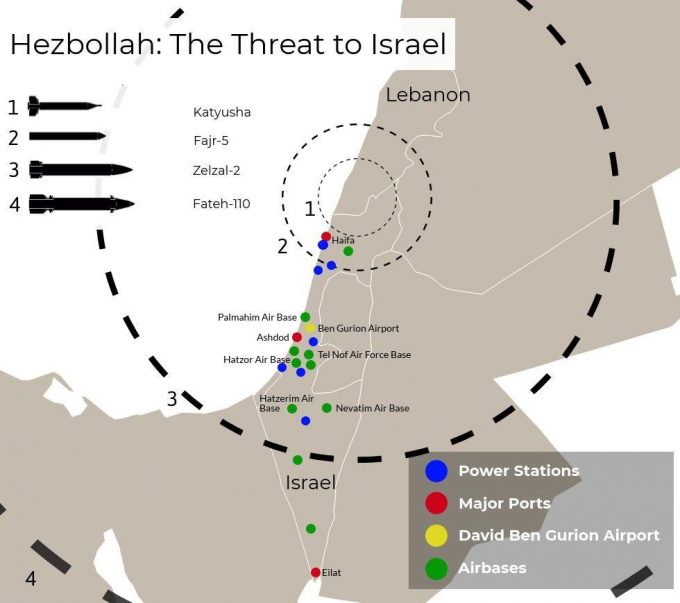
Netanyahu’s speech is the latest in a campaign by Israel to ignite a war against Hezbollah in Lebanon and Iran, a plan which is intimately linked to the effort to destroy Syria over the past seven years.

The war in Syria represents the combined efforts of the United States, Israel and Saudi Arabia to destroy the so-called ‘Shia Crescent’ of Iran, Syria and Lebanon (Hezbollah). The centrality of Israel in this effort was made clear by Roland Dumas, a former foreign minister of France in 2013. But Israel, along with the United States and Saudi Arabia, has been enraged by the fact that Bashar al-Assad’s secular government with the help of Russia, Iran and Hezbollah, has practically defeated the Islamic fanatics who were introduced into Syria for the purpose of overthrowing Assad in order to balkanise the country and stop Iranian arms shipments to Hezbollah in Lebanon.

The reason why Israel wants Iranian aid to Hezbollah cut off and the organisation destroyed is not hard to fathom. Hezbollah is the only armed force within the Arab world willing and capable of taking on the Israeli military. Israel has for long coveted southern Lebanon up to the River Litani. But Hezbollah has twice inflicted humiliating defeats on Israel: first in 2000 when Israel was forced to withdraw after an 18-year occupation of the southern part of Lebanon which had commenced with a bloody invasion, and secondly in 2006 when Israel was forced to withdraw after sustaining heavy losses during a 34-day conflict.

Apart from the aforementioned goal of breaking the conduit between Iran and Hezbollah, the balkanisation of Syria would mean that any of the successor states would find it difficult to make a claim for the Golan Heights which Israel conquered in 1967 and which it illegally annexed in 1981. Israel is also supportive of the idea of a Kurdish state being created out of Syria as a means through which the transfer of oil and gas could be facilitated.

Much evidence exists of a pre-existing Israeli plan to destroy Syria. The Yinon Plan of 1982 and a series of position papers produced by Israel-friendly neoconservative ideologues in the United States (the Project for the New American Century’s ‘Rebuilding America’s Defenses – Strategy, Forces and Resources for a New Century’ in 2000) as well as for the Israeli government (‘A Clean Break: A New Strategy for Securing the Realm’ in 1996) bear this out. Each document clearly calls for the neutralising or the “rolling back” of several states including Syria.

The Yinon Plan, the name given to a paper entitled ‘A Strategy for Israel in the 1980s’ which was published in February 1982 in Kivunim (Directions), a journal written in Hebrew, set out Israel’s enduring aim of balkanising the surrounding Arab and Muslim world into ethnic and sectarian mini-states. Egypt, Lebanon, Syria and Iraq were prime candidates.

It was not a unique or suddenly arrived at policy, but simply set out in detail an overarching policy pursued by Israel’s leaders since the founding of the state. For instance, the diaries of Moshe Sharett, an early prime minister of Israel, laid bare David Ben Gurion and Moshe Dayan’s aim of weakening Lebanon by exacerbating tensions between its Muslim and Christian population in the course of which Dayan hoped that a Christian military officer would declare a Christian state out of which the region south of the River Litani would be ceded to Israel.

A crucial point to mention is that the policy of the United States towards Syria and others is congruent with that of Israel. In fact, America has been pursuing a two-decade long strategy aimed at destabilisation and balkanisation regardless of the political stripe of the president in office. After the attack of 9/11, the United States set in motion a plan, in the words of retired U.S. General Wesley Clark, “to take out seven countries in five years, starting with Iraq, and then Syria, Lebanon, Libya, Somalia, Sudan and, finishing off, Iran”.

The secular nations of Iraq, Syria and Libya had no links to the Sunni Islamist al-Qaeda cell which purportedly carried out the attacks on 9/11. Neither did Shia Iran. Yet, America foreign policy has been geared towards destroying nations who happen to oppose Israel and who are supportive of the Palestinian cause.

To quote General Clark again, American foreign policy was “hijacked” without a public debate.

While the adoption of this policy remains officially unacknowledged, the modus operandi by which the United States has sought to destroy these countries is clear. A succession of position papers as well as the intended effect of United States and NATO interventions point to the exploiting of ethnic and sectarian conflicts as well as the use of Islamist proxy armies as the standard tactic utilised to bring down governments.

For instance, a Pentagon-funded report by the RAND Corporation in 2008 entitled ‘Unfolding the Future of the Long War: Motivations, Prospects and Implications for the U.S. Army’ explicitly refers to the need to foment conflict between Sunni and Shia Muslims as a means to the end of controlling the resources of the Middle East.

Another tactic alluded to by a 2012 document created by the Defense Intelligence Agency is that of declaring ‘Safe Havens’ -a term synonymous with the often used ‘No-Fly Zones’- ostensibly as a humanitarian policy, but which is a technique used to shield and preserve areas controlled by Islamist insurgents. It was utilised by NATO forces as a means of protecting the al-Qaeda-affiliated Libyan Islamic Fighting Group during its campaign to overthrow the government of Muammar Gaddafi, and an attempt was made to implement this prior to the fall of the al-Nusra-controlled city of Aleppo.

America’s Founding Fathers warned against getting involved in foreign entanglements, yet it devotedly follows a Middle East policy that clearly benefits the interests of another nation state. It is a policy which risks setting off a major regional war based on sectarian lines as well as embroiling it in a conflict with nuclear armed Russia.

For Israel, the goal remains the establishment of its undisputed hegemony in the Middle East. However, while an economic rationale predicated on relieving Europe of its dependency on Russian gas via a pipeline from the gulf is occasionally referenced, there has never been a comprehensive articulation of what America’s fundamental interests are in destroying Syria and Iran.

Pursuing such a policy without having had a full and thorough public debate tends to confirm key areas of dysfunction in the American system of governance. First it highlights the power and influence of those lobbies associated with Israeli interests and the Military Industry, and secondly, the unchanging nature of this policy which has been followed by the respective administrations of George W. Bush, Barack Obama and Donald Trump provide evidence that what Michael J. Glennon terms the ‘Madisonian’ institutions of state are no longer accountable in the manner which people still think they are. Instead power in regard to crucial issues on American national security rests with an unelected group of people outside of the separated organs of government: what Glennon, a professor of law at Tufts University, refers to as ‘Trumanite’ institutions.

The implications for the health of American democracy are all too apparent.

The pursuit of a strategy which has served to diminish American esteem among the global community as well as adding to the increasing national debt represents a catastrophic failure not only on the part of the political class, but also on the part of the mainstream media, which has consistently presented a narrative devoid of its true context. The intellectual community comprised of university academics and scholars working for think tanks must accept a large share of the blame.

Binyamin Netanyahu’s speech, a shameless attempt at goading the United States into breaking its obligations under an international agreement as a prelude to fighting a war which would serve Israel’s interests, ought to ignite a full and transparent debate on American national security policy in the Middle East.

A failure to do this risks future costly disasters which would dwarf the debacles of Iraq, Libya and Syria.

Adeyinka Makinde is a writer based in London, England.

© Adeyinka Makinde (2018)

May 4, 2018 Posted by | Corruption, Ethnic Cleansing, Racism, Zionism, Mainstream Media, Warmongering, Timeless or most popular, Wars for Israel | , , , , , , | Leave a comment

The Latest Act in Israel’s Iran Nuclear Disinformation Campaign

By Gareth Porter | Consortium News | May 3, 2018

Israeli Prime Minister Benjamin Netanyahu’s claim in his theatrical 20-minute presentation of an Israeli physical seizure of Iran’s “atomic archive” in Tehran would certainly have been the “great intelligence achievement” he boasted if it had actually happened. But the claim does not hold up under careful scrutiny, and his assertion that Israel now possesses a vast documentary record of a covert Iranian nuclear weapons program is certainly fraudulent.

Netanyahu’s tale of an Israeli intelligence raid right in Tehran that carted off 55,000 paper files and another 55,000 CDs from a “highly secret location” requires that we accept a proposition that is absurd on its face: that Iranian policymakers decided to store their most sensitive military secrets in a small tin-roofed hut with nothing to protect it from heat (thus almost certainly ensuring loss of data on CDs within a few years) and no sign of any security, based on the satellite image shown in the slide show. (As Steve Simon observed in The New York Times the door did not even appear to have a lock on it.)

The laughable explanation suggested by Israeli officials to The Daily Telegraph – that the Iranian government was afraid the files might be found by international inspectors if they remained at “major bases” — merely reveals the utter contempt that Netanyahu has for Western governments and news media. Even if Iran were pursuing nuclear weapons secretly, their files on the subject would be kept at the Ministry of Defense, not at military bases. And of course the alleged but wholly implausible move to an implausible new location came just as Netanyahu needed a dramatic new story to galvanize Trump to resist the European allies’ strong insistence on preserving the Joint Comprehensive Plan of Act (JCPOA) nuclear deal with Iran.

In fact, there is no massive treasure trove of secret files about an Iran “Manhattan Project.” The shelves of black binders and CDs that Netanyahu revealed with such a dramatic flourish date back to 2003 (after which a U.S. National Intelligence Estimate (NIE) said Iran had abandoned any nuclear weapons program) and became nothing more than stage props like the cartoon bomb that Netanyahu used at the United Nations in 2012.

Disinformation Campaign

Netanyahu’s cartoon bomb

Netanyahu’s claim about how Israel acquired this “atomic archive” is only the latest manifestation of a long-term disinformation campaign that the Israeli government began to work on in 2002-03. The documents to which Netanyahu referred in the presentation were introduced to the news media and the International Atomic Energy Agency (IAEA) beginning in 2005 as coming originally from a secret Iranian nuclear weapons research program. For many years U.S. news media have accepted those documents as authentic. But despite the solid media united front behind that narrative, we now know with certainty that those earlier documents were fabrications and that they were created by Israel’s Mossad.

That evidence of fraud begins with the alleged origins of the entire collection of documents. Senior intelligence officials in the George W. Bush administration had told reporters that the documents came from “a stolen Iranian laptop computer”, as The New York Times reported in November 2005. The Times quoted unnamed intelligence officials as insisting that the documents had not come from an Iranian resistance group, which would cast serious doubt on their reliability.

But it turned that the assurances from those intelligence officials were part of an official dissimulation. The first reliable account of the documents’ path to the United States came only in 2013, when former senior German foreign office official Karsten Voigt, who retired from his long-time position as coordinator of German-North American cooperation, spoke with this writer on the record.

Voigt recalled how senior officials of the German foreign intelligence agency, the Bundesnachtrendeinst or BND, had explained to him in November 2004 that they were familiar with the documents on the alleged Iran nuclear weapons program, because a sometime source—but not an actual intelligence agent—had provided them earlier that year. Furthermore, the BND officials explained that they had viewed the source as “doubtful,” he recalled, because the source had belonged to the Mujahideen-E Khalq, the armed Iranian opposition group that had fought Iran on behalf of Iraq during the eight year war.

BND officials were concerned that the Bush administration had begun citing those documents as evidence against Iran, because of their experience with “Curveball” – the Iraqi engineer in Germany who had told stories of Iraqi mobile bioweapons labs that had turned to be false. As a result of that meeting with BND officials, Voigt had given an interview to The Wall Street Journal in which he had contradicted the assurance of the unnamed U.S. intelligence officials to the Times and warned that the Bush administration should not base its policy on the documents it was beginning to cite as evidence of an Iranian nuclear weapons program, because they had indeed come from “an Iranian dissident group.”

Using the MEK

The Bush administration’s desire to steer press coverage of the supposedly internal Iranian documents away from the MEK is understandable: the truth about the MEK role would immediately lead to Israel, because it was well known, that Israel’s intelligence agency Mossad had used the MEK to make public information that the Israelis did not want attributed to itself – including the precise location of Iran’s Natanz enrichment facility. As Israeli journalists Yossi Melman and Meir Javadanfar observed in their 2007 book on the Iran nuclear program, based on U.S., British and Israeli officials, “Information is ‘filtered’ to the IAEA via Iranian opposition groups, especially the National Resistance Council of Iran.”

Mossad used the MEK repeatedly in the 1990s and the early 2000’s to get the IAEA to inspect any site the Israelis suspected might possibly be nuclear-related, earning their Iranian clients a very poor reputation at the IAEA. No one familiar with the record of the MEK could have believed that it was capable of creating the detailed documents that were passed to the German government. That required an organization with the expertise in nuclear weapons and experience in fabricating documents – both of which Israel’s Mossad had in abundance.

El Baradei: Didn’t buy it

Bush administration officials had highlighted a set of 18 schematic drawings of the Shahab-3 missile’s reentry vehicle or nosecone of the missile in each of which there was a round shape representing a nuclear weapon. Those drawings were described to foreign governments and the International Atomic Energy Agency as 18 different attempts to integrate a nuclear weapon into the Shahab-3.

Netanyahu gave the public its first glimpse of one of those drawings Monday when he pointed to it triumphantly as visually striking evidence of Iranian nuclear perfidy. But that schematic drawing had a fundamental flaw that proved that it and others in the set could not have been genuine: it showed the “dunce cap” shaped reentry vehicle design of the original Shahab-3 missile that had been tested from 1998 to 2000. That was the shape that intelligence analysts outside Iran had assumed in 2002 and 2003 Iran would continue to use in its ballistic missile.

New Nose Cone

It is now well established, however, that Iran had begun redesigning the Shahab-3 missile with a conical reentry vehicle or nosecone as early as 2000 and replaced it with a completely different design that had a “triconic” or “baby bottle” shape. It made it a missile with very different flight capabilities and was ultimately called the Ghadr-1. Michael Elleman, the world’s leading expert on Iranian ballistic missiles, documented the redesign of the missile in his path-breaking 2010 study of Iran’s missile program.

Iran kept its newly-designed missile with the baby bottle reentry vehicle secret from the outside world until its first test in mid-2004. Elleman concluded that Iran was deliberately misleading the rest of the world – and especially the Israelis, who represented the most immediate threat of attack on Iran – to believe that the old model was the missile of the future while already shifting its planning to the new design, which would bring all of Israel within reach for the first time.

The authors of the drawings that Netanyahu displayed on the screen were thus in the dark about the change in the Iranian design. The earliest date of a document on the redesign of the reentry vehicle in the collection obtained by U.S. intelligence was August 28, 2002 – about two years after the actual redesign had begun. That major error indicates unmistakably that the schematic drawings showing a nuclear weapon in a Shahab-3 reentry vehicle – what Netanyahu called “integrated warhead design” were fabrications.

Netanyahu’s slide show highlighted a series of alleged revelations that he said came from the newly acquired “atomic archive” concerning the so-called “Amad Plan” and the continuation of the activities of the Iranian who was said to have led that covert nuclear weapons project. But the single pages of Farsi language documents he flashed on the screen were also clearly from the same cache of documents that we now know came from the MEK-Israeli combination. Those documents were never authenticated, and IAEA Director-General Mohamed ElBaradei, who was skeptical of their authenticity, had insisted that without such authentication, he could not accuse Iran of having a nuclear weapons program.

More Fraud

There are other indications of fraud in that collection of documents as well. A second element of the supposed covert arms program given the name “Amad Plan” was a “process flow chart” of a bench-scale system for converting uranium ore for enrichment. It had the code name “Project 5.13”, according to a briefing by the IAEA Deputy Director Olli Heinonen, and was part of a larger so-called “Project 5”, according to an official IAEA report. Another sub-project under that rubric was “Project 5.15”, which involved ore processing at the Gchine Mine.” Both sub-projects were said to be carried out by a consulting firm named Kimia Maadan.

But documents that Iran later provided to the IAEA proved that, in fact, “Project 5.15” did exist, but was a civilian project of the Atomic Energy Organization of Iran, not part of a covert nuclear weapons program, and that the decision had been made in August 1999 – two years before the beginning of the alleged “Amad Plan” was said to have begun.

The role of Kimia Maadan in both sub-projects explains why an ore processing project would be included in the supposed secret nuclear weapons program. One of the very few documents included in the cache that could actually be verified as authentic was a letter from Kimia Maadan on another subject, which suggests that the authors of the documents were building the collection around a few documents that could be authenticated.

Netanyahu also lingered over Iran’s denial that it had done any work on “MPI” or (“Multi-Point Initiation”) technology “in hemispheric geometry”. He asserted that “the files” showed Iran had done “extensive work” or “MPI” experiments. He did not elaborate on the point. But Israel did discover the alleged evidence of such experiments in a tin-roofed shack in Tehran. The issue of whether Iran had done such experiments was a central issue in the IAEA’s inquiry after 2008. The agency described it in a September 2008 report, which purported to be about Iran’s “experimentation in connection with symmetrical initiation of a hemispherical high explosive charge suitable for an implosion type nuclear device.”

No Official Seals

The IAEA refused to reveal which member country had provided the document to the IAEA. But former Director-General ElBaradei revealed in his memoirs that Israel had passed a series of documents to the Agency in order to establish the case that Iran had continued its nuclear weapons experiments until “at least 2007.” ElBaradei was referring to convenient timing of the report’s appearance within a few months of the U.S. NIE of November 2007 concluding that Iran had ended its nuclear weapons-related research in 2003.

Netanyahu pointed to a series of documents on the screen as well a number of drawings, photographs and technical figures, and even a grainy old black and white film, as evidence of Iran’s nuclear weapons work. But absolutely nothing about them provides an evidentiary link to the Iranian government. As Tariq Rauf, who was head of the IAEA’s Verification and Security Policy Coordination Office from 2002 to 2012, noted in an e-mail, none of the pages of text on the screen show official seals or marks that would identify them as actual Iranian government documents. The purported Iranian documents given to the IAEA in 2005 similarly lacked such official markings, as an IAEA official conceded to me in 2008.

Netanyahu’s slide show revealed more than just his over-the-top style of persuasion on the subject of Iran. It provided further evidence that the claims that had successfully swayed the U.S. and Israeli allies to join in punishing Iran for having had a nuclear weapons program were based on fabricated documents that originated in the state that had the strongest motive to make that case – Israel.

Gareth Porter is an independent investigative journalist and historian on U.S. national security policy and the recipient of the 2012 Gellhorn Prize for journalism. His most recent book is Manufactured Crisis: the Untold Story of the Iran Nuclear Scare, published in 2014.

May 4, 2018 Posted by | Deception, Wars for Israel | , , , , , | Leave a comment

Israel seeks Russian help in Syria. Will Russia oblige?

By M K Bhadrakumar | Indian Punchline | May 4, 2018

After threatening Moscow that if it went ahead with plans to strengthen Syria’s missile defence systems, Israel will destroy them on the ground – be it “S-300 or S-700”, as Israel’s Defence Minister Avigdor Liberman sarcastically put it – Tel Aviv is now seeking Russian help to calm things down. The dramatic turnaround is typical of Israel. Israel thinks it is a smart move, but will it work?

Lieberman now wants Moscow’s intervention to tamp down Israel’s tensions with Iran. Israel has painted itself into a corner. First it began taunting Iran to step up for a fight by firing missiles at locations in Syria where Iranian military advisers (IRGC personnel) could be present. In a strike on April 8, Israel drew blood, killing 7 Iranian personnel. The IRGC was not amused. Tehran vowed that Iranian retaliation is hundred percent certain but at a time, place and manner of its choice.

Whereupon, Israel began whipping up media frenzy that a war with Iran is imminent. The pro-Israeli think tanks in the US even speculated a missile war across 1,500 kilometers of air space. But then, no one really believes that a war between Iran and Israel is imminent – or is even likely. Iran knows that Israel is not reckless enough to start a war – and, on the other hand, resorting to war to advance its interests (geopolitical, economic or security interests) is just not the Iranian way of doing things.

However, make no mistake, the IRGC will fulfill its pledge at some point to pay back Israel in its own coin. Israel knows it. Therefore, Liberman’s newfound conciliatory tone toward Moscow can be put in perspective.

Meanwhile, Israeli Prime Minister Benjamin Netanyahu’s attempt to raise dust on Iran’s nuclear program has crash-landed. In Europe or Russia — or within Israel itself – there are no takers for Netanyahu’s stunt. He could not produce a shred of evidence to show that Iran has an active nuclear program today and ended up highlighting, ironically, the raison d’etre of the 2015 Iran nuclear pact.

Israel’s worst fear is that President Trump too has limited choices and may negotiate with Iran eventually. (Opinion polls show that the big majority of US opinion favors Trump keeping the 2015 pact.) Trump’s record on North Korea shows that his rhetoric doesn’t reflect his policies. Besides, Israel’s clout in the Trump White House has also diminished lately. (Aaron David Miller has an interesting write-up on CNN, As Pompeo’s star rises in Trumpland, Haley and Kushner risk getting eclipsed.)

The plain truth is that Iran’s presence in Syria is a geopolitical reality that Israel has to come to terms with. Any Iranian presence in southern Syria bordering Golan Heights becomes a red line for Israel. Liberman’s attempt to rope in Russia to prevail upon Iran to stay off Golan Heights can be seen in this context.

Given the above factors at work, what could be the Russian response? At its most obvious level, Russia will not fall into another US-Israeli game plan to create dissonance in its alliance with Iran, which is acquiring a regional character today. But Russian calculus is complex. Russia’s core interest lies in accelerating a Syrian settlement. There is complete Russian-Iranian convergence in this regard.

Moscow is open to resuming discussions with Washington regarding the creation of a “de-escalation zone” in southern Syria (comprising the provinces of Daraa, Quneitra and As-Suwayda where US and Israeli backed al-Qaeda groups are in control at present). After meeting the visiting Jordanian Foreign Minister Ayman al Safadi in Sochi on Thursday, Russian Foreign Minister Sergey Lavrov said, “Today, we agreed to continue cooperation on this important issue both bilaterally and trilaterally, involving Americans and the monitoring center.”

Indeed, the key issue is the American intentions in Syria. Here, again, there is Russian-Iranian convergence on preserving Syria’s unity. But there are contradictory signals from Washington. Pentagon commanders are generally on the warpath, but there are other signals too.

The latest report that the US state department has cut off funding for the White Helmets (which Moscow alleges to be the culprit in staging the false flag operation of “chemical attacks” in Douma last month leading the US-UK-French missile strike) is a tantalizing signal.

Moscow hopes that American and French experts may join the OPCW (Organization for the Prevention of Chemical Weapons) team to conduct and independent investigation into the alleged chemical attack in Douma. If Washington and Paris cooperate with the OPCW investigation, it will be a tacit admission of their mistake in staging the April 14 missile strike on Syria.

The big question is how far Trump follows his gut instinct to withdraw forces from Syria. Meanwhile, it is highly improbable that Moscow will fall into the Israeli tantrums. President Vladimir Putin is fed up with Netanyahu’s shenanigans. Putin was reluctant to give an appointment to Netanyahu in January. While Netanyahu keeps claiming that he has a secret understanding with Putin in regard of Israeli air strikes on Syria, the Kremlin keeps a deafening silence. Paradoxically, if anyone knows the actual truth behind the Israeli claim, it is only Tehran.

May 4, 2018 Posted by | Timeless or most popular, Wars for Israel | , , , , , | Leave a comment

Impact and Effects of April 30 Strikes Against Syria: Winds of War Blowing Strong

By Arkady SAVITSKY | Strategic Culture Foundation | 01.05.2018

On April 30, powerful missile strikes were delivered against Syria’s military sites in the provinces of Hama and Aleppo. There were casualties, mainly among pro-Iranian forces and Iranian personnel. Nobody took responsibility but it is widely believed that the operation was conducted by Israel’s Air Force. Israeli officials made no comments but Intelligence Minister Israel Katz said his country would not allow Iran to have military outposts on Syrian territory. Israeli Defence Minister Avigdor Lieberman vowed to use force in response to any attempt by Iran to establish a “military foothold” there. Neither would Israel allow Iran to go nuclear. The Israeli government believes it cooperates with N. Korea to acquire nuclear capability, despite the fact that the IAEA affirms that Tehran abides by its international commitments.

Israel has targeted Iranian-backed militia outposts in Syria before. Technically, Syria remains at war with Israel. The Israeli cabinet gathered for an emergency meeting right after the strikes. The military is getting ready Heron ТР drones that have just entered service to strike any air defense systems that can counter the Israeli aviation in Syria. Israeli F-15, F-16, F-35 can operate outside the killing zone of S-300 systems (150km) or approach land targets flying at the altitudes lower than 60m. They have AGM-142 Have Nap air-to-surface missiles with a range of 100km and Delilah stand-off cruise missiles to launch strikes at the distance of up to 250km. If Russia delivers its S-300s to Syria, these weapons will be used to neutralize them.

On April 30, arms depots for missiles were prime targets. One of the positions allegedly was an army base Brigade 47 near Hama city, where Iranian-backed Shi’ite militias are based. Syria said it was an act of aggression.

The process of sliding into a wider conflict in Syria sparked by clashes between Israel and Iran is gaining significant traction.

Coincidence or not, the operation was conducted at the time US State Secretary Mike Pompeo was on a visit to Jerusalem and just a few days after Russia announced it was no longer bound by any moral obligations it had before to withhold S-300 air defense systems deliveries to Syria. The US state secretary expressly emphasized the right of Israel to defend itself. He stressed the role of Geneva talks that have so far produced nothing in finding ways to settle the Syria’s conflict and purposefully omitted to mention the talks in Astana – the peace process that has produced a lot. The US Centcom commander, General Joseph L. Votel had held talks in Israel just a few days before the state secretary’s visit.

There are other very interesting “coincidences” to provide clues to what is actually happening and why. The April 30 operation was launched at the time direct clashes took place between the US-supported Kurdish-led SDF and the Syria’s army. This is a very dangerous turn of events threatening to make US military directly clash with Syria’s and Iran’s forces. Actually, the battle is already waged on at least two fronts.

Now let’s look at what the US and Russia each are doing. Washington supports the Israel’s anti-Iran stance. It approves the use of force and is involved in provoking military conflict in Syria. Israel is not alone when it is bracing up for a conflict with Iran.

The present escalation is taking place after Moscow has undertaken an effort to prevent the worst. The International Meeting of High Representatives for Security Issues undeservedly received little attention in media but the very fact it was organized demonstrates what the Russia’s Syria policy is about.

The forum was held on April 25-26 in Sochi, the Russian famous Black Sea resort. Organized by Russia’s Security Council, the event security officials from 118 countries. It was stated there that some countries played into the hands of extremists in Syria. More participants would have participated if Washington did not apply pressure to reduce their number. The conference opposed the unilateral use of force and neglect of international law in Syria. Nikolai Patrushev, Russia’s Security Council Secretary, held two separate meetings with representatives of Iran and Israel to discuss the ways to avoid a direct confrontation. As one can see, it’s Russia, not the US, is applying efforts to mediate and thus avoid the war.

The foreign ministers of Russia, Turkey and Iran met in Moscow on April 28. They disagreed with the opinion of UN Syria Envoy Staffan de Mistura’s who said in a statement that the Astana process had reached its limits. The parties stressed unity and the need for a broader role of the UN in the efforts to settle the Syria’s conflict.

Russia is the only actor fit for the role of a go-between to prevent a war between Israel and Iran and it’s trying to save lives. US officials talk about the potential conflict as something unavoidable. The comparison of the policies adopted by Washington and Moscow clearly shows who is instigating tensions and who is trying to ease them.

May 1, 2018 Posted by | Timeless or most popular, War Crimes, Wars for Israel | , , | Leave a comment

Neocon Bret Stephens Wants Syria’s Assad Assassinated

By Michael S. Rozeff | Lew Rockwell | May 1, 2018

Bret Stephens is a political commentator who works for The New York Times and NBC News. Stephens was editor-in-chief of The Jerusalem Post between 2002 and 2004.

His Jewish identity is mentioned hand-in-hand with his political orientation by The Times of Israel : “In criticizing Trump even after his electoral victory, Stephens joins other leading Jewish conservative voices, including Brooks, Jennifer Rubin and William Kristol.” His Jewish identity is pertinent because he is known as a neocon and a strong supporter of Israel. The one seems to reinforce the other. Furthermore, his position on Iraq was criminal and disastrous and now he’s advocating a position on Syria that would also be criminal and disastrous. We should be extremely skeptical of the objectivity of someone like him who comes across as a shill for Israel and the Empire all-in-one.

Strong criticism of his position on Syria appears in an article by Robert Rabil dated yesterday that quotes him as follows: “U.S. should target Assad and his senior lieutenants directly in a decapitation strike, just as the U.S. attempted in Iraq in 2003, and against Osama bin Laden in 2011… if we [Americans] are serious about confronting Iran, Syria remains the most important battlefield.” What may result from such an aggression and war crime as decapitating Syria? I quote the article:

“It is mind boggling that someone as astute as Stephens would call for the decapitation of the regime in the same way U.S. had done in Iraq without providing an alternative to the regime. No less significant, does ‘our’ seriousness about confronting Iran require decapitating the Syrian regime? Is punishing the Syrian regime a pretext to confront Iran? This is a dangerous and flawed logic divorced from the harsh reality of the Levant. How could anyone invoke what the U.S. attempted in Iraq without admitting and internalizing the staggering human and financial cost the U.S. has paid? Has the notion of what may happen the day after the decapitation strike and confronting Iran crossed Stephens’ mind, or of those echoing him?

“Undoubtedly, Syria will further descend into anarchy and wretchedness, leading up to regional and international strife. A decapitating strike against the Syrian regime and/or an open confrontation with Iran in Syria would most likely put Moscow and Washington on a path of armed conflict. Russia made its position clear that it will respond to any game changing attack on Syria…

“Most importantly, is it in the national interest of Washington to risk a war over Syria, and by extension Iran, with Moscow after what United States has gone through in Iraq and Afghanistan with little to show for the enormous sacrifices Americans have made?”

Stephens was born in New York City in 1973. Stephens is said to be “brilliant”. He has several awards, indicating he’s a smart fellow, but being smart doesn’t make you wise, right or someone whose ideas should be followed. He strongly endorsed the war on Iraq:

“Stephens was a ‘prominent voice’ among the media advocates for the start of the 2003 Iraq War, for instance writing in a 2002 column that, unless checked, Iraq was likely to become the first nuclear power in the Arab world. Although the weapons of mass destruction used as a casus belli were never shown to exist, Stephens continued to insist as late as 2013 that the Bush administration had ‘solid evidence’ for going to war. Stephens has also argued strongly against the Iran nuclear deal and its preliminary agreements, arguing that they were a worse bargain even than the 1938 Munich Agreement with Nazi Germany.”

Stephens’ advice on Syria is easily as criminal as his advice on Iraq. Keeping the covenant with Iran is productive of peace. Breaking it is productive of war.

The neocon world view fails to recognize the the tremendous injuries the U.S. is inflicting on peoples in other lands. It fails to recognize either their property rights or rights to self-determination. The neocons fail to recognize the long-term ill-will and retaliation that the U.S. is producing. The neocons naively and wrongly think that democracy is a wonderful institution, that the U.S. has a right to overthrow regimes and set up democratic governments. They wrongly think that they are capable of building states when they are not. The neocons fail to recognize the military capabilities, including the nuclear weapons, of other powers. The neocons overestimate the efficacy of the U.S. military. The Jewish neocons are influenced strongly by Israeli right-wingers, and they are not of a mind to devise peaceful solutions to the nagging problems associated with Israel. The neocons do not comprehend that the world can progress peacefully and without a dominant superpower attempting to impose its standards and form of government. The neocons fail to recognize the faults of the U.S. government. The neocons ignore the inflation of the domestic police state as a feature of the Empire, just as they ignore the mounting U.S. debt. The neocons fail to see or appreciate other peoples as persons, instead viewing them as pieces they can move on a world chess board.

Michael S. Rozeff [send him mail] is a retired Professor of Finance living in East Amherst, New York. He is the author of the free e-book Essays on American Empire: Liberty vs. Domination and the free e-book The U.S. Constitution and Money: Corruption and Decline.

May 1, 2018 Posted by | Mainstream Media, Warmongering, Timeless or most popular, War Crimes, Wars for Israel | , , , , , , | Leave a comment

Dumb Moves Have Consequences

The nuclear agreement with Iran is worth preserving

Philip Giraldi • Unz Review • May 1, 2018

The analysis of the recent exchanges between French President Emmanuel Macron and President Donald Trump suggest that Washington is most likely about to withdraw from the Joint Comprehensive Plan of Action (JCPOA) nuclear agreement with Iran that was signed by the U.S. and five other governments in July 2015. The decision will likely be made public before the deadline on re-ratifying the agreement, which is May 12th. As one informed observer has noted, “a train wreck is probably coming, with very damaging consequences that are hard to predict.”

Macron was polite, both in his meeting with Trump and during his speech before Congress, not hammering on the unimaginable awfulness of the White House decision while also offering an alternative, i.e. cooperation with the United States to improve the nuclear agreement while also supporting the principle that it is worth saving. Whether that subtle nudge, coupled with a pledge that Iran will never get a nuclear weapon, will be enough to change minds either in Congress or the White House is questionable as the unfortunate truth is that going to war with Iran is popular among the policy makers and media for the usual reason: it is a major foreign policy objective of the Israeli government and its powerful U.S. lobby.

Iran has been vilified for decades in the American media and it rarely gets a fair hearing anywhere, even when its behavior has not been particularly objectionable. Currently, it is regularly demonized by the Israelis and their supporters over its apparent plan to create an arc of Shi’a states extending through Iraq and Syria to Lebanon, a so-called “land bridge” to the Mediterranean Sea. What that would accomplish exactly has never really been made clear and it assumes that the Syrians and Iraqis would happily surrender their sovereignty to further the project.

The Iranians for their part have made it clear that no modification of the agreement is possible. They note, correctly, that the JCPOA was not a bilateral commitment made between Tehran and Washington. It also included as signatories Russia, China, France, Britain and the European Union and was ratified by the United Nations (P5+1). They and others also have noted that U.S. exit from the agreement will mean that other nations will negotiate with Washington with the understanding that a legal commitment entered into by the President of the United States cannot be trusted after he is out of office.

Under the JCPOA, Iran agreed to eliminate its stockpile of medium-enriched uranium, cut its stockpile of low-enriched uranium by 98%, and reduce by two-thirds the number of its gas centrifuges for 13 years. For the next 15 years, Iran will only enrich uranium up to non-weapons level of 3.67%. Iran also pledged not to build any new heavy-water facilities and to limit uranium-enrichment activities for research and medical purposes to a plant using old technology centrifuges for a period of 10 years. To guarantee compliance with the agreement, Iran accepted the International Atomic Energy Agency (IAEA) proposal that it have highly intrusive access by a team of unannounced inspectors of all the country’s nuclear facilities. In return, Iran was to receive relief from U.S., European Union, and United Nations Security Council sanctions, an aspect of the agreement that the United States has never fully complied with.

Trump’s objection to the agreement is that it is a “bad deal” that virtually guarantees that Iran will have a nuclear weapon somewhere down the road. There is, however, no factual basis for that claim and that it is being made at all is largely reflective of Israeli and Israel Lobby propaganda. It is, on the contrary, an American interest not to have another nuclear proliferator in the Middle East in addition to Israel, which Washington has never dared to confront on the issue. The JCPOA agreement guarantees that Iran will not work to develop a weapon for at least ten years which is a considerable benefit considering that Tehran, if it had chosen to initiate such a program, could easily have had breakout capability in one year.

The U.S. and Israel are also expressing concern about Iranian ballistic missile capability. Again, ballistic missiles would appear to be a weapon that Israel alone seeks to monopolize in its neighborhood because it seeks to regard itself as uniquely threatened, that is, always the victim. It is an argument that sells well in the U.S. Congress and in the media, which has apparently also obtained traction in the White House. It is nevertheless a fake argument contrived by the Israelis. The missiles under development do not in any way threaten the United States and they were not in any event part of the agreement and should not be considered a deal breaker.

Ironically, the JCPOA is approved of by most Americans because it prevents the development of yet another potentially hostile nuclear armed power in a volatile part of the world. American Jews, in fact, support it more than other Americans, according to opinion polls. Even the generals in the Pentagon favor continuing it as do U.S. close allies Germany, France and Britain. The ability of Israel and its Lobby to dominate U.S. foreign policy formulation in certain areas is thereby exposed for what it is: sheer manipulation of our system of government by a small group dedicated to the interests of a foreign government using money and the political access that money buys to achieve that objective.

Those who argue that the withdrawal of the U.S. from JCPOA will be countered by the continued cooperation of the other signatories to the agreement are, one might unfortunately note, somewhat delusional. The U.S. has tremendous leverage in financial markets. If it chooses to sanction Iran over its missiles while also re-introducing the old sanctions relating to the nuclear developments, it would be a brave European or Asian banker who would risk being blocked out of the American market by lending money or selling certain prohibited goods to the Iranians. The United States could force the entire JCPOA quid pro quo agreement to collapse, and that might be precisely what the White House intends to do.

Add into the equation the clearly expressed and oft-times repeated Israeli intention to begin a war with Iran, starting in Syria, sooner rather than later, a disaster for American foreign policy is developing that might well make Iraq and Afghanistan look like cake walks. Iran will surely strike back in response either to the termination of the JCPOA or to Israeli bombing of its militiamen and surrogates in Syria. America forces in the region will surely be sucked into the conflict by Israel and will wind up taking the fall. Someone should tell Donald Trump that there are real world consequences for breaking agreements and rattling sabers. But who will tell him? Will it be John Bolton or Nikki Haley or Mike Pompeo? I doubt it.

Philip M. Giraldi, Ph.D., is Executive Director of the Council for the National Interest, a 501(c)3 tax deductible educational foundation that seeks a more interests-based U.S. foreign policy in the Middle East. inform@cnionline.org.

May 1, 2018 Posted by | Corruption, Timeless or most popular, Wars for Israel | , , , , , | Leave a comment

What if Trump dumps the Iran deal?

By M K Bhadrakumar | Indian Punchline | April 28, 2018

The last big European effort to dissuade US President Donald Trump from abandoning the 2015 Iran nuclear pact ended without success Friday with the ‘working visit’ by German Chancellor Angela Merkel to the White House. Earlier in the week, French President Emmanuel Macron also tried his hand. Perhaps, all that remains is a phone call from British PM Theresa May to Trump.

Macron and Merkel met with no success. Macron floated an ingenious idea of linking the Syrian conflict, Iran’s ballistic missile program, Iran’s regional policies and the nuclear deal and negotiating a new package deal. But Trump didn’t sound enthusiastic. He’d rather tear up the Iran deal and move on. Macron estimated finally that Trump would act for “domestic reasons.” Mike Pompeo, the newly appointed secretary of state, also said Friday that the US is unlikely to remain in the deal.

At the joint press conference with Merkel at the White House on Friday, Trump was rhetorical and took a hard line. Merkel, while conceding that the 2015 pact might not have been a perfect deal, flagged that it was a “first step” that significantly slowed down Iran’s nuclear program and left scope for improvement – “one piece of the mosaic, one building block, if you like, on which we can build up this structure.”

Indeed, the remarks by Macron and Merkel vaguely hint at their acceptance that the 2015 pact needs to be re-negotiated. If so, they have caved in to Trump’s bullying. On the other hand, what they said does not reflect the common European Union position. The EU has never discussed the idea of a new Iran deal. The vast majority of EU countries seem perfectly pleased with the implementation of the 2015 deal and see no reason to reopen the agreement that was painstakingly negotiated. Any shift in the EU stance will need unanimity of opinion, which is highly unlikely to favor a re-negotiation of the 2015 deal.

The big question is what Iran’s reaction is likely to be to Trump’s decision to leave the nuclear deal. The Iranian Foreign Minister Mohammad Javad Zarif spoke on this in a conversation with Robin Wright at the New Yorker magazine. This is what Wright wrote:

  • Tehran has three broad choices if Trump opts out, according to Zarif. In the first, Iran could withdraw from the deal, terminate compliance, and resume—even increase—its uranium enrichment… “America never should have feared Iran producing a nuclear bomb,” Zarif said. “But we will pursue vigorously our nuclear enrichment.”
  • Iran’s second option exploits a dispute mechanism in the deal, which allows any party to file a formal complaint with a commission established to adjudicate violations. Iran has filed eleven complaints—to Federica Mogherini, the E.U.’s foreign-policy chief, who heads the commission—citing U.S. violations on three different counts, Zarif said. The process allows forty-five days for resolution. “The objective of the process is to bring the United States into compliance,” Zarif said.
  • Iran’s third option is the most drastic: the country could decide to walk away from the Treaty on the Non-Proliferation of Nuclear Weapons, or N.P.T… In Tehran, debate is still intense about which option Iran should choose. “Iran is not a monolith,” Zarif said.

The growing impression is that the 2015 deal cannot be saved. But then, there is a flip side to it. One, Trump has shown that his strident rhetoric need not necessarily be followed by corresponding action. The North Korean example is in front of us. Two, Washington never really implemented the Iran deal. So, what difference does it make if Trump pulls out?

In the downstream, the US options are very limited. More US sanctions? Well, Iran has lived with US sanctions for four decades. Regime change? Just forget it. Military attack? Simply suicidal. Then, there are the ground realities. Iran is well entrenched in the so-called northern tier of the Middle East (Iraq, Syria and Lebanon) where the Shi’ite predominance is a geopolitical reality. Above all, there are other players in that region also who don’t like the US presence.

Importantly, Russia and China will never cooperate with Trump on the Iran file. The only significant variable, if at all, could be Europe’s implementation of the deal, which is of course crucial for Tehran. This was how Wright concluded: “I asked Zarif if there was a prospect, if the deal dies, that Iran would negotiate again with the United States. “Diplomacy never dies,” he told me. “But it doesn’t mean that there is only one avenue for diplomacy, and that is the United States.” Whatever Iran’s final decision, he said, it “won’t be very pleasant to the United States. That I can say. That’s a consensus.” Read Wright’s piece here.

April 28, 2018 Posted by | Economics, Wars for Israel | , , , , , , | Leave a comment

The idea of replacing the US contingent in Syria with Saudi troops is doomed to failure

By Dmitry MININ | Strategic Culture Foundation | 25.04.2018

The White House has had a hot new idea – to leave Syria but also stay there at the same time by deploying an Arab contingent to US military bases, primarily from the Kingdom of Saudi Arabia (KSA). So to Arabize one of the bloodiest wars of our time in keeping with the bitter memory of Vietnamization.

It seems that the plan was worked out during the almost month-long stay of Saudi Arabia’s defence minister, Crown Prince Mohammed bin Salman, in America. And the plan’s existence was announced on 17 April by Saudi Arabia’s foreign minister, Adel al-Jubeir, during a joint press conference with the UN secretary general, António Guterres. Following the missile attack on Syria, the White House press secretary, Sarah Sanders, reiterated that President Donald Trump still wants an early withdrawal of US troops from the country. The introduction of a Saudi contingent in their place seems to Washington to be in the interests of the United States. And the US government has not just suggested to Saudi Arabia that it replace the American contingent, but to Qatar and the United Arab Emirates as well. They would take a back seat to the Saudis, however. There is also talk of these regimes providing money to rebuild Syria’s destroyed north. It seems they wouldn’t just be counting on military force, but on “buying” the local population as well.

It does raise a question, of course: have the Americans asked the Syrian government or its own allies – the Kurds and, at the very least, Turkey, Russia and Iran – about the desirability of such a replacement? No, of course they haven’t. Even while withdrawing, the US is unable to forget about its “exclusivity”. For many reasons, however, the idea of replacing Americans with Arabs is doomed to failure.

That Damascus will resolutely resist the proposed reoccupation of its territory by the forces of a “fraternal country” is obvious. It can only lead to more fighting and a rise in regional tensions. Almost as well-equipped as the Americans, the Saudis will never be a worthy opponent of the battle-hardened Syrian army. They have already shown what they’re capable of in the endless war in Yemen, where barefoot Houthis are inflicting one embarrassing defeat after another. Riyadh’s intention to fight a “decisive battle” against Iran on foreign soil will not be realised, either. With its ally Iraq behind it, Tehran would soon have the advantage.

All in all, not a single one of Syria’s neighbours is in favour of the arrival of Saudi troops to replace the Americans except Israel. Iraq is categorically against the idea, since it wants to avoid having to deal with an upsurge in fighting between Sunnis and Shi’ites on its borders. Turkey has no need for the Saudis either, because they would undermine its influence in the Ankara-controlled area of northern Syria. Suffice it to say that the nearly 30,000 troops now under Turkey’s wing from Eastern Ghouta, which was recently liberated by government troops, have been on Riyadh’s payroll for the entire war. Turkey has every reason to fear that Saudi Arabia will use these and other groups to assert its dominance over the area. Libya is also against the appearance of Saudi Arabia on the Syrian stage, fearing that clashes between Sunnis and Shi’ites will move to within its own borders. Even Jordan, which is dependent on Washington and London, is weary of the initiative. As a pragmatic politician, King Abdullah II of Jordan has a good idea of all the possible negative repercussions of such an undertaking.

The proposals have also been criticised by Egypt, which has completely ruled out its involvement in their realisation. Mohammad Rashad, a senior official in Egypt’s General Intelligence Directorate, expressed himself in no uncertain terms: “The Egyptian Armed Forces are not mercenaries and cannot be leased or ordered by foreign states to deploy in a certain area.” Rashad continued: “This is not acceptable. No one should dare to direct or give orders to Egypt’s army.” The statement is an indirect response to an appeal by the US president’s new national security advisor, John Bolton, to the head of Egypt’s intelligence services, Abbas Mustafa Kamil, inviting Cairo to be involved in the project.

Just as many problems await the Saudis in and around the area of their proposed location. To begin with, the Kurds from the Syrian Democratic Forces (SDF) who control the area with the help of the US will certainly not welcome their arrival. It would mean the Kurds giving up control of the local Arab population in favour of the incoming contingent and losing most of the power they have won. It is quite possible that the Americans are secretly pushing for a scenario in which, as well as Arabization, there will also be a “dekurdization” of northern Syria, but at someone else’s hands. Then it would seem as if they are not betraying the Kurds, while calming Arab national feelings and ironing out differences with the Turks at the same time. Don’t think that the Kurds will remain passive bystanders in this situation, however. Chances are they will occupy the vacated US bases and refuse to let anyone in. It is even possible they will finally realise that, in the current situation, the most sensible course of action to resolve the Kurdish national question would be an alliance with Damascus. For the time being, Damascus is prepared to extend the rights of Kurds, but should they find themselves on the losing side later on, their window of opportunity will gradually close.

And for Saudi Arabia, a direct clash with the Islamic State (IS), which, according to the official version, is the terrorist group that the Saudis must go to Syria to fight, could prove fatal. The truth is that many of the IS militants still fighting in Syria are mujahideen from Saudi Arabia and their ability to indoctrinate their fellow countrymen should not be underestimated. It could happen that any direct contact between the Saudi contingent and IS militants will eventually extend the latter’s influence to the Kingdom, something that the Islamic State has long dreamed of. In the countries of the Persian Gulf, there are already some who think it would perhaps be better to hire Sudanese nationals, Pakistanis or some other poor souls for the operation.

The new plan for America to save face in the Middle East is just as chimerical as all of America’s previous attempts at a global reorganisation of the region. The outcome of Arabization will not be any better than the outcome of Vietnamization was all those decades ago. And this will continue to be the case until Washington starts taking into account the positions of all interested parties, including Damascus.

April 26, 2018 Posted by | Illegal Occupation, Timeless or most popular, Wars for Israel | , , , , , , | Leave a comment

Washington Has Violated Iran Deal ‘Ever Since the Agreement Was Signed’

Sputnik – 25.04.2018

European leaders are clamoring for US President Donald Trump not to rip up the historic 2015 Iran nuclear deal. Whether or not Trump kills the deal, the US hasn’t been living up to its end of the bargain since the agreement was signed, according to Mohammad Marandi, a professor at Iran’s University of Tehran.

​French President Emmanuel Macron is in Washington to convince Trump to go against the suggestions of new neoconservative National Security Adviser John Bolton and keep the 2015 Iran nuclear deal intact.

While anything is possible between now and May 12 — when Trump must renew the the Joint Comprehensive Plan of Action (JCPOA) — Bolton’s role in the White House has led to increasing conviction among political observers that Trump will pull the US out of the history agreement struck by his predecessor.

“The Iranians have, for a very long time, been sensing that the deal is coming to an end. Ever since the agreement was signed, the United States has been violating it,” Marandi told Sputnik Radio’s Loud & Clear on Tuesday.

“Under [former] President Barack Obama, they passed the nuclear restriction laws. They also passed — again, despite promises to do otherwise — the Iran Sanctions Act. The Treasury Department has constantly added people and institutions to the sanctions list. But also, more importantly, the United States behind the scenes was putting pressure on banks, financial institutions, insurance companies and shipping companies not to work with Iran. That was in direct violation of the agreement, specifically between Articles 26 and 29,” Marandi, a professor of English Literature and Orientalism at the University of Tehran, said.

Earlier in the day, Trump actually hinted that he may have reached an “understanding” with Macron on the Iran deal. “We could have at least an agreement, among ourselves, fairly quickly… I think our meeting, our one-on-one, went very, very well,” Trump said following the meeting in the Oval Office, shortly before the joint news conference.

And during their joint news conference, Macron introduced the idea of building on top of the Iran nuclear arms deal to accomplish mutual goals instead of tearing up the JCPOA.

“We’re going to have a short little meeting and it turned out to be a long meeting, and it could have gone on for another two hours,” Trump said following extended talks with the French president. “We’ve come a long way — just the two of us — as understanding.”

“We talked about Iran. We talked about Syria… I think we really had some substantive talks on Iran, maybe more than anything else. We’re looking forward to doing something, but it has to be done, and it has to be done strongly,” the New York native said Tuesday.

April 25, 2018 Posted by | Deception, Wars for Israel | , , , , | Leave a comment

US, French presidents call for changes to Iran nuclear deal

Press TV – April 24, 2018

The US and French presidents have called for major changes to Iran’s nuclear deal, despite Tehran’s repeated assertions that the agreement is non-negotiable.

“I can say that we have had very frank discussions on that, just the two of us,” French President Emmanuel Macron told a joint press conference with his US counterpart Donald Trump in Washington on Tuesday.

“We, therefore, wish from now on to work on a new deal with Iran,” he added.

When asked to clarify if he meant a new accord or an add-on agreement, Macron said, “I am not saying that we move from one agreement to another.”

Macron noted that a new deal should incorporate three additional elements, including Iran’s ballistic missile program, the Islamic Republic’s regional influence and what happens after 2025 when Tehran will restart part of its nuclear program under the accord.

The French president described the 2015 nuclear deal, known as the Joint Comprehensive Plan of Action (JCPOA), only as the “first pillar” of a wider final agreement.

Macron’s statements came despite the initial speculations that his visit to Washington was aimed at convincing Trump not to pull out of the accord.

Trump, who currently faces a May 12 deadline to announce his final position on the Iran deal, said, “I think we will have a great shot at doing a much bigger, maybe, deal,” claiming that any new deal will be based on “solid foundations.”

“This is a deal with decayed foundations. It is a bad deal, it is a bad structure. It is falling down,” he said, noting that he will announce his decision on May 12.

While Iran has repeatedly warned that it will resume its enrichment activities if the US withdraws from the deal, Trump said, “They are not going to be restarting anything. If they restart it, they are going to have big problems, bigger than they ever had before. And you can mark it down.”

On Tuesday, Iranian President Hassan Rouhani once again warned the US against violating the 2015 nuclear deal, saying any failure to respect the multinational agreement would have “grave consequences.”

Iran has stressed that European signatories to the JCPOA should convince Trump not to pull out of the deal, because there is no alternative to the accord.

Trump has repeatedly threatened to pull out of the historical agreement, which was struck between the Islamic Republic and the P5+1 group of countries, including Washington itself.

The deal removed nuclear-related sanctions against Tehran, which, in turn, changed some aspects of its nuclear energy program. All other signatories have warned the US against quitting the deal.

Trump has said unless the European parties “fix the terrible flaws” of the accord by May 12, Washington would withdraw from the deal.

Amid Trump’s threats, other parties have stepped up diplomatic efforts to save the deal.

German Chancellor Angela Merkel will also visit the White House later this week to discuss the issue.

Russia and China have also issued a draft statement, calling on the UN member states to express their “unwavering support” for Iran’s nuclear agreement amid the US efforts to scrap the deal.

Russian Foreign Minister Sergei Lavrov said on Monday he had agreed with his Chinese counterpart that Moscow and Beijing would try to block any US attempt to sabotage the nuclear deal.

April 24, 2018 Posted by | Ethnic Cleansing, Racism, Zionism, War Crimes, Wars for Israel | , , , , | Leave a comment