Moscow: UN Weapons Embargo on Iran Can’t Be Prolonged Despite US Efforts
Sputnik – April 30, 2020
The UN embargo on conventional weapons sales to Iran, which expires in October 2020, can’t be extended despite US efforts to prevent its expiration, the Russian Deputy Foreign Minister has stated.
“For us, the case of the existing ban on arms deliveries to and from Iran was closed with the adoption of Resolution 2231. The embargo regime expires in October this year”, Deputy Foreign Minister Sergei Ryabkov stated.
Ryabkov went on to blame the US for its selective approach to Resolution 2231. He recalled that Washington itself had stopped adhering to its provisions two years ago and has since spared no effort to prevent other nations from remaining in compliance with the resolution by introducing unilateral sanctions.
“Instead of discussing which provisions of Resolution 2231 could be used to achieve certain political goals, the US would be better off ensuring the full and comprehensive implementation of the provisions of this resolution, and return to full compliance with the JCPOA”, the Deputy Foreign Minister added.
UN Resolution 2231 adopted back in 2015 alongside the Iran nuclear deal, prohibited the sale of conventional weapons to the Islamic Republic until 18 October 2020 and separately the sale of missiles until 2023. However, US Secretary of State Mike Pompeo stated yesterday that Washington is planning to do anything in its power to extend the ban beyond October 2020 and will apply to the UN to do that.
Pompeo mulled resorting to a mechanism that renews international sanctions against the Islamic Republic by declaring that it violated the nuclear deal inked in 2015, but was later abandoned by the US in 2018. The secretary of state claims the US is still formally a party to the deal and that Washington will seek help from its European allies, signatories to the deal, in this matter. UN inspections, however, revealed that Iran complied with the deal as it promised in 2015.
US return to JCPOA can end impasse over Iran
By M. K. BHADRAKUMAR | Indian Punchline | April 28, 2020
In business transactions and international diplomacy alike, there could be constant variables and dependent variables. Constant variable is where the value cannot be changed once it has been assigned a value. But it becomes a dependent variable if it is susceptible or open to the effect of an associated factor or phenomenon. Then, there is also a third independent variable, which is a factor or phenomenon whose value is given or set already that can cause or influence a dependent variable.
A big question for international security has arisen: What type of variable is at work as the US prepares a legal argument that it still remains a “participant” in the 2015 Iran nuclear accord known as JCPOA?
Both New York Times and Fox News, which reported on this development on Sunday maintained that the Trump administration’s ploy to reenter the JCPOA is riveted on a strategy to invoke the “snapback” clause, which would restore the comprehensive pre-2015 UN sanctions on Iran.
Much depends on the UN Security Council members. What if they come up with a dependent / independent variable that accedes to the US status as “participant”, provided Washington agrees to ‘X’, ‘Y’, ‘C’ factor or phenomenon? Trade-offs are more the rule than the exception in the UN SC; constant variable is a rare occurrence at the horseshoe table.
A Reuters report today, in fact, highlights that the Trump administration can expect “a tough, messy battle if it uses a threat to trigger a return of all United Nations sanctions on Iran as leverage to get the 15-member Security Council to extend and strengthen an arms embargo on Tehran.”
The report quoted a European diplomat: “It’s very difficult to present yourself as a compliance watcher of a resolution you decided to pull out of. Either you’re in or either you’re out.” This is the crux of the matter.
Tehran has already notified the European Union that any move to re-impose UN sanctions through the back door will trigger a vehement reaction — including, possibly, Iran exiting the Nuclear Non-Proliferation Treaty.
The EU and the three European signatories of the JCPOA (UK, France and Germany) are extremely wary of the JCPOA being abandoned. Their sincerity of purpose is self-evident in the IMPEX mechanism (which enables limited trade between European companies and Iran despite US sanctions.)
The EU’s foreign policy chief Josep Borrell recently expressed regret about the US’ opposition to the IMF lending money to Iran against the backdrop of the coronavirus pandemic. The German Foreign Minister Heiko Maas publicly shared Borrell’s view.
Having said that, it is an entirely different ball game if the US were to walk back as “participant” in the JCPOA as original signatory. If that happens, everything else becomes negotiable — including fresh talks to renegotiate the terms of JCPOA. Tehran has laid down Washington’s return to the JCPOA as the sole precondition for talks.
Today, Radio Farda, the Persian service of the US government-funded Radio Free Europe/Radio Liberty beamed to Iran, has carried a report US May Be Prepared To Rethink Stance On Sanctions, Nuclear Accord with Tehran which speculates precisely that on the “pretext” of extending the arms embargo against Iran, Washington could be principally “thinking of returning to the nuclear accord” and engaging with Iran in talks.
Radio Farda quoted a “usually well-informed Iran analyst in Scotland” to this effect. The report hinted that back channels are at work. Possibly, some kite-flying is going on here.
Indeed, Iranian media had reported recently that President Hassan Rouhani told a cabinet meeting in Tehran on March 25 that the “leader of a non-permanent member of the Security Council” had told him about the UN Security Council currently weighing plans for the removal of all sanctions against Iran.
Rouhani was quoted as saying at the cabinet meeting, “We are also trying to have our blocked money unfrozen.” (Rouhani was probably referring to a conversation with Kais Saied, President of Tunisia, which is a non-permanent member of the UN Security Council.)
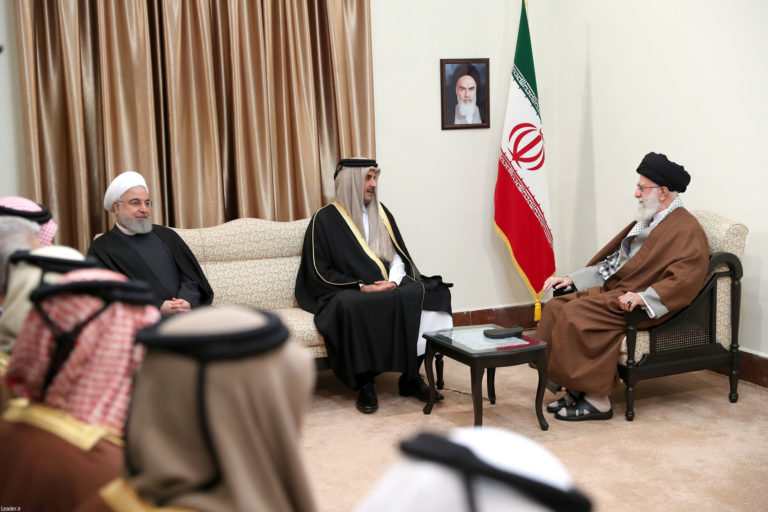
Iran hasn’t reacted to the New York Times and Fox News reports. Meanwhile, in what could well be a related development, Rouhani had a phone conversation on April 21 with the Emir of Qatar Sheikh Tamim bin Hamad Al Thani where the sanctions issue figured.
Interestingly, an Iranian Foreign Ministry statement later verbatim quoted from the conversation. Rouhani told Sheikh Tamim:
“The US pressure and sanctions against Iran are not only a violation of international law, but also they are violating human principles by intensifying their behaviour in these difficult circumstances, including preventing the International Monetary Fund from lending to Iran”.
“We believe that in this special situation, all countries in the world must stand together to fight coronavirus and clearly state their positions against the hostile actions of the United States”.
“Unfortunately, they are still reluctant to end their inhumane acts, but we have no doubt that sooner or later they will have to change course.”
The Emir responded,
“Today, the world is in a special situation and we believe that in this situation, the United States must lift its sanctions and all countries must move in line with the new conditions.”
Subsequently, there has also been a conversation between the two foreign ministers. Now, Qatar, which hosts the US Central Command Hqs, is a close ally of the US. Sheikh Tamim and Trump have a warm relationship.
During the emir’s visit to the White House last July, Trump remarked, “Tamim, you’ve been a friend of mine for a long time, before I did this presidential thing, and we feel very comfortable with each other.” No doubt, if ever Trump needed a back channel with the Iranian leadership, he wouldn’t need to look beyond Sheikh Tamim. (Significantly, Sheikh Tamim made a rare visit to Tehran in January this year.)
Curiously, the day after Sheikh Tamim spoke to Rouhani, he also held a phone conversation with Trump. The White House readout said, “The president and the (emir) discussed the coronavirus response… The president encouraged the emir to take steps toward resolving the Gulf rift in order to work together to defeat the virus, minimise its economic impact and focus on critical regional issues.”
The bottom line is that the UN arms embargo is not really a big ticket item but the sanctions is. Even if the ban gets lifted in October, it is only for small arms, whereas transfer of advanced technology such as missiles will have to wait another 3 years. Iran is largely self-reliant in defence. And its asymmetric capability to generate deterrence against US aggression is legion.
The Trump administration realises that its sanctions policy has failed. The murder of the charismatic Iranian general Qassem Soleimani only hardened Tehran’s resolve to press ahead with the “axis of resistance”. And the world opinion militates against continued US sanctions against Iran.
In this backdrop, the forthcoming summit of the founding members of the UN may address the issue of sanctions. From such a perspective, the Trump administration’s seemingly belligerent move to return as “participant” in the JCPOA may turn out to be a dependent variable open to influence from one or more independent variables.
US to face tough battle in pushing plan to extend UN Iran arms embargo: Diplomats
Press TV – April 28, 2020
Diplomatic sources at the United Nations say Washington has a tough challenge ahead at the Security Council (UNSC) if it pushes for an extension of the world body’s arms embargo against Iran through recourse to a process set out in a multilateral nuclear deal that the US controversially abandoned in 2018.
The agreement — officially called the Joint Comprehensive Plan of Action (JCPOA) — was signed in 2015 between Iran and six major world states and endorsed by UNSC Resolution 2231.
However, the US unilaterally withdrew from what President Donald Trump called “the worst deal ever” in May 2018 and re-imposed anti-Iran sanctions. It has also been coercing the remaining signatories to the JCPOA to follow suit.
Under UNSC Resolution 2231, the UN arms embargo on Iran — in place since 2006/2007 — will be lifted in October 2020. The US has repeatedly expressed its anger at the possible termination of restrictions on Iran’s import and export of arms.
On Tuesday, diplomats told Reuters that Washington is planning to use a threat to trigger a return of all UN sanctions against Iran as leverage to get the Security Council to prolong the arms embargo on Tehran.
A US official, who was speaking on condition of anonymity, said Washington has shared its strategy with Britain, France and Germany, who are permanent Security Council member states and parties to the Iran deal.
The diplomats said the scheme has not been shared with the remaining 11 council members, including veto-wielders Russia and China, the two other signatories to the JCPOA that are deemed certain to oppose the arms embargo on Iran.
Reports say if the Security Council refuses to revive the embargo, the US will try to trigger a so-called snapback of all UN sanctions on Iran by claiming that it is still a party to the JCPOA and that Iran is in significant violation of the nuclear pact.
The New York Times said on Sunday that US Secretary of State Mike Pompeo was laying the groundwork to present a legal argument to the UN that Washington remains a “participant state” in the JCPOA.
It is “part of an intricate strategy to pressure the United Nations Security Council to extend an arms embargo on Tehran,” the report said.
Reuters, however, cited the UN diplomats as saying that Washington’s plan will likely be challenged since the US is no longer a party to the deal.
“It will be dead on arrival,” a Security Council diplomat predicted. “It’s very difficult to present yourself as a compliance watcher of a resolution you decided to pull out of,” a European diplomat said. “Either you’re in or either you’re out.”
Another European official said, “It’s going to be messy from a Security Council standpoint because, regardless of what (Britain, Germany and France) think, Russia and China are not going to sign up to that legal interpretation.”
Iranian Foreign Minister Mohammad Javad Zarif has dismissed Pompeo’s reported scheme, saying the plan to return to the JCPOA is rooted in the failure of Washington’s “maximum pressure” campaign against the Iranian nation.
‘US cannot cherry-pick UN resolutions’
Meanwhile, a Western diplomat, speaking on condition of anonymity, told AFP, “You cannot cherry-pick a resolution saying you implement only parts of it but you won’t do it for the rest.”
Similarly, Kelsey Davenport, director for non-proliferation policy at the US-based Arms Control Association, said “if Pompeo goes through with this plan, snapping back sanctions on Iran collapses the JCPOA.”
Even more significant, she added, the US measure could lead Iran to make good on threats to exit the nuclear Non-Proliferation Treaty (NPT).
“This is just another step that would undermine US credibility, make future negotiations with Iran more difficult and increase the risk of a nuclear crisis in the region,” she said.
‘US placing world in Catch-22 situation’
Russia also slammed the US plan, with Permanent Representative to International Organizations in Vienna Mikhail Ulyanov tweeting, “The country which officially ceased its participation in the #IranDeal cannot remain its participant by definition.”
The Russian Mission Vienna also said in a post on Twitter, “May 8, 2018 the #US says it “ends” and “terminates” its participation in the #JCPOA. Now there are claims that it still considers itself a participant. Is this a “Catch-22” sort of situation for Iran, UNSC and the whole world?”
Netanyahu Is Back Yet Again
Israel will become much bigger
By Philip Giraldi • Unz Review • April 28, 2020
Rahm Emanuel, up until recently the mayor of Chicago and before that a top advisor to the president in the Bill Clinton and Barack Obama White Houses and still earlier a volunteer in the Israeli Army, famously once commented that a good crisis should never be allowed to go to waste. He meant, of course, that a crisis can be exploited to provide cover for other shenanigans involving politicians. It was an observation that was particularly true when one was working for a sexual predator like Bill, who once attacked a “terrorist” pharmaceutical factory in Sudan to divert attention away from the breaking Monica Lewinski scandal.
To be sure, the United States government is focusing its attention on the coronavirus while also using the cover afforded to heighten the pressure on “enemies” near and far. As the coronavirus continues to spread, the Trump White House and Secretary of State Mike Pompeo have increased the ferocity of their sabre rattling, apparently in part to deter Russia, China, Iran and Venezuela. Ironically, of course, none of the countries being intimidated are actually threatening the United States, but we Americans have long since learned that perceptions are more important than facts when it comes to the current occupant of the oval office and his two predecessors.
The latest bit of mendacity coming out of the White House was a presidential tweet targeting the usual punching bag, Iran. Based on an incident that occurred two weeks ago, Trump threatened “I have instructed the United States Navy to shoot down and destroy any and all Iranian gunboats if they harass our ships at sea.” The U.S. Navy ships in question are, one might also observe, in a body of water generally referred to as the Persian Gulf, where they are carrying out maneuvers right off of the Iranian coast. Meanwhile, Iranian flying gunboats have not yet been observed off of New Jersey, but they are probably waiting to be transported to the Eastern Seaboard by those huge trans-oceanic gliders that once upon a time were allegedly being constructed by Saddam Hussein.
Given the cover provided by the virus, it should surprise no one that Israel is also playing the same game. The Jewish state has been continuing its lethal bombings of Syria, with hardly any notice in the international media. In a recent missile attack, nine people were killed near the historic city of Palmyra. Three of the dead were Syrians while six others were presumed to be Lebanese Shi’ites supporting the Damascus government. Israel de facto regards any Shi’ite as an “Iranian” or an “Iranian proxy” and therefore a “terrorist” eligible to be killed on sight.
But the bigger coronavirus story has to do with Israel’s domestic politics. Benjamin Netanyahu and his principle opponent Benny Gantz have come to an agreement to form a national government, ostensibly to deal with the health crisis. The wily Netanyahu, who will continue to be prime minister in the deal, has thereby retained his power over the government while also putting a halt to bids from the judiciary to try and sentence him on corruption charges. As part of the deal with Gantz, Netanyahu will have veto power over the naming of the new government’s attorney general and state prosecutor, guaranteeing the appointment of individuals who will dismiss the charges.
And more will be coming, with the acquiescence of Washington. U.S. elections are little more than six months away and Donald Trump clearly believes that he needs the political support of Netanyahu to energize his rabid Christian Zionist supporters, as well as the cash coming from Jewish oligarchs Sheldon Adelson, Bernard Marcus and Paul Singer. So, it is time to establish a quid pro quo, which will be Israeli government behind the scenes approaches to powerful and wealthy American Jews on behalf of Trump while the White House will look the other way while Israel annexes most of the remaining Palestinian West Bank. Pompeo has welcomed the new Israeli government and has confirmed that the annexation of the Palestinian land will be “ultimately Israel’s decision to make,” which amounts to a green light for Netanyahu to go ahead.
A vote on West Bank annexation will reportedly be taken by the Knesset at the beginning of July followed immediately by steps to incorporate Jewish settlements into Israel proper. According to the Israeli liberal newspaper Haaretz, the planned annexation has raised some concerns among a few liberal American Jewish organizations because it will convince many progressives in the U.S. that Israel has truly become an apartheid state. J Street warned that annexation “would severely imperil Israel’s future as a democratic homeland for the Jewish people, along with the future of the U.S.-Israel relationship” and has even suggested cutting U.S. aid if that step is actually taken. Most other ostensibly liberal groups have adopted the usual Zionist two-step, i.e. condemning the move but not advocating any effective steps to prevent it. And it should also be noted that the largest and most powerful Jewish organizations like the American Israel Public Affairs Committee (AIPAC) and the Zionist Organization of America (ZOA) have not raised any objections at all.
Unaffiliated individual liberal Jews, to include those who consider themselves Zionists, have generally been concerned about the move, though their argument is quite hypocritical, based on their belief that annexation would pari passu destroy any possible two-state solution, damaging both Palestinian rights and “Jewish democracy.” Some have even welcomed the change, noting that it would create a single state de facto which eventually would have to evolve into a modern democracy with equal rights for all. Such thinking is, however, nonsense. Israel under Netanyahu and whichever fascist retread that eventually succeeds him regards itself as a Jewish state and will do whatever it takes to maintain that, even including dispossessing remaining Arabs of their land and possessions, stripping them of their legal status, and forcing them to leave as refugees. That is something that might be referred to as ethnic cleansing, or even genocide.
And those Americans of conscience who are hoping for some change if someone named Joe Biden defeats Trump can also forget about that option. Biden has told the New York Times that “I believe a two-state solution remains the only way to ensure Israel’s long-term security while sustaining its Jewish and democratic identity. It is also the only way to ensure Palestinian dignity and their legitimate interest in national self-determination. And it is a necessary condition to take full advantage of the opening that exists for greater cooperation between Israel and its Arab neighbors. For all these reasons, encouraging a two-state solution remains in the critical interest of the United States.”
Unfortunately, someone should tell Joe that that particular train has already left the station due to the expansion of the Jewish state’s settlements. Nice words from the man who would be president aside, Biden is bound to the Israel Lobby for its political support and the money it provides as tightly as can be and he will fold before AIPAC and company like a cheap suit. He has famously declared that “You don’t have to be a Jew to be a Zionist – I am a Zionist” and “My Name is Joe Biden, and Everybody Knows I Love Israel.” His vice-presidential candidates’ debate with Sarah Palin in 2008 turned embarrassing when he and Palin both engaged in long soliloquys about how much they cherish Israel. Indeed they do. Every politician on the make loves Israel.
Philip M. Giraldi, Ph.D., is Executive Director of the Council for the National Interest, a 501(c)3 tax deductible educational foundation (Federal ID Number #52-1739023) that seeks a more interests-based U.S. foreign policy in the Middle East. Website is councilforthenationalinterest.org, address is P.O. Box 2157, Purcellville VA 20134 and its email is inform@cnionline.org.
US seeking to replace Iraq’s PMU in the western Anbar province bordering Syria: Analyst
Press TV – April 26, 2020
An Iraqi military advisor and analyst has said that the US is seeking to replace Iraq’s Popular Mobilization Units in the western Anbar province bordering Syria with its own forces.
Speaking to Iraq’s al-Maloumah news agency on Sunday, Safa al-A’ssam said that Washington seeks to force the PMU out of the province’s al-Qaim border region by fanning sectarian tensions.
“The plan is to redeploy American forces to the al-Qaim region on the pretext of countering Deash terrorist attacks and filling the security vacuum following a PMU withdrawal,” he added.
The PMU formed shortly after the emergence of the Daesh terrorist group in Iraq in mid-2014.
The group played a major role pushing back and ultimately defeating the terrorist forces which had taken control of a large swathes of the country.
The Iraqi parliament voted to integrate the PMU into the Iraqi military in 2016, effectively placing the force under the command of the prime minister and granting the group a standing similar to that of other branches of Iraqi security forces.
Fazel Jaber, an Iraqi lawmaker affiliated with the Fatah Alliance, has also warned of attempts by certain Iraqi groups to undermine the PMU’s presence in the province despite being deployed under the command of Iraq’s federal government.
He said the attempts to weaken the PMU were led by Washington, which fears the group’s presence.
The PMU has long rejected Washington’s military presence in the country as an obstacle impeding long-lasting security and stability in Iraq.
In January, Washington assassinated the group’s deputy commander, Abu Mahdi al-Muhandis, alongside Iran’s top anti-terror Lieutenant General Qassem Soleimani in the capital city Baghdad.
Iraqi resistance groups have vowed to take up arms against US forces if Washington fails to comply with a parliamentary order calling for the expulsion of US troops following the assassination.
South Korean bank submits to US fine over Iran transactions
Press TV – April 21, 2020
South Korea’s Industrial Bank of Korea (IBK) says it has submitted to the US demand to pay $86 million in fine for processing Iranian transactions.
The compromise includes paying $51 million to US prosecutors and $35 million to the New York State Department of Financial Services, the lender said Tuesday.
South Korea’s Yonhap news agency cited Geoffrey S. Berman, the US attorney for the Southern District of New York, as saying that IBK’s branch in New York had failed to detect and report $10 million in US dollar payments from South Korean entities to Iranian banks.
Authorities said IBK entered a two-year deferred prosecution agreement with the US Department of Justice and a nonprosecution agreement with New York Attorney General Letitia James.
South Korea was among Iran’s major trade partners before falling in line with US guidelines after Washington withdrew from an international nuclear deal with Tehran in 2015 and imposed unilateral sanctions on the Islamic Republic.
Iran was South Korea’s third biggest export market in the Middle East and companies such as Samsung and LG Electronics were among popular brands for TV sets, air conditioners, telecommunications equipment and washing machines.
Samsung’s sales also notably covered about half of Iran’s lucrative android phone market, with almost 18 million Iranians having Samsung devices as of February 2018, according to a report published by Iran’s largest app market Café Bazaar.
In February, Iran’s Foreign Ministry warned that foreign companies leaving the country due to the US sanctions would not be able to return to the country’s market easily after Samsung and LG Electronics pulled down their last advertisement banners in Iran.
According to a statement by the Ministry of Trade, Industry and Energy in Seoul, Iran was once the sixth largest market in terms of orders won by South Korean builders before the 2011 sanctions.
South Korea was also the biggest client of Iranian condensate with 300,000 barrels per day (bpd) on top of 100,000 bpd of crude oil, but it stopped shipments two months before the sanctions kicked in.
South Korean companies have mostly even refused to fulfill Iran’s orders for medicine and medical equipment which is supposedly not subject to the US sanctions.
According to Iranian companies, South Korean banks are refusing to process payments related to Iran’s imports of pharmaceuticals for fear of falling foul of the sanctions.
Iran’s Health Ministry said Saturday South Korea had rejected a SWIFT payment request by Tehran for purchase of coronavirus testing kits.
Ministry spokesman Kianoush Jahanpour disclosed an international financial message recently sent by South Korea’s Woori Bank to Iran’s Keshavarzi Bank, noting that it could not take over an import letter of credit for 5.3 billion won issued by the Iranian bank.
As a result Iran was unable to import the kits because the Korean exporter could not receive payment after Woori Bank’s refusal to take over the import letter of credit.
“This shows claims of medicine and medical equipment not being subject to sanctions are lies. The bank has officially stated that the purchase is not possible due to the sanctions,” Jahanpour said.
The US government has intensified its sanctions on Iran despite international calls on Washington to suspend them to allow the Islamic Republic to secure necessary medicine and equipment in the midst of the coronavirus fight.
Washington claims the sanctions do not target medicine for Iran, but they make it all but impossible for importers to obtain letters of credit or conduct international transfers of funds through banks.
Last week, Iran’s Permanent Mission to the United Nations in New York dismissed the Swiss Humanitarian Trade Arrangement (SHTA) which the Europeans belatedly announced with much fanfare to have made operational in coordination with the US to barter medicine and food with Iran.
The mission said the United States has forced SHTA to pursue a very tight and tough procedure, making it practically very difficult for companies to trade with Iran.
According to the mission, several companies that supply the medical equipment required to fight the coronavirus have recently stopped shipping to Iran because the current US sanctions regime makes the shipping of such items to Iran almost impossible.
The only message the US is sending with intensifying its sanctions amid the coronavirus is that companies must avoid doing any business with Iran, even if their work is humanitarian in nature, it said.
Buying Punishment for “Terrorists”: Washington’s Reward Program Is Largely Ineffective
By Philip Giraldi | American Herald tribune | April 15, 2020
Many people worldwide are aware of the fact that the United States government offers cash rewards to informants who provide information on individuals and groups that it chooses to define as terrorists. The program is referred to as the Rewards for Justice Program (RFJ). It was established in 1984 as part of the Act to Combat International Terrorism and is run by the Department of State’s Diplomatic Security Service (DS). The rewards can be substantial, up to the $25 million that was offered for Osama bin Laden, and they sometimes include resettlement in another country with a new identity for informants whose security is threatened by their cooperation.
The program relies on information provided by local people, referred to on the RFJ website as “tips.” The website itself is accessible in a number of languages and, in its English version, features a headline that promotes its mission as: “Stop a Terrorist Save Lives. The most important reasons to stop a terrorist are all around you. Terrorism kills innocent people in every walk of life. By providing information that prevents a terrorist act, you save lives, protect families, and preserve peace. The United States is offering a reward for information leading to the arrest of persons engaged in terrorism. If you have information that can help, please submit a tip now. Submit a Tip.”
RFJ elaborates its role in very broad terms as “… offering rewards for information that prevents or favorably resolves acts of international terrorism against U.S. persons or property worldwide. Rewards also may be paid for information leading to the arrest or conviction of terrorists attempting, committing, conspiring to commit, or aiding and abetting in the commission of such acts. The Rewards for Justice Program has paid more than $145 million for information that prevented international terrorist attacks or helped bring to justice those involved in prior acts.”
After a slow start in which the program was first called the Counter Terror Rewards Program and then HEROES, by 1997 the site was processing over one million contacts per year. Admittedly, many of the “tips” were little more than bids to obtain cash and resettlement from the American government, but the State Department’s periodic evaluations of the program have considered it to be a success.
Critics note, however, that the reward for bin Laden attracted thousands of calls but no substantive information was obtained. Nor has RFJ been very effective against Islamic radical groups, considered to be its primary target. The website identifies top terrorist targets, but apart from Ramzi Ahmed Yousef, the World Trade Center bomber of 1993 who was also involved in various plots involving airliners in the Philippines, no one important has been identified and arrested through information developed by way of the program. Ramzi was arrested in Pakistan in 1995 after an informant identified him. He is currently in prison in Colorado.
The RFJ program has also claimed several executions of claimed terrorists, to include the killing of two leaders of the Filipino radical group Abu Sayyaf. Many more terrorist leaders, like ISIS head Abu Bakr al-Baghdadi, were killed without any input from RFJ. The relative lack of success against actual militants from groups recognized generally as terrorist, inevitably led to a broadening of the target pool. On December 22, 2011, RFJ offered a $10 million for information leading to Ezedin Abdel Aziz Khalil, the alleged organizer of an al-Qaeda fundraising operation in Iran that sent money to Pakistan and Afghanistan. It was the first listing of what was claimed to be a terrorist financier.
Two major current targets of RFJ are, in fact, financiers and fund-raising mechanisms related to Lebanese Hizballah and the Iranian Revolutionary Guards Corps (IRGC). To include them on the list, the United States declared both organizations to be Foreign Terrorist Groups (FTOs) in 1997 and 2019 respectively. Regarding Hizballah, the RFJ website includes “Rewards for Justice is offering a reward of up to $10 million for information leading to the disruption of the financial mechanisms of Lebanese Hizballah. Terrorist groups such as Hizballah rely on financing and facilitation networks to sustain operations and launch attacks globally. Hizballah earns almost one billion dollars annually through direct financial support from Iran, international businesses and investments, donor networks, corruption, and money laundering activities. The group uses those funds to support its malign activities throughout the world, including: Deployment of its militia members to Syria in support of the Assad dictatorship; alleged operations to conduct surveillance and gather intelligence in the American homeland; and enhanced military capabilities to the point that Hizballah claims to possess precision-guided missiles. These terrorist operations are funded through Hizballah’s international network of financial supporters and activities — financial enablers and infrastructure that form the lifeblood of Hizballah.”
Regarding the IRGC, the RFJ site includes “The U.S. Department of State’s Reward for Justice Program is offering a reward of up to $15 million for information leading to the disruption of the financial mechanisms of Iran’s Islamic Revolutionary Guard Corps (IRGC) and its branches, including the IRGC-Qods Force (IRGC-QF). The IRGC has financed numerous terrorist attacks and activities globally. The IRGC-QF leads Iran’s terrorist operations outside Iran via its proxies, such as Hizballah and Hamas… Since its founding 40 years ago, the IRGC has been involved in terrorist plots and supports terrorism worldwide. The IRGC is responsible for numerous attacks targeting Americans and U.S. facilities, including those that killed U.S. citizens. The IRGC has supported attacks against U.S. and allied troops and diplomatic missions in Iraq and Afghanistan.”
The first thing that strikes the casual reader of the descriptions of the cases made against both Hizballah and the IRGC is that much of the “evidence” is unsubstantiated, fabricated or exaggerated. To be sure, neither group is a friend of the United States or of Israel, but the descriptions of worldwide terror operations is largely made up, particularly the claims about attacks against Americans which have been credibly attributed to ISIS, not to Iranian sources or proxies. That Lebanese Hizballah has been gathering intelligence on the “American homeland,” presumably to stage an attack, is complete nonsense.
To cite only one example of how the RFJ is primarily a vehicle for attacking individuals and groups that the U.S. and Israel do not like, one might cite Muhammad Kawtharani. Informants would be rewarded for information on the “… activities, networks, and associates of Muhammad Kawtharani, a senior Hizballah military commander. This announcement is part of the Department’s standing reward offer for information leading to the disruption of the financial mechanisms of the terrorist organization Lebanese Hizballah. Muhammad Kawtharani is a senior leader of Hizballah’s forces in Iraq and has taken over some of the political coordination of Iran-aligned paramilitary groups formerly organized by Qassim Soleimani after Soleimani’s death in January. In this capacity, he facilitates the actions of groups operating outside the control of the Government of Iraq that have violently suppressed protests, attacked foreign diplomatic missions, and engaged in wide-spread organized criminal activity. As a member of Hizballah’s Political Council, Kawtharani has worked to promote Hizballah’s interests in Iraq, including Hizballah efforts to provide training, funding, political, and logistical support to Iraqi Shi’a insurgent groups.”
Well, RFJ gets Kawtharani’s name right and he is a Hizballah commander, but from that point on the story is pure spin and disinformation. The militia groups that Kawtharani presumably associates with and that have been attacked by U.S. forces are not “outside control of the government,” nor are they “insurgents.” They are, in fact, integrated into the Iraqi army. Nor have attacks on foreign diplomatic missions been demonstrated to be their responsibility as the rage against U.S. presence in Iraq is widespread across sectarian lines. Kawtharani is present in Iraq as a guest of the government in Baghdad, as was Qassim Soleimani before him, largely to assist in the fighting against ISIS. And if he is in Iraq to promote Hizballah interests in that country, why should it surprise anyone? In short, his being featured in RFJ is part of a plan to create a major incentive to kill him, little more. If he committed an actual terrorism crime or act, where is it?
Rewards for Justice is not about justice at all, unless one is promoting vigilante justice, as virtually no one who appears on its site is actually arrested and tried. It is a kill list providing the United States with one more tool to target and eliminate political opponents from countries with which Washington is not at war. As it has now been expanded to include the targeting of organizations and funding mechanisms of groups that are considered hostile, it is a mechanism for widening the hideous global war on terror that has done such terrible damage to American democracy while also killing hundreds of thousands and upending whole countries worldwide.
Trump’s Cyprus Signalling Is More against Turkey than Russia
By Paul Antonopoulos | April 15, 2020
The Al-Monitor portal has left many extremely surprised with news that was not expected in the middle of the coronavirus pandemic. With over 600,000 cases and 25,000 deaths in the U.S., President Donald Trump has made a bold geopolitical move and instructed Secretary of State Mike Pompeo to determine whether Cyprus should have the arms embargo against it lifted, according to Al-Monitor’s congressional correspondent, Bryant Harris.
“Trump tasked Pompeo with the decision [yesterday] via a presidential memorandum after signing two separate bills to lift the embargo in December — legislation that Turkey had unsuccessfully sought to forestall,” explained Harris.
In 1987, the U.S. embargoed arms sales to Cyprus under the pretext of preventing an arms build-up on the island. However, this was not a problem for Cyprus as Russia became one of the biggest weapon suppliers instead. If the U.S. were trying to have balance on Cyprus, it certainly did not achieve this as the country only became closer with Russia and to this day they still have close ties.
In 1974, Turkey invaded the northern parts of the island to prevent Cyprus from uniting with Greece and to this day continues an illegal occupation. The occupation is to maintain the quasi “Turkish Republic of Northern Cyprus” that is recognized by no other state in the world bar Turkey and is recognized by United Nations Security Council Resolution 541 and UN Security Council Resolution 550 as illegal.
The U.S. has never taken an interest in protecting Cypriot interests despite the illegalities of the occupation of northern Cyprus – up until recent times. Turkish President Recep Tayyip Erdoğan going rogue against U.S. and NATO interests by strengthening relations with Russian President Vladimir Putin, including the sale of the S-400 missile defense system that are not compatible with NATO doctrine.
The irony is that Turkey bought the S-400 system despite the fact that in 1997 Cyprus bought the S-300 air defense missiles from Russia, but had to trade it with Greece for other weapons under a Turkish threat of blockade and/or war. The S-300 is now located on the Greek island of Crete. As Greece in recent years has been a loyal subject of NATO without much independent foreign policy, Washington is now willing to give the country more concessions. In previous years, Washington would only appease Turkey as it controlled the Bosporus Straits that connects Russia’s Black Sea Fleet to the rest of the world.
However, these concessions and attempts to strengthen relations between Cyprus and the U.S. come at a price. Harris explains that the U.S. Congress laid out specific criteria that Cyprus needs to fulfill before it is allowed to procure arms from the U.S., if it ever choose to.
“Specifically, the law requires Cyprus to deny Russian military vessels to its ports despite a 2015 agreement with Moscow to do so. It also requires Cyprus — a financial haven for wealthy Russians to evade US sanctions — to comply with anti-money laundering regulations,” he said.
It is very unlikely that Cyprus will meet these demands made as it is not a NATO member, nor does it have the incentive to abandon a partner that supplied it weapons when the U.S. turned its back. Knowing this fact, Harris explained that “even if Cyprus fails to comply with these conditions, the law gives Pompeo the freedom to lift the embargo anyway via a national security waiver.”
This therefore means that the true target of this arms embargo lift is not necessarily Russia, but rather Turkey. It is effectively in Cypriot hands on whether they want to take on these U.S. conditions. Cyprus is being ‘rewarded’ by Washington as in recent years it has formed a strategic partnership with Israel in the economic, energy and military sector. Because of this, pro-Israel groups in the U.S. lobbied to lift the arms embargo last year, especially as Erdoğan frequently antagonizes Tel Aviv.
Although it is in Pompeo’s hands to decide whether to lift the embargo or not, it is more likely he will choose to do this even if Cyprus decides not to conform to the anti-Russian measures demanded. Not only are Trump and Pompeo receiving pressure from the Israeli lobby, but they are also receiving pressure from extremely influential think-tanks.
In an article from June 2019, titled “Lift the Arms Embargo on Cyprus,” that was first published by The Center for the National Interest, and then republished by the CATO Institute, the author explains “The current arms embargo on Cyprus is unbalanced and unfair. Favoring Turkey never was likely to help keep the peace. Today, given Erdogan’s transformation into a frenemy of America at best, and confrontational policy toward Cyprus and Greece, the embargo rewards an essentially rogue government. The United States should see Turkey plain and stop tolerating the latter’s unfriendly conduct.”
However, there is no guarantee that just because Cyprus is now being noticed and recognized by Washington that it will quickly abandon Russia, especially because of decades of limited relations and the important role the U.S. played in supporting the Turkish invasion of northern Cyprus. Rather, the lifting of the arms embargo is just one small gesture that Washington might make to antagonize a rogue Erdoğan, and if this is the aim, it will certainly work as the Turkish president believes the island to be a part of his domain.
Paul Antonopoulos is a Research Fellow at the Center for Syncretic Studies.
New Document Reveals How Jews Manufactured Corbyn “Anti-Semitism” Hysteria In Quest for Power
By Eric Striker – National Justice – April 12, 2020
UK Labour’s election of Keir Starmer, a self-described Zionist with close familial ties to Jewry, is a drastic establishment repudiation of Corbynism.
The elements of the Judeo-Left who did everything in their power to betray their own party and cause Jeremy Corbyn to lose through their bully pulpits at publications like The Guardian are licking their lips at the certain prospect of a sweeping party purge of those labeled “anti-Semitic.” The goal is to solidify Jewish control over a party Jews abandoned in the 1970s and 80s for the Tories, but still distrust.
A gargantuan internal party dossier detailing the conspiracy to undermine and destroy Corbyn goes back to 2016, with the founding of a group called “Labour Against Anti-Semitism” (LAAS). The LAAS uses the “International Holocaust Remembrance Alliance” definition of anti-Semitism, which includes any and all criticism of Israel, once again demonstrating the power of the pernicious myth to give moral leverage to immoral causes like non-stop global war and ethnic cleansing.
LAAS is led by a figure named Euan Philipps, who is described in the investigation (pg 401) as being rude and insulting as he filed loads of discrimination complaints described by staff as “spurious.” Some discourse that Philipps reported as anti-Semitic included party members attacking Blairites (fans of the Zionist warmonger Tony Blair), expressing support for George Galloway (a veteran radical who in recent years has bucked his party to become pro-Brexit, criticize Zionism and push back against anti-white sentiment), criticizing finance-capitalism, and of course, criticism of Israel of any kind.
The large number of anti-Semitism complaints, despite being non-sense, were reported uncritically in British media. This put pressure on Corbyn to purge some of his most fervent supporters and cause infighting as the party campaigned for election.
According to the report, in 2019 half of all “anti-Semitism” complaints came from one person (pg 843). The investigation remarks that none of the claims had any evidence, and were largely just people expressing non-racial political views Jews don’t like. Thanks to the political correctness of the left-wing organization, the powerful and connected Jews in question sought to sow division and waste resources by causing Labour hierarchs to “investigate” and sometimes suspend opponents of Zionism or neo-liberalism. After a while, some involved in the “Dignity at Work” anti-harassment program realized it was a subversive strategy and began to take these complaints less seriously.
Corbyn’s supporters, rather than simply booting all the interlopers, decided upon the limp strategy of calling the other side anti-Semitic for assuming all Jews support Israel (95% of American Jews — among the most “liberal” — support Israel) or going out of their way to prove innocence while being barraged by thunderstriking calumnies. The problem is that the “controversy” was always in bad faith and specifically a rejection of some of Corbyn’s views on economics and foreign policy.
One of the most shocking vignettes from the Jewish conspiracy against Corbyn was when Secretary of State Mike Pompeo spoke with British Jews at a secret meeting and promised American intervention in the immediate aftermath of a Corbyn victory. What this intervention would’ve looked like is left up to our imagination as Boris Johnson won in a landslide in December 2019.
Corbyn’s experience is by no means exclusive to the left. Right-wing groups are also subjected to similar strategies by Jews who seek to weaken their ability to advance the interests of their voters.
Jews have utilized similar tactics to cause internal havoc and trigger purges in conservative-populist parties like Alternativ Fur Deutschland (AfD), Vox, and of course the famous “de-demonization” of Front National.
William F. Buckley’s draconian crackdown at the behest of Norman Podhoretz completely neutered the American right. This was so effective that only recently has it started to recover, and even that’s up for debate.
Any organization that expresses a strong and principled alternative to the plutocratic status quo, never-ending wars, globalization or mass immigration will be labeled anti-Semitic by Jews, whether that is their intent or not.
Jewish elites see political consensus on these issues as vital to retaining dominance in Western nations. Whether left or right, those who present opposition to these policies will be dragged into an open confrontation with Jewish power, which usually ends in the target getting in the fetal position and enduring a beat down.
The question going forward is: who is willing to fight back?
Why the US wouldn’t Ease Iran Sanctions
By Salman Rafi Sheikh – New Eastern Outlook – 09.04.2020
The past two weeks have seen US officials moving first from issuing an alert to their military commanders to make plans for a retaliatory strike against Iranian targets to talking about ‘easing’ sanctions on Iran if Iran ‘wants it.’ It’s obvious that there is no reason why the Iranians wouldn’t want to see sanctions against them being eased up. Yet, Trump’s desire for a formal request about this issue shows the latent intention of ignoring it, while using the whole scenario to its advantage i.e., let the situation exacerbate to an extent whereby the Iranian regime becomes unstable and incapable of rescuing its people from the virus, and thus collapse ultimately.
This would surely serve US interests, along with those of Saudi Arabia and Israel, which have been pushing hard to do a “regime change” in Tehran. In their calculation, the unprecedented crisis caused by the COVID-19 seems to have given them yet another opportunity to attain their ultimate objective.
Indeed, this was the intention when the US asked its military commanders to make plans for a retaliatory strike on Iran in response to an imaginary Iranian attack on US military bases—an attack that had neither been planned nor was it foreseen by anybody. But the fact that the US was going to ‘directly attack the Iranian forces’ in the wake of Iran supported militias attacking US troops shows that the intention was, as Trump himself said, to go “up the food chain”, thus creating a scenario that would be extremely difficult for Tehran to address.
Accordingly, as a part of US ‘war preparations’, the US military officials disclosed, seemingly on purpose, to the western media that Patriot air defence systems have been deployed to two Iraqi military bases and that the same systems were going to be deployed across two more bases.
While manufacturing a military crisis is one thing, executing it is another. Accordingly, even if the US ‘had a plan’, it doesn’t mean it was going to work due to multiple factors, including lack of support from US allies in Europe, who were already in the middle of operationalising Instex to start economic and financial transactions with Iran, bypassing US sanctions and showcasing their ‘independent’ approach towards Iran in the wake of widening gap between the US and Europe/NATO.
But the US sanctions are still intact; for easing sanctions will allow, in the US calculation, the Iranian regime to better tackle the COVID-19 crisis and thus stabilise itself politically and economically. This would thus undermine the very purpose of the US sanctions i.e., forcing the Iranian regime to implode and collapse.
Indeed, a collapse followed by a massive crisis in the Middle East, particularly one that involves Iran, is something that the US would welcome rather than desist. It shows why the US imposed new sanctions on Iran instead of removing the old ones.
It has happened recently when Iran, out of the necessity to cope with monetary shortfall, requested 5 billion dollars from the International Monetary Fund (IMF). While this was always obvious that the request will not be granted without US acquiescence, the US actually responded by announcing new sanctions on Iran’s oil industry, one of its very few remaining foreign exchange earners. The intention was to make life even more difficult for the Iranians.
Also, it explains why Washington has so far taken no serious steps to actually ease the sanctions on its own, even though sufficient conditions for doing so undoubtedly exist, including Iran’s response whereby they called for a halt to “warmongering during the coronavirus outbreak” and further warned that US military activities could create “instability and disaster”. On April 2, Foreign Minister Javad Zarif, addressing the US president, tweeted, “Don’t be misled by usual warmongers, AGAIN. Iran starts no wars, but teaches lessons to those who do.”
Notwithstanding the ‘progressive’ US rhetoric about easing sanctions if Iran asks for it, the fact of the matter remains that the US strategic aim in this part of the world remains a “regime change” in Iran, although it is also becoming clear with every day passing that this objective can never be achieved.
Europe has already started Instex, although it is yet to produce productive economic results and engage in economic and financial activity beyond the support for COVID-19. The Chinese have yet again come out against US war aggression, and the Russians remain a bulwark against any US adventure in the Middle East, particularly against Iran.
None of this, of course, means that the US will end its sanctions. On the other hand, it will continue to add more to the pool as it did a few days ago; after all, ‘Iranian crisis’ is the linchpin of the US military presence in the region and the key source of wealth for its military-industrial complex.
Salman Rafi Sheikh is a research-analyst of International Relations and Pakistan’s foreign and domestic affairs.
Targeting Iran While America Locks Down
A national health crisis does not stop the beat of the war drums
By Philip Giraldi • Unz Review • April 7, 2020
The United States has just declared war against the coronavirus, with President Donald Trump self-proclaiming that he is now a “wartime president.” Whether one believes that the virus must be confronted with maximum aggression by effectively shutting down the country or that the measures already in place are already an overreaction hardly seems to matter as developments over the next several months will likely demonstrate what could have/might have/should have been done. But meanwhile extreme views are proliferating, with Rush Limbaugh detecting a conspiracy by Democrats and communists to destroy capitalism under “the guise of saving lives” while a more restrained but ideologically driven libertarian Ron Paul meanwhile chose to pen an article entitled “Coronavirus Hoax” that personally pilloried as a “chief fearmonger” the government’s widely respected expert on the origin and spread of the disease Dr. Anthony Fauci.
Stalin famously said that the death of one person was a tragedy while the death of a million is a statistic. For both Limbaugh and Paul an epidemic that could kill tens or even hundreds of thousands Americans produces a statistic, of lesser importance than retaining a completely corrupt Wall Street and the individual’s “liberty” to go shopping. Indeed, if greed driven American “vulture” capitalism must be preserved in its current form to protect and empower the rich, radical change might be welcomed by most Americans to include a long overdue genuine health infrastructure safety net.
Meanwhile, more rational and legitimate concerns are being raised by those who are worried about what kind of American democracy and economy will emerge on the other side. They urge the public to be particularly alert to the continuation of emergency practices at both the federal and state levels, permitting respective governments to act autocratically with little in the way of transparency or accountability.
One particular step that has been implemented is the use of cell phone tracking, without the permission of the device owners, to monitor whether separation and isolation measures are being observed by individuals who are out and about, determining whether or not they are obeying the rules in place to penalize congregating in public. It appears that the government and even at least one private presumably Israeli company now have the capability to track hundreds of thousands if not millions of phones simultaneously. This “emergency” abuse of privacy rights amounts to an illegal search and should be challenged on its constitutionality, but the real danger is that the tools used to monitor locations of phones can also be used after the claimed crisis is over to monitor perfectly legal activities of citizens. There should also be the concern that once the technology is developed to track phones a bit more tweaking might well integrate that feature into the National Security Agency’s well-established ability to intercept and record private conversations.
To be sure a different world will emerge post-coronavirus, but one might observe ruefully that some things never seem to change even in the midst of a full-blown global health crisis. Indeed, one might actually suspect that the United States, far from putting its own house in order, has actually used the virus as cover for intensifying its aggressive activities in Asia and Latin America. Along the way, it has also deliberately exploited the disease to punish those countries with which is has an adversarial relationship.
Those promoting the Trump administration’s preferred regime change “maximum pressure” policies are the top White House civilians, namely Secretary of State Mike Pompeo and National Security Adviser Robert O’Brien. The generals, to include Secretary of Defense Mike Esper and the Joint Chiefs of Staff, view the military as already overextended and have so far resisted some of the crazier suggestions but that does not mean that the jingoistic proposals have gone away. They are still on the table being pushed most particularly by Pompeo, and as the president is remarkably easily convinced to take military action, they should be considered to be still viable.
The two proposed courses of action that recently surfaced that must be considered borderline insane both relate to Iran. One of them is remarkable in that it creates two new active enemies simultaneously. It consists of a Pentagon order to regional commanders to make preparations to attack and destroy the Iraqi Shi’ite militia Kataib Hezbollah that the O’Brien/Pompeo twofer believe to be tied to Iran and responsible for recent attacks on U.S. bases in Iraq.
Lt. General Robert P. White, the U.S. top commander in Iraq responded immediately to the order, objecting that such a move would risk war with Iran while also increasing pressure on the government in Baghdad to expel American forces from the country. White also observed that he did not have sufficient forces in Iraq and any attack on an Iraqi militia that is technically part of the Iraqi Army would produce open warfare within the borders of a country that is technically an ally. If other militias, to include the numerous and well-armed Badr Army, were to join in the attacks on U.S. bases there would be no way to defend them.
The order is a compromise due to strong disagreements inside the Trump administration over how to punish Iran and its proxy Iraqi militias. Pompeo and O’Brien see the coronavirus, which has hit Iran hard, as an opportunity to destroy the militias while Iran is in no position to react. Per the New York Times, Esper approved the planning only to create options for dealing with Iraq and Iran based on the possibility that attacks against U.S. forces will increase. So far, Donald Trump has warned that Iran or a proxy militia is planning a “sneak attack” on American bases in Iraq and has stated that Iran itself would “pay a very heavy price” if it were carried out. Nevertheless, the president has only agreed to letting the planning continue, though he has also threatened to “go up the food chain,” implying that he is prepared to attack Iran directly if there is any escalation against American troops.
Pompeo and O’Brien, joined by recently appointed Director of National Intelligence Richard Grenell, have also been promoting a more serious endeavor, namely attacking Iran without warning and without any pretext while it is in its weakened state from the health crisis. Pompeo, O’Brien and Grenell argued that a direct attack on Iran, possibly to include hitting its naval vessels, would so weaken the regime over its inability to defend the country that its leaders would be forced to open negotiations, i.e. to surrender to Washington.
Washington has both increased sanctions and denied medicines to Iran, as well as to Venezuela, to put additional pressure on their governments vis-à-vis the coronavirus pandemic. The Trump Administration has been able to block $5 billion emergency International Monetary Fund loans to both countries while also sending warships to the Caribbean and Persian Gulf to back up the message with force if necessary. The argument being used to punish Venezuela is that it is not clear who represents the legitimate government in the country, whether it is Nicolas Maduro, the president, whom Pompeo has labeled a “drug trafficker,” or Juan Guaido, the aspirant to the position of head of state being promoted by the State Department.
Much of Washington’s maneuvering has been taking place under the radar given the cover provided by the crisis over coronavirus. Venezuela aside, most of the planning has focused on Iran, the Trump White House’s most hated adversary and also, perhaps not coincidentally, the perpetual number one enemy of Israel. In another move, on March 27th, the U.S. State Department’s Defense Security Cooperation Agency has announced approval of an $2.4 billion deal with Israel to buy eight KC-46A Pegasus aerial tankers.
The agreement is the first time the United States has sold actual purpose-built tanker aircraft to Israel. The KC-46A Pegasus can carry 106 tons of fuel to refuel jet fighters and has a range of more than 6,000 miles. It will enable the Israeli Air Force to have sufficient refueling capability to directly attack Iran, its principal regional target. Israel has frequently stated its willingness to attack Iranian nuclear sites and might also exploit the opportunity afforded by the coronavirus and its aftermath to do so.
So, at a time when the American public is clamoring for assurances that everything possible is being done to deal with the coronavirus, some officials in the White House are planning new wars. If one were seeking evidence of just how dysfunctional the Trump Administration is, it would not be necessary to look any further.
Philip M. Giraldi, Ph.D., is Executive Director of the Council for the National Interest, a 501(c)3 tax deductible educational foundation (Federal ID Number #52-1739023) that seeks a more interests-based U.S. foreign policy in the Middle East. Website is councilforthenationalinterest.org, address is P.O. Box 2157, Purcellville VA 20134 and its email is inform@cnionline.org.
Europe sends medical supplies to Iran in first INSTEX transaction: Germany
Press TV – March 31, 2020
Germany says the three European signatories to the 2015 Iran deal have registered the first transaction under a trade system set up last year to protect companies doing business with Iran from US sanctions, delivering medical supplies to the Islamic Republic amid the coronavirus pandemic.
On Tuesday, Berlin’s Foreign Ministry said Germany, France and Britain “confirm that INSTEX (trade system) has successfully concluded its first transaction, facilitating the export of medical goods from Europe to Iran.”
“These goods are now in Iran,” it said in a statement, giving no further details.
The German Foreign Ministry added that Berlin hopes to enhance the mechanism and carry out more transactions with Tehran.
“Now the first transaction is complete, INSTEX and its Iranian counterpart STFI (Special Trade and Finance Instrument) will work on more transactions and enhancing the mechanism,” the German Foreign Ministry said.
Iranian authorities have not commented on the news so far.
The transaction comes over a year after the European trio announced the creation of INSTEX — a non-dollar direct payment channel officially called the Instrument in Support of Trade Exchanges — in an effort to keep Iran’s nuclear deal with world powers alive.
The apparatus was designed to circumvent the sanctions that the United States re-imposed against Iran after leaving a nuclear deal with the Islamic Republic, the trio, plus Russia and China.
However, the Europeans have not been able to operationalize the non-dollar trade mechanism under pressure from the US.
The system was launched after Iran complained about the European countries failing to maintain trade with the country as mandated under the nuclear deal, and bowing instead to Washington’s pressure.
In May, Iran initiated a set of countermeasures against Washington’s withdrawal from the nuclear agreement, officially known as the Joint Comprehensive Plan of Action (JCPOA), and following the European partners’ failure to guarantee Tehran’s business interests under the agreement.
Iran had accepted the nuclear limits voluntarily as part of the deal, despite not being obligated by the UN nuclear agency to commit to any such restrictions.
Tehran has vowed to reverse all its nuclear activities as soon as the other JCPOA signatories begin fully implementing their obligations.
Featured Video
Trita Parsi: Middle East Unraveling — Are We on the Path to World War?
or go to
Aletho News Archives – Video-Images
From the Archives
Why Saudi Ties to 9/11 Mean U.S. Ties to 9/11
By Kevin Ryan | Dig Within | September 27, 2015
Media interest in Saudi Arabian connections to the crimes of 9/11 has centered on calls for the release of the 28 missing pages from the Joint Congressional Inquiry’s report. However, those calls focus on the question of hijacker financing and omit the most interesting links between the 9/11 attacks and Saudi Arabia—links that implicate powerful people in the United States. Here are twenty examples. … continue
Blog Roll
 Aletho News
- Integrity Initiative: UK-funded network framed dissent as Russian disinformation for years
- ‘We don’t seek permission to defend our country’: Snippets from President Pezeshkian’s UNGA address
- NATO chief wants Europeans to fight American wars [for Israel]
- German chemicals giant reveals details of downsizing
- Refaat Al-Areer Was The Canary In The Coal Mine In Israel’s War On The Truth
- Israeli election committee bars candidate from Knesset race over Gaza war opposition
- French-Lebanese man files war crimes complaint over Israeli attacks
- Mahan Air Flight Lands in China Despite US Threat against Iranian Airlines
- US eyes $10bn fund to rebuild war-battered Gulf infrastructure
- Trump meets Rodríguez near Maduro’s prison as Venezuela’s oil flows to US
- If Americans Knew
- Caught on Tape: AIPAC CEO Boasted of Controlling Trump’s National Security Officials
- Why Hamas Attacked Israel in October 2023 – Israeli professor Ilan Pappé
- They see them, then kill them: Israeli quadcopters track, deliberately target civilians in Gaza
- Winter could turn Gaza’s treacherous, war-damaged buildings into deathtraps
- Majority of Democratic Voters Want to Prosecute Both Biden and Trump Administration Officials Over Gaza
- As Gaza languishes, world leaders gather at the UN – Daily Update
- Sanctions are collective punishment: immoral and self-defeating
- Phosphorus Munitions Fired by Israel Burn Groves, Orchards in Southern Lebanon
- Israel Carries Out New Ceasefire Violations Across Gaza
- AI – Emphasis on the ‘I’: Israel Is Funding AI Chatbot Propaganda
- No Tricks Zone
- New Study: Earth And Venus Surface Warmth Largely Explained By Convection And Lapse Rate, Not CO2 Or Radiation
- 2025 Nature Paper Claiming Worsening Global Drought Gets RETRACTED …Heavily Flawed
- New Study: ‘Global Drought Shows No Detectable Recent Acceleration Under Climate Warming’
- Economic Masterminds: German Socialists Suggest Taxing Productivity Gains Stemming From Using AI
- The South China Sea Has Not Been Cooperating With The Climate Change Narrative
- Energy Crisis: Germany Enters Heating Season With Historically Low Gas Reserve Fill Levels
- New Study: The Antarctic Ice Sheet Gained Mass From 2020-2024 Due To Staggering Snow And Ice Accumulation
- Study: Ocean Heating Rates From Thousands Of Years Ago ‘Dwarf’ Modern Ocean Heating Rates
- Climate Extremists Target, Attack Large-Scale Power Grid Infrastructure In Germany!
- New Study: Antarctic Ice Melt Has Contributed Less Than 1 Centimeter To Sea Level Rise In The Last 30 Years

