In late 2006 I was approached by Scott McConnell, editor of The American Conservative (TAC), who told me that his small magazine was on the verge of closing without a large financial infusion. I’d been on friendly terms with McConnell since around 1999, and greatly appreciated that he and his TAC co-founders had been providing a focal point of opposition to America’s calamitous foreign policy of the early 2000s.
In the wake of 9/11, the Israel-centric Neocons had somehow managed to seize control of the Bush Administration while also gaining complete ascendancy over America’s leading media outlets, purging or intimidating most of their critics. Although Saddam Hussein clearly had no connection to the attacks, his status as a possible regional rival to Israel had established him as their top target, and they soon began beating the drums for war, with America finally launching its disastrous invasion in February 2003.
Among print magazines, TAC stood almost alone in whole-hearted opposition to these policies, and had attracted considerable attention when Founding Editor Pat Buchanan published “Whose War?”, pointing the finger of blame directly at the Jewish Neocons responsible, a truth very widely recognized in political and media circles but almost never publicly voiced. David Frum, a leading promoter of the Iraq War, had almost simultaneously unleashed a National Review cover story denouncing as “unpatriotic”—and perhaps “anti-Semitic”—a very long list of conservative, liberal, and libertarian war critics, with Buchanan near the very top, and the controversy and name-calling continued for some time.
Given this recent history, I was concerned that TAC‘s disappearance might leave a dangerous political void, and being then in a relatively strong financial position, I agreed to rescue the magazine and become its new owner. Although I was much too preoccupied with my own software work to have any direct involvement, McConnell named me publisher, probably hoping to bind me to his magazine’s continuing survival and ensure future financial infusions. My title was purely a nominal one, and over the next few years, aside from writing additional checks my only involvement usually amounted to a five-minute phone call each Monday morning to see how things were going.
About a year after I began supporting the magazine, McConnell informed me that a major crisis was brewing. Although Pat Buchanan had severed his direct ties with the publication some years earlier, he was by far the best-known figure associated with TAC, so that it was still widely—if erroneously—known as “Pat Buchanan’s magazine.” But now McConnell had heard that Buchanan was planning to release a new book supposedly glorifying Adolf Hitler and denouncing America’s participation in the world war to defeat the Nazi menace. Promoting such bizarre beliefs would surely doom Buchanan’s career, but TAC was already under continuous attack by Jewish activists, and the resulting “Neo-Nazi” guilt by association might easily sink the magazine as well.
In desperation, McConnell had decided to protect his publication by soliciting a very hostile review by conservative historian John Lukacs, which would thereby insulate TAC from the looming disaster. Given my current role as TAC‘s funder and publisher, he naturally sought my approval in this harsh break with his own political mentor. I told him that the Buchanan book certainly sounded rather ridiculous and his own defensive strategy a pretty reasonable one, and I quickly returned to the problems I faced in my own all-consuming software project.
Although I’d been a little friendly with Buchanan for a dozen years or so, and greatly admired his courage in opposing the Neocons on foreign policy, I wasn’t too surprised to hear that he might be publishing a book promoting some rather strange ideas. Just a few years earlier, he’d released The Death of the West, which became an unexpected best-seller. After my friends at TAC had raved about its brilliance, I decided to read it for myself, and was greatly disappointed. Although Buchanan had generously quoted an excerpt from my own Commentary cover-story “California and the End of White America,” I felt that he’d completely misconstrued my meaning, and the book overall seemed a rather poorly-constructed and rhetorically right-wing treatment of the complex issues of immigration and race, topics upon which I’d been heavily focusing since the early 1990s. So under the circumstances, I was hardly surprised that the same author was now publishing some equally silly book about World War II, perhaps causing severe problems for his erstwhile TAC colleagues.
Months later, Buchanan’s history and the hostile TAC review both appeared, and as expected, a storm of controversy erupted. Mainstream publications had largely ignored the book, but it seemed to receive enormous praise from alternative writers, some of whom fiercely denounced TAC for having attacked it. Indeed, the response was so extremely one-sided that when McConnell discovered that a totally obscure blogger somewhere had agreed with his own negative appraisal, he immediately circulated those remarks in a desperate attempt at vindication. Longtime TAC contributors whose knowledge of history I much respected, including Eric Margolis and William Lind, had praised the book, so my curiosity finally got the better of me and I decided to order a copy and read it for myself.
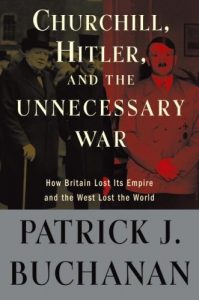
I was quite surprised to discover a work very different from what I had expected. I had never paid much attention to twentieth century American history and my knowledge of European history in that same era was only slightly better, so my views were then mostly rather conventional, having been shaped by my History 101 courses and what I’d picked up in decades of reading my various newspapers and magazines. But within that framework, Buchanan’s history seemed to fit quite comfortably.
The first part of his volume provided what I had always considered the standard view of the First World War. In his account of events, Buchanan explained how the complex network of interlocking alliances had led to a giant conflagration even though none of the existing leaders had actually sought that outcome: a huge European powder-keg had been ignited by the spark of an assassination in Sarajevo.
But although his narrative was what I expected, he provided a wealth of interesting details previously unknown to me. Among other things, he persuasively argued that the German war-guilt was somewhat less than that of most of the other participants, also noting that despite the endless propaganda of “Prussian militarism,” Germany had not fought a major war in 43 years, an unbroken record of peace considerably better than that of most of its adversaries. Moreover, a secret military agreement between Britain and France had been a crucial factor in the unintended escalation, and even so, nearly half the British Cabinet had come close to resigning in opposition to the declaration of war against Germany, a possibility that which would have probably led to a short and limited conflict confined to the Continent. I’d also seldom seen emphasized that Japan had been a crucial British ally, and that the Germans probably would have won the war if Japan had fought on the other side.
However, the bulk of the book focused on the events leading up to the Second World War, and this was the portion that had inspired such horror in McConnell and his colleagues. Buchanan described the outrageous provisions of the Treaty of Versailles imposed upon a prostrate Germany, and the determination of all subsequent German leaders to redress it. But whereas his democratic Weimar predecessors had failed, Hitler had managed to succeed, largely through bluff, while also annexing German Austria and the German Sudetenland of Czechoslovakia, in both cases with the overwhelming support of their populations.
Buchanan documented this controversial thesis by drawing heavily upon numerous statements by leading contemporary political figures, mostly British, as well as the conclusions of highly-respected mainstream historians. Hitler’s final demand, that 95% German Danzig be returned to Germany just as its inhabitants desired, was an absolutely reasonable one, and only a dreadful diplomatic blunder by the British had led the Poles to refuse the request, thereby provoking the war. The widespread later claim that Hitler sought to conquer the world was totally absurd, and the German leader had actually made every effort to avoid war with Britain or France. Indeed, he was generally quite friendly towards the Poles and had been hoping to enlist Poland as a German ally against the menace of Stalin’s Soviet Union.
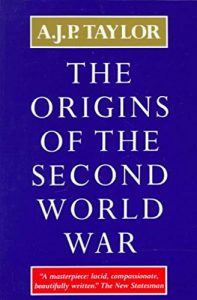
Although many Americans might have been shocked at this account of the events leading up to the outbreak of the Second World War, Buchanan’s narrative accorded reasonably well with my own impression of that period. As a Harvard freshman, I had taken an introductory history course, and one of the primary required texts on World War II had been that of A.J.P. Taylor, a renowned Oxford University historian. His famous 1961 work Origins of the Second World War had very persuasively laid out a case quite similar to that of Buchanan, and I’d never found any reason to question the judgment of my professors who had assigned it. So if Buchanan merely seemed to be seconding the opinions of a leading Oxford don and members of the Harvard history faculty, I couldn’t quite understand why his new book would be regarded as being beyond the pale.
Admittedly, Buchanan also included a very harsh critique of Winston Churchill, cataloging a long list of his supposedly disastrous policies and political reversals, and assigning him a good share of the blame for Britain’s involvement in both world wars, fateful decisions that consequently led to the collapse of the British Empire. But although my knowledge of Churchill was far too scanty to render a verdict, the case he made for the prosecution seemed reasonably strong. The Neocons already hated Buchanan and since they notoriously worshiped Churchill as a cartoon super-hero, any firestorm of criticism from those quarters would hardly be surprising. But the book overall seemed a very solid and interesting history, the best work by Buchanan that I had ever read, and I gently gave my favorable assessment to McConnell, who was obviously rather disappointed. Not long afterward, he decided to relinquish his role as TAC editor to Kara Hopkins, his longtime deputy, and the wave of vilification he had recently endured from many of his erstwhile Buchananite allies surely must have contributed to this.
Although my knowledge of the history of the Second World War was quite rudimentary back in 2008, over the decade that followed I embarked upon a great deal of reading in the history of that momentous era, and my preliminary judgment in the correctness of Buchanan’s thesis seemed strongly vindicated.
The recent 70th anniversary of the outbreak of the conflict that consumed so many tens of millions of lives naturally provoked numerous historical articles, and the resulting discussion led me to dig out my old copy of Taylor’s short volume, which I reread for the first time in nearly forty years. I found it just as masterful and persuasive as I had back in my college dorm room days, and the glowing cover-blurbs suggested some of the immediate acclaim the work had received. The Washington Post lauded the author as “Britain’s most prominent living historian,” World Politics called it “Powerfully argued, brilliantly written, and always persuasive,” The New Statesman, Britain leading leftist magazine, described it as “A masterpiece: lucid, compassionate, beautifully written,” and the august Times Literary Supplement characterized it as “simple, devastating, superlatively readable, and deeply disturbing.” As an international best-seller, it still surely ranks as Taylor’s most famous book, and I can easily understand why it was still on my college required reading list nearly two decades after its original publication.
Yet in revisiting Taylor’s ground-breaking study, I made a remarkable discovery. Despite all the international sales and critical acclaim, the book’s findings soon aroused tremendous hostility in certain quarters. Taylor’s lectures at Oxford had been enormously popular for a quarter century, but as a direct result of the controversy “Britain’s most prominent living historian” was summarily purged from the faculty not long afterwards. At the beginning of his first chapter, Taylor had noted how strange he found it that more than twenty years after the start of the world’s most cataclysmic war no serious history had been produced carefully analyzing the outbreak. Perhaps the retaliation that he encountered led him to better understand part of that puzzle.
Taylor was hardly alone in suffering such retribution. Indeed, as I have gradually discovered over the last decade or so, his fate seems to have been an exceptionally mild one, with his great existing stature partially insulting him from the backlash following his objective analysis of the historical facts. And such extremely serious professional consequences were especially common on our side of the Atlantic, where many of the victims lost their long-held media or academic positions, and permanently vanished from public view during the years surrounding World War II.
I had spent much of the 2000s producing a massive digitized archive containing the full contents of hundreds of America’s most influential periodicals from the last two centuries, a collection totaling many millions of articles. And during this process, I was repeatedly surprised to come across individuals whose enormous presence clearly marked them as among the leading public intellectuals of their day, but who had later disappeared so completely that I had scarcely ever been aware of their existence. I gradually began to recognize that our own history had been marked by an ideological Great Purge just as significant if less sanguinary than its Soviet counterpart. The parallels seemed eerie:
I sometimes imagined myself a little like an earnest young Soviet researcher of the 1970s who began digging into the musty files of long-forgotten Kremlin archives and made some stunning discoveries. Trotsky was apparently not the notorious Nazi spy and traitor portrayed in all the textbooks, but instead had been the right-hand man of the sainted Lenin himself during the glorious days of the great Bolshevik Revolution, and for some years afterward had remained in the topmost ranks of the Party elite. And who were these other figures—Zinoviev, Kamenev, Bukharin, Rykov—who also spent those early years at the very top of the Communist hierarchy? In history courses, they had barely rated a few mentions, as minor Capitalist agents who were quickly unmasked and paid for their treachery with their lives. How could the great Lenin, father of the Revolution, have been such an idiot to have surrounded himself almost exclusively with traitors and spies?
But unlike their Stalinist analogs from a couple of years earlier, the American victims who disappeared around 1940 were neither shot nor Gulaged, but merely excluded from the mainstream media that defines our reality, thereby being blotted out from our memory so that future generations gradually forgot that they had ever lived.
A leading example of such a “disappeared” American was journalist John T. Flynn, probably almost unknown today but whose stature had once been enormous. As I wrote last year:
So imagine my surprise at discovering that throughout the 1930s he had been one of the single most influential liberal voices in American society, a writer on economics and politics whose status may have roughly approximated that of Paul Krugman, though with a strong muck-raking tinge. His weekly column in The New Republic allowed him to serve as a lodestar for America’s progressive elites, while his regular appearances in Colliers, an illustrated mass circulation weekly reaching many millions of Americans, provided him a platform comparable to that of an major television personality in the later heyday of network TV.
To some extent, Flynn’s prominence may be objectively quantified. A few years ago, I happened to mention his name to a well-read and committed liberal born in the 1930s, and she unsurprisingly drew a complete blank, but wondered if he might have been a little like Walter Lippmann, the very famous columnist of that era. When I checked, I saw that across the hundreds of periodicals in my archiving system, there were just 23 articles by Lippmann from the 1930s but fully 489 by Flynn.
An even stronger American parallel to Taylor was that of historian Harry Elmer Barnes, a figure almost unknown to me, but in his day an academic of great influence and stature:
Imagine my shock at later discovering that Barnes had actually been one of the most frequent early contributors to Foreign Affairs, serving as a primary book reviewer for that venerable publication from its 1922 founding onward, while his stature as one of America’s premier liberal academics was indicated by his scores of appearances in The Nation and The New Republic throughout that decade. Indeed, he is credited with having played a central role in “revising” the history of the First World War so as to remove the cartoonish picture of unspeakable German wickedness left behind as a legacy of the dishonest wartime propaganda produced by the opposing British and American governments. And his professional stature was demonstrated by his thirty-five or more books, many of them influential academic volumes, along with his numerous articles in The American Historical Review, Political Science Quarterly, and other leading journals.
A few years ago I happened to mention Barnes to an eminent American academic scholar whose general focus in political science and foreign policy was quite similar, and yet the name meant nothing. By the end of the 1930s, Barnes had become a leading critic of America’s proposed involvement in World War II, and was permanently “disappeared” as a consequence, barred from all mainstream media outlets, while a major newspaper chain was heavily pressured into abruptly terminating his long-running syndicated national column in May 1940.
Many of Barnes’ friends and allies fell in the same ideological purge, which he described in his own writings and which continued after the end of the war:
Over a dozen years after his disappearance from our national media, Barnes managed to publish Perpetual War for Perpetual Peace, a lengthy collection of essays by scholars and other experts discussing the circumstances surrounding America’s entrance into World War II, and have it produced and distributed by a small printer in Idaho. His own contribution was a 30,000 word essay entitled “Revisionism and the Historical Blackout” and discussed the tremendous obstacles faced by the dissident thinkers of that period.
The book itself was dedicated to the memory of his friend, historian Charles A. Beard. Since the early years of the 20th century, Beard had ranked as an intellectual figure of the greatest stature and influence, co-founder of The New School in New York and serving terms as president of both The American Historical Association and The American Political Science Association. As a leading supporter of the New Deal economic policies, he was overwhelmingly lauded for his views.
Yet once he turned against Roosevelt’s bellicose foreign policy, publishers shut their doors to him, and only his personal friendship with the head of the Yale University Press allowed his critical 1948 volume President Roosevelt and the Coming of the War, 1941 to even appear in print. Beard’s stellar reputation seems to have begun a rapid decline from that point onward, so that by 1968 historian Richard Hofstadter could write: “Today Beard’s reputation stands like an imposing ruin in the landscape of American historiography. What was once the grandest house in the province is now a ravaged survival”. Indeed, Beard’s once-dominant “economic interpretation of history” might these days almost be dismissed as promoting “dangerous conspiracy theories,” and I suspect few non-historians have even heard of him.
Another major contributor to the Barnes volume was William Henry Chamberlin, who for decades had been ranked among America’s leading foreign policy journalists, with more than 15 books to his credit, most of them widely and favorably reviewed. Yet America’s Second Crusade, his critical 1950 analysis of America’s entry into World War II, failed to find a mainstream publisher, and when it did appear was widely ignored by reviewers. Prior to its publication, his byline had regularly run in our most influential national magazines such as The Atlantic Monthly and Harpers. But afterward, his writing was almost entirely confined to small circulation newsletters and periodicals, appealing to narrow conservative or libertarian audiences.
In these days of the Internet, anyone can easily establish a website to publish his views, thus making them immediately available to everyone in the world. Social media outlets such as Facebook and Twitter can bring interesting or controversial material to the attention of millions with just a couple of mouse-clicks, completely bypassing the need for the support of establishmentarian intermediaries. It is easy for us to forget just how extremely challenging the dissemination of dissenting ideas remained back in the days of print, paper, and ink, and recognize that an individual purged from his regular outlet might require many years to regain any significant foothold for the distribution of his work.
Ron Unz • June 11, 2018 • 5,400 Words
British writers had faced similar ideological perils year before A.J.P. Taylor ventured into those troubled waters, as a distinguished British naval historian discovered in 1953:
The author of Unconditional Hatred was Captain Russell Grenfell, a British naval officer who had served with distinction in the First World War, and later helped direct the Royal Navy Staff College, while publishing six highly-regarded books on naval strategy and serving as the Naval Correspondent of the Daily Telegraph. Grenfell recognized that great quantities of extreme propaganda almost inevitably accompany any major war, but with several years having passed since the close of hostilities, he was growing concerned that unless an antidote were soon widely applied, the lingering poison of such wartime exaggerations might threaten the future peace of Europe.
His considerable historical erudition and his reserved academic tone shine through in this fascinating volume, which focuses primarily upon the events of the two world wars, but often contains digressions into the Napoleonic conflicts or even earlier ones. One of the intriguing aspects of his discussion is that much of the anti-German propaganda he seeks to debunk would today be considered so absurd and ridiculous it has been almost entirely forgotten, while much of the extremely hostile picture we currently have of Hitler’s Germany receives almost no mention whatsoever, possibly because it had not yet been established or was then still considered too outlandish for anyone to take seriously. Among other matters, he reports with considerable disapproval that leading British newspapers had carried headlined articles about the horrific tortures that were being inflicted upon German prisoners at war crimes trials in order to coerce all sorts of dubious confessions out of them.
Some of Grenfell’s casual claims do raise doubts about various aspects of our conventional picture of German occupation policies. He notes numerous stories in the British press of former French “slave-laborers” who later organized friendly post-war reunions with their erstwhile German employers. He also states that in 1940 those same British papers had reported the absolutely exemplary behavior of German soldiers toward French civilians, though after terroristic attacks by Communist underground forces provoked reprisals, relations often grew much worse.
Most importantly, he points out that the huge Allied strategic bombing campaign against French cities and industry had killed huge numbers of civilians, probably far more than had ever died at German hands, and thereby provoked a great deal of hatred as an inevitable consequence. At Normandy he and other British officers had been warned to remain very cautious among any French civilians they encountered for fear they might be subject to deadly attacks.
Although Grenfell’s content and tone strike me as exceptionally even-handed and objective, others surely viewed his text in a very different light. The Devin-Adair jacket-flap notes that no British publisher was willing to accept the manuscript, and when the book appeared no major American reviewer recognized its existence. Even more ominously, Grenfell is described as having been hard at work on a sequel when he suddenly died in 1954 of unknown causes, and his lengthy obituary in the London Times gives his age as 62.
Another top contemporary observer from that era provides a portrayal of France during World War II that is diametrically opposed to that of today’s widely-accepted narrative:
On French matters, Grenfell provides several extended references to a 1952 book entitled France: The Tragic Years, 1939-1947 by Sisley Huddleston, an author totally unfamiliar to me, and this whet my curiosity. One helpful use of my content-archiving system is to easily provide the proper context for long-forgotten writers, and Huddleston’s scores of appearances in The Atlantic Monthly, The Nation, and The New Republic, plus his thirty well-regarded books on France, seem to confirm that he spent decades as one of the leading interpreters of France to educated American and British readers. Indeed, his exclusive interview with British Prime Minister Lloyd George at the Paris Peace Conference became an international scoop. As with so many other writers, after World War II his American publisher necessarily became Devin-Adair, which released a posthumous 1955 edition of his book. Given his eminent journalistic credentials, Huddleston’s work on the Vichy period was reviewed in American periodicals, although in rather cursory and dismissive fashion, and I ordered a copy and read it.
I cannot attest to the correctness of Huddleston’s 350 page account of France during the war years and immediately after, but as a very distinguished journalist and longtime observer who was an eyewitness to the events he describes, writing at a time when the official historical narrative had not yet hardened into concrete, I do think that his views should be taken quite seriously. Huddleston’s personal circle certainly extended quite high, with former U.S. Ambassador William Bullitt being one of his oldest friends. And without doubt Huddleston’s presentation is radically different from the conventional story I had always heard.
As Huddleston describes things, the French army collapsed in May of 1940, and the government desperately recalled Petain, then in his mid-80s and the country’s greatest war hero, from his posting as the Ambassador to Spain. Soon he was asked by the French President to form a new government and arrange an armistice with the victorious Germans, and this proposal received near-unanimous support from France’s National Assembly and Senate, including the backing of virtually all the leftist parliamentarians. Petain achieved this result, and another near-unanimous vote of the French parliament then authorized him to negotiate a full peace treaty with Germany, which certainly placed his political actions on the strongest possible legal basis. At that point, almost everyone in Europe believed that the war was essentially over, with Britain soon to make peace.
While Petain’s fully-legitimate French government was negotiating with Germany, a small number of diehards, including Col. Charles de Gaulle, deserted from the army and fled aboard, declaring that they intended to continue the war indefinitely, but they initially attracted minimal support or attention. One interesting aspect of the situation was that De Gaulle had long been one of Petain’s leading proteges, and once his political profile began rising a couple of years later, there were often quiet speculations that he and his old mentor had arranged a “division of labor,” with the one making an official peace with the Germans while the other left to become the center of overseas resistance in the uncertain event that different opportunities arose.
Although Petain’s new French government guaranteed that its powerful navy would never be used against the British, Churchill took no chances, and quickly launched an attack on the fleet of its erstwhile ally, whose ships were already disarmed and helplessly moored in port, sinking most of them, and killing up to 2,000 Frenchmen in the process. This incident was not entirely dissimilar to the Japanese attack on Pearl Harbor the following year, and rankled the French for many years to come.
Huddleston then spends much of the book discussing the complex French politics of the next few years, as the war unexpectedly continued, with Russia and America eventually joining the Allied cause, greatly raising the odds against a German victory. During this period, the French political and military leadership performed a difficult balancing act, resisting German demands on some points and acquiescing to them on others, while the internal Resistance movement gradually grew, attacking German soldiers and provoking harsh German reprisals. Given my lack of expertise, I cannot really judge the accuracy of his political narrative, but it seems quite realistic and plausible to me, though specialists might surely find fault.
However, the most remarkable claims in Huddleston’s book come towards the end, as he describes what eventually became known as “the Liberation of France” during 1944-45 when the retreating German forces abandoned the country and pulled back to their own borders. Among other things, he suggests that the number of Frenchmen claiming “Resistance” credentials grew as much as a hundred-fold once the Germans had left and there was no longer any risk in adopting that position.
And at that point, enormous bloodshed soon began, by far the worst wave of extra-judicial killings in all of French history. Most historians agree that around 20,000 lives were lost in the notorious “Reign of Terror” during the French Revolution and perhaps 18,000 died during the Paris Commune of 1870-71 and its brutal suppression. But according to Huddleston the American leaders estimated there were at least 80,000 “summary executions” in just the first few months after Liberation, while the Socialist Deputy who served as Interior Minister in March 1945 and would have been in the best position to know, informed De Gaulle’s representatives that 105,000 killings had taken place just from August 1944 to March 1945, a figure that was widely quoted in public circles at the time.
Since a large fraction of the entire French population had spent years behaving in ways that now suddenly might be considered “collaborationist,” enormous numbers of people were vulnerable, even at risk of death, and they sometimes sought to save their own lives by denouncing their acquaintances or neighbors. Underground Communists had long been a major element of the Resistance, and many of them eagerly retaliated against their hated “class enemies,” while numerous individuals took the opportunity to settle private scores. Another factor was that many of the Communists who had fought in the Spanish Civil War, including thousands of the members of the International Brigades, had fled to France after their military defeat in 1938, and now often took the lead in enacting vengeance against the same sort of conservative forces who had previously vanquished them in their own country.
Although Huddleston himself was an elderly, quite distinguished international journalist with very highly placed American friends, and he had performed some minor services on behalf of the Resistance leadership, he and his wife narrowly escaped summary execution during that period, and he provides a collection of the numerous stories he heard of less fortunate victims. But what appears to have been by far the worst sectarian bloodshed in French history has been soothingly rechristened “the Liberation” and almost entirely removed from our historical memory, except for the famously shaved heads of a few disgraced women. These days Wikipedia constitutes the congealed distillation of our Official Truth, and its entry on those events puts the death toll at barely one-tenth the figures quoted by Huddleston, but I find him a far more credible source.
We may easily imagine that some prominent and highly-regarded individual at the peak of his career and public influence might suddenly take leave of his senses and begin promoting eccentric and erroneous theories, thereby ensuring his downfall. Under such circumstances, his claims may be treated with great skepticism and perhaps simply disregarded.
But when the number of such very reputable yet contrary voices becomes sufficiently large and the claims they make seem generally consistent with each other, we can no longer casually dismiss their critiques. Their committed stance on these controversial matters had proved fatal to their continued public standing, and although they must have recognized these likely consequences, they nonetheless followed that path, even going to the trouble of writing lengthy books presenting their views, and seeking out some publisher somewhere who was willing to release these.
John T. Flynn, Harry Elmer Barnes, Charles Beard, William Henry Chamberlin, Russell Grenfell, Sisley Huddleston, and numerous other scholars and journalists of the highest caliber and reputation all told a rather consistent story of the Second World War but one at total variance with that of today’s established narrative, and they did so at the cost of destroying their careers. A decade or two later, renowned historian A.J.P. Taylor reaffirmed this same basic narrative, and was purged from Oxford as a consequence. I find it very difficult to explain the behavior of all these individuals unless they were presenting a truthful account.
If a ruling political establishment and its media organs offer lavish rewards of funding, promotion, and public acclaim to those who endorse its party-line propaganda while casting into outer darkness those who dissent, the pronouncements of the former should be viewed with considerable suspicion. Barnes popularized the phrase “court historians” to describe these disingenuous and opportunistic individuals who follow the prevailing political winds, and our present-day media outlets are certainly replete with such types.
A climate of serious intellectual repression greatly complicates our ability to uncover the events of the past. Under normal circumstances, competing claims can be weighed in the give-and-take of public or scholarly debate, but this obviously becomes impossible if the subjects being discussed are forbidden ones. Moreover, writers of history are human beings, and if they have been purged from their prestigious positions, blacklisted from public venues, and even cast into poverty, we should hardly be surprised if they sometimes grow angry and bitter at their fate, perhaps reacting in ways that their enemies may later use to attack their credibility.
A.J.P. Taylor lost his Oxford post for publishing his honest analysis of the origins of World War II, but his enormous previous stature and the widespread acclaim his book had received seemed to protect him from further damage, and the work itself soon became recognized as a great classic, remaining permanently in print and later gracing the required reading lists of our most elite universities. However, others who delved into those same troubled waters were much less fortunate.
The same year that Taylor’s book appeared so did a work covering much the same ground by a fledgling scholar named David L. Hoggan. Hoggan had earned his 1948 Ph.D. in diplomatic history at Harvard under Prof. William Langer, one of the towering figures in that field, and his maiden work The Forced War was a direct outgrowth of his doctoral dissertation. While Taylor’s book was fairly short and mostly based upon public sources and some British documents, Hoggan’s volume was exceptionally long and detailed, running nearly 350,000 words including references, and drew upon his many years of painstaking research in the newly available governmental archives of Poland and Germany. Although the two historians were fully in accord that Hitler had certainly not intended the outbreak of World War II, Hoggan argued that various powerful individuals within the British government had deliberately worked to provoke the conflict, thereby forcing the war upon Hitler’s Germany just as his title suggested.
Given the highly controversial nature of Hoggan’s conclusions and his lack of previous scholarly accomplishments, his huge work only appeared in a German edition, where it quickly became a hotly-debated bestseller in that language. As a junior academic, Hoggan was quite vulnerable to the enormous pressure and opprobrium he surely must have faced. He seems to have quarreled with Barnes, his revisionist mentor, while his hopes of arranging an English language edition via a small American publisher soon dissipated. Perhaps as a consequence, the embattled young scholar later suffered a series of nervous breakdowns, and by the end of the 1960s he had resigned his position at San Francisco State College, the last serious academic position he was ever to hold. He subsequently earned his living as a research fellow at a small libertarian thinktank, and after it folded taught at a local junior college, hardly the expected professional trajectory of someone who had begun with such auspicious Harvard credentials.
In 1984 an English version of his major work was finally about to be released when the facilities of its small revisionist publisher in the Los Angeles area were fire-bombed and totally destroyed by Jewish militants, thus obliterating the plates and all existing stock. Living in total obscurity, Hoggan himself died of a heart-attack in 1988, aged 65, and the following year an English version of his work finally appeared, nearly three decades after originally produced, with the scarce surviving copies today being extremely rare and costly. However, a PDF version lacking all footnotes is available on the Internet, and I have now added Hoggan’s volume to my collection of HTML Books, finally making it conveniently available to a broader audience almost six decades after it was completed.
When Peaceful Revisionism Failed
David L. Hoggan • 1989 • 320,000 Words
I only recently discovered Hoggan’s opus, and found it exceptionally detailed and comprehensive, though rather dry. I read through the first hundred pages or so, plus a few selections here and there, just a small portion of the 700 pages, but enough to develop a sense of the material.
The short 1989 introduction by the publisher characterizes it as a uniquely comprehensive treatment of the ideological and diplomatic circumstances surrounding the outbreak of the war, and that seems an accurate appraisal, one which may even still hold true today. For example, the first chapter provides a remarkably detailed description of the several conflicting ideological currents of Polish nationalism during the century or so prior to 1939, a very specialized topic that I had never encountered anywhere else nor found of huge interest.
Despite its long suppression, under many circumstances such an exhaustive work based upon many years of archival research might constitute the foundational research for subsequent historians, and indeed various recent revisionist authors have relied upon Hoggan in exactly that manner. But unfortunately there are some serious concerns. Just as we might expect, the overwhelming majority of the discussion of Hoggan found on the Internet is hostile and insulting, and for obvious reasons this might normally be dismissed. However, Gary North, himself a prominent revisionist who personally knew Hoggan, has been equally critical, portraying him as biased, factually unreliable, and even dishonest.
My own sense is that the overwhelming majority of Hoggan’s material is likely correct and accurate, though we might dispute his interpretations. However, given such serious accusations, we should probably treat all his claims with some caution, especially since it would take considerable archival investigation to verify most of his specific research findings. Indeed, since so much of Hoggan’s overall framework of events matches that of Taylor, I think we are far better off generally relying upon the latter.
Fortunately, these same concerns about accuracy can be entirely dismissed in the case of a far more important writer, and one whose voluminous output easily eclipses that of Hoggan or almost any other historian of World War II. As I described David Irving last year:
With many millions of his books in print, including a string of best-sellers translated into numerous languages, it’s quite possible that the eighty-year-old Irving today ranks as the most internationally-successful British historian of the last one hundred years. Although I myself have merely read a couple of his shorter works, I found these absolutely outstanding, with Irving regularly deploying his remarkable command of the primary source documentary evidence to totally demolish my naive History 101 understanding of major historical events. It would hardly surprise me if the huge corpus of his writings eventually constitutes a central pillar upon which future historians seek to comprehend the catastrophically bloody middle years of our hugely destructive twentieth century even after most of our other chroniclers of that era are long forgotten.
When confronted with astonishing claims that completely overturn an established historical narrative, considerable skepticism is warranted, and my own lack of specialized expertise in World War II history left me especially cautious. The documents Irving unearths seemingly portray a Winston Churchill so radically different from that of my naive understanding as to be almost unrecognizable, and this naturally raised the question of whether I could credit the accuracy of Irving’s evidence and his interpretation. All his material is massively footnoted, referencing copious documents in numerous official archives, but how could I possibly muster the time or energy to verify them?
Rather ironically, an extremely unfortunate turn of events seems to have fully resolved that crucial question.
Irving is an individual of uncommonly strong scholarly integrity, and as such he is unable to see things in the record that do not exist, even if it were in his considerable interest to do so, nor to fabricate non-existent evidence. Therefore, his unwillingness to dissemble or pay lip-service to various widely-worshiped cultural totems eventually provoked an outpouring of vilification by a swarm of ideological fanatics drawn from a particular ethnic persuasion. This situation was rather similar to the troubles my old Harvard professor E.O. Wilson had experienced around that same time upon publication of his own masterwork Sociobiology: The New Synthesis, the book that helped launch the field of modern human evolutionary psychobiology.
These zealous ethnic-activists began a coordinated campaign to pressure Irving’s prestigious publishers into dropping his books, while also disrupting his frequent international speaking tours and even lobbying countries to bar him from entry. They also maintained a drumbeat of media vilification, continually blackening his name and his research skills, even going so far as to denounce him as a “Nazi” and a “Hitler-lover,” just as had similarly been done in the case of Prof. Wilson.
During the 1980s and 1990s, these determined efforts, sometimes backed by considerable physical violence, increasingly bore fruit, and Irving’s career was severely impacted. He had once been feted by the world’s leading publishing houses and his books serialized and reviewed in Britain’s most august newspapers; now he gradually became a marginalized figure, almost a pariah, with enormous damage to his sources of income.
In 1993, Deborah Lipstadt, a rather ignorant and fanatic professor of Theology and Holocaust Studies (or perhaps “Holocaust Theology”) ferociously attacked him in her book as being a “Holocaust Denier,” leading Irving’s timorous publisher to suddenly cancel the contract for his major new historical volume. This development eventually sparked a rancorous lawsuit in 1998, which resulted in a celebrated 2000 libel trial held in British Court.
That legal battle was certainly a David-and-Goliath affair, with wealthy Jewish movie producers and corporate executives providing a huge war-chest of $13 million to Lipstadt’s side, allowing her to fund a veritable army of 40 researchers and legal experts, captained by one of Britain’s most successful Jewish divorce lawyers. By contrast, Irving, being an impecunious historian, was forced to defend himself without benefit of legal counsel.
In real life unlike in fable, the Goliaths of this world are almost invariably triumphant, and this case was no exception, with Irving being driven into personal bankruptcy, resulting in the loss of his fine central London home. But seen from the longer perspective of history, I think the victory of his tormenters was a remarkably Pyrrhic one.
Although the target of their unleashed hatred was Irving’s alleged “Holocaust denial,” as near as I can tell, that particular topic was almost entirely absent from all of Irving’s dozens of books, and exactly that very silence was what had provoked their spittle-flecked outrage. Therefore, lacking such a clear target, their lavishly-funded corps of researchers and fact-checkers instead spent a year or more apparently performing a line-by-line and footnote-by-footnote review of everything Irving had ever published, seeking to locate every single historical error that could possibly cast him in a bad professional light. With almost limitless money and manpower, they even utilized the process of legal discovery to subpoena and read the thousands of pages in his bound personal diaries and correspondence, thereby hoping to find some evidence of his “wicked thoughts.” Denial, a 2016 Hollywood film co-written by Lipstadt, may provide a reasonable outline of the sequence of events as seen from her perspective.
Yet despite such massive financial and human resources, they apparently came up almost entirely empty, at least if Lipstadt’s triumphalist 2005 book History on Trial may be credited. Across four decades of research and writing, which had produced numerous controversial historical claims of the most astonishing nature, they only managed to find a couple of dozen rather minor alleged errors of fact or interpretation, most of these ambiguous or disputed. And the worst they discovered after reading every page of the many linear meters of Irving’s personal diaries was that he had once composed a short “racially insensitive” ditty for his infant daughter, a trivial item which they naturally then trumpeted as proof that he was a “racist.” Thus, they seemingly admitted that Irving’s enormous corpus of historical texts was perhaps 99.9% accurate.
I think this silence of “the dog that didn’t bark” echoes with thunderclap volume. I’m not aware of any other academic scholar in the entire history of the world who has had all his decades of lifetime work subjected to such painstakingly exhaustive hostile scrutiny. And since Irving apparently passed that test with such flying colors, I think we can regard almost every astonishing claim in all of his books—as recapitulated in his videos—as absolutely accurate.
Ron Unz • June 4, 2018 • 1,700 Words
A few years ago I had read two of Irving’s shorter works, Nuremberg: The Last Battle and The War Path, the latter discussing the events leading to the outbreak of the conflict and therefore mostly overlapping with Taylor’s history. Irving’s analysis seems quite similar to that of his eminent Oxford predecessor, while providing a wealth of meticulous documentary evidence to support that simple story first outlined two decades earlier. This concurrence hardly surprised me since multiple efforts to accurately describe the same historical reality are likely to be reasonably congruent, whereas dishonest propaganda may widely diverge in all sorts of different directions.
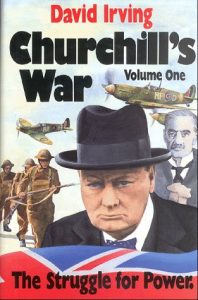
I recently decided to tackle one of Irving’s much longer works, the first volume of Churchill’s War, a classic text that runs some 300,000 words and covers the story of the legendary British prime minister to the eve of Barbarossa, and I found it just as outstanding as I had expected.
As one small indicator of Irving’s candor and knowledge, he repeatedly if briefly refers to the 1940 Allied plans to suddenly attack the USSR and destroy its Baku oilfields, an utterly disastrous proposal that surely would have lost the war if actually carried out. By contrast, the exceptionally embarrassing facts of Operation Pike have been totally excluded from virtually all later Western accounts of the conflict, leaving one to wonder which of our numerous professional historians are merely ignorant and which are guilty of lying by omission.
Until recently, my familiarity with Churchill had been rather cursory, and Irving’s revelations were absolutely eye-opening. Perhaps the most striking single discovery was the remarkable venality and corruption of the man, with Churchill being a huge spendthrift who lived lavishly and often far beyond his financial means, employing an army of dozens of personal servants at his large country estate despite frequently lacking any regular and assured sources of income to maintain them. This predicament naturally put him at the mercy of those individuals willing to support his sumptuous lifestyle in exchange for determining his political activities. And somewhat similar pecuniary means were used to secure the support of a network of other political figures from across all the British parties, who became Churchill’s close political allies.
To put things in plain language, during the years leading up to the Second World War, both Churchill and numerous other fellow British MPs were regularly receiving sizable financial stipends—cash bribes—from Jewish and Czech sources in exchange for promoting a policy of extreme hostility toward the German government and actually advocating war. The sums involved were quite considerable, with the Czech government alone probably making payments that amounted to tens of millions in present-day dollars to British elected officials, publishers, and journalists working to overturn the official peace policy of their existing government. A particularly notable instance occurred in early 1938 when Churchill suddenly lost all his accumulated wealth in a foolish gamble on the American stock-market, and was soon forced to put his beloved country estate up for sale to avoid personal bankruptcy, only to quickly be bailed out by a foreign Jewish millionaire intent upon promoting a war against Germany. Indeed, the early stages of Churchill’s involvement in this sordid behavior are recounted in an Irving chapter aptly entitled “The Hired Help.”
Ironically enough, German Intelligence learned of this massive bribery of British parliamentarians, and passed the information along to Prime Minister Neville Chamberlain, who was horrified to discover the corrupt motives of his fierce political opponents, but apparently remained too much of a gentlemen to have them arrested and prosecuted. I’m no expert in the British laws of that era, but for elected officials to do the bidding of foreigners on matters of war and peace in exchange for huge secret payments seems almost a textbook example of treason to me, and I think that Churchill’s timely execution would surely have saved tens of millions of lives.
My impression is that individuals of low personal character are those most likely to sell out the interests of their own country in exchange for large sums of foreign money, and as such usually constitute the natural targets of nefarious plotters and foreign spies. Churchill certainly seems to fall into this category, with rumors of massive personal corruption swirling around him from early in his political career. Later, he supplemented his income by engaging in widespread art-forgery, a fact that Roosevelt later discovered and probably used as a point of personal leverage against him. Also quite serious was Churchill’s constant state of drunkenness, with his inebriation being so widespread as to constitute clinical alcoholism. Indeed, Irving notes that in his private conversations FDR routinely referred to Churchill as “a drunken bum.”
During the late 1930s, Churchill and his clique of similarly bought-and-paid-for political allies had endlessly attacked and denounced Chamberlain’s government for its peace policy, and he regularly made the wildest sort of unsubstantiated accusations, claiming the Germans were undertaking a huge military build-up aimed against Britain. These roiling charges were often widely echoed by a media heavily influenced by Jewish interests and did much to poison the state of German-British relations. Eventually, these accumulated pressures forced Chamberlain into the extremely unwise act of providing an unconditional guarantee of military backing to Poland’s irresponsible dictatorship. As a result, the Poles then rather arrogantly refused any border negotiations with Germany, thereby lighting the fuse which eventually led to the German invasion six months later and the subsequent British declaration of war. The British media had widely promoted Churchill as the leading pro-war political figure, and once Chamberlain was forced to create a wartime government of national unity, his leading critic was brought into it and given the naval affairs portfolio.
Following his lightening six-week defeat of Poland, Hitler unsuccessfully sought to make peace with the Allies, and the war went into abeyance. Then in early 1940, Churchill persuaded his government to try strategically outflanking the Germans by preparing a large sea-borne invasion of neutral Norway; but Hitler discovered the plan and preempted the attack, with Churchill’s severe operational mistakes leading to a surprising defeat for the vastly superior British forces. During World War I, Churchill’s Gallipoli disaster had forced his resignation from the British Cabinet, but this time the friendly media helped ensure that all the blame for the somewhat similar debacle at Narvik was foisted upon Chamberlain, so it was the latter who was forced to resign, with Churchill then replacing him as prime minister. British naval officers were appalled that the primary architect of their humiliation had become its leading political beneficiary, but reality is what the media reports, and the British public never discovered this great irony.
This incident was merely the first of the long series of Churchill’s major military failures and outright betrayals that are persuasively recounted by Irving, nearly all of which were subsequently airbrushed out of our hagiographic histories of the conflict. We should recognize that wartime leaders who spend much of their time in a state of drunken stupor are far less likely to make optimal decisions, especially if they are as extremely prone to military micro-management as was the case with Churchill.
In the spring of 1940, the Germans launched their sudden armored thrust into France via Belgium, and as the attack began to succeed, Churchill ordered the commanding British general to immediately flee with his forces to the coast and to do so without informing his French or Belgium counterparts of the huge gap he was thereby opening in the Allied front-lines, thus ensuring the encirclement and destruction of their armies. Following France’s resulting defeat and occupation, the British prime minister then ordered a sudden, surprise attack on the disarmed French fleet, completely destroying it and killing some 2,000 of his erstwhile allies; the immediate cause was his mistranslation of a single French word, but this “Pearl Harbor-type” incident continued to rankle French leaders for decades.
Hitler had always wanted friendly relations with Britain and certainly had sought to avoid the war that had been forced upon him. With France now defeated and British forces driven from the Continent, he therefore offered very magnanimous peace terms and a new German alliance to Britain. The British government had been pressured into entering the war for no logical reason and against its own national interests, so Chamberlain and half the Cabinet naturally supported commencing peace negotiations, and the German proposal probably would have received overwhelming approval both from the British public and political elites if they had ever been informed of its terms.
But despite some occasional wavering, Churchill remained absolutely adamant that the war must continue, and Irving plausibly argues that his motive was an intensely personal one. Across his long career, Churchill had had a remarkable record of repeated failure, and for him to have finally achieved his lifelong ambition of becoming prime minister only to lose a major war just weeks after reaching Number 10 Downing Street would have ensured that his permanent place in history was an extremely humiliating one. On the other hand, if he managed to continue the war, perhaps the situation might somehow later improve, especially if the Americans could be persuaded to eventually enter the conflict on the British side.
Since ending the war with Germany was in his nation’s interest but not his own, Churchill undertook ruthless means to prevent peace sentiments from growing so strong that they overwhelmed his opposition. Along with most other major countries, Britain and Germany had signed international conventions prohibiting the aerial bombardment of civilian urban targets, and although the British leader had very much hoped the Germans would attack his cities, Hitler scrupulously followed these provisions. In desperation, Churchill therefore ordered a series of large-scale bombing raids against the German capital of Berlin, doing considerable damage, and after numerous severe warnings, Hitler finally began to retaliate with similar attacks against British cities. The population saw the heavy destruction inflicted by these German bombing raids and was never informed of the British attacks that had preceded and provoked them, so public sentiment greatly hardened against making peace with the seemingly diabolical German adversary.
In his memoirs published a half-century later, Prof. Revilo P. Oliver, who had held a senior wartime role in American Military Intelligence, described this sequence of events in very bitter terms:
Great Britain, in violation of all the ethics of civilized warfare that had theretofore been respected by our race, and in treacherous violation of solemnly assumed diplomatic covenants about “open cities”, had secretly carried out intensive bombing of such open cities in Germany for the express purpose of killing enough unarmed and defenceless men and women to force the German government reluctantly to retaliate and bomb British cities and thus kill enough helpless British men, women, and children to generate among Englishmen enthusiasm for the insane war to which their government had committed them.
It is impossible to imagine a governmental act more vile and more depraved than contriving death and suffering for its own people — for the very citizens whom it was exhorting to “loyalty” — and I suspect that an act of such infamous and savage treason would have nauseated even Genghis Khan or Hulagu or Tamerlane, Oriental barbarians universally reprobated for their insane blood-lust. History, so far as I recall, does not record that they ever butchered their own women and children to facilitate lying propaganda…. In 1944 members of British Military Intelligence took it for granted that after the war Marshal Sir Arthur Harris would be hanged or shot for high treason against the British people…
Churchill’s ruthless violation of the laws of war regarding urban aerial bombardment directly led to the destruction of many of Europe’s finest and most ancient cities. But perhaps influenced by his chronic drunkenness, he later sought to carry out even more horrifying war crimes and was only prevented from doing so by the dogged opposition of all his military and political subordinates.
Along with the laws prohibiting the bombing of cities, all nations had similarly agreed to ban the first use of poison gas, while stockpiling quantities for necessary retaliation. Since Germany was the world-leader in chemistry, the Nazis had produced the most lethal forms of new nerve gases, such as Tabun and Sarin, whose use might have easily resulted in major military victories on both the Eastern and Western fronts, but Hitler had scrupulously obeyed the international protocols that his nation had signed. However, late in the war during 1944 the relentless Allied bombardment of German cities led to the devastating retaliatory attacks of the V-1 flying bombs against London, and an outraged Churchill became adamant that German cities should be attacked with poison gas in counter-retaliation. If Churchill had gotten his way, many millions of British might soon have perished from German nerve gas counter-strikes. Around the same time, Churchill was also blocked in his proposal to bombard Germany with hundreds of thousands of deadly anthrax bombs, an operation that might have rendered much of Central and Western Europe uninhabitable for generations.
I found Irving’s revelations on all these matters absolutely astonishing, and was deeply grateful that Deborah Lipstadt and her army of diligent researchers had carefully investigated and seemingly confirmed the accuracy of virtually every single item.
The two existing volumes of Irving’s Churchill masterwork total well over 700,000 words, and reading them would obviously consume weeks of dedicated effort. Fortunately, Irving is also a riveting speaker and several of his extended lectures on the topic are available for viewing on BitChute after having been recently purged from YouTube.
I very recently reread Pat Buchanan’s 2008 book harshly condemning Churchill for his role in the cataclysmic world war and made an interesting discovery. Irving is surely among the most authoritative Churchill biographers, with his exhaustive documentary research being the source of so many new discoveries and his books selling in the millions. Yet Irving’s name never once appears either in Buchanan’s text or in his bibliography, though we may suspect that much of Irving’s material has been “laundered” through other, secondary Buchanan sources. Buchanan extensively cites A.J.P. Taylor, but makes no mention of Barnes, Flynn, or various other leading American academics and journalists who were purged for expressing contemporaneous views not so dissimilar from those of the author himself.
During the 1990s, Buchanan had ranked as one of America’s most prominent political figures, having an enormous media footprint in both print and television, and with his remarkably strong insurgent runs for the Republican presidential nomination in 1992 and 1996 cementing his national stature. But his numerous ideological foes worked tirelessly to undermine him, and by 2008 his continued presence as a pundit on the MSNBC cable channel was one of his last remaining footholds of major public prominence. He probably recognized that publishing a revisionist history of World War II might endanger his position, and believed that any direct association with purged and vilified figures such as Irving or Barnes would surely lead to his permanent banishment from all electronic media.
A decade ago I had been greatly impressed by Buchanan’s history, but I had subsequently done a great deal of reading on that era and I found myself somewhat disappointed the second time through. Aside from its often breezy, rhetorical, and unscholarly tone, my sharpest criticisms were not with the controversial positions that he took, but with the other controversial topics and questions that he so carefully avoided.
Perhaps the most obvious of these is the question of the true origins of the war, which laid waste to much of Europe, killed perhaps fifty or sixty million, and gave rise to the subsequent Cold War era in which Communist regimes controlled half of the entire Eurasian world-continent. Taylor, Irving, and numerous others have thoroughly debunked the ridiculous mythology that the cause lay in Hitler’s mad desire for world conquest, but if the German dictator clearly bore only minor responsibility, was there indeed any true culprit? Or did this massively-destructive world war come about in somewhat similar fashion to its predecessor, which our conventional histories treat as mostly due to a collection of blunders, misunderstandings, and thoughtless escalations.
During the 1930s, John T. Flynn was one of America’ most influential progressive journalists, and although he had begun as a strong supporter of Roosevelt and his New Deal, he gradually became a sharp critic, concluding that FDR’s various governmental schemes had failed to revive the American economy. Then in 1937 a new economic collapse spiked unemployment back to the same levels as when the president had first entered office, confirming Flynn in his harsh verdict. And as I wrote last year:
Indeed, Flynn alleges that by late 1937, FDR had turned towards an aggressive foreign policy aimed at involving the country in a major foreign war, primarily because he believed that this was the only route out of his desperate economic and political box, a stratagem not unknown among national leaders throughout history. In his January 5, 1938 New Republic column, he alerted his disbelieving readers to the looming prospect of a large naval military build-up and warfare on the horizon after a top Roosevelt adviser had privately boasted to him that a large bout of “military Keysianism” and a major war would cure the country’s seemingly insurmountable economic problems. At that time, war with Japan, possibly over Latin American interests, seemed the intended goal, but developing events in Europe soon persuaded FDR that fomenting a general war against Germany was the best course of action. Memoirs and other historical documents obtained by later researchers seem to generally support Flynn’s accusations by indicating that Roosevelt ordered his diplomats to exert enormous pressure upon both the British and Polish governments to avoid any negotiated settlement with Germany, thereby leading to the outbreak of World War II in 1939.
The last point is an important one since the confidential opinions of those closest to important historical events should be accorded considerable evidentiary weight. In a recent article John Wear mustered the numerous contemporaneous assessments that implicated FDR as a pivotal figure in orchestrating the world war by his constant pressure upon the British political leadership, a policy that he privately even admitted could mean his impeachment if revealed. Among other testimony, we have the statements of the Polish and British ambassadors to Washington and the American ambassador to London, who also passed along the concurring opinion of Prime Minister Chamberlain himself. Indeed, the German capture and publication of secret Polish diplomatic documents in 1939 had already revealed much of this information, and William Henry Chamberlin confirmed their authenticity in his 1950 book. But since the mainstream media never reported any of this information, these facts remain little known even today.
FDR seems to have played the crucial part in orchestrating the outbreak of World War II, greatly assisted by Churchill and his circle in Britain. But during 1939, the growing tensions over Danzig gave Stalin a tremendous strategic opening. Signing a pact with Hitler, the two of them soon jointly invaded Poland, but even as the Soviets seized half the territory, Britain and France declared war only upon Germany. And while Stalin then waited for the other European powers to exhaust each other, he began an offensive military build-up of unprecedented magnitude, soon having far more and better tanks than the rest of the world combined.
As I wrote earlier this year:
These important considerations become particularly relevant when we attempt to understand the circumstances surrounding Operation Barbarossa, Germany’s 1941 attack upon the Soviet Union, which constituted the central turning point of the war. Both at the time and during the half-century which followed, Western historians uniformly claimed that the surprise assault had caught an overly-trusting Stalin completely unaware, with Hitler’s motive being his dream of creating the huge German land-empire that he had hinted at in the pages of Mein Kampf, published sixteen years earlier.
But in 1990 a former Soviet military intelligence officer who had defected to the West and was living in Britain dropped a major bombshell. Writing under the pen-name Viktor Suvorov, he had already published a number of highly-regarded books on the armed forces of the USSR, but in Icebreaker he now claimed that his extensive past research in the Soviet archives had revealed that by 1941 Stalin had amassed enormous offensive military forces and positioned them all along the border, preparing to attack and easily overwhelm the greatly outnumbered and outgunned forces of the Wehrmacht, quickly conquering all of Europe.
Then at almost the last moment, Hitler suddenly realized the strategic trap into which he had fallen, and ordered his heavily outnumbered and outgunned troops into a desperate surprise attack of their own on the assembling Soviets, fortuitously catching them at the very point at which their own final preparations for sudden attack had left them most vulnerable, and thereby snatching a major initial victory from the jaws of certain defeat. Huge stockpiles of Soviet ammunition and weaponry had been positioned close to the border to supply the army of invasion into Germany, and these quickly fell into German hands, providing an important addition to their own woefully inadequate resources.
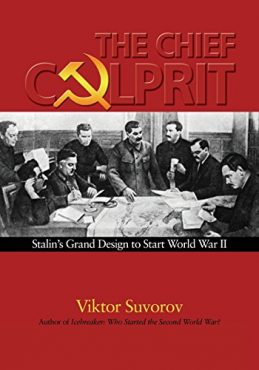
Although almost totally ignored in the English-language world, Suvorov’s seminal book soon became an unprecedented bestseller in Russia, Germany, and many other parts of the world, and together with several follow-up volumes, his five million copies in print established him as the most widely-read military historian in the history of the world. Meanwhile, the English-language media and academic communities scrupulously maintained their complete blackout of the ongoing worldwide debate, with no publishing house even willing to produce an English edition of Suvorov’s books until an editor at the prestigious Naval Academy Press finally broke the embargo nearly two decades later.
Although the primary focus of this discussion has been with regard to the European war, the circumstances of the Pacific conflict also seem to differ greatly from our official history. Japan had been fighting in China since 1937, but this is seldom regarded as the start of the world war. Instead, the December 7th, 1941 attack on Pearl Harbor is usually considered the point at which the war became global.
From 1940 onward, FDR had been making a great political effort to directly involve America in the war against Germany, but public opinion was overwhelmingly on the other side, with polls showing that up to 80% of the population were opposed. All of this immediately changed once the Japanese bombs dropped on Hawaii, and suddenly the country was at war.
Given these facts, there were natural suspicions that Roosevelt had deliberately provoked the attack by his executive decisions to freeze Japanese assets, embargo all shipments of vital fuel oil supplies, and rebuff the repeated requests by Tokyo leaders for negotiations. In the 1953 volume edited by Barnes, noted diplomatic historian Charles Tansill summarized his very strong case that FDR sought to use a Japanese attack as his best “back door to war” against Germany, an argument he had made the previous year in a book of that same name. Over the decades, the information contained in private diaries and government documents seems to have almost conclusively established this interpretation, with Secretary of War Henry Stimson indicating that the plan was to “maneuver [Japan] into firing the first shot.” In his later memoirs, Prof. Oliver drew upon the intimate knowledge he had acquired during his wartime role in Military Intelligence to even claim that FDR had deliberately tricked the Japanese into believing he planned to launch a surprise attack against their forces, thereby persuading them to strike first in self-defense.
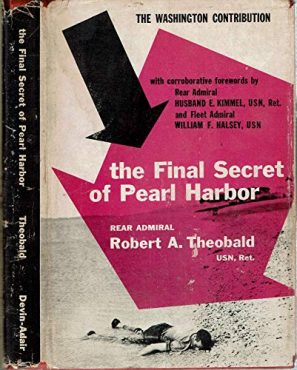
By 1941 the U.S. had broken all the Japanese diplomatic codes and was freely reading their secret communications. Therefore, there has also long existed the widespread if disputed belief that the president was well aware of the planned Japanese attack on our fleet and deliberately failed to warn his local commanders, thereby ensuring that the resulting heavy American losses would produce a vengeful nation united for war. Tansill and a former chief researcher for the Congressional investigating committee made this case in the same 1953 Barnes volume, and the following year a former US admiral published The Final Secret of Pearl Harbor, providing similar arguments at greater length. This book also included an introduction by one of America’s highest-ranking World War II naval commanders, who fully endorsed the controversial theory.
In 2000, journalist Robert M. Stinnett published a wealth of additional supporting evidence, based upon his eight years of archival research, which was discussed in a recent article. A telling point made by Stinnett is that if Washington had warned the Pearl Harbor commanders, their resulting defensive preparations would have been noticed by the local Japanese spies and relayed to the approaching task force; and with the element of surprise lost, the attack probably would have been aborted, thus frustrating all of FDR’s long-standing plans for war. Although various details may be disputed, I find the evidence for Roosevelt’s foreknowledge quite compelling.
Roosevelt’s economic problems had led him to seek a foreign war, but it was probably the overwhelming Jewish hostility to Nazi Germany that pointed him in that particular direction. The confidential report of the Polish ambassador to the U.S. as quoted by John Wear provides a striking description of the political situation in America at the beginning of 1939:
There is a feeling now prevalent in the United States marked by growing hatred of Fascism, and above all of Chancellor Hitler and everything connected with National Socialism. Propaganda is mostly in the hands of the Jews who control almost 100% [of the] radio, film, daily and periodical press. Although this propaganda is extremely coarse and presents Germany as black as possible–above all religious persecution and concentration camps are exploited–this propaganda is nevertheless extremely effective since the public here is completely ignorant and knows nothing of the situation in Europe.
At the present moment most Americans regard Chancellor Hitler and National Socialism as the greatest evil and greatest peril threatening the world. The situation here provides an excellent platform for public speakers of all kinds, for emigrants from Germany and Czechoslovakia who with a great many words and with most various calumnies incite the public. They praise American liberty which they contrast with the totalitarian states.
It is interesting to note that in this extremely well-planned campaign which is conducted above all against National Socialism, Soviet Russia is almost completely eliminated. Soviet Russia, if mentioned at all, is mentioned in a friendly manner and things are presented in such a way that it would seem that the Soviet Union were cooperating with the bloc of democratic states. Thanks to the clever propaganda the sympathies of the American public are completely on the side of Red Spain.
Given the heavy Jewish involvement in financing Churchill and his allies and also steering the American government and public in the direction of war against Germany, organized Jewish groups probably bore the central responsibility for provoking the world war, and this was surely recognized by most knowledgeable individuals at the time. Indeed, the Forrestal Diaries recorded the very telling statement by our ambassador in London: “Chamberlain, he says, stated that America and the Jews had forced England into the war.”
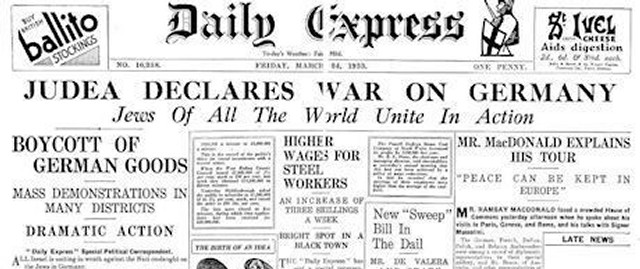
The ongoing struggle between Hitler and international Jewry had been receiving considerable public attention for years. During his political rise, Hitler had hardly concealed his intent to dislodge Germany’s tiny Jewish population from the stranglehold they had gained over German media and finance, and instead run the country in the best interests of the 99% German majority, a proposal that provoked the bitter hostility of Jews everywhere. Indeed, immediately after he came into office, a major London newspaper had carried a memorable 1933 headline announcing that the Jews of the world had declared war on Germany, and were organizing an international boycott to starve the Germans into submission.
In recent years, somewhat similar Jewish-organized efforts at international sanctions aimed at bringing recalcitrant nations to their knees have become a regular part of global politics. But these days the Jewish dominance of the U.S. political system has become so overwhelming that instead of private boycotts, such actions are directly enforced by the American government. To some extent, this had already been the case with Iraq during the 1990s, but became far more common after the turn of the new century.
Although our official government investigation concluded that the total financial cost of the 9/11 terrorist attacks had been an absolutely trivial sum, the Neocon-dominated Bush Administration nonetheless used this as an excuse to establish an important new Treasury Department position, the Under Secretary for Terrorism and Financial Intelligence. That office soon began utilizing America’s control of the global banking system and dollar-denominated international trade to enforce financial sanctions and wage economic warfare, with these measures typically being directed against individuals, organizations, and nations considered unfriendly towards Israel, notably Iran, Hezbollah, and Syria.
Perhaps coincidentally, although Jews comprise merely 2% of the American population, all four individuals holding that very powerful post over the last 15 years since its inception—Stuart A. Levey, David S. Cohen, Adam Szubin, Sigal Mandelker—have been Jewish, with the most recent of these being an Israeli citizen. Levey, the first Under Secretary, began his work under President Bush, then continued without a break for years under President Obama, underscoring the entirely bipartisan nature of these activities.
Most foreign policy experts have certainly been aware that Jewish groups and activists played the central role in driving our country into its disastrous 2003 Iraq War, and that many of these same groups and individuals have spent the last dozen years or so working to foment a similar American attack on Iran, though as yet unsuccessfully. This seems quite reminiscent of the late 1930s political situation in Britain and America.
Individuals outraged by the misleading media coverage surrounding the Iraq War but who have always casually accepted the conventional narrative of World War II should consider a thought-experiment I suggested last year:
When we seek to understand the past, we must be careful to avoid drawing from a narrow selection of sources, especially if one side proved politically victorious in the end and completely dominated the later production of books and other commentary. Prior to the existence of the Internet, this was an especially difficult task, often requiring a considerable amount of scholarly effort, even if only to examine the bound volumes of once popular periodicals. Yet without such diligence, we can fall into very serious error.
The Iraq War and its aftermath was certainly one of the central events in American history during the 2000s. Yet suppose some readers in the distant future had only the collected archives of The Weekly Standard, National Review, the WSJ op-ed page, and FoxNews transcripts to furnish their understanding the history of that period, perhaps along with the books written by the contributors to those outlets. I doubt that more than a small fraction of what they would read could be categorized as outright lies. But the massively skewed coverage, the distortions, exaggerations, and especially the breathtaking omissions would surely provide them with an exceptionally unrealistic view of what had actually happened during that important period.
Another striking historical parallel has the fierce demonization of Russian President Vladimir Putin, who provoked the great hostility of Jewish elements when he ousted the handful of Jewish Oligarchs who had seized control of Russian society under the drunken misrule of President Boris Yeltsin and totally impoverished the bulk of the population. This conflict intensified after Jewish investor William F. Browder arranged Congressional passage of the Magnitsky Act to punish Russian leaders for the legal actions they had taken against his huge financial empire in their country. Putin’s harshest Neocon critics have often condemned him as “a new Hitler” while some neutral observers have agreed that no foreign leader since the German Chancellor of the 1930s has been so fiercely vilified in the American media. Seen from a different angle, there may indeed be a close correspondence between Putin and Hitler, but not in the way usually suggested.
Knowledgeable individuals have certainly been aware of the crucial Jewish role in orchestrating our military or financial attacks against Iraq, Iran, Syria, and Russia, but it has been exceptionally rare for any prominent public figures or reputable journalists to mention these facts lest they be denounced and vilified by zealous Jewish activists and the media they dominate. For example, a couple of years ago a single suggestive Tweet by famed CIA anti-proliferation operative Valerie Plame provoked such an enormous wave of vituperation that she was forced to resign her position at a prominent non-profit. A close parallel involving a far more famous figure had occurred three generations earlier:
These facts, now firmly established by decades of scholarship, provide some necessary context to Lindbergh’s famously controversial speech at an America First rally in September 1941. At that event, he charged that three groups in particular were “pressing this country toward war[:] the British, the Jewish, and the Roosevelt Administration,” and thereby unleashed an enormous firestorm of media attacks and denunciations, including widespread accusations of anti-Semitism and Nazi sympathies. Given the realities of the political situation, Lindbergh’s statement constituted a perfect illustration of Michael Kinsley’s famous quip that “a gaffe is when a politician tells the truth – some obvious truth he isn’t supposed to say.” But as a consequence, Lindbergh’s once-heroic reputation suffered enormous and permanent damage, with the campaign of vilification echoing for the remaining three decades of his life, and even well beyond. Although he was not entirely purged from public life, his standing was certainly never even remotely the same.
With such examples in mind, we should hardly be surprised that for decades this huge Jewish involvement in orchestrating World War II was carefully omitted from nearly all subsequent historical narratives, even those that sharply challenged the mythology of the official account. The index of Taylor’s iconoclastic 1961 work contains absolutely no mention of Jews, and the same is true of the previous books by Chamberlin and Grenfell. In 1953, Harry Elmer Barnes, the dean of historical revisionists, edited his major volume aimed at demolishing the falsehoods of World War II, and once again any discussion of the Jewish role was almost entirely lacking, with only part of one single sentence and Chamberlain’s dangling short quote appearing across more than 200,000 words of text. Both Barnes and many of his contributors had already been purged and their book was only released by a tiny publisher in Idaho, but they still sought to avoid certain unmentionables.
Even the arch-revisionist David Hoggan seems to have carefully skirted the topic of Jewish influence. His 30 page index lacks any entry on Jews and his 700 pages of text contain only scattered references. Indeed, although he does quote the explicit private statements of both the Polish ambassador and the British Prime Minister emphasizing the enormous Jewish role in promoting the war, he then rather questionably asserts that these confidential statements of individuals with the best understanding of events should simply be disregarded.
In the popular Harry Potter series, Lord Voldemort, the great nemesis of the young magicians, is often identified as “He Who Must Not Be Named,” since the mere vocalization of those few particular syllables might bring doom upon the speaker. Jews have long enjoyed enormous power and influence over the media and political life, while fanatic Jewish activists demonstrate hair-trigger eagerness to denounce and vilify all those suspected of being insufficiently friendly towards their ethnic group. The combination of these two factors has therefore induced such a “Lord Voldemort Effect” regarding Jewish activities in most writers and public figures. Once we recognize this reality, we should become very cautious in analyzing controversial historical issues that might possibly contain a Jewish dimension, and also be particularly wary of arguments from silence.
Those writers willing to break this fearsome Jewish Taboo regarding World War II were quite rare, but one notable exception comes to mind. As I recently wrote:
Some years ago, I came across a totally obscure 1951 book entitled The Iron Curtain Over America by John Beaty, a well-regarded university professor. Beaty had spent his wartime years in Military Intelligence, being tasked with preparing the daily briefing reports distributed to all top American officials summarizing available intelligence information acquired during the previous 24 hours, which was obviously a position of considerable responsibility.
As a zealous anti-Communist, he regarded much of America’s Jewish population as deeply implicated in subversive activity, therefore constituting a serious threat to traditional American freedoms. In particular, the growing Jewish stranglehold over publishing and the media was making it increasingly difficult for discordant views to reach the American people, with this regime of censorship constituting the “Iron Curtain” described in his title. He blamed Jewish interests for the totally unnecessary war with Hitler’s Germany, which had long sought good relations with America, but instead had suffered total destruction for its strong opposition to Europe’s Jewish-backed Communist menace.
Then as now, a book taking such controversial positions stood little chance of finding a mainstream New York publisher, but it was soon released by a small Dallas firm, and then became enormously successful, going through some seventeen printings over the next few years. According to Scott McConnell, founding editor of The American Conservative, Beaty’s book became the second most popular conservative text of the 1950s, ranking only behind Russell Kirk’s iconic classic, The Conservative Mind.
Books by unknown authors that are released by tiny publishers rarely sell many copies, but the work came to the attention of George E. Stratemeyer, a retired general who had been one of Douglas MacArthur’s commanders, and he wrote Beaty a letter of endorsement. Beaty began including that letter in his promotional materials, drawing the ire of the ADL, whose national chairman contacted Stratemeyer, demanding that he repudiate the book, which was described as a “primer for lunatic fringe groups” all across America. Instead, Stratemeyer delivered a blistering reply to the ADL, denouncing it for making “veiled threats” against “free expression and thoughts” and trying to establish Soviet-style repression in the United States. He declared that every “loyal citizen” should read The Iron Curtain Over America, whose pages finally revealed the truth about our national predicament, and he began actively promoting the book around the country while attacking the Jewish attempt to silence him. Numerous other top American generals and admirals soon joined Statemeyer in publicly endorsing the work, as did a couple of influential members of the U.S. Senate, leading to its enormous national sales.
In contrast to nearly all the other World War II narratives discussed above, whether orthodox or revisionist, the index of Beaty’s volume is absolutely overflowing with references to Jews and Jewish activities, containing dozens of separate entries and with the topic mentioned on a substantial fraction of all the pages in his fairly short book. I therefore suspect that any casual modern reader who encountered Beaty’s volume would be stunned and dismayed by such extremely pervasive material, and probably dismiss the author as being delusional and “Jew-obsessed;” but I think that Beaty’s treatment is probably the far more honest and realistic one. As I noted last year on a related matter:
… once the historical record has been sufficiently whitewashed or rewritten, any lingering strands of the original reality that survive are often perceived as bizarre delusions or denounced as “conspiracy theories.”
Beaty’s wartime role at the absolute nexus of American Intelligence certainly gave him a great deal of insight into the pattern of events, and the glowing endorsement of his account by many of our highest-ranking military commanders supports that conclusion. More recently, a decade of of archival research by Prof. Joseph Bendersky, a prominent mainstream historian, revealed that Beaty’s views were privately shared by many of our Military Intelligence professionals and top generals of the era, being quite widespread in such circles.
John Beaty • 1951 • 82,000 Words
During the late 1960s, historians once again began focusing upon the central role of Jews in the world war. Indeed, over the last few decades, the bitter conflict between Nazi Germany and world Jewry has become such an overwhelming theme of our popular media that this element may be almost the only aspect of the World War II era that is known to many younger Americans. But the true history is actually far more complex than the simple cartoon that Hitler was bad and he hated the Jews because they were good.
Among other matters, there exists the historical reality of the important Nazi-Zionist economic partnership of the 1930s, which played such a crucial role in establishing the State of Israel. Although these facts are thoroughly documented and even received some major media coverage during the 1980s, notably by the august Times of London, in recent decades the story has been so massively suppressed that a couple of years ago a prominent leftist politician was driven out of the British Labour Party merely for alluding to it. David Irving also uncovered the fascinating detail that the two largest German financial donors to the Nazis during their rise to power were both Jewish bankers, one of them being the country’s most prominent Zionist leader, though the motives involved were not entirely clear.
Another obscured fact is that some 150,000 half- and quarter-Jews served loyally in Hitler’s World War II armies, mostly as combat officers, and these included at least 15 half-Jewish generals and admirals, with another dozen quarter-Jews holding those same high ranks. The most notable example was Field Marshal Erhard Milch, Hermann Goering’s powerful second-in-command, who played such an important operational role in creating the Luftwaffe. Milch certainly had a Jewish father, and according to some much less substantiated claims, perhaps even a Jewish mother as well, while his sister was married to an SS general.
Meanwhile, although our heavily Jewish-dominated media regularly presents Hitler as the most evil man who ever lived, many of his prominent contemporaries seem to have held a very different opinion. As I recently wrote:
By resurrecting a prosperous Germany while nearly all other countries remained mired in the worldwide Great Depression, Hitler drew glowing accolades from individuals all across the ideological spectrum. After an extended 1936 visit, David Lloyd George, Britain’s former wartime prime minister, fulsomely praised the chancellor as “the George Washington of Germany,” a national hero of the greatest stature. Over the years, I’ve seen plausible claims here and there that during the 1930s Hitler was widely acknowledged as the world’s most popular and successful national leader, and the fact that he was selected as Time Magazine’s Man of the Year for 1938 tends to support this belief.
I discovered a particular example of such missing perspectives earlier this year when I decided to read The Prize, Daniel Yergin’s magisterial and Pulitzer Prize-winning 1991 history of the world oil industry, and came across a few surprising paragraphs buried deep within the 900 pages of dense text. Yergin explained that during the mid-1930s the imperious chairman of Royal Dutch Shell, who had spent decades at the absolute summit of the British business world, became greatly enamored of Hitler and his Nazi government. He believed that an Anglo-German alliance was the best means of maintaining European peace and protecting the continent from the Soviet menace, and even retired to Germany in accordance with his new sympathies.
Since the actual history of this era has been so thoroughly replaced by extreme propaganda, academic specialists who closely investigate particular topics sometimes encounter puzzling anomalies. For example, a bit of very casual Googling brought to my attention an interesting article by a leading biographer of famed Jewish modernist writer Gertrude Stein, who seemed totally mystified why her feminist icon seemed to have been a major admirer of Hitler and an enthusiastic supporter of the pro-German Vichy government of France. The author also notes that Stein was hardly alone in her sentiments, which were generally shared by so many of the leading writers and philosophers of that period.
There is also the very interesting but far less well documented case of Lawrence of Arabia, one of the greatest British military heroes to come out of the First World War and who may have been moving in a rather similar direction just before his 1935 death in a possibly suspicious motorcycle accident. An alleged account of his evolving political views seems extremely detailed and perhaps worth investigating, with the original having been scrubbed from the Internet but still available at Archive.org.
A couple of years ago, the 1945 diary of a 28-year-old John F. Kennedy travelling in post-war Europe was sold at auction, and the contents revealed his rather favorable fascination with Hitler. The youthful JFK predicted that “Hitler will emerge from the hatred that surrounds him now as one of the most significant figures who ever lived” and felt that “He had in him the stuff of which legends are made.” These sentiments are particularly notable for having been expressed just after the end of a brutal war against Germany and despite the tremendous volume of hostile propaganda that had accompanied it.
The political enthusiasms of literary intellectuals, young writers, or even elderly businessmen are hardly the most reliable sources by which to evaluate a particular regime. But earlier this year, I pointed to a fairly comprehensive appraisal of the origins and policies of National Socialist Germany by one of Britain’s most prominent historians:
Not long ago, I came across a very interesting book written by Sir Arthur Bryant, an influential historian whose Wikipedia page describes him as the personal favorite of Winston Churchill and two other British prime ministers. He had worked on Unfinished Victory during the late 1930s, then somewhat modified it for publication in early 1940, a few months after the outbreak of World War II had considerably altered the political landscape. But not long afterward, the war became much more bitter and there was a harsh crackdown on discordant voices in British society, so Bryant became alarmed over what he had written and attempted to remove all existing copies from circulation. Therefore the only ones available for sale on Amazon are exorbitantly priced, but fortunately the work is also freely available at Archive.org.
Writing before the “official version” of historical events had been rigidly determined, Bryant describes Germany’s very difficult domestic situation between the two world wars, its problematic relationship with its tiny Jewish minority, and the circumstances behind the rise of Hitler, providing a very different perspective on these important events than what we usually read in our standard textbooks.
Among other surprising facts, he notes that although Jews were just 1% of the total population, even five years after Hitler had come to power and implemented various anti-Semitic policies, they still apparently owned “something like a third of the real property” in that country, with the great bulk of these vast holdings having been acquired from desperate, starving Germans in the terrible years of the early 1920s. Thus, much of Germany’s 99% German population had recently been dispossessed of the assets they had built up over generations…
Bryant also candidly notes the enormous Jewish presence in the leadership of the Communist movements that had temporarily seized power after World War I, both in major portions of Germany and in nearby Hungary. This was an ominous parallel to the overwhelmingly Jewish Bolsheviks who had gained control of Russia and then butchered or expelled that country’s traditional Russian and German ruling elites, and a major source of Nazi fears.
Unlike so many of the other historians previously discussed, after the political climate changed Bryant assiduously worked to expunge his suddenly unfashionable views from the written record, and as a consequence went on to enjoy a long and successful career, topped by the accolades of a grateful British establishment. But I suspect that his long-suppressed 1940 volume, presenting a reasonably favorable view of Hitler and Nazi Germany, is probably more accurate and realistic than the many thousands of propaganda-drenched works by others that soon followed. I have now incorporated it into my HTML Books system, so those so interested can read it and decide for themselves.
Arthur Bryant • 1940 • 79,000 Words
For most present-day Americans, the primary image associated with Hitler and his German regime is the horrendous scale of the war-crimes that they supposedly committed during the global conflict that they are alleged to have unleashed. But in one of his lectures, Irving made the rather telling observation that the relative scale of such World War II crimes and especially their evidentiary base might not necessarily point in the direction of implicating the Germans.
Although Hollywood and those in its thrall have endlessly cited the findings of the Nuremberg Tribunals as the final word on Nazi barbarism, even a cursory examination of those proceedings raises enormous skepticism. As time passed, historians gradually acknowledged that some of the most shocking and lurid pieces of evidence used to secure worldwide condemnation of the defendants—the human lampshades and bars of soap, the shrunken heads—were entirely fraudulent. The Soviets were determined to prosecute the Nazis for the Katyn Forest massacre of the captured Polish officer corps even though the Western Allies were convinced that Stalin had actually been responsible, a belief eventually confirmed by Gorbachev and the newly-opened Soviet archives. If the Germans had actually done so many horrible things, one wonders why the prosecution would have bothered including such fabricated and false charges.
And over the decades, considerable evidence has accumulated that the Gas Chambers and the Jewish Holocaust—the central elements of today’s Nazi “Black Legend”—were just as fictional as all those other items. The Germans were notoriously meticulous record-keepers, embracing orderly bureaucracy like no other people, and nearly all their archives were captured at the end of the war. Under these circumstances, it seems rather odd that there are virtually no traces of the plans or directives associated with the monstrous crimes that their leadership supposedly ordered committed in such massively industrial fashion. Instead, the entirety of the evidence seems to consist of a tiny quantity of rather doubtful documentary material, the dubious interpretations of certain phrases, and various German confessions, often obtained under brutal torture.
Given his crucial wartime role in Military Intelligence, Beaty was particularly harsh in his denunciation of the proceedings, and the numerous top American generals who endorsed his book add considerably to the weight of his verdict:
He was scathing toward the Nuremberg Trials, which he described as a “major indelible blot” upon America and “a travesty of justice.” According to him, the proceedings were dominated by vengeful German Jews, many of whom engaged in falsification of testimony or even had criminal backgrounds. As a result, this “foul fiasco” merely taught Germans that “our government had no sense of justice.” Sen. Robert Taft, the Republican leader of the immediate postwar era took a very similar position, which later won him the praise of John F. Kennedy in Profiles in Courage. The fact that the chief Soviet prosecutor at Nuremberg had played the same role during the notorious Stalinist show trials of the late 1930s, during which numerous Old Bolsheviks confessed to all sorts of absurd and ridiculous things, hardly enhanced the credibility of the proceedings to many outside observers.
By contrast, Irving notes that if the Allies had instead been in the dock at Nuremberg, the evidence of their guilt would have been absolutely overwhelming. After all, it was Churchill who began the illegal terror-bombing of cities, a strategy deliberately intended to provoke German retaliation and which eventually led to the death of a million or more European civilians. Late in the war, military reversals had even persuaded the British leader to order similarly illegal poison gas attacks against German cities, along with the initiation of even more horrific biological warfare involving anthrax bombs. Irving located these signed directives in the British archives, although Churchill was later persuaded to countermand them before they were carried out. By contrast, German archival material demonstrates that Hitler had repeatedly ruled out any first use of such illegal weapons under any circumstances, even though Germany’s far deadlier arsenal might have turned the tide of the war in its favor.
Although long forgotten today, Freda Utley was a mid-century journalist of some prominence. Born an Englishwoman, she had married a Jewish Communist and moved to Soviet Russia, then fled to America after her husband fell in one of Stalin’s purges. Although hardly sympathetic to the defeated Nazis, she strongly shared Beaty’s view of the monstrous perversion of justice at Nuremberg and her first-hand account of the months spent in Occupied Germany is eye-opening in its description of the horrific suffering imposed upon the prostrate population even years after the end of the war. Moreover:
Her book also gives substantial coverage to the organized expulsions of ethnic Germans from Silesia, the Sudatenland, East Prussia, and various other parts of Central and Eastern Europe where they had peacefully lived for many centuries, with the total number of such expellees generally estimated at 13 to 15 million. Families were sometimes given as little as ten minutes to leave the homes in which they had resided for a century or more, then forced to march off on foot, sometimes for hundreds of miles, towards a distant land they had never seen, with their only possessions being what they could carry in their own hands. In some cases, any surviving menfolk were separated out and shipped off to slave-labor camps, thereby producing an exodus consisting solely of women, children, and the very elderly. All estimates were that at least a couple million perished along the way, from hunger, illness, or exposure.
These days we endlessly read painful discussions of the notorious “Trail of Tears” suffered by the Cherokees in the distant past of the early 19th century, but this rather similar 20th Century event was nearly a thousand-fold larger in size. Despite this huge discrepancy in magnitude and far greater distance in time, I would guess that the former event may command a thousand times the public awareness among ordinary Americans. If so, this would demonstrate that overwhelming media control can easily shift perceived reality by a factor of a million or more.
The population movement certainly seems to have represented the largest ethnic-cleansing in the history of the world, and if the Germany had ever done anything even remotely similar during its years of European victories and conquests, the visually-gripping scenes of such an enormous flood of desperate, trudging refugees would surely have become a centerpiece of numerous World War II movies of the last seventy years. But since nothing like that ever happened, Hollywood screenwriters lost a tremendous opportunity.
I think perhaps the most plausible explanation for the widespread promotion of a multitude of largely fictional German war-crimes at Nuremberg was to the camouflage and obscure the very real ones actually committed by the Allies.
Other related indicators may be found in the extreme tone of some of the American publications of the period, even those produced well before our country even entered the war. For example:
But as early as 1940, an American Jew named Theodore Kaufman became so enraged at what he regarded as Hitler’s mistreatment of German Jewry that he published a short book evocatively entitled Germany Must Perish!, in which he explicitly proposed the total extermination of the German people. And that book apparently received favorable if perhaps not entirely serious discussion in many of our most prestigious media outlets, including the New York Times, the Washington Post, and Time Magazine.
Surely any such similar book published in Hitler’s Germany that advocated the extermination of all Jews or Slavs would have been a centerpiece at Nuremberg, and any newspaper reviewers who had treated it favorably would probably have stood in the dock for “crimes against humanity.”
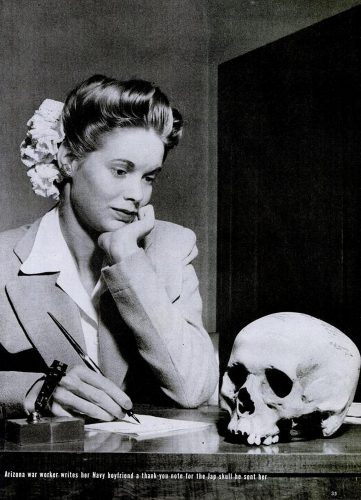
Natalie Nickerson, 20, gazes at a skull — reportedly of a Japanese soldier — sent to her from New Guinea by her boyfriend serving in the Pacific. (May 22, 1944 issues of LIFE, p. 35).
Meanwhile, the terrible nature of the Pacific War fought in the aftermath of Pearl Harbor is suggested by a 1944 issue of Life magazine that carried the photo of a young American woman with the skull of a Japanese soldier her boyfriend had sent her as a war souvenir. If any Nazi magazines ever featured similar images, I doubt the Allies would have had any need to fabricate ridiculous stories of human lampshades or soap.
And remarkably enough, that grotesque scene actually provides a reasonably accurate indication of the savage atrocities that were regularly committed during the brutal fighting of the Pacific Theater. These unpleasant facts were fully set forth in War Without Mercy, an award-winning 1986 volume by eminent American historian John W. Dower that received glowing accolades by leading scholars and public intellectuals.
The unfortunate truth is that Americans typically massacred Japanese who sought to surrender or who had even already been taken as prisoners, with the result that only a small slice—during some years merely a tiny sliver—of Japanese troops defeated in battle ever survived. The traditional excuse publicly offered for the virtual absence of any Japanese POWs was that their Bushido code made surrender unthinkable, yet when the Soviets defeated Japanese armies in 1945, they had no difficulty capturing over a million prisoners. Indeed, since interrogating prisoners was important for intelligence purposes, late in the war U.S. commanders began offering rewards such as ice cream to their troops for bringing some surrendering Japanese in alive rather than killing them in the field.
American GIs also regularly committed remarkably savage atrocities. Dead or wounded Japanese frequently had their gold teeth knocked out and taken as war-booty, and their ears were often cut-off and kept as souvenirs, as was also sometimes the case with their skulls. Meanwhile, Dower notes the absence of any evidence suggesting similar behavior on the other side. The American media generally portrayed the Japanese as vermin fit for eradication, and numerous public statements by high-ranking American military leaders explicitly claimed that the bulk of the entire Japanese population would probably need to be exterminated in order to bring the war to a successful conclusion. Comparing such thoroughly-documented facts with the rather tenuous accusations usually leveled against Nazi political or military leaders is quite revealing.
During the late 1980s evidence of other deep wartime secrets suddenly came to light.
While visiting France during 1986 in preparation for an unrelated book, a Canadian writer named James Bacque stumbled upon clues suggesting that one of the most terrible secrets of post-war Germany had long remained completely hidden, and he soon embarked upon extensive research into the subject, finally publishing Other Losses in 1989. Based upon very considerable evidence, including government records, personal interviews, and recorded eyewitness testimony, he argued that after the end of the war, the Americans had starved to death as many as a million German POWs, seemingly as a deliberate act of policy, a war crime that would surely rank among the greatest in history.
For decades, Western propagandists had relentlessly barraged the Soviets with claims that they were keeping back a million or more “missing” German POWs as slave-laborers in their Gulag, while the Soviets had endlessly denied these accusations. According to Bacque, the Soviets had been telling the truth all along, and the missing soldiers had been among the enormous numbers who had fled westward near the end of the war, seeking what they assumed would be far better treatment at the hands of the advancing Anglo-American armies. But instead, they were denied all normal legal protections, and confined under horrible conditions where they rapidly perished of hunger, illness, and exposure.
Without attempting to summarize Bacque’s extensive accumulation of supporting material, a few of his factual elements are worth mentioning. At the close of hostilities, the American government employed circuitous legal reasoning to argue that the many millions of German troops that they had captured should not be considered “prisoners of war” and therefore were not covered by the provisions of the Geneva Convention. Soon afterward, attempts by the International Red Cross to provide food shipments to the enormous Allied prison camps were repeatedly rejected, and notices were posted throughout the nearby German towns and villages that any civilian who attempted to smuggle food to the desperate POWs might be shot on sight. These undeniable historical facts do seem to suggest certain dark possibilities.
Although initially released by an obscure publisher, Bacque’s book soon became a sensation and an international best-seller. He paints Gen. Dwight Eisenhower as the central culprit behind the tragedy, noting the far lower POW losses in areas outside his control, and suggests that as a highly ambitious “political general” of German-American ancestry, he may have been under intense pressure to demonstrate his “harshness” toward the defeated Wehrmacht foe.
Furthermore, once the Cold War ended and the Soviet Archives were open to scholars, their contents seem to have strongly validated Bacque’s thesis. He notes that although the archives do contain explicit evidence of such long-denied atrocities as Stalin’s Katyn Forest massacre of Poland’s officer corps, they show absolutely no signs of any million missing German POWs, who instead had very likely ended their lives in the starvation and illness of Eisenhower’s death camps. Bacque points out that the German government has issued severe legal threats against anyone seeking to investigate the likely sites of the mass graves that might hold the remains of those long-dead POWs, and in an updated edition, he also mentions Germany’s enactment of harsh new laws meting out heavy prison sentences to anyone who merely questions the official narrative of World War II.
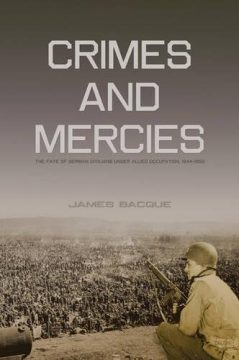
Bacque’s discussion of the new evidence of the Kremlin archives constitutes a relatively small portion of his 1997 sequel, Crimes and Mercies, which centered around an even more explosive analysis, and also became an international best-seller.
As described above, first-hand observers of post-war Germany in 1947 and 1948 such as Gollanz and Utley, had directly reported on the horrific conditions they discovered, and stated that for years official food rations for the entire population had been comparable to that of the inmates of Nazi concentration camps and sometimes far lower, leading to the widespread malnutrition and illness they witnessed all around them. They also noted the destruction of most of Germany’s pre-war housing stock and the severe overcrowding produced by the influx of so many millions of pitiful ethnic German refugees expelled from other parts of Central and Eastern Europe. But these visitors lacked any access to solid population statistics, and could only speculate upon the enormous human death toll that hunger and illness had already inflicted, and which would surely continue if policies were not quickly changed.
Years of archival research by Bacque attempt to answer this question, and the conclusion he provides is certainly not a pleasant one. Both the Allied military government and the later German civilian authorities seem to have made a concerted effort to hide or obscure the true scale of the calamity visited upon German civilians during the years 1945-1950, and the official mortality statistics found in government reports are simply too fantastical to possibly be correct, although they became the basis for the subsequent histories of that period. Bacque notes that these figures suggest that the death rate during the terrible conditions of 1947, long remembered as the “Hunger Year” (Hungerjahr) and vividly described in Gollancz’s account, was actually lower than that of the prosperous Germany of the late 1960s. Furthermore, private reports by American officials, mortality rates from individual localities, and other strong evidence demonstrate that these long-accepted aggregate numbers were essentially fictional.
Instead, Bacque attempts to provide more realistic estimates based upon an examination of the population totals of the various German censuses together with the recorded influx of the huge number of German refugees. Based upon this simple analysis, he makes a reasonably strong case that the excess German deaths during that period amounted to at least around 10 million, and possibly many millions more. Furthermore, he provides substantial evidence that the starvation was either deliberate or at least enormously worsened by American government resistance to overseas food relief efforts. Perhaps these numbers should not be so totally surprising given that the official Morgenthau Plan had envisioned the elimination of around 20 million Germans, and as Bacque demonstrates, top American leaders quietly agreed to continue that policy in practice even while they renounced it in theory.
Assuming these numbers are even remotely correct, the implications are quite remarkable. The toll of the human catastrophe experienced in post-war Germany would certainly rank among the greatest in modern peacetime history, far exceeding the deaths that occurred during the Ukrainian Famine of the early 1930s and possibly even approaching the wholly unintentional losses during Mao’s Great Leap Forward of 1959-61. Furthermore, the post-war German losses would vastly outrank either of these other unfortunate events in percentage terms and this would remain true even if the Bacque’s estimates are considerably reduced. Yet I doubt if even a small fraction of one percent of Americans are today aware of this enormous human calamity. Presumably memories are much stronger in Germany itself, but given the growing legal crackdown on discordant views in that unfortunate country, I suspect that anyone who discusses the topic too energetically risks immediate imprisonment.
To a considerable extent, this historical ignorance has been heavily fostered by our governments, often using underhanded or even nefarious means. Just like in the old decaying USSR, much of the current political legitimacy of today’s American government and its various European vassal-states is founded upon a particular narrative history of World War II, and challenging that narrative might produce dire political consequences. Bacque credibly relates some of the apparent efforts to dissuade any major newspaper or magazine from running articles discussing the startling findings of his first book, thereby imposing a “blackout” aimed at absolutely minimizing any media coverage. Such measures seem to have been quite effective, since until eight or nine years ago, I’m not sure I had ever heard a word of these shocking ideas, and I have certainly never seen them seriously discussed in any of the numerous newspapers or magazines that I have carefully read over the last three decades.
Even illegal means were employed to hinder the efforts of this solitary, determined scholar. At times, Bacque’s phone-lines were tapped, his mail intercepted, and his research materials surreptitiously copied, while his access to some official archives was blocked. Some of the elderly eyewitnesses who personally corroborated his analysis received threatening notes and had their property vandalized.
In his Foreword to this 1997 book, De Zayas, the eminent international human rights attorney, praised Bacque’s ground-breaking research, and hoped that it would soon lead to a major scholarly debate aimed at reassessing the true facts of these historical events that had taken place a half-century earlier. But in his update to the 2007 edition, he expressed some outrage that no such discussion ever occurred, and instead the German government merely passed a series of harsh laws mandating prison sentences for anyone who substantially disputed the settled narrative of World War II and its immediate aftermath, perhaps by overly focusing on the suffering of German civilians.
Although both of Bacque’s books became international best-sellers, the near-complete absence of any secondary media coverage ensured that they never entered public awareness with anything more than a pinprick. Another important factor is the tremendously disproportionate reach of print and electronic media. A best-seller may be read by many tens of thousands of people, but a successful film might reach tens of millions, and so long as Hollywood churns out endless movies denouncing Germany’s atrocities but not a single one on the other side, the true facts of that history are hardly likely to gain much traction. I strongly suspect that far more people today believe in the real-life existence of Batman and Spiderman than are even aware of the Bacque Hypothesis.
Ron Unz • July 9, 2018 • 6,600 Words
Many of the elements presented above were drawn from my previous articles published over the last year or two, but I believe there is some value in providing this same material in unified form rather than only separately, even if the total length necessarily becomes quite considerable.
World War II dominates our twentieth century landscape like a colossus, and still casts huge shadows across our modern world. That global conflict has probably been the subject of far more sustained coverage, whether in print or electronic media, than any other event in human history. So if we encounter a small handful of highly anomalous items that seem to directly contradict such an ocean of enormously detailed and long-accepted information, there is a natural tendency to dismiss these few outliers as implausible or even delusional. But once the total number of such discordant seemingly yet well-documented elements becomes sufficiently large, we must take them more seriously, and perhaps eventually concede that most of them are probably correct. As was suggested in a quote widely if doubtfully attributed to Stalin, “Quantity has a quality all of its own.”
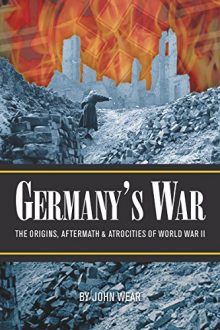
I am hardly the first individual to gradually become aware of this sweeping and cohesive counter-narrative of the Second World War, and a few months ago I happened to read Germany’s War, published in 2014 by amateur historian John Wear. Drawing from sources that substantially overlap with the ones I have discussed, his conclusions are reasonably similar to my own, but presented in a book length form that includes some 1,200 exact source references. So those interested in a much more detailed exposition of these same issues can read it and decide for themselves.
When intellectual freedom is under attack, challenging an officially enshrined mythology may become legally perilous. I have seen claims that thousands of individuals who hold heterodox opinions about various aspects of the history of World War II are today imprisoned across Europe on the basis of those beliefs. If so, that total is probably far higher than the number of ideological dissidents who had suffered a similar fate in the decaying Soviet Bloc countries of the 1980s.
World War II ended nearly three generations ago, and few of its adult survivors still walk the earth. From one perspective the true facts of that conflict and whether or not they actually contradict our traditional beliefs might appear rather irrelevant. Tearing down the statues of some long-dead historical figures and replacing them with the statues of others hardly seems of much practical value.
But if we gradually conclude that the story that all of us have been told during our entire lifetimes is substantially false and perhaps largely inverted, the implications for our understanding of the world are enormous. Most of the surprising material presented here is hardly hidden or kept under lock-and-key. Nearly all the books are easily available at Amazon or even freely readable on the Internet, many of the authors have received critical and scholarly acclaim, and in some cases their works have sold in the millions. Yet this important material has been almost entirely ignored or dismissed by the popular media that shapes the common beliefs of our society. So we must necessarily begin to wonder what other massive falsehoods may have been similarly promoted by that media, perhaps involving incidents of the recent past or even the present day. And those latter events do have enormous practical significance. As I pointed out several years ago in my original American Pravda article:
Aside from the evidence of our own senses, almost everything we know about the past or the news of today comes from bits of ink on paper or colored pixels on a screen, and fortunately over the last decade or two the growth of the Internet has vastly widened the range of information available to us in that latter category. Even if the overwhelming majority of the unorthodox claims provided by such non-traditional web-based sources is incorrect, at least there now exists the possibility of extracting vital nuggets of truth from vast mountains of falsehood.
We must also recognize that many of the fundamental ideas that dominate our present-day world were founded upon a particular understanding of that wartime history, and if there seems good reason to believe that narrative is substantially false, perhaps we should begin questioning the framework of beliefs erected upon it.
George Orwell fought in the Spanish Civil War during the 1930s and discovered that the true facts in Spain were radically different from what he had been led to believe by the British media of his day. In 1948 these past experiences together with the rapidly congealing “official history” of the Second World War may have been uppermost in his mind when he published his classic novel 1984, which famously declared that “Who controls the past controls the future; who controls the present controls the past.”
Indeed, this observation has never been more true than when we consider some of the historical assumptions that govern the politics of today’s world, and the likelihood that they are entirely misleading:
Back in those late Cold War days, the death toll of innocent civilians from the Bolshevik Revolution and the first two decades of the Soviet Regime was generally reckoned at running well into the tens of millions when we include the casualties of the Russian Civil War, the government-induced famines, the Gulag, and the executions. I’ve heard that these numbers have been substantially revised downwards to perhaps as little as twenty million or so, but no matter. Although determined Soviet apologists may dispute such very large figures, they have always been part of the standard narrative history taught within the West.
Meanwhile, all historians know perfectly well that the Bolshevik leaders were overwhelmingly Jewish, with three of the five revolutionaries Lenin named as his plausible successors coming from that background. Although only around 4% of Russia’s population was Jewish, a few years ago Vladimir Putin stated that Jews constituted perhaps 80-85% of the early Soviet government, an estimate fully consistent with the contemporaneous claims of Winston Churchill, Times of London correspondent Robert Wilton, and the officers of American Military Intelligence. Recent books by Alexander Solzhenitsyn, Yuri Slezkine, and others have all painted a very similar picture. And prior to World War II, Jews remained enormously over-represented in the Communist leadership, especially dominating the Gulag administration and the top ranks of the dreaded NKVD.
Both of these simple facts have been widely accepted in America throughout my entire lifetime. But combine them together with the relatively tiny size of worldwide Jewry, around 16 million prior to World War II, and the inescapable conclusion is that in per capita terms Jews were the greatest mass-murderers of the twentieth century, holding that unfortunate distinction by an enormous margin and with no other nationality coming even remotely close. And yet, by the astonishing alchemy of Hollywood, the greatest killers of the last one hundred years have somehow been transmuted into being seen as the greatest victims, a transformation so seemingly implausible that future generations will surely be left gasping in awe.
Today’s American Neocons are just as heavily Jewish as were the Bolsheviks of a hundred years ago, and they have greatly benefited from the political immunity provided by this totally bizarre inversion of historical reality. Partly as a consequence of their media-fabricated victimhood status, they have managed to seize control over much of our political system, especially our foreign policy, and have spent the last few years doing their utmost to foment an absolutely insane war with nuclear-armed Russia. If they do manage to achieve that unfortunate goal, they will surely outdo the very impressive human body-count racked up by their ethnic ancestors, perhaps even by an order-of-magnitude or more.
Related Reading:
September 23, 2019
Posted by aletho |
Book Review, Full Spectrum Dominance, Timeless or most popular, Wars for Israel | UK, United States |
Leave a comment