On Wednesday, for the first time, Iran’s Supreme Leader Ayatollah Ali Khamenei expressed his views on the US elections of November 8. The Tehran Times quoted Khamenei as saying,
- Unlike some of those in the world who have either been bemoaning or celebrating the results of the American elections, we are neither bemoaning nor celebrating because the results make no difference to us. Nor do we have worries, and by the grace of God, we are ready to encounter any likely incident.
Khamenei said that from a historical perspective,
- We have no judgment about this election because America is the same America, and over the past 37 years either of the two parties which has been in office not only has done no good (to the Iranian nation), but has always been an evil to the Iranian nation.
Khameini downgraded the significance of the US election and stressed that Iran’s focus should be on promoting and preserving the “internal strength of the establishment” and nurturing and preserving the “revolutionary spirit and orientation.”
The Supreme Leader’s remarks come amidst furious speculations in the American media, driven mostly by pro-Israeli Jewish lobby, to the effect that the Iran nuclear deal (known as Joint Comprehensive Plan of Action or JCPOA) faces the prospect of sudden death any moment after January 20. The Israeli intelligence website DebkaFile, which routinely disseminates sensational items on Iran, even reported that Trump is contemplating a military attack on Iran as soon as he moves into the Oval Office.
Therefore, Khamenei’s indifference is striking. It must be noted, though, that Khamenei made no reference to US president-elect Donald Trump, directly or indirectly. What does that imply?
Simply put, Iran is not worried, since Iran does not expect anything dramatically different in the US policies toward Iran. The ‘psy war’ by the Israeli lobby has failed to have an effect. The Iranians would know that Israelis habitually create larger-than-life image of themselves, but the plain truth is that Trump has not been a candidate sponsored by the Jewish lobby in America. In fact, Jewish circles have attributed to him traces of ‘anti-semitism’, Trump’s son-in-law’s Jewish ethnicity notwithstanding.
Can it be that Iran has lines of communication open to Trump’s transition team? Now, that isn’t such an outrageous thought as it may seem at first sight, because, simply put, that is the way Iranian diplomacy always worked. Iran is a tireless communicator. A clutch of ‘red lines’ apart (such as the ‘Zionists’ or Daesh and al-Qaeda), Iran’s diplomacy is willing to engage even adversaries or detractors.
What must be noted in this context is that two key personalities in the Iranian regime, both enormously prestigious and powerful within Iran and in the outside world, have hinted in the recent days that Tehran keeps an open mind on Trump – Foreign Minister Mohammad Javad Zarif and the Speaker of the Majlis (parliament) Ali Larijani.
Zarif said on November 11 that in his estimation, the Trump administration will eventually accept the landmark nuclear deal “once the dust has settled and people are briefed about the realities of the region and the world.” He added, “It will be in the interest of everybody to remain committed in practice to the JCPOA. But if there are doubts about the implementation, then Iran will have its own options as well.”
Zarif is a highly experienced career diplomat who served for long years in New York and enjoys extensive contacts with American political elites and the foreign-policy community. Zarif implied here that Tehran is inclined to take much of what Trump had said on the campaign trail regarding Iran as the stuff of grandstanding and politicking, and far from the final word on the subject.
Equally, the speaker of the Iranian Majlis Ali Larijani’s remarks in Tehran last Sunday to a big gathering of some 100 parliamentarians merits even more careful attention. Larijani cautioned the Iranian religious and political elites against making intemperate remarks about the US president-elect. In a highly nuanced remark, he counselled,
- Analyses and remarks about the U.S. president-elect should be more mature, and hasty remarks and premature judgments should be avoided until the Foreign Ministry takes a transparent stance.
No doubt, Larijani made a hugely significant remark. Larijani is a veteran diplomat and statesman of many battles with ‘Great Satan’, and chooses his words with utmost care. In effect, he pleaded for patience till such time as when Zarif could take a “transparent stance”.
Larijani spoke in the context of some flippant remarks attributed to influential clerics lately scoffing at Trump. Evidently, he has restrained them from muddying the waters and cautioned them against making “premature judgments”. Larijani is close to Supreme Leader Khamenei.
The salience of what Larijani said is that it is critically important that Zarif gets a free hand to conduct diplomacy optimally in a dynamic situation in a high-stakes game when the contours of the transition in Washington are far from crystallized.
November 17, 2016
Posted by aletho |
Wars for Israel | Ali Khamenei, Ali Larijani, Iran, Mohammed Zarif, Sanctions against Iran, United States |
Leave a comment
A senior Israeli official says Tel Aviv should be concerned about deepening disconnect with Moscow over Russia’s role in the Syria conflict.
Avi Dichter, chairman of Israel’s foreign affairs and military committee and the former head of the Shin Bet intelligence agency, says Russia’s interests in the region by no means coincide with Israel’s.
“The gap between us and them is large and disturbing,” he told Reuters news agency after returning from a visit to Moscow where he held high-level meetings last week.
Dichter said Russia’s views on Iran, Syrian President Bashar al-Assad and the Lebanese group Hezbollah were in sharp contrast to Israel’s and a growing source of potential conflict.
Russia does not view Iran and its allies “according to the level of threat they pose or broadcast towards Israel,” he said.
The Russians, he said, “view Hezbollah positively” and are backing the group’s assistance to the Syrian government in the war against Takfiri and other terrorists.
“Russia thinks and acts as a superpower and as such it often ignores Israeli interest when it doesn’t coincide with the Russian interest,” Dichter said.
Israel is believed to have been assisting militants fighting to topple President Assad in Syria. The Israeli regime’s worries have risen as Takfiri terrorists have suffered major setbacks over the past few months.
Tel Aviv’s main concern is to be able to attack Hezbollah, with which it fought a war in 2006. Over the past two years, Israeli artillery and warplanes have carried out several strikes against alleged weapons convoys in southern Syria that Israel claimed were destined for Hezbollah.
The occupying regime’s freedom of movement in the area is now more restricted because of the presence of Russian jets and advanced anti-aircraft batteries that Moscow has put in place.
With Russia becoming more deeply involved in the Syria conflict, Tel Aviv has sought to keep lines of communication with Moscow open to avoid an accidental confrontation.
Meanwhile, Israeli Prime Minister Benjamin Netanyahu has visited President Vladimir Putin three times this year, apparently in an effort to persuade him to drop Russia’s engagement in Syria.
But Dichter said Russia thinks Assad should stay in power, that Iran is a stabilizing force and that the nuclear deal the word powers struck with Tehran was largely positive.
November 17, 2016
Posted by aletho |
Ethnic Cleansing, Racism, Zionism, Wars for Israel | Hezbollah, Iran, Israel, Lebanon, Middle East, Russia, Syria |
Leave a comment
With Donald Trump’s historic victory in the US Presidential Election this week it is appropriate to pause and take a moment to reflect about what the incoming President of the United States needs to do in order to Make American Great Again.
1) Trump has proposed restrictions on lobbyists acting for foreign governments and more specifically for former elected officials seeking or being offered employment by organizations such as these after leaving office.
He needs to implement and expand this restriction in order to curb the well-documented activities of the partisans of Israel as the principle abusers of the lobby system. To do this he needs to focus on the flow of capital between domestic jewish organizations (such as AIPAC, NORPAC, the Zionist Organization of America and the Anti-Defamation League), international Jewish organizations (such as Birthright Israel and the World Jewish Congress) and the Israeli government itself. In addition to requiring the Israel Lobby’s plethora of legal entities register as representatives of a foreign government (i.e. Israel) in compliance with current legislation.
This will help prevent the widespread abuse of the lobby and donor system by Israel’s partisans in the United States and abroad. In addition to making it difficult for Israel’s political agents to continue ring fence 3.8 billion of US taxpayer’s money to balance its own domestic budget deficit. (1)
2) Trump has stated that he intends to take China to task for its repeated violations of US intellectual property laws. This is laudable indeed, but Trump needs to expand this mandate to include other major violators of US intellectual property laws such as Israel. (2)
3) Trump has repeatedly affirmed that he intends to take a hatchet to all Free Trade Agreements that do not provide a net benefit to America. He has targeted NAFTA (the North American Free Trade Agreement) and TPP (the Trans-Pacific Partnership) in particular, but he also needs to address ILFTA (the United States-Israel Free Trade Agreement) which has been running a deficit since it began in 1985. The latest figures available on the US trade deficit with Israel caused by ILFTA stand at $8 billion in goods and $466 million in services. (3)
4) Trump has repeatedly expressed his desire to convene a special prosecutor to look into the charges that Hillary Clinton used an unsecured private email server to deal with official government business while she was Secretary of State in addition to her activities, along with her husband Bill, in regards to the Clinton Foundation.
He must do this, because if he does not then the neo-Conservatives – the avowed enemies of a foreign policy that puts America first in addition to being the strident partisans of Israel – will rally around Hillary and attempt to subvert Trump’s populist revolution for their own ends.
Further Trump must not limit the glaring light of judicial scrutiny to Hillary Clinton alone, but expand that focus across the whole pro-Hillary framework of think tanks, non-profits and media companies. Whose corruption and anti-American treason has been so decisively documented by the emails hacked from the Democratic National Committee and published by Wikileaks.
5) Trump must distance himself from Israel and treat it as any other country with whom the United States has diplomatic relations. Unless he does so and stops treating Israel as a special case in terms of United States foreign policy. Then he will face difficult headwinds in his diplomatic relations within the Middle East and allow the Israel Lobby to rebuild its powerful grip on American foreign policy in the future.
None of these policy prescriptions are difficult to implement and indeed they come with a significant prize. Whether that be in diplomatic and moral capital, economic advantage and/or domestic security.
Without implementing these policies however Trump runs the very real risk that his populist revolution will be co-opted and infiltrated by the very establishment that he was elected into the highest political office to purge once and for all.
In short Donald Trump has to address the problem of Israeli power and influence in the United States in order to Make America Great Again.
It is that simple.
References
(1) http://www.ifamericansknew.org/stat/usaid.html
(2) Cf. Grant Smith, 2009, ‘Spy Trade: How Israel’s Lobby Undermines America’s Economy’, 1st Edition, Institute for Research: Middle East Policy: Washington D.C.
(3) https://ustr.gov/trade-agreements/free-trade-agreements/israel-fta
November 16, 2016
Posted by aletho |
Economics, Ethnic Cleansing, Racism, Zionism, Timeless or most popular, Wars for Israel | AIPAC, Donald Trump, ILFTA, Israel, United States, Zionism |
Leave a comment

Introduction
Castigating the US electorate as accomplices and facilitators of wars, or, at best, dismissing the voters as ignorant sheep-people (‘sheeple’) herded by political elites, describes a partial reality. Public opinion polls, even the polls overwhelmingly slanted toward the center-right, consistently describe a citizenry opposed to militarism and wars, past and present.
Both the Right and Left have failed to grasp the contradiction that defines US political life: Namely, the profound gap between the American public and the Washington elite on questions of war and peace within an electoral process that consistently leads to more militarism.
This is an analysis of the most recent US public opinion polls with regard to outcome of the recent elections. The essay concludes with a discussion of the deep-seated contradictions and proposes several ways in which these contradictions can be resolved.
Method
A major survey of public opinion, sponsored by the Charles Koch Institute and the Center for the National Interest, conducted by the Survey Sampling International, interviewed a sample of one thousand respondents.
The Results: War or Peace
More than half of the American public oppose any increase in the US military role overseas while only 25% back military expansion.
The public has expressed its disillusionment over Obama’s foreign policy, especially his new military commitments in the Middle East, which have been heavily promoted by the state of Israel and its US domestic Zionist lobby.
The US public shows a deep historical memory with regard to the past military debacles launched by Presidents Bush and Obama. Over half of the public (51%) believe that the US has become less safe over the past 15 years (2001-2015), while one eighth (13%) feel they are more secure.
In the present period, over half of the public opposes the deployment of ground troops to Syria and Yemen and only 10% favor continued US support for the Kingdom of Saudi Arabia.
With regard to specific US wars, over half believe that Bush’s invasion of Iraq made the US homeland less secure, while only 25% believe it didn’t increase or decrease domestic security. Similar responses were expressed with regard to Afghanistan: 42% believe the Afghan War increased insecurity and about a third (34%) felt it did not affect US security.
In terms of future perspectives, three quarters (75%) of the American public want the next President to focus less on the US military operations abroad or are uncertain about its role. Only 37% are in favor of increased spending for the military.
The mass media and the powerful financial backers of the Democratic Presidential candidate have focused on demonizing Russia and China as ‘the greatest threats in our time’. In contrast, almost two thirds (63.4%) of Americans believe the greatest threat comes from terrorism both foreign and domestic. Only 18% view Russia and China as major threats to their security.
In regard to the Pentagon, 56% want to reduce or freeze current military spending while only 37% want to increase it.
Wars and Peace: The Political Elites
Contrary to the views of a majority of the public, the last four US Presidents, since the 1990’s, have increased the military budget, sending hundreds of thousands of US troops to launch wars in three Middle Eastern countries, while promoting bloody civil wars in three North African and two European countries. Despite public opinion majorities, who believe that the invasions of Afghanistan and Iraq have increased threats to the US security, Obama kept ground troops, air and sea forces and drone operations in those countries. Despite only 10% public approval for his military policies, the Obama regime has sent arms, advisors and Special Forces to support the Saudi dictatorship’s invasion of tiny Yemen.
Obama and the Democratic presidential candidate Hillary Clinton pushed a policy of encircling Russia and demonizing its President Putin as the greatest threat to the US in contrast to US opinion, which considers the threat of Islamist terrorism as five times more serious.
While the political elite and the leading Presidential candidates promise to expand the number of US troops abroad and increase military spending, over three quarters of the American public oppose or are uncertain about expanding US militarism.
While candidate Clinton campaigned for the deployment of the US Air Force jets and missiles to police a ‘no fly zone’ in Syria, even shooting down Syrian and Russian government planes, the majority of US public opposed it by 51%.
In terms of constitutional law, fully four-fifths (80%) of the US public believes the President must secure Congressional approval for additional military action abroad. Nevertheless, Presidents from both parties, Bush and Obama launched wars without Congressional approval, creating a precedent which the next president is likely to exploit.
Analysis and Perspectives
On all major foreign policy issues related to waging war abroad, the political elite is far more bellicose than the US public; they are far more likely to ignite wars that ultimately threaten domestic security; they are more likely to violate the Constitutional provisions on the declaration of war; and they are committed to increasing military spending even at the risk of defunding vital domestic social programs.
The political elites are more likely to intervene in wars in the Middle East, without domestic support and even in spite of majoritarian popular opposition to war. No doubt the executives of the oligarchical military-industrial complex, the pro-Israel power configuration and the mass media moguls are far more influential than the pro-democracy public.
The future portends a continuation of militarism by the political elites, and increase in domestic security threats and even less public representation.
Some Hypothesis on the Contradiction between Popular Opinion and Electoral Outcomes
There is clearly a substantial gap between the majority of Americans and the political elite regarding the role of the military in overseas wars, the undermining of constitutional prerogatives, the demonization of Russia, the deployment of US troops to Syria and deeper US entanglement in Middle East wars for the benefit of Israel.
Yet it is also a fact that the US electorate continue to vote for the two major political parties which have consistently supported wars, formed military alliances with warring Middle East states, especially Saudi Arabia and Israel and aggressively sanctioned Russia as the main threat to US security.
Several hypotheses regarding this contradiction should be considered:
1. Close to 50% of the eligible voters abstain from voting in Presidential and Congressional elections. This most likely includes many among the majority of Americans who oppose the expansion of the US military role overseas. In fact, the war party ‘winner’ typically claims victory with less than 25% of the electorate – and threats this as a mandate to launch more wars.
2. The fact that the mass media vehemently supports one or the other of the two war parties probably influences a minority of the electorate who decide to actually participate in the elections. However, critics have exaggerated the mass media’s influence and fail to explain why the majority of the American public disagree with the mass media and oppose the militarist propaganda.
3. Many Americans, while opposed to militarism, vote for the ‘lesser evil’ between the two war parties. They may believe that there are greater and lesser ‘degrees’ of war mongering and choose the less strident.
4. Americans, who consistently oppose militarism, may decide to vote for militarist politicians for reasons besides those of overseas wars. For example, majoritarian Americans may support a militarist politician who has secured funding for local infrastructure programs, or protected farm and dairy subsidies, or who promises jobs programs, lowers public debt or opposes corrupt incumbents.
5. Americans, opposed to militarism, may be deceived by the pronouncements of a demagogic presidential candidate from one of the war parties, whose promise of peace will give way to escalating wars.
6. Likewise, the emphasis on ‘identity politics’ can deceive anti-war voters into supporting a proven militarist because of issues related to race, ethnicity, gender, sexual preferences or loyalties to overseas states.
7. The war parties work together to block mass media access for anti-militarist parties, especially preventing their participation in national electoral debates viewed by tens of millions of voters. War parties collude to set impossible restrictions against anti-militarist party participation in national level elections, banning citizens with non-violent police records or former convicts who have served their sentences from voting. They reject poor citizens who lack photo identification, limit access to transport to voting sites, limit the number of polling places in poor or minority neighborhoods and deny time-off for workers to vote. Unlike other countries, US elections are held on a work day and many workers are unable to vote.
In other words the electoral process is ‘rigged’ and imposes ‘forced voting’ and abstention: Collusion between the two war parties limits voter choice to abstention or casting a ballot for the ‘lesser evil’ among the militarists.
Only if elections were open and democratic, where anti-militarist parties were allowed equal rights to register, participate and debate in the mass media, and where campaign financing were made equal would the contradictions between the wishes of the anti-militarist majorities and votes cast for pro-war elites be resolved.
November 14, 2016
Posted by aletho |
Militarism, Progressive Hypocrite, Timeless or most popular, Wars for Israel | Hillary Clinton, Israel, Middle East, Obama, Saudi Arabia, United States, Zionism |
Leave a comment
Part 1: Introduction
For the last 30 years, I have witnessed and experienced the severe restraints on any free and balanced discussion of the facts. This reluctance to criticize any policies of the Israeli government is because of the extraordinary lobbying efforts of the American-Israel Political Action Committee and the absence of any significant contrary voices.
— Former U.S. President Jimmy Carter [1]
How the Interviews Came About
The Marxian thesis that the dominant culture and ideology of a society (here referred to as Social Base or just Base) are those of the dominant class (here referred to as System) is a sharp tool to probe how political systems work and how they stay in power. Does this tool work in the U.S. model? Certainly, in the United States, the relation between the System and its Social Base has been regular since the inception of the thirteen colonies. Because of that sustained regularity, System and Base acted in convergent patterns of dependency. In historical perspective, it was not possible for the System to transform those colonies into states, and thereafter expand its conquests to form a continental empire without a solid social base that shared its purpose and visions for expansion. From that time onward, an ideological symbiosis ran between the System and the Base. Not only that, but each time the System modifies direction, philosophy, or ideology, the Base would adapt by modifying its attitudes and perception.
The patterns of ideological association between the U.S. System and its Social Base extended into modern times, and the yardstick to measure them is the presidential elections. If you look at voters’ turnout since 1960, you will notice that a relative-to-large majority of Americans had voted in those elections. My interpretation of the vote in relation to Marx’s thesis is the following. Voting for a system that is known for its aggressive imperialist policies, crimes around the world, overthrowing foreign governments not in line with Washington, and countless military interventions and invasions that left millions of people dead means one thing: Voting for that system while knowing its attributes, policies, and actions amounts to active sharing in its ideology, culture, and violence.
Caveat! That does not necessarily mean that all voters share the System’s imperialistic values of violence and destruction of foreign peoples. The pertinent meaning of voting interpreted in relation to the System’s foreign policy objectives versus the objectives of the Base resides in two concepts. Discarding immediately the notion that the Base has been cohabitated by the system, the first concept has it that the Base has given a mandate to the System to carry out its ideology of empire and imperialism based on the undeclared condition to spare the people from the horrors of foreign wars. A dichotomy sets in here. The System has its way of life, and the Base has its own. The second concept has to do with the basic tenets of colonialism. Meaning, if the System could be successful to obtain unspecified benefits through wars, then the base could share in these benefits despite aversion to violence and opposition to the institution of war as a means to resolve problems between nations.
A question: Would abstaining from voting resolve the issue of “active sharing” in the policies of the system? This subject is open for debate . . .
The relation between the American System and its Base was uniform up to a certain point in history (late 1920s). Until that point, the American state was still busy completing its structural transformation into a big power status. That uniformity, however, managed to keep the patterns of the political power unchanged. To be exact, despite persistent immigration that should have altered the relations between the Base and government, as well as the composition of the latter, the dominance of the traditional ruling elites was 1) not open for challenge, and 2) shaped by an exclusive American Anglo-Saxon experience.
But when Franklyn D. Roosevelt showed signs of surrender to the Zionist pressure on the issue of establishing a “Jewish” state in Palestine, he opened a large crack in the System. That was the first time in U.S. history where the powerful American imperialist state yielded to a foreign ideology that was not part of its basic project. With that, a movement with a limited religious social base began penetrating the files and ranks of the U.S. power. The rest is history. As a result, the unrelenting entrenchment inside the political structures of the United States coupled with accumulated changes in the configuration of the U.S. power, the dominant American System itself fell under the domination of one of its social factions—American Jewish Zionists.
When Franklyn D. Roosevelt showed signs of surrender to the Zionist pressure on the issue of establishing a “Jewish” state in Palestine, he opened a large crack in the System.
As a group, American Jewish Zionists have all attributes of an independent establishment. They possess efficient organizational structures, have a monolithic political presence across the American system, and they know how to finance their activities with U.S. tax money. I must note that their alignment with the global agenda of U.S. imperialism is a two-point expedient. The first is focused on being recognized as earnest operators at the service of America’s interests. The second is tactical. To reap, on behalf of Israel, the benefits of alignment with slogans such as “Israel is our only trusted ally in the Middle East”.
The American Jewish Zionist experience is agenda driven. As such, their domestic and foreign agendas have precedence over any other Jewish-related consideration.
On the domestic front, the focus could not be more evident: to consolidate Zionism in the United States and turn it into a means to 1) perpetuate Israel as an American national issue, and 2) make of them the principal factor in defining American politics. You can notice the endeavor clearly during U.S. elections when the Zionist media question whether this or that candidate is good for the Jews, and for Israel. Today, voicing dissent against the policies of American Jewish Zionism or criticizing Israel amounts to crime. Jimmy Carter experienced this firsthand. When he published his book: Palestine: Peace not Apartheid, American Jewish Zionists unleashed the fire of hell upon him.
As for the Jewish Zionist foreign agenda, this is clear-cut and leaves no space for misunderstanding. It aims to induce, control, or lead the United States to 1) adopt hostile policies toward the Arab nations because due to their rejection of the Zionist state, and 2) undertake military actions against any country that appears as posing a potential or direct threat to Israel. Equally important, it demands that the United States keep denying the Palestinians rights for nationhood through American diplomacy. What is the rationale? Recognition of the Palestinian national rights means the invalidation of the Zionist state and its claim on Palestine.
Because the Jewish Zionist control of the U.S. System is real and dominant, how does the American society figure vis-à-vis this dominance? Based on observations of the American society and its multiple cultural and ideological patterns, there can be but one answer: Zionism is not the dominant culture and ideology of the American people. It is, however, the dominant culture and ideology of the U.S. political system.
OBSERVATIONS
First, despite gargantuan Zionist propaganda apparatuses directed to the American people, Jewish Zionists have consistently failed to create interest or sympathy for Zionist issues and for Israel,
Second, due to historically developed indifference to foreign issues, a majority of Americans have only vague ideas on what Zionism is,
Third, to establish roots for their political dominance, Jewish Zionist activists invariably focus not on the American people, but on ways to control the American system from inside by controlling first the institutions that matter: White House and Congress.
Fourth, this control did not happen because of elections. It is preponderantly due to the practice of appointing Jewish Zionists to important positions inside the administrations,
Fifth, among the stratagems employed by Zionists when they run for elective offices, one was particularly effective: Take advantage of the reverence of the population for the idea of election. To do that, Jewish Zionist candidates rarely, if ever, talk about Israel or Zionism. Instead, they only debate matters of interest to the voters. Once elected though, promoting Israel via American legislations becomes the top hidden agenda,
Sixth, and to conclude this particular argument, the fact that one administration after another succumbed to the diktat of Jewish Zionists (thus indirectly to Israel) in matters of foreign policy and wars proves that the culture and praxis of those administrations are those of the dominant ideology and culture—Zionism.
Another point to discuss is the expansion of the Jewish Zionist power. By all accounts, such an expansion is not a phenomenon but an incremental process. In his book, The Arabists: The Romance of an American Elite, Robert D. Kaplan defined the issue that I framed as a process in terms of gradual replacement of traditional diplomatic elites with new ideological elites that had no interest in the ways of the old school of diplomacy. Kaplan was unambiguous. He called these new elites by their names: Irish-Americans and Jewish-Americans.
Kaplan’s viewpoint on this replacement is important to our discussion. He argued that the old elites approached the U.S.-Arab relations with an open mind and readiness for dialog, all while keeping an eye on the U.S. imperialist interests. His argument opens the door for a veritable conclusion. The two groups of post-WWII American society that Kaplan mentioned had in fact changed the dynamics of U.S. foreign policy. (It is public knowledge that both groups are known for their hostility toward Arabs and Muslims—each for his own set of religious, political, and ideological rationales.). As for the successive shares of African-Americans and Hispanics in the making of the national policy of the United States, this is another argument.
As a witness to history, in early 2012, I began drafting a comprehensive analysis on the role of American Jewish Zionists in the making of U.S. policies and wars in the Arab world. In May of that year, as my work became broad in scope, I decided to seek more views on the subject. I came up with the idea to conduct several interviews where I pose the same questions. While some of the prospective interviewees declined, and others accepted but then withdrew, three prominent thinkers acclaimed for their knowledge, scholarship, and outstanding political activism graciously gave me their views.
They are Francis Boyle, a professor of international law, University of Illinois, College of Law; James Petras, a professor emeritus, University of Binghamton, New York; Canadian writer and former co-editor of the online publication of Dissident Voice Kim Petersen. Professors Boyle and Petras answered my questions via phone conversations, and, Petersen via email correspondence.
However, in the weeks following the interviews, my work swelled up to such a length that it became unsuitable for internet publishing. In short, I was unable to honor my commitment to publish the interviews as planned. Today, as I thank Prof. Francis Boyle, Prof. James Petras, and Kim Petersen for sharing their invaluable insight, I apologize to them for the delay in putting the interviews out there to read.
INTRODUCTION
The turning point in the emergence of Jewish Zionism as a dominant American political force came about when Iraq invaded Kuwait. (Discussing the origins and strategic complications of that invasion goes beyond the scope of this introduction.) The Jewish Zionist establishment seized the occasion, mobilized its omnipresent propaganda operatives, and led colossal media campaigns to promote military actions against Iraq. To bring their war mania to fruition, they unleashed their “experts” in all directions. They talked about Iraq’s “formidable” military capabilities and about Saddam’s one-million-man standing army ready to invade Saudi Arabia and seize its oil. They told stories about Saddam Hussein’s personal life, his bunkers, and his mortal “nuclear threats” to Israel. And they talked about Iraq’s threats to U.S. interests and “allies” in the Middle East. . . . Here is a brief account of those events.
On July 25, 1990, Iraqi president Saddam Hussein met with U.S. ambassador to Iraq, April Glaspie. It is on record that Glaspie gave Hussein an unambiguous but indirect greenlight to resolve Iraq’s problems with Kuwait militarily. On August 2, Iraq invaded Kuwait. On August 3, George H. W. Bush ordered the freezing of Iraqi and Kuwaiti assets and immediately placed Iraq under hermetic embargo. Considering the prompt, extraordinary anti-Iraq measures that the United States took in the first 24 hours of that invasion, one wonders what was pushing the U.S. to move so quickly on Iraq knowing that only two days earlier, this was conducting a U.S. proxy against Iran. The observation that the U.S. did not take similar actions when Iraq invaded Iran in 1980, or when Israel invaded Lebanon in 1982 raises many questions. What were the U.S. rationales in taking such measures? Who conceived them? Did the U.S. entrap Iraq? Why? . . .
The atmosphere that followed the invasion was surrealistic. Like a lightning bolt, U.S. imperialist and Zionist forces instantly mobilized their media, talking heads, retired generals, and bogus experts on the Middle East. The deafening uproar they made and all lies they told about atrocities committed by Iraq in Kuwait hid a definite scheme: Incite for war. In the period August 2, 1990 – January 14, 1991, Israelis and Jewish Zionists from all fields appeared en mass and in every possible medium available to urge the Bush regime to give up diplomacy in favor of war. On January 15, 1991, a 30-member “coalition” in which the U.S. had the lion share—ninety-seven percent of the total force—attacked Iraq. By every standard and minutia of details, the war on Iraq in 1991 was an American War.
At the end of a war that destroyed one of Israel’s Arab adversaries, George H. W. Bush might have thought of himself as America’s “laureate hero”. He did not predict though that his temporary freezing of the U.S. loan guaranties to Israel, would have unleashed the Jewish Zionist establishment against him. The fact that he lost to Bill Clinton (who opposed Bush’s freeze, and who stated that Israel was the “only country that paid back its debts”) indicated that American Jewish Zionists had finally reached their objective: To perfect ways to control the U.S. politics from the inside. In retrospect, it can be said that George H. W. Bush was the last non-Zionist American president. From Bill Clinton forward, U.S. presidents and their vice president became pawns in the Jewish Zionist play of power.
Now, as the United States was preparing for war with Iraq to “liberate” Kuwait, thousands of antiwar activists and intellectuals from a wide spectrum of political convictions spoke loudly against it. But no one could have ever beaten Patrick J. Buchanan’s memorable words about how American Jewish Zionists and Israel were pushing for that war. He said, ”There are only two groups that are beating the drums for war in the Middle East – the Israeli Defense Ministry and its amen corner in the United States.” [2] With that, Buchanan hit the proverbial nail on the head. A.M. Rosenthal, a ringleader of U.S. Zionist journalism could not bear what he heard. In a rebuttal, he unleashed an acerbic attack against Buchanan. His weapon of argument, so to speak, was the stale and trite accusation of “antisemitism”.
Whining, Rosenthal twisted Buchanan’s clear words and went on to imply that Buchanan was in effect engaging in an “anti-Jewish” tirade. He re-interpreted Buchanan’s words and cast them in a standard Zionistic fashion. He wrote that Buchanan’s intention was ”The Jews are trying to drag us into war. Only Jews want war. Israeli Jews want war to save Israel’s hide. American Jews who talk of military action against Iraq want war because it would suit Israeli interests. They are willing to spill American blood for Israeli interests.” [3]
By inserting the word, “Jew” in his reply, Rosenthal and the New York Times behind him spat on the face of U.S. political reality under the tight grip of Zionism. We need not waste our breath on Rosenthal’s petty tactic. His clear objective was to distract from the central issue, which is, Buchanan’s opposition to the planned war against Iraq was unrelated to the religious denomination of those who were promoting it. Rather he was unmistakably referring to their political identity.
Still, Buchanan was honest. He pointed the finger to Israel and its “Amen corner” because that was the truth. The fact that most Israelis and “Amen corners” happened to be of Jewish faith was nonissue. To conclude, it is evident that Buchanan, a dreamer of an American “republic” not “empire”, could not stand by idle while seeing the United States sheepishly fastened to the yoke of Zionism and gutlessly prostrating before a tiny settler state, Israel.
Buchanan did not stop there. Truthful and resolute, he dared to describe in categorical terms the pitiful condition of the U.S. Congress vis-à-vis Israel and American Jewish Zionists. He dubbed it as “An Israeli-occupied territory” [4]. Buchanan powerfully hit the target in such a way that countless cowardly American politicians would dare not think, let alone say. Notice that Buchanan had placed Israel before its U.S. “amen corner”. I view this as a statement. He clearly implied that Israel is the primary decision maker. Did that also imply that U.S. Zionist groups (amen corner) are puppets moved by Israel? Most likely, if so, which has more power in setting the U.S. world agenda and policies: Israel or American Jewish Zionists? Dialectically, the answer should be Israel by means of its “amen corner’.
Now, in December 1991, Jim Lehrer (a former co-anchor of The Macneil/Lehrer NewsHour, and later sole anchor of The NewsHour with Jim Lehrer) interviewed Pat Buchanan. It is important to mention, that Jim Lehrer has monopolized a significant position funded by federal tax money for over 30 years starting in 1975. Is that an issue? Yes, and to debate it, the following applies. Whenever a specific group of people, be they Christian, Muslim, Jewish, atheist, duopoly party apparatchiks, etc., keeps an important public post for such a long duration, the implication is unescapable: the group controls that post because of its embedded importance. . . . But more important, they have the power to keep it.
Nonetheless, when a specific group continues to hold, throughout time, important positions inside public corporations, agencies, and branches of the U.S. government, a paradigm emerges. Either the group controls said corporations directly—that is why it is able to do what they want. Or, it controls them indirectly by controlling first who appoints the board of trustees and sets corporate policies and appointees. At any rate, considering this type of control, the assumption that such group has power over the government and its public corporations is reasonable.
Additionally, the issue of monopoly of news is critical in another respect. It means that someone within the context of U.S. imperialism has decided that the U.S. public discourse must conform to predetermined patterns. In these patterns, issues such as Israel, Zionism, Palestine, U.S. imperialism in the Middle East, wars, etc., are designed to move only on linear grounds without ever touching the core of the matter.
Before continuing, I must state that Lehrer’s political views are not a subject to discuss vis-à-vis his program. For one, the NewsHour program is not about the personal views of presenters—it is about information prepared for the public from a public corporation. Second, whether Lehrer had sympathies for Israel or Zionism is nonissue because most viewers expect neutral discussions regardless of who delivers them. Nevertheless, a situation such as this has a consequence affecting the special relations between the narrated news/comments, the people who deliver them, and the people who hear them.
Firstly, planning news delivery to attain specific results is a good technique for those in the business of indoctrination. Psychology and perception are the areas of expertise that news planners depend on to disseminate certain news and analyses. To be sure, these planners know that most viewers have no special or personal stakes on events happening in other countries. Still, the immediate consequence that controlled news and commentaries could generate is easy to predict. They also know they can seep to the viewers pre-conceived ideas through pleasant dialogs, affable manners, appearance of neutrality, and clever circumlocutions.
To be fair to Lehrer, he was consistent in making intelligent questions. However, he was also consistent at doing something else. He would calibrate his questions in such a way as not to reveal new truths or solicit critical replies that could go beyond boundaries deliberately conceived so as not to be crossed. It is pragmatic to say that the observance of these boundaries would nicely serve the Zionist and imperialist discourse. In essence, a practice thusly followed is a preemptive mechanism of control cloaked as a professional presentation.
Now, in his interview, Lehrer played dumb when he asked Buchanan about his bold characterization of the Congress. He phrased his question as follows, “You have also said that Congress is an Israeli-occupied territory. Now, what do you mean by that?” [Italics are mine]
COMMENT: Semantically as much as politically, Buchanan’s figure of speech was terse and unequivocal. He plainly meant that the Congress observes Israel’s agenda and acts accordingly. There was no need for Buchanan to say anything further because what he said had (and still has) basis in verifiable facts. With a question such as, “what do you mean by that” Lehrer was not seeking a rational reply from Buchanan. The form and content of the question had the objective of wanting to entrap Buchanan, make him retract, or at least contradict himself to show inconsistency. In essence, Lehrer had simply tried to deny that Israel controls the Congress through its “amen corner” because his “what do you mean” indicated astonishment rather than request for explanation. [5]
To wrap up the issue, without exclusion, any denial of the Jewish Zionist control of the United States is a farce. Take Abraham H. Foxman of the infamous Anti-Defamation League as an example. Foxman authored a master‑deceptive propaganda book that he called, “The Deadliest Lies: The Israeli Lobby and the Myth of Jewish Control. [Italics are mine]. First, Foxman lied. He knew very well that the Jewish [Zionist] control is not a myth but a pervasive reality. Second, but most important, the problem is not the abstract “Jewish control” but the specific—Jewish Zionist control. This can be explained using a current universal truth: hundreds of thousands of Jews from all nationalities actively oppose Zionism on political, religious, ethical, historical, and ideological grounds.
Foxman’s denial means one of two things. Either he is a parochial charlatan when the subject is the undisputed power of American Jewish Zionism, or he is very ignorant of the history of Zionism in the United States, which is impossible. Either way, Foxman’s business is propaganda, demagogy, and deception. Incidentally, Foxman’s denial looks very similar to what some Arabs do in the Middle East. Villagers—but even some city folks—try to fend off “envy” by following an eon-old superstition. They fix a drawing on a wall in their shops or homes showing the palm of an open hand with an open eye in its center. It appears that Foxman and his associates have their own superstition. By decrying the “deadliest lies” against American Jewish Zionists, they try to fend off the accusation or the “envy” that Jews—specifically, Jewish Zionists—have power and influence.
Of substance, did Foxman not learn or did anyone inform him about what John Foster Dulles told William Knowland (a pro-Zionist senator from California) back in February 1957? In an exchange about the proposed sanctions to get Israel out of Egyptian territory occupied by Israel in the Suez War, Dulles pronounced these prophetic words, “We cannot have all our policies made in Jerusalem . . .” [6]. That was in 1957. Today, all those who deride or deny the charge that Israel has a say on U.S. foreign policy and wars in the Middle East must prove that those who are making this charge are misinformed or just lying.
Interestingly, years after Buchanan made that statement, the successive events proved his sharp assessment and political perspicacity. Two people vindicated his characterization of Capitol Hills as an Israeli-occupied territory” and both used his words to make the point. The first is a former CIA officer Philip Giraldi, and the second is Philip Weiss, founder of MondoWeiss website. In an article he wrote in 2011, Giraldi pointed to the Congress as, “It’s Still Occupied Territory“. Weiss titled a piece he wrote in 2015 as such: “Capitol Hill — still Israeli-occupied territory“.
At this point, do American Jewish Zionists control the United States? Do they control it as polity or only the political system? Do they have real influence in setting U.S. foreign policy and wars against the Arab and Muslim nations? Or maybe all this talk is no more than baseless allegations?
NEXT
Part 2: Discussion
Part 3: Interview with Francis Boyle
Part 4: Interview with James Petras
Part 5: Interview with Kim Petersen
NOTES
- Jimmy carter, Speaking frankly about Israel and Palestine, Los Angeles Times, 8 December 2006
- Pat Buchanan, The McLaughlin Group, Aug 26, 1990, quoted in the Washington Report on Middle East Affairs, What They Said: Israel and Its “Amen Corner”, February 1992
- ON MY MIND; Forgive Them Not, The New York Times, 14 September 1990
- Quoted in the Washington Report on Middle East Affairs, Is Congress an Israeli-Occupied Territory?, July 1995
- The Washington Report on Middle East Affairs, What They Said: Israel and Its “Amen Corner”, Feb. 1992
- David Tal, editor, The 1956 War: Collusion and Rivalry in the Middle East, Frank Cass Publishers, 2001, p. 40
November 11, 2016
Posted by aletho |
Ethnic Cleansing, Racism, Zionism, Mainstream Media, Warmongering, Timeless or most popular, Wars for Israel | Iraq, Israel, Jim Lehrer, Middle East, Palestine, PBS, United States, Zionism |
Leave a comment
Delusional foreign policy could bring disaster
The American people don’t know very much about war even if Washington has been fighting on multiple fronts since 9/11. The continental United States has not experienced the presence a hostile military force for more than 100 years and war for the current generation of Americans consists largely of the insights provided by video games and movies. The Pentagon’s invention of embedded journalists, which limits any independent media insight into what is going on overseas, has contributed to the rendering of war as some kind of abstraction. Gone forever is anything like the press coverage of Vietnam, with nightly news and other media presentations showing prisoners being executed and young girls screaming while racing down the street in flames.
Given all of that, it is perhaps no surprise that both Hillary Clinton and Donald Trump, neither of whom has served in uniform, should regard violence inflicted on people overseas with a considerable level of detachment. Hillary is notorious for her assessment of the brutal killing of Libya’s Moammar Gaddafi, saying “We came, we saw, he died.” They both share to an extent the dominant New York-Washington policy consensus view that dealing with foreigners can sometimes get a bit bloody, but that is a price that someone in power has to be prepared to pay. One of Hillary’s top advisers, former Secretary of State Madeleine Albright, famously declared that the deaths of 500,000 Iraqi children due to U.S. led sanctions were “worth it.”
In the election campaign there has, in fact, been little discussion of the issue of war and peace or even of America’s place in the world, though Trump did at one point note correctly that implementation of Hillary’s suggested foreign policy could escalate into World War III. It has been my contention that the issue of war should be more front and center in the minds of Americans when they cast their ballots as the prospect of an armed conflict in which little is actually at stake escalating and going nuclear could conceivably end life on this planet as we know it.
With that in mind, it is useful to consider what the two candidates have been promising. First, Hillary, who might reasonably be designated the Establishment’s war candidate though she carefully wraps it in humanitarian “liberal interventionism.” As Senator and Secretary of State, Hillary Clinton has always viewed a foreign crisis as an opportunity to use aggressive measures to seek a resolution. She can always be relied upon to “do something,” a reflection of the neocon driven Washington foreign policy consensus.
Hillary Clinton and her advisors, who believe strongly in Washington’s leadership role globally and embrace their own definition of American exceptionalism, have been explicit in terms of what they would do to employ our military power. She would be an extremely proactive president in foreign policy, with a particular animus directed against Russia. And, unfortunately, there would be little or no pushback against the exercise of her admittedly poor instincts regarding what to do, as was demonstrated regarding Libya and also with Benghazi. She would find little opposition in Congress and the media for an extremely risky foreign policy, and would benefit from the Washington groupthink that prevails over the alleged threats emanating from Russia, Iran, and China.
Hillary has received support from foreign policy hawks, including a large number of formerly Republican neocons, to include Robert Kagan, Michael Chertoff, Michael Hayden, Eliot Cohen and Eric Edelman. James Stavridis, a retired admiral who was once vetted by Clinton as a possible vice president, recently warned of “the need to use deadly force against the Iranians. I think it’s coming. It’s going to be maritime confrontation and if it doesn’t happen immediately, I’ll bet you a dollar it’s going to be happening after the presidential election, whoever is elected.”
Hillary believes that Syria’s president Bashar al-Assad is the root cause of the turmoil in that country and must be removed as the first priority. It is a foolish policy as al-Assad in no way threatens the United States while his enemy ISIS does and regime change would create a power vacuum that will benefit the latter. She has also called for a no-fly zone in Syria to protect the local population as well as the insurgent groups that the U.S. supports, some of which had been labeled as terrorists before they were renamed by current Secretary of State John Kerry. Such a zone would dramatically raise the prospect of armed conflict with Russia and it puts Washington in an odd position vis-à-vis what is occurring in Syria. The U.S. is not at war with the Syrian government, which, like it or not, is under international law sovereign within its own recognized borders. Damascus has invited the Russians in to help against the rebels and objects to any other foreign presence on Syrian territory. In spite of all that, Washington is asserting some kind of authority to intervene and to confront the Russians as both a humanitarian mission and as an “inherent right of self-defense.”
Hillary has not recommended doing anything about Saudi Arabia, Qatar and Turkey, all of which have at one time or another for various reasons supported ISIS, but she is clearly no friend of Iran, which has been fighting ISIS. As a Senator, she threatened to “totally obliterate” Iran but she has more recently reluctantly supported the recent nuclear agreement with that country negotiated by President Barack Obama. But she has nevertheless warned that she will monitor the situation closely for possible violations and will otherwise push back against activity by the Islamic Republic. As one of her key financial supporters is Israeli Haim Saban, who has said he is a one issue guy and that issue is Israel, she is likely to pursue aggressive policies in the Persian Gulf. She has also promised to move America’s relationship with Prime Minister Benjamin Netanyahu to a “new level” and has repeatedly declared that her support for Israel is unconditional.
One of Hillary’s advisors, former CIA acting Director Michael Morell, has called for new sanctions on Tehran and has also recently recommended that the U.S. begin intercepting Iranian ships presumed to be carrying arms to the Houthis in Yemen. Washington is not at war with either Iran or Yemen and the Houthis are not on the State Department terrorist list but our good friends the Saudis have been assiduously bombing them for reasons that seem obscure. Stopping ships in international waters without any legal pretext would be considered by many an act of piracy. Morell has also called for covertly assassinating Iranians and Russians to express our displeasure with the foreign policies of their respective governments.
Hillary’s dislike for Russia’s Vladimir Putin is notorious. Syria aside, she has advocated arming Ukraine with game changing offensive weapons and also bringing Ukraine and Georgia into NATO, which would force a sharp Russian reaction. One suspects that she might be sympathetic to the views expressed recently by Carl Gershman in a Washington Post op-ed that received curiously little additional coverage in the media. Gershman is the head of the taxpayer funded National Endowment for Democracy (NED), which means that he is a powerful figure in Washington’s foreign-policy establishment. NED has plausibly been described as doing the sorts of things that the CIA used to do.
After making a number of bumper-sticker claims about Russia and Putin that are either partially true, unproven or even ridiculous, Gershman concluded that “the United States has the power to contain and defeat this danger. The issue is whether we can summon the will to do so.” It is basically a call for the next administration to remove Putin from power—as foolish a suggestion as has ever been seen in a leading newspaper, as it implies that the risk of nuclear war is completely acceptable to bring about regime change in a country whose very popular, democratically elected leadership we disapprove of. But it is nevertheless symptomatic of the kind of thinking that goes on inside the beltway and is quite possibly a position that Hillary Clinton will embrace. She also benefits from having the perfect implementer of such a policy in Robert Kagan’s wife Victoria Nuland, her extremely dangerous protégé who is currently Assistant Secretary of State for European and Eurasian Affairs and who might wind up as Secretary of State in a Clinton Administration.
Shifting to East Asia, Hillary sees the admittedly genuine threat from North Korea but her response is focused more on China. She would increase U.S. military presence in the South China Sea to deter any further attempts by Beijing to develop disputed islands and would also “ring China with defensive missiles,” ostensibly as “protection” against Pyongyang but also to convince China to pressure North Korea over its nuclear and ballistic missile programs. One wonders what Beijing might think about being surrounded by made-in-America missiles.
Trump’s foreign policy is admittedly quite sketchy and he has not always been consistent. He has been appropriately enough slammed for being simple minded in saying that he would “bomb the crap out of ISIS,” but he has also taken on the Republican establishment by specifically condemning the George W. Bush invasion of Iraq and has more than once indicated that he is not interested in either being the world’s policeman or in new wars in the Middle East. He has repeatedly stated that he supports NATO but it should not be construed as hostile to Russia. He would work with Putin to address concerns over Syria and Eastern Europe. He would demand that NATO countries spend more for their own defense and also help pay for the maintenance of U.S. bases.
Trump’s controversial call to stop all Muslim immigration has been rightly condemned but it contains a kernel of truth in that the current process for vetting new arrivals in this country is far from transparent and apparently not very effective. The Obama Administration has not been very forthcoming on what might be done to fix the entire immigration process but Trump is promising to shake things up, which is overdue, though what exactly a Trump Administration would try to accomplish is far from clear.
Continuing on the negative side, Trump, who is largely ignorant of the world and its leaders, has relied on a mixed bag of advisors. Former head of the Defense Intelligence Agency General Michael Flynn appears to be the most prominent. Flynn is associated with arch neocon Michael Ledeen and both are rabid about Iran, with Flynn suggesting that nearly all the unrest in the Middle East should be laid at Tehran’s door. Ledeen is, of course, a prominent Israel-firster who has long had Iran in his sights. The advice of Ledeen and Flynn may have been instrumental in Trump’s vehement denunciation of the Iran nuclear agreement, which he has called a “disgrace,” which he has said he would “tear up.” It is vintage dumb-think. The agreement cannot be canceled because there are five other signatories to it and the denial of a nuclear weapons program to Tehran benefits everyone in the region, including Israel. It is far better to have the agreement than to scrap it, if that were even possible.
Trump has said that he would be an even-handed negotiator between Israel and the Palestinians but he has also declared that he is strongly pro-Israel and would move the U.S. Embassy to Jerusalem, which is a bad idea, not in America’s interest, even if Netanyahu would like it. It would produce serious blowback from the Arab world and would inspire a new wave of terrorism directed against the U.S.
Regarding the rest of the Middle East, Trump would prefer strong leaders, i.e. autocrats, who are friendly rather than chaotic reformers. He rejects arming rebels as in Syria because we know little about whom we are dealing with and find that we cannot control what develops. He is against foreign aid in principle, particularly to countries like Pakistan where the U.S. is strongly disliked.
In East Asia, Trump would encourage Japan and South Korea to develop their own nuclear arsenals to deter North Korea. It is a very bad idea, a proliferation nightmare. Like Hillary, he would prefer that China intervene in North Korea and make Kim Jong Un “step down.” He would put pressure on China to devalue its currency because it is “bilking us of billions of dollars” and would also increase U.S. military presence in the region to limit Beijing’s expansion in the South China Sea.
So there you have it as you enter the voting booth. President Obama is going around warning that “the fate of the world is teetering” over the electoral verdict, which he intends to be a ringing endorsement of Hillary even though the choice is not nearly that clear cut. Part of the problem with Trump is that he has some very bad ideas mixed in with a few good ones and no one knows what he would actually do if he were president. Unfortunately, it is all too clear what Hillary would do.
November 8, 2016
Posted by aletho |
Militarism, Timeless or most popular, Wars for Israel | Donald Trump, Hillary Clinton, Israel, NATO, United States, Zionism |
Leave a comment
The most fateful chapter of the war in northern Syria may be deemed to have commenced on Sunday with the launch of the offensive by Syrian Kurdish militia, backed by American and French Special Forces, to retake control of Raqqa, ‘capital’ of the Islamic State, situated almost mid-point between Aleppo and Mosul. (Japan Times )
Raqqa’s fall will be a lethal blow for IS. But expert opinion has been that US is ill-prepared for a full-bodied campaign on Raqqa. A former US Army colonel Daniel Davis wrote in the National Interest magazine last week that with no state-supported military unit leading the assault, no allied militia, no resupply lines through friendly territory, wresting control of a major city such as Raqqa, “in a hostile foreign land enmeshed in a years-long civil war… could… result in deadly consequences.” (National Interest )
Yet, President Barack Obama decided otherwise. US soldiers have been spotted on the frontline. (RT)
What is the US gameplan? Indeed, driving the IS out of Raqqa is invested with symbolism, as Obama will be fulfilling his pledge to “degrade and defeat” the IS before leaving office. With the November 8 election no longer constraining him, Obama hopes to notch up a legacy in Syria as the president who ‘defeated’ the IS.
Second, there is the ‘big picture’. Washington is hoping to stall the capture of Aleppo by Syrian government forces (backed by Russia and Iran) so that the next US president has the option to revisit Syrian conflict. Control of Raqqa would allow the US to keep a direct influence on Aleppo.
Again, in immediate terms, the IS fighters coming under pressure in Mosul may evacuate to Raqqa and the US intends to blockade Raqqa at least partially so as to revisit the front after the battle for Mosul has been won.
To be sure, Raqqa is shaping up to be the bloodiest battle yet in the Syrian conflict. An estimated 5000 IS fighters are located in Raqqa.
The ‘known unknown’ will be the reactions of Turkey and Russia. The Turkish-Russian rapprochement faces a litmus test here. Suffice it to say, Russia will be watching Turkey’s ‘strategic autonomy’ vis-à-vis the US. There are conflicting signals that US and Turkey have a tacit understanding over Raqqa. (KUNA )
Meanwhile, Syrian Kurds also claim to have an understanding with the US to keep Turkey out in the cold. (Rudaw )
The Americans are playing a smart game. Turkey couldn’t have chosen this moment to push to capture the hugely strategic town of al-Babi without informing US, because the operation’s main aim is to thwart Kurdish plans to establish a contiguous enclave in northern Syria. Simply put, how is it possible that Turks are ostensibly hitting the Syrian Kurds hard just when the latter are fighting Obama’s war on IS in Raqqa? How could that possibly happen without some back-to-back US-Turkish understanding? (Read an excellent analysis in Al-Monitor on the Turkey’s plans in northern Syria)
In the developing situation, a Russian-Syrian consolidation in Aleppo becomes complicated if Americans and the French manage to establish a base camp in Raqqa from where they can lend support seamlessly to rebel groups in Aleppo. Prima facie, Obama’s one-year old warning of a ‘quagmire’ for Russians in Syria no longer seems far-fetched. (Reuters )
But then, Russians seem to estimate that capturing Raqqa is beyond the US’ capability anytime soon. For Tehran, too, Turkey and US’s control of al-Bab and Raqqa could foreclose a direct Iranian access route via Iraq and Syria to Lebanon, which is crucial for bolstering the military capability of Hezbollah. In fact, Raqqa leads to Zeir e-Zor city in eastern Syria, just 120 kilometers away, which is under Syrian government control and is a gateway for Iran to access Lebanon. The US and Israel have been hoping to bring Zeir e-Zor under control of Salafi groups hostile to Iran.
Read an impromptu commentary by Russian news agency Sputnik titled Operation Euphrates Rage: What is Known So Far About Raqqa Offensive.
November 7, 2016
Posted by aletho |
Illegal Occupation, Militarism, Progressive Hypocrite, Timeless or most popular, Wars for Israel | Aleppo, Hezbollah, ISIS, Israel, Lebanon, Mosul, Obama, Raqqa, Syria, Zionism |
Leave a comment
A senior Iranian official says the US and West intend to partition countries in the Middle East, warning that the breakup of Muslim states will lead to “dangerous” consequences.
“What is pursued by the US and Western countries is to partition Syria into four parts and the same issue is also envisaged for Iraq to be divided into three parts and also for Yemen to be divided into at least two parts,” Ali Akbar Velayati, senior adviser to Leader of the Islamic Revolution Ayatollah Seyyed Ali Khamenei on international affairs, said in a meeting with a Tunisian parliamentary delegation in Tehran on Saturday.
He added that the disintegration of Muslim countries would lead to “dangerous consequences and outcomes.”
“Terrorists and extremists are a tool in the hands of the Americans and the Zionists, supported by them. The aim of terrorism and arrogant powers is to weaken and partition Muslim countries,” the senior Iranian official said.
He pointed to the dangerous conditions and the presence of terrorists in the region and said, “There is an undesirable and dangerous situation surrounding Tunisia, which has led to insecurity in the region.”
Velayati emphasized that Muslim countries have great resources and can potentially become an important part of the world power, warning; however, that they could turn into “ineffective governments” in case of their division.
He expressed hope that the ongoing wars in Iraq and Syria as well as conflicts in regional countries would end.
Gruesome violence has plagued the northern and western parts of Iraq ever since Daesh terrorists mounted an offensive there more than two years ago, and took control of portions of Iraqi territory.
The foreign-sponsored conflict in Syria, which started in March 2011, has claimed the lives of more than 400,000 people, according to an estimate by United Nations Special Envoy for Syria Staffan de Mistura.
November 5, 2016
Posted by aletho |
Ethnic Cleansing, Racism, Zionism, Timeless or most popular, Wars for Israel | Da’esh, Iraq, Israel, Middle East, Syria, United States, Yemen, Zionism |
Leave a comment
Zionism has always seemed to me to be a mischievous political creed, untenable by any patriotic citizen of the United Kingdom.
— Lord Edwin Montagu
Show me one time where a Jew was persecuted in any country because of his religion…. It’s always their impact on the political, social, or economic customs and traditions of the community in which they settle.
— Benjamin Freedman
The latest anti-Semitism witch-hunt being conducted by the Zio-Inquisition in the UK is all hogwash if the statements of two leading Jews are to be believed.
One is the speech by successful Jewish businessman Benjamin Freedman at the Willard Hotel, Washington, in 1961. The other is a letter in 1917 by Lord Edwin Samuel Montagu, a prominnent British Jew, disagreeing with the Balfour Declaration.
I had seen neither before. My attention was drawn to Freedman by reader comments to a recent article of mine on the Balfour Declaration (many thanks ‘Bill Rollinson’ and ‘frog’).
Freedman kicked off his his remarks at the Willard by saying that just before the elections of 1960 Senator Kennedy (afterwards President of the United States) went to New York and delivered an address to the Zionist Organization of America.
In that address…. he stated that he would use the armed forces of the United States to preserve the existence of the regime set up in Palestine by the Zionists who are now in occupation of that area.
In other words, Christian boys are going to be yanked out of their homes, away from their families, and sent abroad to fight in Palestine against the Christian and Moslem Arabs who merely want to return to their homes. And these Christian boys are going to be asked to shoot to kill these innocent [Arab Palestinians] people who only want to follow out fifteen resolutions passed by the United Nations in the last twelve years calling upon the Zionists to allow these people to return to their homes.
And he warned that if the US went to war in Palestine “to help the thieves retain possession of what they have stolen from these innocent people”, no-one would fight alongside Americans as their ally.
Harking back to WW1 Freedman explained that by 1916 Germany had effectively won. Thanks to the success of the U-boats Britain was alone, almost out of ammunition and on the edge of starvation. Germany offered peace terms, and while Britain chewed it over the Zionists of Germany (representing the Zionists of Eastern Europe who wanted to see an end to the Czar) came to London and said:
We will guarantee to bring the United States into the war as your ally, to fight with you on your side, if you will promise us Palestine after you win the war.
Balfour’s shabby promissory note
How could they make such a promise?
Because the newspapers here were controlled by Jews, the bankers were Jews, all the media of mass communications in this country were controlled by Jews, and they were pro-German because their people, in the majority of cases came from Germany, and they wanted to see Germany lick the Czar…. they didn’t want Russia to win this war. So the German bankers – the German-Jews – Kuhn Loeb and the other big banking firms in the United States refused to finance France or England to the extent of one dollar. They stood aside and they said: ‘As long as France and England are tied up with Russia, not one cent!’ But they poured money into Germany, they fought with Germany against Russia, trying to lick the Czarist regime.
Now those same Jews, when they saw the possibility of getting Palestine, they went to England and they made this deal…. Where the newspapers had been all pro-German, where they’d been telling the people of the difficulties that Germany was having fighting Great Britain commercially and in other respects, all of a sudden the Germans were no good. They were villains…. Well, shortly after that, Mr. Wilson declared war on Germany.
Freedman went on to say it was “absolutely absurd” for Great Britain to offer Palestine as “coin of the realm” to pay the Zionists for bringing the United States into the war. But that was the bargain they struck, in October 1916, ignoring pledges made to the Arabs for their help. After they’d done their bit, the Zionists wanted a ‘receipt’ – written confirmation of Britain’s pledge. Hence Balfour’s infamous ‘declaration’, a grubby promissory note addressed to Lord Rothschild.
The way Freedman tells it, when the war was over and the Germans went to the Paris Peace Conference in 1919, it was attended by a huge delegation of Jews. Freedman says he was there. As the Great Powers carved up the losers’ territories – German and Ottoman – the Jewish delegation, of course, claimed Palestine.
They produced, for the first time to the knowledge of the Germans, this Balfour Declaration. So the Germans, for the first time realized, ‘Oh, that was the game! That’s why the United States came into the war.
When the Germans realized this, they naturally resented it. Up to that time, the Jews had never been better off in any country in the world than they had been in Germany.
And that, according to Freedman, is why Jews eventually came to pay such a horrendous price.
On the subject of Jews and anti-Semitism he made the crucial point that the eastern European Jews accounted for 92 per cent of the world’s Jews and were originally Khazars.
It’s ridiculous to call them ‘people of the Holy Land’…. they outnumber all the rest by so many that they create the impression that they are the Jewish ‘race’; that they are the Jewish nation; that they are the Jewish people. . . and the Christians swallow it like a cream puff.
As for Semites:
The Christians talk about people who don’t like Jews as anti-Semites, and they call all the Arabs anti-Semites. The only Semites in the world are the Arabs. There isn’t one Jew who’s a Semite. They’re all Turkothean Mongoloids. The Eastern European Jews…. they brainwashed the public.
And he neatly disposed of the anti-Semitism kerfuffle by saying:
Show me one time where a Jew was persecuted in any country because of his religion. It has never happened. It’s always their impact on the political, social, or economic customs and traditions of the community in which they settle.
No such thing as a Jewish nation
An earlier bombshell had been dropped by Lord Montagu, only the second Jew to serve in a British cabinet. Coincidentally he was Minister of Munitions in 1916 when, according to Freedman, Britain was running out of ammunition.
In August 1917, while the Palestine deal was still being discussed but before Balfour issued his Declaration, Montagu penned a memorandum to the British Cabinet headed ‘On the Anti-Semitism of the Present Government’.
He said he wanted to place on record his view that the policy of the British Government was anti-Semitic because it would provide a rallying ground for anti-Semites in every country in the world.
Zionism has always seemed to me to be a mischievous political creed, untenable by any patriotic citizen of the United Kingdom. If a Jewish Englishman sets his eyes on the Mount of Olives and longs for the day when he will shake British soil from his shoes and go back to agricultural pursuits in Palestine, he has always seemed to me to have acknowledged aims inconsistent with British citizenship and to have admitted that he is unfit for a share in public life in Great Britain, or to be treated as an Englishman.
He said those who indulged in the Zionist creed were spurred by the oppression of Jews in Russia. He assumed:
Zionism meant that Mahommedans and Christians were to make way for the Jews and that the Jews should be put in all positions of preference and should be peculiarly associated with Palestine in the same way that England is with the English or France with the French, that Turks and other Mahommedans in Palestine will be regarded as foreigners….
When the Jews are told that Palestine is their national home, every country will immediately desire to get rid of its Jewish citizens, and you will find a population in Palestine driving out its present inhabitants, taking all the best in the country, drawn from all quarters of the globe.
He argued that there was no such thing as a Jewish nation, and it was no more true to say that a Jewish Englishman and a Jewish Moor are of the same nation than it was to say that a Christian Englishman and a Christian Frenchman are of the same nation. He wanted Jews in the UK to be regarded, not as British Jews, but as Jewish Britons.
Montagu was well aware of the unpopularity of the Jewish community.
We have obtained a far greater share of this country’s goods and opportunities than we are numerically entitled to…. Many of us have been exclusive in our friendships and intolerant in our attitude, and I can easily understand that many a non-Jew in England wants to get rid of us….
As for the Balfour Declaration itself he felt the Government was carrying out the wishes of a Zionist organisation “largely run by men of enemy descent or birth” and had thus “dealt a severe blow to the liberties, position and opportunities of service of their Jewish fellow-countrymen”. Furthermore, he said, “I would be almost tempted to proscribe the Zionist organisation as illegal and against the national interest.”
His message to Lord Rothschild was that the Government should help Jews in Palestine enjoy liberty of settlement and life on equal terms with the inhabitants of that country who hold other religious beliefs, but go no further.
*****
I wonder what either of them would say if they’d lived to see the situation today on both sides of the Atlantic where Zionist bully-boys run amok, and the degradation of the Holy Land where indigenous Christian and Muslim communities are still horribly abused and dispossessed by incomers with no ancestral connection with the region.
I wonder too how Benjamin Freedman would react to finding that the US was still handing Israel billions of Americans’ hard-earned tax dollars and military equipment “to help the thieves retain possession of what they have stolen”.
How many of us share Lord Montagu’s subtle distinction between American Jews and Jewish Americans, or in our case British Jews and Jewish Brits?
And how many agree with Freedman that it’s the impact Jews have on the customs and traditions of the community in which they settle, rather than their religion that causes problems?
The words of Benjamin Freedman and Lord Montagu reinforce what we’ve heard from other knowledgeable sources. The truth is out there for those who bother to listen.
Stuart Littlewood’s book Radio Free Palestine can now be read on the internet by visiting radiofreepalestine.org.uk.
November 5, 2016
Posted by aletho |
Ethnic Cleansing, Racism, Zionism, Timeless or most popular, Wars for Israel | UK, Zionism |
Leave a comment
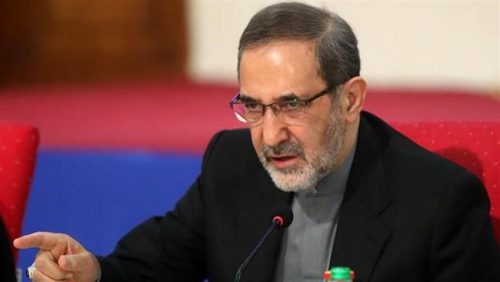
Ali Akbar Velayati, senior adviser to Leader of the Islamic Revolution Ayatollah Seyyed Ali Khamenei
A senior adviser to Leader of the Islamic Revolution Ayatollah Seyyed Ali Khamenei has warned of plots hatched by the US and its regional allies to divide the Middle East countries, saying such a move aims to safeguard the Israeli regime’s security.
“The Americans and some of their regional allies are trying to sow discord and break up the region and want to partition and weaken big, strong and ancient countries in the region in order to [ensure] Israel’s security and meet their own excessive demands,” Ali Akbar Velayati, the Leader’s top adviser on international affairs, said in a meeting with Mala Bakhtiar, chief of Executive Body of the Patriotic Union of Kurdistan (PUK), in Tehran on Tuesday.
The senior Iranian official stressed the importance of resisting such a malicious plot, saying that the enemies of Islam are committing crimes against oppressed nations in the region, including the Iraqis and Syrians, in the name of Islam by waging “proxy wars” and creating extremist and Takfiri terrorist groups.
Velayati added that plotters and reactionary countries in the region seek to sow discord among Muslim nations; however, regional people would certainly be the final victors.
He further pointed to the great cultural and religious commonalities between the Iranian and Iraqi people and said both countries give priority to the development of relations.
Bakhtiar, for his part, said the era of hegemony and arrogance is over and added that plotters would fail to achieve their divisive goals in the region.
The PUK official added that Iran is carrying out effective measures to promote regional peace and stability.
November 1, 2016
Posted by aletho |
Ethnic Cleansing, Racism, Zionism, Wars for Israel | Iran, Iraq, Israel, Middle East, Syria, Zionism |
Leave a comment
If Hillary Clinton hangs on to win the presidency, liberal Democrats have vowed to block her appointment of Wall Street-friendly officials to key Cabinet and sub-Cabinet jobs. But there has been little organized resistance to her choosing hawkish foreign policy advisers.
Indeed, Washington’s foreign policy establishment has purged almost anyone who isn’t part of the neoconservative/liberal-interventionist “group think.” That’s why pretty much everyone who “matters” agrees about the need to push around Russia, China, Syria, Iran, etc.
Reflecting that attitude, Sunday’s lead editorial in the neocon Washington Post hailed the broad consensus within the Establishment for more warlike actions once President Obama is gone, taking with him what the Post calls Obama’s “self-defeating passivity.”
The Post praised a new report from the liberal Center for American Progress which calls for bombing the Syrian military and getting tough to “counter Iran’s negative influence” in line with what all the neocons — as well as Israel and Saudi Arabia — want the next President to do.
The absence of any significant counter to this neocon/liberal-hawk “group think” represents one of the greatest dangers to the future of the human species, since this new hubris comes with a cavalier assumption that nuclear-armed Russia and China will simply accept humiliation dished out by the “indispensable nation.”
If they don’t, we can expect Official Washington to ratchet up tensions in a game of nuclear chicken with the expectation that the leaders in Moscow and Beijing will bow down to U.S. “exceptionalism’ and slink away with their tails between their legs.
Surely, that is what the armchair warriors at The Washington Post will demand and they have, of course, a spotless record of infallibility, such as their certainty that Iraq was hiding stockpiles of WMD in 2003. Editorial-page editor Fred Hiatt was so sure of that he wrote it as flat fact.
Given the Iraq War catastrophe and the failure to find the WMD, you might have assumed that Hiatt was summarily fired and has never worked in journalism again. But, of course, you’d be wrong. He is still the editorial-page editor of The Washington Post continuing to ladle out his extraordinary wisdom and brilliant insights.
The New McCarthyism
And, if you dare question those new certainties or note the risks of stumbling into a nuclear conflagration, the Post’s editorial pages label you a Moscow stooge repeating Russian propaganda.
That is what Post columnist Anne Applebaum wrote about Republican presidential nominee Donald Trump when he warned about the risks of World War III if a President Hillary Clinton starts shooting down Russian planes over Syria.
Rather than acknowledge the genuine risk of getting into a shooting war with Russia, neocon Applebaum declares such concerns unacceptable and offers a whiff of McCarthyism toward anyone who thinks such a thing.
“Why is Russian state media using such extreme language?” she asks darkly. “And why is Trump repeating it?”
Then, with the typical perceptiveness of a neocon ideologue, Applebaum determines that the Kremlin is warning its citizens about the growing risks of nuclear war to scare them into line amid a recession that the U.S. helped create as part of its “regime change” strategy to destabilize Russia by making its economy scream.
A thoughtful person might stop here and wonder if the use of economic sanctions and other means to destabilize nuclear-armed Russia is such a good idea, but no mainstream person is allowed to raise such questions inside Official Washington. That would just make you a Russian puppet, in Applebaum’s view.
Applebaum then rants on with some wild conspiracy theories about Russian plans to exploit the U.S. presidential transition:
“Whatever the outcome on Nov. 8, political uncertainty will follow: the months of transition, a change of White House staff, perhaps even the violent backlash that Trump may incite. This could be an excellent moment for a major Russian offensive: a land grab in Ukraine, a foray into the Baltic states, a much bigger intervention in the Middle East — anything to ‘test’ the new president.
“If that’s coming, Putin needs to prepare his public to fight much bigger wars and to persuade the rest of the world not to stop him. He needs to get his generals into the right mind-set, and his soldiers ready to go. A little nuclear war rhetoric never fails to focus attention, and I’m sure it has.”
Reckless Drivel
Perhaps the more immediate question here is why a major American newspaper runs such crazy and reckless drivel from one of its regular columnists. But the fact that the Post does so indicates how dangerous the moment is for humanity. For those of us who read the Post regularly, such insane rhetoric barely registers since we see similar nuttiness on a daily basis.
But the “group think” that the Post and other mainstream publications create and then enforce explains why there is such unity among the Establishment as it presses ahead with these dangerous policies in much the same manner that almost the same cast of insiders “group thought” their way into the disastrous Iraq War.
So, the wannabe insiders at the Center for American Progress and the more established pooh-bahs at the Brookings Institution and other preeminent think tanks know they have to promote “regime change” strategies and other forms of warmongering to appease Hiatt and his fellow neocon editorialists and columnists.
In Washington, this “group think” has moved beyond the usual careerist and conformist “conventional wisdom” into something more akin to totalitarianism, at least on foreign policy issues.
That is why it is hard to even come up with a list of sensible people who could survive the onslaught of character assassinations if they were to be proposed as senior advisers to a President Hillary Clinton.
That is also why the attention of progressives, such as Sens. Bernie Sanders and Elizabeth Warren, only on vetting domestic officials in a prospective Hillary Clinton administration is so insufficient.
If a hawkish President Clinton surrounds herself with like-minded neocons and liberal hawks, the costs of their warmongering would surely swallow up the tax dollars necessary for domestic priorities – on infrastructure, education, health care, the environment and other pressing concerns.
And, if the McCarthyistic intolerance of The Washington Post influences or infects her administration, the genuine risks of World War III will dwarf any other worries.
October 31, 2016
Posted by aletho |
Mainstream Media, Warmongering, Militarism, Timeless or most popular, Wars for Israel | Anne Applebaum, Hillary Clinton, United States, Washington Post |
Leave a comment

Britain’s then Foreign Secretary Philip Hammond boards a UK military ship docked in Manama, Bahrain, in November 2015.
The United Kingdom will open a massive permanent military base in Bahrain and deploy warships in the Persian Gulf, a new report has revealed.
The military base, which is the first such facility being opened by Britain in 40 years in the Persian Gulf region, will be launched next month, Britain’s Express newspaper reported on Saturday.
Britain will station around 600 military forces at the Royal Navy Facility and will deploy its warships to patrol the surrounding waters and guard oil and gas shipments in the waters.
The base located in Bahrain’s Mina Salman Port, will also be used by Special forces, Navy destroyers and frigates to launch operations against the Daesh takfiri terrorist group in the region, according to the report.
“The project could save the Ministry of Defense millions because they won’t have to travel back to the UK,” the newspaper quoted unnamed diplomatic sources as saying.
The base, which will be used as a weapons store, will allow Britain to take part in any possible emergency operation if any country tries to block UK commercial ships from passing through the Strait of Hormuz, said a navy source.
“If we miss out on too much oil and gas then the lights will start to go out,” the source added.
When Britain kicked off the project in 2014, Defense Secretary Michael Fallon described it as “a permanent expansion of the Royal Navy’s footprint” in the Persian Gulf.
“It will enable Britain to send more and larger ships to reinforce stability in the [Persian] Gulf,” he said.
Critics, however, raised concerns over the legality of the base, saying the project had not been discussed in Bahrain’s parliament.
Human rights campaigners criticized the plan at the time, arguing that the Royal Navy named HMS Juffair, is reminiscent of the colonial era because it’s named after a previous naval base, Britain maintained in the country during colonial times.
Opposition activists also said Britain’s move strengthens the ruling al Khalifa family which, has long been carrying out crackdown on human rights activists in the kingdom.
Scores of people have been killed and hundreds of others injured or arrested in the Bahraini crackdown on the anti-regime activists, who have been holding protests on an almost daily basis since February 14, 2011.
October 29, 2016
Posted by aletho |
Militarism, Wars for Israel | Bahrain, UK |
Leave a comment

 Aletho News
