Westerners’ minds disoriented with fake news on Syria: Anthony Hall
Press TV – December 14, 2016
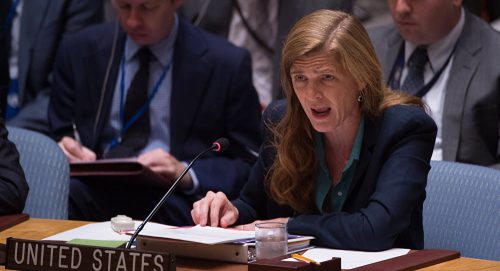
Russia’s UN Ambassador Vitaly Churkin has accused the United States, France and Britain of spreading fake news and and waging a psychological warfare over the situation in Syria’s Aleppo. The three countries have claimed that the Syrian government targeted civilians in eastern Aleppo, with US Ambassador to the UN Samantha Power accusing Syrian forces of killing some 80 civilians in the last few days.
Anthony Hall, editor-in-chief of the American Herald Tribune, believes Westerners’ minds are completely “disoriented” with a barrage of fake news, adding there has been an enormous psychological warfare campaign to totally confuse them about what is going on in Syria.
“And now in Aleppo we are presented with this image of rebels as if these are human rights activists who have just been standing there trying to bring about better human rights in Syria, ignoring the reality of this tremendous infusion of weaponry, of psychological warfare, of resources, Saudi Arabia’s role, Qatar’s role, NATO’s role in creating this whole confused situation in Syria,” he told Press TV on Wednesday.
By defeating the terrorists in Aleppo, he said, Russia demonstrated that the United States military campaign against Daesh is “phony”.
Less than a month ago, Syrian army forces, backed by Russian airstrikes, started a wholesale push to drive the militants out of their stronghold in the city’s eastern side, making great strides in the process.
Hall said there is overwhelming evidence that Daesh is a creation of the same process that created al-Qaeda and an extension of 9/11 wars.
According to the analyst, the “Angelo-American Zionist empire” is seeking to divide and break up the Middle East so that Israel can thrive and continue its expansionary policies towards a greater Israel.
Since March 2011, Syria has been hit by militancy it blames on some Western states and their regional allies. The Syrian Observatory for Human Rights and UN have put the death toll from the Syria conflict at more than 300,000 and 400,000, respectively.
US Mulls Pulling Out of Iran Deal
By Peter KORZUN | Strategic Culture Foundation | 06.12.2016
The US Senate voted on December 1 to extend the Iran Sanctions Act (ISA) giving the president the authority to impose sanctions on Iran for another decade. The bill had already passed the house of Representatives. The ISA was enacted in 1996 (as the Iran and Libya Sanctions Act), reauthorized in 2006 and 2011, and is set to expire on Dec. 31, if not renewed. GOP lawmakers have unanimously opposed the agreement. Some Democratic senators reconsidered their stances, expressing support for extending the presidential authority to counter Iran’s «aggressive behavior.» President Obama is not expected to veto the motion because the scale of support indicates a veto would be easily overridden.
The measure ensures that the president could easily restore the sanctions, if Iran breached the Joint Comprehensive Plan of Action (JCPOA). The deal reached in July 2015 required Iran to cap its nuclear program in exchange for lifting of sanctions against it.
Iran has complied significantly reducing its nuclear infrastructure. It’s important to note that the implementation of the JCPOA began January 16 after the UN’s International Atomic Energy Agency (IAEA) certified that Iran was meeting all its obligations under the deal. Other parties to the agreement – Russia, the UK, China, France, Germany and the European Union – have largely lifted the sanctions since the deal became effective. Non-nuclear sanctions have also been dropped, partially ushering Iran back into the global economy.
After taking office, Donald Trump may continue signing waivers to be reissued every 120 to 180 days or he may change the policy. The waiver related to nuclear sanctions remains in place under the reauthorized ISA but the deal is in jeopardy. US President-elect Donald Trump has said many times that he would scrap the nuclear agreement, calling it the «stupidest deal of all time». He said that dismantling it would be his «No. 1 priority» as president. The deal allows any of the countries that negotiated the deal to cancel it within 30 days, without a vote by the United Nations Security Council, if they flag a violation.
Non-nuclear sanctions related to terror-sponsorship, human rights abuses and ballistic missile activities are intended to remain in place under the JCPOA.
The GOP lawmakers support the idea of introducing new sanctions on Iran over human rights violations and terrorism, including the support of Hezbollah. Mitch McConnell, the Senate majority leader, calls for a review of the current policy on Iran.
Iran has threatened to resume its nuclear program if the bill goes through. The Iranian government described the Senate vote as a violation of the agreement. Iranian Supreme Leader Ayatollah Khamenei said recently the extension would be viewed in Tehran as a breach of the nuclear accord and threatened retaliation.
A US Senate vote to extend the Iran Sanctions Act (ISA) for 10 years shows the world that Washington cannot be relied upon to act on its commitments, said Iranian Foreign Minister Mohammad Javad Zarif. Iranian lawmakers said they want to introduce a measure to make the government resume nuclear activity.
Indeed, the prospect of US ultimate withdrawal from the JCPOA is not to be taken lightly. Congress can vote to reintroduce sanctions not waived or vetoed by the new president. President Trump may not renew waivers. The US could merely declare that Washington was no longer bound by the non-binding multilateral agreement based on the UN Security Council resolution. The United States can sneak out of the deal if the Congress overrides a presidential veto of a joint congressional resolution disapproving the JCPOA.
The consequences of Congress stopping the deal would be grave. The deal has the support of European parties to the JCPOA. The US will face a big problem trying to bring them to its side. If not, some sanctions will remain lifted and the West’s unity will be broken. It would put into question the ability of the United States to lead the reshaping of the world order on Western terms, by alienating Washington’s European allies. The move will rob Europe of any illusions about their ally at a time when support for the US is already low. The EU will face a big challenge trying to convince the US and Iran not to leave. It will have a slim chance to succeed.
Russia and China will adhere to the JCPOA provisions. Defying other global powers will make Washington the odd man out while the rest of the world would continue to trade with Iran.
Slate cites Jeffrey Lewis, an expert on nuclear nonproliferation at Middlebury College and founder of the Arms Control Wonk blog, who says, «If the unity of the countries that negotiated the deal falls apart, all of the safeguards that the IAEA has put in place under the deal will go away.» According to him, «The IAEA access will drop, and they will say that they are no longer in a position to verify the peaceful nature of Iran’s program. They just won’t have the access. You could end up with a situation in which there are no sanctions, and we have no idea whether they’re building a bomb or not. And by the time we figure it out, it might be too late.»
As a party to the Iran deal talks, Russia is a member of the Joint Commission established to monitor the implementation of the agreement and resolve any disputes that may emerge. As such, it can influence the process of compliance. Moscow has the right to co-decide on the sanctions imposed by the Security Council and the unilateral sanctions adopted by the United States. This right is envisioned by the JCPOA.
No matter what the US does, Russia retains the right to export weapons to Iran on condition that contracts are reported to and verified by the UN Security Council. It has already sold S-300 air defense systems to Tehran.
A decision to tear up the deal will most certainly provoke Iran into reviving its nuclear weapons [sic] program. It could lead to a regional arms race. Saudi Arabia has already made known its intention to acquire nuclear capability. Israel – a US skittish regional ally – may consider striking Iran – a decision fraught with grave implications.
Donald Trump has said many times his prime goal in the Middle East is ousting Islamic State (IS). This stance has vast support in Congress. Iran is a member of the coalition fighting the extremist group. If the US joins Russia in fighting IS – something the US president-elect said many times he wanted to do – it will need Tehran onside.
* * *
The US Congress has taken a step to destroy a deal enshrined in a United Nations resolution. «Say goodbye to the Iran deal», said Richard Nephew, a former US negotiator with Iran now at Columbia University. «There is very little likelihood that it stays, either because of a deliberate decision to tear it up by Trump, or steps that the US takes which prompt an Iranian walk back.»
The move entails harsh consequences. The Senate vote has undermined the US credibility as a reliable partner. Some of them mentioned above definitely prove that Congress does a disservice to its country reducing its national security and international standing.
Will America’s War with Iran Continue?
By Donald Liebich | American Herald Tribune | December 2, 2016
The United States has been at war with Iran for over thirty five years. Sometimes the war has been hot, sometimes cold, sometimes overt, and sometimes covert. Throughout this time period relations between the two countries have been hostile with very little diplomatic contact between officials of the two governments. In 2008, Barack Obama ran against Hillary Clinton on a platform of diplomatic engagement with Iran in opposition to her statements of being able to “totally obliterate Iran”.
Upon entering office, Obama, continuing America’s penchant for coercive diplomacy, doubled down on sanctions against Iran hoping that by causing economic hardship for ordinary Iranians he could pressure Iran to change its policies, particularly with respect to the development of nuclear capabilities. The strategy failed as Iran not only continued its peaceful nuclear development, but in many ways accelerated it. By his second term Obama, prioritizing addressing the nuclear proliferation issue, began negotiations with Iran on the nuclear issue in conjunction with Germany, France, United Kingdom, Russia and China. (EU3 + 3) The negotiations resulted in the signing in July 2015 of the Joint Comprehensive Plan of Action (JCPOA) which limited Iran’s nuclear program in return for removal of economic sanctions. The agreement was endorsed by the UN Security Council in an action that requires member states to carry out the agreement.
The International Atomic Energy Agency (IAEA) has affirmed on numerous occasions that Iran has largely lived up to its obligations under the JCPOA. Obama has taken some executive action to live up the JCPOA by loosening the impact of the sanctions. The administration has approved the sale of aircraft and aircraft parts to Iran by Boeing and this week the US approved a license for Airbus to sell over 100 aircraft to Iran. However, the basic legal structure of sanctions remains in place. Obama has not moved as aggressively as he did in Cuba to increase U.S. business involvement in Iran, a step which would make the nuclear deal more difficult to reverse by engaging the business lobby in the issue.
With the current sanctions authorization legislation set to expire on December 31, 2016, House of Representatives and the Senate passed the Iran Sanctions Extension Act by an overwhelming majorities (419 -1 and 99-0). Opponents of the JCPOA in the U.S. have argued in justifying this action, which is a clear violation of the JCPOA, that Iran has engaged in other “nefarious” activities, such as supporting the Assad in Syria, supplying arms to Hezbollah in Lebanon and the Houthi tribe in Yemen, developing ballistic missiles and in general resisting U.S. influence in the Middle East. The Senate has said that it will take up this bill in the rump session of Congress in December. Although Obama has indicated that he will veto the bill, the bipartisan support in Congress for sanctions extension means that a veto override is likely. Obama’s best option for preserving the nuclear deal is to fight a delaying action to “kick the can” down the road to the next administration where a Republican controlled Congress may be reluctant to create a big foreign policy problem for President Trump so early in his administration.
As on many issues, it is unclear what President Trump’s position will be on the JCPOA. During the campaign he condemned the JCPOA as a “horrible contract”, but acknowledging that it was a contract, vowed to renegotiate it. Renegotiating the agreement is probably not possible. The JCPOA is the result of complicated, intertwined negotiations over a long period of time. Reopening talks in an atmosphere of mistrust and recriminations likely means that the whole agreement would collapse. A number of senior Congressmen and potential officials in a Trump led government, having received large speaking fees, are closely tied with the Mujahidin-e-Khalq (MEK), an exiled Iranian opposition group with an odd Islamist/Marxist ideology. The MEK, having allied with Saddam Hussein during Iran-Iraq war, has the distinction of being more unpopular in Iran than the U.S. They will push a hard line approach under a Trump administration..
The agreement, however, is not totally dependent on the U.S. Even if the U.S. withdraws from the agreement, Iran, under the administration of President Hassan Rouhani, and Russia, China and the EU have indicated that they will continue to abide by it. As it has in the past, the U.S. will likely use secondary sanctions on European companies to deter them from conducting business with Iran. This strategy will probably not be effective with Russia, India and China who have taken steps to disconnect their economy from the U.S. dominated and dollar denominated neo-liberal economic system. It remains to be seen how U.S. allies in Europe will react to being pressured to act against their own national interest.
The political situation in Iran will also have an influence on how U.S./Iran relations play out. Supreme Leader Ali Khamenei has said that if sanctions are extended Iran will “respond”. What the response will look like depends, in large measure, on the outcome of the May 2017 presidential elections. Incumbent President Rouhani has maintained a position that engagement with the West will benefit Iran diplomatically and economically. Because sanctions have, in large measure, remained in place and because Iran has been slow to reform its economic system, the benefits have not met public expectations. The opposition have attacked the policy of engagement with the West. Faced with these political threats, Rouhani may be forced to tack to the right and abandon the JCPOA, kick out the IAEA inspectors and expand the nuclear program. In that case the undeclared war with Iran will continue with all of the uncertainties and potential for disastrous consequences.
Don Liebich spent his work career with the US Navy Nuclear Submarine service and Sysco Corp. He and his wife, Marcia, have traveled to the Middle East numerous times in the past ten years. Mr. Liebich has conducted seminars and taught courses on Islam: God and his Prophet, Christian Fundamentalisms, US Middle East foreign policy and Iran. Don & Marcia live in Hailey, ID.
Iranophobes on Parade
Will Iran be the target of the Trump regime?
By Philip Giraldi • Unz Review • November 29, 2016
One of the most discouraging aspects of the filling out of the Donald Trump cabinet is the array of Iran haters that seem to be lining up in the foreign policy and national security areas. Trump has been personally advocating sensible policies relating to Russia and Syria but he appears to have gone off the rails regarding Iran, which just might be attributed to those who are giving him advice. A reversion to the relationship that prevailed prior to last year’s signing of the Joint Comprehensive Plan of Action (JCPA) between Iran and the so-called P5+1 consisting of the United States, Russia, China, France, Britain, and the European Union would be undesirable, to say the least, but that appears to be what is likely to develop. Or it could be even worse, finding bilateral support for “action” as a number of policy advisors in the presidential campaign from both parties were endorsing something like war against the Persians.
The irony is that the arguments made then and now for attacking Iran were based on the threat of Tehran deciding to build its own atomic bomb. With the JCPA agreement, however, most would agree that any remaining concerns that Tehran might even be considering the development of a nuclear weapons program were greatly diminished. Iran has since that time been in compliance with the agreement, possible nuclear proliferation has been avoided, and, apart from the fulminations of the inevitable anti-Iranian politicians in the United States, the signatories to the agreement have expressed their satisfaction with the outcome. It has been Washington that has failed to live up to its part of the agreement by easing remaining restrictions that are being imposed against Iranian financial institutions and regarding the purchase of some commercially available dual use technologies.
Candidate Donald Trump did not need much prompting to pick up on the prevailing anti-Iran sentiment. In a number of campaign speeches he denounced the JCPA as a bad deal and vowed to tear it up upon taking office. Some of that sentiment might well have been derived from his desire to distance himself from foreign policy positions promoted by President Barack Obama that were subsequently endorsed by Hillary Clinton so it is no surprise that since being elected he has somewhat modified his stance. He is now veering towards trying to renegotiate the agreement, which would likely be impossible given that it has multiple signatories. He could nevertheless disrupt it by continuing or increasing sanctions on Iran.
The thought of reverting to a state of unrelenting hostility towards Iran is disconcerting. One recalls joint CIA-Mossad operations between 2010 and 2012 that assassinated four civilian scientists connected to the country’s nuclear program as well as the creation of the Stuxnet virus that threatened to spread to other computers worldwide. It is generally accepted that Israel’s Mossad planned and prepared the killing of the scientists with a little help from the U.S., attacks which were almost certainly carried out by associates of the radical Marxist group Mujaheddin e Khalq (MEK), which is now being seen favorably by several Trump advisors even though the group is Marxist, cult-like and has killed Americans.
The assassinations were based on the false premise that Iran had a nuclear weapons program that could be disrupted by killing the scientists and technicians involved. Two comprehensive studies by the American government’s Central Intelligence Agency (CIA) conducted in 2007 and 2011 determined that no such program existed and that Iran had never taken any serious steps to initiate such research. Israel was also aware that there was no program. Nevertheless, the Israeli and American governments took steps to interfere with Iran’s existing and completely legal and open to inspection atomic energy program by identifying then killing its scientists and also introducing viruses into its computer systems. This was in spite of the fact that Iran was fully compliant with international norms on nuclear research and it was a signatory to the Nuclear Non-Proliferation Treaty (NPT), which Israel, possessing its own nuclear arsenal, had refused to sign.
The history of the Iran-U.S. relationship is significant because several Trump advisors appear to be locked into a time warp regarding the Mullahs and the threat to Americans that they allegedly constitute. Former Defense Intelligence Agency (DIA) head Michael Flynn, who will be the Trump National Security Advisor, is the most prominent Iran hater and also the most outspoken.
Flynn, also an unapologetic Islamophobe, has said that Iran represents a danger to U.S. national security and that our friend and ally Israel “lives under the threat of total annihilation from Iran… something the United States must never allow.” He believes that Iran intends to build nuclear weapons as well as the ballistic missiles needed to deliver them on target and thinks that “regime change” is the only solution to the threat posed by the current government. And for Flynn, Iran is not alone, it is part of a “global alliance” that includes China and Russia which seeks to threaten the U.S. and its allies.
Flynn concludes that Iran is unmitigated evil and that Washington should have nothing to do with it, apart from recognizing the reality that it and its government must be destroyed. I personally attended a conference in Moscow last December at which Flynn asserted that Iran is solely responsible for nearly all the instability in the Middle East and is behind at least five wars in the region, an assertion that is just as ridiculous as it sounds.
One might suggest that Flynn is terribly uninformed about a subject regarding which he claims expertise. His comments would suggest that the capabilities of the DIA that he once headed were dangerously overrated, but reports from his former colleagues indicate that he was always guilty of serious overreach in his pronouncements, something they referred to as “Flynn facts”.
If Flynn were just one loud voice braying in the wilderness he would be bad enough since his job is important, particularly with a president who has no foreign policy experience, but the sad fact is that he is not alone. Congressman, West Point grad and former Army officer Mike Pompeo, who will head the CIA, is more-or-less on the same page when it comes to Iran. He supports new sanctions on the country and, regarding his appointment as Director, he had only one comment to make and it related to the JCPA, “I look forward to rolling back this disastrous deal with the world’s largest state sponsor of terrorism.” As in the case with Flynn and DIA one has to wonder what kind of “objective” intelligence CIA will be producing under Pompeo.
Finally, there is retired Marine General James Mattis, who is being considered for a senior position in national security, possibly as Secretary of Defense. He is yet another Iranophobe who opposed the JCPA and calls Iran a rogue state that constitutes the “greatest threat” in the Middle East. As part of the evidence for that assessment he cites Iran’s alliance with Syria, which is at least in part directed against America’s enemy number one ISIS, demonstrating once again how Establishment Washington has difficulty in understanding what constitutes actual national interests. Mattis, in fact, denies that Iran is actually fighting ISIS.
The neoconservative kingpin Bill Kristol is gloating, headlining in his Weekly Standard publication that the “Iran Deal Is Doomed!” He should be pleased. Team Trump’s attitude towards an alleged Iranian threat is delusional, more in sync with Kristol and some Israeli thinking than with any actual American interests. Just as neoconservatives always believe that it is 1938 and we are in Munich, Flynn, Pompeo and Mattis likewise seem to think that it is 1979 and the United States Embassy in Tehran is still occupied.
The three Trumpsmen are not stupid, far from it, but the problem appears to be that they cannot comfortably assess two or more conflicting concepts at the same time, which might be due to the linear thinking derived from their military backgrounds. The Middle East is awash with players, all of whom have separate agendas, few of which coincide with actual American interests. If one is fixated on or obsessed with Iran as the sole disruptive force in the region it becomes difficult to see how Saudi Arabia, Turkey and Israel are also problems. It is decidedly neoconnish to look at a complex foreign policy issue and only see black and white, but that is what the Trump national security team seems to be prone to do.
Hopefully someone will convince Donald Trump that the real answer to eliminating the “Iranian threat” is not war. It requires building on the relationship established by JCPA to bind Iran more closely to the international community, both economically and culturally. By all accounts, young Iranians, a majority of the population, are dismissive of the rigidity of their own government and are very open to Western ideas and lifestyle. Change will come to Iran if the United States and its European allies encourage more rather than less non-threatening contact. It will not come at the point of a bayonet as Flynn, Pompeo and Mattis appear to be promoting.
Israeli military court jails two Syrians for blocking ambulance carrying Nusra militants
Press TV – November 25, 2016
An Israeli court has handed down prison sentences to two Syrians living in the occupied Golan Heights for blocking an Israeli ambulance transporting militants operating in Syria for treatment.
The military court on Thursday sentenced Amal Abu Saleh to seven years and eight months in jail and a fine of more than 3,000 dollars, Syria’s official news agency SANA reported.
Bashira Mahmoud, the other Syrian, was sentenced to 22 months in prison. She was also fined 1,000 dollars.
According to the report, Israeli forces arrested the two along with 24 others in June 2015, when residents of the village of Majdal Shams blocked the ambulance and prevented it from transporting two injured terrorists with the Takfiri Jabhat Fateh al-Sham militant group, formerly known as al-Nusra Front.
The Israeli regime later released the detainees except the two. Bashira has been under house arrest since July 2016.
Sheikh Nazih Abu Saleh, Amal’s uncle, said the court ruling was “hostile.” He added that the residents of the occupied Golan Heights have the right to block the transport of al-Nusra terrorists for treatment in Israeli hospitals.
Ahmed Sheikh Abdul Qader, the governor of the city of Quneitra in southwestern Syria that borders Golan, slammed the “provocative” court ruling, calling on human rights organizations to force the Israeli regime to release Syrians held in its prisons.
Syria says Israel and its Western and regional allies are aiding Takfiri terrorist groups operating inside the Arab country.
In December 2015, the Daily Mail said the Israeli regime had saved the lives of over 2,000 Takfiri militants at the cost of about 13 million dollars since 2013.
The Syrian army has several times seized huge quantities of Israeli-made weapons and advanced military equipment from the foreign-backed militants inside Syria.
In February 2014, photos of Israeli Prime Minister Benjamin Netanyahu were released, showing him visiting injured militants at a field hospital in Israel.
Congressional Hawks Rush to Intensify War in Syria
By Rick Sterling | Dissident Voice | November 21, 2016
Hawks pass HR5732
Late in the day Tuesday November 15, Congress convened in special session. With normal rules suspended, they passed House Resolution 5732 the “Caesar Syria Civilian Protection Act”. The resolution calls for intensifying already harsh sanctions on Syria, assessing implementation of No Fly Zone in Syria and escalating efforts to press criminal charges against Syrian officials. HR5732 claims to promote a negotiated settlement in Syria but, as analyzed by Friends Committee for National Legislation, imposes preconditions which would actually make that more difficult.
There was 40 minutes of “debate” with six representatives (Royce, Engel, Ros-Lehtinen, Kildee, Smith, and Curbelo) speaking in favor of the resolution. There were few other Congressional representatives present in Congress. The House Foreign Affairs Committee stated that the resolution was passed “unanimously” without mentioning the special conditions.
The “Non Controversial” Resolution that could lead to World War III
According to wikipedia “Suspension of the rules is a procedure generally used to quickly pass non-controversial bills in the United States House of Representatives …. such as naming Post Offices…” In this case, the resolution calls for evaluating and developing plans for a “No Fly Zone” which is an act of war. This is obviously controversial and it seems clear the resolution should have been debated and discussed under normal rules with a normal amount of Congressional presence and debate.
The motivation for bypassing normal rules and rushing the bill through without debate was articulated by the bill’s author and ranking Democrat Eliot Engel: “We cannot delay action on Syria any further…. if we don’t get this legislation across the finish line in the next few weeks, we are back to square one.” The current urgency may be related to the election results since Trump has spoken out against “regime change” foreign policy. As much as they are critical of Obama for not doing more, Congressional neoconservatives are concerned about the prospect of a President who might move toward peace and away from war.
The Caesar Fraud
HR5732 is titled the “Caesar Syria Civilian Protection Act”. Foreign Affairs Committee Chair Ed Royce (R-Ca) explained that the resolution is named after “the brave Syrian defector known to the world as Caesar, who testified to us the shocking scale of torture being carried out within the prisons of Syria.”
In reality, the Caesar story was a grand deception involving the CIA with funding from Qatar to sabotage the 2014 Geneva negotiations. The 55,000 photos which were said to show 11,000 torture victims have never been publicly revealed. Only a tiny number of photos have been publicized. However, in 2015 Human Rights Watch was granted access to view the entire set. They revealed that almost one half the photos show the opposite of what was claimed: instead of victims tortured by the Syrian government, they actually show dead Syrian soldiers and civilian victims of car bombs and other terror attacks! The “Caesar” story, replete with masked ‘defector’, was one of the early propaganda hoaxes regarding Syria.
False Claims that the US has been doing nothing
One of the big lies regarding Syria is that the US has been inactive. Royce says:
The administration has decided not to decide. And that itself, unfortunately, has set a course where here we sit and watch and the violence only worsens. Mr. Speaker, America has been sitting back and watching these atrocities for far too long. Vital U.S. national security interests are at stake.
The ranking Democrat Eliot Engel said:
Four years ago I thought we should have aided the Free Syrian Army. They came to us in Washington and begged us for help… they were simply looking for weaponry. I really believe if we had given it to them, the situation in Syria would have been different today.
This is nonsense. The US was actively coordinating, training and supplying armed opposition groups beginning in late 2011. When the Qadaffi government was toppled in Fall 2011, the CIA oversaw the theft of the Libyan armories and shipment of weapons to Syrian armed opposition as documented in the Defense Intelligence Agency report of October 2012.
These weapons transfers were secret. For the public record it was acknowledged that the US was supplying communications equipment to the armed opposition while Saudi Arabia and Qatar were supplying weaponry. This is one reason that Saudi purchases of weapons skyrocketed during this time period; they were buying weapons to replace those being shipped to the armed opposition in Syria. It was very profitable for US arms manufacturers.
Huge weapons transfers to the armed opposition in Syria have continued to the present. This past Spring, Janes Defense reported the details of a U.S. delivery of 2.2 million pounds of ammunition, rocket launchers and other weaponry to the armed opposition.
Claims that the US has been inactive are baseless. In reality the US has done everything short of a direct attack on Syria. And the US military is starting to cross that barrier. On September 17 the US air coalition did a direct attack on the Syrian Army in Deir Ezzor, killing 80 Syrian soldiers and enabling ISIS to launch an attack on the position. Claims that it was a “mistake” are highly dubious.
The claims by Congressional hawks that the US has been ‘inactive’ in the Syrian conflict are part of the false narrative suggesting the US must “do something” which leads to a No Fly Zone and full scale war. Ironically, these calls for war are masked as “humanitarian”. And never do the proponents bring up the case of Libya where the US and NATO “did something”: destroyed the government and left chaos.
Congress as a Fact-Free House of Propaganda
With only a handful of representatives present and no debate, the six Congress members engaged in unrestrained propaganda and misinformation. The leading Democrat, Eliot Engel, said “We’re going into the New Year 2017, Assad still clings to power, at the expense of killing millions of his citizens.” That number is way off anyone’s charts.
Rep Kildee said “The world has witnessed this terrible tragedy unfold before our eyes. Nearly half a million Syrians killed. Not soldiers – men, women, children killed.”
The official text of the resolution says,
It is the sense of Congress that–
(1) Bashar al-Assad’s murderous actions against the people of Syria have caused the deaths of more than 400,000 civilians…
The above accusations – from “millions of citizens” to “half a million” to “400,000 civilians” – are all preposterous lies.
Credible estimates of casualties in the Syrian conflict range from 300,000 to 420,000. The opposition supporting Syrian Observatory for Human Rights estimates the documented 2011-2016 death toll as follows:
killed pro Syrian forces – 108,000
killed anti government forces – 105,000
killed civilians – 89,000
In contrast with Congressional and media claims, civilians comprise a minority of the total death count and the largest casualty group is those fighting in defense of the the Syrian state. These facts are ignored and never mentioned because they point to the reality versus the propaganda narrative which allows the USA and allies to continue funding terrorism and a war of aggression against Syria.
The Congressional speakers were in full self-righteous mode as they accused the Syrian government of “committing crimes against humanity and war crimes against civilians including murder, torture and rape. No one has been spared from this targeting, even children.” A naive listener would never know that the Syrian government is primarily fighting the Syrian branch of Al Qaeda including thousands of foreigners supplied and paid by foreign governments.
The Congressional speakers go on to accuse the Syrian military of “targeting” hospitals, schools and markets. A critical listener might ask why they would do that instead of targeting the Al Qaeda terrorists and their allies who launch dozens and sometimes hundreds of hell cannon missiles into government held Aleppo every day.
The Congressional propaganda fest would not be complete without mention of the “White Helmets.” House Foreign Affairs Committee Chairman Ed Royce said:
We (previously) heard the testimony of Raed Saleh of the Syrian White Helmets. These are the doctors, nurses and volunteers who actually, when the bombs come, run towards the areas that have been hit in order to try to get the injured civilians medical treatment… They have lost over 600 doctors and nurses.
This is more Congressional nonsense. There are no nurses or doctors associated with the White Helmets. The organization was created by the USA and UK and heavily promoted by a “shady PR firm.” The White Helmets operate solely in areas controlled by Nusra and associated terrorist groups. They do some rescue work in the conflict zone but their main role is in the information war manipulating public opinion. The White Helmets actively promote US/NATO intervention through a No Fly Zone. Recently the White Helmets has become a major source of claims of innocent civilian victims in east Aleppo. Given the clear history of the White Helmets, these claims should be treated with skepticism. What exactly is the evidence? The same skepticism needs to be applied to video and other reports from the Aleppo Media Center. AMC is a creation of the Syrian Expatriates Organization whose address on K Street, Washington DC indicates it is a US marketing operation.
What is really going on?
The campaign to overthrow the Syrian government is failing and there is possibility of a victory for the Syrian government and allies. The previous flood of international jihadi recruits has dried up. The Syrian Army and allies are gaining ground militarily and negotiating settlements or re-locations with “rebels” who previously terrorized Homs, Darraya (outer Damascus) and elsewhere. In Aleppo the Syrian army and allies are tightening the noose around the armed opposition in east Aleppo.
This has caused alarm among neoconservative lawmakers devoted to Israel, Saudi Arabia and U.S. empire. They are desperate to prevent the Syrian government from finally eliminating the terrorist groups which the West and allies have promoted for the past 5+ years.
“Pro Israel” groups have been major campaigners for passage of HR5732. The name of Simon Wiesenthal is even invoked in the resolution. With crocodile tears fully flowing, Rabbi Lee Bycel wrote “Where is the Conscience of the World?” as he questioned why the “humanitarian” HR5732 was not passed earlier.
Israeli interests are one of the primary forces sustaining and promoting the conflict. Syria is officially at war with Israel which continues to occupy the Syrian Golan Heights; Syria has been a key ally of the Lebanese resistance; and Syria has maintained its alliance with Iran. In 2010 Secretary of State Clinton urged Syria to break relations with Hezbollah, reduce relations with Iran and come to settlement with Israel. The Syrian refusal to comply with these Washington demands was instrumental in solidifying Washington’s hostility.
Congressional proponents of HR5732 make clear the international dimension of the conflict. Royce explains “It is Russia, it is Hezbollah, that are the primary movers of death and destruction… it is the IRGC fighters from Iran.” Engel echoes the same message: “Yes, we want to go after Assad’s partners in violence… along with Iranian and Hezbollah forces”.
These statements are in contrast with the analysis of some writers who believe Israel is not deeply opposed to the Damascus government. For example, Phyllis Bennis recently wrote that belief in an “arc of resistance” has been “long debunked” and that “the Syrian regime …. often plays a useful role for US and Israeli interests.”
It’s remarkable that this faulty analysis continues to be propounded. In words and deeds Israel has made its position on Syria crystal clear. Israeli Ambassador Michael Oren explained in an interview:
We always wanted [President] Bashar Assad to go, we always preferred the bad guys who weren’t backed by Iran to the bad guys who were backed by Iran … the greatest danger to Israel is by the strategic arc that extends from Tehran, to Damascus to Beirut. And we saw the Assad regime as the keystone in that arc.
These statements have been fully backed up by Israeli actions bombing Syrian positions in southern Syria and providing medical treatment for Nusra/Al Qaeda and other armed opposition fighters.
What Will Happen Now?
If the Syrian government and allies continue to advance in Aleppo, Deir Ezzor, outer Damascus and the south, the situation will come to a head. The enemies of Syria – predominately the USA, Gulf Countries, NATO and Israel – will come to a decision point. Do they intervene directly or do they allow their regime project to collapse?
HR5732 is an effort to prepare for direct intervention and aggression.
One thing is clear from the experience of Libya: Neoconservatives do not care if they leave a country in chaos. The main objective is to destabilize and overthrow a government which is too independent. If the USA and allies cannot dominate the country, then at least they can destroy the contrary authority and leave chaos.
What is at stake in Syria is whether the USA and allies Israel, Saudi Arabia, etc. are able to destroy the last secular and independent Arab country in the region and whether the US goal of being the sole superpower in the world prevails.
The rushed passing of HR5732 without debate is indicative that:
* “regime change” proponents have not given up their war on Syria
* they seek to escalate US aggression.
* the US Congress is a venue where blatant lies are said with impunity and where violent actions are advanced behind a cynical and amoral veneer of “humanitarianism” and crocodile tears.
Rick Sterling is an investigative journalist and member of Syria Solidarity Movement. He can be reached at rsterling1@gmail.com.
Draining the Swamp at State
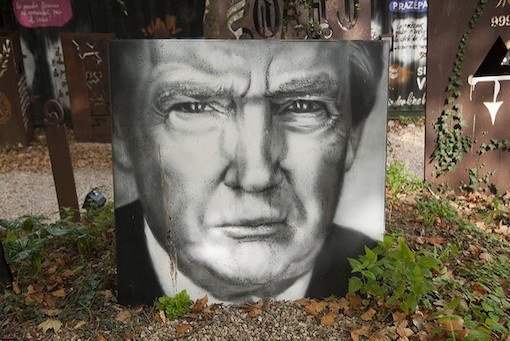
Photo by thierry ehrmann | CC BY 2.0
By Renee Parsons | CounterPunch | November 22, 2016
If there is one hopeful sign in the Presidency of Donald Trump, it is his pledge to ‘drain the swamp’ as it relates to those special insider interests who run the show and those outsider interests who own the show.
It is a hugely ambitious task and hardly achievable in four short years but there is a branch of the Federal government where the President-elect (PE) would find immediate results and bring the satisfaction that American foreign policy would no longer be dependent on globalization or spreading unwinnable wars on wasteful adventurism overseas. If the PE is, in fact, favorable towards a non-interventionist role, the opportunity for a thorough housecleaning and a reshape of the State Department is Now. According to current reports, the struggle is underway within the transition team for the soul of the State Department and ultimately the Trump Administration.
As HRC continued her crazed war talk about Syria and defended NATO encroachment on Russian borders while uttering unprovoked attacks on Russian President Vladimir Putin, there was every reason to believe that minutes after concluding her inaugural address, HRC would have walked off the stage and signed the order initiating a No-Fly Zone over Syria, right then and there. And bingo-bango-bongo, Putin would have responded. I knew it as sure as I know my own name. At some point it became clear, as Green Party candidate Jill Stein said so precisely, HRC would be more dangerous than Donald Trump.
Even as he talked about modernizing the US military, Trump’s campaign rhetoric about disentangling from foreign entanglements, making NATO nations pay their fair share and dialogue with Putin rather than the usual “Blame it on the Russians” bombast, struck a chord; there was reason for hope. Unlike Bernie Sanders who has proven to be just another Democrat, Trump dared to question whether there were any ‘moderate’ rebels (aka terrorists) in Syria, the mythical existence of which justified the Obama administration’s lust to overthrow the Assad government. Trump’s positions, limited elucidation though there was, were always far more reasonable than HRC’s inflammatory saber rattling and aggressive militarism that stirred justified fears of WW III. If anyone bothered to listen, Trump was voicing foreign policy concerns that not one Democrat in Congress has dared to articulate in the last eight years.
While I am in the ‘wait and see’ category of pragmatists regarding the PE, I agree with Robert Parry’s point that Trump has the opportunity to be a truly great president IF, and it’s a big IF, he uses his inner grit and a street savvy to break the globalist/neoliberal/neocon stranglehold (with its links to shadow government) on foreign policy at the State Department, a concept that President Barack Obama never understood or even aspired to. The PE appointment for Secretary of State which is currently an intense subject of debate within the transition will indicate which direction the PE will take US foreign policy.
In the early days after the election Trump communication advisor Jason Miller offered reassurance with the following:
“There will be non-traditional names, a number of people who have had wide-ranging success in a number of different fields; wide-ranging success in business … People will be excited when they see the type of leaders the President-elect brings into this administration.”
One not so non-traditional and not so exciting appointment is that of Rep. Mike Pompeo (R-KS), a member of the House Intelligence Committee and the Select Committee on Benghazi, as Director of the CIA. Pompeo, who graduated first in his class at West Point and then Harvard Law School and was a backer of Sen. Marco Rubio (R-Fl) during the primaries, would hardly qualify as anything more than the ‘same old’ school of CIA Directors that have dominated the agency for decades under the Republicrats. Pompeo, known as a rabid political ideologue, is not expected to break with the past and can be expected to continue the agency’s widespread unconstitutional violations with an unabashed torture program as if that ever revealed reliable ‘actionable intelligence’ or curtailed dedicated terrorists. So what message does that appointment send?
During their interview, it would be interesting to know if there was discussion that PE Trump’s opposition to the Iran nuclear treaty has been largely based on non-inclusive trade concerns. If, in fact, the PE’s view of foreign policy includes trade as a legitimate tool for negotiations, the House of Representatives recent party-line vote in rejection (a plum for Israel) of the sale of Boeing and Airbus commercial jets to Iran would be considered a diplomatic setback (under a Trump Administration).
Yet to be determined is whether Trump will roll over and appoint his good friend Rudy Giuliani who has no diplomatic experience whatsoever to qualify him and will inevitably be utterly lost in the State Department’s bureaucracy and political snake pit – or will the President-elect allow himself to be pressured to accept former Bush UN Ambassador, the wacky conniving John Bolton who will owe his allegiance to the professional warmongering neocons. Sen. Rand Paul (R-SC) who frequently shows some good Libertarian common sense on foreign policy issues, has announced his intention to block either nomination.
While former Presidential candidate Mitt Romney who has been recently added to the list for Secretary of State would add a certain gravitas, he is another not non-traditional name with little first hand, on the ground knowledge of today’s foreign policy complexities. More importantly, does Romney know how to clean house?
As soon as the votes were counted, certain neo-cons jumped Clinton’s sinking ship without so much as a fond adieu and, being shy, retiring types, sought to elbow their way onto the Trump Ship of State. More recently, Eliot Cohen’s attempts at a tryst soured as he expressed displeasure after having ‘made the case that young conservatives should volunteer to serve” now concluded he ‘was wrong’.
Other neo-con names floating as transition team members have been the especially slimy, Richard Perle known appropriately as the Prince of Darkness, foreign policy analyst Michael Ledeen who supports the use violence to spread democracy and noted Islamaphobe Frank Gaffney, who denied he was on the transition team and had ever been contacted.
If the PE and his closest aides are naïve enough to believe that a conciliatory gesture will engender cooperation from the foreign policy establishment, they are woefully misguided. If Trump fails to rein in the neocons and war hawk neolibs (including assistant secretaries, deputy assistant secretaries and lower level staff) with dispatch, they will quickly discover that if you get into the swamp with alligators, you had better be prepared to wrestle alligators.
At the same time, the reality is that the estimated hundreds of embedded neocons and neolibs at State have the potential, as they clean out their desks, to pilfer (an ultra serious legal violation) the last decade worth of top secret and confidential memos, notes and reports, contacts and network names and other vital information necessary for the transition of foreign policy to the Trump administration. It would not be surprising for a situation to develop similar to some months ago when fifty plus State mid level careerists ‘leaked’ an internal memo criticizing President Obama’s policy on Syria without any apparent repercussions. If the Trump Administration takes foreign policy in a new, improved direction, how will the new President deal with being subtly, or not so subtly, undermined by his own staff? There is no reason to believe that the most virulent elements of the US foreign policy establishment closely tied to Israel will ‘go quietly into that good night.’
Less than a week after the election, PE had his first phone conversation with Putin and they reportedly talked extensively about Syria and promised a face-to-face in the near future. Moscow reported that Putin told Trump he was ready for “dialogue of partnership based on principles of equality, mutual response and non-interference in the internal affairs of each other.” The Trump transition team statement said that the PE told Putin ‘he is very much looking forward to having a strong and enduring relationship with Russia and the people of Russia” which is considerably more encouraging than what HRC would have told Putin if she had been elected.
In a Wall Street Journal interview three days after the election, Trump suggested a shift from Obama’s foreign policy objectives regarding support for the Syrian opposition and its insistence on ousting Syrian president Bashar al Assad. “We’re backing rebels against Syria and we have no idea who these people are.”
Not unexpectedly, Trump named retired Lt. Gen. Michael Flynn, former director of the Defense Intelligence Agency (2012-2014), as his National Security Adviser succeeding Obama NSA Susan Rice. Flynn resigned or was pushed out of the DIA because of a public difference of opinion regarding the Obama Syria strategy which was to support those mythical ‘moderate’ Syrian rebels to oust Assad rather than focus on the destruction of ISIS. Flynn is being portrayed by the NY Times and others as ‘hotheaded’ and irresponsible with ‘poor judgment’ as well as an “alarming pick” for NSA.
In an interview with Fareed Zakaria in 2015 which was replayed on CNN since his appointment, Flynn spoke about threats from ISIS: “We are not winning, we are participating. We need to do more to defeat this problem than just go kill a couple more radical Islamists.” Flynn took the discussion beyond a military solution citing the need for an “economic transformation beyond building schools” while creating “other aspects of energy to achieve that economic transformation” and the use of “water as a means to increase the economic health of the region.”
Zakaria debunked Flynn’s thoughts with “that would require a huge transformation of the whole region” and would be “incredibly costly, laborious and generational. I think the Obama Administration would say it’s not worth the effort; not the kind of existential threat to the US that would warrant that massive expenditure of time, money and resources.” As if the US war-related $20 trillion deficit is peanuts.
Currently, Flynn is being criticized for comments referring to radical Islamists as ‘a political ideology hiding behind the notion of it being a religion” which brings to mind a discussion re the true tenets of Islam that I had with a Florida Imam. His comparison was that as certain fundamental Christians have distorted Christianity to suit their political agenda; so too have certain Moslems used their religion to justify their ideology. The fact that Flynn sees that distinction is encouraging.
Renee Parsons has been a member of the ACLU’s Florida State Board of Directors and president of the ACLU Treasure Coast Chapter. She has been an elected public official in Colorado, an environmental lobbyist and staff member of the US House of Representatives in Washington DC. She can be found on Twitter @reneedove31
Trump’s Tulsi Gabbard Factor
By Robert Parry | Consortium News | November 21, 2016
Two weeks after Donald Trump’s shocking upset of Hillary Clinton, the imperious and imperial neoconservatives and their liberal-interventionist understudies may finally be losing their tight grip on U.S. foreign policy.
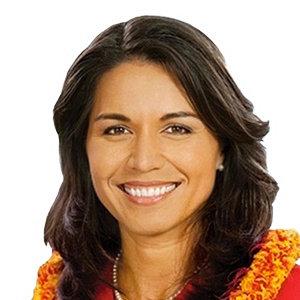
The latest sign was Trump’s invitation for a meeting with Rep. Tulsi Gabbard, D-Hawaii, on Monday. The mainstream media commentary has almost completely missed the potential significance of this start-of-the-work-week meeting, suggesting that Trump is attracted to Gabbard’s tough words on “radical Islamic terrorism.”
Rep. Tulsi Gabbard, D-Hawaii.
Far more important is that Gabbard, a 35-year-old Iraq War veteran, endorsed Sen. Bernie Sanders in the Democratic primaries because of his opposition to neocon/liberal-hawk military adventures. She starred in one of the strongest political ads of the campaign, a message to Hawaiians, called “The Cost of War.”
“Bernie Sanders voted against the Iraq War,” Gabbard says. “He understands the cost of war, that that cost is continued when our veterans come home. Bernie Sanders will defend our country and take the trillions of dollars that are spent on these interventionist, regime change, unnecessary wars and invest it here at home.”
In the ad, Gabbard threw down the gauntlet to the neocons and their liberal-hawk sidekicks, by accusing them of wasting trillions of dollars “on these interventionist, regime change, unnecessary wars.” Her comments mesh closely with Trump’s own perspective.
So, the surprise election results on Nov. 8 may have represented a “trading places” moment for the neocons and liberal hawks who were eagerly counting the days before the “weak” President Barack Obama would turn over the Commander-in-Chief job to former Secretary of State Clinton who had made clear that she shared their hawkish agenda of escalating the war in Syria and ratcheting up the New Cold War with Russia.
There was even speculation that one of Clinton’s neocon favorites within the State Department, Assistant Secretary of State for European Affairs Victoria Nuland, might be rewarded with State’s top job for her “regime change” in Ukraine that sparked the start of the New Cold War in 2014.
Nuland, the wife of arch-neocon Robert Kagan, sabotaged President Obama’s emerging strategy of collaborating with Russian President Vladimir Putin on sensitive global issues. In 2013-14, Putin helped orchestrate two of Obama’s brightest foreign policy successes: Syria’s surrender of its chemical weapons arsenal and Iran’s guarantee that it would not develop nuclear weapons.
But those agreements infuriated the neocons who favored escalating both crises into direct U.S. bombing campaigns aimed at Syria and Iran – in accordance with the desires of Israeli Prime Minister Benjamin Netanyahu and the Saudi monarchy. Yet. there was perhaps even greater alarm at what the next move of the Obama-Putin tag team might be: demanding that Israel finally get serious about a peace deal with the Palestinians.
So, the neocons took aim at Ukraine, which neocon National Endowment for Democracy President Carl Gershman identified as “the biggest prize” and an important stepping stone to an even bigger prize, a “regime change” in Moscow removing Putin.
While Gershman’s NED funded (with U.S. taxpayers’ money) scores of projects inside Ukraine, training anti-government activists and journalists, Nuland took the point as the key organizer of a putsch that removed elected President Viktor Yanukovych on Feb. 22, 2014, and replaced him with a fiercely anti-Russian regime.
Given the geopolitical sensitivity of Ukraine to Russia, including its naval base on the Crimean peninsula, Putin had little choice but to react, supporting a referendum in Crimea in which 96 percent of the voters favored leaving Ukraine and rejoining Russia – and assisting ethnic Russian rebels in the east who resisted the violent ouster of their president.
Of course, the mainstream Western news media presented these developments as simply a case of “Russian aggression” and a “Russian invasion.” And, faced with this new “group think,” Obama quickly abandoned his partner, Putin, and joined in the chorus of condemnations.
Nuland emerged as a new star inside the State Department, a hero of the New Cold War which was expected to funnel trillions of tax dollars into the Military-Industrial Complex.
Trump’s Heresy
But Trump surprisingly adopted the position that Obama shied away from, a recognition that Putin could be an important asset in resolving major international crises. The real-estate-mogul-turned-politician stuck to that “outside-the-mainstream” position despite fierce attacks from rival Republicans and Democratic presidential nominee Clinton, who even mocked him as Putin’s “puppet.”
After Trump’s upset victory on Nov. 8, many pundits assumed that Trump would fall back in line with Washington’s hawkish foreign-policy establishment by giving top jobs to neocons, such as former U.S. Ambassador to the United Nations John Bolton and ex-CIA Director James Woolsey, or Netanyahu favorites, such as former Republican presidential nominee Mitt Romney or ex-New York City Mayor Rudy Giuliani.
So far, however, Trump has followed a different course, more in line with the libertarian thinking of the Koch brothers – not only the more famous ones, Charles and David, but also their long-estranged brother William, who I’m told have become behind-the-scenes advisers to the President-elect.
Though Trump did offer high-profile meetings to the likes of Romney and Giuliani, he has yet to hand over any key foreign-policy job to the Republican neocon wing. His one major announcement in that area has been naming as National Security Advisor retired Gen. Michael Flynn, who led the Defense Intelligence Agency when it produced a prescient warning that U.S. policy in Syria would lead to the creation of an “Islamic State.”
Though Flynn is regarded as a hardliner in the fight against Islamic jihadist terror, he is seen as an independent thinker regarding how best to wage that war. For instance, Flynn has objected to the notion that drone strikes, i.e., killing off individual jihadists, is a route to success.
“We’ve tended to say, drop another bomb via a drone and put out a headline that ‘we killed Abu Bag of Doughnuts’ and it makes us all feel good for 24 hours,” Flynn said. “And you know what? It doesn’t matter. It just made them a martyr, it just created a new reason to fight us even harder.”
That leaves open the possibility that a President Trump might eschew the “whack-a-mole” approach that has bedeviled the “war on terror” and instead go after the “mole nest” – if you will – the Saudi monarchy that has long financed Islamic extremists both through the fundamentalist Wahhabi brand of Sunni Islam and by supplying money and weapons to jihadists dating back at least to the Afghan mujahedeen in the 1980s, the origin of modern Islamic terrorism.
Traditional U.S. politicians have recoiled from facing up to the hard reality that the Saudi monarchy is the real “terror central” because of Saudi Arabia’s enormous riches and influence, which is now enhanced by its quiet alliance with Israel in their joint campaign against the so-called “Shiite crescent,” from Iran through Syria to Lebanon’s Hezbollah.
Taking on this Saudi-Israel nexus has long been regarded as political suicide, given Israel’s extraordinary lobbying power and Saudi Arabia’s exceptional wealth. But Trump may be assembling a team that is “crazy” enough to take on that mission.
So, while the fight over the future of U.S. foreign policy is far from over – the neocons will surely flex their muscles at the major think tanks, on the op-ed pages and inside the halls of Congress – the Trump transition is showing some creativity in assembling a national security team that may go in a very different direction.
Much will become apparent in Trump’s choice of Secretary of State. If it’s someone like Sen. Rand Paul, R-Kentucky, or Rep. Gabbard or a libertarian from the Kochs’ world, that would be bad news for the neocons. If it’s someone like Romney, Giuliani, Bolton or Woolsey, then that will mean that President-elect Trump has blinked and the neocons can breathe a sigh of relief.
Investigative reporter Robert Parry broke many of the Iran-Contra stories for The Associated Press and Newsweek in the 1980s.
Will Trump Dump The Wahabbi Autocrats?
By Caleb Maupin – New Eastern Outlook – 20.11.2016
US leaders almost always justify their foreign policy with words about “democracy” and “human rights.” Especially when talking about the Middle East, the insincerity of such words are blatantly obvious. While US leaders criticize Iran and Syria for alleged human rights violations, the entire world can see that the US allies in the region are serial human rights violators.
Israel has been widely condemned for its treatment of Palestinians. Saudi Arabia is a country where even the basic notion of human rights does not exist. The Kingdom is an absolute monarchy where people can still be executed by beheading or crucifixion in the 21st century. Crimes punishable by death under the Saudi regime include “sorcery” and “insulting the King.” Under Saudi law, the people are not citizens with rights, but rather “subjects” who are essentially the King’s property.
Qatar is yet another repressive regime. Like Saudi Arabia, it is an absolute monarchy, where a King serves as the unelected autocrat.
Bahrain is known not only for its lack of democratic structures, but for its repression of the Shia Muslim majority who frequently take to the streets, demanding their rights.
The United Arab Emirates, Kuwait, Jordan, and almost every other US-aligned regime in the Arab world has a primitive political system, centered on an autocratic monarchy. These regimes are known to torture, behead, flog, repress free speech, oppress religious minorities, and do all kinds of things US leaders claim to oppose.
This does not prevent the United States from selling weapons to these regimes, or from purchasing their oil. This also does not prevent the USA from establishing military bases on their soil, and otherwise coddling them.
In fact, the Financial Times describes how the United Arab Emirates is becoming a beloved “tax haven” for the rich and powerful in the western world. While western leaders love to talk about human rights, they have no problem with autocratic emirates handling their money.
The Roots of Wahabbi Terrorism
More shockingly, the involvement of these regimes in terrorism has not deterred US support. It took 15 years for the classified 28 pages of the 9/11 Commission report to be released. The pages revealed that Saudi government officials had collaborated with the 9/11 hijackers. It furthermore revealed that Saudi Arabia had been uncooperative and offered minimal support to US officials with their investigations during the aftermath of the attacks.
The Saudi Royal family owes its reign to the British Empire. During the 1900s the British discovered that the House of Saud were useful allies against the Ottoman Empire, and were more than willing to sell their oil at a reasonable price. The Saudi monarchy professes a particularly conservative brand of Islam known as “Wahabbism.”
While not every Wahabbi has been involved in terrorism, Al-Queda, ISIS, Al-Nusra, Osama Bin Laden, Omar Mateen, and nearly every Middle-Eastern or Central-Asian terrorist who has menaced the world in recent years has been an adherent of Wahabbism. Wahabbism is particularly anti-Western and anti-American. Opponents of the Saudi ideology often call it “Takfirism,” a term that refers to Wahabbi’s willingness to kill other Muslims with whom they disagree.
The relationship between Wahabbi fanatics and Britain’s wealthy has not ended. A recent article in the Financial Times describes how British Houses of Finance now specialize in “Islamic Banking.” While many Islamic scholars describe the very concept as fraudulent, many financial institutions are accommodating sultans, emirates, and princes who adhere to strict Wahabbi laws. Islam forbids lending money for interest, so many financial institutions have invented loopholes with hidden fees, investment returns, and other mechanisms that can accommodate strict adherents.
During the 1980s, the CIA worked with the heir of a wealthy Saudi construction dynasty to build a Wahabbi army. Osama bin Laden was sent to Afghanistan to build an army of “Mujihadeen” to topple the People’s Democratic Party. The US worked closely with the fanatical Wahabbi terrorists to battle the Marxist government of Afghanistan and their Soviet allies.
Currently, the United States works with Saudi Arabia to fund a Wahabbi insurgency against the secular Syrian Arab Republic. ISIS and Al-Nusra are known to be terrorists inspired by the Saudi ideology. The Saudis have been caught directly helping them out. Among the US backed “moderate rebels,” many Wahabbis can also be found.
Most of the various US-aligned autocracies in the Middle East can be linked to the Wahabbi forces in Syria. Bahrain, Qatar, Kuwait, and other regimes have made the goal of “regime change” in Syria a priority, and many ISIS fighters have emerged from their respective populations.
Is The Tide Turning?
While the past three presidencies of Bush, Obama, and Clinton have involved massive coddling of the Saudi regime, Donald Trump often spoke against Saudi Arabia during his Presidential campaign. Furthermore, in a recent move, the US Congress dramatically overrode Barack Obama’s veto, and passed the controversial JASTA bill, allowing victims of terrorism to sue the Kingdom of Saudi Arabia in US courts.
While Trump often appealed to ignorant and Islamophobic sentiments among Americans, he also appealed to an isolationist desire to stop meddling around the world. Trump made fighting ISIS, the Wahabbi extremist group unleashed amid US-Saudi regime change efforts, a key plank of his campaign.
Will Trump live up to his words? Will the USA end its alliance with Pro-Wahabbi autocratic regimes that are linked to terrorism?
Though Trump spoke against the Saudis and talked of fighting ISIS, his campaign included reckless denunciations of the Islamic Republic of Iran. Trump’s speeches often seemed to lump Iran in with ISIS, ignoring the fact that Iranian Revolutionary Guards are on the battlefield each and every day, risking their lives to defeat ISIS.
Iran is greatly threatened by ISIS terrorism. ISIS and most Wahabbis consider the Islamic Republic of Iran to be led by “Shia Apostates.” ISIS and other anti-government forces in Syria have recruited fighters from around the world on the basis of toppling Syrian President Bashar Assad because of his Alawi faith, which Wahabbis consider to be a variation of Shia apostasy.
Contradictory Middle East Positions
For too long, the USA has been targeting secular, nationalist governments like the Baathist regimes of Iraq and Syria, the Islamic Republic of Iran, or Gaddafi’s Libya. In doing so they have been passively helping and strengthening the bloodthirsty Wahabbi fanatics who these regimes have held back, and whose ideological foundation is promoted by Saudi Arabia.
If Trump is serious about stopping ISIS and the surrounding wave of Wahabbi terrorism, he will immediately end the US financial and military relationship with the Saudi regime, as well as the nearby, pro-Wahabbi autocracies.
Furthermore, Trump will need to end his irresponsible demonization of the Islamic Republic of Iran, and join with the Iranians, the Russians, the Syrian government, and China in the fight against ISIS terrorism.
If Trump were to do this, it would be one of the most dramatic shifts ever seen in US foreign policy.
During his campaign, Trump has taken two somewhat contradictory positions in relation to the Middle East. While he has denounced Saudi Arabia and talked about how US “regime change” policies have strengthened terrorism, he has also repeated the anti-Iranian talking points of Netanyahu, and spoken with great admiration for Israel.
Israel has been the greatest direct beneficiary of the US policy in the Middle East. Each regime the US has targeted in the region–Syria, Iraq, and Iran–have been outspoken opponents of Israel who directly support Palestinian resistance. Meanwhile, the Wahabbi-linked autocrats denounce Israel in words, but do very little to threaten its existence or strength.
Israel’s primary enemies, Iran and Syria, are also the primary target of the Wahabbi fanatics and the Saudi monarchy. Israel and Saudi Arabia may denounce each other, but their foreign policies both center on hostility to what the Saudis call “the Shia crescent.”
Regarding the Middle East, the new President will be forced to decide whether he seeks to continue aligning US and Israel foreign policies, and targeting Iran and Syria, or whether he wants to end Wahabbi terrorism, and stop cooperating with the regimes actively linked to it.
Trump is often perceived as quite unpredictable. Whichever choice he makes, it is likely to surprise many people.
Caleb Maupin is a political analyst and activist based in New York. He studied political science at Baldwin-Wallace College.
Featured Video

Death Spikes & Rising Cancer In Our Youth Explained
or go to
Aletho News Archives – Video-Images
From the Archives
Politicians lie
By Mazin Qumsiyeh | Popular Resistance | August 18, 2013
There is no way to say this truth nicely: Politicians lie. That includes Japanese, American, Egyptian, Israeli, and Palestinian politicians! Is there something more common sense than that? Yet, so many citizens around the world believe their own politicians or wistfully acknowledge lies but think it is part of the job needed to run things. They believe even when politicians contradict themselves blatantly. This phenomenon is rather remarkable. It is a dissonance and disconnect from reality that many seem oblivious to. It is very dangerous because it can lead to accepting rationales for going to war. These can be deadly wars that lead to millions of lives lost as happened in what was called World War 1 and WW2. Even when incredible and declassified evidence abound, politicians continue to lie and old mythologies refuse to die. Here are just a few of the countless lies told to us over the past few decades… continue
Blog Roll
 Aletho News
- From Unipolar Universalism to Multipolar Civilizational Distinctiveness
- RSF military group defects, joins Sudanese army: State media
- Ireland goalkeeper refuses to play ‘Israel’ as squad weighs boycott
- China pushes back against US on Cuba, Iran
- Ukrainian Soldiers, Potential Mercenaries: Have Gun, Will Travel!
- Burnham’s UN debut… A masterclass in British disinformation
- Iran flights continue despite US aviation sanctions
- Global Tipping Points Lead the World Into a State of Entropy
- The day-after at the White House: USA and Xi Jinping
- The Geopolitical Balance in the Red Sea: The UAE Being Displaced by New Players
- If Americans Knew
- Deconstructing Netanyahu’s pants-on-fire UN rant – Daily Update
- Trump betrayed voters with his campaign lies and prioritized a foreign country once he took office
- Netanyahu calls Israel’s war in Gaza ‘opposite of genocide’ in UN speech to near-empty hall
- Settler Kidnappings: Torture, Sexual Abuse and Terrorisation of Palestinian Abductees as Israel Deepens Annexation of West Bank
- Gaza winter nears as 162,000 tents become unusable, raising fears of humanitarian crisis
- Netanyahu says, “It’s the opposite of genocide”; UN says Gaza economy is world’s ‘most severe crisis on record’ – Daily Update
- Israel’s US-Backed Assault on Gaza Has Created the ‘World’s Most Severe Economic Crisis on Record’: UN
- ‘Protecting U.S. Citizens’… From Israel
- ‘This is where I live now, the back of a truck’: a day in the life of a grandmother in Gaza
- In UN Speech, Iran’s President Displays Pictures of Children Killed by US, Brings Attention to Israel’s Nuclear Arsenal
- No Tricks Zone
- New Study: Earth And Venus Surface Warmth Largely Explained By Convection And Lapse Rate, Not CO2 Or Radiation
- 2025 Nature Paper Claiming Worsening Global Drought Gets RETRACTED …Heavily Flawed
- New Study: ‘Global Drought Shows No Detectable Recent Acceleration Under Climate Warming’
- Economic Masterminds: German Socialists Suggest Taxing Productivity Gains Stemming From Using AI
- The South China Sea Has Not Been Cooperating With The Climate Change Narrative
- Energy Crisis: Germany Enters Heating Season With Historically Low Gas Reserve Fill Levels
- New Study: The Antarctic Ice Sheet Gained Mass From 2020-2024 Due To Staggering Snow And Ice Accumulation
- Study: Ocean Heating Rates From Thousands Of Years Ago ‘Dwarf’ Modern Ocean Heating Rates
- Climate Extremists Target, Attack Large-Scale Power Grid Infrastructure In Germany!
- New Study: Antarctic Ice Melt Has Contributed Less Than 1 Centimeter To Sea Level Rise In The Last 30 Years

