US Republican frontrunner Donald Trump has implied that Israel is supporting Daesh (ISIL) by “sending massive amounts of money” to the Takfiri terrorists in Syria and Iraq.
Trump made the remarks in a recent interview with the Morning Joe show, shortly before he cancelled his trip to Israel.
“Some of our so-called allies that we work with and that we protect militarily, they are sending massive amounts of money to ISIS and to al-Qaeda and to others,” he said, using an alternative acronym for the terrorist group.
Asked about who he was talking about, Trump said “you know who it is. What do I have to bring it up for? You know who it is.”
He said that he will not mention US allies which support Daesh because of his relationship with Israelis, but noted that no one talks about Israel, even though everyone is aware of support Israel and other states provide to ISIL.
“There are, but I’m not gonna say it, because I have a lot of relationships with people. But there are. And you know that. And everybody knows that. And nobody says it. Nobody talks about it,” Trump said.
The multi-billionaire businessman said the US government knows about it, suggesting checking records to insure his claims are true.
“All you have to do is check your records. Our government knows the countries,” he stated.
On Thursday, Trump cancelled his plan to visit Israel, saying he would reschedule “at a later date after I become President of the US.”
One reason he mentioned why he had called off his visit was that he did not want to put Israeli Prime Minister Benjamin Netanyahu “under pressure.”
Trump’s campaign has been marked by controversy from the start, but he leads the GOP field with 33 percent support among Republican primary voters.
According to American writer Mickey Z., “It’s always interesting when Donald Trump peels away a propaganda layer to offer a tiny glimpse at the corporate-political brotherhood.”
December 15, 2015
Posted by aletho |
Timeless or most popular, Wars for Israel | al-Qaeda, Da’esh, Donald Trump, ISIL, ISIS, Israel, United States, Zionism |
Leave a comment
Who Do They Really Represent?
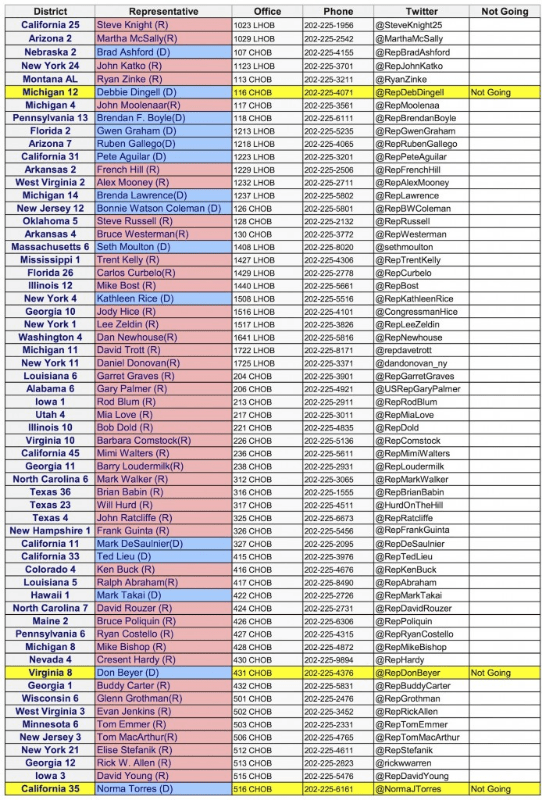
In August, 2015, 57 brand new members of the U.S. House of Representatives bowed their heads and promised to obey their Israeli overlords. They allowed themselves to be taken to Israel, plied with good food and propaganda. They then returned home to do Israel’s bidding in the Congressional seats that Israel helped them win. Sixty were invited, but only three decided not to go, for unknown reasons.
But isn’t there a more innocent explanation? Perhaps they just wanted to learn more about the issue and would equally have accepted an invitation to visit Palestine and see it from a Palestinian point of view. Nothing wrong with giving equal opportunity to both sides.
The Free Palestine Movement tested this theory and found it wanting. We sent a personalized invitation to exactly the same members of Congress to come to Palestine at our expense. Not a single one accepted. Although we sent a followup to those who did not respond the first time, the vast majority never responded at all. A few said that they could not make time in their schedule, not even when we suggested that they could wait as long as their next term. Only one, Brad Ashford of Nebraska, said that he was working with some of his constituents to visit Palestine. (We have been able to find no evidence of such an initiative.)
Israel, through its US Lobby, has of course been doing this for more than half a century. There are hardly any members of Congress that have not accepted an invitation at least one time during their career, often more. Can you name any other country with such a devoted following in the U.S. Congress?
The reason, of course, is that the Israel Lobby has a reputation of making or breaking congressional careers, and that members of Congress are x-rayed to assure that they possess no detectable spine before they take office. There is more pushback from some Israeli newspapers than from the US Congress.
And why not? There has never been any price to pay for obeying Israel. In fact, candidates compete to do favors for Israel and to get donations managed by Israel’s Lobby, with little or no consideration of how much they are robbing their constituents.
But this time it’s different. We may not be able to persuade members of Congress to look at both sides of the Israel question, nor to ask why US taxpayer money is supporting an Israeli ethnic cleansing campaign against Palestinians, nor why our roads are not paved nor our bridges repaired nor our children educated. But we can show the depravity of our elected officials. We can demonstrate their hypocrisy and their bias and dishonest treatment of US foreign policy, which results in war, death and destruction for all but the tiny number of super-wealthy profiteers whose hands are covered in blood.
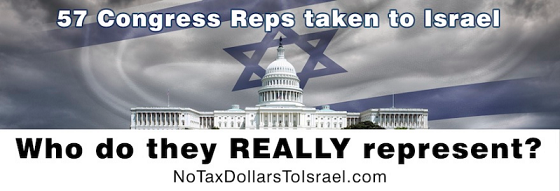
That’s why the Free Palestine Movement is running the ad below on the sides of buses in San Francisco. It is why we are making the same ad available at cost as a 3″ x 9″ sticker to anyone who wants to use it. It’s why we’re ready to share the cost of a display ad on buses or anywhere else with any group that wants to run the ad anywhere in the US, for as long as our funds last.

It is only a start, but we can at least begin to hold our elected officials accountable. We can make them begin to pay a price for selling out both the American and the Palestinian people to Israel.
Paul Larudee is one of the founders of the Free Gaza and Free Palestine Movements and an organizer in the International Solidarity Movement.
December 14, 2015
Posted by aletho |
Corruption, Ethnic Cleansing, Racism, Zionism, Timeless or most popular, Wars for Israel | Israel, Palestine, United States, Zionism |
Leave a comment
At the Brookings Institution in Washington last Friday, Israeli Defence Minister Moshe Ya’alon gave an expose of his country’s perspectives on the conflict in Syria. Ya’alon is a former chief of staff of Israeli armed forces. His extensive remarks betrayed Israel’s acute dilemma on the policy front following the traumatic defeat its diplomacy suffered in attempting to forestall the Iran nuclear deal. Israel is finding it hard to turn a new leaf, while other protagonists in the region and indeed the Obama administration are moving on. Ya’alon made the following points:
- Russia is playing a “more significant role” than the US in the Syrian conflict at present. This is not to Israel’s liking, because Russia supports the ‘Shia axis’, which includes Iran, Syria (Assad regime), Hezbollah, Houthis in Yemen and other Shia elements in Bahrain and Saudi Arabia, etc.
- Israel disfavors the Syrian peace process devolving upon the UN-sponsored International Syria Support Group and the Vienna talks because it recognizes Iran’s key role in reaching any settlement, which can only lead to the consolidation of Iran’s ‘hegemony’ in Syria.
- The geopolitics of the Middle East in general and in Syria are centred around three groupings: a) The “very solid” Shia axis which at present enjoys the support of Russia, is anathema to Israel; b) The Muslim Brotherhood axis which comprises Turkey, Qatar, and Gaza (Hamas), which is “not on the same page” as with the US or Israel; and, c) The Sunni Arab camp, “the most significant camp” in the region, which lacks leadership, but brings together Israel with Saudi Arabia and other GCC states, Egypt, Jordan, and Morocco.
- The US should “orchestrate” and lead the Sunni Arab camp; in Syria, this means defeating Daesh with the foot soldiers provided by Sunni Arabs and Kurds, whom, therefore, Washington should ‘empower, support, finance and arm’. The US should have done this from the very beginning, but it is not yet “a lost cause. There is still a chance to do it”.
- One of the dangerous implications of the Iran deal is that Tehran is increasingly perceived as “a part of the solution” in Middle East’s hot spots, whereas, a resurgent Iran is a more confident Iran which is all set on the path to become a big military power. The S-300 missiles supplied by Russia recently “are going to be operational within a couple of weeks.”
- The Russian military operations in Syria have been a failure insofar as Moscow had estimated that a 3-month offensive would gain more territory for the Syrian regime, whereas, this hasn’t happened, and, therefore, pressure has built on Moscow to explore a political settlement.
- A settlement is hard to reach in Syria and the country will remain unstable for a very long time to come.
Interestingly, Ya’alon conceded that the “apocalyptic, messianic” regime in Iran is firmly ensconced in power in Tehran and “with more money now, without political isolation, without external pressure”, it has more room to maneuver. Thus, no change can be expected in the Iranian policies. As he put it, “I don’t see the chance to have McDonald branches in Tehran as the new future”.
The remarks by Ya’alon underscore the stark isolation of Israel in the politics of the Middle East. Evidently, Israel’s preferred option is that the US resumes its containment strategy against Iran, and, as part of the policy, should lead its regional allies to militarily push for regime change in Syria. On the other hand, the Obama administration has had enough of confrontation with Iran, has no stomach for getting involved in a prolonged war in Syria or anywhere in the Middle East. Besides, Israel is overlooking that the West’s attitude toward the Assad regime has mellowed significantly and there is overall acceptance that Assad has a role in the transition.
On the other hand, the S-300 missiles supplied by Russia recently are becoming operational within the coming week or so and they will considerably strengthen Iran’s air defence system. In sum, an Israeli military option against Iran is inconceivable from now onward. Both Iran and Israel are acutely conscious that the power balance in the region has shifted. Put differently, the spectre that is haunting Israel is the inexorable rise of Iran as a regional ‘superpower’. At one point Ya’alon put it as follows:
- We believe in the end Daesh (Islamic State) is going to be defeated. Iran is very different. It’s actually an original superpower… That is why we worry about this regime, and if they are perceived as a key for the solution because they are ready to fight Daesh, then they are going to gain more hegemony in the region… to be more dangerous, to be situated on our border, as part of the political settlement in Syria. This is very dangerous.
The implications of a Syrian settlement, reached on the basis of a consensus involving Iran, are very serious indeed for Israel. Iran put its cards on the table recently by stressing that the fate of President Assad is a ‘red line’ for Tehran – non-negotiable. And Iran openly regards Assad as an anchor sheet of ‘resistance’. Significantly, one of the most influential figures in the Iranian establishment, Ali Akbar Velayati, the advisor on foreign affairs to the Supreme Leader and a distinguished former foreign minister himself, made a stunning statement last week that Tehran expects Russia to join the resistance soon — and China too in a conceivable future. Velayati’s statement cannot be without any basis.
Israel has adopted a tactful line so far by engaging Russia and avoiding any skirmishes with the Russian forces operating in Syria. But it thoroughly dislikes the Russian-Iranian-Hezbollah axis in Syria, which is only going from strength to strength. Israel watches with unease that the Russian-Iranian military ties are poised for a phenomenal makeover. (Iranian and Hezbollah forces apparently helped in the rescue of the Russian pilot recently on the Syrian-Turkish border.) The Russian operations go hand in hand with the ground attacks by the Syrian government forces, who are assisted by the Hezbollah and are operating under the guidance of Iranian military advisors.
The crunch time comes if and when the military operations intensify in the southern regions of Syria bordering the Golan Heights. The instability in Syria is useful for Israel to disrupt the supply lines for Hezbollah. But the new reality could be a strong Iranian-Hezbollah presence in southern Syria in the approaches to the Golan Heights enjoying Russian air cover. If that happens, Israel’s illegal annexation of the Golan Heights could become a theatre for the forces of the ‘resistance’. Read Ya’alon’s extensive remarks here.
December 13, 2015
Posted by aletho |
Timeless or most popular, Wars for Israel | Da’esh, Egypt, GCC, Hamas, Hezbollah, Iran, Iraq, Israel, Jordan, Middle East, Morocco, Qatar, Russia, Saudi Arabia, Syria, Turkiye, Yemen, Zionism |
Leave a comment
Argentina’s newly elected President Mauricio Macri will not appeal a court’s decision to strike down a deal with Iran over investigating a deadly 1994 bombing of a Buenos Aires Jewish community center, Reuters reported on Friday.
Former leader Cristina Fernandez had said she would appeal the ruling last year voiding the agreement she signed with Iran in 2013 to investigate the country’s suspected role in the bombing.
The memorandum would have launched a joint “truth commission” comprised of five independent judges from third-party countries to investigate the bombing. It would also have allowed for Iranian suspects in the case to be questioned.
Tehran denies any responsibility in the attack that killed 85. No one has yet been found responsible or tried in court over the incident.
Earlier this year, in April, a bill to compensate the victims was passed by parliament, after receiving unanimous approval from the Argentine senate. The legislation provides a one-time compensation of US$170,000 for the relatives of those killed in the attack. The hundreds who suffered “extremely grievous” injuries will receive 70 percent of that amount, while those who suffered “grievous” injuries will receive 60 percent of that amount, according to the Jerusalem Post.
The bombing of the AMIA Jewish center made headlines recently after the mysterious death of Federal Attorney Alberto Nisman who was investigating the case. The Argentine opposition has used his death to try to implicate Kirchner’s government, even though it was not in power in 1994.
December 13, 2015
Posted by aletho |
Wars for Israel | Argentina, Iran, Latin America, Mauricio Macri |
Leave a comment
Thomas Friedman doesn’t like threats of massive bombing when they’re made by someone else
Thomas Friedman has some harsh words in his New York Times column (12/9/15) for Donald Trump and his unsophisticated grasp of the complexities of foreign policy:
As for Trump, well, he may be a deal maker, but he’s no poker player ready for the Middle East five-card stud sharks. His xenophobic rhetoric and unrealistic, infantile threats of massive bombing make up the kind of simplistic hand you’d play in “Go Fish” — not in this high-stakes game.
Where could Trump have gotten the idea that his “infantile threats of massive bombing” would be taken seriously as foreign policy proposals? Well, as a resident of New York City, maybe he reads the New York Times:
There is only Option 2 — bombing Iraq, over and over and over again, until either Saddam says uncle, and agrees to let the UN back in on US terms, or the Iraqi people eliminate him…. Given the problems with the other options, we may have no choice but to go down this road. Once we do, however, we better have the stomach to stay the course.
–Thomas Friedman (New York Times, 1/31/98)
Blow up a different power station in Iraq every week, so no one knows when the lights will go off or who’s in charge.”
–Friedman (New York Times, 1/19/99)
Let’s at least have a real air war. The idea that people are still holding rock concerts in Belgrade, or going out for Sunday merry-go-round rides, while their fellow Serbs are ‘cleansing’ Kosovo, is outrageous. It should be lights out in Belgrade: Every power grid, water pipe, bridge, road and war-related factory has to be targeted….
Every week you ravage Kosovo is another decade we will set your country back by pulverizing you. You want 1950? We can do 1950. You want 1389? We can do 1389 too.
–Thomas Friedman (New York Times, 4/23/99) on Serbia
People tend to change their minds and adjust their goals as they see the price they are paying mount. Twelve days of surgical bombing was never going to turn Serbia around. Let’s see what 12 weeks of less than surgical bombing does. Give war a chance.
–Thomasa Friedman (New York Times, 4/6/99)
My motto is very simple: Give war a chance.
–Thomas Friedman (ABC News, 10/29/01) on Afghanistan
Let’s all take a deep breath and repeat after me: Give war a chance. This is Afghanistan we’re talking about.
–Thomas Friedman (New York Times, 11/2/01)
I was a critic of [Defense Secretary Donald] Rumsfeld before, but there’s one thing… that I do like about Rumsfeld. He’s just a little bit crazy, OK? He’s just a little bit crazy, and in this kind of war, they always count on being able to out-crazy us, and I’m glad we got some guy on our bench that our quarterback — who’s just a little bit crazy, not totally, but you never know what that guy’s going to do, and I say that’s my guy.”
–Thomas Friedman (CNBC, 10/13/01)
There is a lot about the Bush team’s foreign policy I don’t like, but their willingness to restore our deterrence, and to be as crazy as some of our enemies, is one thing they have right.
–Thomas Friedman (New York Times, 2/13/02)
We needed to go over there, basically, and take out a very big stick… and there was only one way to do it…. What they needed to see was American boys and girls going house to house, from Basra to Baghdad, and basically saying: “Which part of this sentence don’t you understand?
You don’t think, you know, we care about our open society? You think this bubble fantasy, we’re just gonna to let it grow? Well: Suck. On. This.” That, Charlie, is what this war was about. We could have hit Saudi Arabia; it was part of that bubble. Could have hit Pakistan. We hit Iraq because we could.
–Thomas Friedman (Charlie Rose, 5/30/03)
Israel’s counterstrategy was to use its air force to pummel Hezbollah and, while not directly targeting the Lebanese civilians with whom Hezbollah was intertwined, to inflict substantial property damage and collateral casualties on Lebanon at large. It was not pretty, but it was logical. Israel basically said that when dealing with a nonstate actor, Hezbollah, nested among civilians, the only long-term source of deterrence was to exact enough pain on the civilians–the families and employers of the militants–to restrain Hezbollah in the future.”
—New York Times columnist Thomas Friedman (1/13/09) on why Israel needed to kill civilians in Gaza
December 11, 2015
Posted by aletho |
Islamophobia, Mainstream Media, Warmongering, Militarism, Timeless or most popular, War Crimes, Wars for Israel | Iraq, Israel, New York Times, Thomas Friedman, United States, Zionism |
Leave a comment
Hilary Benn is very serious about his power grab and has been laying the ground for it very carefully. On 18 November BICOM – the British Israeli Communications and Research Centre – published this:
Shadow Foreign Secretary Hilary Benn told a Labour Friends of Israel (LFI) lunch yesterday that relations with Israel must be based on cooperation and rejected attempts to isolate the country.
Addressing senior party figures in Westminster, Benn praised Israel for its “progressive spirit, vibrant democracy, strong welfare state, thriving free press and independent judiciary.” He also called Israel “an economic giant, a high-tech centre, second only to the United States. A land of innovation and entrepreneurship, venture capital and graduates, private and public enterprise.”
Consequently, said Benn, “Our future relations must be built on cooperation and engagement, not isolation of Israel. We must take on those who seek to delegitimise the state of Israel or question its right to exist.”
It is worth reading the next article BICOM published. Brigadier General Michael Herzog, head of strategy for the Israeli defence Force, sets out a strategy for Israeli interests in Syria which dovetails precisely with what Benn and Cameron were pushing in the Commons. Note that Herzog says an overall diplomatic solution is not realistic and rather de facto partitioning of Syria suits Israel’s interests. Therefore there should be no waiting for diplomatic progress before western military action.
With his abandonment of any pretended concern for the slow and agonising genocide of the Palestinians, and his strident support for Trident, Benn is embracing the Israeli establishment and the British military and political establishment. In return, the Tories roared his speech to the rafters, while the media, and especially the Genie Energy linked media, are boosting him to the Labour leadership.
The United Kingdom has, temporarily, an opposition leadership which is not controlled, Zionist, neo-con and in the pocket of the arms industry. Benn has positioned himself very carefully to offer himself as the vehicle for the entire establishment to move to correct this aberration.
December 3, 2015
Posted by aletho |
Corruption, Timeless or most popular, Wars for Israel | Hilary Benn, Israel, Labour Friends Of Israel, LFI, Syria, UK, Zionism |
Leave a comment
Pakistan says its import of gas from Iran through a pipeline is the best option as the stalled project is given new impetus with anticipated lifting of sanctions on Tehran.
The energy crisis in Pakistan which suffers about 12 hours of power cuts a day has worsened in recent years amid 4,000 megawatts of electricity shortfall which the Iran gas pipeline is being fostered to cover.
Iran has completed its part of the project with more than $2 billion of investment but Pakistan has fallen behind the target to take gas deliveries in the winter of 2014.
Addressing a seminar on business opportunities in the clean energy sector in Washington Tuesday, Pakistan’s Minister for Petroleum and Natural Resources Khaqan Abbasi said he hoped sanctions on Iran would be removed soon.
“The Iran gas line project is the best option for Pakistan. But as long US sanctions are there, we cannot buy gas from Iran,” the website of the Dawn newspaper quoted him as saying.
The remarks came as Turkmenistan’s leader last month ordered construction of a $10 billion rival pipeline to Pakistan and India through Afghanistan to begin despite questions about the project.
The US has long lobbied against the Iran-Pakistan pipeline, promoting Turkmen over Iranian natural gas even though the route requires the extra distance of more than 700 km across Afghanistan.
Western giants such as Chevron, Exxon, BP and Total have held off on committing to the project all the more because of Afghanistan’s insecurity and the region’s complex geopolitics.
Contractually, Pakistan has to pay steep fines to Iran for failing to build and operate its section of the pipeline by the winter of 2014 but Abbasi shrugged off the postulation.
“Not our fault. We made several attempts in the last 18 months to complete the project on our side. But no investor, no builder came forward,” the minister claimed.
“Once the sanctions are lifted, we will work on this project. A pipeline is always more reliable than other options,” he added.
Besides the expected lifting of sanctions, the bolstered prospects of the Iran gas pipeline arise from China’s $46 billion investment project dubbed the China-Pakistan Economic Corridor.
Officials say up to $2 billion has been earmarked as part of the package for the Iran pipeline extension, running from Pakistan’s southern port of Gwadar to the Nawab Shah district.
The energy-starved country imports about 100 megawatts (MW) of Iranian electricity for to the areas near their border. The government has said it was in final stages of negotiations to increase electricity imports from Iran to 1,000 MW.
Trade between Iran and Pakistan plunged to $217 million in 2014 from its peak of more than $1.3 billion in 2009.
December 2, 2015
Posted by aletho |
Economics, Wars for Israel | Iran, Pakistan, Sanctions against Iran, United States, Zionism |
Leave a comment
Senator Rand Paul, supported by a number of other congressmen, has demanded that the 28 pages of the 9/11 Commission Report that explored the Saudi Arabian role in the terrorist attack be made public. The redacted section of the report, which apparently concluded that the Saudi government itself played no direct role in 9/11, nevertheless contained considerable evidence suggesting that wealthy Saudis and even members of the Royal Family had been supporting and funding al-Qaeda. Some who have actually read the 28 pages were reported to be shocked by what was revealed.
Recent comments by presidential aspirant Donald Trump indicating that he was aware of people celebrating the terrorist attack in New Jersey, whom he described as “Muslims” numbering in their thousands, might well be regarded as misremembering events that took place over fourteen years ago. Or it could just possibly be part of a deliberate scheme to establish a false narrative that would fit nicely with Trump’s stated desire to surveil mosques, waterboard suspects and subject all Muslims to extraordinary scrutiny by the police.
The Trump over-the-top comments were greeting with disbelief and debunked by many media pundits. They were even denounced by some Republicans competing with him for the GOP nomination. But what is really astonishing about the reaction was the failure to connect the dots with what actually happened on 9/11. There were indeed people celebrating as the Twin Towers were burning and collapsing, but they were not Muslims. They were Israelis.
If the Saudi role in 9/11 is still classified secret it is regrettable, but the Israeli role, insofar as can be determined, was never seriously investigated at all and any conclusions, if there were any, were never included in the final report. This time around with the story being resurfaced by Trump one would think that a journalist or two just might be able to make the connection and realize that Donald may have actually been referring to a reported incident involving Israelis rather than Arabs and that he is possibly confusing one with the other.
But of course no one in the mainstream media did pick up on the connection, inhibited no doubt by the understanding that there are some things that one just does not write about Israel if one hopes to remain employed. That is true in spite of the fact that the Israeli angle to 9/11 is without a doubt a good story, one that has never been satisfactorily explored, but it is a tale that will have to remain mired in the alternative media where it can be marginalized by critics as a conspiracy theory or the product of anti-Semitism.
So for the benefit of Mr. Trump and for anyone else who might be interested, I will take it upon myself to relate what happened. Quite possibly Senator Paul will read this and decide that giving billions of dollars in aid annually to a country that just might have been linked to what occurred on 9/11 might no longer be a good idea. He might even demand an inquiry or a commission to look into it and determine what exactly the U.S. government does and does not know. That would be very interesting.
In the year 2001 Israel was running a massive spying operation directed against Muslims either resident or traveling in the United States. The operation included the creation of a number of cover companies in New Jersey, Florida and also on the west coast that served as spying mechanisms for Mossad officers. The effort was supported by the Mossad Station in Washington D.C. and included a large number of volunteers, the so-called “art students” who traveled around the U.S. selling various products at malls and outdoor markets. The FBI was aware of the numerous Israeli students who were routinely overstaying their visas and some in the Bureau certainly believed that they were assisting their country’s intelligence service in some way, but it proved difficult to actually link the students to actual undercover operations, so they were regarded as a minor nuisance and were normally left to the tender mercies of the inspectors at the Bureau of Customs and Immigration.
American law enforcement was also painfully aware that the Israelis were running more sophisticated intelligence operations inside the United States, many of which were focused on Washington’s military capabilities and intentions. Some specialized intelligence units concentrated on obtaining military and dual use technology. It was also known that Israeli spies had penetrated the phone systems of the U.S. government, to include those at the White House to include those at the White House.
In its annual classified counterespionage review, the FBI invariably places Israel at the top for “friendly” countries that spy on the U.S. In fact, the pre-9/11 Bureau did its best to stay on top of the problem, but it rarely received any political support from the Justice Department and White House if an espionage case involved Israelis. By one estimate, more than 100 such cases were not prosecuted for political reasons. Any Israeli caught in flagrante would most often be quietly deported and most Americans who were helping Israel were let off with a slap on the wrist.
But the hands-off attitude towards Israel shifted dramatically when, on September 11, 2001, a New Jersey housewife saw something from the window of her apartment building, which overlooked the World Trade Center. She watched as the buildings burned and crumbled but also noted something strange. Three young me were kneeling on the roof of a white transit van parked by the water’s edge, making a movie in which they featured themselves high fiving and laughing in front of the catastrophic scene unfolding behind them. The woman wrote down the license plate number of the van and called the police, who responded quickly and soon both the local force and the FBI began looking for the vehicle, which was subsequently seen by other witnesses in various locations along the New Jersey waterfront, its occupants “celebrating and filming.”
The license plate number revealed that the van belonged to a New Jersey registered company called Urban Moving Systems. At 4 p.m. the vehicle was spotted and pulled over. Five men between the ages of 22 and 27 years old emerged. They were detained at gunpoint and handcuffed. They were all Israelis. One of them had $4,700 in cash hidden in his sock and another had two foreign passports. Bomb sniffing dogs reacted to the smell of explosives in the van.
According to the initial police report, the driver identified as Sivan Kurzberg, stated “We are Israeli. We are not your problem. Your problems are our problems. The Palestinians are the problem.” The four other passengers were Sivan’s brother Paul, Yaron Shmuel, Oded Ellner and Omer Marmari. The men were detained at the Bergen County jail in New Jersey before being transferred the FBI’s Foreign Counterintelligence Section, which handles allegations of spying.
After the arrest, the FBI obtained a warrant to search Urban Moving System’s Weehawken, N.J., offices. Papers and computers were seized. The company owner Dominick Suter, also an Israeli, answered FBI questions but when a follow-up interview was set up a few days later it was learned that he had fled the country for Israel, putting both his business and home up for sale. The office space and warehouse were abandoned. It was later learned that Suter has been associated with at least fourteen businesses in the United States, mostly in New Jersey and New York but also in Florida. Suter and his wife Omit Levinson Suter were the owners of 1 Stop Cleaner located in Wellington Florida and Dominick was also associated with Basia McDonnell, described as a Polish “holocaust survivor,” as a business partner in yet another business called Value Ad. Florida was a main focus for the Israeli intelligence operation in the U.S. that was directed against Arabs.
The five Israelis were held in Brooklyn, initially on charges relating to visa fraud. FBI interrogators questioned them for more than two months. Several were held in solitary confinement so they could not communicate with each other and two of them were given repeated polygraph exams, which they failed when claiming that they were nothing more than students working summer jobs. The two men that the FBI focused on most intensively were believed to be Mossad staff officers and the other three were volunteers helping with surveillance.
The Israelis were not exactly cooperative, but the FBI concluded from documents obtained at their office in Weehawken that they were targeting Arabs in New York and New Jersey, most particularly in the Paterson N.J. area, which has the second largest Muslim population in the U.S. They were particularly interested in local groups possibly linked to Hamas and Hezbollah as well as in charities that might be used for fund raising. The FBI also concluded that there was a distinct possibility that the Israelis had actually monitored the activities of at least two of the 9/11 hijackers.
To be sure, working on an intelligence operation does not necessarily imply participation in either the planning or execution of something like 9/11, but there are Israeli fingerprints all over the place, with cover companies and intelligence personnel often intersecting with locations frequented by the hijackers. And even possessing bits and pieces relating to the plot does not necessarily imply significant prior knowledge of it.
Apart from the interrogations of the five men from Weehawken, the U.S. government has apparently never sought to find out what else the Israelis might have known or were up to in September 2011. There are a lot a dots that might well have been connected once upon a time, but the trail has grown cold. Police records in New Jersey and New York where the men were held have disappeared and FBI interrogation reports are inaccessible. Media coverage of the case also died, though the five were referred to in the press as the “dancing Israelis” and by some, more disparagingly, as the “dancing Shlomos.”
Inevitably, the George W. Bush White House intervened. After 71 days in detention, the five Israelis were released from prison, put on a plane, and deported. Two of the men later spoke about their unpleasant experience in America on an Israeli talk show, one explaining that their filming the fall of the Twin Towers was to “document the event.” In 2004 the five men sued the United States government for damages, alleging “that their detention was illegal and that their civil rights were violated, suffering racial slurs, physical violence, religious discrimination, rough interrogations, deprivation of sleep, and many other offenses.” They were represented by Nitsana Darshan-Leitner, who in the previous year had founded the Shurat HaDin Israel Law Center which seeks to bankrupt groups that Israel considers to be “terrorists.” Shurat HaDin is closely tied to the Israeli government.
Now it is just possible that the Urban Moving Israelis were indeed uninvolved in 9/11 but nevertheless working for Mossad, which one has to suspect is the case. More than fourteen years later it is perhaps past time to reveal what exactly the FBI knew and currently knows about both the scale and modus operandi of Israeli espionage in the United States. Did Israel have critical intelligence either in broad outline or possibly in specific detail about 9/11 and let it happen to bind Washington more closely to it in a “global war on terror?” If Senator Rand Paul wants to learn more about the Saudis, it is fair to ask “What about Israel?” If Donald Trump wants to pillory fictional celebrating Muslims it is perhaps appropriate that he begin to take note of the actual celebrating Israelis who were caught in the act on 9/11.
December 1, 2015
Posted by aletho |
Deception, False Flag Terrorism, Islamophobia, Timeless or most popular, Wars for Israel | 9/11, Israel, Saudi Arabia, United States |
Leave a comment
Two US senators are demanding that Washington deploy some 20,000 troops to Syria and Iraq.
Republicans John McCain and Lindsey Graham called on Sunday for Washington to nearly triple the US military force levels in Iraq to 10,000, and send an equal number of troops to Syria to ‘counter’ Daesh (ISIL) terrorists in both countries.
McCain and Graham also criticized President Barack Obama’s Daesh strategy, which relies on airstrikes and modest support to what Washington deems as ‘moderate’ militants in Syria, stressing the need for greater US [intervention] in the Middle East conflicts.
“The only way you can destroy the caliphate (Daesh) is with a ground component,” said Graham who is seeking his party’s presidential nomination. “The aerial campaign is not turning the tide of battle,” Reuters reported.
McCain, chairman of the Senate Armed Services Committee, recently proposed intervention in Syria by a European and Arab ground force backed by 10,000 US military advisers and trainers.
On Sunday, both senators told reporters during a visit to Baghdad, the Iraqi capital, that US personnel could provide logistical and intelligence support to a proposed 100,000-strong force from countries like Egypt, Turkey and Saudi Arabia.
Last month, the US president ordered the deployment of dozens of special operations troops to northern Syria to “advise” what it calls ‘opposition forces’ in their fight against ISIL.
US counter-terrorism experts have warned that deploying ground troops risks backfiring.
The so-called US-led coalition, which has been bombing purported militant targets in Syria and Iraq for more than a year now, relies heavily on American resources despite including some 60 nations, according to Reuters.
The senators met earlier with Iraqi Prime Minister Haider al-Abadi who they said had welcomed the idea of more US troops.
However, Iraqi government spokesman Saad Hadithi denied the claim, saying that the PM had not requested US combat troops on the ground but rather asked for more arms and advisers to increase air support for Iraqi forces.
Leading Iraqi politicians have repeatedly voiced opposition to a greater role for US forces, which withdrew in 2011 after a nearly nine-year war that left massive casualties.
November 30, 2015
Posted by aletho |
Illegal Occupation, Militarism, War Crimes, Wars for Israel | Iraq, Syria, United States, Zionism |
Leave a comment
US, Turkey, NATO Supporting ISIS and al-Qaeda – Supporting the Creation of Buffer Zones
Here is the situation in Syria as I see it : Russia is taking a long-range view and wants stability in post-ISIS Syria. France and the United States are taking the short-range view and really have no achievable plans for Syria’s future stability. Turkey appears to have given little thought to Syria’s future. Ankara may be willing to see indefinite chaos in Syria if it hurts the Assad regime on the one hand and the Kurds on the other.
Part I – Russia
The Russians may be the only party interested in the long-term political stability of Syria. There is certainly no doubt that President Putin is more determined than Western leaders to act on the fact that the various so-called moderate parties standing against the Assad regime cannot work together, and that this fault cannot be corrected by enticements from the United States. For the Russians, this fact makes the Damascus government the only source of future stability.
This understanding, and not Soviet-era nostalgia, has led Russia to support the Assad regime, which possesses a working government, a standing army, and the loyalty of every religious minority group in the country.
Some might object that both Assad and Putin are dictators and thugs (by the way, thugs in suits in the U.S. government are all too common). However, this cannot serve as a serious objection. The only alternative to Damascus’s victory is perennial civil war fragmenting the country into warlord zones. With the possible exception of Israel, this scenario is in no one’s interest, although it seems that the leaders of in Washington and Paris are too politically circumscribed to act on this fact.
Part II – U.S. and France
Thus, it would appear that neither the U.S. nor France really cares about Syria as a stable nation. Once the present military capacity of ISIS is eliminated, Washington and Paris may well clandestinely continue to support a low-level civil war against the Assad regime. In this effort they will have the help of Turkey, the Kurds and Israel. The result will be ongoing decimation of the Syrian population and fragmentation of its territory.
As if to justify U.S. strategy, President Obama, with French President Hollande by his side, recently boasted that the United States stood at the head of a “65-country coalition” fighting terrorism in Syria. However, this is a hollow claim. Most of these countries are coalition members in name only, and some of them, like Saudi Arabia and the Gulf state governments, play a double game. And then Obama dismissed Russia and Iran as “outliers” and “a coalition of two.” Yet those two countries are the Syrian nation’s best hope for future stability.
The fact is that U.S. policy in Syria has been a losing proposition from the beginning just because of its hostility to the Assad government. Despite its air campaign against ISIS, Washington has no ground component nor any answer to the political vacuum in Syria. Both missing parts are to be found in an alliance with Damascus.
Refusal to make that alliance has also opened Washington to building neoconservative political pressure to increase U.S. military presence in the area. However, American “boots on the ground” in Syria is both a dangerous option as well as an unnecessary one. Syrian government boots can do the job if they are properly supported. The support has come from Russia, Iran and Hezbollah. It is the United States and its coalition who are the “outliers.”
Part III – Turkey
It is not easy to explain Turkey’s animosity toward Damascus. Prior to the civil war in Syria, the two countries had good relations. Then something changed. It may have been something as foolish as President Erdogan’s taking personal offense against President Assad because the latter chose to heed the advice of Iran rather than Turkey at the beginning of the war. Whatever happened, it sent Ankara off on an anti-Assad crusade.
That anti-Assad mindset is probably the backstory to the recent reckless Turkish decision to shoot down a Russian warplane operating in support of Syrian government troops close to the Turkish border.
The Turks say that the Russian jet strayed into Turkish airspace. The Russians deny this. The Turks claim that they tried to communicate with the Russian plane to warn it away. When it did not respond, they destroyed it. Of late the Turkish Prime Minister, Ahmet Davutoglu, has said that Ankara “didn’t know the nationality of the plane that was brought down … until Moscow announced it was Russian.” This statement is frankly unbelievable given that Davutoglu followed it up with an admission that Turkey had complained to Russian about military flights in this exact border area. He also asserted that both Russian and Syrian operations in this region of northern Syria should stop because ISIS has no presence there. This assertion makes no sense, since Damascus’s aim is to reassert government authority by the defeat of armed rebels regardless of their organizational affiliation.
It is hard to say whether the Turks are telling the truth about an incursion into their airspace. Most of their evidence, such as recorded Turkish warnings to the Russian plane, is easily fabricated. However, in the end it does not really matter if the plane crossed the border. There was no need to shoot it down.
If the Russian jet strayed into Turkish airspace, there would have been a range of options. The Turks could be very sure that the Russian plane had no hostile intention toward their country, and they should have assumed, for the sake of minimizing any consequences, that no provocation was meant on the part of the Russia. In other words, they should have acted as if the alleged overflight was a mistake. The Turks could have then shadowed the Russian plane in a way that coaxed it back into Syrian airspace and followed the incident up with a formal protest to Moscow. Instead they made the worst possible choice and shot the plane down. Now both Ankara and Washington are shouting about Turkey’s right to defend its territory despite the fact that the Russian plane never posed any threat.
Part IV – Conclusion
In all of the bloodshed, population displacement and terror that has accompanied the Syrian civil war, the least-considered party has been the Syrian people and their future. ISIS, or at least its present infrastructure, will ultimately be destroyed. However, while that destruction is necessary, it is an insufficient outcome because it fails to provide long-term stability. Right now that vital ingredient can only be supplied by the reimposition of order by Damascus. The folks in Washington, Paris and Ankara might not like that, but they are not the ones facing a future of anarchy. And indeed, the more they stand in the way of Damascus, the more chaos they will help create.
November 30, 2015
Posted by aletho |
Wars for Israel | al-Qaeda, France, ISIS, Israel, NATO, Obama, Russia, Turkiye, United States, Zionism |
Leave a comment
Iran says it has never reciprocated cyber attacks with counter raids, although it has been a victim of such illegal attacks in the past years.
“Iran has never responded to these illegal attacks with reciprocal cyber attacks,” Iran’s Foreign Ministry spokesman Hossein Jaberi Ansari said on Friday.
He also noted that the Islamic Republic has been the victim of serious cyber attacks, such as the Stuxnet case, in recent years.
The spokesman was referring to the 2010 cyber attacks on Iran’s nuclear energy facilities by the Stuxnet computer worm, built jointly by the US and the Israeli regime.
He made the remarks in response to a recent New York Times report, which cited unnamed US officials as claiming that there has been a surge in cyber attacks by Iran against US State Department officials over the past month.
Jaberi Ansari went on to say that the lack of an efficient legal system in the international arena to prevent and prohibit cyber attacks is one of the serious shortcomings in countering cyber raids.
Pointing to Iran’s rotating presidency of the Non-Aligned Movement (NAM), the top diplomat said Tehran has always been committed to adopting and strengthening international deterrent mechanisms to prevent cyber attacks, urging all countries, especially the West, to cooperate and prevent such destructive measures.
November 27, 2015
Posted by aletho |
Deception, Mainstream Media, Warmongering, Timeless or most popular, War Crimes, Wars for Israel | Iran, Israel, Stuxnet, United States |
Leave a comment
The NATO attack on a Russian military jet on Tuesday November 24, using the Turkish air force to do its dirty work, is a dangerous act of war against Russia with very dangerous consequences for the world. The murder of one of the pilots, shot by ISIS terrorists while parachuting to the ground, is a war crime for which Turkey and the NATO countries are collectively responsible. President Putin has rightly called it a stab in the back by Turkey, a betrayal that cannot be forgiven and will forever be remembered.
If anyone ever doubted that the joint criminal enterprise called NATO was supporting and directing the terrorist groups in Syria, the same groups, they claim, that conducted the attacks in Paris and on the Russian airliner over Sinai, they now have the proof. Can there be any doubt that this attack on Russian forces in Syria is intended to disrupt the Russian-Syrian campaign against those NATO supported terrorist groups? Can there be any doubt that if they are willing to shoot down one Russian aircraft they are willing to shoot down more? Can there be any doubt that this attack is intended to push Russia to react with counter force against Turkey resulting in a claim by NATO that it is under attack, resulting in a general war?
This attack is intended to both test Russian resolve in Syria and to provoke it into a reaction that will be used to justify further military actions by the Turkish and US military forces against the Russian forces. It was preceded by hysterical claims by NATO leaders that Russia and the Syrian government are the reasons ISIS exists and calling for action against both. It was preceded by the sudden appearance of the refugee crisis in Europe and then the attacks in Sinai and Paris and the constant fear raising alerts in Belgium, Germany, Britain and the United States.
Just days before this attack, Russia was subjected to the sabotage of the electric power lines connecting Crimea with the Ukraine electricity grid that the Kiev regime has not attempted to repair, cutting off power to Crimea at the same time as shelling of the Donbass republics increased, accompanied by a build up of Kiev forces in the region. Who would be surprised if Crimea also found itself subject to further sabotage and then shelling by the Kiev forces pushing Russia on this front as well, to react to defend its territory, again testing its resolve?
The only reaction from the NATO countries on Tuesday was to call an emergency meeting and it has to be asked if they knew this attack was coming since none of the NATO leaders has so far condemned Turkey’s action and it is logical to assume that the order for the attack came from Washington, desperate to save its terrorist proxy forces in Syria from being annihilated by the joint Syrian-Russian campaign against ISIS. No doubt the order was to seek a target of opportunity, bring it down, and see what happens, what Russia will do in response.
Whatever Russia does it will be serious but necessarily measured in order to avoid a general war in the Middle East. But act it will.
The New York Times, the journal that speaks for the American ruling class and intelligence services, on the same day as the shoot down, ran an opinion piece by former U.S. ambassador to the United Nations, the aggressive John Bolton, who clearly defined the American strategy in Syria and Iraq. He wrote:
“Today’s reality is that Iraq and Syria as we have known them are gone. The Islamic State has carved out a new entity from the post-Ottoman Empire settlement, mobilizing Sunni opposition to the regime of President Bashar al-Assad and the Iran-dominated government of Iraq. Also emerging, after years of effort, is a de facto independent Kurdistan. If, in this context, defeating the Islamic State means restoring to power Mr. Assad in Syria and Iran’s puppets in Iraq, that outcome is neither feasible nor desirable. Rather than striving to recreate the post-World War I map, Washington should recognize the new geopolitics. The best alternative to the Islamic State in northeastern Syria and western Iraq is a new, independent Sunni state.”
And,
“Creating an American-led anti-Islamic State alliance instead of Moscow’s proposed coalition will require considerable diplomatic and political effort. American ground combat forces will have to be deployed to provide cohesion and leadership. But this would be necessary to defeat the Islamic State even if the objective were simply to recreate the status quo ante.”
And,
“This Sunni state proposal differs sharply from the vision of the Russian-Iranian axis and its proxies (Hezbollah, Mr. Assad and Tehran-backed Baghdad). Their aim of restoring Iraqi and Syrian governments to their former borders is a goal fundamentally contrary to American, Israeli and friendly Arab state interests. Notions, therefore, of an American-Russian coalition against the Islamic State are as undesirable as they are glib.
In Syria, Moscow wants to dominate the regime (with or without Mr. Assad) and safeguard Russia’s Tartus naval base and its new Latakia air base. Tehran wants a continuing Alawite supremacy, with full protection for Hezbollah in Lebanon and Syria.
As for Iraq, Russia and Iran want the Sunni territories returned to Baghdad’s control, reinforcing Iran’s regional influence. They may wish for the same in Kurdistan, but they lack the capability there. Sunnis today support the Islamic State for many of the same reasons they once supported Al Qaeda in Iraq — as a bulwark against being ruled by Tehran via Baghdad. Telling these Sunni people that their reward for rising against the Islamic State in Syria and Iraq will be to put them back in thrall to Mr. Assad and his ilk, or to Shiite-dominated Baghdad, will simply intensify their support for the jihadists. Why would they switch sides? This is why, after destroying the Islamic State, America should pursue the far-reaching goal of creating a new Sunni state. Though difficult in the near term, over time this is more conducive to regional order and stability.”
So there we have it, the plan by Washington and its dependencies to continue their aggression against Syria and Iraq in order to create a new state serving its interests and wrecking the strategic interests of Russia and Iran. This is a statement of intent to carry out a war of aggression against sovereign states, members of the United Nations, in complete defiance of and contempt for the United Nations Charter, and all international law and humanity. It matters not to them how many innocents are slaughtered in the process. They know no morality, have no conscience.
The shooting down of the Russian jet, the murder of its officers is in the logic of this madness. And how long will it be before a French fighter jet shoots down a Russian jet as well, claiming it was too close to them and further escalating the situation?
Can Russia trust the French after the Mistral Affair, the refusal by the French, to deliver two naval ships bought and paid for by Russia in order to sabotage Russian strategic interests, and after they learned that the French aircraft carrier was already on its way to the region before the Paris attack; giving credence to the strong possibility that the attack in Paris, and the bombing of the Russian airliner, were Gladio style NATO operations with the blame shifted to their assets in ISIS? No one in NATO can be trusted except to commit every crime and to cut every thread that weaves civilization together.
The world watches and waits for the next phase of this war, a war which is developing with breathtaking rapidity into a world war in which all of us will suffer. Hopes for peace in our time have vanished along with the humanity required to achieve it. The anti-NATO, anti-war movement has not developed as we hoped and those who are engaged in the effort now risk arrest and worse as accomplices of ‘terrorism.’ All I can say is prepare yourselves as best you can for what is coming, and try to resist, try to speak out, and try to hold the flame of civilization aloft as long as you can.
Christopher Black is an international criminal lawyer based in Toronto, he is a member of the Law Society of Upper Canada and he is known for a number of high-profile cases involving human rights and war crimes.
November 26, 2015
Posted by aletho |
Ethnic Cleansing, Racism, Zionism, Full Spectrum Dominance, Illegal Occupation, Timeless or most popular, War Crimes, Wars for Israel | Hezbollah, Iran, Iraq, Israel, John Bolton, Lebanon, Middle East, NATO, Russia, Syria, Turkiye, Ukraine, United States, Zionism |
Leave a comment


 Aletho News
