Peres praises the ‘Egyptian war’ against Hamas
MEMO | January 6, 2014
Israeli President Shimon Peres has praised what he describes as “the war” being waged by the Egyptian authorities against the Islamic resistance movement Hamas.
Peres also celebrated, in statements during a meeting held on 5 January with foreign ministry representatives, the incitement campaigns being waged by some of the Egyptian authorities against the Palestinian resistance factions, particularly Hamas.
In the same context, Peres noted, “We may be in isolation, but we are not alone”, adding that: “the Arabs wanted to uproot Israel during its establishment; however, they have become convinced that Israel is not the problem, and they are utterly aware that terrorism is their first enemy.”
Last week, Egypt’s Interior Minister Mohammad Ibrahim claimed that Hamas had provided military training in the Gaza Strip for members of the Egyptian Muslim Brotherhood, which the Egyptian authorities have now designated a terrorist organisation.
Former Mossad Chief Meir Dagan also praised Egypt’s campaign against Hamas ever since the military coup that deposed the former Egyptian president, Mohamed Morsi. He remarked that: “We don’t need to destroy Hamas, as Egypt is playing that role already.”
Attending the Majdi Forum in Kfar Saba, Dagan explained: “Israel has no interest in destroying Hamas, and the reason is the important efforts made by Egypt to dwarf Hamas’s power. And I also see a similar effort exerted by the Gulf countries. The State of Israel is not involved in these efforts.”

Syria as a Bridge
By Robert Thompson | Axis of Logic | March 8, 2009
The good news is that two envoys have been sent by the USA to Damascus, and that they have discussed with the Syrian Foreign Minister what can be done to improve Syria’s relations with the USA, now that a new régime is in place in Washington.
The bad news is that these envoys (and their bosses) seem to have expected Syria, as part of this aim, to give up all its present diplomatic and other links with some of its principal local friends and allies in the region, especially Hezbollah, Hamas, and (above all) Iran. If this is indeed so, it shows a staggering lack of understanding, not only of Syria, but also of the whole Near and Middle East on the part of the US State Department under the direction of Mrs Hillary Clinton [who seems to think that Syria should be yoked to an alliance with U.S. backed Sunni regimes].
The Syrian Ba’ath Party remains (as its founders, Michel Aflaq and Salah-al-Din Bitar always intended) strictly secular, and its links with theocratic bodies and governments are based on practical strategic concerns and on shared interests which are not linked to any religious affinities. Beyond this, the Syrian government has the good sense to wish to remain in close touch with the vast majority of the inhabitants of all the Arab states. This is in stark contrast, very clearly, with the behaviour and policies of the many Arab rulers who, effectively to protect themselves from their own subjects, have decided to shelter under the protection of the USA and the Zionists.
The rulers of the USA must also bear in mind that a significant and strategic area of Syrian territory is still under harsh enemy occupation. We, on the sidelines, can only wonder what the Obama régime, with its ‘diplomacy’ being mismanaged by Mrs Clinton, thinks it can do, if it believes that it can bully Syria into joining the club of Arab states which have been neutered to make them do as the Zionists/Neocons wish.
The very sensible proposal put forward once again by Syria (using much more polite words than I do) is that it should serve as a bridge linking the USA, the Zionist entity and their servile allies on the one hand, and the people of the Near and Middle East on the other. If the Neocons/Zionists really wanted peace in the area, they would not hesitate a second to welcome such a proposition. Any hesitation can only be a sign that they wish merely to make much of pretending to work for peace, while doing all that they can to ensure that justice continues to be denied to the Palestinians, the Syrians, and the Lebanese, all of whom seek liberation from the atrocities inflicted on them by the Zionist war machine.
It would appear that even the Obama régime has finally understood the sheer lunacy of the expression (invented for Mr George W. Bush by Mr David Frum) ‘Axis of Evil’ in grouping Iran and Syria with North Korea. These three states are so dissimilar that it is hard to follow what this expression was intended to mean. The USA has every interest in having the best of relations with both Iran and Syria; and if they wish to get anywhere in solving the multiple problems arising from the chaos of Afghanistan, they could not do better than to cooperate closely with Iran. Both parties have similar concerns relating to that unhappy country.
To revert to the question of relations between the USA and Syria, some humility on the part of the former would not come amiss, since Syria is no threat to any of the USA’s genuine interests. It is fully understandable, though, that Syria would be extremely happy to see its turbulent south-western neighbour converted into a single democratic and secular state, based on justice, in which its citizens of any religion or none would have equal rights and duties. Apart from the benefits that the whole world would enjoy if peace could return to the Near and Middle East, the USA has no vital interests in that part of the world. The sooner they withdraw their occupation forces from the area, the better it would be for the ordinary citizen (and taxpayer) in the US, as well as for the rest of the world.
The basic problem remains, as ever, the greedy desire by the rulers of the USA to dominate the whole world, and I cannot get out of my mind the fact that the command structure based in Diego Garcia is known as CENTCOM (i.e. Central Command). I would still like a satisfactory answer to explain what it is ‘central’ to, for the USA.
My conclusion is that the USA has every interest in taking advantage of any assistance which Syria can give them, and should be grateful for it. However, I cannot see this being welcomed by the Zionist entity based on (and only held together by) its viciously rigid apartheid system!
© Copyright 2009 by AxisofLogic.com
Israel rejects US proposals on Jordan Valley
Ma’an – 05/01/2014
JERUSALEM (AFP) — Israel rejects any US-proposed security concessions for the Jordan Valley, a cabinet member close to Prime Minister Benjamin Netanyahu said Sunday, as US Secretary John Kerry visited the Middle East.
“Security must remain in our hands. Anyone who proposes a solution in the Jordan Valley by deploying an international force, Palestinian police or technological means … does not understand the Middle East,” Intelligence Minister Yuval Steinitz told Israeli public radio.
Steinitz’s comments came after three days of intense shuttle diplomacy by Kerry, who was trying to push a framework for final status talks between Israel and the Palestinians.
With a late April deadline looming for the negotiations that he kick-started in July after a three-year hiatus, Kerry has pledged to work even more intensively in the coming months.
US officials have refused to release any details of the proposed framework, and Kerry acknowledged it would not be agreed during this trip.
Palestinian hopes of having an international force brought in to help patrol the Jordan Valley under a peace deal had been sidelined, a Palestinian source told AFP Saturday.
Instead the US was proposing a mixed Israeli-Palestinian military presence to ensure security in the area, without setting a deadline when the Israeli troops would be withdrawn.
But Israel insists on maintaining a long-term military presence in the Jordan Valley.
Kerry has said a peace treaty will deal with all the core issues dividing the two sides. These include the contours of a future Palestinian state, refugees, the fate of Jerusalem claimed by both as a capital, security, and mutual recognition.
Direct negotiations began in July between Israel and the Palestinians in a US-led attempt to restart the deadlocked peace process.
Israel has announced plans to build thousands of homes in illegal settlements across the West Bank over the course of the talks, inhibiting US efforts.
The Palestinian negotiating team resigned in protest against continued Israeli settlement construction in mid-November, dealing a major blow to negotiations between Israel and the PLO that had already been stalled.
Negotiator Mohammed Shtayyeh told AFP at the time that they resigned in response to “increasing settlement building (by Israel) and the absence of any hope of achieving results,” following Netanyahu’s announcement that Israel would build 20,000 new settlement homes in the West Bank.
The internationally recognized Palestinian territories of which the West Bank and East Jerusalem form a part have been occupied by the Israeli military since 1967.
Ma’an staff contributed to this report.
Related article

Beirut murder: Dirty tricks get dirtier
By Finian Cunningham | Press TV | December 28, 2013
The latest deadly attack in Lebanon’s capital Beirut is yet another desperate attempt to destabilize not only that country, but the entire Middle East to precipitate all-out sectarian war.
The murder of senior Lebanese Sunni political figure, Mohamad Shatah, on Friday in a massive bomb blast that hit his motorcade as it drove through downtown Beirut was aimed at implicating the Shia Hezbollah and closely allied Syrian and Iranian governments.
Syria’s government of President Bashar al-Assad, along with Hezbollah and Iran, swiftly condemned the assassination of Shatah, who was formerly Lebanon’s finance minister between 2008 and 2011.
But the condemnations didn’t stop anti-Syria politicians within Lebanon and various Western media outlets from pointing the finger.
“Anti-Assad ex-minister killed in Beirut bomb,” was the headline carried by Reuters and Britain’s Daily Telegraph, among others.
This contrived innuendo betrays who the real perpetrators are.
Mohamad Shatah, a senior political adviser to Lebanese opposition leader Saad Hariri, was indeed a strident critic of Hezbollah and Syria’s Assad, accusing them of fuelling bloodshed in Syria and also sectarian tensions inside Lebanon. His political views were consistent with the narrative of the pro-Zionist Western media, as well as Saudi Arabia.
Shatah could therefore be considered an ally of the West, Saudi Arabia and the Zionist Israeli regime. But that very profile may have been what made him a prime target, not for Hezbollah or Syria, but for his so-called allies.
The day before his killing, Shatah had reiterated criticism of Hezbollah, claiming that the group was using Syria to consolidate its military strength in Lebanon.
Within minutes of Shatah’s murder, the Saudi-backed Lebanese opposition leader Saad Hariri implicated Hezbollah for the attack. “Shatah’s murderers are the same ones who assassinated former premier Rafik Hariri.” This was a reference to the bomb-blast killing of his father, Rafik, also a former prime minister, in 2005.
A United Nations-backed Lebanese tribunal has indicted five members of Hezbollah for that 2005 murder. The trial is set to open in the coming weeks in a Hague court. For the past eight years Hariri’s group have accused Hezbollah as well as Syrian intelligence over that assassination, without the accusations gaining much credibility.
Both Hezbollah and Syria have strenuously denied any involvement, saying that there is no evidence, and that the tribunal is politically driven. Hence, they have refused to cooperate with the forthcoming trial.
That is why Saad Hariri said of the latest killing: “The accused… are the same ones who are running away from international justice.”
Shatah’s assassination this week comes at a sensitive time, which strongly suggests who the real perpetrators might be.
First, the atrocity serves to re-ignite the accusations against Hezbollah, and its regional allies, in the murder of Rafik Hariri just when the case is being re-opened in an international court.
Secondly, there is the forthcoming Geneva II political talks organized to find a peaceful solution to the nearly three-year Syrian crisis. If Hezbollah, and by extension Syria and Iran, can be linked by sensational media claims of involvement in the murder of high-profile Lebanese politicians, then that would have a damaging impact on the Assad government during the Geneva negotiations.
Thirdly, and this is more to the point of who are the likely perpetrators, the murder of Mohamad Shatah comes at a time of mounting sectarian tensions and violence across the region. Lebanon has witnessed a wave of deadly bomb attacks and assassinations in recent months, which have mainly targeted Shia areas of Beirut.
Earlier this month, a senior Hezbollah commander was shot dead. And at the end of last month, a twin suicide bomb attack on the Iranian embassy in Beirut killed 29, including Iran’s cultural attaché, Ebrahim Ansari. Back in August, a bomb outside a Sunni mosque in Sidon reportedly butchered 40 people.
This violence replicates the pattern of sectarian bloodshed unleashed in neighboring Syria and Iraq. There is ample evidence to show that that violence is being systematically fuelled by Saudi Arabia, working in collusion with Israeli and Western intelligence.
Israel in particular has a long track record of sabotaging Lebanon from within, having invaded that country in 1978, 2000 and 2006. There is also evidence that its agents were the real authors of the assassination of Rafik Hariri in 2005.
Lebanon is particularly vulnerable to sectarian strife. The country’s communal wounds are still raw from the 15-year-old civil war between its Sunni, Shia, Christian and Druze communities, which ended in 1990. There have been renewed sectarian clashes between Sunni and Shia/Alawite groups in Sidon, Tripoli and several other towns over the past year. Saudi-backed Sunni clerics have been prominent in agitating sharper tensions in Lebanon.
This pattern of sectarian destabilization within Lebanon and across the Middle East by external forces is consistent with the latest murder of Mohamad Shatah in Beirut. The massive blast is believed to have come from a 50-60 kg bomb wired in a booby-trapped car. Wreckage was scattered 100 meters away and some 40 other cars were damaged, some of them upended. This was a professional hit with a devastating message.
In the grand nefarious scheme of geopolitics it matters little that Shatah was a prominent Sunni figure who was an ardent critic of Hezbollah and Syria. Indeed, from the viewpoint of the agents of subversion and destabilization, Shatah’s political and religious affiliation would have made him a prime target for their purpose of trying to explode sectarian war.
The heinous role played by Saudi, Israeli and Western intelligence in inflicting untold suffering on civilians across the Middle East, whether Shia, Sunni or Christian, means that their capability of using the dirtiest tricks knows no limits. The murder of Mohamad Shatah would be viewed by these dark forces as merely an expendable sacrifice if that means achieving the bigger aim of inciting all-out sectarian war in Lebanon; and engulfing the entire region in internecine flames.
The powers that gain from this atrocity are those that sow division and thrive on conflict in order to shore up their illegitimate hegemony over the region and over the mass of its ordinary, decent people.
Congress Must Not Cede Its War Power to Israel
By Sheldon Richman | FFF | December 26, 2013
The American people should know that pending right now in Congress is a bipartisan bill that would virtually commit the United States to go to war against Iran if Israel attacks the Islamic Republic. “The bill outsources any decision about resort to military action to the government of Israel,” Columbia University Iran expert Gary Sick wrote to Sen. Chuck Schumer (D-NY) in protest, one of the bill’s principal sponsors.
The mind boggles at the thought that Congress would let a foreign government decide when America goes to war, so here is the language (PDF):
If the government of Israel is compelled to take military action in legitimate self-defense against Iran’s nuclear weapon program, the United States Government should stand with Israel and provide, in accordance with the law of the United States and the constitutional responsibility of Congress to authorize the use of military force, diplomatic, military and economic support to the Government of Israel in its defense of its territory, people and existence.
This section is legally nonbinding, but given the clout of the bill’s chief supporter outside of Congress — the American-Israel Public Affairs Committee (AIPAC [PDF]), leader of the pro-Israel lobby — that is a mere formality.
Since AIPAC wants this bill passed, it follows that so does the government of Israeli Prime Minister Benjamin Netanyahu, who opposes American negotiations with Iran and has repeatedly threatened to attack the Islamic Republic. Against all evidence, Netanyahu insists the purpose of Iran’s nuclear program is to build a weapon with which to attack Israel. Iran says its facilities, which are routinely inspected, are for peaceful civilian purposes: the generation of electricity and the production of medical isotopes.
The bill, whose other principal sponsors are Sen. Robert Menendez (D-NJ) and Sen. Mark Kirk (R-IL), has a total of 26 Senate cosponsors. If it passes when the Senate reconvenes in January, it could provoke a historic conflict between Congress and President Obama, whose administration is engaged in negotiations with Iran at this time. Aside from declaring that the U.S. government should assist Israel if it attacks Iran, the bill would also impose new economic sanctions on the Iranian people. Obama has asked the Senate not to impose additional sanctions while his administration and five other governments are negotiating with Iran on a permanent settlement of the nuclear issue.
A six-month interim agreement is now in force, one provision of which prohibits new sanctions on Iran. “The [Menendez-Schumer-Kirk] bill allows Obama to waive the new sanctions during the current talks by certifying every 30 days that Iran is complying with the Geneva deal and negotiating in good faith on a final agreement,” Ali Gharib writes at Foreign Policy magazine. That would effectively give Congress the power to undermine negotiations. As Iran’s foreign minister, Javad Zarif, told Time magazine, if Congress imposes new sanctions, even if they are delayed for six months, “The entire deal is dead. We do not like to negotiate under duress.”
Clearly, the bill is designed to destroy the talks with Iran, which is bending over backward to demonstrate that its nuclear program has no military aims.
Netanyahu and Israel’s American supporters in and out of Congress loathe the prospect of an American-Iranian rapprochement after 34 years of U.S.-Israeli covert and proxy war against Iran, whose 1979 Islamic revolution followed a quarter-century of brutality at the hands of a U.S.-backed monarch. The Israeli government, AIPAC, and the Republicans and Democrats who do their bidding in Congress are on record opposing any agreement that would leave intact Iran’s ability to enrich uranium, even at low levels for peaceful civilian purposes. But insisting that Iran cease all enrichment of uranium is equivalent to obliterating any chance of a peaceful settlement with Iran and making war more likely. That’s what this bill is all about.
Americans should refuse to let Congress give Israel the power to drag the United States into war. American and Israeli intelligence agencies say repeatedly that Iran has no nuclear-weapons program. Though Iran champions the Palestinians, who live under Israeli occupation, it has not threatened Israel, which, remember, is itself a nuclear power.
But even if Iran were a threat to Israel, that would not warrant letting any foreign government dictate when we go to war.
Related articles
Kirk-Menendez-Schumer Wag the Dog Act of 2014
By Jim Lobe | LobeLog | December 18, 2013
Copies of the bill that Sens. Kirk, Menendez, and Schumer hope to introduce in the Senate this week — presumably to be pressed for passage after the Christmas/New Year recess — are circulating today around Washington, and, as predicted, it is clearly designed to sabotage last month’s first-phase deal (the Joint Plan of Action) on Tehran’s nuclear program, as well as prospects for a final agreement. The bill is called the Iran Nuclear Weapon Free Act of 2013, although I would prefer to call it the Wag the Dog Act of 2014, given the implicit discretion it gives to Bibi Netanyahu to commit the U.S. to war with Iran. Its key provisions, as described by the sponsors, are laid out at the end of this post.
A couple of very quick observations about the bill first:
1) Despite its prospective application, it is definitely a sanctions bill and thus violates at least the spirit — if not the letter — of the Joint Plan of Action.
2) It requires that any final agreement include the dismantling of all of Iran’s enrichment capabilities — a condition, which Iran has made clear repeatedly, is a non-starter.
3) As noted below, it expresses a “Sense of Congress” that “America will have Israel’s back if Israel acts in self-defense against Iran’s nuclear weapons program.” (Mind you, not against an actual or imminent attack, but against “Iran’s nuclear weapons program,” which, so far as Israel and the co-sponsors are concerned, Iran already has.) More specifically, the bill states:
…if the Government of Israel is compelled to take military action in legitimate self-defense against Iran’s nuclear weapon program, the United States Government should stand with Israel and provide, in accordance with the law of the United States and the constitutional responsibility of Congress to authorize the use of military force, diplomatic, military, and economic support to the Government of Israel in its defense of its territory, people, and existence…
At least, Congress will have to approve an authorization to use military force (AUMF) before it can actually be employed.
4) As I’ve noted in past posts, the two main co-sponsors of this legislation are also two of the biggest recipients of campaign funding from “pro-Israel” political action committees (PACs) associated with the American Israel Public Affairs Committee (AIPAC) in the U.S. Congress, according to the Center for Responsive Politics’ Open Secrets website. By a wide margin, Kirk was the biggest recipient of pro-Israel PAC money in Congress since 2002; in his most recent campaign (2012), Menendez received more than $340,000 from pro-Israel Pacs, beating out all other Senate candidates. Schumer, a major rainmaker for other Democratic candidates (which poses a very serious challenge to the Obama administration in keeping his party in line on any vote on this bill) ranked fifth in his 2010 race at more than $260,000, far behind Kirk, the year’s winner at nearly $640,000. Let there be no doubt about it: this bill was approved by AIPAC and is thus as close to the position of the Israeli government as its followers here believe will be politically palatable. (Saudi Arabia will also be pleased.)
There will likely be much more meticulous analyses of the Wag the Dog Act of 2014 that will no doubt point up other highly problematic elements, but here’s the summary of the bill that’s circulating on Capitol Hill today:
Iran Nuclear Weapon Free Act of 2013
I. Findings and Sense of Congress. The bill expresses the following key principles:
1) The Government of Iran must not be allowed to develop or maintain nuclear weapon capabilities, and all instruments of power and influence of the United States should remain on the table to prevent the Government of Iran from developing nuclear weapon capabilities;
2) The Government of Iran does not have an absolute or inherent right to enrichment and reprocessing capabilities and technologies under the Nuclear Non-Proliferation Treaty;
3) A violation by Iran of any interim or final agreement with respect to the nuclear program of Iran should result in the immediate imposition of economic sanctions;
4) The United States should continue to enforce sanctions on the Government of Iran and its terrorist proxies for their continuing sponsorship of terrorism, ongoing abuses of human rights, and actions in support of Bashar al-Assad in Syria; and
5) America will have Israel’s back if Israel acts in self-defense against Iran’s nuclear weapons program.
II. New Contingency-Based Sanctions to Protect Against Iranian Deception
The bill does not violate the Joint Plan of Action. New sanctions would only be imposed if Iran violates the interim agreement or does not reach a final agreement regarding its nuclear program. Such deceptive Iranian behavior would be met with the following new sanctions:
A) Sanctions on Condensates, Fuel Oil and other Unfinished Oils from Iran. Requires a significant reduction in the import of all petroleum products extracted, produced or refined in Iran, including lease condensates, fuel oils and other unfinished oils on top of crude oil.
B) Reductions in purchases of Iranian petroleum to de minimis levels. To avoid sanctions, countries must at a minimum reduce their purchases of Iranian-based petroleum products by 30% within one year and further reduce purchases to de minimis levels within two years.
C) Strategic Sector Sanctions on Iran’s Engineering, Mining, and Construction Sectors. Expands business and financial sanctions targeting Iran’s strategic economic sectors to include Iran’s engineering, manufacturing, and mining sectors.
D) Sanctions on Foreign Exchange Transaction by Designated Iranian Actors. Imposes sanctions with respect to transactions in foreign currencies with or for the Central Bank of Iran, a designated financial institution, or a person that is part of a strategic sector of Iran.
E) Sanctions on Countries Illicitly Diverting Goods to Iran. Authorizes sanctions against countries permitting diversion of goods and services to Iran that may be used to make a material contribution to Iran’s development of nuclear, chemical, or biological weapons; ballistic missile or advanced conventional weapons capabilities; support for terrorism; or a strategic sector of Iran.
F) Sanctions on Human Rights Abusers, Sanctions Evaders & Other Illicit Actors. Requires visa denial and asset blocking of those enabling Iran to evade sanctions, as well as senior officials of the Office of the Supreme Leader, the Atomic Energy Organization of Iran, the Islamic Consultative Assembly, the Council of Ministers, Ministries of Defenses and Justice, and others.
III. Suspension of Sanctions – Explaining the Contingencies
A) During the first 180 days of negotiations, the President can suspend the sanctions contained in this bill so long as he certifies to Congress every 30 days that—
- Iran is complying with and transparently, fully, and verifiably implementing the provisions of the Joint Plan of Action and Iran has not breached the terms of or any commitment made pursuant to the Plan;
- any suspension or relief of sanctions provided to Iran pursuant to the Joint Plan of Action are temporary, reversible, and proportionate to the specific and verifiable steps taken by Iran with respect to terminating its illicit nuclear program and related weaponization activities;
- Iran has not directly, or through a proxy, supported, financed, planned or otherwise carried out an act of terrorism against the United States or U.S. persons or property;
- Iran has not conducted a ballistic missile test with a range exceeding 500 km; and
- the suspension of sanctions is vital to the national security of the United States.
B) After these 180 days are up, 2 additional 30 day periods –
- If the President certifies the above and certifies that a final agreement is imminent (and that such agreement will fully and verifiably dismantle Iran’s illicit nuclear infrastructure, including enrichment and reprocessing capabilities and facilities, the heavy water reactor and production plant at Arak, and any nuclear weapon components and technology), sanctions can be delayed for another 30 days;
- Then, if the President certifies the above AND certifies that such a final agreement with Iran is still imminent, sanctions can be delayed for another 30-day period.
C) If after this total period of 240 days there still is no final agreement with Iran as described above, sanctions are re-imposed, but President can waive sanctions for 120 more days. The bill provides the President with four 30-day national security waivers to delay the sanctions – ending at the 1-year mark from the start date of this bill. Sanctions must be re-imposed thereafter.
D) If at any time the President cannot certify the criteria listed above (that is, Iran violates the interim agreement or no final agreement is imminent after 180 days) –
- sanctions waived or suspended under the interim agreement are re-imposed; and
- the new sanctions in this bill must be implemented.
E) If a final agreement with Iran over its nuclear program is reached –
- Subject to a Joint Resolution of Congressional Disapproval, the President may suspend new sanctions for one-year if he certifies to the Congress that a final and verifiable agreement has been reached with Iran that will
- i. dismantle Iran’s nuclear infrastructure, including enrichment and reprocessing capabilities and facilities, the heavy water reactor and production plant at Arak, and any nuclear weapon components and technology, such that Iran is precluded from a nuclear breakout capability and prevented from pursuing both uranium and plutonium pathways to a nuclear weapon;
- ii. bring Iran into compliance with all United Nations Security Council resolutions related to Iran’s nuclear program, including Resolutions 1696 (2006), 1737 (2006), 1747 (2007), 1803 (2008), 1835 (2008), and 1929 (2010), with a view toward bringing to a satisfactory conclusion the Security Council’s consideration of matters relating to Iran’s nuclear program;
- iii. resolve all issues of past and present concern with the International Atomic Energy Agency (IAEA), including possible military dimensions of Iran’s nuclear program;
- iv. permit continuous, around the clock, on-site inspection, verification, and monitoring of all suspect facilities in Iran, including installation and use of any compliance verification equipment requested by the IAEA, so that any effort by Iran to produce a nuclear weapon would be quickly detected; and
- v. require Iran’s full implementation of and compliance with its Safeguards Agreement with the IAEA, including modified Code 3.1 of the Subsidiary Arrangements to the Agreement, ratification and implementation of the Protocol Additional to the Agreement Between Iran and the IAEA for the Application of Safeguards in Connection with the Treaty on the Non-Proliferation of Nuclear Weapons, done at Vienna December 18, 2003 (commonly referred to as the ‘‘Additional Protocol’’), and Iran’s implementation of steps in addition to the Additional Protocol that include IAEA verification of Iran’s centrifuge manufacturing facilities, including raw materials and components, and Iran’s uranium mines and mills.
- If Congress enacts the Joint Resolution of Congressional Disapproval, any sanctions suspended under a final agreement would be re-imposed.
- Additional 1-Year Suspension PeriodsIf Congress does not disapprove, the President must still renew the suspension of sanctions every year by certifying that Iran is complying with the final agreement criteria described above.
IV. Expedited Processing of Religious Minorities Fleeing Iran: Re-authorizes the Lautenberg Amendment, which expired earlier this year, until September 30, 2014.
UPDATE: You can find a copy of the bill, as introduced Thursday, here.
Co-sponsors include:
Kirk Schumer Graham Cardin McCain Casey Rubio Coons Cornyn Blumenthal Ayotte Begich Corker Pryor Collins Landreiu Moran Gillibrand Roberts Warner Johanns Hagan Cruz Donnelly Blunt
The White House and all those who want to save the diplomatic track have their work cut out for them.
Related article
Sanctions, War and the Policy of Dual Containment
The United States and Iran
By SASAN FAYAZMANESH | March 17, 2008
It is now nearly three decades since the Unites States adopted the policy of dual containment of Iran and Iraq. While much has been written about the containment of Iraq, there has been very little in-depth analysis of this policy when it comes to Iran. In a book that is going to be released on March 31, 2008, entitled The United States and Iran: Sanctions, Wars and the Policy of Dual Containment (Routledge), I attempt to address this shortcoming by investigating when and why the US policy of containment of Iran came about, how it evolved, and where it stands today.[1] To the extent that Israel has been involved in US policy making, the study will also include the role that Israel has played in the containment of Iran. Also, since the fate of Iran has been inextricably linked to that of Iraq, occasionally the investigation will overlap with the containment of Iraq.
The policy of dual containment of Iran and Iraq originated during the Carter Administration, but it was not until the Clinton Administration that the expression “dual containment” became popular. Despite its widespread use, the meaning of the expression is not crystal clear; different individuals have had different interpretations of “containment” of Iran and Iraq. For some, it has meant keeping the two countries militarily, economically, and politically in check. This was the case with Iraq between 1990-when Saddam Hussein invaded Kuwait and United Nations sanctions were imposed on Iraq-and 2003-when the US invaded Iraq for the second time and occupied the country. In the case of Iraq, it was hoped initially that economic pressures through extensive United Nations sanctions, as well as some limited military actions, would create discontent and lead to “regime change.” But since sanctions did not result in the overthrow of Hussein, Iraq was not exactly contained. The 2003 US invasion and occupation of Iraq showed that containment could go beyond sanctions and limited military operations; it could involve outright invasion of a country to achieve the desired goals.
To this day, the US military adventure in Iraq has not been successful, and the future of Iraq and its government remains uncertain. In this sense, some may argue that Iraq has not been contained. But a few might disagree with this conclusion. For these individuals Iraq has already been contained, since the country has been economically ruined, militarily shattered, and politically disintegrated. For decades to come, Iraq will not be able to rise from the ashes and challenge the US and Israel; and this, in the opinion of these individuals, is a successful containment. Such a view might appear to be too cynical to be held by anyone. But, as I have argued in my book, the attitude of many US and Israeli officials toward the Iran-Iraq war indicates that this view did actually exist. Some American and Israeli officials wished to see Iran and Iraq destroy one another in a costly and protracted war. They helped to prolong the war and make sure that neither side had a decisive victory. The horrendous eight-year war, which resulted in a massive loss of human life and severe economic losses, was therefore viewed as a kind of containment. The same view of containment seems to exist today among many so-called neoconservatives who, after pushing for the Iraq invasion, show no remorse for the resulting carnage and advocate bombing Iran.
Whatever the interpretation of the dual containment of Iran and Iraq, one aspect of this policy has been to use war, or threats of war, to bring about the desired change. Another has been to rely on sanctions. US unilateral sanctions against Iran started shortly after the 1979 Revolution and continued throughout the Iran-Iraq war. In this period many of the imposed sanctions were intended to prevent Iran from winning the war against Hussein’s Iraq. But it was also hoped that sanctions would bring about popular dissatisfaction in Iran and result in the overthrow of the new government. Such sanctions continued and became even more intensified after the Iran-Iraq war, particularly in the 1990s. Yet, even though these sanctions did harm the Iranian economy, they did not bring about the intended “regime change.” The failure was attributed to the unilateral nature of these sanctions, and therefore multilateral sanctions, imposed through the United Nations, were sought. So far three such sanctions have been passed against Iran. Whether these sanctions will have the desired results and, eventually, would do to Iran what has been done to Iraq is hard to predict. But it is even harder to make any predictions about the future without knowing the past. It was in the spirit of documenting the history, in order to better understand the present and the future, that The United States and Iran Sanctions, Wars and the Policy of Dual Containment was written. An outline of the book is as follows.
The origin of the dual containment policy, as mentioned above, goes back to the Carter Administration. There is plenty of evidence to suggest that individuals within the Carter Administration, contrary to their denials, gave Hussein the green light to invade Iran and assisted him after the invasion. It was hoped that the war would not only lead to the resolution of the so-called hostage crisis, but that it might lead to the overthrow of the Iranian government and the restoration of the old order, where the Shah of Iran maintained a symbiotic relationship with the US and Israel. However, assisting Hussein in his war against Iran did not mean that the US was planning to establish a long-term relationship with him. Befriending Hussein was temporary; and while the US was helping the Iraqi government, the Israelis were selling arms to Iran with the full knowledge of the US. Indeed, the Carter Administration itself was considering the possibility of providing Iran with military spare parts as well. This was the beginning of the policy of dual containment, when the US, playing the role of a double agent, tried to make sure that neither side would achieve a decisive victory in the Iran-Iraq war.
The dual containment policy continued in the 1980s under the Reagan and George H. W. Bush Administrations. But while the US assisted Hussein covertly during the Carter period, it did so overtly during the Reagan Administration, despite the official US policy of remaining neutral in the war. The support also became more vigorous. US officials tried to prevent Iran from winning the war against Hussein by providing him with intelligence, weapons, and extension of credit. They also established full diplomatic relations with Hussein’s government, lifted trade sanctions against Iraq, and imposed new economic sanctions against Iran. In addition, the Reagan Administration closed its eyes to the use of chemical weapons by Iraq in the war, and, indeed, supplied Saddam Hussein with chemical compounds that had multiple uses, including making poison gas. Subsequently, with the Iranian military victories, the US entered the war against Iran directly to assure that Hussein was not defeated. With this direct US intervention, in 1988 Iran was forced to accept a humiliating ceasefire, especially after the USS Vincennes affair. In the end, the Reagan Administration had managed by means of indirect and direct war to defeat Iran for all practical purposes and contain it. Yet the policy of dual containment demanded that not only Iran but also Iraq be emasculated as a potential challenger. Therefore, while helping Hussein, the US also sold arms to Iran, mostly with the help of the Israelis, in what came to be known as the “Iran-Contra scandal.” Furthermore, the US administration provided both Iran and Iraq with deliberately distorted or inaccurate intelligence data on the other’s capabilities. More importantly, with the end of the Iran-Iraq war-and the emergence of Iraq militarily stronger at the end of the war than at the beginning-the US turned its attention toward containing Iraq. This was accomplished through manufactured sensational news and incidents, as well as a sudden US interest in the “gross violation of international law” by Iraq during the Iran-Iraq war. The final incident was Iraq’s invasion of Kuwait after the US gave confusing messages to Hussein. Following this invasion, the US tried to contain Iraq by means of a war, UN economic sanctions, and limited military operations.
The US policy of the dual containment cannot be understood without understanding the role that Israel has played in it. Following the 1979 Revolution in Iran, which ended a cozy and symbiotic relation between the Jewish state and the Shah, Israel started a campaign against the new Iranian government. However, once the Iran-Iraq war started, Israel began to sell arms to Iran. This was not because Israel was against the US policy of dual containment and the devastation of Iran and Iraq in a costly and protracted war, but because Israel wished to see Iraq contained before Iran. As a result, while the US was aiding Iraq, Israel was selling arms to Iran, and, eventually, got the US to sell arms to Iran in the infamous Iran-Contra scandal. When put in historical context the Iran-Contra affair does not appear as an aberration or isolated incident. It was part of the policy of helping to contain both countries. At the end of the Iran-Iraq war, however, Israel, like the US, largely concentrated on containing Iraq. In so doing, Israel contributed greatly to the propaganda campaign against Saddam Hussein before Iraq was invaded by the US. After the imposition of UN sanctions against Iraq in 1990 and the first US invasion of Iraq, Israel turned its attention toward containing Iran. With the help of its lobby groups in the US, particularly the American Israel Public Affairs Committee (AIPAC), Israel concentrated on strengthening US economic sanctions against Iran. In this pursuit, Martin Indyk, the head of the Washington Institute for Near East Policy, an AIPAC affiliate, became instrumental. The meteoric rise of Martin Indyk to power in the Clinton Administration allowed him to carry on the policy of dual containment-which he took credit for devising-primarily by means of increasing sanctions against Iran. In this policy Iran was accused of three misbehaviors: sponsoring terrorism worldwide; opposing Middle East peace efforts; and developing weapons of mass destruction. Once formulated, these alleged misbehaviors became the rationale for maintaining and strengthening US sanctions against Iran. Indeed, during the Clinton Administration Israeli lobby groups became the major underwriters of US foreign policy toward Iran.
Besides Martin Indyk there were other individuals in the Clinton Administration who helped develop the Iran sanctions policy. One such individual was Secretary of State Warren Christopher, who had a particular animosity toward Iran since his hostage negotiation days. This animosity came in handy for Indyk and the Israeli lobby groups in implementing their sanctions policy against Iran. But this was not all; there was also a competition between a predominantly Republican Congress and a Democratic Administration as to which was more hostile to Iran and thus faithful to Israel. In this competition, the role of Senator Alfonse D’Amato in trying to pass sanctions acts against Iran is examined in my book. One major act, the Iran-Libya Sanctions Act (ILSA)-which imposed secondary sanctions on foreign companies that would make new investments of at least $40 million in Iran-becomes a focus of my study. With the passage of ILSA, however, the US sanctions policy started to fall apart. Not only did many countries around the world defy it, the US corporate lobbies, too, began to organize to oppose various Israeli lobby groups. In this regard, I examine the role of some heavyweights that the corporate lobby brought forth to oppose the sanctions-such as two former national security advisors, Zbigniew Brzezinski and Brent Scowcroft-the formation of an umbrella lobby organization called USA*ENGAGE, various individuals or lobbyist groups working with the Iranian government who started to organize, and a number of US Congressmen who were lobbied by the corporations to oppose the passage of further unilateral sanctions against Iran. All this, as well as the appointment of a new Secretary of State, Madeleine Albright, who tilted more toward the corporate lobby, resulted in an incoherent and inconsistent US policy toward Iran at the end of the Clinton era, a policy that tried to reconcile the irreconcilable aims and interests of Israel and the US corporations. It is worth noting that during the Clinton Administration the Mujahedin-e-Khalq-e-Iran (MEK), an Iranian exile group, became a convenient tool in the hands of strange bedfellows-namely Iraq, the US, and Israel-in a campaign to overthrow the Iranian government. Even though in 1997, as a result of some shifts in US foreign policy, the US State Department put MEK officially on the list of terrorist organizations, the group operates relatively freely in the US to this day.
The end of the Clinton era ushered in a new phase in the US policy of containment of Iran. The 2000 US presidential election brought uncertainty concerning the future policies of the Bush Administration toward the Middle East in general and Iran in particular. The fact that the new administration was top heavy with former oil executives added to this uncertainty. Yet, in spite of the uncertainty, Israel correctly perceived that the policy would be made more by the neoconservative forces within the new administration-such as Paul Wolfowitz and Richard Perle-than anyone else, including those in the State Department. Wolfowitz and Perle-who were on the Board of Advisors of the Washington Institute for Near East Policy, an offshoot of AIPAC-had advocated, at least since 1992, the use of military force against Iraq. But Israel was more interested in containing Iran rather than Iraq and was hoping that the neoconservative forces, particularly those within the administration, would achieve that goal. The events of September 11, 2001 played a determining role in both containments. The neoconservative forces got what they had wished for when it came to invading Iraq. But as far as Iran was concerned, the initial reaction of the US State Department after 9/11 was to start a courtship dance with Iran, a dance that Israel, its lobby groups, and its neoconservative allies, in and out of the administration, watched with a great deal of trepidation. A concerted campaign was waged by Israeli officials, including Binyamin Netanyahu and Ariel Sharon, to end the dance. The US was warned by these officials not to cozy up to Iran. Such warnings, as well as the puzzling Karine-A affair, managed to end the US State Department’s attempt to approach Iran. The death of the rapprochement was made official by President Bush in his “axis of evil” speech on January 29, 2002, a speech in which Iran was accused, along with Iraq and North Korea, of aggressively pursuing weapons of mass destruction and exporting terror. In the end, Israel, its various lobby groups, and its neoconservative allies changed the direction of US policy toward Iran as conceived by the US State Department. A case had to be made as to why Iran should be targeted. Israel put forward a list of allegations against Iran that included everything from Iran’s involvement in the Karine-A affair to pursuing missiles capable of striking Israel with chemical and biological weapons, dispatching its Revolutionary Guards to foment anti-Israel activity in Lebanon, and being on schedule to develop a nuclear bomb by 2005. Yet even though Israel had made its case for targeting Iran, and wished to see Iran attacked before Iraq, it had to settle for second-best: wait until after the invasion of Iraq to contain Iran. Thus, in an interview with The Times (London) on November 5, 2002, Sharon stated that he considered Iran to be the “centre of world terror,” and “that as soon as an Iraq conflict is concluded, he will push for Iran to be at the top of the ‘to do’ list.”
How was Iran pushed to the top of the US’s “to do” list? As in the case of Iraq, Iran’s alleged development of weapons of mass destruction became the rallying point for targeting the country. The first step in the process came in late summer 2002, when, in a dramatic press conference, a representative of MEK revealed the construction of a uranium enrichment facility and a heavy water production plant in Iran, neither of which had been reported to the International Atomic Energy Agency (IAEA). The actual source of the revelation appears to have been Israel, which passed the information to MEK. Once these constructions were disclosed, the US and Israel started to build a case for reporting Iran to the United Nations Security Council and for the imposition of sanctions. How the case proceeded is narrated in my book. Before that, however, the origin of Iran’s nuclear program is discussed. It is argued that the US and Israel had no problems with Iran’s nuclear program when the Shah of Iran was in power. Indeed, the US helped the Shah with nuclear technology and encouraged him to build nuclear power plants. Subsequently, the Shah signed an agreement to purchase two reactors from Germany to be installed at Bushehr. The construction of these power plants began in 1975, but after the 1979 Iranian Revolution the Germans left the country without completing the project. In 1995 Iran signed a formal agreement with Russia to finish the Bushehr reactor. But Russia continuously postponed the completion of the reactor and delivery of nuclear fuel. Given Russia’s foot-dragging, as well as the numerous US sanctions imposed on Iran, it appears that Iran had engaged in a number of nuclear-related activities not reported to the IAEA, including building the two structures that were disclosed by MEK. Even though, technically speaking, the construction of these facilities did not violate the Nuclear Non-Proliferation Treaty (NPT)-to which Iran is a signatory-it provided the perfect excuse to the US and Israel to argue that Iran was clandestinely developing nuclear weapons. Such claims, however, were not new. They were heard as early as 1984, when a neoconservative argued that Iran might be only two years away from acquiring nuclear weapons. Following this claim there were numerous others concerning the impending development of nuclear weapons by Iran. Indeed, in the 1990s a number of sources associated with Israel claimed that Iran had already purchased three or four nuclear warheads from the former Soviet republic of Kazakhstan. That allegation and subsequent assertions concerning Iran developing nuclear arsenals all proved to be false. But the guessing game continued well into the late 1990s and early 2000s. With each day passing and no nuclear weapons or even evidence of development of such weapons showing up, the ever-changing prediction of doomsday appeared to attract little attention until the revelation of the two unreported nuclear-related facilities in Iran. Once this revelation was made, Israel could push for Iran to be at the top of the US’s “to do” list.
The road was being paved to report Iran to the Security Council. The 2003 IAEA report mentioned certain failures by Iran to disclose information. It also encouraged Iran to sign the “Additional Protocol” to the IAEA Safeguards Agreements. But the report did not show any smoking gun and, therefore, was not the report that the US and Israel needed to contain Iran. Nevertheless, the report left a number of open questions that made the US and Israel hopeful about taking Iran before the Security Council. For example, why was Iran developing a facility to produce heavy water, building a uranium enrichment facility, manufacturing uranium metal, hesitant to allow IAEA inspectors visit an electric workshop and take environmental samples? The last question, in particular, made the US and Israel contend that Iran was hiding something, and this could be an indication of a nuclear weapons program. In the end, this allegation proved to be incorrect. However, such allegations continued to be made until Iran was reported to the Security Council. In addition to making false claims, the US and Israel intensified their psychological warfare against Iran, threatening a preemptive military strike on her nuclear facilities. Such threats made the Europeans, particularly France, Britain, and Germany (EU 3), worry and start negotiating with Iran in October of 2003 to sign the “Additional Protocol,” stop nuclear enrichment, and provide full disclosure of its nuclear program. The Iranian government capitulated and signed an agreement in December 2003, even though the Iranian parliament refused to ratify the “Additional Protocol.” The US and Israel, however, continued their pressure on Iran by making false claims and portraying Iran as a threat to Israel and the world at large. Pressure mounted in summer of 2004 to report Iran to the Security Council. The EU 3 made a last-ditch effort to stop Iran’s enrichment activities. The result was the November 2004 Paris Agreement, which asked Iran to suspend all enrichment-related and reprocessing activities voluntarily and temporarily in exchange for some vague and, for all practical purposes, undeliverable economic promises. The US gave this agreement guarded approval but made it clear that it was a kind of “good-cop, bad-cop arrangement,” where the Europeans and Americans were working together but playing different roles.
The US and Israel intensified their threats of a preemptive strike against Iran in 2005. By now the argument had changed from not allowing Iran to develop nuclear weapons to not even tolerating Iran having knowledge of nuclear enrichment. At the same time there were reports that the US might support EU negotiations with Iran and accept the so-called carrot and stick approach. Even though this was no more than the bad cop joining the good cop, Israel and its lobby groups were opposed to any shift in US policy and waged a campaign against it. In Iran, too, there was opposition to the Paris Agreement, especially after the US gave the agreement its tacit blessing. The opposition became stronger with the election of Mahmoud Ahmadinejad as President of Iran, a man who was demonized by a massive US and Israeli disinformation campaign as soon as he took office. After protesting that the Paris Agreement was turning a voluntary and temporary halt in uranium enrichment activities into a permanent freeze and that the EU had not kept its part of the bargain, Iran ended the agreement. The campaign to report Iran to the Security Council by the IAEA gained momentum and a resolution to this effect was passed; however, the question of the timing of when the matter would be referred to the Security Council was left open. A number of events speeded up the process of referral. One such event was Ahmadinejad quoting Ayatollah Khomeini as saying that the occupying regime of Jerusalem must disappear from the page of time. The statement was translated in both Israel and the US as “wipe Israel off the map,” and was used in a massive campaign to portray Iran as Nazi Germany and Ahmadinejad as another Hitler poised to commit a holocaust. Another was the claim by American intelligence officials that they had discovered a stolen laptop showing Iran’s attempt to design a nuclear warhead. The contents of the laptop were shown to IAEA inspectors, but, IAEA officials doubted the authenticity of the material, and believed that much of the intelligence provided by the US and other intelligence services had proved to be wrong. Numerous assertions, even though false, made any compromise solution impossible. In the end, a relentless effort by the US and Israel to bring Iran before the Security Council and impose UN sanctions against her paid off in early 2006. The IAEA was forced to issue an early update brief followed by a full report on Iran’s compliance with the earlier resolution. But even before the full report was issued, the five permanent members of the Security Council and Germany reached an agreement, and soon afterwards the US obtained the necessary vote to refer Iran to the Security Council. Iran, in turn, ended all voluntary cooperation with the IAEA.
Accusations and threats by US and Israel continued against Iran even after Iran’s referral to the Security Council. As the US allocated more funds to bringing “democracy” to Iran, AIPAC mounted another “largest ever policy conference” aimed at bringing about the harshest possible sanctions against Iran. Frantic efforts by those uneasy about imposing UN sanctions, including the Director General of the IAEA, failed as most US policy makers followed the lead of Israel and its allies in the US. The Security Council issued in late March 2006 a draft statement asking Iran to halt all enrichment activities, and ordered the Director General of the IAEA to report in 30 days on Iran’s compliance. This was not exactly the harsh resolution that the US and Israel were hoping for. The US pushed for the passage of a UN Chapter 7 resolution against Iran that could result in the use of military force against her. In this effort, parallels were continuously drawn between Iran and Nazi Germany and Ahmadinejad and Hitler. Iran’s alleged hidden nuclear programs were reported and talks of pre-emptive military attacks by either the US, Israel, or both were heard. In this atmosphere even the most outrageous tales would become credible news. One such story was an alleged new law in Iran that would force the Iranian Jewish population to wear yellow insignia. Even though the “news” proved to be a complete fabrication, it for some time and enabled many political figures around the world, particularly Americans, to condemn and demonize Iran. The US, however, still had to get the reluctant Russians and Chinese on board to impose sanctions against Iran. A new strategy was adopted: the US would join the EU 3 in negotiating with Iran if Iran halted all enrichment activities. The Bush Administration knew full well that this offer would not be accepted by Iran and was, indeed, worried about a possible positive response by Iran. The US gambit paid off, and the “carrot and stick” package offered was ultimately rejected by Iran. The US wielded more sticks, including financial sanctions to paralyze the Iranian banking system. Security Council Resolution 1696 was passed in July 2006, demanding that Iran suspend all enrichment-related and reprocessing activities and that the Director General of the IAEA give a report by the end of August 2006 on Iran’s compliance. If Iran did not comply, according to Resolution 1696, UN sanctions would be imposed. The stage was set for the imposition of the first set of UN sanctions against Iran.
The August 2006 IAEA report indicated that Iran was not complying with UN Resolution 1696. The report was followed by Iran’s adversaries calling for immediate imposition of sanctions. Any compromise offered, including a temporary suspension of uranium enrichment by Iran, was ruled out by the US and Israel. The US further tightened its financial sanctions against Iran, and Israel raised, once again, the specter of Iran becoming another Nazi Germany determined to commit another holocaust. The campaign to impose UN sanctions against Iran was beginning to bear fruit. Draft resolutions for such sanctions began to circulate in November 2006. War drums beat intensely and there was again talk of a possible military strike by Israel against Iran’s nuclear facilities. US pressure mounted for adopting a sanction resolution. The push resulted in Security Council Resolution 1737 in December of 2006, the first UN sanction resolution against Iran. The resolution demanded that Iran halt all enrichment-related and reprocessing activities and suspend work on all heavy water-related projects. It asked all states to take the necessary measures to prevent the supply, sale, or transfer of all items, materials, equipment, goods, and technology which could contribute to Iran’s enrichment related, reprocessing, or heavy water-related activities, or to the development of nuclear weapon delivery systems. It also asked all states to exercise vigilance regarding the entry into or transit through their territories of individuals engaged in Iran’s proliferation-sensitive nuclear activities or the development of nuclear weapon delivery systems. In addition, the resolution provided a list of certain Iranians and asked all states to freeze their funds, other financial assets, and economic resources.
Moreover, the resolution established a sanctions committee to monitor Iran’s compliance with the resolution and collect information from countries about their trade with Iran. Finally, the resolution asked the Director General of the IAEA to provide a report in 60 days on Iran’s compliance. Resolution 1737 was the crown jewel of the US-Israeli policy of containment of Iran. More than a quarter of a century of US unilateral sanctions against Iran, many underwritten by forces close to Israel, had not contained Iran. Even though this resolution was too weak to contain Iran, it was hoped that future resolutions would do the job. Iran shrugged off the sanctions and reduced its cooperation with the IAEA. The US levied more accusations against Iran and engaged in more provocative acts. Israel continued to call Iran an existential threat. In early 2007 there were fears that a war with Iran might become inevitable. In the end, however, the threats of war were used to set the stage for the second round of UN sanctions against Iran.
After an IAEA report indicating Iran’s non-compliance with Resolution 1737, the US and Israel pushed for another resolution. The result was Security Council Resolution 1747 in March 2007, which extended previous sanctions. The resolution called upon all states to exercise vigilance and restraint regarding the entry into or transit through their territories of certain Iranians engaged in or associated with Iran’s proliferation-sensitive nuclear activities. In addition, it provided another list of Iranian entities involved in nuclear or ballistic missile activities and entities whose funds or assets shall be frozen. Among these was one of the largest banks in Iran. Resolution 1747 also stated that Iran shall not supply, sell, or transfer any arms or related materiel. Furthermore, it called upon all states to exercise vigilance and restraint in the supply, sale, or transfer of any battle tanks, armored combat vehicles, large caliber artillery systems, combat aircraft, attack helicopters, warships, missiles, or missile systems. Finally, the resolution asked all states and international financial institutions not to enter into new commitments for grants, financial assistance, and concessional loans to the Iranian government. As in the previous case, the resolution asked the Director General of the IAEA to prepare a report within 60 days as to whether Iran had complied with the demands of Resolutions 1737 and 1747. Iranian officials were defiant and shrugged off the effect of the resolutions. Yet Resolutions 1737 and 1747 put great pressure on Iran economically and politically, setting the stage for further, and harsher, resolutions to follow.
The next Security Council sanction resolution against Iran did not materialize until nearly a year after Resolution 1747. On March 3, 2008, the Security Council passed its third sanction resolution against Iran, Resolution 1803.[2] The new resolution tightens two previously passed sanction acts by 1) asking states to exercise “vigilance and restraint” against a new set of Iranian nationals purportedly involved in “proliferation-sensitive nuclear activities or the development of nuclear-weapon delivery systems”; 2) extending the freezing of the financial assets of persons or entities allegedly “supporting” the above mentioned activities; 3) calling upon states to “exercise vigilance over the activities of financial institutions in their territories with all banks domiciled in Iran, in particular with Bank Melli and Bank Saderat”; and 4) continuing to block the import and export of allegedly “sensitive nuclear material and equipment.”
Resolution 1803 also added a new provision to the previous sanction acts: it called upon states to “inspect cargo to and from Iran of aircraft and vessels owned or operated by Iran Air Cargo and Islamic Republic of Iran Shipping Line, provided ‘reasonable grounds’ existed to believe that the aircraft or vessel was transporting prohibited goods.” This new provision is one of the most dangerous provisions in all the resolutions that have been passed so far by the Security Council against Iran. The term “Reasonable grounds” is ambiguous. What is reasonable or unreasonable is in the eye of the beholder. Thus, theoretically, any adversary of Iran can now stop an Iranian aircraft or vessel to inspect it because it is “believed” there is “reasonable grounds” for such an inspection. If the Iranian vessel refuses inspection, all hell could break loose.
The new provision was probably one of the reasons why four non-permanent members of the Security Council, Indonesia, Libya, South Africa and Vietnam, tried in vain to stop, revise or at least slow down the passage of Resolution 1803. At the end, however, under pressure from the US and its allies, three of the four countries caved in and went along with the resolution. The fourth, Indonesia, abstained. US and its allies, who wanted unanimous vote against Iran in the Security Council, and wished for a much harsher resolution, declared victory nevertheless. But this was not enough. A day after, US, France and Britain tried to introduce another resolution against Iran at the meeting of the IAEA. This time, however, Russia, China and a number of countries belonging to the Non-Aligned Movement (NAM) stopped the effort and argued that given the action by the Security Council a day earlier, a new resolution against Iran would be superfluous.
All this happened against the backdrop of two major reports undermining the necessity of passing a third sanction resolution against Iran. The first was the November 2007 National Intelligence Estimate (NIE) report, entitled “Iran: Nuclear Intentions and Capabilities.”[3] The “Key Judgments” portion of the report that was made public stated:
We judge with high confidence that in fall 2003, Tehran halted its nuclear weapons program; we also assess with moderate-to-high confidence that Tehran at a minimum is keeping open the option to develop nuclear weapons. We judge with high confidence that the halt, and Tehran’s announcement of its decision to suspend its declared uranium enrichment program and sign an Additional Protocol to its Nuclear Non-Proliferation Treaty Safeguards Agreement, was directed primarily in response to increasing international scrutiny and pressure resulting from exposure of Iran’s previously undeclared nuclear work.
The report, of course, claimed that Iran had exerted “considerable effort from at least the late 1980s to 2003 to develop such [nuclear] weapons.” But the assertion that such efforts had been halted in 2003 not only removed the rationale for the US and Israel to wage a military campaign against Iran but it apparently slowed down the attempt to pass a third sanction act through the Security Council. Indeed, the resolution which passed recently was supposed to have been passed in early summer of 2007. But almost immediately after the conclusion of the NIE report became public the US government, as well as its allies, belittled or even dismissed its value, and, in so doing, made the passage of a new sanction resolution against Iran appear to be urgent.
The second report that undermined the urgency of the 3rd round of UN sanctions was the IAEA report.[4] The summary of the report stated that
The Agency has been able to continue to verify the non-diversion of declared nuclear material in Iran. Iran has provided the Agency with access to declared nuclear material and has provided the required nuclear material accountancy reports in connection with declared nuclear material and activities. Iran has also responded to questions and provided clarifications and amplifications on the issues raised in the context of the work plan, with the exception of the alleged studies. Iran has provided access to individuals in response to the Agency’s requests. Although direct access has not been provided to individuals said to be associated with the alleged studies, responses have been provided in writing to some of the Agency’s questions.
The summary also stated that the “Agency has been able to conclude that answers provided by Iran, in accordance with the work plan, are consistent with its findings.” But, the summary also added, the “one major remaining issue relevant to the nature of Iran’s nuclear programme is the alleged studies on the green salt project, high explosives testing and the missile re-entry vehicle.” According to the report, the documents related the allegations were only shown to Iran in February, as late as just a few days before the IAEA report. Iran the report states, “maintained that these allegations are baseless and that the data have been fabricated.” The Agency, the report stated, is examining the allegations and the statements provided by Iran.
The allegations apparently refer to the content of the “stolen laptop” that the US had in its possession and supposedly showed Iran’s plans to build a nuclear warhead.[5] The content of this mysterious laptop had resurfaced a number of times before and its authenticity questioned by a number of sources, including IAEA’s own experts. For example, on February 22, 2007, the Guardian reported that, according to “informed sources” at the IAEA, “most of the tip-offs about supposed secret weapons sites provided by the CIA and other US intelligence agencies have led to dead ends when investigated by IAEA inspectors.” The report quoted an IAEA “diplomat” as saying: “Most of it has turned out to be incorrect. . . They gave us a paper with a list of sites. [The inspectors] did some follow-up, they went to some military sites, but there was no sign of [banned nuclear] activities.” The report then referred to the mysterious “stolen laptop” that the US had in its possession and supposedly showed Iran’s “plans to build a nuclear warhead.” As the report pointed out, in “July 2005, US intelligence officials showed printed versions of the material to IAEA officials, who judged it to be sufficiently specific to confront Iran.” But the report pointed out that IAEA officials doubted the authenticity of the laptop. “First of all,” the Guardian quoted one such official as saying, “if you have a clandestine programme, you don’t put it on laptops which can walk away [Moreover, the] data is all in English which may be reasonable for some of the technical matters, but at some point you’d have thought there would be at least some notes in Farsi. So there is some doubt over the provenance of the computer.” A similar report appeared on February 25, 2007, in the Los Angeles Times under the heading “U.N. Calls U.S. Data on Iran’s Nuclear Aims Unreliable.” The report quoted a “senior diplomat at the IAEA” as saying: “Since 2002, pretty much all the intelligence that’s come to us [by way of the CIA and other Western spy services] has proved to be wrong.” This report, too, pointed out that some IAEA officials doubted the authenticity of the laptop story.
Had IAEA officials changed their minds? Was there more to this report than had been divulged before? Or was the intense pressure exerted on the IAEA by the US and its allies, including repeated calls by the US and Israel to remove the IAEA Director, Dr. ElBaradei, resulted in the IAEA changing its position about the authenticity of the allegations? Given the number of false claims made by the US and its allies-which I have documented in my book-and given the intense pressure that the IAEA has been under to produce results agreeable to Iran’s adversaries, one cannot help but to suspect that story of the mysterious laptop might be another fabrication.
Whatever the nature of the US allegations, one thing is certain: even if the threat of military attack against Iran by the US, Israel or both has subsided for the time being, sanctioning of Iran has not. US unilateral sanctions, as well UN multilateral sanctions, are being intensified. Iran is clearly feeling the pain of numerous sanctions. It is, however, uncertain whether this pain is sufficient for Iran to relinquish its “inalienable right” to “develop research, production and use of nuclear energy for peaceful purposes without discrimination,” as guaranteed under Article IV of the Nuclear Non-Proliferation Treaty. The fact that after three rounds of UN sanctions Iran is still cooperating with the IAEA shows that Iran is bending under the pressure. But even if Iran does forfeit its right and capitulates, it is uncertain whether the US and Israel would stop their attempts to contain Iran. If containment means the destruction of any country that stands in the way of US and Israel, the fate of Iran might be similar to that of Iraq; ultimately an excuse will be found to do to Iran what was done to Iraq. The advocates of the dual containment policy, particularly those who had argued that Iran should be contained before Iraq, have been relentless. They will not stop until they achieve the ultimate containment of Iran.
Notes
[1] This essay is based on the Introduction of my book: http://www.routledgemiddleeaststudies.com/books/The-United-States-and-Iran-isbn9780415773966
[2] The text of Resolution 1803 is available at: http://www.counterpunch.org/2008/sc9268.doc.htm
[3] The text of the report is available at: http://www.dni.gov/press_releases/20071203_release.pdf
[4] The text of the report is available at: http://www.iaea.org/Publications/Documents/Board/2008/gov2008-4.pdf
[5] For more details about the “laptop” see my book, The United States and Iran, and a recent article by Gareth Porter, “Iran Nuke Laptop Data Came from Terror Group,” February 29, 2008: http://ipsnews.net/news.asp?idnews=41416.
Sasan Fayazmanesh is chair of the Department of Economics at California State University, Fresno. He can be reached at: sasan.fayazmanesh@gmail.com
Netanyahu urges more pressure against Iran

Press TV – December 15, 2013
Israel’s Prime Minister Benjamin Netanyahu has called for the escalation of international pressure against Iran over the country’s nuclear energy program.
“As long as we don’t see actions instead of words, the international pressure should continue, and even more than that, it should be strengthened,” Netanyahu said on Sunday.
The remarks were Netanyahu’s first comments after the four-day expert-level nuclear talks between the representatives of Iran and six world powers in Vienna last week.
On Thursday, the US Treasury Department announced new sanctions against a number of companies and individuals for “providing support for” Iran’s nuclear energy program.
On Sunday, Iranian Foreign Minister Mohammad Javad Zarif slammed the US action as “unconstructive and inappropriate” and reaffirmed Iran’s resolve to respond prudently to such measures, while seriously pursuing the nuclear negotiations with the six countries.
The new US sanctions came despite the nuclear deal inked between Iran and the five permanent members of the UN Security Council – Russia, China, France, Britain and the US – plus Germany in the Swiss city of Geneva on November 24.
Following the conclusion of the interim agreement, Netanyahu described the nuclear deal as a “historic mistake.”
Israel, known as the sole possessor of nuclear weapons in the Middle East, has repeatedly accused Iran of pursing non-civilian objectives in its nuclear energy program and threatened to take unilateral military action against the country.
Related article
US: Anti-Iran ‘non-nuclear’ sanctions are OK
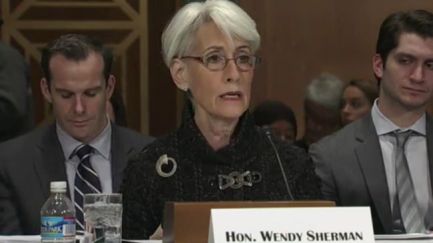
US State Department official Wendy Sherman at the Senate Banking Committee on Dec. 12, 2013

Press TV – December 13, 2013
The administration of President Barack Obama has told lawmakers in US Congress that they could pass new sanctions against Iran as far as they are not “nuclear-related.”
During a public testimony before the Senate Banking Committee on Thursday, State Department official Wendy Sherman, who led the US delegation in nuclear talks with Iran in Geneva, indicated that US lawmakers had the green light from the Obama administration to pass new anti-Iran sanctions as long as the sanctions are not “nuclear-related.”
“Given that there are different kinds of sanctions and the agreement focuses on nuclear-related sanctions,” Sen. Mike Crapo, the top Republican on the Committee, asked Sherman, “assuming we can specify exactly what that is and distinguish between the different sanctions, does that mean that Congress would be free to pass other sanctions measures while we are” negotiating over a final deal over Iran’s nuclear energy program?
“We have said to Iran that we will continue to enforce all of our existing sanctions, and we have said that this agreement pertains only to new nuclear-related sanctions,” Sherman answered.
In a phone interview with Press TV on Thursday, US Congress policy advisor Frederick Peterson said that the problem with some hawkish US lawmakers who are pushing for a new anti-Iran sanctions bill is exacerbated by the way the Obama administration is “misrepresenting” the interim deal between Iran and the P5+1 to the American people and Congress.
Meanwhile, the US Departments of Treasury and State announced new sanctions against a number of companies and individuals for “providing support for” Iran’s nuclear energy program.
Treasury Department official David Cohen, who also testified before the Senate Banking Committee on Thursday, said the new sanctions were “a stark reminder to businesses, banks, and brokers everywhere that we will continue relentlessly to enforce our sanctions.”
Iranian Deputy Foreign Minister Abbas Araqchi has hit out at Washington, saying that the new restrictions are in full contradiction with the recent nuclear deal between Tehran and the P5+1. Araqchi also said that Tehran is now assessing the current situation.
Related articles
Iran slams new US sanctions on firms, individuals
Press TV – December 13, 2013
Iran’s Deputy Foreign Minister Abbas Araqchi slams the new US sanctions targeting Iran, saying the bans run counter to the spirit of the recent nuclear deal reached between Tehran and six major world powers.
“This [US] move is against the spirit of the Geneva deal,” Araqchi said on Friday.
“We are assessing the current situation,” the senior member of Iran’s nuclear negotiating team added.
On Thursday, the administration of US President Barack Obama issued new sanctions against more than a dozen companies and individuals for “providing support for” Iran’s nuclear energy program.
The US Treasury Department said it was freezing assets and banning transactions of entities that attempt to evade the sanctions against Iran.
The sanctions came despite the nuclear deal inked between Iran and the five permanent members of the UN Security Council – Russia, China, France, Britain and the US – plus Germany in the Swiss city of Geneva on November 24 in a bid to set the stage for the full resolution of the West’s decade-old dispute with Iran over the country’s nuclear energy program.
Under the Geneva deal, the six countries have undertaken to lift some of the existing sanctions against the Islamic Republic in exchange for Iran agreeing to limit certain aspects of its nuclear activities during six months. It was also agreed that no more sanctions would be imposed on Iran in the same time frame.
Iran and the six powers ended four days of intense expert-level negotiations in Vienna, Austria, on Thursday.
Iranian Foreign Minister Mohammad Javad Zarif had earlier warned that the Geneva nuclear deal will be “dead” if the US imposes further sanctions against the Islamic Republic.
“The entire deal is dead. We do not like to negotiate under duress. And if Congress adopts sanctions, it shows lack of seriousness and lack of a desire to achieve a resolution on the part of the United States,” Zarif said in an exclusive interview with Time magazine in Tehran on Saturday.
Related articles
Featured Video

New positive ivermectin evidence
or go to
Aletho News Archives – Video-Images
From the Archives
Fanatical Followers of the Covid Regime: A Jim Jones-Style Cult?
By Professor Roger Watson and Dr. Niall McCrae | The Daily Sceptic | November 15, 2021
As scholars at leading British universities over recent decades, we witnessed the replacement of critical thinking and debate by narrative: facts are discrimination and scientific method is imperialism; truth, instead, is derived from ‘progressive’ values. This educational trend may be a major contributory factor to the ease in which society has been inculcated to the Covid ‘new normal’ of masking, testing, and repeated doses of vaccines for a disease of similar risk to severe influenza.
One doesn’t need much critical reasoning to observe the flawed logic of some vaccination enthusiasts, such as people who respond to experiencing any side effects, however debilitating, by saying “at least I know it’s working”, or, after contracting the disease despite their promised inoculation (over 90% effective, according to initial drug company claims), “I’d have been worse off without the jab.” … continue
Blog Roll
 Aletho News
- ‘Grave, alarming’: Iran mission on Trump’s UNGA ‘annihilation’ threats
- Najaf airport to reopen to Iranian flights within 24 hours: Ambassador
- From ‘How Will This End For Iran’ to ‘When America Walks Away’: A tale of two Economist covers
- Tehran blasts ‘baseless’ speculation linking Iran to alleged bomb plot at UK air base
- The Rise And… Rise Of ‘Color Revolutions’
- The Coming GOP Bloodbath?
- Arctic Scare Stories Melt Away
- Wrong, Euronews: Climate Change Has Not Created a Food, Energy, and Economic “Meta-Crisis”
- New positive ivermectin evidence
- Met Office Caught Fabricating Daily Temperature Record Claims
- If Americans Knew
- Netanyahu Asked UAE Leader to Deny Report on Oct. 7 Warning in Secret Visit, Sources Say
- CNN Chief Int’l Correspondent Clarissa Ward on Journalists in Gaza
- Democratic Party Consultants Surround Troy Jackson with Pro-Israel Donors
- Christian Leader Responds To Netanyahu’s Claims Regarding Palestinian Christians
- In Gaza, ‘Whoever Survives the Bombing Won’t Survive the Rubble’
- Israel kills more Palestinians, amid push to resettle Gaza – Daily Update
- Israel forces Gazans to live in constant peril – Daily Update
- Deconstructing Netanyahu’s pants-on-fire UN rant – Daily Update
- Trump betrayed voters with his campaign lies and prioritized a foreign country once he took office
- Netanyahu calls Israel’s war in Gaza ‘opposite of genocide’ in UN speech to near-empty hall
- No Tricks Zone
- New Study: Earth And Venus Surface Warmth Largely Explained By Convection And Lapse Rate, Not CO2 Or Radiation
- 2025 Nature Paper Claiming Worsening Global Drought Gets RETRACTED …Heavily Flawed
- New Study: ‘Global Drought Shows No Detectable Recent Acceleration Under Climate Warming’
- Economic Masterminds: German Socialists Suggest Taxing Productivity Gains Stemming From Using AI
- The South China Sea Has Not Been Cooperating With The Climate Change Narrative
- Energy Crisis: Germany Enters Heating Season With Historically Low Gas Reserve Fill Levels
- New Study: The Antarctic Ice Sheet Gained Mass From 2020-2024 Due To Staggering Snow And Ice Accumulation
- Study: Ocean Heating Rates From Thousands Of Years Ago ‘Dwarf’ Modern Ocean Heating Rates
- Climate Extremists Target, Attack Large-Scale Power Grid Infrastructure In Germany!
- New Study: Antarctic Ice Melt Has Contributed Less Than 1 Centimeter To Sea Level Rise In The Last 30 Years

