In recent days, reports about an alleged Israeli-US bombing attack that would have allegedly destroyed a large portion of the Fordo nuclear enrichment plant in Qom were circulating in Western media. However, its falsehood was soon revealed by several sources.
The story first appeared on February 25th when an Iranian defector going by the pseudonym Reza Kahlili published an evidence-free article in the US site wnd.com, in which he claimed that the Fordo plant had been the target of a sabotage operation. The article claimed that a blast deep within Fordo had “destroyed much of the installation and trapped about 240 personnel deep underground”.
However, the first doubts came due to the personality of the author himself, as Kahlili, a defector, is widely considered as a liar because of his previous claims. He wrote some months ago that Iran actually had nuclear weapons.
Kahlili’s sole source was Hamid Reza Zakeri, another Iranian defector, who is also notorious for his lies against Iran. A US official has been quoted by some US media as saying that Zakeri was “a fabricator or monumental proportions”.
This is not the first time that defectors are used in order to launch false accusations against a country. In the run-up to the Iraq War in 2003, New York Times reporter Judith Miller (and some others) published several stories about Saddam Hussein´s non-existent weapons of mass destruction programs and these reports were used by the Bush administration as a pretext to launch the war. Later, all these allegations turned out to be false and the newspaper was forced to admit that Miller had based her reports on Iraqi defectors. In that sense, the case for the war on Iraq was built on a set of fabricated documents and deliberately manipulated intelligence that US media outlets uncritically reproduced.
Israel spreads the story
Shortly after the Fordo story appeared, Israeli sites and officials tried to make it pass as true. The website of the Israeli newspaper Yediot Aharonot repeated the claim and it was later echoed by the Times of London, which added that the story had been confirmed by Israeli intelligence officials. “We are still in the preliminary stages of understanding what happened and how significant it is,” one Israeli official told the London Times. “Israel believes the Iranians have not evacuated the (Fordo´s) surrounding area. It is unclear whether that is because no harmful substances have been released, or because Tehran is trying to avoid sparking panic among residents.”
For his part, Israeli acting Defense Minister, Avi Dichter, reacted to the story by saying that indeed any explosion in Iran was “good news”.
Of course, Israeli officials always knew that the story was false but it is clear that they wanted to feed the notion that they -with US help- were conducting a successful secret war against Iran in order to reinforce their own extremist stance. However, as these stories are revealed as lies, the effect is counterproductive to them because they expose themselves, once again, as liars before the international community, especially on the Iran nuclear issue.
However, two senior Iranian officials dismissed reports of the explosion. Deputy head of the Iranian Atomic Energy Agency Seyyed Shamseddin Barbroudi said there had been no explosion at the Fordo facility, according to the Islamic Republic News Agency (IRNA). The chairman of the Iranian parliament’s Committee for Foreign Policy and National Security, Alaeddin Boroujerdi, said they were “baseless lies” meant to impact talks on Iran´s nuclear program, reported IRNA.
The Iranians´ statements were then confirmed by the International Atomic Energy Agency (IAEA), which claimed that there were no signs of any explosion whatever in Fordo. The IAEA has live cameras at the site and its inspectors regularly visit it, and, therefore, they would have known if it had been “in ruins with hundreds trapped within”. “We understand that Iran has denied that there has been an incident at Fordo. This is consistent with our observations,” IAEA spokeswoman Gill Tudor said.
The White House also rejected the report as unreliable. “We have no information to confirm the allegations in the report and we do not believe the report is credible,” spokesman Jay Carney said in a briefing with reporters. “We do not believe those are credible reports.”
The false diagram
The Fordo false explosion was not the only Israeli fabrication on the Iranian nuclear issue. On November 27th 2012, the Associated Press agency published a report claiming that it had discovered the existence of alleged evidence of “Iranian work on a nuclear bomb”. “Iranian scientists have run computer simulations for a nuclear weapon that would produce more than triple the explosive force of the World War II bomb that destroyed Hiroshima”, the agency said.
This evidence, according to AP, was a “graph” which the agency said was “leaked” to it by “officials from a country critical of Iran’s atomic program” to “bolster their arguments that Iran’s nuclear program must be halted before it produces a weapon”. Moreover, “an intelligence summary was provided with the drawing” claiming that “Iran is working not on isolated experiments, but rather on a single program aimed at mastering all aspects of nuclear arms development.”
Why did AP hide which country had delivered the diagram? It said that officials of that country wanted anonumity, so the agency gave it anonymity. However, everybody was certain it was Israel.
The author of the AP report, George Jahn is also notorious because every time there is a possibility of a diplomatic solution to the crisis over Iran´s nuclear program, he reports an “exclusive” anti-Iranian revelation, always provided to him by “an official of a country tracking Iran’s nuclear program,” or “an official of a country that has been severely critical of Iran´s nuclear program.”
Nevertheless, experts soon discovered that the diagram was fake and amateurish. According to the British newspaper The Guardian, it simply showed that “the bulk of the nuclear fission yield is produced in a short 0.1 microsecond pulse”, which is a common knowledge for any physics student. Later, it was equally discovered that it is widely available all over the Internet and in university textbooks. Even worse, the diagram contained huge errors, which were unlikely to have been made by research scientists who work in a state-run national program.
Scott Kemp, an assistant professor of nuclear science and engineering at the Massachusetts Institute of Technology (MIT), told IPS he suspects the graph leaked to AP was “adapted from the open literature”. He said he believed its authors “were told they ought to look into the literature and found that paper, copied (the graph) and made their own plot from it.”
After the hoax became exposed, Western diplomats privately accused Mossad, the Israeli intelligence agency, of being behind the leaks, which would be part of an effort to implicate a murdered Iranian in an alleged weapons program. The diplomats also said Mossad is becoming increasingly active in Austria, the home of the IAEA and the place where George Jahn works, in order to drive support for a war on Iran.
Therefore, what AP presented as a kind of highly specialized and very complex document was only a very common graph, which can be easily found on the internet. The agency helped create and spread a dangerous hoax and its credibility was severely damaged by this serious incident that demonstrated that it let itself be manipulated by officials “of an anonymous state” in order to incriminate Iran. The agency did not tell the public who gave it the false and misleading information with the evident goal of misleading the public into believing that Iran had a weapons programme.
Recently and after having scored a heavy defeat in the latest parliamentary elections, where he and his his right-wing partner Avigdor Lieberman lost 25% of their seats in the Knesset, Israeli Prime Minister Benjamin Netanyahu tried to hide his current political weakness by shifting the public´s attention to Iran. In his “victory speech”, he insisted that his first challenge would be “preventing Iran from obtaining nuclear weapons”.
Of course, this rhetoric does not deceive anyone, as even the US and the IAEA reports recognize that Iran continues to use civilian enriched uranium only for civilian purposes. US officials have recently said that the assessment included in the 2010 National Intelligence Estimate, which claims that there is no evidence whatever of an Iranian nuclear weapons program, remains the consensus view of the US´s 16 intelligence agencies.
The international community is actually fed up with Israel’s false allegations and fabrications against Iran. Netanyahu and his Zionist supporters in the US probably know that the American and Western public cannot be manipulated into supporting an attack on Iran, as all the polls show.
Another for-Israel war in the Middle East would not benefit anyone but the far right in Israel, the pro-Israeli lobby in the US and its neocon agents. It would not only devastate the Middle East and kill hundreds of thousands, if not more, but it would also produce a decades-long conflict between the Muslim world and the West that would also destroy the West´s economy. Due to all this, the international community and the peoples of the world must confront these Zionist plots threatening the existence and hopes of humanity.
February 7, 2013
Posted by aletho |
Deception, Mainstream Media, Warmongering, Wars for Israel | Associated Press, Fordo, International Atomic Energy Agency, Iran, Islamic Republic News Agency, Israel, Mossad |
Leave a comment
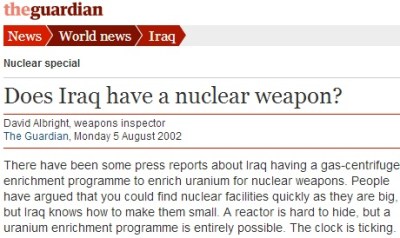
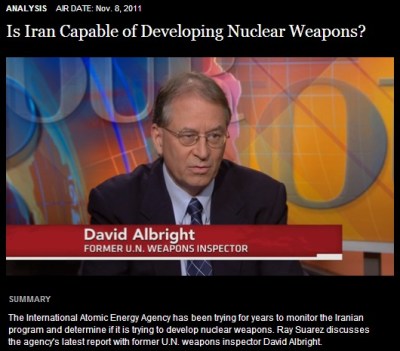
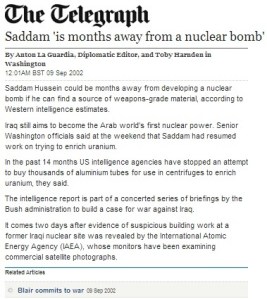
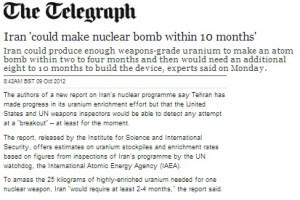
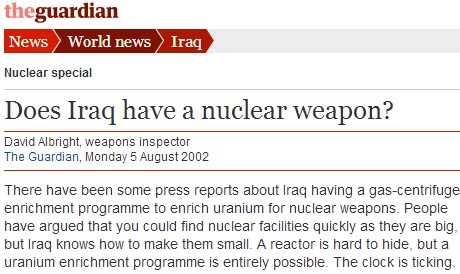
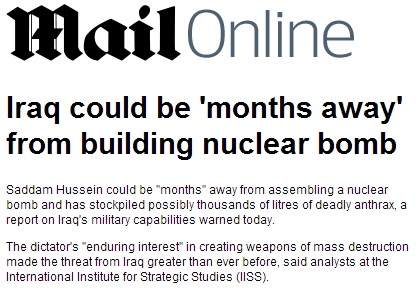
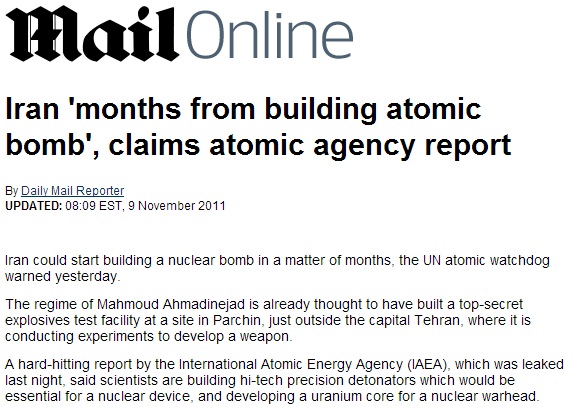
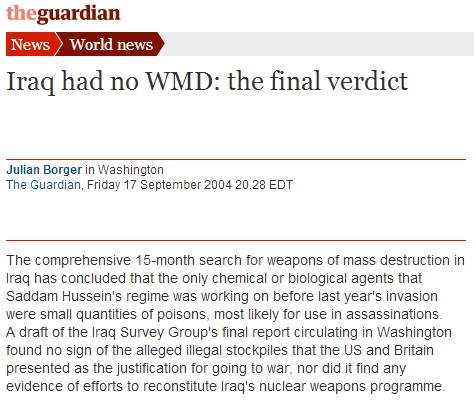
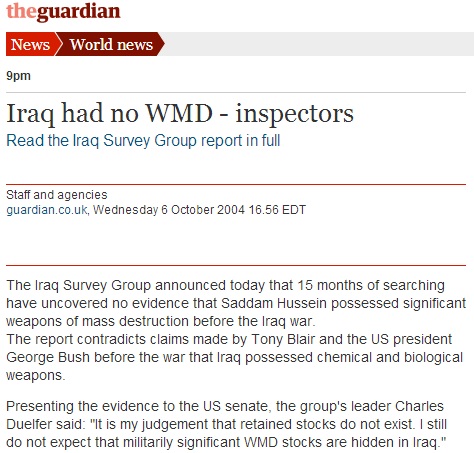
Could this repeated history be any more obvious?
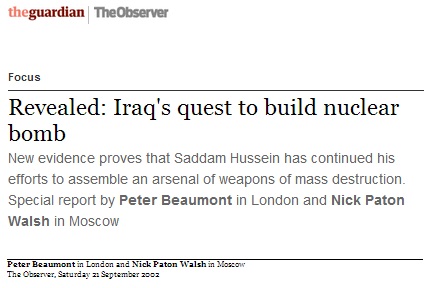
This was August 5, 2002:
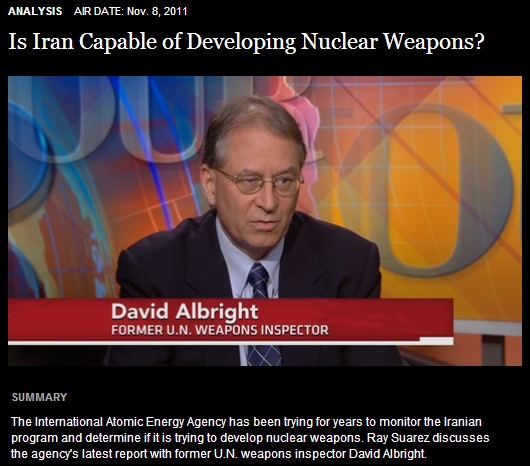
And this was November 8, 2011:
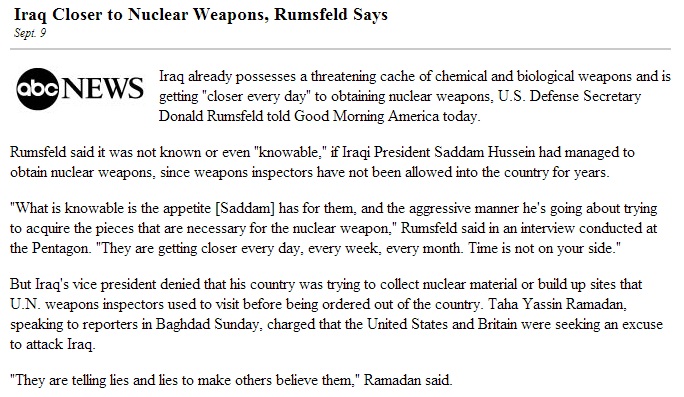
This was September 9, 2002:
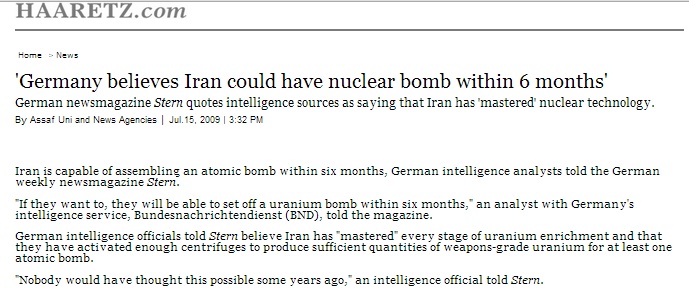
And this was October 9, 2012:
This was also September 9, 2002:
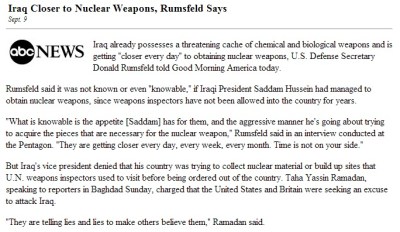

This was September 17, 2002:

And this was May 9, 2006:
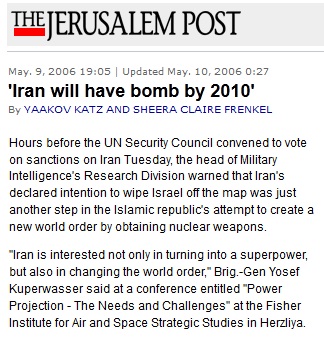
This was September 22, 2002:
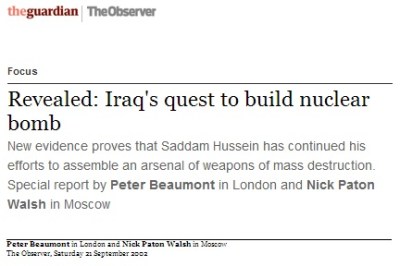
And this was November 6, 2011:
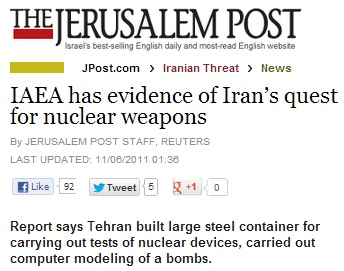
This was September 10, 2002:
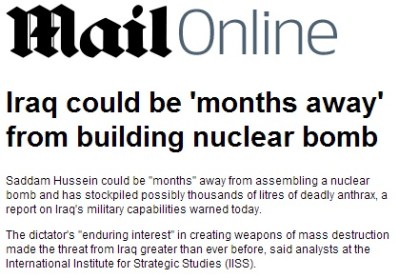
And this was November 9, 2011:

This was September 17, 2004:

And this was January 27, 2009:

This was October 6, 2004:

And this was January 25, 2010:

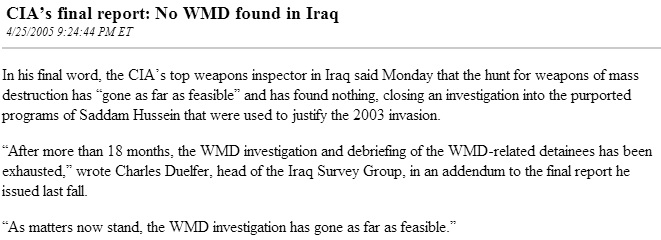
This was April 25, 2005:

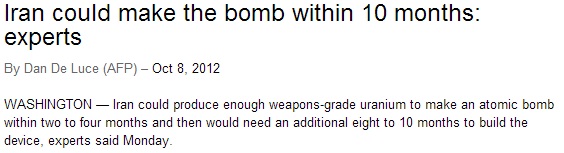
And this was October 8, 2012:

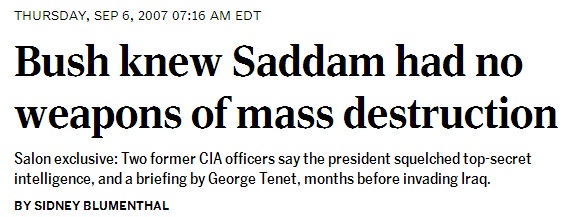
This was September 6, 2007:
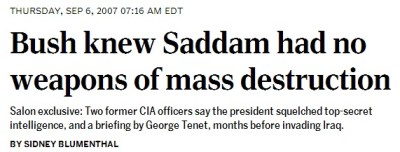
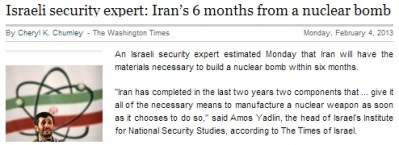
And this was February 4, 2013:
*****
February 6, 2013
Posted by aletho |
Deception, Mainstream Media, Warmongering, Timeless or most popular, Wars for Israel | George W. Bush, Iran, Iraq, Israel, Middle East, Saddam Hussein, United States |
Leave a comment
The US and Israel are using the accusations leveled against Hezbollah in the 2012 Burgas bus bombing to pressure the EU into including the resistance group on its terrorist list. But the Bulgarian opposition is crying foul.
Israeli and US pressure on Bulgarian authorities to formally accuse Hezbollah as the organization behind the 18 June 2012 bus bombing in the city of Burgas – in which six people, including five Israelis, were killed – has not been entirely successful.
They have succeeded in pressuring the Bulgarian investigators probing the bombing to link the attack to Hezbollah. This has been done in such a way as to strike a compromise between the hardline stances of Israel and the US, and the cautious position of European countries, who do not see it in their interest to up the ante against Hezbollah at this juncture.
Bulgarian Minister of Interior Tsvetan Tsvetanov announced Tuesday, 5 February 2013, that two people believed to have been connected to Hezbollah were involved in the Burgas bombing.
Speaking after a special meeting of the country’s Consultative Council on National Security to discuss the investigation’s findings, Tsvetanov said the pair were part of a group of three who carried out the attack. The two had traveled on Australian and Canadian passports, and lived in Lebanon since 2006 and 2010, respectively.
The minister went on to say that “there is data showing the financing and connection between Hezbollah and the two suspects,” and that investigators had “a well-founded assumption that they belonged to the military wing of Hezbollah.”
The wording of his remarks was significant. It could foil longstanding Israeli and US efforts to pressure the EU to designate Hezbollah in its entirety as a terrorist organization, as opposed to merely its “military wing.”
Tsvetanov also said that the Lebanese authorities had been asked for assistance in the probe.
From Lebanon to Bulgaria, the Opposition Reacts
The announcement was quickly challenged by Sergei Stanishev, leader of Bulgaria’s parliamentary opposition and the head of the Bulgarian Socialist Party, who charged that finger-pointing against Hezbollah was unfounded and politically motivated.
“It is obvious that Bulgaria’s government has chosen a political approach and is only repeating the interpretation alleged by Israel on the very next day following the attack, when the investigation had not even started,” he said, as quoted by the Sofia News Agency.
“The investigation is currently underway, and there is no way one can be talking about decisive evidence regarding the direct perpetrators, much less regarding the organization that is behind this tragic event,” Stanishev added.
The Agency quoted sources at the Bulgarian foreign ministry as saying that security had been stepped up at the country’s embassy in Beirut as a precaution against possible attacks.
The Bulgarian opposition’s skepticism over the Hezbollah accusation has made no impression on the Lebanese opposition. Members of the March 14 coalition seized on the news, and some predicted it would lead to the downfall of Prime Minister Najib Mikati’s government, of which Hezbollah is a member.
Senior sources in the Future Movement told Al-Akhbar that it had already been agreed that Mikati would step down once a new election law is in place, “but now we have been unexpectedly given the Bulgarian accusation.”
The sources said Future Movement MPs discussed the issue at a meeting Tuesday, but decided not to discuss the Bulgarian charge against Hezbollah in the media for the time being.
Nevertheless, a prominent Future Movement MP remarked to Al-Akhbar: “How can a partnership be established in this country on the basis of terrorism?” He added that in demanding that the government quit, “we are not speaking from a position of hostility or score-settling,” but “out of concern for the country and its interests.”
Sources close to the prime minister denied that the government had any intention of stepping down in the wake of the Bulgarian minister’s announcement. The source attributed the suggestion to “the wishful thinking of the March 14 camp.”
In his public reaction to the announcement, Mikati reiterated Lebanon’s readiness to cooperate with the Bulgarian authorities “to shed light on the circumstances” of the incident, while stressing its condemnation of all such attacks in any European or Arab country.
Lebanese official sources said Beirut had been informed earlier that four members of Hezbollah would be accused of complicity in the bombing. It also knew in advance that the Bulgarians would draw a distinction between Hezbollah’s military wing and Hezbollah itself in order to avoid its placement on the EU terrorist list.
Yet no Lebanese officials were informed of the suspects’ identities, the sources said. The only request for assistance received from Bulgarian investigators by Lebanese judicial authorities was a request to search for an individual’s fingerprints in Lebanese records.
While Hezbollah remained silent, Israeli Prime Minister Benjamin Netanyahu was quick to seize on the news to demand that the EU designate Hezbollah a terrorist organization and not distinguish between its military and political wings.
In a statement released by his office, Netanyahu thanked the Bulgarian government for its “thorough and professional investigation” and elaborated on how Iran and Hezbollah were “orchestrating a worldwide campaign of terror,” as well as supporting “the murderous Assad regime in Syria.”
The Israeli prime minister’s words were parroted almost verbatim by US President Barack Obama’s counterterrorism advisor John Brennan, who urged EU states to ”take proactive action to uncover Hezbollah’s infrastructure and disrupt the group’s financing schemes and operational networks.”
The EU itself seemed less eager than the US and Israel to put Hezbollah on its terrorism list. EU foreign policy chief Catherine Ashton merely took note of the results of the Bulgarian probe and stressed the need to “reflect on the consequences.” She said that “the EU and member states will discuss the appropriate response based on all elements identified by the investigators.”
Israeli media had reported in advance of the Bulgarian announcement that Israel’s contribution to the probe had enabled investigators to link the Burgas bombing to Hezbollah. Israeli reports over the past two months had anticipated that Hezbollah and Iran – Hezbollah as an organization and the Iranian state – would be accused of funding and implementing the attack.
February 6, 2013
Posted by aletho |
Deception, False Flag Terrorism, Wars for Israel | Bulgaria, Bulgarian Socialist Party, Burgas, Hezbollah, Israel, Sergei Stanishev, Tsvetan Tsvetanov |
Leave a comment
Argentinean Foreign Minister Hector Timerman says the Israeli regime has no right to interfere in the proceedings of the AMIA issue underway between Argentina and Iran.
Israel recently called for an explanation about an agreement between Iran and Argentina to set up a fact-finding committee to investigate the 1994 deadly bombing at a Jewish center in Buenos Aires.
“Israel has no right to demand explanations; we’re a sovereign state,” Timerman told Israel’s ambassador to Buenos Aires Dorit Shavit.
“Israel doesn’t speak in the name of the Jewish people and doesn’t represent it,” Timerman added.
Those who live in Argentina are Argentinean citizens and Israel’s involvement in the issue will only give ammunition to anti-Semites, the Argentinean foreign minister stated.
On January 27, 2013, Iran and Argentina signed a memorandum of understanding for the two countries to shed light on the 1994 bombing on the AMIA building in Buenos Aires, which killed 85 people and wounded 300 others.
The Israeli foreign ministry issued a statement on January 28, 2013, saying they were “astonished and disappointed” at the deal.
Israel summoned Argentina’s envoy Atilio Norberto Molteni the following day in protest against the deal. The Tel Aviv regime also asked Shavit to demand a meeting with Timerman to “seek clarifications.”
Under intense political pressure imposed by the United States and Israel, Argentina formally accused Iran of having carried out the 1994 bombing attack on the AMIA. The Islamic Republic has vehemently and consistently denied any involvement in the bombing.
February 6, 2013
Posted by aletho |
Deception, Wars for Israel | 1994 AMIA bombing, AMIA, Argentina, Buenos Aires, Héctor Timerman, Iran, Israel |
Leave a comment
Syrian TV has broadcast images of what it said was the aftermath of an Israeli airstrike on a research facility near Damascus. Israel has implicitly admitted it was behind the raid, which allegedly targeted a weapons convoy headed to Lebanon.
The footage broadcast on Saturday by Al-Ikhbariya TV and Syrian state TV showed destroyed cars, trucks and military vehicles, and a damaged building with its windows broken and interior damaged. The video was allegedly shot at Jamraya, northwest of Damascus. The Syrian military earlier said that Israeli jets bombed the area.
Israel has not officially confirmed the allegations. But on Sunday, Israeli Defense Minister Ehud Barak said that “What happened in Syria several days ago… that’s proof that when we said something we mean it. We say that we don’t think it should be allowed to bring advanced weapons systems into Lebanon.”
“Hezbollah from Lebanon and the Iranians are the only allies that [Syrian President Bashar] Assad has left,” Barak told reporters at a security conference in Munich, adding that the “imminent” fall of the Assad government “will be a major blow to the Iranians and Hezbollah.”
Earlier, it was reported that the Wednesday airstrike targeted a convoy carrying SA-17 anti-aircraft missiles to Hezbollah forces in southern Lebanon. The advanced Russian-made missiles would have enabled troops in Lebanon to target Israeli warplanes, which can currently intrude into Lebanese airspace unopposed.
The reports were denied by the Syrian military, which said that no such weapons transfer had been planned.
Damascus vowed to retaliate against the Israeli airstrike, while Syrian rebel forces battling the government criticized President Bashar Assad for not responding to the bombing.
On Sunday, President Assad accused Israel of trying to destabilize Syria through the attack. He warned that Syria will confront “current threats… and aggression” against it during a meeting in Damascus with Iranian national security council secretary Saeed Jalili. The remarks were the Syrian leader’s first public comment on the airstrike since it happened on Wednesday.
Israel maintains the most advanced military of any nation in the region, and has carried out a number of airstrikes against foreign targets over the past few decades. The latest high-profile incident attributed to Israel was the bombing of an arms factory in Khartoum, Sudan, last October.
Israeli jets also reportedly bombed Syria in 2007, destroying what was alleged to be a nuclear reactor being constructed with the help of North Korea.
Israel and Syria are embroiled in an ongoing land dispute over a portion of the Golan Heights occupied by the Jewish state during the Six-Day War of 1967. The two countries do not maintain formal diplomatic relations, and hostilities between the two have been sparked on several occasions, most recently in the 2006 Lebanon war.
Israel has avoided interfering in Syria’s ongoing 22-month-long armed conflict, but said it would deploy troops if needed to secure Syria’s chemical weapons stockpiles and prevent them from being captured by Islamist forces.
VIDEO
February 3, 2013
Posted by aletho |
Militarism, War Crimes, Wars for Israel | Ehud Barak, Israel, Lebanon, Syria |
Leave a comment
When is it acceptable for a country to engage in an act of aggressive war? Can it be justified to engage in an act that has been recognized by the world community and laid down in international law as a crime against humanity? Not just my humanity but all humanity?
These are questions the world community should have been asking itself every day for approximately the past two decades, but it has not. For it was approximately that long ago that one of the world’s superpowers began engaging in acts of aggression wherever it saw fit in order to show its strength and military might and terrorize the world into bending to its will.
Suppose for a minute you and I are that power. We are righteous, rich and powerful and control much of the planet through our economic manipulations and massive media and political know-how. We also have bombs and weapons all over the planet ready to wipe out any adversary and the adversaries of our friends. We are righteous, our God is the proper god and our people are beautiful, fairly well educated and created in our God’s image.
We have more of a right to exist on earth and consume the world’s resources than any of the other nations, because we are the chosen, the beautiful and the strong. They are weak, poor, envious of our power, and worth almost nothing compared to us. What is more, their god is the wrong god and they are not as beautiful and tall and proud as we are. The world is ours, we own it and everyone else has to bow down before us. We take what we want, from where we want, when we want.
Above all else is our moral superiority; we have been victimized in the past and the world must side with us and allow us to seek revenge on our enemies who want to destroy us because we are powerful, beautiful, free and our God is better and more righteous than their god. Our word must be good enough for everyone. If we say someone wants to destroy us, that is the way it is. We do not need to provide proof or receive permission from anyone to destroy whoever we decide is our enemy.
We know that one of us is worth thousands of them because we are the chosen and live in God’s land, a land given to us by our God. A land we cleansed of the savages and animals that had claimed it was theirs. We also know we are worth more than them because we were persecuted for our God and our God has chosen us over other, false, gods.
Since we are the chosen, if we have the idea that you are not worthy of life and are a useless eater, we can kill you, we can bomb you and we can take your lands. After all you are less worthy than us, we are the beautiful and strong and we were created in our God’s image.
So if we have “intelligence” that your country is arming our enemies we can, at our discretion and when we please, enter any country’s territory, including yours, and murder the people and destroy their facilities. Sure we can. After all we are the righteous and you are a bad guy in the eyes of me and my friends. And what is more we control the international courts and all of the international bodies that you could use to complain against us.
What is more, if we decide we don’t like your ruler we will replace him, assassinate him or publicly execute him before your eyes.
But you will never complain or do anything against us because what is more we control you, and if we decide you are a threat we will come to you and destroy you. Or cripple you, or torture you, or take you to a secret prison and make you disappear forever. We can even kill you without leaving our own bunker on the other side of the world.
Do you doubt our power? We have satellites, the Internet, cameras and even tracking devices set up in your cell phone. We know where you are every minute. We record your every move, we know what you watch and what you buy at the shop and we know where your children are and we can kill them if you get out of line. For you are nothing. You are the mud people and we are your masters.
Did you imagine you and I were that powerful? Did you feel the righteousness and superiority? Do you understand who we are dealing with? If you feel a little uneasy, queasy or even nauseous that is okay. It means you are still human and there is still hope; if you feel rage and feel you are being mocked it is time you took off your blinders and imagined you were the “lesser” people and your lands were being taken and your women and children were being murdered before your eyes and there was nothing you could do about it.
Wake up!
February 1, 2013
Posted by aletho |
Ethnic Cleansing, Racism, Zionism, Militarism, Wars for Israel | God, Israel, John Robles, Righteousness, Warfare and Conflict, Zionism |
Leave a comment
British Foreign Secretary William Hague claims the Israeli regime’s violation of Syria’s airspace in the air raid on a Syrian army research center is a “reaction” to the Syrian crisis rather than a breach of the country’s sovereignty.
“I’m not going to give any condemnation of Israel, rushing to any criticism,” Hague told the BBC.
In a clear attempt to whitewash the Israeli aggression, Hague further claimed that Israel has rightfully reacted to the situation in Syria.
“We have a whole massive situation in Syria to deal with … So I think we should keep our eyes on the main event, on the main crisis,” he said.
“If it affects neighboring countries they would react in various ways, we have to get to the root causes of it and the root cause of the Syria crisis is not Israel,” he added.
This comes as Britain had initially avoided reacting to the airstrike on the research center in northwest of the Syrian capital of Damascus that killed two people and injured several others in full violation of the international law.
The raid has been condemned by Iran, China and Russia with Russians calling it an “unjustified assault” and a “blatant violation of the UN Charter.”
This is while analysts believe the attack has been exactly opposite to what Hague has tried to pretend it is, that is an Israeli act of provocation to drag Syria into de facto war that would give the west an excuse for direct military intervention in the Middle Eastern country.
Following the strike, the Syrian army accused Tel Aviv of being behind the unrest in the country.
Syria has formally complained to the United Nations over the Israeli fighter jets’ attack.
Meanwhile, Britain has been playing a major role in fanning the flames of unrest in Syria by providing support for terrorists who are killing innocent civilians in the country.
Hague reiterated that stance in his interview with the BBC, saying London will “keep increasing the support, the practical support we give to the [Syrian] opposition.”
February 1, 2013
Posted by aletho |
Militarism, War Crimes, Wars for Israel | Hague, Israel, Syria, William Hague |
Leave a comment
Though Washington tries to engineer Middle Eastern politics by influencing economies, Iran has never given in to such pressure, Middle East experts Hillary and Flynt Leverett told RT. Iran’s concerns deserve fair consideration, they argue.
The Leveretts acted as analysts in both the Bill Clinton and George W. Bush administrations, and are two of America’s most informed Middle East experts. Their new book, ‘Going to Tehran: Why the United States Must Come to Terms with the Islamic Republic of Iran,’ offers a way out of the current diplomatic crisis facing the two countries.
RT: Washington seems to be very happy with the sanctions. They are crippling the Iranian economy. Why should they change policies now? Why should they come to terms with Iran?
Hillary Leverett: Sanctions are not going to work. Sanctions have not worked. We’ve seen sanctions imposed on the Islamic Republic of Iran for 32 years. We saw crippling sanctions imposed on Iran during their 8 year war on Iraq from 1980 to 1988. We saw at that time half their GDP was erased, half of it. And still the Islamic Republic of Iran did not surrender to hostile foreign powers. The idea that now the sanctions are going to force the Islamic Republic of Iran to surrender to what it sees as hostile foreign powers and their demands, there’s no basis for that in the history of the Islamic Republic of Iran. And, frankly, there’s no basis for that anywhere. The United States imposed crippling sanctions, for example, on Saddam Hussein’s Iraq for over a decade, killing over a million people, half of them children, and even then Saddam Hussein’s government did not implode and it did not concede to the demands of hostile foreign powers. It took a massive US land invasion to do that.
RT: The ability to stand in the other side’s shoes, to show that you can do it is key to diplomacy, I think you would agree with that. But everything the US has done so far showed Iran the opposite of that, starting from the US helping to get rid of their democratically elected leader in the fifties, putting the Shah in power, a much hated figure in Iran. What can the US do now to show Iran, that they respect their national interests?
Flynt Leverett: The first thing that has to happen is this basic acceptance – acceptance of the Islamic Republic as a legitimate and rational actor. This is the model which Nixon and Kissinger used to pursue the diplomatic opening with China in the early 1970’s. It’s not their achievement, it was not that they started talking to Beijing. The United States had been talking to Beijing for years, but it was this very narrow kind of dialogue very focused on grievance – American grievances towards China and what China was going to need to do to bring itself in line with American preferences. Nixon and Kissinger flipped that on its head. They said alright, we are going to convey to the Chinese both in words and in actions that we accept the People’s Republic of China and on that basis the rest of these issues can be taken care of. That’s what enabled this dramatic turn in American diplomacy toward China, that’s what we need to do toward the Islamic Republic of Iran – to accept it and then to back that up with concrete actions in terms of rolling back covert action programs, in terms of stopping economic warfare against Iran.
RT: But what are the chances for diplomacy? I mean Iran is surrounded by US military bases, by NATO Patriot missiles. They have the sanctions that are crippling the Iranian economy. It seems there’s more ground for blackmail now than for diplomacy.
HL: Unfortunately, I think that is the American hope that we can still force, coerce outcomes. That’s what the United States has been doing really since the end of the Cold War. We have focused on coercing outcomes by, as Flynt said, projecting enormous amounts of conventional military force into the Middle East to coerce political outcomes. Before 1991 we were somewhat restrained in doing that because of the Cold War. If we put in too many troops we were afraid the Soviet Union would. So, in a sense, that constrained us, forced the United States to really rely more on soft power, more on having a narrative. After the collapse of the Soviet Union and the end of the Cold War, we, I think, left that out, we put that under the table. We focused entirely on trying to force political outcomes. And what we’ve done in Iraq and Afghanistan has underscored the very important limits of that. And I would add Libya. We were able to take out Muammar Gaddafi but what were we able to put in instead?
RT: What if everything fails? What is your worst case scenario?
FL: I think that my worst case scenario is that the United States starts another war in the Middle East to disarm another Middle Eastern country of weapons of mass destruction that it does not have. And that the damage, that the backlash this does to the American position in the Middle East makes how much damage was done to the American position by the invasion of Iraq look quite trivial by comparison. That’s my worst case.
RT: I want to ask you about the new face of the Pentagon Chuck Hagel. He allowed himself to say outright attacking Iran is a stupid idea. And I believe he also called for direct negotiations. Do you think we can see direct negotiations any time soon with Chuck Hagel’s administration?
HL: I think that former senator Hagel has taken the greatest positions on Iran and a range of issues. And I admire them and respect them. The concern I have is that he’s been nominated for the wrong job to carry out those positions. As Defense Secretary, if he is approved as Defense Secretary, he will not be the person in charge of creating or implementing strategy vis-a-vis Iran or any other foreign policy issue. He will be at the Defense Department doing quintessentially Defense Secretary things in this environment, which is to cut the budget and try to keep the United States out of another war. Now that piece – trying to keep the United States out of another war – could have impact here, but the problem is he could potentially try to keep the United States out of another war without being able to offer a vision to deal with this challenge. The Islamic Republic poses a real challenge to the United States and a real challenge to Israel. That challenge significantly constrains both the United States’ and Israel’s preferred strategies for the region – just to project force whenever, wherever and to whatever degree we want unilaterally. The Islamic Republic of Iran challenges that not with tanks, not that they go and park their tanks in other people’s countries, they challenge that with their narrative. They oppose that viscerally at its core.
RT: Chuck Hagel said some very unflattering things about the Israeli lobby. That they are “intimidating a lot of people in Washington”. He also said American interests should trump Israeli interests if they conflict. And that’s a subversive thing to say here in Washington, could be a career killer. Can you name some key points where US and Israeli interests conflict?
FL: I think it is very much in America’s interests, it’s not a favor to Iran, it is in America’s interests to come to terms with the Islamic Republic, to accept safeguarded enrichment of uranium as the basis for a deal on the nuclear issue. Israel’s ability to impose its hegemony in Gaza or Southern Lebanon is not an American interest. It may be an Israeli preference, it’s not an American interest. I think American interests would be much better served by a kind of rational political settlement of the Palestinian issue, that Palestinians and other Middle Easterners will see as legitimate. There’s no way that open-ended Israeli occupation of Palestinian lands will ever be seen that way. And I think that’s very much against American interests.
HL: It’s very difficult for the way Israel is structured politically for it to accept and buy into and support what I think would be in American interests, which is that all of the states in the Middle East be able to have much more participatory political orders. Israel does not accept that in its own political order, because it does not allow the Palestinians under its occupation to vote or have a say in their governance. And essentially it cannot support it even more broadly beyond its borders, because of countries like Egypt, which I think the Israelis see today as very much of a threat in terms of how it’s developing. If it becomes any more reflective of its population’s preferences, history, interests, religion, it’s going to become by definition less interested in being OK with the policies that Israel has developed to use force coercively whenever wherever it wants along its borders or within its borders on the Palestinian population under its control.
RT: At the same time the US calls for democracy in all those countries.
HL: And that’s what rings hollow for the Arab and Muslim population, is that it’s not a real call by the United States for democratization. What the United States is trying to do is sow chaos and civil war like we are doing in Syria. We are not really trying to get democratization or political participation in Syria. It’s sowing chaos and destruction. I think that’s how many people see it and that’s how it is unfolding.
RT: What do you think Israel is going to do next? What is their strategy towards Iran?
FL: I think they have more or less come into position that if Iran is going to be struck, it’s the United States that’s going to need to do it and so I fully anticipate over the next year or so that Prime Minister Netanyahu, he and his government, will be putting a lot of pressure on the Obama administration, that Iran is approaching whatever red line Netanyahu draws, that it’s time for the United States to step up to the plate and deal with this problem in a decisive way. And even if they don’t succeed initially in persuading Obama of this, they’ll leverage it to get more sanctions on Iran, to get other kind of pressure on Iran. They will try and keep Iran in a box.
RT: Do you think President Obama appointed Chuck Hagel as a message to Israel?
FL: That’s difficult to say. We’ll see, but I’m skeptical that Obama really is out to redefine the American relationship with Israel.
HL: In addition to the Hagel appointment we have the appointment of John Brennan, the CIA, who I think the Israelis are just fine with, who will continue many of the covert programs, of course our drone program, but many of the covert programs will be under his authority at the CIA. That will be very much to Israel’s liking. That will serve to undermine any attempts, any possibilities for real rapprochement or coming to terms with Islamic Republic of Iran.
RT: There is an argument often made in Washington, that Bashar Assad’s fall would be a strategic victory against Iran. What can you say about an approach like that?
FL: First of all, at this point Iran’s most important Arab ally is no longer Syria, it’s Iraq, thanks in no small part to the United States. Iran’s most important strategic ally in the Arab world is Iraq. Even if Syria Bashar Assad is still there. I don’t think his downfall is imminent. Even if he reaches a point where he might feel like he needs to abandon Damascus, or something like this, we are going to still have a big chance of Syria that far effectively under the control of his government, under his security apparatus. Syria might at that point start to look more and more like a kind of a failing state with different regional warlords in different parts of the country. But that is not a situation which is good for American interests, first of all, or a situation in which Iran doesn’t have influence or an ability to act in ways to protect its interests in this situation.
HL: The idea that somehow we can just have these short term marriages of convenience to arm, train and fund the Sunni Islamist Jihadist groups in Syria against the Islamic Republic of Iran… just this time it will work.
FL: And if somehow secular democrats are going to come to power…
HL: Yes, if liberal secular pro-American democrats will come to power. But it didn’t work in Afghanistan and it’s not going to work in Syria.
January 31, 2013
Posted by aletho |
Militarism, Timeless or most popular, Wars for Israel | Flynt Leverett, Iran, Islamic Republic of Iran, Middle East, United States |
Leave a comment
Instead of going to a full-scale war with Iran over its nuclear program Israel may be satisfied with a US-led operation, says Defense Minister Ehud Barak. Previously Tel Aviv was determined to resolve the issue on its own, if the US refuses to help.
Apparently after the Knesset election this month left the Netanyahu cabinet weakened, Israeli hawks are toning down their war drumming rhetoric. In an interview at the World Economic Forum in Davos, Switzerland, Barak said the Pentagon had prepared a surgical operation that can be used as a last-ditch measure to slow Iranian progress.
“I used to tell them [American friends], you know, when we are talking about surgical operations we think of a scalpel, you think of a chisel with a 10-pound hammer,” Barak joked as cited by The Daily Beast. But that’s not the case with the plan, he noted. “The Pentagon prepared quite sophisticated, fine, extremely fine, scalpels. So it is not an issue of a major war or a failure to block Iran. You could under a certain situation, if worse comes to worst, end up with a surgical operation.”
Such an operation “will delay [the Iranians] by a significant time frame and probably convince them that it won’t work because the world is determined to block them,” Barak said.
“We of course prefer that some morning we wake up and see that the Arab Spring was translated into Farsi and jumped over the Gulf to the streets of Tehran, but you cannot build a plan on it,” he added.
Israel’s right-wing government under PM Benjamin Netanyahu has been trumpeting war drums for months, saying it is prepared to do anything to stop Iran from building a nuclear weapon and would launch an attack before its own window of opportunity closes. It called on its American allies to draw a red line after which a military action should follow. The pressure antagonized the Barack Obama administration, which refused to sign up for a new major conflict and called for non-military effort.
Tel-Aviv, Washington and some other countries believe that Iran is trying to build a nuclear weapon under the guise of its nuclear program. They want Tehran to shut down uranium enrichment facilities. Iran insists that it pursues strictly civilian goals with its nuclear industry, including production of fuel for nuclear reactors and radioactive isotopes for medical and research applications.
In a move aimed at dispersing international fears Iran’s supreme leader Ayatollah Ali Khamenei issued a religious decree banning nuclear weapons last year. The decree is binding for the Iranian government, Tehran stressed earlier this month ahead of a new round of international talks on the issue.
Earlier the US and Israel reportedly launched several clandestine operations against the Iranian nuclear program. Those include infecting Iranian industrial computer networks at enrichment facilities with a sophisticated virus, which damaged the sensitive equipment. There have also been several assassinations of Iranian nuclear scientists, which Tehran says were orchestrated by Israel.
The US also championed a set of strict economic sanctions against Iran, which crippled its oil exports.
January 27, 2013
Posted by aletho |
Wars for Israel | Ehud Barak, Iran, Israel, United States |
Leave a comment
An Associated Press report from this past week demonstrates how plain facts and provable, documented historical events are often described as subjective perceptions and matters of perspective in the mainstream media whenever an honest presentation and assessment of those facts would serve to reduce the fear-mongering propaganda over Iran’s nuclear energy program.
Writing from Tehran on January 15, 2013, AP‘s Iran correspondent Ali Akbar Dareini reported that Iranian Foreign Ministry spokesman Ramin Mehmanparast had declared Iran’s intention to register its long-stated (and officially binding) prohibition on nuclear weapons as a legally-recognized, secular, international document.
“Mehmanparast could not be more definitive in dispelling suspicions that Iran may ultimately develop a nuclear weapon,” Dareini wrote, before explaining that while Iran is confident that “any ambiguities or concerns” regarding its nuclear program can be addressed and resolved as long as “a structured approach” is first agreed upon.
Dareini continues:
Iranians say they have a bitter memory of allowing IAEA inspections and providing replies on a long list of queries over its nuclear program in the past decade. Now, Tehran says such queries should not be revived or remain open-ended once the IAEA has verified them.
Mehmanparast said Iran provided detailed explanations to IAEA questions on six outstanding issues in the past but instead of giving Iran a clean bill of health, the agency leveled new allegations on the basis of “alleged studies” provided by Iran’s enemies.
Iran uses that term to refer to a list of questions including a dispute at Parchin, a military site southeast of Tehran, where the agency suspects Iran ran explosive tests needed to set off a nuclear charge.
Note the repeated use of the same basic construction: “Iranians say…” and “Tehran says…” and “Mehmanparast said…” and “Iran uses…” The statements made after this routine prefix are therefore presented as subjective declarations coming from Iran and are never qualified or substantiated as facts. In short, they are used as disclaimers, readily understood by a suspicious and ill-informed audience.
The readers of this AP report are therefore intentionally left with the perception that these are simply Iranian contentions and therefore automatically suspect, dubious, disputed or otherwise easily dismissed; after all, the comments all came out of an Iranian government spokesman’s mouth and the mainstream media (and politicians, of course) has spent decades training its readers to believe nothing the Iranian government says or does can be trusted.
While Dareini writes that “Mehmanparast said Iran provided detailed explanations to IAEA questions on six outstanding issues in the past,” he omits that this isn’t just a claim made by the Iranian government. Amazingly, the “bitter memory” that Iranians have about cooperating with the IAEA inquiries only to receive international sanctions and more military threats from the world’s most well-armed and aggressive states is not merely some crazy Persian fantasy! No, it actually happened.
In August 2007, Iran and the IAEA agreed to a “Work Plan” which defined modalities and a timetable in order to “clarify the outstanding issues” in relation to Iran’s nuclear program. With regard to the memorandum of understanding itself, IAEA Director General Mohammad ElBaradei pointed out at the time that although “these outstanding issues are the ones that have led to the lack of confidence, the crisis,” he confirmed, “We have not come to see any undeclared activities or weaponization of their programme.” This conclusion was reached after two years of Iran’s voluntary implementation of the IAEA’s Additional Protocol, including a complete suspension of its enrichment program, which allowed intrusive and unfettered access to Iranian facilities for its inspectors.
Despite the constant allegations of nuclear weapons work, the IAEA has confirmed both that “[t]o date, there is no evidence that the previously undeclared nuclear material and activities referred to above were related to a nuclear weapons programme” and found that “all the declared nuclear material in Iran has been accounted for, and therefore such material is not diverted to prohibited activities.”
The IAEA has consistently reaffirmed this finding in each of its reports over the past decade.
It too should be remembered that Iran only suspended its voluntary implementation of the Additional Protocol after the EU-3 (now referred to as the P5+1) failed to offer any substantive proposals and reneged on its agreement to acknowledge Iran’s inalienable right to enrich uranium as part of a peaceful, safeguarded nuclear energy program. The proposal eventually brought to Iran by Western negotiators has been described as “vague on incentives and heavy on demands,” and even dismissed by one EU diplomat as “a lot of gift wrapping around an empty box.”
Regarding the Work Plan itself, it affirmed that the “[t]hese modalities cover all remaining issues and the Agency confirmed that there are no other remaining issues and ambiguities regarding Iran’s past nuclear program and activities” and that that IAEA had “agreed to provide Iran with all remaining questions according to the above work plan. This means that after receiving the questions, no other questions are left. Iran will provide the Agency with the required clarifications and information.”
In October 2007, ElBaradei confirmed, “I have not received any information that there is a concrete active nuclear weapons program going on right now [in Iran],” adding, “Have we seen Iran having the nuclear material that can readily be used into a weapon? No. Have we seen an active weapons program? No.”
By February 2008, due to Iranian cooperation and efforts at transparency, ElBaradei was able to report, “We have managed to clarify all the remaining outstanding issues, including the most important issue, which is the scope and nature of Iran’s enrichment programme” and the IAEA continued “to verify the non-diversion of declared nuclear material in Iran.”
Nevertheless, the so-called “alleged studies” – information provided to the IAEA by Western and Israeli intelligence agencies that accuses Iran of engaging in research regarding uranium conversion, high-explosives testing that could be linked to the creation of a nuclear-weapon trigger, and ballistic missile designs that might be capable of accommodating a nuclear warhead – remains the sole point of contention and is often pointed to by Iran alarmists and the mainstream press as evidence of Iranian duplicity and intransigence.
As Iran itself has repeatedly noted, according to the Work Plan, the IAEA was obligated to submit “all related documents” regarding these “alleged studies” to Iran and, in return, while reiterating its insistence that these accusations were “politically motivated and baseless,” Iran would “review and inform the Agency of its assessment,” which was acknowledged “as a sign of [Iran’s] good will and cooperation.”
As per this agreement between Iran and the IAEA, “no visit, meeting, personal interview, [or] swipe sampling were foreseen for addressing this matter.” Still, in yet another example of constantly moving goalposts, after Iran examined the documents it was allowed to see (far from the “all related documents” as promised in the Work Plan) and delivered a detailed “117-page assessment in which it asserted that the documentation was forged and fabricated,” the IAEA dismissed the evaluation as being too “focused on form rather than substance” and “requested Iran to provide a substantive response.”
That Iran’s assessment wasn’t as substantive as the IAEA may have hoped is perhaps unsurprising considering that the IAEA didn’t provide Iran with “all related documents” as required. In fact, the IAEA openly admitted to concealing most of the alleged documentation from Iran, claiming that it had “received much of this information only in electronic form and was not authorised to provide copies to Iran” and revealing that while “the Agency had been shown the documents that led it to these conclusions, it was not in possession of the documents and was therefore unfortunately unable to make them available to Iran.”
Furthermore, the IAEA itself “noted that the [IAEA] currently has no information – apart from the uranium metal document – on the actual design or manufacture by Iran of nuclear material components of a nuclear weapon or of certain other key components, such as initiators, or on related nuclear physics studies.” The alleged “uranium metal document” referred to is identical to one produced by Pakistan, was neither commissioned nor requested by Iran and, along with other alleged documents, dates to “the late 1970s and early to mid-1980s.”
The IAEA also repeatedly emphasized that, despite all the allegations, “the Agency has not detected the use of nuclear material in connection with the alleged studies, nor does it have credible information in this regard” but still “urged Iran to engage actively with the Agency in a more detailed examination of the documents available about the alleged studies which the Agency has been authorized to show to Iran.”
In a reasonable world, that the IAEA lacks both full access to and authorization over any alleged documentation purporting to show past weaponization research and testing and upon which is based its own claims that it demand Iran substantively explain would cast considerable doubt on the authenticity of such information and clearly demonstrates the dubious integrity and political nature of the allegations themselves. As the Iranian Mission to the IAEA has noted:
The Agency has not delivered to Iran any official and authenticated document which contained documentary evidence related to Iran with regard to the Alleged Studies.
The Government of the United States has not handed over original documents to the Agency since it does not in fact have any authenticated document and all it has are forged documents. The Agency didn’t deliver any original documents to Iran and none of the documents and materials that were shown to Iran have authenticity and all proved to be fabricated, baseless allegations and false attributions to Iran.
Iran has also wondered, “How can one make allegations against a country without provision of original documents with authenticity and ask the country concerned to prove its innocence or ask it to provide substantial explanations?”
In his own memoir, published in 2011, former IAEA head Mohammad ElBaradei echoed that question:
Absurdly, we were limited with regard to what documentation we permitted to show Iran. I constantly pressed the source of the information to allow us to share copies with Iran. How can I accuse a person, I asked, without revealing the accusations against him? The intelligence crowd refused, continuing to say they needed to protect their sources and methods.
Iran, for its part, continued to dismiss most of the allegations as fabrications. Since the Iranians’ cooperation on the work plan had been rewarded with yet more Security Council sanctions, their cooperation on the alleged weaponization studies had been minimal. Their predicament, they said, was that proving the studies were unrelated to nuclear activities would expose a great deal about their conventional weaponry, particularly their missile program. (p. 291)
ElBaradei also lamented the “willingness, on the part of Israel and the West, to treat allegations as fact,” admitting that the IAEA “did not have the tools or expertise, however, to verify the authenticity of documents.” (p. 290)
It should also be remembered that, in early 2007, an unnamed senior official at the IAEA revealed to the Los Angeles Times, “Since 2002, pretty much all the intelligence that’s come to us [from the United States about the Iranian nuclear program] has proved to be wrong” and has never led to significant discoveries inside Iran. Additionally, the paper noted that “U.S. officials privately acknowledge that much of their evidence on Iran’s nuclear plans and programs remains ambiguous, fragmented and difficult to prove.”
When, in 2009, “the Israelis provided the IAEA with documentation of their own, purportedly showing that Iran had continued with nuclear weapon studies until at least 2007,” in order to “create the impression that Iran presented an imminent threat, perhaps preparing the grounds for the use of force,” ElBaradei has written that the IAEA’s “technical experts, however, raised numerous questions about the document’s authenticity.” He also pointed out that “[t]he accuracy of these [Israeli] accusations has never been verified; however, it is significant that the conclusions of the U.S. National Intelligence Estimate were not changed, indicating that they, at least, did not buy the ‘evidence’ put forward by Israel.” (p. 291)
This history of IAEA allegations and Iranian assessments is completely absent from the recent Associated Press report, leading readers to believe Iran is making claims that can’t be backed up with evidence.
Also, that reporter Dareini states that the “alleged studies” referred to by Mehmanparast is a term used by Iran “to refer to a list of questions including a dispute at Parchin,” gives the distinct impression that this term is not an official one and that only Iran claims the studies in questions are merely “alleged” to have taken place rather than “proven,” “corroborated,” and “authenticated.”
But the term “alleged studies,” is not an Iranian creation. Rather, that phrase is a construction of the IAEA itself; Iran didn’t make it up. The first informal use of the term, referring to “topics which could have a military nuclear dimension” appears to be found in an IAEA Safeguards report on Iran from February 26, 2006.
These “topics,” purportedly revealed in documents taken from a mysterious stolen Laptop of Death, the authenticity of which has long been known to rest somewhere on the spectrum of dubious to fabricated, and which was provided to the IAEA by the United States by way of the MEK by way of the Mossad in late 2005; in fact, information gleaned from the laptop does not even contain any words such as nuclear or nuclear warhead.
It is unsurprising, then, that IAEA chief ElBaradei once stated, “The IAEA is not making any judgment at all whether Iran even had weaponisation studies before because there is a major question of authenticity of the documents.”
The IAEA continued to use the term informally throughout 2006 and early 2007, before elevating the term to an official section heading in its August 30, 2007 report. It was subsequently used as such until May 26, 2008, when the more alarmist phrase “Possible Military Dimensions” superseded “Alleged Studies” in IAEA nomenclature. These allegations, unverified and long considered to have questionable authenticity by the IAEA’s leadership, were suddenly resurrected and “assessed by the Agency to be, overall, credible,” when Yukiya Amano (the America’s man in Vienna who has proudly boasted of being, not an objective arbiter of truth and evidence, but as “solidly in the U.S. court on every key strategic decision”) took over stewardship of the agency and began secretly meeting with White House and National Security Council officials before presenting biased IAEA reports on Iran.
Back to the AP report: While Dareini notes that “Tehran has in the past allowed IAEA inspectors twice into Parchin,” he fails to explain that because Parchin is not a nuclear facility, but rather a military complex not safeguarded by the IAEA, it is therefore off-limits legally to its inspectors. When Iran voluntarily allowed two rounds of inspections of Parchin by IAEA personnel in 2005, the agency revealed that its inspectors “did not observe any unusual activities in the buildings visited, and the results of the analysis of environmental samples did not indicate the presence of nuclear material at those locations.”
Regarding the current accusations centered around an alleged detonation chamber located at the site (a charge made in documents provided to the IAEA by Israel), nuclear expert and former IAEA inspector Robert Kelley has explained, “The IAEA is stretching its mandate to the limit in asking for access to a military site based on tenuous evidence.” Kelley also called the Parchin impasse “a secondary issue” that is deliberately serving Israel and the West as “a distraction for the negotiations between Iran and the five permanent members of the United Nations Security Council plus Germany (the ‘P5+1’).” He adds (and explores in depth) that “the case for visiting the Parchin site—a matter on which the IAEA continues to insist—is not as clear-cut or compelling as some experts and officials portray it.”
It is undeniable that AP‘s Dareini is nowhere close to the propagandist that his colleague George Jahn is. Considering Jahn contributed “additional reporting” to Dareini’s article, perhaps the problematic sections were his work.
Regardless, for the Associated Press to omit crucial and easily accessible information from its characterizations of Iran’s nuclear program is irresponsible and serves to continually misinform (or under-inform) the public on the facts. And when facts aren’t important, innuendo, allegations and demonization take over, inevitably setting the stage for something far more dangerous: an uncritical and unscrupulous press, aiding and abetting (wittingly or not) the dissemination of propaganda, dutifully presenting a manufactured justification for the supreme international crime, the initiation of (yet another) a war of aggression.
January 23, 2013
Posted by aletho |
Deception, Mainstream Media, Warmongering, Timeless or most popular, Wars for Israel | Associated Press, IAEA, International Atomic Energy Agency, Iran, Parchin |
Leave a comment
“Every kind of inter-Arab confrontation will assist us”
Oded Yinon, World Zionist Council, 1982.

On the third of September one of the central figures behind “Innocence of Muslims” also released a statement on the National American Coptic Assembly website calling for the balkanisation of Egypt into five states one of these being a Coptic state with Alexandria as it’s capital.
It was released by Morris Sadek, who incidentally would become the new state’s Vice President. Sadek is an extremist, Coptic-Zionist who is denounced by mainstream Copts in Egypt as an anti-Islam fanatic who dishonestly pushes his extremist agenda. However, in the US Sadek, has forged alliances in his anti-Islamic crusade with the lunatic fringes of the Christian-right and the Zionist-funded anti-Islam propagandists such as Brigitte Gabriel of ACT! For America and Robert Spencer of Jihadwatch.
A September 1st Arabic News article suggested that there are moves afoot in Egypt to charge Sadek and his Coptic co-conspirators for treason.
So it may come as no suprise that Sadek’s vision for the Middle-East neatly parallels “The Zionist Plan For The Middle-East” The following is a section from a report written in 1982 by Oded Yinon who worked The Foriegn Ministry of Israel and was published by The World Zionist Organisation:
17
In the course of the Nineteen Eighties, the State of Israel will have to go through far-reaching changes in its political and economic regime domestically, along with radical changes in its foreign policy, in order to stand up to the global and regional challenges of this new epoch. The loss of the Suez Canal oil fields, of the immense potential of the oil, gas and other natural resources in the Sinai peninsula which is geomorphologically identical to the rich oil-producing countries in the region, will result in an energy drain in the near future and will destroy our domestic economy: one quarter of our present GNP as well as one third of the budget is used for the purchase of oil.9 The search for raw materials in the Negev and on the coast will not, in the near future, serve to alter that state of affairs.
18
(Regaining) the Sinai peninsula with its present and potential resources is therefore a political priority which is obstructed by the Camp David and the peace agreements. The fault for that lies of course with the present Israeli government and the governments which paved the road to the policy of territorial compromise, the Alignment governments since 1967. The Egyptians will not need to keep the peace treaty after the return of the Sinai, and they will do all they can to return to the fold of the Arab world and to the USSR in order to gain support and military assistance. American aid is guaranteed only for a short while, for the terms of the peace and the weakening of the U.S. both at home and abroad will bring about a reduction in aid. Without oil and the income from it, with the present enormous expenditure, we will not be able to get through 1982 under the present conditions and we will have to act in order to return the situation to the status quo which existed in Sinai prior to Sadat’s visit and the mistaken peace agreement signed with him in March 1979.10
18
(Regaining) the Sinai peninsula with its present and potential resources is therefore a political priority which is obstructed by the Camp David and the peace agreements.
(…)
19
Israel has two major routes through which to realize this purpose, one direct and the other indirect
(…)
Israel will not unilaterally break the treaty, neither today, nor in 1982, unless it is very hard pressed economically and politically and Egypt provides Israel with the excuse to take the Sinai back into our hands … Israel will be forced to act directly or indirectly in order to regain control over Sinai as a strategic, economic and energy reserve for the long run.
(…)
20
Egypt, in its present domestic political picture, is already a corpse, all the more so if we take into account the growing Moslem-Christian rift. Breaking Egypt down territorially into distinct geographical regions is the political aim of Israel in the Nineteen Eighties on its Western front.
(…)
21
The vision of a Christian Coptic State in Upper Egypt alongside a number of weak states with very localized power and without a centralized government as to date, is the key to a historical development which was only set back by the peace agreement but which seems inevitable in the long run.
The report fantasizes over the the establishment of Israel as an expanded regional superpower ruling over weak and defenseless, Muslim mini-states ravaged by internal strife. Coincidentally or not this process has already begun – Sudan has been split, Somalia and Libya aren’t actually controlled by a central government and the two other main focuses/threats (Syria and Iraq) have been destroyed or are in the process of being destroyed.
January 20, 2013
Posted by aletho |
Ethnic Cleansing, Racism, Zionism, Timeless or most popular, Wars for Israel | Brigitte Gabriel, Egypt, Israel, Sinai, Sinai Peninsula, Zionism |
Leave a comment
Nouakchott – In light of widespread discontent among Mauritanians over the French military intervention in neighboring Mali, the French embassy is taking strict security measures to protect its citizens living in Mauritania.
There is a wide consensus among Mauritanians, regardless of political leanings, against French involvement in Mali, which many view as a return to colonialism.
This sentiment found expression in a fatwa, or religious edict, issued by 39 clerics and imams forbidding the Mauritanian government and people from cooperating with the invading countries.
The fatwa said that France’s real objective is to occupy northern Mali and that the intervention is “the continuation of an ongoing colonial campaign that has targeted many Muslim countries, from Palestine to Afghanistan, Iraq, Sudan, and Somalia.”
Most of the country’s political parties agree with the clergy’s position, including the ruling Republican Party for Democracy and Renewal.
One of its leading members, Mohammad Ould Mham, denounced the French war, saying that it would have been better for Paris “to gather all the Malian parties around the negotiating table – only dialogue can avert a war in Mali and the region.”
Opposition party leaders such as Ahmed Ould Daddah also rejected French intervention in Mali, warning that Mauritanian participation in the war will have dangerous consequences for the country’s military. He added that Mali and Mauritania have historical and religious ties, as well as common interests which “the government has frittered away.”
Leftist opposition leader Mohammad Ould Mawloud also rejected the war against Mali, expressing concern that “Mauritania will be exposed to danger, particularly the eastern and southern provinces.”
The Mauritanian Party of Union and Change claimed that it was French colonialism that created the problem in northern Mali in the first place and now it has returned to ignite a war, the consequences of which no one can predict.
Two socialist-leaning opposition parties singled out France’s ruling Socialist Party for criticism, accusing it of being under the influence of Zionism.
In a joint statement, the parties pointed out French President François Hollande’s contradictory policies of supporting radical Islamist groups in Syria – not to mention allying Paris with the reactionary Islamist regimes of the Gulf – while at the same time waging war against them in Mali.
January 18, 2013
Posted by aletho |
Militarism, Timeless or most popular, Wars for Israel | Africa, France, Mali, Mauritania, Socialists, Zionism |
Leave a comment








 Aletho News
