Nouakchott – In light of widespread discontent among Mauritanians over the French military intervention in neighboring Mali, the French embassy is taking strict security measures to protect its citizens living in Mauritania.
There is a wide consensus among Mauritanians, regardless of political leanings, against French involvement in Mali, which many view as a return to colonialism.
This sentiment found expression in a fatwa, or religious edict, issued by 39 clerics and imams forbidding the Mauritanian government and people from cooperating with the invading countries.
The fatwa said that France’s real objective is to occupy northern Mali and that the intervention is “the continuation of an ongoing colonial campaign that has targeted many Muslim countries, from Palestine to Afghanistan, Iraq, Sudan, and Somalia.”
Most of the country’s political parties agree with the clergy’s position, including the ruling Republican Party for Democracy and Renewal.
One of its leading members, Mohammad Ould Mham, denounced the French war, saying that it would have been better for Paris “to gather all the Malian parties around the negotiating table – only dialogue can avert a war in Mali and the region.”
Opposition party leaders such as Ahmed Ould Daddah also rejected French intervention in Mali, warning that Mauritanian participation in the war will have dangerous consequences for the country’s military. He added that Mali and Mauritania have historical and religious ties, as well as common interests which “the government has frittered away.”
Leftist opposition leader Mohammad Ould Mawloud also rejected the war against Mali, expressing concern that “Mauritania will be exposed to danger, particularly the eastern and southern provinces.”
The Mauritanian Party of Union and Change claimed that it was French colonialism that created the problem in northern Mali in the first place and now it has returned to ignite a war, the consequences of which no one can predict.
Two socialist-leaning opposition parties singled out France’s ruling Socialist Party for criticism, accusing it of being under the influence of Zionism.
In a joint statement, the parties pointed out French President François Hollande’s contradictory policies of supporting radical Islamist groups in Syria – not to mention allying Paris with the reactionary Islamist regimes of the Gulf – while at the same time waging war against them in Mali.
January 18, 2013
Posted by aletho |
Militarism, Timeless or most popular, Wars for Israel | Africa, France, Mali, Mauritania, Socialists, Zionism |
Leave a comment
The Foreign Ministry has expressed outrage after a US court imposes a fine on Russia for its refusal to comply with a 2010 court order to return a collection of religious documents to a prominent US-based Jewish organization.
The move comes shortly after the Magnitsky Act, which saw US legislators attempting to exert pressure on Russia’s judicial system. A court in Washington is now attempting to penalize Russia for its possession of a collection of books, manuscripts and other Judaic documents.
According to the ruling, Russia would be required to pay $50,000 a day to Chabad Lubavitch, an Orthodox Jewish movement headquartered in New York City, until it releases the Schneerson Library, of which the Jewish group claims rightful ownership.
“It is outrageous that a Washington court has taken this unprecedented step fraught with most serious consequences as the imposition of a fine on a sovereign state,” the Russian Foreign Ministry said in a statement on Thursday.
The ministry statement slammed the US ruling as “exterritorial in nature,” and a violation of international law. Russia considers the ruling to be legally null and void, the statement added.
Meanwhile, the US Justice Department also spoke out against the decision, arguing the court cannot introduce sanctions of this type against Russia, and that such a move would further damage US-Russian relations.
Chabad Lubavitch claimed the Schneerson collection – which includes 12,000 books and 50,000 rare documents gathered since the 18th century by Rabbi Joseph I. Schneersohn and his descendants in the Russian city of Smolensk – was illegally seized during a wave of Soviet nationalization projects.
“The Schneerson Library has never belonged to the Chabad; it never left Russia, and was nationalized because there were no legal heirs in the Schneerson family,” the ministry said. “The ‘return’ of these books to the US is therefore not an issue in principle.”
Due to the controversial question regarding the ownership rights of the Schneerson Collection, Russian museums are hesitant to travel to the United States with any exhibitions for fear of them being held hostage in the court standoff.
Meanwhile, the head of Russia’s Jewish Congress has said that Russia should be compensated by the Americans “50,000 dollars plus one dollar a day” for saving the collection from the Nazis and handing the massive collection of documents over to the National Library, where “they are kept carefully and remain available to the general public,” Zinovy Kogan told Itar-Tass in an interview on Thursday.
We should be grateful (to Russia) for the rescued books, he added.
The rabbi also challenged claims on the collection by the Chabad Lubavitch movement, reminding that the books were written “long before the emergence of the Chabad Lubavitch movement.”
Why should the books be given away to them, he asked.
“It does not matter where the books are kept. What is really important is they are available to the public. The books that are kept at the Eastern Section of the Russian State Library are available. Everyone is free to order and have a copy. No problem. Books are not to be treated as idols. Books will be books. They are not to be kissed and worshiped, they are to be read and studied,” Kogan said.
The Russian State Library in the 1990s agreed to give 70 books from the Schneerson archive to the Federation of the Jewish Communities of Russia. They are now stored at the library of the Moscow Jewish Community Center in the Maryina Roshcha neighborhood.
Yitzhak Schneerson died in 1950. He left behind no instructions regarding the future of his vast library.
January 18, 2013
Posted by aletho |
Wars for Israel | Russia, United States |
Leave a comment
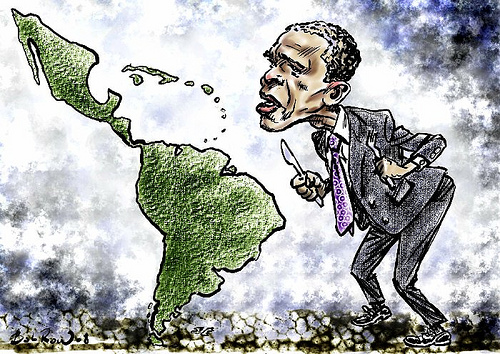
On December 28, US President Barack Obama enacted the so-called “Countering Iran in Western Hemisphere Act” which seeks to undermine Iran´s growing relations with Latin America, a region that has traditionally seen by the United States as its backyard and sphere of influence.
The Act, passed by congressmen earlier this year, requires the US Department of State to develop a strategy within 180 days to “address Iran´s growing hostile presence and activity” in Latin America. The Act points out that “Iran´s business and diplomatic ties are a threat to US national security”. It is seen, however, as another anti-Iranian move fabricated by the Zionist lobby in the US.
Shortly before, in July 2011, Robert F. Noriega – former Assistant Secretary of State for Western Hemisphere affairs, former US ambassador to the Organization of American States (OAS) and current Visiting Fellow at the American Enterprise Institute, one of the main neoconservatives -controlled entities in the US – said in a hearing before the House Subcommittee on Counterterrorism and Intelligence that Iran was carrying out “an offensive strategy” in Latin America.
The Iranian presence in the Latin America has also been harshly attacked by the pro-Israeli hawk Ileana Ros-Lehtinen, Foreign Affairs Committee Chairman and self-appointed bulwark against the alleged “Islamo-Boliviarian threat” to US security. She was co-star of a so-called “documentary” entitled “La amenaza iraní” (The Iranian Threat), in which she said, without blushing, that the US should attack Iran in order to “avert bomb explosions in various Latin American capitals”. The film was aired by Univision, a US broadcast network, which is owned by someone who has hosted galas in honour of the occupying Israeli army.
In 2009, another ridiculous “documentary” released by Univision involved the Venezuelan consul in Miami, Livia Acosta, in an absurd cyber-plot against the US allegedly promoted by “Iranian diplomats and Mexican computer hackers”. This was the pretext used for expelling her from the United States in a move that was widely seen as an American political revenge for Venezuela´s independent foreign policy.
Actually, the US Act rudely violates Latin American countries´ sovereignty and contains some stupid claims such as that the opening of Iranian embassies or cultural centers is to “spread terrorism”. Former Defense Secretary Leon Panetta also echoed those views by claiming, in a recent visit to Colombia, that Iranian attempts to expand its influence in South America amounted to expanding terrorism. Of course, no real evidence has ever been shown to support that laughable allegation.
“The paranoid nature of these estimations, and the scant evidence presented for them, are eerily reminiscent of the kind of broad-strokes, hawkish fear-mongering on display in the lead up to the war in Iraq. The testimony comes from a group bent on hyping security threats and, as Noriega admitted in the testimony, is not even in agreement with the State Department or intelligence agencies”, wrote John Glaser in a recent report.
The US accusations against Iran are also a way of targeting and casting suspicion on Latin American Muslims. In the Act, Washington speaks of “isolating Iran and its allies” and US officials accuse Iran or other pro-Iranian forces of “establishing mosques or Islamic centers throughout the region” in order to advance violent jihad “on our doorstep”.
US declining influence in Latin America
However, Latin American people know well that for over a hundred years it was the United States, and not another country, which wrought terror, war, poverty and repression throughout Latin America in the form of CIA-orchestrated military coups and support of paramilitary crimes, terrorism and dictatorial regimes. Military personnel found guilty of the worst violations of human rights in Latin American countries were trained in the notoriously famous School of Americans by US officers.
Actually, the Act is more evidence that US influence in Latin America is rapidly waning. Latin American countries have developed their own policies and set up independent blocks -ALBA, UNASUR and CELAC- while the Organization of American States, which includes the US and Canada, has been declining due to its submission to US policies on issues such as Cuba´s participation in its summits.
Iran has been seeking to increase its relations with Latin America in a bilateral way and in the framework of the Non-Aligned Movement and other international organizations. This has irritated Washington, which still seems to consider Latin American countries as vassals not having the right to pursue an independent foreign policy or seek its own friends and partners. Any agreement between Latin American states and Iran –or Russia and China- always arouses suspicion in the US.
Several Latin American countries have enhanced their diplomatic and trade ties with Iran in recent years, while their relations with the US have been downgraded amid popular demands for an end to dependence on Washington. Although the United States is still the largest economic partner of many Latin American countries, its economic and financial crisis has adversely affected them. This has led some nations, such as Mexico, to announce their intention to diversify their commercial partners in the next years.
As an international partner, the Islamic Republic is one of the best positioned to help Latin American countries develop their economies and their scientific and technological skills in many fields. The Iranian industry is highly developed. It has remarkable expertise in oil and gas exploitation and other sectors including health, defence, agriculture and space technology.
Iran has helped Venezuela build unmanned drone aircraft as part of their military cooperation. Referring to a Spanish media report that US prosecutors were investigating drone production in Venezuela, President Hugo Chavez said: “Of course we are doing it, and we have the right to. We are a free and independent country.”
In a televised speech to military officers at Venezuela´s Defense Ministry, Chavez said the aircraft only had a camera and was exclusively for defensive purposes. He said that Venezuela planned to soon begin exporting the unmanned drone. Moreover, Iran and Venezuela have mutual investments of about $ 5 billion in factories to make cement, satellites and tractors and the Iranians have helped the Latin American country build 14,000 houses.
Tehran has forged significant economic and political relations with the government of Evo Morales in Bolivia and with that of Rafael Correa in Ecuador. Iran´s links with Argentina, where Zionist circles have unsuccessfully tried to blame Iran for the AMIA attack in 1994, are also rapidly improving, as the government of President Cristina Fernandez is promoting a more conciliatory line towards Tehran.
Latin American countries, especially those that follow an independent foreign policy, trust Iran because they know that the Iranians cannot be pressured into betraying an agreement that disturbs the US or its allies. This is a main reason of Iran´s rising popularity in Latin America despite the propaganda of Zionist-owned media outlets and the US political and diplomatic actions.
HispanTV, the Spanish-language channel similar to the English-language Press TV channel, is also feared by the US establishment and Zionist circles because it is giving Latin American audiences accurate information about the Middle East and international developments that exposes the lies of Zionist-controlled agencies and media. The recent expulsion of Hispan TV from the Spanish-owned Hispasat channel is, in this sense, a desperate attempt to prevent the channel from reaching mass audiences. However, this move, as other similar ones in the past, is doomed to failure.
Therefore, Latin American nations won´t allow the US to dictate their foreign policy on the issue of their relations with Iran or any other country. In fact, Washington has already had a sign of this when it tried to pressure these countries to vote against Palestine’s bid to gain the status of a non-member state at the United Nations. Only one country, Panama, whose government has strong links with the Zionist entity and the local Zionist lobby voted against it.
January 11, 2013
Posted by aletho |
Full Spectrum Dominance, Progressive Hypocrite, Wars for Israel | Iran, Latin America, Obama, Organization of American States, United States, United States Department of State, Venezuela |
Leave a comment
Iran has officially begun pumping crude from an oil field it shares with it western neighbor Iraq, the managing director of the Iranian Central Oil Fields Company (ICOFC) says.
Speaking in a press conference on Tuesday, Mehdi Fakour said development and crude oil production from the Aban oil field has started.
Iran shares oil and gas fields with most of its neighbors, including Iraq, Kuwait, Qatar as well as Oman and Turkmenistan.
The official noted that Iran has not lagged behind its neighboring countries in developing the fields it shares, adding, “Currently, ten drilling rigs are operating simultaneously in the country’s joint oil fields.”
Fakour also stated that since the beginning of the current Iranian calendar year [March 20, 2012], USD1.2 billion of funds have been supplied by companies other than the National Iranian Oil Company (NIOC) for investment in Iran’s oil and gas projects.
Iran holds the world’s third-largest proven oil reserves and the second-largest natural gas reserves.
The country’s total in-place oil reserves have been estimated at more than 560 billion barrels, with about 140 billion barrels of extractable oil. Moreover, heavy and extra heavy varieties of crude oil account for roughly 70-100 billion barrels of the total reserves.
Iranian energy officials said in July 2011 that as much as 35 percent of the country’s energy development budget would go towards the development of the shared oil fields.
January 9, 2013
Posted by aletho |
Economics, Malthusian Ideology, Phony Scarcity, Wars for Israel | International Energy Agency, Iran, Iraq, National Iranian Oil Company, Petroleum, Turkmenistan |
Leave a comment
By Dr. Paul Larudee | January 8, 2013
Amazing stuff, India ink. A few drops spread vigorously with a roller for several minutes on an iron plate are enough for eight sets of fingerprints and two sets of hand prints on four ancient double-sided and folded Indian police fingerprint forms. By contrast, the mug shot was taken with a digital camera. After that, I was issued an official deportation order, for which I signed to acknowledge receipt. My passport remained in police custody until I got to the security check at the airport, when it was returned to me.
My crime? I had spoken to an audience of 22,000 youth at a Student Islamic Organization conference in Kerala State without having a visa that authorized public speaking or conference participation. India is perhaps the only “democracy” where free speech for foreigners depends upon the visa they are carrying. In fact, it is probably the only such country that has no visit visa category at all, and which has one of the most convoluted, bureaucratic and invasive visa application procedures this side of North Korea.
Not that the visa restrictions are always enforced. However, the myriad regulations and procedures (“for public protection”) permit the security apparatus to control individuals and events at their discretion without having to cite the true reasons for their enforcement. Every effective police state knows the drill.
In my case, I used a tourist visa, because the conference visa is a truly onerous procedure unless it is a state-sponsored event. In fact, that is the only type of conference participation permitted, because even private groups must seek state sponsorship in order to bring speakers from outside. In today’s India, however, state sponsorship is hardly a routine bureaucratic procedure.
It shouldn’t have been this way. India was supposed to have been the model for tolerant multi-ethnic, multi-linguistic, multi-confessional societies. And when India was a leader of the Non-Aligned Movement, carefully balancing its relationships among great and small powers and supporting those who might otherwise be a mere pawn in world affairs, this promise seemed plausible.
Regrettably, India has now become a home-grown Raj, choosing sides and fomenting discord between competing interests as a means of governing and controlling, in the best traditions of its colonial past. Thus, for example, conservative Salafist clerics are welcome when they attend conferences on tourist visas, while human rights speakers like David Barsamian, John Esposito, Yvonne Ridley, Wilhelm Langthaler and myself are unwelcome, and are denied visas or expelled, and/or their hosts are prosecuted.
The Salafist treatment is part of a Machiavellian formula hatched by India with its newest partner, Israel. Salafists deserve free speech as much as anyone, but the reason India accords more of it to them is on the advice of Israel. Israel promotes Islamophobia as part of its strategy of demonizing Palestinians and Arabs, a majority of whom are Muslims, and the Salafist brand of Islam fits Israel’s agenda of portraying Islam as an extremist ideology. This stokes the flames of the more extreme nationalist Hindu groups in India and plays on the fears of many other non-Muslim groups, as well. Since Pakistan is an external Muslim enemy, such demonization helps to unify non-Muslim India and permit popular tolerance of greater government control as well as encroachment of security forces on civil rights and privacy.
In fact, India has its own version of the U.S. Patriot Act, curbing the rights of its people. It is called the Unlawful Activities Prevention Act (UAPA), and while the title is more honest than “Patriot”, it is also a bit scary. It implies that people can be snatched from the edge of a sidewalk on the pretext that they were intent on jaywalking. No need for the infraction to happen first.[i] UAPA is an illustration of the degree to which human rights have been marginalized in the land of M.K. Gandhi and Abdulghaffar Khan.
Not that India doesn’t have real security concerns. Communal strife is as old as India itself and has sometimes risen to the level of genocide, which drove the 1947 Pakistan secession. However, it is one thing to use law enforcement to prevent fighting and quite another to use it to drive a wedge between communities with a view towards playing them off against each other.
A case in point is the role that Israel is playing. The self-proclaimed Jewish state is selling itself to India as a worthwhile ally on the basis that it is a) an experienced and effective leader in the fight against Islamist extremism and terrorism, b) a supplier of high-tech weapons and intelligence, and c) a means of access to U.S. support and cooperation. In effect, Israel is saying that both states have common friends and enemies and that Israel is in a position to provide what India needs.
India appears to be buying, and is currently the largest customer for Israeli military arms systems and services. Never mind that the expensive Iron Dome systems are effective less than 50% of the time against rockets from Gaza that use 16th century technology. Like most governments, India has been seduced by the promise of omniscient surveillance systems and the prospect of winning battles rather than preventing them.
This is obviously a devil’s bargain. True to the nature of such contracts, however, are the surprises that await the unwary. It is instructive to remember that Israeli agents once planted bombs in Baghdad synagogues to encourage Iraq’s Jews to emigrate to Israel. (It worked, and encouraged Iraqi thugs toward violence, as well.)
Since then, Israel has stolen nuclear weapon technology and weapons grade fissionable material from the U.S., conducted the most massive spying operation in U.S. history against its “ally”, and staged numerous assassinations and “black ops” actions outside its borders, including friendly countries. Questions currently surround the killing of Israeli tourists in Bulgaria and the putative assassination attempt on Israeli diplomats in India. Israel blamed both of these on Iran on the basis of flimsy evidence, possibly fabricated in collaboration with its allies, the violent Mujahedin-e-Khalq Iranian exile group.
India would do well to be more circumspect toward friends like this. Vilifying Iran is high on Israel’s current agenda, and Israel reportedly provided “evidence” and pushed the Indian government to prosecute the case. The result was the arrest of journalist Syed Mohammed Ahmed Kazmi, who anchors a news program on West Asia providing alternative views of events in the region. His open advocacy of better relations with Iran and his Iranian contacts were enough make him an Israeli target and an Indian suspect. After seven months of incarceration, however, the Indian government had to release him for lack of evidence.
Kazmi and I shared the podium at the SIO conference in Kerala and I was able to chat with him privately just prior to the event. He is a courageous man, willing to accept the risk of speaking in public so soon after his release, but appears to hold no bitterness. Peaceful dissent of this kind needs to be encouraged in India, which is well advised to heed John F. Kennedy’s warning that, “Those who make peaceful revolution impossible will make violent revolution inevitable.”
Sadly, Israel sees violent revolution in foreign countries to be in its national interest, under the “divide and conquer” principle. However, one would think that India’s principle would be the opposite if it wants to remain a successful unified nation with a highly diverse population seeking assurance that all their voices are heard in a national consensus. Furthermore, there is no need for India to acquire the same enemies as Israel. It may be in Israel’s perceived interests, but is it in India’s?
My few days in Kerala were an inspiring glimpse of what is possible. I saw thousands of young Indian Muslims whose religious and social mission is to benefit all mankind, to alleviate the social ills of Muslims and non-Muslims alike, to promote interfaith cooperation and to create an umbrella that is inclusive of everyone.
Although this was a Muslim event, many who attended were not Muslim and were invited directly by their Muslim neighbors. I was invited to be the keynote speaker even though I am not Muslim and spoke more generally about human rights and about Palestinian issues, which are not specifically Muslim or Indian. Roughly 40% of the attendees were young women, in a society not always known for its success in promoting women’s rights.
These young people were politically aware, committed, well organized and motivated. Society is supposed to create models for young people, but in this case it was the young that created a model for their society.
Dr. Paul Larudee is a human rights advocate and one of the co-founders of the movement to break the siege of Gaza by sea. He was deported from India on 31st December, 2012.
[i] For a fictional treatment illustrating the absurdity of this proposition, see the film Minority Report (2002).
Source
January 8, 2013
Posted by aletho |
Civil Liberties, Full Spectrum Dominance, Islamophobia, Timeless or most popular, Wars for Israel | India, Israel, Kerala, Non-Aligned Movement, Paul Larudee, Unlawful Activities Act |
Leave a comment

TEL AVIV, Israel – Israel’s Channel 2 TV station reported on Sunday that 100 fighter jets from around the world are training in Israel, including preparation for possible intervention in Syria.
The foreign pilots and aircraft arrived in the country in recent days, and will examine crisis scenarios if Syria uses chemical weapons, the report said.
It did not release the names of the countries participating.
Last week, the TV channel said the Israeli air force was preparing for the joint training, which would include practicing bombing runs and air-to-air combat.
January 8, 2013
Posted by aletho |
Mainstream Media, Warmongering, Militarism, Wars for Israel | Israel, Middle East, Syria |
Leave a comment
“The Jewish lobby intimidates a lot of people up here.”
“I’m not an Israeli senator. I’m a United States senator.”
Chuck Hagel’s most famous words may give hope to some that Obama’s nomination of him for Secretary of Defense is a sign that the influence of Israel is waning. Hagel has even been cautious about war with Iran and has indicated he prefers talking over shooting.
Any nominee that has problems with the ADL, Joe Lieberman and Lindsey Graham must have something going for him. Right? Maybe.
Hagel is a member of the CFR and a sometimes Bilderberg participant. Two strikes.
Take a look at his voting record and some of his stances while senator. Not exactly progressive. He voted for going into Afghanistan. He also voted to go into Iraq before he said he was somewhat against that war and did a little criticizing of the Bush administration. Patriot Act? No problem. He twice cast his lot for it.
FISA? Yep, he likes spying.
Hagel’s campaign contributors included a lot of bankers and we all know how well they like war and military contractors.
Proper disclosure has not been one of his strong suits. Could his own electronic voting machine company have ‘aided’ in his senate campaign wins?
For the first ten weeks of 1996, Hagel served as chairman of American Information Systems (AIS), a voting machine company which later changed its name to ES&S. He also had holdings in the firm’s parent group, McCarthy Group Inc., worth between $1 and $5 million. In November 1996, Hagel was elected to the Senate, the first Republican elected from Nebraska since 1974. He came from behind twice during his run (according to polls), first against well known Republican Attorney General Don Stenberg in the primary, and then against popular Democratic Gov. (and eventual senator) Ben Nelson. In fact, one Nebraska newspaper described his victory as a “stunning upset.” In January 1997, the Washington Post called Hagel’s victory, “the major Republican upset in the November election.” According to Bev Harris of Blackboxvoting.org, a group aimed at “consumer protection for elections,” Hagel won virtually every demographic group, including many largely African-American communities that had never before voted Republican. AIS was responsible for counting approximately 80% of the votes in the election.
In a disclosure form filed in 1996, Hagel did not report that he was chairman of AIS during 1996 or go into detail regarding the company’s underlying assets. Rather, he cited his holdings as an “excepted investment fund,” which is exempt from detailed disclosure rules.
Hope and change with Hagel? It seems somewhat odd that Obama would pick such a controversial Republican for the cabinet post. It’s often said that no one reaches these positions without being bought and/or blackmailed. No word on if Hagel would approve of the military being used against the American people and I doubt the question will come up in the confirmation hearings.
With all the corruption in the merging of government, banks and corporations and the continued influence of the jewish lobby, even if Hagel is ‘approved’ I’m not holding my breath that it will be anything but business as usual.
January 7, 2013
Posted by aletho |
Militarism, Progressive Hypocrite, Wars for Israel | Chuck Hagel |
Leave a comment
Reading the text of a bill that was recently signed into law by US President Barack Obama would instill fear in the hearts of ordinary Americans. Apparently, barbarians coming from distant lands are at work. They are gathering at the US-Mexico border, cutting fences and ready to wreak havoc on an otherwise serene American landscape.
Never mind that crazed, armed to the teeth, homegrown American terrorists are killing children and terrorizing whole cities. It is the Iranian menace that we are meant to fear according to the new law. When compounded with the other imagined threats of Hezbollah and Hamas, all with sinister agendas, then the time is right for Americans to return to their homes, bolt their doors and squat in shelters awaiting further instructions, for evidently, “The Iranians are coming.”
It is as comical as it is untrue. But “The Countering Iran in the Western Hemisphere Act”, which as of December 28th is an official US law, is not meant to be amusing. It is riddled with half-truths, but mostly complete and utter lies.
Yes, Iran’s influence in Latin America is on the rise. However, by US standards, the expanding diplomatic ties, extending trade routes and such are considered a threat to be ‘countered’ or per Forbes magazine’s endless wisdom, ‘confronted.’
Language in politics can be very dangerous as it can misconstrue reality, turning fictitious scenarios into ‘facts’. Despite its faltering economy, the US continues to experience a sharp growth in its think tank industry – men and women whose sole purpose are to invent and push political agendas, which oftentimes belong to some foreign entity; in this case it is Israel. Ian Barman, Vice President of the American Foreign Policy Council reflected that sentiment exactly in a recent article in Forbes.
Only in the past year, “policymakers in Washington have woken up to a new (Iranian) threat to U.S. security”, he wrote, citing an alleged Iranian assassination plot in Washington. According to Barman, that was the wake-up call leading to a “deeply worrisome” reality. In a moment of supposed level-headedness, he writes: “exactly how significant this threat is represents the subject of a new study released in late November by the U.S. House of Representatives Homeland Security Committee. That report, entitled ‘A Line In The Sand’, documents the sinister synergies that have been created in recent years between Iran and Hezbollah on the one hand, and radical regional regimes and actors-from Venezuela to Mexican drug cartels-on the other.”
But according to Agence France Press, reporting on the new law on December 29th, “Washington has repeatedly stated it is closely monitoring Tehran’s activities in Latin America, though senior State Department and intelligence officials have indicated there is no apparent indication of illicit activities by Iran.”
Indeed, on the issue of Iran’s influence in Latin America there are two contradicting narratives. One that merely acknowledges Iranians growing diplomatic outreach in Latin America since 2005 and another that speaks of massive conspiracies involving Iran, Venezuela, Ecuador, Bolivia, drug cartels, and yes, even underground music piracy groups. The alleged conspiracy is not only far-fetched, it is purposely fabricated to further punish Iran, on behalf of Israel, for its nuclear energy program. The panic over Iran’s ‘infiltration’ of the US ‘neighborhood’ in Latin America, didn’t start a year ago (as alleged by Barman) but rather coincided with old Israeli-Western propaganda which pained Iran as a country ruled by religious fiends whose main hobby is to assemble bombs and threaten western civilization. When pro-Israeli think tank ‘experts’ began floating a scenario of ‘what if Iran and Hezbollah join forces with Mexico’s Los Zetas drug cartel’ a few years ago, the idea seemed too absurd to compel a rational response. Now it is actually written into the new bill turned law as if a matter of fact. (Sec. 2, Findings 12)
The bill doesn’t only lack reason, proper references and is dotted with a strange amalgam of politically-inspired accusations, it also relies on wholesale allegations of little, if any plausible foundation whatsoever: “Hezbollah and other Iranian proxies with a presence in Latin America have raised revenues through illicit activities, including drug and arms trafficking, counterfeiting, money laundering, forging travel documents, pirating software and music and providing haven and assistance to other terrorists transiting the region.” (Sec 2, Findings 8)
Of course, since the whole exercise is fueled by Israeli anxiety, Hamas also had to somehow be pulled in, if not indicted through the same inexplicable reasoning: “The U.S. Drug Enforcement Administration concluded in 2008 that almost one-half of the foreign terrorist organizations in the world are linked to narcotics trade and trafficking, including Hezbollah and Hamas.” (Sec. 2, Findings 10)
US author and journalist, Belen Fernandez has been looking into this matter for years. In all of her writings on the topic she seemed to trace the very thread that unites the invented upheaval over Iran’s supposed takeover of the ‘Western Hemisphere.’ In an article entitled: “Distorting Iranian-Latin American Relations”, nearly two years ago, she wrote: “Iranian ‘penetration’ in Latin America has in recent years become a pet issue of Israeli Foreign Ministry officials and American neoconservative pundits, many of whom take offense at the perceived failure of the U.S. government to adequately appreciate the security threat posed by, for example, the inauguration of a weekly flight from Caracas to Tehran with a stop in Damascus.”
The issue for Israel and its US conduits is entirely political. Iran is indeed expanding its political and diplomatic outreach, but entirely through legal and official means, something that the US has failed to do since The Monroe Doctrine gave the US exclusive hegemony over Latin America starting in December 1823. But much has changed since then, especially in the last two decades when the US swung towards disastrous Middle East foreign policies, much to the pleasure of Israel. The suffering endured by Arabs and Muslims was the needed break for some Latin American countries to challenge US policies in their respective countries. This period was the era in which powerhouses like Brazil rose and popular governments took the helm. US policies in Latin America are not failing because of Iranians ‘sinister’ plans, but because of something entirely different.
Demeaning Latin America as a hapless region waiting for US saviors and pinning US political stocks on Iran might serve immediate Israeli purposes, but it will certainly contribute to the growing political delusion that permeates Washington. Alas, there are little indications that Washington politicians are anywhere near waking up from Israel’s overbearing spell. Just examine the author of the anti-Iran bill: Rep. Jeff Duncan of South Carolina’s 3rd District. He is a ‘freshman’, but has massive ambitions. He joined the Congress in 2011 and quickly learned the ropes. He knows that in order to succeed on Capitol Hill, one must win favor with the pro-Israeli lobby. He sponsored the bill on January 3, just a few days before the Iranian President went on a major diplomatic tour in Latin America to expand his country’s international relations. That alone was unacceptable, for Latin America has long been designated as the US ‘backyard’, per the belittling perception of US mainstream media. The trip ignited the ire of Israel, which both media and officials considered a travesty at a time that Tel Aviv was tirelessly working to isolate Iran. The bill was clearly a coordinated move, as its language indicates textbook Israeli hasbara.
Duncan might have been a novice, but he is quickly catching up. On May 20th, he proudly posted a statement on his House of Representative page that sharply censures his own president’s remarks on Israel, while fully supporting the political stances of the leader of another country, Israel’s Prime Minister Benjamin Netanyahu. He decried Obama’s siding with the “Hamas-led government”, thus “undermined(ing) Israel’s position in the negotiation process.”
“President Obama’s statement that Israel should retreat to its impossible to defend 1967 borders breaks a promise to one of our strongest allies, threatens Israel’s security, and jeopardizes the future of democracy in the region,” he wrote. Of course, Duncan wholeheartedly agreed with Netanyahu’s right-wing policies. “(The Israeli) Prime Minister understands the hard reality of Israel’s precarious security situation and daily threats of terrorism. I agree with the Israeli Prime Minister that President Obama’s position is simply unrealistic.” He concluded with a very telling statement: “As a Christian, I ask Americans to continue lifting up the people of Israel with prayers for safety and the hope for a lasting peace.”
This strange attitude towards politics and American national security is the real threat, not Iranian embassies and water purification projects in some Latin American countries. But considering the rising religious zealotry, shrewd Israeli lobby and the numerous think tanks of catered wisdom, there is little space for pragmatic politics or sensible approach to anything that concerns Israel. Thus, Obama enacted the bill into law and funds have been secured to evaluate Iran’s growing ‘threats’ in ‘America’s backyard’ so that proper measures are taken to counter the frightening possibilities.
What Duncan doesn’t know however, is that Latin America is no longer hostage, neither to the whims of Washington, nor to his South Carolina’s 3rd District. And that the ‘Western Hemisphere’ is no longer defined by the confines of US foreign policies, which seem to be narrowing each year to meet Israeli expectations and not those of America.
January 2, 2013
Posted by aletho |
Full Spectrum Dominance, Mainstream Media, Warmongering, Timeless or most popular, Wars for Israel | American Foreign Policy Council, Forbes, Hamas, Hezbollah, Iran, Latin America, Obama, United States, Venezuela, Zionism |
Leave a comment
Are they STILL pushing this absurd line? The Jewish Chronicle is propagandising again.[1] In its recent article “Britain’s anger with Israel over 1982 Lebanon War,” the JC states the attempted assassination of the Israeli Ambassador to the UK in June 1982 “provided the spark for Ariel Sharon to spearhead Israel’s incursion into Lebanon.” The JC states that the ambassador was “shot in the head by Palestinian terrorists,” and that the “invasion of southern Lebanon” demonstrated “Israel’s determination to stamp out terrorism from its northern border.” NOT BY A LONG SHOT, GUYS.
In case you missed it, the ambassador was shot by a Jordanian who was working within the Abu Nidal Organisation (ANO)—which in turn was run by a Palestinian who had been based in Jordan, Syria, Sudan and Iraq . . . but not in Lebanon. The ANO was characterised by its international, mercenary approach. The Jordanian gunman was accompanied by a cousin of Abu Nidal. . . and an Iraqi intelligence operative.
At best, the JC is being disingenuous. The 1982 military invasion of Lebanon was simply an escalation of Israeli aggression dating back decades—the aim of which was to eradicate the Palestinian resistance. The 82 invasion targeted the PLO, with whom the ANO were enemies. Thus the attempted assassination has long been widely acknowledged to have been a thin pretext. Yet the JC laments that, when the ambassador was shot, Israel had had to defend itself by running over Lebanon—a tired and feeble excuse.
As stated at the 7th emergency special session of the UN General Assembly (16 August 1982):
“For more than two months now the international community, as a whole, has focused its attention on Lebanon, where one of the most lethal wars of aggression the Middle East has ever known throughout its history is going on. The capital of a member nation of the United Nations [Beirut] has been besieged by the armed forces of a neighbor State [Israel].
This premeditated operation, which has already resulted in thousands of Lebanese and Palestinian civilian victims, was planned well in advance, designed to bring about a final solution to the Palestinian problem. At the same time, acts of intimidation and terrorism towards the Palestinians on the West Bank of the Jordan and in the Gaza Strip are increasing, leaving the victims convinced that the only way, to survive is to submit to domination.
Thus the military operations conducted by Israel in Lebanon replicate the political war against the PLO . . . . the Israeli leaders continue to flout the fundamental principles contained in the Charter and to violate numerous resolutions of the United Nations which, however, presided over the creation of the State of Israel. The most recent and most flagrant example of this attitude was Israel’s rejection of resolutions 508 (1982), 509 (1982), 512 (1982), 513 (1932) and 516 (1982) of the Security Council, and resolution ES-7/5 of the General Assembly, which all required Israel to put an end to the hostilities and to withdraw its forces behind the internationally recognized frontiers of Lebanon. The diplomatic efforts which have been undertaken here and there have always been met by the same Israeli reaction. That is, an escalation of violence.” [2]
The platitudes of the JC are routine. This article does serve, however, to draw attention to one disheartening reality. The attitude of far too many—not just Israelis, but also Americans, Arabs and Europeans—has been to view the Palestinians as nothing more a problem. Send them here, send them there, blast them into oblivion, just sort it. But the Palestinians are not a problem, they are a people. They deserve neither scorn nor pity; they deserve simple human equality. Was Britain “angry” with Israel for stampeding Lebanon in its attempt to eliminate the Palestinian “problem” and to pave the way toward a greater Israel? In retrospect, it seems they were not angry enough.
[1] For further reading, the British National Archives documents referred to in the JC article: http://filestore.nationalarchives.gov.uk/documents/prem-19-824-1.pdf ; CAB 128/74/7 (08 July 1982); CAB 128/74/5 (24 June 1982)
[2] Massamba Sarre (Senegal) Chairman, Committee on the Exercise of the Inalienable Rights of the Palestinian People: UNGA A/ES-7/PV.25 (16 August 1982) http://unispal.un.org/UNISPAL.NSF/0/6DC9C76A00B3E8E085256A16006D4056. See also further international statements UNGA A/ES-7/PV.27 (17 August 1982) http://unispal.un.org/UNISPAL.NSF/0/0C46FBC69F3D95F685256A260072FE9E.
December 31, 2012
Posted by aletho |
Deception, Ethnic Cleansing, Racism, Zionism, Illegal Occupation, Mainstream Media, Warmongering, Timeless or most popular, War Crimes, Wars for Israel | Abu Nidal, Human rights, Israel, Jewish Chronicle, Lebanon, Middle East, United Nations, Zionism |
Leave a comment
In order to advance its hegemonic designs, Israel has long exploited ethnic and sectarian differences in the Middle East and beyond. To date, the 2011 secession of South Sudan from Khartoum stands as one of the most successful examples of Tel Aviv’s divide and conquer strategy. Now, the involvement of individuals with intimate ties to the self-defined “Jewish state” in a project whose stated aim is to rescue Christians in Pakistan strongly suggests that Islamabad is also being targeted for destabilization.
Introducing the ostensibly humanitarian project on his website, Walid Shoebat, a prominent figure in the Israeli-inspired and -funded Islamophobia network, writes:
Pakistan is our primary focus for our initial push to save Christians who are suffering from the Blasphemy laws, which are used by Islamic extremists to make up charges against innocent Christians, in order to steal their property and stir up violence against the Christian population.On March 4th the Christian Minister of Minorities Shahbaz Bhatti was gunned down by Islamic extremists causing tremendous fear within the Christian community. Even in the short time since his murder, the violence against Christians has increased dramatically.
The Raoul Wallenberg Project is working with people on the ground who are well connected in the Christian community. They have reached out to us for our support to help alleviate their suffering, and in certain situations, help with their escape. For their protection we cannot expose their names publicly. In the future, large donors who are concerned about the transparency of fund ing [sic], we can provide the names and details privately.
The work we do is practical. We will be supplying food, medicine, safe houses, legal help for visa applications, and in extreme circumstances, security details for rescue missions.
Our financial goal is to raise one million dollars a month – solely for the Raoul Wallenberg Project – which will allow us to make a significant impact to alleviate much of the suffering of persecuted Christians and remove them from their circumstances. We are working behind the scenes with members of Congress, in particular the staff of Congressman Allen West, who has kindly offered his help on Capital [sic] Hill. Other members of Congress will be recruited as public opinion puts pressure on them for their support of this real, and dangerous threat to Christians worldwide.
Shoebat’s reference to Congressman West is revealing. While AIPAC ensures that most members of Congress dare not openly oppose Israeli policies, West is particularly eager to please the lobby. In a letter to Florida constituents before his 2011 visit, he wrote:
In Israel, I will get the opportunity to meet with a true Leader, Prime Minister Binyamin Netanyahu. At a time when western civilization has no leading voice, I believe the only one that resonates, speaks Hebrew.
As for Shoebat, his purported concern for persecuted Christians appears to be motivated by a similar passionate attachment. According to the description on his website of his alleged conversion from Muslim terrorist to Christian activist,
“He has set out to bring the cause of Christ, the Bible, and the case for Israel to millions throughout the world.”
Given Israel’s dispossession and ongoing oppression of Christians in Palestine, it seems likely that the Raoul Wallenberg Project’s stated mission of rescuing their co-religionists in Pakistan is merely cover for another Israeli project for the destabilization of the Islamic world.
Maidhc Ó Cathail is an investigative journalist and Middle East analyst. He is also the creator and editor of The Passionate Attachment blog, which focuses primarily on the U.S.-Israeli relationship.
December 31, 2012
Posted by aletho |
Deception, Timeless or most popular, Wars for Israel |
Leave a comment
How bad has it gotten for the US antiwar movement? After the president its most prominent leaders supported in 2008 took George W. Bush’s war on terror and institutionalized it, they have been at a strategic loss, unable to kick their dogmatic, electoral-minded tactics to the point that they are now engaged in an awkward campaign to get a conservative Republican appointed to administer Barack Obama’s wars. Indeed, after getting a commander-in-chief of its own, the down-and-out antiwar movement is now angling to get its own defense secretary.
The logic behind the leftists for Chuck Hagel campaign — sometimes unstated — is not so much that he’s a great guy, but that the people attacking him are even worse. And to be fair, they’re right. Most of the people blasting the former Nebraska senator hail from the belligerent far right, primarily employed by neoconservative media outlets like the Weekly Standard and Washington Post. Their critique is that Hagel is no friend of the Jewish state, and perhaps even anti-Semitic, because he once made comments critical of its influential lobby in DC and opposed Israel’s 2006 war on Lebanon (an undeniably good thing). He’s also talked about giving diplomacy a shot with Iran, when the proper line is supposed to be “nah, fuck those guys.”
Hagel has also come under fire from military lobbyists for his stated desire to cut bloat at the Pentagon, though it’s worth remembering that Bush/Obama secretary of defense Robert Gates pledged the same thing while burning through the biggest military budgets in world history. In other words, the usual sky-is-falling crowd is making much ado about nothing with respect to a guy who, outside of a few maverick-y speeches over the years, adheres to the Washington consensus as much as the next old white guy. Their goal? Maybe a nice little war with a third-rate power and a bit larger share of the GDP. But like executives at Goldman Sachs, they know they’re going to be pretty much fine no matter who is in office.
It would be one thing to simply point this out; that yes, some of the charges against Hagel can politely be called “silly.” One can disagree about the wisdom of Israeli wars, for instance, without being a raging anti-Semite, and indeed much of the Israeli establishment would privately concede their 2006 war was a bust. And with politicians talking of slashing Social Security, you damned well better believe it’s not a gaffe to say maybe we ought to take a quick look at where half the average American’s income tax goes: the military. Such a defense might have some value.
Unfortunately, that’s not what the pro-Hagel campaign is doing. Instead, they’re billing the fight over Hagel’s nomination as a defining battle of Obama’s second term. If Hagel wins, the argument goes, AIPAC loses, opening up the foreign policy debate in Washington and increasing the possibility of peace in our time. If his nomination goes down, however, that reinforces the idea that the hawkish foreign policy consensus in Washington shall not be challenged and that even the mildest criticisms of Israel cannot be tolerated. Some even suggest that who administers the Defense Department could decide if there’s a war with Iran or not, perhaps forgetting the chain of command.
Indeed, most of Hagel’s defenders aren’t defending his occasionally heterodox views on Israel and unilateral sanctions (he’s cool with the multilateral, 500,000-dead-children-in-Iraq kind), but rather trumpeting his commitment to orthodoxy. The Center for American Progress, for instance, has released a dossier detailing “Chuck Hagel’s Pro-Israel Record,” noting his oft-stated verbal and legislative commitment to the “special relationship.” Some of his former staffers have also issued a fact sheet showing that all of Hagel’s alleged heretical views are well within the hawkish mainstream.
Further left on the spectrum, it’s not much different. The Washington-based group Just Foreign Policy, for instance, has revived Democratic rhetoric from 2004 to pitch the fight over the potential Hagel nomination in black and white terms of good and evil.
“The Obama-hating Neocon Right is trying to ‘Swift Boat’ the expected nomination of Chuck Hagel to be Secretary of Defense,” the group states in a recent email blast to supporters. Neoconservatives have been “making up a fantasy scare story that Hagel . . . is ‘anti-Israel,’” it continues, helpfully informing us that the Hagel the neocons make out to be such a reasonable guy is indeed a fantasy. Finally, it ends with an appeal: “We cannot stand idly by as the neocons stage a coup of our foreign policy,” followed by a petition supporting Hagel’s nomination hosted by MoveOn.org sure to defeat any military coup.
In a blog, the group’s policy director, Robert Naiman, likewise pitches the battle over Hagel’s nomination in terms of Obama vs. The Warmongers. “Hagel represents the foreign policy that the majority of Americans voted for in 2008 and 2012: less war, more diplomacy,” he writes, pointing to past statements he’s made about the wisdom of a war with Iran.
Of course, the unfortunate truth is that American’s didn’t vote for “less war, more diplomacy,” as comforting as that thought may be, because they haven’t had the chance. In this past election, Obama often ran to the right of Mitt Romney, his campaign frequently suggesting the latter would not have had the guts to kill Osama bin Laden. The DNC ridiculed Romney for suggesting he’d consider the war’s legality before bombing Iran. “Romney Said He Would Talk To His Lawyers Before Deciding Whether To Use Military Force,” read the press release, as if that’s a bad thing. Obama, bomber of a half-dozen countries, never forgot to mention the “crippling” sanctions he’s imposed.
And J Street, the group that just co-sponsored a rally with AIPAC backing the Israeli state’s latest killing spree? Ask a resident of Gaza how “pro-peace” it is.
But, in order to create a sign-this-petition! narrative, one often can’t do nuance. So Naiman doesn’t. In another post, this one highlighting Hagel’s establishment support, because antiwar activists care about that sort of thing, he casually refers to former ambassador Ryan Crocker as among the “diplomacy champions and war skeptics” backing the former senator. This would be the same Ryan Crocker appointed by George W. Buish who has said “it’s simply not the case that Afghans would rather have US forces gone,” and dismissed the killing of at least 25 people in Afghanistan, including children, as “not a very big deal.”
That should give you a good idea of the obfuscation going on in the antiwar campaign for a Pentagon chief. This is a problem. If you’re going to play the role of the savvy Washington activist and get involved in the inside baseball that is fights over cabinet appointments, ostensibly to reframe the debate more than anything – we must defeat AIPAC! – you ought not go about reinforcing adherence to orthodoxy and the perceived value of establishment support and credentials. And you ought not cast as heroes of the peace movement people that really shouldn’t be. That’s actually really dangerous.
Yet, some would rather play down Hagel’s pro-war credentials for the all-important narrative. So we cast him as a staunch opponent of a war with Iran, ignoring his repeated assertions that we must “keep all options on the table” with respect to the Islamic Republic, including killing men, women and children. In a piece he coauthored with other establishment foreign policy figures, Hagel’s opposition to war amounted merely to a call to consider its costs – and its benefits.
For instance, “a U.S. attack would demonstrate the country’s credibility as an ally to other nations in the region and would derail Iran’s nuclear ambitions for several years, providing space for other, potentially longer-term solutions,” the senator and his friends wrote. “An attack would also make clear the United States’ full commitment to nonproliferation as other nations contemplate moves in that direction.” Ah, but he mentioned there could be “costs” (though none of those he mentioned were “dead people”). Such is brave, antiwar opposition in Washington.
But that’s the cynical game played in DC by some of the would-be movers-and-shakers on the outskirts of the policy conversation: cynically play down a politician’s faults to please funders, other politicians and one’s own sense of savvy self-satisfaction. It’s how the antiwar movement ended up dissolving and largely getting behind a president who more than doubled the number of troops in Afghanistan. People were presented a rosy image of a candidate who was on their side and they concluded their work was done upon his election. The same thing threatens to be the case with Chuck Hagel. Indeed, as The Atlantic’s Jeffrey Goldberg notes, “who better to sell the president’s militant Iran position than someone who comes from the realist camp?”
When I privately raised some of these concerns with Naiman, he got snooty quick, just as he did with other writers who questioned whether the quest to “defeat AIPAC” should be conducted by stressing why AIPAC should love the guy. To me, Naiman wrote that if I had concerns about the antiwar movement taking ownership of a defense secretary, “There are plenty of organizations that pursue an ultra-left, ideological purist line. Why don’t you give them your support and be happy?”
We live in an an age where ideological purity is defined as being uncomfortable with an antiwar organization throwing unequivocal support behind a conservative Republican to head the Pentagon. It’s an amazing world.
Rather than engage in the reactionary politics of supporting what one perceives to be the least-evil administrator of war, those on the antiwar left and right ought to be truth tellers. Let’s not sugar coat this: The problem isn’t just AIPAC and the neocons, but the Center for American Progress and the neoliberals. Dumbing down the reality only serves to bolster one faction of the war party. And it kills antiwar movements.
December 30, 2012
Posted by aletho |
Militarism, Progressive Hypocrite, Solidarity and Activism, Timeless or most popular, Wars for Israel | Chuck Hagel, Hagel, Iran, Obama, United States |
Leave a comment
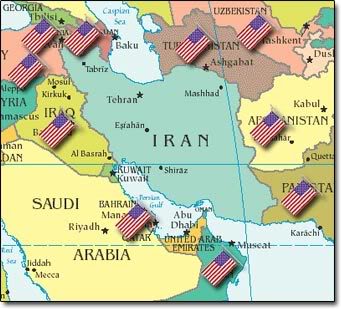
An analyst says America and its allies have planned to leave a residual force of more than 10,000 troops in Afghanistan passed 2014, contrary to the agreement.
In the background of this, American pilots are currently under special training ready to be deployed to Afghanistan in coming months in what appears to be a renewed build up by certain US forces. 66,000 US troops are stationed in Afghanistan. America is expected to honor a 2014 agreed deadline to withdraw from the country.
Press TV has interviewed Mr. Mohammad Daoud Abadi, Chairman of the Afghanistan National Peace Council, Los Angeles about this issue. The following is an approximate transcription of the interview.
Press TV: We see American pilots training in conditions similar to that of Afghanistan. Are we preparing for a longer stay of US troops in Afghanistan do you think?
Abadi: Thank you for inviting me again I appreciate it. Before I answer that question I’d like to thank Press TV for it’s worldwide media presence and being honest on the matters, we do appreciate that very, very much.
In response to your question I must say that what we hear from the US government is that they’re planning to leave a 6,000 to 9,000 fighting force in Afghanistan after 2014. That plus another 5,000 from NATO allies.
What I’m hearing – I hope it’s not correct, but what I’m hearing from the media and from different sources is that the US has planned to leave these 6,000 soldiers in Baghram airport, Kandahar in the south and Jalalabad in the East.
They are planning to have the Spaniards in Hira and Shindand airport, which is close to the Iranian border, to the Italians and on the North the Mazar e Sharif, the Germans still be staying.
To be honest and to look at it from a technical point of view this residual force will not be a force to really do the terrorist war or against terrorist activities because let’s say that if they are in Baghram airport and they fly from Baghram airport to Kandahar to do an operation, it is a 2 hour flight of 350 kilometers distance – it takes two hours for a helicopter to get there.
So in general this residual force is there for some other purpose other than what is claimed. Therefore this policy as I have said, this time the Pentagon will fail on this again and I don’t think this is something that they can count on.
Press TV: Just how much has President Hamid Karzai been a president to the Afghan people and tried to help efforts to oust the US occupiers from Afghanistan?
Abadi: Based on yesterday’s report Mr. Karzai is coming to Washington in early January and they will hopefully be talking about future issues in Afghanistan as well as the matter of residual forces.
President Karzai is going to make the biggest mistake of his life if he agrees to residual forces because that will mean the continuation of war in Afghanistan.
As I have said before the Mujaheddin of Afghanistan have put this condition even at the 19th of December meeting in Paris – this was the first condition that both sides the Taliban and Jamiat e Islami of Afghanistan put on the table.
Therefore what Mr. Karzai is going to sign with them based on their immunity issues, that is not going to work. As for US forces they are defeated now they were defeated then.
December 30, 2012
Posted by aletho |
Illegal Occupation, Militarism, Timeless or most popular, Wars for Israel | Afghanistan, NATO, United States, War in Afghanistan (2001–present) |
Leave a comment


 Aletho News
