Russian and Chinese refusal to support UN sanctions against Syrian President Bashar al-Assad at the end of August has caused a dramatic outburst of criticism in Western media and from the local human rights activists. On Tuesday the Facebook group ‘Syrian Revolution 2011’ posted a banner in Russian condemning Moscow for allegedly ‘killing the Syrians’. Let’s have a brief look at who is actually killing in Syria and other Arab countries.
Despite a common prejudice the rioters opposing the Syrian authorities are by no means ‘peaceful protestors’. The Syrian army and police fight against well-trained and properly armed professional raiders supported by the West and the fifth column inside Syria.
Since April the total record of Syrian soldiers, policemen and security officers assassinated by the ‘demonstrators’ has reached 600, while the number of injured is even higher. Many of them are killed by knifes with utmost cruelty. Every second shot by the long range sniper fire from upper locations (tops of the multistory buildings) precisely above or under the vest. That’s a notably professional pattern of action. Although typical for Syria, Soviet and Russian-made arms are being widely used in the clashes, many victims were hit by the weapons of Western origin having higher killing power, including pump rifles. There are many mutilated by improvised explosive devices.
The tactics of provocations is another distinctive feature of the opposition’s modus operandi set to keep the situation destabilized and create havoc and bloodshed. Having the most significant gangs already dispersed by the governmental forces, the opposition renews these tactics. Here is the message from Elena, who has relatives in Syria:
‘The gangsters were planning a series of debacles on 27th day of Ramadan (August 26). This is a special day for Muslims, Laylat al-Qadr (the Night of Destiny), when the sky is believed to be open and Allah is fulfilling all dreams. They wanted to organize a series of explosions and assassinations to cause people’s outrage. Syrian security agencies were timely informed about these plans and managed to detain around 200 plotters. There were several foreign specialists in subversive actions among the detained as well as Arab mercenaries from Qatar, Saudi Arabia and other countries. According to the evidence obtained, they were about to capture al Abbasein and al-Amaween squares in Damascus by pretending to organize pro-Assad march. When on the site, they schemed to change the slogans generating chaos, scuffles and eventually victims among the civilians.’ (Source in Russian)
NATO’s ‘humanitarian intervention’ in Libya has already led to unprecedented suffering of the Libyan people. The so-called ‘new government of Libya’ has shown to their former patrons in the UK, France and Italy that they do not care much about the sentiments of the international community. The mass lynching of black-skinned foreigners is now typical on the Libyan territories controlled by anti-Qaddafi forces. Mustafa Abdul Jalil, one of the leaders of the Libyan Transitional National Council (TNC), has even admitted that ‘there are no bloodless revolutions… We should not be surprised if some casual victims of skirmishes are the case. Our soldiers cannot afford wasting time for identifying detained personalities. Their loyalty to the new authorities will be determined subjectively.’
As a result the number of victims of the new regime among Libyan residents from Chad, Niger and Sudan is counted in thousands. Khamis al-Bass, a Saudi journalist reports from Libya: ‘On my eyes several uniformed men dragged an entire black family off their asylum, accused them in espionage for Qaddafi and hanged them all.’
The chairman of the African Union commission, Jean Ping, said many members of the Union had not yet recognized the TNC as the legitimate government of Libya because of reports of anti-black violence. He warned that the rebellion had left Libya unstable and its huge arms caches prey to looting by extremists and smugglers.
The perspective of turning Libya into a new lawless territory resembling Somalia or Liberia is tangible. The civil war is gaining momentum as the NATO Special Forces get seemingly restrained from further involvement into conflict. Their loss toll is already too high. According to several insider reports, e.g. British SAS has lost 21 to 35 soldiers, most of them during the storm of Tripoli and helicopter crash on the Algerian border in August. So NATO apparently decided to pump the ‘new Libyan government’ with more weapons in the endeavor to turn the scale of the on-going faceoff in Libya in favor of the TNC and wash their hands. For example, this week the Russian news agencies reported a massive arms shipment to the TNC from Moldova. An air-craft IL-76 arrived in Kishinev from Benghazi on Tuesday to be loaded by a ‘cargo of Moldavian army’s stores with expired date of usage’. Defense Ministry of the Republic of Moldova officially commented that ‘the shipment is being carried out according to the contract between the Ministry and a Latvian company’. Most likely the delivery of the second-hand Soviet weapons (there are no other sources actually available at Moldavian stores) to Benghazi was arranged by K.S.A via Ltd, a Latvian Riga-based transportation firm and used Soviet arms supplier…
Factually we can see that a small mediator from Latvia, a NATO country, starts playing a key role in channeling old Soviet-made weapons to the Afro-Asian conflict zones. The outcome of such arming would be extremely dangerous. That will lead to the escalation of civil war in Libya and other hotspots meaning more victims and more sufferings for the civilians. We have already written about this strategy in previous posts here and here.
Last but not least, it would be surprising if NATO pumping up the Islamic Orient with old Soviet arms had not played the propagandistic card of ‘Russian weapons killing Arabs’. Indeed, since late August they have launched a ridiculous press campaign in Yemen, accusing Russia (!) of ‘supplying equipment to Saleh regime to be used against peaceful pro-democracy protesters’. In a propaganda stupor they are even claiming that the presidential palace in Sana’a is being defended by the Russian tanks T-92, a model that does not exist in nature! Here we will not get into details of US$ 4 billion deal for military modernization program of Yemeni army and police that United States provided to President Saleh in the framework of counter-terrorism cooperation in 2010. We just take a note that the ‘military convoys’ coming to Yemeni port of Hodeida are contracted by the same dubious Latvian company K.S. Avia transporting arms to the Libyan Transitional National Council.
Shamai Leibowitz, an FBI Hebrew translator, was arrested in May 2010 for revealing restricted information consisting of five reports classified “secret” to an unidentified blogger. He confessed—explaining that he had been trying to reveal illegal activity—repented, and was sentenced to a minimum term of 20 months in prison. He has now been released. There was considerable speculation over what Leibowitz, a left-wing, Israel-born dual national, had actually revealed. A New York newspaper claimed that the information had gone to a “pro-Palestinian Arab group.”
In reality, Leibowitz, who had top-secret clearance, was working as the translator for an undercover FBI counterintelligence team operating out of Calverton, Maryland. The FBI was tapping into all the telephone lines and cell phone numbers associated with diplomats and intelligence officers working out of the Israeli Embassy in Washington and the United Nations in New York. The Israelis practiced good communications security when they were on their phones speaking English, but they were reportedly extremely reckless when speaking Hebrew because they believed that they could not be understood. The FBI compiled a thick dossier on Israeli diplomats and spies and was able to establish linkages to a number of other targets of interest. Analyzing the Hebrew recordings, Leibowitz identified a number of hidden relationships with U.S. government officials and the media, as well as advocacy groups like AIPAC and the Washington Institute for Near East Policy.
What the FBI uncovered was a massive and highly focused campaign referred to by the Israelis as “perception management,” but which the CIA would refer to as a covert action. Much of the activity was illegal or incompatible with the role of foreign diplomats in the United States, which is why Leibowitz took action after his supervisors refused to proceed with prosecution. The focus was on Iran, with Israeli officials intent on preparing the American public for war against the mullahs. They were spreading disinformation on Iran’s nuclear program, promoting international sanctions, and trying to obtain Washington’s support for an ultimatum on the nuclear program as a final diplomatic gesture that would be turned down by Iran, leading to war with the U.S. playing the lead role. The Israeli Embassy’s activities consisted of drafting articles and editorials that were placed with an accommodating media, paying journalists to write pieces making the same points, and working closely with groups like WINEP and AIPAC to present policymakers with a coordinated list of arguments for war. At least one congressman from Indiana was approached directly by Israeli intelligence and agreed to host an anti-Iran conference as well as to introduce legislation tightening Iran sanctions. The recorded telephone conversation between an Israeli intelligence officer and Rep. Jane Harman in April 2009, in which she agreed to intervene on behalf of accused AIPAC spies Steve Rosen and Keith Weissman in exchange for chairmanship of the House Intelligence Committee, was also part of the special FBI counterintelligence operation.
Leibowitz’s concern that the illegal activity would not be prosecuted by the Justice Department proved correct. No Israeli or American named in the extensive FBI investigative dossier has been in any way punished.
Philip Giraldi, a former CIA officer, is executive director of the Council for the National Interest.
While many Americans may believe that US policies are designed to address American needs, America’s new Ambassador to Israel explains that this is far from the case.
In a recent speech before the Jewish People Policy Institute (JPPI), Ambassador Daniel Shapiro clarified what drives US policies:
“The test of every policy the Administration develops in the Middle East is whether it is consistent with the goal of ensuring Israel’s future as a secure, Jewish, democratic state. That is a commitment that runs as a common thread through our entire government.”
Shapiro went on to say:
“This test explains our extraordinary security cooperation, our stand against the delegitimization of Israel, our efforts on Iran, our response to the Arab Spring, and our efforts on Israeli-Palestinian peace.”
US funding of Israel and its weapons industry
Shapiro elaborated:
“Israel will receive over $3 billion in U.S. funding for training and equipment in the coming fiscal year. This assistance allows Israel to purchase the sophisticated defense equipment it needs to protect itself, by itself, including the world’s most advanced fighter aircraft, the F-35 Joint Strike Fighter. Our assistance has also helped boost Israel’s domestic defense industry.”
On top of this, Shapiro pointed out,
“Congress, at the request of President Obama, provided $205 million to accelerate production and deployment of the Iron Dome short-range missile system, a project to which I devoted particular attention during my tenure at the White House.”
Shapiro failed to note that this system competes with American defense firms, causing still further job loss for Americans, who have a higher unemployment rate than Israel.
Shapiro said that one of his first visits as Ambassador to Israel was to see an Iron Dome battery deployed near Ashkelon, where he “had very moving visits with the victims of rocket attacks in Ashdod.” Palestinian rocket attacks have killed approximately 20 Israelis. There is no report that Shapiro has visited the victims of Israeli shelling attacks on Gaza, where over 1,400 have been killed.
Opposing international initiatives
Shapiro said:
“The test of our policy – that it advances Israel’s status as a secure, Jewish, democratic state – also explains our commitment to vigorously battle against those who would attempt to isolate or delegitimize Israel in the international community.”
As a result, Shapiro said, the US withdrew from the South African conference on racism in Durban and vetoed UN efforts on Israel (which otherwise would have passed).
Currently, he said, the administration is “doing everything we can” to oppose the Palestinian bid for UN membership to come later this month. “We are taking our opposition to capitals around the world.”
This campaign is reminiscent of previous pro-Israel campaigns, including the original pressure brought by Israel partisans in 1947 on the UN General Assembly to pass a recommendation to give over half of Palestine to a Jewish state.
Policies on Iran based on Israeli concerns
Shapiro went on to say:
“The test of our policy – to advance Israel’s status as a secure, Jewish democratic state – explains our persistent efforts and the President’s determination to prevent Iran from acquiring nuclear weapons.
“Since 2009, the United States has led the world in imposing the toughest sanctions ever against Iran, through U.N. Security Council Resolution 1929, through the Comprehensive Iran Sanctions and Divestment Act, and through additional sanctions imposed by European and other partners beyond those mandated by the U.N. Security Council… We are working to increase pressure on Iran through additional means, and have taken no option off the table.”
Twenty years ago similar pressure on Iraq created a humanitarian catastrophe in which, according to the World Health Organization, over 5,000 children under the age of five died each month from “embargo-related causes.”
Arab Spring actions predicated on Israeli interests
Shapiro explained that concerns for Israel also drive the US administration’s actions regarding the Arab Spring:
“The test of our policy explains President Obama’s original outreach to the Muslim world, and his response to the Arab Spring.
“Israel’s interests were not served by the deep anger felt toward the United States in many Muslim communities, and the President made clear that those who would accept his outstretched hand must do so knowing that the United States will remain a fierce defender of Israel’s legitimacy and call on others to build their own connections with Israel.
“As the unprecedented events of the Arab Spring have unfolded, we have recognized the opportunity presented by the possible emergence of more open, transparent, peaceful, and democratic governments, who will make better neighbors, while remaining vigilant about the risks these changes could present. We know the stakes for Israel are high, and in a situation where neither of us can control outcomes, we are working closely together to chart a common strategy.”
Shapiro said that US support for a “two-state solution” is also based on Israeli desires, explaining that he and the Administration are “convinced that a two-state solution is the only way to guarantee Israel’s future as a Jewish and democratic state.” Therefore, he said, the administration’s “vigorous pursuit of Israeli-Palestinian peace” also meets the pro-Israel test.
Need to bolster pro-Israel ties among Jewish Americans
Shapiro spoke of the close allegiance that most Jewish Americans feel for Israel, but expressed concern that “much research has shown that growing numbers of younger American Jews feel disconnected, or at best ambivalent, toward Israel. Valuable programs like Birthright have exposed many to this connection, but many more have not been reached.”
He said that “a stronger commitment to Zionist education for American Jewish youth could do much to strengthen bonds that we want to be even stronger in the next generation, but may not be if left untended.”
Helping Israeli finances even further
Shapiro said that “one of the most fruitful opportunities for deepening ties” between Americans and Israelis is in the economic sphere:
“There are approximately one dozen American-Israel Chambers of Commerce throughout the United States, based in New York, Chicago, Dallas, Miami, Los Angeles, and elsewhere. These organizations are run and organized by Americans who care deeply about the U.S.- Israel relationship and strive to facilitate U.S.-Israel business connections.”
Shapiro pointed out:
“In 2010 alone the U.S. imported $21 billion of Israeli goods and services; that’s 10 percent of Israel’s GDP. American companies and their representatives here directly employ about 60,000 Israelis; that’s fully 2 percent of Israel’s entire workforce. This figure does not include the many thousands more that are supported by American companies here as subcontractors or in downstream businesses.
“American companies have opened two-thirds of all foreign R&D facilities in Israel and brought in nearly 60 percent of all foreign direct investment. In 2011, American companies have acquired ten Israeli startups to the tune of $1.5 billion dollars, not just for their products, but to establish leading international R&D centers tapping into the greatest asset of Israel’s people, their brainpower. American-sourced venture capitalism provides more than half of all money for nascent technology companies to get off the ground.
“Just as other Diaspora communities are often in the lead in promoting economic ties with their countries of origin, many of these projects began because of Jewish-American ‘champions’ of corporate interaction with Israel.”
Ambassador Shapiro failed to mention that Israel’s current account balance is 29th in the world; the U.S. comes in at 196th.
1973 War and Shapiro’s personal ties to Israel
In his speech, Ambassador Shapiro recounted his personal history “for the insights it can give us about the connection of the American Jewish community to the U.S.-Israel relationship.” He stated:
“I am a proud member of our Jewish community in Washington, DC, active in a Conservative synagogue and the Jewish day school that my children attend and where my wife, Julie, worked for many years. And my profound respect for the State of Israel and its remarkable achievements stems from a lifetime of exposure to the extraordinary people who brought Theodore Herzl’s Zionist dream to life.”
Shapiro explained that his close attachment to Israel began in 1973 when he was four years old and his family spent a fall semester in Israel. They were there during the war in which Egypt and Syria tried to retrieve land that had been taken by Israel seven years before.
While Ambassador Shapiro didn’t go into this, there is a close US connection to the 1973 war, called by Israel and US media the “Yom Kippur War.”
Before and during this war, Saudi Arabia called on the US to pressure Israel to return the lands that it had taken and held since 1967, in violation of international law. Instead, Henry Kissinger arranged a massive airlift of US weaponry to Israel, saving Israel from losing the war. This support led to the oil embargo against the US that caused a deep depression and cost thousands of Americans their jobs.
As historian Donald Neff later wrote, this boycott, induced by Kissinger’s weapons to Israel, left “economies around the world shattered and many individuals living poorer lives.” Neff wrote that while “Kissinger admitted, ‘I made a mistake,’ skeptics might wonder whether it was a mistake, or wanton disregard of U.S. interests during a passionate effort to help Israel.”
Shapiro explained that the 1973 war had a major impact on his family:
“By the end of the war, and even more so, by the end of our stay, our family’s relationship with Israel had been utterly transformed, from a solid but light connection to the deepest of bonds. Throughout the remainder of my childhood, family dinner conversations turned easily to events in Israel, from the thrill of the peace with Egypt to the anguish of the Lebanon War [initiated by Israel; fatalities were approximately 25:1 Lebanese to Israelis]. The ample bookshelves in my parents’ home grew laden with studies in Zionism, Jewish history, and Israeli literature.
“A product of the Reform Movement, I nurtured my own connection to Israel primarily through summer camp experiences at the Olin-Sang-Ruby Union Institute in Oconomowoc, Wisconsin, an unlikely setting for some of the most innovative Jewish and Zionist education to be found anywhere.
“These experiences led me to spend half a year after high school in Israel on a Reform Movement program, living with an Israeli family in Jerusalem, studying at Hebrew Union College, traveling widely throughout the country, and volunteering on Kibbutz Yahel in the Arava.
“I returned for my sophomore year of college at Hebrew University, supplementing my studies with work as a waiter at the wedding hall in the Beit Knesset HaGadol and long walks in Rehavia, where my girlfriend – who is now my wife of 19 years – took an apartment.
“In the years since, I have made Israel, its history and people, its quest for peace and security in the Middle East, and its relationship with the United States, the centerpiece of my academic studies at Brandeis and Harvard, my work on Capitol Hill, and my service in the Clinton and Obama Administrations.”
Shapiro emphasized that in many ways his story is not unique, stating that “it is impossible to deny the special connection that most in the American Jewish community feel for Israel…. wherever they fall on the political spectrum, and whatever their views on American policy, Israeli policy or the Israeli-Palestinian conflict, the vast majority of American Jews care deeply about Israel…”
Shapiro said that he is deeply honored that President Obama has entrusted him with the “task and responsibility of strengthening and deepening” US ties to Israel.
Shapiro concluded:
“… as a committed Jewish American, with deep roots in the American Jewish community and warm bonds of affection with Israel, I will have an opportunity to draw on those associations to help make the U.S.-Israel relationship, strong as it is, even stronger in the years ahead.”
Americans are frustrated, angry and disappointed in the political leadership of our country. We are enduring one crisis after another: housing, war, jobs, budget, debt and deficit. We are also shouldering our own personal and professional crises. We are governed by political ideologies that are inflexible, uncompromising and that ignore the long-term well-being of our country.
Yet, with all of these pressing and unrelenting national challenges, a record 81 House members, about a fifth of the chamber, spent a week in Israel last month, courtesy of a foundation set up by the American Israel Public Affairs Committee (AIPAC), the largest pro-Israel lobby group in the US.
As a participant in the Interfaith Peace-Builders’ African Heritage Delegation to Israel/Palestine, who recently returned from a two-week fact-finding study tour, I can attest that Israelis have their own urgent and pressing issues to deal with: ongoing maintenance of the 63-year-old occupation (yes, it dates to the 1948 ethnic cleansing of approximately 750,000 Palestinians), expensive and unjust military rule over the Palestinian people in the occupied West Bank and Gaza Strip, seized in 1967, massive Israeli youth protests regarding the rising cost of housing, food, and gas, and the ongoing oppression of Jews of color and Palestinians citizens of Israel.
Congressman Jesse Jackson, Jr., one of the Democrats who visited Israel, said that he was looking forward to learning about Israel’s business and commercial sectors as well as the latest tools and technology the country is using to fight terror, but what did he really see? I doubt he saw and experienced what the 14 members of the African Heritage Delegation witnessed.
More than likely, his delegation saw and experienced the beauty and opulence of Tel Aviv. They enjoyed the finest of foods and perhaps sampled wines from the colonized Golan Heights. They probably witnessed well-orchestrated military exercises and political speeches. I suspect they did not hear, as we did, from Palestinians who are displaced from their homes, whose lands, farms and olive trees have been confiscated or from the mothers who worry about their sons being bullied, abused and imprisoned by the Israeli police using the most technologically advanced counterinsurgency practices.
I’m sure they did not see, as my delegation did, the rationing of water to Palestinians, the daily blackouts of electricity or the lack of health care services to the elderly or those suffering from post-traumatic occupation stress syndrome. No doubt, they did not meet Palestinians, as we did, in Hebron who live each day under the assault of angry, militant Jewish settlers.
Democracy means more than voting rights
House Majority Leader Eric Cantor, who led one of two Republican delegations, stated, “I am pleased to be bringing so many of our new Members of Congress to Israel so that they can learn firsthand about Israel and the important role our key ally plays in the Middle East. The United States and Israel share similar core values of democracy, human rights and a strong national defense.”
Yet Israel is not living up to the definition of a democracy. Israel has dominated Palestinians for 63 years while illegally occupying the West Bank, including East Jerusalem, and Gaza for the past 44 years. It routinely denies full participation of Palestinian citizens of Israel. Inside Israel, it is well documented that Jews of color (Sephardi and Mizrahi Jews), African Palestinians and non-Jewish residents are treated as second- and third-class citizens with diminished human and civil rights. Democracy means more than voting rights for Palestinian citizens. There must be equality under the law, yet that is significantly absent in Israel and dramatically lacking in how Israel administers the occupied West Bank and Gaza Strip.
There is simply too much at stake in America for our congressional members to meet with Israeli and Palestinian leaders without the complete picture of the Israeli-Palestinian conflict. The situation is vastly different from the one Israel’s prime minister depicted recently to Congress.
What if we stopped the $3 billion in aid?
What if we stopped the $3 billion in aid we give to Israel annually and used the savings to create a national jobs-deficit reduction program? Our African Heritage Delegation believes, as many Americans do, that we need a jobs growth and deficit reduction program here at home now. This is the time to reallocate financial resources to American families and communities and to fix our obsolete, dilapidated infrastructure.
The two-tier system of law Israel has established in the occupied West Bank, documented by Human Rights Watch, recalls the Jim Crow laws of the American South and the discriminatory practices of apartheid South Africa. Our members of Congress should loudly reject such discrimination. And they should spend more time with constituents in dire need of their leadership as well as modeling democratic values in their respective congressional districts.
Rev. Carolyn L. Boyd lives in Alexandria, Virginia.
The Islamic Republic of Iran warned on Thursday it would not hesitate to hit back following any foreign attack on its soil.
In a formal complaint to the United Nations over a warning from French President Nicolas Sarkozy, Iran’s UN ambassador said in a letter to UN leaders that his country would “not hesitate to act in self-defense to respond to any attack against the Iranian nation.”
Sarkozy said last week that Iran’s “military, nuclear and ballistic ambitions constitute a growing threat that may lead to a preventive attack against Iranian sites that would provoke a major crisis that France wants to avoid at all costs”.
Iran would “take appropriate defensive measures to protect itself”, ambassador Mohammad Khazaee told UN Secretary General Ban Ki-moon and the Security Council. The envoy also described Sarkozy’s remarks as “inflammatory and baseless allegations”.
Khazaee again denied the charge that his country was seeking a nuclear weapon. “Iran is a leading nation in rejecting and opposing all kinds of weapons of mass destruction, including nuclear weapons,” said Khazaee. “Moreover I wish to reiterate my government’s position that the Islamic Republic of Iran has no intention to attack any other nations.”
In an August 31 speech to French ambassadors, Sarkozy said that Iran “refuses to negotiate seriously” and declared that France would work with its allies to build support for tougher international sanctions. However, he did not say which country might carry out the preventive attack.
A retired college professor who has sailed approximately 8,000 miles to the eastern Mediterranean has now arrived at his destination: the exact location where Israeli forces tried to sink a US Navy ship in 1967, killing or injuring over 200 American servicemen.
Larry Toenjes, 74 years old, is planning to hold a memorial service for those killed on board the ship, the USS Liberty. Israel shelled and torpedoed the ship, an electronics surveillance ship, in an attack that lasted as long as the attack on Pearl Harbor.
While Israel and its partisans have tried to claim that the attack was “a mistake,” a 2003 inquiry by an independent commission led by a retired four-star Navy Admiral, a Rear Admiral, and the highest ranking Medal of Honor recipient in the U.S., a Marine General, announced on Capitol Hill that all the evidence indicated that the attack had been intentional, had consisted of an act of war against the United States by Israel, and that a cover-up had been ordered by the White House.
In addition, the commission found that rescue flights had been recalled by President Lyndon Johnson and Secretary of Defense Robert McNamara. While almost no media covered the Capitol Hill briefing, a full record of its findings is in the Congressional Record and Stars and Stripes military newspaper. [more information on the incident]
Toenjes, who departed from Galveston, Texas, almost four months ago, is accompanied by Marine veteran Rusty Glenn, also from Texas, who joined him in Malta. While there has been concern that Israel might interfere with their voyage as it has other boats in the Mediterranean, ramming and hijacking some, so far Israel seems to be ignoring the voyage. Toenjes will remain 12 miles offshore, in international waters, where the attack took place.
In a column published by the Galveston News, Toenjes explained that he was undertaking the voyage for two primary purposes: to honor the men who died in service to their country and to try to draw attention to attempts by their surviving families and crew-mates to obtain the full government investigation that is legally required but that has been blocked by the powerful Israel Lobby.
Toenjes’ trip is being tracked on the website of the Council for the National Interest (CNI), which will stream live his memorial service later today, which will be carried by satellite phone to a radio program hosted by a Liberty survivor, Phil Tourney.
While the national media have ignored this voyage, Toenjes and Liberty survivors hope that the American public will learn about his undertaking by word of mouth, blogs, and social media.
ANKARA — Turkish Prime Minister Recep Tayyip Erdogan said he may visit the Gaza Strip next week in conjunction with his scheduled visit to Cairo after talks with the Egyptian Foreign Ministry.
Erdogan said in response to questions by reporters on Sunday that he could visit the besieged Gaza Strip after first visiting Egypt. But he said the visit to Gaza has not yet been determined on his official agenda.
Erdogan was scheduled to visit Gaza 21 June, but the visit was postponed indefinitely.
Officials from the Turkish Foreign Ministry said they were making contacts with their counterparts in Egypt with regard to Erdogan’s potential visit to Gaza.
They said that Egyptian Foreign Ministry was excited about the visit but that it would require Israel’s consent.
Meanwhile, an Israeli official has warned Erdogan against the visit, saying it would be a major diplomatic mistake.
The official said on Israel’s Channel Two that the visit would harm Turkey’s relations with the United States and challenge the legitimacy of the governance of Palestinian Authority President Mahmoud Abbas.
Government officials in Gaza have welcomed the possibility, saying that the Gaza Strip would benefit from such a high-profile visit. But they said that no arrangements have been made so far apart from what was leaked by the media outlets.
Tablet Magazine, which offers “a new read on Jewish life,” features an interesting interview with Edward Luttwak, author of Coup d’État: A Practical Handbook, in which the influential pro-Israeli “private intelligence operative” argues that America’s Christian Zionists, not the Israel lobby, are the key to America’s passionate attachment to the Jewish state.
David Samuels: There have been many different explanations given over the past 10 years for the strength of the American-Israeli relationship, ranging from the idea that Israel has the best and most immediately deployable army in the Middle East, to the idea that a small cabal of wealthy and influential Jews has hijacked American foreign policy.
Edward Luttwak: You mean the Z.O.G.? The Zionist Occupied Government?
David Samuels: Yes.
Edward Luttwak: Personally, from an emotional point of view, myself, as me, I prefer the Z.O.G. explanation above all others. I love the idea that the Zionists have sufficient power to actually occupy America, and through America to basically run the world. I love the idea of being a member of a secretive and powerful cabal. If you put my name Luttwak together with Perle and Wolfowitz and you search the Internet, you will get this little list of people who run the American government and the world, and I’m on it. I love that.
David Samuels: Anytime you need an added jolt of ego gratification, you open your laptop and confirm the fact that you rule the world.
Edward Luttwak: In Pakistan, there are millions of people who go to schools where they are taught that I am the ruler of the universe. So, emotionally speaking, I would explain everything that happens by referring to the Z.O.G., the Zionist Occupied Government, which is run by a small cabal of people, and that I am one of them.
Now, if I’m forced to actually think about this question, I would say that the cleanest analytical way of understanding the American-Israeli relationship is to say that the post-1945 career of the United States as a world-meddling, imperialist power has forced Americans to be very foreign-oriented. Many American families have had their sons killed overseas, and many other Americans have become foreign-oriented for many reasons. Among them there is a group of Christians who read the Bible, who believe in the Bible to some degree as a document that registers God’s will. For them, Israel is the proof of the truth of the Bible. Hence, the notion that the United States should be supporting rather than opposing Israel has now become expected, which was absolutely not true in 1948 when the United States did every possible thing to prevent the existence of Israel by systematically intercepting arms flows to the Jews.
Therefore, if we in the Z.O.G. didn’t really run everything, and there was no Zionist influence, then this solid mass of foreign-aware Americans, who also happen to be Bible-believers — we’re talking 50 million people — to them, the only foreign policy that counts is America’s support for Israel. Period.
The only problem with Luttwak’s theory is that the “Bible” these “Christians” believe in is hardly free of Zionist influence either.
If trade promotes peace, and it does, then trade sanctions stifle it. That may be simple logic, but it continues to go unnoticed with Washington officials.
The latest nation on the receiving end of economic provocation is Syria. On August 18, Barack Obama froze all Syrian government assets within U.S. jurisdiction and banned American investment in, service trade with, and petroleum imports from Syria. Echoed by officials from other nations, both Obama and Hillary Clinton have called on Bashar al-Assad, president of Syria, to step aside — although they still gave lip service to national sovereignty, saying that “no outside power should impose on [Syria’s] transition.”
To justify that move, Clinton denounced Syrian leaders as contemptuous towards their own people, and she asserted an array of atrocities against peaceful demonstrators, including the murder of thousands of unarmed civilians.
The story is not that simple, however. Verification of the number of deaths is scant, and the “peaceful demonstrations” could better be described as an armed insurrection. In fact, alongside the insurrection, Damascus has witnessed mass pro-government rallies. Syria also happens to be the leading destination for refugees from Iraq, and as recently as 2009 Obama had sought to ease sanctions, on the basis of “mutual interest and mutual respect” (according to his press spokesman).
Regardless, al-Assad has dismissed calls for him to step down as meaningless, and trade sanctions will pave the way for military confrontation, not prevent it.
Obama’s latest sanctions are an amplification of George W. Bush’s under the 2003 Syria Accountability Act. Congress introduced that legislation against Syria for, you guessed it, support for terrorism, weapons of mass destruction, and, among other things, failure to support American activities in Iraq. Obviously, Syria is a “threat to U.S. national security interests.”
Paranoia aside, the track record of trade sanctions does not support their existence. Just take a look at the list of embargoed nations, including Iran, Cuba, North Korea, and Zimbabwe. If anything, sanctions have offered a scapegoat for national officials and galvanized loyalists, who could better demonize the disengaged populations. Most important, sanctions have not led the officials of targeted nations to back down.
Worse, sanctions worsen the plight of the poor, scarcely different from open war. 1990s Iraq provides just one compelling example. Impact estimates for deaths for that period, due to sanctions-induced contaminated living conditions and a lack of access to medicines, go as high as 500,000, as John Pilger has documented.
Madeleine Albright, U.S. ambassador to the UN at the time, even acknowledged that impact, when she said, “This is a very hard choice, but we think the price is worth it.” Worth it for what? A decade of sanctions only led into the second Gulf War.
U.S. politicians also appear to forget that trade is mutually beneficial, so sanctions are mutually harmful. Blocking Syrian petroleum and business ventures is going to hurt both Syrian and American economic prospects. Moreover, the application of freezes on foreign-owned assets is so vague that it will dissuade further investment here.
The selectivity of sanctions is another riddle that further undermines their credibility. Syria mustn’t be lending the United States enough money, because the Chinese government has a record of violent tactics that dwarfs that of Syria. They own $1.2 trillion of the U.S. debt and face no sanctions. They even just received a lecture from Joe Biden on the need for open trade:
“I believe history has shown … that in the long run, greater openness is a source of stability and a sign of strength, that prosperity peaks when governments foster both free enterprise and free exchange of ideas, that liberty unlocks a people’s full potential. And in its absence, unrest festers.”
That’s right, Mr. Biden; the absence of trade does allow unrest to fester, just as it will in Syria. There may not be easy answers to the regrettable political conflicts in Syria, but isolation from the rest of the world is not going to help. Even if unintentionally, U.S. officials are setting the stage for military engagement, as they did with Iraq and recently with Libya.
Fergus Hodgson is director of fiscal policy studies with the John Locke Foundation and a policy advisor with The Future of Freedom Foundation. You can follow him on Twitter and send him email.
As part of its 7th set of US sanctions against Syria, which began in June, 2011, the Obama administration has targeted a messenger, a sometime spokeswoman, a positive image of Syria, someone people of all religions and cultures have easily identified with over the past several years, Dr. Bouthainia Shaaban. The US administration acted thus for the sole purpose of pressuring the government of Syrian President Bashar Assad, but has succeeded in undermining American values of freedom of expression much more.
On August 28, 2011, the US Treasury and State Departments targeted Dr. Bouthainia Shaaban, and froze any assets she might have in the US.
According to State Department spokesman, Victoria Nuland, who two US Senate Foreign Relations Committee staffers speculate may view Dr. Shaaban as a rival of sorts given their job descriptions, and Dr. Shaaban’s stellar performances during meeting with US officials both in the US and Syria, the explanation for blacklisting a Syrian nationalist and media advisor remains: “She (Dr. Shaaban) has served as the public mouthpiece for the repression of the regime.”
No US official to date has stepped forward to defend the sanctions against Dr. Shaaban with any more substantive or detailed complaint or supporting evidence.
Theodore Kattouf, former US ambassador to Syria was reportedly astonished to see Dr. Shaaban’s name on the latest sanctions list and he expressed on television his regret for such a bad decision. Former Ambassador Kattouf explained that sanctioning Dr.Shaaban was a serious mistake because Dr. Shaaban is well known of her positive and constructive attitudes and positions against wars and injustices and bloodshed.
True, Dr. Shaaban, among several others, is a trusted advisor to the Syrian administration. She presumably offers counsel and insights; perhaps much like Theodore Sorenson did for President John Kennedy, and Bill Moyers for Lyndon Johnson. But she is not and has never been a decision maker. Presumably her advice is considered, but who knows to what degree. Which advisor is also a key decision maker?
Surely the Obama administration knows well that when any person occupies a position as media advisor or even press secretary, he/she speaks for and explains the policy of the administration he’s working for. To sanction them violates American notions and values of freedom of expression and immunity from harassment for performing a vital job that benefits all by way of clear understanding and communication of a country’s position on political, social, and economic issues of the day.
Dr. Shaaban’s background is well known to recent US administrations and also much appreciated according to Washington sources. She is known as an independent thinker, reformer, writer, University Professor (she taught in Eastern Michigan for two years and earned her PhD from Warwick University in the UK and was a Fulbrighter at Duke University (1990 – 1991) and got the prestigious McCandless professorship at Easter Michigan University for 2000. She is known for her ability and willingness to take a minority position, if her evaluation of the facts of a case or issue leads her there, and is never reluctant to speak truth to power. Her writings, many of which have appeared in the left of center Counterpunch (counterpunch.org) always advance positions against wars, violence and occupation.
The Obama administration knows that Dr. Shaaban has no account in the US, earns a modest salary, is the wife of the manager of the Syrian Establishment for Food Industry, and this ‘sanction’ is designed solely to harm her excellent reputation that she has earned during the past couple of decades. When pressed for details of her assets both the US Treasury, and State Department spokeswoman Nuland only offered: “Let’s just leave it at that.”, whatever that is supposed to mean.
Dr. Shaaban’s office avers that she has very few assets at all and certainly none in the US.
“Bouthainia connects with people” according to a US Senate Foreign Relations Committee staffer who has met with her: “Whether with Hamas or Saudi Princes, and both know her views on full rights for women and justice for Palestinians, and with American officials too she is effective.”
For some of these reasons the US treasury and State departments have targeted her and the Obama administration, largely it appears, out of ignorance, according to Congressional sources, said, “Ok, if you think is a good idea go ahead.”
It was not a good idea. Attacking Mrs. Shabaan is a low blow and disgraceful by any standards and especially for one who is a very positive force helping bridge several divides between East and West.
President Obama erred in signing off on this mistake.
The White House attacked a friend of America and of all people of good will. It needlessly assaulted a symbol of the great country of Syria, the great Syrian people, their history, culture, resistance values, profound dignity, and their decency.
In so doing the Obama Administration sullied American values and doubtless does not represent American values or the will of the American people. It did undermine American values of freedom of expression and compromised American notions of fair play and American legal norms of substantial justice.
Would that President Obama will immediately reverse this ill-considered action.
– Franklin Lamb is the author of The Price We Pay: A Quarter-Century of Israel’s Use of American Weapons Against Civilians in Lebanon.
Part One, The Record, treats the history of garlic as evidence. From the clay garlic bulb placed in an Egyptian grave nearly six thousand years ago, through the Ebers Papyrus, through Hippocrates, Dioscorides, Pliny and Galen, the Arab physicians under Avicenna, the medieval herbals, Culpeper, and the plague years, to the last era in which Western physicians prescribed garlic as a matter of course, which ran from 1850 to 1945. It closes with the living traditions that never stopped using it, and with the folklore of charms, vampires and the evil eye.
Part Two, The Chemistry and the Evidence, sets out what is known about why a clove has no smell until it is cut, and why the order of crush, rest and heat changes the medicine. It then reads the clinical evidence against the historical record — bacteria, blood and vessels, cancer epidemiology, metals and fatigue — and names the trials that went against garlic as directly as the trials that went for it, including the 2007 Stanford trial funded by the US National Institutes of Health which found that raw garlic, garlic powder and aged garlic extract moved LDL cholesterol no more than placebo did. It then turns to onion, garlic’s closest relative, and reads the newer evidence published since 2015, before closing with the whole of the record through the terrain lens.
Part Three, Why Medicine Set It Aside, asks the question directly. One chapter contrasts the pharmaceutical model of isolating a single active compound with the folk model of combining whole plants, and reports what the garlic evidence says about which model works better. One chapter examines the economics of research on a plant that cannot be patented. One chapter — Fire Cider — tells the story of a folk preparation whose name was taken into a United States trademark by a Massachusetts company in 2012, and won back by three herbalists in 2014 who documented forty years of prior use through Rosemary Gladstar and her students into the older tradition.
Part Four, Garlic in Practice, is the working manual — the kitchen pharmacy, traditional uses by body system, a full chapter on safety and interactions, and a complaint-by-complaint practical guide. The book closes with The Trial That Was Never Run — a one-chapter reading of the whole evidential architecture.
At the back: two appendices (a traditional list of uses, and a preparation quick-reference), a full bibliography, and a live index.
This site is provided as a research and reference tool. Although we make every reasonable effort to ensure that the information and data provided at this site are useful, accurate, and current, we cannot guarantee that the information and data provided here will be error-free. By using this site, you assume all responsibility for and risk arising from your use of and reliance upon the contents of this site.
This site and the information available through it do not, and are not intended to constitute legal advice. Should you require legal advice, you should consult your own attorney.
Nothing within this site or linked to by this site constitutes investment advice or medical advice.
Materials accessible from or added to this site by third parties, such as comments posted, are strictly the responsibility of the third party who added such materials or made them accessible and we neither endorse nor undertake to control, monitor, edit or assume responsibility for any such third-party material.
The posting of stories, commentaries, reports, documents and links (embedded or otherwise) on this site does not in any way, shape or form, implied or otherwise, necessarily express or suggest endorsement or support of any of such posted material or parts therein.
The word “alleged” is deemed to occur before the word “fraud.” Since the rule of law still applies. To peasants, at least.
Fair Use
This site contains copyrighted material the use of which has not always been specifically authorized by the copyright owner. We are making such material available in our efforts to advance understanding of environmental, political, human rights, economic, democracy, scientific, and social justice issues, etc. We believe this constitutes a ‘fair use’ of any such copyrighted material as provided for in section 107 of the US Copyright Law. In accordance with Title 17 U.S.C. Section 107, the material on this site is distributed without profit to those who have expressed a prior interest in receiving the included information for research and educational purposes. For more info go to: http://www.law.cornell.edu/uscode/17/107.shtml. If you wish to use copyrighted material from this site for purposes of your own that go beyond ‘fair use’, you must obtain permission from the copyright owner.
DMCA Contact
This is information for anyone that wishes to challenge our “fair use” of copyrighted material.
If you are a legal copyright holder or a designated agent for such and you believe that content residing on or accessible through our website infringes a copyright and falls outside the boundaries of “Fair Use”, please send a notice of infringement by contacting atheonews@gmail.com.
We will respond and take necessary action immediately.
If notice is given of an alleged copyright violation we will act expeditiously to remove or disable access to the material(s) in question.
All 3rd party material posted on this website is copyright the respective owners / authors. Aletho News makes no claim of copyright on such material.
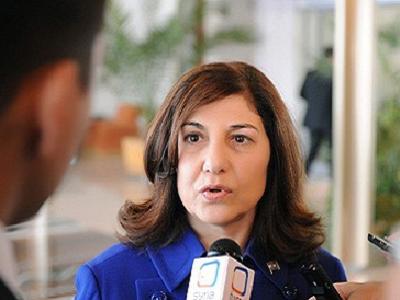 As part of its 7th set of US sanctions against Syria, which began in June, 2011, the Obama administration has targeted a messenger, a sometime spokeswoman, a positive image of Syria, someone people of all religions and cultures have easily identified with over the past several years, Dr. Bouthainia Shaaban. The US administration acted thus for the sole purpose of pressuring the government of Syrian President Bashar Assad, but has succeeded in undermining American values of freedom of expression much more.

 Part One, The Record, treats the history of garlic as evidence. From the clay garlic bulb placed in an Egyptian grave nearly six thousand years ago, through the Ebers Papyrus, through Hippocrates, Dioscorides, Pliny and Galen, the Arab physicians under Avicenna, the medieval herbals, Culpeper, and the plague years, to the last era in which Western physicians prescribed garlic as a matter of course, which ran from 1850 to 1945. It closes with the living traditions that never stopped using it, and with the folklore of charms, vampires and the evil eye.
 Aletho News

