Why Condemning Israel and the Zionist Lobby is so Important
By James Petras | Atlantic Free Press | December 25, 2006
“It’s no great secret why the Jewish agencies continue to trumpet support for the discredited policies of this failed administration. They see defense of Israel as their number-one goal, trumping all other items on the agenda. That single-mindedness binds them ever closer to a White House that has made combating Islamic terrorism its signature campaign. The campaign’s effects on the world have been catastrophic. But that is no concern of the Jewish agencies.” – December 8, 2006 statement by JJ Goldberg, editor of Forward (the leading Jewish weekly in the United States)
Introduction
Many Jewish writers, including those who are somewhat critical of Israel, have raised pointed questions about our critique of the Zionist power configuration (ZPC) in the United States and what they wrongly claim to be our singular harsh critique of the state of Israel. Some of these accusers claim to see signs of ‘latent anti-Semitism’, others, of a more ‘leftist’ coloration, deny the influential role of the ZPC arguing that US foreign policy is a product of ‘geo-politics’ or the interests of big oil. With the recent publication of several widely circulated texts, highly critical of the power of the Zionist ‘lobby’, several liberal pro-Israel publicists generously conceded that it is a topic that should be debated (and not automatically stigmatized and dismissed) and perhaps be ‘taken into account.’
ZPC Deniers: Phony Arguments for Fake Claims
The main claims of ZPC deniers take several tacks: Some claim that the ZPC is just ‘another lobby’ like the Chamber of Commerce, the Sierra Club or the Society for the Protection of Goldfish. Others claim that by focusing mainly on Israel and by inference the ‘Lobby’, the critics of Zionism ignore the equally violent abuses of rulers, regimes and states elsewhere. This ‘exclusive focus’ on Israel, the deniers of ZPC argue, reveals a latent or overt anti-Semitism. They propose that human rights advocates condemn all human rights abusers everywhere (at the same time and with the same emphasis?).
Others still argue that Israel is a democracy – at least outside of the Occupied Territories (OT) – and therefore is not as condemnable as other human rights violators and should be ‘credited’ for its civic virtues along with its human rights failings. Finally others still claim that, because of the Holocaust and ‘History-of-Two-Thousand-Years-of-Persecution’, criticism of Jewish-funded and led pro-Israel lobbies should be handled with great prudence, making it clear that one criticizes only specific abuses, investigates all charges – especially those from Arab/Palestinian/United Nations/European/Human Rights sources — and recognizes that Israeli public opinion, the press and even the Courts or sectors of them may also be critical of regime policies.
These objections to treating the Israeli-Palestinian-Arab conflict and the activities of Zionist Lobbies as central to peace and war serve to dilute, dissipate and deflate criticism and organized political activity directed at the ZPC and its directors in Israel.
The response of the critics of Israel and the ZPC to these attacks has been weak at best and cowardly at worst. Some critics have responded that their criticism is only directed toward a specific policy or leader, or to Israeli policies in the OT and that they recognize Israel is a democracy, that it requires secure borders, and that it is in the interests of the Israeli ‘people’ to lower their security barriers. Others argue that their criticism is directed at securing Israeli interests, influencing the Zionist Lobby or to opening a debate. They claim that the views of ‘most’ Jews’ in the US are not represented by the 52 organizations that make up the Presidents of the Major Jewish Organizations of America, or the thousands of PACs, local federations, professional associations and weekly publications which speak with one voice as unconditional supporters of every twist and turn in the policy of the Zionist State.
There are numerous similar lines of criticism, which basically avoid the fundamental issues raised by the Israeli state and the ZPC, and which we are obliged to address. The reason that criticism and action directed against Israel and the ZPC is of central importance today in any discussion of US foreign policy, especially (but not exclusively) of Middle East policy and US domestic policy-making is that they play a decisive role and have a world-historic impact on the present and future of world peace and social justice. We turn now to examine the ‘big questions’ facing Americans as a result of the power of Israel in the United States.
The Big Questions Raised by the ZPC and Israeli Power in the USA:
War or Peace
Critical study of the lead up to the US invasion of Iraq, US involvement in providing arms to Israel (cluster bombs, two-ton bunker buster bombs and satellite surveillance intelligence) prior to, during and after Israel’s abortive invasion of Lebanon, Washington’s backing of the starvation blockade of the Palestinian people and the White House and Congress’ demands for sanctions and war against Iran are directly linked to Israeli state policy and its Zionist policy-makers in the Executive branch and US Congress. One needs to look no further than the documents, testimony and reports of AIPAC and the Presidents of the Major American Jewish Organizations to observe their claims of success in authoring legislation, providing (falsified) intelligence, engaging in espionage (AIPAC) and turning documents over to Israeli intelligence (now dubbed ‘free speech’ by liberal Zionists).
If, as the overwhelming evidence indicates, the ZPC played a major role in the major wars of our time, wars capable of igniting new armed conflicts, then it ill behooves us to dilute the role of the Zionist/Jewish Lobby in promoting future US wars. Given Israel’s militarist-theocratic approach to territorial aggrandizement and its announced plans for future wars with Iran and Syria, and given the fact that the ZPC acts as an unquestioning and highly disciplined transmission belt for the Israeli state, then US citizens opposed to present and future US engagement in Middle East wars must confront the ZPC and its Israeli mentors. Moreover, given the extended links among the Islamic nations, the Israel/ZPC proposed ‘new wars’ with Iran will result in Global wars. Hence what is at stake in confronting the ZPC are questions which go beyond the Israeli-Palestine peace process, or even regional Middle East conflicts: it involves the big question of World Peace or War.
Democracy or Authoritarianism
Without the bluster and public hearings of former Senator Joseph McCarthy, the Jewish Lobby has systematically undermined the principal pillars of our fragile democracy. While the US Congress, media, academics, retired military and public figures are free to criticize the President, any criticism of Israel, much less the Jewish Lobby, is met with vicious attacks in all the op-ed pages of major newspapers by an army of pro-Israeli ‘expert’ propagandists, demands for firings, purges and expulsions of the critics from their positions or denial of promotions or new appointments. In the face of any prominent critic calling into question the Lobby’s role in shaping US policy to suit Israel’s interests, the entire apparatus (from local Jewish federations, AIPAC, the Presidents of Major American Jewish Organizations etc) go into action – smearing, insulting and stigmatizing the critics as ‘anti-Semites’. By denying free speech and public debate through campaigns of calumny and real and threatened repercussions the Jewish Lobby has denied Americans one of their more basic freedoms and constitutional rights.
The massive, sustained and well-financed hate campaigns directed at any congressional candidate critical of Israel effectively eliminates free speech among the political elite. The overwhelming influence of wealthy Jewish contributors to both parties – but especially the Democrats – results in the effective screening out of any candidate who might question any part of the Lobby’s Israel agenda. The takeover of Democratic campaign finance by two ultra-Zionist zealots, Senator Charles Schumer and Israeli-American Congressman Rahm Emanuel ensured that every candidate was totally subordinated to the Lobby’s unconditional support of Israel. The result is that there is no Congressional debate, let alone investigation, over the key role of prominent Zionists in the Pentagon involved in fabricating reports on Iraq’s ‘weapons of mass destruction’, and in designing and executing the war and the disastrous occupation policy. The Lobby’s ideologues posing as Middle East ‘experts’ dominate the op-ed and editorial pages of all the major newspapers (Wall Street Journal, New York Times, Los Angeles Times, Washington Post). In their pose as Middle East experts, they propagandize the Israeli line on the major television networks (CBS, NBC,ABC, Fox, and CNN) and their radio affiliates. The Lobby has played a prominent role in supporting and implementing highly repressive legislation like the Patriot Act and the Military Commission Act as well as modifying anti-corruption legislation to allow the Lobby to finance congressional ‘educational’ junkets to Israel. The head of Homeland Security with its over 150,000 functionaries and multi-billion dollar budget is none other than Zionist fanatic Michael Chertoff, head persecutor of Islamic charity organizations, Palestinian relief organizations and other ethnic Middle Eastern or Moslem constituencies in the US, which potentially might challenge the Lobby’s pro-Israel agenda.
The biggest threat to democracy in its fullest sense of the word – the right to debate, to elect, to legislate free of coercion – is found in the organized efforts of the Zionist lobby, to repress public debate, control candidate selection and campaigning, direct repressive legislation and security agencies against electoral constituencies opposing the Lobby’s agenda for Israel. No other lobby or political action group has as much sustained and direct influence over the political process – including the media, congressional debate and voting, candidate selection and financing of congressional allocation of foreign aid and Middle East agendas as the organized Zionist Power Configuration (ZPC) and its indirect spokespeople heading key Congressional positions. A first step toward reversing the erosion of our democratic freedoms is recognizing and publicly exposing the ZPC’s nefarious organizational and financial activities and moving forward toward neutralizing their efforts.
Their Foreign Policy or Ours?
Intimately and directly related to the loss of democratic freedoms and a direct consequence of the Jewish lobby’s influence over the political process is the making of US Middle East policy and who benefits from it. The entire political effort of the Lobby (its spending, ethnic baiting, censorship and travel junkets) is directed toward controlling US foreign policy and, through US power, to influence the policy of US allies, clients and adversaries in Europe, Asia and the Middle East. The Lobby’s systematic curtailment of our democratic freedoms is intimately related to our own inability to influence our nation’s foreign policy. Our majoritarian position against the Iraq War, the repudiation of the main executioner of the War (the White House) and our horror in the face of the Israeli invasion of Lebanon and destruction of Gaza are totally neutralized by Zionist influence over Congressional and White House policymakers. The recently victorious Congressional Democrats repudiate their electorate and follow the advice and dictates of the pro-Zionist leadership (Nancy Pelosi, Harry Reid, Rahm Emmanuel, Stephan Israel and others) by backing an escalation of troops and an increase in military spending for the war in Iraq. Bush follows the war policy against Iran proposed by the zealous Zionist fanatics in the American Enterprise Institute, repudiating the diplomatic proposals of the bi-partisan Baker Commission. Congress quadruples US arms stored in Israel (supposedly for dual use) in the aftermath of Israel’s bombing of Southern Lebanon with one million anti-personnel bomblets from cluster bombs in direct defiance of US electoral opinion. While hundreds of millions of undernourished women and children suffer and die in Africa, Latin America and Asia, the Lobby ensures that over half of US foreign aid goes to Israeli Jews with per capita incomes of over $22,000 USD.
No other organized political action group or public relations firm acting on behalf of the Cuban and Venezuelan exiles or Arab, African, Chinese or European Union states comes remotely near the influence of the Zionist lobby in shaping US policy to serve the interest of Israel.
While the Lobby speaks for less than 2% of the US electorate, its influence on foreign policy far exceeds the great majority who have neither comparable organizational nor financial muscle to impose their views.
Never in the history of the US republic or empire has a powerful but tiny minority been able to wield so much influence in using our nation’s military and economic power and diplomatic arm-twisting in the service of a foreign government. Neither the Francophiles during the American Revolution, the Anglophiles in the Civil War and the German Bund in the run-up to World War Two, nor the (anti-China) Nationalist Taiwan Lobby possessed the organizational power and sustained political influence that the ZPC has on US foreign and domestic policy at the service of the State of Israel.
Confronting the Lobby Matters
The question of the power of the Lobby over US policies of war or peace, authoritarianism or democracy and over who defines the interests served by US foreign policy obviously go far beyond the politics of the Middle East, the Israeli-colonial land grabs in Palestine and even the savage occupation of Iraq. The playing out of Zionist influence over the greatest military power in the world, with the most far-reaching set of client states, military bases, deadly weapons and decisive voice in international bodies (IMF/World Bank/United Nations Security Council) means that the Lobby has a means to leverage its reach in most regions of the world. This leverage power extends over a range of issues, from defending the fortunes of murderous Russian-Jewish gangster oligarchs, to bludgeoning European allies of the US to complicity with Israel’s ethnic cleansing of Palestine.
The ZPC represents a basic threat to our existence as a sovereign state and our ability to influence whom we elect and what agendas and interests our representatives will pursue. Even worse, by serving Israeli interests, we are becoming complicit with a State whose Supreme Court legalizes political assassinations across national boundaries, torture, systematic violations of international law and a regime which repudiates United Nations resolutions and unilaterally invades and bombs its neighbors and practices military colonist expansionism. In a word Israel resonates and feeds into the most retrograde tendencies and brutal practices of contemporary American politics. In this sense the Lobby through its media, Congressional influence and think tanks is creating an Israeli look-alike. Like Israel, the US has established its own Pentagon assassination teams; like Israel, it invades and colonizes Iraq; like Israel, it violates and rejects any constitutional or international legal restraints and systematically tortures accused but untried prisoners.
Because of these fundamental considerations, we cannot oblige our Jewish ‘progressive’ colleagues and compatriots and refrain from confronting the Zionist Lobby with force and urgency. Too many of our freedoms are at stake; too little time is left before they succeed in securing a greater military escalation; too little of our sovereignty remains in the face of the concerted effort by the Lobby and its Middle Eastern ‘expert-ideologues’ to push and shove us into a new and more devastating war with Iran at the behest of Israel’s pursuit of Middle East dominance.
No other country, abuser or not of human rights, with or without electoral systems, has the influence over our domestic and foreign policy as does the state of Israel. No other Lobby has the kind of financial power and organizational reach as the Jewish Lobby in eroding our domestic political freedoms or our war-making powers. For those reasons alone, it stands to reason, that we Americans have a necessity to put our fight against Israel and its Lobby at the very top of our political agenda. It is not because Israel has the worst human rights agenda in the world – other states have even worst democratic credentials – but because of its role in promoting its US supporters to degrade our democratic principles, robbing us of our freedom to debate and our sovereignty to decide our own interests. The Lobby puts the military and budgetary resources of the Empire at the service of Greater Israel – and that results in the worst human rights in the world.
Democratic, just and peaceful responses to the Big Questions that face Americans, Europeans, Muslims, Jews and other peoples of the world passes through the defeat and dismantlement of the Israeli-directed Zionist Power Configuration in America. Nothing less will allow us to engage in an open debate on the alternatives to repression at home and imperialism abroad.
Obama Warns Erdogan over Israel, Gives Ultimatum
Al-Manar – 16/08/2010

Britain’s Financial Times reported on Monday that the US President Barack Obama personally warned Turkish Prime Minster Recep Tayyip Erodgan that Washington will not sell weapons to Turkey if it does not change its position towards Israel.
Obama said that Turkey’s strained ties with Israel and increasing support of Iran could hinder an arms deal between Ankara and Washington.
The ultimatum is particularly important to Turkey, who was reportedly planning to buy American drone aircraft to attack Kurdish group PKK after the US pulls out of Iraq next year.
“The president has said to Erdogan that some of the actions that Turkey has taken have caused questions to be raised on the Hill [Congress] about whether we can have confidence in Turkey as an ally,” one senior administration official told the Financial Times.
“That means that some of the requests Turkey has made of us, for example in providing some of the weaponry that it would like to fight the PKK, will be harder for us to move through Congress,” the official was quoted as saying.
Relations between Israel and Turkey have grown increasingly strained since Israel’s three-week-long Operation Cast Lead in Gaza, which was launched in December 2008. More than 1,400 Palestinians were killed, including 420 children and over 5300 others were injured.
Erdogan condemned the Israeli offensive in Gaza, and criticized the Israeli blockade of the Palestinian enclave.
Following the offensive, Turkey called off a joint military drill with Israel, and relations were strained further after Israel rebuked the then Turkish envoy over a television show depicting Israeli soldiers as cold-blooded killers.
The most critical blow to Israeli-Turkish relations, however, came on May 31, when Israeli commandos raided a Turkish aid convoy trying to break the naval blockade on Gaza, which resulted in the deaths of nine Turkish activists. Turkey had threatened to cut off diplomatic ties with Israel, and continues to demand an official apology over the raid.
Turkey’s Foreign Minister Ahmet Davutoglu last week said Israel should admit sole responsibility for the killing of the nine activists.
“No one else can take the blame for killing civilians in international waters,” Davutoglu told journalists. “Israel has killed civilians, and should take the responsibility for having done so.”
Turkey, which is a NATO member and European Union member candidate, has also seen its capital rise sharply in the Muslim Middle East since Ankara’s vocal condemnation of the killings of nine pro-Palestinian activists aboard a Gaza-bound aid ship.
Ankara, together with Brazil, brokered a nuclear fuel swap in May in the hopes that the deal would draw Iran and major powers back to the negotiating table.
Turkey last week also said it would support gasoline sales by Turkish companies to Iran, despite U.S. sanctions that aim to squeeze the Islamic Republic’s fuel imports.
The U.S. administration official quoted by the Financial Times, however, said that Turkey needs to show it takes American national security interests seriously.
Washington is closely watching Turkish conduct to assess if there were “sufficient efforts that we can go forward with their request,” the official said.
Israel-US Increase Military Cooperation, Hold Joint Exercises
Al-Manar – 15/08/2010

The Israeli military on Saturday carried out maneuvers in a terrain that resembles south Lebanon as part of exercises on the occupied Palestinian territories’ borders with Lebanon and Syria.
The maneuvers were the first of their kind. Israeli TV channels showed parts of the exercises in which occupation soldiers engaged in street battles with “Hezbollah”. TV footage also showed U.S. marines participating in the drills with their Israeli counterparts.
U.S. military aid to Israel has increased markedly this year. Top-ranking U.S. and Israeli soldiers have shuttled between Tel Aviv and Washington with unusual frequency in recent months. A series of joint military exercises in Israel over the past months has included a record number of American troops.
This month, about 200 U.S. Marines joined a battalion of Israeli soldiers for an all-night march through the Negev desert, the culmination of three weeks of joint drills. As dawn approached, they crept up on a mock village, an Israeli military-built re-creation of a typical Palestinian hamlet, used for combat training, the Wall Street Journal reported.
Behind a dune on the village’s edge, a U.S. Marine company commander conferred with his Israeli counterpart before the two barked orders to soldiers scattered behind them. As dawn gave way to the Negev desert’s grinding August heat, the forces battled house-to-house in mock battle, as Israeli and Marine generals watched on from the sidelines, the report said.
The exercise was the biggest U.S.-Israeli joint infantry exercise ever, according to officials. By comparison, at the same exercise last year, there were only around 20 U.S. Marines involved. In the fall, there will be an even bigger joint infantry exercise involving tanks and armored vehicles, WSJ quoted officials as saying.
On James Petras’ Twelve Reasons to Reject Obama

By James Petras | Axis of Logic | October 29, 2008
The presidential elections in the US, once again, provide an acid test of the integrity and consequential conduct of US intellectuals. If it is the duty and responsibility of the public intellectual to speak truth to power, the recent statements of most of our well-known and prestigious public pundits have failed miserably. Instead of highlighting, exposing and denouncing the reactionary foreign and domestic policies of Democratic Party candidate Senator Barack Obama, they have chosen to support him, ‘critically, offering as excuses that even ‘limited differences’ can result in positive outcomes,and that ‘Obama is the lesser evil’ and ‘creates an opportunity for a possibility of change.’
What makes these arguments untenable is the fact that Obama’s public pronouncements, his top policy advisers, and the likely policymakers in his government have openly defined a most bellicose foreign policy and a profoundly reactionary domestic economic policy totally in line with Paulson-Bush-Wall Street. On the major issues of war, peace, the economic crisis and the savaging of the US wage and salaried class, Obama promises to extend and deepen the policies which the majority of Americans reject and repudiate.
Twelve Reasons to Reject Obama
1. Obama publicly and repeatedly promises to escalate the US military intervention in Afghanistan, increasing the number of US troops, expanding their operations and engaging in systematic cross-border attacks. In other words, Obama is a greater warmonger than Bush.
2. Obama publicly has declared that his regime will extend the ‘war against terrorism’ by systematic, large-scale ground and air attacks on Pakistan, thus escalating the war to include villages, towns and cities deemed sympathetic to the Afghan resistance.
3. Obama opposes the withdrawal of US troops in Iraq in favor of redeployment; the relocation of US troops from combat zones to training and logistical positions, contingent on the military capability of the Iraqi Army to defeat the resistance. Obama opposes a clearly defined deadline to withdraw US forces from Iraq because US troops in Iraq are essential to pursuing his overall policies in the Middle East, which include military confrontations with Iran, Syria and Southern Lebanon.
4. Obama has declared his unconditional support for the position of the pro-Israel Lobby and the colonial expansionist and bellicose policies of the Jewish state. He has promised to back Israeli military attacks whatever the cost to the US. His abject servility to Israel was evident in his speech at the annual AIPAC conference in Washington 2008. Top advisers who have long and notorious links to the top echelons of the principle Zionist propaganda mills and the Presidents of the Leading Jewish American Organizations wrote the speech and formulate his Middle East policy.
5. Obama has promised to attack Iran if it continues to process uranium for its nuclear programs. Twice, just weeks before the elections, Obama’s running mate Joseph Biden spelled out a series of ‘points of conflict’ (including Iran, Afghanistan, Pakistan, Russia and North Korea) emphasizing that Obama ‘would respond forcefully’. Obama’s senior Middle East advisers include leading Zionists like Dennis Ross, closely linked to the ‘Bipartisan Policy Center’, which published a report serving as a blueprint for war with Iran. Obama’s proposed offer to negotiate with Iran is little more than a pretext for issuing an ultimatum to Iran to surrender its sovereignty or face massive military assault.
6. Obama unconditionally supports Israel’s expulsion of Palestinians and the expansion of Jewish settlements in the West Bank, the leading cause of Middle East hostility, warfare and the discredit of US policy in the region. With three dozen Israel-Firsters among his leading campaign organizers, top policy advisers, speech writers and among the likely candidates for cabinet positions, there is virtually no hope of ‘influencing from within’ or ‘applying popular pressure’ to change Obama’s slavish submission to the Zionist Power Configuration. By supporting Obama, the “progressive intellectuals” are, in effect, allies of his Zionist mentors.
7. On the domestic front, Obama’s key economic advisers have impeccable Wall Street credentials. He gave unquestioning and immediate endorsement to Treasury Secretary Paulson’s $700 billion dollar taxpayer bailout of the richest investment banks in the US. Obama has failed to challenge Paulson or the banks over the use of Federal funds for buyouts and acquisitions instead of loans and credit to producers and homeowners. Obama’s backing of Paulson and the Wall Street bailout is matched by his meager proposals to suspend mortgage foreclosures for a three-month period, pending re-negotiations of interest payments. Obama proposes to escalate transfers of government funds to mismanaged financial institutions and bankrupt capitalist corporations, in efforts to save failed capitalism rather than pursue any new large-scale, long-term public investment programs which will generate well-paid employment for workers.
1. Obama’s economic team has openly declared their embrace and practice of ‘free market’ ideology and opposition to any effort to engage in large-scale injections of government funds in publicly-owned productive activity and social services in the face of wide-spread private sector failure, corruption and collapse.
2. Obama embraces failed private sector health plans, run and controlled by corporate insurance companies, conservative medical and hospital associations and Big Pharma. He publicly rejects a universal national health program modeled after the successful Federal Medicare program in favor of inefficient, state-subsidized private for profit plans that are costly and beyond the means of over one third of US families.
3. Obama is and continues to be an advocate for Big Agro and its highly subsidized and profitable ethanol program, which has increased food prices for millions in the US and for hundreds of millions in the world.
4. Obama advocates continuing the criminal embargo on Cuba, hostile confrontation with Venezuela’s populist President Chavez and other Latin American reformers and the duplicitous policy of promoting protectionism at home and free market access to Latin America. His key policy advisers on Latin America propose cosmetic changes in style and diplomacy but unrelenting support for re-asserting US hegemony.
5. Obama has not proposed, nor do his free market advisers and billionaire financial backers envision, any comprehensive plan or strategy to get us out of the deepening recession. On the contrary, the course of piecemeal measures presented by Obama are internally inconsistent: Fiscal austerity is incompatible with job creation; bailing out Wall Street drains funds from productive investment; and pursuing new wars undermine domestic recovery.
CONCLUSION
The intellectuals who, in the name of ‘realism’, support a politician who publicly and openly embraces new wars, billionaire bailouts and for profit, private sector-run health programs are repudiating their own claims as ‘responsible critics’. They are what C. Wright Mills called ‘crackpot realists’, abdicating their responsibility as critical intellectuals. In purporting to support the ‘lesser evil’ they are promoting the ‘greater evil’: The continuation of four more years of deepening recession, colonial wars and popular alienation. Moreover, they are allies of the mass media, major parties and the legal system which has marginalized or outright excluded the alternative candidates, Ralph Nader and Cynthia McKinney, who do speak out and oppose the war, the pro-Wall Street bailouts and propose genuine large-scale public investment in the domestic economy, a universal single payer health program, sustainable and pro-environment economic policies and large-scale, long-term income redistributive policies.
What is crass and unacceptable is the argument of these intellectuals, (an insignificant pimple on the Democratic donkey’s rear-end) that for a single moment believe that their ‘critical support’ of the Obama political machine will open space for radical ideas. The Zionists and civilian militarists totally control Obama’s war policy in the Middle East: There will be no space for peace with Iran, Palestine, Pakistan, Afghanistan or Iraq. Wall Street controls the Obama’s financial policy: There will be no space for some Cambridge progressive to sneak in a handout for families losing their homes.
If the trade unions that have spent a hundred million dollars on each presidential campaign have failed to secure a single piece of progressive legislation in over 50 years, isn’t it delusional for our progressive ‘public intellectuals’ to imagine that they, in their splendid organizational isolation, can ‘pressure’ President Obama to renounce his advisers, backers and public defense of military escalation, to see his way to peace with Iran and to promote social justice for our workers and unemployed?
How a War with Iran Would Diminish American Power
By Greg Scoblete | The Compass | August 13, 2010
Jennifer Rubin wants a war with Iran:
But the emphasis on the existential threat to Israel ignores a more basic issue for Americans to ponder: a nuclear-armed Iran represents a dagger at the heart of America and an existential threat to our status as a superpower and guarantor of the West’s security. As to the former, Iran is pressing ahead with its long-range ballistic missile program. First the Middle East and Eastern Europe, then all of Europe and, within a matter of years, the U.S. will be within range of Iranian missiles. If those are nuclear and not conventional, what then? We’re not talking about whether Iran is going to be “merely” a destabilizing factor in the Middle East or whether it will set off an arms race with its neighbors or imperil Israel’s existence. We’re talking about whether America will then be at risk (and lacking sufficient missile-defense capabilities if we continue to hack away at our defense budget). The argument about whether mutual assured destruction can really work against Islamic fundamentalists who have an apocalyptic vision becomes not about Israel’s ability to deter an attack but about ours. Those who oppose American military action have an obligation to explain why America should place itself in that predicament.
I would argue that any obligation to present an explanation lies with those whose disastrous policy prescriptions with respect to Iraq lead America into the worst strategic blunder in the country’s recent history. That aside, note the blind faith in the power of the military to actually achieve its ends. The recent history in Lebanon is instructive on this point: Israel attacked Hezbollah in Lebanon in 2006 with an eye toward seriously degrading the group’s ability to endanger Israel. And it worked – for a bit. Now, in 2010, Hezbollah is reportedly even better armed than before the war began. And this is a group that relies on outside aid crossing international borders to resupply itself. It can’t call on vast oil reserves or the full resources that a state can muster.
Now imagine bombing Iran’s nuclear facilities. At best, as with Hezbollah in Lebanon, a wide-ranging attack on Iran would delay its acquisition of nuclear weapons and long-range missiles. But it would surely impress upon Iran the need to redouble its efforts to seek those weapons. When those are rebuilt – as they would be – there would be almost no question that Iran would seek to actually “weaponize” its nuclear program and not merely have the ability to do so when it wants. What’s more, any hope that Iran’s citizens would look approvingly at the West when they eventually slough off the clerical regime would presumably take a severe hit. We would deal America’s long-term prospects with Iran and the Iranian people a damaging blow and still have failed to achieve the ends we desired.
But Rubin makes a more sweeping point, that the U.S. must fight a war to maintain its imperial vanity:
And then there is the broader issue of America’s standing as the sole superpower and the defender of the Free World. Should the “unacceptable” become reality, the notion that America stands between free peoples and despots and provides an umbrella of security for itself and its allies will vanish, just as surely as will the Zionist ideal.
I can’t speak for the Zionist ideal, but the concern about America’s standing as a sole superpower strikes me as a terrible casus belli. First, it’s simply wrong. China, India and Pakistan went nuclear, and America didn’t tumble from its superpower perch. Whether or not Iran has one or two crude nuclear bombs has next to no bearing on America’s superpower status relative to questions about the health of the American economy.
The second, more fundamental, problem with Rubin’s analysis is that a war with Iran would actually accelerate America’s fall from super power status. The war with Iraq dealt American power and strategic position a huge blow, with costs that vastly outstripped the gains, but a war with Iran could potentially deal an even greater jolt.
The major failure of the war against Iraq was the inability to articulate – let alone achieve – specific political goals for the post-war environment. We knew we wanted Saddam gone but we didn’t know what would take his place or how we’d get from point A to B in post war Iraq. So it is with Iran. Commentary has devoted a lot of time to explaining why we should bomb Iran but has devoted almost no attention to the question what we do after we’ve attacked them. As with Iraq, concern for any post-war phase in Iran is simply glossed over, if it’s dealt with at all. In theory, one should be expected to learn from their mistakes, not ignore them.
The U.S. military may know how to destroy Iran’s nuclear facilities, but it has demonstrated in two successive military conflicts that it cannot manage the post-war aftermath, let alone put in place political institutions that will serve America’s needs (this is no knock on the military, this stuff is almost impossible to do). Neither can Washington’s civilian bureaucracy, which can barely staff itself in Iraq. It beggars belief that Washington could cope with the aftermath of a war against Iran.
To insist that this is not relative to any conflict with Iran because we’d simply bomb them from afar implies that the aftermath of such a conflict is knowable or that the threat from Iran is so urgent and so imminent that it overwhelms our capacity for reasonable planning.
Neither of those positions strike me as true.
Israel’s War with Iran and The Zionist Power Configuration in America
By Prof. James Petras | July 15, 2008
“My strong preference here is to handle all this (US conflict with Iran) diplomatically with the other powers of government, ours and many others as opposed to any kind of strike occurring… From the US perspective, from the United States military perspective in particular, opening up a third front (Israeli and/or US act of war against Iran) would be extremely stressful to us” testimony of Admiral Michael Mulligan, Chairman of the Joint Chiefs of Staff. July 2, 2008.
“If Iran continues its nuclear arms program – we will attack it. The sanctions aren’t effective. There will be no choice but to attack Iran to halt the Iranian nuclear program.” Shaul Mofaz, Israeli Minister of Transportation in Yediot Ahronot, June 6, 2008.
“The present economic sanctions on Iran have exhausted themselves. Iranian businesspeople who would not be able to land anywhere in the world would pressure the regime.” Israeli Prime Minister Ehud Olmert, speaking to US House Speaker, Senator Nancy Pelosi in favor of a unilateral, pre-emptive US naval blockade of Iran. (Haaretz May 21, 2008.)
“It was a triumphalist conference. Even this powerful organization (AIPAC), the most powerful group in the US Israel lobby, had never seen anything like. Seven thousand Jewish functionaries from all over the United States came together to accept the obeisance of the entire Washington elite. The three presidential hopefuls (Hillary went too) made speeches, trying to outdo each other in flattery. Three hundred senators and members of Congress crowded the hallways. Everybody who wanted to be elected or re-elected to any office came to see and be seen.” Uri Avnery, London Review of Books, July 3, 2008. page 18
House Resolution 362 received unanimous support from all the Presidents of the Major American Jewish Organizations including the 7,000 delegation attending the AIPAC Conference in Washington DC on June 2-4, 2008.
“Resolution 362 became our chief legislative priority”, according to AIPAC’s website, June 4, 2008.
“The President should prohibit the export to Iran of all refined petroleum products imposing stringent inspection requirements in all persons, vehicles, ships, planes, trains and cargo ships enters and departing Iran .” US House Resolution 362 introduced May 22, 2008.
Resolution 362 gained 170 co-sponsors or nearly 40% of the House and 19 co-sponsors in the Senate in less than a month.
Introduction
Zionists and their allies in Congress authored, implemented and enforced sanctions against Iran, which hinder the ambitions of the world’s biggest oil and gas companies. Israeli war exercises and public declarations threatening a massive air assault on Iran have pushed petroleum prices to world records. This spring 2008, the most powerful pro-Israel Jewish Lobby in the US , AIPAC held their annual conference and secured the support and commitment of both major US Presidential candidates and the majority of US members of Congress for an Israeli initiative to impose extreme economic sanctions on Iran with threats of a US/Israeli military attack. In early summer 2008, the AIPAC operatives, who wrote this US Congressional resolution, successfully rounded up Congressional leaders’ support of an air and naval blockade of all critical imports into Iran – a blatant act of war.
Israel adopts a ‘peace policy’ designed to isolate Iran in preparation for an attack – and then immediately violates its terms. The entire spectrum of major Jewish organizations unquestioningly and unconditionally give their active support, as they have in the past, to AIPAC’s domination of the US Presidential candidates as well as to the twists and turns in Israel’s war preparations via military exercises and phony peace gestures.
In the entire history of US relations with oil and gas-producing countries, there is not a single previous case in which it sacrificed profitable investments by its major oil companies at the behest of a foreign power ( Israel ) and its “lobby” – the Zionist Power Configuration.
Israel ’s Two Track Policy Toward Iran
Israel ’s policy to obliterate Iran , in much the same way that the US has devastated Iraq , has followed a carefully planned multi-prong strategy. Israel has relied on direct military attacks, all out wars, economic blockades and the use of overseas Zionist front organizations to destroy Iran ’s allies and strangle its economy.
The Israeli strategy is directed at undermining, weakening and enticing Iranian allies to politically and militarily isolate Tehran , in order to facilitate a full-scale massive air assault without having to deal with military fallout from Iranian allies on its borders.
In pursuit of this ‘isolate and destroy’ strategy, Israel launched a full-scale invasion and massive air and missile bombing of Lebanon knocking out critical civilian infrastructure in the hopes of obliterating Hezbollah, a staunch Iranian ally. Israeli preparation for its Lebanese war began a full year before its sneak attack, using a common minor border incident to invade Hezbollah strongholds in Southern Lebanon . Israel ’s offensive against Hezbollah made no sense from the point of view of its border security. No Israeli military official ever envisioned Hezbollah being any kind of military threat to its national security. At most Israel saw Hezbollah as a serious counterweight to its anemic puppet allies in Beirut .
From the perspective of Israel ’s regional hegemonic perspective, an attack and destruction of Hezbollah would isolate Iran and allow Israel to develop a strategic Middle East client in Beirut , facilitating an air attack.
Hezbollah’s defeat of the Israeli invasion seriously weakened Tel Aviv’s military based strategy to ‘isolate Iran ’ and strengthened Hezbollah’s power in Lebanon , raising its prestige immensely among the Arab and Muslim populations.
The second prong in Israel ’s strategy was to destroy the democratically elected Hamas government in Palestine by financing and arming a coup attempt by its Arab clients in the Palestinian Authority,Abbas and Dahlens. Hamas successfully routed the putschists and proceeded to consolidate its rule in Gaza . Israel turned toward a destructive blockade to starve the 1.5 million Palestinian civilians in Gaza into revolt against Hamas. Israel ’s allies in the US and EU poured hundreds of millions of dollars and euros to prop up the corrupt Israeli client regime in the West Bank . Once again Israel failed to militarily or economically destroy Hamas, but that didn’t prevent the Jewish state from turning to its third target – Syria .
In 2007 Israel launched an air invasion of Syria , bombing what it described as a ‘military target’, a low-grade non-military nuclear facility in order to intimidate Syria and weaken the Assad regime’s ties to Iran . While Israel demonstrated its military capacity to violate Syrian sovereignty with impunity, its action did not have any major impact on Iran-Syrian ties.
In response to the repeated failures of the Israeli military strategy of undermining Iran ’s allies, Tel Aviv turned toward a different ‘divide and conquer’ approach. Israel , through its Turkish ally, began ‘peace negotiations’ with Syria , offering to discuss the return of the Israeli-occupied Golan Heights . The trade off for Israel takes the form of peace talks over the Golan in exchange for lessening Damascus ’ military dependence on Iran . Since the Israeli public and most of the Knesset are overwhelmingly opposed to returning the Golan, the peace talks are not intended to end Israeli occupation, but to give the Assad regime a certain credibility among the Western imperial powers and lessen its isolation. The Israeli regime had no trouble selling its new line on Syria to its highly subservient and disciplined supporters among the Presidents of the fifty-two leading American-Jewish organizations. They are well practiced in following the zig-zag of Israeli policy, switching policy of demonizing Syria one day and acknowledging its pragmatism the next. French President Sarkozy followed up the Israeli initiative by inviting Syrian President Assad to Paris with all the pomp and honors of a chief of state.
Two years after its failed military invasion of Lebanon , Tel Aviv sought and pursued negotiations with Hezbollah to exchange prisoners (and/or their remains) as part of a tactical mini-‘détente’. Once again, the US Zionist Power Configuration, after years of denouncing Hezbollah as a mere tool of Iran , accommodated the new Israeli line of recognizing Hezbollah as an independent political interlocutor.
At about the same time (June 2, 2008), Israel finally and perhaps temporarily recognized it could not militarily or economically destroy Hamas, or prevent its military retaliation against Israeli attacks or undermine its mass base of support and signed a military truce to end armed incursions and open entry points in exchange for the end of retaliatory rocket attacks on Israeli towns.
While the new Israeli turn toward peace negotiations, cease fire agreements and prisoner negotiations seems to augur a less belligerent and more realistic assessment of the Middle East balance of power, in fact the new policy is linked with a more extremist, aggressive and war-threatening military policy toward Iran. In late May and early June 2008, while Israel was proposing a more conciliatory approach toward Iran ’s allies, it engaged in a massive military exercise, involving over a hundred warplanes and thousands of commandos in an unmistaken dress rehearsal for an offensive war against Iran . Top officials from the Israeli military command, cabinet and Knesset publicly pronounced their intention to bomb Iran if it proceeded in its entirely legal and non-military uranium enrichment program. Israeli officials secured the tacit and overt approval of US and European Union for its military posture. More important Israel practically dictated the terms of debate in the United Nations Security Council by insisting that it would launch a war unless the harshest economic sanctions (and even a military-economic blockade) were not implemented and enforced by the United Nations.
Israeli policy was operating on several parallel and reinforcing tracks: The ‘peace track’ to engage and neutralize Iran’s Middle East allies, to isolate Iran and polish up its image in the Western mass media; the ‘military track’ to prepare for war, which remains its defining strategy in order to destroy an isolated (from its allies) and economically weakened (by US/EU/UN sanctions) Iran. In pursuit of its relentless drive for Middle East supremacy and the implementation of its two-track strategy, the Israeli state depends on the power of the major American Jewish organizations to promote the policies of the Jewish state in the US .
The Centrality of the ZPC in Israel ’s Pursuit of the Destruction of Iran The Zionist Power Configuration (ZPC), through its dominant role in making US-Middle East policy, plays a central part in the implementation of all aspects of Israeli foreign policy goals in the region. Israel ’s principle goal over the past five years is the destruction of Iran , to end its opposition to Israel ’s domination of the region. In pursuit of the Israeli agenda, the ZPC led by AIPAC (the American Israel Public Affairs Committee) has exploited its control and influence over the US Congress and Executive branches. AIPAC has leveraged the presence of highly placed Israel-Firsters in key positions in Treasury, the Pentagon, Commerce, the National Security Council, the Justice Department and Homeland Security to design and pursue economic and military policies in line with Israel’s war policies toward Iran. AIPAC, through its media and economic leverage undermined domestic opposition. Israel’s power over US bellicose policy toward Iran is so complete that even critics of Washington’s military posture toward Iran refrain from mentioning the powerful role of the ZPC in designing and implementing that policy.
Zionist power was on open display at its annual conference in Washington . At the 2008 AIPAC Conference, over 7,000 delegates representing 100,000 members, met to discuss how to force Washington to implement Israel ’s Middle East priorities, overwhelmingly focused on the Jewish State’s stated objective of militarily destroying Iran . Over 300 US Congress members attended (over 60% of all members of both houses) along with the three major presidential candidates, major cabinet members, including the Secretary of State, Vice President Cheney from the White House and a host of Hollywood celebrities, media moguls and prominent financial and real estate billionaires from Wall Street and its environs.
Presidential candidates competed with each other in swearing their total and unconditional servility to Israel , swearing their utmost to back any and all past, present and future Israeli military attacks. Hillary Clinton promised to implement the equivalent of twelve holocausts against Iran ’s 70 million citizens in her rant to ‘obliterate Iran ’ if it endangered Israel . Obama backed the ultra-orthodox Jewish demand to give Israel sole control over Jerusalem , and joined John McCain and Clinton in promising to bomb Iran if it continued its uranium enrichment program (which they equated with a nuclear weapon – despite the objections of the IAEA and the US intelligence community). All endorsed Israel ’s starvation of Gaza ’s 1.5 million inhabitants and rejected any concessions or negotiations with Hamas , Syria and Hezbollah – even as Israel was already engaged in negotiations for tactical reasons. AIPAC’s entire agenda has been endorsed by the US Congress, the Executive and both parties, including a military blockade of Iran, harsher world sanctions against all global oil and gas corporations, banks and industries dealing with Iran, the immediate transfer of the most advanced missile and attack technology to Israel to facilitate an attack on Iran, and a substantial increase in yearly US military grants to Israel totaling an additional $30 billion dollars over the next decade. The top Israeli officials present, Foreign Minister Tzipi Livni and Prime Minister Olmert took the opportunity to reiterate and re-affirm their will to use military power to force Iran to submit or face destruction, to standing ovations and wild cheering from the ecstatic AIPAC delegates, deriving delirious pleasure from these blood thirsty calls for US military and economic sacrifice!
Nary a single word of dissent was heard from the entire Congressional entourage in attendance; the Presidential candidates assured the zealous Israel-firsters that for the next 4 years Israeli interests would be the centerpiece of US Middle East policies.
The AIPAC conference was no simple ‘show of force’ nor an exercise in ‘group think’ meant to keep the faith of the zealots. It was the kick-off to a full-scale ZPC campaign to implement a series of measures designed to accelerate a US and Israeli military assault against Iran .
The Congressmen and women in attendance at the AIPAC were there for a purpose: to be instructed on what Middle East policies Israel and the ZPC would demand of them. Their presence at the AIPAC conference was not just a courtesy call intended to ‘network’ with wealthy Jewish campaign fund contributors. They were there because of long-standing and intense relations with the ZPC, which made it obligatory to show up and pay obeisance to demanding paymasters who shortly thereafter visited their offices and presented them with proposals and resolutions for immediate action.
The Aftermath of the AIPAC Conference Under AIPAC tutelage, if not actual authorship, a Congressional resolution was introduced, which called for a naval blockade of the Islamic Republic of Iran, a deliberate act of war. H. Con. Res. 362 calls on the President of the United States to stop all incoming international shipments of refined petroleum products from reaching Iran by any means. By the middle of June 2008, three weeks after it was introduced, the resolution had attracted 146 co-sponsors. In the Senate in two weeks time a similar measure secured 19 co-sponsors. The Congressional resolutions use almost the exact wording of an AIPAC memo issued just prior to the Congressional action. AIPAC got its cue from Israeli Prime Minister Ehud Olmert who, in early May 2008, told House Speaker Nancy Pelosi that sanctions were not enough and called a US naval blockade ‘a good possibility’ (Global Research June 18, 2008). The loyal AIPAC servants made their Israeli masters’ wish a reality – in a matter of days. (Who says critical issues get ‘bogged down’ in Washington ?)
In late June 2008, under AIPAC leadership and direction, the US Congress added $170,000,000 dollar increase in military assistance to Israel as part of a 10 year, $30 billion dollar war commitment to the Jewish state. AIPAC was instrumental in drawing up the bill and openly declared that the addition was designed to maintain Israel ’s military dominance and superiority in the Middle East but specifically designed for its war preparation against Iran and the Palestinians. AIPAC pointedly emphasized that, “The US commitment to maintaining Israel’s qualitative military edge is the cornerstone of American (sic-ZPC) policy in the region…This year’s package holds heightened significance…as the US and Israel face new challenged from Iran’s drive to acquire (sic) nuclear weapons…” (AFP June 27, 2008).
At a time when the US government faces a major financial crisis and refuses to refinance millions of Americans facing loss of their homes through foreclosures, AIPAC secured a 25% increase in military handouts to Israel. Olmert praised his US Zionist agents for improving Israel ’s take. The 52 Presidents of the Major American Jewish Organizations and their million members and affiliates successfully pursued AIPAC’s proposal to increase economic sanctions on Iran via its captive US Congressional bloc, its appointed agents in the Treasury Department and in the UN Security Council via its influence in the White House. Each and every sanction introduced by the US representative in the United Nations is a thinly veiled copy of memos and resolutions written and powerfully pushed in the Executive branch by AIPAC. They are backed by several hundred professional lobbyists and scores of pro-Israel PACs (political action committees) and ten propaganda mills (the so-called ‘think tanks’) with tight links to AIPAC. Through their influence in the US , the ZPC has successfully secured the acquiescence of other members of the UN Security Council.
Throughout 2008, a presidential election year, the ZPC has successfully engaged in sustained interrogation and pressure on the major candidates, securing pledges of unconditional support for every aspect of Israel ’s murderous policies in Gaza and the West Bank , including its policies of starvation and assault. All major candidates have echoed the ZPC-Israeli line of labeling the elected Hamas movement, Hezbollah , Iran and Syria as ‘terrorist’ organizations and states and pledged to attack or back an Israeli offensive war against Iran .
In so far as the Middle East is the center of US foreign policy, the ZPC has ensured that the next President of the United States will continue the bellicose pro-Israel policies pursued by George W. Bush. The ZPC’s influence over the next US President guarantees that the issues of war and peace will be dictated by a minority of a minority ethno-religious group, comprising less than 3% of the population and loyal to a foreign state. Whichever party wins the Presidential election or controls Congress, the ZPC will set the Middle East agenda, the head of which is the destruction of the Islamic Republic of Iran.
During the entire run-op to the November 2008 elections, not a single political leader has raised the issue of the catastrophic consequences of a war with Iran for the world economy, the astronomical rise in oil prices, which will result in the conversion of the US recession into a depression, the killing of hundreds (if not millions) of Iranian citizens and the loss of American lives. In other words, the greatest of all ZPC successes is their ability to focus the entire political elite and mass media on the advantages of launching a preemptive war for Israel and to distract public and political attention away from any reports relating the world-shattering destructive consequences.
Zionist Power: Big Oil and Liberal Obfuscation
One of the most salient issues in the run-up of oil and gas prices has been the power and policies of the ZPC. Iran possesses some of the most potentially productive and rich oil and gas fields, which are not yet exploited. Iran possesses 15-17% of the world’s supply of gas. It is number two in the world. Israel , and therefore the ZPC, has been the leading voice in blocking all investment and financing in Iran by the world’s leading public and private gas and oil multinationals. Thanks to AIPAC authored Congressional legislation, any and all oil and gas companies investing more than $20 million dollars in Iran are barred from the US market and subject to criminal investigation and fines (if not imprisonment of executives). AIPAC authored Congressional legislation, which labeled the Iranian National Guard, the so-called ‘Revolutionary Guard’, as an international ‘terrorist organization’, subject to military attack by the Pentagon.
By extension, any multinational corporation, which signs economic agreements over Iranian oil assets, is considered to be financing terrorism. Huge quantities of Iranian gas and oil are not coming onto the world market and lowering the price of gasoline, solely due to US Congressional policies authored and enforced by the ZPC. According to the Financial Times (June 25, 2008) every major US , European and Asian oil company is eager to invest in Iran but are blocked by Zionist authored legislation: “American companies are prohibited from any involvement in Iran ’s energy sector. Those non-US international groups that have invested in Iran are for now going slow. They are trying to avoid pressing ahead with investments that would anger Washington , while also trying to avoid pulling out; which could annoy Tehran .” (FT June 25, 2008. p.9).
The US Treasury Department houses the most influential enforcement agency for policing the behavior of Big Oil, Big Banking and Big Construction companies, which would normally invest in Iran , given the world historic prices. According to investigator Grant Smith (Classified Deceptions: 2007): “In 2004, AIPAC and its affiliated think tank, the Washington Institute for Near East Policy (WINEP), lobbied for a new separate US Treasury unit to be created – the ‘Office of Terrorism and Financial Intelligence’ (OTFI). It is headed by AIPAC vetted leadership and many OTFI briefings are delivered directly to WINEP. OFTI’s secretive financial operations that target Iran and its trading partners are tightly coordinated with Israel ’s leadership.” (Smith. page 59). Stuart Levey, sub-secretary of the Treasury and a zealous Zionist, who runs OTFI, and his staff have successfully pressured many of the biggest multi-billion dollar public pension funds in states like New York, Florida, Texas and California to disinvest in any company investing, trading or engaged in any economic activity with any Iranian public or private enterprise. Secondly, it has arbitrarily labeled any humanitarian organization dealing with Iran as a possible ‘terrorist conduit’. Levey has made frequent visits to Europe and Asia, threatening US reprisals to any country or corporation trading or investing in Iran . Levey and the OTFI have formulated Treasury policy memos which have decisively shaped US sanctions policy and proposals to the United Nations. It is clear that Cheney, Bush and the Democratic Congress make decisions largely drawn up, promoted and enforced by AIPAC and its key operative in Treasury, who in turn openly coordinate policy with their mentors in the Israeli foreign and financial ministries and the office of the Israeli Prime Minister.
Clearly the power of the ZPC is as much from its capacity to leverage malleable non-Zionist Congress people, public agencies, private financial institutions as it is to apply direct control over public policy. In other words for every dues paying member or leader of AIPAC, and of the 52 leading Jewish organizations in America, there are a multiplicity of state and civil society leaders and organizations who are influenced to initiate and implement pro-Israeli policies. The surprise expressed by some critical overseas Israeli observers, like Uri Avnery, over how a tiny minority of American Jews can dominate US Middle East policy, overlooks their leverage, access, and power to shape the agenda of vast sectors of US public and civil society policy makers.
While the oversight of foreign observers is understandable, what is absolutely inexcusable is the behavior of liberal critics of US war policy toward Iran . Bill Moyers, ignoring the abundant evidence published in all the major financial media on the economic sanctions against the oil companies spearheaded by the ZPC, argues that the Middle East wars are “about oil”. (Moyers and Winship June 28/29, 2008 Counterpunch). Citing as evidence for Big Oil’s role in Middle East wars, they quoted a number of former top Zionist officials in the US government (Greenspan, Wolfowitz and others). They argued that the signing of oil contracts in Iraq eight years after the start of the war is evidence that US policy was a product of Big Oil. Instead of examining Wolfowitz and over three dozen pro-Israel top policymakers in the Bush Administration who designed and executed the policy to invade Iraq – and the current all out push by the ZPC toward war with Iran – Moyers and Winship cite obscure meetings between Cheney and the oil companies. Instead of discussing the public overt campaigning for war with Iraq and Iran by the 52 leading Jewish organizations in the United States and the public policies of leading policymakers in the government, Moyers resorts to individual conspiracies between Cheney and the ‘oil industry’. Moyers admits he knows nothing about the content of the meetings and why the secret meeting did not lead to any direct lobbying for war by Big Oil (in contrast to AIPAC and its affiliates). Moyers article in Counterpunch totally avoids making a single reference to the massive, sustained and successful Zionist war campaign in the Executive and Legislative offices as well as in the Op-Ed pages of all the major daily and weekly newspapers and magazines.
A similar kind of liberal cover-,up is found in the July 17, 2008 issue of the New York Review of Books, entitled “Iran: The Threat” by Thomas Powers who puts the entire burden for war policy toward Iran solely on Bush and Cheney, overlooking the intense and successful economic sanctions and war resolutions authored by AIPAC and implemented by the Democratic Congress. Powers omits the entire war propaganda campaign which appears in the mass media written by academics from Zionist ‘think tanks’, the entire groveling for Israel exercises by the US presidential candidates and three-quarters of the US Congress and Senate at the AIPAC conference, (which took place just prior to the Powers article). Powers says nothing about the entire political class’ blind support for Israel ’s promise to go to war with Iran . Powers, a supporter of killer sanctions as an alternative to an air and missile attack, doesn’t even mention the fact that the ZPC is the leading advocate of sanctions. His research didn’t include the crucial fact that the implementation and enforcement of sanctions are in the Treasury Department (OTFI), which coordinates with Israeli agencies and is run by Stuart Levey, an Israel-Firster.
Noam Chomsky has long been one of the great obfuscators of AIPAC and the existence of Zionist power over US Middle East policy. One of his most blatant examples of cover-up occurred during the AIPAC conference in early June 2008. In answer to a question on what it would take to change US unconditional support for Israel, Chomsky ignored the servility of US Presidential candidates to Israel and the AIPAC at the AIPAC conference; Congressional approval of AIPAC authored sanctions resolutions and their implementation by Treasury Department Under-Secretary Levey; the role of the ZPC in shaping media demonizing of Iran, Palestine, Hezbollah and Syria. Instead Chomsky engages in vacuous circumlocution. With reference to US support for Israel , he claims, “We have to consider the sources of support. The corporate sector in the US , which dominates policy formation, appears to be quite satisfied with the current situation. One indication is the increasing flow of investment to Israel by Intel, Hewlett-Packard, Microsoft and other leading elements of the high tech economy. Military and intelligence relations remain very strong. Since 1967, US intellectuals have had a virtual love affair with Israel, for reasons that relate more to the US than to Israel, in my opinion. That strongly affects portrayal of events and history in media and journals.”
Chomsky deliberately omits the elementary step of actually looking at the process of ‘policy formation’ and noting the role of the AIPAC lobby in shaping US Middle Eastern policy, a point noted by every major expert, Congressional staffer and observer on and off the scene. He mentions ‘the corporate sector’, a vague entity without mentioning how the Zionist lobby has successfully blocked the major oil companies from investing billions in Iran and who undermined US investment agreements with pre-war Iraq. None of the high tech investors he cites has ever lobbied to shape US policy in the Middle East, least of all pressured the US to support Israeli occupation and eviction of Palestinians, the invasion of Lebanon, its military attack of Syria. To suggest that Micro-Soft’s Bill Gates has been lobbying for Israel , as Chomsky does, is the height of silliness. But the Presidents of the 52 Major Jewish Organizations in America have. No conference organized by high-tech companies has ever drawn 65% of the members of Congress and the Senate and all major Presidential candidates to pledge their allegiance to their corporate interests in Israel. But the AIPAC conference in June drew a huge majority of Congress members and McCain, Obama and Clinton who pledged their unconditional support for Israel ’s policies and interests.
Chomsky’s claim that the US has a love affair with Israel omits the systematic repression by pro-Israel and mostly Jewish professors of any critics of Israel , including the firing, smearing and censorship of critical fellow academics. What makes Chomsky’s simple-minded and blatant cover up of Zion-power in shaping US policy so grotesque is that it occurs at a time when it is at its highest point of power – when AIPAC has presidential candidates publicly swearing unconditional support to Israel at its major conference in Washington even as two top officials of AIPAC have been indicted for espionage for Israel.
Chomsky, Moyers and Powers (and a host of liberal critics of US threats to bomb Iran ) ignore the power of US Zionists backing of Israel ’s overt war exercises and naked threats to bomb Iran . By covering up the role of the ZPC, who are the principle Congressional and Presidential backers of sanctions, embargo and war, the liberal critics undermine our efforts to prevent a catastrophic war.
Intellectuals silently complicit with the main purveyors of war for Israel are abdicating their responsibility to speak truth to power – in this case Zionist power. At some point intellectual abdication becomes co-responsibility for a Middle East catastrophe. In the face of the complicity of our political leaders and their Zionist mentors in pursuit of Israel ’s apocalyptic war strategy toward Iran , the American public becomes of utmost relevance (contrary to Chomsky). To argue otherwise is to become complicit with the great crimes committed in our names, by leaders and ideologues with foreign allegiances.
To continue to masquerade as ‘war critics’ while ignoring the central role of the Zionist Power Configuration makes pundits like Chomsky, Moyers and Powers and their acolytes irrelevant to the anti-war struggle. They are part of the problem, not part of the solution.
James Petras’ latest book is Zionism, Militarism and the Decline of US Power (August 2008) (Clarity Press, Ste 469 , 3277 Rosewell Road, NE , Atlanta , Georgia. 30305).
‘Alarmist’ Goldberg Iran piece promotes Israeli objectives
By Philip Weiss on August 13, 2010
Tony Karon at rootless cosmopolitan, and Stephen Walt and Flynt and Hillary Mann Leverett at Foreign Policy– and all these writers concur that the Jeff Goldberg piece in the Atlantic is an argument for war and that it’s a war with a strong Israel interest. I find it amazing that such an Israelcentric argument can be put forward in establishment debate after a, Goldberg helped lead us into the Iraq war on a dubious basis without suffering much diminution of influence, and b, Goldberg himself admitted last year on Israeli television that when it came to Iran, Israeli interests and U.S. interests diverge, and he would be torn. Well, not that torn!
Here are excerpts from the three writers emphasizing the Israelcentric aspect of Goldberg’s argument. Karon says that “former IDF Corporal Jeffrey Goldberg” wrote an “alarmist screed” at the behest of his Israeli sources:
why call in Goldberg? Well, quite simply, because Goldberg is one of the most influential opinion-makers among hawkish Israel backers in the Democratic Party camp. Such are his pro-Israel hawk credentials that if Goldberg can be convinced, there’s a chance you can convince the likes of Lester Crown*. Not that Rahm succeeded, of course; that’s why Goldberg is pushing the line that Israel is going to do something crazy early next year.
Walt also says the piece serves an “alarmist” agenda:
a central purpose of this article is to mainstream the idea that an attack on Iran is likely to happen and savvy people-in-the-know should start getting accustomed to the idea. In other words, a preemptive strike on Iran should be seen not as a remote or far-fetched possibility, but rather as something that is just “business-as-usual” in the Middle East strategic environment. If you talk about going to war often enough and for long enough, people get used to the idea and some will even begin to think if it is bound to happen sooner or later, than “better to be done quickly.” In an inside-the-Beltway culture where being “tough” is especially prized, it is easy for those who oppose “decisive” action to get worn down and marginalized. If war with Iran comes to be seen as a “default” condition, then it will be increasingly difficult for cooler heads (including President Obama himself) to say no.
You’ll recall that a similar process of “mainstreaming” occurred over Iraq: What at first seemed like the far-fetched dream of a handful of out-of-power neoconservatives in 1998 had become a serious option by 2001. By 2003, aided in no small part by the efforts of journalists such as Goldberg, the idea had been embraced by liberals and others who should have known better.
Then Walt quotes his and John Mearsheimer’s book, The Israel Lobby, to identify the sources of Goldberg’s thinking:
If the United States does launch an attack, it will be doing so in part on Israel’s behalf, and the lobby will bear significant responsibility for having pushed this dangerous policy.”
Now the Leveretts. Goldberg is offering “the neoconservative case for attacking Iran,” they write here. And at FP, one of their themes is the Israelcentricness of Goldberg’s argument.
Goldberg’s reporting also reveals that the case for attacking Iran — especially for America to attack so Israel won’t — is even flimsier than the case Goldberg helped make for invading Iraq in 2002, in a New Yorker article alleging that “the relationship between Saddam’s regime and Al Qaeda is far closer than previously thought.” Goldberg’s case for war on Iran starts with the Holocaust — and a view of the Islamic Republic as a latter-day Third Reich, under ideologically obsessed, anti-Semitic leadership to which “rational deterrence theory … might not apply.”…
Goldberg’s reporting on his conversations with Israeli generals, national-security policymakers, and politicians makes clear that, in fact, those at the top of Israel’s political order understand Iran’s nuclear program is not an “existential threat.” His interlocutors recognize Iran is unlikely to invite its own destruction by attacking Israel directly. Rather, they say, a nuclear Iran “will progressively undermine [Israel’s] ability to retain its most creative and productive citizens,” according to Defense Minister Ehud Barak.
“The real threat to Zionism is the dilution of quality,” Barak tells Goldberg. “Jews know that they can land on their feet in any corner of the world. … Our young people can consciously decide to go other places [and] stay out of here by choice.”
…In other words, Israeli elites want the United States to attack Iran’s nuclear program — with the potentially negative repercussions that Goldberg acknowledges — so that Israel will not experience “a dilution of quality” or “an accelerated brain drain.”…
[P]reventing “dilution of quality” or bolstering Israelis’ perceptions regarding their country’s raison d’être can never give an American president a just or strategically sound cause for initiating war. And make no mistake: Bombing Iran’s nuclear facilities would mean war.
…Israeli elites want to preserve a regional balance of power strongly tilted in Israel’s favor and what an Israeli general described to Goldberg as “freedom of action” –the freedom to use force unilaterally, anytime, for whatever purpose Israel wants. The problem with Iranian nuclear capability — not just weapons, but capability — is that it might begin constraining Israel’s currently unconstrained “freedom of action.” In May, retired Israeli military officers, diplomats, and intelligence officials conducted a war game that assumed Iran had acquired “nuclear weapons capability.” Participants subsequently told Reuters that such capability does not pose an “existential threat” to Israel — but “would blunt Israel’s military autonomy.”One may appreciate Israel’s desire to maximize its military autonomy. But, in an already conflicted region, Israel’s assertion of military hegemony is itself a significant contributor to instability and the risk of conflict. Certainly, maximizing Israel’s freedom of unilateral military initiative is not a valid rationale for the United States to start a war with Iran. Just imagine how Obama would explain such reasoning to the American people.
* [prominent Chicago area Obama financial backer] – Aletho News
Gas deal with Iran still on, EGL says
Press TV – August 11, 2010
The Swiss energy group EGL says its €18 billion gas contract with Iran is still on, despite the US threats of sanctions over the gas deal with Tehran.
In 2007, the Elektrizitaetsgesellschaft Laufenburg (EGL) signed a 25-year agreement with the National Iranian Gas Export Company (NIGEC) to import around 5.5 billion cubic meters of gas per year from Iran.
The €18 billion gas contract was criticized in the US Congress because of possible violations of US sanctions against firms active in Iran’s gas and oil sectors.
“We are not violating any regulations, and [we] follow rules; we feel we are not really deserving to come on the [sanctions] list,” the Jerusalem Post quoted EGL spokeswoman Lilly Frei as saying.
Frei added that EU sanctions were “evaluated by our advisers, [who said that] offtake of gas at the border would not fall under these sanctions.”
After the UN Security Council ratified a sanctions resolution against Iran in July, the United States and the European Union imposed unilateral sanctions against the Islamic Republic over its nuclear program, mostly targeting the country’s energy and banking sectors.
Washington will deny access to US markets for companies that supply refined petroleum products to Iran.
The European Union measures target investment and technical assistance to Iran’s refining, liquefaction, and natural gas sectors. New investments in the energy sector are also banned. [War on oil]
You must do what we can’t, because if you don’t, we will
By Paul Woodward on August 11, 2010
 There are those who would have us believe that:
[O]ne day next spring, the Israeli national-security adviser, Uzi Arad, and the Israeli defense minister, Ehud Barak, will simultaneously telephone their counterparts at the White House and the Pentagon, to inform them that their prime minister, Benjamin Netanyahu, has just ordered roughly one hundred F-15Es, F-16Is, F-16Cs, and other aircraft of the Israeli air force to fly east toward Iran — possibly by crossing Saudi Arabia, possibly by threading the border between Syria and Turkey, and possibly by traveling directly through Iraq’s airspace, though it is crowded with American aircraft.
Worried about an Israeli attack on Iran? That’s the idea.
You must do what we can’t, because if you don’t, we will.
This is how some Israelis are trying to twist Washington’s arm to get the US to attack Iran.
A more honest way of making the argument would be to say this: If the US won’t attack Iran, then Israel will — even though it won’t accomplish its military objectives and it will open Pandora’s box. Desperate nations sometimes do desperate things. You have been warned.
Another name for this: blackmail.
It’s hard to counter an irrational argument when the irrationality is intentional. Such are the means by which someone like erstwhile Israeli army corporal and current Atlantic commentator, Jeffrey Goldberg, attempts to persuade his readers — not through cogent reasoning based on clear evidence, but by an insidious form of argument that has the clarity of slime.
Consider the way he tries to close his case for an attack on Iran — even while avoiding saying straight out that he supports such a course of action.
The United States must not take the risk of letting Israel attack Iran because if President Obama orders US forces to attack instead, this would be the most patriotic thing to do. Obama would not be serving Israel’s interests; he would be defending Western civilization.
Based on months of interviews, I have come to believe that the administration knows it is a near-certainty that Israel will act against Iran soon if nothing or no one else stops the nuclear program; and Obama knows — as his aides, and others in the State and Defense departments made clear to me — that a nuclear-armed Iran is a serious threat to the interests of the United States, which include his dream of a world without nuclear weapons. Earlier this year, I agreed with those, including many Israelis, Arabs — and Iranians — who believe there is no chance that Obama would ever resort to force to stop Iran; I still don’t believe there is a great chance he will take military action in the near future — for one thing, the Pentagon is notably unenthusiastic about the idea. But Obama is clearly seized by the issue. And understanding that perhaps the best way to obviate a military strike on Iran is to make the threat of a strike by the Americans seem real, the Obama administration seems to be purposefully raising the stakes. A few weeks ago, Denis McDonough, the chief of staff of the National Security Council, told me, “What you see in Iran is the intersection of a number of leading priorities of the president, who sees a serious threat to the global nonproliferation regime, a threat of cascading nuclear activities in a volatile region, and a threat to a close friend of the United States, Israel. I think you see the several streams coming together, which accounts for why it is so important to us.”
When I asked Peres what he thought of Netanyahu’s effort to make Israel’s case to the Obama administration, he responded, characteristically, with a parable, one that suggested his country should know its place, and that it was up to the American president, and only the American president, to decide in the end how best to safeguard the future of the West. The story was about his mentor, David Ben-Gurion.
“Shortly after John F. Kennedy was elected president, Ben-Gurion met him at the Waldorf-Astoria” in New York, Peres told me. “After the meeting, Kennedy accompanied Ben-Gurion to the elevator and said, ‘Mr. Prime Minister, I want to tell you, I was elected because of your people, so what can I do for you in return?’ Ben-Gurion was insulted by the question. He said, ‘What you can do is be a great president of the United States. You must understand that to have a great president of the United States is a great event.’”
Peres went on to explain what he saw as Israel’s true interest. “We don’t want to win over the president,” he said. “We want the president to win.”
Israel only wants what’s good for America — and we’re supposed to believe that, even while few if any Israelis could be persuaded that America only wants what’s good for Israel.
The truth is that everyone gets to define their own interests so let’s ignore the obsequious crap from Peres and consider Goldberg’s core claim: that Israel is gearing up to strike Iran.
Even if Goldberg is participating in a neocon game of bluff, the only kind of bluff worth engaging in is one that has credibility. To make a credible argument that Israel has the intention of going it alone, Goldberg would have to present the outline of a credible plan of attack. He doesn’t even try.
Israeli planes would fly low over Saudi Arabia, bomb their targets in Iran, and return to Israel by flying again over Saudi territory, possibly even landing in the Saudi desert for refueling—perhaps, if speculation rife in intelligence circles is to be believed, with secret Saudi cooperation.
And he prefaces this “plan” by saying Israel only gets one try. That’s not even a back-of-an-envelope war plan. It’s more like a Twitter war plan.
Five years ago Kenneth Pollack dismissed the idea that Israel could attack Iran on its own. I don’t see any reason to doubt that his analysis on the military logistics of an attack still remains sound. Indeed, there seem to be plenty of Israeli analysts who concede that Israel simply does not have the option of going it alone. Even Goldberg quotes an unnamed Israeli general who says: “This is too big for us.”
In The Persian Puzzle: The Conflict Between Iran and America, Pollack wrote:
[T]he United States … should not count on Israel to conduct a counterproliferation strike for us. It is almost certainly the case that Israel would be willing to absorb the diplomatic costs of a strike, would be prepared to deal with Iran’s retaliation in the form of either terrorist attacks or missile strikes on Israel, and probably is not overly concerned about Iranian behavior in Iraq. The problem for Israel is much simpler: Iran is too far away. Most of the known Iranian nuclear facilities are around 1,000 miles away from Israel. Its Jericho II ballistic missiles could reach these targets, but they lack the payload, accuracy, and numbers to be able to significantly damage (let alone destroy) more than one or two of the large Iranian nuclear facilities, which leaves the matter to the Israeli Air Force. Even assuming that Israeli aircraft were to fly directly to Iran, overflying Jordan and Iraq, the only aircraft in its inventory that could reach Iran’s known nuclear sites are its 25 F-151 strike fighters. (Israel would need to set up aerial refueling stations at three to five locations between Israel and the Iranian targets for its roughly 350 F-16s to be able to participate, which would be practically impossible.) Because the F-151s would have to carry a considerable amount of fuel, they could not carry a great deal of ordinance. Given the size of the various Iranian nuclear facilities, it would not be possible for Israel to destroy all of them in a single raid as it did Osiraq. Nor would it be politically, militarily, or logistically possible for Israel to sustain multiple such strikes over the many days, if not weeks, it would take for all its F-151s to accomplish the job. [My emphasis.]
The neocon game of bluff will only box in the Obama administration if the Israeli “threats” are treated seriously. A more appropriate response would seem to be to focus on the limits of Israeli military action — unless that is one imagines that Israel would launch a nuclear attack on Iran, which to my mind is wildly implausible. (If Israel wants to permanently seal its global pariah status, the first offensive use of nuclear weapons since Nagasaki is a sure way.)
Goldberg reports, but apparently didn’t take seriously, the observations of some Israelis who given their positions of military command seem to merit close attention:
Gabi Ashkenazi, the Israeli army chief of staff, is said by numerous sources to doubt the usefulness of an attack, and other generals I spoke with worry that talk of an “existential threat” is itself a kind of existential threat to the Zionist project, which was meant to preclude such threats against the Jewish people. “We don’t want politicians to put us in a bad position because of the word Shoah [Holocaust],” one general said. “We don’t want our neighbors to think that we are helpless against an Iran with a nuclear bomb, because Iran might have the bomb one day. There is no guarantee that Israel will do this, or that America will do this.”
The message Netanyahu, Goldberg and other panic-stricken Zionists are unintentionally sending out is that come the day Iran acquires a nuclear weapon, Israelis may as well back their bags and abandon the Jewish state.
That probably won’t happen because in such an event Israel will “discover” what many Israelis no doubt already think: that retired General John Abizaid was right when he said that the United States and its allies can “live with” a nuclear-armed Iran. “Let’s face it — we lived with a nuclear Soviet Union, we’ve lived with a nuclear China, and we’re living with nuclear powers as well,” Abizaid told an audience at the Center for Strategic and International Studies.
That was true in 2007 and it’s true now. It’s also true that spineless politicians remain the playthings of fear-mongers who are addicted to war.
Details of Canadian Security Intelligence Service probe on foreign influence being withheld
Grace Batchoun | Canadians for Justice and Peace in the Middle East | August 10, 2010
Montreal – The Harper government is still withholding the details of Canadian Security Intelligence Service (CSIS) investigations that prompted CSIS Director Richard Fadden to comment on foreign influence on Canadian politicians. The media have been focusing on China as one source of inappropriate influence. However, Fadden indicated that at least five countries, including China and Middle East nations were involved. He did not specify which Middle Eastern countries. The government’s secrecy may indicate that Israel – to which the Harper government has given resolute uncritical support – is among the Middle Eastern countries that CSIS investigations reveal are unduly influencing Canada’s politicians.
In his comments, Fadden talked about foreign influence exercised through university and social clubs. He noted “You pay [for] their trips and … when an event is occurring that is of particular interest to country ‘X,’ you call up and you ask the person to take a particular view,” Fadden said. Currently, Hillel Clubs operate on most Canadian campuses, and their mandates explicitly include “Israel advocacy” and promoting Jewish students’ identification with Israel. Opportunities for all-expenses-paid two-week trips to Israel are also made available to students. A similar process occurs with federal MPs and provincial legislators. The Canada-Israel Committee has been subsidizing trips to Israel for MPs and provincial legislators for decades.
Canadians for Justice and Peace in the Middle East is concerned about the influence that Israel and the Canada-Israel Committee exercise on federal politicians through travel subsidies and possibly other means. “We urge the government to disclose now which countries CSIS found exercising undue influence, and the means by which they do so,” says CJPME President Thomas Woodley. As pointed out by veteran CBC journalist Brian Stewart, trips subsidized by foreign governments are “carefully planned, often by the host nation’s intelligence arm.” CJPME believes that Canadian policy should be moulded by respect for international law, and is concerned that Canadian Middle East policy could be skewed through the type of influence Fadden described.
According to the federal ethics commissioner, the Canada-Israel Committee paid over $160,000 for various one-week trips by 14 MPs to Israel in 2009 alone. The Canada-Israel Committee subsidized a July 2010 trip by seven MPs: Conservative MPs John Duncan, Jeff Watson, Edward Fast and Brent Rathgeber, Liberal MPs Scott Simms and Anthony Rota and NDP MP Glenn Thibeault. No other Middle East nation has hosted so many MPs on such frequent and expensive trips.
The Myth of the US Military Aid to Lebanon
By Yusuf Fernandez | Al-Manar – TV | August 10, 2010
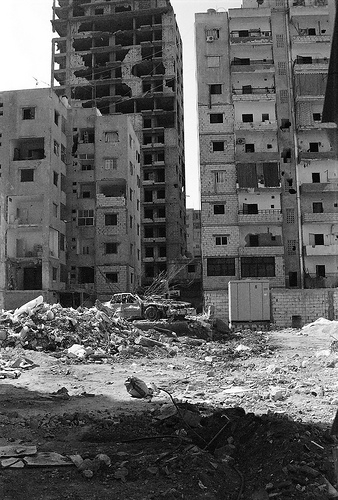 US weaponry laid entire Lebanese communities to waste in 2006 – Photo credit Amelia Opalinska
On August 4, US State Department spokesman P. J. Crowley said that Lebanese armed forces firing on Israeli troops near the Israel-Lebanon border the previous day, which killed two Lebanese soldiers and one Lebanese journalist as well as one Israeli officer and seriously wounded another, was “totally unjustified and unwarranted.” Shortly before, Israeli Ambassador in Washington, Michel Oren, held talks with US senior officials to demand a harsh US response.
Some US congressmen warned Lebanon that the US could reassess its aid to the Lebanese Army. “To start shooting as they did -one person killed, one seriously injured– is a very serious move by the Lebanese army,” Florida Representative Ron Klein, who sits on the House Foreign Affairs Committee, told The Jerusalem Post.“It certainly is going to come up in our conversations in the Congress about the continued support of the Lebanese Army,” he said. Klein ignored the three Lebanese victims and the Israeli actions that provoked the incident.
The American Israel Public Affairs Committee (AIPAC), the main organization of the Zionist lobby, reportedly circulated a memorandum claiming that the Lebanese Army was cooperating with Hezbollah, and stating that unless this stops, “Washington must reevaluate its relationship with the Beirut government and the Lebanese Armed Forces – the recipient of significant American military aid.” A State Department representative declined to respond to a Jerusalem Post question about whether the incident could affect American aid to Lebanon.
According the Israeli daily Haaretz, in the past five years, the Lebanese Army has been the second largest recipient of US military assistance per capita after Israel. A State Department press release from late 2008 noted that between 2006 and 2008, the Lebanese Army received 10 million rounds of ammunition, Humvees, spare parts for attack helicopters, vehicles for its Internal Security Forces “and the same frontline weapons that US military troops are currently using, including assault rifles, automatic grenade launchers, advanced sniper systems, anti-tank weapons and the most modern urban warfare bunker weapons.”
Since 2006, the US has provided Lebanon some 500 million dollars in military assistance. Last year, the US approved 100 million dollars in assistance to the Lebanese military. The Obama administration has requested the same levels for 2011, with small increases for anti-terror and military training programs.
However, the border incident of August 3 highlighted the fact that the US Administration does not consider that its military aid should be used to protect Lebanon against its only real enemy: Israel. “We have no indication that US equipment played any role in this incident earlier this week,” Crowley said. “In any US-origin equipment that has been provided to Lebanon, we have very strong end-use monitoring to make sure it is used appropriately.”
“Used appropriately” means that US aid must only be used against other Lebanese parties, especially the Resistance. According to Lebanon’s As-Safir newspaper, in written testimony to Congress, Obama´s nominee to head the US Central Command, General James Matthis, claimed that the relationship between US Central Command and the Lebanese Army is focused on building the latter´s capabilities “to preserve internal stability”. US Assistant Secretary of Defense Alexander Vershbow, who has recently visited Beirut and the South of Lebanon, said that continued US aid and training to the Lebanese Army would allow it to “prevent militias and other nongovernmental organizations” from “undermining the government”.
One State Department spokesperson made the quid pro quo clearer: if the Lebanese Army hopes for equipment, even spare parts, it will have to first focus on “using its military to keep Hezbollah in check and to control southern Lebanon and Palestinian refugee camps in order to prevent them from being used as bases to attack Israel”. This point was underscored by US officials interviewed by International Crisis Group who “implied” that “the Lebanese must be trained and equipped to meet Hezbollah´s, not Israel´s, challenge.” Therefore, US military aid for Lebanon seeks to protect Israel, the real enemy of Lebanon, and the Lebanese Army should become a mercenary force to implement US and Israeli schemes in Lebanon and the Middle East. Significantly, the US has not given the Lebanese Army anti-aircraft, anti-tank or anti-ship missiles that could be used against Israel.
The second goal of US aid, according to the US Central Command, is to “protect borders”, which means to prevent the Resistance from receiving weapons from abroad in order to protect the country against the Israeli enemy. However, the Jerusalem Post complained, “the Lebanese Army has taken no actions to seal off that border from weapons transfers to Hezbollah” and has done “nothing while Syria and Iran have been arming Hezbollah´s army with tens of thousands of missiles.”
At a White House meeting in December 2009, President Barack Obama asked Lebanese President Michel Sleiman to stop the flow of weapons being allegedly sent to the south of Lebanon “that potentially serve as a threat to Israel”. He warned that a failure to do so could lead to another invasion by Israel. Vice President Joe Biden went further, telling Sleiman that Israel could invade Lebanon and go all the way to Beirut to destroy Hezbollah´s weapons if the government failed to rein in the organization.
Of course, massive US military aid to Israel, which includes all kind of weapons, including the most advanced ones in the US arsenal, is something normal and nobody has the right to question it. However, when Syria, Iran or Lebanon acquire any kind of weapons adequate to protect their countries against US or Israeli attacks or threats this becomes a universal scandal.
The US aid is not supposed be used to protect Lebanon from Israeli spies either. Recently, Los Angeles Times complained that the US-supported Lebanese Internal Security Forces had used US signals equipment to help Hezbollah “ferret out Israeli agents.” According to the Times, “a strengthening Lebanese government is helping Hezbollah bust alleged spy cells, sometimes using tools and tradecraft acquired from Western nations eager to build up Lebanon´s security forces as a counterweight to the Shiite group.” Once again, Hezbollah was the target, not Israel.
In this way, US and Israeli outrage is easy to understand. The Lebanese have not used US weapons to crush Hezbollah but to defend Lebanon and this is an unbearable reality for Israelis and pro-Zionist circles in Washington. For Washington and Tel Aviv, the truth is simple: the Lebanese Army is not supposed to protect Lebanon from Israeli violations of the Lebanese sovereignty and, thus, it shot at whom did not have to.
More and more Lebanese are now questioning the value of US aid that can only used in an internal conflict. Agriculture Minister Hussein al-Hajj Hasan has called for preventing the US from controlling the army through its ill-intentioned support, the National News Agency said. He claims that American military and security assistance does not benefit Lebanon.
SUPPORT FOR ISRAELI WARS ON LEBANON
Lebanese people also remember that the US role has gone much beyond trying to turn the Lebanese Army into an internally oppressive security force. Washington has been an accessory to all Israeli attacks and aggressions against Lebanon. For example, a great portion of the American equipment stored in Israel was used for combat in the 2006 July war in Lebanon. Moreover, the US sent Israel all kinds of weapons and ammunition during the conflict.
Moreover, Washington politically supported the Israeli assault and blocked all efforts for an immediate halt to a war that killed more than 1,300 Lebanese, wounded more than 4,000 and drove 900,000 from their homes. A third of the Lebanese dead were children under the age of 12.
This US stance outraged the Lebanese population. “We did not use to be against the Americans, but now we are. They are against us,” said Fatima Haider, a Lebanese who lived in the district of Ein el-Mreiseh in Beirut, to Reuters at that time. Her home was destroyed by US-made Israeli bombs. “It is clear America´s support for Israel during the 34 days of bombing will not be forgotten,” said Fawaz Gerges, a professor at Sarah Lawrence College in New York, to ABC News.
As the Lebanese newspaper Daily Star said: “American complicity in these (Israeli) plans is clear: the Lebanese middle class has witnessed the carnage and destruction of their country with US approval, and the killing of innocent women and children with advanced American weaponry that mutilated their bodies into pieces.” Even naïve Lebanese that had believed for a moment that the US Administration could have a sincere interest in promoting democracy in its country got indignant about American support for the Israeli aggression.
NY Times full-page ad demonstrates who is pushing for war against Iran
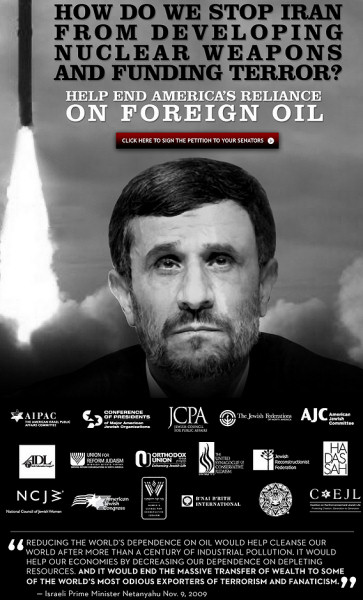
Also, the organizers say they’re actuated by fears of climate change, but why the Netanyahu quote and the emphasis on missiles?
And the NYTimes is still on message, Global Warming, Peak Oil and the War on Terror all seem to merge to support Zionism:
Letters to the International Herald Tribune – How to Fight Climate Change – NYTimes.com
The only way to effectively address climate change is for our leaders to make it an issue of national security: Emphasize the link between consumption of fossil fuels, especially foreign oil, and the rise of international terrorism. Once that link is clearly established, people will be willing to make an effort: The home-front will contribute to fighting against terrorism, which threatens every one of us. People will understand that there is no way to put a value on the lives of any of the nearly 3,000 people who perished in the Sept. 11 attacks, and that any effort is worth making to prevent recurrence of such a tragedy.
Update:
The Israel Lobby’s War on America’s Middle East Oil Dependence
By Maidhc Ó Cathail | The Passionate Attachment | October 26, 2012
See also:
US Jewish leaders push Obama to act on Iran
Jerusalem Post, September 10, 2009
Related efforts toward energy independence and war on Iran
- Obama uses Weekly Address to lobby for Israeli firm BrightSource (alethonews)
- Noam Chomsky: The Fate of Humanity Is at Stake — Why Are Romney and Obama Too Cowardly to Talk About What Really Matters? (alternet.org)
- Iran Underground Nuclear Plant Almost Finished, NY Times Says – Bloomberg (bloomberg.com)
- Earth Day in Israel: Apartheid Showing Through the Greenwash (alethonews)
Featured Video
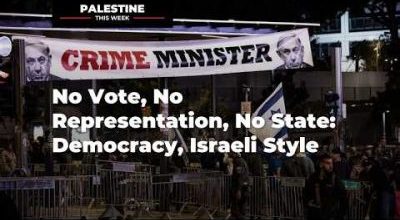
No Vote, No Representation, No State: Democracy, Israeli Style
or go to
Aletho News Archives – Video-Images
From the Archives
Sanctions, War and the Policy of Dual Containment
By SASAN FAYAZMANESH | March 17, 2008
It is now nearly three decades since the Unites States adopted the policy of dual containment of Iran and Iraq. While much has been written about the containment of Iraq, there has been very little in-depth analysis of this policy when it comes to Iran. In a book that is going to be released on March 31, 2008, entitled The United States and Iran: Sanctions, Wars and the Policy of Dual Containment (Routledge), I attempt to address this shortcoming by investigating when and why the US policy of containment of Iran came about, how it evolved, and where it stands today.[1] To the extent that Israel has been involved in US policy making, the study will also include the role that Israel has played in the containment of Iran. Also, since the fate of Iran has been inextricably linked to that of Iraq, occasionally the investigation will overlap with the containment of Iraq.
The policy of dual containment of Iran and Iraq originated during the Carter Administration, but it was not until the Clinton Administration that the expression “dual containment” became popular. … continue
Blog Roll
 Aletho News
- No Vote, No Representation, No State: Democracy, Israeli Style
- Zionist Bought Senate Blocks Information About American Citizens Killed By Israel
- While Gaza dominates the UN, these are the people keeping it alive
- New Report: “Scholasticide and Genocide in Gaza: Assessment, Testimonies and Legal Analysis”
- ‘THAAD Delusion’: Iran war exposes US missile shield limits – The Atlantic
- Moscow issues warning to NATO over Russian exclave
- Yes, the Iran war has destroyed Trump’s presidency
- The fallacy of US delusions about Iran’s economic collapse
- Hezbollah denies Syria cell link, warns of Israeli plan to sow discord
- The legacy of US sanctions, war, and occupation in Iraq
- If Americans Knew
- Mamdani releases plan to combat antisemitism and hate crimes in New York City
- Iran’s Revolutionary Guards Publish Letter to the American People
- DMFI launches $1 million ad campaign supporting Virginia’s Elaine Luria
- US Senate blocks resolution seeking report on Americans killed by Israel
- Israeli Attacks Kill Ten Palestinians in Gaza
- Massacre at Minab: The School That Became a Grave
- Israeli media: The IDF Shows It Doesn’t Turn a Blind Eye; It Actively Emboldens Settler Havoc
- As settlers ravage West Bank, Israeli forces kill 10 in Gaza – Daily Update
- New Report: “Scholasticide and Genocide in Gaza: Assessment, Testimonies and Legal Analysis”
- Ex-Biden officials are desperate for a Gaza scapegoat
- No Tricks Zone
- Green Energy Debacle: German Expert Professor Fritz Vahrenholt Warns Of Severe Economic And Social Consequences
- Two More Paleo Reconstructions Affirm Meters-Higher Sea Levels Across Ireland, Brazil 7000-6000 Years Ago
- New Study: Earth And Venus Surface Warmth Largely Explained By Convection And Lapse Rate, Not CO2 Or Radiation
- 2025 Nature Paper Claiming Worsening Global Drought Gets RETRACTED …Heavily Flawed
- New Study: ‘Global Drought Shows No Detectable Recent Acceleration Under Climate Warming’
- Economic Masterminds: German Socialists Suggest Taxing Productivity Gains Stemming From Using AI
- The South China Sea Has Not Been Cooperating With The Climate Change Narrative
- Energy Crisis: Germany Enters Heating Season With Historically Low Gas Reserve Fill Levels
- New Study: The Antarctic Ice Sheet Gained Mass From 2020-2024 Due To Staggering Snow And Ice Accumulation
- Study: Ocean Heating Rates From Thousands Of Years Ago ‘Dwarf’ Modern Ocean Heating Rates

