Electronic Intifada and the mudkicker
By M. Idrees | Pulse Media | May 1, 2010
The Electronic Intifada has on its front page a ludicrous, factually challenged and logically flawed attack on John Mearsheimer and Stephen Walt’s work — work that has been pivotal in shifting the debate on US Middle East policy. It is not clear to me what EI was hoping to achieve with this self-defeating move. But I don’t blame the author of the article — the fellow is clueless, he has cobbled together his screed from arguments and quotes randomly lifted from Noam Chomsky’s writings — I blame EI’s political and editorial judgment. At a time when Israeli colonization is intensifying, with the land in the grip of a neo-Fascist government, one’s priorities must be seriously upside down to spend precious time impugning the invaluable work of allies. It appears for some supporters of Palestine the need to feel self-righteous takes precedence over the imperative to be effective. Now, it is beneath me to respond to someone who freely purloins others’ work, misuses sources, and constructs a slipshod argument. But I’ll give two illustrative examples of the kind of deliberate distortions that keep resurfacing in these ideological assaults on M & W (in both cases the specific claims have been ‘borrowed’ from Chomsky):
Chomsky has long maintained that the war in Iraq was for oil. He always produces the same evidence to support his case. A state department document from 1945, a quote from Zbigniew Brzezinski and another from George Kennan. Chomsky argues that Middle East oil is ‘a stupendous source of strategic power, and one of the greatest material prizes in world history’ (State Department), and anyone who controls Iraq’s vast oil reserves gains ‘critical leverage’ (Brzezinski), indeed ‘veto power’ (Kennan), over competitors. All of this is indisputable: the United States would no doubt like to control Iraqi oil; it recognizes the ‘critical leverage’ the control affords it; and the critical leverage no doubt would grant it ‘veto power’. Now here is the problem: The State department document Chomsky cites is about Saudi Arabia, not Iraq. And it recommends that, precisely because Saudi oil is so important, US must always maintain friendly relations with the kingdom. Also, it does not follow that regime change is the only means to achieve these goals. Indeed, all of these claims have been just as true the past half century, but they did not necessitate war. The US has long preferred shoring up authoritarian regimes which could ensure its dominance and maintain a stable flow of oil.
Secondly, The Iraqi government was not withholding its oil; it was the US-led sanctions that were preventing it from reaching the markets. There is no evidence that Iraq was unwilling to cede control of its oil to the United States. Indeed, in the months leading up to war Saddam Hussein’s government made several attempts to stave off war by offering the United States exclusive concessions to its oil reserves. If oil was indeed the motivation, then one would expect plentiful evidence of oil interests influencing policy, or at least in selling the war. Chomsky offers none. Nor does he inform readers that Zbigniew Brzezinski, the man whose words he cites as evidence of Iraq as a ‘resource war’, was one of its most vocal opponents. Bzrezinski has called the war ‘a historic, strategic, and moral calamity…driven by Manichean impulses and imperial hubris’.
In his peculiar reading of Brzezinski, Chomsky ascribes him a view that is an inversion of what he actually says. Brzezinski, who saw the invasion as an unnecessary war by the pro-Israel neoconservatives, avers:
American and Israeli interests in the region are not entirely congruent. America has major strategic and economic interests in the Middle East that are dictated by the region’s vast energy supplies. Not only does America benefit economically from the relatively low costs of Middle Eastern oil, but America’s security role in the region gives it indirect but politically critical leverage on the European and Asian economies that are also dependent on energy exports from the region. Hence good relations with Saudi Arabia and the United Arab Emirates… is in the U.S. national interest. From Israel’s standpoint, however, the resulting American-Arab ties are disadvantageous: they not only limit the degree to which the United States is prepared to back Israel’s territorial aspirations, they also stimulate American sensitivity to Arab grievances against Israel. (my emphasis)
Since the EI scrivener reproduces Chomsky’s exact interpretation of the ‘critical leverage’ quote along with Kennan’s on ‘veto power’, it is clear that he hasn’t even bothered reading the original sources. The same is true of his other comment about Israel serving as an offshore base for the US (which he mistakenly attributes to Chomsky, who is in fact quoting Alexander Haig). What this fellow doesn’t know is that the comment was uttered in a certain context: i.e., Haig’s bureaucratic struggle against Reagan (whom he saw as an intellectual inferior) in which he was keen to enlist Israel lobby support. (For more on this, see Patrick Tyler’s excellent A World of Trouble or my review of it). So long as the de-contextualized quotes fit preconceived notions, who cares what was actually said or done?
The French sociologist Emile Durkheim called this the ‘ideological method’: the use of ‘notions to govern the collation of facts, rather than deriving notions from them’. In the a-historical writings of these analysts-on-the-cheap, one frequently finds that two and two add up to yield twenty-two. If US support for Israel and its interests in the region’s oil have remained constant over the years, it must mean the two are complementary. They aren’t. As I explained elsewhere:
United States Middle East policy has been defined since World War II by the tension between two competing concerns: the strategic interests which require good relations with Arab-Muslim states, and domestic political imperatives which demand unquestioning allegiance to Israel. That the US interest in the region’s energy resources has remained consistent, as well as its support for Israel, leads some to conclude that somehow the two are complementary. They aren’t. US President Harry S. Truman recognized the state of Israel the day of its founding over the strenuous objections of his State Department in order to court the Jewish vote and, more significantly, Jewish money for his re-election campaign. Every president since — with the exception of Lyndon Johnson and George W. Bush, who saw no cause to feign balance — has sought to address this tension with attempts to resolve the Arab-Israeli conflict. All these efforts have so far foundered. A study of US policy in the region over the decades, then, is inevitably a study of the causes of these failures [among which the Israel lobby looms largest].
It is not clear to me why The Electronic Intifada would undermine years of valuable work by giving platform to this discreditable piece of charlatanry. It has certainly made me reconsider any future association with the publication. We are at a juncture that calls for political maturity, to make the most of the openings recently created. This type of reactionary posturing and myopic absolutism merely serves as an alibi for inaction.
Related article
- Chomsky Acknowledges the Neocons as the Dominant Force in Pushing for Iraq War (alethonews.wordpress.com)
US seeks to snub Global South in NY
Press TV – May 1, 2010
Iranian President Mahmoud Ahmadinejad’s decision to attend the upcoming non-proliferation conference in New York has prompted the US to take measures to counter the move.
On Monday, which is the opening day of the conference to review the Nuclear Non-Proliferation Treaty (NPT), Ahmadinejad is scheduled to speak third after the opening remarks by UN Secretary General Ban Ki-moon and a Non-Aligned Movement representative.
Representatives from over 180 countries will be attending the gathering, which is being held at the UN Headquarters in New York.
US Secretary of State Hillary Rodham Clinton will speak at the gathering Monday afternoon. She will be the highest-ranking US diplomat to attend the talks in 10 years. Pundits say the decision to have Clinton participate in the conference was made to prevent the event from becoming a forum for countries of the Global South that are opposed to the calls to impose a new round of UN sanctions on Iran.
According to a report in the April 28 edition of The New York Times, the United States and its allies want to avoid negotiating Iran sanctions at the time of the conference to prevent the Iranian nuclear issue from becoming a rallying cry for non-nuclear states.
Non-nuclear states assert that the NPT has been misinterpreted and misused by the nuclear states to keep their club exclusive.
At the NPT talks, Washington will be seeking more authority and money for the UN nuclear watchdog, the International Atomic Energy Agency (IAEA), US Undersecretary of State for Arms Control Ellen Tauscher said on Friday. She referred to Obama’s recently-crafted Nuclear Posture Review (NPR), under which the US commits to never use nuclear weapons against states that do not possess nuclear arsenals, with the exception of Iran and North Korea.
The New York Times quoted Obama as saying that the loophole would apply to “outliers” like Iran, which is an NPT member, and North Korea, which has withdrawn from the treaty and tested nuclear warheads.
The UN secretary general did not comment on the US president’s nuclear threats against two UN members.
Iran is a signatory to the NPT and has repeatedly declared that its nuclear program is peaceful and is being pursued within the framework of international regulations. In addition, the IAEA has conducted numerous inspections of Iran’s nuclear facilities but has never found any evidence showing that Iran’s civilian nuclear program has been diverted to nuclear weapons production.
The Israel Lobby and the Left: Uneasy Questions
By Jeff Blankfort
Kevin Barrett’s interview with Jeff Blankfort
Who Makes up the Lobby?
It is important to note that the Israel lobby is much more than AIPAC (American-Israel Public Affairs Committee), which primarily focuses on Congress and directs funding from Jewish PACs and individuals to those politicians it considers to be deserving. Its other more visible components are the biggest Jewish organizations, the Anti-Defamation League, the American Jewish Committee, and the American Jewish Congress, but there are also a number of others, not the least of which is the extreme right wing Zionist Organization of America, which at the moment is extremely influential in Washington.
All of these organizations form part of the Council (www.conferenceofpresidents.org) Presidents of Major Jewish American Organizations, whose current president is Mortimer Zuckerman, owner of the NY Daily News and US News and World Report. Its job is to lobby the President. At the grass-roots you have hundreds of local Jewish federations and councils that cultivate the support of city councilors and supervisors and select the more promising among them to run for Congress, assured that they will be solid votes for Israel.
While not officially part of the lobby, since the establishment of Israel in 1948, the AFL-CIO has been one of its most solid cornerstones. It has provided millions of dollars for pro-Israel Democrats; it has blocked all international efforts to punish Israel for its exploitation and abuse of Palestinian workers, and it has encouraged its member unions to invest millions of dollars of their pension funds in State of Israel Bonds, thereby linking their members’ retirement to the health of the Israeli economy. Over the past year, the lobby has cemented ties with the Christian evangelical right, which gives it clout in states where there are few Jews and access to hundreds of thousands of new donors to Israel cause. – Jeff Blankfort
—
It was 1991 and Noam Chomsky had just finished a lecture in Berkeley on the Israeli-Palestinian conflict and was taking questions from the audience. An Arab-American asked him to explain his position regarding the influence of America’s Israel lobby.
Chomsky replied that its reputation was generally exaggerated and, like other lobbies, it only appears to be powerful when its position lines up with that of the “elites” who determine policy in Washington. Earlier in the evening, he had asserted that Israel received support from the United States as a reward for the services it provides as the US’s “cop-on-the-beat” in the Middle East.
Chomsky’s response drew a warm round of applause from members of the audience who were no doubt pleased to have American Jews absolved from any blame for Israel’s oppression of the Palestinians, then in the fourth year of their first Intifada.
What is noteworthy is that Chomsky’s explanation for the financial and political support that the U.S. has provided Israel over the years is shared by what is generically known as the Israel lobby, and almost no one else.
Well, not quite “almost no one.” Among the exceptions are the overwhelming majority of both houses of Congress and the mainstream media and, what is equally noteworthy, virtually the entire American Left, both ideological and idealistic, including the organizations ostensibly in the forefront of the fight for Palestinian rights.
That there is a meeting of the minds on this issue between supporters of Israel and the Left may help explain why the Palestine support movement within the United States has been an utter failure.
Chomsky’s position on the lobby had been established well before that Berkeley evening. In The Fateful Triangle, published in 1983, he assigned it little weight:
The “special relationship” is often attributed to domestic political pressures, in particular the effectiveness of the American Jewish community in political life and in influencing opinion. While there is some truth to this it underestimates the scope of the “support for Israel,” and it overestimates the role of political pressure groups in decision making. (p.13) 1
A year earlier, Congress had applauded Israel’s devastating invasion of Lebanon, and then appropriated millions in additional aid to pay for the shells the Israeli military had expended. How much of this support was due to the legislators’ “support for Israel” and how much was due to pressures from the Israel lobby? It was a question that should have been examined by the left at the time, but wasn’t. Twenty years later, Chomsky’s view is still the “conventional wisdom.”
In 2001, in the midst of the second intifada, he went further, arguing that “it is improper — particularly in the United States — to condemn Israeli atrocities,” and that the “US/Israel-Palestine conflict” is the more correct term, comparable with placing the proper responsibility for “Russian-backed crimes in Eastern Europe [and] US-backed crimes in Central America.” And, to emphasize the point, he wrote, “IDF helicopters are US helicopters with Israeli pilots.”2
Prof. Stephen Zunes, who might be described as a Chomsky acolyte, would not only relieve Israeli Jews from any responsibility for their actions, he would have us believe they are the victims.
In Tinderbox, his widely praised (by Chomsky and others) new book on the Middle East, Zunes faults the Arabs for “blaming Israel, Zionism, or the Jews for their problems.” According to Zunes, the Israelis have been forced to assume a role similar to that assigned to members of the Jewish ghettos of Eastern Europe who performed services, mainly tax collection, as middlemen between the feudal lords and the serfs in earlier times. In fact, writes Zunes, “US policy today corresponds with this historic anti-Semitism.” 3 Anyone comparing the relative power of the Jewish community in centuries past with what we find in the US today will find that statement absurd.
Jewish power has, in fact, been trumpeted by a number of Jewish writers, including one, J. J. Goldberg, editor of the Jewish weekly Forward, who wrote a book by that name in 1996.4 Any attempt, however, to explore the issue from a critical standpoint, inevitably leads to accusations of anti-Semitism, as Bill and Kathleen Christison pointed out in their article on the role of right-wing Jewish neo-cons in orchestrating US Middle East policy, in Counterpunch (1/25/03):
Anyone who has the temerity to suggest any Israeli instigation of, or even involvement in, Bush administration war planning is inevitably labeled somewhere along the way as an anti-Semite. Just whisper the word “domination” anywhere in the vicinity of the word “Israel,” as in “U.S.-Israeli domination of the Middle East” or “the U.S. drive to assure global domination and guarantee security for Israel,” and some leftist, who otherwise opposes going to war against Iraq, will trot out charges of promoting the Protocols of the Elders of Zion, the old czarist forgery that asserted a Jewish plan for world domination.5
Presumably, this is what Zunes would call an example of the “latent anti-Semitism which has come to the fore with wildly exaggerated claims of Jewish economic and political power.”6 And that it “is a naive asumption to believe that foreign policy decision-making in the US is pluralistic enough so that any one lobbying group can have so much influence.”7
This is hardly the first time that Jews have been in the upper echelons of power, as Benjamin Ginsberg points out in The Fatal Embrace: Jews and the State; but there has never been a situation anything like the present. This was how Ginzberg began his book:
Since the 1960s, Jews have come to wield considerable influence in American economic, cultural, intellectual and political life. Jews played a central role in American finance during the 1980s, and they were among the chief beneficiaries of that decade’s corporate mergers and reorganizations. Today, though barely 2 % of the nation’s population is Jewish, close to half its billionaires are Jews. The chief executive officers of the three major television networks and the four largest film studios are Jews, as are the owners of the nation’s largest newspaper chain and the most influential single newspaper, the New York Times.8
That was written in 1993. Today, ten years later, ardently pro-Israel American Jews are in positions of unprecedented influence within the United States and have assumed or been given decision-making positions over virtually every segment of our culture and body politic. This is no secret conspiracy. Regular readers of the New York Times business section, which reports the comings and goings of the media tycoons, are certainly aware of it. Does this mean that each and every one is a pro-Israel zealot? Not necessarily, but when one compares the US media with its European counterparts in their respective coverage of the Israel-Palestine conflict, the extreme bias in favor of Israel on the part of the US media is immediately apparent.
This might explain Eric Alterman’s discovery that “Europeans and Americans differ profoundly in their views of the Israel/Palestine issue at both the elite and popular levels, with Americans being far more sympathetic to Israel and the Europeans to the Palestinian cause”9
An additonal component of Chomsky’s analysis is his insistence that it is the US, more than Israel, that is the “rejectionist state,” implying that were it not for the US, Israel might long ago have abandoned the West Bank and Gaza to the Palestinians for a mini-state.
Essential to his analysis is the notion that every US administration since that of Eisenhower has attempted to advance Israel’s interests in line with America’s global and regional agenda. This is a far more complex issue than Chomsky leads us to believe. Knowledgeable insiders, both critical and supportive of Israel, have described in detail major conflicts that have taken place between US and Israeli administrations over the years in which Israel, thanks to the diligence of its domestic lobby, has usually prevailed.
In particular, Chomsky ignores or misinterprets the efforts made by every US president, beginning with Richard Nixon, to curb Israel’s expansionism, to halt its settlement building and to obtain its withdrawal from the Occupied Territories.10
“What happened to all those nice plans?” asked Israeli journalist and peace activist Uri Avnery. “Israel’s governments mobilized the collective power of US Jewry — which dominates Congress and the media to a large degree — against them. Faced by this vigorous opposition, all the presidents; great and small, football players and movie stars — folded, one after another.”11
Gerald Ford, angered that Israel had been reluctant to leave the Sinai following the 1973 war and backed by Secretary of State Henry Kissinger, not only suspended aid for six months in 1975, but in March of that year made a speech calling for a “reassessment” of the US-Israel relationship. Within weeks, AIPAC (American-Israel Public Affairs Committee), Israel’s Washington lobby, secured a letter signed by 76 senators “confirming their support for Israel, and suggesting that the White House see fit to do the same. The language was tough, the tone almost bullying.” Ford backed down.12
We need to only look at the current Bush presidency to see that this phenomenon is still the rule. In 1991, the same year as Chomsky’s talk, Israeli Prime Minister Yitzhak Shamir asked the first Bush administartion for $10 billion in loan guarantees in order, he said, to provide for the resettlement of Russian Jews. Bush Sr. had earlier balked at a request from Congress to appropriate an additional $650 million dollars to compensate Israel for sitting out the Gulf War, but gave in when he realized that his veto would be overridden. But now he told Shamir that Israel could only have the guarantees if it freezes settlement building and promised that no Russian Jews would be resettled in the West Bank.
An angry Shamir refused and called on AIPAC to mobilize Congress and the organized American Jewish community in support of the loans guarantees. A letter, drafted by AIPAC was signed by more than 240 members of the House demanding that Bush approve them, and 77 senators signed on to supporting legislation.
On September 12, 1991, Jewish lobbyists descended on Washington in such numbers that Bush felt obliged to call a televised press conference in which he complained that “1000 Jewish lobbyists are on Capitol Hill against little old me.” It would prove to be his epitaph. Chomsky pointed to Bush’s statement, at the time, as proof that the vaunted Israel lobby was nothing more than “a paper tiger. It took scarcely more than a raised eyebrow for the lobby to collapse,” he told readers of Z Magazine. He could not have been further from the truth.13
The next day, Tom Dine, AIPAC’s Executive Director, declared that “September 12, 1991 is a day that will live in infamy.” Similar comments were uttered by Jewish leaders, who accused Bush of provoking anti-Semitism. What was more important, his friends in the mainstream media, like William Safire, George Will, and Charles Krauthammer, not only criticized him; they began to find fault with the economy and how he was running the country. It was all downhill from there. Bush’s Jewish vote, which has been estimated at 38% in 1988, dropped down to no more than 12%, with some estimates as low as 8%.14]
Bush’s opposition to the loan guarantees was the last straw for the Israel lobby. When he made disparaging comments about Jewish settlements in East Jerusalem in March, 1990, AIPAC had begun the attack (briefly halted during the the Gulf War). Dine wrote a critical op-ed in the New York Times and followed that with a vigorous speech to the United Jewish Appeal’s Young Leaders Conference. “Brothers and sisters,” he told them as they prepared to go out and lobby Congress on the issue, “remember that Israel’s friends in this city reside on Capitol Hill.”15 Months later, the loan guarantees were approved, but by then Bush was dead meat.
Now, jump ahead to last Spring, when Bush Jr. forthrightly demanded that Israeli Prime Minister Ariel Sharon withdraw his marauding troops from Jenin, saying “Enough is enough!” It made headlines all over the world, as did his backing down when Sharon refused. What happened? Harsh criticism boomed from within his own party in Congress and from his daddy’s old friends in the media. George Will associated Dubya with Yasser Arafat and accused Bush of having lost his “moral clarity.”1617 Junior got the message and, within a week, declared Sharon to be “a man of peace.”18 The next day, Safire suggested that Bush was “being pushed into a minefield of mistakes”and that he had “become a wavering ally as Israel fights for suvival.” Since then, as journalist Robert Fisk and others have noted, Sharon seems to be writing Bush’s speeches.
There are some who believe that Bush Jr. and Presidents before him made statements critical of Israel for appearances only, to convince the world, and the Arab countries in particular, that the US can be an “honest broker” between the Israelis and the Palestinians. But it is difficult to make a case that any of them would put themselves in a position to be humiliated simply as a cover for US policy.
A better explanation was provided by Stephen Green, whose Taking Sides, America’s Secret Relations with Militant Israel, was the first examination of State Department archives concerning US-Israel relations. Since the Eisenhower administration, wrote Green in 1984, “Israel, and friends of Israel in America, have determined the broad outlines of US policy in the region. It has been left to American Presidents to implement that policy, with varying degrees of enthusiasm, and to deal with the tactical issues.”19
A slight exaggeration, perhaps, but former US Senator James Abourezk (D-South Dakota) echoed Green’s words in a speech before the American-Arab Anti-Discrimination Committee last June:
That is the state of American politics today. The Israeli lobby has put together so much money power that we are daily witnessing US senators and representatives bowing down low to Israel and its US lobby.
Make no mistake. The votes and bows have nothing to do with the legislators’ love for Israel. They have everything to do with the money that is fed into their campaigns by members of the Israeli lobby. My estimate is that at least $6 billion flows from the American Treasury to Israel each year. That money, plus the political support the US gives Israel at the United Nations, is what allows Israel to conduct criminal operations in Palestine with impunity.20
That is a reality that has been repeated many times in many forms by ex-members of Congress, usually speaking off the record. It is the reality that Chomsky and the left prefer to ignore. The problem is not so much that Chomsky has been wrong. He has, after all, been right on many other things, particularly in describing the ways in which the media manipulates the public consciousness to serve the interests of the state.21 However, by explaining US support for Israel simply as a component of those interests, and ignoring the influence of the Israel lobby in determining that component, he appears to have made a major error that has had measurable consequences. By accepting Chomsky’s analysis, the Palestinian solidarity movement has failed to take the only political step that might have weakened the hold of Israel on Congress and the American electorate, namely, by challenging the billions of dollars in aid and tax breaks that the US provides Israel on an annual basis.
The questions that beg asking are why his argument has been so eagerly accepted by the movement and why the contrary position put forth by people of considerable stature such as Edward Said, Ed Herman, Uri Avnery and, more recently, Alexander Cockburn, has been ignored. There appear to be several reasons.
The people who make up the movement, Jews and non-Jews alike, have embraced Chomsky’s position because it is the message they want to hear; not feeling obligated to “blame the Jews” is reassuring. The fear of either provoking anti-Semitism or being called an anti-Semite (or a self- hating Jew), has become so ingrained into our culture and body politic that no one, including Chomsky or Zunes, is immune. This is reinforced by constant reminders of the Jewish Holocaust that, by no accident, appear in the movies and in major news media on a regular basis. Chomsky, in particular, has been heavily criticized by the Jewish establishment for decades for his criticism of Israeli policies, even to the point of being “excommunicated,” a distinction he shares with the late Hannah Arendt. It may be fair to assume that at some level this history influences Chomsky’s analysis. But the problems of the movement go beyond the fear of invoking anti-Semitism, as Chomsky is aware and correctly noted in The Fateful Triangle.:
[T]he American left and pacificist groups, apart from fringe elements, have quite generally been extremely supportive of Israel (contrary to many baseless allegations), some passionately so, and have turned a blind eye to practices that they would be quick to denounce elsewhere.22
The issue of US aid to Israel provides a clear example. During the Reagan era, there was a major effort launched by the anti-intervention movement to block a $15 million annual appropriation destined for the Nicaraguan contras. People across the country were urged to call their Congressional representatives and get them to vote against the measure. That effort was not only successful, it forced the administration to engage in what became known as Contragate.
At the time, Israel was receiving the equivalent of that much money on a daily basis, without a whimper from the movement. Now, that amount “officially” is about $10 million a day and yet no major campaign has ever been launched to stem that flow or even call the public’s attention to it. When attempts were made they were stymied by the opposition of such key players (at the time) as the American Friends Service Committee, which was anxious, apparently, not to alienate major Jewish contributors. (Recent efforts initiated on the internet to “suspend”military aid – but not economic – until Israel ends the occupation have gone nowhere.)
The slogans that have been advanced by various sectors of the Palestinian solidarity movement, such as “End the Occupation,” “End Israeli Apartheid,” “Zionism Equals Racism,” or “Two States for Two Peoples,” while addressing key issues of the conflict, assume a level of awareness on the part of the American people for which no evidence exists. Concern for where their tax dollars are going, particularly at a time of massive cutbacks in social programs, certainly would have greater resonance among voters. Initiating a serious campaign to halt aid, however, would require focusing on the role of Congress and recognition of the power of the Israel lobby.
Chomsky’s evaluation of Israel’s position in the Middle East admittedly contains elements of truth, but nothing sufficient to explain what former Undersecretary of State George Ball described as America’s “passionate attachment” to the Jewish state.23 However, his attempt to portray the US-Israel relationship as mirroring that of Washington’s relations to its client regimes in El Salvador, Guatemala, and Nicaragua, has no basis in reality.
US involvement in Central America was fairly simple. Arms and training were supplied to military dictatorships in order for their armies and their death squads to suppress the desires of their own citizens for land, civil rights and economic justice, all of which would undermine US corporate interests. This was quite transparent. Does Israel fit into that category? Obviously not. Whatever one may say about Israel, its Jewish majority, at least, enjoys democratic rights.
Also, there were no Salvadoran, Nicaraguan or Guatemalan lobbies of any consequence in Washington to lavish millions of dollars wooing or intimidating members of Congress; no one in the House or Senate from any of those client countries with possible dual- loyalties approving multi-billion dollar appropriations on an annual basis; none owning major television networks, radio stations, newspapers or movie studios, and no trade unions or state pension funds investing billions of dollars in their respective economies. The closest thing in the category of national lobbies is that of Miami’s Cuban exiles, whose existence and power the left is willing to acknowledge, even though its political clout is miniscule compared to that of Israel’s supporters.
What about Chomsky’s assertion that Israel is America’s cop-on-the-beat in the Middle East? There is, as yet, no record of a single Israeli soldier shedding a drop of blood in behalf of US interests, and there is little likelihood one will be asked to do so in the future. When US presidents have believed that a cop was necessary in the region, US troops were ordered to do the job.
When President Eisenhower believed that US interests were threatened in Lebanon in 1958, he sent in the Marines. In 1991, as mentioned, President Bush not only told Israel to sit on the sidelines, he further angered its military by refusing to allow then Defense Sectretary Dick Cheney to give the Israeli air force the coordinates it demanded in order to take to the air in response to Iraq’s Scud attacks. This left the Israeli pilots literally sitting in their planes, waiting for information that never came.24
What Chomsky offers as proof of Israel’s role as a US gendarme was the warning that Israel gave Syria not to intervene in King Hussein’s war on the Palestinian Liberation Organization in Jordan in September 1970.
Clearly, this was done primarily to protect Israel’s interests. That it also served Washington’s agenda was a secondary consideration. For Chomsky, it was “another important service” for the US.25 What Chomsky may not be aware of is another reason that Syria failed to come to the rescue of the Palestinians at the time:
The commander of the Syrian air force, Hafez Al-Assad, had shown little sympathy with the Palestinian cause and was critical of the friendly relations that the PLO enjoyed with the Syrian government under President Atassi. When King Hussein launched his attack, Assad kept his planes on the ground.
Three months later, he staged a coup and installed himself as president. Among his first acts was the imprisonment of hundreds of Palestinians and their Syrian supporters. He then proceeded to gut the Syrian sponsored militia, Al-Saika, and eliminate the funds that Syria had been sending to Palestinian militia groups. In the ensuing years, Assad allowed groups opposed to Yasser Arafat to maintain offices and a radio station in Damascus, but little else. A year after Israel’s invasion of Lebanon, he sponsored a short, but bloody intra-Palestinian civil war in Northern Lebanon. This is history that has fallen through the cracks.
How much the presence of Israel has intimidated its weaker Arab neighbors from endangering US interests is at best a matter of conjecture. Clearly, Israel’s presence has been used by these reactionary regimes, most of them US allies, as an excuse for suppressing internal opposition movements. (One might argue that the CIA’s involvement in the overthrow of Mossadegh in Iran in 1953, and Abdel Karim Kassem in Iraq in 1963, had more of an impact on crushing progressive movement in the region.)
What Israel has provided for the US to their mutual benefit have been a number of joint weapons programs, largely financed by US taxpayers and the use by the US of military equipment developed by Israeli technicians — not the least of which were the “plows” that were used to bury alive fleeing Iraqi soldiers in the first Gulf War. Since high levels of US aid preceded these weapons programs, it is hard to argue that they form the basis of US support.
Another argument advanced by Chomsky has been Israel’s willingness to serve the US by taking on tasks which past US administrations were unable or unwilling to undertake due to specific US laws or public opinion, such as selling arms to unsavory regimes or training death squads.
That Israel did this at the request of the US is an open question. A comment by Israeli minister Yakov Meridor’s comment in Ha’aretz, at the time, makes it unlikely:
We shall say to the Americans: Don’t compete with us in Taiwan, don’t compete with us in South Africa, don’t compete with us in the Caribbean area, or in other areas in which we can sell weapons directly and where you can’t operate in the open. Give us the opportunity to do this and trust us with the sales of ammunition and hardware. 26
In fact, there was no time that the US stopped training death squads in Latin America, or providing arms, with the exception of Guatemala, where Carter halted US assistance because of its massive human rights violations, something that presented no problem for an Israeli military already steeped in such violations. In one situation we saw the reverse situation. Israel provided more than 80% of El Salvador’s weapons before the US moved in.
As for Israel’s trade and joint arms projects, including the development of nuclear weaponry, with South Africa, that was a natural alliance: two societies that had usurped someone else’s land and saw themselves in the same position, “a civilized people surrounded by threatening savages.” The relationship became so close that South Africa’s Sun City became the resort of choice for vacationing Israelis.
The reason that Israeli officials gave for selling these weapons, when questioned, was that it was the only way that Israel could keep its own arms industry functioning. Israel’s sales of sophisticated weaponry to China has drawn criticism from several administrations, but this has been tempered by Congressional pressure.
What Israel did benefit from was a blanket of silence from the US anti-intervention movement and anti-apartheid movements, whose leadership was more comfortable criticizing US policies than those of Israel’s. Whether their behavior was due to their willingness to put Israel’s interests first, or whether they were concerned about provoking anti-Semitism, the result was the same.
A protest that I organized in 1985 against Israel’s ties to apartheid South Africa, and its role as a US surrogate in Central America, provides a clear example of the problem.
When I approached board members of the Nicaraguan Information Center (NIC) in San Francisco and asked for the group’s endorsement of the protest, I received no support. NIC was the main group in solidarity with the Sandinistas and, despite Israel’s long and ugly history, first in aiding Somoza and, at the time of the protest, the contras, the board voted well, they couldn’t vote not to endorse, so they voted to make “no more endorsements,” a position they reversed soon after our rally. NIC’s board was almost entirely Jewish.
I fared better with GNIB, the Guatemalan News and Information Bureau, but only after a considerable struggle. At the time, Israel was supplying 98% of the weaponry and all of the training to one of the most murderous regimes in modern times. One would think that an organization that claimed to be working in solidarity with the people of Guatemala would not only endorse the rally but be eager to participate.
Apparently, the GNIB board was deeply divided on the issue. Unwilling to accept another refusal, I harassed the board with phone calls until it voted to endorse. Oakland CISPES (Committee in Solidarity with the People of El Salvador) endorsed. The San Francisco chapter declined. (A year earlier, when I had been quoted in the San Francisco Weekly criticizing the influence of the Israel lobby on the Democratic Party, officials from the chapter wrote a letter to the editor claiming that I was provoking “anti-Semitism.”) The leading anti-apartheid organizations endorsed the protest but, again, after lengthy internal debate.
The protest had been organized in response to the refusal of the San Francisco-based Mobilization for Peace, Jobs and Justice, (Mobe), a coalition of movement organizations, to include any mention of the Middle East among the demands that it was issuing for a march opposing South African apartheid and US intervention in Central America.
At an organizing meeting for the event, a handful of us asked that a plank calling for “No US Intervention in the Middle East” be added to the demands that had previously been decided. The vote was overwhelmingly against it. A Jewish trade unionist told us that “we could do more for the Palestinians by not mentioning them, than by mentioning them,” a strange response which mirrored what President Reagan was then saying about ending apartheid in South Africa. I was privately told later that if the Middle East was mentioned, “the unions would walk,” recognition of the strong support for Israel that exists among the labor bureaucracy, as well as the willingness of the movement to defer to it.
The timing of the Mobe’s refusal was significant. Two and a half years earlier, Israel had invaded Lebanon and its troops still remained there as we met that evening. And yet, the leaders of the Mobe would not let Tina Naccache, a programmer for Berkeley’s KPFA, the only Lebanese in the large union hall, speak on behalf of the demand.
Three years later, the Mobe scheduled another mass march. The Palestinians were in the first full year of their intifada, and it seemed appropriate that a statement calling for an end to Israeli occupation be added to the demands. The organizers, the same ones from 1985, had already decided on what they would be behind closed doors: “No US Intervention in Central America or the Caribbean; End US Support for South African Apartheid; Freeze and Reverse the Nuclear Arms Race; Jobs and Justice, Not War.”
This time the Mobe took no chances and canceled a public meeting where our demand could be debated and voted on. An Emergency Coalition for Palestinian Rights was formed in response. A petition was drawn up and circulated supporting the demand. Close to 3,000 people signed it, including hundreds from the Palestinian community. The Mobe leadership finally agreed to one concession. On the back of its official flyer, where it would be invisible when posted on a wall or tree, was the following sentence:
Give peace a chance everywhere: The plight of the Palestinian people, as shown by the recent events in the West Bank and Gaza, remind us that we must support human rights everywhere. Let the nations of our world turn from building armies and death machines to spending their energy and resources on improving the quality of life — Peace, Jobs and Justice.
There was no mention of Israel or the atrocities its soldiers were committing. The flyer put out by the unions ignored the subject completely.
Fast forward to February, 2002, when a new and smaller version of the Mobe met to plan a march and rally to oppose the US war on Afghanistan. There was a different cast of characters, but they produced the same result. The argument was that what was needed was a “broad” coalition, and raising the issue of Palestine would prevent that from happening.
The national movement to oppose the extension of the Iraq war has been no different. As in 1991, at the time of the Gulf War, there were competing large marches, separately organized but with overlapping participants. Despite their other political differences, what the organizers of both marches agreed on was that there would be no mention of the Israel-Palestine conflict in any of the protest literature, even though its connections to the situation in Iraq were being made at virtually every other demonstration taking place throughout the world. The movement’s fear of alienating American Jews still takes precedence over defending the rights of Palestinians.
Last September, the slogan of “No War on Iraq – Justice for Palestine!” drew close to a half-million protesters to Trafalgar Square. The difference had been presciently expressed by a Native American leader during the first Intifada. “The problem with the movement,” he told me, “is that there are too many liberal Zionists.”
If there is one event that exposed their influence over of the movement, it is what occurred in the streets of New York on June 12, 1982, when 800,000 people gathered in front of the United Nations to call for a ban on nuclear weapons. Six days earlier, on June 6th, Israel had launched a devastating invasion of Lebanon. Its goal was to destroy the Palestine Liberation Organization, then based in that country. Eighty thousand soldiers, backed by massive bombing from the air and from the sea were creating a level of death and destruction that dwarfed what Iraq would later do in Kuwait. Within a year there would be 20,000 Palestinians and Lebanese dead and tens of thousands more wounded.
And what was the response that day in New York? In recognition of the suffering then taking place in his homeland, a Lebanese man was allowed to sit on the stage, but he would not be introduced; not allowed to say a word. Nor was the subject mentioned by any of the speakers. Israel and its lobby couldn’t have asked for anything more.
Twenty-one years later, Ariel Sharon, the architect of that invasion, is Israel’s Prime Minister, having been elected for the second time. As I write these lines, pro-Israel zealots within the Bush administration are about to savor their greatest triumph. After all, they have been the driving force for a war which they envision as the first stage in “redrawing the map of the Middle East,” with the US-Israel alliance at its fore. 27
And the Left? Rabbi Arthur Waskow, a long-time activist with impeccable credentials, assured the Jewish weekly, Forward, that United for Peace and Justice, organizers of the February 15th anti-war rally in New York, “has done a great deal to make clear it is not involved in anti-Israel rhetoric. From the beginning there was nothing in United for Peace’s statements that dealt at all with the Israel-Palestine issue.”28
Editors Note: A version of this article was first published in Left Curve Issue 27, May 2003, and recently re-published in IfAmericansKnew.org
Jeffrey Blankfort was raised in a Jewish non-Zionist family. He produces a radio program on KZYX, the public radio station for Mendocino County in Northern California and has written extensively on the Middle East. He was formerly the editor of the Middle East Labor Bulletin and co-founder of the Labor Committee of the Middle East. His photographs of the Anti-Vietnam War and Black Panthers Movements have appeared in numerous books and magazines. “In February 2002, he won a lawsuit against the Anti-Defamation League (ADL), which was found to have had a vast spying operation directed against American citizens opposed to Israel’s policies in the Occupied West Bank and Gaza and to the apartheid policies of the government of South Africa and passing on information to both governments.” –IfAmericansKnew.org
Endnotes
- Noam Chomsky, The Fateful Triangle: The United States, Israel and the Palestinians, South End Press, 1983, p. 13.
- Roane Carey, Ed., The New Intifada, Verso, 2001, p. 6.
- Stephen Zunes, Tinderbox, Common Courage Press, 2003, p. 163.
- J. J. Goldberg, Jewish Power, Addison-Wesley, 1996.
- Bill and Kathleen Christison, “Too Many Smoking Guns to Ignore: Israel, American Jews, and the War on Iraq,” CounterPunch (online). http://www.counterpunch.org/christison01252003.html
- J. J. Goldberg, ibid., p. 158.
- ibid., p. 159.
- University of Chicago, 1993, p. 1.
- Footnote, The Nation, Feb. 10, 2003, p.13.
- The Rogers Plan, introduced by Nixon’s Secretary of State William Rogers was accepted by Egyptian President Gamal Nasser but turned down by Israel and the PLO, since at the time the Palestinians had dreams of returning to the entirety of what had been Palestine. Under the plan, the West Bank would have been returned to Jordan and Gaza to Egypt.
- Ha’aretz, March 6, 1981.
- Edward Tivnan, The Lobby, Jewish Political Power and American Foreign Policy, Simon & Schuster, 1988.
- Z Magzine, December 1991.
- Goldberg, op. cit.
- Washington Jewish Week, March 22, 1990.
- Washington Post, April 11, 2002.
- New York Times, April 12, 2002.
- International Herald Tribune, April 19, 2002.
- Stephen Green, Taking Sides, America’s Secret Relations with Militant Israel, William Morrow, 1984.
- Al-Ahram, June 20-27, 2002. 21. Edward S. Herman and Noam Chomsky, Manufacturing Consent, Pantheon Books, 1988.
- Chomsky, op. cit., p. 14.
- George W. Ball and Douglas B. Ball, The Passionate Attachment, America’s Involvement with Israel, 1947 to the Present, Norton, 1992.
- Moshe Arens, Broken Covenant, Simon and Shuster, 1995, p. 162-175.
- The New Intifada, p. 9.
- Los Angeles Times and Financial Times, August 18, 1981.
- Bill and Kathy Christison, op. cit.; Robert G. Kaiser, “Bush and Sharon Nearly Identical On Mideast Policy,” Washington Post, Feb. 9, 2003; p. A01
- Forward, February 14, 2003
When will Israel attack the USA – again?
By Jeff Gates – 30 April 2010
Israel has long been waging war on the US by way of deception. To date, its operatives have worked from the shadows, hoping not to be detected. Their duplicity typically includes the displacement of facts with what the American public can be deceived to believe.
Thus, the need to create a widely held belief around Iraqi weapons of mass destruction, Iraqi ties to Al-Qaeda, Iraqi meetings in Prague, Iraqi mobile biological weapons laboratories and Iraq’s purchase of uranium from Niger. Though all five “facts” were false, only the last claim was conceded as phony prior to inducing our invasion of Iraq.
There lies our national security challenge as the groundwork is being laid for another 911.
The same fact-displacing modus operandi is again at work. In the parlance of national security analysts, psy-ops specialists are “preparing the mind” to accept another generally accepted truth at odds with the facts. This time the objective is Iran. Or Pakistan.
Except that this time national security is shining a bright light in the shadows where such operations are launched.
The displacement process
As a reasoning species, we depend on rationality to stay alive and thrive. That’s why the displacement of facts requires preparation. First, the public’s shared field of consciousness is flooded with thoughts and impressions to ease the displacement process.
A decade before the thematic Clash of Civilizations was used as a rationale to invade a nation that played no role in 911, Harvard Professor Samuel Huntington published this thesis in Foreign Affairs, a publication widely read by opinion-makers. The Clash premise first appeared in the writings of Bernard Lewis, a Jewish-Zionist academic at Princeton.
By the time Huntington’s book with that title appeared in 1996, 100 organizations were prepared to promote it. As that process gained momentum, the Cold War consensus was replaced by a new generally accepted truth: the Global War on Terrorism. The widespread embrace of that theme was catalyzed in September 2001 by a mass murder on US soil.
Such a seamless segue from one generally accepted truth to another requires both mental preparation and an emotionally wrenching event. In combination, those two influences create an ideal framework for explaining to ourselves what we now know was a pre-staged storyline. A myth need not be true; it need only be plausible – and only temporarily so.
Prompted by false intelligence fixed around a predetermined goal, The Clash emerged as the latest generally accepted truth. With the rebranding of Saddam Hussein, a former US ally, as a plausible Evil Doer, the stage was set. As the war began, the term “Islamo-fascist” crept into the rhetoric to reinforce the theme that a new enemy had emerged – by consensus.
Anyone not outraged at this mental and emotional manipulation is ill informed about the common source of this ongoing deceit. In the information age, this is how wars are catalyzed. And how treason is committed in plain sight and, to date, with legal impunity.
The next provocation
With chilling consistency, the myth makers responsible for this latest corruption of US intelligence have proven adept at inducing serial conflicts that hollowed out our economy, damaged our credibility and undermined our faith in our own government.
There was no Gulf of Tonkin incident, the rationale that took us to war in Vietnam. Israel was not endangered in 1967 when it began the Six-Day war. Phony intelligence rationalized a massive land grab guaranteed to provoke antagonisms that undermined our security.
In rationalizing the war in Iraq, who deceived us? Who had the means, motive and opportunity? Are our minds again being prepared to wage yet another war that is not in our interest? Are we again being subjected to a seductive psy-ops as a prelude to war, awaiting only the emotional catalyst of another mass murder?
The mental threads have been laid. For example, in March 2005, author Jerome Corsi published Atomic Iran, urging that either the US or Israel kill the “mad mullahs” of Iran.
In July 2006, Corsi released Minuteman. Citing the president’s “failed immigration policy”, this Israeli asset claimed that Iran-supported terrorists are “invading from Mexico” to stage another 911. “We have definitive proof that we have Hezbollah – the terrorist group that Israel is fighting today – sleeper cells that are here.”
This prepare-the-minds publication appeared two weeks after Israel invaded Lebanon to combat “Hezbollah terrorists”. Where was the book launched? If you answered Ground Zero, the 911 site in Manhattan, you understand how psy-ops experts deploy the power of association to displace facts with fictions.
Such “associative” duplicity can only succeed in plain sight. CNN’s Wolf Blitzer broadcasts from “The Situation Room” with its White House-associative branding. What “the most trusted name in news” fails to tell you is that Blitzer worked 17 years for The Jerusalem Post and authored a sympathetic book on Israeli master spy Jonathan Pollard.
Treason in plain sight
The mental preparation is well advanced. The missing ingredient is another mass murder. Strongly-provoked emotions are critical when staging psy-ops designed to displace facts with what “the mark” can be deceived to believe. Plus, of course, it helps to muster some evidence that plausibly links the attack to Iran or Pakistan. That will suffice.
Or perhaps not. This time around, those who took an oath to defend this nation from all enemies – both foreign and domestic – may well have better tools to do their job.
There is but one possible source able to sustain such operations with impunity inside the US. Only one nation has the requisite intelligence capabilities to operate from within our government in plain sight yet non-transparently.
As yet, few dare speak its name. Instead, four-fifths of those in “our” Congress recently proclaimed themselves loyal to a foreign nation and insisted that our commander-in-chief maintain an “unbreakable bond” with what the facts confirm is an enemy within.
Will the US again be attacked? If so, will we focus our forces on the real enemy? Our veterans’ community is 27 million strong. Let your voice be heard. Our nation is at stake.
Obama seeks to exempt Russia, China from Iran sanctions bill
Press TV – April 29, 2010
The White House has reportedly called on Congress to provide waivers in the Iran sanction bill that would allow Chinese and Russian companies to do business with Iran.
The Obama administration is pressing Congress to provide an exemption from sanctions against Iran for certain companies of “cooperating countries,” Foxnews reported on Thursday.
Congressmen believe the decision is aimed at relieving concerns about possible penalties for Chinese and Russian companies and garnering Moscow and Beijing’s support for a fourth round of sanctions against Iran in the UN Security Council.
The move has raised some objections and strong feelings in the Congress.
“These exemptions clearly are aimed at Russia and China, which have business ties to Iran,” Republican Ileana Ros-Lehtinen, who is a conference committee member, told reporters. Appointed by the House of Representatives and the Senate, the conference committee has been formed to resolve disagreements on this particular bill.
On April 28, an Obama administration official confirmed that the White House was pressing the conference committee to adopt the exemption of “cooperating countries” in the sanctions bill. According to reports, once a country is listed among “cooperating countries,” the administration would not have to identify companies from that country as doing business with Iran and can waive the penalties.
Is Iran Really a Threat?
By Ray McGovern | Consortium News | April 26, 2010
Secretary of State Hillary Clinton said publicly that Iran “doesn’t directly threaten the United States.” Her momentary lapse came while answering a question at the U.S.-Islamic World Forum in Doha, Qatar, on Feb. 14.
Fortunately for her, most of her Fawning Corporate Media (FCM) fellow travelers must have been either jet-lagged or sunning themselves poolside when she made her unusual admission.
And those who were present did Clinton the favor of disappearing her gaffe and ignoring its significance. (All one happy traveling family, you know.)
But she said it: it’s on the State Department Web site. Those who had been poolside could even have read the text after showering. They might have recognized a real story there — but, granted, it was one so off-message that it would probably not we welcomed by editors back home.
In a rambling comment, Clinton had lamented that, despite President Barack Obama’s reaching out to the Iranian leaders, he had elicited no sign they were willing to engage:
“Part of the goal — not the only goal, but part of the goal — that we were pursuing was to try to influence the Iranian decision regarding whether or not to pursue a nuclear weapon. And, as I said in my speech, you know, the evidence is accumulating that that [pursuing a nuclear weapon] is exactly what they are trying to do, which is deeply concerning, because it doesn’t directly threaten the United States, but it directly threatens a lot of our friends, allies, and partners here in this region and beyond.” (Emphasis added)
Qatar Afraid? Not So Much
The moderator turned to Qatari Prime Minister Sheikh Hamad Bin Jassim Al-Thani and invited him to give his perspective on “the danger that the Secretary just alluded to…if Iran gets the bomb.”
Al-Thani pointed to Iran’s “official answer” that it is not seeking to have a nuclear bomb; instead, the Iranians “explain to us that their intention is to use these facilities for their peaceful reactors for electricity and medical use…
“We have good relations with Iran,” he added. “And we have continuous dialogue with the Iranians.”
The prime minister added, “the best thing for this problem is a direct dialogue between the United States and Iran,” and “dialogue through messenger is not good.”
Al-Thani stressed that, “For a small country, stability and peace are very important,” and intimated — diplomatically but clearly — that he was at least as afraid of what Israel and the U.S. might do, as what Iran might do.
All right. Secretary Clinton concedes that Iran does not directly threaten the United States; so who are these “friends” to whom she refers? First and foremost, Israel, of course.
How often have we heard the Israelis say they would consider nuclear weapons in Iran’s hands an “existential” threat? But let’s try a reality check.
Former French President Jacques Chirac is perhaps the best-known statesman to hold up to ridicule the notion that Israel, with between 200 and 300 nuclear weapons in its arsenal, would consider Iran’s possession of a nuclear bomb an existential threat.
In a recorded interview with the New York Times, the International Herald Tribune, and Le Nouvel Observateur, on Jan. 29, 2007, Chirac put it this way:
“Where will it drop it, this bomb? On Israel?” Chirac asked. “It would not have gone 200 meters into the atmosphere before Tehran would be razed.” Thus, Iran’s possession of a nuclear bomb would not be “very dangerous.”
Chirac and a Hard Place
Soon, the former French president found himself caught between Chirac and a hard place. He was immediately forced to retract, but did so in what seemed to be so clumsy a way as to deliberately demonstrate that his initial candor was spot on.
On Jan. 30, Chirac told the New York Times:
“I should rather have paid attention to what I was saying and understood that perhaps I was on record. … I don’t think I spoke about Israel yesterday. Maybe I did so, but I don’t think so. I have no recollection of that.”
The Israeli leaders must have been laughing up their sleeve at that. Their continued ability to intimidate presidents of other countries — including President Barack Obama — is truly remarkable, particularly when it comes to helping to keep Israel’s precious “secret,” that it possesses one of the world’s most sophisticated nuclear arsenals.
Shortly after Obama became U.S. President, veteran reporter Helen Thomas asked him if he knew of any country in the Middle East that has nuclear weapons, and Obama awkwardly responded that he didn’t want to “speculate.”
On April 13, 2010, Obama looked like a deer caught in the headlights when the Washington Post’s Scott Wilson, taking a leaf out of Helen Thomas’ book, asked him if he would “call on Israel to declare its nuclear program and sign the Non-Proliferation Treaty.”
Watch the video, unless you have no stomach for watching our normally articulate President stutter his way through with a mini-filibuster answer, the highlight of which was, “And, as far as Israel goes, I’m not going to comment on their program…”
The following day the Jerusalem Post smirked, “President Dodges Question About Israel’s Nuclear Program.” The article continued: “Obama took a few seconds to formulate his response, but quickly took the weight off Israel and called on all countries to abide by the NPT.”
The Jerusalem Post added that Israeli Defense Minister Ehud Barak chose that same day to send a clear message “also to those who are our friends and allies,” that Israel will not be pressured into signing the Nuclear Non-Proliferation Treaty.
(Also the following day, the Washington Post made no reference to the question from its own reporter or Obama’s stumbling non-answer. For more on U.S. politicians dodging this question, click here.)
Consistent Obsequiousness
In his response to Scott Wilson, Obama felt it necessary to tack on the observation that his words regarding the NPT represented the “consistent policy” of prior U.S. administrations, presumably to avert any adverse reaction from the Likud Lobby to even the slightest suggestion that Obama might be ratcheting up, even a notch or two, any pressure on Israel to acknowledge its nuclear arsenal and sign the NPT.
The greatest consistency to the policy, however, has been the U.S. obsequiousness to this double standard. Clearly, Washington and the FCM find it easier to draw black-and-white distinctions between noble Israel and evil Iran if there’s no acknowledgment that Israel already has nukes and Iran has disavowed any intention of getting them.
This never-ending hypocrisy shows itself in various telling ways. I am reminded of an early Sunday morning talk show over five years ago at which Sen. Richard Lugar, then chair of the Senate Foreign Relations Committee, was asked why Iran would think it has to acquire nuclear weapons. Perhaps Lugar had not yet had his morning coffee, because he almost blew it with his answer:
“Well, you know, Israel has…” Oops. At that point he caught himself and abruptly stopped. The pause was embarrassing, but he then recovered and tried to limit the damage.
Aware that he could not simply leave the words “Israel has” twisting in the wind, Lugar began again: “Well, Israel is alleged to have a nuclear capability.”
Is “alleged” to have? Lugar was chair of the Foreign Relations Committee from 1985 to 1987; and then again from 2003 to 2007. No one told him that Israel has nuclear weapons? But, of course, he did know, but he also knew that U.S. policy on disclosure of this “secret” – over four decades — has been to protect Israel’s nuclear “ambiguity.”
Small wonder that our most senior officials and lawmakers — and Lugar, remember, is one of the more honest among them — are widely seen as hypocritical, the word Scott Wilson used to frame his question.
The Fawning Corporate Media, of course, ignores this hypocrisy, which is their standard operating procedure when the word “Israel” is spoken in unflattering contexts. But the Iranians, Syrians and others in the Middle East pay closer attention.
Obama Overachieving
As for Obama, the die was cast during the presidential campaign when, on June 3, 2008, in the obligatory appearance before the American Israel Public Affairs Committee (AIPAC), he threw raw red meat to the Likud Lobby.
Someone wrote into his speech: “Jerusalem will remain the capital of Israel and it must remain undivided.” This obsequious gesture went well beyond the policy of prior U.S. administrations on this highly sensitive issue, and Obama had to backtrack two days later.
“Well, obviously, it’s going to be up to the parties to negotiate a range of these issues. And Jerusalem will be part of those negotiations,” Obama said when asked if he was saying the Palestinians had no future claim to the city.
The person who inserted the offending sentence into his speech was not identified nor fired, as he or she should have been. My guess is that the sentence inserter has only risen in power within the Obama administration.
So, why am I reprising this sorry history? Because this is what Israeli Prime Minister Benjamin Netanyahu sees as the context of the U.S.-Israeli relationship.
Even when Israel acts in a manner that flies in the face of stated U.S. policy – calling on all nations to sign the NPT and to submit to transparency in their nuclear programs – Netanyahu has every reason to believe that Washington’s power-players will back down and the U.S. FCM will intuitively understand its role in the cover-up.
L’Affaire Biden – when the Vice President was humiliated by having Israel announce new Jewish construction in East Jerusalem as he arrived to reaffirm U.S. solidarity with Israel — was dismissed as a mere “spat” by the neoconservative editorial page of the Washington Post.
Making Amends
Rather than Israel making amends to the United States, it has been vice versa.
Obama’s national security adviser, James Jones, trudged over to an affair organized by the AIPAC offshoot think tank, Washington Institute for Near East Policy (WINEP), last Wednesday to make a major address.
I got to wondering, after reading his text, which planet Jones lives on. He devoted his first nine paragraphs to fulsome praise for WINEP’s “objective analysis” and scholarship, adding that “our nation — and indeed the world — needs institutions like yours now more than ever.”
Most importantly, Jones gave pride of place to “preventing Iran from acquiring nuclear weapons and the means to deliver them,” and only then tacking on the need to forge “lasting peace between Israelis and Palestinians.” He was particularly effusive in stating:
“There is no space — no space — between the United States and Israel when it comes to Israel’s security.”
Those were the exact words used by Vice President Joe Biden in Israel on March 9, before he was mouse-trapped by the announcement of Israel’s plans for East Jerusalem.
The message is inescapably clear: Netanyahu has every reason to believe that the Siamese-twin relationship with the United States is back to normal, despite the suggestion from CENTCOM Commander, Gen. David Petraeus, earlier this year that total identification with Israel costs the lives of American troops.
Petraeus’s main message was that this identification fosters the widespread impression that the U.S. is incapable of standing up to Israel. The briefing that he sponsored reportedly noted, “America was not only viewed as weak, but there was a growing perception that its military posture in the region was eroding.”
However, in the address to WINEP, National Security Adviser Jones evidenced no concern on that score. Worse still, in hyping the threat from Iran, he seemed to be channeling Dick Cheney’s rhetoric before the attack on Iraq, simply substituting an “n” for the “q.” Thus:
“Iran’s continued defiance of its international obligations on its nuclear program and its support of terrorism represents (sic) a significant regional and global threat. A nuclear-armed Iran could transform the landscape of the Middle East…fatally wounding the global non-proliferation regime, and emboldening terrorists and extremists who threaten the United States and our allies.”
A Bigger Mousetrap?
Jacques Chirac may have gone a bit too far in belittling Israel’s concern over the possibility of Iran acquiring a small nuclear capability, but it is truly hard to imagine that Israel would feel incapable of deterring what would be a suicidal Iranian attack.
The real threat to Israel’s “security interests” would be something quite different. If Iran acquired one or two nuclear weapons, Israel might be deprived of the full freedom of action it now enjoys in attacking its Arab neighbors.
Even a rudimentary Iranian capability could work as a deterrent the next time the Israelis decide they would like to attack Lebanon, Syria or Gaza. Clearly, the Israelis would prefer not to have to look over their shoulder at what Tehran might contemplate doing in the way of retaliation.
However, there has been a big downside for Israel in hyping the “existential threat” supposedly posed by Iran. This exaggerated danger and the fear it engenders have caused many highly qualified Israelis, who find a ready market for their skills abroad, to emigrate.
That could well become a true “existential threat” to a small country traditionally dependent on immigration to populate it and on its skilled population to make its economy function.
The departure of well-educated secular Jews also could tip the country’s political balance more in favor of the ultra-conservative settlers who are already an important part of Netanyahu’s Likud coalition.
Still, at this point, Netanyahu has the initiative regarding what will happen next with Iran, assuming Tehran doesn’t fully capitulate to the U.S.-led pressure campaign. Netanyahu could decide if and when to launch a military strike against Iran’s nuclear facilities, thus forcing Washington’s hand in deciding whether to back Israel if Iran retaliates.
Netanyahu may not be impressed – or deterred – by anything short of a public pronouncement from Obama that the U.S. will not support Israel if it provokes war with Iran. The more Obama avoids such blunt language, the more Netanyahu is likely to view Obama as a weakling who can be played politically.
If Netanyahu feels himself in the catbird seat, then an Israeli attack on Iran seems to me more likely than not. For instance, would Netanyahu judge that Obama lacked the political spine to have U.S. forces in control of Iraqi airspace shoot down Israeli aircraft on their way to Iran? Many analysts feel that Obama would back down and let the warplanes proceed to their targets.
Then, if Iran sought to retaliate, would Obama feel compelled to come to Israel’s defense and “finish the job” by devastating what was left of Iran’s nuclear and military capacity? Again, many analysts believe that Obama would see little choice, politically.
Yet, whatever we think the answers are, the only calculation that matters is Israel’s. My guess is Netanyahu would not anticipate a strong reaction from President Obama, who has, time and again, showed himself to be more politician than statesman.
James Jones is, after all, Obama’s national security adviser, and is throwing off signals that can only encourage Netanyahu to believe that Jones’s boss would scurry to find some way to avoid the domestic political opprobrium that would accrue, were he to seem less than fully supportive of Israel.
Backing Off the NIE?
Netanyahu has other reasons to take heart with the political directions of Washington.
According to Sunday’s Washington Post, the U.S. intelligence community is preparing what is called “a memorandum to holders of Iran Estimate,” in other words an update to the full-scale National Intelligence Estimate (NIE) completed in November 2007, which downplayed Iran’s nuclear capabilities and intentions.
The NIE’s update is now projected for completion this August, delayed from last fall reportedly because of new incoming information.
The Post article recalls that the 2007 NIE presented the “startling conclusion” that Iran had halted work on developing a nuclear warhead. Why “startling?” Because this contradicted what President George W. Bush and Vice President Dick Cheney had been saying during the previous months.
It is a hopeful thing that senior intelligence officials from both CIA and the Defense Intelligence Agency have, the way the Post puts it, “avoided contradicting the language used in the 2007 NIE,” although some are said to privately assert that Iran is seeking a nuclear weapon.
The Post says there is an expectation that the previous NIE “will be corrected” to indicate a darker interpretation of Iranian nuclear intentions.
It seems a safe, if sad, bet that the same Likud-friendly forces that attacked experienced diplomat Chas Freeman as a “realist” and got him “un-appointed,” after National Intelligence Director Dennis Blair had named him Director of the National Intelligence Council, will try to Netanyahu-ize the upcoming Memorandum to Holders.
The National Intelligence Council has purview over such memoranda, as well as over NIEs. Without Freeman, or anyone similarly substantive and strong, it seems likely that the intelligence community will not be able to resist the political pressures to conform.
Resisting Pressure
Nevertheless, the intelligence admirals, generals and other high officials seem to be avoiding the temptation to play games, so far.
The Director of the Defense Intelligence Agency, Gen. Ronald Burgess, and the Vice Chairman of the Joint Chiefs of Staff, Gen. James Cartwright, hewed to the intelligence analysts’ judgments in their testimony to the Senate Armed Services Committee last Wednesday.
Indeed, their answer to the question as to how soon Iran could have a deliverable nuclear weapon, if fact, sounded familiar:
“Experience says it is going to take you three to five years” to move from having enough highly enriched uranium to having a “deliverable weapon that is usable… something that can actually create a detonation, an explosion that would be considered a nuclear weapon,” Cartwright told the panel.
What makes Cartwright’s assessment familiar – and relatively reassuring – is that five years ago, the director of DIA told Congress that Iran is not likely to have a nuclear weapon until “early in the next decade” — this decade. Now, we’re early in that decade and Iran’s nuclear timetable, assuming it does intend to build a bomb, has been pushed back to the middle of this decade at the earliest.
Indeed, the Iranians have been about five years away from a nuclear weapon for several decades now, according to periodic intelligence estimates. They just never seem to get much closer. But there’s not a trace of embarrassment among U.S. policymakers or any notice of this slipping timetable by the FCM.
Not that NIEs – or U.S. officials – matter much in terms of a potential military showdown with Iran. The “decider” here is Netanyahu, unless Obama stands up and tells him, publicly, “If you attack Iran, you’re on your own.”
But don’t hold your breath.
(For a BBC documentary on Israel’s nuclear program, click here.)
Six decades of dispossession
Founded on ethnic cleansing, erasing the Palestinians remains the modus operandi of the state of Israel
By Khaled Amayreh | Al-Ahram | April 22, 2010
With a strange combination of self- righteousness and self-gratification, Israel this week celebrated its 62nd anniversary. Using skilfully fabricated sound bites, Israeli leaders sought to deflect blame for the lingering conflict with the Palestinians and the stalemated political process, invoking the old mantras about the Jewish homeland and the miraculous establishment of Israel.
Israeli Prime Minister Binyamin Netanyahu said Israel was extending one hand towards peace while the other was holding a sword in self-defense. Meanwhile, Netanyahu and other Israeli leaders used the occasion to assert Israel’s determination to continue to build settlements on occupied Palestinian land, including in occupied East Jerusalem.
“We are a peace seeking nation that prays for peace,” he said.
Shimon Peres, Israel’s president, also claimed that Israel wanted peace: “On this blessed occasion, I want to say in the name of the state of Israel at large: We don’t seek war. We are a nation that yearns for peace, but knows, and will always know, how to defend ourselves.”
Peres’s words came less than 24 hours after one Israeli official warned that Israel would “send [Syria] back to the Stone Age” in any military confrontation. Israel continues to occupy the Syrian Golan Heights taken in 1967.
Overlooking Israel’s decades-old repressive occupation of the West Bank, including East Jerusalem, as well as last year’s relentless campaign against the Gaza Strip, Israeli leaders tried to draw a rosy picture of a state that stands falsely accused by extremists in the international community. Meanwhile, though singing the praises of Israeli democracy, the rampant discrimination against Israel’s Palestinian citizens — who make up more than a quarter of Israel’s population — was equally ignored.
Last week, Israel announced plans that would lead to the deportation of tens of thousands of Palestinians from their homes and places of residence in the West Bank. The plans were viewed by most Palestinians, including the Western-backed Palestinian Authority (PA), as a revival of the policy of ethnic cleansing against Palestinians — the policy upon which Israel’s existence was founded.
Some Palestinian officials argue privately that despite 62 years since Israel’s creation in Palestine, ethnic cleansing remains Israel’s ultimate if undeclared strategy towards the Palestinians, both in Israel proper and the territories occupied in 1967. Israeli officials deny the charges. However, Israeli behavior on the ground fully vindicates the Palestinian view.
In East Jerusalem, which Israel unilaterally declared part of its “eternal and undivided capital,” Israeli authorities have continued meticulous efforts aimed at emptying the town of its non-Jewish inhabitants. There are nearly half-a-million Palestinians living in Jerusalem and its vicinities.
Similarly, Jewish settler thugs, often in tacit coordination with the occupation army, are stepping up attacks on and acts of vandalism against Palestinian villagers, especially in areas adjacent to Jewish settlements. This week, several Arab cars were torched and a mosque desecrated in the Nablus region, apparently by gangs from nearby settlements.
What is more alarming about these Jewish terrorist attacks against Palestinians is that the attacks do not come in response to Palestinian resistance, but rather as a “price tag” in response to half-hearted efforts by the Israeli government to partially freeze settlement expansion in response to American pressure.
Israel’s Independence Day ceremonies saw Israeli leaders reiterating familiar rejections of any equitable resolution to the enduring conflict with the Palestinians, such as the creation of a viable and territorially contiguous Palestinian state. At the same time, the majority of Israelis reject the idea of annexing the West Bank into Israel, fearing that Israel would lose its Jewish identity as a result.
Some Israeli leaders, such as Moshe Yaalon, former army chief of staff who now holds the post of minister of strategic affairs, say openly that the war of 1948 has not really ended. In an interview this week with the right-wing Israeli paper, The Jerusalem Post, Yaalon suggested that Israel would first have to achieve total victory over the Arabs before contemplating a lasting solution.
Like Netanyahu, Yaalon is frustrated that many Europeans and Americans have come to view the Israeli occupation as the cause of instability in the Middle East. The problem, Yaalon suggests, is “Jihadi Islam”.
On the other hand, Yaalon — who epitomizes the current Israeli government view — doesn’t reject the concept of a Palestinian state outright, so long as this state doesn’t encompass East Jerusalem or lead to the dismantlement of Jewish colonies in the West Bank. “I don’t care, then, if they would call it a state or even an empire,” he said.
For the current Israeli leadership, the “neutralization” of the “Iranian threat” is taken as a precondition for any progress on the Palestinian front. Israel is widely believed to possess 200- 300 nuclear warheads. Overemphasis of the Iranian “threat” is seen by many as a “red herring” aimed at retaining Israeli military supremacy and hegemony in the region.
Indeed, most Palestinian and Arab observers dismiss the Israeli “Iran scare” as a mere “tactical trick” aimed at disposing of any potential foe in order to further enhance Tel Aviv’s maneuverability on the Palestinian issue. In other words, Israel wants to strip the Palestinians and Arabs of real or potential assets while delaying as long as possible the quest for a lasting solution to the Israeli-Arab conflict.
End Israel lobbies’ pervasive and damaging influence in US politics
Support for Israel is not only tragic and immoral, it is also extremely damaging to Americans.
By Debbie Menon | Salem News | 1 April 2010
In a recent article in the journal Foreign Policy entitled “Petraeus wasn’t the first”, Mark Perry describes succinctly the opposition to US support for Israel, the rationale for this support and how American publishers cover it up.
The article is extremely valuable reading, recommends Alison Weir, the executive director of the website If Americans Knew. “It corrects misconceptions that so many Americans have on the causation of US support for Israel, including even some who are otherwise well informed on Palestine,” she asserts.
Mark Perry is correct in all respects. He quotes Joe Hoar, who remind him that it’s all old history. “What’s the news here? Hasn’t this been said before?” and hasn’t it all been done before?
Indeed, have humans ever learned from history? I think it says something about the nature of our species when you reflect that Albert Einstein once said that “the definition of insanity is doing the same thing over and over again and expecting different results.”
Key elements of the US government have always opposed the concept of a Zionist Israel, ever since the state and defence departments advised President Harry Truman not to sign up to the Zionist project, which he nevertheless did but with reservations, qualifications and conditions that were immediately ignored.
But none of these key elements of governance has influence over the Zionist-controlled US corporate press, entertainment, academic and public (mis)information media (and the corporate and business advertising budgets that drive them) where the roots of American public opinion are planted and from which the blissfully ignorant American masses take the cues for their views and feelings. Nor do they control the free-spending lobbies that buy and sell legislators and politicians on Capitol Hill with the same ease with which they trade banks and corporations on the stock market.
While this is well documented, the sad thing is that today many editors, journalists, analysts and publishers, even in the so-called progressive American media, either still do not know these facts or have chosen not to inform the public about them.
Recent “hate speech” legislation in the US Congress has already eviscerated the freedom of speech guarantees of the First Amendment. Try to persuade me that abuse and vilification of Islam and Christianity will get you the same treatment in the courts that open and objective political criticism of Israel will. The fact that it will almost certainly not is a perfect example of the power of lobbies in controlling the law of, and restricting free speech in, the USA.
The recent 300-36 vote by the US House Representatives rejecting the UN-sponsored Goldstone Report, and the American Israel Public Affairs Committee (AIPAC)-initiated letter “Reaffirming the US-Israel Alliance”, which was signed by 76 senators and pressed the US president not to put pressure on Israel – and repeated the “unbreakable bond” mantra – is the best evidence of who controls US Middle East policy and how powerless the US president is to serve his own country’s interest. Barack Obama would do well to heed George Washington’s advise, when he warned in his farewell address against “passionate attachment” to an ally. (Also see Anthony Lawson’s video, “Treason by Members of the United States Congress”.)
Yes, it is about this ally’s powerful lobbying and its pervasive influence on American politics, policy and institutions that these and other writers have long written valuable books, revealing facts about the extent of the stranglehold of the Israel lobby over the US Congress and the US administration.
It’s long past time to end one of the most damaging and pervasive cover-ups in the US today, and time for people and institutions to confront Israel’s lobbies.
Paul Findley They Dare to Speak Out
Edgar Tivnan The Lobby: Jewish Political Power and American Foreign Policy
Donald Neff Fallen Pillars: U.S. Policy Towards Palestine and Israel Since 1945
George W. Ball and Douglas B. Ball The Passionate Attachment: America’s Involvement With Israel, 1947 to the Present
John Mulhall America and the Founding of Israel: An Investigation of the Morality of America’s Role
James Petras The Power of Israel in the United States
John Mearsheimer and Stephen Walt The Israel Lobby and U.S. Foreign Policy
Jeff Gates Guilt by Association: How Deception and Self-Deceit Took America to War (2008) his first release in the Criminal State series.
Debbie Menon is a freelance writer based in Dubai. Her articles have been published widely in print and online. She can be reached at debbiemenon@gmail.com. For more of her work, visit My Catbird Seat.
Israel First: More on Dr. Lani Kass
By Philip Giraldi | April 22, 2010
My recent account of the career of Dr. Lani Kass was based on what has appeared about her in the public record and media, including her own comments regarding national defense and security policy. To recapitulate, Kass was born, raised, and educated in Israel. She has a PhD in Russian studies and is fluent in Russian and Hebrew in addition to English. Kass reportedly reached the rank of major in the Israeli air force before moving to the United States and working her way up through the US defense establishment. She is currently the most senior civilian adviser to Air Force Chief of Staff Norton Schwartz and is believed to have access to most American defense secrets. Kass is best known to the public for her role in promoting Air Force cyberwarfare, but she also appears to have been a major player in counter-terrorism policy and in war preparations directed against Iran even though she has no actual substantive background in those areas. She believes that the US is engaged in a long war against Islamo-radicalism and that “winning” against Iran is necessary but the American people must be willing to pay the price to succeed.
My concern regarding Dr. Kass is based on the potential conflict of interest and divided loyalty that is normal in anyone who is born in one country and moves to another. She comes from a country that has a history of large scale and highly aggressive espionage directed against the United States and she appears to continue to have close ties to her birthplace. Dr. Kass has become a naturalized American while apparently retaining her Israeli citizenship and her three children were reportedly born in Israel, not the United States. The information she has access to would be extremely valuable to Israel and potentially damaging to US interests, particularly as she likely knows what the US Air Force response to a unilateral Israeli attack on Iran would be.
The issue of Israel aside, one might reasonably argue in any event that a senior officer in any foreign country’s military establishment should be considered an undesirable candidate for a top post in the Pentagon on security grounds. If Dr. Kass were a dentist it would make absolutely no difference where she came from and what her political views might be, but a person’s ultimate loyalty is not just an abstraction for someone who has relatively free access to the Defense Department’s most highly classified information and is probably also able to influence policy.
I continue to question to what extent Kass has been properly security vetted for her position, to include rigorous inquiry into whether or not she still has ties to the Israeli government. I also can only speculate at the type of advice that Kass is providing to her Pentagon associates as she appears to embrace particularly hard line views about Muslims and about the desirability of going to war with Iran, positions that are rather similar to those promoted by the Israeli government.
Additional information has come to light on Kass that heightens my concern about her high position in the United States government’s defense and security establishment. Her first job in Washington was with the Advanced International Studies Institute (AISI), a Washington DC area based think tank. After being recommended by someone at the Pentagon, she was hired for her Russian language skills in an unclassified program funded by the Department of Defense called Soviet Watch. Her fellow employees understood that she was a former major in Israeli intelligence. A few months later she moved on to beltway bandit Booz Allen Hamilton. Some months after she departed AISI, one of her colleagues received a call from a personnel manager at the Industrial War College asking to confirm Kass’s employment with AISI. The Industrial War College was, as the name implies, an institute set up to coordinate industrial production with Defense Department needs. Some of its work was classified. Kass’s colleague told the caller that Kass was an intelligence officer who thought of herself as an Israeli and added that putting her in any position of influence would be a bad idea.
From there and then to here and now has taken more than twenty years, proceeding through a number of Defense Department positions with ever-increasing responsibility and access. It would not be out of place to observe that if the report that Kass was truly an intelligence officer for the Israeli Defense Forces is correct the Department of Defense security screeners should have erred on the side of caution based on the supposition that she was still in touch with her former employers. She should never have been given a security clearance and provided access to United States classified information in the first place, which again raises the issue of just if and how thoroughly her background was actually investigated.
More information has also been developed regarding Kass’s current role. According to a highly reliable source, Dr. Lani Kass is now the principal adviser to Chairman of the Joint Chiefs of Staff Admiral Mike Mullen regarding the Middle East. She recently was involved in a very important meeting, one that concerned Israel.
The meeting took place because of concerns that the United States has been losing the “war of ideas” in the Muslim world. At the end of last year, General David Petraeus sent a special emissary out on a fact finding mission to meet with the heads of state and top military officers in all of the Muslim countries considered to be friends or allies of the US for a frank exchange of views. The emissary, an Arabic speaker, learned that no country any longer trusts the United States because it is widely believed that all American policies in the Near East region are subject to veto by Israel. It was also commonly observed that Washington is complicit in the genocide against the Palestinians because of its failure to do anything to restrain Israel, making it extremely difficult to rally popular support in any Muslim country for US policies.
Petraeus was surprised by the unanimity and emotion of the views that were confidentially expressed and thought the issue to be important enough to move it up the chain of command. In February, he met with Admiral Mullen and briefed him on his findings. Mullen was accompanied only by Dr. Lani Kass, who was described to Petraeus as his special assistant for the Middle East. Mullen expressed some dismay at the implications of the findings while Kass disputed Petraeus’ conclusions and said that the concerns being expressed were greatly exaggerated. Petraeus nevertheless presented his report to the Senate Armed Services Committee on March 17th together with his judgment that the failure to address the Palestinian issue was putting US soldiers in danger because it was inflaming anti-American sentiment and giving groups like al-Qaeda an unnecessary propaganda victory.
One might argue that Dr. Lani Kass is just another Israel firster who has risen to high office in the US government, not really unlike Dennis Ross, Paul Wolfowitz, Richard Perle, Elliott Abrams, and Douglas Feith. And that might well be true. But at the same time one must challenge the judgment of those who enabled her rise to a position of great responsibility and power and there should be serious questions about whether her bellicose and racially tinged viewpoint comes from objective and honest analysis of the genuine challenges confronting the United States or from her loyalty to her country of birth.
US: All Options on the Table Against Syria
By Jason Ditz, April 21, 2010
Though they have admitted once again that they still haven’t actually got any proof that any such thing happened, the US State Department insisted today that “all options are on the table” with respect to retaliating against Syria over its alleged delivery of Scud missiles to Hezbollah.
Assistant Secretary Jeffrey Feltman says the State Department has “really, really serious concern” about the report, and said if Syria actually turns out to have done such a thing it would be a “provocative action.”
Israel made the accusation last week, but it has since been denied by both Syria and Lebanon’s governments. Israel has not provided any public evidence to support its claim, but Hezbollah has been rumored in the media to have been given some old, unusable Scuds at some point in the past.
Scud missiles would give the Lebanese militant group the ability to hit targets anywhere in Israel at a time when Israeli officials are openly talking of launching another invasion of southern Lebanon.
US Vows New Sanctions Against Iran in ‘Weeks’
By Jason Ditz | April 20, 2010
Much as they did several times last week, and several times the week before that, and indeed innumerable times this year, last year, and the year before that, the US today vowed that there would be new sanctions against Iran in a matter of weeks.
 This time the pledge came in the form of comments by House Majority Leader Steny Hoyer (D – MD) who promised that the United States would act “sooner, rather than later” in more harsh sanctions against Iran for its civilian nuclear program.
The comments came as Israeli Prime Minister Benjamin Netanyahu once again demanded that the US enact “crippling sanctions” against Iran, blocking the nation’s gasoline imports in the hopes of crushing the government. Netanyahu made similar demands earlier in the month, and several times last month, and also innumerable times since coming into office last year.
But once again, the prospect of the sanctions, despite US optimism, seems slim. Russia has repeatedly opposed “crippling” sanctions, and said it would only support very limited sanctions targeting just the nuclear industry. China for its part again declared today that it remains firmly in favor of diplomacy, and says negotiations, not sanctions, remain the best way to solve disagreements.
Background:
March 08, 2010
Israeli Official: West Has 4-8 Weeks Left for Iran Diplomacy
VoteVets.org Crosses the Line
By Kelley B. Vlahos, April 20, 2010
Anyone paying attention to veterans’ issues on Capitol Hill these days has no doubt heard of VoteVets.org.
During the Bush administration, this group was a thorn in the side of the Republican pro-war agenda that put millions of servicemen and women through the meat grinder in Iraq and Afghanistan. It exposed and derided scandalous weaknesses in the Department of Veterans Affairs (VA) mental health care system, called for the closing of Gitmo, and fought for the modernization of the GI Bill so that vets could actually go to college as Uncle Sam promised.
So today we are forced to ask one simple question of VoteVets: what’s up with you?
Though technically it is a non-partisan 401(c)(4) organization (that’s Washington-speak for a political non-profit), VoteVets also has a political action committee (PAC) dedicated to electing veterans to Congress. The group’s preferred candidates happen to be Democrats who subscribe to a “progressive” agenda, particularly on issues of national security and foreign policy. The millions of dollars VoteVets has spent in the last two election cycles also paid for negative campaign ads against Republicans in tight races, including the 2008 presidential contest. Fine. Over the last several years, that mission has seemed almost necessary in terms of providing pushback against the influential neoconservative-dominated national security establishment in Washington.
But then comes this new advertising campaign, and for the first time, VoteVets.org looks less like a veterans’ lobby than a full-fledged water-carrier for Democratic interests on Capitol Hill. Not only that, VoteVets.org is employing the same dirty rhetorical tricks that neoconservative hawks invoked to get us into Iraq and Afghanistan – and now possibly Iran:
There are so many things wrong with this advertisement that one wonders if the smartypants at the American Enterprise Institute put it out themselves and slapped the VoteVets.org logo on it. Indeed, the minute it hit the airways back in March, you could almost hear Michael Ledeen and Frank Gaffney giggling gleefully from either side of the Potomac. Liz Cheney might as well have canceled an ad buy in her own Keep America Safe campaign to save some money.
All joking aside, it is troubling to see a group that has been forthright about taking care of the grunts in the field and veterans in our communities indulging in stale neoconservative tropes to appeal to Americans’ base prejudices and fears, all to win a debate over climate-change legislation that the American public has yet to see, much less absorb and weigh in on.
It’s just another example of how seductive Washington politics can be, and how off-putting it is to see veterans exploited, once again, for political gain.
Fellow Antiwar.com columnist and intelligence expert Phil Giraldi had this to say about the ad: “I don’t have any problem with supporting clean energy, though I wonder what that has to do with VoteVets, unless it is a lobbying effort to get groups behind Obama’s next domestic program, which might be the intention of this promotion.”
That seems to be how it’s shaping up, given that the ads are part of a $3 million campaign to promote clean energy legislation favored by progressive Democrats in Congress. The group is also targeting a “bipartisan” package being crafted by Senators John Kerry (D), Lindsey Graham (R), and Joe Lieberman (I), which VoteVets say is too stacked in favor of Big Oil and takes the federal government out of regulating greenhouse gases. No doubt that is why it is running these emotionally stoked and muscular energy ads in swing districts across the country.
“Three years ago, VoteVets would have never used the word ‘enemy’ in an ad like this,” pointed out Inter Press News Service correspondent Gareth Porter. Now we know why. Making a vote against Big Oil a patriotic act against the “Iranian menace” might prove useful in shaming members who do not agree with the planks in their preferred energy agenda.
Is Energy a Veterans’ Issue?
VoteVets.org chairman John Soltz, who as an Iraq vet has been an effective critic of the war overseas (indeed, VoteVets opposed the current surge of 30,000 troops into Afghanistan), recently repeated his group’s cock-eyed brief on MSNBC. “We have states like Iran who are then earning money off our demand and passing that off to terrorist organizations across the Middle East,” he told liberal host Ed Schultz, who flashed a graphic of a poll commissioned by VoteVets.org [.pdf] that conveniently found 73 percent of veterans in favor of “clean energy legislation.”
Come again?
Simply put, the liberal-leaning VoteVets hired Lake Research Partners, a Democratic polling firm, to gin up this issue as a priority for American veterans. But is it really? The question that elicited the 73 percent positive response was this: “Do you favor or oppose a comprehensive clean energy and climate bill that invests in clean, renewable energy sources in America and limits carbon pollution in the atmosphere?”
Sure, a majority of Democrats, Republicans, and independents favor it, according to the poll, but it tells us virtually nothing about what the respondents want specifically, much less that a plan by progressive Democrats in Washington is at all preferred. We all know veterans are not a monolithic group, and while most would agree they want their VA benefits on time and a GI Bill that works, to suggest they all support federal regulation of greenhouse gases and so-called “cap and trade” measures is quite presumptuous.
Liberal Backlash
Despite the campaign’s progressive goals, the ad itself has certainly left the group’s loyal liberal supporters scratching their heads. Wrote pundit Taylor Marsh in March:
“Well, if you wanted to give Sarah Palin’s bomb, bomb, bomb Iran team a freebie, the new Vote Vets ad is it. However, it’s supposed to be about Congress getting us off oil and on to clean energy in order to keep us out of real life energy wars. Instead it serves up powerful visuals and a narrative that promotes going straight at Iran. …
“[T]he ad is a cynical appeal using fear about Iran, specifically, through EFPs [explosively formed penetrators] to get the job done. Vote Vets could have begun the ad the way you ended it, immediately making the oil-clean energy connection, but didn’t. You purposefully chose to focus on the fear card and the Iran boogieman, complete with a picture of Ahmadinejad, before making your clean energy pitch, because you thought that would get the attention. … But they got the emotional appeal exactly backwards, stressing Iranian dangers instead of energy dependence and they did it deliberately.”
To which VoteVets.org representative Richard Allen Smith immediately responded on Marsh’s Web site, “Being that we also created StopIranWar.com, if we’re trying to convince anyone the US should invade Iran, we’re doing a pretty terrible job.”
Sadly, when you click onto StopIranWar.com on the VoteVets.org Web site, there’s nothing to see. Not sure what that is all about. Smith also wrote: “What is dishonest in the ad? Point to one assertion that is untrue.”
Is the ad untrue? Depends on whom you ask. Dishonest? Certainly. I reached out to VoteVets.org media relations man Eric Schmeltzer over the weekend to get some background on the assertion that for every $1 increase in oil on the global market, the government of Iran gets another $1.5 billion in annual revenue, and moreover, that any increase in oil revenue goes directly to the Iranian manufacture of EFPs used against U.S. forces in Iraq or, by extension, Afghanistan.
He said he’d get back to me on the first part of the question but added that the “claim about EFPs is consistent, it says they were created in Iran, which they were. Now, most insurgents have the ability to make them. But the originals came from Iran.”
Schmeltzer might have been suggesting that VoteVets never claimed Iran was directly supplying weapons to hurt our troops, but the ad certainly insinuates that linkage. Soltz also made the charge more directly on his MSNBC appearance on April 8.
I am going to assume then, that in part, the basic premise of the advertisement was culled from this August 2009 report [.pdf] by the Center for American Progress, which is displayed prominently on the VoteVets.org Web site as an accompanying resource in the clean-energy campaign:
“America’s oil dependence has other indirect but no less serious impacts on U.S. interests. For example, high rates of American consumption drive up global demand for oil, which fuels lofty prices and helps to fund and to sustain undemocratic and corrupt regimes. Because of this anti-Western nations such as Iran – with whom the United States by law cannot trade or buy oil – benefit regardless of who the end buyer of the fuel is. …
“Reducing U.S. oil demand in the world market would be a big financial hit to Iran and other unfriendly petrostates.”
The Iranian Connection
Giraldi called this linking of the production and deployment of IEDs to U.S. consumption of oil “largely baloney.”
“The IED technology is simple and has been adapted everywhere from Northern Ireland (where it originated) to today’s Afghanistan. There is no evidence whatsoever that money used to buy oil goes to terrorists (we are funding them directly through bribes paid to move our equipment and supplies in AfPak) and that Iran is profiting thereby and killing our soldiers. What a load of nonsense!”
“There has never been any proof that the Iranian government has any connection with EFPs or other militarized activity in Iraq or Afghanistan. Zero. Nada,” complained war correspondent Dahr Jamail in an e-mail exchange. “It seems funny they are resurrecting a long-since defunct Bush propaganda tactic … seems to me like they could use a new PR person – someone a little more savvy.”
The military of course has been trying to establish such a link for years. In 2008, the U.S. captured several Iranian agents associated with the so-called Iranian “Special Groups” in Iraq. Also in 2008, military officials said they had evidence that sources within Iran were supplying rogue Shia militias with EFPs, while in 2007, President George W. Bush charged that the Iranian Quds Force, a unit of the Iranian Revolutionary Guards, was causing unrest and supporting the insurgency in Iraq.
Many of the broader linkages have been maintained and promulgated to this day through neoconservative think-tanks and publications such as the Foundation for the Defense of Democracies, The Long War Journal, and The Weekly Standard.
However, a report this March [.pdf] by the Congressional Research Service found that while Iran maintained a high and complicated level of political influence in Iraq, the charges regarding its connection to militant activity over the border were simmering down.
Meanwhile, links between Iran and EFP attacks against Westerners in Afghanistan are tenuous. In fact, despite reports about Iranian-made weapons in the hands of the Taliban, Gen. Stanley McChrystal was forced to tell reporters just four days ago that he has no evidence the Iranian government is channeling weapons or fighters into Afghanistan.
But back to the VoteVets advertisement.
It is so hard to stomach because not only does it indicate the group’s willingness to compromise its standards of truth in order to win over votes in a problematic legislative battle, but it is cynically using our feelings about veterans and our fears of war to do it.
Which is disappointing, since Soltz was one of the first people with Iraq credentials to weigh in publicly on the unexpected resignation of Navy Adm. William Fallon in 2008. Fallon, who was considered one of the military’s most important bulwarks against a neoconservative drive toward war with Iran, said he felt he had to resign after his views were showcased in an April 2008 article in Esquire.
This is what Soltz had to say at the time:
“Let’s call a spade a spade here. Admiral Fallon has not so quietly had severe disagreements with the White House on our Iraq policy, how it impacts the region and global war on terror, for which he is largely responsible, and warning against war with Iran.
“Just one year into his tenure as CENTCOM commander, Fallon resigned today, and you can read into it nothing more than a resignation in protest. …
“Another voice of reason bites the dust.”
Please, Soltz, don’t let VoteVets.org be yet another voice of reason to bite the dust. Continue to elect Democratic veterans to Congress if you must. Keep fighting for energy independence, for sure. But leave the neoconservative appeals and the gratuitous use of veterans out of it. As Gareth Porter said so succinctly, it may be “the politically clever thing to do, but never make hash out of the truth – it’ll come back to bite you.”
Featured Video
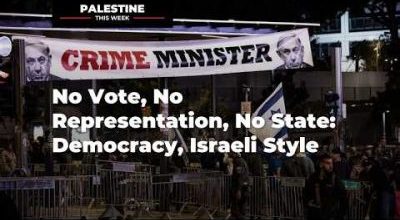
No Vote, No Representation, No State: Democracy, Israeli Style
or go to
Aletho News Archives – Video-Images
From the Archives
Sanctions, War and the Policy of Dual Containment
By SASAN FAYAZMANESH | March 17, 2008
It is now nearly three decades since the Unites States adopted the policy of dual containment of Iran and Iraq. While much has been written about the containment of Iraq, there has been very little in-depth analysis of this policy when it comes to Iran. In a book that is going to be released on March 31, 2008, entitled The United States and Iran: Sanctions, Wars and the Policy of Dual Containment (Routledge), I attempt to address this shortcoming by investigating when and why the US policy of containment of Iran came about, how it evolved, and where it stands today.[1] To the extent that Israel has been involved in US policy making, the study will also include the role that Israel has played in the containment of Iran. Also, since the fate of Iran has been inextricably linked to that of Iraq, occasionally the investigation will overlap with the containment of Iraq.
The policy of dual containment of Iran and Iraq originated during the Carter Administration, but it was not until the Clinton Administration that the expression “dual containment” became popular. … continue
Blog Roll
 Aletho News
- Europe’s Establishment Is Embracing War – and Losing Voters
- NATO chief advocates war of aggression
- No Vote, No Representation, No State: Democracy, Israeli Style
- Zionist Bought Senate Blocks Information About American Citizens Killed By Israel
- While Gaza dominates the UN, these are the people keeping it alive
- New Report: “Scholasticide and Genocide in Gaza: Assessment, Testimonies and Legal Analysis”
- ‘THAAD Delusion’: Iran war exposes US missile shield limits – The Atlantic
- Moscow issues warning to NATO over Russian exclave
- Yes, the Iran war has destroyed Trump’s presidency
- The fallacy of US delusions about Iran’s economic collapse
- If Americans Knew
- Mamdani releases plan to combat antisemitism and hate crimes in New York City
- Iran’s Revolutionary Guards Publish Letter to the American People
- DMFI launches $1 million ad campaign supporting Virginia’s Elaine Luria
- US Senate blocks resolution seeking report on Americans killed by Israel
- Israeli Attacks Kill Ten Palestinians in Gaza
- Massacre at Minab: The School That Became a Grave
- Israeli media: The IDF Shows It Doesn’t Turn a Blind Eye; It Actively Emboldens Settler Havoc
- As settlers ravage West Bank, Israeli forces kill 10 in Gaza – Daily Update
- New Report: “Scholasticide and Genocide in Gaza: Assessment, Testimonies and Legal Analysis”
- Ex-Biden officials are desperate for a Gaza scapegoat
- No Tricks Zone
- Green Energy Debacle: German Expert Professor Fritz Vahrenholt Warns Of Severe Economic And Social Consequences
- Two More Paleo Reconstructions Affirm Meters-Higher Sea Levels Across Ireland, Brazil 7000-6000 Years Ago
- New Study: Earth And Venus Surface Warmth Largely Explained By Convection And Lapse Rate, Not CO2 Or Radiation
- 2025 Nature Paper Claiming Worsening Global Drought Gets RETRACTED …Heavily Flawed
- New Study: ‘Global Drought Shows No Detectable Recent Acceleration Under Climate Warming’
- Economic Masterminds: German Socialists Suggest Taxing Productivity Gains Stemming From Using AI
- The South China Sea Has Not Been Cooperating With The Climate Change Narrative
- Energy Crisis: Germany Enters Heating Season With Historically Low Gas Reserve Fill Levels
- New Study: The Antarctic Ice Sheet Gained Mass From 2020-2024 Due To Staggering Snow And Ice Accumulation
- Study: Ocean Heating Rates From Thousands Of Years Ago ‘Dwarf’ Modern Ocean Heating Rates

