Iran has halted negotiations with the US over the ongoing Israeli offensive in Lebanon, moving to block maritime traffic through the Strait of Hormuz, Tasnim news agency has reported, citing sources.
Israel has intensified its bombing campaign in Lebanon in recent days, against what it describes as sites used by the Hezbollah militant group. The Israeli military has pushed deeper into the country’s south, seizing Beaufort Castle, a 900-year-old Crusader fortress and a key vantage point in the region.
While Iran made an end to the war in Lebanon a condition for its Pakistani-mediated negotiations with the US, the hostilities between Israel and Hezbollah have continued despite a supposed ceasefire announced in mid-April.
In response to the escalation in Lebanon, Tehran is stopping the “negotiations and exchange of messages through a mediator,” according to Tasnim.
Iran has reportedly demanded an “immediate cessation of hostilities” in the country, as well as in the Palestinian enclave of Gaza, making it a condition for continuing the contacts with the US.
Tehran and its regional allied groups have also expressed readiness to seal off the Strait of Hormuz, as well as to “activate other fronts,” including disrupting maritime traffic in the Bab al-Mandab Strait, according to the agency.
The Islamic Revolution Guards Corps (IRGC) says it has carried out a retaliatory strike against an air base used by the United States to launch a military attack on a telecommunications tower in southern Iran.
In a statement on Monday, the IRGC said its Aerospace Force struck and destroyed the air base from which the “aggressor US military” launched an attack on the telecom tower on Sirik Island in Iran’s southern province of Hormozgan.
“Following the aggression carried out hours ago by the aggressor US military against a communications tower on Sirik Island in Hormozgan Province, the fighters of the IRGC Aerospace Force targeted the air base from which the attack originated, and the predetermined targets were destroyed,” the statement added.
The IRGC Aerospace Force also issued a stern warning against further military action, emphasizing that any future attacks would prompt more severe responses.
“The IRGC Aerospace Force warns that if the aggression is repeated, the response will be completely different, and responsibility for its consequences will rest with the aggressor and child-killing US regime,” the statement said.
The developments came after the United States Central Command (CENTCOM) said late Sunday that it conducted “self-defense strikes” over the weekend against Iranian radar and drone command-and-control facilities in the city of Goruk and on Qeshm Island.
“The measured and deliberate strikes occurred on Saturday and Sunday,” CENTCOM said in response to what it called “aggressive Iranian actions that included the shootdown of a US MQ-1 drone that was operating over international waters.”
The IRGC Public Relations Department announced in a statement on Sunday that the elite force’s air defense units detected and successfully shot down an intruding MQ-1 Predator drone belonging to the “aggressor US military”, shortly after it encroached upon Iranian airspace over the Persian Gulf.
It added that the multi-mission and long-endurance remotely piloted aircraft was intercepted and destroyed as it entered the Iranian skies in the early hours of Sunday.
NATO’s proxy war in Ukraine is morphing into a direct EU-Russia war. And the war hawks in Brussels are further escalating by attacking civilians in the Donbas and Russia proper. The doves in the Kremlin are running out of options to keep their own hawks under wraps. As things stand now, an all-out EU-Russia war is not only a possible, but by now a likely scenario. But to what end?
For decades, prominent Jewish voices have wrestled privately with an uncomfortable question. Does aggressive Israeli government conduct expose diaspora Jewish communities to backlash they did not invite? In early March, Ezra Klein brought that question back into public view. Speaking with former Obama senior adviser Ben Rhodes on a podcast episode titled “The Great Lie of War”, the New York Times columnist warned that Israel’s central role in the joint U.S. assault on Iran could fuel a new wave of antisemitism.
The two men spent most of the interview discussing the strategic recklessness of the Iran operation where the United States and Israel launched an assault that killed Supreme Leader Ali Khamenei and much of his senior command. They examined the lack of congressional authorization, the absence of an endgame, the risk of a massive refugee crisis, and what they described as Israeli Prime Minister Netanyahu’s long-sought goal of drawing the United States into direct military confrontation with Iran.
The antisemitism remark came near the end of that segment, specifically as a follow-on to a discussion about Saudi ambivalence toward the war and the question of what Israel actually wants from the conflict. Klein’s exact words in the transcript were, “I’m not saying this is the biggest issue at this moment, but the centrality of Israel in the operation has raised some concerns for me about what this is going to mean for anti-Semitism. You see the amount of talk on the MAGA right, but elsewhere as well that, you know, Israel’s leverage over Donald Trump or that, you know, this is all just some kind of Israeli plot.”
Klein then noted that Netanyahu appeared to be gambling with Israel’s long term political standing in America and in the world at a time of “very, very sharply rising anti-Semitism,” expressing uncertainty about how it would all pan out. The New York Times columnist’s concern, stated plainly, was that Israel’s highly visible, central role in what many perceived as an unjustified war of aggression would fuel conspiracy theories rather than defuse them. His worry was that Netanyahu’s short-term tactical success, finally getting a U.S. president to strike Iran, risked long-term consequences for Jews, especially in the United States.
This dilemma is not new. Jewish billionaire George Soros articulated a similar concern over two decades ago. Soros has largely steered clear of public association with Jewish communal life and seldom appears at exclusively Jewish functions. That changed in 2003, when he took the stage at a New York City meeting hosted by the Jewish Funders Network. Questioned about the spread of antisemitism across Europe, Soros offered an unexpected diagnosis, laying blame at the feet of U.S. and Israeli policy. “There is a resurgence of anti-Semitism in Europe. The policies of the Bush administration and the Sharon administration contribute to that,” he stated. “If we change that direction, then anti-Semitism also will diminish. I can’t see how one could confront it directly.”
At the time, the reaction from Jewish leadership was furious. Elan Steinberg, who served as senior adviser to the World Jewish Congress after a stint as its executive director, fired back. “Let’s understand things clearly: Anti-Semitism is not caused by Jews; it’s caused by anti-Semites.” Abraham Foxman dismissed Soros’s words as “absolutely obscene.” The head of the ADL elaborated. “He buys into the stereotype. It’s a simplistic, counterproductive, biased and bigoted perception of what’s out there. It’s blaming the victim for all of Israel’s and the Jewish people’s ills.”
The Foxman and Steinberg responses reflected an orthodox position within Jewish communal leadership. Antisemitism, in this view, is a pathology of antisemites, and any attempt to link it to Israeli behavior constitutes victim blaming. Yet this position has always co-existed uneasily with a practical awareness that Israeli actions, particularly those perceived as disproportionate or aggressive, create public relations challenges for diaspora Jewish communities.
Klein’s 2026 remarks fall squarely within this tension. He was warning that Netanyahu’s gamble, making Israel so visibly central to an unpopular war, would hand ammunition to those who already believed such theories. Polling data suggests that Klein’s concerns about Israel’s political standing are well-founded. Gallup’s 2025 Annual World Affairs Survey documented a broader collapse in American sentiment toward Israel. Only 46% of Americans sympathized with Israelis, the lowest figure in 25 years of Gallup tracking. Among Democrats, 59% sympathized more with Palestinians—with only 21% sympathizing with Israelis—creating a nearly 3-to-1 ratio, the first time Palestinians had held such a commanding lead among members of a major U.S. party. A majority of Americans, and a record-high 76% of Democrats, supported an independent Palestinian state.
These trends predate the Iran strike and reflect cumulative damage from Israel’s conduct in Gaza. The joint United States and Israel operation against Iran, with Israel’s role so prominently featured, is unlikely to reverse this trajectory and will more than likely heighten Western populations’ hostility toward Israel. The polling numbers bear this out.
The Jewish People Policy Institute found that only 28% of strong liberal Jews support the war while 62% oppose it. Support climbs to 100% among strong conservative Jews. The partisan split is even more dramatic. Trump voters among American Jews back the war at 99%, while Harris voters divide 47% to 42%.
The picture among Americans generally looks very different. Pew Research found that 59% of Americans said the United States made the wrong decision in using military force and 61% disapprove of Trump’s handling of the conflict. An AP-NORC poll found that 59% of Americans believe U.S. military action has gone “too far,” while a Quinnipiac survey reported 74% oppose sending U.S. ground troops into Iran. The immediate unpopularity of the Iran war combined with Israel’s sullied image as a result of the Gaza genocide may explain why elements of American Jewry are embracing certain forms of controlled opposition to the Netanyahu regime, while stopping short of criticizing the entire Zionist project and its thoroughly Jewish nature.
It should be said that rational anti-Semitism is never about all Jews. Klein’s worry that “Jewish communities globally could be stained with guilt by association in the eyes of those who conflate the Israeli government with all Jews” should be seen as relying on the idea that anti-Semitism refers to complaints about “all Jews.” Most commonly complaints about Jews rely on understanding where the power of the Jewish community is directed, and in this case it’s obvious that the mainstream Jewish community in the U.S. and its powerful lobbying organizations (here and here) are entirely on board with the war. This is especially true in the Trump administration where the more conservative elements of the Jewish community, including Chabad Lubavitch, have increased their influence greatly.
It is simply that their vision [of conservative Jewish groups] for Jewish flourishing in America is radically at odds with the basic assumptions that have grounded American Jewish politics for much of the last century: chiefly, that Jewish interests are best served by the separation of religion and state; that American Jews are best protected through multiethnic, pluralistic coalitions rather than an alliance with the Christian majority; and that the invisibility of Jewish group interests is preferable to visible Jewish particularity.
Ezra Klein’s warnings about the centrality of Israel in the Iran war are a tacit admission that the Jewish establishment has lost its ability to operate from behind a veil. By leveraging control over U.S. administrations to initiate wars of choice, this power structure has forced a public reckoning that no amount of image-polishing can reverse. History has repeatedly shown that Jewish overreach eventually triggers an immune response from the host population.
We are currently in the midst of that reaction, and the path forward lies in the unapologetic identification and systematic dismantling of the Jewish influence networks that have compromised the highest levels of our government and financial institutions.
Of all the media around the world, there is no country’s media that is more controlled and infiltrated by its security state than the British media.
This is best underscored by a recent smear piece published in the Guardian by tech reporter Aisha Down, which slanders British journalist Bushra Shaikh, who has reported on the U.S./Israeli war on Iran from the ground.
The article alleges Bushra Shaikh “went on two state-sponsored tours of Iran this spring where she met senior officials and was ‘active’ in spreading the regime’s message” only to later admit to having no evidence to back up this claim, writing, “It is unclear whether Shaikh and others covered their own expenses or were paid to do the trip”.
The Entire Piece Is Based On A Blog Post Smear Piece
The entire smear is based on a “report”, in reality a blog post, by a shady outfit which claims to be a “fact-checking” organisation called “Factnameh”.
The “report” that the article entirely bases its claim on is in reality a blog post on Substack, which baselessly smears the few Western journalists who reported on the ground on the U.S./Israeli war crimes committed in Iran.
The blog post claims that Bushra Shaikh’s on-the-ground reporting on Iran “demonstrates how the (Iranian) state utilises these figures to manipulate Western algorithms” without giving a shred of evidence to back this up.
In the most bizarre section of the blog post, Factnameh claimed that Bushra Shaikh was engaging in “a highly calculated pattern of social media manipulation” because she tweeted about Iran, “almost exclusively during critical events, such as the intensification of military conflicts, ceasefires, and nationwide protests.”
In other words, she engaged in “social media manipulation” because she covered news topics while they were happening.
The blog post also claimed she achieved a high social media following “by routinely targeting controversial topics and engaging in confrontational discussions that drew attention to her videos” (in other words, using social media the same way anyone else would).
It also complained that “Her online narrative consistently framed Western media and elites as hypocritical and corrupt, while portraying Iran as a rational, restrained country merely defending itself against Western aggression” a.k.a the truth.
The rest of the blog post simply complained that her reporting on the ground in Iran did not match up with CIA/Mossad narratives, such as when “she filmed herself walking unveiled through the bazaars of Tabriz and Tajrish”, “visited an Armenian monastery in Isfahan” and reporting from protests which showed “that the crowds did not want war”.
In other words, debunking the cartoonish Western portrayal of Iran’s treatment of women and religious minorities, and showing that maybe Iranians aren’t cheering to have their country carpet bombed by the U.S. and Israel.
Inside ‘Factnameh’
Factnameh, the shady organisation that the Guardian based its article on, was created by a Canadian organization called ASL19.
ASL19, according to the outlet theVerge, was created in 2009 – by Ali Karimzadeh Bangi, who came from the University of Toronto’s Citizen Lab project – in order to “promote a free Iranian internet” during the “Green Revolution” protests in Iran of 2009.
At the time, the Verge noted, “the US, Canada, and private donors were offering tens of millions of dollars in grant money for anyone who could build digital tools and give Iranians a reliable way to access them”.
The outlet also added that “Bangi’s connections at the University of Toronto’s Munk School of Global Affairs gave him an early line on (U.S. and Canadian) government-funded projects like the multimillion-dollar Digital Public Square initiative, which funded digital tools for political opposition groups around the world.”
Along with being a tool of Western government to destabilise Iran, ASL19 has been plagued with allegations of sexual assault within the organisation.
Ali Karimzadeh Bangi, the Verge noted, “appeared in court on charges of sexual assault and forcible imprisonment” and was “forced to cut ties with ASL19 entirely”.
The outlet added, “In early 2009, separate charges of sexual assault were filed against Bangi, although they were withdrawn before reaching court. The Verge has also learned of at least one separate incident in which Bangi used a nondisclosure agreement to silence a staff member in the wake of their romantic relationship”.
According to the article, written in 2018, “Many former employees of ASL19 see the charges as part of a larger pattern.”
As for Factnameh, the subsidiary of ASL19, it is edited by Farhad Souzanchi, who has baselessly claimed that Iran was behind protests against the genocide in Gaza on college campuses, claiming that “Over the years, Iranian media, officials, and the country’s Supreme Leader himself have repeatedly tried to influence international public opinion against Israel”.
Factnameh has published lies to cover up Mossad infiltration in Iran. In one blog post, the outfit claimed that a New York Times report which heavily implied Mossad infiltration of the protests in Iran in January does not make “any reference to the January 8th and 9th protests being a Mossad plan to encourage Trump to attack Iran” adding, “Iran’s state media has repeatedly misrepresented international news coverage and reports”.
In reality, the article heavily implied that there was Mossad involvement in the January protests, without explicitly saying it, writing:
As the United States and Israel prepared to go to war with Iran, the head of Mossad, Israel’s foreign intelligence service, went to Prime Minister Benjamin Netanyahu with a plan.
Within days of the war’s beginning, said David Barnea, the Mossad chief, his service would likely be able to galvanize the Iranian opposition — igniting riots and other acts of rebellion that could even lead to the collapse of Iran’s government. Mr. Barnea also presented the proposal to senior Trump administration officials during a visit to Washington in mid-January.
Mr. Netanyahu adopted the plan. Despite doubts about its viability among senior American officials and some officials in other Israeli intelligence agencies, both he and President Trump seemed to embrace an optimistic outlook. Killing Iran’s leaders at the outset of the conflict, followed by a series of intelligence operations intended to encourage regime change, they thought, could lead to a mass uprising that might bring about a swift end to the war.
The Israeli newspaper Ynet, however, directly confirmed that the Mossad had infiltrated the protests, writing, “David Barnea was appointed head of the Mossad in 2021. Iran had been the organization’s main arena of operations for years. Barnea ordered a dramatic change in an area that had been marginal until then – driving influence within the general Iranian public. Under him, this area became central to the campaign against Iran … faced with a regime that is all poison, Israel has set up its own poison machine. The organization began four years ago and reached operational maturity two and a half years ago. This is a weapons system that, if activated at full power, could be deadly far beyond the boundaries of the social network … in January of this year, tens of thousands of Iranians took to the streets, at their own pace. The enormous work that Israel had put in was behind the demonstrations”. (Emphasis: Mine)
Factnameh has even gone as far as to defend U.S/Israeli war crimes against Iranian civilians.
In one blog post, the outfit claimed that “In Iran, mosques and other religious sites function not only as places of worship but also as components of the country’s security infrastructure. Many host local bases of the Basij, a paramilitary force operating under the IRGC, with numerous neighbourhood units co-located in or around these mosques. This overlap embeds security and military activity within civilian neighbourhoods, effectively extending the battlefield into residential areas. As a result, when aerial strikes target elements of the country’s security apparatus, they often occur in densely populated areas, increasing the risk to surrounding civilians”, blatant propaganda to justify U.S./Israeli bombings of civilians.
The Guardian Wants Bushra Shaikh Investigated By The Security State
The real purpose of the Guardian hit piece becomes clear when it writes, “Earlier this year, Shaikh’s tours sparked criticism from Iranian digital rights activists, who noticed she appeared to have access to the internet that ordinary people did not, suggesting her trips were at the invitation of the regime. Iranian activists, some affiliated with the Women, Life, Freedom movement, circulated an online petition suggesting Shaikh should be investigated for sanctions violations.” (Emphasis:Mine).
To back up calls for Bushra Shaikh to be investigated by the British security state, the Guardianlinks to a petition started by zionist Nicholas Lissack which says, “We demand that the UK Government, OFSI, HMRC, and FCDO immediately investigate UK citizen Bushra Shaikh for potential breaches of the Iran (Sanctions) Regulations 2023 and the Foreign Influence Registration Scheme (FIRS).”
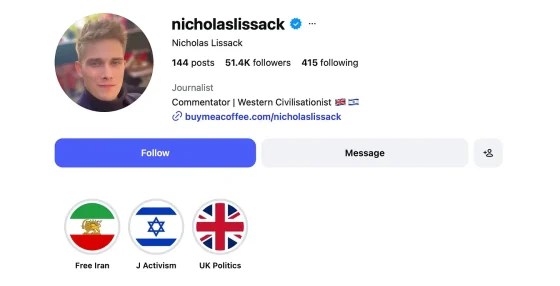
Nicholas Lissack, a self-described “Western Civilisationist” with a British and Israeli flag in his Instagram bio, has publicly agitated for a war with Iran to install the son of the U.S. backed Shah of Iran, posting only a day ago:
This is it. Our last chance to crush the terrorist Mullahs and liberate Iran.
President Trump: Choose humanity. Free the Iranian people from this Islamist nightmare and enter history as a hero.
Abandon them—and be remembered as its greatest traitor.
Make the call.
Free Iran. King Reza Pahlavi. Javid Shah!
They’ve repeatedly broken the ceasefire, rejected nuclear negotiations, and tried to assassinate your daughter Ivanka.
Honour your promise to the tens of thousands of slaughtered Iranians: Free Iran now.
Pictured Above: Instagram profile of Nicholas Lissack, who started the petition cited in the Guardian.
Yet again, instead of investigating actual power, the MI6 media in the UK instead spends its time slandering an anti-war reporter and attempting to get her investigated.
An Iranian ballistic missile attack on a Kuwaiti air base has wounded several American military personnel and caused serious damage to two US MQ-9 Reaper drones, according to a new report.
The American news outlet Bloomberg, citing an informed source, said in a report published on Saturday that the attack on the Ali Al Salem Air Base resulted in minor injuries to approximately five individuals, including US service members and contractors.
It also caused significant damage to two MQ-9 Reaper drones, with one reportedly destroyed and another heavily damaged. Each drone is valued at around $30 million.
According to Bloomberg, Kuwaiti air defences intercepted an Iranian Fateh-110 missile before it reached its intended target. However, debris from the intercepted projectile fell onto the US-operated Ali Al Salem Air Base, causing the injuries and damage.
The latest development comes amid heightened tensions between Washington and Tehran.
On Thursday, US Central Command (CENTCOM) claimed that Iran had launched a missile toward Kuwait, describing the action as a “gross violation of the ceasefire.”
In a statement issued later in the day, Iran’s Islamic Revolution Guards Corps (IRGC) said it had deliberately targeted the US base, noting that it had been used to launch an earlier American attack.
The IRGC went on to say that US forces had conducted a strike using aerial projectiles against a location near Bandar Abbas airport earlier that morning, describing its missile attack as a warning to the US.
It also vowed that any future acts of aggression would be met with a stronger response, stressing that responsibility for any escalation would rest with the party initiating hostile actions.
The US and Israel started an aggression against Iran on February 28, some eight months after they carried out unprovoked attacks on the country.
Iran began to swiftly retaliate against the strikes by launching a barrage of missiles and drone attacks on the Israeli-occupied territories as well as on US bases in regional countries.
On April 8, forty days into the war, a Pakistan-brokered temporary ceasefire between Iran and the US took effect.
Negotiations ensued in the Pakistani capital, Islamabad, but stopped short of an agreement amid Washington’s maximalist demands and insistence on unreasonable positions.
Fars News Agency cited informed sources rejecting recent claims by US President Donald Trump regarding a potential agreement with Iran, saying his remarks are “a mixture of truths and lies” aimed at portraying a “fabricated victory.”
According to the report, the proposed agreement, drafted under the framework of “commitment in exchange for commitment,” is currently in the final stages of approval in Iran, though no final decision has yet been made.
The sources said Trump, whom they said is unable to withdraw from the agreement process, made statements that contradict the actual provisions of the text while simultaneously claiming that the US would immediately end the blockade against Iran.
Distortions in Trump’s remarks
The report said Trump falsely claimed that Iran would be required to open the Strait of Hormuz without imposing transit fees. According to the sources, no such clause exists in the agreement.
Iran, they said, has stressed that once the blockade is lifted, the strait would reopen according to arrangements determined by Tehran, including possible ship monitoring, inspections, maritime services, and security measures. The report added that Iran is currently preparing the infrastructure for implementing those procedures.
Fars also dismissed Trump’s claim that Iran would dismantle or destroy its nuclear materials, saying informed sources confirmed that the memorandum of understanding contains no such provision and that the allegation is “entirely baseless.”
Key provisions omitted
According to the report, one of the most important terms ignored in Trump’s statements is the immediate payment of $12 billion from frozen Iranian assets.
The sources said the agreement requires the payment to be carried out immediately and stipulates that Iran will not proceed to further stages of negotiations until the transfer is completed. Failure to fulfill this obligation would constitute a violation of US commitments under the deal, the report added.
The report also stated that another key component of the proposed agreement involves establishing a full ceasefire in Lebanon in line with Hezbollah’s position.
According to the sources, only after these issues are resolved would Iran move to the next phase of talks concerning the lifting of all sanctions and the nuclear issue, in accordance with Tehran’s “red lines.”
Iranian officials also stressed that any final agreement would be based on the principles and red lines of the Islamic Republic and formulated with “complete distrust” toward the US, ensuring that any breach of commitments would trigger an immediate reciprocal response.
Iran’s Islamic Revolution Guard Corps (IRGC) issued a stern warning on Thursday following a US military violation and aggression near the Bandar Abbas Airport, stressing that any further aggression “will not go unanswered.”
In a statement released by its public relations office, the IRGC said the US military launched aerial projectiles at a location on the outskirts of Bandar Abbas before dawn. It added that Iran responded by targeting the US air base from which the attack originated at approximately 4:50 am.
The operation comes as a “serious warning,” the IRGC said, adding that the response was intended to demonstrate that any aggression against Iran would be met with retaliation, warning that any repeat attack would provoke “a more decisive response.”
“The responsibility for the consequences lies with the aggressor,” the statement added.
At the same time, the Kuwaiti military confirmed that “air defense systems are confronting missile and drone attacks.”
During the war, Iran repeatedly warned that any US military base used to launch attacks against its territory would be considered a legitimate target, stressing that while it maintains friendly relations with neighboring countries, it would not hesitate to strike the source of any aggression.
US attacks Bandar Abbas
This comes after the US military targeted the “scorched earth” areas surrounding the city of Bandar Abbas, as explosions were heard across the area without any reported casualties or material damage, according to an Iranian military source cited by Tasnim News Agency.
Shortly after, Iranian media outlets reported hearing three explosions east of Bandar Abbas, with air defense systems activated.
Meanwhile, Reuters quoted a US official as saying that the US military had carried out fresh strikes on an Iranian military site near the Strait of Hormuz and allegedly intercepted several Iranian drones that were deemed “a threat to US forces.”
Similarly, on Monday, the US launched an aggression on alleged missile sites in southern Iran and targeted boats allegedly attempting to lay naval mines in the area, according to the US Central Command.
US tanker forced to retreat from Hormuz following Iranian intervention
In a related escalation, a US oil tanker attempted to cross the Strait of Hormuz overnight after disabling its radar system, but was forced to retreat after the Iranian navy responded swiftly and opened fire on the vessel, Tasnim reported, citing an Iranian military source.
Washington’s continued violations have raised fresh concerns over the stability of the current ceasefire and prospects for a broader regional agreement, with the US yet again bombing Iran in the middle of talks.
Just yesterday, Tasnim reported that progress has been made in talks, particularly on the release of Iran’s frozen assets in Qatar. However, reaching a final formulation of the memorandum of understanding between Washington and Tehran requires resolving outstanding differences, as per the same sources.
They emphasized that the mechanism for announcing the memorandum must be joint, warning that any unilateral announcement by the United States could be “not entirely accurate.”
The sources further indicated that, following the implementation of this initial phase, a 60-day negotiation period, extendable, would be allocated to address Iran’s nuclear file.
The US military aggression and economic strangulation ended in a ceasefire, not because of American goodwill, but because the war objectives failed and the aggression backfired.
This outcome reflects a new strategic reality that emerged during the war itself.
Facing the biggest military assault in its history, with Western and Arab countries complicit in arming and supporting the enemy across multiple fronts, Iran not only avoided strategic collapse but imposed a new balance of power on the battlefield.
Against overwhelming odds and coordinated pressure, Iranian resistance transformed what was meant to be a war of submission into a demonstration of enduring national strength.
What has emerged now is far more than the end of a military aggression against the Islamic Republic. It is the failure of a campaign designed to weaken Iran, isolate it from other nations, drain its economic strength, and ultimately force it into strategic retreat.
Military lessons of the war
In terms of the military, the most telling and self-evident lesson from the war is that the idea of “shaping Iran to crumble quickly” was misguided from the outset. Even after multiple claims by the enemy that Iran’s missile infrastructure, command centers, and launch capabilities had been destroyed, Iran continued its regular military activity, hitting the enemy at will.
Missile and drone operations were carried out multiple times every day during the war. The continuity of launch waves will one day become one of the most compelling pieces of evidence that the backbone of Iran’s strategic missile program has remained completely intact.
This revealed a critical wrong assumption made by both Americans and Zionists: the true extent of Iran’s underground military infrastructure, its depth, dispersion, and survivability.
Much of Iran’s arsenal of rockets, along with the necessary underground launching, storage, and escape facilities, is located in hardened bunker networks built over decades to resist common aerial attacks. Some of the most effective US bunker-penetration munitions are thought to be severely restricted by these heavily fortified facilities.
Operational philosophy: Restraint as strength
Also significant was the implementation of Iran’s operational philosophy during the war. Data has shown that Iran was not as aggressive in its use of its most advanced missiles as is often believed. Several systems discussed for years in military circles were either underutilized or not used at all. This has reinforced assessments that Iran deliberately relied more heavily on older missile stockpiles while carefully managing the timing and intensity of launches.
This has led to reports that Iran deliberately kept some of its strategic missiles in reserve while using older arms with calibrated firing patterns. This approach enabled Tehran to maintain its escalation edge while simultaneously proving sustainability.
Moreover, recent reports and analyses of military forces in the region suggest that systems for launching newer solid-fuel ballistic missiles with dual-stage capsules were not widely deployed, though they could greatly boost launch density in future operations.
Iran mounted extended attacks without fully testing its more sophisticated launch architecture. The size and intensity of future attacks could be far greater than anything seen so far.
The naval dimension: Anti-access and area denial
The naval dimension of the war also revealed a major shift in regional deterrence equations. US carrier groups operated well off Iranian waters on opposite shores, a remarkable caution given the overwhelming power of the American navy.
It has become clear that as Iran has matured its anti-access and area-denial (A2/AD) doctrine, derived from the use of anti-ship ballistic missiles, long-range cruise weapons, drones, and multi-tiered coastal defense systems, the country has imposed a new caution on American operational decisions.
The Khalij Fars and Hormuz missiles, along with newer generations of anti-ship missiles, pose a serious threat to large naval assets in the confined waters of the Persian Gulf and the Gulf of Oman. Notably, these systems were not used during the recent war, indicating that Iran kept its deterrent capacity largely unused – yet visible enough to alter enemy behavior. This restraint sends its own message: what remains in the arsenal is far more capable than what was shown.
Strategic failure: The unraveling of the pressure campaign
Strategically, the most significant event of the third imposed war has been the complete failure of the original political goal behind the military pressure campaign. What its planners envisioned was a war that would trigger internal instability within Iran’s borders, fracture its command structure, undermine its regional cooperation, and ultimately isolate Tehran as a matter of strategy. Prolonged military pressure, they believed, would achieve what decades of illegal and crippling sanctions could not.
Not a single one of these goals was realized. The Iranian state machinery was not fractured. Continuity of command was maintained. Regional ally networks remained not only intact but operationally effective. In fact, the war produced the opposite effect on multiple fronts.
The war reinforced Iran’s broader strategic narrative across the region that military pressure alone cannot force Tehran into capitulation.
Diplomatic implications: A unified front that never formed
The results carry significant implications for diplomacy as well. Perhaps the most obvious fact to emerge from the war is that Iran successfully thwarted the establishment of any unified international body arrayed against it.
Despite a heavy Western political and military campaign coordinated with Israeli objectives, large portions of the Global South refused to align with the escalation drive against Tehran.
Several regional governments actively worked to defuse the crisis rather than escalate it. Major powers like China and Russia remained opposed to wider international isolation measures. Even among Western allies, growing concerns emerged regarding the risks of uncontrolled regional escalation, energy disruption, and maritime insecurity.
This deep division inhibited Washington from fashioning the kind of new global pressure architecture against Iran that it has typically pursued during past crises – from nuclear non-proliferation to regional security frameworks. The coalition that was meant to isolate Iran found itself isolated instead.
Economic dimension: Sanctions undermined, energy leverage preserved
The economic goal of the unprovoked war was another expected outcome that was not met. During the war, the economic disruption that many external observers had anticipated became totally muted. Iran continued exporting energy and maintaining its internal markets and logistics throughout the war, despite pressure on infrastructure and the weight of sanctions.
Remarkably, the US-Israeli aggression and Iranian retaliation revealed the fragile nature of the global energy system when it comes to instability involving Iran. The mere threat of escalation at the Strait of Hormuz triggered an immediate reaction from the international community, precisely because of the waterway’s critical importance to global oil supply.
Tehran’s inability to be isolated without sparking international ramifications was reaffirmed by the facts, not least of which are Iran’s deep ties to the region’s energy landscape and its central role in maritime security.
Industrial adaptation: War as a catalyst for expansion
The swift pace of the industrial adaptation process was another crucial factor in the recent war. Based on domestic sources and analyses from military-affiliated institutions, the rate of missile production had already dramatically increased after the 12-day war in June last year, and the recent war only accelerated and extended it even further.
Iran possesses a widespread defense industry, and even if aggressors succeed in targeting its production facilities, these are interdependent in such a way that they can localize supply chains and establish underground production lines.
Far from halting production and launch capabilities, the latest war has spurred strategic investments in survivability, redundancy, and high-volume output.
Political triumph: The narrative that collapsed
Among the more significant political considerations, this war represents a significant triumph for Iran, given the failure of the central narrative that Tel Aviv and Washington had been aggressively pushing for decades.
Their premise was that continued military, economic, and diplomatic pressure would eventually bring Tehran to the end of its rope, forcing it to “sit at the table” to negotiate strategic concessions.
Instead, the war proved to be another confirmation of the reverse: Iran under pressure continues to function, possesses the capacity to retaliate, and maintains domestic and governmental strength and unity. Most importantly, it has survived the encounter with its ability to influence regional affairs completely intact.
This is not to suggest that Iran was unaffected or bore no costs. Wars come with severe costs. But strategic results are not determined solely by the scale of damage. They are determined by the ultimate success or failure of political and military objectives.
The new regional reality
In this respect, there is growing evidence that Iran’s opponents found themselves baffled by the outcome. A campaign designed to diminish Iranian deterrence ended up confirming much of it.
A policy aimed at isolating Iran was met by a pressure strategy that ultimately promoted de-escalation with Tehran and prevented tensions from proliferating across the region.
What emerged instead were increased challenges and the risk of direct confrontation with a long-established regional power armed with deep missile stockpiles, rugged supply chains, and a mature asymmetric warfare doctrine.
The lessons that have become clear on the battlefield, in regional negotiations, and in energy calculations leave Iran poised to enter the post-war era with strategic gains and enhanced leverage.
The vice secretary of Iran’s Supreme National Security Council has denounced hostile measures by the United States and the Israeli regime as the root cause of insecurity in West Asia.
Ali Bagheri-Kani made the remarks in a Wednesday meeting with head of the International Security Division at Switzerland’s Federal Department of Foreign Affairs, Gabriel Luchinger, on the sidelines of the 14th International Meeting of High Representatives Responsible for Security Issues in the Russian capital, Moscow.
Bagheri-Kani said the root cause of insecurity and instability in the region is the Israeli regime’s and the United States’ aggressive measures, emphasizing they will have no role in its future.
For his part, Luchinger expressed his deep condolences over the assassination of former secretary of Iran’s Supreme National Security Council Ali Larijani in an Israeli airstrike on March 17, stating that Bern is prepared to cooperate with Tehran to resolve regional and international issues.
The two officials further discussed and exchanged viewpoints on regional and international developments, particularly the fallout of the US-Israeli war of aggression against the Islamic Republic of Iran.
Earlier, Bagheri-Kani met and held talks with Iraqi National Security Adviser Qasim al- Araji.
Bagheri-Kani arrived in Moscow on Tuesday to take part in the international security conference. Besides giving a speech at the event, the Iranian official is expected to meet with several Russian political and security leaders.
The International Security Forum is taking place in Moscow from May 26 to 29, aimed at fostering practical collaboration among nations and facilitating a non-political, thorough dialogue on urgent security challenges.
The forum also features the 14th International Meeting of High Representatives Responsible for Security Issues, a variety of thematic sessions (academic conferences, roundtables, briefings, presentations), as well as bilateral and multilateral meetings and exhibits that display specific projects from relevant Russian agencies and organizations.
Almost immediately after the proxy war erupted, ISIS-tier footage of the torture and murder of Russians in Ukrainian custody emerged.
On July 6th, the New York Times published an astonishing investigation: In Ukraine, Killings of Surrendering Russians Divide an American-Led Unit. The article documents in grim detail how Chosen Company, an international volunteer battalion for Kiev, routinely executes Russian prisoners of war. It is the very first mainstream admission that this practice – a brazen breach of the Geneva Conventions, and a grave war crime – is widespread among Ukraine’s fighters, both foreign and homegrown. … continue
This site is provided as a research and reference tool. Although we make every reasonable effort to ensure that the information and data provided at this site are useful, accurate, and current, we cannot guarantee that the information and data provided here will be error-free. By using this site, you assume all responsibility for and risk arising from your use of and reliance upon the contents of this site.
This site and the information available through it do not, and are not intended to constitute legal advice. Should you require legal advice, you should consult your own attorney.
Nothing within this site or linked to by this site constitutes investment advice or medical advice.
Materials accessible from or added to this site by third parties, such as comments posted, are strictly the responsibility of the third party who added such materials or made them accessible and we neither endorse nor undertake to control, monitor, edit or assume responsibility for any such third-party material.
The posting of stories, commentaries, reports, documents and links (embedded or otherwise) on this site does not in any way, shape or form, implied or otherwise, necessarily express or suggest endorsement or support of any of such posted material or parts therein.
The word “alleged” is deemed to occur before the word “fraud.” Since the rule of law still applies. To peasants, at least.
Fair Use
This site contains copyrighted material the use of which has not always been specifically authorized by the copyright owner. We are making such material available in our efforts to advance understanding of environmental, political, human rights, economic, democracy, scientific, and social justice issues, etc. We believe this constitutes a ‘fair use’ of any such copyrighted material as provided for in section 107 of the US Copyright Law. In accordance with Title 17 U.S.C. Section 107, the material on this site is distributed without profit to those who have expressed a prior interest in receiving the included information for research and educational purposes. For more info go to: http://www.law.cornell.edu/uscode/17/107.shtml. If you wish to use copyrighted material from this site for purposes of your own that go beyond ‘fair use’, you must obtain permission from the copyright owner.
DMCA Contact
This is information for anyone that wishes to challenge our “fair use” of copyrighted material.
If you are a legal copyright holder or a designated agent for such and you believe that content residing on or accessible through our website infringes a copyright and falls outside the boundaries of “Fair Use”, please send a notice of infringement by contacting atheonews@gmail.com.
We will respond and take necessary action immediately.
If notice is given of an alleged copyright violation we will act expeditiously to remove or disable access to the material(s) in question.
All 3rd party material posted on this website is copyright the respective owners / authors. Aletho News makes no claim of copyright on such material.