Iran sets one-month deadline for end to US-Israeli war, blockade: Report
The Cradle | May 3, 2026
The Islamic Republic has set a one-month deadline for an agreement on the Strait of Hormuz and a full end to the wars on both Iran and Lebanon, sources told US media outlet Axios on 3 May.
Iran “set a one-month deadline for negotiations on a deal to reopen the Strait of Hormuz, end the US naval blockade and permanently end the war in Iran and in Lebanon,” the sources said.
“Per the Iranian proposal, only after such a deal is reached, another month of negotiations would be launched to try and reach a deal on the nuclear program,” they added.
On the same day, the Islamic Revolutionary Guard Corps (IRGC) Intelligence Organization said in a social media post: “Iran sets Pentagon a blockade deadline. China, Russia, Europe shift tone against Washington. Trump’s passive letter to Congress. Acceptance of Iran’s negotiating terms. There is only one way to read this: Trump must choose between ‘an impossible military operation or a bad deal with the Islamic Republic of Iran.’ The room for US decision-making has narrowed.”
Iran had previously proposed setting nuclear issues aside and negotiating a ceasefire and the reopening of the Strait of Hormuz. Trump said on Friday that he was dissatisfied with Tehran’s proposal before saying he would review it on a flight to Miami.
“I’m looking at it. I’ll let you know about it later… They told me about the concept of the deal. They’re going to give me the exact wording now.”
Shortly after the president said he “can’t imagine that it would be acceptable,” adding that Iran “has not yet paid a big enough price for what they have done to Humanity, and the World, over the last 47 years.”
He also said he would resume bombing if Tehran “misbehaves.”
The US president is required to end his war within 60 days or request approval from the US Congress to continue it for another 30 days on grounds of “unavoidable military necessity” for the safety of the military. Trump formally notified Congress of the conflict 48 hours later, making Friday, 1 May, the deadline to request a 30-day extension from Congress or terminate the war.
Trump has claimed the ceasefire has terminated hostilities and that this has rendered the deadline irrelevant and inapplicable. Secretary of Defense Pete Hegseth also claimed that the 60-day clock pauses or stops during a ceasefire.
The US has maintained an illegal blockade on Iranian ports throughout the ceasefire, while also imposing new sanctions. Tehran has repeatedly warned that it may take further military action, following its recent retaliation to the seizure of its vessels by Washington.
According to a report by Israel’s Channel 12, Tel Aviv is “bracing” itself for the collapse of negotiations between Washington and Tehran and the resumption of all-out war against the Islamic Republic.
Axios reported on 29 April that Trump was to be briefed on a series of options for renewed attacks against Iran.
US Central Command (CENTCOM) has readied a “short and powerful” wave of strikes on Iran, “likely including infrastructure targets – in hopes of breaking the negotiating deadlock,” the report claimed.
Tehran has vowed a “crushing response” to any renewed aggression.
At the edge of the Strait: A superpower in a narrow sea
By Mahmood Rehman | Al Mayadeen | May 3, 2026
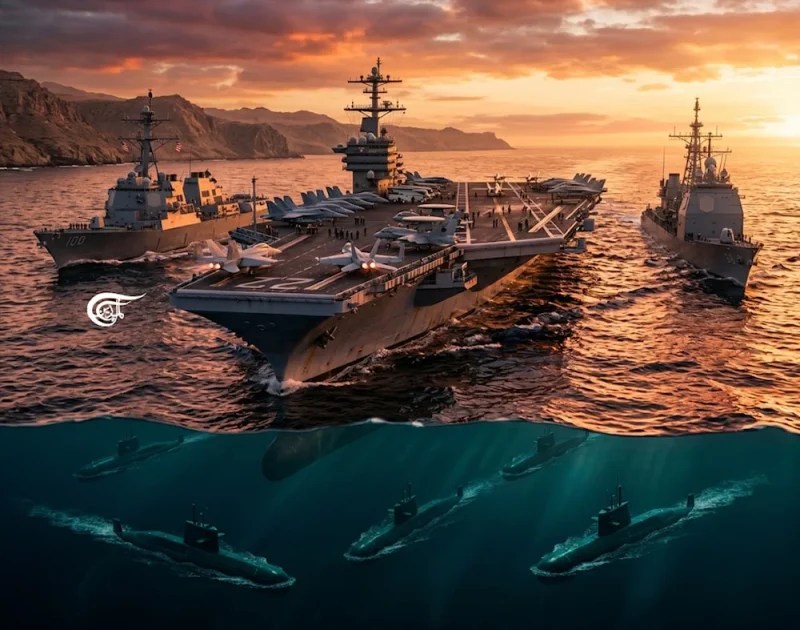
I have spent a good part of my professional life at sea, and I say this without hesitation: there are few waterways in the world as unforgiving, as deceptive, and as strategically consequential as the Strait of Hormuz. It is not just a stretch of water; it is a pressure point of the global economy. When tension rises here, the entire world feels it—from fuel pumps in America to kitchen tables in South Asia.
What we are witnessing today is not merely a regional conflict. It is a strategic impasse in one of the most sensitive maritime corridors on earth. The United States has deployed significant naval power into the region. Carrier strike groups centred around the USS Dwight D. Eisenhower, USS Theodore Roosevelt, and USS Gerald R. Ford are operating alongside cruisers, destroyers, frigates and replenishment tankers. Along with them are nuclear-powered guided missile submarines of the Ohio-class submarine type, carrying formidable strike capability. With over two hundred and fifty aircraft embarked across these platforms, the sheer scale of deployment is impressive by any standard.
Yet, having commanded ships myself, I know that numbers and tonnage do not always translate into control, especially in confined, contested waters.
The stated objective appears straightforward: enforce a maritime blockade of Iranian ports and ensure unhindered passage through the Strait of Hormuz. But here lies the irony. The Strait, by most accounts, was already open before the escalation. What has changed is not the physical state of the waterway, but the political and military environment surrounding it.
Iran’s recent offer has placed Washington in a difficult position. It has indicated willingness to ensure the Strait remains open, on its own terms, provided the United States lifts the blockade and shows flexibility on the timing of nuclear negotiations. Accepting such an offer risks appearing to concede under pressure. Rejecting it prolongs a costly and increasingly unpopular confrontation.
And cost is now becoming the defining factor.
Fuel prices have risen. The ripple effect is visible in everyday commodities. The American public, which never truly supported this war, is beginning to feel the burden directly. Wars fought thousands of miles away eventually find their way into domestic politics, and this one is no exception. The narrative of a swift and decisive operation has long faded. What remains is a grinding reality.
There is also a growing perception (rightly or wrongly) that this was not entirely America’s war to begin with. Many point towards the long-standing position of Benjamin Netanyahu, who has, for decades, articulated a hardline stance against Iran. Previous US administrations, including those led by Barack Obama, Joe Biden, George W. Bush and Bill Clinton, exercised caution in this regard. They understood, perhaps better than most, that Iran is not an easy adversary.
And this is where, in my professional judgement, the conversation must turn towards Iran’s maritime capability, often underestimated, sometimes misunderstood, but very real.
Iran does not seek to match the United States ship for ship. Instead, it has built what we in naval terms would call an asymmetric maritime strategy. Its so-called “mosquito fleet” consists of numerous fast attack craft — small, agile, heavily armed platforms that can swarm larger vessels. Operating from concealed bases along the coastline and from island positions, these units are difficult to detect and even harder to neutralize in large numbers.
Then there are the Ghadir-class submarines, small, quiet, and ideally suited for the shallow waters of the Gulf. These are not platforms designed for long blue-water patrols; they are designed for ambush. In confined waters, that makes all the difference.
Iran unveils new control measures over Strait of Hormuz transit
Al Mayadeen | May 2, 2026
Senior Iranian lawmakers have unveiled a proposed plan to regulate maritime traffic through the Strait of Hormuz, introducing new restrictions on certain vessels and a licensing system that would require ships to obtain authorization from Tehran.
Ali Nikzad, Deputy Speaker of Iran’s parliament, detailed that the initiative includes a 12-point framework aimed at managing transit through one of the world’s most critical oil shipping routes. Under the proposal, vessels linked to “Israel” would be barred from passing through the Strait at all times, while ships from “hostile countries” would be denied transit unless they pay unspecified war reparations.
Nikzad added that all other vessels would be required to operate under a newly established legal framework, obtaining official licenses and authorization from Iranian authorities before entering the waterway. He emphasized that the plan would be implemented “in accordance with international law” and with consideration for the rights of neighboring states, while asserting that Iran would not relinquish what it views as its sovereign rights.
The deputy speaker described the proposed administration of the Strait as comparable in significance to Iran’s historic oil nationalization efforts, signaling the strategic importance Tehran places on the initiative.
Control of the Strait of Hormuz seen as public demand in Iran
Further details were provided by Mohammad Reza Rezaei, head of the Iranian Parliament’s Reconstruction Committee, who outlined how revenues generated under the plan would be allocated. He said that 30% of fees collected from passing vessels would be directed toward strengthening military infrastructure, while the remaining 70% would fund economic development projects and public welfare initiatives.
Rezaei also emphasized the political framing of the proposal, stating that managing the Strait of Hormuz is “more important than obtaining nuclear weapons” and describing control over the waterway as a demand of the Iranian public. He reiterated that Iran would not forgo its right to administer and oversee the Strait.
“Exercising control and administration over the Strait of Hormuz is a demand of the Iranian people, and Iran will not relinquish this right,” he stressed.
War escalation and regional impact
Against the backdrop of escalating regional tensions, the situation in the Strait of Hormuz has escalated following a US-Israeli aggression on Iran, triggering a forceful Iranian response.
The United States has intensified its military and maritime aggression through sanctions enforcement, ship seizures, and a broader blockade targeting Iranian ports and vessels, moves widely viewed by Tehran as unlawful and destabilizing.
In response, Iran has exercised its geographic leverage over the strait to control the maritime traffic, prioritizing vessels not linked to the hostile aggression. The standoff has disrupted one of the world’s most critical energy corridors, through which roughly a fifth of global oil and gas supplies pass, fueling volatility in global markets while limited shipping continues under heightened restrictions.
Trump Taps Israel Lobbyist From Mossad Cutout FDD To Join Iran Negotiations
The Dissident | May 1, 2026
Journalist Alex Marquardt reported recently that , “Amid stalled talks with Iran, President Donald Trump’s negotiators are adding a new member to the team from an outside Washington lobbying group” adding, “Nick Stewart, the Managing Director of Advocacy at FDD Action, the lobbying side of the Foundation for Defense of Democracies think tank, has joined the office of Steve Witkoff, the Special Envoy for Peace Missions”.
This means- as I will demonstrate- that a literal Israel lobbyist is now joining the team negotiating with Iran on behalf of the Trump administration.
The think tank, initially founded by the journalist Clifford May, was initially called “EMET,” the Hebrew word for truth, and was established in order to “provide education to enhance Israel’s image in North America”.
John Judis at the Carnegie Endowment for International Peace documented in 2015 that , “On April 24, 2001, three major pro-Israel donors incorporated an organization called EMET (Hebrew for “truth’). In an application to the Internal Revenue Service for tax-exempt status, (Clifford) May explained that the group ‘was to provide education to enhance Israel’s image in North America and the public’s understanding of issues affecting Israeli-Arab relations.’ But in the wake of the Sept. 11 attacks, May broadened the group’s mission and changed its name to the Foundation for Defense of Democracies. As he explained in a supplement to the IRS, the group’s board of directors decided to focus on ‘develop[ing] educational materials on the eradication of terrorism everywhere in the world.’”
He added that the funding for FDD comes primarily from U.S.-based Zionist donors, writing, “FDD’s chief funders have been drawn almost entirely from American Jews who have a long history of funding pro-Israel organizations. They include Bernard Marcus, the co-founder of Home Depot, whiskey heirs Samuel and Edgar Bronfman, gambling mogul Sheldon Adelson, heiress Lynn Schusterman, Wall Street speculators Michael Steinhardt and Paul Singer, and Leonard Abramson, founder of U.S. Healthcare.”
He also noted that, similar to AIPAC and other Israel lobby groups, the FDD runs propaganda tours of Israel for Americans, noting, “Since its founding, FDD has been running tours of Israel for American academics (with most of their expenses paid) similar to those run for journalists and politicians by AIPAC and other groups. University of Kentucky political scientist Robert Farley, who went on an FDD tour in 2008, says ‘the goal of the trip was to inculcate a particular view of the Israeli security situation and the Israeli-Palestinian conflict.’ FDD’s view, Farley says, was ‘rght-wing Likudnik on the relations between Israel and its neighbors and with the Palestinians.’ The tour leaders took a ‘negative’ view of Palestinian statehood. ‘It was understood that the military occupation of the West Bank was necessary to prevent a terrorist campaign against Israel.’”
Al Jazeera’s 2018 documentary on the Israel lobby further exposed that FDD “is functioning as an agent of the Israeli government”.
Sima Vaknin-Gil, a former Israeli intelligence official and official in the Israeli Ministry of Strategic Affairs, admitted in the documentary that “We have FDD,” adding that “the foundation is ‘working on’ projects for Israel, including ‘data gathering, information analysis, working on activist organizations, money trail. This is something that only a country, with its resources, can do the best.’”
By putting a lobbyist for Israel from a “think tank” that is in reality a cover for an Israeli intelligence cutout, the Trump administration is guaranteeing that Israel will be driving the American side during negotiations with Iran.
Trump’s Blockade Snatches Defeat from the Jaws of Victory
By Trita Parsi | May 1, 2026
It appears Donald Trump once again snatched defeat from the jaws of victory by heeding the hawkish counsel of the warmongers at the Foundation for Defense of Democracies.
As I have argued before, the fragile ceasefire disproportionately favored the United States over Iran: Trump secured his central objective — a swift exit from a costly war — while Iran forfeited its primary source of leverage, namely the inflationary pressure of elevated oil prices. Tehran, by contrast, remained unable to achieve its core objective — meaningful sanctions relief — without entering a difficult diplomatic process with Washington.
The asymmetry was stark: Trump could afford strategic patience, whereas Iran risked squandering the most consequential gains the conflict could have yielded if negotiations faltered or collapsed.
In short, this emerging status quo could have constituted a quiet but decisive victory for Trump. Yes, Iran would retain control over the strategically vital Strait of Hormuz — but it does so today as well and would do so in almost any scenario. But the status quo would have seen oil prices drop as the Iranians would allow tankers to transit in order to collect fees. And as long as oil prices came down, Trump’s position at home and vis-à-vis Iran would have strengthened.
FDD argued that blockading the Persian Gulf would swiftly cripple the Iranian economy and coerce Tehran into capitulation, allowing Trump to achieve through economic strangulation what he had failed to secure through military force. In short, it was sold to him as a silver bullet. More on that later.
According to this logic, the blockade would “effectively zero out” Iran’s export revenues within days, inflicting losses of nearly $500 million per day. With oil exports halted, Iran’s limited storage capacity would be filled within weeks, forcing the costly and technically damaging shutdown of its oil wells. This, FDD claimed, would dramatically reverse the strategic balance — transforming the Strait of Hormuz from a perceived Iranian asset into a crippling Achilles’ heel, while handing Washington the invaluable advantage of time. Pressure on Iran would escalate sharply while pressure on the United States would rapidly dissipate.
Trump was fully on board. His long-sought subjugation of Iran suddenly appeared tantalizingly within reach. “The blockade is genius,” the president told reporters. “Now, they have to cry uncle; that’s all they have to do. Just say, ‘We give up.’” (Notably, an FDD staffer has reportedly since joined Steve Witkoff’s team.)
Predictably, the opposite occurred. FDD’s confident calculations and tidy logic were, as so often, rooted more in wishful thinking than in hard reality. By its own projections, Iran should have exhausted its storage capacity nearly a week ago. Yet satellite imagery shows Tehran still actively loading oil onto tankers at Kharg Island. While the blockade has undeniably increased economic pressure, there is no sign of the acute storage crisis — or the cascading collapse — FDD confidently promised Trump.
But by targeting Iran’s oil exports, Trump did more than complicate an already fragile diplomatic pathway — he tightened global supply and drove prices upward. In fact, thanks to the blockade, oil prices now exceed the levels seen during the war itself.
Exxon’s CEO told shareholders today that gasoline prices are poised to rise even further, noting that “the market hasn’t seen the full impact of [the Iran conflict] yet.” Meanwhile, Joe Kent, Trump’s former director of the National Counterterrorism Center, cautions that “the blockade is now triggering a global fertilizer shortage that will cause major food security crises and potential famines.”
In short: the desperately needed pressure release Trump secured through the ceasefire has been entirely undone by FDD’s vaunted silver-bullet blockade.
The lure of the silver bullet
There is a pathology in U.S. policy on Iran that transcends administrations and party affiliations: The incessant search for an escalatory silver bullet that brings Iran to its knees, forces it to capitulate, and enables the U.S. to assert its superpower dominance and avoid a compromise with the Islamic Republic.
Across 47 years, the hunt for this fabled silver bullet has echoed on — yet nothing answers back. Countless diplomatic opportunities have been sacrificed, and face-saving exit ramps have been burnt in the process. Yet, the quest continues.
The demand for Iranian capitulation and the enduring faith in elusive silver bullets are deeply intertwined. In January, Trump believed that the mere threat of military force would compel Tehran to surrender. After issuing a series of increasingly explicit warnings that Iran pointedly ignored, he proposed a calibrated strike — one to which Tehran should respond symbolically by targeting an empty American base. Iran refused outright, making clear that any attack would trigger a full-scale war.
Interpreting this defiance as a failure of credibility rather than a rejection of coercion, Trump escalated. He ordered a substantial buildup of military assets in the region, convinced that a critical mass of force would finally deliver the decisive breakthrough — the long-sought silver bullet. It didn’t.
Indeed, Witkoff revealed in an interview that Trump was frustrated that, despite his military threats, Iran had still not “capitulated.”
Clearly, more escalation was needed. The next imagined silver bullet was the assassination of Iran’s Supreme Leader, Ayatollah Ali Khamenei. Midway through the war, a GCC official told me that Trump had assured regional leaders the conflict would last no more than 100 hours. Israeli media similarly reported that he told Britain’s Keir Starmer it would be over within three days. The logic was stark: the killing of Khamenei would trigger either the regime’s rapid implosion or its immediate capitulation. It proved to be yet another illusory silver bullet.
Nor did the sweeping bombardment of Iran’s civilian infrastructure deliver the long-sought breakthrough. A Bloomberg analysis found that only 32% of the damaged buildings were linked to military targets — the overwhelming majority were civilian. Even this devastating and indiscriminate campaign failed to produce the decisive outcome its architects had promised.
The blockade-on-the-blockade is merely the latest in a long line of delusional silver bullets that American presidents have chased instead of pursuing far less costly and far more effective diplomacy. I suspect that a stunning number of those silver bullets were cooked up by FDD.
Trita Parsi is the co-founder and Executive Vice president of the Quincy Institute for Responsible Statecraft.
Iran Blockade Complications /Lt Col Daniel Davis & Nima Alkhorshid
Daniel Davis / Deep Dive – May 1, 2026
Minab children massacre not ‘unfortunate situation’ but ‘heinous war crime’: Tehran
Press TV – May 1, 2026
Iran’s Foreign Ministry spokesman has condemned the US war secretary’s attempt to portray the massacre of children in Minab as an “unfortunate incident,” reiterating that the missile strike was “a heinous war crime.”
During hours of tense testimony before Congress on Wednesday, Pete Hegseth described the deadly strike on Shajareh Tayyebeh Elementary School in Iran’s southern city of Minab as an “unfortunate incident,” which according to him remains under investigation.
On the first day of the US-Israeli aggression against Iran on February 28, US Tomahawk missiles struck the school, killing 168 people, most of them children.
In a post on X on Friday, Esmaeil Baghaei said that the attack “was not an ‘unfortunate situation.’ It was a premeditated, heinous war crime.”
Baghaei shared a video of Representative Ro Khanna questioning Hegseth about the cost to American taxpayers “in terms of the strike on the Iranian school where kids were killed, in terms of the missiles we used.”
“To put it plainly,” Baghaei said, “how much did it cost American taxpayers for their secretary of defense to direct the deliberate killing of innocent schoolchildren and their teachers?”
The spokesman added that those responsible for the crime “must be held fully accountable and brought to justice.”
In an address to the UN Human Rights Council in late March, Iran’s Foreign Minister Abbas Araghchi described the incident as “the tip of the iceberg” of systematic violations committed with impunity by the United States and Israel.
The two enemies launched a large-scale, unprovoked war against Iran, assassinating the Leader of the Islamic Revolution, Ayatollah Seyyed Ali Khamenei, and a host of senior commanders while indirect negotiations were underway between Tehran and Washington regarding Iran’s peaceful nuclear program.
Subsequent terrorist strikes on civilian targets have so far killed more than 3,300 people, including children.
Iran can thrive under blockade, the US and its allies cannot
By Robert Inlakesh | Al Mayadeen | May 1, 2026
While officials of the US Trump administration have repeatedly claimed that their blockade on Iran’s blockade of the Strait of Hormuz is a winning strategy, on the contrary, Tehran thrives. Instead of taking the temporary ceasefire as an opportunity to find a viable offramp, Washington has used mental gymnastics to sell the public on a non-existent get out of jail free card.
US Treasury Secretary Scott Bessent has claimed that Iran’s oil industry is creaking under the pressure of the blockade imposed upon its exports, even making rather outlandish comments about the inevitability of oil infrastructure blowing up as a result. While the US seizure of Iran-linked tankers and vessels does evidently have an impact, it is being enormously overblown by an American administration that is out of viable options.
The way US President Donald Trump and his senior officials are speaking, it would lead you to believe that the “uno reverse card,” as it has been mockingly referred to, was going to lead to the freefall of Tehran’s economy. Yet, the US is still adding more sanctions to Iran, attempting to seize and/or freeze more of its assets, while issuing round-the-clock threats. If the US-imposed blockade, which is failing to block all shipping to and from Iran, were so effective, then these other much lesser measures wouldn’t make sense.
Even the pro-war Zionist think tanks, like the Foundation for Defense of Democracies (FDD), have been agitating for more aggressive tactics and to escalate. For example, the Washington-based FDD recently published a Policy Brief article entitled ‘Trump Strikes at China’s Iranian Oil Trade, but It’s Not Enough’. In other words, nobody is convinced by Trump’s strategies, not even the biggest fans of the Iran war.
In the realm of reality, the Islamic Republic of Iran has survived under US sanctions for some 47 years now. Although the sanctions have had varying impacts at different phases of the ongoing conflict with the US, Iran has managed to adapt to its predicament. It survived through 8 years of brutal war with its neighbours, after former Iraqi President Saddam Hussein attacked it for the sake of the United States, and has endured the most brutal sanctions campaigns known to man.
What the US has done over the years is make Iran de facto sanctions-immune. This does not mean that they don’t work at all; clearly, the Iranian economy has taken enormous hits, and the civilian population has borne the brunt of the consequences. But the takeaway here is that the Islamic Republic is not going to buckle in a matter of weeks or months, just because the US is interdicting the passage of some Iranian vessels.
As a matter of record, back in 2018, when President Trump first imposed his maximum pressure campaign – following the decision to unilaterally pull out of the 2015 nuclear deal – the daily Iranian oil exports rapidly declined to 350,000 barrels per day. It remained this way for some 33 months, until Tehran managed to recover. The recovery led Iran back to exporting around 2.5 million barrels per day. Amidst the height of the first round of the current war, Iran even managed to break records for oil revenues generated, not seen since the triumph of the Islamic Revolution in 1979.
In addition to this, the Iranians have established a status quo under which they will not allow the Strait of Hormuz to be transited unless a toll is paid to them first; a move that has not only placed the key global chokepoint under their control, but will inevitably drive enormous profits in the long run.
Iran did not buckle under years of maximum pressure sanctions and the steep decline in their oil exports. Its Gulf neighbours will not fare so well. The damage done to US allies, like the United Arab Emirates (UAE), has already surpassed what is necessary to cause permanent damage. Emirati officials may have even doubled down on their support for the Zionist project and to see Iran destroyed, withdrawing from OPEC, and claiming they will use alternative export routes, but everyone knows those options simply do not exist.
In the end, it was always going to boil down to the US buckling under the weight of an economic fallout, due to the total closure of the Strait of Hormuz, a pressure that only grew worse following Trump’s goofy decision to impose his own blockade.
Therefore, the embarrassing failure of the Trump administration was only ever going to lead to one of two outcomes: a full US backdown or the resumption of war.
Iran slams US leadership, debunking fabrications, false war costs
Al Mayadeen | May 1, 2026
Iranian officials criticized the United States over its leadership and its justification for the US-Israeli war on Iran, debunking Washington’s fabrications and scrutinizing its political coherence and legal rationale.
In reference to the reported cost of the US-Israeli war on Iran, estimated at 25 billion dollars by the US Department of War, Iranian Foreign Minister Abbas Araghchi maintained that “the Pentagon is lying.”
In a post on X, Araghchi asserted that “Netanyahu’s gamble cost America $100b so far, four times what is claimed.”
He further noted that “indirect costs for U.S. taxpayers are FAR higher. Monthly bill for each American household is $500 and rising fast.”
“Israel First always means America Last,” he assertively concluded.
Trump’s contradictions reveal US decision-making made elsewhere
Mohsen Rezaei, a member of Iran’s Expediency Discernment Council, said, also took a swing at the “America first” slogan, asserting that “the contradictory statements of Trump show that real decisions in US are being made somewhere else.”
In a post on X, he argued that key decisions in Washington were being shaped by “behind-the-scenes power networks” that do not align with the “America First” slogan associated with Trump and MAGA.
Rezaei added that this demonstrates “the kind of deadlock America is facing,” emphasizing that Americans “are the ones paying the price.”
‘Self-defense’ against what?: Baghaei
Separately, Iranian Foreign Ministry spokesperson Esmail Baghaei rejected US claims that the US-Israeli war on Iran was launched in “self-defense”.
In a post on X responding to a US claim that the war was launched “at the request of and in the collective self-defense of its Israeli ally,” he questioned the legal basis for such claims, asking, “Was there any ‘armed attack’ by Iran to justify ‘self defense’?”
Baghaei rejected the claim by Washington, emphasizing that the war was “an act of AGGRESSION against the nation of Iran.”
Zionists Are Gunning for Your Freedom of Speech
By Jack Hunter | The Libertarian Institute | May 1, 2026
The First Amendment of the Bill of Rights in the Constitution of the United States guarantees the right to free speech. This right has long differentiated the United States from other Western nations like the United Kingdom and Canada where laws against so-called “hate speech” laws exist and are enforced.
Thankfully, America is different. In our country, even alleged hate speech is protected speech to ensure democratic principles and debate.
In a 1929 dissenting opinion, Supreme Court Justice Oliver Wendell Holmes said that the Constitution secured “freedom for the thought that we hate.” In 2011, Chief Justice John Roberts said in a ruling that the First Amendment serves “to protect even hurtful speech on public issues to ensure that we do not stifle public debate.”
This constitutional protection has been increasingly threatened recently, particularly by pro-Israeli forces that have tried to frame any criticism of that government as “anti-Semitism” and thus hate speech punishable by law. This has included everything from arrests, to squashing campus debate to buying TikTok to an attempt to cover up human rights absuses in Gaza. President Donald Trump has even issued executive orders that use vague definitions of what constitutes “anti-Semitism” that comes with criminal penalties.
Mark Levin is an American-born Zionist radio host who is an outspoken advocate for Israel’s government, regularly calling anyone who criticizes the U.S.-Israeli war with Iran and conflict in Gaza “Nazis.”
Toward this agenda, Levin recently appeared to not agree with his own country’s free speech rights. On his latest Sunday Fox News program, unironically called Life, Liberty and Levin, the neoconservative pundit explained why free speech liberties in the U.S. have gone too far.
Seemingly worried that certain speech is protected in the United States, Levin said in the wake of the Secret Service taking down a shooter at the White House Correspondents Dinner on Friday, “First time things like this have happened, but it really is problematic because so much of it is protected.”
“And you hear people say, don’t you believe in the First Amendment?” Levin said. “They don’t even know what the First Amendment believes.”
Certain “speech” is “problematic” because “so much of it is protected.” You could see where this was headed.
Levin then explained what he believes “the First Amendment believes.” “Do you want to de-platform people?” he ranted. “You know, the libs do that. I don’t have any problem with de-platforming Nazis or jihadis.”
“Nazis,” Levin says. Levin uses this term loosely, all the time, and that’s putting it mildly.
Prominent libertarian personality Josie Glabach, known most popularly as “The Libertarian Redhead,” made a telling list of the many people and groups Levin has called Nazis since 2024:
- The Democrats
- The Democrat media
- An Australian bakery
- The Pakistani defense minister
- Libertarian Institute Director Scott Horton
- The entire Libertarian Party
- College students
- MMA fighter Jake Shields
- Nick Fuentes
- Putin’s buddies
- Influencer Dan Bilzarian
- The Houthis
- Comedian and libertarian personality Dave Smith
- Anyone who associates with Dave Smith
- Tucker Carlson
- Beirut
- Hezbollah
- A veteran who asked Mark to be more tolerant
- Influencer Myron Gaines
- The city of London
- Hamas
- The New York Times
- New York Times columnist Thomas Friedman
- A New York Times correspondent
- Terrorists;
- The “woke reich”
- Maine Democratic Senate candidate Graham Platner
- The United Nations
- Harvard University
- The city of Amsterdam
- Columbia University students
- Iterations of the “Iranian Nazi regime,” the “Islamic Nazi regime,” the “Islamo Nazi regime,” the “Islamist Nazi regime,” and “All of Iran (the new Nazis)”
- The Ayatollah (presumably of Iran)
- Former Iranian President Ebrahim Raisi
- A protestor on a subway
- Congresswoman Rashida Tlaib (D-MI)
- President Joe Biden’s entire State Department
- Turkish Preisdent Recep Erdoğan
- College basketball analyst Bruce Pearl
- Certain Arab, liberals and journalists
- Reporter Lulu Garcia-Navarro
- ISIS
- Seventeen random Twitter users
This eclectic group of entities great and small, many of whom are regular critics of Israel’s government, are “Nazis” in Levin’s view. As Libertarian Institute Senior Fellow Tom Woods succinctly put it, “Nazis’ includes everyone who mocks Levin.”
Levin continued his Sunday rant against “Nazis”:
“I don’t have any problem with de-platforming them. What does that mean, de-platforming them? A government law? No. It means that X or Twitter or Facebook or Amazon with Twitch and someone says you know what? You’re a low life we’re not paying, you know, get off our platform. What’s wrong with that?”
The neocon pundit appeared to say that private platforms should police speech according to the political views of Mark Levin. He is right that this is no violation of the First Amendment. Private companies can allow or restrict speech as they please. “It’s called private enterprise,” he said. “I got no problem with that.”
Then Levin basically said such speech was no different than pornography, which is not protected under the First Amendment. Levin continued, “I mean, what if they have this horrific pornography on? Is that okay? No, it’s not okay.”
“Because our kids have access to it,” he said. “People who are impressionable have access to it. “What if they had people screaming at the top of the lungs saying, assassinate this guy and assassinate that guy? Well, they shouldn’t do that.”
“Why? What’s the standard?” Levin went on. “You need to have a standard. What should the law be? What does the Constitution say?”
The Constitution says that all speech is protected, but “true threats” and obscenity are not.
But political opinions about Israel that go against Levin’s views are protected, whether he likes it or not.
That’s when Levin basically outright said that speech that criticizes Israel should be forbidden just like pornography. “I just think we’ve taken this too far because we’re not even talking about political speech, which is the most protected of all speech,” Levin said.
“We do limit speech,” he insisted. “We limit speech, pornography. We limit speech.”
What Levin, like so many other Zionists, truly want is for the First Amendment to be amended itself. They believe, whether they say it forthright or not (and Levin appears to be doing just that), that this legal provision designed by the Founders precisely to protect political speech should no longer protect speech that is critical of Israel’s government.
Americans have historically valued their free speech. American Zionists like Levin now want a carve out.
But the free speech guarantee enshrined in the United States’s governing charter is so integral to the American experience, to gut it for any reason would be to drastically alter the DNA of the soon to be 250-year-old country.
As an American, Mark Levin doesn’t seem to have a problem with doing just that—all in the service of a foreign country.
It might be better for Americans to instead wish other nations well, yet solely concentrate on our own affairs at home, and perhaps just as important, to stop listening to American pundits whose primary allegiance seems to be countries other than their own.
Larry Johnson: U.S. Desperation Grows as Iran Is Winning
Glenn Diesen | April 30, 2026
Trump and Putin speak for 90 minutes as Russia offers its support to Iran, while the US is growing desperate as the war and economic war fail. Johnson is a former CIA intelligence analyst who also worked at the U.S. State Department’s Office of Counterterrorism.
Read Larry Johnson’s Sonar21: https://sonar21.com/
Follow Prof. Glenn Diesen:
- Substack: https://glenndiesen.substack.com/
- X/Twitter: https://x.com/Glenn_Diesen
- Patreon: https://www.patreon.com/glenndiesen
Support the research by Prof. Glenn Diesen:
- PayPal: https://www.paypal.com/paypalme/glenndiesen
- Buy me a Coffee: buymeacoffee.com/gdieseng
- Go Fund Me: https://gofund.me/09ea012f
Featured Video
BRITAIN’S WARNING: PREPARE FOR WAR
or go to
Aletho News Archives – Video-Images
From the Archive
How Ukraine Tortured and Slaughtered Donbass
By Kit Klarenberg | Al Mayadeen | July 11, 2024
Almost immediately after the proxy war erupted, ISIS-tier footage of the torture and murder of Russians in Ukrainian custody emerged.
On July 6th, the New York Times published an astonishing investigation: In Ukraine, Killings of Surrendering Russians Divide an American-Led Unit. The article documents in grim detail how Chosen Company, an international volunteer battalion for Kiev, routinely executes Russian prisoners of war. It is the very first mainstream admission that this practice – a brazen breach of the Geneva Conventions, and a grave war crime – is widespread among Ukraine’s fighters, both foreign and homegrown. … continue
Blog Roll
 Aletho News
- Israel Demolishes Home Of Lebanese Journalist Whose Viral Film Exposed Pager Attack
- Record Oil, Empty Tanks: The UAE’s Miracle Recovery
- Burnham tackles Britain’s poverty with aggression in Yemen
- Peace in Ukraine: the easy way – or the hard way
- Trump & the Rrrrussians
- US taxpayer money laundered back through Ukraine – Musk
- Before COVID, an NIH lab chief proposed making a SARS-like bat virus more infectious
- Gates, Bourla on Trial in Netherlands Accused of ‘Great Reset’ Scheme at Vaccine Injury Hearing
- BRITAIN’S WARNING: PREPARE FOR WAR
- “Historic Russia”: The Land Putin Will Not Give Back
- If Americans Knew
- An error has occurred; the feed is probably down. Try again later.
- No Tricks Zone
- Two New Studies Find Thwaites Glacier Melt Cannot Be Driven By Human Activity Or A Warming Ocean
- E-Cars Reduce CO2 Emissions By Only 41% Compared To Internal Combustion Engine Vehicles
- Predictions Made By Renowned Climate Professor Over Past Decades Have Been Proven To Be Poor
- New Study Suggests Large Regions Of The Pacific Ocean Have Been Cooling For The Last 80 Years
- Germany’s Green Energy Debacle: High Energy Costs Force Kahla Porzellan to Close After 182 Years!
- New Study: 50 Years Of The Most Aggressive ‘Net Zero’ Policies Can Only Affect The Global Climate By 0.03°C
- US September “Heat” Was No Record…Many Records Set Decades Ago
- Latest European Green Energy Debacle; Portugal’s Largest Flagship Solar Park Insolvent!
- Green Energy Debacle: German Expert Professor Fritz Vahrenholt Warns Of Severe Economic And Social Consequences
- Two More Paleo Reconstructions Affirm Meters-Higher Sea Levels Across Ireland, Brazil 7000-6000 Years Ago

