In another clash report, US denies agreement to release Iran’s assets
Al Mayadeen | April 11, 2026
The United States has denied reports stating it agreed to release Iran’s frozen assets in Qatar and other foreign banks, one of Tehran’s prerequisite for negotiations in Islamabad, Pakistan.
A senior Iranian source had stated that the United States in fact agreed, describing the move as a sign of “seriousness” ahead of potential negotiations in Islamabad, according to a report by Reuters.
According to the source, the unfreezing of assets is “directly linked” to ensuring safe passage through the Strait of Hormuz.
This is not a first for Washington. Reports previously indicated that the US agreed to a ceasefire that would include Lebanon and other regional fronts. While Trump and Netanyahu denied, US media asserted that the inclusion of Iran’s regional allies in the ceasefire was always in agreement.
Moreover, among the Iranian demands was its right to enrich uranium, another provision the US agreed to. However, only hours after the agreement was declared, Donald Trump claimed Iran would not be allowed to enrich uranium, further exposing Washington’s unreliable positions.
Iran ties ceasefire to Lebanon, ‘Israel’ sabotages agreement
Iranian Parliament Speaker Mohammad Bagher Ghalibaf previously conditioned talks with the US with a ceasefire in Lebanon and the release of Iran’s blocked assets. He emphasized that both conditions are essential before any diplomatic process can move forward. “These two matters must be fulfilled before negotiations begin,” he added.
Tehran’s 10‑point proposal, accepted by Washington as the framework for talks during the two-week ceasefire, includes ending all US and Israeli military operations against Iran and its allies, as well as halting Israeli attacks on Lebanon and other countries in the region. Iran’s negotiators stress that without a permanent stop to aggression on all fronts, any ceasefire would be meaningless and allow enemy forces to regroup.
Netanyahu, however, made it clear that “Israel” has no intention of halting its campaign, explicitly excluding Lebanon from any ceasefire arrangement. “I insisted that the temporary ceasefire with Iran not include Hezbollah, and we continue to strike them forcefully,” he said, reaffirming the occupation’s commitment to continued aggression.
European officials have warned that excluding Lebanon risks collapsing any broader agreement, as the war increasingly takes on a regional character linking Gaza, Iran, and Lebanon into a single confrontation.
What is fueling unrest across the EU?
RT | April 10, 2026
The EU is sliding into a fuel crisis driven by a global supply shock caused by the US-Israeli attack on Iran. It has already triggered protests, early signs of shortages, and warnings of the wider economic impact.
This has resulted from the disruption of the Strait of Hormuz, a critical route for global energy shipments. Oil prices surged above $120 per barrel during the escalation, and while crude fell below the $100 mark after a two-week US-Iran ceasefire was announced on April 7, it remains well above the $70 level before the war. Prices have remained volatile amid uncertainty over the truce and continued disruption to shipping through the strait.
Diesel and kerosene have emerged as the central pressure points in the crisis. Europe’s benchmark diesel and jet fuel prices have risen above $200 per barrel equivalent from below $100 in January, according to Bloomberg. Jet fuel prices have also surged since the start of the conflict in late February, according to industry data cited by multiple outlets.
Why has diesel become more expensive than gasoline?
The European market has shifted toward higher diesel consumption following decades of tax policies that lowered diesel taxes compared to gasoline.
The EU’s refining system produces a different mix of fuels than the market consumes. A barrel of crude oil typically yields about 40-50% gasoline, but only around 30–40% diesel and jet fuel combined, with the rest made up of heavier products.
This mismatch has left the bloc structurally short of diesel. The region is a major net exporter of gasoline but relies on imports for a significant share of its diesel and jet fuel.
Diesel has traded above gasoline prices at the pump in several EU countries.
Rising wholesale costs have fed through to consumers. Diesel prices at the pump have exceeded €2 per liter in multiple countries, according to national data and media reports — equivalent to roughly $8.80–$10.50 per US gallon, compared with about $5.60 per gallon in the US. Governments in Italy, Portugal, Slovenia, Hungary, Spain, Poland, and Ireland have introduced tax cuts and other measures to limit the impact of rising fuel costs.
Why are farmers and truckers protesting?
Rising diesel prices are hitting sectors most dependent on the fuel, particularly agriculture and road freight. The EU’s transport sector is facing a “fast-moving diesel shock,” according to logistics platform Logifie.
Ireland has become the most visible flashpoint of the crisis. Fuel protests have spread nationwide since this past Tuesday, led by farmers, truckers and transport workers, disrupting supply chains and transport networks, according to local media.
Blockades have strained fuel distribution, with queues forming at petrol stations with some running dry amid panic buying. On Thursday, the government called in the army to clear the blockades.
During a protest march in Dublin on Friday, demonstrators carried a coffin with “RIP Ireland” written on it.
What do jet fuel shortages mean for summer travel?
Airports across Europe could face “systemic” jet fuel shortages within three weeks if the Strait of Hormuz remains closed, according to a letter sent by an airport industry group to the European Commission, as cited by the Independent.
According to Corriere della Sera, “some airports on the continent have been experiencing shortages in jet fuel quantities for days without officially reporting it.” The outlet cited its sources on Friday as saying that “it’s such a sensitive issue that official talk remains tight-lipped,” adding that Brussels is hoping the truce between the US and Iran will hold.
Ryanair, Europe’s largest airline by passenger numbers, has started reducing flights to popular destinations, with chief executive, Michael O’Leary warning that the airline will not be able to run its full summer schedule if the Strait of Hormuz remains closed.
Is The War Against Iran Over?
It is easier to start than end wars, but this one appears to have run its course
By Mouin Rabbani | April 8, 2026
Is the war against Iran over?
The aerial massacre conducted by Israel in Beirut Wednesday, the Iranian response further limiting passage through the Strait of Hormuz, and a number of other incidents suggest the agreement reached Tuesday is not only fragile but on the verge of collapse.
Yet the more likely scenario is that these are the death throes of a failed war, and that Israel’s furious efforts to re-ignite a full-scale war will fail.
Let’s recall what happened on Tuesday. That morning the US leader, Donald Trump, threatened that “A whole civilization will die tonight, never to be brought back again”.
Shortly before the 8pm deadline for yet another genocide in the Middle East, Pakistan announced that the US and Iran had agreed to a ceasefire. Iranians celebrated, Arabs and particularly those in the Gulf breathed an enormous sigh of relief, and Israel and its flunkies went into meltdown.
What changed?
As recent reporting in the New York Times makes clear, Israeli Prime Minister Binyamin Netanyahu in February successfully sold this war to Trump as one that would be short, decisive, and guaranteed to succeed. A quickie like no other.
With the exception of self-styled Secretary of War Pete Hegseth, Trump’s advisors all had serious doubts about the Israeli plan, with one describing it as “farcical” and another dismissing the associated optimism as “bullshit”. But being loyal yes-men, they all signed off on it.
The war was intended to achieve Iranian capitulation or collapse within days, and failing that Iran’s ballistic missile capabilities were to be successfully eliminated within a few short weeks.
The Iranians would be so overwhelmed they would be unable to meaningfully retaliate, and the Islamic Republic would cease to exist before it could choke off the Strait of Hormuz and affect global energy supplies.
Success was so certain there was no need to prepare for any contingencies, let alone develop a Plan B.
More than a month later the US has accepted a ceasefire without any of its objectives achieved. Nor have Israel’s been. No regime change, no state collapse, no de-nuclearization, not even a significant degradation of Iran’s ballistic missile program. An attempted operation near Isfahan last week, the purpose of which appears to have been to establish a base within Iranian territory, went disastrously wrong.
More importantly, Iran was not only able to absorb a series of devastating blows and consistently retaliate against states throughout the region, and target and credibly threaten vital infrastructure, but Tehran also established unilateral control over the Strait of Hormuz. In response, the most powerful navy in history went out of its way to stay well over the horizon.
Iran, in other words, managed to transform the war against it into first a regional crisis and then a global economic crisis. While the US-Israeli bombing campaign continued to focus on the degradation of Iran’s military and industrial and civilian infrastructure, and although it inflicted enormous damage and killed thousands, the US focus visibly shifted to the economic ramifications of its war and re-opening the Strait of Hormuz by hook or by crook.
Washington shifted from achieving its original objectives to addressing the consequences of its own actions.
The US came to the realization that it had too eagerly purchased the counterfeit goods offered at a bargain basement price by Israel, and that achieving its objectives through warfare would require a massive commitment of additional resources. Not only was success still not guaranteed, but the disruption even success would entail would be prohibitively costly.
All the indications are that it was the US which called it a day, and that it was the US that engaged Pakistan, China, and others to bring its adventure to an end.
Trump’s genocidal threats about ending Iranian civilization appear to have been made after he knew a ceasefire was imminent, and as such may well have primarily reflected his need to look tough before accepting reality.
The suggestions that the US and Israel are using the two-week ceasefire to re-arm and resupply doesn’t really make sense. The equipment and weaponry most needed will take months if not years to replace, and the active war did not prevent the US from deploying tens of thousands of additional forces to the Middle East.
The coming days will demonstrate whether or not Iran is serious about bringing Israeli aggression against not only Iran but also Lebanon to an end. Indications are that it is. If indeed so, and as it has stated, Washington will need to choose between Israeli aggression and the Strait of Hormuz.
If that proves an insufficient incentive, and Tehran is serious, it has other options it can deploy. It is unlikely that the US will choose to fall into an Israeli trap, at even greater cost, yet again. Unlikely, but not impossible.
Over the course of the past six weeks Iran has sustained much more damage than it has inflicted. Yet strategically it emerges in a strengthened position relative to where it stood in late February. It neither capitulated, nor collapsed, nor sued for peace.
More to the point, absent this war Iran would not have been able to establish unilateral control over the Strait of Hormuz, and it is not going to fully relinquish this new-found power and leverage over the global economy. In real terms, this is worth more to Iran than a nuclear weapons arsenal, which it may well now develop anyway if negotiations do not result in a satisfactory agreement.
If and when negotiations commence, Iran will put less on the table, and demand more, than it accepted in either the 2015 JCPOA unilaterally renounced by the first Trump administration, or in negotiations with the US during the past year.
The US can make a deal, or refuse one, but at present it does not seem that resuming the war for the purpose of unattainable objectives is a realistic option for Washington. A return to maximum pressure is also no longer an option, because in the Strait of Hormuz Iran can now respond with maximum pressure of its own.
I’ve been wrong before and will of course be wrong again, and perhaps by tomorrow morning Israel or the US will have dropped a nuclear bomb on Iran or are preparing a ground invasion for next month.
Never underestimate the willingness of Americans to be led to disaster by their Israeli proxy. With actors as fanatic, irrational, and hubristic as the US and Israel, anything is possible.
Two issues to look for are Lebanon and Hegseth. Will Washington continue to indulge Israeli aggression against Lebanon, or will it order it to stop in order to wind this crisis down? As for Hegseth, if he is sent back to Rupert Murdoch to drown his sorrows in a succession of bottles, it means the US recognizes it has failed and has sacrificed him as its scapegoat.
The larger question is whether there will be a reckoning for Israel and the central role it played in this fiasco. If and when this reckoning arrives, this should start from the premise that it was Israel’s determination to permanently dispossess the Palestinian people that produced this crisis.
The refusal to properly address the question of Palestine, and the assumption that it can be resolved by armed force and slaughter, remains the root cause of the crisis that has now engulfed the entire region and beyond.
Iran war will leave long-term ‘scar’ on Wall Street, investors warn
Al Mayadeen | April 10, 2026
Investors have warned that the US-Israeli war on Iran will leave “scar tissue” in global markets, with commodity prices and bond yields unlikely to quickly return to prewar levels even if a lasting deal is reached.
Energy prices remain far above prewar levels even after the United States and Iran announced a fragile two-week ceasefire on Tuesday, with investors saying that damage to Gulf infrastructure and the loss of confidence after Tehran’s de facto closure of the Strait of Hormuz will weigh on any recovery.
“It goes beyond the reopening of the Strait of Hormuz. I think there would be longer-lasting scar tissue that would need a higher risk premium in markets, even if a permanent ceasefire was agreed,” said James Vokins, head of core income and investment grade credit at Aviva Investors.
Markets rallied but remain fragile
Stocks and bonds tumbled throughout March as US and Israeli attacks on Iran led Tehran to close the narrow waterway through which a fifth of the world’s oil and gas transits. Markets rallied quickly on the truce, with European government bonds and stock markets posting their best day for years on Wednesday.
Yet the international oil benchmark Brent crude remains nearly 35 percent higher than its price on the eve of the war, despite falling sharply in recent trading sessions. Bond yields, which have surged as traders slashed their bets on interest rate cuts by major central banks, remain elevated.
The yield on the interest rate-sensitive two-year Treasury note is 0.4 percentage points higher than it was before the aggression began. In Europe, where energy-importing economies are particularly vulnerable to global oil prices, yields have risen even further. Two-year yields in the United Kingdom, Germany, and Italy remain more than 0.5 percentage points higher than they were on the eve of the war.
A worse outlook than before the war
Bill Papadakis, macro strategist at Lombard Odier, said: “Even if the ceasefire proves to be a lasting one, the conflict was long enough, and leaves enough damage behind, that any reasonable macro scenario as of today looks meaningfully worse than the pre-conflict outlook.”
The US dollar and Treasuries have historically been seen as risk-free assets, used around the world for reserves. But President Trump’s alienation of allies and the ballooning national debt, made worse by the war on Iran, has lifted risk levels on those assets.
“Absolutely there is a bigger risk premium priced into US assets than before the war,” said George Pearkes, macro strategist at Bespoke Investment Group.
International investors losing confidence in the dollar
Andrew Jackson, head of investments at Vontobel, said his firm’s clients were increasingly concerned about the US dollar. “International investors are worried about the US dollar because of debt sustainability and the US’s relationship with the rest of the world. The US dollar curve is probably not the risk-free curve now,” he said.
Bill Campbell, a bond portfolio manager at DoubleLine, added that the conflict had encouraged him to further diversify away from the United States.
As the war on Iran enters its seventh week, the economic consequences continue to ripple outward. Even with a temporary ceasefire in place, investors are warning that the damage done to global markets and to confidence in US assets may not be easily repaired. The “scar tissue” that Aviva’s Vokins spoke of could take years to heal, if it ever does.
For the United States, a country already burdened by record debt and a president who has alienated traditional allies, the long-term cost of this war may be measured not only in dollars, but in the erosion of the very foundations of its economic power.
Iran’s report details US-Israeli war crimes in targeting schools, hospitals, livelihoods
Press TV – April 10, 2026
Iran’s Human Rights Headquarters has condemned the US-Israeli attacks that “deliberately” targeted civilian places directly affecting people’s daily lives and livelihoods as a “clear violation” of the most basic humanitarian and legal principles, stressing that they amount to “war crimes”.
In a statement on Friday, the office strongly condemned “the repeated and deliberate attacks by the Zionist regime and the United States against a wide range of civilian targets, including residential homes, hospitals, medical and relief centers, vital infrastructure, economic centers, bridges, schools, as well as vessels and barges used for people’s livelihoods”.
The statement referred to the attack on four fishing boats in the Lengeh port and other civilian vessels set ablaze, saying the attacks have directly violated “fundamental human rights, including the right to life, the right to work and the right to development.”
These acts of aggression “may amount to war crimes”, it said, referring to threats by US President Donald Trump and his war secretary Pete Hegseth to return Iran to the “Stone Age” and attack its vital infrastructure as “a clear evidence of the war crime intent of this aggressor regime.”
The statement noted that the fundamental principle of separation – the principle of distinction between military and civilian – in international humanitarian law obliges all parties to the conflict to avoid targeting civilian persons and property.
“Systematic attacks against ordinary people, the country’s vital arteries and development infrastructure are a gross violation of these principles and constitute a war crime.”
The statement also emphasized that the US and Israeli practice of “collective punishment” of the Iranians breaches the principle of prohibition of the threat and use of force in international law.
“This inhuman approach, which is devoid of the logic of law, morality and human conscience, reveals the true mentality” of those behind these “brutal” attacks, it added.
The statement urged the international community, human rights institutions and the United Nations to take immediate, decisive action against the US and the Israeli regime for committing these crimes and holding them accountable for these crimes.
It warned that any silence or indifference on the part of international institutions constitutes “approval and complicity” in these crimes.
Chinese jet fuel and the myth of energy independence
Inside China Business | April 8, 2026
Except for in Russia and (ironically) Iran, the war in the Persian Gulf has blown up energy markets everywhere. Worldwide, no country is self-sufficient in all its energy needs, and disruptions in a supply chains anywhere result in major problems everywhere. China is the largest refiner of jet fuel in Asia-Pacific, and has enormous reserves of crude stashed away, which can last months. But immediately after the war on Iran began, China locked down its exports of jet fuel. The effect on prices across Asia was felt immediately, with costs more than doubling in just six weeks. In the United States, fuel prices also soared, and also by over 100%.
Resources and links:
$140, and going higher: That’s the real price of oil, right now. Oil traders will be wiped out.  • $140, and going higher: That’s the real p…
Singapore’s major oil source is blocked and experts warn Australians will pay https://www.abc.net.au/news/2026-04-0…
Australia and Japan face jet fuel supply crunch as China cuts exports https://www.scmp.com/economy/china-ec…
Daily Jet Fuel Spot Prices https://www.airlines.org/dataset/argu…
America’s energy independence https://no01.substack.com/p/americas-…
US crude oil exports decreased by 3% in 2025 despite higher production (+3%) https://www.enerdata.net/publications…
Petroleum & Other Liquids, Imports by Country of Origin https://www.eia.gov/dnav/pet/pet_move…
China set to extend fuel export ban with small exemptions, sources say https://www.reuters.com/world/asia-pa…
South Korea to enforce 5-day vehicle rotation system as Mideast conflict hits energy supplies https://www.aa.com.tr/en/asia-pacific…
IRGC: Iranian forces launched no attacks during ceasefire hours
Press TV – April 9, 2026
The Islamic Revolution Guard Corps (IRGC) has categorically denied carrying out reported drone and missile strikes on facilities in countries along the southern edge of the Persian Gulf, stressing that Iranian forces carried out no such operations during the ceasefire hours.
In an official statement on Thursday night, the IRGC stated, “The armed forces of the Islamic Republic of Iran have not launched any missiles at any country during the ceasefire hours until now.”
The IRGC was responding to a wave of unverified reports circulated by various news agencies over the past few hours alleging Iranian attacks on targets in the Persian Gulf region.
“We would like to inform you that the armed forces of the Islamic Republic of Iran have not launched any missiles at any country during the ceasefire hours until now,” the statement read.
The IRGC further stated that if the media reports prove accurate, “it is undoubtedly the work of the Zionist enemy or the United States,” entities notorious for staging provocations and false-flag operations to destabilize the region and undermine the ceasefire.
Highlighting the Islamic Republic’s policy of transparency and accountability, the IRGC added, “If the armed forces of the Islamic Republic of Iran hit any target, they will boldly announce it in an official statement, and any action that is not in the statements made by the Islamic Republic of Iran has nothing to do with us.”
The IRGC’s decisive clarification exposes yet another attempt by hostile media networks to fabricate narratives against the Islamic Republic at a sensitive time. Iran has remained steadfast in honoring the ceasefire while the Zionist regime continues its aggressive policies across West Asia.
The IRGC reaffirmed the Iranian armed forces’ readiness to defend the country’s sovereignty and regional stability, while exposing the real instigators of any destabilizing actions in the Persian Gulf.
The US and Israel launched an unprovoked war against Iran on February 28, assassinating the Leader of the Islamic Revolution, Ayatollah Seyyed Ali Khamenei, along with several senior officials, military commanders, and hundreds of civilians.
In retaliation, Iran launched its decisive Operation True Promise 4. Hundreds of ballistic and hypersonic missiles and drones have pounded US military bases across West Asia and Israeli positions throughout the occupied territories.
Throughout the war, Iran continued to target Israeli and American assets in occupied Palestine and US military bases and interests in the Persian Gulf, maintaining its resilience even after about six weeks of fighting.
Trump Administration Moves To Automate U.S. Military Draft Registration
A dark omen that peace is not what lies ahead
blueapples on X | April 9, 2026
Although the Trump administration has framed the war it has waged against Iran as a decisive victory saving the American people from an inevitable nuclear apocalypse, that unconvincing narrative does little to shield from the reality that the biggest loser in the conflict is the reputation of the administration itself. While Trump built the campaign that led him back to the White House upon a platform of refusing to drag the country into any new conflicts like the endless cycle of regime change wars in the Middle East that has haunted the United States since the dawn of the new millennium, that promise has been completely broken little more than a year into his second term in the Oval Office. Any optimism that the administration will emerge in the image of the pro-peace ticket voters elected is bleak, as the two-week ceasefire agreement between the U.S. and Iran de-escalating the latest episode of the return to a neoconservative foreign policy already hangs on a knife’s edge, making a resumption of the conflict seem little more than an inevitability. The pessimism that more war lies ahead have been amplified by a new policy being advanced by the Trump administration that forecasts an even more bellicose future for the country, as the Selective Service System (”SSS”) has begun to take measures to automatically register eligible men for a potential military draft that could be enacted to quench the bloodthirst of the warmongers who have once again taken control of America’s foreign policy.
Starting in December 2026, men between 18 and 25 years old will be automatically registered into the U.S. military draft pool. This requirement went into effect on December 18th, 2025, when President Trump signed the Fiscal Year 2026 National Defense Authorization Act (”NDAA”) into law. A proposed rule submitted by the SSS to the Office of Information and Regulatory Affairs on March 30th has initiated the implementation of the technical infrastructure necessary to transfer registration for the draft from eligible individuals to an automated process that will integrate disparate federal data systems. All male U.S. citizens from 18 to 25 years old continue to be required by federal law to register with the SSS within 30 days of their 18th birthday until the automated system goes into effect in December 2026. Young men failing to register for the draft pool are in violation of the Military Selective Service Act (“MSSA”) and face penalties including ineligibility for federal programs and a fine of up to $250,000 or five years imprisonment.
The SSS lists that automatic registration system as the first of the three strategic initiatives it aims to achieve in order to reshape the agency and increase the draft pool over the next five years. The second and third of those initiatives are the technological modernization and workforce optimization of the agency, each of which it frames as imperative to facilitate automatic draft registration. The newly automated draft registration system will integrate data from various state and federal databases, including the Social Security Administration, Internal Revenue Service, and nationwide Department of Motor Vehicles registries, to register eligible individuals.
Automating registration into the draft pool has long been a goal of the SSS, which it began making headway during the drafting of the Fiscal Year 2025 NDAA in 2024 when the agency began to enhance its efforts to work with Congress to achieve that mission. The impetus of that increased initiative followed a decline in voluntary registrations, which began decreasing significantly in 2022 when the option to register for the draft was removed from federal student loan forms. That option had previously accounted for nearly one quarter of all previous registrations.
The SSS was established under the Selective Service Act (”SSA”) in 1917 by President Woodrow Wilson following the U.S. entry into the First World War, marking the first modern military draft in the country’s history. Opposition to conscription into the U.S. military to fight WWI was quickly suppressed, culminating in the landmark decision by the Supreme Court of the United States (”SCOTUS”) in the case of Schenck v. United States, which ruled that criticism of the draft was not protected by the free speech protection under the First Amendment. In a unanimous decision from the SCOTUS, Justice Oliver Wendell Holmes Jr. famously coined the term “clear and present danger” to characterize how speech designed to oppose the draft created an imminent threat to national security. The court upheld the application of Section 3 of the Espionage Act of 1917 that the defendants were charged with violating. Long considered to be one of the worst rulings in the SCOTUS’ history, the precedent set by Schenck became void when the case was overturned in 1969 following the decision in the case of Brandenburg v. Ohio, which deemed that the government cannot punish inflammatory speech unless it is “directed to inciting or producing imminent lawless action and is likely to incite or produce such action.”
Since the U.S. implemented conscription under President Wilson, the SCOTUS has heard several challenges to its constitutionality. In 1918, the court immediately upheld the constitutionality of the SSA after deciding the Selective Service Draft Law Cases united under the matter of Arver v. United States. The court rejected the argument that the military draft violated the Thirteenth Amendment’s prohibition of involuntary servitude and the First Amendment’s protection of freedom of conscience. The constitutionality of a male-only draft has also been challenged on the basis it violates the equal protection component of the Due Process Clause of the Fifth Amendment. That argument was also rejected by the SCOTUS in the case of Rostker v. Goldberg in 1981. While opponents of the draft who continue to conceptualize arguments that only requiring men to register for the military draft violates the equal protection provisions under the Fifth and Fourteenth amendments to the U.S. Constitution are optimistic that the changing attitudes of the court toward a more liberal jurisprudence offer some hope in striking the draft down, caselaw since the decision of Schenck demonstrates the SCOTUS’ unwavering support to uphold it.
Six years after Schenck was overturned by Brandenburg, President Gerald Ford suspended the draft in 1975 in response to the fallout from the Vietnam War, which shifted the paradigm on how U.S. citizens perceived the bellicosity of their federal government. Although President Jimmy Carter reinstated the draft just five years later in 1980 after the Soviet Union invaded Afghanistan, the U.S. hasn’t implemented a military draft since 1973 during the Vietnam War. Currently, 17 million men between the ages of 18 and 25 years old are eligible for the draft pool. In 2024, registration rates dropped to as low as 81%. The Trump administration hopes to increase that rate to as close to 100% as possible by enabling the SSS to automate the draft registration process. While the administration has undertaken increased efforts to streamline the draft process, reactivation of the draft is not vested in the authority of the Executive Branch alone. Congress would have to amend the MSSA first in order for President Trump to exercise that authority.
The implementation of an automated draft registration process is the latest troubling sign of enhanced militarism from the Trump administration. In late March 2026, the U.S. Army increased its maximum enlistment age to 42, a significant increase from the previous limit of 35. The army had previously increased its maximum enlistment to 42 temporarily in 2006 as it struggled to fill its ranks during the height of the War on Terror. Despite President Trump and Secretary of Defense Pete Hegseth constantly boasting about how military recruitment is at record highs, the increased enlistment age of the Army indicates the administration seeks to further supplement its ranks nevertheless. The decision to automate the draft registration process beckons the question of how it intends to do so.
When White House Press Secretary Karoline Leavitt spoke on the prospect of the U.S. reactivating the military draft during the onset of the war with Iran, she stated that while it was not part of the current calculus of the administration, she refused to rule out the possibility, saying that President Trump “keeps his options on the table.” That rhetoric, combined with decisions to automate the military draft registration and increase the age of those eligible to enlist in the U.S. army, stands as an ominous omen that peace will not be what defines the legacy of the Trump presidency.
Iran restricts Hormuz access to 15 vessels per day under ceasefire terms: Report
The Cradle | April 9, 2026
Iran will restrict maritime traffic through the Strait of Hormuz to fewer than 15 vessels per day under a Pakistani-brokered ceasefire with the US, a senior Iranian source told Russia’s state-run TASS on 9 April, outlining the conditions for the ceasefire’s continuation.
“Under the current ceasefire, fewer than 15 ships per day are permitted to transit the Strait of Hormuz. This movement is strictly contingent upon Iran’s approval and the enforcement of a specific protocol,” the source said.
“This new regulatory framework, operating under the supervision of the IRGC, has been officially communicated to regional parties. There will be no return to the pre-war status quo,” the source added.
The same official linked the arrangement to broader demands, stating that “the unfreezing of Iran’s blocked assets is a critical executive guarantee that must be realized within this two-week timeframe.”
Tehran has also tied the ceasefire to international backing.
“If the termination of the war is not codified into a UN Security Council resolution based on our stipulated terms, we are fully prepared to resume combat against the US and the Zionist regime … and with even greater intensity,” the source said.
In parallel, Iran insisted that Washington refrain from increasing troop deployments during the truce, while maintaining its right to uranium enrichment.
“Regarding uranium enrichment – we remain committed strictly to the text of the exchanged agreement and are actively holding to it,” the source added.
On 7 April, US President Donald Trump announced a “two-week mutual ceasefire,” describing Iran’s demands as a “working basis” for negotiations and linking the pause in hostilities to reopening Hormuz.
Tehran, in turn, agreed to halt “defensive attacks” on the condition that no strikes target the country.
Pakistan Prime Minister Shehbaz Sharif has invited both sides to Islamabad on 10 April for talks, which Iranian state television said are expected to be direct.
The ‘Opposition Party’ Has Done Nothing to Stop the Iran War and Much to Goad Trump Into Continuing It
By Jeremy Loffredo | April 9, 2026
There is a version of the Democratic Party that exists only in the imagination: the peace party, the anti-war party, the party that marched against the Iraq War and howled at its neocon designers. As Donald Trump (reportedly) accepted Iran’s ceasefire terms this week, some of the most pointed attacks coming his way from Democrats are not about the thousands of civilians killed, the weeks of brutal bombardments against medical centers and universities, or the global economic damage the war has caused. They are about the war ending before the U.S. and Israel finished the job.
And this is not a fringe phenomenon. It is a pattern coming from Democratic senators, the Democratic House Foreign Affairs Committee, ranking members of the Armed Services Committee, and some of the party’s most prominent voices. The liberal opposition party wants more war.
This pattern predates the war. During the 2024 presidential campaign, Kamala Harris called Iran America’s “greatest adversary,” vowed that Iran would never obtain a nuclear weapon under her watch, and argued that Iran’s attacks on Israel would not have happened under her presidency. The Democratic nominee for president was running on a promise to be harder on Iran than Donald Trump.
“What a disaster”
On April 7, 2026, as a ceasefire between the United States and Iran was announced following weeks of devastating U.S.-Israeli bombing campaigns, Sen. Chris Murphy (D-Conn.) took to X to offer his initial reaction: not relief at the end of the killing, but outrage at the terms Trump had accepted to stop it.
“It appears Trump just agreed to give Iran control of the Strait of Hormuz, a history-changing win for Iran,” Murphy wrote. “The level of incompetence is both stunning and heartbreaking. What on earth is happening?”
And Murphy is not a Democratic Party outlier. The New York Times has called Murphy “one of the future leaders of the party.” The Guardian, the Times, and NBC News have all listed him as a possible 2028 presidential candidate. Senate Minority Leader Chuck Schumer has named him one of the party’s “best messengers.” Foreign Policy magazine has called him a “rising Democratic star.”
For Murphy, attempting to end a war against a civilian population that had been brutally bombed for over five weeks was just infuriating.
In a follow-up thread, he wrote: “They will control and toll the Strait for the first time. They keep their nuclear program. They keep their missiles. What a disaster.”
And should anyone point out that at least the killing had stopped, Murphy had an answer ready: “An anti-American regime is in power and emboldened. Iran still has their missiles and nuclear program. That’s ‘good’?”
Murphy is not arguing that the war was unjust, that it violated international law, or that it killed too many innocent women and children, all of which are true and documented. He’s arguing that the ceasefire is a bad deal because it leaves the Iranian government standing with its nuclear program and ballistic missiles intact.
Having a civilian nuclear program is a legal right under Article IV of the Nuclear Non-Proliferation Treaty, to which Iran is a signatory. But Murphy is treating Iran’s exercise of their international right as an American defeat. And as for their intolerable missiles, most countries have militaries, and every country has the right to them.
Trump, for his part, had no good options left: Iran had closed the Strait of Hormuz, oil prices had spiked globally, and American military objectives had not been achieved. The only path out was accepting terms. Stopping the bombing has already saved lives and protected a civilian population from further devastation. Murphy’s “Democratic rising star” objection is not that the war was wrong but that it ended before the Iranian state was entirely destroyed.
‘TACO’ Trump
Chuck Schumer, the Senate’s top Democrat, had established this line — attacking Trump from the right — months earlier, during nuclear deal negotiations in mid-2025. When Trump was reportedly exploring a diplomatic agreement with Tehran as an alternative to war, Schumer coined an acronym: TACO (Trump Always Chickens Out).
“When it comes to negotiating with the terrorist government of Iran, Trump’s all over the lot,” Schumer said. “One day he sounds tough, the next day he’s backing off. If TACO Trump is already folding, the American public should know about it.”
Schumer was not criticizing Trump for threatening war; he was criticizing him for not following through on those threats, demanding that Trump be tougher on Iran at a moment when most Americans, including supermajorities of his own party, supported a diplomatic nuclear deal. Foreign Policy magazine noted that Schumer’s attack was from a position to Trump’s right, using the language of Iran hawks.
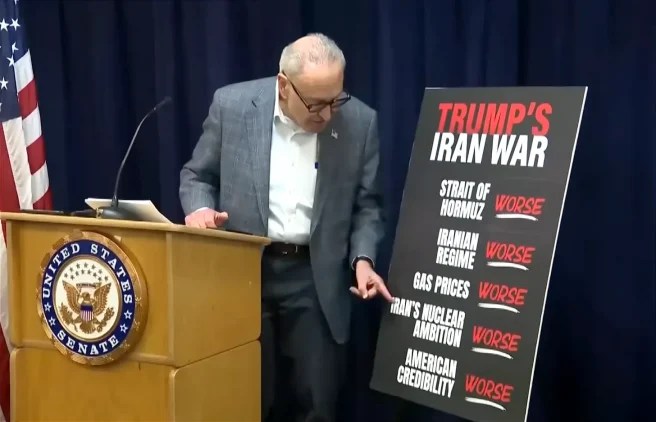
When the ceasefire was finally announced, Schumer held a press conference in New York and went through the deal point by point, explaining why the outcome represented an American failure. “The Strait of Hormuz is in worse shape today, with more Iranian domination of it than it was before the war started,” Schumer said. “Iran still has an ayatollah named Khamenei. The Iranian regime is still standing. Not just standing, but now emboldened. And the regime is likely to be even more radical and more dangerous than it was before.” He called Trump “a military moron” and said the war had made the United States worse off than before it started. The Senate’s top Democrat was not upset that the war happened. He was upset that it hadn’t achieved more.
Venezuela: Trump Didn’t Finish the Job
In January 2026, U.S. special forces captured Venezuelan President Nicolas Maduro in a nighttime raid and flew him to New York to face drug trafficking charges. Within weeks, the Trump administration settled into a working relationship with Maduro’s former vice president, Delcy Rodriguez, now Venezuela’s acting president. Trump, having removed Maduro, chose to work with the Venezuelan regime rather than dismantle it. Rodriguez, previously sanctioned by Trump’s own Treasury Department, was quietly removed from the sanctions list in April 2026.
House Foreign Affairs Committee Democrats posted a screenshot of the New York Times article reporting the sanctions removal and responded:
“Delcy was Maduro’s brutal co-conspirator to steal an election and repress Venezuelans. 3 months later she’s off the US sanctions list, with zero plans for reforms and her regime still harassing and jailing its political opponents. Trump doesn’t care about Venezuela’s democracy, just its oil.”
Democrats on the House Foreign Affairs Committee, the body in Congress responsible for overseeing U.S. foreign policy, were not satisfied. The problem, in their telling, was not that Trump had removed a foreign head of state by military force. It was that Trump had cut a deal with his successor rather than going for full regime change.
The Impeachment Spectacle
In 2019, Democrats launched an impeachment process that would run for months, producing two weeks of nationally televised public hearings, 12 witnesses, and more than 30 hours of testimony, before the full House voted to impeach in December. The central charge was that Trump had frozen $400 million in military aid to Ukraine, weapons intended to be used against Russia, a U.S. adversary. Withholding them was, in the Democratic telling, an impeachable betrayal of American interests. Fast forward to 2026: Trump waged a 40-day bombing campaign against Iran, a U.S. adversary, without congressional authorization, and Democrats introduced not impeachment articles but complaints that he failed to hit Iran hard enough.
When Trump withheld weapons from a U.S. enemy’s enemy, Democrats called it impeachable. When Trump actually bombed a U.S. enemy, Democrats called it inadequate. In both cases, they were pushing Donald Trump in exactly the same direction.
All of it, from Schumer’s TACO attacks to the Democratic Foreign Affairs Committee’s frustration with Delcy Rodriguez to Murphy calling a ceasefire “heartbreaking,” points in the same direction. Not toward restraint, not toward diplomacy, but toward a more complete and more decisive confrontation with American adversaries. Whether that reflects genuine hawkishness, reflexive opposition to anything Trump does, or some complicated mixture of both, the political effect is the same. The liberal opposition party is pushing for more war.
Jeremy Loffredo (X: @loffredojeremy) is an independent journalist and filmmaker who covers foreign policy and war.
Moscow backs Tehran on status of Lebanon in US-Iran deal
RT | April 9, 2026
Moscow believes the US-Iran ceasefire has a regional dimension and extends to Lebanon, Russian Foreign Minister Sergey Lavrov told his Iranian counterpart Abbas Aragchi in a phone call on Thursday, according to a readout.
Lavrov stated that Russia fully supports the cessation of hostilities between the US and Iran and Israel’s accession to those agreements. He expressed hope for the success of the upcoming negotiations and reaffirmed Moscow’s readiness to help “overcome the consequences of the unprovoked US‑Israeli aggression against Iran and ensure long-term peace and sustainable security in the region.”
The Russian minister also emphasized that Moscow “firmly believes that these agreements, as announced by the Pakistani mediators, have a regional dimension and, in particular, extend to Lebanon.”
Israel has insisted that Lebanon is not part of the ceasefire deal and said it intends to continue operations in the country, where it has conducted extensive airstrikes and launched a ground invasion.
Shortly after the US-Iranian ceasefire was announced, the Israeli military said it carried out its largest wave of strikes on Lebanon since the war began, hitting approximately 100 targets across the country in just ten minutes.
More than 1,700 people have been killed in Israeli strikes since March 2, and over 5,800 have been wounded, including hundreds of women and children, according to Lebanon’s Health Ministry.
Iran has made clear that Lebanon must be included in any cessation of hostilities. It has also warned that the Strait of Hormuz will remain closed to shipping until Israel commits to a ceasefire on all fronts.
Araghchi thanked Lavrov for Russia’s “principled position” during UN Security Council meetings on the situation in the Persian Gulf, according to the ministry. The two diplomats also discussed broader regional security issues.
Moscow has consistently condemned the US‑Israeli campaign against Iran, which began on February 28. Russia has called for de‑escalation and a diplomatic solution, while accusing Washington of violating international law.
The Kremlin has also criticized Israel’s strikes on Lebanon, including a March attack on a Russian cultural center in the southern city of Nabatieh.
Featured Video
BRITAIN’S WARNING: PREPARE FOR WAR
or go to
Aletho News Archives – Video-Images
From the Archive
How Ukraine Tortured and Slaughtered Donbass
By Kit Klarenberg | Al Mayadeen | July 11, 2024
Almost immediately after the proxy war erupted, ISIS-tier footage of the torture and murder of Russians in Ukrainian custody emerged.
On July 6th, the New York Times published an astonishing investigation: In Ukraine, Killings of Surrendering Russians Divide an American-Led Unit. The article documents in grim detail how Chosen Company, an international volunteer battalion for Kiev, routinely executes Russian prisoners of war. It is the very first mainstream admission that this practice – a brazen breach of the Geneva Conventions, and a grave war crime – is widespread among Ukraine’s fighters, both foreign and homegrown. … continue
Blog Roll
 Aletho News
- Pentagon designates Chinese cultural centers national security threat
- Israel Demolishes Home Of Lebanese Journalist Whose Viral Film Exposed Pager Attack
- Record Oil, Empty Tanks: The UAE’s Miracle Recovery
- Burnham tackles Britain’s poverty with aggression in Yemen
- Peace in Ukraine: the easy way – or the hard way
- Trump & the Rrrrussians
- US taxpayer money laundered back through Ukraine – Musk
- Before COVID, an NIH lab chief proposed making a SARS-like bat virus more infectious
- Gates, Bourla on Trial in Netherlands Accused of ‘Great Reset’ Scheme at Vaccine Injury Hearing
- BRITAIN’S WARNING: PREPARE FOR WAR
- If Americans Knew
- An error has occurred; the feed is probably down. Try again later.
- No Tricks Zone
- Two New Studies Find Thwaites Glacier Melt Cannot Be Driven By Human Activity Or A Warming Ocean
- E-Cars Reduce CO2 Emissions By Only 41% Compared To Internal Combustion Engine Vehicles
- Predictions Made By Renowned Climate Professor Over Past Decades Have Been Proven To Be Poor
- New Study Suggests Large Regions Of The Pacific Ocean Have Been Cooling For The Last 80 Years
- Germany’s Green Energy Debacle: High Energy Costs Force Kahla Porzellan to Close After 182 Years!
- New Study: 50 Years Of The Most Aggressive ‘Net Zero’ Policies Can Only Affect The Global Climate By 0.03°C
- US September “Heat” Was No Record…Many Records Set Decades Ago
- Latest European Green Energy Debacle; Portugal’s Largest Flagship Solar Park Insolvent!
- Green Energy Debacle: German Expert Professor Fritz Vahrenholt Warns Of Severe Economic And Social Consequences
- Two More Paleo Reconstructions Affirm Meters-Higher Sea Levels Across Ireland, Brazil 7000-6000 Years Ago

