US Intelligence Community is Covering its Ass… What is Really Going On with the US War on Iran?
By Larry C. Johnson – SONAR21 – March 8, 2026
Let’s start with the big news from a US Intelligence Community leak to the Washington Post… John Hudson and Warren P. Strobel got the story:
A classified report by the National Intelligence Council found that even a large-scale assault on Iran launched by the United States would be unlikely to oust the Islamic republic’s entrenched military and clerical establishment, a sobering assessment as the Trump administration raises the specter of an extended military campaign that officials say has “only just begun.”
The findings, confirmed to The Washington Post by three people familiar with the report’s contents, raise doubts about President Donald Trump’s declared plan to “clean out” Iran’s leadership structure and install a ruler of his choosing.
The report, completed about a week before the United States and Israel initiated the war on Feb. 28, outlined succession scenarios stemming from either a narrowly tailored campaign against Iran’s leaders or a broader assault against its leadership and government institutions, the people familiar with its findings said. In both cases, the intelligence concluded that Iran’s clerical and military establishment would respond to the killing of Supreme Leader Ayatollah Ali Khamenei by following protocols designed to preserve continuity of power, these people said.
This means the war in Iran is not going well and the US IC is beginning the Washington game of, “Don’t blame me, I warned you not to do it.” I don’t know if Tulsi Gabbard authorized this leak, or if it came from senior analysts from the four principal agencies that were involved in writing this classified report — i.e., the CIA, the Defense Intelligence Agency, State Department’s Bureau of Intelligence and Research, and the National Security Agency. It is important to understand that this report was produced by the National Intelligence Council, aka the NIC, and it is under the direct control of Tulsi Gabbard. In any event I see this as a clear signal from people involved in producing this report that they will not be the scapegoats when the Iran war turns into a debacle for Donald Trump.
I get dozens of emails a day from readers asking questions and offering commentary. I try to read and respond to all. Today I received a series of questions from one of my subscribers. Instead of responding to this person personally, I decided to save time and post for all to see. Hopefully this helps you plow thru the ton of propaganda being spewed by Trump and the Zionists.
1) I’ve read that Tehran is now being hit with gravity bombs. Does the US now have total air space control? What happened to S300-400 and super long range radar able to detect stealth aircraft?
The US does not have air supremacy. The US and Israeli planes are flying close to Iran’s western border and releasing primarily the Joint Air-to-Surface Standoff Missile aka JASSAMs, which have a range between 230 and 600 miles depending on the variant (AGM-158A JASSM (baseline): ~370 km [230 miles] and AGM-158B JASSM-ER (Extended Range): ~980 km [610 miles]). I don’t know how many, if any, S300-S400 are deployed in Iran. Iran has reportedly shot down 29 MQ9s and Hermes drones since 28 February, which represents a financial loss of $800 million.
2) What does it imply that Iran has apologized to its neighbors for attacking them?
That is a misreading of what the Iranian President said. Pezeshkian personally apologized to the neighboring countries (Gulf/Arab states) that had been affected by Iranian missile and drone strikes, saying something along the lines of: “I should apologize to the neighboring countries that were attacked by Iran, on my own behalf and on behalf of Iran.” However, Pezeshkian in later remarks emphasized that any de-escalation gesture was undermined by US actions (like Trump’s response framing it as capitulation). As long as the US continues to conduct military operations from the territories of the Gulf/Arab states Iran will (and has) continue to attack the US targets in those countries.
3) What are the targets of the new cluster bomb rockets? Airfields?
The most recent video evidence shows Iran has hit Ben Gurion airport in Tel Aviv, the oil refinery in Haifa. The clusters from the Iranian rocket are hitting ground targets in Tel Aviv and Haifa at a minimum.
4) Why can’t Iran stop the constant barrage they are undergoing? They seem as defenseless as Gaza.
Iran does not have a perfect air defense system. Worth noting that despite Donald Trump’s threats, the number of US AGM strikes in Iran have declined by 80%. According to Simplicius :
US’s strikes have likewise fallen off from nearly 1,000 on the first day to an estimated 200-300 per day or less since then—and many if not most of those strikes are hitting superficial targets to “fluff up the score”, like a plane boneyard which surely added a couple dozen “points” to the “impressive” strike list
5) Is the Iranian Air Force destroyed?
No. The strikes on Iranian combat planes have been largely confined to the Western part of Iran. They still have ample capability in the East. Iran maintains 17 Tactical Fighter Bases (TFBs), and in recent years several new airfields have been constructed in central and eastern Iran, with at least two becoming permanent TFBs — the first established since 1979. One known eastern base is TFB.14 near Mashhad, in the far northeast. To protect assets from preemptive strikes, Iran has moved much of its air power underground. The “Eagle 44” (Oghab 44) airbase, unveiled in 2023, is a massive facility carved into the Zagros Mountains, designed to withstand bunker-buster bombs and housing fighter jets, drones, and command facilities. As of February 28, 2026, reports indicate MiG-29s flying over Tehran and Su-24 strike aircraft being repositioned, suggesting active defensive preparations.
6) Is it hard to put airfields out of service? For example send all fuel tanks up in flames. The conclusion I reach is that it requires high precision missiles and Iran doesn’t have enough of those types to expend them on that type of target. Meanwhile Tehran burns and some US radars are gone.
Blowing up fuel tanks can create a fuel shortage, but it does not disable airfields. Cratering an airfield and putting it permanently out of commission is difficult because the runways can be repaired. You need to stop listening to the US propaganda claims about massive destruction. And how do you know how many high precision missiles Iran has? I don’t know, but what I continue to see is that Iran is firing several waves of precision missile attacks into Tel Aviv and Haifa as well as US bases/ installations throughout the Persian Gulf.
7) The fact that US has been blinded by radar loss hasn’t seemed to help Iran much. Newer Iranian missiles are getting through but that would have been true regardless of those radar stations status.
You answer your own question. Yes, the US loss of the advance radar systems has blinded it and, as a consequence, Iranian missiles are getting through. So what is your real question?
I had an excellent conversation about the current state of the war on Iran with Mario Nawfal this afternoon:
Andrei Martyanov and I spent an hour on Friday afternoon with Randy Credico on his show, Live on the Fly:
The Trump Administration is Lying About American Casualties in the Persian Gulf Region
By Larry C. Johnson | Ron Paul Institute | March 7, 2026
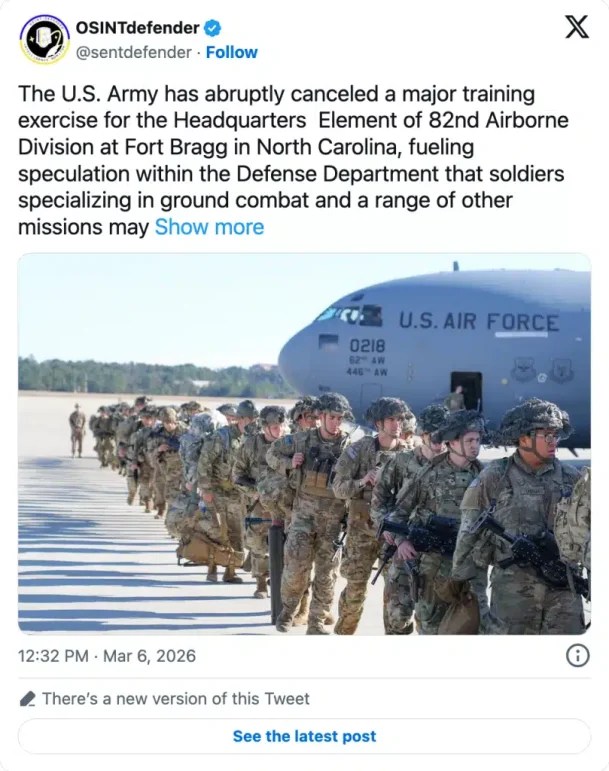
First let me explain the meaning of the X message and photo that appears above… the cancellation of the training exercise is a key indicator that the Pentagon is going to deploy some, if not all, of the 82nd Airborne Division to the Persian Gulf. Final destination unknown. You may recall an article I wrote on February 18 when I reported that a CENTCOM exercise scripting conference, which was scheduled to begin on Sunday, 22 February 2026, had been abruptly cancelled. Six days later the war started.
The imminent deployment of the 82nd does not mean they are going into battle in the next couple of days. I expect it will be at least two weeks before they reach their base camp. However, this does mean that Trump and Hegseth were not just making an idle comment when they mentioned putting boots on the ground.
Despite the Trump administration’s efforts to downplay US casualties after seven days of war in the Persian Gulf, clues are appearing on the internet that indicate the US has suffered more combat losses than reported. The first clue is this Xhitter (pronounced SHITTER) from Stars and Stripes.
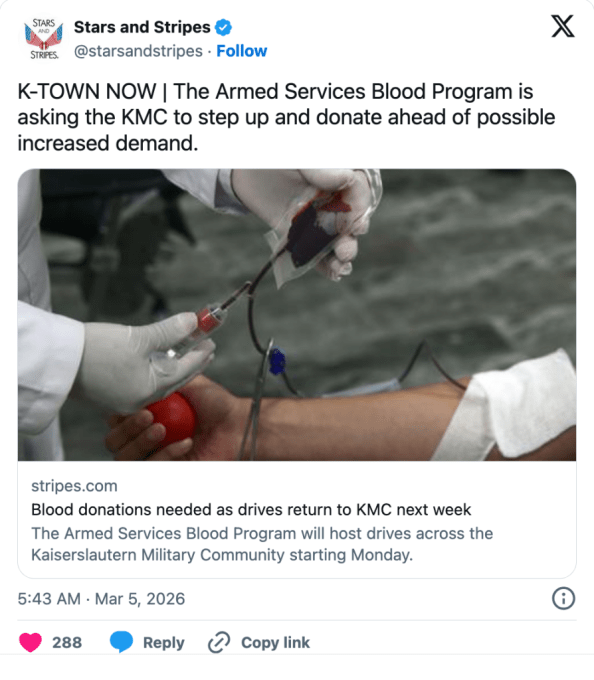
K-Town refers to Kaiserslautern, a US Army base in Germany, which is located 13 miles east of the Landstuhl Regional Medical Center. So what? Well, on March 4, 2026 the Landstuhl Regional Medical Center (LRMC) in Germany—the largest US Department of Defense hospital outside the United States and the primary overseas trauma/evacuation hub for injured service members from Europe, the Middle East, and Africa—sent out a memo announcing the temporary suspension of its labor and delivery services “until further notice.” The memo did not explicitly define the “primary objective,” but LRMC’s core role is treating combat- and training-related injuries. It also is the main medical evacuation point for wounded troops from ongoing operations.
A knowledgeable friend who supervised DOD’s Wounded Warrior Program during the Iraq and Afghanistan Wars and worked with personnel at the LRMC, learned today that there is a flood of casualties arriving at the hospital. The numbers are so large that the hospital could no longer continue to spend resources on birthing babies.
Then this picture popped up on Telegram a little bit ago:
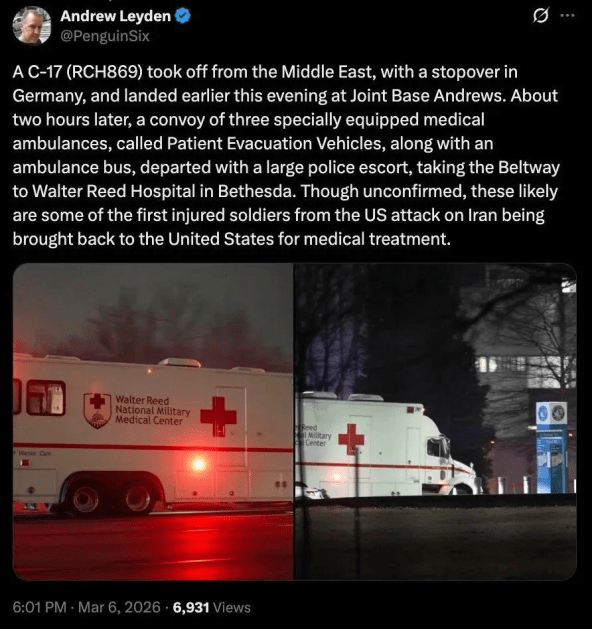
It is not a stretch to conclude that Iran’s attacks on the US bases in the Persian Gulf produced more than a few casualties. DOD/DOW is working hard to keep this information from the public. Most Americans do not support the unprovoked war… This is likely to fuel more opposition.
Iraqi Resistance: Attacks on Beirut suburbs threaten US interests
Al Mayadeen | March 7, 2026
The Iraqi Resistance Coordination Committee affirmed that recent years have demonstrated that the entire region is governed by one equation: “Either security for all, or security for none.”
Addressing the ongoing aggression against Lebanon, the Iraqi resistance stressed that the security and stability of the southern suburbs of Beirut and their residents form an integral part of the regional security equation. It added that any escalation there would have repercussions for the vital interests of the US in the region.
The committee warned that any attack on the security of the densely populated civilian suburb would inevitably be met with threats to the security of embassies belonging to the aggressor countries, whether in Iraq, Bahrain, Kuwait, or Lebanon.
It further stated that undermining the security of the Beirut suburbs would also directly affect the security of major American oil companies operating in the Arabian Peninsula, stressing that “a warning has been given.”
‘Israel’ issues massive displacement threat to Beirut Southern Suburb
The Israeli occupation, in an unprecedented move, issued a massive displacement threat on Thursday against entire neighborhoods in Beirut’s Southern Suburb. Previously issuing displacement warnings against specific buildings, the Israeli occupation has discarded this strategy and now threatens thousands of homes, businesses, medical facilities, schools, and civilians with bombardment.
The threats have specifically named the neighborhoods of Bourj el-Barajneh, Hadath, Haret Hreik, and Chiyah, which house tens of thousands of civilians, who were ordered to head east along the Beirut-Damascus highway, or north towards Matn or Beirut-Tripoli highways, respectively.
This resulted in severe traffic congestion at the entrances to Beirut’s southern suburbs as residents began leaving their homes.
The Israeli threat eerily resembles those in Gaza, where hundreds of thousands and up to a million civilians were forced to flee their zones amid mass displacement plots.
“Burnt Bridges”: Why Trump’s Plan to Use Kurds Against Iran Is Doomed to Fail
By Mohammed ibn Faisal al-Rashid – New Eastern Outlook – March 7, 2026
Following a series of devastating U.S. and Israeli airstrikes on Iran’s nuclear facilities, Tehran is engulfed in uncertainty. However, the White House, facing the prospect of a ground operation in mountainous terrain, is betting on an old, tested, but extremely risky tool—Kurdish forces. The Donald Trump administration views the Kurds as ideal “cannon fodder” to ignite a civil war in Iran. But will this plan work? Given Trump’s history of betrayals, deceit, and cynical pragmatism, the attempt to play the Kurdish card might not only fail but could also backfire on the United States itself.
A Proxy Army for a Big War
While the U.S. Air Force continues to bomb Iranian cities and Donald Trump boasts about destroying the enemy’s navy, Washington is soberly assessing the risks. Sending thousands of American soldiers into Iran would be political suicide for a president who promised voters an end to “endless wars.” Analysts agree: the U.S. will not launch a full-scale invasion like in Iraq or Afghanistan due to the mountainous terrain, the risk of high casualties, and a lack of public support.
A solution was quickly found. As early as March 4th, the South Korean publication Donga Ilbo reported that thousands of Kurdish fighters had begun a ground offensive into Iran from Iraqi territory. According to Fox News and CNN, cited by the publication, the operation is coordinated with active participation from the CIA, which is providing weapons and equipment.
But is this really the case? Currently, data on a massive invasion by thousands of Kurdish fighters is contradictory.
The scenario appears logical: The Kurds, who make up about 10% of Iran’s population (approximately 9 million people), have historically faced discrimination within the Shia theocracy. They are concentrated in the western provinces bordering Iraq, making them an ideal foothold. Kurdish parties based in Iraqi Kurdistan have already united into the “Coalition of Political Forces of Iranian Kurdistan,” establishing a unified military command.
Israel: Old Ties and New Opportunities
The role of Israel deserves special attention. Tel Aviv has long-standing, complex but generally positive relations with Kurdish movements, viewing them as a natural counterweight to hostile Arab and Iranian regimes. In the current conflict, Israel has taken on the role of “igniter.” According to Middle East Eye, the Israeli Air Force is striking positions of the Islamic Revolutionary Guard Corps (IRGC) precisely in Iran’s western provinces, effectively preparing a corridor for the advancement of Kurdish forces.
According to experts, Israeli strategists are actively exploring the option of using Iranian Kurds (specifically groups like PAK, linked to the PKK) as manpower instead of American soldiers. For Israel, this is an opportunity to inflict maximum damage on its primary enemy without getting bogged down in a protracted ground conflict. The calculation is that the Kurdish national movement could become the “Trojan horse” capable of exploding Iran from within.
However, a fundamental contradiction lies here: the interests of Israel and the U.S. are often situational. And if Washington decides its goals are achieved, the Kurds could once again be left alone to face an enraged adversary.
“I Don’t Like the Kurds”: A Bloody History of Betrayals
This is precisely where Trump’s plan begins to unravel. To understand why the Kurds are unlikely to become a pliable tool in the White House’s hands, one need only look at Trump’s relationship with these people.
As early as 2020, the world learned shocking details from the memoirs of former National Security Advisor John Bolton. According to Bolton, Trump stated in a small circle, “I don’t like the Kurds. They run from the Iraqis, they run from the Turks. The only time they don’t run is when we’re bombing everything around them with F-18s.” This statement isn’t mere rudeness; it’s the quintessence of Trump’s approach: he despises those he considers weak and feels no moral obligation towards allies.
The most cynical example was the betrayal of the Syrian Kurds in October 2019. Trump then ordered the withdrawal of American troops from northern Syria, effectively giving a “green light” to the Turkish invasion. The Kurds, who had lost 11,000 fighters battling ISIS and were America’s only reliable partner on the ground, were abandoned to their fate. American officers on the ground were shocked: “They trusted us, and we betrayed that trust,” one of them told The New Arab at the time.
The “1991 Syndrome” is also vivid in Kurdish memory. Then, President George H.W. Bush called on Iraqi Kurds to rise up against Saddam Hussein but abandoned them when the uprising began, allowing the regime’s army to brutally crush the rebellion with helicopters. Now, this nightmare seems poised to repeat itself in Iran.
Can the U.S. Ignite a Civil War in Iran?
Formally, the prerequisites for unrest exist. Besides ethnic Kurds, Iran is home to disaffected Baluch, Azeris, and Arabs. Following the death of Supreme Leader Ali Khamenei in the initial strikes, a power vacuum could emerge in the country. The White House has already openly stated its readiness to deal with a “new government” and is discussing who should lead Iran after regime change.
Trump personally called on Iranian diplomats worldwide to seek asylum, promising to help “form a new, better Iran.” It would seem this is the moment of truth: Kurds and other minorities should rise up and overthrow the hated regime.
But reality is more complex.
Fear of History Repeating. As analyst Oral Toga noted in a comment to Middle East Eye, the fact that the U.S. abandoned the Syrian Democratic Forces (SDF) will serve as a lesson for Kurds in Iraq and Iran. “The airstrikes will end someday, but Tehran will remain there forever,” he reminds us.
Lack of Strategy. The U.S. and Israel have no clear vision for Iran’s future. Do they want a unitary state, a federation, or the complete disintegration of the country? Using the Kurds as a battering ram without guaranteeing them autonomy or protection after the war would condemn the region to a bloodbath. The Kurdish leaders themselves understand this. As activist Golaleh Sharafkandi stated, “We have a political program supported by an army, not the other way around.”
Regional Opposition. The creation of a new Kurdish zone of influence in northern Iran would be opposed not only by Iran but also by Turkey and even Azerbaijan, which see it as a threat to their sovereignty and a risk of separatism. Ankara already brutally suppresses any pro-Kurdish movements near its borders. Azerbaijan, which has strategic relations with Turkey and Israel, has already expressed condolences to Iran and called for peace, fearing destabilization.
Operational Difficulties. Several sources, including the Turkish agency Anadolu, report that the information about the offensive has been denied or clarified. The Kurdish factions themselves deny starting a full-scale invasion, and Iranian media report that the border is under control. The groups ready to fight number, by various estimates, between 8,000 and 10,000 people—insufficient to conquer territory without direct air support and U.S. special forces, which Trump is not yet ready to provide.
Dreams of a Caliphate and the Bitter Truth
Donald Trump’s attempt to use the Kurds as a match to ignite the powder keg of Iran appears to be an adventure based on a denial of reality. Yes, the Kurds hate the Ayatollahs’ regime. Yes, they want autonomy and rights. But they do not want to once again become bargaining chips in a high-stakes game where their physical survival is on the line.
Trump has already twice demonstrated his true attitude towards Kurdish allies—in Iraq and Syria. A third time could be the last, not for the American president’s reputation, but for hundreds of thousands of civilians who would find themselves caught between the hammer of the Iranian army and the anvil of American geopolitical ambitions. The Kurdish leaders, united in a coalition, understand perfectly well: when the situation gets hot, the White House might once again throw up its hands and say, “This is not our war.”
Therefore, despite the loud headlines and CIA leaks, the active use of Kurds in full-scale combat operations is unlikely. Kurds might try to expand their autonomy amidst the chaos, but playing the role of a disciplined U.S. proxy army that can be unleashed on Tehran and then written off—they won’t buy that anymore. The price of trust in America under Trump has proven too high, and paying off those debts may take decades.
Muhammad ibn Faisal al-Rashid, political scientist, expert on the Arab world
Follow new articles on our Telegram channel
Iran Red Crescent says 6,668 civilian sites targeted in US-Israeli attacks
MEMO | March 7, 2026
The Iranian Red Crescent Society said that 6,668 civilian locations have been targeted in attacks carried out by the US and Israel, including thousands of homes and dozens of public service facilities, Anadolu reports.
In a statement, the Iranian aid organization said that the attacks by the US and Israel struck a wide range of civilian infrastructure across the country.
According to the statement, 5,535 residential buildings, 1,041 commercial units, 14 health centers, 65 schools, and 13 facilities affiliated with the Red Crescent were among the locations hit.
The organization also reported that numerous aid and rescue vehicles were damaged during the attacks, while several relief workers and Red Crescent staff members were injured.
The statement emphasized that the attacks by the US and Israel targeting civilians violate the Geneva Conventions.
“International institutions, humanitarian aid organizations, and human rights defenders are expected to take urgent and effective measures to protect civilian lives, ensure the safety of aid workers, and guarantee respect for the rules of international humanitarian law,” it added.
Maybe Attacking Iran Was Not Such A Good Idea
By Philip Giraldi • Unz Review • March 7, 2026
The completely unprovoked attack on Iran initiated by the United States and Israel has, after a little more than a week of military action, opened a new depth of geopolitical insanity. As suspected, the attack was all about protecting Israel while also minimizing the damage to US military, intelligence and diplomatic facilities in the Persian Gulf region. In that it has been less than a great success in that there has been reportedly considerable damage done by Iranian missiles and drones in both the Jewish State and at American bases. Iran has also suffered substantially and the US bomb that killed 165 schoolgirls continues to fuel huge demonstrations and rage that is feeding a willingness to resist the United States among the Shia communities both inside Iran and in adjacent states and regions, expanding the conflict.
The combined Israel-US onslaught was intended to destroy Iranian military capabilities, most particularly its fictional nuclear and missile programs, and to bring about regime change after killing its Supreme Leader. As the attack took place, President Donald Trump announced by way of his Truth Social platform, that “We are going to destroy their missiles and raze their missile industry to the ground. It will be totally — again — obliterated. We’re going to annihilate their navy.” On Saturday March 7th Trump elaborated, tweeting how “Today Iran will be hit very hard! Under serious consideration for complete destruction and certain death, because of Iran’s bad behavior, are areas and groups of people that were not considered for targeting up until this moment in time.”
Trump also expressed himself in a post on Truth Social how Americans will die against Iran, elaborating that “the lives of courageous American heroes may be lost” in what the Pentagon dubbed “Operation Epic Fury… We may have casualties.” As Trump’s entire family has avoided military service, the ultimate price for his warmaking will consist of using other American families’ sons and daughters as cannon fodder and he may be preparing for a political backlash by demonstrating now how much he cares about the average Americans who will be impacted by his policies. Of course, he clearly does not care unless your name is Adelson or Netanyahu.
That the war is taking place at all is due to Israel’s absolute control over America’s political class, a reality that Netanyahu and his predecessors in office have not been exactly shy about admitting. The US is a hapless giant that has been corrupted by Jewish billionaire money from within, totally committed to the expansion of greater Israel no matter how many have to die in the process. Do the Israelis care what happens to the American people? No. It is only necessary to take a look at the planned or actual killing of Americans by Israel starting with the Lavon Affair in 1954 which planned to bomb US Embassy offices in Egypt. Then there came the attack on the USS Liberty in international waters in 1967, an attempt to sink the navy ship and kill all its crew, which was covered-up by President Lyndon B Johnson and his Secretary of Defense Robert McNamara. More recently, a number of American citizens have been killed with impunity by Israelis. One might mention prominent peace activist Rachel Corrie in 2003 who was deliberately run over by an Israeli army bulldozer.
To cite how this works in practice and to demonstrate how the United States uniquely favors Israel, one might cite the recent February 18th killing of the nineteen year old Philadelphia native Nasrallah Abu Siyam, who was shot in the West Bank village of Mukhmas, when rampaging settlers attacked Palestinian farmers. Nasrallah was trying to stop the settlers from stealing livestock when he was shot and it took hours to transport him to a hospital due to “security” checkpoints and Jews-only roads established by the Israeli government. Israeli settlements, built on land stolen in the Palestinian territories, have been expanding at a rapid pace and the rampaging settlers are routinely protected by the army and police. Settler attacks soared to over 1,800 incidents last year, according to a United Nations report. Attacks have included violence, property damage, arson, killing of livestock and theft.
In a normal country, the US Embassy or Consulate would pressure the local government to investigate and seek to have the killers arrested, tried and brought to justice, but that does not take place in Israel where the attitude is “we’ll let the Israelis handle it.” Sure. Nine US citizens have been murdered in Israel in the past several years, but no one has been criminally charged in the killings while the United States has declined to open any independent investigations. The death toll includes New Jersey-born Amer Rabee, 14, who was shot by soldiers on April 6th, 2025, amid unproven allegations that he had thrown stones. Also there was Saifullah Kamal Musallet, a 20-year-old resident of Tampa, Florida, who was beaten to death by Israeli settlers in July; and Khamis Ayyad, 44, who died of smoke inhalation in August after settlers set fire to houses in his village. Tawfic Abdel Jabbar and Mohammad Ahmed Mohammad Khdour, both 17, were shot and killed in separate incidents in February 2024 while in September of that year, a soldier fatally shot in the head Aysenur Ezgi Eygi, 26, of Seattle, during a protest against illegal settlements. And then there was Omar Assad, 78, who was walking in his village before being seized by soldiers for no reason, handcuffed and gagged, with his hands bound behind his back, and then left alone on his stomach at a cold construction site. He died from a stress-induced heart attack in January 2022.
There is also the high-profile killing of journalist Shireen Abu Akleh, who lived in New Jersey as a child, in May 2022. Israeli authorities determined that the gunfire from soldiers was likely accidental, despite investigations by media and the UN concluding she was deliberately targeted and killed lest she report on Israeli war crimes. Beyond Abu Akleh, Israel is responsible for two-thirds of all journalists killed in the line of duty worldwide.
Interestingly, in the case of the teenager Nasrallah and the other recent deaths, more than 30 US senators have signed a letter demanding that the Trump administration open an independent investigation. “For all nine of these killings, no one has yet been held accountable by the Netanyahu government, nor has the US government upheld its duty to protect Americans and secure justice and accountability for their deaths,” the letter from the Congressmen says. “It is unclear to us how many more Americans must die in the West Bank in order for this administration, and other administrations, to take serious, credible steps to secure accountability and ensure an end to the ongoing killings of Americans without consequence.”
The State Department responded that it extends condolences to the family and expects “a full, thorough and transparent investigation into the circumstances surrounding the death,” indicating that it would rely on Israeli authorities to investigate, which means that nothing will be done. The unwillingness to represent the interests of actual American citizens is due to the fact that all recent US Ambassadors to Israel have themselves been ardent Zionists, with the worst of the lot being the current incumbent Mike Huckabee who has cordially met with Israel’s leading spy against the US Jonathan Pollard and has endorsed a Greater Israel which will stretch from the Nile River to the Euphrates. The indigenous population will of course be removed, just as the Gazans, Palestinians on the West Bank and the inhabitants of South Lebanon are being currently disposed of with the assistance of Donald Trump and company. Huckabee, in an interview with Tucker Carlson, said that it “would be fine if they took it all” [Greater Israel] for the Jewish state, as it was a “land given by God to the Jewish people.” This was not a casual remark but a moment of unscripted candor, a world-changing admission of a supremacist belief system favoring the Jewish state that had long operated in the shadows of US foreign policy.
US Secretary of War Pete Hegseth, a fervent Christian Zionist, even foresees great benefit coming from a Biblically predicted Armageddon global conflict beginning in the Middle East which will lead to “End Times” after which the faithful will be wafted up to heaven in the so-called “Rapture.” If one wonders just what has happened to US foreign and national security policy Hegseth and Huckabee are good places to start.
The point is that Israel is beyond brutal in its treatment of anyone who is not a Jew yet Donald Trump and company appear to think that that is just fine. Last week I saw a video on Facebook which was sickening. It showed a Christian woman walking her dogs in Jerusalem and being assailed by a mob of screaming hysterical Orthodox Jewish students who attacked her, and the dogs, for no other reasons beyond the fact that she existed. To be sure, I am an animal lover, but the attackers were so far outside the realm of conventional morality that one has to despise what they represent. Their on-display manifestation of what they regard as their Yahweh-given exceptionalism should be revolting to most others who do not share their so-called faith. The truly disgusting part is that the woman and her dogs were not exactly an extreme example of the interactions that Christians are now experiencing in Jerusalem with their presumed Jewish overlords. Churches are regularly vandalized and Christians are blocked from attending services while also being spat upon, cursed and otherwise harassed in the streets. There are reports that “Spitting on Christians is a Jewish custom!”
Unfortunately the Christian Zionist belief system has successfully dominated American evangelicalism and Israeli policy. This ideology asserts a “divine right” to conquer, pillage, and commit genocide, positioning itself above all man-made laws and international norms. It is, by its very definition, an ethnic and theological supremacist doctrine that dehumanizes all neighboring peoples as obstacles to a divine plan. As I’ve noted previously, this philosophy “is rooted in ethnic supremacism” and claims that “God gave modern day Israel the right to kill anyone they want, to steal any land they want.” This is not seen as a symbolic promise but a literal deed to real estate, with the millions of current occupants to be “subordinated, expelled, or dealt with by whatever means history requires.” Such a worldview reduces the US Constitution, international law and the UN Charter to be mere inconveniences. Mike Huckabee has argued that “the United Nations charter doesn’t count because God said so.” And his boss Donald Trump has declared that as President of the United States “I can do whatever I want!” which includes permitting genocide and land theft. With such beliefs in place, it is no wonder that many Americans are increasingly coming to appreciate that what is going on in our nation is leading us towards disaster!
Philip M. Giraldi, Ph.D., is Executive Director of the Council for the National Interest, a 501(c)3 tax deductible educational foundation (Federal ID Number #52-1739023) that seeks a more interests-based U.S. foreign policy in the Middle East. Website is https://councilforthenationalinterest.org address is P.O. Box 2157, Purcellville VA 20134 and its email is inform@cnionline.org
UK readies deployment of Prince of Wales carrier amid war on Iran
Al Mayadeen | March 7, 2026
The United Kingdom is reportedly preparing one of its naval assets for possible deployment to West Asia as Western military pressure on Iran continues to grow following the US-Israeli assault on the country.
According to media reports, the Royal Navy aircraft carrier HMS Prince of Wales is being placed on higher readiness, with its preparation time reduced so that it can be deployed more quickly if ordered by the British government. Crew members have reportedly been warned that the vessel could be sent to the region amid the escalating confrontation triggered by the US and Israeli strikes on Iran.
According to reports, the move does not mean the carrier will necessarily be dispatched immediately. However, raising its readiness would allow the government of Prime Minister Keir Starmer to deploy the warship rapidly should the aggression against Iran escalate further.
Western buildup around Iran
The preparations come as Britain gradually expands its military presence across the region following the US–Israeli assault on Iran that began on February 28.
Since then, London has moved additional forces to the Middle East, including deploying more fighter jets to Qatar and sending helicopters equipped with counter-drone systems to Cyprus.
British forces have also been involved in intercepting drones and missiles across several countries in the region, while the Royal Navy has ordered the destroyer HMS Dragon to the eastern Mediterranean to reinforce security around British bases on the island of Cyprus.
These deployments also follow a drone strike targeting the British air base at RAF Akrotiri, during which British forces identified the drone as a Shahed-type model widely associated with Iranian production. The launch location was not immediately known.
Despite Western attempts to increase their military presence, Iranian officials have repeatedly rejected calls for surrender and warned that any further escalation will be met with additional responses.
Iran warns of consequences after US strike on water plant
Al Mayadeen | March 7, 2026
Iran’s foreign minister has accused the United States of striking a freshwater desalination plant on Qeshm Island, warning that the attack has disrupted water supplies to dozens of villages.
In a post on social media, Iranian Foreign Minister Abbas Araghchi condemned the incident, describing it as a serious violation and warning of potential consequences.
“The US committed a blatant and desperate crime by attacking a freshwater desalination plant on Qeshm Island,” Araghchi wrote. “Water supply in 30 villages has been impacted.”
“US set this precedent”: Araghchi
The minister added that targeting civilian infrastructure could have significant repercussions. “Attacking Iran’s infrastructure is a dangerous move with grave consequences. The US set this precedent, not Iran,” he stressed.
It is worth noting that Qeshm Island, located in the Strait of Hormuz, relies on desalination facilities to convert seawater into drinking water, making such plants critical for local communities. According to Iranian officials, the facility supplies water to around 30 villages in the area.
Trump’s war on Iran unjustified, violates int’l law: Legal experts
The United States has insisted that the aggression against Iran was launched to curb “direct threats” that they claim the Islamic Republic posed. However, legal experts say the reasons cited by Washington do not justify the war under international law.
US and Israeli attacks targeted Iran on February 28 in a large-scale aggression to allegedly “limit Tehran’s nuclear and missile capabilities,” despite ongoing mediated talks between Washington and Tehran, which sought to de-escalate tensions through a potential deal.
The strikes also targeted senior leadership and government facilities, including the Leader of the Revolution and the Republic, Martyr Sayyed Ali Khamenei. US President Donald Trump later demanded Iran’s “unconditional surrender”, which Iran categorically rejects.
It is worth noting that Iran had been engaged in indirect talks with the US and expressed hope for a deal that would resolve the nuclear issue peacefully. However, as reports indicated that a possible settlement was near, the aggression was launched.
US Bases in Middle East Fail to Secure Nations & Become Safety Risk – Expert
Sputnik – 07.03.2026
American bases in the Middle East are constantly facing various kinds of attacks and do not protect the countries on whose territory they are located that effectively, Turkish political scientist Umur Tugay Yucel tells Sputnik.
“For a long time, the Gulf countries had unwavering trust in the American security umbrella, but during the 12-day war, we all saw how untrustworthy it turned out to be,” Umur Tugay Yucel said.
He says that the ongoing conflict shows that the Western security framework in the Gulf region fails to address contemporary defense needs; a concern now spreading to US allies in Asia as reports emerge of THAAD and Patriot systems being withdrawn from South Korea — a move that could soon affect Japan and other partners.
“It is obvious that American bases bring more harm than good to the civilian population and infrastructure of the countries where they are located. They pose a serious threat to populated areas. When a base is struck, not only military installations are damaged, but also roads, railways, and vital transport channels in the vicinity. Moreover, there is an inevitable increase in civilian casualties,” the expert emphasizes.
Iranian Crisis Becomes Embarrassment for US Military That Can’t Protect Anyone – MidEast Analyst
Sputnik – 07.03.2026
Prior to the arrival of the United States, the Persian Gulf was essentially the domain of the British Empire which ended up handing over its holdings to the US to ensure that the latter would be at the forefront of any major war in the region, Middle East affairs expert Mais Kurbanov tells Sputnik.
Currently, the US controls a network of military installations that don’t just serve as military garrisons – these are all elements of a system of control of the Gulf ‘gas station,” Kurbanov remarks.
This defensive network was never meant to protect the Arab states of the Gulf – it’s real purpose was to protect Israel.
“This entire shield was created to keep Israel safe and to intercept missiles. They were more or less able to intercept them during the previous conflicts, before Iran started targeting their radars. And now they got nothing to intercept because Iran destroys the early warning system itself,” notes Kurbanov.
The US is unwilling and unable to defend the Gulf states – it only cares about its own interests. And all of the Gulf states besides Iran are now vulnerable because they don’t have any air defense systems, he adds. The US focuses on protecting only its own assets in the region.
“The US has embarrassed itself in front of the entire world. Everybody now knows that the Americans are no protectors,” says Kurbanov. “They used to mock Russia when Ukraine scored some hits, acting as if they are invincible. Now Iran keeps pummeling them, and US ships have to flee two thousand kilometers into the ocean to escape Iranian missiles.”
“It means the US has no meaningful air defense. Neither Israel’s Iron Dome nor the US’ vaunted Patriots can do anything. Consider this: such weapon system costs a billion dollars and an Iranian Shaheed, this dirt-cheap drone worth twenty thousand, just takes it out.”
All of the weapons the US peddled across the world – stealth aircraft, MQ-9 Reaper drones they were so proud of – turned out to be useless,” he points out.
Meanwhile, Iran keeps demonstrating the kind of new missiles that maybe two other leading world powers beside them possess.
“The US should just leave. There will be no negotiations with them and they know it,” argues Kurbanov.
Though the US does possess an extensive global network of military installations – several hundred facilities in dozens of different countries – even it cannot ensure an immediate stabilization of the situation. He points out that Russia and China haven’t yet become actively involved in the current crisis, and that without their involvement the US would be hard-pressed to deal with global issues.
Iran pledges to ‘respect sovereignty of neighbors’, declares US-Israel assets ‘primary targets’
The Cradle | March 7, 2026
The Iranian armed forces warned that US and Israeli military installations across the region remain legitimate targets, as officials seek to ease tensions with neighboring countries.
“Should the previous hostile actions continue, all military bases and interests of criminal America and the fake Zionist regime on land, at sea, and in the air across the region will be considered primary targets and will come under the powerful and crushing strikes of the mighty armed forces of the Islamic Republic of Iran,” the Iranian Revolutionary Guard Corps (IRGC) said in a statement on Saturday.
The warning came alongside a declaration by Iran’s Khatam al-Anbiya Central Headquarters that Iranian forces “respect the national interests and sovereignty of neighboring countries” and “have not carried out any act of aggression against them.”
Nevertheless, military officials emphasized that installations used by the US or Israel to launch attacks against Iran remain fair game. Lieutenant Colonel Ibrahim Zolfaghari said that at least 21 US personnel have been killed and many more injured in attacks on the US Navy’s Fifth Fleet infrastructure, while additional casualties occurred during strikes on Al-Dhafra Air Base.
He also said Iranian forces targeted a US-owned oil tanker in the northern Persian Gulf.
Earlier in the day, President Masoud Pezeshkian announced that Iran’s interim leadership council had ordered the armed forces to cease striking neighboring countries unless attacks originate from their territory.
“The temporary leadership council approved yesterday that neighboring countries should no longer be targeted and missiles should not be fired unless an attack on Iran originates from those countries,” Pezeshkian said in a pre-recorded address.
Pezeshkian’s statement was made amid increasing tensions over regional airspace with Iran’s neighboring countries.
Turkish authorities claimed this week that NATO missile defenses intercepted a ballistic projectile allegedly launched from Iran that crossed Iraqi and Syrian airspace before approaching the northwestern Syria-Turkiye border.
In Azerbaijan, officials accused Tehran of launching a drone attack that struck the Nakhchivan airport terminal, prompting President Ilham Aliyev to warn Iran “will regret it,” while Iranian authorities denied involvement.
Tehran vehemently denied involvement in either of these attacks.
Saudi journalist Adhwan al-Ahmari said in a recent interview with Asharq News that “not all attacks” targeting Gulf states come from Iran, warning the war could be “an American-Israeli trap to implicate the Gulf countries and draw them into a confrontation with Iran.”
Iranian officials told Middle East Eye (MEE) that some recent drone strikes on Gulf energy infrastructure were not carried out by Tehran, with one official describing the attack on Saudi Aramco’s Ras Tanura facility as “an Israeli effort to sabotage regional peace and alliances between neighbours.”
“I can categorically say that some of the attacks were not carried out by us [Iran],” the anonymous official told MEE.
Saudi Arabia, Qatar, the United Arab Emirates, Kuwait, Bahrain, and Oman have all sustained strikes within their territories due to the presence of US assets within their borders.
USA and Israel: Who is the lord and who is the colony?
By Raphael Machado | Strategic Culture Foundation | March 7, 2026
The Epstein Coalition (USA and Israel) began a war against the Islamic Republic of Iran on February 28th. The starting shot was the murder of 171 girls in an elementary school (perhaps as a sacrifice to Baal, the Epsteinians’ favorite deity?), followed by the martyrdom of Ayatollah Ali Khamenei, in his own residence.
It was the beginning of an “operation” that the USA expected to see finished in a few hours, then in 3 days. Well, the operation has now exceeded 6 days, and all analysts indicate that the war will last at least a few weeks, with significant losses on both sides.
What led to this operation being initiated? The easy and predictable answer is that the USA wants Iran’s oil and other natural resources.
Usually, those who reason this way also tend to say that the State of Israel represents an enclave of the USA or the “collective West” in the Middle East, whose purpose would be to serve as a trading post to facilitate or enable the occupation of the region, to ensure the exploitation of its natural resources. This is perhaps the inevitable result of looking at the comparative statistics of both countries.
The USA is larger, has a larger GDP, more powerful and numerous armed forces, has more billionaires; in short, it is “superior” in every possible and imaginable aspect, so that the US-Israel relationship can only be perceived as one in which the USA commands and Israel obeys.
Indeed, Marxian and, in general, materialist readings go in this direction. But does the Iran War confirm this assessment?
If Israel is the obedient colony of the USA, then the decision to start the conflict would have been eminently that of the USA, with Israel simply obeying the determination of its “metropole.”
But what is perceived from the official statements of Secretary of State Marco Rubio and Secretary of War Pete Hegseth is exactly the opposite: they made it quite clear in their press conferences that the USA became involved in the conflict only because Israel had already decided to attack Iran, with Washington simply following the Zionist determination.
The pretext of alleging a pre-emptive attack plan by Iran was used, but the pretext was quickly abandoned after being refuted by the Pentagon. In fact, Iran had no plan to attack either the USA or Israel.
In other words, Israel would have made the USA attack Iran. How is that possible?
The solution to the mystery seems to lie in the role of the Jewish community in the USA and its influence over the country’s internal affairs, regardless of whether its members hold Israeli citizenship or not. After all, despite comprising only 2.4% of the US population, 25% of its members have an income equivalent to the top 4% richest among non-Jews.
And if in many countries a large part of the Jewish community is critical or indifferent to Israel, in the USA, 90% of community members support Israel against its enemies. And this support is not merely verbal, expressing itself through the formal organization of lobbies that finance pro-Israel candidates and harm anti-Israel candidates, the most famous of these organizations being AIPAC, which invested almost 130 million dollars to elect its candidates in 2024.
A much more important asset, however, is the fact that, as indicated by income, many members of this community occupy positions of power and influence in the mass media, the banking system, and entertainment. Even though they are only, again, 2.4% of the US population, they constitute 33% of the CEOs of major banks, 40% of the CEOs of major media conglomerates, and 50% of the CEOs of major companies in the entertainment industry.
And these are the sectors that basically control the flow of investments, as well as shape the opinions and tastes of the country’s population.
Years ago, geopolitical analysts John Mearsheimer and Stephen Walt released an excellent book on the Zionist lobby in the USA. What they make very clear in that work is that US support for Israel is not linked to any strategic interest of Washington. The cost of supporting Israel is immense, both in money and in the international popularity of the USA. In fact, the USA only harms itself by supporting Israel against its enemies.
So how could one say that the USA controls Israel?
Returning to the current presidential administration, figures like Hegseth and Lindsay Graham openly admit that the main goal of the USA is to facilitate the reconstruction of the Temple in Jerusalem to pave the way for the coming of the Jewish Messiah. Eschatologically, the problem there is that, for Catholics, Orthodox, and traditional Protestants, the Jewish Messiah is the Antichrist.
As much as Israel is dependent on US financial and military aid, Zionism has captured the decision-making and public opinion-forming mechanisms so completely that we could practically compare the unipolar hegemon to a headless golem. In place of “America First,” it is the policy of “Israel First.”
While US bases, radars, planes, and personnel are hit by barrages of missiles and drones, and Washington loses influence and the capacity to project power in the Middle East, it becomes inevitable to reach the conclusion that Israel is the one calling the shots in this relationship, and that Tel Aviv will instrumentalize the USA as long as it serves its own expansionist interests.
Featured Video
BRITAIN’S WARNING: PREPARE FOR WAR
or go to
Aletho News Archives – Video-Images
From the Archives
British weapons and personnel doing much of the killing in Yemen
Press TV – June 18, 2019
A detailed report published by the Guardian newspaper has shown how Britain is massively contributing to Saudi Arabia’s devastating war on Yemen as it suggests that London is not only supplying the bombs that fall on Yemenis, but it provides the personnel and expertise that keep the war going.
The comprehensive report by Arron Merat published on Tuesday showed that Britain was doing much of the killing in Yemen as the country continues to provide Saudi Arabia with everything it needs to turn its southern impoverished neighbor into a graveyard.
“Every day Yemen is hit by British bombs – dropped by British planes that are flown by British-trained pilots and maintained and prepared inside Saudi Arabia by thousands of British contractors,” said Merat in the report. … continue
Blog Roll
 Aletho News
- A West Bank War for Netanyahu’s Election Campaign, Could It Backfire?
- Yemen denounces European Parliament’s ‘hypocritical’ push to blacklist Ansarullah
- Qalibaf: UAE’s UN bid aims to ‘clear the runway’ for ‘Greater Israel’, whitewash genocide
- Pakistan reopens Iran border after boosting security: Report
- Why are so many Brazilians voting for Flávio Bolsonaro?
- Democrats Put Anti-Russia Agenda Ahead of American Workers
- Elijah Magnier: Yemen’s Strikes Are Shattering Saudi Arabia’s Long-Term Strategy
- Pentagon designates Chinese cultural centers national security threat
- Israel Demolishes Home Of Lebanese Journalist Whose Viral Film Exposed Pager Attack
- Record Oil, Empty Tanks: The UAE’s Miracle Recovery
- If Americans Knew
- Tourism Ministry launches free food truck tour in US
- “So Much Worse Than People Realize”: Never-Before-Seen Images Reveal Damage at U.S. Bases as Troops Describe Being Abandoned
- UK Bell Review Confirms Only Anti-Israel Attitudes Are Rising, Not Antisemitism
- DAILY UPDATE: Latest essential news on Palestine, Israel, & region
- DAILY UPDATE: Latest essential news on Palestine, Israel, & region
- Damning report shows the media must confront its failures on Gaza
- BBC senior broadcaster speaks out on Gaza coverage
- Netanyahu vows vast West Bank invasion in response to 20-minute skirmish that left 2 Israeli soldiers and 2 Palestinian fighters dead
- Tied up and tortured: Israel using US-made electroshock weapons on Palestinian detainees
- The outsourced risk: how newsrooms rely on Gaza’s freelancers without protecting them
- No Tricks Zone
- Sudden Stratospheric Warming, Powerful El Niño Combination May Lead To Extreme Europe Cold, Energy Crisis!
- Two New Studies Find Thwaites Glacier Melt Cannot Be Driven By Human Activity Or A Warming Ocean
- E-Cars Reduce CO2 Emissions By Only 41% Compared To Internal Combustion Engine Vehicles
- Predictions Made By Renowned Climate Professor Over Past Decades Have Been Proven To Be Poor
- New Study Suggests Large Regions Of The Pacific Ocean Have Been Cooling For The Last 80 Years
- Germany’s Green Energy Debacle: High Energy Costs Force Kahla Porzellan to Close After 182 Years!
- New Study: 50 Years Of The Most Aggressive ‘Net Zero’ Policies Can Only Affect The Global Climate By 0.03°C
- US September “Heat” Was No Record…Many Records Set Decades Ago
- Latest European Green Energy Debacle; Portugal’s Largest Flagship Solar Park Insolvent!
- Green Energy Debacle: German Expert Professor Fritz Vahrenholt Warns Of Severe Economic And Social Consequences

