US, UK run illegal facilities in Afghanistan: Karzai
Press TV – April 30, 2014
Afghanistan President Hamid Karzai says the United States and Britain continue running “illegal” detention facilities in the country.
“After many decrees that have been issued by the presidential palace about not having any detention centers run by foreign forces, still foreign forces are detaining Afghan and putting them in prisons,” Karzai said in a statement on Tuesday.
“It’s a clear violation of the law of Afghanistan,” he added.
Karzai’s remarks came after an investigation panel revealed that six Afghan prisoners are held at a UK-run facility at Kandahar Air Field in the country’s south and 17 others at a facility at Camp Bastion in Helmand Province, which is also run by British forces.
Ghalum Farooq Barakzai, the head of the panel, said that his team has not found any prisoners at the American facilities, stressing that such facilities should no longer exist.
Under pressure from Afghan President, the US signed an agreement with Kabul to transfer its prisons and inmates into Afghan custody. British forces in the country are only allowed to hold suspects for 96 hours and can detain them longer only in exceptional conditions.
Barakzai called on Britain to hand over any Afghans held in the facilities, saying that the 23 inmates detained ranging from several weeks to 31 months.
“All the detainees should be transferred to Afghan security forces in the areas where they were arrested. Then the judicial officials in that area will investigate them and put them on trial. If they are guilty they should be jailed, if they are innocent they should be freed,” he also said.
Earlier this year, Afghan government freed dozens of detainees held in the US-run Bagram prison.
In November 2012, President Karzai ordered Afghan forces to take control of the prison and accused US officials of failing to fully comply with the terms of the Memorandum of Understanding on Detentions signed between Kabul and Washington.
NATO/ISAF’s ‘parting gift’ to Afghan children
Interventions Watch | April 10, 2014
A new report from The Washington Post highlights the increasing number of Afghan children who are being killed by unexploded ordinance on abandoned NATO/ISAF firing ranges.
The report says that ‘of the casualties recorded by the United Nations, 88 percent were children’, with ‘most of the victims . . . taking their animals to graze, collecting firewood or searching for scrap metal’.
A bare minimum of 77 people have been killed in this fashion since 2012, but the number is likely higher.
This was the experience of a couple of Afghan families:
‘Last month, Jawad’s father, Sayed Sadeq, heard a boom and ran onto the range. He spotted his son’s bloodied torso.
“The left side of his body was torn up. I could see his heart. His legs were missing,” the father said.
One of the boys, it appeared, had stepped on a 40mm grenade, designed to kill anyone within five yards. Both teens died.
“If the Americans believe in human rights, how can they let this happen?” Sadeq said’.
—
‘Two months after his family moved to Bagram, Abdul Wakhil, 12, walked around the area looking for firewood and unknowingly entered the range. Thirty feet from the main road, he stepped on an explosive.
One of his legs was blown off. The other was amputated at a Kabul hospital.
He doesn’t have prosthetics or a wheelchair, so he has to be carried everywhere.
“What can he do without legs?” said his brother, Abdul Mateen, 25. “His future is hopeless.”
The Occupiers have promised to clean up the ranges, although some military officials have expressed doubt as to the feasibility of this, given a lack of manpower.
The article also states that ‘because Afghanistan is not a signatory to the U.N. Convention on Certain Conventional Weapons, U.S. officials say they are not legally obligated to clear any of the unexploded ordnance’.
The Occupying powers have also ‘refused to construct fencing’ around the ranges, saying that this ‘would be prohibitively expensive and probably ineffective’.
Let us not forget that the life of an Afghan civilian can be worth as little as $210 to the Occupying forces, so paying the ‘compensation’ for any deaths could well turn out to be more cost effective than constructing thousands of square miles of barriers (that grim calculus aside, Afghans losing access to tens of thousands of square miles of their own land, simply because the Occupiers wanted to use it to test the weapons which had previously been used to kill them with, would be a Kafkaesque injustice indeed).
But at this moment in time, it appears that even if – and that’s a big and very doubtful ‘if’ – the Occupying forces do completely withdraw from Afghanistan by the end of 2014, they will continue to kill and maim Afghan children long into the future.
Should the left call for Taliban victory?
Socialist Worker | August 18, 2009
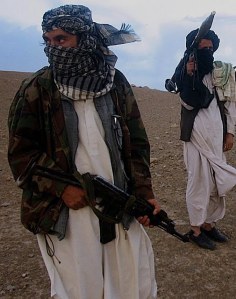 AS SOCIALISTS, we support the right of oppressed peoples to fight for self-determination unreservedly, just as we oppose imperialism, without caveat.
This perspective is generally accepted by the left without question in contexts such as Latin America or Africa, where bitter fights against U.S. and European imperialism have been fought and, in some cases, won.
Yet, when it comes to the Middle East and Afghanistan today there is suddenly much less clarity about what radicals and Marxists should be saying. Nowhere is that more evident than in the case of Afghanistan, which has suffered under the yoke of U.S. imperialism since 2001 (with active U.S. interference in the country since at least the 1970s).
The idea that the Taliban, as a movement fighting against U.S. occupation, is a force we should be supporting is, unfortunately, a somewhat controversial position to hold, even on the far left. This is a serious mistake and speaks both to the extent to which Islamophobia has penetrated the left, as well as to the lack of understanding of the social dynamics of an oppressed and devastated country like Afghanistan.
We are all familiar with the lies and excuses used to justify the invasion and occupation of Afghanistan in the wake of the September 11 attacks. Bush and his coterie of crooks and warmongers told us that only a military invasion could liberate the people, and especially the women, of Afghanistan from the brutal, misogynistic and “medieval” Taliban movement.
There was no mention, of course, of the substantial support offered to the Taliban regime in the late 1990s when Clinton was president and in the early days of the Bush presidency, nor of the long and ugly history of U.S. intervention in Central and South Asia, which was an important precondition for the rise of Islamism.
We should condemn unreservedly the oppression of women and the general social conservatism of the pre-2001 Taliban regime, as well, of course, as their efforts to cut deals with regional and global superpowers against the interests of the vast majority of Afghans. However, we must also unreservedly condemn the racism and Islamophobia used as an ideological fig leaf to justify invasion and imperialism, and it is the left’s weakness on this issue, which has blinded many to the new realities on the ground in Afghanistan.
Before addressing the important question of who the Taliban actually are, it is important to understand the material conditions Afghans face. Afghanistan is a devastated country. It is ranked at or near the bottom of a broad range of social indicators, such as levels of poverty, infant mortality, literacy, per capita income, prevalence of easily preventable diseases and so forth. Most major cities in Afghanistan, including the capital Kabul, are in ruins (despite claims of “reconstruction” by NATO imperialists) and decent roads, electricity, clean water, sanitation and basic social services are unheard of for most of the population, especially in the rural areas. The majority of the population ekes out a living on a subsistence basis, and the struggle for survival is the overarching concern for most Afghans.
In a nutshell, there is no Afghan working class or progressive petit bourgeoisie to speak of, and the major social classes (aside from the puppet regime and it’s assortment of bandits and thugs) are the poor peasantry and the Islamic clergy.
THE SIGNIFICANCE of this to a discussion of anti-imperialist resistance in Afghanistan should be obvious to any serious historical materialist. This question cannot be thought about in the abstract, it must be considered in light of the material realities on the ground. Such realities necessarily shape the kinds of social forces and the character of class struggle in that country and make it highly likely that any grassroots resistance will have a strongly religious character, given that the rural clergy are the only force capable of uniting the peasantry against the comprador ruling class.
The following point cannot be stressed enough; whilst the U.S. remains in Afghanistan, economic and social development will not occur much beyond current levels. This in turn means that the Taliban, as a broad-based movement of poor farmers and lower clergy, is the face of anti-imperialist resistance in Afghanistan for the foreseeable future.
To put it another way, if we, as avowed anti-imperialists, intend to wait around for a resistance movement that agrees with us on every issue, including the need to fight the oppression of women, gays, racial and religious minorities, etc., we’ll be waiting a long time. The Taliban is the resistance in Afghanistan and we must support it, critically, but unreservedly.
The Taliban that ruled Afghanistan prior to the U.S. invasion no longer exists. The U.S. and NATO routinely refer to any act of resistance as the work of the “Taliban” (meaning the followers of Mullah Omar), much as every act of resistance in Iraq was the work of “Baath loyalists.”
To be sure, there are attacks being carried out by people who support the former regime, but many, perhaps most, resistance fighters have no particular loyalty to the former leadership and some are actively hostile to it.
Anand Gopal, one of the few independent journalists actively trying to find out what is actually happening in Afghanistan has written some very useful and insightful work on this, and as he points out, the ranks of the Taliban have been swelled in recent years by rural peasants who have been radicalized as a result of US/NATO brutality, including the indiscriminate air attacks which have killed thousands of Afghans.
The Taliban are increasingly espousing a strong nationalist message and, in some cases, have substantially moderated their social conservatism in order to build a more broad-based and effective resistance movement.
It is also the case that the “Taliban” is effectively a blanket term for a coalition of groups, some drawn from the tiny strata of educated middle class Afghans, which aim to eject foreign troops from their country. In short, when the U.S. and its allies use the term “Taliban” they want us to think of public stonings, music bans and ultra-conservative clerics–and if we follow their lead we do a grave disservice to the Afghan resistance and only help to perpetuate Islamophobic caricatures of “crazed, bearded extremists.”
There is no fundamental difference between the liberation theology movements in South America and the popular Islamist resistance movements in the Middle East and Asia, movements such as Hezbollah, Hamas and the Taliban. To be sure, the former were less socially conservative, but as religiously colored grassroots resistance movements they are essentially the same kind of manifestation of class resistance.
The left needs to ask itself why it is much more critical of Muslims expressing class anger in a religious form than of South American Christians; to my mind, unexamined Islamophobia explains much of this discrepancy.

Karzai meets Chinese FM in Kabul
BRICS Post | February 23, 2014
Kabul’s China-policy will not alter, irrespective of the political situation, said Afghan President Hamid Karzai on Saturday.
Karzai was hosting Chinese Foreign Minister Wang Yi who arrived in Afghanistan on Saturday.
Wang said he made the visit in the crucial year of Afghanistan’s transition to underscore the importance of bilateral ties.
“We hope to see a broad-based and inclusive political reconciliation in Afghanistan as soon as possible, and China will play a constructive role to facilitate that,” he said.
“China firmly supports Afghanistan to realize a smooth transition and hopes Afghanistan’s general election will go ahead smoothly as scheduled. China is willing to keep close communication with Afghanistan and work hard to facilitate Afghanistan’s political reconciliation,” he added.
The Afghan government is trying to reassure foreign investors its economy will not sink following the NATO withdrawal. In their meeting on the sidelines of the Sochi opening in Russia earlier this year, Karzai asked Chinese President Xi Jinping to aid the restructuring of the war-torn nation.
During his visit Wang announced China will increase aid to help infrastructure projects, including the construction of school buildings in Kabul University, offering farm machinery and training classes to Afghan technicians.
“The Chinese government encourages and supports capable Chinese enterprises to invest in Afghanistan to strengthen cooperation with the Afghanistan side in trade, energy and other fields,” said Wang.
In 2007, Chinese mining companies announced the single biggest foreign investment in Afghanistan, a whopping $4 billion into developing a copper mine.
Mineral reserves in the country, including copper, gold, iron ore and rare earths, are estimated to be worth $1 trillion.
In a separate meeting with Rangin Dadfar Spanta, Karzai’s national security advisor, Wang stressed on security cooperation even as the Chinese government battles insurgency in the restive region of Xinjiang.
China lauded Afghanistan’s efforts to crack down on the East Turkestan Islamic Movement and other terrorist forces.
“China hopes both sides would continue strengthening such cooperation,” said Wang.
Spanta said as a good neighbor of China, Afghanistan will keep its policy to cooperate with China to fight the “three evil forces, ” including the East Turkestan Islamic Movement.
The US and its allies invaded Afghanistan on October 7, 2001 as part of Washington’s war on terror.
Related articles
Former Pakistani general says US seeks to ruin his country
Press TV – February 23, 2014
Retired Pakistani General Hamid Gul says the United States and its allies are seeking to destroy Pakistan by fueling insecurity in the country.
The former head of Pakistan’s Intelligence Service (ISI) alleged that Washington used the 9/11 attacks on the World Trade Center in New York City as a pretext to invade the neighboring Afghanistan.
The former Pakistani intelligence chief, who was often accused of collaborating with the Taliban militant group in Pakistan and Afghanistan, also stated that the United States has failed in Afghanistan and is now seeking to destroy Pakistan.
General Gul also pointed out that the US military will have to withdraw its troops from Afghanistan and follow the example of the former Soviet Union in accepting defeat after its military occupation of the country in the late 1970s.
The administration of Pakistani Prime Minister Nawaz Sharif has initiated a negotiating process with the pro-Taliban militants in an effort to end the violence in the country.
There are speculations that the negotiations may not succeed as the militants have set tough conditions for the talks.
Pakistan has been gripped by deadly violence since 2001, after Islamabad joined the so-called US war on terror. According to official Pakistani sources, nearly 50,000 people have lost their lives in fatal attacks across the country ever since.
CIA seeks new bases for deadly drones
Press TV – February 17, 2014
The US Central Intelligence Agency is seeking new drone bases in unnamed countries in Central Asia, fearing the full withdrawal of US troops from Afghanistan would affect the targeted killings in neighboring Pakistan.
The spy agency asserts that if the US fails to sign a bilateral security deal with Afghanistan and secure an enduring military presence there, it would not be able to fly drones from its Afghan bases because drone operations are covert and need US military protection.
The security deal, which Washington says “ought to be signed” and is not renegotiable, could allow thousands of US troops to stay in Afghanistan beyond 2014.
However, despite pressures from the White House and Congress, Afghan President Hamid Karzai has so far refused to sign the deal and the US intelligence community is hoping that the next Afghan president will agree to sign it.
Worried that its drone killings can become a casualty of strained relations between Kabul and Washington, the CIA is reportedly making contingency plans to use bases in other countries.
“There are contingency plans for alternatives in the north,” an unnamed US official briefed on the matter told the Los Angeles Times without specifying the countries.
According to Brian Glyn Williams, a University of Massachusetts professor, the CIA and the Pentagon used to fly drones from an airbase in Uzbekistan until the US was evicted in 2005.
Michael Nagata, commander of US special operations in the Middle East and Central Asia, also traveled last month to Tajikistan, which is Afghanistan’s northern neighbor, to discuss “issues of bilateral security cooperation” and “continued military cooperation.”
Meanwhile, US officials say a new jet-powered drone, called Avenger, which will be able to “get to ‘hot’ targets in Pakistan much faster,” could soon be flying from bases outside Afghanistan.
The CIA is in charge of drone strikes in Pakistan since the country is not officially a war zone and the CIA’s program is covert.
US President Barack Obama has already stated that the responsibility for Washington’s deadly drone attacks could gradually shift from the CIA to the Pentagon. However, the idea of putting the US military in charge of drone attacks is not favored by US lawmakers.
US scraps ‘glossy propaganda’ plans for Afghanistan aid projects
RT | February 14, 2014
A US federal agency that sought to pay photographers for “positive images” of its work in Afghanistan has canceled the program. The project, created to combat negative news coverage, collapsed amid charges that the effort amounted to propaganda.
Using US$1 billion on aid programs in Afghanistan, the US Agency for International Development (USAID) solicited proposals on Monday for a project that aimed to “help inform Afghans about the assistance American taxpayers are providing,” an anonymous USAID official told USA Today of Thursday’s decision.
“The wording of the (request) did not appropriately articulate that purpose and is being re-evaluated,” the official said.
In addition to targeting Afghans, the program was intended to gather support in the United States for USAID initiatives in Afghanistan. Over 12 years old, the war in Afghanistan is highly unpopular with the American public, if the war can be called an issue of popular awareness at all. A CNN poll released at the New Year found record low 17 percent support for the ongoing efforts in Afghanistan.
The proposal was quickly criticized by a public advocacy group as a blatant hype campaign.
“USAID should instead be focusing on accomplishing mission goals, not glossy propaganda,” said Scott Amey, general counsel for the Project on Government Oversight, a non-partisan government watchdog organization. “Waste, fraud, and poor performance have already resulted in billions being lost, let’s not throw additional money down the drain.”
The agency called the budding program one that would serve to show positive influences of US aid in the war-torn country amid the “negative” images usually shown by news organizations.
“USAID is executing the most massive US international assistance campaign ever, and the gains particularly in health and education have been impressive, yet the overwhelming majority of pictures recording that effort are negative, and at least to some extent misleading,” the solicitation reads. “This is because professional photographers working for news agencies are the prime source of high-quality images of USAID work in Afghanistan. News photographs by their very nature focus on the negative.”
Top objectives of the project included countering negative representations of Afghanistan, distributing those images through USAID social media, and to establish a long-term contract that would continually provide such images “to conventional media and directly to the US public.”
USAID also sought to influence American thought on efforts in Afghanistan.
“The US and Afghan publics require accurate, well-balanced information about USAID work abroad,” the proposal states. “Currently, this requirement is not being met in Afghanistan.”
USAID did not disclose how much contract photographers would earn for the photos.
The announcement of the “positive image” proposal on Monday came alongside the unveiling of three new USAID development programs worth almost $300 million to wean Afghanistan off its ‘war economy,’ which is heavily subsidized today by opium exports – a trade that had been practically squashed while the country was under Taliban rule.
Under the USAID initiative, $125 million will go to reviving Afghanistan’s food and farm sector, and another $77 million to opening up the country to greater international trade and investment. The last program, valued at about $100 million, would seek to assist Afghanistan’s educational system.
A report released late last month by the Special Inspector General for Afghanistan Reconstruction (SIGAR) found that Afghanistan cannot be trusted to properly spend the millions of dollars it receives in aid from the United States. The report found that none of Afghanistan’s 16 ministries could be entrusted with USAID funds without high risk of that assistance being stolen or wasted.
In September, the SIGAR chastised USAID for poor oversight of money the agency spent there. A SIGAR report highlighted how USAID gave over $230 million to the Afghan Ministry of Health with little guidance for how the money was to be spent.
“Despite financial management deficiencies at the Afghan Ministry of Public Health, USAID continues to provide millions of US taxpayer dollars in direct assistance with little assurance that the (ministry) is using these funds as intended,” according to the SIGAR report.
Meanwhile, after a long, protracted struggle that sought to convince Afghanistan President Hamid Karzai to approve a security deal, the US is considering leaving the issue suspended until the Afghan presidential elections in April in order to address Karzai’s successor.
The Obama administration has long hoped to get the long-lasting bilateral security deal with Kabul signed by the end of 2013, yet Karzai has refused to take responsibility for leaving a several thousand-strong US military contingent in the country beyond 2014.
Pentagon Leads PR Campaign to Counter Critical Inspector General Reports on Afghanistan
By Noel Brinkerhoff and Danny Biederman | AllGov | February 6, 2014
Frustrated by numerous reports criticizing U.S. spending in Afghanistan, the Department of Defense has launched a public relations campaign aimed at countering the work of the Special Inspector General for Afghanistan Reconstruction (SIGAR). That watchdog agency is charged with overseeing the military’s $96.5 billion reconstruction program in Afghanistan.
John Sopko, the head of SIGAR, has upset military commanders by frequently reporting on million-dollar programs that haven’t panned out or failed to account for missing American tax dollars.
One recent example involved a hospital in northeastern Afghanistan costing $600,000 that lacked adequate water, sewer, electrical, and heating systems—and was vulnerable to collapsing in an earthquake, according to SIGAR.
The U.S. military countered SIGAR’s report by issuing a news release that praised the hospital and even rejected some of the critical findings.
Somehow, the military came to these conclusions even though the Army hadn’t inspected the hospital in months because the insurgency made the area too dangerous to visit.
In addition to putting out press releases, the military has crafted an in-house strategy for dealing with SIGAR’s negative reports. This plan was revealed in a slide presentation, a copy of which was obtained by USA Today, that stated the goal was to “[build] the right combination of ammunition to achieve desired effects on a specified target.”
That target was Sopko, who was mentioned in the presentation during a hunting analogy: “In the past we may have shot where we saw the duck, but now, with our plan of action—we will bag our limit of birds before Mr. Sopko wakes up to feed his dogs.”
When informed of the anti-SIGAR campaign, Sopko told the newspaper: “It’s disappointing to see that funds appropriated by Congress are being used by elements of the Department of Defense to misrepresent the work of an independent inspector general. American taxpayers would be better served if ISAF [International Security Assistance Force] spent less time writing misleading press releases and more time fixing the problems we’ve identified.”
SIGAR spokesperson Philip LaVelle shares his boss’s concerns. “Let me get this straight,” he recently said to the Los Angeles Times. “They’re complaining we’re telling the American people how their tax dollars are being spent? The public has a right to know and we have a duty to tell them — and we intend to keep doing just that.”
Since 2008, SIGAR’s investigations have resulted in 56 criminal convictions or guilty pleas, involving nearly three dozen civilians and members of the U.S. military, along with 21 Afghans.
The Pentagon’s overall public relations campaign—exercised at home and abroad—grew by 63% during a five-year period since 2004, reaching $4.7 billion in 2009, according to Defense Department budgets and other documents produced that year. The budget included the employment of 27,000 people to handle public relations, advertising and recruitment.
The military’s budget for outreach and media amounts to 1% of the total Pentagon budget, according to Fox News.
To Learn More:
The Pentagon’s PR War Against SIGAR (by Neil Gordon, Project On Government Oversight)
Military Yanks Leash of Critical Government Watchdog (by Tom Vanden Brook, USA Today)
U.S. Embassy in Kabul Defends Itself Against Blistering Fraud Reports (by David Zucchino, Los Angeles Times)
Pentagon Spending Billions on PR to Sway World Opinion (Fox News)
Harsh Inspector General Report Says 0 of 16 Afghan Agencies can be Trusted with U.S. Aid (by Noel Brinkerhoff and Danny Biederman, AllGov)
U.S.-Led Military Unit in Afghanistan Lost $230 Million in Spare Parts, Then Spent $138 Million for More (by Noel Brinkerhoff, AllGov)
U.S. Paid $6.8 Million to “Maintain” Non-Functioning Afghan Police Vehicles (by Noel Brinkerhoff, AllGov)
Karzai sees ‘no good’ with US presence in Afghanistan
Press TV – February 3, 2014
Afghan President Hamid Karzai says he has seen “no good” with the presence of American forces in his country, prompting further speculations of a breakdown of trust between Kabul and Washington.
“This whole 12 years was one of constant pleading with America to treat the lives of our civilians as lives of people,” Karzai said in an interview with The Sunday Times.
Karzai also said that he has not spoken to US President Barack Obama since June last year, which may show the increasing gulf between Afghanistan and the US.
“We met in South Africa but didn’t speak. Letters have been exchanged,” he said, referring to the funeral ceremony for South African anti-Apartheid leader Nelson Mandela.
The differences between the two sides have grown increasingly since Karzai refused to sign a security pact with Washington that would allow thousands of foreign troops to stay in Afghanistan after 2014.
“The money they should have paid to the police they paid to private security firms and creating militias who caused lawlessness, corruption and highway robbery,” Karzai said.
The Afghan president also went on to say that the US-led forces “then began systematically waging psychological warfare on our people, encouraging our money to go out of our country.”
“What they did was create pockets of wealth and a vast countryside of deprivation and anger,” he said.
“In general, the US-led NATO mission in terms of bringing security has not been successful, particularly in Helmand,” Karzai said.
He also dismissed concerns about the cutting of Western financial aid to Afghanistan over his refusal to sign the security deal.
“Money is not everything,” he said, adding, “If you ask me as an individual, I would rather live in poverty than uncertainty.”
On Wednesday, US Defense Secretary Chuck Hagel expressed deep frustration with Karzai over the prolongation of the review process for the signing of the Bilateral Security Agreement (BSA) with the US.
The Pentagon chief, however, stated that Karzai is the elected president of a sovereign country, and Washington’s ability to influence his decisions is limited.
Karzai says he will not sign the BSA until certain conditions are met, including a guarantee from Washington that there will be no more raids on Afghan houses. He says the demands come from the country’s highest decision-making body, the Loya Jirga.
In his speech at the Loya Jirga on November 24, 2013, Karzai said, “If US military forces conduct military operations on Afghan homes even one more time, then there will be no BSA and we won’t sign it.”
The US and its allies invaded Afghanistan on October 7, 2001 as part of Washington’s so-called war on terror. The offensive removed the Taliban from power, but after more than 12 years, the foreign troops have still not been able to establish security in the country.
Featured Video

Why Hamas Really Attacked Israel on Oct. 7
or go to
Aletho News Archives – Video-Images
From the Archives
Israel: Strategic Ally or Liability?
By Stephen Sniegoski | My Catbird Seat | June 12, 2010
The claim that Israel serves as a valuable ally for the United States is made by both pro-Zionists and much of the anti-war and anti-Zionist Left that is influenced by Noam Chomsky. As a result of the Gaza flotilla massacre, which has caused a world-wide uproar against Israel, the value of Israel to the United States is being publicly questioned in more mainstream foreign policy forums. … continue
Blog Roll
 Aletho News
- Why Hamas Really Attacked Israel on Oct. 7
- Declassified UK exposes British man who fought for ‘Israel’ in Gaza
- West’s death cult in a theater near you
- How the Yandex ‘Russian bots’ lie fell apart
- Burnham’s ‘Russia did Brexit’ ruse crumbles
- Estonia making movies and games to encourage war against Russia
- Four in five new UK jobs taken by foreigners – report
- Here’s what Trump’s latest U-turn really means for Russia and Ukraine
- The Houthis Are Not an Iranian Proxy
- Europe’s Energy Hypocrisy, Russian LNG Profits and US Dependence
- If Americans Knew
- Activists Abused By Israel Return to New Freedom Flotilla Mission
- 60 Minutes won’t tell the full truth about Israeli settler violence
- Nearly 50,000 women, girls killed or severely injured in Gaza since October 2023: UN Women
- ADL is working with AI companies to suppress alleged ‘antisemitism’
- Israeli occupation forces using social media surveillance unit to target hundreds of Palestinians in the West Bank
- Israel’s New – and Terrifying – Security Doctrine
- Israeli Attacks Kill Five in Gaza, Including a four-year-old and a woman
- Air Force Major Who Called for Trump’s Impeachment Held in Solitary Confinement
- It’s a Genocide, I’m Into It’: Seinfeld Mocks Protest over Palestinian Children Killed
- Universities fire dozens amid pressure from Zionist billionaires
- No Tricks Zone
- New Study Suggests Large Regions Of The Pacific Ocean Have Been Cooling For The Last 80 Years
- Germany’s Green Energy Debacle: High Energy Costs Force Kahla Porzellan to Close After 182 Years!
- New Study: 50 Years Of The Most Aggressive ‘Net Zero’ Policies Can Only Affect The Global Climate By 0.03°C
- US September “Heat” Was No Record…Many Records Set Decades Ago
- Latest European Green Energy Debacle; Portugal’s Largest Flagship Solar Park Insolvent!
- Green Energy Debacle: German Expert Professor Fritz Vahrenholt Warns Of Severe Economic And Social Consequences
- Two More Paleo Reconstructions Affirm Meters-Higher Sea Levels Across Ireland, Brazil 7000-6000 Years Ago
- New Study: Earth And Venus Surface Warmth Largely Explained By Convection And Lapse Rate, Not CO2 Or Radiation
- 2025 Nature Paper Claiming Worsening Global Drought Gets RETRACTED …Heavily Flawed
- New Study: ‘Global Drought Shows No Detectable Recent Acceleration Under Climate Warming’

