Bowe Bergdahl and the Moral Rot of American Exceptionalism
By Winston Warfield | CounterPunch | June 6, 2014
“The future is too good to waste on lies,” Bowe wrote. “And life is way too short to care for the damnation of others, as well as to spend it helping fools with their ideas that are wrong. I have seen their ideas and I am ashamed to even be american (sic). The horror of the self-righteous arrogance that they thrive in. It is all revolting.”
From “America’s Last Prisoner of War”, by Michael Hastings. Rolling Stone, June 7, 2012
Nothing exposes the decadence of American militarism and the ideology of American exceptionalism better than the explosion of emotion sweeping the internet, Congress and the news media over the prisoner exchange of Bowe Bergdahl for five Taliban. He is being vilified as a deserter and personally responsible for the deaths of fellow soldiers missioned to find him. The American right-wing located in the Republican party, some liberals like Chris Matthews and Dianne Feinstein and some of his fellow soldiers are all calling for his head in a display of vengeful nastiness bordering on psychotic. Bergdahl’s motivations for walking away from the bizarre U.S. counterinsurgency expedition in Afghanistan, a “dirty war” seemingly without purpose or end, are being lost in the fog of infantile political temper tantrums.
Bergdahl was according to an in-depth Rolling Stone article in 2012 by the late Michael Hastings, an exceptionally competent and motivated soldier during training, serious about preparing himself for combat. So serious and competent, that his fellow soldiers kidded him about being too gung-ho. He was moved in part by what he had read or viewed of reports of atrocities against civilians by the Taliban and other jihadist groups in other countries. His was an honest and heartfelt desire to “serve and protect” the poor and destitute in conflict zones. He was a highly-motivated foot soldier for “humanitarian imperialism”, the perfect youthful idealist falling for the good-vs-evil fairy tale of American exceptionalism.
Bergdahl’s disillusionment started as soon as he joined the U.S. Army, and found that his unit was incompetent to the point of being dysfunctional. The leadership problems and motivation issues never were really resolved in training, and only intensified after deployment to Paktia Province, one of the more volatile and dangerous areas in Afghanistan. He describes an 8-hour mission in an email home to his parents which turned into an extreme military FUBAR (fucked up beyond all recognition), where he and his unit spent multiple days stranded in enemy territory due to what in his view was leadership and bureaucratic incompetence. In a supreme irony, this is the same province in which Pat Tillman, the former Arizona Cardinal football player who joined the Army Rangers out of idealistic and self-sacrificing patriotism, was killed by members of his own unit in a notorious “friendly-fire” incident. That was the result of grossly negligent decision-making on the part of his chain-of-command which committed the cardinal sin of splitting up his unit while similarly stranded, as reported in Counterpunch.
From the Hastings article, Bergdahl’s views seem to go beyond the usual soldierly complaints into an angry indictment of careerism and “covering-your-ass” incompetence:
“Three good sergeants, Bowe said, had been forced to move to another company, and ‘one of the biggest shit bags is being put in charge of the team.’ His battalion commander was a ‘conceited old fool.’ The military system itself was broken: ‘In the US army you are cut down for being honest… but if you are a conceited brown nosing shit bag you will be allowed to do whatever you want, and you will be handed your higher rank… The system is wrong. I am ashamed to be an american. And the title of US soldier is just the lie of fools.’ The soldiers he actually admired were planning on leaving: ‘The US army is the biggest joke the world has to laugh at. It is the army of liars, backstabbers, fools, and bullies. The few good SGTs are getting out as soon as they can, and they are telling us privates to do the same.’”
Bergdahl’s vehemently critical attitude toward his chain-of-command is familiar to many enlisted soldiers who served in the Vietnam War. Officers, especially field-grade, were viewed with deserved contempt, with some exceptions, as corrupt and incompetent careerists who avoided personal risk. The assault on Hill 937, which came to be known as “Hamburger Hill” is one of the more notorious incidents, where soldiers were gratuitously sacrificed by officers in the rear. In what came to be called in the black humor of the soldier “ticket punching”, these kinds of officers were scorned for their career-building tours in Vietnam only to get the necessary medals for upward advancement.
It isn’t clear from Bergdahl’s personal history in the Rolling Stone article whether he joined the Army due to economic difficulties, the “poverty draft” as it’s called. It may have played a role. His parents were certainly not wealthy or privileged, earning an annual income of only $7000 one year according to Hastings.
He did have other personal motivations for wanting to become a soldier, revealing some of the more telling features of militarized American culture, where ignorance of history and the world outside, especially among youth, even those with strong ethical senses, yields startling contradictions. He at one point unsuccessfully tried to join the French Foreign Legion as a mercenary, probably unaware or willfully ignorant of its savage and ruthless record in French imperial history. That ignorance and historic amnesia is coupled with a desire to express one’s youthful need for excitement and adventure by joining the military, and in essence acquiring that excitement by deploying across the planet to combat zones. In the society of the spectacle, where young Americans are immersed in an entertainment culture, the world becomes a theme park or giant (real) video contest, where they can overcome their boredom in a spiritually dead consumerism by testing themselves in what they view as heroic combat in other people’s countries, riding to their rescue. The “others” in those countries in essence become two-dimensional cutouts or foils for a live-action videogame with real risks and danger and excitement. The suffering resulting from American military occupation is not part of the consciousness, and rarely is noticed by soldiers immersed in the demands of survival against lethal dangers. It is instead often replaced with resentment and hatred for the ungrateful locals who either support the insurgents or are caught between them and American forces.
But this isn’t always so, for some don’t lose their moral compass and independent intellect, even in the stifling culture of the military, where mental activity is supposed to be totally directed at focused attention on the mission. Questioning that mission is heresy. As the saying goes in the military, “Those things are ‘way above my pay grade”. Bergdahl was one of those exceptions, a soldier who observed his situation with a critical eye, spent down time reading, and was prone to measuring the stated mission of the U.S. occupation and counterinsurgency, “winning hearts and minds” against actual behavior of his fellow soldiers. It was this independence and strong moral sense that would get him into trouble and set off a political firestorm.
While Bergdahl was motivated initially in part by the desire for adventure, and to escape the confines of small-town Hailey, Idaho and the isolating regime of family life in a religious household, he brought his apparently strong ethical upbringing into the military. He was home-schooled by strict sort of hippie Christian fundamentalist parents who lived mostly off-the-grid, and he got a strong education in ethics and morality, studying Thomas Aquinas and St. Augustine. Ironically considering the left-right political paradigm in America, where Christian fundamentalism is viewed as a monolithic ideological construct on the right of the spectrum, the hatred and vitriol directed at him comes mostly (but not exclusively) from the right while his moral and ethical development took place in what could be argued was a Christian fundamentalist home.
In a letter his father wrote, from the Rolling Stone article, he advised his son:
“‘Dear Bowe,’ he wrote. ‘In matters of life and death, and especially at war, it is never safe to ignore ones’ conscience. Ethics demands obedience to our conscience. It is best to also have a systematic oral defense of what our conscience demands. Stand with like minded men when possible.’ He signed it simply ‘dad.’”
There’s another name for the neutral and dispassionate word “counterinsurgency”, or, in our western culture in love with acronyms, “COIN”. It’s “dirty war”, which is a more accurate label for the bitter, ruthless struggle between occupiers and occupied. By now, even with the historic amnesia of the “putting Vietnam behind us” mantra of the national storytellers, the nature of COIN remains the same. Occupation forces are obliged to ferret out insurgents “by whatever means necessary”, tantamount to terror, which includes nocturnal home invasions, “enhanced interrogation” (a.k.a. modernized torture), drone strikes on village compounds, occasionally weddings and funerals (by mistake of course – we never know for sure), and the ruthless practice of sometimes firing missiles into crowds of what we would call “first responders”, the Afghani equivalent of cops, firefighters and ambulances. Insurgents of course respond with ambush and mine warfare (IED’s) against occupation forces and their own brand of terror directed against collaborators.
Not surprisingly, many occupation soldiers, carrying in their heads the bright, shining lie of American benevolence and purity (and by extension their own), bedeviled by constant pressure from an unseen enemy and a civilian population unable or unwilling to cooperate, soon develop very negative attitudes toward those whom they thought they were “saving”. Atrocity stories about American soldiers murdering women and children, desecrating corpses and so forth start percolating into the national consciousness, like skunks at a garden party. Bergdahl hinted at this sinister attitude starting to develop in his own unit in Hasting’s article:
“In the second-to-last paragraph of the e-mail, Bowe wrote about his broader disgust with America’s approach to the war – an effort, on the ground, that seemed to represent the exact opposite of the kind of concerted campaign to win the ‘hearts and minds’ of average Afghans envisioned by counterinsurgency strategists. ‘I am sorry for everything here,’ Bowe told his parents. ‘These people need help, yet what they get is the most conceited country in the world telling them that they are nothing and that they are stupid, that they have no idea how to live.’ He then referred to what his parents believe may have been a formative, possibly traumatic event: seeing an Afghan child run over by an MRAP. ‘We don’t even care when we hear each other talk about running their children down in the dirt streets with our armored trucks… We make fun of them in front of their faces, and laugh at them for not understanding we are insulting them.’
Bowe concluded his e-mail with what, in another context, might read as a suicide note. ‘I am sorry for everything,’ he wrote. ‘The horror that is america is disgusting.’”
This remarkable statement comes from a formerly highly-disciplined soldier, trained to carry a SAW (squad automatic weapon) into combat, by all accounts what the national mythology reveres, a poster-boy for the new secular religion of American exceptionalism . It is also what no doubt has driven its true believers and priests into enraged apoplexy, including some in his own unit and possibly many veterans. The rage has turned into an avalanche of hate on social media, intimidating parade organizers in his hometown into cancelling his homecoming.
Yet disaffection in the ranks is not new with Bergdahl. The tragic friendly-fire death of one Pat Tillman, who America fell in love with after he sacrificed a lucrative National Football League career to join the Army Rangers after 9-11, gives us a glimpse into this dissonance. In March 2003 he told his buddy Spc. Russell Baer while serving in Iraq, in a quote which went viral over the internet, “You know, this war is so fucking illegal.” His accidental death in Afghanistan in a botched mission at the hands of his fellow soldiers was assiduously covered up by the military and Bush administration, until through the struggle for truth by his own family it could no longer be. His journal which he kept disappeared.
The discord within the military and veteran community finally coalesced organizationally into resistance through the formation of Iraq Veterans Against the War (IVAW) in July 2004 at the annual convention of Veterans for Peace in Boston. IVAW opened its doors to American veterans of the occupation of Afghanistan in 2009. The public disclosure of dissent by veterans, and especially active-duty members, is highly sensitive in this militarized culture and in certain high-profile cases like Bergdahl’s is immediately attacked. The true believers in American mythology, many veterans who have experienced much pain and loss as a result of their military service, are unable to tolerate this kind of dissent, for it raises agonizing questions, “Was it all in vain? Was I used for ulterior motives by my own government?” and lash out at dissenters. They are rounded up by clever political operatives and used to build campaigns of intimidation. This is what is happening now as the established political parties and their corporate media allies attempt to quash dissent.
What must be alarming to those depending on a reliable military for power projection in the neoliberal project of policing the world, is the specter of resistance in the military. During the invasion and occupation of Vietnam an intense, wide and deep GI resistance movement developed which ultimately played a crucial role in bringing the war to an end. This resistance in the military is brilliantly described in David Cortright’s “Soldiers in Revolt”, but has been mostly erased from national memory in the selective amnesia referred to as “putting Vietnam behind us.”
One of the main reasons for the initiation of the all-volunteer military after the debacle in Vietnam was to eliminate the problem of draftees in the military and general draft resistance. It was thought that most of the GI resistance was within the ranks of disgruntled draftees, but this assumption, which has become unquestioned, is declared by Cortwright to be completely untrue. He says, referring to those days:
“Of course, the end of conscription did not halt the GI resistance movement. The assumption that the U.S. military would be free of dissension, that volunteers would be more docile and acquiescent than draftees, proved wrong. In fact, the GI movement had always been primarily a movement of enlistees, and filling the ranks with volunteers thus actually increased the likelihood of internal dissent.”
The political class knows the importance keeping control of the military and thus the story coming out of occupations. All the soldiers in the current occupations are enlisted. Bergdahl’s anguish and desperate escape, especially his reasons, will be snuffed by the orchestrated outrage and “debate” over whether or not he should be deemed a deserter and whether the prisoner swap was a good or bad deal and who is to blame if it’s seen as “bad”. Republican political ambitions will be resurrected by attempts to paint whoever has to preside over the defeat in Afghanistan as “appeasement”. The underlying issues of the criminality of these occupations which Bergdahl’s act called into question cannot be allowed into the discussion.
Winston Warfield is a member of the Smedley D. Butler Brigade of Veterans for Peace, in Boston.
Hillary Clinton and the Weaponization of the State Department
By JP Sottile | News Vandal | June 5, 2014
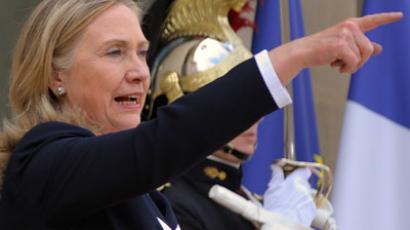
On May 23, 2012, then-Secretary of State Hillary Clinton went to the Special Operations Forces Industry Conference (SOFIC) trade show in Tampa, Florida to share her vision of “smart power” and to explain the State Department’s crucial role in extending the reach and efficacy of America’s growing “international counterterrorism network.”
First, there is such a thing as a “Special Operations Forces Industry Conference trade show.” Without some keen reporting by David Axe of Wired, that peculiar get-together might’ve flown completely under the radar—much like the shadowy “industry” it both supports and feeds off of like a sleek, camouflaged lamprey attached to a taxpayer-fattened shark.
Second, “special operations” have officially metastasized into a full-fledged industry. United States Special Operations Command (USSOCOM) is located at MacDill Air Force Base in Tampa and, therefore, conveniently located near the special operations trade show, which happened again this year at the Tampa Convention Center. The theme was “Strengthening the Global SOF Network” and the 600,000-square-foot facility was filled with targets of opportunity for well-connected and well-heeled defense contractors.
According to the SOFIC website, this year’s conference afforded attendees “the opportunity to engage with USSOCOM Program Executive Officers, Science and Technology Managers, Office of Small Business Programs and Technology & Industry Liaison Office representatives, and other acquisition experts who will identify top priorities, business opportunities, and interests as they relate to USSOCOM acquisition programs.”
Third, Hillary’s widely-ignored speech marked a radical departure from the widely-held perception that the State Department’s diplomatic mission endures as an institutional alternative to the Pentagon’s military planning. Instead, Secretary Clinton celebrated the transformation of Foggy Bottom into a full partner with the Pentagon’s ever-widening efforts around the globe, touting both the role of diplomats in paving the way for shadowy special ops in so-called “hot spots” and the State Department’s “hand-in-glove” coordination with Special Forces in places like Pakistan and Yemen.
Finally, with little fanfare or coverage, America’s lead diplomat stood before the shadow war industry and itemized the integration of the State Department’s planning and personnel with the Pentagon’s global counter-terrorism campaign which, she told the special operations industry, happen “in one form or another in more than 100 countries around the world.”
If this isn’t entirely unexpected, consider the fact that under then-Secretaries of State Colin Powell and Condoleezza Rice, the State Department fought attempts by the Pentagon to trump its authority around the globe and, as reported by the Washington Post, “repeatedly blocked Pentagon efforts to send Special Operations forces into countries surreptitiously and without ambassadors’ formal approval.”
But that was before Hillary brought her “fast and flexible” doctrine of “smart power” to Foggy Bottom and, according to her remarks, before she applied lessons learned from her time on the Senate Armed Services Committee to launch the first-ever Quadrennial Diplomacy and Development Review, which she modeled on the Pentagon’s Quadrennial Defense Review. That Pentagon-style review spurred the creation of the Bureau of Conflict and Stabilization Operations to “advance the U.S. government’s foreign policy goals in conflict areas.”
According to a Congressional Research Service analysis, the initial intent of the Conflict Bureau was to replace the ineffectual Office of the Coordinator of Reconstruction and Stabilization, which was created in 2004 to help manage “stabilization” efforts in two nations the U.S. was actively destabilizing—Afghanistan and Iraq.
But the new, improved bureau does more than just react to messes made by unlawful invasions or direct costly remediation efforts in war zones—it also collaborates with “relevant partners” in the Department of Defense and NATO “to harmonize civilian and military plans and operations pertaining to conflict prevention, crisis response, and stabilization.”
This integrated relationship between State and Defense was confirmed by U.S. Special Operations chief Admiral William McRaven shortly after Hillary’s speech. When asked about the “unlikely partnership,” McRaven assured DefenseNews that SOCOM has “an absolutely magnificent relationship with the State Department” and that SOCOM doesn’t “do anything that isn’t absolutely fully coordinated and approved by the U.S. ambassador and the geographic combatant commander.”
As David Axe aptly described it in Wired, “Together, Special Operations Forces and State’s new Conflict Bureau are the twin arms of an expanding institution for waging small, low-intensity shadow wars all over the world.”
In fact, during Hillary’s time as America’s chief diplomat, the State Department embraced the shadowy edge of U.S. foreign policy where decision-makers engage in activities that look like war, sound like war and, if you were to ask civilians in places like Yemen and Pakistan, feel a lot like war, but never quite have to meet the Constitutional requirement of being officially declared as war.
The Whole-of-Government Shift
Once upon a time, “low-intensity shadow wars” were the Congressionally-regulated bailiwick of the Central Intelligence Agency. But 9/11 changed everything. However, the excesses of the Bush Administration led many to hope that Obama could and would change everything back or, at least, relax America’s tense embrace of “the dark side.”
Although the new administration did officially re-brand “The War on Terror” as “Overseas Contingency Operations,” Team Obama employed an increasingly elastic interpretation of the 9/11-inspired Authorization for Use of Military Force and expanded covert ops, special ops, drone strikes and regime change to peoples and places well-beyond the law’s original intent, and certainly beyond the limited scope of CIA covert action.
Obama’s growing counter-terrorism campaign—involving, as Secretary Clinton said, “more than 100 countries”—took flight with a new, ecumenical approach called the “Whole-of-Government” strategy. Advanced by then-Secretary of Defense Bill Gates and quickly adopted by the new administration in early 2009, this strategy catalyzed an institutional shift toward inter-agency cooperation, particularly in the case of “state-building” (a.k.a. “nation building”).
During remarks to the Brookings Institution in 2010, Secretary Clinton explained the shift: “One of our goals coming into the administration was… to begin to make the case that defense, diplomacy and development were not separate entities, either in substance or process, but that indeed they had to be viewed as part of an integrated whole and that the whole of government then had to be enlisted in their pursuit.”
Essentially, the Whole-of-Government approach is a re-branded and expanded version of Pentagon’s doctrine of “Full-Spectrum Dominance.” Coincidentally, that strategy was featured in the Clinton Administration’s final Annual Report to the President and Congress in 2001. It defined “Full-Spectrum Dominance” as “an ability to conduct prompt, sustained, and synchronized operations with forces tailored to specific situations and possessing freedom to operate in all domains—space, sea, land, air, and information.”
In 2001, Full-Spectrum Dominance referred specifically to 20th Century notions of battlefield-style conflicts. But the “dark side” of the War on Terror stretched the idea of the battlefield well-beyond symmetrical military engagements. “Irregular warfare” became the catchphrase du jour, particularly as grinding campaigns in Afghanistan and Iraq exposed the reality that the full spectrum still wasn’t enough.
An assessment by the Congressional Research Service identified the primary impetus for the Whole-of-Government “reforms” embraced by Team Obama as the “perceived deficiencies of previous inter-agency missions” during the military campaigns in Afghanistan and Iraq. Those missions failed to address a myriad of problems created—culturally, economically and politically—by the wholesale bombing and occupation of those countries. The Full-Spectrum was half-baked. Lesson learned.
But the lesson wasn’t that the U.S. should avoid intervention, regime change or unleashing nascent civil, ethnic or religious conflicts. Instead, the lesson was that the “Whole-of-Government” must be marshaled to fight a worldwide array of Overseas Contingency Operations in “more than 100 countries.”
This Whole-of-Government shift signaled a renewed willingness to engage on variety of new fronts—particularly in Africa—but in a “fast and flexible” way. With other agencies—like the State Department—integrated and, in effect, fronting the counter-terrorism campaign, the military footprint becomes smaller and, therefore, easier to manage locally, domestically and internationally.
In some ways, the Whole-of-Government national security strategy is plausible deniability writ-large through the cover of interagency integration. By merging harder-to-justify military and covert actions into a larger, civilian-themed command structure, the impact of the national security policy overseas is hidden—or at least obfuscated—by the diplomatic “stabilization” efforts run through the State Department—whether it’s the Conflict Bureau working against Joseph Kony’s Lord’s Resistance Army in Central Africa, “stabilizing” post-Gaddafi Libya or spending $27 million to organize the opposition to Bashar al-Assad’s Syrian regime.
The Pass Key
The cover of diplomacy has traditionally been an effective way to slip covert operators into countries and the State Department’s vast network of embassies and consulates still offers an unparalleled “pass-key” into sovereign nations, emerging hot spots and potential targets for regime change. In 2001, the Annual Report to the President and Congress foresaw the need for more access: “Given the global nature of our interests and obligations, the United States must maintain the ability to rapidly project power worldwide in order to achieve full-spectrum dominance.”
Having the way “pre-paved” is, based on Hillary’s doctrinal shift at State, a key part of the new, fuller-spectrum, Whole-of-Government, mission-integrated version of diplomacy. At the SOFIC’s Special Operations Gala Dinner in 2012, Hillary celebrated the integration of diplomatic personnel and Special Operations military units at the State Department’s recently created Center for Strategic Counterterrorism Communications—a “nerve center in Washington” that coordinates “military and civilian teams around the world” and serves “as a force multiplier for our embassies’ communications efforts.”
As with most doors in Washington, that relationship swings both ways and mission-integrated embassies have served as an effective force multiplier for the Pentagon’s full spectrum of activities, particularly around Africa.
In his 2011 testimony before the House Foreign Affairs Committee Subcommittee on Africa, Deputy Assistant Secretary of State for African Affairs Don Yamamoto noted that State had “significantly expanded the number of DoD personnel who are integrated into embassies across the continent over the past three years,” and read a surprisingly long laundry list of collaborative efforts between State and the United States Africa Command (AFRICOM), including: “reduction of excess and poorly secured man-portable air defense systems (MANPADS); Defense Sector Reform in Liberia, DRC, and South Sudan; counterpiracy activities off the Somali coast; maritime safety and security capacity building; and civil-military cooperation.”
It seems that “civil-military cooperation” is a primary focus of the State Department in Africa. Most notably, Yamamoto told Congress that “embassies implement Department of State-funded Foreign Military Financing (FMF) and International Military Education and Training (IMET) programs, which further U.S. interests in Africa by helping to professionalize African militaries, while also assisting our African partners to be more equipped and trained to work toward common security goals.”
As the ever-vigilant Nick Turse recently reported, U.S. presence on the continent has only grown since that testimony was given in 2011. On TomDispatch.com, Turse identified the infamous attack on Benghazi on September 11, 2012 as the catalyst for “Operation New Normal”—the continent-wide response to, quite ironically, the political potboiler still simmering around Secretary Clinton. Whether or not Congressional Republicans find anything more than incompetence at the root of Benghazi, the U.S. military certainly finds itself in a “new normal” of increased activity in response to the forces—and the weaponry—unleashed by U.S.-led regime change in Libya. According to Turse, the U.S. is “now conducting operations alongside almost every African military in almost every African country and averaging more than a mission a day.”
Those missions are, of course, integrated with and augmented by the State Department’s Conflict Bureau which has used a variety of state-building programs and its diplomatic “pass key” in places like Libya, Nigeria, Kenya, South Sudan, Somalia, Democratic Republic of the Congo and six other African nations, all to develop a growing roster of “host country partners.”
Establishing “host country partners” is the nexus where the State Department, its Conflict Bureau and the AFRICOM meet—implementing the Whole-of-Government strategy in emerging or current conflict zones to fuse a mounting counter-terrorism campaign with stabilization, modernization and state-building initiatives, particularly in oil and resource-rich areas like the Niger River Delta, Central Africa and around AFRICOM’s military foothold on the Horn of Africa.
As Richard J. Wilhelm, a Senior Vice President with defense and intelligence contracting giant Booz Allen Hamilton, pointed out in a video talk about “mission integration,” AFRICOM’s coordination with the Departments of State and Commerce, USAID is the “most striking example of the Whole-of-Government approach.”
And this is exactly the type of “hand-in-glove” relationship Secretary Clinton fostered throughout her tenure at State, leveraging the resources of the department in a growing list of conflict areas where insurgents, terrorists, al-Qaeda affiliates, suspected militants or uncooperative regimes threaten to run afoul of so-called “U.S. interests”.
Ultimately, it became a hand-in-pocket relationship when Clinton and Defense Secretary Gates developed the Global Security Contingency Fund (GSCF) to “incentivize joint planning and to pool the resources of the Departments of State and Defense, along with the expertise of other departments, to provide security sector assistance for partner countries so they can address emergent challenges and opportunities important to U.S. national security.”
Although he’s been criticized as feckless and deemed less hawkish than Secretary Clinton, President Obama’s newly-proposed Counterterrorism Partnership Fund (CTPF) is the logical extension of the Clinton-Gates Global Security Contingency Fund and epitomizes the Whole-of-Government shift.
The $5 billion Obama wants will dwarf the $250 million pooled into the GSCF and will, the President said at West Point, “give us flexibility to fulfill different missions including training security forces in Yemen who have gone on the offensive against al Qaeda; supporting a multinational force to keep the peace in Somalia; working with European allies to train a functioning security force and border patrol in Libya; and facilitating French operations in Mali.”
That “flexibility” is exactly what Hillary Clinton instituted at State and touted at the SOFIC conference in 2012. It also portends a long-term shift to less invasive forms of regime change like those in Yemen, Libya, Syria and Ukraine, and an increased mission flexibility that will make the Authorization for the Use of Military Force functionally irrelevant.
Normalizing the War on Terror
The ultimate outcome of this shift is, to borrow from Nick Turse, yet another “new normal”—the new normalization of the War on Terror. What the adoption of the Whole-of-Government/mission integration approach has done is to normalize the implementation of the re-branded War on Terror (a.k.a. Overseas Contingency Operations) across key agencies of the government and masked it, for lack of the better term, under the rubric of stabilization, development and democracy building.
It is, in effect, the return of a key Cold War policy of “regime support” for clients and “regime change” for non-client states, particularly in strategically-located areas and resource-rich regions. Regimes—whether or not they actually “reflect American values”—can count on U.S. financial, military and mission-integrated diplomatic support so long as they can claim to be endangered… not by communists, but by terrorists.
And because terrorism is a tactic—not a political system or a regime—the shadowy, State Department-assisted Special Ops industry that fights them will, unlike the sullen enthusiasts of the Cold War, never be bereft of an enemy.
Sgt. Bergdahl and the Fog of War
By Sheldon Richman | FFF | June 4, 2014
The “fog of war” is a reference to the moral chaos on the battlefield as well as the rampant confusion. Individuals kill others for no other reason than that they are ordered to. Things deemed unambiguously bad in civilian life are authorized and even lauded in war. The killing and maiming of acknowledged innocents — in particular children and the elderly — is excused as “collateral damage.”
No wonder that some individuals thrust into this morass sometimes act differently from how soldiers behave in romantic war movies. The hell of war is internal as well as external.
We might remember this as the story of Sgt. Bowe Robert Bergdahl unfolds.
Bergdahl volunteered for the U.S. military and was apparently a gung-ho soldier. Americans have not been conscripted since 1973, but young Americans are propagandized from childhood with the message that time in the military is service to their country. Few question this narrative; fewer seek rebuttals to it. You have to want to face the facts that governments lie and that the service is to an empire having nothing to do with Americans’ security.
This, however, doesn’t relieve military personnel of responsibility for their own conduct. In 1951 — while Americans were fighting in Korea — Leonard E. Read, one of the founders of the modern libertarian movement, published “Conscience on the Battlefield,” in which a dying American soldier hears his conscience say that he — not the army or government — bears responsibility for his deadly conduct: “Does not the fault inhere in your not recognizing that the consequences of your actions are irrevocably yours…?”
Bergdahl seems to have been plagued by this question. (See Michael Hastings’s revealing 2012 article.)
In his novel Nineteen Eighty-Four, George Orwell described a regime that used war to keep its population too frightened to ask questions and in which the enemy could change without notice. Orwell may have exaggerated, but not by much. The United States sided with one Afghan faction against the Soviets and their Afghan allies in the 1980s, then switched when it replaced the Soviets as invaders in 2001.
On the surface, the war in Afghanistan seems easy to understand. The Taliban government gave sanctuary to Osama bin Laden and al-Qaeda, which attacked American targets in the 1990s and on September 11, 2001.
But things are not so simple. During the Soviet war in Afghanistan, the U.S. government sided with the future Taliban and al-Qaeda. President Reagan called the Afghan mujahideen“freedom fighters,” subsidized their war, and hosted them at the White House.
After the Soviet exit and years of civil war, the Taliban became the brutal theocratic government of Afghanistan, but not an anti-American terrorist organization. Indeed, as late as May 2001, President George W. Bush was helping the Taliban suppress opium production. After 9/11, the Taliban made various offers to surrender or expel bin Laden, but the Bush administration was uninterested. (This lack of interest predated 9/11.) Taliban attacks on American military targets since the U.S. invasion should not be construed as terrorism, but rather as combat between former government officials and the foreign force that overthrew them.
Anand Gopal, author of No Good Men Among the Living: America, the Taliban, and the War through Afghan Eyes, points out that soon after American forces invaded Afghanistan, “there was no enemy to fight”:
By mid-2002 there was no insurgency in Afghanistan: al-Qaeda had fled the country and the Taliban had ceased to exist as a military movement. Jalaluddin Haqqani [whose “network” held Bergdahl captive] and other top Taliban figures were reaching out to the other side in an attempt to cut a deal and lay down their arms.
But, Gopal writes, “driven by the idée fixe that the world was rigidly divided into terrorist and non-terrorist camps, Washington allied with Afghan warlords and strongmen. Their enemies became ours, and through faulty intelligence, their feuds became repackaged as ‘counterterrorism.’”
When Haqqani, a celebrated freedom fighter during the Soviet war, turned down a deal from the Americans because it included detention, the U.S. military attacked his home province and other areas, killing his brother-in-law and innocent children.
If he wasn’t with the Americans, he was against them, and therefore it was open season.
In this whirlwind of cynicism and relativism, can anyone be blamed for wondering what the point of the war was?
US airbase in Kyrgyzstan officially closes
RT | June 3, 2014
The US military has finally closed its transit center at Bishkek’s Manas airport, Kyrgyzstan. During the 12 1/2 years of the Afghan military campaign the facility remained the primary air supply hub for the ISAF’s contingent in the war zone.
Formerly known as Manas Air Base (unofficial name: Ganci Air Base), the facility became operable in 2001, when the US started Operation Enduring Freedom against the Taliban forces in Afghanistan.
The facility soon proved to be absolutely indispensable, as it transported to and from Afghanistan up to 5.5 million American servicemen and allied troops from 26 countries – accounting for 98 percent of personnel rotation during the Afghan campaign.
Under the base’s current commander, US Air Force Colonel John Millard, there were days when it hosted up to 4,000 servicemen either being deployed on a mission to Afghanistan or returning from the warzone.
Another important job done by the 376th Air Expeditionary Wing in Manas was the aerial refueling of ISAF fighter jets operating in Afghanistan. Over the years, Boeing KC-135 Stratotankers performed 33,000 flight refueling operations in Afghan skies, pumping 1 million tons of aviation fuel into the tanks of assault fighter jets.
The US base has been at the center of several scandals, including the fatal shooting of a local man by an American guard at a base checkpoint. The killing was not prosecuted by Kyrgyzstan, as US military personnel have legal immunity in the country. Critics also voiced concerns over environmental damage and potential terrorist threats from US enemies against the base.
In 2009, then-Kyrgyz President Kurmanbek Bakiev announced plans to shut the base. Yet after long negotiations with Washington, the airbase was simply renamed Transit Center Manas.
But in 2013, the Kyrgyz parliament refused to prolong the contract with Washington, obliging the US to withdraw all personnel form the base no later than on July 10, 2014. Now it appears that the demand will be fulfilled one month earlier than the deadline, by the end of next week.
Millard, who earlier handed over the symbolic keys to the base to Kyrgyz authorities, told journalists that the US government has left $30 million worth of equipment, facilities and generators to the country’s government.
The base’s closure has left several hundred locals previously employed at the base without work.
Reportedly, there are 300 American servicemen left at Manas airfield, carrying out the closure of the base.
Yet its closure does not mean that the US has no more interests in Kyrgyzstan. A new US embassy is currently being constructed in the country.
The new building will reportedly be big enough to host not only a diplomatic mission but also a detachment of US intelligence personnel to be stationed in the country.
The geographical position of Kyrgyzstan, situated right at the crossroads between Russia, China, Afghanistan and a number of Central Asian countries, make Kyrgyzstan an ideal place for intelligence gathering and eavesdropping, to ensure that Washington keeps an eye on the region after its troops withdraw from Afghanistan.
Doha official: Freed Taliban “will not be treated as prisoners”
Al-Akhbar | June 3, 2014
Qatar has moved five Afghan Taliban prisoners freed in exchange for a US soldier to a residential compound and will let them move freely in the country, a senior Gulf official said on Tuesday, a step likely to be scrutinized by Washington.
US officials have referred to the release of the Taliban members as a transfer and said they would be subject to certain restrictions in Qatar. One of the officials said that would include a minimum one-year ban on them travelling outside of Qatar as well as monitoring of their activities.
“All five men received medical checks and they now live with their families in an accommodation facility in Doha,” the Gulf source, who declined to be identified, told Reuters. “They can move around freely within the country.”
Following the deal under which freed the last American soldier held in Afghanistan, concerns have been expressed by some US intelligence officials and congressional advisers over the role of the Gulf Arab state as a bridge between Washington and the world of radical Islam.
The Gulf official said the Taliban men, who have been granted Qatari residency permits, will not be treated like prisoners while in Doha and no US officials will be involved in monitoring their movement while in the country.
“Under the deal they have to stay in Qatar for a year and then they will be allowed to travel outside the country… They can go back to Afghanistan if they want to,” the official said.
The five, who had been held at the US Guantanamo Bay prison in Cuba since 2002, arrived in Qatar on Sunday where US security personnel handed them over to Qatari authorities in the Udeid area west of Doha, where the US military is based.
US Army Sergeant Bowe Bergdahl had been held for nearly five years by Taliban fighters in Afghanistan and his release followed years of on-off negotiations.
A diplomatic source said Qatar has flown in family members of the five released Taliban men and gave them accommodation paid for by the government.
On Sunday, Qatari Foreign Minister Khaled al-Attiyah told a news conference that Doha got involved in the case because it was a “humanitarian cause,” but did not elaborate.
(Reuters)
US troops ‘kidnap’ 4-year-old drone strike victim from hospital, allege parents
RT | June 02, 2014
A four-year-old girl whose face was blown off during a US drone strike in Afghanistan was kidnapped by American troops and hidden by an international organization, her family says.
The child, named Aisha Rashid, was travelling with her parents, a sibling and several other relatives from Kabul to their home in the village of Gamber in the Kunar province on a hot September day, when the drone exploded, Expressen.se reported. An uncle, Meya Jan, is at home on his farm in that village when he receives a phone call about the strike from the neighboring village. He and others rush to the strike.
Suddenly they hear a voice. “Water, water…”
It is Aisha. She is missing a hand, her leg is bleeding, and there is nothing left of her eyes or nose.
Older relatives rush her to the hospital in Asadabad, but doctors there can do nothing. She is transported by ambulance to a hospital in Jalalabad, where surgeons do what they can to patch her face, but her case is too difficult for them. Hospital staff contact the United Nations Assistance Mission in Afghanistan (UNAMA), who arranges for her to be sent by medical helicopter to Kabul four days later.
The incident occurred on September 7, 2013, when NATO drones destroyed a pickup truck with civilians inside after its driver agreed to give a lift to Taliban insurgents, provincial governor Shuja ul Mulk Jalala said at the time. A report listed that four women, four children, and four men had been killed in the strike. The remaining four fatalities were said to be Taliban militants. NATO command acknowledged that the strike took place, but stated that the operation killed only militants – not civilians.
Once in the Kabul hospital, Aisha is visited by Afghan President Hamid Karzai. “She had lost the whole family, the entire family, 14 of them, in the bombing in Kunar. And that day . . . [note: there is a 39-second pause as Karzai struggles with his emotions] . . . that day, I wished she were dead, so she could be buried with her parents and brothers and sisters,” he said, recalling the visit in an interview with the Washington Post five months later.
“She is walking now, she is in America. We arranged for her to be taken to America. She’s there now,” Karzai said in the March phone interview.
But Jan and Aisha’s other uncle, Hasrat Gul, did not give permission for the only surviving member of the Rashid family to be taken to the US, nor were they allowed to go with her. And they were not given any news of their niece.
“We think she is in the US, that’s what they told us, but we have no contact and we don’t know if she is still in Bagram or if she’s been flown out,” Gul told Expressen’s Av Terese Cristiansson in early October. They said they believed the US military was trying to hide her because drone strikes are such a sensitive subject.The two uncles give the reporter power of attorney to find Aisha.
And so Cristiansson embarks on a journey to find Aisha that she describes as “Kafkaesque.”
The International Security Assistance Force (ISAF) took over the case days after Karzai visited Aisha. Cristiansson emails the ISAF, but they have turned Aisha’s case over to a relief organization named Solace, which helps Afghan children with war injuries to receive international treatment. Solace’s strategy is to pay for foreign treatment and then place the children with foster families until they can be flown back to their own country. The reporter contacts them in November, and they initially seem willing to work with her on following the case for an article and documentary. But when Cristiansson says she wants to visit Aisha at Walter Reed National Military Medical Center outside Washington, DC (where Solace says the girl is located), the group becomes unresponsive.
In the meantime, the family had been receiving no communications. “We were informed that she didn’t have any family,” says Patsy Wilson, one of the founders of Solace told Cristiansson. The press office at Walter Reed said the family should ask local representatives at the base in Kunar about Aisha’s condition.
The family, with no updates, believes the US military have taken Aisha. “They probably don’t want her to become a poster girl for drone repercussions,” they said. They even start doubting whether she is alive.
Karzai spoke to Aisha at the end of February, days before his Post interview. “I called the family with whom she was. She’s still blind; she will not be a normal girl again. They’re trying to conduct plastic surgery on her,” he said. “The lady that looks after her, an Afghan lady, says she keeps asking about her younger brother who was 3 years old when they were killed.”
Jan and Gul did not speak to their niece until March.
“She cried and wondered where we are and how everyone in the village is. She spoke to my son and said that ‘as soon as I’m strong I’m coming home to the village’,” Jan said to Cristiansson at the time. “She said she has learnt her ABC.”
But the two uncles say they do not want Aisha in the United States. “We were against the US taking her. They killed our entire family and now they have her,” they said. “Even Germany and France said they could help her, but the US wanted her so that the case didn’t become too big in other countries. We don’t understand why none of us got to go with her either, that she had to travel alone.”
Gul told Cristiansson they have been compensated $2,000 per victim who died in the drone strike. “They want to give us money, but we don’t want America’s money. We have said that the only apology we can accept is what it says in the Koran: 100 camels,” he said. They also want the person responsible for killing their family brought to justice, and for Aisha to return to them. They think she realizes she cannot live in a country that killed her mother, father and little brother.
“She belongs at home with us,” Jan said.
USA Freedom Act has Nothing to Do With Freedom
By Alfredo Lopez | This Can’t Be Happening! | May 28, 2014
It just wasn’t a very good week for phones or for freedom.
Last week’s obscene joke of a bill coughed up by a Congress [1] wheezing with immobilizing congestion morphed an already compromised law about data collection into a green light to spy on everyone.
The bill passed the House last Thursday and is now heading to the Senate where the chances of getting a better bill are pretty slim. The President has endorsed this House bill; after all, it endorses his policies.
Sponsored by Wisconsin Republican Jim Sensenbrenner (the author of the Patriot Act), the ironically named USA Freedom Act’s most salient feature is that, contrary to the bluffery about how it’s going to rein in the government on phone surveillance, it has now made massive phone data capture legal and public. The NSA and related agencies under this supposed “reform” bill would gain full authority to collect all information from phone companies and, what’s more, the bill mandates that the companies hold on to that information (apparently permanently).
The House obviously caved. Not that the first edition of this bill was very good to start with. The government obviously is not going to limit its own power. But the bill as passed by the House is much weaker and, in a “blink if you don’t believe it” moment, many Democratic Congressional leaders are actually congratulating themselves. Even John Conyers (D-Mich.), Detroit’s traditionally progressive Democrat, supported this bill: “We stand poised to end domestic bulk collection across the board,” he said not making clear where he was standing or when domestic bulk collection was going to end. It certainly didn’t end with this bill.
On the other hand, a few Congresspeople did express concern, including Sensenbrenner himself, who called the new law “an abuse” of the Patriot Act. One is left wondering what the Wisconsin lawmaker expected from the draconian nightmare he authored.
While that little humorless comedy was playing out, we got another glimpse of how phone surveillance is being used. Wikileaks revealed that the NSA has been collecting phone data on virtually all phones in Afghanistan. This comes on the heels of revelations a few days earlier about such mass phone call collection in the Bahamas, Mexico, Kenya and the Philippines. The punch-line to this gross violation of people’s rights is that the bill passed last week doesn’t even mention international phone call capture — that’s still left completely unregulated.
There’s a lot wrong with the bill passed through the House [2] and that’s obvious from the scenario of “permitted activity” that the bill is based on. Essentially, phone companies have to hold records for an unspecified period of time. The government can’t collect them indiscriminately as it had previously done. But that “reform” is meaningless because government agencies can acquire data from any phone company by using either a specific court order through the Foreign Intelligence Surveillance Act (FISA) court (the NSA’s rubber stamp in robes) based on “selectors,” or on the basis of an emergency situation defined according to NSA criteria.
The problem lies in the definition of “selectors” — the filters used to determine whether or not specific information is captured or requested. Previously, the NSA would capture the phone data and then run it through its “selectors” to determine what gets pulled or retained. Now, they can either ask the telephone company to run the selectors or go in and run it themselves. Before doing that, the spy agency must present the selection set to the FISA court. Since the court is going to approve anything NSA requests (it has rejected less than one percent of all requests up to now), the definition of the selectors is important because they are the only element of restraint in the entire collection process.
The bill requires that a selector be “a discrete term, such as a term specifically identifying a person, entity, account, address, or device”. How much is included under that umbrella? It’s probably better to ask what isn’t included. With that list, under this law, the NSA is allowed to access the records of almost all Americans.
But we still won’t know how many records have been accessed because this version strikes provisions in the original draft that would have forced phone companies to tell us how many records they’ve had to release to the NSA. Under the just-passed version of the bill, if the company wants to tell us, it can’t until six months after it has received a request. If it’s a start-up, it can’t do a report for two years.
In short, the law puts an automatic gag order on phone companies in this country.
In the guise of protecting our privacy or limiting surveillance power, the bill also continues to allow “about searches” in which an international conversation is scanned for names of people who then become targets of investigation. That particularly nasty practice makes any provisions protecting Americans useless. If a person in another country mentions your name, you are a legitimate target. In the original bill, any “reverse targeting” of this type was outlawed, but that protective provision has been eliminated from the version the House just passed.
This type of “foreign connection” is looming more important with recent revelations about international phone capture. This week, several publications released the information [3] about the complete capture of phone data in several countries but refused to name one of them (for national security reasons). Wikileaks, in response to that weak-kneed journalism, then named it: Afghanistan. (Even Glenn Greenwald, who broke the international capture story based upon some of NSA whistleblower Edward Snowden’s documents, honored a government request not to name Afghanistan.)
While fans of spy-craft will defend this practice of massive spying on international phones, under the curious but oft-repeated theory that our rights only pertain to people in this country, this sweeping capture program goes way beyond any traditional spying. In fact, phone data capture bears no resemblance to espionage or traditional spying (which is selective in its targeting) and is much closer to the activities of a police state. When done to another country, it’s a lot like trying to police the other country: a virtual act of virtual war.
It’s grotesque to consider that, after over 12 years of war waged on Afghanistan, our government is now waging a war of information capture against its people. But that revelation is proof of what many have been saying about this country’s intentions in that beleaguered and battered nation: we have absolutely no intention of pulling out of Afghanistan, no matter what President Obama says.
In fact, the phone data captured targets not only Afghans but phone calls from U.S. diplomatic and military personnel. In short, the NSA is spying on the military and the diplomatic core, including even the CIA. This is truly the stuff of a police state.
The entire phone capture controversy underscores another important political fact: the cell phone is now the most popular access to the Internet among people in developing countries and among young people and people of color in this country. These are also the people who are going to provide the sharpest and most aggressive challenges to the world’s governments in the coming years of deepening crisis. If our government wants to control anybody, it’s these people. The USA Freedom Act demonstrates one way they are planning to do that.
Bring Back Our Girls!

By Gary Corseri | Dissident Voice | May 25, 2014
From the droned villages of Pakistan and Afghanistan–
Bring back our girls!
From Nigeria, and the brothels of the Philippines–
Bring back our girls!
From the ruined cities of Detroit and Newark
And the ravished American Dream–
Bring back our girls!
From “Disaster Capitalism” and twerking jerks–
Bring back our girls!
From the “Occupied Territories” of Palestine
And from Israeli Porn Kings–
Bring back our girls!
From the “royal” slave-holders of Arabia,
And the crapulous monarchs of Britain–
Bring back our girls!
From our culture of destitution and prostitution–
Bring back our girls!
From “entrepreneurs” and exploiters
Of sex and violence and from those who confound and abuse–
Bring back our girls!
Restore them to their birthright dignity:
Co-creators; mothers; sisters; daughters; friends.
Bring back our girls
From the wars that have butchered them
(Restore them!);
From the silence that has answered their prayers
(Answer now…);
From the callous hypocrisy
Of scoffed-at dreams and snuffed-out hopes–
Bring back our girls!
Featured Video
Why Hamas Really Attacked Israel on Oct. 7
or go to
Aletho News Archives – Video-Images
From the Archives
Israel: Strategic Ally or Liability?
By Stephen Sniegoski | My Catbird Seat | June 12, 2010
The claim that Israel serves as a valuable ally for the United States is made by both pro-Zionists and much of the anti-war and anti-Zionist Left that is influenced by Noam Chomsky. As a result of the Gaza flotilla massacre, which has caused a world-wide uproar against Israel, the value of Israel to the United States is being publicly questioned in more mainstream foreign policy forums. … continue
Blog Roll
 Aletho News
- Why Hamas Really Attacked Israel on Oct. 7
- Declassified UK exposes British man who fought for ‘Israel’ in Gaza
- West’s death cult in a theater near you
- How the Yandex ‘Russian bots’ lie fell apart
- Burnham’s ‘Russia did Brexit’ ruse crumbles
- Estonia making movies and games to encourage war against Russia
- Four in five new UK jobs taken by foreigners – report
- Here’s what Trump’s latest U-turn really means for Russia and Ukraine
- The Houthis Are Not an Iranian Proxy
- Europe’s Energy Hypocrisy, Russian LNG Profits and US Dependence
- If Americans Knew
- Activists Abused By Israel Return to New Freedom Flotilla Mission
- 60 Minutes won’t tell the full truth about Israeli settler violence
- Nearly 50,000 women, girls killed or severely injured in Gaza since October 2023: UN Women
- ADL is working with AI companies to suppress alleged ‘antisemitism’
- Israeli occupation forces using social media surveillance unit to target hundreds of Palestinians in the West Bank
- Israel’s New – and Terrifying – Security Doctrine
- Israeli Attacks Kill Five in Gaza, Including a four-year-old and a woman
- Air Force Major Who Called for Trump’s Impeachment Held in Solitary Confinement
- It’s a Genocide, I’m Into It’: Seinfeld Mocks Protest over Palestinian Children Killed
- Universities fire dozens amid pressure from Zionist billionaires
- No Tricks Zone
- New Study Suggests Large Regions Of The Pacific Ocean Have Been Cooling For The Last 80 Years
- Germany’s Green Energy Debacle: High Energy Costs Force Kahla Porzellan to Close After 182 Years!
- New Study: 50 Years Of The Most Aggressive ‘Net Zero’ Policies Can Only Affect The Global Climate By 0.03°C
- US September “Heat” Was No Record…Many Records Set Decades Ago
- Latest European Green Energy Debacle; Portugal’s Largest Flagship Solar Park Insolvent!
- Green Energy Debacle: German Expert Professor Fritz Vahrenholt Warns Of Severe Economic And Social Consequences
- Two More Paleo Reconstructions Affirm Meters-Higher Sea Levels Across Ireland, Brazil 7000-6000 Years Ago
- New Study: Earth And Venus Surface Warmth Largely Explained By Convection And Lapse Rate, Not CO2 Or Radiation
- 2025 Nature Paper Claiming Worsening Global Drought Gets RETRACTED …Heavily Flawed
- New Study: ‘Global Drought Shows No Detectable Recent Acceleration Under Climate Warming’

