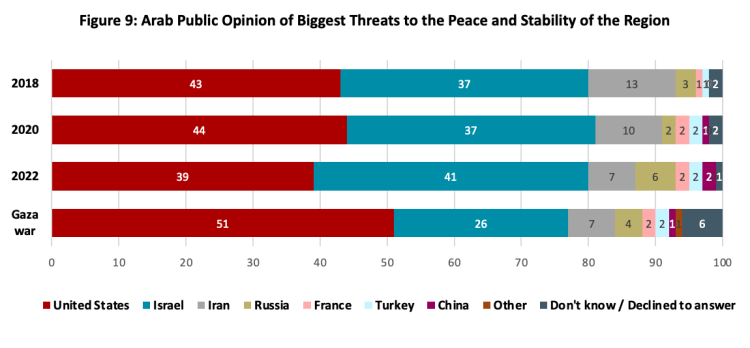
A new opinion poll conducted in 16 Arab countries shows that Washington’s continued support for Israel’s campaign of genocide in the Gaza Strip has dramatically hurt its image across West Asia and North Africa, as 94 percent of respondents describe the US position as “bad.” At the same time, more than half say the US poses the biggest threat to regional security.
Other western states fared almost as poorly, with more than three-quarters of those polled saying the position of the UK, France, and Germany in relation to Gaza is “bad” or “very bad.”
In contrast, Iran received a surge in recognition, with 48 percent of respondents expressing a positive view of the Iranian position, while 37 percent held a negative view. Despite Ankara’s increasing trade ties with Tel Aviv, Turkiye got a similar response – 47 percent perceived the country’s position positively, and 40 percent perceived it negatively.
To make matters worse for Washington, 51 percent of respondents agree that the US is currently the biggest threat to peace and stability in the region – marking a 12-point jump from 2022. Israel trails behind with 26 percent, a 15-point drop from 2022.
The survey, conducted by the Arab Center Washington DC (ACW) in cooperation with The Arab Center for Research and Policy Studies (ACRPS), also asked respondents their opinions on prospects for peace with Israel in the wake of the war in Gaza.
Fifty-nine percent answered with certainty that there can be no possibility for peace with Israel, while 14 percent reported having serious doubts, and nine percent said they did not believe in the possibility of peace with Israel in the first place.
Furthermore, 89 percent of Arab citizens say they oppose official recognition of Israel, with only four percent favoring it. This marks the lowest level of recognition since the question was first asked in 2011.
When asked what actions regional leaders must take to stop the mass murder of Palestinians in Gaza, 36 percent said governments should suspend relations or normalization agreements with Israel, 14 percent said aid must be delivered to Gaza regardless of Israeli approval, and 11 percent said oil exports should be used to put pressure on Israel and its western backers.
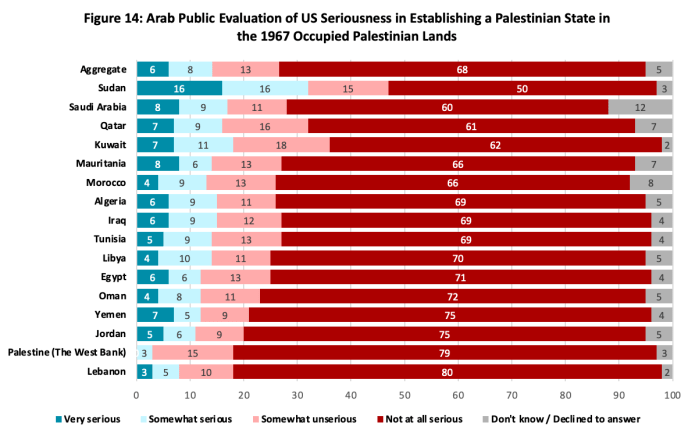
A large majority of respondents also agreed that the US is not serious about working to establish an independent Palestinian state under the 1967 borders with occupied Jerusalem as its capital.
“This is a historic moment in some very important ways,” Shibley Telhami, a professor at the University of Maryland, said at an event presenting the survey findings on Thursday. “The scale of what we have seen and the role the US has played in this deeply painful crisis has been so large and been perceived to be so large that it’s going to leave an imprint on the consciousness of a generation in the region that is going to outlast this administration and outlast this crisis.”
Questions about Washington’s alleged commitment to democracy and regional stability have been growing steadily in the Arab world for several years. According to a Gallup poll conducted in April 2023, a great majority of citizens in 13 countries across West Asia and North Africa said they did not trust US claims about “encouraging the development of democracy” or about “improving the economic lot of people.”
A few months earlier, the ACRPS revealed the results of the largest opinion survey conducted in the Arab world, showing that 84 percent of Arabs reject recognizing Israel for political and cultural reasons.
Retired CIA intelligence officer and State Department official Larry Johnson told Sputnik the move may be related to internal pressure not to work alongside “troops associated with coup governments.”
The United States military leadership has scrapped plans to hold joint exercises with several African states such as Sudan, Mali, Niger, Ethiopia, Eritrea and Burkina Faso.
According to the Washington Post, the Pentagon’s change of plans was, “at least in part,” the result of US Democrats pressuring the Biden administration to bar “troops associated with coup governments” from participating in US-led military exercises.
Exercises such as these are usually planned many months in advance, so the decision to scrap these plans means “there’s an issue with the governments that were supposed to participate,” said retired CIA intelligence officer and State Department official Larry Johnson.
Describing the military exercises’ cancellation as a “significant” development, Johnson told Sputnik that this move by the Pentagon may have also been prompted by the decision of the host African governments not to participate.
“In any event, I think what it does signify is that US influence over other countries, its ability to basically tell countries what to do and compel countries to follow US policy, is slipping, that the US influence in areas like Africa is growing weaker, not stronger,” he remarked.
Johnson also suggested that the decision by Niger, Mali and Burkina Faso to withdraw from the Economic Community of West African States (ECOWAS) may be related to this development, considering that ECOWAS is primarily regarded as an entity “under Western influence.”
According to him, the fact that these countries chose to part ways with ECOWAS and pursue “bilateral agreements among themselves” does seem like signs of them “distancing themselves from US control.”
Rwanda, Congo and Chad have refuted claims that they have engaged in any discussions with Israel concerning the potential acceptance of Palestinians displaced from the war-torn Gaza Strip.
Citing the latest fake news campaign from Israel, the Rwanda foreign ministry circulated a “disinformation alert” against the Zman Yisrael, an Israeli news outlet and The Times of Israel’s Hebrew sister site, that had claimed on Friday that “Israel is in talks with Chad and Rwanda to accept thousands of Palestinians from Gaza.”
“No such discussion has taken place either now or in the past, and the disinformation should be ignored,” the statement from the Rwanda foreign ministry read on X, formerly Twitter.
Earlier, Congo and Chad also denied holding talks with Israel about the forced displacement of Palestinians from Gaza.
Contrary to what is reported in some media, there has “never been any form of negotiation, discussion or initiative” between Kinshasa and Israel on the alleged reception of Palestinian migrants on Congolese soil, the Congolese government spokesperson, Patrick Muyaya, said in a statement late Thursday.
In its report, The Times of Israel asserted that Congo is willing to take in Palestinians. Quoting from a senior source in the security cabinet, it claimed that Congo “will be willing to take in migrants, and we’re in talks with others.”
“Prime Minister Benjamin Netanyahu’s coalition is conducting secret contacts for accepting thousands of immigrants from Gaza with Congo, in addition to other nations,” the report read.
Meanwhile, The Times of Israel published another report on Thursday, stating that Israel has denied that it is in talks with other countries about absorbing Gazan immigrants, and that the senior official pushed back on Zman Yisrael’s report.
“It’s a baseless illusion in my opinion. No country will absorb 2 million people, or 1 million, or 100,000, or 5,000. I don’t know where that idea came from,” said the official in a briefing to Israeli journalists, on condition of anonymity, as the report stated.
According to reports, the Israeli regime is adopting the “voluntary” resettlement of Palestinians from Gaza as an official policy.
Earlier, Benjamin Netanyahu said he supports the idea but needs to find countries that are willing to “absorb” Gazans. “We are working on it,” he said.
While quoting a senior Israeli official, the report from Zman Yisrael also stated that whoever volunteers for migration would be handed over a “generous financial grant” and “extensive aid” to the receiving country.
“The principle is to give a generous financial grant to any Palestinian who expresses a desire to emigrate from Gaza, along with extensive aid to the receiving country, including military aid,” the report read.
On Wednesday, despite criticisms from the United States, Israeli finance minister Bezalel Smotrich, the leader of the Religious Zionism Party, doubled down on a call for “voluntary emigration” from Gaza once the current war on Gaza ends.
Itamar Ben-Gvir, the so-called national security minister, this week issued a call “to encourage the migration of Gaza residents” as a “solution” to the humanitarian crisis.
Josep Borrell, the EU’s top foreign policy official, condemned both Smotrich and Ben Gvir for their calls to resettle Palestinians living in Gaza as “inflammatory and irresponsible” on Wednesday.
“Forced displacements are strictly prohibited as a grave violation of [international humanitarian law] and words matter,” Borrell said on X.
A spokesperson for the United Kingdom foreign office said: “Gaza is Occupied Palestinian Territory and will be part of a future Palestinian state. The UK firmly rejects any suggestion of the resettlement of Palestinians outside of Gaza.”
Furthermore, the Spanish government also offered its own rebuke Wednesday, saying the administration rejects recent statements by Israeli authorities evoking population movements in Gaza that would be contrary to international law.
Israel has launched relentless air and ground attacks on the Gaza Strip since a cross-border attack by the Palestinian resistance group Hamas on Oct. 7.
Since the beginning of the war, at least 22,600 Palestinians have since been killed and 57,910 others injured, according to Gaza’s health authorities.
The relentless attacks have caused extensive devastation in Gaza, resulting in 60% of the region’s infrastructure being either damaged or completely destroyed.
This has led to the displacement of nearly 2 million residents, who now face severe shortages of essential resources such as food, clean water, and medicine.
Nearly two and a half years after the United States’ campaign in Afghanistan ended in an inglorious rout, the US seems poised to expand its military operations in another part of the globe.
The United States is attempting to convince several West African states to allow them to use their airfields to carry out drone operations, according to a report by the Wall Street Journal.
This move is ostensibly aimed at curbing the spread of Islamist terrorist groups in Ghana, Benin and the Ivory Coast, the media outlet claimed, adding that US drones might purportedly “conduct aerial surveillance of militant movements along the coast and provide over-the-shoulder tactical advice to local troops during combat operations.”
The United States’ drone initiative, however, takes place amid a “shift in public sentiment and attitude” in African states “against foreign military presence,” argued Ovigwe Eguegu, a Nigerian policy adviser at the Development Reimagined consultancy.
“The attitude that we are seeing that is very much against foreign military presence, particularly of major power like the US, is because of the concern that we’re now in an era of good power competition and the risk of proxy conflict is quite high,” Eguegu said. “Citizens knowing what happened during the Cold War [are] very much averse to foreign troops present.”
He also observed that the US and French military missions in Africa, as well as the UN MINUSMA peacekeeping force, did little to improve the security situation in the countries they were deployed in, while the “successes that are being achieved in counterterrorism” in the region were primarily achieved by the Multinational Joint Task Force comprised of military units from Niger, Nigeria, Chad, Cameroon and Benin.
“While there is room for foreign military cooperation, there is no need for foreign military presence on the continent, because that is what regional armies are there for in the first place,” Eguegu remarked.
He also suggested that further “militarization of security solutions” is unlikely to improve the security situation in Africa and argued for a different approach.
According to Eguegu, the “solution to the Africa security challenges, in West Africa in general, can come in the form of funding support,” where the foreign support essentially amounts to providing weapons and training to local forces and does not necessarily involve “direct military operations” by foreign forces.
On December 4, Luis Inacio Lula da Silva, the President of Brazil (which has taken G20 presidency) said, after meeting with German Chancellor Olaf Scholz in Berlin, that he will invite Russian President Vladimir Putin to the G20 Summit that will take place in Brazil. Previously, Lula da Silva had stated Putin should not worry about being arrested, should he visit Brazil, despite the county’s membership in the International Criminal Court (ICC). The Brazilian leader later withdrew this promise but has maintained the invitation, thereby prompting a political controversy about the court in the Latin American country. On March 17, the Hague-based court issued a controversial arrest warrant for both Maria Alekseyevna Lvova-Belova, Presidential Commissioner for Children’s Rights (of Russia) and for Putin, a ruling that has been praised by US President Joe Biden, among others.
Whenever people hear about the “International Crime Court”, they often assume it is some essential part of the fabric of international law. The court’s name, however, should not be taken at face value. It is true that about 124 countries are ratified state parties to the Rome Statute, the treaty that established the ICC. It is also true, though, that 30 others have not yet ratified it, some of which have no intention of doing so. China, Russia, the US, India, Pakistan, Indonesia, and Turkey are not states parties – no Great Power in fact is a party to the ICC, unless one considers France, the UK and Germany as such. South Africa and the Philippines have already given formal notice of their intention to withdraw from the Statute, and so have Gambia and Burundi. Many other countries are considering doing so – which is not surprising at all.
Consider this: having been formed in 2002, with the exception of the Putin/Lvova-Belova warrant and the investigation on Rodrigo Duterte (former President of the Philippines), all other cases thus far launched by the court have been against Africans, including prominent regional leaders such as Muammar Gaddafi of Libya. It is no wonder then that over the last years the African Union has often accused the ICC of being biased against the continent. William Schabas (professor of international law at Middlesex Universit) summarized it: “Why prosecute post-election violence in Kenya… but not murder and torture of prisoners in Iraq or illegal settlements in the West Bank? Tony Blair, the former British prime minister and George W. Bush, the former American president… were never indicted by the ICC… in spite of the ample evidence available to justify legal proceedings against the two.”
In September, Brazil’s aforementioned President Lula da Silva had already questioned the value of a Hague-based court that does not include the US, Russia, or China. In his reasoning, the ICC cannot be that relevant, considering the fact that major powers do not submit themselves to its jurisdiction. Similarly, Flavio Dino, then the Brazilian Minister of Justice, described the court as “unbalanced”, saying that “it makes no sense to have a court that is only to judge some and not others”, even adding that his country’s Ministry of Foreign Affairs could debate Brazil’s participation in the Statue.
As shown, Lula da Silva is not the only one who has doubts about the ICC and the controversies pertaining to the court have been around for a long time, way before its arrest warrant for Putin. Take the United States for instance. The US and the ICC have a peculiar record, to say the least. Back in 2002, President George W. Bush famously signed into law the so-called “Hague Invasion Act”, which in fact authorized the use of military force to liberate any American citizen being held by the ICC. More recently, it was described as a “kangaroo court” by former US Secretary of State Mike Pompeo when President Donal Trump authorized sanctions against an ICC investigation into US war crimes in Afghanistan. Washington went so far as to threaten to arrest the court’s judges over the same issue.
However, in 2022, S.Res.546, a bipartisan, unanimous resolution by the US Senate (agreed to without amendment) came into being to support the ICC, which is quite remarkable, considering all the aforementioned record. It would seem the US is quite ready to applaud the Hague court, as long as it only persecutes its geopolitical rivals and never points its finger to any American war criminal – in this case Washington will literally threaten the court and its judges with arrest and invasion.
The ICC is predominantly funded by European states. The United Kingdom, France, Germany, Italy, Australia, Spain (and also Japan) have long been among the court’s top 10 contributors. Moreover, it also receives contributions from private donors, such as large corporations. All of that throws some doubts on its credibility and impartiality as an international organ often accused (justifiably so) of having a pro-Western bias.
I wrote before about the dangerous trend of employing international lawfare as a geopolitical tool – as seen in Germany, where local courts have been invoking “universal jurisdiction” (over some crimes) to convict Syrian authorities accused of having committed torture in Syria. This development was applauded by many, including Wolfgang Kaleck, founder of the European Center for Constitutional and Human Rights (ECCHR), who described it as a step towards bigger things.
One could very well ask how big it can get. We know that torture and sexual abuse were and have been common place in CIA-operated bases overseas as well as in places such as Guantánamo Bay (Cuba), and Abu Ghraib (Iraq). We also know Biden admittedly authorized the infamous August 29 drone strike in Kabul that killed civilians only. His predecessor Donald Trump in turn ordered the illegal assassination of Iranian General Qassem Soleimani, who was on a peace mission. Even so, it is hard to imagine a top CIA official (or Biden and Trump themselves for that matter) being investigated by a German court – or by the ICC.
From a perspective informed by legal realism and political realism, one could reason that the very way a country’s judicial systems’ “universal jurisdiction” can be exercised is limited by certain conditions regarding political, economic, and military power. The same limitations apply to the ICC. To sum it up, it is about geopolitics as much as it is about international law. The ICC today is a reflection of the inequalities between countries in today’s architecture of international law.
Disruption of Russian gas supplies due to Western sanctions on Moscow over Ukraine have left Europe grappling with spiraling inflation and surging energy bills, with the costs of liquefied natural gas (LNG) exports from the US adding to the pressures on European households’ budgets.
The European Union has been forced to overpay some €185 billion for gas imports since it imposed self-harming sanctions against Russia over Ukraine, according to Sputnik’s calculations based on Eurostat data.
Since February 2022, when Brussels first started to levy restrictions on Moscow, the EU’s average monthly gas import expenditures have risen to €15.2 billion. Of this, €7.7 billion has been spent on liquefied natural gas (LNG), while the remaining €7.5 billion has gone to pipeline gas. Meanwhile, during the year before the introduction of sanctions, European countries paid an average of €5.9 billion for gas (€3.6 billion for pipeline gas; €2.3 billion for liquefied gas).
Thus, it is estimated that EU member states over the course of 20 months spent a total of €304 billion on gas imports, while previously such expenses were accrued over several years. For example, from April 2017 to the end of 2021, the EU spent €186 billion on gas imports, and from 2013 to 2021 the value of such imports was at €292 billion.
While Europe has been reeling from the fallout from the backfiring sanctions, the United States has been raking in profits estimated to be worth €53 billion. Other countries that have benefited from the EU’s struggle to find alternatives to Russian energy are the UK (€27 billion), Norway (€24 billion), and Algeria (€21 billion).
Russia, on the other hand, despite the reduction in supply volumes, has received an additional €14 billion due to surging prices. The EU’s shortsighted crusade to limit Moscow’s energy-related income has resulted in Qatar earning the same amount – an additional €14 billion, while Azerbaijan brought in a bonus worth €12 billion. A look at some of the other beneficiaries of this EU gas policy revision shows that Angola banked €5 billion, Egypt – €4 billion, and Trinidad and Tobago – €3 billion. An additional €2 billion were received by Nigeria and Cameroon, and another billion each by Libya, Oman and Equatorial Guinea. Another 12 countries earned relatively small sums, totaling almost €2 billion.
Before the Ukraine crisis and the sanctions unleashed against Moscow over its special military operation in the neighboring country, Europe received approximately 40 percent of the gas it consumed from Russia. Ever since the Ukraine conflict escalated, Brussels has been cobbling together package after package of sanctions targeting Russia. However, to anyone with a clear understanding of the energy needs of the 27-member bloc, it was evident that it was backing itself into a corner by opting to “wean itself” off Russian gas. The Ukraine conflagration and the punitive restrictions have led to disruptions of supply chains and a surge in energy prices worldwide. Furthermore, the Nord Stream pipeline sabotage added to the continent’s woes.
The Nord Stream pipelines, built to deliver gas under the Baltic Sea from Russia to Germany, were hit by explosions on September 26, 2022. Denmark, Germany, and Sweden left Russia out of their investigations into the attack, prompting Moscow to launch its own probe with charges of international terrorism. In the absence of any official results so far, Pulitzer Prize-winning US investigative journalist Seymour Hersh published a report in February 2023 alleging that the blasts were organized by the US with Norway’s support. Washington has denied any involvement.
Western countries and their allies were left facing an energy crisis and struggling to fill their gas reserves. Overall, the sanctions have triggered in the West everything from raging inflation, recession fears, to looming deindustrialization, with Germany being hit the hardest.
At the same time, oil and gas revenues of the Russian budget have been significantly outpacing those of the last year since September despite external pressure, Russian Prime Minister Mikhail Mishustin said earlier in the autumn.
Furthermore, the World Bank reported in August that by the end of 2022, Russia’s wealth in purchasing power parity (PPP) terms had exceeded $5 trillion for the first time — putting it ahead of Western Europe’s three biggest economies, namely, France, financial giant the United Kingdom, and industrial powerhouse Germany.
With support from the Bill & Melinda Gates Foundation, the United Nations (U.N.) this month launched an “ambitious-country-led campaign” to promote and accelerate the development of a global digital public infrastructure (DPI).
The United Nations Development Programme (UNDP) said its “50-in-5” campaign will spur the construction of “an underlying network of components” that includes “digital payments, ID, and data exchange system,” which will serve as “a critical accelerator of the Sustainable Development Goals (SDGs).”
“The goal of the campaign is for 50 countries to have designed, implemented, and scaled at least one DPI component in a safe, inclusive, and interoperable manner in five years,” the UNDP stated.
In September 2022, the Gates Foundation allocated $200 million “to expand global Digital Public Infrastructure,” as part of a broader plan to fund $1.27 billion in “health and development commitments” toward the goal of achieving the SDGs by 2030.
The Gates Foundation stated at the time that the funding was intended to promote the expansion of “infrastructure that low- and middle-income countries can use to become more resilient to crises such as food shortages, public health threats, and climate change, as well as to aid in pandemic and economic recovery.”
California-based privacy attorney Greg Glaser described the “50-in-5” campaign as “a totalitarian nightmare” and a “dystopian” initiative targeting small countries “to onboard them with digital ID, digital wallets, digital lawmaking, digital voting and more.”
“For political reasons, U.N. types like Gates cannot openly plan ‘one world government,’ so they use different phrases like ‘global partnership’ and ‘Agenda 2030,’” Glaser told The Defender. “People can add ‘50-in-5’ to that growing list of dystopian phrases.”
Another California-based privacy attorney, Richard Jaffe, expressed similar sentiments, telling The Defender the “50-in-5” initiative “point[s] to the much bigger issue of the globalization, centralization and digitalization of the world’s personal data.”
“My short-term concern is bad actors, and that would be individuals and small groups, as well as state mal-actors, who will now have a big fat new target or tool to threaten the normal operation of less technologically sophisticated countries,” he said.
Jaffe said Gates’ involvement “scares the hell out of him.” Derrick Broze, editor-in-chief of The Conscious Resistance Network, told The Defender that it is “another sign that this renewed push for digital ID infrastructure will not benefit the average person.”
“Projects like these only benefit governments who want to track their populations, and corporations who want to study our daily habits and movements to sell us products,” Broze said.
Initiatives to promote DPI globally also enjoy the support of the G20. According to The Economist, at September’s G20 Summit in New Delhi — held under the slogan “One Earth, One Family, One Future” — India garnered support from the Gates Foundation, UNDP and the World Bank for a plan to develop a global repository of DPI technologies.
‘World doesn’t need 50-in-5’
The 11 “First-Mover” countries launching “50-in-5” are Bangladesh, Estonia, Ethiopia, Guatemala, Moldova, Norway, Senegal, Sierra Leone, Singapore, Sri Lanka and Togo.
“Countries, regardless of income level, geography, or where they are in their digital transformation journey, can benefit from being part of 50-in-5,” the campaign states, adding that “with steadfast and collective efforts, the world can build a future where digital transformation is not only a vision but a tangible reality.”
According to Glaser, the 11 initial countries were chosen not because they are “digital leaders” but because the U.N. sees smaller nations as a “unique threat” because their leaders are occasionally accountable to the people.
“We have seen what happens to leaders of small nations who reject international intelligence agencies’ favorite products, such as COVID-19 vaccines, GMOs [genetically modified organisms] and petrodollars,” Glaser said. “U.N. programs like ‘50-in-5’ are a way for smaller countries to sell out early to Big Tech and preemptively avoid ‘economic hitmen,’” he added.
Speaking at the “50-in-5” launch event, Dumitru Alaiba, Moldova’s deputy prime minister and minister of Economic Development and Digitalization said, “The source of our biggest excitement is our work on our government’s super app. It’s modeled after the very successful Ukrainian Diia app [and] will be launched in the coming few months.”
"We are committed to enhancing & establishing key DPI components (digital ID, payments) .. The source of our biggest excitement is our work on our government's super app modeled after the very successful Ukrainian Diia app": Moldova Deputy Prime Minister Dumitru Alaiba, 50-in-5 pic.twitter.com/z173VsKqBr
At the same event, Cina Lawson, Togo’s minister of Digital Economy and Transformation, said, “We created a digital COVID certificate. All of a sudden, the fight against the pandemic became really about using digital tools to be more effective.”
According to Hinchliffe, Togo’s DPI system had seemingly benign origins, launching as a universal basic income scheme for the country’s citizens, “but shortly after that, they expanded the system to implement vaccine passports.”
Today, Togo became the first sub-Saharan African country whose digital COVID-19 vaccination certificate is recognized by the @eu_commission. Travelers with a Togolese certificate will be able to validly present it in the EU & vice versa. @AmbUETogo@KoenDoenspic.twitter.com/Uy9mRF8bkU
Togo’s vaccine passport was interoperable with the European Union’s (EU) digital health certificate. In 2021, the EU was one of the first governmental entities globally to introduce such passports. In June, the World Health Organization (WHO) adopted the EU’s digital health certificate standards on a global basis.
Speaking at the G20 Summit in September, European Commission President Ursula von der Leyen said, “The trick is to build public digital infrastructure that is interoperable, open to all and trusted,” citing the EU’s COVID-19 digital certificate as an example.
The future is digital. I passed two messages to the G20:
→ We should establish a framework for safe, responsible AI, with a similar body as the IPCC for climate
→ Digital public infrastructures are an accelerator of growth. They must be trusted, interoperable & open to all
Four of the “First-Mover” countries are African. Shabnam Palesa Mohamed, executive director of Children’s Health Defense (CHD) Africa Chapter, told The Defender the “50-in-5” campaign will be used as a geo-political tool. “Africa is always a prime target because it is comparatively untapped digitally,” she said.
“Africa needs respect, food, water and peace,” she said. “It does not need DPI.”
Along similar lines, Hinchliffe said, “The world doesn’t need ‘50-in-5.’ The people never asked for it. It came from the top down. What the people want is for their governments to do their actual jobs — to serve the people.”
Digital ID intended to be ‘securely accessed’ by government, private stakeholders
According to The Economist, India is heavily promoting its digital ID technologies, first deployed domestically, for global implementation in “poor countries.” These technologies have garnered support and funding from Bill Gates and the Gates Foundation.
For instance, Lawson said Togo was issuing biometric digital ID “for all our citizens using MOSIP” — Modular Open Source Identity Platform — a system developed at India’s International Institute of Information Technology in Bangalore.
MOSIP, backed by the Gates Foundation, the World Bank and eBay founder Pierre Omidyar, is modeled after Aadhaar, India’s national digital ID platform — the largest in the world — which has been beset by controversy.
Glaser said Aadhaar “has been a nightmare for Indians. It is constantly hacked, including, for example the largest personal information hack in world history earlier this month, with personal information sold on the dark web.”
“Aadhaar is openly mocked in India,” Glaser said. “The only reason it is still used by the citizenry is because people have no practical choice. To participate meaningfully in Indian society, you need the digital ID,” he added.
A Business 20 (B20) communique issued following this year’s G20 summit called on “G20 nations to develop guidelines for unique single digital identification … that can be securely accessed (based on consent) by different government and private stakeholders for identity verification and information access within three years.”
In April, Nandan Nilekani, former chair of the Unique Identification Authority of India, told an International Monetary Fund panel on DPI that digital ID, digital bank accounts and smartphones are the “tools of the new world.” He added that if this is achieved, “Then, anything can be done. Everything else is built on that.”
“The lesson of course for the rest of the world is to never let digital ID take root in your society,” Glaser said. “Once a nation’s consumer class adopts digital ID with global partners, as in India, it is basically checkmate for that nation.”
‘When they say inclusive, they really mean exclusive’
According to The Sociable, DPI “promises to bring about financial inclusion, convenience, improved healthcare, and green progress.”
According to the “50-in-5” campaign, DPI “is essential for participation in markets and society in a digital era [and] is needed for all countries to build resilient and innovative economies, and for the well-being of people.”
But Hinchliffe refuted that assertion. “You don’t need digital ID and digital governance to provide better services to more people,” he said. “The tools are already available. It’s about incentives. Businesses, governments, and private citizens all have the power to come up with better solutions now, but why don’t we?”
Still, “inclusivity” is one of the key narratives employed to promote DPI. The “50-in-5” campaign states, “Countries building safe and inclusive DPI … can foster strong economies and equitable societies” and that DPI “promotes innovation, bolsters local entrepreneurship, and ensures access to services and opportunities for underserved groups, including women and youth.”
Experts who spoke with The Defender warned DPI has the potential to be exclusionary.
“While the United Nations, the Gates Foundation and Rockefeller Foundation promote DPI as necessary for an ‘equitable’ world, the reality is that these tools have the potential for furthering exclusion of political activists, whistleblowers, and other individuals who hold controversial opinions,” Broze said.
Similarly, CHD Africa’s Mohamed claimed, “People, groups and organizations that pose a threat to the establishment will be targeted for digital surveillance and socio-economic isolation” via DPI. “This … is an easier way to control critical thinkers.”
Hinchliffe said DPI will “accelerate technocratic control through digital ID, CBDC and massive data sharing, paving the way for an interoperable system of social credit.”
Similarly, Glaser said, “With DPI, the U.N.’s plan is to issue everyone a social credit score in line with U.N. SDGs (Agenda 2030) … Your digital ID will become the new you. And from the perspective of governments and corporations, your digital ID will be more real than your flesh … required in various measures to travel, work, buy/sell, and vote.”
“When they say inclusive, they really mean exclusive, because the system is set up to exclude people who don’t go along with unelected globalist policies,” Hinchliffe said. “What they really want is for everybody to be under their digital control.”
Notably, a June 2023 WEF report titled “Reimagining Digital ID” concedes that “Digital ID may weaken democracy and civil society” and that the “greatest risks arising from digital ID are exclusion, marginalization and oppression.”
Making ID — digital or otherwise — mandatory may exacerbate “fundamental social, political and economic challenges as conditional access of any kind always creates the possibility of discrimination and exclusion,” the report adds.
Experts who spoke with The Defender said people must be given the choice to opt out.
“If the U.N. and its member states push the digital ID agenda, they must ensure that their respective populations have a simple way to opt out without being punished or denied services,” Bronze said. “Otherwise, the digital ID creep will eventually become mandatory to exist in society and we will see the end of privacy, and, in the long-term, liberty,” Broze said.
Jaffe said that while he does not oppose digital payment systems, he “would be vehemently opposed to the elimination of non-digital payment, like fiat paper currency,” calling this an issue of “freedom and privacy.”
Similarly, Hinchliffe said, “There should be non-digital alternatives available at all times and this should be a right of every citizen. Systems can fail. Databases can be breached. Governments can become tyrannical. Corporations can become greedy.”
‘The endgame is sovereignty by transhumanists’
Many of the initiatives that are backing “50-in-5” are themselves interlinked — in addition to their connections to entities such as the Gates Foundation.
For instance, the Omidyar Network, one of the supporters of “50-in-5,” has provided funding to MOSIP — as has the Gates Foundation.
The Gates Foundation, the Rockefeller Foundation, the UNDP and UNICEF participate in the Digital Public Good Alliance’s “roadmap” of entities that “strengthen the DPG [digital public goods] ecosystem.”
Earlier this year, Co-Develop invested in the establishment of the Center for Digital Public Infrastructure, which is headquartered at the International Institute of Information Technology in Bangalore, and is also home to MOSIP. Co-Develop was co-founded by the Rockefeller Foundation, along with the Gates Foundation and the Omidyar Network.
And “endorsing organizations” of the World Bank’s “Principles on Identification for Sustainable Development” report include the Gates Foundation, the Omidyar Network, UNDP, Mastercard, ID2020 and the Tony Blair Institute for Global Change.
Glaser said that Gates attained wealth by “monopolizing his operating system into every home and business worldwide” and “is doing the same now at the U.N. level with vaccines and DPI applications.”
“DPI platforms essentially outsource sovereignty to international governing bodies that do the bidding of financial entities like Vanguard, BlackRock and State Street,” he said.
“Companies with that much information on citizens hold enormous power to sabotage infrastructure [with] very few ethics to stop them,” Mohamed said.
“The endgame is sovereignty by transhumanists,” Glaser added. “The reason digital ID is an existential threat to society is because it separates people from their local governments, who have always worked cooperatively to prevent tyranny.”
“DPI is being sold to authorities on the grounds that it will include them in the worldwide economy, when in reality it will commodify their people and remove the ability of local authorities to ever govern meaningfully again,” he said.
Hinchliffe also connected DPI to policies that purport to combat climate change.
“With G20 nations committing to net-zero carbon emissions policies by around 2050 … restrictions will be placed on what we can consume, what we can purchase, and where we can go thanks to the widespread implementation of digital ID and CBDC to track, trace, and control our every move in … 15-minute smart cities,” he said.
“They openly talk about using DPI for ‘digital health certificates’ … and I believe that next will come carbon footprint tracking to monitor and control how you travel and what you consume,” Hinchliffe added, calling it “a future of constant surveillance and control.”
“If we can legislate and litigate to retain the right to traditional identification, then this categorically protects all of our rights,” Glaser added. “As long as the consumer classes of large nations like the United States resist digital ID, there is hope.”
“These schemes do little to nothing for the prosperity of the majority of Africans, but rather, they further the interests of a small economic and political class,” Mohamed said. “With growing economic disparity and anger, the attempt to waste more African resources on digital ID may lead to widespread revolt.”
“Generally, once Africans know what Bill Gates is about, they refuse to get involved in or support his activities,” she added.
Watch this Kitco News segment on the ‘50-in-5’ campaign:
Michael Nevradakis, Ph.D., based in Athens, Greece, is a senior reporter for The Defender and part of the rotation of hosts for CHD.TV’s “Good Morning CHD.”
This is a story of a rather unknown history of Zionism from before the theft & colonization of Palestine there was the colonization of 13 sugar colonies in the the Americas & Caribbean which brought about the sugar & slave trade and the birth of globalized capitalism. Join educational discussions by legit scholars and historians, both Black & Jewish professors who have discussed the 13 Sugar Colonies and the impact they played on the Black Holocaust. No matter how much they want to hide the history, there is no longer any debate. The evidence is overwhelming.
Feel free to download it or upload it elsewhere, I need no credit. The critical history told to us through Dr. Leonard Jeffries, Dr. Tony Martin, Dr. John Henrik Clarke, Dr. Khalid Muhammad, Dr. Leonard E. Barrett Sr., Minister Louis Farrakhan, Dr. Aviva Ben-Ur, Dr. Stanley Mirvis, Dr. Bertram W. Korn, Rabbi Barbara Aiello, & Professor Cary Silverstein should be of public domain for the world to know about.
A human rights organisation has called on Arab states to stop hosting US military bases and to cut ties with Israel in response to the occupation state’s ongoing assault on the Gaza Strip and the war crimes it is committing against Palestinians.
Democracy for the Arab World Now (DAWN) called on the UAE, Bahrain, Morocco and Sudan to “withdraw immediately from the Abraham Accords with Israel and, alongside peace treaty signatories Egypt and Jordan, end all military coordination with Israel.”
The NGO insisted that those Arab states hosting US military bases, “including Jordan, Saudi Arabia, UAE, Bahrain and Qatar, should publicly declare that they will not permit the US to use these bases to supply weapons to or provide protection for Israeli forces during its ongoing war against Palestinians in Gaza.”
In 2020, both the UAE and Bahrain signed the “Abraham Accords” with Israel, normalising relations with the occupation state and cementing cooperation and trade in the economic, technological, tourism, military and intelligence fields. Morocco did the same later that year, followed by Sudan in January 2021, each with their own conditions agreed upon with Washington and Tel Aviv.
“The UAE and other signatories to the Abraham Accords should take responsibility for emboldening Israel into believing that it can wantonly bombard and massacre Palestinians with no consequence to its standing in the region,” said DAWN’s Executive Director, Sarah Leah Whitson. “Continued adherence to the Abraham Accords signals that the UAE and other Accords signatories are still supporting Israel and rewarding it with commitments for economic and trade development and most shocking of all, military coordination.”
Aside from many Arab states’ decades-long hosting of US military bases, which aids American forces in assisting Israel, there is also growing cooperation between those countries and Israel in initiatives backed by the US. Examples include the Middle East Air Defence Alliance (MEAD) and the Negev Forum, which aims to further integrate security cooperation with Israel and to form a regional alliance.
“Geneva Conventions impose obligations on states to ensure respect for the Conventions in all circumstances,” said DAWN. “This includes the responsibility to prevent and put an end to breaches of these conventions, not only within their own actions but also in their international relations. Continued military support for Israel violates these fundamental principles of international humanitarian law and raise serious legal and moral concerns.” The organisation called on Arab states to “critically evaluate their roles and take proactive measures to halt any form of assistance that might contribute to the perpetuation of atrocities in Gaza and the West Bank.”
The United States regime has picked sides in the Israel-Hamas war and has committed to funding Israel’s ongoing bombing of non-combatant men, women, and children in the Gaza strip. Northern Gaza’s infrastructure is now all but destroyed, with millions of Gazans displaced and homeless. Nearly ten times more Gazans than Israelis have now died in the conflict. Many Gazans have fled to the southern portion of Gaza, but homelessness and abject poverty awaits them there.
By employing what is essentially the carpet-bombing approach, Tel Aviv has made the choice of adopting a policy that is sure to produce hundreds of thousands of refugees—or perhaps even more than a million. Indeed, many in the Israeli regime are motivated to maximize refugees, and push Gazans out of the country altogether using the Orwellian phrase “voluntary migration.”
On a military, tactical level, the Israeli state will have no problem accomplishing this. Tel Aviv has an air force, a deep reservoir of American-funded weapons, and a nuclear arsenal. The Israeli military can easily reduce all of Gaza to rubble. But what is sure to result from this is a humanitarian disaster accompanied by a global debate over which foreign country will host the refugees.
Israeli mouthpieces are already at work pushing the cost onto foreign taxpayers, including American ones. This week, two Israeli politicians—one from the militarist Likud party, and one from the center-left Yesh Atid party—took to the pages of The Wall Street Journal to demand that “countries around the world should offer a haven for Gaza residents who seek relocation.” According to these politicians, “[t]he international community” — i.e., not Israel — “has a moral imperative” to resettle Gazans somewhere outside Israel at not-Israel’s expense.
It is significant these claims appeared in an American publication. Tel Aviv is the latest welfare-queen regime—in the tradition of Ukraine’s Volodymyr Zelensky—repeatedly haranguing the American public with demands for free money. It’s no coincidence that Israel’s Benjamin Netanyahu is now seemingly ubiquitous on American prime-time news programs. His primary job right now is to demand money and favors from Washington and from other Western regimes.
It will probably work. Americans should get ready for plane-loads of Gaza refugees arriving in their cities, funded by the American taxpayers who can now barely afford to keep up with the price of groceries. This will be sold as a “humanitarian” effort, but anyone who sees through the propaganda will see that it’s really all a cynical effort to please pro-Israel interest groups and Israeli politicians.
A Pattern of War and Refugees
This was all predictable from the minute the war started last month.
The US and its allies have settled into a predictable pattern in foreign policy over the past thirty years: force the taxpayers to pay for the regime’s wars which involve bombing various poor foreign countries “back into the stone age.” Then, once the refugees start pouring out—and the Americans have lost the war, of course—Western regimes then tell the taxpayers back home to cough up even more money to pay for resettlement of all those refugees whose countries were needlessly destroyed by the bombs dropped by Washington and its allies.
This is no small phenomenon. A 2020 report from Brown University estimated that 37 million people have been made refugees by the US-led “War on Terrorism.” By 2016, 5.2 million of them reached Europe. In 2022 alone, more than 159,000 refugees arrived by sea in Italy, Greece, Spain, Cyprus, and Malta. Thousands more arrive at the land borders of the EU every year.
Thanks to the distance from western Asia and North Africa, refugees totals have been smaller in the United States. Nonetheless, the total number of refugees has ranged from 50,000 to 90,000 per year in most years since the US began its war in Afghanistan. This has transformed a number of communities in the United States, however, since refugees often tend to concentrate in specific places along ethnic or religious lines. In the decades of the US’s endless on-again, off-again military meddling in Somalia, tens of thousands of Somali refugees have been relocated to Minnesota at taxpayers’ expense. Since 2018, Minnesota has hosted more than 40,000 Somalia-born migrants (many classified as refugees). Most of the refugees, of course, are concentrated within Minneapolis’ metro population of only 3.5 million. In democracies, this has political consequences.
It is also important to remember that migrants who enjoy the legal status of refugees are not normal immigrants. Ordinary immigrants arrive at the United States at their own expense. The vast majority must find work on their own if they wish to have an income. They are eligible for few social benefits. Those seeking legal residency, of course, must go through a lengthy administrative process. For example, Mexicans who obtain a work visa in the United States have to work. They don’t show up and receive “free” help from government-funded refugee agencies in finding jobs, apartments, and other government freebies.
In contrast, all of that is fast-tracked for people labeled “refugee” by the federal government, and most of these refugees are immediately eligible for a wide array of taxpayer funded benefits. In total, this all costs the taxpayers nearly two billion dollars per year, or $80,000 per refugee per year in the form of federal and state programs including food stamps, child care, and public housing.
It’s not enough that you pay for the bombs that create the refugees, dear American taxpayer. You’ll also have to pay to resettle those refugees in your town.
A recent Washington Post (The Post) story, “Where Malaria is Spreading,” claims that climate change could put over 5 billion people at risk of malaria by 2040, primarily due to expanding seasons where mosquitoes can spread the disease, migrating mosquitoes, and increased populations and stagnant water caused by unusual flooding. This is false. Malaria already has a wide distribution, with many areas only avoiding it being endemic due to past suppression efforts. Population growth in areas where the disease remains common may lead to more instances of the disease unless available preventative and prophylactic measures are taken. However, there is no evidence malaria will spread geographically, due to either modestly rising temperatures or increased moisture.
The Post’s article, written by authors Rachel Chason, Kevin Crowe, John Muyskens, and Jahi Chikwendiu, mainly focuses on malaria’s increase in Mozambique. It has seen a 10 percent increase in malaria cases over the past six years. The Post than ties Mozambique’s malaria increase to claims made in a Lancet study, “Projecting the risk of mosquito-borne diseases in a warmer and more populated world: a multi-model, multi-scenario intercomparison modelling study,” which used climate and mosquito-borne disease models to estimate how the transmission seasons and population densities might change with global warming.
The study’s authors say their modelling shows malaria suitability may increase by 1-6 months in tropical highlands in Africa, the Eastern Mediterranean, and the Americas. Dengue sees similar results, with suitability increasing in lowlands in the Western Pacific and the Eastern Mediterranean by 4 months.
Shamefully, like many studies making misleading and alarming claims attributed to climate change, the Lancet study uses the climate modelling scenario RCP8.5 (RCP meaning representative concentration pathway), which climate scientists admit runs way too hot. Any research that built upon that scenario is going to produce extremely skewed results, because RCP8.5 involves an amount of released carbon dioxide that is actually impossible, even if all the fossil fuels on the planet were burned.
While the Lancet study is suspect, it may still seem logical to assume that the modest warming of the past hundred or so years has and will continue to expand the range of mosquitoes, as well as the number of days during the year in which they are active and biting. However, a large body of research refutes this assumption.
A chapter in Climate Change Reconsidered II: Fossil Fuels, discusses the results of more than a dozen peer-reviewed studies which demonstrate that temperature alone is not enough to guarantee migration or longer survival of mosquitoes or mosquito-borne illnesses like malaria. There are far more factors that come into play, including human interventions, that outweigh temperature alone.
The report explains:
Gething et al. (2010), writing specifically about malaria, may have put it best when they said there has been “a decoupling of the geographical climate malaria relationship over the twentieth century, indicating that non-climatic factors have profoundly confounded this relationship over time.
More examples from Climate Change Reconsidered are discussed in a Climate Realism post, “Environment Journal Wrong About Climate Change Increasing Malaria,” including papers by a vector-borne disease expert, Paul Reiter, from the Centers for Disease Control and Prevention (CDC) which explain that while reemergence of malaria and similar diseases in some regions is concerning, “it is facile to attribute this resurgence to climate change.”
ThePost admits that endemic malaria “was eliminated in North America and Europe in the mid-1900s, with a better understanding of how to control it.” This is true, and what’s more, a 2010 Nature study (Gething et al.) found that malaria was probably endemic on 58 percent of the world’s surface in 1900, before the period of modern warming, and only 30 percent by 2007, after decades of modest warming.
Almost every credible study, not based on biased computer models, rejects the myopic causal view of the relationship between climate and malaria.
Extreme weather, ThePost claims, like flooding are causing cases to rise in places like Mozambique, with “experts” telling them that the frightening trend is likely to continue. While The Post suggests the trends are mostly due to climate change, they also admit that other factors like “increased resistance of mosquitoes to insecticides and of the parasite to drugs” and improved disease reporting and tracking have played a role in the reported increase.
Flooding is unlikely to cause an increase in mosquito-borne illness, because even the U.N. Intergovernmental Panel on Climate Change (IPCC) reports only low confidence that there is even any sign climate change has impacted flooding. Mozambique, a South-East African nation, has suffered some flooding in recent years, but as discussed in Climate Realism, here, any link to long-term climate change lacks evidence. Flooding is a regular occurrence in many parts of southern Africa, and population increases means that during the rainy season more people are living near mosquito-friendly standing water.
Before running this alarming story, The Washington Post should have examined the wider body of research available concerning mosquito-borne illnesses. There is no evidence that warming is currently causing, or will lead to, an increase in malaria cases or deaths. Facts, not fearmongering, should guide The Post’s and other legitimate news outlets’ coverage of climate and disease issues.
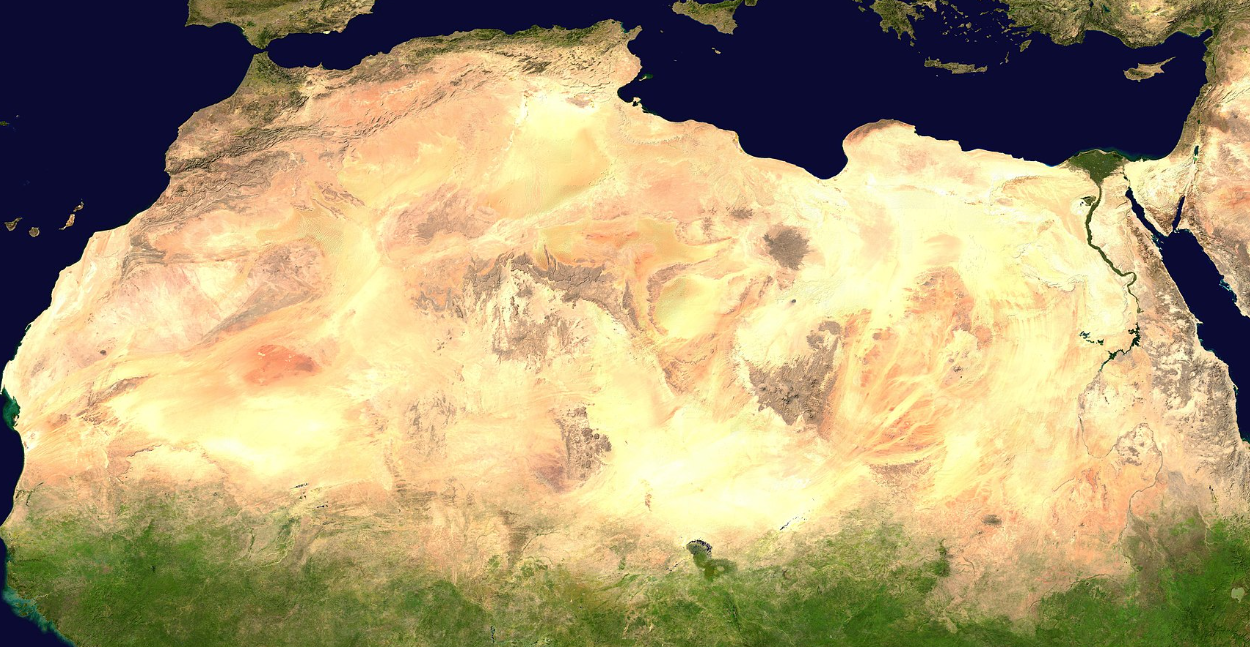
Sahara has been shrinking over the past decades. Image: NASA
Dr. Kröpelin is an award-wining geologist and climate researcher at the University of Cologne and specializes in studying the eastern Sahara desert and its climatic history. He’s been active out in the field there for more than 40 years.
In the Auf 1 interview, Dr. Kröpelin contradicts the alarmist claims of growing deserts and rapidly approaching climate tipping points. He says that already in the late 1980s rains had begun spreading into northern Sudan and have since indeed developed into a trend. Since then, rains have increased and vegetation has spread northwards. “The desert is shrinking; it is not growing.”
Kröpelin confirms that when the last ice age ended some 12,000 years ago, the eastern Sahara turned green with vegetation, teemed with wildlife and had numerous bodies of water 5000 – 10,000 years ago (more here).
Later in the interview Kröpelin explains how the eastern Sahara climate was reconstructed using a vast multitude of sediment cores and the proxy data they yielded. According to the German geology expert: “The most important studies that we conducted all show that after the ice age, when global temperatures rose, the Sahara greened” … “the monsoon rains increased, the ground water rose”. This all led to vegetation and wildlife taking hold over thousands of year.
Then over the past few thousands of years, the region dried out. It didn’t happen all of a sudden like climate models suggest.
Modelers don’t understand climate complexity
When asked about dramatic tipping points (8:00) such as those claimed to be approaching by the Potsdam Institute (PIK), Kröpelin says he’s very skeptical and doesn’t believe crisis scenarios such as those proposed by former PIK head, Hans-Joachim Schellnhuber. He says people making such claims “never did any studies themselves in any climate zone on the earth and they don’t understand how complex climate change is.”
Except for catastrophic geological events, “it’s not how nature works,” Kröpelin says. “Things change gradually.”
The claims that “we have to be careful that things don’t get half a degree warmer, otherwise everything will collapse, is of course complete nonsense.”
“I would say this concept [tipping points] is baseless. Much more indicates that they won’t happen than that they will happen.”
Late last year in Munich, he called the notion of CO2-induced climate tipping points scientifically outlandish. He also called the prospect of the Sahara spreading into Europe preposterous.
By portraying Chinese characters as perpetrators of ruthless violence while casting Japanese Self-Defense Forces (SDF) intelligence operatives as defenders, the season 2 of the Japanese drama Vivant has recently drawn criticism from Chinese netizens, who argue that its depiction turns historical reality on its head while ignoring Japan’s wartime atrocities.
The TBS drama series – a spy suspense story in which an alleged unofficial intelligence unit of the SDF operates across the globe — has attracted a passionate fanbase. Its currently airing season 2 opened with a household rating of 18.8 percent, the highest for a TV drama this year, according toa commentary article by Japanese media Toyo Keizai.
What draws attention is the portrayal of the enemies in the series, the article noted. Scenes in which the Chinese organization subjects kidnapped members of the SDF unit to brutal torture are repeated with unrelenting intensity.
It is rare for Japanese TV dramas to explicitly portray a real-life country as the enemy, the article noted.
Japanese Prime Minister Sanae Takaichi also made a reference to the drama, saying that she has been recording Vivant and hopes to binge-watch it over the year-end and New Year holidays, according to Japanese media outlets.
China’s CCTV News report on Sunday revealed that the drama features scenes in which Chinese personnel cut off the fingers of and stab Japanese intelligence operatives in the abdomen. Such acts bear striking similarities to the torture inflicted on Chinese nationals by invading Japanese troops during the World War II.
The drama distorts the truth by attributing these atrocities to modern Chinese characters. Beneath the surface, it subtly glorifies Japan’s cross-border overseas operations, blurs the functional boundaries of the SDF and implicitly promotes an expansionist narrative, per CCTV News. … continue
This site is provided as a research and reference tool. Although we make every reasonable effort to ensure that the information and data provided at this site are useful, accurate, and current, we cannot guarantee that the information and data provided here will be error-free. By using this site, you assume all responsibility for and risk arising from your use of and reliance upon the contents of this site.
This site and the information available through it do not, and are not intended to constitute legal advice. Should you require legal advice, you should consult your own attorney.
Nothing within this site or linked to by this site constitutes investment advice or medical advice.
Materials accessible from or added to this site by third parties, such as comments posted, are strictly the responsibility of the third party who added such materials or made them accessible and we neither endorse nor undertake to control, monitor, edit or assume responsibility for any such third-party material.
The posting of stories, commentaries, reports, documents and links (embedded or otherwise) on this site does not in any way, shape or form, implied or otherwise, necessarily express or suggest endorsement or support of any of such posted material or parts therein.
The word “alleged” is deemed to occur before the word “fraud.” Since the rule of law still applies. To peasants, at least.
Fair Use
This site contains copyrighted material the use of which has not always been specifically authorized by the copyright owner. We are making such material available in our efforts to advance understanding of environmental, political, human rights, economic, democracy, scientific, and social justice issues, etc. We believe this constitutes a ‘fair use’ of any such copyrighted material as provided for in section 107 of the US Copyright Law. In accordance with Title 17 U.S.C. Section 107, the material on this site is distributed without profit to those who have expressed a prior interest in receiving the included information for research and educational purposes. For more info go to: http://www.law.cornell.edu/uscode/17/107.shtml. If you wish to use copyrighted material from this site for purposes of your own that go beyond ‘fair use’, you must obtain permission from the copyright owner.
DMCA Contact
This is information for anyone that wishes to challenge our “fair use” of copyrighted material.
If you are a legal copyright holder or a designated agent for such and you believe that content residing on or accessible through our website infringes a copyright and falls outside the boundaries of “Fair Use”, please send a notice of infringement by contacting atheonews@gmail.com.
We will respond and take necessary action immediately.
If notice is given of an alleged copyright violation we will act expeditiously to remove or disable access to the material(s) in question.
All 3rd party material posted on this website is copyright the respective owners / authors. Aletho News makes no claim of copyright on such material.




 Aletho News
