Why Are We in Niger?
By Ron Paul | September 11, 2023
The July military coup in the west African country of Niger has once again brought attention to the fact that the US government runs a global military empire that serves Washington’s special interests, and not the national interest.
Before the coup made news headlines, most Americans – including many serving in Congress – had no idea the US government maintains more than 1,000 troops stationed on several US bases in Niger. But it’s even worse than that. A recent report in The Intercept suggests the Pentagon repeatedly misled Congress about the extent and the cost of the US presence in Niger.
According to The Intercept, “in testimony before the House and Senate Armed Services Committees in March, the chief of US Africa Command described Air Base 201 (in Niger) as ‘minimal’ and ‘low cost.’” In fact the US government has spent a quarter of a billion dollars on the base since construction began in 2016.
So when did Congress declare war so as to legalize US military operations in Niger? They didn’t. But as Kelley Vlahos writes in Responsible Statecraft, US troops have been “training” the military in Niger since 2013 and the US government has constructed a number of military bases to “fight terrorism” in the country and region.
Does that mean that the Pentagon is operating in Niger under the 2001 authorization for the use of military force (AUMF) meant to track down those who attacked the US on 9/11? It’s a good question and thankfully one being asked by Sen. Rand Paul in a recent letter sent to Secretary of Defense Lloyd Austin.
Senator Paul first pointed out in the letter, “the Administration’s limitless interpretation of the 9/11 AUMF and frequent use of Title 10 authorities results in military operations abroad conducted with little Congressional oversight and even less public scrutiny.” Such actions “undermine our Constitution,” he writes as he asks, “in how many countries are US forces conducting operations authorized by the 2001 AUMF.”
Ironically – or maybe not – one of the coup leaders in NIger had been trained by the Pentagon at Ft. Benning, Georgia, and at the National Defense University in Washington, DC. What is the US government training foreign military officers to do, exactly? Overthrow their own governments?
Whatever the case, it appears the coup government in Niger may be seeking a withdrawal of foreign military on its soil. Mass protests against French military presence has led the French government to begin talks with the coup government on withdrawal. There are rumors that the coup government may next request US troops to leave the country.
We should pre-empt their possible request by withdrawing all US troops immediately from Niger (and the rest of Africa) and closing all military bases. The claim that the US government is fighting terrorism in the area is doubtful. After all, in both Libya and in Syria the US government backed terrorist groups against governments it sought to overthrow. President Biden’s national security advisor Jake Sullivan famously wrote to his then-boss Secretary of State Hillary Clinton in 2012 that, “in Syria, al-Qaeda is on our side.”
Congress must step up and exercise its oversight authority to end the counter-productive US military presence in Africa. Our military empire is bankrupting us and turning the rest of the world against us.
Copyright © 2023 by RonPaul Institute
Pentagon Misleads Congress About Number of Bases in Africa
By James Tweedie – Sputnik – 12.09.2023
The US military maintains a string of bases spanning the Sahel region of Africa. Tunde Osazua, coordinator of the US Out of Africa Network — part of the Black Alliance for Peace — said they amounted to a military occupation of the continent.
The US Department of Defense has lied to Congress about its shady activities in Africa — funded by taxpayers. Peace campaigner Tunde Osazua told Sputnik that the US Department of Defense was not coming clean to legislators about its network of bases across the continent.
Osazua explained that General Michael Langley, commander of the US Africa Command (AFRICOM), had briefed Congress on the military’s facilities in Africa, including the ‘enduring forward operating sites’ at Camp Lemonnier in Djibouti and the Cat Hill air base on Ascension Island, the tiny British South Atlantic colony, along with 12 other “posture locations”.
“He claimed that those locations have minimal permanent US presence and low cost facilities and limited supplies for the US forces The soldiers and their personnel are there to perform critical missions and quickly respond to emergencies,” he noted.
“Experts say that he misled Congress, that AFRICOM’s chief basically lied about the size and the scope of the US presence on the African continent,” Osazua said. “Instead of 12 posture locations there are no less than 18 outposts in addition to Camp Lemonnier.”
“This is according to what AFRICOM itself released in its own secret 2022 Theater Posture Plan, which I think might even understate the current footprint of AFRICOM on the continent.” In fact, peace group World Beyond War has listed around 55 US military installations in Africa, he pointed out.
The anti-imperialist campaigner said the Pentagon was “essentially lying to Congress about this.”
“They’re trying to say that they’re doing a lot with very few resources when there’s a lot of funding for… what is military occupation,” Osazua said. “it’s clear that the US military activity on the continent is extensive. A few years ago a report came out that said that there are close to 3,500 missions per year that the AFRICOM takes part in on the continent. That’s close to ten missions a day.”
The commentator noted that the west African state of Niger had become “a particular point of focus” since the recent military takeover, with former colonial power France refusing to evacuate its troops and embassy and some of its compliant governments in the region threatening military intervention.
AFRICOM’s Airbase 201 is also in Niger, featuring a 6,200-foot runway taxiways, hangars, living quarters, roads, utilities, munitions, storage, an aircraft rescue and firefighting station — all within a 25-kilometer security zone.
But Osazua stressed “how the people and the government have responded to US and French military presence on their soil, which again amounts to a basically military occupation.”
Russia-Turkiye-Qatar Grain Deal: ‘Humanitarian Program’ to Shore Up Poorest Nations
By Oleg Burunov – Sputnik – 08.09.2023
A new grain agreement initiated by Moscow may partly add to resolving the problem of hunger across the globe, Russian analysts have told Sputnik.
The Russian Foreign Ministry has heaped praise on a joint project between Moscow, Ankara and Doha on Russian grain supplies to Turkiye.
The ministry said in a statement that “the project to deliver one million tons of grain from Russia for processing in Turkiye with subsequent free transportation to the poorest countries is of utmost importance.”
The statement came after Russian Deputy Foreign Minister Alexander Grushko told reporters that Moscow and Ankara had reached an agreement.
“This is a good initiative, and the right process,” Moscow-based political analyst Alexander Asafov said, describing the deal as an example of international cooperation that “takes into account promoting Turkiye’s interests with the help of Qatar,” which “will act as the agreement’s financial contributor.”
Asafov noted that although the deal would unlikely become a “game-changer” in terms of tackling the problem of hunger globally, it “will, of course, improve the situation in those countries where grain will be delivered to.”
When asked about the prospect of the initiative, the analyst said that the agreement “confirms the logic of a multipolar world, where the parties, without fear of sanctions or other pressure, can conclude two, three or more deals, contrary to the opinion of the side that until recently considered itself global cop,” an apparent nod to the US.
Asafov was echoed by Victor Nadein-Raevskiy, a senior researcher at the Russian Academy of Sciences, who underscored that Russia initiated the Moscow-Ankara-Doha initiative after the suspension of the Black Sea Grain Deal. According to him, Moscow offered the accord proceeding from the fact that developing countries, who are “going through really great food problems, should not suffer.”
Actually, “this agreement is no longer a deal, but a humanitarian program to deliver grain – to be more exact, flour – to those countries that are in need of it,” Nadein-Raevskiy stressed. He added that transportation-related expenses would be on Qatar, who “enthusiastically joined the agreement.”
Touching upon the prospects of the initiative, the expert pointed out that first and foremost, it’s necessary to assess the effectiveness of the project as such.
“If we and our partners in Turkiye and Qatar manage to implement our plans, namely, if the deal is successful, then, of course, Russia will use its great opportunities on grain exports market,” he said.
Scheme’s Details to Follow
The issue was on the agenda of talks between Russian President Vladimir Putin and Turkish counterpart Recep Tayyip Erdogan in Russia’s Black Sea resort of Sochi on September 4.
“We expect that in the near future we will begin discussions with all parties to work out all the technical aspects of the scheme of such supplies,” Grushko said, adding that the technical details include, among other issues, logistics and finances.
Erdogan, for his part, signaled Ankara’s readiness to prepare its own proposals on the matter and to “find a solution in the near future” that will meet the expectations of all parties to the talks.
Nadein-Raevskiy noted in this vein that Turkiye is “ready” for flour supplies to developing countries “at very low prices or on the free-of-charge basis.”
“One should not think that Turkiye is a country that does everything only for its own benefit. While strengthening Turkish positions in Africa and beyond ahead of the COVID-19 pandemic, Turkiye – as far as I remember – spent up to $3 billion a year on humanitarian programs,” the expert emphasized.
The deal comes after Moscow suspended its participation in the Black Sea grain deal, also known as the Black Sea Grain Initiative, on July 18. The Kremlin has repeatedly emphasized that the Turkiye and UN-mediated grain deal’s component on facilitating Russian grain and fertilizer exports was not fulfilled, specifically with regard to reconnecting Russian banks to SWIFT and unblocking the Tolyatti-Odessa ammonia pipeline.
Moscow also pointed out that just three percent of the grain shipped out of Ukraine under the agreement actually went to countries in need in Africa and Asia, with the vast majority instead ending up in Europe and Turkiye.
Russian Foreign Minister Sergey Lavrov later stressed that the proposals made by the United Nations regarding the resumption of the Black Sea Grain Initiative lack guarantees when it comes to Russia’s concerns.
A Second Geo-Strategic Shoe (Other Than Ukraine) Is Dropping
By Alastair Crooke | Strategic Culture Foundation | August 28, 2023
Whilst it has become clear to increasing numbers of people in the West that something has gone terribly wrong with the élites’ Ukraine project, and that the exaggerated predictions and expectations of Russian forces being ‘knocked for six’ by an armoured ‘fist’ have proved spectacularly wrong, those same élites are going wrong again – on another strategically decisive issue: They again largely ignore ‘reality’ – for the sake of control of the ‘narrative’. In this case, the West prefers to sneer at the implications of the new accessions to BRICS (let alone the other 40 states ready to join): ‘Nothing to see there’.
The BRICS is just a jumble of states lacking any cohesion, or common thread, western MSM proclaims. It can never challenge the U.S. global power, nor the sheer financial weight of the dollar sphere. However, China’s Global Times explains in mild tones, a different backdrop:
“The reason why the BRICS mechanism has such great appeal … reflects a general disappointment of many developing countries with the global governance system dominated and interfered by the U.S. and the West. As China has repeatedly emphasized, the traditional global governing system has become dysfunctional, deficient and missing in action, and the international community urgently expects the BRICS mechanism to strengthen unity and cooperation”.
Others in the Global South say it more starkly: The BRICS mechanism is seen as a means to slough off the last vestiges of western colonialism and to acquire autonomy. Yes, of course, BRICS 11 initially will be more cacophony than smooth opera, but nonetheless, it represents a profound shift of global consciousness.
BRICS 11 establishes a pole of influence and global heft that has the potential to eclipse in scope that of the G7.
The ‘mess’ in Ukraine is commonly attributed to mere ‘miscalculation’ by the western élites: They did not expect Russian society to be so robust, nor so steadfast under pressure.
Yet this was no minor ‘slip up’ by the West, since the recognition of NATO’s doctrinal contradictions, its second-rate weaponry and its inability to think rigorously – beyond tomorrow’s sound-bite – has (inadvertently) shone the spotlight on the deeper dysfunction within the West – one that runs far deeper than just the situation around the Ukraine project. Many in the West see major institutions of society locked within suffocating orthodoxy; in an intense level of political and cultural polarisation; and with political reform effectively locked-down.
The proxy war on Russia nevertheless was launched through Ukraine, precisely to reaffirm western global vigour. It is doing the opposite.
The financial war (as opposed to the ground war in Ukraine) was the counter-play to generating regime change in Moscow: Financial war was intended to underline the futility of opposing the sheer ‘muscle’ that dollar hegemony – acting in concert – represented. It was the jealous hegemon demanding obeisance.
But this back-fired spectacularly. And this has directly contributed not just to the expansion of BRICS, but to the energy resources of the Middle East and the raw materials of Africa sliding out of western control. Rather than the western scatter-gun threats of sanctions and financial ostracisation creating fear and reaffirming obsequiousness, the threats contrarily, have mobilised anti-colonial sentiments across the globe; fed the understanding that the western financial construct amounted to tutelage, and that any acquisition of sovereignty required the act of de-dollarisation.
And here, again, egregious mistakes were committed: Errors of geo-strategic magnitude were embarked upon almost casually, and without due diligence.
The primordial mistake was that of Team Biden (and the EU) illegally seizing Russia’s overseas reserve assets; expelling Russia from the financial clearing system, SWIFT; and imposing a trade blockade so complete that (it was hoped in the White House) its effects would tear down President Putin. The rest of world understood – they easily could be next. They needed a sphere that was resistant to western financial predations.
Yet, the second strategic error by Biden (& Co.) magnified the error of their initial ‘unprecedented’ financial blitz. This blunder marked the ‘second shoe to drop’ in Biden’s de-fenestration of the American financial imperium: He treated Mohammad bin Salman (and the Saudis generally) with contemptuousness: ordering them to increase oil production (in order to bring down the price of gasoline before the mid-term Congressional elections), and disdainfully threatening the kingdom with “consequences”, were it to fail to comply.
Perhaps Biden, so consumed with his electoral prospects, did not think it through. Even now, it is not clear that the White House understands the consequences of it having treated MbS as some aberrant underling. There is an eleventh-hour attempt to dissuade Saudi from joining BRICS, but it is too late. It’s application to join has been approved and will take effect from 1 January 2024. The West misread the mood.
The shared ethos within Gulf states is one of self-assured, assertive leaders, who are no longer willing to accept binary ‘with us or against us’ U.S. demands.
For the avoidance of mis-understanding, Biden, through the combination of these two strategic mistakes, has launched the West’s financial hegemony onto a slipway leading to incremental unwinding of much of the $32 trillion of foreign investment in fiat dollars which has accumulated in the U.S. system over the last 52 years – with an implicit acceleration towards ‘own currency trading’ amongst the majority of non-western states.
Ultimately this likely will lead to a BRICS trade settlement medium – possibly anchored to gold. Were a trading currency to be anchored in some way to a gram of gold, that currency would, of course, acquire status as a store of value, based on that of the underlying commodity (in this case gold).
The point here is that when inflation was zero-bound, U.S. Treasury bonds were seen as a store of (enduring) value. However, wide de-dollarisation undermines the synthetic (i.e. the imposed) demand for dollars that owed entirely to the Bretton Woods and the Petro-dollar frameworks (that demanded that commodities be traded only in U.S. dollars) and to the implicit understanding that U.S. Treasuries offered a certain store of value.
But what did Team Biden do? They have driven Saudi Arabia – the lynchpin to the Petro-dollar, and one of the pillars (together with other Gulf States and China) underpinning the huge holdings of U.S. Treasury debt – into the arms of BRICS. Put simply, the BRICS 11 incorporates six out of nine of the top global energy producers, as well as the principal energy consumers. OPEC+, in effect, has been swallowed to make a self-enclosed, self-sufficient circle of trading in energy (and raw materials) that does not need to touch dollars. And over time, this will amount to a major monetary shock.
The ‘consequences’ threatened towards Saudi Arabia by the White House have been rendered inconsequential. Saudi and Iran can sell their oil to other BRICS consumers (in non-dollar currencies). Members no longer need to be so concerned at western threats – one of the key provisions of BRICS is the joint refusal of all members to permit or facilitate any ‘regime change’ manoeuvres against BRICS members.
To be clear, what this all means is further price inflation in the West, reflecting the falling purchasing power of fiat currencies as dollar-demand subsides. Inevitably, a weakening dollar will lead to higher interest rates in the U.S. This – simply – will be one major consequence of de-dollarisation. Higher interest rates will impose great stress on the U.S. and European banks.
The first BRICS 11 summit is set for October 2023 in Kazan. By ‘coincidence’, full membership of the new states will coincide with Russia taking the rotating annual presidency of the BRICS on 1 January 2024. Putin already has made clear his determination to move towards resolving the complexities of a separate BRICS currency – “one way or another”.
The Nigerien Coup Prompted A Long-Overdue Discussion About Sovereignty In West Africa
BY ANDREW KORYBKO | AUGUST 27, 2023
It was earlier assessed that “The AU-ECOWAS Rift Over Niger Was Predictable” due to their differing approaches towards the continent’s latest regime change. The AU believes that its ousted leader should be returned to power via peaceful means while ECOWAS’ active members are in favor of forcefully reimposing his rule. Neither of them support the interim authorities’ three-year transitional plan, however, with ECOWAS rejecting it outright and the AU suspending Niger right afterwards.
The AU also “called upon all Member States of the AU and the international community including bilateral and multilateral partners, at large to reject this unconstitutional change of government and to refrain from any action likely to grant legitimacy to the illegal regime in Niger.” This came shortly after reports began circulating that neighboring Burkina Faso and Mali, which are also run by interim military-led governments, stationed warplanes in Niger to deter a French-backed Nigerian-led ECOWAS invasion.
Late last week, those three countries’ Foreign Ministers met in Niamey, where they issued a joint statement that importantly declared the following:
“The three countries have agreed to grant each other facilities for mutual assistance in matters of defense and security in the event of aggression or terrorist attacks. They have decided to set up a consultation framework that allows them to coordinate their actions in order to deal with the multiple situations and challenges to which they are exposed. This consultation framework remains open to countries wishing to participate in this dynamic in order to respond to the concerns and needs of their populations in terms of peace, security and economic and monetary development. To this end, they agreed to set up a Joint Secretariat.”
Simply put, they’ve established a regional mutual defense alliance (“Sahelian Alliance”) that’ll also aim to accelerate political and economic-financial integration between them.
Before delving into a discussion about which of the three organizations involved in the West African Crisis – the AU, ECOWAS, and the Sahelian Alliance – truly represent the Nigerien people’s sovereign will, Russian Foreign Minister Lavrov’s detailed reaction to that country’s regime change is worth mentioning. It can be read in full here, but he basically concluded that the region’s interim military-led governments sought to rebalance their prior leaderships’ relations with the West for the betterment of their people.
That observation segues into the subject of this analysis since it lends credence to the views shared by Burkinabe leader Ibrahim Traore during late July’s Second Russia-Africa Summit in St. Petersburg. While speaking among those of his fellow African leaders who were brave enough to resist Western pressure to attend, he still lambasted many of them for being imperialist puppets due to their opposition to his interim military-led government after it was suspended from the AU and ECOWAS.
His country’s people and those of similarly military-ruled Guinea, Mali, and now Niger all rallied behind their armed forces after they overthrew their French puppet leaderships, yet each were still punished by those two organizations to different extents, with Niger now facing the threat of invasion. It stands to reason that all of these interim military-led governments genuinely enjoy grassroots support otherwise there’d be Color Revolution attempts and even anti-state rebellions/insurgencies/terrorist campaigns.
To be sure, Burkina Faso, Mali, and Niger – which have now joined forces to become the Sahelian Alliance – are indeed facing terrorist threats, but they’re derived from a radical ideological virus that predates their respective military coups and aren’t a result of those regime changes. The AU represents the African Establishment, however, whose members fear being overthrown by their own armed forces. For that reason, it always opposes coups even if they’re popular among the people.
The same can be said about ECOWAS’ stance since it’s pretty much just a regionally focused version of the AU that represents the West African Establishment more so than the West African people. Since the Nigerien coup is the fourth one to take place in the ambit of its influence, the non-suspended members of the group are more worried than the distant AU is about the possibility of a so-called “domino effect”, ergo why they’re threatening the use of force to reverse the situation while the AU remains against it.
Both organizations prioritize the interests of their elite members, the African Establishment as a whole in the AU’s case and the West African one in ECOWAS’, over those of the people that they claim to represent. This explains why they’re not only against the Nigerien coup, but why the AU told others not to legitimize it while ECOWAS is threatening an invasion. Although Russia is formally opposed to it and any anti-constitutional regime change too, Moscow’s stance is much more pragmatic than theirs.
Post-coup Mali became one of Russia’s closest military partners on the continent behind the Central African Republic, while Burkina Faso is considering following in its neighbor’s footsteps after Interim President Traore declared earlier this spring that he considers Russia his country’s strategic ally. These two Sahelian security relationships are flourishing in spite of Moscow having opposed their anti-constitutional regime changes since it believes in cooperating with them during their transitions.
By contrast, the AU and ECOWAS are against third parties legitimizing the post-coup leaderships of those countries who they’ve suspended even though the aforesaid could advance everyone’s objective interests like in the Russian example of helping Mali and Burkina Faso fight transnational terrorists. Once again, it’s important to remind the reader that neither those two, Guinea, or Niger experienced any Color Revolution attempts or serious anti-state violence, thus confirming popular support for their rulers.
All factors considered, the AU and ECOWAS are arguably against the sovereign will of the Nigerien people whereas that country’s interim military-led authorities, the newly formed Sahelian Alliance, and Russia all embody it on the national, regional, and international levels. The first of those three carried out their coup for patriotic reasons aimed at realizing their people’s desire for true sovereignty after languishing under France’s neo-colonial occupation for decades as de facto slaves.
The second’s allies experienced their own patriotic military coups for the same reason and then sought to pool their forces to deter imperialist puppets like ECOWAS’ remaining members. As for Russia’s interests, it pragmatically decided to help these post-coup countries’ leaderships fight transnational terrorism since it’s in their own people’s, the region’s, and all of Africa’s interests. These three – Niger’s new authorities, the Sahelian Alliance, and Russia – are the true vanguards of sovereignty in West Africa.
Why’s US Media Talking About Nigerien General Moussa Barmou All Of A Sudden?
From Bazoum To Barmou
BY ANDREW KORYBKO | AUGUST 15, 2023
American media’s narrative about last month’s regime change in Niger has conspicuously shifted since Acting Deputy Secretary of State Victoria Nuland’s trip to Niamey last week. Prior to then, most information products aggressively supported Nigerian-led ECOWAS’ threatened invasion aimed at reinstalled ousted leader Mohamed Bazoum. Ever since she revealed that the US is “pushing for a negotiated solution”, however, attention has turned towards General Moussa Barmou.
NBC News’ Report
The Wall Street Journal began the trend two days after her visit in a paywalled article here, but it wasn’t until NBC News’ piece on Monday headlined “Blindsided: Hours before the coup in Niger, U.S. diplomats said the country was stable” that the public at large was introduced to him. Its subtitle about how “An American-trained general whom U.S. military officials considered a close ally backed the overthrow of the country’s democratically elected president” was a reference to Barmou. Here’s what they reported:
“U.S. military officials believed that the head of the Nigerien Special Forces, Gen. Moussa Salaou Barmou, their close ally, was going along with the other military leaders to keep the peace. They noted that in a video showing the coup leaders on the first day, Barmou was in the back of the group with his head down and his face mostly hidden.
Less than two weeks later, Barmou met with a U.S. delegation in Niamey, led by acting Deputy Secretary of State Victoria Nuland, and expressed support for the coup and delivered a sobering message: If any outside military force tried to interfere in Niger, the coup leaders would kill President Bazoum. ‘That was crushing,’ said a U.S. military official who has worked with Barmou in recent years. ‘We were holding out hope with him.’
Not only had Barmou worked with top U.S. military leaders for years, but he was also trained by the U.S. military and attended the prestigious National Defense University in Washington, D.C. Last week, sitting across from U.S. officials who had come to trust him, Barmou refused to release Bazoum, calling him illegitimate and insisting that the coup leaders had the popular support of the Nigerien people. Nuland later said the conversations were ‘quite difficult.’”
The unnamed US military source who said that “We were holding out hope with him” spilled the beans about the way in which their country intended to control Niger by proxy. The Pentagon thought that cultivating the chief of that country’s special forces would be sufficient for preventing a coup, but Barmou decided to go along with it because he knew better than they did how genuinely popular it was. His “defection” from American proxy to patriot ensured this surprise regime change’s success.
Politico’s Report
The next US media report of relevance was published the day later by Politico and was about how “The U.S. spent years training Nigerien soldiers. Then they overthrew their government.” It builds upon Barmou’s biography that was introduced by NBC News and can therefore be conceptualized as the second step of an ongoing information campaign intended to inform Americans more about him. Here’s what they had to say about this top Nigerien military official:
“Brig. Gen Moussa Barmou, the American-trained commander of the Nigerien special operations forces, beamed as he embraced a senior U.S. general visiting the country’s $100 million, Washington-funded drone base in June. Six weeks later, Barmou helped oust Niger’s democratically elected president.
…
Retired Maj. Gen. J. Marcus Hicks, who served as the commander of U.S. Special Operations Forces Africa from 2017 to 2019, says he was instantly impressed by Barmou. The Nigerien general speaks perfect English, and attended multiple English language and military training courses at bases in the United States over nearly two decades, including at Fort Benning, Georgia, and the National Defense University.
Hicks and Barmou developed a friendship. They had many long conversations over dinner about the influx of extremists into Niger, and how difficult it was for Barmou to see his country deteriorate in recent years, said Hicks. ‘He’s the kind of guy that gives you hope for the future of the country, so that makes this doubly disappointing,’ said Hicks. It was ‘disheartening and disturbing’ to learn that Barmou was involved in the coup.
As its neighbors fell like dominos to military coups over the last two years, Niger — and Barmou himself — remained the last bastion of hope for the U.S. military partnership in the region. He ‘was a good partner, a trusted partner,’ said a U.S. official familiar with the U.S.-Niger military relationship. ‘But local dynamics, local politics, just trump whatever the international community may or may not want.’
It’s not clear whether Barmou was initially involved in plotting the coup, which is believed to have been spearheaded by Gen. Abdourahamane Tchiani, the head of Bazoum’s presidential guard. Tchiani and his men reportedly took the president captive because Tchiani believed he was going to be pushed out of his job. But soon after, Nigerien military leaders including Barmou endorsed the putsch.”
Politico’s piece serves to raise maximum awareness of just how much the Pentagon trusted Barmou, which humanizes him in the eyes of their targeted audience, who likely hitherto thought that he was either a greedy wannabe despot or a pro-Russian anti-Western ideologue. Upon learning that he was America’s closest ally in Niger, they’ll be more inclined to support Nuland’s diplomatic efforts to resolve the crisis via some sort of compromise than back the use of force at the risk of sparking a regional war.
Le Figaro’s Report
NBC News and Politico’s back-to-back pieces about Barmou were published a week after Nuland returned from Niger, which gave the US’ permanent policymaking bureaucracies enough time to decide their next move. During that time, an unnamed diplomatic source told Le Figaro in an article published on Sunday the day before NBC News’ that they feared the US might backstab France. According to them, the US could tacitly recognize the interim military-led government if they get to retain their bases.
The next day on Monday, which coincided with the release of NBC News’ report about Barmou that was conceptualized in this analysis as the first step of an ongoing information campaign intended to inform Americans more about him, the US publicly balked at the ECOWAS invasion scenario. State Department principal deputy spokesman Vedant Patel said that “military intervention should be a last resort”, thus extending credence to Le Figaro’s report after its diplomatic source correctly foresaw the US’ new stance.
From “Francafrique” To “Amerafrique”
This sequence of events suggests that the US might offer Niger’s interim military-led government a deal whereby they’d tacitly recognize these new authorities and order ECOWAS to call off its invasion in exchange for that country retaining its bases and declining to embrace Russia/Wagner as explained here. In this scenario, the US’ backtracking on its prior demands to reinstall Bazoum could be attributed to its trust of Barmou’s assessment that the coup truly channeled the will of the Nigerien people.
NBC News and Politico’s pieces also included information about Niger’s importance for the US’ African strategy, which preconditions the public to expect that the White House could resort to the national security exception for not cutting off military aid to that post-coup state per its domestic legal obligation. In that event, the US would seamlessly replace France’s traditional security role there while preventing the emergence of a void that could have otherwise been filled by Russia/Wagner.
If post-coup Niger successfully transitions from France’s “sphere of influence” in Africa (“Francafrique”) to America’s (“Amerafrique”), then the US might weaponize the model that it opportunistically improvised after the latest surprising turn of events to export it to other former French colonies. Those that experience a grassroots surge of anti-French sentiment might also undergo coups by former US-trained military leaders, who’d then negotiate similar deals as the previously mentioned one.
The US could offer to replace France’s scandalous security role in their countries together with preventing an ECOWAS invasion in exchange for their new interim military-led governments offering it a share of the previously French-dominated market and declining to embrace Russia/Wagner. In this way, the US could manage revolutionary trends in the region and actually benefit from them if it replicates the model that it’s presently experimenting with in Niger via Barmou’s envisaged bridge role.
This insight answers the question of why US media is talking about him all of a sudden in the week after Nuland’s trip to Niamey. They’re warming average Americans up to the scenario of Barmou functioning as a bridge between their countries after the coup. Since he chose to go along with the regime change instead of stop it, the US’ new hope is that he’ll convince his superiors to accept the deal that was described, which could then form the basis for a model that might later be exported across the region.
The Latin American Precedent
The US would prefer for France to manage Africa on the West’s behalf per the “Lead From Behind” stratagem of “burden-sharing” in the New Cold War, but if its military-strategic withdrawal is inevitable due to rising anti-imperialist trends, then it’s better for America to replace its role than Russia/Wagner. To that end, it might soon support anti-French coups by US-trained military leaders in order to corral populist sentiment in a geostrategically safe direction that avoids creating space for its rivals.
This is similar to what it’s recently begun doing in Latin America after the Democrats started supporting leftist-liberal movements like those in Brazil, Chile, and Colombia, which led to Lula’s PT becoming the posterchild of this so-called “compatible left” project, in order to not lose control of regional processes. It’s precisely this precedent that’s arguably influencing the formulation of America’s new “bait-and-switch” approach towards seemingly inevitable socio-political changes in “Franceafrique” as well.
Concluding Thoughts
Circling back to the lede, Americans are suddenly learning more about Barmou because the US is likely exploring the possibility of employing this trusted pre-coup partner as a bridge with Niger in the hope that he convinces his superiors to agree to a “negotiated solution”. If the Latin American model for corralling populist sentiment is replicated by the US in Niger, albeit accounting for “Francafrique’s” coup-prone conditions, then this modified method might eventually be weaponized across the entire region.
ECOWAS’ Sanctions Starve Average Nigeriens But The US Only Cares About Bazoum’s Health
BY ANDREW KORYBKO | AUGUST 14, 2023
Spokesman of the military-led interim Nigerien Government Colonel Major Amadou Abdramane said on Sunday that his compatriots “have been hard hit by the illegal, inhumane and humiliating sanctions imposed by ECOWAS”, adding that “people are being deprived of medicines, food and electricity.” Amidst Niger’s humanitarian crisis, Secretary of State Antony Blinken “expressed grave concern” at what he described as the “deteriorating conditions of President Bazoum and his family.”
The US’ top diplomat didn’t spare a single word for the approximately 25 million Nigerien people who are tremendously suffering right now, instead focusing solely on the health of America’s detained ally. The Mainstream Media has followed suit by obsessing over recent reports that Bazoum has been “forced to eat dry rice and pasta” while ignoring the plight of the people in whose name he previously served. This approach is arguably driven by ulterior motives that’ll be explained throughout this analysis.
The collective punishment that the West ordered its ECOWAS proxies to inflict on average Nigeriens is intended to provoke them into rebelling against their new military-led interim government out of desperation for sanctions relief in order to stave off impending starvation. Simply put, 25 million people are being held hostage for purely political purposes, but this wouldn’t have happened had regional heavyweight Nigeria not gone along with it.
“None Of Nigeria’s Objective National Interests Are Served By Invading Niger”, nor are any served by sanctioning it either. In fact, Nigeria has recklessly endangered its own objective national interests by cutting off trade and financial ties with its northern neighbor. In one fell swoop, it destroyed decades’ worth of goodwill, which risks turning this country’s friendly people into an enemy. Regardless of however this crisis is resolved, bilateral relations will likely never be the same again.
Furthermore, these sanctions could also breed resentment within Nigeria among those northern border communities that have family and friends in Niger who are now suffering. Just like the sanctions are meant to provoke Nigeriens into rebelling out of desperation, so too might they backfire by provoking Nigerians into violating them by smuggling medicine and food to their loved ones. If the military resorts to forcible and possibly even lethal means to stop them, then it could provoke unrest or worse.
Nigeria has been broadly divided between the majority-Muslim North and majority-Christian South since the merging of two hitherto separate British colonies in the decades before independence. These differences resulted in the forging of very distinct regional identities that have occasionally posed threats to the country’s unity. In the present context, the actual or perceived oppression of northern cross-border communities by the military during anti-smuggling operations could rekindle these tensions.
Likewise, if the humanitarian situation continues deteriorating in Niger, the resultant influx of refugees into Northern Nigeria could also lead to similar problems if these people aren’t allowed to cross into that country or if the federal government doesn’t properly provide for those who do. The first sub-scenario could provoke unrest among those Nigerians who want to host their family and friends from Niger, while the second could provoke unrest if some desperate refugees resort to crime and/or take locals’ jobs.
Nigeria is already struggling to ensure security in the Northeast against Boko Haram and in the Southeast against Southern separatists like the “Indigenous People of Biafra” (IPOB) that Abuja considers to be terrorists. If the Nigerien borderland slips into crisis per any of the scenarios that were described, then it could further divide the armed forces and prove disastrous for national unity. It’s therefore in Nigeria’s objective national interests for the situation in Niger to stabilize as soon as possible.
Awareness of this imperative accounts for why the Northern Senators Caucus was so strongly against Nigeria leading a NATO-backed and possibly French-supported ECOWAS invasion of Niger when they were asked to vote on this earlier in the month. Their spokesman Senator Suleiman Kawu warned that “We also take exception to use of military force until other avenues as mentioned above are exhausted as the consequences will be casualties among the innocent citizens who go about their daily business.”
He added that “about seven northern states who shared border with Niger Republic namely Sokoto, Kebbi, Katsina, Zamfara, Jigawa, Yobe and Borno will be negatively affected.” Building upon this second observation, it’s just as relevant in the event that the sanctions persist as it is if Nigeria invades Niger. If they remain in place and the humanitarian situation in Niger continues deteriorating, then it’s inevitable that Northern Nigeria “will be negatively affected” exactly as the Caucus’ spokesman predicted.
With this in mind, one naturally wonders whether the US has ulterior motives in encouraging Nigeria to stay the course in keeping its sanctions against Niger, not to mention potentially invading it. Neither serves the interests of Africa’s most populous country and both actually go against them as was explained in this analysis. For these reasons, it can’t be ruled out that the US is manipulating Nigeria into sowing the seeds of another domestic security crisis in order to more effectively divide-and-rule it.
Blinken’s sole focus on Bazoum’s health as opposed to the health of his 25 million compatriots, whose interests the US could otherwise have been expected to at least pay superficial attention to for soft power’s sake, suggests that these suspicions are sound. Niger was already the world’s third poorest country before the sanctions, which could quickly plunge it all the way to bottom, thus leading to a large-scale outflow into Northern Nigeria that risks catalyzing the security crises that were warned about.
America never misses a chance to exploit the optics of a humanitarian crisis, yet this time it’s conspicuously silent about the latest one that it just created, as is the Mainstream Media. They’re both obsessing over reports about Bazoum’s deteriorating conditions while not saying anything about the much worse ones that his countrymen are facing due to ECOWAS’ sanctions. This approach is inconsistent with precedent, thus extending credence to speculation that they have ulterior motives.
Why military intervention in Niger could be catastrophic for everyone
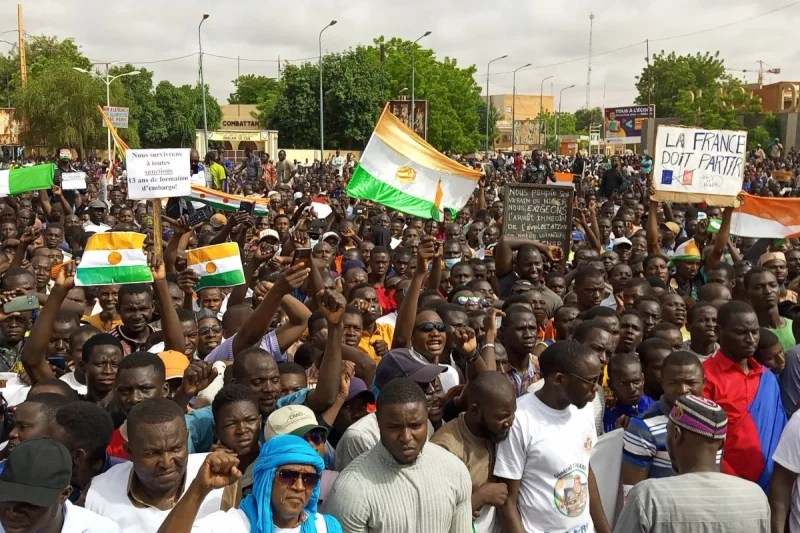
Coup supporters protest the decision of the ECOWAS countries to sanction Niger, in Niamey, Niger on August 3, 2023 [Balima Boureima/Anadolu Agency]
By Dr Mustafa Fetouri | MEMO | August 10, 2023
Niger rejects rules-based order
BY M. K. BHADRAKUMAR | INDIAN PUNCHLINE | AUGUST 8, 2023
The coup in the West African state of Niger on July 26 and the Russia-Africa Summit the next day in St. Petersburg are playing out in the backdrop of multipolarity in the world order. Seemingly independent events, they capture nonetheless the zeitgeist of our transformative era.
First, the big picture — the Africa summit hosted by Russia on July 27-28 poses a big challenge to the West, which instinctively sought to downplay the event after having failed to lobby against sovereign African nations meeting the Russian leadership. 49 African countries sent their delegations to St. Petersburg, with seventeen heads of states traveling in person to Russia to discuss political, humanitarian and economic issues. For the host country, which is in the middle of a war, this was a remarkable diplomatic success.
The summit was quintessentially a political event. Its leitmotif was the juxtaposition of Russia’s long-standing support for Africans resisting imperialism and the predatory nature of western neo-colonialism. This works brilliantly for Russia today, which has no colonial history of exploitation and plunder of Africa.
While every now and then skeletons from the colonial era keep rolling out of the Western closet, dating back to the unlamented African slave trade, Russia taps into the Soviet legacy of being on the ‘right side of history’ — even resurrecting the full name of Patrice Lumumba Peoples’ Friendship University of Russia in Moscow.
Yet, it wasn’t all politics. The summit deliberations on Russia-Africa partnership helping the continent achieve ‘‘food sovereignty,’’ alternatives to the grain deal, new logistics corridors for Russian food and fertilisers; enhancement of trade, economic, cultural, educational, scientific, and security cooperation; Africa potentially joining the International North–South Transport Corridor; Russia’s participation in African infrastructure projects; Russia-Africa Partnership Forum Action Plan to 2026 — these testify to the quantifiable outcome.
Enter Niger. The most recent developments in Niger underscore the leitmotif of the Russia-Africa summit. Russia’s prognosis of the African crisis stands vindicated — the continuing ravages of Western imperialism. This is evident from the reports of Russian flags seen at demonstrations in Niamey, Niger’s capital.
The rebels who seized power lost no time to denounce Niger’s military-technical cooperation agreements with France, which has been followed up with the demand that France withdraw its troops within 30 days. On its part, France has spoken ‘‘firmly and resolutely’’ in favour of foreign military intervention ‘‘to suppress the coup attempt.’’ The French authorities made it clear that they have no plan to withdraw their armed contingent of 1,500 people who are in Niger “at the request of the legitimate authorities of the country on the basis of signed agreements.”
France’s stance comes as no surprise – Paris does not want to lose its position in Sahel region and the cheap source of resources, especially uranium. But France miscalculated that the coup didn’t enjoy the support of the Nigerien military or had a social base, and all that was needed to roll it back would be a limited demonstration of force that would compel the elite presidential guard to begin direct negotiations with France.
France and the US coordinate their actions with the Economic Community of West African States [ECOWAS]. The ECOWAS initially did some sabre-rattling but has piped down. Its deadline for intervention has passed. The ECOWAS simply does not have a mechanism for the rapid gathering of troops and the coordination of hostilities, and its powerhouse Nigeria has its hands full tackling internal security. The Nigerian public opinion feels wary about a blowback — Niger is a large country and has a 1500-kilometre long porous border with Nigeria. An unspoken truth is, Nigeria is hardly interested in increasing the French military presence in Niger or on being on the same side with France, which is extremely unpopular throughout the Sahel.
The mother of all surprises is that the military coup enjoys a groundswell of popular support. Under the circumstances, the strong likelihood is that the French troops may be forced to leave Niger, its former colony. Niger is a victim of neo-colonial exploitation. Under the guise of fighting terrorism, which is, ironically, a spillover from the NATO intervention in Libya in 2011 spearheaded by none other than France into the Sahel region, France ruthlessly exploited Niger’s mineral resources.
A noted Nigerian poet and literary critic Prof. Osundare wrote last week, ‘‘Probe the cause, course, and symptoms of the present resurgence of military coups in West Africa. Find a cure for this pandemic. More important, find a cure for the plague of political and socio-economic injustices responsible for the inevitability of its recurrence. Remember the present brutish anarchy in Libya and the countless repercussions of the destabilisation of that once blooming country for the West African region.’’
The only regional state that can afford effective military intervention in Niger is Algeria. But Algeria has neither any experience in conducting such operations on a regional scale nor has any intention to depart from its consistent policy of non-interference in the internal politics of a sovereign country. Algeria has warned against any external military intervention in Niger. ‘‘Flaunting military intervention in Niger is a direct threat to Algeria, and we completely and categorically reject it… Problems should be solved peacefully,” said Algerian president Abdelmadjid Tebboune.
At its core, without doubt, the coup in Niger Republic narrows down to a struggle between Nigeriens and the colonial powers. To be sure, the growing trend of multipolarity in the world order emboldens African nations to shake off neo-colonialism. This is one thing. On the other hand, the big powers are being compelled to negotiate rather than dictate.
Interestingly, Washington has been relatively restrained. President Biden’s espousal of ‘’values’’ fell far short of the diktat on ‘‘rules-based order’’ — although America reportedly has 3 military bases in Niger. In the multipolar setting, African nations are gaining space to negotiate. Russia’s pro activism will spur this process. China also has economic stakes in in Niger.
Notably, the coup leader Abdurahman Tchiani is on record that “the French have no objective reasons to leave Niger,” signalling that a fair and equitable relationship is possible. Russia has been cautious that the key task at the moment is “to prevent further degradation of the situation in the country.” Foreign Ministry spokesperson Maria Zakharova said, ‘‘We consider it an urgent task to organise a national dialogue to restore civil peace, ensure law and order… we believe that the threat of the use of force against a sovereign state will not contribute to defusing tensions and resolving the situation in the country,” .
Clearly, Niamey will not succumb to pressure from outsiders. “Niger’s armed forces and all our defence and security forces, backed by the unfailing support of our people, are ready to defend the integrity of our territory,” a junta representative said in a statement. A delegation from Niamey went to Mali asking for Russian-affiliated Wagner fighters to join the fight in the event of a Western-backed intervention.
An early resolution of the crisis around Niger is not to be expected. Niger is a key state in the fight against the jihadi network and is linked strategically and structurally to neighbouring Mali. And the situation in the Sahel region is escalating. This has profound implications for the crisis of statehood in West Africa as a whole.
American exceptionalism is not a universal panacea for existing ills. The Pentagon helped train at least one of the coup leaders in Niger — and those in Mali and Burkina Faso, which have promised to come to Niger’s defence. Yet, speaking from Niamey on Monday, the visiting US acting deputy secretary of state Victoria Nuland lamented that the coup leaders refused to allow her to meet with the ousted president Mohamed Bazoum and were unreceptive to US calls to return the country to civilian rule.
Nuland’s mission aimed at dissuading the coup leaders from engaging with the Wagner group but she was unsure of success. Nuland was not granted a meeting with General Tchiani.
African neighbors finalize Niger war plans
RT | August 4, 2023
The militaries of several ECOWAS members have agreed on a plan for military intervention in Niger and are waiting for a final political decision, a senior official of the bloc said on Friday.
The Economic Community of West African States has already sanctioned the junta in Niamey over last week’s military coup and demanded the restoration of ousted president Mohamed Bazoum before Sunday.
Even as Nigeria sent diplomats to its northern neighbor, its capital Abuja was hosting a planning meeting of ECOWAS chiefs of staff. Notably absent were Mali, Burkina Faso, Chad, and Guinea.
“All the elements that will go into any eventual intervention have been worked out here, including the resources needed, the how and when we are going [to] deploy the force,” said Abdel-Fatau Musah, ECOWAS commissioner for political affairs, peace and security.
Musah added that the final decision will be made at the political level, but that ECOWAS will not telegraph when and where it will strike.
“ECOWAS will not be used for coups. Democracy is what we stand for and democracy is what we will sustain,” General Christopher Gwabin Musa, chief of Nigeria’s defense staff, told AP.
On Thursday, Bazoum appealed directly to the US to intervene. Washington has some 1,000 troops in Niger, engaged in counter-terrorism operations against Islamist groups that arose after NATO’s 2011 regime change intervention in Libya. Niger’s former colonial master France has another 1,500 troops on the same mission.
The Nigerien junta repudiated all military treaties with France on Thursday, and sacked the country’s ambassadors to the US, France, Togo and Nigeria. Paris and Washington have said they do not intend to remove their troops from the country, and only recognized Bazoum as the legitimate leader.
Niamey has warned both the West and ECOWAS that any military intervention will be met with deadly force. “All aggression or attempt at aggression against the state of Niger will see an immediate response,” junta spokesman Colonel Amadou Abdramane, said on Friday.
In a joint statement earlier this week, Burkina Faso and Mali said that an ECOWAS incursion into Niger will be taken as a declaration of war against them as well.
Featured Video

Racist Seinfeld Dances for Joy as Bibi Unveils His New Map
or go to
Aletho News Archives – Video-Images
TV Drama Review
Japanese drama projects Japan’s wartime atrocities onto Chinese characters

Global Times | October 25, 2026
By portraying Chinese characters as perpetrators of ruthless violence while casting Japanese Self-Defense Forces (SDF) intelligence operatives as defenders, the season 2 of the Japanese drama Vivant has recently drawn criticism from Chinese netizens, who argue that its depiction turns historical reality on its head while ignoring Japan’s wartime atrocities.
The TBS drama series – a spy suspense story in which an alleged unofficial intelligence unit of the SDF operates across the globe — has attracted a passionate fanbase. Its currently airing season 2 opened with a household rating of 18.8 percent, the highest for a TV drama this year, according toa commentary article by Japanese media Toyo Keizai.
What draws attention is the portrayal of the enemies in the series, the article noted. Scenes in which the Chinese organization subjects kidnapped members of the SDF unit to brutal torture are repeated with unrelenting intensity.
It is rare for Japanese TV dramas to explicitly portray a real-life country as the enemy, the article noted.
Japanese Prime Minister Sanae Takaichi also made a reference to the drama, saying that she has been recording Vivant and hopes to binge-watch it over the year-end and New Year holidays, according to Japanese media outlets.
China’s CCTV News report on Sunday revealed that the drama features scenes in which Chinese personnel cut off the fingers of and stab Japanese intelligence operatives in the abdomen. Such acts bear striking similarities to the torture inflicted on Chinese nationals by invading Japanese troops during the World War II.
The drama distorts the truth by attributing these atrocities to modern Chinese characters. Beneath the surface, it subtly glorifies Japan’s cross-border overseas operations, blurs the functional boundaries of the SDF and implicitly promotes an expansionist narrative, per CCTV News. … continue
Blog Roll
 Aletho News
- EU facing trillion-euro debt hole while seeking more cash for Kiev
- How US, Europe, Persian Gulf states exhausted missile stockpiles, splurged billions to defend Israel
- Up in arms… Koreans reject U.S. empire’s plan to make South Korea the next Ukraine
- Iran, Turkey, Pakistan, Saudi Arabia could advance region-led security framework in Tehran: FM spox
- Netizens condemn Japanese drama for projecting Japan’s wartime atrocities onto Chinese characters
- Racist Seinfeld Dances for Joy as Bibi Unveils His New Map
- A West Bank War for Netanyahu’s Election Campaign, Could It Backfire?
- Yemen denounces European Parliament’s ‘hypocritical’ push to blacklist Ansarullah
- Qalibaf: UAE’s UN bid aims to ‘clear the runway’ for ‘Greater Israel’, whitewash genocide
- Pakistan reopens Iran border after boosting security: Report
- If Americans Knew
- An error has occurred; the feed is probably down. Try again later.
- No Tricks Zone
- Sudden Stratospheric Warming, Powerful El Niño Combination May Lead To Extreme Europe Cold, Energy Crisis!
- Two New Studies Find Thwaites Glacier Melt Cannot Be Driven By Human Activity Or A Warming Ocean
- E-Cars Reduce CO2 Emissions By Only 41% Compared To Internal Combustion Engine Vehicles
- Predictions Made By Renowned Climate Professor Over Past Decades Have Been Proven To Be Poor
- New Study Suggests Large Regions Of The Pacific Ocean Have Been Cooling For The Last 80 Years
- Germany’s Green Energy Debacle: High Energy Costs Force Kahla Porzellan to Close After 182 Years!
- New Study: 50 Years Of The Most Aggressive ‘Net Zero’ Policies Can Only Affect The Global Climate By 0.03°C
- US September “Heat” Was No Record…Many Records Set Decades Ago
- Latest European Green Energy Debacle; Portugal’s Largest Flagship Solar Park Insolvent!
- Green Energy Debacle: German Expert Professor Fritz Vahrenholt Warns Of Severe Economic And Social Consequences

