Russian military experts on the current state of the war
By Gilbert Doctorow | July 25, 2023
There is a lot of cheerleading for Russian military successes on the Western alternative news portals. There is also a fair amount of cheerleading coming from front line Russian war correspondents on Russian state television. But, as I have indicated in past essays, the more serious Russian news programs such as Sixty Minutes and Evening with Vladimir Solovyov also give the microphone to military experts from among Duma committee chairmen and others who actually bear responsibility and accountability for the war effort and are not just talking heads. These speakers are much more restrained in their remarks on the war’s progress and I use this opportunity to share with readers what I hear from such sources. I will be drawing in particular on what was said on the Solovyov show two days ago.
The most sober remark was that it is a mistake to gloat over reports that the Ukrainians have run out of reserves and that their soldiers at the front are now just old men and youths, who are demoralized and surrendering to Russians when they can. Saying that is to diminish our respect for the heroism of Russian soldiers who are facing, in fact, peer equals in the Ukrainian forces. This is a tough war.
Moreover, the Ukrainian reserves are not yet exhausted. Out of the approximately 60,000 elite troops that received training in NATO countries only 30 – 40% were killed or wounded in the battle for Bakhmut and subsequent Ukrainian counter-attack after 4 June. The Russians will not begin their own massive offensive to knock out the Ukrainian military until they are confident that most of the Ukrainian reserves have been depleted in the ongoing war of attrition.
Accordingly, what we are witnessing these days is localized attacks that have tactical, not strategic importance. Yes, the Ukrainians make advances here and there of a few meters at great cost in lost lives of the soldiers. Yes, the Russians make advances of three or four kilometers here or there, at significantly lower cost. The Russians are biding their time. This is not a stale-mate as Western media keep telling their audiences.
Now let us turn to another aspect of the conflict that has grabbed the news over the past week when ground skirmishes between the hostile forces moved to the back pages of our newspapers. I have in mind the spectacular Russian missile attacks on Ukrainian port infrastructure in Odessa, in Nikolaev and yesterday in a river port of the Danube estuary just across from the Romanian border. These attacks are described by official Russian military sources as “revenge attacks” for the damage inflicted on one of the roadways of the Crimean bridge by Ukrainian surface drones that exploded under bridge supports.
Of course, that is just Public Relations talk to satisfy the Russian public and overwhelm local outrage at the failure to defend what is, finally, vulnerable infrastructure. No, the reason for the Russian destruction of the Ukrainian port facilities day after day lies elsewhere. The missile strikes were not so much intended to inflict pain on the Ukrainians as to avert what could be naval battles on the Black Sea and a quantum jump in risks of total war. And, en passant, they demonstrated that the latest sea-launched Russian cruise missiles with 3,000 km range that fly just 15 meters above the sea at Mach 3 cannot be intercepted by present Ukrainian air defenses.
Let us remember that when Vladimir Putin announced that the grain deal with Turkey and the United Nations would expire on 18 July, the RF Ministry of Defense announced that any vessels headed towards Ukrainian ports ostensibly to receive export grain would henceforth be considered as carriers of arms to Ukraine and were fair game for destruction by Russian forces.
Immediately after this Ukrainian President Zelensky went on air with his proposal to Turkey that the grain exports by sea continue without Russian participation. The safety of the vessels would be assured by Turkish and other NATO naval convoys. In the context of Erdogan’s latest turn to the U.S. and away from Russia, it appeared that Ankara was prepared to strike a deal with Zelensky. If that were done, then the chances of naval battles between Russian and NATO vessels in the Black Sea would have soared.
And so the Russians decided to destroy the Ukrainian port facilities active in the grain trade and so to preempt the dangers in view. Erdogan was compelled to draw back from any agreement with Zelensky on resumption of the grain corridor mission.
To be sure, export of grain by ship is the cheapest solution to bringing Ukrainian grain to world markets. But there are other means, namely by rail and truck, traveling north and west across Bulgaria or Romania or Poland. These logistics were used last autumn to move a lot of grain, but that grain tended to disappear into the nominal transit countries where it provoked outrage among the farming communities of these countries for underpricing their own grain crops. We may expect more of this political turmoil in Eastern Europe and protests against Ukraine in the coming months, and this also will serve the Russian objective of making Europe pay for its support of Kiev.
The U.S. State Department representatives have shrieked over the humanitarian disaster that the Russians were causing first by pulling out of the grain deal and then by destroying Ukraine’s export infrastructure in the Black Sea. Particular attention has been directed at the nations of Africa which purportedly represent a large proportion of the poor destination countries for Ukrainian grain.
It is interesting to note that notwithstanding vicious American propaganda against the Russian pull-out from the grain deal, the leaders of Africa have not gone for the bait. Today 47 African leaders are assembling in Russia for highest level strategic talks and deal-making with their Russian counterparts. The Russians are offering free of cost grain to the poorest countries and contracts for grain supply to the others at normal commercial terms. The certainty of supply is assured by what the Russians say will be their biggest grain harvest ever during this season.
Though I denounce the U.S. State Department policies under Antony Blinken as a force for evil in the present world context, I do not mean to say that each and every player there is a villain. I am amused to see on Russian television images of the speeches to the United Nations about the grain corridor delivered by Rosemary Di Carlo, a former U.S. career diplomat who since 2018 has served in the UN as Under-Secretary General for Political and Peace-building Affairs.
Once upon a time, in 1998, I had conversations with Rosemary when she was in charge of cultural affairs at the U.S. Embassy in Moscow. We sat together at the head table of a gathering of American graduate students and professors on the academic exchange with Russia directed by a Cold War holdover NGO, IREX, for which I was briefly country manager back then. Rosemary talked about the theater season in Moscow and we discussed possibilities for assisting Russian museums and other cultural institutions to adapt to the post-Soviet realities of low government funding and finding private sponsors. She held a Ph.D. in Slavic literature. She was one of the relatively few career diplomats who actually understood and spoke Russian. Her heart was in the right place and I very much doubt that she is working to do the Russians a bad turn today.
Moral of the story above from start to finish: very often things are not what they seem.
©Gilbert Doctorow, 2023
Grain Deal Replacement? Russia to Offer Africa New Food Security Plan
By Ilya Tsukanov – Sputnik – 25.07.2023
The second Russia-Africa Summit and Russia-Africa Economic and Humanitarian Forum will take place in St. Petersburg on July 27-28, with President Putin expected to meet with the leaders and representatives of 49 different African countries which have confirmed plans to take part.
Russia will be offering African countries an alternative to the defunct Black Sea Grain Deal to ensure the continent’s continued food security, Russian Foreign Ministry ambassador-at-large Oleg Ozerov has said.
“Of course, it will be not only a discussion as such, but the discussion with solutions for African nations so that they leave St. Petersburg with clear understanding how these issues will be resolved,” the Russian diplomat, who heads the Russia-Africa Partnership Forum, told Sputnik.
Russia has already provided assistance to some African countries earlier, including gratis fertilizer shipments to countries including Malawi and Kenya, Ozerov added.
Moscow suspended its participation in the Black Sea grain deal last week, citing Western countries’ failure to facilitate Russian food and fertilizer exports, and pointing out that just 3 percent of the grain shipped out of Ukraine under the agreement actually went to countries in need in Africa and Asia, with the vast majority instead ending up in Europe and Turkiye.
Failure to Bully Africa Into Submission
Western powers have failed to bully African countries into submission and to persuade them not to attend the upcoming summit in St. Petersburg, Ozerov said.
“Pressure is being exerted. It is of a permanent character. This pressure was exerted through various channels – through the diplomatic corps of Western nations, which literally on a daily basis are trying to dissuade representatives of African states from traveling to Russia, and which demand that African countries firmly pick a camp,” Ozerov said.
The West’s demands look “very strange,” the diplomat said, as they’re coming “from those countries which publicly proclaim democracy and freedom of choice, but in practice demand submission to their dictates.”
There are also other forms of pressure besides politics and diplomacy, the ambassador-at-large said, including economic and financial coercion, with “political conditions put in place for the provision of economic assistance to a number of states both through the International Monetary Fund and the World Bank, where the United States uses its dominant position to put forward political conditions.”
Similar conditionalities are being set up by the European Union, “when the allocation of loans is conditioned on the termination of contacts with the Russian side, or their reduction to a minimum, the non-attendance of a summit or the non-participation in [other] events,” Ozerov said.
Nevertheless, the diplomat stressed that Russia has not seen “African states following this dictate en masse.”
“It’s now obvious that the Western bloc cannot bend all other countries to its will, for objective reasons,” Ozerov said, likely alluding to the G7’s falling political and economic weight in the world as the BRICS countries slowly move the planet in the direction of genuine political and economic multipolarity.
Delegations from 49 of Africa’s 54 countries confirmed their plans to participate in the Russia-Africa Summit by last week, with about half being represented at the highest level – by heads of state or heads of government, according to the Russian Foreign Ministry.
Ozerov indicated that Russian and African leaders will be adopting an overarching policy declaration, joint action plan, as well as three documents on sectoral cooperation at the summit, with the latter concerned with “the fight against terrorism, the non-deployment of weapons in space and international information security.”
The Russian Foreign Ministry expects that these document will become a platform for joint work with African countries on the creation of a new configuration of international relations, based on equality and a multipolar world rather than on a “unilateral dictatorship,” the diplomat noted.
Security Cooperation
In the security sphere, the Russian ambassador-at-large pointed out that Russia has no military presence in Africa, with requests of certain African countries concerning only security assistance.
“We do not have military presence there. There are requests to Russia to provide security assistance. But it is not military presence. Military presence is when one sends troops. We are not sending them. We are sending instructors at the request of African states,” Ozerov said.
Exposed, the multi-billion-dollar illusion of ‘HIV’: Part 1
Readers of TCW will be familiar with Neville Hodgkinson’s critical reporting of the ‘Covid crisis’ since December 2020, notably his expert, science-based informed alarm about the mass ‘vaccine’ rollout, so absent from mainstream coverage. What they may be less aware of is the international storm this former Sunday Times medical and science correspondent created in the 1990s by reporting a scientific challenge to the ‘HIV’ theory of Aids, presaging the hostile response to science critics of Covid today. In this series, written exclusively for TCW, he details findings that form the substance of his newly updated and expanded book, How HIV/Aids Set the Stage for the Covid Crisis, on the controversy. It is available here.
By Neville Hodgkinson | TCW Defending Freedom | July 3, 2023
Three years into the Covid crisis, many are now aware of the disastrous advice on which so many governments blindly acted. False predictions of spread, fearmongering propaganda, lockdowns damaging young and old, suppression of cheap treatments to make way for a dangerous, experimental vaccine . . . so much of ‘the science’ turned out to be fiction, hugely profitable for a few but harmful for billions.
These failures have brought back into focus claims that the syndrome known as HIV/Aids was – and still is – being similarly mishandled and exploited by the worlds of medical science, public health and Big Pharma. Robert Kennedy Jr documents this in detail his best-selling 2021 book The Real Anthony Fauci: Bill Gates, Big Pharma, and the Global War on Democracy and Public Health.
What few people know however is that for almost 40 years a small group of scientists has deconstructed almost every aspect of the theory that Aids is caused by a lethal, sexually transmitted virus known as HIV. Their critique goes beyond questioning HIV as the cause of Aids. They say ‘HIV’ has never even been proved to exist. And the reason you have probably never heard of their work is that, like the doctors and scientists who challenged Covid insanities, they have been silenced at every turn.
With Covid, pressure to conform came through government-directed appeals to our higher nature through slogans such as ‘Stay at home. Protect the NHS. Save Lives’ and ‘Every vaccination gives us hope’. The implied claim was that anyone who thought differently was either an idiot or a murderer.
Similarly with Aids, advocates of the deadly virus theory sought to make those who questioned it sound as though they were lacking in compassion, irresponsible or stupid.
I was working as medical correspondent of the London Sunday Times in the 1980s when Aids suddenly became big news after American government scientists claimed to have identified a previously unknown virus as the cause of a mysterious cluster of symptoms related to severely depleted immunity. They included Kaposi’s sarcoma, a cancer affecting the skin and internal organs; severe candidiasis; and pneumonia caused by an out-of-control fungus. The symptoms proved resistant to treatment, and fatal in a number of cases.
The first victims were groups of gay men who were challenging long-standing homophobic attitudes in American society through what came to be known as the ‘fast-track’ gay lifestyle. This involved multiple sex partners and heavy drug use.
The partying was fun, I was later told, but it caused disease microbes to become pooled among participants such that almost every encounter carried a risk of infection. Prophylactic use of antibiotics staved off some illnesses but contributed to an underlying deterioration, and in some cases complete collapse, of the immune system.
The crisis at first met an unsympathetic response from the right-wing Reagan administration. The common histories of the victims led to dismissive descriptions of Aids as a ‘gay plague’. As numbers increased, however, outrage and anger grew. Those involved had often already suffered greatly from discriminatory attitudes and behaviour, and their efforts to end this bigotry through the Gay Lib movement looked to be under threat.
That was the context in which US biomedical researcher Robert Gallo found immediate acceptance when in 1984 he claimed to have identified a deadly virus, new to humanity, as the cause of Aids. The theory took off like wildfire and by the end of 1984 had come to be accepted by virtually everyone. The microbe Gallo said he had found became known as the Human Immunodeficiency Virus, or HIV.
It brought virologists, drug companies and public health experts to centre stage. Taxpayer dollars, eventually reaching hundreds of billions, were poured into Aids research and treatment through the US National Institutes of Health, in particular the National Institute of Allergy and Infectious Diseases (NIAID) under the leadership of Dr Anthony Fauci. Well-funded NGOs and activist groups sprang up with the aim of contributing to the fight against the disease.
Religious leaders warmed to the theory because it discouraged sleeping around. Politicians liked it because it put in place a new ‘enemy within’ against which they could claim to offer protection with advertising campaigns such as the UK’s ‘Aids: Don’t Die of Ignorance’ – a precursor of the intense propaganda inflicted on us with the advent of Covid-19.
Media people – including me, I am ashamed to say – vigorously promulgated warnings that the virus put at risk everyone and anyone who had sex. It felt good to be not just selling newspapers, but helping to sound the alert.
Young people were less readily taken in. James Delingpole has recalled how the ad campaign put a dampener on his sex life, though after the initial shock it became increasingly clear to him that the government had been overstating the case.
In fact, as the late Nobel Prize-winning chemist Kary Mullis and other scientists were to point out, there never was a body of scientific evidence demonstrating the validity of the ‘deadly new virus’ idea. That remains the case today, despite hundreds of thousands of papers having been published over the years predicated on the HIV belief system.
Henry Bauer, a retired professor of science studies who has drawn on numerous sources in documenting The Case Against HIV, says: ‘Anyone open to looking at the actual data . . . can find an enormous amount of evidence that the diagnosis of HIV as cause of AIDS is simply wrong.’
One lasting outcome of the theory was that by ‘democratising’ Aids, with the message that the disease did not discriminate and so everyone was at risk, it prevented the feared setbacks for the Gay Lib movement. Lesbian and gay rights became firmly established in American society, and in some other parts of the world.
In many other ways, however, the global hysteria to which the theory gave rise has had disastrous consequences, some of which continue to this day.
A failed cancer drug called AZT, pulled off the shelf by American government researchers because of an apparent anti-HIV effect, killed and injured thousands. It was administered in high doses not just to people with Aids but to gay men, haemophiliacs and others thought to be HIV-infected, earning hundreds of millions of pounds for the US drug company Burroughs Wellcome and its British parent, the Wellcome Foundation (later taken over by Glaxo). American and British government institutions promoted it vigorously as the ‘gold standard’ of Aids treatment. Doctors who stepped publicly out of line were hounded out of the profession.
Although later generations of drugs can genuinely help to support a failing immune system, 40 years of research has failed to bring either a vaccine or cure for the purported ‘HIV’ infection. Taken over long periods, the drugs themselves can kill, contributing significantly to the 800 or so deaths reported annually of ‘people living with HIV’ in the UK.
The most widespread and long-lasting harm, however, has been to the countless people around the world, especially in Africa and of African descent, terrorised with a false belief that they are victims of a sexually transmitted virus which only Western medicine has the means to hold at bay. The World Health Organization (WHO) claims that more than 80million people have been infected, and that about 40million have died from HIV. Three-fifths of purported new HIV infections are said by WHO to be in the African region. African Americans are eight times more likely to be diagnosed with HIV infection compared with the white population.
American taxpayers in particular have been burdened with the huge expense of maintaining an industry that has grown up around HIV/Aids. The US government spends more than $28billion a year on the domestic response, and expenditure globally between 2000 and 2015 totalled more than half a trillion dollars ($562.6billion), according to a University of Washington study. Yet the Joint United Nations Programme on HIV/AIDS (UNAIDS), in a never-ending plea for more money, says the pandemic continues to take a life every minute.
In this series of articles I am going to describe the fruits of years of painstaking work by scientists based in Perth, Western Australia, collating evidence challenging almost every aspect of the ‘HIV’ theory. The essence of their case is that there is no ‘HIV’ epidemic, and there never will be a vaccine or cure, because there is no ‘HIV’.
If you find this hard to believe, I am with you entirely in the sense that it took me years to accept fully how wrong I had been in my early reporting on Aids. I documented this painful journey of discovery in my book AIDS: The Failure of Contemporary Science, published in 1996 by Fourth Estate.
If you ask how it could be possible that for 40 years the scientific and medical worlds have failed to correct a belief in a mythological virus, the answer is more sociological than scientific.
Solidarity with the suffering of the gay community played a part – although genuine kindness, such as Louise Hay demonstrated in her early healing work with people with Aids, strongly and successfully challenged the medical view that they were certain to die. An arrogant, but ill-informed, neocolonial drive by countless NGOs to ‘do good’ in poorer parts of the world also contributed. But probably the most powerful and detrimental element in maintaining the deception was the money and influence involved, as governments went into partnership with the hugely profitable pharmaceutical industry. The resources poured into HIV/Aids created thousands of jobs, buying loyal collaboration and stifling dissent.
Highly experienced scientists who spoke out against the theory were ridiculed, defunded, gaslighted, and accused of killing people by weakening the public health message.
I experienced this pressure myself when I began to examine alternative ways of looking at Aids in the early 1990s, when I was working as Sunday Times science correspondent. Joan Shenton of Meditel, producers of prize-winning but much criticised documentaries on the issue, alerted me to the fact that several distinguished scientists had challenged the idea that HIV could be doing all the damage attributed to it.
Andrew Neil, editor of the Sunday Times, which had serialised Michael Fumento’s 1990 book The Myth of Heterosexual Aids, supported my reports on an ever-deepening scientific challenge to the theory. Over a three-year period, condemnation came from just about every quarter. The deeper the critique went, the shriller the protests became.
In 1993, with the HIV/Aids industry still pointing to Africa as proof of how millions could become infected, Neil told me to go there to find out what was happening. Over six weeks, travelling through Kenya, Zambia, Zimbabwe and Tanzania, it became increasingly plain to me that the entire pandemic was an illusion arising from diseases of poverty being reclassified as ‘HIV/Aids’.
My reports to this effect proved too much for the scientific establishment, and Nature – supposedly one of the top scientific journals in the world – declared that we must be stopped. Having decided that picketing our offices would be impractical, the magazine mounted a campaign of ridicule. The UK’s Health Education Authority started an Aids journalism award specifically in my dishonour. They said it was to counter the newspaper’s dangerously misleading coverage. There was incomprehension and abuse from all three main political parties, as well as from scientific and medical chiefs.
But we also heard from many doctors, health workers, gay men, and specialists on Africa, thanking the newspaper for its challenging coverage. An ‘HIV’ diagnosis at that time could still have the power of a witch-doctor’s hex, and people who had tested positive wrote to say that our reports were like a breath of fresh air.
Andrew Neil was undeterred by the hostile bluster, while insisting the paper was ready to publish any evidence that countered the dissident case we were presenting. In 1994 he left the paper for New York, and I left too after his successor John Witherow made it plain that he did not want me to continue this line of reporting. The literary agent David Godwin had been in touch, suggesting a book on the controversy, and this took shape over the following year.
When Fourth Estate published it in 1996, however, it became an early victim of ‘cancel culture’. The late American gay activist Larry Kramer, at first a bitter critic of Fauci but later his friend and ally, was in the UK at the time of publication to address a conference on Aids. He picked up a copy at a pre-conference gathering, tore several pages, and spat in it, telling his audience: ‘Do the same if you come across this book. They will soon stop stocking it.’ It quickly disappeared from view, subsequently topping a list of ‘Books You’re Not Supposed to Read’ in a work on political incorrectness in science.

(From The Politically Incorrect Guide to Science, by Tom Bethell, Regnery, 2005)
I am republishing it now, with additional material including a summary of where the science of ‘HIV’ went wrong, because the story is so redolent of the misunderstandings, mishandling and downright lies surrounding Covid-19. As with Aids, huge grants from Big Pharma and ‘philanthropic’ foundations to researchers, medical associations, consumer groups, and civil rights organisations fuelled the Covid illusions.
There is one important difference. At first I thought the Covid fearmongering was as ill-conceived as that over ‘HIV’ and Aids. It soon became clear, however, that unlike ‘HIV’ this was a genuine pathogen. A disgracefully suppressed paper by the UK’s Professor Angus Dalgleish, working with Norwegian colleagues including a biowarfare expert, demonstrated beyond reasonable doubt the genetically-engineered nature of SARS-CoV-2 (see here and here).
Panic measures to try to hide its laboratory origin confirm that view. These were led by the Chinese, from whose Wuhan laboratory the virus almost certainly escaped, and by Fauci, whose NIAID had part-funded the work. Sir Jeremy Farrar, then director of the UK’s Wellcome Trust and now WHO chief scientist, also played a leading role in the cover-up.
Many are now aware of the adverse social, economic and health consequences of the Covid hysteria into which Fauci and others led us. Billions of people meekly accepted and even welcomed unprecedented lockdowns and other fearmongering measures, along with mass administration of the mRNA gene products. TCW Defending Freedom has been one of few voices constantly critical of the mishandling of Covid over the past three years, despite high-level, far-reaching efforts to silence and defund the site.
Much less widely understood is the way Aids became subject to similar mismanagement 40 years ago, with adverse consequences lasting until today.
Can the WHO and the United Nations impose sanctions on your country for non-compliance?
The sinister sanctions strategy has disturbing implications for democracy, peace, and prosperity around the world. It’s time for us to defund and exit.
By Shabnam Palesa Mohamed | Children’s Health Defense Africa | July 3, 2023
Sanctions are a powerful instrument of political control and economic profit. One of the rare but critical topics relevant to the international campaign to #ExitTheWHO is whether the World Health Organisation and the United Nations can impose, influence or recommend specific sanctions. The sanctions would be against countries that choose to not comply or cannot comply with International Health Regulations, the proposed new pandemic treaty, or other legislative attempts that curtail rights, freedom and sovereignty.
The accelerating and profitable globalist march towards unprecedented levels of ‘1984’ style totalitarianism – using censorship, vaccine passports, 15 minute cities, and CBDC’s continues. It is plausible that the WHO and the UN will move to impose, influence or recommend sanctions against countries that do not want to or cannot comply with its centralised health agenda and undemocratic legislative attempts.
At last year’s World Health Assembly 75, the 47 nation African bloc voted surprisingly, against most amendments to the International Health Regulations, stating that they were broad, rushed, and can pose a threat to national sovereignty. Since then, no doubt with persuasive behind the scenes manoeuvres, some of the most disturbing amendments are being proposed by African countries. Many relate to financing for the cost intensive provisions of IHR amendments and the proposed pandemic treaty or accord. Africa cannot afford more debt slavery.
Countries that could be sanction targets for non-compliance with the WHO and the UN, include but are not limited to, those in the steadily growing BRICS initiative: Brazil, Russia, India, China and South Africa. Iran and Malaysia are reported to have expressed reservations to the proposed IHR amendments at last year’s World Health Assembly 75. Russia is making decisive moves in the international arena and could possibly exit the WHO. In addition, India raised serious audit concerns on irregularities with WHO financials, including missing assets.
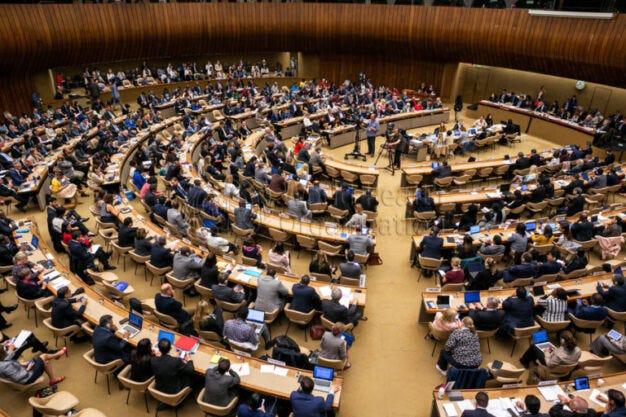
World Health Assembly, Geneva, Switzerland
The ambit of the overwhelmingly privately funded WHO, contained in its extensive constitution, can be interpreted as overly broad and sweeping, and thus, unknown to non-participants, has always posed a potential threat to individual health and national sovereignty.
The WHO’s constitution states in Chapter 2 – Functions – Article 2: In order to achieve its objective, the functions of the Organization shall be: (v) generally to take all necessary action to attain the objective of the Organization. However Article 21 of the WHO’s constitution is specific about making (non-binding) regulations, limiting the WHO to just five areas.
Proposed amendments to the new pandemic treaty include a dangerous clause that would change the WHO’s role from a UN agency that shares recommendations, to a rogue agency whose elitist and secretive attempts at legislation are binding and mandatory on member states, violating fundamental human rights and freedoms. However, health freedom advocates agree that WHO has no actual authority in the law.
In effect therefore, with both IHR amendments and the proposed new treaty, the WHO is acting ultra vires in its Big Pharma driven power grab, in collusion with naïve or compromised member state delegates. Ultra vires is defined in the law as: acting beyond the scope or in excess of legal power or authority. Ultra vires acts of impunity by the WHO could accelerate a mass defund and exit of the agency.
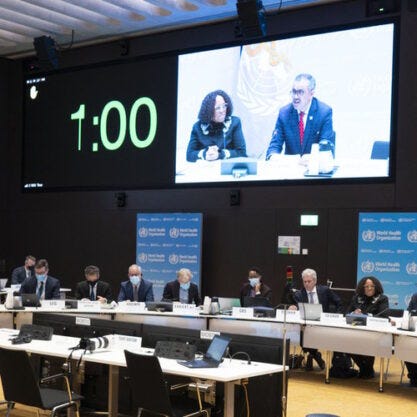
WHO’s negotiating body on a proposed pandemic treaty
Health is no longer just health, as it is defined in the WHO’s constitution. Through Covid-19, and other controversially declared pandemics, health is now a multi-billion dollar health security industry. With it, creeps in the tyranny of secrecy, surveillance, vaccine certificates, forced quarantines, and the undemocratic censorship of free speech. Given the absence of public participation, the WHO is a strategic spear for oligarchs and corporations, and given international resistance to its power grab, it may become desperate and argue or push for sanctions.
Reported in 2021: “In 2021, German Health Minister Jens Spahn called for sanctions against countries that hide information about future outbreaks. Citing the World Trade Organization’s power to sanction countries for non-compliance, Spahn said “there must be something that follows” if countries fail to live up to commitments under a new pandemic treaty that the World Health Assembly will take up in November.”
Further, it is entirely under reported that controversial “World Health Organization Director-General Tedros Adhanom Ghebreyesus also urged countries to consider the idea as they take up the treaty, a legally binding tool. The treaty should “have all the incentives, or the carrots” to encourage transparency, Tedros said, appearing at a press conference with Spahn in Berlin. “But maybe exploring the sanctions may be important,” he added.”
Also reported in 2021: “Speaking at the WHA in June, Mike Ryan, WHO Health Emergencies Programme Executive Director, also spoke out in favour of the treaty, despite the fact that WHO technical staff have historically avoided taking positions on controversial policy choices before member states. “My personal view is that we need a political treaty that makes the highest-level commitment to the principles of global health security — and then we can get on with building the blocks on this foundation.”
I engaged renowned international law expert Professor Francis Boyle about the possibility of sanctions via the WHO. He had no doubt “They will pursue sanctions against countries that do not comply with their orders, coming from Geneva. Both economic and political sanctions. However, they will only have the power to pursue sanctions if we accept their authority. We cannot. We must exit the WHO.”
With far less public scrutiny currently than the WHO, the United Nations is also seeking exponential new powers and stronger “global governance” mechanisms to deal with what they define as international emergencies. In March 2023, the UN released a policy brief , astonishingly titled “To Think and Act for Future Generations – Our Common Agenda. Strengthening the International Response to Complex Global Shocks – An Emergency Platform”
These all encompassing areas of expanded UN power include:
- climate or environmental events;
- environmental degradation;
- pandemics;
- accidental or deliberate release of biological agents;
- disruptions in the flow of goods, people, or finance;
- disruptions in cyberspace or “global digital connectivity;”
- a major event in “outer space;”
- and “unforeseen risks (‘black swan’ events)
There are several types of sanctions imposed through the United Nations:
- Economic sanctions – typically a ban on trade, possibly limited to certain sectors such as armaments, or with certain exceptions (such as food and medicine)
- Diplomatic sanctions – the reduction or removal of diplomatic ties, such as embassies.
- Military sanctions – military intervention
- Sport sanctions – preventing one country’s people and teams from competing in international events.
- Sanctions on the environment – since the declaration of the United Nations Conference on the Human Environment, international environmental protection efforts have been increased gradually.
- Economic sanctions are distinguished from trade sanctions, which are applied for purely economic reasons, and typically take the form of tariffs or similar measures.
It is plausible that the UN’s controllers realise that the world is pushing back against the WHO’s overreach, or find it irrelevant to real health. Given that sovereign nations will choose to exit the WHO, the UN decided to launch plan B and ascribe to itself even greater powers. Technically, there is no legislation to exit the United Nations within the UN Charter. Again, this is a critical issue of national sovereignty.
The United Nations Children’s Fund or UNICEF’s 2020 Annual Report highlights USD 717 million in donations from the private sector, which is 21 percent of income overall. Lucrative corporate partnerships include Unilever, Louis Vuitton, and Microsoft, while foundation partners include Bill and Melinda Gates Foundation and Mastercard Foundation. It also prides relationships with the World Economic Forum and the International Chamber of Commerce. National committees fundraise from individual donors and corporations at the national level, to support UNICEF globally. The UN’s programmes therefore are heavily dependant on private funding. Funding crowns influence.
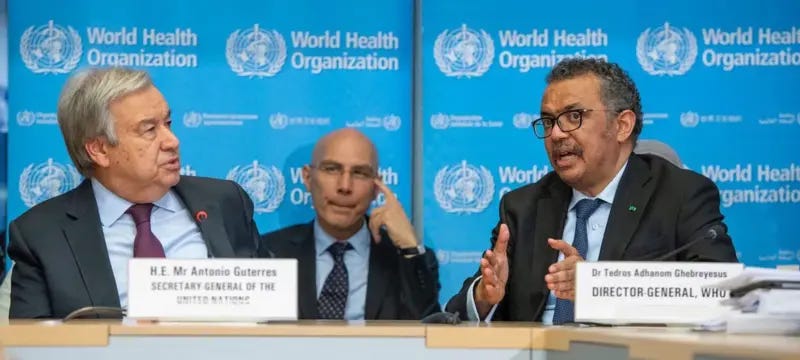
UN secretary general Antonio Guterres with WHO director general Adhanom Tedros Ghebreyesus
The WHO is an agency of the United Nations.
- In 2015, on punishing member states who violate the IHR, as reported: “United Nations health officials said they want to impose sanctions on countries that do not comply with public health regulations meant to avoid the spread of dangerous epidemics, such as the Ebola outbreak that killed more than 9,000 people and ravaged domestic health care systems in West Africa last year. World Health Organization Director Margaret Chan said she is investigating ways to reprimand countries that disobey the International Health Regulations (IHR) — a set of rules adopted in 2005 and mandate that countries set up epidemiological surveillance systems, fund local health care infrastructure and restrict international trade and travel to affected regions deemed unsafe to the public, among other provisions. Chan is on a panel set up by U.N. Secretary General Ban Ki-moon, who instructed the group to think of ways to hold countries accountable for how they manage public health crises and punish those who violate the IHR.”
- In 2022, according to commentators in a policy article: “In order to enforce compliance, some commentators have recommended concluding the treaty at the United Nations level. However, we fear that it has been already decided with the INB (mandated by WHASS) that a treaty will be developed under the roof of WHO. They added: “To move on with the treaty, WHO therefore needs to be empowered — financially, and politically. If international pandemic response is enhanced, compliance is enhanced. In case of a declared health emergency, resources need to flow to countries in which the emergency is occurring, triggering response elements such as financing and technical support. These are especially relevant for LMICs, and could be used to encourage and enhance the timely sharing of information by states, reassuring them that they will not be subject to arbitrary trade and travel sanctions for reporting, but instead be provided with the necessary financial and technical resources they require to effectively respond to the outbreak. High-income settings may not be motivated by financial resources in the same way as their low-income counterparts. An adaptable incentive regime is therefore needed, with sanctions such as public reprimands, economic sanctions, or denial of benefits.”
* Tweet CHD Africa if you agree that sanctions are possible and must be opposed internationally. Use the #StopSanctions
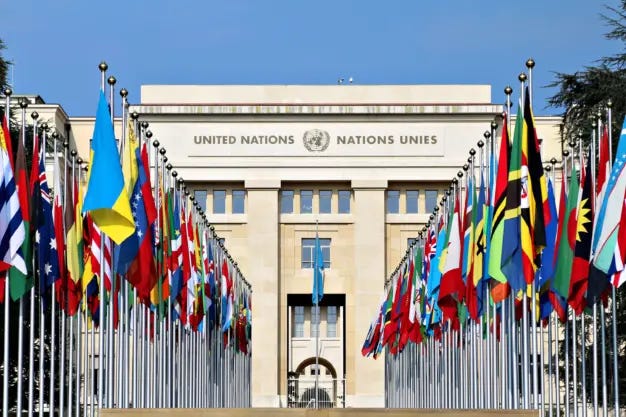
United Nations headquarters in Geneva, Switzerland
In 2000, Kofi Annan, former Secretary General of the UN said: “However, just as we recognize the importance of sanctions as a way of compelling compliance with the will of the international community, we also recognize that sanctions remain a blunt instrument, which hurt large numbers of people who are not their primary targets. Further, sanctions need refining if they are to be seen as more than a fig leaf in the future. Hence, the recent emphasis on targeted sanctions which prevent the travel, or freeze the foreign bank accounts, of individuals or classes of individuals – the so-called ‘smart sanctions’.”
Do sanctions work? “UN targeted sanctions, which are packages of sanctions imposed by the UN Security Council, have been successful in leading to intended policy change only 10% of the times, and limited the policies they intended to change in 28% of cases, but led to a reduced life expectancy in the targeted countries by 1.2–1.4 years. Economic sanctions have also been criticised for the potential collateral damage to third states they can cause. For this reason, some authors suggest that economic sanctions should be banned, as they are having detrimental effects on health and nutrition of civilians.”
Countries themselves can and do impose dangerous sanctions. A 2022 UN security council meeting on sanctions recorded: “Unilateral sanctions, which are sanctions imposed by (groups of) states and not by the UN Security Council, are particularly controversial. Unilateral sanctions have also been criticised for being disproportionately imposed on low-income and middle-income countries by wealthier countries, for example, by the Kenyan representative in a Security Council debate on sanctions on 7 February 2022: ‘The frequency and reach of unilateral sanctions have led to a growing view that they are the weapons of the strong against the vulnerable or weak’.”
- The Universal Declaration of Human Rights, in its first article, states that ‘all human beings are |…| equal in dignity and rights’, which includes the right to health. Article 25 specifies that ‘everyone has the right to |…| health and well-being |…| including medical care’.
- In the UN Convention on the Rights of the Child, article 24 states that ‘state parties recognize the right of the child to |…| the highest attainable standard of health and to facilities for the treatment of illness and rehabilitation of health. State parties shall strive to ensure that no child is deprived of his or her right of access to such health care services’.
- General Comment No.14 of the UN Committee on Economic, Social and Cultural Rights (CESCR) on the right to the highest attainable standard of health, the right to health is a fundamental human right which is necessary for all other human rights to exist and be exercised.
- “The use of sanctions designed to hurt a country’s healthcare sector is clearly incompatible with respecting citizens’ right to health. Accordingly, the general comment No. 14 of the CESCR calls on states to refrain ‘at all times’ from sanctions on medicines and medical equipment. However, sanctions on other healthcare products and, in fact, other non-healthcare products may as well interfere with the right to health, and, thus, need to be subject to scrutiny.”
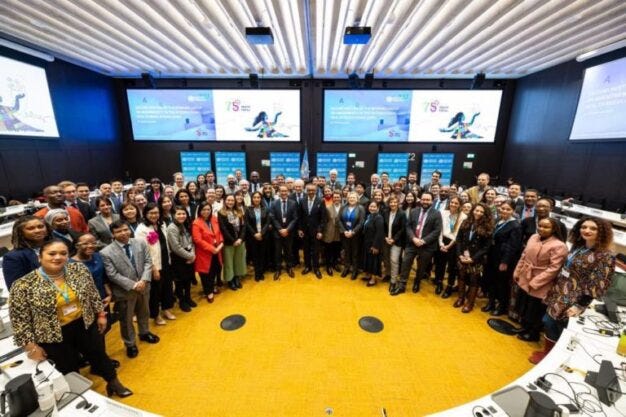
WHO’s World Health Assembly 75
South African Precious Matsoso, co-chair of the International Negotiating Body (INB), formed to negotiate the terms of the proposed pandemic treaty or accord, admitted openly that punitive measures have not been shown to work “anywhere” in the world. However, she said, there must be accountability measures while recognizing countries’ sovereignty. “We have to recognize that they’re sovereign, and they keep on reminding us that they are sovereign states.” It is positive to note that more states do recognise the real threat to sovereignty.
Not all states are considered equal. Smaller countries are at a distinct disadvantage in participating, negotiating and making decisions at the hierarchical WHO. Significantly, Matsoso was transparent about failures in equal participation. “A number of smaller delegations have always expressed concerns about organizations of multiple meetings, where they have to travel from afar, and not even having the capacity to participate in the negotiations,” Matsoso said. “And they have repeatedly requested that you must avoid parallel sessions.” To little avail.
Given the rapidly growing distrust in the WHO, its historical failures and harms, Covid-19 failures and harms, and the fact that it cannot maintain independence because it is a largely privately funded entity; it is plausible that the WHO and/or the UN will move to impose or influence sanctions via the World Trade Organisation, ahead of Agenda 2030. This act of aggression weaponises the WHO and/or the UN against countries that influential funders and unethical stakeholders have an interest in destabilising for power and resource control.
This sinister strategy has disturbing implications for democracy, peace, and prosperity around the world. Freedom faces an existential risk through unelected bureaucratic entities. Nations can and must protect their sovereignty by defunding and exiting WHO, and, by critically assessing the true nature, value, and risks of continued membership in the 78 year old United Nations. Not to do so, means ignoring the risks of UN peacekeepers, who are known to commit crimes with impunity, being deployed in your country to enforce UN and WHO dictates.
Shabnam Palesa Mohamed is executive director and chapter coordinator for Children’s Health Defense Africa. She is an activist, journalist, lawyer, and mediator, with over 20 years of experience in human rights work. To share information, Twitter: @ShabnamPalesaMo
Follow CHD Africa on 6 social platforms for news, action alerts, and updates:
– Telegram: t.me/CHDafrica
– Twitter: https://twitter.com/CHD_Africa
– Instagram: https://www.instagram.com/af.childrenshealthdefense/
– Facebook: https://www.facebook.com/CHDafricachapter
– Rumble: https://rumble.com/user/ChildrensHealthDefenseAfrica
– Tiktok: https://www.tiktok.com/@chdafrica?is_from_webapp=1…
Gates Commits $400 Million to Test New TB Vaccine on 26,000 People in Africa and Southeast Asia
By Brenda Baletti, Ph.D. | The Defender | June 30, 2023
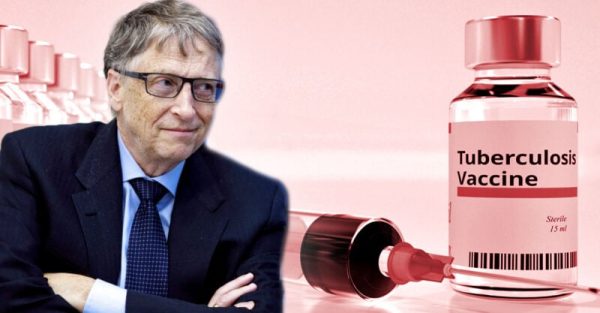
The Bill & Melinda Gates Foundation and Wellcome Trust on Wednesday announced plans to fund a phase 3 clinical trial for a tuberculosis (TB) vaccine that will be tested on 26,000 people at 50 sites in Africa and Southeast Asia over the next four to six years.
Gates committed $400 million to the trial and Wellcome — the largest funder of medical research in the U.K. and one of the largest in the world — committed an additional $150 million.
The trials will test the M72/AS01 vaccine, developed by pharmaceutical giant GSK (formerly GlaxoSmithKline) with partial funding from the Gates Foundation.
Experts told The Washington Post the news was “huge.” The Guardian heralded the announcement as “gamechanging,” while STAT called it “promising.”
But Brian Hooker, Ph.D., P.E., senior director of science and research for Children’s Health Defense told The Defender that the planned trials for the TB vaccine raised red flags.
“I’m concerned that they’re planning on conducting the trial in underdeveloped nations,” Hooker said. “It seems almost prototypical that the underserved have to be guinea pigs for the rest of the world.”
He added, “Fifty percent is incredibly low efficacy for such an ‘important’ intervention to go to essentially everyone in the developing world.”
TB more common among poor
GSK developed the vaccine and ran smaller, “proof-of-concept” phase 2b trials on it in 2018, reporting a 54% efficacy rate. But the vaccine maker didn’t move forward with the large-scale trials needed for a license.
Instead, it passed the license to the Gates Medical Research Institute, a nonprofit biotech spinoff of the Gates Foundation dedicated to developing “novel biomedical interventions” to treat global health problems.
The existing vaccine for TB, the BCG (bacille Calmette-Guérin) vaccine, was developed in 1921 and is effective at stopping TB infection among children but has limited efficacy in adults.
Recent estimates suggest up to 25% of the global population carries a latent (asymptomatic) TB infection, which may later become active among 5-15% of latent carriers. People with latent infection cannot spread the disease.
TB kills 1.6 million people per year, primarily in low and middle-income countries. It is treatable and curable with antibiotics. Drug-resistant strains have emerged, but those also are treatable and curable using second-line drugs.
TB is more common among poor people, who are more likely to work in poorly ventilated and overcrowded conditions, suffer from malnutrition and have more limited access to healthcare.
The funded trial will test whether the experimental vaccine can prevent adolescents and adults with latent tuberculosis from developing symptoms.
Maziar Divangahi, Ph.D., associate director of the McGill International TB Centre — a WHO collaborating research center and recipient of large-scale Gates Foundation grants — told STAT the vaccine was “really a big deal.”
But he also cautioned against putting too much faith in the earlier GSK trial. In that trial, 39 people — 26 in the placebo group and 13 in the vaccine group — became sick, so the sample size was “extremely low,” he said. And no one knows how long protection might last, he said.
In the earlier trial, 67% of people in the group that received the drug made unsolicited reports of adverse events within 30 days after injection, compared with 45% in the placebo group.
Gates Foundation funding like working in a ‘cartel’
The Gates Foundation is one of the largest funders of global health initiatives and “its influence on international health policy and the design of global health programmes and initiatives is profound,” The Lancet reported in 2009.
Since then its influence has grown substantially.
According to Anne-Emanuelle Birn, Sc.D., professor and chair of the Dalla Lana School of Public Health at the University of Toronto, this is a problem:
“The BMGF [Gates Foundation], emblematic of elite interests in contemporary society, disregards the underlying causes of ill health in the first place, overlooks what role the unprecedented accumulation of wealth in the hands of a few has played therein, and remains fiercely proud (staking a moral high ground) of its generosity and technical savoir-faire, all the while remaining underscrutinized by scientists and the wider public alike.”
Her research outlined how the Gates Foundation’s “profit-making principles as drivers of policy” have given business interests “an enormous and unprecedented role” in driving international policy-making.
“Despite the manifold shortcomings of a technology-focused, disease-by-disease approach to global health, this model prevails at present, abetted by the BMGF’s prime sway at formal global health decision-making bodies,” she wrote.
In a recent article examining the role of the Gates Foundation in global health, University of London professor Gwilym David Blunt, Ph.D., wrote that the foundation has been widely criticized for not following data-driven policies. “Its preference for technology and new vaccines” fails to acknowledge that mortality is often driven by “lack of basic resources such as sanitation, housing and nutrition,” Blunt wrote.
While people may benefit from clinical solutions, he wrote “a public health intervention such as ensuring access to clean water and sanitation may reduce deaths more quickly and with less expense.”
Instead, he wrote, the Gates Foundation’s influence “has helped move global health towards high-tech, vaccine-focused initiatives.”
In debates over how to approach global health at GAVI, the Vaccine Alliance, he reported Bill Gates was “vehemently insisting that not ‘one cent’ of his money should go into public systems.”
Arata Kochi, Ph.D., former head of the WHO’s malaria program, compared the Gates Foundation’s funding to working in a “cartel,” with researchers locked into the agenda of a foundation with “a closed internal process, and as far as can be seen accountable to none other than itself.”
Even The Lancet published a similar critique of Gates back in 2009.
“Important health programmes are being distorted by large grants from the Gates Foundation,” Dr. Richard Horton, editor-in-chief wrote in an editorial.
Linsey McGoey, Ph.D., professor of sociology at the University of Essex and author of a book examining Gates’ philanthropy has written that diseases like HIV, tuberculosis and malaria — key focuses for the Gates Foundation — clearly need urgent attention.
But, she said in an interview with Current Affairs, “In reality, you need to build up the public health capacity and the universal healthcare capacity of developing regions, not introduce more market actors who have incentives to drive up the costs of different medicines and interventions.”
Proponents of the TB vaccine concede that the global roll-out will “require a lot of resources” and are encouraging governments “to substantially increase investments in the TB vaccine pipeline.”
Wellcome Trust and the Gates Foundation hope to secure a commercial partner for their new vaccine within 12 months, The Economist reported.
Brenda Baletti Ph.D. is a reporter for The Defender. She wrote and taught about capitalism and politics for 10 years in the writing program at Duke University. She holds a Ph.D. in human geography from the University of North Carolina at Chapel Hill and a master’s from the University of Texas at Austin.
This article was originally published by The Defender — Children’s Health Defense’s News & Views Website under Creative Commons license CC BY-NC-ND 4.0. Please consider subscribing to The Defender or donating to Children’s Health Defense.
Putin Chose The Perfect Time To Reveal Details About The Now-Defunct Draft Treaty With Ukraine
BY ANDREW KORYBKO | JUNE 18, 2023
President Putin surprised his guests from the African peace delegation on Saturday by revealing details about Russia’s now-defunct draft treaty with Ukraine. It would have re-enshrined neutrality in that country’s constitution and also limited its number of military forces. According to him, it had even been signed by the Ukrainian side, which then discarded it in response to pressure from the Anglo-American Axis (AAA) despite Russia pulling its troops back from Kiev as part of an agreed-upon goodwill gesture.
The special operation could have been over just a month after it started, thus meaning that this development marked the beginning of the NATO-Russian proxy war in hindsight seeing as how that bloc hadn’t yet gone all-out in supporting Ukraine until right after that happened. This suggests that while the AAA was indeed surprised by President Putin preemptively averting Kiev’s planned reconquest of Donbass, they eventually saw an opportunity to weaken their rival by perpetuating this conflict.
They seemingly calculated that it would quickly collapse due to combined proxy war and sanctions pressure, though that obviously didn’t happen. The following fifteen months ended up hurting the Global South a lot more than Russia as proven by the food and fuel crises that ravaged these developing countries as a result of the West’s unilateral restrictions on their target’s financial dealings. The so-called “grain deal” also failed to relieve their suffering since Kiev never shipped its supplies to those states.
It was in the context of those countries’ plight that some of their leaders decided to embark on a peace mission to the two direct combatants in this conflict. They reportedly sought to convince both sides to agree to a ceasefire and other de-escalation measures such as lifting some of the sanctions in order to restore their previously reliable grain imports from those two. President Putin was aware of why they visited him and thus took the chance to prove that Russia wasn’t responsible for their problems.
His country regards Africa as an emerging pole in the ongoing global systemic transition to multipolarity, hence the importance of comprehensively expanding their relations. To that end, the Russian leader must absolutely ensure that his counterparts and their people aren’t misled by the West’s propaganda blaming it for the food crisis, especially since the “grain deal” is unlikely to be renewed due to its terms never having been fulfilled and a renewed round of information warfare will predictably follow.
President Putin therefore chose the perfect time to reveal details about Russia’s now-defunct draft treaty with Ukraine in order to show them that it’s Kiev and its AAA patrons who are responsible for disrupting Africa’s previously reliable import of grain from Eastern Europe. The supplementary context of Kiev’s disastrous NATO–backed counteroffensive also enabled him to show average Westerners that this catastrophe was entirely avoidable had the AAA not meddled in the Russian-Ukrainian peace process.
About those talks, they might very well resume around wintertime after Kiev’s doomed counteroffensive finally comes to an end, during which time the African peace delegation might be requested by both sides to informally mediate. By informing them of the details contained in the signed agreement that was ultimately discarded by Ukraine under the AAA’s pressure, they’ll be able to pick up where those two left off and thus be able to more effectively facilitate their talks in that scenario.
For these reasons, it makes sense why President Putin waited until now to reveal details about this treaty. He wanted to reassure Russia’s African partners that it isn’t responsible for the food crisis ahead of the next foreseeable round of information warfare claiming otherwise, which will likely commence once the “grain deal” expires next month in the days leading up to the second Russia-Africa Summit. By sharing proof of this with their peace delegation, President Putin ensured that they won’t be misled.
While the West Seeks Victory in Ukraine, the Global South Seeks Peace
By Ted Snider | The Libertarian Institute | June 14, 2023
There is a revealing difference between the peace proposals for the Russo-Ukrainian War that come from the Global South and peace proposals that come from the NATO-aligned West. For starters, no peace proposals have come from the West, while several have come from the Global South. But when the West talks of a negotiated settlement, they insist on Russia losing the war, granting the essential concessions first and only then negotiating the enforcement. The Global South just wants the killing to stop: first stop the war, then negotiate the settlement.
The West has made its position clear at every stage: don’t call for a ceasefire or negotiate during the war. First defeat Russia, then hold talks to impose a settlement. In the early days of the war, when Ukraine was willing to negotiate an end to the fighting, then-United Kingdom Prime Minister Boris Johnson was quick to scold Ukrainian President Volodymr Zelensky that Russian President Vladimir Putin “should be pressured, not negotiated with.” He added that, even if Ukraine was ready to sign some agreements with Russia, “the West was not.”
The West refuses to negotiate during the war. “Now we see Moscow suggesting that diplomacy take place at the barrel of a gun or as Moscow’s rockets, mortars, artillery target the Ukrainian people. This is not real diplomacy,” State Department spokesperson Ned Price explained. “Those are not the conditions for real diplomacy.” Don’t stop the war by negotiating peace, first win the war, then negotiate. “If President Putin is serious about diplomacy,” Price said, “he knows what he can do. He should immediately stop the bombing campaign against civilians [and] order the withdrawal of his forces from Ukraine.”
When China put forward a twelve point peace proposal, the United States dismissed points two through twelve and insisted that the proposal should “stop at point one.” Point one said that “[t]he sovereignty, independence and territorial integrity of all countries must be effectively upheld.” The American script was clear: first Russia concedes and gives into Western demands, then discuss the peace proposal. “My first reaction to it,” U.S. National Security Advisor Jake Sullivan scoffed, “is that it could stop at point one, which is to respect the sovereignty of all nations.” Reading from the same script, Blinken quipped, “If they were serious about the first one, sovereignty, then this war could end tomorrow.”
It is a novel theory of diplomacy that you don’t negotiate with enemies at times of war. When else do you negotiate? Who else do you negotiate with? Is it diplomacy if it is just imposing the result you won by war?
When point three of the Chinese proposal suggested “ceasing hostilities,” the United States rejected it. The Chinese proposal says that “Conflict and war benefit no one,” and requests that “All parties should support Russia and Ukraine in working in the same direction and resuming direct dialogue as quickly as possible, so as to gradually deescalate the situation and ultimately reach a comprehensive ceasefire.” But the U.S. did not want to resume dialogue “as quickly as possible.” National Security Council spokesperson John Kirby explained that “a ceasefire, at this time, while that may sound good, we do not believe would have that effect,” it would not be “a step towards a just and durable peace.” He then clearly stated that “we don’t support calls for a ceasefire right now.” Secretary of State Antony Blinken called the peace proposal a “tactical move by Russia” that was “supported by China” and warned that “the world should not be fooled.”
The Global South sees diplomacy differently. Where the West wants to continue the fighting to allow talks, the Global South wants to stop the fighting to allow talks.
On May 16, South African President Cyril Ramaphosa announced that he had held phone calls with Putin and Zelensky, who both agreed to separately receive a delegation of African heads of state in their capitals to discuss a possible peace plan to end the war. Joining South Africa in the delegation will be Senegal, Uganda, Egypt, the Republic of the Congo, and Zambia. In opposition to Western demands that Russian troops withdraw from Ukrainian territory as a condition for talks to begin, the African heads of state “propose that Ukraine accept opening peace talks with Russia even as Russian troops remain on its soil.” Reversing the order of the West’s agenda, South African Presidency Spokesman Vincent Magwenya said, “First is the cessation of hostilities. Second is a framework for lasting peace.”
Brazil has also “pressed for a truce.” And on June 3, Indonesia offered a peace plan that, like those offered by China, Africa and Brazil, placed the ceasefire first on the agenda to allow for the talks that would follow. Indonesia’s proposal calls for a ceasefire first, then the creation of a de-militarized buffer zone, followed by referendums that would allow the people of the “disputed territories” to democratically determine the post war boundaries.
The West, once again, rejected the order of business on the agenda. “I will try to be polite,” Ukrainian Defense Minister Oleksii Reznikov responded, “It sounds like a Russian plan…We don’t need these mediators suggesting such a strange plan.” Josep Borrell, the European Union high representative for foreign policy, asked that there be a “just peace,” not a “peace of surrender.”
But how is the Indonesian proposal “strange” or a “peace of surrender”? A senior Biden administration official told The Washington Post, “African leaders have made clear to White House and administration officials that they simply want an end to the war.” The official acknowledged that Africa and the United States “disagree on what tactics to use to get to a settlement…as the Africans oppose the idea of punishing Russia or insisting that Kyiv must agree to any resolution.” Africa stresses diplomacy first; the West stresses victory first. While “The Africans want to see a diplomatic solution to this conflict,” the West wants “nothing about Ukraine without Ukraine,” according to the official.
The Global South wants a lasting end to what they see as a European war and the global hardships it causes. They do not seek to punish Russia and defend democracy partly because they do not believe this is a war for the triumph of democracy over autocracy or a Manichean war between good and evil. It is just a devastating war that needs to be stopped. Africa remembers Western colonialism and their sponsored coups. And Indonesia’s Defense Minister, Prabowo Subianto, upon introducing Indonesia’s peace proposal, reminded the West, “We in Asia have our share of conflict and war, maybe more disastrous, more bloody than what has been experienced in Ukraine…Ask Vietnam, ask Cambodia, ask Indonesians how many times we’ve been invaded.” He might have added to ask Indonesia about the half a million to a million Indonesians who were slaughtered with the complicity of the United States.
The Global South has a very different view than the West that gives shape to a very different view on how to end the war. Most obviously, while the West refuses to push the warring parties to negotiate an end to the war and has offered no peace proposals, the Global South is pushing hard for an end to the war and has offered several peace proposals. Unlike the West who favors winning the war before allowing diplomatic talks, the Global South favors a ceasefire that would stop the war as soon as possible in order to allow diplomatic talks.
Most Countries Side With Russia in Ukraine Conflict While US’s Credibility Slips – Hersh
Sputnik -12.06.2023
Most of the world’s population supports Russia’s special military operation in Ukraine, while the United States lost its credibility, Pulitzer Prize-winning US investigative journalist Seymour Hersh said on Sunday.
“The percentage of the [countries], particularly of the African and Central Asian and South Asian countries, that have changed from being pro-America to being pro-Russia is really quite dramatic. Much more than a half of the world’s population supports Russia in the war and not the United States. This was never the way it was,” Hersh said in an interview with talk show host George Galloway.
The journalist opined that “things are not as good as they used to be in Russia” amid Western sanctions, but “the idea that they are desperate is just wrong.”
Hersh also argued that Washington “lost so much credibility around the world,” citing Saudi Arabia’s diplomatic rapprochement with Iran as an example.
“It’s happened because, I think, because of Ukraine and dislike of the war. Saudi Arabia, by the way, they’re selling 25% of [their] oil to China, as I have mentioned, but the Saudis immediately cut a deal. And the Iranians immediately responded … They have a lot of control in Yemen over the Houthi tribes,” Hersh said.
Russia launched its special military operation in Ukraine on February 24, 2022, following calls for help from the breakaway republics of Donetsk and Luhansk. The world has split into those who support Moscow and accuse NATO of provoking the conflict, and those who condemn Russia’s actions and impose sanctions on the country, while also ramping up their financial and military aid to Kiev. Some countries have avoided taking sides in the conflict.
Ukraine reaches out to Africa
By Bakhtiar Urusov – New Eastern Outlook – 11.06.2023
Ukrainian Foreign Minister Dmytro Kuleba began a tour of African countries in a desperate attempt to enlist the support of the countries of the continent to put pressure on Russia, as well as in search of new economic opportunities for Kyiv, which is financially still in a state of clinical death and is only alive thanks to the ongoing (as of yet) emergency rehabilitation assistance from Western sponsors.
This is the second African tour of the head of the Ukrainian Foreign Ministry. Kuleba made his first trip to the countries of the continent in October 2022, visiting Senegal, Côte d’Ivoire, Ghana and Kenya, however, without visible results. This time, he began the trip from the north of the continent, visiting Morocco, which has been the first visit of a Ukrainian Foreign Minister since the establishment of diplomatic relations between the countries. This is by no means accidental. After all, Morocco is the first state on the African continent to supply weapons to Ukrainians. These were Soviet at the disposal of the Moroccans. Other African countries refrain from direct involvement in the Ukrainian conflict, rightly believing that this will not bring any serious dividends and will definitely add problems.
Kuleba’s itinerary also includes Kenya, Ethiopia, Nigeria and Tanzania. The purpose of the trip, along with “increasing the number of supporters” of Volodymyr Zelensky’s “peace formula,” was also stated as establishing business cooperation. But Kyiv’s main problem in implementing its plans is that it actually has nothing to offer Africans for their potential sacrifices in the name of Ukraine, especially in the current conditions, when the country is disintegrated and is in a state of deep political, financial and economic crisis.
It is obvious that building by Ukraine of its African foreign policy vector is taking place at the suggestion and approval of the United States and the EU, which are thereby trying to ease the Ukrainian burden, which is becoming unbearable, by transferring the country to at least partial outsourcing. Today, the role of African countries in world geopolitics has grown. This, in particular, is due to the fact that there are 54 states on the continent that are represented in the UN and other international organizations, and, accordingly, have their own voice in world affairs. Ukraine is tasked with enlisting this support and isolating Moscow from the African corner as much as possible.
Meanwhile, an ostensibly ridiculous piece of news appeared recently in the media that Ukraine decided, due to an acute shortage of professional diplomats, to advertise for ambassadors. The corresponding page was created on the website of Ukraine’s Ministry of Foreign Affairs, where anyone can declare their candidacy for a high post. Foreign Minister Kuleba called such a move an attempt to find a “precious drop” to “feed” the diplomatic service. However, the problem is systemic and has deep roots. The shortage of foreign policy personnel in Ukraine was largely man-made and arose after the 2004 Orange Revolution, when many experienced employees were dismissed from the diplomatic service for political reasons. No one bothered to recruit and prepare worthy replacements for them. As a result, Ukrainian foreign policy is fraught with scandals. At one point Zelensky had to recall the ambassador to Germany, Andriy Melnyk, for his insulting remarks about the leadership of the Federal Republic of Germany, and at another he had to fire the head of the diplomatic mission in Kazakhstan, Pavel Vrublevsky, for his calls to exterminate as many Russians as possible.
EU’s Green Deal to have dire implications for East African farmers — study
North Africa Post | June 1, 2023
As the EU executive is adopting intermediate proposals in its international climate policy as outlined in the European Green Deal, this will have serious and multifaceted implications for Africa, according to a recent study by Eastern Africa Farmers Federation (EAFF).
The Green Deal provides a road map for a socioecological transition to a low-carbon future and the building blocks for a green economic growth strategy to address climate change, energy, and biodiversity.
According to Stephen Muchiri, CEO of the Nairobi-based EAFF, the stringent policies outlined in the Farm to Fork (F2F) and Chemical Sustainability Strategies will greatly affect global trade in agricultural inputs and outputs and, by extension, also the economies of African countries that greatly depend on agriculture. Muchiri also warns that the new additional requirements, as set by the European Commission, threaten the livelihoods of many small producers and may significantly reduce the export earnings of East African countries such as Uganda, which is the second largest horticulture exporter in the region.
Horticultural exports from East Africa to the European Union are valued at more than $2.3 billion, with smallholder farmers contributing up to 70% of the export volumes. The study revealed that farmers would be overburdened by the new regulations because substantial costs will be introduced with the new specifications on standards, certifications, logistics, and carbon border adjustment mechanisms (CBAM).
This prompts Muchiri to warn that the implementation of the Green Deal in its current form falls short in support of progressive and sustainable export-oriented farming for most East African smallholder farmers as it will introduce additional constraints that will impact the region’s competitiveness, sustainability, and livelihoods negatively, so whereas the EU will achieve its goals, the countries of export will be reeling from significant production and compliance challenges.
British special forces deployed to 19 countries since 2011 – Report
RT | May 23, 2023
The UK has sent its special forces to 19 countries since 2011, according to a report by Action on Armed Violence (AOAV). These British operatives trained foreign militants, carried out assassinations, and reportedly fought alongside child soldiers.
In a report published on Tuesday, AOAV stated that British operatives have been deployed to fight or surveil hostile forces in Algeria, Cyprus, Estonia, France, Iraq, Kenya, Libya, Mali, Nigeria, Pakistan, the Philippines, Russia, Somalia, the Strait of Hormuz between Iran and Oman, Sudan, Syria, Ukraine, and Yemen.
Some of these deployments were into locations in which British troops were already fighting, as was the case in Afghanistan and Iraq. However, UK Special Forces (UKSF) continued their operations in both countries long after regular forces withdrew. In Afghanistan, hundreds of civilian deaths were attributed to night raids by British and American special forces between 2009 and 2012.
While parliament authorized military action in Afghanistan and Iraq, UKSF have deployed to other active conflict zones without the assent of lawmakers. Three days before parliament voted against a deployment to Syria in 2013, UKSF and MI6 operatives were on the ground targeting Syrian air defense installations and calling in American airstrikes, the report stated. Within months, they were training anti-government militants while assassinating Islamic State fighters.
In Yemen, UKSF operatives conducted raids on Al Qaeda-linked militants, but, in some cases, fought alongside jihadists who had been recruited by Saudi Arabia and the UAE to attack Houthi rebels. Up to 40% of these jihadi forces, AOAV noted, were child soldiers.
Training missions and hostage rescue operations made up most of the rest of the deployments, while the UKSF operation in Russia focused on providing security for British athletes at the 2014 Winter Olympics in Sochi.
Recently leaked Pentagon documents suggest that the UK has deployed 50 special forces personnel to Ukraine since Russia launched its military operation last February. Prior to the leak, multiple media outlets reported the presence of British and American special forces in Ukraine, while one general told The Times last year that as many as 300 British commandos were conducting “discrete operations” alongside Kiev’s forces.
“The extensive deployment of Britain’s Special Forces in numerous countries over the past decade raises serious concerns about transparency and democratic oversight,” said AOAV Director Iain Overton. “The lack of parliamentary approval and retrospective reviews for these missions is deeply troubling.”
Featured Video

Racist Seinfeld Dances for Joy as Bibi Unveils His New Map
or go to
Aletho News Archives – Video-Images
TV Drama Review
Japanese drama projects Japan’s wartime atrocities onto Chinese characters

Global Times | October 25, 2026
By portraying Chinese characters as perpetrators of ruthless violence while casting Japanese Self-Defense Forces (SDF) intelligence operatives as defenders, the season 2 of the Japanese drama Vivant has recently drawn criticism from Chinese netizens, who argue that its depiction turns historical reality on its head while ignoring Japan’s wartime atrocities.
The TBS drama series – a spy suspense story in which an alleged unofficial intelligence unit of the SDF operates across the globe — has attracted a passionate fanbase. Its currently airing season 2 opened with a household rating of 18.8 percent, the highest for a TV drama this year, according toa commentary article by Japanese media Toyo Keizai.
What draws attention is the portrayal of the enemies in the series, the article noted. Scenes in which the Chinese organization subjects kidnapped members of the SDF unit to brutal torture are repeated with unrelenting intensity.
It is rare for Japanese TV dramas to explicitly portray a real-life country as the enemy, the article noted.
Japanese Prime Minister Sanae Takaichi also made a reference to the drama, saying that she has been recording Vivant and hopes to binge-watch it over the year-end and New Year holidays, according to Japanese media outlets.
China’s CCTV News report on Sunday revealed that the drama features scenes in which Chinese personnel cut off the fingers of and stab Japanese intelligence operatives in the abdomen. Such acts bear striking similarities to the torture inflicted on Chinese nationals by invading Japanese troops during the World War II.
The drama distorts the truth by attributing these atrocities to modern Chinese characters. Beneath the surface, it subtly glorifies Japan’s cross-border overseas operations, blurs the functional boundaries of the SDF and implicitly promotes an expansionist narrative, per CCTV News. … continue
Blog Roll
 Aletho News
- EU facing trillion-euro debt hole while seeking more cash for Kiev
- How US, Europe, Persian Gulf states exhausted missile stockpiles, splurged billions to defend Israel
- Up in arms… Koreans reject U.S. empire’s plan to make South Korea the next Ukraine
- Iran, Turkey, Pakistan, Saudi Arabia could advance region-led security framework in Tehran: FM spox
- Netizens condemn Japanese drama for projecting Japan’s wartime atrocities onto Chinese characters
- Racist Seinfeld Dances for Joy as Bibi Unveils His New Map
- A West Bank War for Netanyahu’s Election Campaign, Could It Backfire?
- Yemen denounces European Parliament’s ‘hypocritical’ push to blacklist Ansarullah
- Qalibaf: UAE’s UN bid aims to ‘clear the runway’ for ‘Greater Israel’, whitewash genocide
- Pakistan reopens Iran border after boosting security: Report
- If Americans Knew
- An error has occurred; the feed is probably down. Try again later.
- No Tricks Zone
- Sudden Stratospheric Warming, Powerful El Niño Combination May Lead To Extreme Europe Cold, Energy Crisis!
- Two New Studies Find Thwaites Glacier Melt Cannot Be Driven By Human Activity Or A Warming Ocean
- E-Cars Reduce CO2 Emissions By Only 41% Compared To Internal Combustion Engine Vehicles
- Predictions Made By Renowned Climate Professor Over Past Decades Have Been Proven To Be Poor
- New Study Suggests Large Regions Of The Pacific Ocean Have Been Cooling For The Last 80 Years
- Germany’s Green Energy Debacle: High Energy Costs Force Kahla Porzellan to Close After 182 Years!
- New Study: 50 Years Of The Most Aggressive ‘Net Zero’ Policies Can Only Affect The Global Climate By 0.03°C
- US September “Heat” Was No Record…Many Records Set Decades Ago
- Latest European Green Energy Debacle; Portugal’s Largest Flagship Solar Park Insolvent!
- Green Energy Debacle: German Expert Professor Fritz Vahrenholt Warns Of Severe Economic And Social Consequences

