The lead, Western warmaking/regime-change countries intervening in northern Iraq and Syria held a strategy conference of their ministers of war in Paris on January 20. The meeting made waves in Canada because Ottawa was not invited to attend.
The meeting of ministers of the United States, Britain, Germany, France, Italy, Australia and the Netherlands discussed ongoing plans for intervention in Syria and Iraq. Canada is fully engaged in that intervention, more so than some of the other countries attending in Paris. For example, neither Italy or Germany have fighter aircraft engaged in bombings. But Canada was not invited to the party because Prime Minister Justin Trudeau made a promise during the national election campaign of October 19, 2015 that, if elected, his government would withdraw its six fighter-bomber jets from the U.S.-led warmaking alliance and instead focus on ground operations, including training of allied Iraqi and Kurdish forces.
The decision not to invite Canada was likely taken by U.S. Secretary of Defense (sic) Ashton Carter. Never mind that the new Trudeau government is not keeping its electoral promise or that, to the contrary, it has promised to step up its military presence in northern Iraq. No, for the U.S. government, any deviation from its lead in the imperialist war agenda is punishable by shunning.
The U.S. views the Canadian electoral promise as a weak-kneed sop. It cares not a whiff about the war-weary Canadian public, repelled by Canada’s failed military intervention in Afghanistan. That intervention goes back to late 2001. 158 Canadian soldiers died in combat in Afghanistan. At least 59 of those who served have killed themselves upon their return, while, shamefully, the previous Conservative government in Ottawa did all it could to reduce to a minimum disability payments to injured, returned soldiers.
The U.S. snub is intended as a warning to the Trudeau government just in case any of its members are actually considering keeping their election promise. It needn’t worry, there is no evidence that any are doing so. Also, importantly, the snub is serving as a rallying cry for pro-war ideologues in Canada who never liked the election promise in the first place and now want it definitively buried.
The enclosed opinion article in the Globe and Mail is exactly the kind of knee-jerk, pro-war backlash that the U.S. government wanted to foment. The writer, David Bercuson, is a well-known military academic in Canada. He directs his criticisms not at the United States government for snubbing its loyal ally but at the Trudeau government for giving the U.S. a reason to do so.
Bercuson wrote a commentary last month in the Globe saying that Prime Minister Trudeau was asking for trouble with his allies by making flaky election promises over war and intervention in the Middle East.
Columnist Thomas Walkom of the Toronto Star, Canada’s largest circulation newspaper, provides a different view of the snub in a January 18 column. He calls it a “welcome snub”. He says, “Trudeau’s Liberals won power on a pledge to end Canada’s combat mission in Iraq and Syria — in the air and on the ground. If they are serious about this, why should we expect the Americans to include Ottawa in their combat deliberations?
“More to the point, why should we want to be included?”
Ottawa is lucky to have carte blanche, more or less, in working out the subtleties of its desired intervention in Iraq and Syria. The two large opposition parties in Parliament support military intervention in the Middle East, differing only on how that should be done. Meanwhile, antiwar forces are weak and marginalized. Years of confusion over the regime change agenda of the imperialist countries in the in Africa and the Middle East (Mali, Libya, Egypt, Syria) combined now with utter disarray in the face of the anti-Russia drive of NATO have left antiwar forces marginalized.
January 22, 2016
Posted by aletho |
Militarism | Africa, Canada, Iraq, Middle East, NATO, Syria, United States |
Leave a comment
Coercive Engineered Migration: Zionism’s War on Europe (Part 2 of an 11 Part Series)
During the 1920s General Secretary of the Communist Party of the Soviet Union Josef Stalin formulated what he considered to be the essential contribution of Lenin to Marxist political economy. Leninism, he wrote, is Marxism in the era of proletarian revolution. Since 1989 proletarian and national liberation revolutions throughout the world have been overturned by a general, global counter-revolutionary upsurge. It is a counter-revolutionary upsurge that has seen the onslaught of US colour revolutions, which seek to do away with the bourgeois nation-state itself, the last barrier to the total exploitation of the world by the global corporate and financial elite.
In this essay we have argued that the contemporary form of this counter-revolutionary ideology, of this imperial drive for global domination, is Zionism. One could therefore assert that Zionism is imperialism in the age of capitalist counter-revolution. In other words, Zionism is the very form of contemporary Western imperialism. Therefore, unlike Russian and Chinese imperialism, Western imperialism or Zionism has both a religious and ethnic dimension. Zionism is a Messianic and racist ideology based on Talmudic Judaism.
Zionism, through its control of Western finance capitalism, is striving for global governance. Lenin, writing in 1915, described as ‘indisputable’ the fact that ‘development is proceeding towards monopolies, hence, towards a single world monopoly, towards a single world trust’. But Lenin also pointed out that this drive towards unipolar global power would also intensify the contradictions in the global economy. A cogent example of this today is the low-intensity covert war currently being waged by the United States/Israel against Germany: The Western imperial alliance is turning on itself.
However, no people’s resistance to Zionism can be mounted if the empire continues to outsmart its opponents. The aforementioned General Barnett understands his enemies well. He used to teach Marxism in Harvard university and has written a book comparing the African policies of the German Democratic Republic and the Socialist Republic of Romania. In his book Blueprint For Action, he points out that the father of Fourth Generation Warfare is Mao Tse Tung. Imperial grand strategy is now waging war using techniques developed during the Chinese revolution, one of the greatest anti-colonial struggles in history. The key for anti-imperialist resistance today is, therefore, to understand how to turn the tools of imperialism against imperialism.
Marxism is a useful and indispensable tool but is insufficient for an full understanding of the complexities of the information age in the context of imperial strategy and tactics. Barnett and many other US and Israeli military strategists are keen students of social psychology, and in particular General Boyd’s OODA Loop Theory. The OODA stands for observation, orientation, decision, action. According to Boyd, decision-making occurs in a recurring cycle of observe-orient-decide-act. An entity (whether an individual or an organization) that can process this cycle quickly, observing and reacting to unfolding events more rapidly than an opponent, can thereby “get inside” the opponent’s decision cycle and gain the advantage.
One could see this psychology at work during the Arab Spring. The rigid ideological orientation of the average ‘leftist’ saw the uprisings in Tunisia as proof that people were rebelling against a US-backed dictator and his ‘neo-liberal’ regime. This interpretation was reinforced by strategically placed ‘critics’ of US-foreign policy in the news station of Zionism’s ancillary regime, Qatar, while the initial indifference of the Western press confirmed the interpretation of the Tunisian revolt as a genuine, grass roots uprising against US imperialism.
US and Israeli strategists were capable of doing this through their deep understanding of ‘leftist’ discourse. They also understood that the ‘anti-globalisation’ form of the protest movement would fool genuine critics of US imperialism, thereby impeding their ability to react to the US-orchestrated revolutions in a rational manner.
In the Arab Spring, inverted Marxian dialectics, Systems Theory, Psychology, Military Science and Utility Theory were waged against a feckless and discombobulated anti-war movement who would repeat the sound bites of ‘popular uprising’ and the ‘defeat of US imperialism in the Middle East’ implanted in their minds by one of the most impressive and successful US/Israeli geostrategic operations in modern history.
On the eve of NATO’s bombing of Libya, the BBC predictably called upon an old reliable ‘critic of US foreign-policy’ Noam Chomsky. The veteran American philosopher agreed that the West had a “duty” to “stop the massacres” in Libya thus ensuring there would be no moral outrage among the so-called anti-war movement. The invitation of Noam Chomsky by the Zionist-controlled BBC shows the importance for British intelligence of ideologically disarming potential ‘leftist’ opponents in the run-up to meticulously planned wars of aggression, disguised as ‘humanitarian interventions’.
Given Chomsky’s anarchist ideology, the very ideology instrumentalised by the CIA in colour revolutions, the BBC knew he would go along with their fake ‘popular uprising’ in Benghazi, thus providing justification to wage ‘humanitarian’ warfare in support of the ‘revolution’.
In 2013, a massive military destablisation of Brazil was undertaken by US NGOs, operating under the guidance of the CIA, in order to weaken the popularity of a government moving far too close to Russia and China in the eyes of Washington. Again, the CIA’s ‘Vinegar revolution‘ received full support from most ‘leftist’ quarters. Once again, military geostrategy had triumphed over anti-imperialist analysis.
The current refugee crisis proves that US/Israeli military geostrategy is running circles around its opponents, who, instead of identifying the culprits who are using human beings as weapons, are unwittingly collaborating with Zionism’s plan to inundate Europe with migrants for the purposes of fomenting civil war in the European peninsula, in a desperate effort to prevent Eurasian integration, a prospect inimical to what the Pentagon refers to as ‘full spectrum dominance’, US/Zionist global hegemony.
Those who have joined in the chorus of welcoming the refugees/migrants are unwitting participants in an extension of Zionism’s neo-colonial wars in Africa and the Middle East. They are also complicit in the endorsement and cover-up of a modern slave trade. Opposing imperialism requires study of the logic of its geostrategic operations. Imperialism’s deliberate flooding of Europe with a Wahhabised lumpen-proletariat from a war-torn Southern Hemisphere will not help the cause of labour, the cause of human freedom. Rather, it will contribute to prevent the unification of the European-peninsula with Russia and Asia. It will contribute towards the further colonisation and destruction of independent African and Middle Eastern nations such as Eritrea and Syria.
An example of Marxist Leninist parties’ inability to deal with imperialism’s weaponization of migrants comes from the Communist Party of Great Britain (Marxist Leninist). Their argument in favour of immigration is sound under normal circumstances but they fail to address the problem of when immigration becomes a tool of imperialism, a specific geopolitical strategy aimed at destabilizing both the country of origin and the destination of the migrant.
The recent resolution of the CPGBML is worth reproducing here in full:
This party firmly believes that immigration is not the cause of the ills of the working class in Britain, which are solely the result of the failings of the capitalist system.
Immigration and asylum legislation and controls under capitalism have only one real goal: the division of the working class along racial lines, thus fatally weakening that class’s ability to organise itself and to wage a revolutionary struggle for the overthrow of imperialism.
These controls have the further effect of creating an army of ‘illegal’ immigrant workers, prey to super exploitation and living in dire conditions as an underclass, outside the system, afraid to organise and exercising a downward pull on the wages and conditions of all workers.
The scourge of racism, along with all other ills of capitalism, will only be finally abolished after the successful overthrow of imperialism. But since immigration can no more be abolished under capitalism than can wage slavery, our call should not be for the further control and scapegoating of immigrants, but the abolition of all border controls, as part of the wider fight to uproot racism from the working-class movement and build unity among workers in Britain, so strengthening the fight for communism.
The problem here is that no distinction is made between immigration into imperialist countries and immigration into semi-colonial type countries. For example, Syria has been forced to close its borders due to the passage of terrorists in the service of imperialism. In such circumstances, it would be ludicrous to condemn the Syrian government for erecting fences to protect its borders. Similarly, Hungary, a small country which has just taken modest steps towards escaping from the clutches of US imperialism under the control of the IMF, has decided to erect fences to protect its borders from what it perceives as an attempt by US imperialism to destablize the country. Under these conditions, such a decision is entirely justified. The CPGBML argues correctly that “the scourge of racism, along with all other ills of capitalism, will only be finally abolished after the successful overthrow of imperialism.” The erection of fences in Hungary is part of that fight against imperialism, when migrants are clearly being used as weapons of imperialist strategy against recalcitrant nation-states.
The fact that Zionism is using the refugee crisis to further its imperialist agenda does not mean, however, that all refugees in the world are being used for this purpose. Rather, just as in the Arab Spring where the social inequalities of capitalism were used by imperialism to further the cause of capitalism, so are many refugees coming from the Middle East and Africa being used for the same purpose.
Throughout the world Homo sapiens is being supplanted by homo economicus: a vacuous, brain-washed, rootless cosmopolitan, a deterritorialised and acculturated nomad, hopelessly blown hither and thither by the exigencies of capital. Meanwhile, Zionism continues to stoke up the incessant and utterly fraudulent ‘War on Terror’, with omnipresent mass surveillance of the “nations” (goyim) while at the same time Jews are being encouraged by the Israeli regime to leave Europe for settlement on Arab lands, ruined and depopulated by Zionism’s wars.
The ‘refugee crisis’ is indubitably one more step towards the creation of a Greater Israel. Benjamin Netanyahu recently told the Israeli National News that Israel must become a “world power”.
To politically correct pundits, Victor Orban’s fence might appear inhumane and xenophobic, but at this moment in history the concrete choice presented to us is between temporary fences designed to protect nations from imperialism or Zionist walls built to imprison humanity.
Part I
January 17, 2016
Posted by aletho |
Deception, Ethnic Cleansing, Racism, Zionism, Timeless or most popular | Africa, BBC, Brazil, Central Intelligence Agency, CIA, Germany, Israel, Judaism, Libya, Middle East, Noam Chomsky, Syria, United States, Zionism |
Leave a comment
Saudi Arabia pledged the Somali government USD 50 million in aid on the same day Mogadishu declared it had severed ties with Iran, a report says.
According to a document from the Saudi embassy in Nairobi, Kenya, to the embassy of Somalia there, the regime in Riyadh pledged USD 20 million in budget support to Mogadishu and USD 30 million for investment in the African country, Reuters reported Sunday.
The news agency quoted diplomats as saying that the financial support is “the latest sign of patronage used by the kingdom to shore up regional support against Iran.”
“The Saudis currently manage to rally countries behind them both on financial grounds and the argument of non-interference,” a diplomat said. Iran has repeatedly denied the Saudi allegations of interference in the affairs of other countries.
On January 2, Saudi Arabia announced the execution of prominent cleric Sheikh Nimr al-Nimr and 46 other people. Nimr was a critic of Riyadh. After that, protesters gathered outside the Saudi embassy in the Iranian capital, Tehran, and the consulate building in the city of Mashhad. Some people attacked the Saudi diplomatic missions during the protests. Iranian authorities strongly condemned the attacks and some 60 people were detained.
Riyadh severed its ties with Tehran on January 3.
Somalia was among those countries that declared they were cutting diplomatic relations with Iran. Bahrain, Sudan, Djibouti and Comoros also have severed ties with Iran. Kuwait and the United Arab Emirates recalled ambassadors.
The Somali government has not confirmed or denied the pledge, but Mogadishu claims the Saudi support for Somalia, which has been long-running, is not related to the decision to break diplomatic ties with Iran. The Saudi Foreign Ministry did not respond to requests for comment.
January 17, 2016
Posted by aletho |
Corruption | Africa, Bahrain, Comoros, Djibouti, Iran, Saudi Arabia, Somalia, Sudan |
Leave a comment
Last week, Siddharta Dhar, a Hindu-born Muslim convert, made front page news as the latest British citizen to turn up in Syria draped in ISIS imagery and toting an AK.
He may or may not be the masked Brit who starred in a recent ISIS snuff movie, but, like pretty much all those who preceded him, he was well known to the British security services.
A member of Al-Muhajiroun, a ‘proscribed organization’ under the 2000 Terrorism Act, he was on bail for terrorism offenses at the time he left the country, and had been asked to hand over his passport to the police (he didn’t bother, it turned out). Indeed, according to Andy Burnham, shadow British Home Secretary, “He was well-known to the authorities having been arrested six times on terrorism related offenses”.
Perhaps stating the obvious, Burnham added that “people will be shocked that a man detained on a series of counts of terrorism-related activity could be allowed to walk out of the country, unimpeded.”
Nor was his flight exactly unpredictable. Earlier in the year, he had declared – on the BBC’s ‘This Morning’ program, no less – that “now that we have this caliphate I think you’ll see many Muslims globally seeing it as an opportunity for the Koran to be realized”. Just to further clarify his intentions, he went on to tell Channel Four News: “I would love to live under the Islamic State”.
I’m no expert on decoding terrorist lingo, but to my untrained eye this statement appears fairly unambiguous. But perhaps no one in British intelligence has a telly.
Or perhaps there is another explanation. Once in Syria, Dhar tweeted: “My Lord (Allah) made a mockery of British intelligence and surveillance… What a shoddy security system Britain must have to allow me to breeze through Europe to the Islamic State.” Shoddy? Maybe. But as Nick Lowles, from the group Hope not Hate, put it, “With at least six prominent members of al-Muhajiroun (the banned extremist group) having been able to slip out of Britain whilst on bail or having been banned from leaving, questions need answering. One absconding is a worry, two appears careless, but six – well, that needs answering.” Indeed it does.
In fact, it seems that pretty much every time a British ISIS or Al Qaeda recruit is unearthed, they turn out to have deep ties to the intelligence services. The story of Michael Adebalajo is a case in point.
On May 22, 2013, Adebelajo and Michael Adebowale stabbed Fusilier Lee Rigby to death in London. It soon emerged that MI5 had been trying to recruit him at the time. But for what?
The parliamentary committee on intelligence and security conducted hearings on the murder later that year, and its report makes fascinating reading. It revealed that, prior to the murder, Adebolajo had been identified as a Subject of Interest (SoI) in no less five separate MI5 investigations, including one which was focused specifically on him.
This surveillance had revealed that he was in contact with “a high profile and senior AQAP [Al Qaeda in the Arabian Peninsula] extremist” as well as two “Tier 1 SoIs being investigated… due to their possible links with AQAP in Yemen”. At one point in 2011, this particular investigation was “MI5’s highest priority operation” and it led MI5 to conclude that “Adebolajo was a primary contact of BRAVO and CHARLIE”, code names for the two suspected AQAP members under investigation.
Of course, ‘guilt by association’ alone would not have been enough to arrest him. But his drug dealing would have been. In theory, MI5 are supposed to ‘disrupt’ the activity of extremists by, for example, facilitating their arrest if they are involved in criminality. In Adebolajo’s case, the ‘intrusive surveillance’ which he was under for a time revealed not only that he was “involved in drug dealing” but indeed that he was “spending most of his time” drug dealing.
This was the perfect opportunity for MI5 to ‘disrupt’ the activities of a man suspected of being a recruiter for Al Shabaab and known to be in contact with senior members of Al Qaeda. But MI5 seemed curiously uninterested in pursuing it. They did eventually pass some information onto the local police – but without passing on any actual evidence, and “accidentally omitting” his house number, with the result that “the police officer tasked to investigate concluded… that no further action could be taken”, an entirely predictable outcome.
Further opportunities for ‘disruption’ were also ignored. The report notes that in November 2012, Adebolajo was part of “a larger group of individuals who were [involved in] a violent confrontation”. Following the disruption, it was noted that “Adebolajo’s details will be passed to [another police unit]”. For some reason, however, this didn’t happen. Nor was Adebolajo prosecuted for his membership in a proscribed organization (Al Ghurabaa, aka Al Muhajiroon).
But most suspicious was the British response to his arrest in Kenya in 2010: “On 22 November 2010, the Kenyan police reported to the MPS officer based in Nairobi that they had arrested Adebolajo the previous day. He had been arrested with a group of five Kenyan youths and was assessed to have been attempting to travel into Somalia to join Al Shabaab (a Somalia-based terrorist group).”
Information apparently relating to Adebolajo’s involvement with terrorism – but redacted from the report – was known by MI6 at the time of his arrest according to the British counter-terrorist police officer stationed in Kenya at the time.
According to the Daily Mail, “The Kenyans believed Adebolajo, 28, had played a crucial role in recruiting his co-accused, including two secondary school-aged boys, after they were radicalised during weekly visits to a mosque in Mombasa.”
Kenyan government spokesman Muthui Kariuki said: “We handed him to British security agents in Kenya and he seems to have found his way to London and mutated to Michael Adebolajo. The Kenyan government cannot be held responsible for what happened to him after we handed him to British authorities.”
The security agents in question belonged to a highly secretive counter-terrorism unit in Kenya (referred to in the report as ARCTIC) with “a close working relationship” with the British government. Adebolajo alleged on several occasions that he had been tortured during his time in custody, leading the Committee to point out that “if Adebolajo’s allegations of mistreatment did refer to his interview by ARCTIC then HMG could be said to have had some involvement”.
MI6 consistently lied to the Committee about their involvement with Adebolajo in Kenya – a point noted (albeit somewhat apologetically) in their report. Of his detention, MI6 claimed “we did not know it was going on”; prompting the Committee report to “note that SIS [MI6] had been told that a British citizen was being held in detention: therefore, they did know that “it was going on”.
The Chief of MI6 then lied about their responsibility to investigate the allegations of abuse, claiming that this “is not an SIS responsibility”, directly contradicting emails written by an MI6 officer at the time which had stated that “We obviously need to investigate these allegations”. This, said the Committee, “clearly indicates that SIS officers believed that they had a responsibility to investigate the allegations”, adding that this is “not consistent with the evidence provided to the Committee by the Chief of SIS”, and going on to note their “concern that this email was not provided as part of the primary material initially offered in support of this Inquiry as it should have been [as] it was clearly relevant to the issues under consideration.”
Finally, a redacted piece of information referring to what the Committee called “relevant background knowledge” concerning Adebolajo was disowned by MI6, who claimed only to have heard it when told by the police. The police, however, had already explained that it was MI6 who passed it to them in the first place.
Exactly what MI6 were up to in Kenya with Adebolajo remains shrouded in mystery. However, the Committee was clearly unimpressed by what they were told: “SIS has told the Committee that they often take the operational lead when a British national is detained in a country such as Kenya on a terrorism-related matter.
They have also told the Committee that they have responsibility for disrupting the link between UK extremists and terrorist organizations overseas, and that in Kenya this is at the centre of their operational preoccupations. The Committee therefore finds SIS’s apparent lack of interest in Adebolajo’s arrest deeply unsatisfactory: on this occasion, SIS’s role in countering ‘jihadi tourism’ does not appear to have extended to any practical action being taken.”
What if, however, MI6’s work on the “link between UK extremists and terrorist organizations overseas” is not aimed at disruption after all? What if they have been charged with facilitating, rather than countering, “jihadi tourism”?
The SO15 (counter-terrorism) police officer who conducted an extensive interview with Adebolajo on his return to the UK from Kenya concluded that “It is… believed Adebolajo will attempt to travel again in the future…”
At the time, MI5 was running an investigation into “individuals who were radicalizing UK-based extremists and facilitating their travel overseas for extremist purposes”, referred to in the Committee’s report as Operation Holly. They wrote to an MI6 representative in East Africa to ask whether “one of Adebolajo’s contacts could have been a Kenya-based SoI known to MI5 and SIS” then under investigation, but MI6 never responded.
The following year, “surveillance deployments indicated that Adebolajo had met an SoI investigated for radicalizing UK-based individuals and facilitating their travel overseas.” This entry in the report’s timeline was preceded by four redacted items and followed by another.
The report also contains reference to a number of occasions in which investigating officers’ requests and recommendations for action against Adebolajo and Adebowale were not implemented, for reasons that were not recorded. This raises the issue of whether these requests had been over-ruled, and if so by whom.
Unfortunately, the committee seemed to accept at face value MI5’s explanations of such failures (new priorities taking away resources, etc), but their report did note, in somewhat exasperated tone, that “where actions were recommended, they should have been carried out. If the investigative team had good reason not to carry out a recommended action, then this should have been formally recorded, together with the basis for that decision”.
Adebolajo, then, had come up on the security services radar again and again as someone not just potentially involved in recruiting for overseas terrorism, but with prior form in actually doing so. And yet we are supposed to believe that MI6 – whose prime concern was supposedly to deal with such people – had no interest in him in Kenya, and that MI5 – who are supposed to disrupt the work of such figures – willfully passed up chance after chance to do so.
Fast forward to today, and we have an official figure of 800 – but with estimates of 1,500 and more – British citizens who have gone to fight in Syria. We have evidence from Moazzam Begg’s collapsed trial that MI5 gave the ‘green light’ to his trips to train fighters in Syria; we have the collapse of Bherlin Gildo’s trial for terrorist activities in Syria due to the embarrassment it was feared it would cause British security; we have Abu Muntasir’s testimony that “I inspired and recruited, I raised funds and bought weapons, not just a one-off but for 15 to 20 years. Why I have never been arrested I don’t know”; we have the US Senate hearings into the murder of US ambassador Christopher Stevens revealing that MI6 was involved in running a ‘ratline’ of weapons from Libya to Syria; we have case after case of families angry at the British authorities for allowing their children to go and fight despite repeated warnings, and on it goes.
Can we really still call it a conspiracy theory to believe that British intelligence has allowed this to happen?
A shoddy security system? Or a ruthlessly efficient one.
Dan Glazebrook is a freelance political writer who has written for RT, Counterpunch, Z magazine, the Morning Star, the Guardian, the New Statesman, the Independent and Middle East Eye, amongst others. His first book “Divide and Ruin: The West’s Imperial Strategy in an Age of Crisis” was published by Liberation Media in October 2013. It featured a collection of articles written from 2009 onwards examining the links between economic collapse, the rise of the BRICS, war on Libya and Syria and ‘austerity’. He is currently researching a book on US-British use of sectarian death squads against independent states and movements from Northern Ireland and Central America in the 1970s and 80s to the Middle East and Africa today.
January 16, 2016
Posted by aletho |
Deception, False Flag Terrorism, Timeless or most popular | Africa, al-Qaeda, Kenya, Libya, MI5, Middle East, Siddharta Dhar, Syria, UK |
Leave a comment
A Nigerian Shia group says more than 700 of its members are still unaccounted for a month after the deadly attacks by Nigerian forces against Shia Muslims in the northern city of Zaria.
In a statement released on Thursday, Ibrahim Musa, the spokesman for the Islamic Movement of Nigeria (IMN), whose leader Sheikh Ibrahim al-Zakzaky is in police custody, said about 730 people have gone missing since December 12, 2015.
“These missing people were either killed by the army or are in detention” but their “whereabouts are still unknown and undisclosed,” Musa said.
He further noted that some 220 IMN members were in a prison, located in the city of Kaduna, the capital of the state with the same name, while others were in military custody elsewhere across the African state.
On December 12 last year, Nigerian soldiers attacked Shia Muslims attending a ceremony at a religious center in the northern city of Zaria, accusing them of blocking the convoy of the army’s chief of staff and attempting to assassinate him. The Shias have categorically denied the allegations.
The following day, Nigerian forces also raided Zakzaky’s home and arrested him after reportedly killing those attempting to protect him, including one of the IMN’s senior leaders and its spokesman.
Both incidents led to the deaths of hundreds of members of the religious community, including three of Zakzaky’s sons. There has been no official death toll in the violence, but rights activists have put the number at over 1,000.
Musa said no Nigerian family had received a body for burial in the weeks since the Zaria violence.
The Shia cleric is said to have been charged with “criminal conspiracy and inciting public disturbances.”
The IMN has called for Zakzaky’s unconditional release and for Abuja to respond to the “unjustifiable atrocities committed by the army.”
January 14, 2016
Posted by aletho |
Civil Liberties, Ethnic Cleansing, Racism, Zionism, Subjugation - Torture | Africa, Human rights, Islamic Movement of Nigeria, Nigeria |
Leave a comment
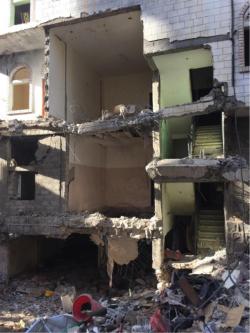 The United States in the past year dropped more than 20,000 bombs on Muslim-majority countries Iraq, Syria, Afghanistan, Pakistan, Yemen and Somalia, according to a study by the Council on Foreign Relations (CFR).
In an article published January 7, Micah Zenko, a senior fellow at CFR, states that since January 1, 2015, the United States has dropped an estimated 23,144 bombs in those six countries: 22,110 in Iraq and Syria; 947 in Afghanistan; 58 in Yemen; 18 in Somalia; and 11 in Pakistan.
“This estimate is based on the fact that the United States has conducted 77 percent of all airstrikes in Iraq and Syria, while there were 28,714 US-led coalition munitions dropped in 2015. This overall estimate is probably slightly low, because it also assumes one bomb dropped in each drone strike in Pakistan, Yemen, and Somalia, which is not always the case,” Zenko writes.
Despite dropping tens of thousands of bombs over the past 17 months, Washington’s strategy has failed to defeat Daesh and other Islamic militant groups, Zenko observed.
In Afghanistan, the Taliban control more territory than at any point since the 2001 US invasion, according to a recent analysis in Foreign Policy magazine.
Zenko notes that the primary focus of Washington’s counter-terrorism strategy is to kill extremists, and that far less attention is paid to prevent a moderate individual from becoming radicalized.
As a result, “the size of [Daesh] has remained wholly unchanged,” Zenko writes.
In 2014, the Central Intelligence Agency estimated the size of Daesh to be between 20,000-31,000 members. On Wednesday, Colonel Steve Warren, a spokesman for the US-led coalition, estimated the group at 30,000 members, despite Pentagon claims that 25,000 Daesh members have been killed in US air strikes.
At the same time, the Pentagon claims that only six civilians have “likely” been killed in the course of the bombing campaign.
January 11, 2016
Posted by aletho |
Militarism, Progressive Hypocrite, War Crimes | Afghanistan, Africa, Da’esh, Human rights, Iraq, Pakistan, Somalia, Syria, United States, Yemen |
Leave a comment
The year 2016 promises to see the deepening of Zimbabwe’s relations with Russia and China, old friends who supported our quest to overthrow colonialism as long ago as the 1950s.
Both Russia and China are stepping up economic investment in Zimbabwe. They are also continuing to oppose the illegal sanctions the West has imposed on us — a blatant attempt to change an elected government by crippling our economy in the hope that the masses would rise up against it.
Yet this hope has proved utterly false, as the people of Zimbabwe refuse to adopt the West’s notions about how to conduct our sovereign affairs.
Russia’s biggest economic commitment to Zimbabwe to date was its agreement in September 2014 to invest $3 billion in what will be Zimbabwe’s largest platinum mine.
What will set this investment apart from those that have been in Zimbabwe for decades is that the project will see the installation of a refinery to add value, thereby creating more employment and secondary industries. The Darwendale operation near our capital of Harare is expected to produce 600,000 ounces of platinum a year when it reaches capacity.
We are confident that this is just the start of a Russia-Zimbabwe economic partnership that will blossom in coming years. Our two countries are discussing other mining deals in addition to energy, agriculture, manufacturing and industrial projects. Russia also continues to assist Zimbabwe in training young Zimbabweans in special-skills areas such as medicine, general engineering, agricultural engineering and many other disciplines.
Groundwork was laid for expanding trade and investment when Zimbabwean President Robert Mugabe met President Vladimir Putin in Moscow in May 2015.
A few months after their meeting in December 2015, Chinese President Xi Jinping visited Zimbabwe, where he announced 10 economic agreements worth billions of dollars.
China is already our largest trading partner outside the continent, and the new investments will have a major impact on our economy.
Of particular importance is a billion-dollar deal that will help Zimbabwe overcome the critical shortage of electricity that prevents us from realizing our full economic potential.
Under the agreement, China will expand the capacity of our largest electric-generating facility at Hwange in western Zimbabwe, while the Chinese-funded Kariba South power extension project — adding 300 MW to the grid — will be commissioned within the next 18 months.
Another deal will involve China financing the installation of fiber-optic cable to help us expand our high-speed Internet system. It is the government’s desire to ensure that every corner of the country has access to modern communication systems, including the Internet. This will facilitate trade and commerce, as the better a country‘s Internet, the greater its chances of boosting its industrial efficiency and developing its own high-tech sector.
China has also agreed to build a pharmaceutical distribution center in Zimbabwe. The facility will assist the government in improving the health delivery system, which has long been burdened by the debilitating illegal sanctions. This will allow us to provide medicine to all hospitals and clinics at affordable prices. But in addition to creating jobs, it will also give us a key piece of infrastructure that we can use to build out the domestic pharmaceutical industry.
China has not only become the biggest investor in Zimbabwe, but in all of Africa in recent years. Alarmed and envious of China’s expanding investment on the continent, the West has tried to portray China as trying to set up its own neocolonialist system in Africa.
Zimbabwe rejects that notion. China has proved a reliable development partner. It has not dictated terms of cooperation with us. Instead the parties have negotiated and agreed to the terms under which economic cooperation is to be consummated. Such agreements take into account the need to empower our own people by accepting that mineral resources are finite.
We highly appreciate both Russia’s and China’s opposition to the West’s efforts to harm our economy through illegal sanctions. They adamantly believe that such sanctions are illegal infringements on sovereignty because they are designed to intimidate a sanctioned country into adopting those policies that the West prefers, as opposed to those that it believes are in its best interest.
But Russia and China have not just talked the talk in opposing sanctions against Zimbabwe. They have walked the walk. In addition to investing in our country in defiance of the sanctions, they vetoed a UN Security Council resolution on July 11, 2008 that sought to impose further sanctions.
The African Union has joined Russia and China in resisting Western efforts to bully Zimbabwe. Its most important show of support was defying the West by naming President Mugabe the chairman of the AU in February 2015. Many Western governments had called publicly for the AU not to give Zimbabwe the chairmanship. These calls, however, fell on deaf ears.
As long as Zimbabwe refuses to dance to the West’s wishes it will remain sanctioned indefinitely. Yet we have already lived under these sanctions for 16 years and believe that the worst is over. Sanctions cannot defeat the human spirit, no matter how hurtful they might be.
We are thankful for the AU’s support and are confident that the illegal sanctions will fail to bring us to our knees as the West so desires.
With the support that Zimbabwe is receiving from China and Russia — two powerful nations — as well as an increasingly progressive mankind, we have entered 2016 with greater hope, optimism and confidence. We look forward to positive changes in the living standards of our people.
We thank everyone who has steadfastly stood with us in 2015 and look forward to their continued support in 2016.
January 9, 2016
Posted by aletho |
Economics | Africa, China, Russia, Zimbabwe |
Leave a comment
The White House may end a program encouraging Cuban doctors sent abroad to defect and move to the United States.
The program, created under George W. Bush in 2006, is under review as a part of ongoing negotiations to normalize relations with Cuba, reported Reuters on Friday. Cuba considers it a “reprehensible practice” that is designed to “deprive Cuba and many other countries of vital human resources.”
The island sends medical personnel to countries suffering from health crises, including to South Africa in the post-apartheid brain drain and to West Africa to treat patients infected with Ebola.
The dispatches are a significant export and source of income for the country. In exchange for staff Cuba receives 100,000 barrels of oil a year from Venezuela.
Under the Cuban Medical Professional Parole Program, U.S. embassies in over 60 countries have discretionary authority to grant Cuban doctors abroad U.S. visas.
Despite being compared to slaves or prisoners on parole, out of over 40,000 medical workers in third world countries, the program accepted a total of 7,117 applicants. In 2015, 1,663 applicants were approved, a record in its nine-year history.
“It’s not only an issue of quantity, but of the quality of the specialists, the brains that the North American government has been selectively robbing… which is also a source of income for the problems that our people are confronting daily,” Marcos Agustín del Risco, director of Human Capital in the Ministry of Public Health, told Radio Rebelde.
The defectors “seriously affected” Cuba’s own free health care system, causing President Raul Castro to recently announce that the government will re-impose limits on the number of medics leaving the country. Last summer, controversy over Cuban doctors who had fled to Colombia to process U.S. visas became a major question in U.S.-Cuba relations.
“It’s an unusual policy, and I think as we look at the whole totality of the relationship, this is something that we felt was worth being in the list of things that we consider,” Ben Rhodes, a national security adviser that participated in Cuba talks last year, told Reuters.
January 9, 2016
Posted by aletho |
Corruption, Economics | Africa, Cuba, Latin America, United States |
Leave a comment
Public opinion is increasingly influenced by mixing politics, business and entertainment with good causes. When Mark Zuckerberg announced he was giving away most of his money, people got excited. But charity and good causes are rarely what they seem.
Politics – as the adage goes – is show business for ugly people.
If by ‘show business’ we mean the implementation of a script worked out in advance by people the public never hears about and dressed up to resemble a spontaneous and passable substitute for reality, then I would agree.
What I see, though, is just as all other norms are being redefined and merged with their polar opposites to form a new mush designed to confuse and debilitate, so the beautiful people are being blended with the ugly ones to form a new compound agent.
The first feet over the line appeared in the 1960s. They belonged to JFK who was the first TV president star, and Muhammad Ali, the first major sports star activist.
Since then, the trickle has turned into a deluge, with a lot of the traffic coming from Hollywood and big business.
Just to be clear: I’m not bemoaning the injection of a lack of purity into the political discourse. I have no time for any politician in power of any stripe who does not actively and openly work to wrest power away from international bankers. Outside of Iceland, I’m still waiting.
But today, it is commonplace – almost expected – for a star or an industrial magnate to get behind a cause.
Charities, philanthropies and foundations
Charities and philanthropies have two attractive qualities if you’re in the business of pushing through an agenda quietly. Firstly, they are tax-exempt. Secondly, they are beyond criticism.
People’s naiveté is staggering. They believe that industrial magnates and investors – men who have spent their lives screwing people over – suddenly and for no reason fall under the influence of benevolent fairy dust.
They want to believe that the Warren Buffetts and George Soroses – men whose careers are characterized by reflex ruthlessness – are suddenly compelled to go out and do random acts of kindness.
What, in fact, is happening is that these men are creating foundations: corporations that will never pay any tax and which will continue to advance an agenda none of us voted for – in perpetuity.
A foundation will hire and retire generations of directors and workers, all of whom will be suborned to the Articles governing that foundation at the time it was created. The DNA of the founder is enshrined in a legal entity, given boundless amounts of money, and then allowed to follow an agenda invariably directed towards ‘change’ – change no one ever heard about, never mind voted for.
What foundations (and charities or so-called philanthropies) do not do is give away money. What they, in fact, do is allow money to be released to persons or organizations, which must then do very specific things with it. In short, they subcontract out the implementation of their guiding Articles to the recipients of their ‘charity’.
If it is still hard for you to embrace the notion that what is termed ‘charity’ or ‘philanthropy’ could be anything but benign, I recommend watching Norman Dodd interviewed by the excellent G. Edward Griffin. Norman Dodd was, in 1954, the Staff Director of the Congressional Special Committee to Investigate Tax-Exempt Foundations. He knew how they really work.
Agenda 21
Mainstream media works hard, generally speaking, to defuse criticism of Agenda 21. Similar to philanthropy, it uses warm, fuzzy terminology. It talks, for example, about ‘sustainable development’ – and who could be against that?
Glenn Beck nailed it when he said: “Sustainable development is just a really nice way of saying centralized control over all of human life on planet earth.”
Bill Gates has gone from knowing how to make computer software (which defies any intelligent attempt to use it and now spies on you), to being an expert on the environment (i.e. how all of us should live), which is at the core of Agenda 21.
He couldn’t make an operating system that didn’t crash and turn blue every time you wanted to do something, but he’s got the solution to the problem which was identified by his buddy Al Gore, who went from almost inventing the internet and almost being president of the United States to almost winning the Nobel Peace Prize (he shared it with the Intergovernmental Panel on Climate Change) and who – like Bill – is an expert on how we all should live.
Bill explains with nerd-like zeal the need to reduce carbon emissions to “almost zero” (which, since humans are carbon-based life forms, would require our virtual extinction), and among his toolkit for achieving this aim is “a really great job on new vaccines.”
Bill Gates also has a tax-free foundation. Knowing how – and, in fact, if – the rest of us should have children is something of a family business for Gates. His father, W. H. Gates, was a director of Planned Parenthood, and also a ‘philanthropist’.
Eye candy
Actors and pop stars get adoration and money – at least the successful ones do. And if you live in a grim area and work in a boring job that can seem like the zenith of all possible joy.
However, the appeal wears off after a while. You don’t just want to speak other people’s words. You want to say something significant yourself. You’ve spent your life scrambling up a greasy pole to get respect, only to find yourself secretly afraid that people don’t take you seriously.
Such people, then, are nothing if not vain. That’s partly why they went into the business in the first place.
So it’s not difficult to utilize both their vanity and their proven skills in delivering dialogue they didn’t write and don’t understand, in order to push forward agendas they could never grasp.
Such people are Bill Gates and Warren Buffett writ small. Very small. Because while they might seem like gods to you, they have no real power. They are only ever one misjudged comment away from never working again, and they are all terrified of having to go back and live with the unwashed masses.
People such as Gates and Buffett and Gore are pretty dull to most people. Joe Public is not accustomed to listening to suits. But he has thousands of hours invested in giving his rapt attention to Hollywood stars and musicians.
This makes them useful to those who really do understand power; who can make where the rubber meets the road – where vanity meets inanity – serve to push forward the agenda the grown-ups came up with.
Pop people are basically used by the system to sell a new weaponized culture to the target audience. It is an obvious move to use those tried-and-tested puppets to sell more of that same agenda.
So Angelina Jolie was gushed over by the Telegraph, in part for her intrepid journey to Darfur and then for lecturing the Council on Foreign Relations (a place where real power resides) on the need to do the things in Darfur – stuff the CFR was planning on doing anyway, but was unable to express in a way that did not send people to sleep.
Bono, for his part, has gone from anthems against the establishment to eulogies in its praise. He is big friends with Bill Gates, for example, and likes to chew the cud with him on the ‘charity’ they are both involved in.
You name the star, they’ll have a cause. From Emma Watson (who at the age of 25 is already an ‘activist’) to George Clooney to Scarlett Johansson – they are all out there treading the boards of seemingly worthy narratives, looking authentic and concerned, and investing dullness with magic.
The fact that few if any of them could write an undergraduate paper unaided on the subject they are supposedly experts in doesn’t matter. People follow the stars. And the people who control the stars know that.
Very occasionally, someone goes off-script; someone claws his way to a position of prominence by sheer grit and talent and then just says what he thinks. Tyson Fury comes to mind.
Then the media is less interested in causes and more interested in damage limitation, wringing its hands at the incongruity of someone capable of Wrongthink being fantastically good at something.
Something tells me Mr Fury isn’t going to be invited to share his thoughts with the Council on Foreign Relations or to hug trees with Bill Gates.
I also wonder how long we’ll have to wait to find a star using the Oscars to speak out in favor of no sex before marriage or tipping buckets of cold water over themselves to highlight the evils of usury.
I’m thinking Hell will freeze over first.
Read more:Gates Foundation focuses $3bn agro-fund on rich countries, ‘pushes GMO agenda in Africa’
January 7, 2016
Posted by aletho |
Corruption, Deception, Mainstream Media, Warmongering, Science and Pseudo-Science, Timeless or most popular | Africa, Bill Gates, George Clooney, George Soros, Human rights, Mark Zuckerberg, Scarlett Johansson, United States |
Leave a comment
Like children’s fairy tales, foreign policy myths are created, told and retold for a purpose.
The Boy Who Cried Wolf imparts a life lesson while entertaining your five year-old niece. Unfortunately foreign policy myths are seldom so benign.
The tale told about Romeo Dallaire illustrates the problem. While the former Canadian General rose to prominence after participating in a failed (assuming the purpose was as stated) international military mission, he’s widely considered a great humanitarian. But, the former Senator’s public persona is based on an extremely one-sided media account of his role in the complex tragedy that engulfed Rwanda and Burundi two decades ago.
In a particularly egregious example of media bias, criticism of Dallaire’s actions in Rwanda have been almost entirely ignored even though his commander published a book criticizing the Canadian general’s bias. According to numerous accounts, including his civilian commander on the UN mission, Dallaire aided the Rwandan Patriotic Front (RPF), which invaded Rwanda with decisive Ugandan support and quiet US backing. Gilbert Ngijo, political assistant to the civilian commander of United Nations Assistance Mission for Rwanda (UNAMIR), summarizes the criticism: “He [Dallaire] let the RPF get arms. He allowed UNAMIR troops to train RPF soldiers. United Nations troops provided the logistics for the RPF. They even fed them.”
In his 2005 book Le Patron de Dallaire Parle (The Boss of Dallaire Speaks), Jacques-Roger Booh Booh, a former Cameroon foreign minister and overall head of UNAMIR, claims Dallaire had little interest in the violence unleashed by the RPF despite reports of summary executions in areas controlled by them. RPF soldiers were regularly seen in Dallaire’s office, with the Canadian commander describing the Rwandan army’s position in Kigali. This prompted Booh Booh to wonder if Dallaire “also shared UNAMIR military secrets with the RPF when he invited them to work in his offices.” Finally, Booh Booh says Dallaire turned a blind eye to RPF weapons coming across the border from Uganda and he believes the UN forces may have even transported weapons directly to the RPF. Dallaire, Booh Booh concludes, “abandoned his role as head of the military to play a political role. He violated the neutrality principle of UNAMIR by becoming an objective ally of one of the parties in the conflict.”
Dallaire doesn’t deny his admiration for RPF leader Paul Kagame who was likely responsible for shooting down the plane carrying both Rwandan Hutu President Juvénal Habyarimana and Burundian President Cyprien Ntaryamira on April 6, 1994. (That event triggered mass killing and an environment of deep instability that facilitated the RPF’s rise to power in Kigali.) In Shake Hands with the Devil, published several years after Kagame unleashed terror in the Congo that’s left millions dead, Dallaire wrote: “My guys and the RPF soldiers had a good time together” at a small cantina. Dallaire then explained: “It had been amazing to see Kagame with his guard down for a couple of hours, to glimpse the passion that drove this extraordinary man.”
Dallaire’s interaction with the RPF was certainly not in the spirit of UN guidelines that called on staff to avoid close ties to individuals, organizations, parties or factions of a conflict.
A witness at the International Criminal Tribunal for Rwanda (ICTR) actually accused Dallaire of complicity in a massacre. A Rwandan national testifying under the pseudonym T04, reported Tanzania’s Arusha Times, “alleged that in April 1994, Gen. Dallaire allowed members of the rebel Rwandese Patriotic Front (RPF, now in power in Kigali), to enter the national stadium and organize massacres of Hutus. Several people, including the witness, took refuge there following the assassination of Rwandan President Juvenal Habyarimana.”
But, criticisms of Dallaire’s actions in Rwanda have been almost entirely ignored by the Canadian media. Le Patron de Dallaire Parle went largely unnoticed, or at least not commented upon. A Canadian newswire search found three mentions of the book (a National Post review headlined “Allegations called ‘ridiculous’: UN boss attacks general,” an Ottawa Citizen piece headlined “There are many sides to the Rwanda saga” and a letter by an associate of Dallaire). Other critical assessments of Dallaire’s actions in Rwanda have fared no better including Rwanda and the New Scramble for Africa and Enduring Lies: The Rwandan Genocide in the Propaganda System, 20 Years Later in which Edward Herman and David Peterson “suggest that Dallaire should be regarded as a war criminal for positively facilitating the actual mass killings of April-July, rather than taken as a hero for giving allegedly disregarded warnings that might have stopped them.”
On the other hand, a Canadian newswire search of “Romeo Dallaire Rwanda” elicited over 6,000 articles that generally provide a positive portrayal of Dallaire. Similarly, a search for mention of Dallaire’s 2003 book Shake Hands with the Devil elicited 1,700 articles.
The complex interplay of ethnic, class and regional politics, as well as international pressures, which spurred the “Rwandan Genocide” has been decontextualized. Instead of discussing Uganda’s aggression against its much smaller neighbour, the flight of Hutus into Rwanda after the violent 1993 Tutsi coup in Burundi and economic reforms imposed on the country from abroad, the media focuses on a simplistic narrative of vengeful Hutus killing Tutsis. In this media fairy tale, Dallaire plays the great Canadian who attempted to save Africans.
While two decades old, the distortion of the Rwandan tragedy continues to have political impacts today. It has given ideological cover to dictator Paul Kagame’s repeated invasions of the Congo and domestic repression. In addition, this foreign policy myth has been used to justify foreign military intervention as is the case with the current political crisis in Burundi. The myth of Dallaire in Rwanda is also cited to rationalize the Responsibility to Protect doctrine, when, in fact the true story illustrates the inevitable duplicitousness of foreign interventions.
Unlike in bedtime stories, in foreign policy making things up is usually harmful.
December 28, 2015
Posted by aletho |
Deception, Mainstream Media, Warmongering | Africa, Burundi, RPF, Rwanda |
Leave a comment
I was brought up in Rhodesia, the country named after Cecil Rhodes, so I’m quite interested in the current controversy about the removal of his statue outside Oriel College in Oxford.
The supporters of Rhodes and other champions of British imperial history, argue that it was people like him who made Britain “great”, and “civilised” the countries they conquered. They talk about the thousands of miles of railways, and imposing colonial architecture. Whilst those things may indeed still be used by the native populations there today, that was never their original purpose. Railways were laid to help transport stolen minerals and other products of slavery as quickly as possible back to Britain, and to move British soldiers efficiently around hostile lands. And the fine colonial buildings were built to facilitate the administration of the plundering and oppression, and provide opulent luxury for the oppressors. None of it was done to help the natives; it was done to exploit and steal from them, and crush any resulting dissent.
If Rhodes and his kind had indeed tried to improve the lives of the people of the foreign lands they looted, the catastrophic revolutions that tore through the British Empire after WW2 may never have happened. In the 1960s, for example, almost nothing was provided by the followers of Rhodes for the natives of Rhodesia. We white-skinned sons of empire, a mere 5% of the population, went to fine schools, had good health care, great sports clubs, public swimming pools and spacious parks – access to which was either wholly forbidden to black-skinned people or severely restricted. I clearly remember the public buses and toilets labelled “whites only”, the fine railways that 95% of the population couldn’t use – except for riding in filthy, overcrowded, rickety third class carriages; I remember the shops, hotels, restaurants and bars that black people could work in but not use.
In the African tribal lands schools and health clinics were few and far between, very basic, and more likely to be run by Catholic missionaries rather than the government. Black-skinned people could only work as labourers, domestic servants or do other menial jobs that white people didn’t want to do. They couldn’t take managerial positions or serve as officers in the police or army. They couldn’t vote or stand in elections. When I worked on Rhodesia Railways, as late as 1979, black people weren’t even allowed to become train drivers because, it was said, they weren’t clever enough. We white people lived in pampered comfort in exclusive leafy suburbs, whilst the black-skinned people who provided our comfort were forced to live out of sight in sheds at the bottom of the garden, or miles away in segregated overcrowded shameful townships. This was the true legacy of Rhodes and his kind.
Tear down his statue, Oriel, and smash it to atoms.
December 28, 2015
Posted by aletho |
Ethnic Cleansing, Racism, Zionism, Solidarity and Activism, Timeless or most popular | Africa, Cecil Rhodes, Oriel College, Rhodesia, UK |
Leave a comment
More than 600 Tunisian Jihadists have returned to their homes after fighting in Syria, a spokesman for the interior ministry said on Friday.
Speaking to journalists during a conference to discuss the consequences of returning terrorist Jihadists, Waleed Al-Waqini said that more than 3,000 Tunisians have gone to fight against the regime in Syria. While at least 600 have gone back to Tunisia, he pointed out that 800 others have been killed. An unspecified number of those who have returned are being prosecuted, he added, and some are under house arrest.
A previous UN report claimed that at least 5,500 Tunisian Jihadists were active in different conflict areas. Most are members of Daesh in Syria, although some are with Al-Nusra Front and Al-Qaeda. The report also claimed that hundreds of Tunisian fighters are in Libya.
December 26, 2015
Posted by aletho |
Aletho News | Africa, Da’esh, Libya, Syria, Tunisia |
Leave a comment
 Aletho News
 Aletho News