Regarding the assassination of the martyr Samir el-Kuntar
– After a few days, there will be the anniversary of the birth of Jesus Christ – and on this anniversary, we extend our greetings to all the Christians and Muslims. A few days later, is the anniversary of the birth of Prophet Mohammed, and we extend our greetings to all the Muslims on this occasion and we ask God for the blessings of both these two prophets to extend mercy and security and happiness to all the region and to open the hearts and minds of all to love and mercy that these two great leaders brought to the world.
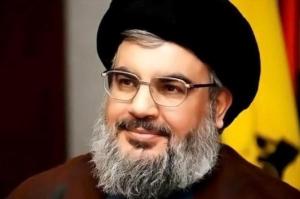 – Yesterday, we lost one of our brothers who shared in the birth of Hezbollah from its first hours and carried heavy responsibility for 33 years – el Sheikh Mohammed Khatoun. I shall speak more about him at the date of his funeral tomorrow. I extend condolences to his family and loved ones.
– Before I speak about the main event – I want to speak about what happened in Nigeria a few days ago – a massacre in Zariah. Hundreds were killed. Hundreds were injured. Hundreds were detained. We include our voice among the voices of all who condemned this massacre, and we condemn the silence of all those who chose to be silent – a horrific silence. There is talk of up to 1,000 killed. And we call on the Nigerian government and its political parties – to act with strength to hold those responsible and to have a national and humanitarian response. I worry that there are American or Israeli hands or Takfiri hands that are behind this horrific massacre – designed to create more bloodshed in Nigeria.
– Back to our main point of discussion
– The assassination of the General of the Political Prisoners in the Israeli Jails – the brother, the martyr, Samir el Quntar
– (1) The facts. We have no doubt that the Israeli enemy is the one behind the assassination. It was not a covert operation – but an open attack. The assassination was by Israeli jets – against a residential home, that specifically targeted Samir el Quntar and other fighters and civilians. Did the Israeli jets enter Syrian air space or the did the Israeli jets fly over occupied Golan Heights – that is a detail, one that does not change anything, unless the discussion is about Syria and Russia and today that is not our focus. What is clear is that it was an Israeli attack against a residential home in Geramana in the outskirts of Damascus. I extend condolences to all those martyred. Anyone who kills a man like Samir el Quntar does a service to Israel.
– (2) We know and Samir knew and the Israelis themselves did not hide – that Israel would not leave Samir el Quntar alive, from the first day of his release. The threat was alive throughout all the years, months, days. Israel was very open that it would not forgive him for his past nor on his strength and resilience in jail nor on his dedication to the resistance. Israel does not forgive – it is our governments that forgive the murderers of Deir Yassin to Qana. This talk by Israel was before the plan for building resistance in the occupied Golan Heights. We in Hezbollah hold the enemy Israel responsible for the assassination of Samir el Quntar
– (3) In this night I do not want to talk about the characteristics of this great martyr. I shall simply say tonight that Samir el Quntar was a lover of Palestine. Palestine was all his love and filled his heart and mind. Palestine’s destiny and the destiny of Palestine’s people and the future of the resistance was always his first and main focus. In our first visit upon liberation, he and I spoke – and we always leave options open – I told him that he has numerous options – politics, media, and military. He said then what he told others publicly: I left Palestine to return to Palestine. He told me that from this very moment I am ready to participate in any military operation, whether on the border with occupied Palestine or within occupied Palestine. I await my martyrdom, he said. It would be an honor to me to be a fighter, he said. That is Samir, that is his truth that we must say today. Does the enemy Israel imagine that by killing Samir and those like him that they can kill such love and passion and commitment and the vast sacrifice of the people of this nation? Many great leaders have been killed and tens of thousands of people have been martyred – in Palestine and Lebanon and Syria and Egypt and Jordan. And what was the result? Has this nation and these people and these generations given up on Palestine? NO. A generation grew up to inherit resistance and to give it to the next generation. The blood of Samir el Kuntar and those who passed before him – is that the resistance against Israel for liberation is a call that will not be broken, regardless of who will be killed and detained and tortured; this is a call that will not be broken. Look now at the people of occupied Palestine – this is a generation that is as old as Samir el Kuntar was when he went to occupied Palestine (i.e. 17). The youth of Palestine fight death with death. Tens of them have been martyred as they fight with knives – because that is their only option. They have entered terror in the hearts of the enemy. When we see a youth in her prime – such as (martyr) Ashraqat Tamami – and when I speak of her, I speak of all the youth of Palestine, I discovered that this youth (female) had a great deal of awareness and clarity and dedication and deep understanding to the cause that she wants to sacrifice for and to the understanding of the enemy and the friend, and for the calmness of her decision. Ashraqat is today a model for many of Palestine’s youth – who love with a passion the land and freedom. They carry the same passion that Samir el Quntar carried and it remained in his heart until a traitorous Israeli rocket killed him.
– (4) Our position. When Israel attacks, anywhere it chooses and how it chooses and in any time it does, it is the right of the resistance – anywhere, and any way, and in any place, and at any time. Today, I repeat: from now, any member of Hezbollah that is killed, we shall hold the responsibility to the Israelis and we shall consider it is our right to respond at any time, at any location, and in the manner we choose. We said this on the 30th of January 2015. Today, we say, to the enemy and to the friend, Samir el Quntar is one of us, and he is a leader in our resistance, and Israelis killed him, and it is our right to respond to his assassination in the time, place, and in the manner that we choose. That is our right. And I add – we, in Hezbollah, we shall fulfill this right.
– (5) In the same vein, the killing against Hezbollah and this resistance, comes the US actions that seek to target Hezbollah on a number of levels. Since the early 90s, we as a party have been on the terrorism list – as a political party and as individuals. And for decades, the Americans have tried to force this description on other countries; they were not successful. Such a description is not accepted by the UN, and the EU, only lately, considers the military wing on the terrorism list, and China and Russia do not consider us as such. What the Americans decided to do now – even though they support terrorism worldwide — is that they consider us a criminal organization and not terrorism, claiming that we are drug dealers and that we are money launderers and that the US Congress now seeks to investigate the accusation that we are human traffickers. These accusations are false and have no basis in truth. It is our duty to deny them. We are not due to show evidence of our innocence. It is their responsibility to show evidence – if they have any, although they have long made accusations without evidence. Clearly, these accusations are political – and it’s first objective is to show Hezbollah in a bad light. They are the ones who spent millions of dollars, as per their own Ambassador, to create propaganda against Hezbollah for the Arab youth. We have a strong example here: the international organization of nuclear energy presented a report about the Iranian nuclear energy – and they said that the Iranian nuclear energy is peaceful and at the very least, since 2009 until today, there is no evidence of anything military in the Iranian nuclear energy. They presented the evidence, and one of the panel of the international organization is an American and there was a consensus on the report! A full consensus. Let us remember that it was the Americans that accused Iran for years. Also the Europeans. And let’s not forget Netanyahu in many occasions, including his speech at the UN. Netanyahu should be a joke internationally and even for Israel – let’s remember his chart at UN when he said that Iran would have a nuclear bomb in a few months. And now we have this report – with consensus – that there is no evidence of military usage of Iran’s nuclear energy. Let’s remember that they were planning a war against Iran, and they enforced sanctions against more than 80 million people, and they threatened, unfortunately with some of their Arab collaborators. That is just one example of a political accusation. The accusations against us are small in comparison. With the battle against us, they won’t accuse us of getting nuclear weapons. This is what they have to say against – either terrorist or criminal. That is the end of their line. The line of their lie is short. The truth will eventually be exposed. We know, in front of God, in front of our people, in front of many people, this is not who we are. If they think their accusations are a propaganda war, it will fail. From a financial perspective, they have now forced upon international banks to freeze Hezbollah funds – well, this was closed a long time ago. We do not have funds in international banks. Now, they are also putting pressure on Lebanese banks and the Lebanese central bank – to put pressure on any organization that is claimed to be tied to Hezbollah. We also state today, and state it again, we have no funds in Lebanese banks, not in the past nor in the present, nor do we have funds that we put in any banks. Nor do we transfer our funds via Lebanese banks – so there is no need for either the Lebanese central bank or any Lebanese banks to feel fear of being chased by the Americans. Furthermore, as I have stated before and shall say again, we are not a business nor an investment. We do not have companies nor are we partners with any Lebanese merchants. Whatever funds we have, we give to our resistance and to the families of the injured and the martyrs. We do not have an extra penny that we invest or put in any fund.
– Based on this, we have to speak seriously about this – it is the responsibility of the Lebanese Central Bank and the Lebanese banks to protect the Lebanese consumers and merchants! It is enough that one sign come from the Americans for there to be an accusation against an individual, and these banks immediately follow. Does this country not have sovereignty? Not have its own courts? Its own state? There are Lebanese merchants and investors that are hurt. We are not hurt. But now if Americans want to target a particular political current or a particular community, all they do is give the names to the Lebanese banks! These are Lebanese who should be protected by the Lebanese State. I do not ask the Lebanese State to protect any member of Hezbollah – but at the very least, it is the responsibility of the State to protect the men and women of this country. No one is asking the State to declare war on the US, only to ask for evidence for these accusations and to take the evidence to the Lebanese courts. This has already begun — this subservience to the US!
– Furthermore, with regards to the media, whether it is part of our network (Manar and Nour) or accused of supporting us or even empathizing with us – they are being threatened! The US is accusing you and judging you in absentia and charging you and killing you and you are not allowed to speak and if you speak, your voice cannot reach anywhere in the world. That is the freedom and democracy of the United States. Your media is not allowed – and maybe it will reach the stage that any media that shows the truth will be accused of being pro-terrorism, while knowing of course that anyone with a Dish can see hundreds of channels that call for takfiri [intolerance] and for killing and raping and committing terrorism and destruction and occupation and violence; those channels are accepted. But you and your type of the resistance are targeted, and the real reason is Israel, and not our position in Yemen or otherwise, but the real reason is that you are a resistance! The intention is Resistance itself – the discourse, the culture, the knowledge base of Resistance!
– Media is part of the struggle. We will not surrender. We will look for all options and opportunities so that the voice of Resistance and the voice of all who reject the project of Israel and the US in the region – those voices will be heard. This is an ongoing struggle.
– What is more important about all these actions against us, is how we look upon all these actions. You can see the negative, but there is also the positive. The fact that Congress sits and meets and has consensus and continues to think about new ways to fight us – means that we are in the right place. They have given us more faith and strength. It shows that we are in the right struggle, the right battle, the right discourse. Who ever finds himself – knowingly or not – a partner with the US and Zionism, let him re-examine his nationalism and religion and ethics! These actions by the US are also a recognition of us, that we are not a small group with small consequences. It is a recognition that Hezbollah plays a large role in Lebanon and in the region in fighting the Israeli project and the hegemonic project. As part of the Resistance – and we don’t claim to fight alone, just as we didn’t fight alone in 1982 and since – there were many US projects of hegemony, we are part of this battle and not alone. That is why the US Congress needs to take these declarations with clear time lines — they take us seriously. We also say that we understand these actions, see how loving we are. We understand these actions. When we are enemies to each other, and this is a compliment to us – to be enemies to the US and to Israel and enemies to all who want to steal the riches of our people and to all who want to destroy our civilization, we understand that they would want to do all these things, and we also will not surrender in this battle. I say to the US and to Israel and to their allies in the region: all these actions against us, from sanctions and murders, you will not be able to erase us. All the actions against us and are planned against us – will only increase our commitment.
– May God have mercy on our great martyr Samir el Kuntar…
Translation by Rania Masri [not word for word]
December 21, 2015
Posted by aletho |
Ethnic Cleansing, Racism, Zionism, False Flag Terrorism, Full Spectrum Dominance, Timeless or most popular, Wars for Israel | Africa, Hezbollah, Israel, Nigeria, Palestine, Samir el Kuntar, Syria, United States, Zionism |
Leave a comment

Hussainiyyah Baqeeyatullah in Nigeria’s northern city of Zaria before its reported destruction
The Nigerian army has completely demolished a religious center belonging to the Islamic Movement in Nigeria (IMN) following the recent massacre of Shia Muslims in the West African country.
The IMN’s website cited a local source as saying that the army bulldozed Hussainiyyah Baqeeyatullah in the northern city of Zaria in Kaduna State on Sunday.
This comes nearly a week after Nigerian soldiers opened fire on the people attending a religious ceremony at the site. Local media said more than a dozen people were killed during the December 12 raid.
The military accused the Shias of stopping the convoy of Nigeria’s Chief of Army Staff Lieutenant General Tukur Yusuf Buratai and attempting to assassinate him. The IMN and its leader Ibrahim al-Zakzaky strongly rejected the assassination accusation.
IMN spokesman Ibrahim Usman also rejected an accusation by local officials that the movement had “blocked roads for four days” during the religious ceremony, which marked Arba’een, the fortieth day to follow the martyrdom anniversary of Imam Hussein (PBUH), the grandson of Prophet Muhammad (PBUH) and the third Shia Imam.
One day later, Zakzaky was arrested during a raid by the army on his residence and the buildings connected to the Shia community in Zaria. Local sources say hundreds of people trying to protect the cleric, including three of his sons, were killed in the raid.
December 21, 2015
Posted by aletho |
Civil Liberties, Ethnic Cleansing, Racism, Zionism | Africa, Human rights, Islamic Movement in Nigeria, Nigeria |
Leave a comment
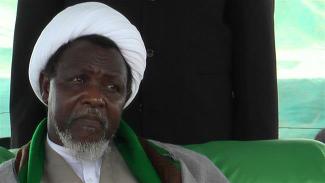
Nigerian Shia leader Ibrahim al-Zakzaky
Nigerian authorities say Shia leader Ibrahim al-Zakzaky, who has been arrested and whose family and supporters have faced a bloody crackdown, will face prosecution.
On Saturday, Nasir al-Rufai, the governor of Kaduna State in north-central Nigeria, where Zakzaky was arrested in his home city of Zaria last week, said the cleric “will be prosecuted for any crimes that he may have committed,” Nigerian newspaper THISDAY reported on Sunday.
“That is the decision for the federal authorities. There are state and federal crimes,” the official added, making it clear that the case would be brought against the cleric by Abuja rather than local officials. “There is a government and a constitution and we are resolved to follow the constitution and due process.”
Nigerian forces raided the house of Zakzaky, the head of the Islamic Movement of Nigeria (IMN), last Sunday and arrested him after reportedly killing individuals attempting to protect him, including one of the movement’s senior leaders and its spokesman.
Nigerian soldiers had opened fire on Shia Muslims attending a ceremony at a religious center in the city the previous day, accusing the Shias of stopping the convoy of Nigeria’s Chief of Army Staff Lieutenant General Tukur Yusuf Buratai and attempting to assassinate him. Zakzaky was planning a speech at the center, and the IMN has strongly rejected the assassination accusation.
The attack on Zakzaky’s residence and the violence during the road incident led to the deaths of hundreds of the members of the religious community, including three of Zakzaky’s sons.
The IMN spokesman, Ibrahim Usman, meanwhile, rejected the accusation by the governor that the movement had “blocked roads for four days” during the religious ceremony, which marked Arba’een, the fortieth day to follow the martyrdom anniversary of Imam Hussein (PBUH), the grandson of Prophet Muhammad (PBUH) and the third Shia Imam.
“Clearly, this is a deliberate attempt to twist the facts. During the Arba’een symbolic treks, we block only limited part of the road, and this is to protect persons from traffic accidents, control mass movement and avoid chaos on the roads,” Usman said.
“The governor here was trying to give the impression of a complete occupation of a lane for four days. That was not the case. Blocks were only from junction to junction on the roads. The public was informed about these little inconveniences with apologies on public radio and television stations throughout the trek. Road users during the period would be surprised by the governor’s statement,” he said.

Shia Muslims in Nigeria march during a procession marking Arba’een. (File photo)
Rufai has also announced that a judicial commission of inquiry has been set up to look into the attack on the cleric’s residence.
The IMN has said it does not trust any likely findings by the state investigators, adding that authorities have refused to listen to the Shia community about what happened in Zaria and are only focusing on the army’s account.
December 20, 2015
Posted by aletho |
Civil Liberties, Subjugation - Torture | Africa, Human rights, Ibrahim al-Zakzaky, Islamic Movement of Nigeria, Nigeria |
Leave a comment
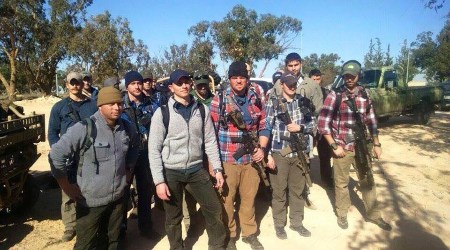
© Libyan Air Forces / Facebook
Libya’s air force said in a Facebook post that 20 US commandoes arrived at Wattiya airbase and disembarked “in combat readiness,” only to be told to leave. Pentagon sources confirmed the US had sent a special forces unit to Libya as part of a mission.
The Libyan Air Force said the 20 soldiers arrived at the airbase on Monday, but left soon after local commanders asked them to go because they had no right to be at the base “without prior coordination with protection force base.”
The Libyan air force published a Facebook post on Wednesday which included photographs of the special forces unit. It noted the 20 soldiers had disembarked “in combat readiness wearing bullet proof jackets, advanced weapons, silencers, handguns, night vision devices and GPS devices.”
When questioned by Libyan soldiers, the American troops said they were “in coordination with other members of the Libyan army,” the Libyan Air Force said. The Libyans were unconvinced.
“The response from your heroic army stationed at Wattiya base was to tell them to depart immediately and the group left, keeping their equipment with them,” the post added.
The photographs show three men armed with assault rifles, boarding a blue-and-white-striped passenger plane and driving a yellow dune buggy.
Pentagon sources confirmed to NBC News that the special forces unit was part of a mission sent this week, but it was unclear if the soldiers had left the country. Commandoes have been “in and out of Libya” for “some time now,” unnamed US officials told NBC, but the outlet reported they were there “purely to advise Libyan forces rather than conduct combat operations or training.”
According to the Associated Press, the failed debarkation happened just as Libya’s rival parliaments signed a landmark United Nations-sponsored deal to form a government in the war-torn country. Libya has been in chaos ever since Muammar Gaddafi was overthrown by NATO-backed rebels in 2011.
Read More: Fight against ISIS should be extended to Libya – French PM
December 18, 2015
Posted by aletho |
Illegal Occupation, Militarism | Africa, Libya, United States |
Leave a comment
This year marked the 70th anniversary of the end of the Second World War, which is almost universally seen in Britain as purely a war against the Nazis and their UK-bound warplanes. Unlike the First World War or the wars in Indochina and Iraq, the Second World War is somewhat unique in that it is likely the only modern war whose reputation has remained pristine throughout the decades, being regarded as the ‘Good War’. But the impetus behind Britain’s involvement was as much imperial as it was defensive. At the end of the 1930s, Winston Churchill and Anthony Eden believed Germany to be a significant threat to their empire, and not Britain’s national security. Some of the ruling class entered the Second World War reluctantly, and contrary to many propaganda cartoons, British elites did nothing to aid the Poles; they did, however, evacuate a segment of the Polish army to deploy in their own objectives in 1940.
Even after the Battle of Britain, Whitehall still marginally favoured Hitler. Indeed, its objection to the Hitler-Stalin pact was merely that it gave Stalin too much power. Between the spring of 1940 (the fall of France) and 1943 (the Allied landing in southern Italy), the British army fought the majority of their battles in northern Africa. Churchill was deeply concerned about the safety of Suez Canal and the region’s oilfields, along with Saudi Arabia, which he sought to keep from Roosevelt’s influence.
The traditional view of the war, however, is a picture of democracy versus fascism, good versus evil. But this was not the motivation for the Allied leaders, as Chris Harman wrote in A People’s History of the World (Verso, 2008, p. 536):
The Churchill who demanded a no-holds-barred prosecution of the war was the same Churchill who has been present during the butchery at Omdurman, sent troops to shoot down striking miners in 1910, ordered the RAF to use poison gas against Kurdish rebels in British-ruled Iraq, and praised Mussolini. He had attacked a Conservative government in the 1930s for granting a minimal amount of local self government to India, and throughout the war he remained adamant that no concessions could be made to anti-colonial movements in Britain’s colonies, although this could have helped the war effort.
At the Yalta Conference, Churchill informed Roosevelt and Stalin that ‘While there is life in my body, no transfer of British sovereignty will be permitted’ in India. His stubbornness over the issue was so extreme that in 1942, during the Battle of Stalingrad, instead of pushing back the Nazis thousands of British troops were viciously suppressing demonstrations in India. Churchill’s inflexibility on the issue of sovereignty was so extreme that it led to a famine in Bengal which killed three million.
As historians like Harman and Danny Gluckstein (in A People’s History of the Second World War) have documented, the Second World War was comprised of two wars; one ‘from above’ and one ‘from below’. In a typically hypocritical act of pseudo-internationalist policy formation, during the war ‘from above’ in August 1941 Roosevelt and Churchill pledged to respect, in one of the principles of the Atlantic Charter, ‘the right of all peoples to choose the form of government under which they will live’. Applying different standards to his own actions, Churchill later stressed, when presenting the Charter to the House of Commons, that it did ‘not qualify in any way the various statements of policy which have been made [regarding] the British Empire’, since it only applied to ‘the States and nations of Europe now under the Nazi yoke’ (The Times, 10 September 1941). The war was consequently a disagreement between the major world governments about who should dominate, and not a battle against domination itself.
As early as the fall of Singapore in 1942, plans were already being made in Whitehall to reclaim parts of the empire, with the examples of Burma, Malaya, Hong Kong and Nigeria being the most notable. Churchill even drew up a plan, vetoed by the US, of taking over Thailand (covered by P.J. Cain and A.G. Hopkins in their 1993 study British Imperialism: Crisis and Deconstruction 1914-1990). He also issued a stern instruction to Eden towards the end of 1944: ‘[H]ands off the British empire is our maxim and it must not be weakened or smirched to please sob-stuff merchants at home or foreigners of any hue’. Labour had long confessed a principled opposition to imperialism, though had a change of heart after assuming office in 1945, supporting the renewal of the Colonial Development and Welfare Act and the establishment of a managerial structure run by several generations of educated colonial subjects. As Ernest Bevin modestly put it, ‘our crime is no exploitation; it’s neglect’ – where ‘neglect’ should be understood in its proper sense of ‘more exploitation’ (for discussion, see Robert D. Pearce’s 1982 The Turning Point in Africa: British Colonial Policy 1938-1948).
In 1936, the Greek king appointed General Ioannis Metaxas as a fascist dictator, who sought to bring about a ‘Third Hellenic Civilisation’. A British liaison officer sent to wartime Greece, C.M. Woodhouse, believed Metaxas to be ‘benevolent’, having ‘high-minded motives for undertaking supreme power’ (The Apple of Discord: A Survey of Recent Greek Politics in their International Setting, Hutchinson, 1948, pp. 16-17). Britain supported Metaxas because, as a different liaison officer explained in 1944, three years after the dictator’s death, the Greeks ‘are a fundamentally hopeless and useless people with no future or prospect of settling down to any form of sensible life within any measurable time’. Any remnants of the Atlantic Charter had by now been long discarded from political consciousness. The Allies proceeded to bomb Athens in order to destroy the Greek resistance movement, EAM (the National Liberation Front) and its military arms, ELAS (the National Popular Liberation Army). During the war, zones controlled by EAM underwent large-scale self-government to a level of sophistication rivalling the Spanish anarchists. Residents voted for municipal councilors and judiciaries in mass assemblies, while expensive lawyers were dispensed with and regular justice prevailed.
‘Communist’ Russia also declined to support EAM/ELAS, and ordered the resistance to fuse with the government of the king. In an effort to dominate as much of the country as possible, Churchill’s coup later overthrew the Greek government while also suppressing the communists. Churchill informed General Scobie, in language to match that of any of the century’s great dictators, ‘Do not hesitate to fire at any armed male in Athens who assails the British authority or Greek authority … [A]ct as if you were in a conquered city where a local rebellion is in progress’. He later informed parliament of his view on EAM/ELAS, preferring collaborators to anti-fascists: ‘The security battalions came into existence … to protect the Greek villagers from the depredations of some of those who, under the guise of being saviours of their country, were living upon the inhabitants and doing very little fighting against the Germans’, unlike the ‘security battalions’ deployed by the Greek government who pledged loyalty to Hitler and who, according to Churchill, ‘did the best they could to shelter the Greek population from German oppression’.
Post-war Greek persecutors also worked alongside US counterinsurgency forces. Whereas Russia allowed the Nazis to crush the Polish communist resisters, the AK, Churchill actively sought the destruction of the Greek anti-fascists. In 1947 the American New Republic reported that ‘Churchill’s victory is complete – and neatly underwritten by hundreds of millions of American dollars. It could only be slightly more complete if Hitler himself had engineered it’ (15 September 1947). Like the US, Churchill also thoroughly approved of Mussolini. After visiting him in 1927, Churchill once again picked up his pen to confess how he ‘could not help being charmed, like so many other people have been, by his gentle and simple bearing and by his calm, detached poise’ (Extract from press statements made by Churchill, January 1927, Churchill Papers, CHAR 9/82 B). When Mussolini fell in 1943, Churchill promised that ‘Even when the issue of the war became certain, Mussolini would have been welcomed by the Allies’.
Earlier in the 1920s, Churchill had proclaimed his desire for justice when he confessed that poison gas would be an excellent weapon against ‘uncivilized tribesmen and recalcitrant Arabs’. This tactic was in clear violation of the Hague Declaration of 1899, calling on all adherents to refrain from ‘the use of projectiles the sole object of which is the diffusion of asphyxiating or deleterious gases’, which Britain eventually agreed to sign in 1907. During the Good War, he added that ‘It is absurd to consider morality on this topic when everybody used it in the last war without a word of complaint from the moralists or the Church. On the other hand, in the last war the bombing of open cities was regarded as forbidden. Now everybody does it as a matter of course. It is simply a question of fashion changing as she does between long and short skirts for women’. Expressing his concern for the safety of the British public, he continued in a secret memo:
If the bombardment of London became a serious nuisance and great rockets with far-reaching and devastating effect fell on many centres of Government and labour, I should be prepared to do anything that would hit the enemy in a murderous place. I may certainly have to ask you to support me in using poison gas. We could drench the cities of the Ruhr and many other cities in Germany in such a way that most of the population would be requiring constant medical attention. We could stop all work at the flying bomb starting points. I do not see why we should have the disadvantages of being the gentleman while they have all the advantages of being the cad. There are times when this may be so but not now.
Britain engaged in what Churchill called the ‘absolutely devastating’ tactic of ‘area bombing’ of German cities instead of hitting specific military targets. Because of the power of aerial bombing, as Prime Minister Baldwin had explained in 1932, ‘The only defence is in offence, which means that you have to kill more women and children more quickly than the enemy if you want to save yourselves’. During the later years of the war, Arthur ‘Bomber’ Harris took this message to heart more than any other RAF commander. He took pride in the fact that his Bomber Command has ‘virtually destroyed 45 out of the leading 60 German cities. In spite of invasion diversions we have so far managed to keep up and even exceed our average of two and a half cities a month’; that is, in spite of the existence of actual military targets to hit, Harris continued to wreak unnecessary and horrific damage on Germany.
On February 13th 1945, the Allies initiated the bombing of Dresden, an act which only hardened the resolve of the German military and encouraged it to step up its production of armaments. British and US bombers devastated Dresden’s cultural centre, the Altstadt, and destroyed 19 hospitals, 39 schools and residential areas. Meanwhile, core military and transport installation remained unscathed. Between 35,000 and 70,000 people died, and only 100 were soldiers; a civilian:soldier death ratio which would make even Benjamin Netanyahu blush. The only reason the bombing stopped was because Churchill realised that a completely demolished Dresden would leave no spoils, such as ‘housing materials … for our own needs’. Likewise, two years earlier, after the end of the Battle of Britain in May 1941, Churchill had wept over the ruins of the House of Commons, though not, strangely, over the deaths of thousands of Londoners.
After the Siege of Sidney Street in January 1911, in which Churchill, Home Secretary in the Liberal government, directed police to attack two jewelry robbers who had left three policemen dead the previous month in Houndsditch, the building the robbers were hiding in ended up in flames and all three were killed. Lindsey German and John Rees comment in A People’s History of London (Verso, 2012, p. 167).
Churchill reveled in such confrontations, and exploited the furore over the killing and the emerging popular press’s witch-hunt of anarchists to stoke up his own reputation and justify repressive methods overall. In fact the dead men were not anarchists but Latvian social democrats, engaged in what was called an ‘expropriation for the cause’.
Consequently, because of Churchill’s authoritarianism and the media’s assault on anarchists, Latvians, and Russians, one anarchist noted that ‘Anyone who walked along in a Russian blouse was considered a suspicious character and sometimes assaulted’. It’s against this cultural and political backdrop that any histories of Churchill and the Second World War should be assessed – and any judgements of the benevolent claims of present statesmen should be made.
Elliot Murphy teaches in the Division of Psychology and Language Sciences at University College, London.
December 17, 2015
Posted by aletho |
Deception, Mainstream Media, Warmongering, Militarism, Timeless or most popular, War Crimes | Africa, India, RAF, UK, Winston Churchill |
Leave a comment
A public commemoration of Leopold II in Brussels has sparked indignation in Belgium this week for celebrating a man responsible for the Congolese genocide that left over 10 million dead during colonial rule.
A public-funded parade and meeting at the city hall was meant to take place this Thursday to mark 150 years since the crowning of King Leopold II. Outrage over the event forced its cancellation on Tuesday, however. The commemoration is now to be held behind closed doors.
“A tribute to Leopold II in Brussels is a spit on the Congolese people and its diaspora. It is an insult to all colonized peoples,” the groups New Anti-Colonial Way (JOC) and Intal Congo stated in response to the event, according to RTBF.
“In (his) forty year presence in Congo, the bloody King eliminated more than half of the Congolese population; that is over 10 million people. The consequences of colonization are still felt today. Belgium has its hands stained with blood due to its actions in the past but also in the present. We will not silence the cries of our deaths, we will not silence history. We will not let you walk over our dignity. We believe it is our duty to mobilize for the memory, for the recognition of history and to end the hegemony of colonial thinking,” the groups added.
While the commemoration has been cancelled, protests to honor the victims have been organized at the city council on Thursday, where a statue in tribute to the man responsible for the Congolese holocaust still stands.
“(It’s) an unfortunate controversy” said Geoffroy Coomans Brachène, the organizer behind the tribute, who added it was “only to salute the exceptional mark of Leopold II on urbanism, architecture and regional planning in Brussels.”
For decades, Belgium exploited Congolese natural resources and enslaved its people through detention and forced labor camps, where the local population was subjected to bodily mutilations, torture and executions. The Congo did not achieve independence from Belgium until 1960.
Leopold II has become a symbol of western moral hypocrisy for many marginalized racial and ethnic communities. They see the absence of his crimes and colonial legacy in history books and public commemorations telling of whose lives are considered worthy, and whose lives aren’t.
“You see, when you kill ten million Africans, you aren’t called ‘Hitler’. That is, your name doesn’t come to symbolize the living incarnation of evil. Your name and your picture don’t produce fear, hatred and sorrow. Your victims aren’t talked about and your name isn’t remembered,” Liam O’Ceallaigh noted on the blog Walking Butterfly.
December 16, 2015
Posted by aletho |
Ethnic Cleansing, Racism, Zionism, Solidarity and Activism, Timeless or most popular | Africa, Belgium, Congo, King Leopold II |
Leave a comment
Any serious analysis of mass migration as a phenomena has to provide an in depth study as to the effects of the process, of who benefits and who gains and whether it is a natural phenomena[i] or an organised movement[ii] which serves the neo-liberal agenda.
Greece once more is in the eye of the storm. During 2015 around 750,000 have passed through Greece on their way to Northern Europe. The borders have essentially become non-existent. Another 3 million are expected to arrive in 2016. Is this a natural phenomena (product of wars or economic displacement) or something more sinister? A new world order agenda to reduce wages in the EU as it is now in stark competition with the USA and China? Replacing a century and a half of unionised labour?
Greece suffered extensively as a result of two decades of wars, in the first half of the 20th century as a consequence of the collapse of the Ottoman Empire and World War I and as a result of World War II and the subsequent Cold War (Truman doctrine was inaugurated in Greece) and civil war. As such it has been prone to mass movements of populations from abroad to Greece and vice versa and two examples stand out. The population transfers as a result of the Asia Minor expedition of the early 20’s that saw a couple of million arrive in Athens from Attaturk’s Turkey and the tens of thousands of Greeks that emigrated after the end of the civil war to find work in the factories and mines of Germany, Belgium and France.
From the mid 1960’s to approximately 1990 no large population movements occurred apart from the displacement of Greek Cypriots from Turkey’s invasion into Cyprus. What did occur and what isn’t mentioned ever is the first wave of globalisation created by the Greek merchant ship owners who had Greek flagged crews on their fleet which was mainly used to carry goods East to West and who developed enormously during the period of the embargo on Saudi Arabia in the 1950s.
They were closely linked to the City of London in terms of insurance and financing of loans for developing the merchant fleets and were at the cutting edge of labour reform. With the advent of new technology and the reduction in manning on merchant shipping, alongside the creation of schools for shipping in the Philippines and Central America, Greek flagged ships became a rarity. Most of the personnel were from the ‘third world,’ unless they were the captains or port engineers. Labour costs were driven to the ground way before the fall of the Soviet Union and in the 1990’s this essentially became the blueprint for neoliberal labour relations worldwide.
The military junta of the late 1960’s early 1970’s pioneered the first wave of cheap labour from Pakistan for agriculture but this was regulated and at the time the Drachma wasn’t a convertible currency so the export of currency was minimal and controlled by the government of the day.
Entrance into the EEC
Greece’s entrance into the EEC in 1981 occurred under the guise that it would develop both its agriculture and its heavy industry. Nearly four decades later its agriculture has been decimated and its heavy industry destroyed. Instead of Greek agricultural products being protected in the EU wide market the opposite occurred. Greek supermarkets were taken over by larger chains and they started to import produce the world over. This destroyed agricultural labour costs which led directly to the mass importation of cheap labour. We recently had the odious situation of Asian farmers living with animals to pick strawberries in Greece and being shot for asking for wages. [iii]
Fall of the Soviet Union
When the Soviet Union fell there was a mass wave of illegals that arrived from Albania.
Statements alluded to the recent leader of New Democracy Samaras, made at the time when Greeks had two homes and multiple cars led to a massive wave of Albanians to arrive. Initially they were few but then they kept on coming and the crescendo reached the Olympic Games building projects of the early 2000.
Greek bosses started to prefer and select Albanian immigrant workers for cost as well as hours worked. Insofar as there was a building boom, they were needed and older Greek workers became foremen. Just as mechanisation in shipping led to smaller shipping crews required with more simple instructions, so the changes in building construction led to less workers required with a smaller skill set. By 2000 there were allegedly around 800,000 Albanians alone, but official figures always underestimate. According to estimates by the police there are currently 94 different nationalities present in Greece. In the first decade of the 21st century around 1.5 million Albanians gained legal status in Greece and this year all children born in Greece can gain nationality.
A Greek Parliamentary Committee was set up in 1993 to analyse the issue of mass migration and the demographic crisis. All the major parties signed it (PASOK, New Democracy, KKE and Sinaspismos – Syriza’s precursor[iv]).
Olympics Building Boom
Between 1999 and 2004 a mass building program of works occurred for the Olympic games. Thousands of companies were created and tens of thousands of new immigrant workers came. “The entrance of the new immigrants in the labor movement, which covers now around one third of the total number of laborers who are occupied in Greece,” explained the Greek TUC Report[v] in 2002.
In other words 33% of the working people are immigrants. From this many have concluded that the borders of Greece are hermetically sealed. Greece is a Fortress inside a European fortress! Someone could ask what percentage should the 33% of cheap laborers be, so as to theoretically accept that borders are open? 100% of all laborers, 200%, 500%, an endless figure? Not that we expect a reply to this
question.
‘Whoever continues to talk about open borders is either consciously lying or doesn’t have a consciousness of reality’ was a common refrain at the time alongside what was written on walls all over Athens: ‘Worker, the bosses like racism.’
Just think about it. More than two million (and more) immigrants who live in Greece, a number which represents 20% of the total population, is a ‘conscious lie’! Whilst truth is that Europe closed its borders a long time ago, stopped immigration, became a Fortress. The simple Greek worker who believes in the opposite doesn’t have a consciousness of reality! As this reality isn’t one which is witnessed daily in their journeys on public transport, in factories, on ships, on building sites and public works, but that which exists in the realms of fantasy.
Is there competition for work amongst Greeks and immigrants?
‘No, jobs are not taken by immigrants.’ That is what we are told by the anti-racist globalists. Greek capitalists didn’t bring them to replace the more expensive and demanding Greek workers but for them to do the jobs which the well fed locals refuse to do! The foreign workers who work in Greece apparently occupy positions that are exclusively those of unskilled laborers such as cleaning duties, cleaners or building work and agricultural work for men.
Allegedly new migrant workers were required for work in occupations that were new in the expanding labor market, such as building sites. Even if we assume that was the case, building sites aren’t new occupations and unemployment always existed between 7-10% during the first decade of the 21st century.
As the ‘reality’ for which we don’t all have a ‘consciousness’ is that before the immigrants arrived in Greece there were no house servants, no building workers, fishermen, no one dug any fields or worked in making furniture!
Let us contemplate the ‘logic’ of the ahistorical globalist: that before 1990 the Greek worker didn’t work; he knitted and waited for the arrival of immigrants to stand upright and become a new labor aristocracy. Now he has found a new occupation: ‘managers of consumerism,’ avoiding every labor intensive activity, just like the writers on immigration in the neoliberal era avoid every intellectual activity, with the end result of creating paper-thin arguments, full of contradictions.
Greek labor fought for labor standards. Ship owners destroyed them.
The whole of the history of the Greek labor movement and of every country is based primarily on one-two militant sections of workers with a history and tradition, with a socialist tradition and perspective for another world. The dockworkers and building workers before they were globalised were the advanced guard of class struggle. They were the example to be copied by all the other sections. Whoever sits to read a little history will see that the dockworkers and sailors were the first in Greece during the 2nd world war that created Workers’ Committees which decided and forced the ship owners onto their regime on the ships. They reached such a level of class militancy and dynamism that the bosses couldn’t recruit or sack who they wanted or when they wanted. Their fame spread in all the significant shipping fleets around the world and the dockers and sailors in many countries followed the example of the Greek dockworkers.
Greece occupied around 25% of the shipping fleet of the Western world and it is no coincidence that the ship owners tried to break the power of the dockworkers and ships crews. This was finally achieved by the rise of PASOK in power (in the early 1980’s) and the policies of the KKE who wrote off the leadership of the dockworkers and supported the party of ‘change’ (which is how PASOK called themselves). The ship owners created schools of sailors in the Philippines and slowly but surely started to replace Greek crews with hungry, politically subdued and educationally backward workers so as to escape from the high labor contracts, and the special provisions regarding unhygienic and dangerous labor, pre-determined hours of work and introducing on the ships a regime of the Roman galleys, once more.
The ship owners from their base in the City of London have in store a future identical to the one above for the whole of the working class. With the use of foreign crews they achieved what they hadn’t in four decades. They gained from the paltry wages they paid. More significantly they achieved a significant strategic defeat on the whole labor movement in Greece opening the path to the subjugation of all sectors, using as a lever neoliberal mass immigration. This task will be undertaken when every relationship with militant and revolutionary traditions of the Greek labor movement are broken with the replacement of the natural carriers of these traditions not by the 33% of the Greek TUC report but by 100%, with the support of the ‘leftist’ globalists.
People don’t ask to whom do the jobs belong. To the Greek workers or to their bosses? If the Greek boss had 5 Greek workers on an X wage and he sacks them recruiting 15 immigrants, he didn’t create 10 new positions but divided 5 wages to 15 people. With such logic (if anyone can call it that) they claim with all honesty that unemployment in Greece has remained stable and during certain periods even been reduced!… What a nice picture for Greek capitalism.[vi]
With 1/3 of the labor force being immigrants, with only 2,000 Greek seafarers left out of an estimated 100,000 in 1970, everything is going fine. For whom? This isn’t really the issue. Due to the immigrants the wages on the building sites –as everywhere else in the private sector – are now under the level of the 1980’s. Hours of work have gone through the roof. Thus the beggar became a ‘strong Greece.’ Greece from being at the bottom of the EU, due to the expansion of immigrant labor, is now somewhere in the middle. First among last, great is its glory (but these borders keep on closing whilst the EU keeps expanding).
We are told that the use of immigrants hasn’t occurred due to the profit collapse of gross sales by companies, but because of the expansion of the market. We needed immigrants in booming capitalism. You see, without them the Greek worker would be lazy. He wouldn’t get off the couch to pick a grape (despite doing this for thousands of years) or to clean a hospital.
Foreign workers do not take jobs from Greeks, this is the common refrain, as the market has developed and unemployment remained the same. But if the market truly developed, would unemployment remain the same? The unemployed remain unemployed in a period of growth of the economy? So who takes all the new jobs (if they truly exist) as they aren’t being taken by Greeks? Whilst some economists present a picture of economic boom of capitalism and the appearance of new jobs, unemployment remains static. In other words development doesn’t equal a drop in unemployment. Immigrants don’t then take the jobs of Greeks. Or are they taking the new jobs and therefore a drop in unemployment is impossible, despite development?
Trying to justify the unjustifiable and to state that the presence of immigrants has no social, political or economic consequences in the neoliberal era, but only brings to the surface the racist nature of Greek people, globalists who justify mass immigration are being led by mathematical precision into the camp of the apologists of capitalism, in its greatest crisis of history, which is attempting to survive transforming the planet into an arsenal of racial conflicts and planetary slavery. The industrial bourgeoisies in globalised capitalism will try to replace the hands it uses with cheaper and cheaper pools of labor, using the endless pools of illegal labor wherever it can on the planet. Not to improve the standard of life of the hungry and dispossessed but to destroy whatever was achieved by struggle by Western workers and to globalize immiseration.
Riots over Illegal Immigration
Two areas, one in the central Athenian working class district of Ag. Panteleomonas, and another in the port town of Patras, have finally broken center-stage in political life. Starting off by people living in the areas, they protested against the mass invasion, occupation and enforced ‘multiculturalism’ of the Greek globalist oligarchy whose starting point is the City of London.
Initially unable to know what to do and frightened of being blamed for racism they complained to the official authorities about the squatter camps of hundreds of illegal immigrants camped in town squares, in children’s play areas, outside churches. The mass number of illegals meant that not having any work, crime skyrocketed in these areas, people were frightened of moving about in their areas, local businesses were forced into closure, property prices catapulted downwards and communal areas were being used by people to defecate, take drugs, drink, even have sex in full public view. Globalization had finally arrived.
The press initially started a mass wave of criticism blaming the victims for the crimes. The authorities provided no facilities for the hundreds thousands of illegals. Why should they? They don’t live in working class areas. After all multiculturalism is for the poor, not the rich. Over a sustained period of six months the protestors were vilified by all: by the media, by the government, by the leftists, but not by the Greek people. They stood on their side, in every conversation on the street, in the markets, even by the first large wave of immigrants. There were Albanians who signed petitions against the multicultural wave from Afghanistan, Somalia, Morocco, Pakistan, Nigeria, Chad, Bangladesh etc. The numbers are now currently standing at around 4 million new immigrants in a country of 10 million, in 2009.
The government’s loyal followers in the form of the leftists started a mass campaign to brand the citizens of the central Athens district of Ag. Panteleomonas as ‘racists,’ ‘fascists,’ and ‘Nazis.’ They held demo after demo in the area trying to hound out the hundreds of local protestors.
The focal point was the biggest Orthodox Church in Greece and the children’s play area in its garden. They would not be cowed or browbeaten though. They fought back, with posters, leaflets, petitions leading up to a national protest in Omonia Square central Athens. After 9 months of struggle and after the disastrous Euroelections for the ruling parties of both right and left, they have finally achieved half their aims.
The square has been cleared and the illegal immigrants have been forced to move on. Of course they haven’t gone to the northern rich suburbs of Athens where the businessmen and politicians live, but the whole country has heard about them now. It’s become a national issue where before, it was a side issue. The KKE and the leftists in tow have stood on the opposite side of the class war with the government.
The fake Left has refused to participate or take up any of the issues. They have been forced to admit like the government that there is a problem. The 3,500-strong petition that was gathered (in November 2008) was of course ignored when circulated.
It will be extremely difficult to justify the current mass waves of sustained illegal immigration that currently number around 200,000 a year (2010 onward). When we had Muslim protests in Athens, this further weakened the position of illegal immigration. The Greek working class has no reason to accept wave upon wave of migrants when it itself cannot survive.
By 2009, the percentage of votes going to extreme rightwing parties was minimal and their representation in the Athens council elections (central districts where most of the immigrants congregated) was minor. The arrival of the Troika meant the parties of the extreme centre (PASOK, New Democracy) which adopted the economic genocide of Greece started to fragment and from a high point of combined votes of 85% of the electorate dropped to around 30% (in the 2012 elections) and the political vacuum created meant people voted for parties of the alleged extreme left and right. Retro-fascists in the form of a party called Golden Dawn gained national prominence and the myth created around this party was that it was fighting for state power, when it had no such intentions. It arrived on the scene due to the political vacuum created.
Just as most of the heavy industries of the EU went to Asia due to high labour costs, so the high cost of Greek labour led to the importation of wave upon wave of immigrants who took over whole industries: farming, catering, building, home care, hotel work and so on. Many bosses preferred cash in hand work with no contractual ties and achieved what they always wanted: a labour movement with no history and zero memory. This they achieved in a majority of sectors and wherever there is some industry left, Greeks remain at most 20% of the labour force.
When New Democracy took over the elections in 2012, it was under pressure, due to another round of riots in central Athens after the murder of a Greek by lumpen Afghanis for a video camera as he was taking his wife to give birth. This forced New Democracy to take emergency measures to limit the globalist inflows of migrants who congregated with nothing to do in all the central town squares. This forced Manolis Glezos (historic leader of the Left who helped tear down the German flag from the Akropolis during the occupation) to make a statement against the Left stating it has adopted mass immigration without any criticisms. [vii]
Anyone visiting Athens between 2008 and 2012 would have noticed the total absence of tourist police (they never existed), hundreds of unlicenced immigrant street sellers everywhere, tens of migrants going round in shopping trolleys taking old metal, hundreds involved in daily muggings and in particular many crimes against old people who couldn’t defend themselves, whilst we also had the arrival of teenage prostitutes from Africa pushed by pimps 50 meters from a central police station, just south of Omonia Square.
This in a country that suffered extensively during the German occupation losing around 10% of its overall population, with such violence being unknown against old people by hungry and starving Greeks. These were the social effects of neoliberal globalisation on the immigration side. It would also be absurd to believe that so many people could survive in an era of de-industrialisation just by arriving in Greece. The export of the Euro (hard currency) is of course the pull factor, but this would have a detrimental effect on the actual economy as wages were pinned to the floor and local companies would face the full weight of global competition as was witnessed by the mass importation of low priced goods from Asia. A return to a national currency would reduce the presence of such large numbers of migrants only because the currency of the country would no longer have a global trading status.
Dublin II and Frontex
Throughout the first decade of the 21st century an agreement was reached called Dublin II which stated that all new immigrant arrivals would have to be registered in the first country of arrival. For a decade this was argued against by the parties from the Left. The argument was that Greece could not become a depository of lost souls. In other words, once in, new migrants should be free to travel anywhere within the EU. So why even bother paying fig leaf to borders. Why not just set up direct flights to Pakistan, Bangladesh and the Congo for example, and ask who wants to fly to Europe? There would a lot less stress and a lot less corporate propaganda, but how could the powers that be sell this process?
Brussels has a no pushback policy implying that at anytime one is in the territory of the EU one has to be processed forwards, everything else is illegal. That also implies that the navy of each country which is in the Mediterranean has to accept anyone at sea. As the states don’t want to openly admit they desire the mass movement of populations from Asia and Africa into the EU, they like the fact that this is organised on a for profit basis by smugglers and hundreds drown every now and again. It serves their globalist agenda.
The unregistered process serves big business well, as a section of workers has no papers, and bosses can use them as a way of lowering wages across the board.
At around the same time another organisation Frontex was set up, based in Poland, whose aim was to process and register the hundreds of thousands that would arrive in the EU.
Syriza’s rise to power with Independent Greeks
If Turkey does not accept repatriation Greece cannot be the EU’s reservoir of lost souls. This was the new common refrain. Without officially abolishing Dublin II, Germany gave the green light for millions to arrive in the EU. Syriza complied.
Tens of thousands have arrived and there seems to be no let up in the situation.
What is the real agenda? Solving Germany’s demographic problem or weakening European elites? Evidence exists for both[viii] options.[ix]
There were indications that this was Syriza’s actual program: opening the borders and facilitating the mass importation of labor. It works insofar as tens of thousands don’t stay in Greece. Each new migrant is given a travel document to leave Greece within 30 days. Priority is only given to Afghanis, Iraqis and Syrians. The non-EU countries bordering Greece like the former Yugoslavia, have been targeted perhaps to bring it into the EU. Immigrants could in theory just go to wherever they wanted via Bulgaria as there are no borders with Greece. Merkel wanted Brussels to centralize the mass movement of migrants and for each member state to receive constant flows and for Frontex to decide who is registered as an asylum seeker so individual states lose control of their own territory.
The future will be explosive, just like the past.
One cannot argue the political elite did not understand the issues related to mass immigration and the demographic problems of Greece or the fact that neighbouring states have laid claim to Greek land. A whole parliamentary committee was set up and it produced a report in 1993 signed by all the major parties.
The open borders regime introduced with the election of Syriza has meant around 1 million have entered the EU via Greece (officially 740,000) in 2015. The EU commissioner on immigration who happens to be Greek (another ‘natural’ phenomenon) Dimitris Avramopoulos stated that “the end of the Schengen Treaty will mean the beginning of the end of Europe. We have thrown down the walls and we are seeing that some people are putting them up again,” reported Kontra newspaper on December 4, 2015.
Turkey is expected to receive 3 billion Euros in order to ship across 3 million more migrants in 2016 whilst Greece has agreed to house and feed 50,000 and set up another 4 processing centers on top of the 11 reception centers created in 2012.
The plan is to reintroduce Dublin II whereby migrants are kept in country of arrival for 18 months before being allowed to leave. The expulsion of Greece from Schengen is the new propaganda tool, just like Grexit before it, to force Greece to accept joint naval operations in the Aegean sea with Turkey, to accept sole responsibility of borders to Frontex and lose all rights of national sovereignty.
A weak state with porous borders: a new – found banana republic, without taking into account the host nation. How will they be housed and fed? Various programs are mentioned with respect to this, housing benefits and a minimal food subsidy. So do they have as an aim to house tens of thousands in empty properties that have been abandoned by owners due to the financial crash in Greece. Who will fix up these properties that are in decay? They will house thousands provisionally in old Olympic stadiums or ones still functioning eg. Galatsi, Faliro or the old Olympic Airport in Athens. Four new processing centres are to be set on Aegean islands but only one so far is functioning. No private housing has yet been set up, reported the ProtoThema newspaper on December 6.
The EU is founded on four core principles: freedom of movement of capital services, capital, and goods. Any logjam in any of them implies the EU starts to unravel. This is what the globalist elites want to avoid at all costs and will try their hardest to achieve.
We had before movements of populations into the EU that were related to decolonization, with Algeria and Vietnam being the two most prominent cases at stake.
Over 100,000 Algerians arrived who were part of the security services of occupied Algeria and a similar situation developed when up to 2 million Vietnamese left Vietnam in the mid-70s when the US occupation collapsed there. Parallels with our times exist in the departure of Iraq’s Kurds in the early 1990’s organized by the then Secretary of the Conservative Party of Great Britain Jeffrey Archer. Nowadays for Western imperialism to gain influence in each society it occupies, priority is given to all these local quislings like the campaigns to allow Afghani translators free access to the UK by the British Army. [x]
All these issues are pie in the sky schemes without taking into account local reactions. One cannot relocate Asia and Africa into the EU under ‘humanitarian’ guises or ‘welcome all refugees’ to justify a globalist neoliberal free for all. One can start a process, attempt to control it by using riot police to stop people’s reactions, but in the long term there will be civil wars. The USA is a special case. It was created from scratch as an area whereby each successive wave of migrants replaced another, creating multi-ethnic ghettoes in a period where stability was guaranteed by America’s global status. In declining capitalism only ethnic ghettoes can be created which are in conflict with each other over declining resources and the idea that a new order can be created which doesn’t resemble the old order of the past is indeed a fantasy by those who have given up hope in another world and support the neoliberal order of the current one.
In John Kerry’s recent visit to Athens, his only visit was to an NGO serving mass immigration called Melissa. There were zero protests against his visit.
Sources
[i] George Soros on EU expansion, free trade zones and mass immigration: http://www.project-syndicate.org/commentary/rebuilding-refugee-asylum- system-by-george-soros-2015-09,
[ii] Hungarian PM blames Soros’ NGOs for refugee crisis: https://www.rt.com/news/320192-soros-orban-hungary-usa/
[iii] Greece’s migrant fruit pickers: ‘They kept firing. There was blood everywhere’ http://www.theguardian.com/world/2014/sep/01/greece-migrant-fruit-pickers-shot-they-kept-firing
[iv] Greek Parliamentary Committee on Mass Immigration: http://imfoccupationgreece.blogspot.gr/2013/08/the-left-knewparliamentary-committee-on.html
[v] Debate on State of Greek Labour 2004 http://imfoccupationgreece.blogspot.gr/2015/12/debate-on-state-of-greek-labour-2004.html
[vi] Illegal Immigration and the NWO in Greece
http://imfoccupationgreece.blogspot.gr/2015/12/illegal-immigration-and-nwo-greece-1999.html
[vii] Manolis Glezos: The Left covers the Illegal Low Lifes: http://imfoccupationgreece.blogspot.gr/2014/05/manolis-glezos-left-covers-illegal-low.html
[viii] Report states why population of EU which is 6% of global population has to become around 14% http://www.un.org/en/development/desa/population/publications/ageing/r eplacement-migration.shtml
[ix]Russian politician on EUs alleged refugee crisis: http://russia-insider.com/en/politics/top-russian-politician-explains- who-behind-europes-refugee-crisis-nikolai-starikov-video
[x] Jeffery Archer and Kurds http://www.theguardian.com/uk/2001/jul/26/iraq.archer 25 years later same * different people… http://kurdistantribune.com/2013/john-major-lord-archer-and-real-story -of-how-british-people-backed-kurds-in-1991/
December 16, 2015
Posted by aletho |
Economics, Ethnic Cleansing, Racism, Zionism, Timeless or most popular | Afghanistan, Africa, European Union, Germany, Greece, Human rights, Libya, Middle East, Syria |
Leave a comment
A recent Globe and Mail article (reprinted on Rabble.ca) by Gerald Caplan detailing Canadian relations with Uganda made me mad.
Why?
It was not so much for what’s in the article, but rather what it ignores, which is reality. Any progressive author writing about Canada’s foreign affairs betrays his readers if he ignores the bad this country has done and feeds the benevolent Canadian foreign-policy myth.
“Canadians have had ties to Uganda for many decades”, writes Caplan, a self-described “Africa scholar” citing the establishment of diplomatic relations soon after independence. He also mentions many Canadians who “found their way to the country” amidst instability and the federal government taking in Asians expelled by Idi Amin. The former NDP strategist points to some private Canadian aid initiatives in the country and details a Canadian lawyer’s contribution to a suit over the Ugandan government’s failure to provide basic maternal health services, which may violate the Constitution.
But, Caplan completely ignores the unsavory – and much more consequential – role Canada has played in the East African country.
For example, he could have at least mentioned this country’s role during the “scramble for Africa” when Canadians actively participated in subjugating various peoples and stealing their land. This is necessary to acknowledge if we are ever to build a decent foreign policy.
In the late 1800s a number of Canadian military men helped survey possible rail routes from the East African Coast to Lake Victoria Nyanza on the border between modern Uganda and Kenya. The objective was to strengthen Britain’s grip over recalcitrant indigenous groups and to better integrate the area into the Empire’s North East Africa-India corridor.
Beginning in 1913 dozens of Canadian missionaries helped the colonial authority penetrate Ugandan societies and undermine indigenous customs. The preeminent figure was John Forbes who was a bishop and coadjutor vicar apostolic, making him second in charge of over 30 mission posts in Uganda. A 1929 biography describes his “good relations” with British colonial authorities and the “important services Forbes rendered the authorities of the Protectorate.”
In 1918 Forbes participated in a major conference in the colony, organized by Governor Robert Coryndon in the hopes of spurring indigenous wage work. The Vaudreuil, Québec, native wrote home that “it’s a big question. The European planters in our area, who cultivate coffee, cotton and rubber need workers for their exploitation. But the workforce is rare. Our Negroes are happy to eat bananas and with a few bits of cotton or bark for clothes, are not excited to put themselves at the service of the planters and work all day for a meager salary.”
British officials subsidized the White Fathers schools as part of a bid to expand the indigenous workforce.
Canadians were also part of the British colonial authority. Royal Military College of Canada graduate Godfrey Rhodes became chief engineer and general manager of Kenya and Uganda Railways and Harbours in 1928. The Victoria, BC, native was in Uganda for over a decade and was followed by Walter Bazley, a colonial administrator in Bunyoro from 1950 to 1963 (after Ugandan independence, Bazley joined the Canadian public service).
Throughout British rule Ottawa recognized London’s authority over Uganda. After fighting in the 1898 – 1902 Boer War Henry Rivington Poussette was appointed Canada’s first trade commissioner in Africa with “jurisdiction extending from the Cape to the Zambesi, including Uganda.”
Poussette and future trade representatives helped Canadian companies profit from European rule in Africa. By independence Toronto-based Bata shoes controlled most of the footwear market in Uganda while a decade before the end of British rule Falconbridge acquired a 70% stake in the Kilembe copper-cobalt mine in western Uganda. In a joint partnership with the London controlled Colonial Development Corporation, the Toronto company’s highly profitable mine produced more than $250 million ($1 billion today) worth of copper yet paid no income tax until its capital was fully recovered in 1965. In 1968, post-independence leader Milton Obote increased the country’s copper export tax and then moved to gain majority control of the mine. Falconbridge quickly stripped out $6 million in special dividend payments and threatened to withdraw its management from the country.
Falconbridge: Portrait of a Canadian Mining Multinational explains:
Although Kilembe Copper was both profitable and socially important in the Ugandan economy, this did not prevent the Falconbridge group from withdrawing capital as rapidly as possible just before president Obote forced it to sell Uganda a controlling interest in 1970. The implication was that its management team would be withdrawn entirely if the government did not restore Falconbridge’s majority ownership. Dislocation in the lives of Ugandan people was a price the company seemed willing to pay in this tug-of-war over the profits from Uganda’s resources.
The Kilembe mine also contaminated Elizabeth National Park and tailings seeped into Lake George, near Uganda’s western border with the Congo.
Upon taking office, General Idi Amin returned control of the Kilembe mine to Falconbridge. (This was maintained for several years, after which Amin returned the mine to his government.) He had managed to overthrow Obote’s government in January 1971 with the aid of Britain, Israel and the US. A British Foreign Office memo noted that Obote’s nationalizations, which also included Bata, had “serious implications for British business in Uganda and Africa generally… other countries will be tempted to try and get away with similar measures with more damaging consequences for British investment and trade.”
While this country’s “Africa scholars” have largely ignored Canada’s position towards Amin’s rise to power, the available documentation suggests Ottawa passively supported the putsch. On three occasions during the early days of the coup (between January 26 and February 3, 1971) the Pierre Trudeau government responded to inquiries from opposition MPs about developments in Uganda and whether Canada would grant diplomatic recognition to the new regime. Within a week of Obote’s ouster, both External Affairs Minister Mitchell Sharp and Prime Minister Trudeau passed up these opportunities to denounce Amin’s usurpation of power. They remained silent as Amin suspended various provisions of the Ugandan Constitution and declared himself President, Commander in Chief of the Armed Forces, Army Chief of Staff and Chief of Air Staff. They failed to condemn a leader, now infamous, for plunging the nation into a torrent of violence.
In African Pearls and Poisons: Idi Amin’s Uganda; Kenya; Zaire’s Pygmies, Alberta bureaucrat Leo Louis Jacques describes a conversation he had with the CIDA liaison officer in Uganda who facilitated his 1971-73 appointment to the Uganda College of Commerce. Asked whether the change in government would affect his CIDA-funded position, the aid agency’s liaison officer in Uganda, Catrina Porter, answered Jacques thusly: “‘Yes, there was a coup on January 25th, 1971 and it was a move that promises to be an improvement. The new administration favours Democracy and Western Civilization’s Democracy, while the former one favoured the Communists.’ I [Jacques] said, ‘I understand the present government is being run by the Ugandan army under the control of a General named Idi Amin Dada. What is he like?’ Porter said ‘General Amin’s gone on record as saying he loves Canada and the Commonwealth. He also vowed that his country of Uganda would have democratic elections soon. The British and Americans have recognized him as the Ugandan government and so do we.’”
Two years after the coup the Canadian High Commissioner in Nairobi visited to ask Amin to reverse his plan to nationalize Bata shoes. After the meeting, the High Commissioner cabled Ottawa that he was largely successful with Bata and also mentioned that “KILEMBE MINES (70 PERCENT FALCONBRIDGE OWNED) IS DOING WELL.”
But, just in case you think it’s just our unsavoury history that Caplan ignores, there’s more. He also also ignores more recent developments such as SNC Lavalin’s alleged bribery in the country, Montréal-based Canarail’s contribution to a disastrous World Bank sponsored privatization of the Kenya and Uganda railway systems or Ottawa’s “logistical support and some funding for the Uganda led [military] force” dispatched to Somalia to do Washington’s dirty work.
Why did this article make me so mad? Because it’s part of a pattern of the social democratic Left ignoring how Canadian corporations and governments impoverish the Global South. Too often social democrat intellectuals dim, rather than enlighten, progressives’ understanding of Canada’s role in the world.
To preserve his position at the Globe and Mail and CBC Caplan may feel he needs to feed the benevolent Canadian foreign-policy myth. But, he should at least show some decency and spare Rabble.ca from this nonsense.
December 8, 2015
Posted by aletho |
Corruption, Deception, Mainstream Media, Warmongering, Timeless or most popular | Africa, Canada, Idi Amin, Uganda, UK |
Leave a comment
Coming on the heels of the terrorist attack in Paris, the mass shooting and siege at the Radisson Blu Hotel in Bamako, the capital of the African nation of Mali, is still further evidence of the escalation of terrorism throughout the world. While there has already been much written about the incident in both western and non-western media, one critical angle on this story has been entirely ignored: the motive.
For although it is true that most people think of terrorism as entirely ideologically driven, with motives being religious or cultural, it is equally true that much of what gets defined as “terrorism” is in fact politically motivated violence that is intended to send a message to the targeted group or nation. So it seems that the attack in Mali could very well have been just such an action as news of the victims has raised very serious questions about just what the motive for this heinous crime might have been.
International media have now confirmed that at least nine of the 27 killed in the attack were Chinese and Russian. While this alone would indeed be curious, it is the identities and positions of those killed that is particularly striking. The three Chinese victims were important figures in China’s China Railway Construction Corporation (CRCC), while the Russians were employees of Russian airline Volga-Dnepr. That it was these individuals who were killed at the very outset of the attack suggests that they were the likely targets of what could perhaps rightly be called a terrorist assassination operation.
But why these men? And why now? To answer these questions, one must have an understanding of the roles of both these companies in Mali and, at the larger level, the activities of China and Russia in Mali. Moreover, the targeted killing should be seen in light of the growing assertiveness of both countries against terrorism in Syria and internationally. Considering the strategic partnership between the two countries – a partnership that is expanding seemingly every day – it seems that the fight against terrorism has become yet another point of convergence between Moscow and Beijing. In addition, it must be recalled that both countries have had their share of terror attacks in recent years, with each having made counter-terrorism a central element in their national security strategies, as well as their foreign policy.
And so, given these basic facts, it becomes clear that the attack in Mali was no random act of terrorism, but a carefully planned and executed operation designed to send a clear message to Russia and China.
The Attack, the Victims, and the Significance
On Friday November 20, 2015 a team of reportedly “heavily armed and well-trained gunmen” attacked a well known international hotel in Bamako, Mali. While the initial reports were somewhat sketchy and contradictory, in the days since the attack and siege that followed, new details have emerged that are undeniably worrying as they provide a potential motive for the terrorists.
It is has since been announced that three Chinese nationals were killed at the outset of the attack: Zhou Tianxiang, Wang Xuanshang, and Chang Xuehui. Aside from the obviously tragic fact that these men were murdered in cold blood, one must examine carefully who they were in order to get a full sense of the importance of their killings. Mr. Zhou was the General Manager of the China Railway Construction Corporation’s (CRCC) international group, Mr. Wang was the Deputy General Manager of CRCC’s international group, and Mr. Chang was General Manager of the CRCC’s West Africa division. The significance should become immediately apparent as these men were the principal liaisons between Beijing and the Malian government in the major railway investments that China has made in Mali. With railway construction being one of the key infrastructure and economic development programs in landlocked Mali, the deaths of these three Chinese nationals is clearly both a symbolic and very tangible attack on China’s partnership with Mali.
In late 2014, Mali’s President Ibrahim Boubacar Keita traveled to China to attend the World Economic Forum in Tianjin. On the sidelines of the forum the Malian president sealed a number of critical development deals with the Chinese government, the most high-profile of which were railway construction and improvement agreements. Chief among the projects is the construction of an $8 billion, 900km railway linking Mali’s capital of Bamako with the Atlantic port and capital of neighboring Guinea, Conakry. The project, seen by many experts as essential for bringing Malian mineral wealth to world markets, is critical to the economic development of the country. Additionally, CRCC was also tapped to renovate the railway connecting Bamako with Senegal’s capital of Dakar, with the project carrying a price tag of nearly $1.5 billion.
These two projects alone were worth nearly $10 billion, while a number of other projects, including road construction throughout the conflict-ridden north of the country, as well as construction of a much needed new bridge in gridlock-plagued Bamako, brought the cumulative worth of the Chinese investments to near (or above) the total GDP for Mali ($12 billion in 2014). Such massive investments in the country were obviously of great significance to the Malian government both because of their economically transformative qualities, and also because they had solidified China as perhaps the single most dominant investor in Mali, a country long since under the post-colonial economic yoke of France, and military yoke of the United States.
It seems highly implausible, to say the least, that a random terror attack solely interested in killing as many civilians as possible would have as its first three victims these three men, perhaps three of the most important men in the country at the time. But the implausible coincidences don’t stop there.
Among the dead are also six Russians, all of whom are said to have been employees of the Russian commercial cargo airline Volga-Dnepr. While at first glance it may seem irrelevant that the Russian victims worked for an airline, it is in fact very telling as it indicates a similar motive to the killing of the Chinese nationals; specifically, Volga-Dnepr is, according to its Wikipedia page, “a world leader in the global market for the movement of oversize, unique and heavy air cargo…[It] serves governmental and commercial organizations, including leading global businesses in the oil and gas, energy, aerospace, agriculture and telecommunications industries as well as the humanitarian and emergency services sectors.” The company has transported everything from gigantic excavators to airplanes, helicopters, mini-factories, and power plants, not to mention heavy machines used in energy extraction.
This fact is significant because it is quite likely, indeed probable, that the airline has been transporting much of the heavy, oversized equipment being used by the Chinese and other developers throughout the country. In effect, the Russian crew was part of the ongoing economic development and foreign investment in the country. And so, their killing, like that of the CRCC executives, is a symbolic strike against Chinese and Russian investment in the country. And perhaps even more importantly, the attack was a symbolic attack upon the very nature of Sino-Russian collaboration and partnership, especially in the context of economic development in Africa and the Global South.
It would be worthwhile to add that Volga-Dnepr has also been involved in military transport services for NATO and the US until at least the beginning of the Ukraine conflict and Crimea’s reunification with Russia. Whether this fact has any bearing on the employees being targeted, that would be pure conjecture. Suffice to say though that Volga-Dnepr was no ordinary airline, but one that was integral to the entire economic development initiative in Mali. And this is really the key point: China and Russia are development partners for the former French colonial possession and US puppet state.
China, Russia, and Mali’s Future
China and, to a lesser extent, Russia have become major trading and development partners for Mali in recent years. Aside from the lucrative railroad and road construction projects mentioned above, China has expanded its partnerships with Mali in many other areas. For instance, in 2014 China gifted Mali a grant of 18 billion CFA (nearly $30 million) and an interest-free loan of 8 billion CFA (nearly $13 million). Additionally, China established a program that offers 600 scholarships to Malian students over the 2015-2017 period. Also, the Chinese government announced the construction of a training and educational center focused on engineering and the construction industry, as well as the completion of the Agricultural Technical Center in the city of Baguineda in Southern Mali, not far from the capital and population center of Bamako.
Of course, these sorts of Chinese offerings are only the tip of the iceberg as Beijing has also expanded its contracts with Mali in the transportation, construction, energy, mining, and other important sectors, including an agreement for China to construct at least 24,000 affordable housing units, making ownership of a decent home possible for many who would otherwise never have such an opportunity. Going further, as African Leadership Magazine reported in 2014:
Mali also relies on China to invest in new power plants to break the electricity crisis that is affecting the country. This is supposed to make available cheaper electricity for the industrial development…A hydroelectric dam will be built in the area of Dire in the North of the country; a hybrid power plant in Kidal in the North-East and another one in Timbuktu, which is in the North as well. Solar power plants will also be created in other parts of the country and all those infrastructures will be connected to the national grid of electricity… A factory of medicine production that is being constructed in the outskirts of the capital will be enlarged to be the largest in West Africa… More than 95 percent of the factory has been completed and it will be operating on January, 2015…Chinese banks that are not yet present in Mali are supposed to contribute to create small-scaled companies and industries.
To be sure, China is not offering such deals to Mali solely out of altruism and in the spirit of generosity; naturally China expects to enrich itself and ensure access to raw materials, resources, and markets in Mali now and in the future. This is the sort of “win-win” partnership forever being touted by China as the cornerstone of its aid and investment throughout Africa. Indeed, in many ways, Mali is a prime example of just how China operates on the continent. Rather than a purely exploitative investment model (the IMF and World Bank examples come to mind), China is engaging in true partnership. And, contrary to what many have argued (that China is merely a rival imperialist power in Africa), China’s activities in Africa are by and large productive for the whole of the countries where China invests, a few egregious bad examples aside.
China is a friend of Africa, and it has demonstrated that repeatedly throughout the last decade. And perhaps it is just this sort of friendship that was under attack in the Radisson Blu Hotel in Bamako.
Likewise Russia has been engaged in Mali, though certainly nowhere near the extent that China has. Russia was one of the principal contributors to the humanitarian relief effort in Mali after the 2012 coup and subsequent war against terror groups affiliated with Al-Qaeda. Russia provided much needed food, clothing, and basic medical aid, while also supplying more advanced, and essential, medical equipment to Malian hospitals desperately trying to cope with the flood of wounded and displaced people.
Additionally, Moscow became one of the major suppliers of weapons and other military materiel to Mali’s government in its war against terrorism in 2013. According Business Insider in 2013, Anatoly Isaikin, head of Russia’s state-owned arms exporter Rosoboronexport, “revealed that Moscow had recent military contacts with the government of Mali… He said small amounts of light weapons were already being delivered to Mali and that new sales were under discussion. ‘We have delivered firearms. Literally two weeks ago another consignment was sent. These are completely legal deliveries… We are in talks about sending more, in small quantities.’”
Finally, Mali has a longstanding cultural connection with Russia through the Soviet Union’s sponsorship of thousands of Malian students who studied in Soviet universities from the early 1960s through the 1980s. As Yevgeny Korendyasov of the Center for Russian-African Relations at the Russian Academy of Sciences explained, “We have had very close ties to Mali throughout recent history… Though overall financial estimates of Soviet aid received by Mali are hard to come by, Moscow’s involvement with the country was all-encompassing.” Indeed, the Soviets educated Malian officials and intelligentsia, as well as their children, developed local infrastructure, and mapped the country’s abundant natural resources. Such long-standing ties, moribund though they may seem today, still have a lasting legacy in the country.
While the world has been transfixed by terrorism from the downing of the Russian airliner in Egypt, to the inhuman attacks in Paris and Beirut, not nearly enough attention has been paid to the attack in Mali. Perhaps one of the reasons the episode has not gotten the necessary scrutiny and investigation is the seemingly endless series of terror attacks that have transfixed news consumers worldwide. Perhaps it is simply good old fashioned racism that sees Africa as little more than a collection of chaotic states constantly in conflict, with violence and death being the norm.
Or maybe the real reason almost no one has shined a light on this episode is because of the global implications of the killings, and the obvious message they sent. While media organizations seem to have deliberately ignored the implication of the attacks of November 20th in Mali, one can rest assured that Beijing and Moscow got the message loud and clear. And one can also rest assured that the Chinese and Russians are well aware of the true motives of the attack. The question remains: how will these countries respond?
Eric Draitser, an independent geopolitical analyst based in New York City, is the founder of StopImperialism.org.
November 27, 2015
Posted by aletho |
Economics, False Flag Terrorism, Timeless or most popular | Africa, al-Qaeda, China, Mali, Russia |
Leave a comment
In response to the tragic Paris events of November 13, Central Intelligence Agency director John Brennan warned that “ISIL is planning additional attacks… It is clear to me that ISIL has an external agenda, that they are determined to carry out these types of attacks.” (Quoted in Daily Telegraph, November 16, 2015)
Five days later following the CIA Chief’s premonition, the Bamako Radisson Hotel Blu in Mali’s capital was the object of a terrorist attack, resulting in 21 people dead. Following the attack and the taking of hostages by the terrorists, French and Malian special forces raided the hotel. US. Africa Command (AFRICOM) also confirmed that US special forces were involved.
 The Bamako terror operation was allegedly coordinated by Mokhtar Belmokhtar (aka Khaled Abu al-Abbas), leader of an affiliate of Al Qaeda in the Islamic Maghreb (AQIM), the Islamist al-Mulathameen (Masked) Brigade, or “Those who Sign with Blood.”
Belmokhtar’s group was created in 2012 in the wake of the war on Libya. His organization has also allegedly been involved in the drug trade, smuggling as well kidnapping operations of foreigners in North Africa. While his whereabouts are said to be known, French intelligence has dubbed Belmokhtar “the uncatchable”.
In June he was reported dead as a result in a U.S. air strike in Libya. His death was subsequently denied.
Based on shaky evidence, The New York Times report below (November 20) concludes that Belmokhtar’s group (together with AQIM) is unequivocally behind the Bamako attacks:
A member of Al Qaeda in Africa confirmed Saturday that the attack Friday on a hotel in Bamako, Mali, had been carried out by a jihadist group loyal to Mokhtar Belmokhtar, an Algerian operative for Al Qaeda. The Qaeda member, who spoke via an online chat, said that an audio message and a similar written statement in which the group claimed responsibility for the attack were authentic. The SITE Intelligence Group, which monitors jihadist groups, also confirmed the authenticity of the statement.
The Qaeda member, who refused to be named for his protection, said that Mr. Belmokhtar’s men had collaborated with the Saharan Emirate of Al Qaeda in the Islamic Maghreb, … In the audio recording, the group, known as Al Mourabitoun, says it carried out the operation in conjunction with Al Qaeda’s branch in the Islamic Maghreb.
The recording was released to the Al Jazeera network and simultaneously to Al Akhbar, … The recording states: “We, in the group of the Mourabitoun [Arabic Rebel Group], in cooperation with our brothers in Al Qaeda in Islamic Maghreb, the great desert area, claim responsibility for the hostage-taking operation in the Radisson hotel in Bamako.” (emphasis added)
The SITE Intelligence Group is presented as an “independent” Washington think tank with a mandate of analyzing data pertaining to Al Qaeda affiliated terror organizations. SITE is also on contract with a number of US government agencies and has close links to US intelligence.
SITE has provided no substantive evidence which supports the authenticity of the online audio chat recording, which is considered as a reliable source. The story could have been planted.
Following the audio release, the Western media in chorus immediately pointed to an act of revenge directed against the French Republic in response to France’s 2013 military intervention in Mali, which had been ordered by President Francois Hollande.
“France saved Mali from al-Qaeda but it never broke terror threat”. “France saved northern Mali from al-Qaeda’s brutal rule … But the country is still beholden to outsiders and, as events at the Radisson hotel have demonstrated, acutely vulnerable to the worst of terrorism” (The Independent, November 20, 2015)

Screenshot The Independent, November 20, 2015
In turn, the French Minister of Defense acknowledged –prior to the conduct of a police investigation– that the authors of the attack were “most likely” led by Mokhtar Belmokhtar’s group in association with Al Qaeda in the Islamic Maghreb (AQIM).
What Defense Minister Jean-Yves Le Drain failed to mention was that both Belmokhtar and AQIM have longstanding links to the CIA, which in turn has a working relationship with France’s General Directorate for External Security, Direction générale de la sécurité extérieure (DGSE).
Casually ignored by the Western media, the leaders of Al Qaeda in the Islamic Maghreb (AQIM) including Belmokhtar were trained and recruited by the CIA in Afghanistan. Acknowledged by the Washington based Council on Foreign Relations (CFR):
Most of AQIM’s major leaders are believed to have trained in Afghanistan during the 1979-1989 war against the Soviets as part of a group of North African volunteers known as “Afghan Arabs” that returned to the region and radicalized Islamist movements in the years that followed. The group is divided into “katibas” or brigades, which are clustered into different and often independent cells.
The group’s top leader, or emir, since 2004 has been Abdelmalek Droukdel, also known as Abou Mossab Abdelwadoud, a trained engineer and explosives expert who has fought in Afghanistan and has roots with the GIA in Algeria. (Council on Foreign Relations, Al Qaeda in the Islamic Maghreb, cfr.org, undated)
 Saudi born terror mastermind Osama bin Laden was recruited in 1979 ironically under the auspices of the CIA. The training, recruitment and indoctrination of Mujahideen launched in 1979 was considered to be “the largest covert operation in the history of the CIA” in response the Soviet Union’s military support of the pro-Communist secular Afghan government of Babrak Kamal.
Al Qaeda in Arabic means “the Base”. What it referred to was the CIA’s “Database” of Mujahideen recruits who were referred to by President Ronald Reagan as “freedom fighters”:
Shortly before his untimely death, former British Foreign Secretary Robin Cook told the House of Commons that “Al Qaeda” is not really a terrorist group but a database of international mujaheddin and arms smugglers used by the CIA and Saudis to funnel guerrillas, arms, and money into Soviet-occupied Afghanistan. (See Pierre-Henri Bunel, Al Qaeda: The Database, Global Research, November 20, 2005, emphasis added)
Mokhtar Belmokhtar: Post Cold War CIA intelligence asset?
The Council on Foreign Relations erroneously describes “Mokhtar Belmokhtar as the one-eyed veteran of the anti-Soviet Afghan insurgency.” (CFR, op cit, emphasis added). Belmokhtar (born in 1972) did not fight in the Soviet-Afghan war (1979-1989). He was recruited in 1991 at the age of 19 in the immediate wake of the Cold War.
CIA recruitment continued in the wake of the Cold War. It was in large part directed against the Russian Federation and the former Soviet Republics as well as the Middle East.
The purpose of this later CIA recruitment was to establish a network of “intelligence assets” to be used in the CIA’s post-cold war insurgencies. Leaders of the Chechen Islamist insurgencies were also trained in CIA camps in Afghanistan and Pakistan, including the notorious leader of the Chechen insurrection Ibn al-Khattab (a citizen of Saudi Arabia).
 Following his training and recruitment and a two year stint in Afghanistan (1991-1993), Mokhtar Belmokhtar was sent back to Algeria in 1993 at age 21 where he joined the Salafist Group for Preaching and Combat (GSPC) (emblem left). The latter was initially part of the so-called Armed Islamic Group (Groupe islamique armé (GIA)) in Algeria which sought to overthrow the secular Algerian Government with a view to installing a theocratic Islamic State.
Supported covertly by the CIA, Belmokhtar fought in Southern Algeria in the civil war opposing Islamist forces and the secular government. He was also instrumental in the integration and merging of “jihadist” forces.
In January 2007, the Armed islamic Group (GIA) which had been prominent in the 1990s, officially changed its name to the Al-Qaeda Organization in the Islamic Maghreb (AQIM).
In turn, as of 2007, the newly formed AQIM established a close relationship with the Libya Islamic Fighting Group (LIFG), which was directly supported by NATO during the 2011 war on Libya, “providing weapons, training, special forces and even aircraft to support them in the overthrow of Libya’s government.” (Tony Cartalucci, The Geopolitical Reordering of Africa: US Covert Support to Al Qaeda in Northern Mali, France “Comes to the Rescue”, Global Research, January 2013).
British SAS Special Forces had also been brought into Libya prior to the onset of the insurrection, acting as military advisers to the LIFG.
In fact, what has unfolded since the war on Libya is the merging of LIFG and AQIM forces. In turn, many of the LIFG operatives have been dispatched to Syria to fight within the ranks of Al Nusrah and the ISIS.
Robert Stephen Ford, US Ambassador to Algeria (2006-2008)
It is worth noting that the 2007 restructuring of jihadist forces in Algeria and the Maghreb coincided with the appointment of Robert Stephen Ford as US ambassador to Algeria in August 2006. Ford had been reassigned by the State Department from Baghdad to Algiers. From 2004 to 2006, he worked closely with Ambassador John Negroponte at the US embassy in Baghdad in supporting the creation of both Shia and Sunni death squads in Iraq.
This project consisted in recruiting and training terrorists modelled on the so-called “Salvador Option” which had been applied by the CIA in Central America. Negroponte as we recall played a central role in supporting the Contras terrorists in Nicaragua as ambassador to Honduras from 1981-1985. For further details see Michel Chossudovsky, “The Salvador Option For Syria”: US-NATO Sponsored Death Squads Integrate “Opposition Forces”, Global Research, May 28, 2012)
The 2006 appointment of Robert Stephen Ford to head the US Embassy in Algeria was timely. It coincided with the consolidation of jihadist groups within Algeria and the Maghreb. It preceded the 2011 US-NATO sponsored insurrections in Libya and Syria.
In 2010, Ford was approved by the US Congress as US Ambassador to Syria. He presented his credentials to president Bashar al Assad in January 2011, barely two months prior to the onslaught of the terrorist insurrection in the border city of Daraa in mid-March 2011. Ford played a central role in assisting the channelling of US and allied support to Syrian “opposition” groups including Al Nusrah and the ISIS.
Concluding Remarks
Belmokhtar’s history and involvement in Afghanistan confirms that from the very outset he was an instrument of US intelligence. While, he operates with a certain degree of independence and autonomy in relation to his intelligence sponsors, he and his organization are bona fide CIA “intelligence assets”, which can be used by the CIA as part of a covert agenda.
There are various definitions of an “intelligence asset”. From the standpoint of US intelligence, “assets” linked up to terrorist organizations must not be aware that they are supported and monitored by Western intelligence.
With regard to Al Qaeda, from the outset in 1979, the CIA chose to operate through various front organizations as well as indirectly through its Saudi, Qatari and Pakistani intelligence partners. CIA’s Milton Beardman who played a central role in the Soviet Afghan war confirms that members of Al Qaeda including Osama bin Laden were not aware of the role they were playing on behalf of Washington. In the words of bin Laden (quoted by Beardman): “neither I, nor my brothers saw evidence of American help”(Michel Chossudovsky, Who is Osama bin Laden, Global Research, September 12, 2001):
Motivated by nationalism and religious fervor, the Islamic warriors were unaware that they were fighting the Soviet Army on behalf of Uncle Sam. While there were contacts at the upper levels of the intelligence hierarchy, Islamic rebel leaders in theatre had no contacts with Washington or the CIA. (Ibid)
Amply documented, Al Qaeda in the Islamic Maghreb (AQIM)and its affiliated groups including the Libya Islamic Fighting Group (LIFG) was serving the interests of the Western military alliance. Confirmed by the Washington Post, June 29, 2011 (See below), France was supplying weapons to the LIFG at the height of NATO’s bombing raids.

AQIM in turn was receiving weapons from the LIFG, which was supported by NATO. Moreover, LIFG mercenaries had integrated AQIM brigades.
According to alleged Terror Mastermind Mokhtar Belmokhtar, who also coordinated the 2013 In Amenas Mali kidnapping operation:
“We have been one of the main beneficiaries of the revolutions in the Arab world. As for our benefiting from the (Libyan) weapons, this is a natural thing in these kinds of circumstances.” http://www.hanford.gov/c.cfm/oci/ci_terrorist.cfm?dossier=174
Al Qaeda in the Islamic Maghreb (AQIM) is indelibly tied into a Western intelligence agenda. While it is described as ”one of the region’s wealthiest, best-armed militant groups”, financed covertly by Saudi Arabia and Qatar. France’s Canard enchaîné revealed (June 2012) that Qatar (a staunch ally of the United States) has been funding various terrorist entities in Mali:
The original report cites a French military intelligence report as indicating that Qatar has provided financial support to all three of the main armed groups in northern Mali: Iyad Ag Ghali’s Ansar Ed-Dine, al-Qa’ida in the Islamic Maghreb (AQIM) and the Movement for Unity and Jihad in West Africa (MUJWA).
The amount of funding given to each of the groups is not mentioned but it mentions that repeated reports from the French DGSE to the Defense Ministry have mentioned Qatar’s support for ‘terrorism’ in northern Mali. (quoted by Jeune Afrique June 2012)
Qatar is a proxy state, a de facto Persian Gulf territory largely controlled by Washington. It hosts a number of Western military and intelligence facilities.
The Emir of Qatar does not finance terrorism without the consent of the CIA.
And with regard to Mali, the CIA coordinates its activities in liaison with its French intelligence partners and counterparts, including la Direction du renseignement militaire (DRM) and the Direction générale de la sécurité extérieure (DGSE).
The implications are obvious and should be carefully understood by Western public opinion. Inasmuch as Belmokhtar and AQIM are “intelligence assets”, both US and French intelligence are (indirectly) behind the Bamako attacks.
Both US and French intelligence are complicit in the State sponsorship of terrorism.
November 24, 2015
Posted by aletho |
Deception, False Flag Terrorism, Timeless or most popular | Afghanistan, Africa, Al Qaeda in the Islamic Maghreb, AQIM, Central Intelligence Agency, CIA, DGSE, France, Mali, Mokhtar Belmokhtar, Qatar, United States |
Leave a comment
The Assembly of States Parties is meeting this month in The Hague to review the work of the International Criminal Court and to discuss the ICC’s budget. The ASP is the International Criminal Court’s management oversight and legislative body. The Assembly also elects the judges and prosecutors and decides the Court’s budget. The court’s proposed budget for 2016 amounts to €153.32 million, representing an increase of €22.66 million, or 17.3 per cent, over the 2015 approved budget. At face value, far from increasing the budget for the ICC, the Assembly of State Parties should be demanding a refund.
Established in 2002, the ICC is an impotent billion euro white elephant. 2015 has been a particularly bad year for the court. It has botched the Kenyan cases it has undertaken and its continuing alienation from Africa was centre-stage internationally when South Africa, previously a keen member, publicly ignored ICC arrest warrants and appears on the verge of withdrawal from the organisation – something seen by observers as a death knell for the court.
The International Criminal Court has self-evidently failed across the board. In 2010 the ICC-friendly Economist had already found it necessary to publish an article about the ICC entitled “International justice: Courting disaster?” Things have worsened considerably since then. The ICC has consumed more than a billion euros in its 13-year existence and has only secured two deeply questionable convictions. The ICC’s claims to international jurisdiction and judicial independence are institutionally flawed and the court’s reputation has been irretrievably damaged by its racism, blatant double standards, hypocrisy, corruption and serious judicial irregularities. The Assembly of State Parties should also accept that it has grotesquely neglected its responsibility to manage the court. The ASP has turned a blind eye to systemic failure on the part of the ICC.
While the ICC pretends to be the world’s court this is simply not the case. Its members, however, represent under one-third of the world’s population: China, Russia, the United States, Pakistan and Indonesia are just some of the many countries that have remained outside the court’s jurisdiction. India, the world’s largest democracy, has chosen not to join the ICC because the court is subordinate to the United Nations Security Council and because it does not criminalise terrorism and the use of nuclear weapons. The United States has forcefully pointed out that the ICC is a kangaroo court, a travesty of justice open to political influence, and has said that no American citizen will ever come before it. That said, Washington is perfectly happy when it suits American foreign policy objectives to demand that black Africans appear before a deeply flawed court peddling sub-prime justice.
The ICC pretends to be independent. Far from being an independent and impartial court, the ICC grants special “prosecutorial” rights of referral and deferral to the UN Security Council – by default its five permanent members (three of which are not even ICC members). The court is also inextricably tied to the European Union which provides over 60 percent of its funding. The ICC has come to be seen within Africa very much as a European-funded and directed instrument of European foreign policy. The Office of the Prosecutor, for example, has to date received approximately 9,000 complaints about alleged crimes in 139 countries. From these almost nine thousand alleged instances of serious abuses of human rights, the ICC has acted in eight African “situations”, and indicted 39 Africans, to the exclusion of any complaints implicating white Europeans and North Americans or their protégés. The ICC has turned a blind eye to self-evident human rights abuses well within its jurisdiction in Iraq and Afghanistan. Afghanistan is an ICC member state. As a result the court can investigate alleged war crimes committed by citizens of any country, ICC Member State or not, within its borders. Tens of thousands of civilians have died and well over one hundred thousand have been injured in the conflict in Afghanistan, many of them at the hands of NATO and US forces. The ICC has however ignored any allegations of war crimes by NATO, US or EU citizens in Afghanistan.
The ICC promised “swift justice” but took several years to bring the first accused to trial for allegedly using child soldiers. The Nuremberg trials, which addressed infinitely more serious charges, were over and done within a year. The ICC pretends to be victim-centred yet Human Rights Watch has publicly criticised the ICC’s ambivalence toward victim communities. The court promised to usher in a new era of gender justice. Women’s rights specialists such as Professor Louise Chappell have noted that the ICC’s record in this respect “has been partial and inconsistent”, and that “The ICC’s legitimacy is fragile.”
Despite having consumed more than one billion euros the ICC has also shown itself to be stunningly dysfunctional. The court’s proceedings thus far have often been questionable where not simply farcical. At the heart of any judicial process is testimony provided by witnesses. The court has produced witnesses who recanted their testimony the moment they got into the witness box, admitting that they were coached by non-governmental organisations as to what false statements to make. In its first trial, that of Thomas Lubanga, a process that lasted seven years, the judges found all but one of the alleged former child soldiers presented as witnesses by the Prosecution to be unreliable. Dozens of other “witnesses” have either been similarly discredited or disavowed their “evidence”. This hallmark of incompetence continues to this day. Most recently the ICC prosecutor had to admit that one of its own star witnesses in its case against Kenyan Vice-President Ruto was “thoroughly unreliable and incredible”. In reality it is the Office of the Prosecutor that has been revealed to be thoroughly unreliable and unprofessional.
There have been scandalous examples of prosecutorial misconduct, not least of which the ICC Chief Prosecutor hiding hundreds of items of exculpatory evidence, which should have ended any trial because they would have compromised the integrity of any legal process. The ASP has simply stood by doing nothing.
That the International Criminal Court is corrupt is also self-evident. The Shorter Oxford English Dictionary defines “corrupt” as “destroyed in purity, debased; vitiated by errors or alterations.” The Assembly of State Parties is responsible for the appointment of judges to the ICC. It is in the selection of judges that the ASP and ICC have been at their most corrupt. ICC judges – some of whom have never been lawyers, let alone judges – are the result of grubbily corrupt vote-trading within the Assembly of State Parties amongst member states and delegates. The relationship between appointments to the ICC and vote trading between states is an open secret. Selecting International Judges: Principle, Process, and Politics, a ground-breaking study of international judicial appointments, written by Professor Philippe Sands QC, and others as part of Oxford University Press’ International Courts and Tribunals Series, concluded that “the evidence leads unequivocally to the conclusion that merit is not the main driving factor in the election processes.” The study also revealed that “[m]any individuals who participate in the ICC process believe it to be even more politicized than other international judicial elections.” The sheer corruption of the process aside, the reality is that vote-trading results in mediocre judges which in turn leads to a dysfunctional, politicised court.
It is clear that the both the Assembly of States Parties and the International Criminal Court are simply unfit for purpose. Far from granting the ICC yet more money, both the ASP and the ICC should be defunded and disbanded.
Dr David Hoile is the Director of the Africa Research Centre and author of Justice Denied: the Reality of the International Criminal Court, a 610-page study of the ICC. The book is available to read or download at www.africaresearchcentre.org. The author can be contacted by email at africaresearchcentre@gmail.com.
November 23, 2015
Posted by aletho |
Corruption, Deception | Africa, European Union, ICC, International Criminal Court, NATO, United States |
Leave a comment
In the wake of the horrific terror attacks in Paris, world attention will once again be focused on the issue of refugees entering Europe. While much of the spotlight has been rightly pointed at Syrian refugees fleeing the western-sponsored war against the Syrian government, it must be remembered that the refugees come from a variety of countries, each of which has its own particular circumstances, with many of them having been victims of US-NATO aggression in one form or another. Syria, Afghanistan and Libya have of course been targeted by so-called ‘humanitarian wars’ and fake ‘revolutions’ which have left the countries fractured, divided, and unable to function; these countries have been transformed into failed states thanks to US-NATO policy.
What often gets lost in the discussion of refugees however is the fact that a significant proportion of those seeking sanctuary in Europe and the US are from the Horn of Africa: Sudan, Somalia, Ethiopia, and Eritrea primarily. While there is some discussion of this issue in western media, it is mostly ignored when it comes to the first three countries as news of fleeing Sudanese, Somalis, and Ethiopians does not bode well for Washington’s narrative as the US has, in one way or another, been directly involved in each of those countries.
However, in the case of Eritrea, a fiercely independent nation that refuses to bow to the diktats of the US, the country is presented as a seemingly bottomless wellspring of refugees fleeing the country. Were one to read solely the UN reports and news stories, one could be forgiven for thinking that Eritrea has been mostly depopulated as hordes of Eritrean youth flee the country in droves. But that narrative, one which is periodically reinforced by distorted coverage in the media, is quickly being eroded as increasingly the truth is coming out.
Countering the Eritrean Refugee Propaganda
The popular understanding of Eritrea in the West (to the extent that people know of the country at all) is of a nation, formerly ruled by Ethiopia, which has become the “North Korea of Africa,” a systematic violator of human rights ruled by a brutal dictatorship that uses slave labor and tortures its citizens. As such, Eritrea is immediately convicted in the court of public opinion and, therefore, becomes a convenient scapegoat when it comes to migration. In fact, it seems that the propaganda against Eritrea has been so effective, with the US and Europe so keen to take in anyone fleeing the country, that it has become the stated country of origin for thousands upon thousands of refugees from a number of countries. It seems that African refugees, regardless of their true country of origin, are all Eritreans now.
Take for instance the comments by the Austrian ambassador to Ethiopia who unabashedly explained that, “We believe that 30 to 40 percent of the Eritreans in Europe are Ethiopians.” Depending on who you ask, the numbers may actually be even higher than that. Indeed, being granted asylum in Europe is no easy feat for African refugees who, knowing the political agenda of Europe and its attempts to isolate and destabilize Eritrea through promoting the migration of its citizens, quickly lose their passports and claim to be Eritreans fleeing political persecution.
But who can blame these people when the US itself has established specific policies and programs aimed at luring Eritrean youths away from their country? As WikiLeaks revealed in a 2009 diplomatic cable from the US Embassy entitled “Promoting Educational Opportunity for Anti-Regime Eritrean Youth,” the former US ambassador to Eritrea Ronald K. McMullen noted that the US:
… intends to begin adjudicating student visa applications, regardless of whether the regime is willing to issue the applicant an Eritrean passport and exit visa …With an Eritrean passport and an F1 visa in a Form DS-232, the lucky young person is off to America. For those visa recipients who manage to leave the country and receive UNHCR refugee status, a UN-authorized travel document might allow the young person to travel to America with his or her F1 in the DS-232.…Due to the Isaias regime´s ongoing restrictions on Embassy Asmara, [the US] does not contemplate a resumption of full visa services in the near future. However, giving young Eritreans hope, the chance for an education, and the skills with which to rebuild their impoverished country in the post-Isaias period is one of the strongest signals we can send to the Eritrean people that the United States has not abandoned them…
Using the twin enticements of educational scholarships and escape from mandatory national service, the US and its European allies have attempted to lure thousands of Eritreans to the West in the hopes of destabilizing the Asmara government. As the Ambassador noted, the US intention is to usher in a “post Isaias [Afewerki, president of Eritrea] period.” In other words: regime change. And it seems that Washington and its European allies calculated that their policy of economically isolating Eritrea through sanctions has not effectively disrupted the country’s development.
And it is just such programs and guidelines which look favorably on Eritrean migrants which have motivated tens of thousands of Africans to claim that they all come from the relatively small Eritrea. The reality however is that a significant number of these refugees (perhaps even the majority) are actually from Ethiopia and other countries. As Eritrea-based journalist and East Africa expert Thomas Mountain noted in 2013:
Every year for a decade or more than a million Ethiopians, 10 million and counting, have left, or fled, their homeland… Why, why would ten million Ethiopians, one in every 8 people in the country, risking their lives in many cases, seek refuge in foreign, mostly unwelcoming, lands? The answer lies in the policies of the Ethiopian regime which have been described by UN investigators in reports long suppressed with words such as “food and medical aid blockades”, “scorched earth counterinsurgency tactics”, “mass murder” and even “genocide”… Most of the Ethiopian refugees are from the Oromo nationality, at 40 million strong half of Ethiopia, or the ethnic Somalis of the Ogaden. Both of these regions in southern Ethiopia have long been victims of some of the most inhumane, brutal treatment any peoples of the world have ever known.
There is little mention of this Ethiopian exodus which, for a variety of reasons, is suppressed in the West. Many of the refugees simply claim to be Eritrean knowing that they stand a far greater chance of being admitted into Europe or the US if they claim origin from a blacklisted country like Eritrea, rather than an ally such as Ethiopia, a country long seen as Washington’s closest partner in the region.
In fact, Ethiopia is consistently praised as an economic success story, with the World Bank having recently announced that the African nation is the world’s fastest growing economy for 2015-2017. Despite this alleged ‘economic miracle,’ Ethiopia is still hemorrhaging population as citizens flee in their thousands, providing further evidence that outside the glittering capital of Addis Ababa the country remains one of the most destitute and violent in the world.
The same can be said of South Sudan, a country created by the US and Israel primarily, and which has now descended into civil war sending more than 600,000 refugees streaming out of the newly created country, with another 1.5 million internally displaced. Somalia remains a living nightmare for the poor souls unfortunate enough to have been born in a country that is a nation-state in name only. According to the UN, Somalia boasts more than 1.1 million internally displaced refugees with nearly 1 million refugees located outside the country. Taken in total, Ethiopian, South Sudanese, and Somali refugees comprise a population greater than the entire population of Eritrea.
However, Somalia, Ethiopia, and South Sudan are all strategic allies (read clients) of the United States and its western partners; Eritrea is considered persona non grata by Washington. This fundamental fact far more than anything else accounts for the completely distorted coverage of the refugee issue in Eritrea. Put another way, refugees and human trafficking are a convenient public relations and propaganda weapon employed by the US to demonize Eritrea, and to tarnish its project of economic and political self-reliance.
Refugees as Pretext, Independence Is the Real Sin
Eritrea has been demonized by the US and the West mainly because it has refused to be subservient to the imperial system. First and foremost among Eritrea’s grave sins is its stubborn insistence on maintaining full independence and sovereignty in both political and economic spheres. This fact is perhaps best illustrated by Eritrean President Afewerki’s bold rejection of foreign aid of various sorts, stating repeatedly that Eritrea needs to “stand on its own two feet.” Afewerki’s pronouncements are in line with what pan-Africanist leaders such as Thomas Sankara, Marxists such as Walter Rodney, and many others have argued for decades: namely that, as Afewerkie put it in 2007 after rejecting a $200 million dollar “aid” package from the World Bank, “Fifty years and billions of dollars in post-colonial international aid have done little to lift Africa from chronic poverty… [African societies] are crippled societies… You can’t keep these people living on handouts because that doesn’t change their lives.”
Of course, there are also other critical political and economic reasons for Eritrea’s pariah status in the eyes of the so called “developed world,” and especially the US. Perhaps the most obvious, and most unforgivable from the perspective of Washington, is Eritrea’s stubborn refusal to have any cooperation, formal or informal, with AFRICOM or any other US military. While every other country in Africa with the exception of the equally demonized, and equally victimized, Zimbabwe has some military connections to US imperialism, Eritrea remains stubbornly defiant. I suppose Eritrea takes the notion of post-colonial independence seriously.
Is it any wonder that Afewerki and his government are demonized by the West? What is the history of US and European behavior towards independent African leaders who advocated self-sufficiency, self-reliance, and anti-capitalist, anti-imperialist ideology? The answer is self-evident. Such ideas as those embodied by Eritrea are seen by Washington, London, and Brussels as not only defiant, but dangerous; dangerous not only because of what they say, but dangerous because they’re actually working.
Naturally there are legitimate concerns to be raised about Eritrea and major strides still to be made in the political and economic spheres. Social progress is an arduous process, especially in a part of the world where nearly every other country is racked with violence, genocide, famine, and a host of other existential crises. But the progress necessary for Eritrea will be made by and for Eritreans; it cannot and must not be imposed from without by the same forces that, in their humanitarian magnanimity, rained bombs on Libya and systematically undermined, destabilized, and/or destroyed nations in seemingly every corner of the globe.
Refugees should be treated with dignity and respect. Their suffering should never be trivialized, nor should they be scapegoated as terrorists. But equally so, their tragedies should not be allowed to be cynically exploited for political gain by the West. The flow of refugees is an outgrowth of the policies of the Empire – the same Empire that continues to transform this crisis into a potent weapon of destabilization and war.
November 21, 2015
Posted by aletho |
Deception, Mainstream Media, Warmongering | Africa, Eritrea, Ethiopia, European Union, Somalia, South Sudan, United States, Zimbabwe |
Leave a comment
 The Bamako terror operation was allegedly coordinated by Mokhtar Belmokhtar (aka Khaled Abu al-Abbas), leader of an affiliate of Al Qaeda in the Islamic Maghreb (AQIM), the Islamist al-Mulathameen (Masked) Brigade, or “Those who Sign with Blood.”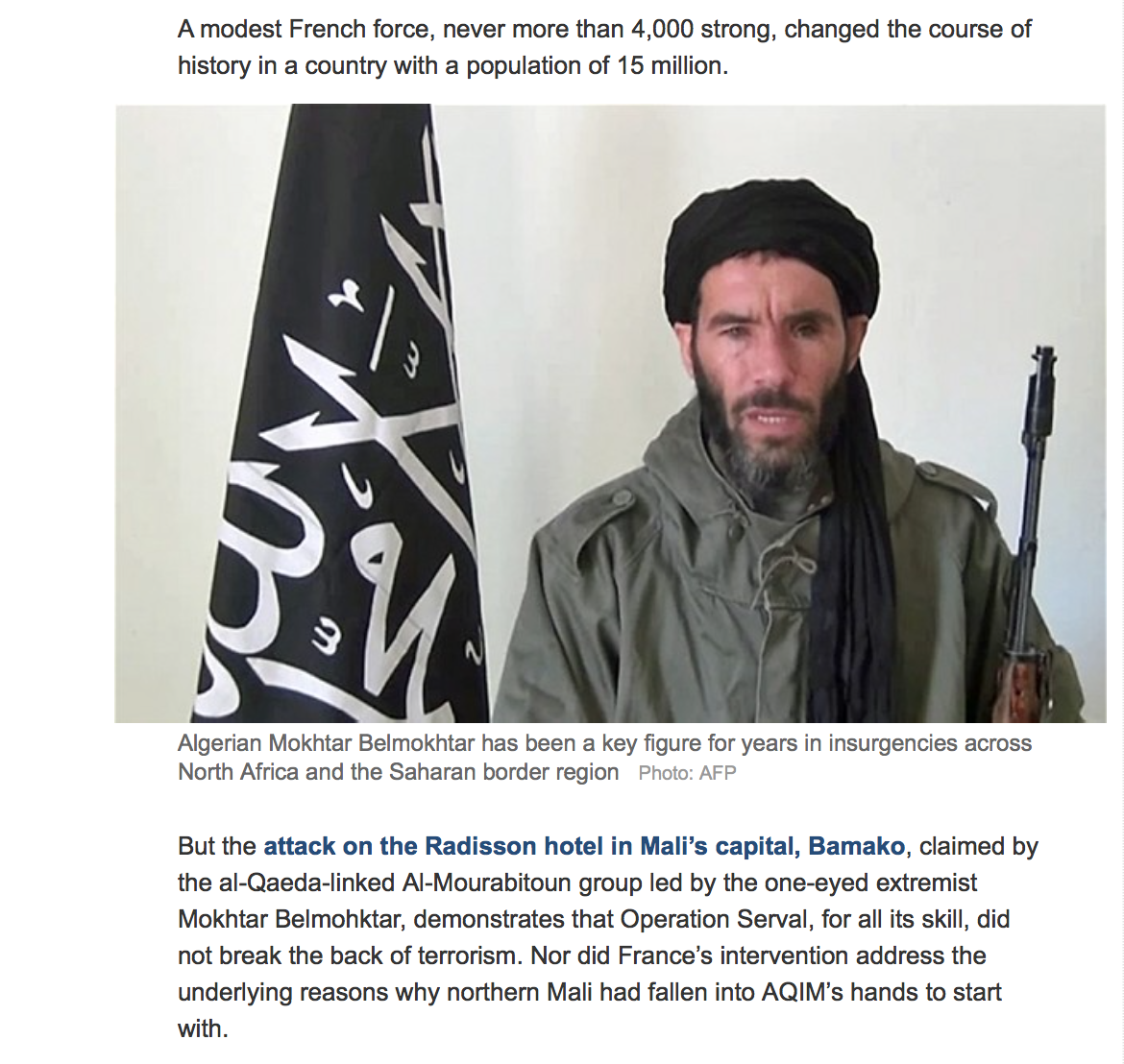
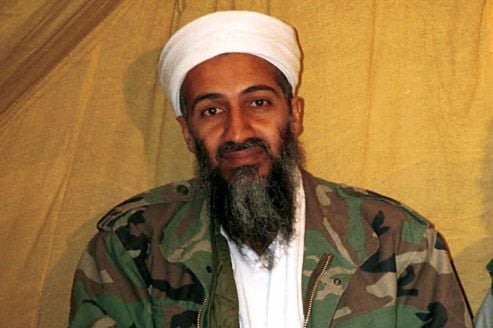 Saudi born terror mastermind Osama bin Laden was recruited in 1979 ironically under the auspices of the CIA. The training, recruitment and indoctrination of Mujahideen launched in 1979 was considered to be “the largest covert operation in the history of the CIA” in response the Soviet Union’s military support of the pro-Communist secular Afghan government of Babrak Kamal.
 Following his training and recruitment and a two year stint in Afghanistan (1991-1993), Mokhtar Belmokhtar was sent back to Algeria in 1993 at age 21 where he joined the Salafist Group for Preaching and Combat (GSPC) (emblem left). The latter was initially part of the so-called Armed Islamic Group (Groupe islamique armé (GIA)) in Algeria which sought to overthrow the secular Algerian Government with a view to installing a theocratic Islamic State.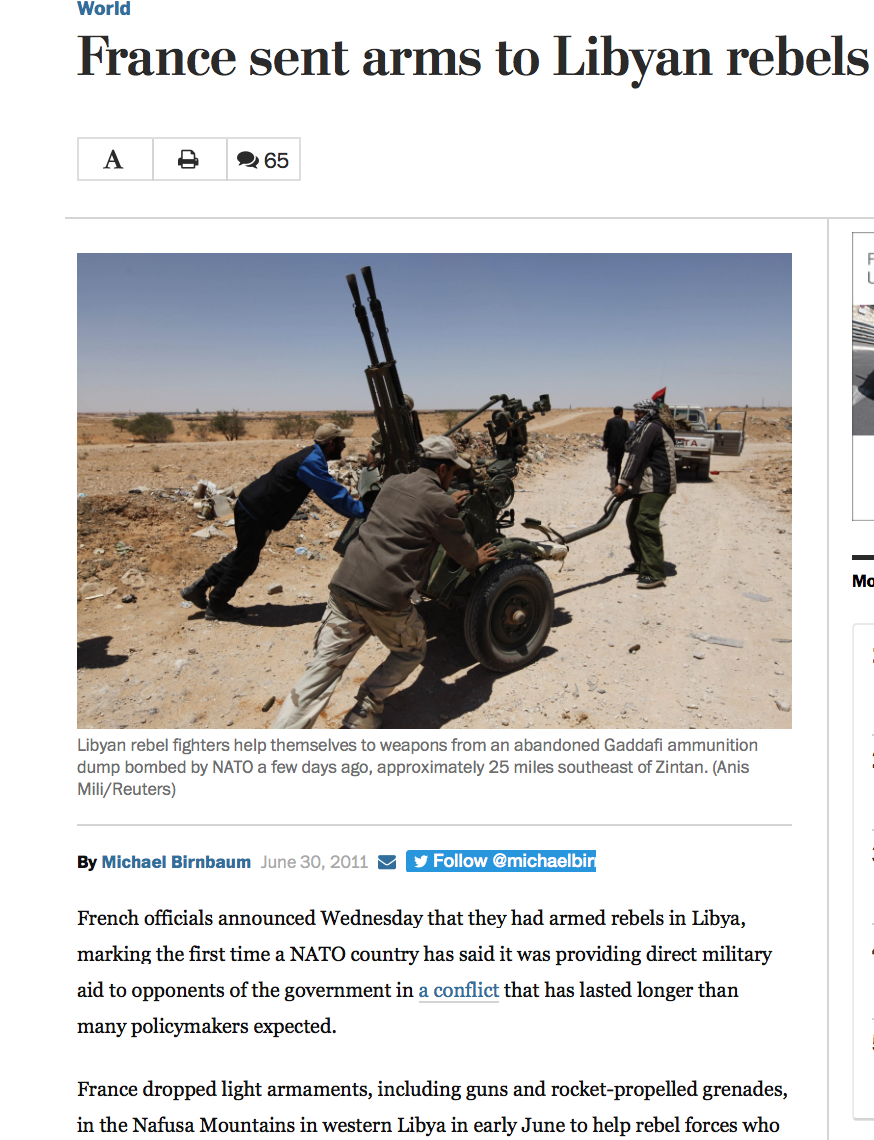


 Aletho News
 Aletho News