
Washington’s involvement in the violent overthrow of the democratically elected government of Chile in September 1973 is by this point well known. The pivotal role played by Brazil has not been as clear until now.
On the anniversary of the 1964 US-backed coup that led to Brazilian President Joao Goulart being replaced by a military junta, the National Security Archive has published a trove of previously classified documents showing the role that junta later played in subverting democracy in Chile, and its subsequent support of General Augusto Pinochet’s brutal repression of political opponents.
The file trail begins September 22, 1970, 18 days after Salvador Allende of the Popular Unity alliance narrowly won the Chilean presidency. A document, prepared for General Emilio Garrastazu Medici – then the third president of Brazil’s military dictatorship – summarizes a recent meeting between the US ambassador to Chile, Edward Korry, and his Brazilian counterpart.
Following Allende’s victory, Korry, a veteran diplomat during the administrations of Presidents Kennedy, Johnson, and Nixon, vowed that “not a nut or bolt shall reach Chile” under the socialist’s rule, and if and when he took office in November that year, the US would “do all within our power to condemn Chile and the Chileans to utmost deprivation and poverty.”
Accordingly, the summary makes clear US plans to undermine Allende were well underway by the time the two ambassadors met.
“Following direct orders from the White House,” Korry was said to be “insinuating to all relevant sectors” that Chile would have “difficulties” – including a shortage of foreign credit and military aid – should the country’s Congress confirm Allende as leader. He also noted the US Embassy was distributing written material warning of the dangers of an Allende government to Chilean military commanders, the very elements that would brutally take power three years later.
Korry’s message was clearly received loud and clear, for in March the next year – five months after Allende’s confirmation – Chilean ambassador to Brasilia Raul Rettig submitted a troubling report to his foreign ministry, titled ‘Brazilian Army possibly conducting studies on guerrillas being introduced into Chile’.
Rettig – who, two decades later, chaired the country’s first ‘truth commission’, which investigated human rights abuses during Pinochet’s rule – had heard from multiple sources that the Brazilian regime was extensively evaluating how to instigate violent insurrection in Chile and overthrow the Allende government via an “armed movement.”
Plans were well developed already, with the military having established a dedicated ‘war room’, with maps and models of the Andean mountain range along the Chilean border, to plan infiltration operations. A number of Brazilian secret agents had also reportedly “entered the country as tourists, with the intention of gathering more background on possible regions where a guerrilla movement might operate,” Rettig’s report revealed.
Brasilia was highly confident of success. In a November 1971 meeting at the White House, President Medici assured Richard Nixon that Allende “would be overthrown for very much the same reasons that Goulart had been,” and Chile’s military was up to the task. He added that Brazil had been “exchanging many officers with the Chileans, and made clear that Brazil was working towards this end.”
In return, the US president pledged “to be helpful in this area,” such as providing “discreet aid,” on the basis that “we must try and prevent new Allendes and Castros and try, where possible, to reverse these trends.” A contemporary CIA intelligence memorandum noted that, to Brazilian military top brass, Washington “obviously” wanted Brasilia to “do the dirty work” in Chile and elsewhere in Latin America.
By July the next year, Brazil had established back-channel communications with Chilean army officers, covertly flying them into the country to meet with high-ranking authorities and begin plotting the downfall of Allende. An August 1973 Brazilian intelligence report details a summit at an airbase in Santiago, at which high-level Chilean military officials were given extensive briefings on Brazil’s own military coup nine years earlier, in the process learning “useful” lessons for their own impending action.
So, it was that, on September 11, 1973, the Chilean military stormed the presidential palace and took power by force. Ground troops were assisted by British-made Hawker Hunter aircraft, which bombed the building and suppressed rooftop snipers. Allende also died in the fighting, and while investigators have ruled it was suicide, some still question that conclusion, arguing that he was in fact murdered.
In the process, Chile – hitherto an aberrant beacon of democracy and stability in a region typified by dictatorships – became a military junta, led by General Pinochet. Death squads immediately set about rounding up thousands of known or suspected Chilean leftists in the country, imprisoning up to 40,000 people in the country’s National Stadium.
The new files make it clear that Brazil moved very quickly to legitimize the new regime, racing to become the first country to officially recognize Pinochet’s despotism, and drafting speeches for the government’s representatives at the United Nations General Assembly to palliate the bloodshed unfolding in Santiago.
Plainclothes Brazilian intelligence agents also secretly assisted Chilean officials in conducting interrogations, torture, and executions at the National Stadium. Among those detained were US citizens, and Brazilians residing in Chile, at least three of whom were of such interest to Brasilia that officials were attempting to arrange their return home.
Comparable hands-on support persisted for many years thereafter. In August 1974, Colonel Manuel Contreras, chief of Chile’s Direccion de Inteligencia Nacional (DINA), requested official passports for 12 officers for a trip to Sao Paulo, in order that they might receive training from their Brazilian counterparts.
Humberto Gordon, who later headed DINA, is named among the officers, as are individuals later involved in the assassination of Orlando Letelier in Washington DC, which was directly ordered by Pinochet.
In the wake of the coup, Letelier – a Chilean economist, politician, and diplomat during Allende’s presidency – was held for 12 months in several concentration camps, along the way being severely tortured, being released only due to international diplomatic pressure. He fled the country and took refuge in the US, becoming Pinochet’s most prominent overseas critic.
On September 21, 1976, Letelier was killed via car bomb – much of his lower torso was blown away and his legs severed. Documents previously unearthed by the National Security Archive indicate that US officials had foreknowledge of the assassination, but transmission of a State Department communiqué warning the Chilean government against carrying it out was blocked by then-Secretary of State Henry Kissinger. … Full article
April 1, 2021
Posted by aletho |
Civil Liberties, Deception, Economics, Timeless or most popular, War Crimes | Brazil, Chile, CIA, Human rights, Latin America, United States |
Leave a comment
By Lucas Leiroz | October 8, 2020
A “parallel” Venezuelan Consulate in Brazil was condemned in a recent statement by Venezuelan Foreign Minister Jorge Arreaza. In late September, supporters of the Venezuelan opposition leader, the self-proclaimed “interim president” Juan Guaidó, announced that they would form a new consulate in Brazil. Basically, the objective is to create a parallel Venezuelan diplomatic representation, which meets the interests of the opposition – which is supported by the Brazilian government. The decision has received strong criticism from the Venezuelan government, which considers it illegal. However, despite the criticism, the consulate is starting its operations this week in the Brazilian state of Roraima – a region strategically chosen because it borders Venezuela.
Jorge Arreaza, head of the Bolivarian government’s foreign relations, reinforced his criticism and published an official statement warning the international community against the activities of the opposition, which he classified as fraudulent. According to Arreaza, there is an attempt to usurp the legitimate consular power of the Venezuelan government – which, in legal terms, is correct, considering that Guaidó is not actually the president of Venezuela.
Guaidó’s initiative in Brazil continues a series of clashes between the government of Jair Bolsonaro and representatives of Nicolás Maduro. Last month, the Brazilian Ministry of Foreign Affairs declared Venezuelan diplomats as “persona non grata” after setting a deadline in April for them to leave the country – which did not happen due to a later decision by the Supreme Court. Now, with the appointment of new “diplomats” by Juan Guaidó, the situation between both countries is even more tense, since the Brazilian government will publicly recognize the role of the opposition’s parallel diplomatic service, while denying maintaining relations with the Venezuelan official diplomacy.
No specific date has been set for the opening of the parallel consulate, and it has just been announced that from this week on the agency would be fully operational. In fact, Guaidó’s “diplomats” are already acting freely in Brazil and even distributing documents to Venezuelan citizens in Brazilian territory. The Maduro government has already stated that such documents have no validity, but the Brazilian government recognizes the actions and cooperates with the oppositionist Consulate. It is also important to emphasize that the employees of the parallel consulate have no diplomatic training, being political militants chosen by Guaidó to represent his interests in Brazil.
Brazil is making a serious mistake in accepting the formation of an illegal consulate in its territory. This represents a total violation of good customs in international relations. Although Brazil is directly opposed to the Venezuelan government, recognizing the legitimacy of an illegal “consulate” and allowing parallel diplomats to act in its territory sets an undesirable precedent in bilateral relations between these states. According to the Montevideo Convention, a State is constituted by the presence of territory, government and diplomatic relations. Therefore, when recognizing a new diplomacy, Brazil is, in practice, recognizing the existence of a Venezuelan State parallel to the Bolivarian Republic. The Venezuelan case, moreover, illustrates an absolutely inappropriate international behavior among the nations that oppose Maduro. To recognize a deputy as president for the simple fact that there was political opposition to the legitimate government had already been a serious violation of international customs. Now, with the creation of parallel consulates, the situation is likely to get even worse, mainly due to the fact that Brazil may not be the only country to receive “Guaidó’s diplomats”.
Interestingly, the inauguration of the parallel Consulate in Brazil takes place a few weeks after the visit of US Secretary of State Mike Pompeo to four countries in South America. The head of American diplomacy met with Brazilians including Brazil’s minister of foreign affairs Ernesto Araújo and Venezuelan immigrants precisely in the state of Roraima. The secret talks between Pompeo and Araújo still remain obscure. When called by the Senate to clarify the content of the meeting, Araújo gave no details and mentioned only generic aspects of the conversations he had with Pompeo. The other countries visited by Pompeo were Colombia, Guyana and Suriname – countries strategically chosen to form a siege against Venezuela. Considering that Pompeo’s visit to Brazil was most likely decisive for the Brazilian government to agree to cooperate with Guaidó’s parallel diplomacy, it is possible to foresee that sometime soon some of the other countries visited by Pompeo will also announce a similar decision, receiving “diplomatic missions” coming from the self-proclaimed and illegitimate government of Juan Guaidó.
It remains to be seen what the consequences of these acts will be going forward. The parallel consulate is already acting freely in Brazil, consolidating an historic act of violation of Venezuelan state sovereignty perpetrated by the Brazilian government. However, the US – the world power that promotes the crusade against Maduro – has not yet made such a bold decision and does not publicly have “diplomats” in the service of Guaidó. In fact, Brazil is acting as the laboratory of a great experiment, where the limits of the violation of Venezuelan sovereignty are being tested. Depending on the reaction of Caracas and its allies, other countries will receive – or not – such “diplomats”.
Lucas Leiroz is a research fellow in international law at the Federal University of Rio de Janeiro.
October 8, 2020
Posted by aletho |
Aletho News | Brazil, Latin America, United States, Venezuela |
Leave a comment
The packed living conditions, poor sanitation, lack of healthcare and flouting of lockdown measures make Brazil’s slums – home to around 11 million people or 6 percent of the population – particularly vulnerable to the virus.
Emerson Barata draws a circular map of Sao Paulo’s largest slum, Paraisopolis, and begins to mark confirmed coronavirus cases in blue ink. At the center of the favela of around 120,000 people, which crowds between luxury apartment blocks and high-walled mansions, he draws four dots.
“It’s going to get a lot worse,” the 34-year-old tells an assembled medical team, adding another two dots to the favela’s outer districts. “The surge hasn’t hit yet.”
Barata is leading the coronavirus response in this labyrinth of red cinder block homes where, beyond the six confirmed cases, his team suspects another 60.
He is not connected to the Brazilian state, and nor is the medical team around him. The former minor league soccer pro is part of an association of Paraisopolis residents whose deep distrust of government has led them to take things into their own hands.
The residents’ association has hired a round-the-clock private medical service including three ambulances, two doctors, and two nurses, as well as drivers and support staff.
While President Jair Bolsonaro has dismissed the virus as “a little flu” and told Brazilians to get back to work, Barata is sleep-deprived trying to get his favela ready for what he describes as a “war.”
Barata declined to say how much this would cost or how it was being funded, beyond saying some was covered by donations. Much of it still needs to be raised, he said. The medical team is on an initial 30-day contract, likely to be extended.
“Favelas are going to be hit the worst,” he said, standing in a parking lot outside a mechanic’s workshop that doubles as a base for the medical team. “The places that are already neglected by the state will be neglected even more.” Public health experts agree.
Paraisopolis is likely to be on the front line. Many of its residents work in the nearby wealthy neighborhood of Morumbi, ground zero for the outbreak in Brazil. Across Latin America, many of the first cases were diagnosed in those affluent enough to travel abroad, but the virus is expected to hit the poorest hardest.
Brazil is Latin America’s worst affected nation by the coronavirus so far, with nearly 7,000 confirmed cases and 240 deaths.
The Paraisopolis residents who have tested positive include two who work in the nearby Albert Einstein Hospital, a private medical facility that diagnosed the first case in Latin America. Another was a live-in nanny.
The population density in Paraisopolis is about the same as Manhattan, although most buildings are just two or three stories tall. Residents complain the water runs dry after 8 p.m. and rubbish piles up along the tight, damp alleyways that weave through the community.
“I think it’s going to get ugly… This is a ‘little flu’ that kills,” said Luiz Carlos, a short, grey-haired doctor who is part of the hired medical team.
Roberto de Souza, 41, believes he caught the virus through his job in a pharmacy – despite wearing disposable gloves and a facemask when serving customers. He developed terrible pain in his legs and a constant cough soon followed.
After testing positive he isolated himself in a cramped second-floor flat in Paraisopolis.
“What hurts the most is being locked away, alone,” he said through a facemask, in between coughing fits. “I have to worry, not just about myself but about not giving it to the next person.”
De Souza lives by himself. In Paraisopolis that puts him in the minority.
Reuters visited one cramped home where a woman was self-isolating, sick with coronavirus symptoms. But her three children, mother and brother had nowhere else to go, so continued to live with her.
To address that challenge, the residents’ association is looking to use two local schools – closed due to the outbreak – to house up to 500 suspected and confirmed cases without life-threatening symptoms, removing them from tight living quarters.
Despite all the preparations, Barata is worried residents are not taking the threat seriously enough. Unlike in the rest of Sao Paulo, where a lockdown is in place, most bars and shops remain open in Paraisopolis. The streets bustle. Parties pound.
Barata fears many will change their attitude only once a parent or a friend dies. By then it might be too late.
“We’re trying to get the message out: This is no joke,” he said.
April 3, 2020
Posted by aletho |
Solidarity and Activism | Brazil, Covid-19 |
Leave a comment
Brazilian federal deputy Eduardo Bolsonaro, the son of right-wing dictatorship fanatic President Jair Bolsonaro, announced recently that the country will be moving to designate Hezbollah as a terrorist organisation. “Inside the government, we are debating the ways to stop terrorist groups from coming to Brazil,” Bolsonaro stated. “We are going to follow Argentina, declaring that Hezbollah is a terrorist group.”
Not only Hezbollah is being targeted with this designation. Bolsonaro’s son has also declared that the Brazilian government will be “considering a harsher stance on terrorist groups Hamas, Al-Qaeda, and Boko Haram.” Israel praised Brazil’s decision as part of the fight against “Iranian-sponsored terrorism”. Since the US declared its war on terror following September 11, Israel has appropriated the narrative and used it to gain diplomatic leverage for its murderous colonial policies, while strangling Palestinian resistance in the process. Unsurprisingly, Brazil will be joining other countries supportive of Israel’s security narrative in blurring the distinction between legitimate resistance movements and terrorist groups. That narrative is anything but democratic.
For the right wing Israeli and Brazilian governments, resistance movements such as Hamas and Hezbollah on one hand, and the Landless Workers’ Movement (MST) are terrorists, as Bolsonaro declared recently in one of his usual tirades. In defence of Israel’s purported security narrative, Brazil will be employing a designation on Hezbollah and Hamas which has nothing to do with terrorism and everything with how state terror seeks to delegitimise anti-colonial struggle.
As democracy moves even further away from its principles, becoming a label utilised by the right-wing in its quest to annihilate opposition, resistance movements become even more marginalised politically. Needless to say, Brazil’s move will endear it to the US and Washington’s own dissemination of Israel’s security versus terror narrative. Criminalising resistance movements has one main aim, to delegitimise resistance and, as a result, alter the understanding of what constitutes “terrorism”.
Categorising Hamas, the Palestinian Islamic Resistance Movement, alongside terror groups such as Al-Qaeda and Boko Haram builds upon the US-Israeli narrative of seeking to undermine Iranian influence in Latin America. Paraguay, Colombia and Honduras have already adopted this narrative since last year. It ignores the simple fact that Hamas has never carried the struggle for freedom from Israeli occupation beyond the borders of historical Palestine.
The right-wing surge in the region is not conducive to diplomatic support for Palestine, let alone Palestinian resistance. Hamas is already ostracised politically, but the US-Israeli scheming will continue to seek unanimous support for the narrative which allows the far-right to define terror at the expense of the occupied and oppressed.
Bolsonaro has stated on occasions that he seeks further alignment with the US in terms of policy. The latest decision strikes at the heart of Palestinian resistance at a time when Palestinians are in need of diplomatic support due to Trump’s deal of the century versus the two-state compromise dead ends in terms of opportunity. The more that Palestinians are obscured from the political process, the easier it is to simplify, albeit erroneously, the Palestinian cause into an issue between a “democratic state” and “terror”. This is part of the strategy that the US and Israel are pursuing, which is to have a monopoly over who decides that the definition of state-sponsored terror of the kind practiced by Israel and other right-wing governments is somehow “democratic”. That is far from the truth.
March 5, 2020
Posted by aletho |
Ethnic Cleansing, Racism, Zionism | Brazil, Colombia, Honduras, Israel, Latin America, Palestine, Paraguay, Zionism |
Leave a comment
By Lucas Leiroz | February 25, 2020
Recently, the Brazilian Ministry of Defense published a dossier on possible threats to national security over the next two decades. The document, however, is far from showing any sign of seriousness, being full of unfounded predictions, which call into question even the quality of the academic training of the military involved – or their commitment to the truth.
In the document, the Brazilian military set up a series of hypothetical scenarios and warn that France could become a real threat to Brazil in the coming years. The reason is due to a brief tension and war of words between the Presidents Jair Bolsonaro and Emmanuel Macron over the past year, due to the environmental crisis and bushfires in the Amazon Rainforest. For Brazilian generals, this is already a sufficient basis to see France as a real threat to national security, ignoring notable facts, such as that both countries are the biggest trading partners in military industry and that the tension between Bolsonaro and Macron has already calmed down months ago, in addition to the fact that the French interest in starting a transcontinental war over the Amazon territory is absolutely minimal.
Continuing with forecasts, the document testifies to a future of great tensions in South America, with Venezuela and Guyana fighting conflicts in the north and Bolivia and Chile in the south, in addition to the installation of Chinese and American military bases across the continent. Brazil, aligning itself with the USA, will act as a mediator of regional conflicts and will receive advanced armaments from Washington. The document also foresees the installation of three American military bases in Colombia and a conflict between this country and Venezuela. It is also speculated that Argentina will grow economically with oil exploration and that it will align with China, but that Brazil will veto the installation of Chinese bases in the neighboring country.
Brazil’s role in internal tensions and international geopolitics will depend exclusively on its good relations with the United States. The dossier speculates that China will overtake the United States as an economic power, but that Washington will remain the global military leader. Brazilian alignment with American hegemonic power, then, will be a matter of survival and will allow Brazil to mediate regional conflicts, pacify neighboring countries and curb Chinese influence in South America. The generals go even further with their unfounded speculations and claim that Brazil will arouse the fury of “ultranationalist groups in Southeast Asia” that, in retaliation, will launch biological weapons against the Brazilian population on the occasion of the musical festival “Rock in Rio” in its 2039 edition.
In brief summary, the document creates a hypothetical scenario in which Brazil’s alignment with the United States will no longer be a matter of political will, but of necessity and survival. In practice, a group of more than 500 military researchers created a myth to justify alignment with Washington, using predictions that lack meaning and material bases. The ultimate goal is simply to forcibly instill the belief that Brazil should become an American ally.
But the Brazilian military does not stop there. Recently, the Russian ship Yantar approached the Brazilian coast, having anchored for a few days in the state of Rio de Janeiro. When the ship was about 50 miles away from the beaches of Rio, the Brazilian Navy issued a communication signal that was not answered immediately. It happens, however, that the vessel responded to the communication attempts issued later, which was not enough for the Brazilian Navy to retreat in its false alarm that the Russian ship would be performing espionage services on the Brazilian coast, spreading the lie through several media agencies and creating an unnecessary tension atmosphere.
The scandal made by the Brazilian Navy would make any specialist in military and intelligence operations laugh. Do they really believe that such a vessel would be used for espionage purposes with such public exposure? Would the Brazilian State be irresponsible to the point of creating such an atmosphere of tension with Russia for absolutely nothing?
The scenario leads one to believe that it is not a collective idiocy of Brazilian generals, but rather a very well-designed project to create an environment of fear in relation to everything that is not of interest to the United States. Chinese military presence in South America, Russian espionage, French threat, regional wars, biological terrorism – these are all imaginary threats meticulously created by the military who are no longer interested in national defense, but in the country’s subordination to the hegemonic global power.
Brazil seems to be experiencing one of the worst moments in its history. Again, the higher generals are more committed to external interests than to the defense of their own country and seem to be willing to do anything to see Brazil become an American dependency.
Lucas Leiroz is a research fellow in international law at the Federal University of Rio de Janeiro.
February 25, 2020
Posted by aletho |
Economics, Militarism, Russophobia | Brazil, Latin America, United States |
Leave a comment
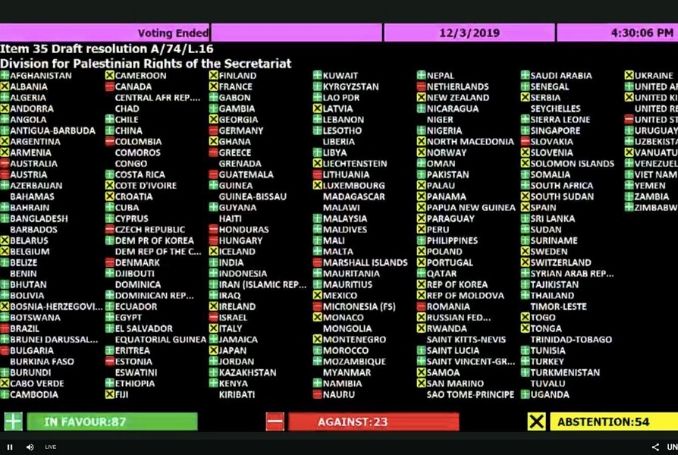
For the first time, 13 countries changed their longstanding positions and voted against a pro-Palestine measure at the United Nations on Tuesday.
Germany, the Czech Republic, Austria, Bulgaria, Denmark, Estonia, Greece, Lithuania, Netherlands, Romania, Slovakia, Brazil, and Colombia voted against the annual resolution regarding the “Division for Palestinian Rights of the Secretariat”, according to the Times of Israel.
They had previously abstained on the vote.
The resolution, which includes a call to halt to illegal Israeli settlements being constructed in the occupied West Bank, still passed with a large majority voting in favor.
The Palestinian representative told the council: “If you protect Israel, it will destroy you all.” He also said Israel’s character as a Jewish state is “shameless racism”.
The New York-based Division for Palestinian Rights oversees the Committee on the Exercise of the Inalienable Rights of the Palestinian People.
The resolution was co-sponsored by Comoros, Cuba, Indonesia, Jordan, Kuwait, Lao People’s Democratic Republic, Qatar, Saudi Arabia, Senegal, the United Arab Emirates, and Yemen.
The UK, France, and Spain abstained, as they do every year, allowing the resolution to pass with a vote of 87-54, with 21 other abstentions.
The General Assembly adopted five resolutions on the question of Palestine and the Middle East, including one calling on the Member States not to recognize any changes to the pre-1967 borders, including with regards to Jerusalem, other than those agreed by the parties through negotiations.
December 5, 2019
Posted by aletho |
Ethnic Cleansing, Racism, Zionism | Austria, Brazil, Bulgaria, Colombia, Czech Republic, Denmark, Estonia, Germany, Greece, Israel, Lithuania, Netherlands, Palestine, Romania, Slovakia, Zionism |
Leave a comment
The seizure of Venezuela’s embassy in Brasilia was not only an attack on the legitimate government of Nicolas Maduro in Caracas, but also an attempt to sow discord between the BRICS member states, Russia’s Deputy FM told RT.
The Wednesday storming on the diplomatic mission by the supporters of US-backed Venezuelan opposition figure Juan Guaido was “planned before and timed that it coincided with the first day of BRICS summit,” Sergey Ryabkov said.
It took place on the same day as the leaders of Russia, China, India and South Africa arrived to the Brazilian capital for the high-profile BRICS summit. Members of the block, which unites the world’s largest emerging economics, have quite different views on the crisis in Venezuela. Moscow and Beijing are backing Maduro as the democratically-elected president, while Brazil’s Jair Bolsonaro said he recognized Guaido as Venezuelan leader.
The incident at the embassy shows that those who push for regime change in Caracas will “use and abuse every opportunity to pursue their goals,” the deputy foreign minister said, vowing that Moscow will “disclose the actual intentions of those people.”
The fact that some “unknown persons” were able to make their way into a diplomatic mission “creates questions on how effective the law enforcers in Brazil were,” Ryabkov pointed out.
The Venezuelan opposition supporters remain inside the embassy in Brasilia, with Bolsonaro saying he was looking for ways to restore order without provoking violence.
November 13, 2019
Posted by aletho |
Illegal Occupation | Brazil |
Leave a comment
By Paul Antonopoulos | November 11, 2019
The Workers Party (PT) ruled Brazil, mostly under the leadership of the charismatic Luiz Inácio Lula da Silva, or simply known as Lula, from 2003 until his successor’s impeachment in 2016. This period saw Brazil undergo major changes and advancements with an emphasis on educating the poor, providing access to healthcare for all Brazilians, poverty reduction and Latin American integration. Although the PT did not challenge the capitalist system entirely, there was an emphasis on reducing the neoliberal model that has exploited South America since Chilean dictator Augusto Pinochet allowed his country to be economically ruled by this U.S.-endorsed system since the 1970’s.
The progress made by Lula saw a great reversal after his controversial arrest for allegedly engaging in corrupt practices. However, after only 580 days of incarceration in what was supposed to be a near decade long sentence, the Federal Supreme Court released the former president on Thursday from prison. His release, although initially a joyful event for progressives into South America, was quickly overshadowed by the coup taking place in Bolivia that has seen Evo Morales resign as president.
The successful coup against Morales is a setback for the re-emergence of the socialist Pink Tide order in Latin America. However, the release of Lula is likely to re-energize the entire cultural space against U.S. hegemony that has nearly completely dominated region since the mid-2010’s when the “Blue Tide” (Conservative Wave) took over Brazil, Argentina, Peru and other Latin American states in the aftermath of the Pink Tide.
There is little doubt that the news has become not only the political event of the year in Brazil, but in all of Latin America. The second half of 2019 has seen major changes and polarizations occur with major revolts in Ecuador and Chile against the ruling governments, Mauricio Macri’s failure to be re-elected in Argentina, and the likelihood of a Leftist election victory in Uruguay later this month.
The majority of analysts who believe Lula is innocent claim the reason he was imprisoned was to prevent his election victory in 2018. Lula often claims that he is more than a man, but “an idea.” However, if Lula is “an idea,” this also begs the question on why the “idea” was not successful when represented by Fernando Haddad, the PT presidential candidate who failed against Jair Bolsonaro in last year’s election.
Rather, people are more likely to follow people than ideologies. Lula is incorrect to call himself “an idea,” and rather he is an icon or a symbol. The symbol of Lula is one of hope for the poorest and progressives of Latin America, and his “idea” can only be continued through him since he has built a symbology behind his persona. Therefore, the meaning behind his release, many years earlier than originally sentenced, has a tremendous meaning across the region. Even Bolsonaro had to resign to the fact that he “would not be here” as president if Lula had not been imprisoned by then judge Sérgio Moro – Brazil’s current Minister of Justice.
Lula’s freedom is without a doubt a major shock to the reactionary forces operating in Brazil with full encouragement and endorsement by Bolsonaro. It is for this reason that former U.S. President Donald Trump’s strategist and adviser Steve Bannon criticized the release of Lula, calling him “one of the most cynical and corrupt politicians in the world,” claiming the release of Lula will bring a return of corruption to Brazil. Although Bannon is a former adviser to U.S. President Donald Trump, he still wields a great amount of influence and power in Washington DC and recently even cancelled trips to Brazil, England, Italy and Australia to structure a task force to fight against the impeachment process against Trump.
And of course, the “return of corruption” to Brazil is a ludicrous claim made by Bannon, especially when considering he has been a staunch defender and endorser of Bolsonaro and has elevated Eduardo Bolsonaro, a son of the Brazilian president, to the main representative of South America in “The Movement,” a consortium of European representatives who support right-wing nationalist populism while defending exploitative economic policies. Bannon’s ideological extremism defends “economic nationalism,” but it is not confused with neoliberalism or globalism. His extremist economic nationalism conceptually cannot cross the borders of the American empire, but as mere rhetoric, as it is incompatible with economic policies that promote the economic and social development of any other state. However, Bannon of course did not mention that Bolsonaro, his sons and his aides have been involved in endless scandals and corruption cases since January this year.
Although Bannon may not be involved with the Trump administration at an official level, there is little doubt that he has always been the bridge between Trump and the Bolsonaro family. Therefore, Bannon quickly coming out to denounce Lula after his release from prison can suggest that his release will be a major concern for Washington.
Why?
Lula certainly did not wait long before firing shots at the defenders of U.S. unilateralism in Latin America after his release from prison, stating: “The so-called Left that Bolsonaro fears so much will defeat the extreme Right – Brazil does not deserve the government it has,” citing unemployment rates, attacks on education and the poor, and the “lies” by Bolsonaro. He also had a look at the Latin American situation, praising Chile’s protests and called for solidarity with the Chilean people, while also showing his support for Evo Morales and denouncing Trump.
This was the Lula that Brazilians had fallen in love with. They fell in love with a leader who had no fear to speak his mind. It is not the destructive Bolsonaro’s way that attacks Brazil’s minorities and most vulnerable, but Lula’s way that attacks the forces that kept Brazil poor and subservient to Washington, and those who also prevent efforts for Latin American cooperation and integration.
It is for this reason that Lula also immediately addressed the Puebla Group, a regional body that brings together 32 progressive leaders from twelve countries that held its second meeting in Buenos Aires over the weekend.
In his message to the Puebla Group, Lula was firm in announcing that he will fight “the rotten side of the Judiciary, the rotten side of the Federal Police, the Public Ministry and Brazilian companies,” and that “It is important that we have courage and face them, because the Latin American elite is a very conservative elite and does not accept the idea of a poor people up the ladder of social conquests.”
However, his most startling revelation was that he has “the objective of constituting a very strong Latin American regional integration […] with the dream of building our great Latin America.”
It is this very goal of uniting Latin America to ensure the regions sovereignty and economic independence that has U.S. puppets like Bolsonaro and international populists like Bannon critically worried about Lula’s release. With Bolsonaro and Bannon worried by Lula, it can only be a matter of time until we see efforts to put Lula back in prison, potentially with Trump’s endorsement.
Although there are real efforts in maintaining the Blue Tide in Latin America, especially with the latest coup against Morales, it appears that the path towards Pink Tide 2.0 is still firmly paved, especially with Lula’s release from prison. Not only was he a symbol in Brazil, but he was a symbol of unity and integration across Latin American, alongside the equally charismatic Hugo Chávez of Venezuela. There can be little doubt that Lula’s release from prison will not only embolden progressive leaders in Latin America, but it will help reduce U.S. hegemony in the region.
Paul Antonopoulos is a Research Fellow at the Center for Syncretic Studies.
November 11, 2019
Posted by aletho |
Economics | Brazil, Latin America, United States |
Leave a comment
By Paul Antonopoulos | October 8, 2019
In an interview with DW Brasil, former Brazilian ambassador to Beijing, Marcos Caramuru, revealed the great interest Chinese companies have in potential infrastructure work in Brazil. Even with Brazilian President Jair Bolsonaro showing initial hostility towards China during his 2018 election campaign, his opinion appears to have changed given the huge sums involved in bilateral relations and the opportunities the Asian country can provide the economic struggling Latin American Giant.
Bolsonaro is commonly known as the ‘Tropical Trump’ for his open admiration of the U.S. President and his shared ideas and beliefs. Therefore, it was unsurprising that he said “The Chinese are not buying in Brazil… They are buying Brazil,” in the pre-election campaign.
Global Times speculated that “it’s inconceivable the new Bolsonaro government would give up on the Chinese market.” It also left a note of caution for the Brazilian leader who made another major antagonism towards China: “His trip to Taiwan during the presidential campaign caught the ire of Beijing. If he continues to disregard the basic principle over Taiwan after taking office, it will apparently cost Brazil a great deal … The Chinese island won’t bring any more benefits to Brazil, which Bolsonaro and his team must be aware of.”
Marcus Vinicius Freitas, a visiting professor at the China Foreign University in Beijing, explained that: “When the Chinese look at Brazil they actually see an amusement park where everything still needs to be done.” His assessment is in reference to the huge developmental and infrastructural opportunities that Brazil has, with many sectors remaining underdeveloped despite the domineering position Brazil has over the wider Latin American region. “There is no doubt that China has a menu of options for Brazil,” he added, citing Chinese technologies in road, subway, rail, viaduct and airport construction that could be of interest to Brazil.
There are also additional opportunities from agribusiness to commodities, the most attractive sector for Chinese capital is infrastructure and major works, especially in the area of gas, oil, renewable energy which will ensure growth on a sustainable and significant basis for the Brazilian economy.
However, despite the significant economic relationship between the two countries and the opportunities China can provide Brazil, it had not stopped Bolsonaro from aggravating Beijing. Therefore, it would be assumed that Bolsonaro would submit to Trump’s every demand in the midst of the U.S. president’s trade war with China. However, this has proven not to be the case with Brazil’s Vice President Hamilton Mourão saying in June that his country does not plan to ban Huawei from providing 5G equipment to telecoms in his country, signalling that Bolsonaro has said one thing during the election campaign, but acted in another way while president.
This would suggest that Bolsonaro’s government is following a different path than initially anticipated and the Brazilian president is not a complete U.S. puppet as often said by his critics. Although Trump told Bolsonaro during the latter’s visit to the White House earlier this year that Huawei was a security threat, the Brazilian Vice President emphasized that Brazil has no reason to distrust Huawei and that his country needs the Chinese technology to help its continued development.
As Beijing has been calling for a resolution to the Trump-initiated trade war, China’s ambassador to Brazil, Yang Wanming, accused the United States of bullying and lobbying its trading partners, affecting the entire global economy. He explains that the U.S. ruined market confidence, increased the risk of global recession and endangered emerging economies like Brazil.
And in this scenario, it would be important for Brasilia and Beijing to defend international cooperation and multilateralism. China’s GDP grew by ‘only’ 6.2% in the second quarter of 2019, which is the lowest economic growth recorded since 1992. This so-called economic ‘slowdown’ has served as a successful bait to trigger Western media.
As a result, Trump declared that his tariff war with China was working and said his protectionist measures had led to the exodus of companies from the Asian giant. However, if the measures were so successful Trump would not continue to threaten his partners from trading with China. The Bolsonaro government has seen that in this situation, siding with the U.S. is not in its interests.
Although Bolsonaro will continue to take on a very pro-Trump stance in Latin American affairs, especially against Cuba and Venezuela, he has demonstrated that he is unwilling to embroil Brazil in international issues besides those relating to Israel, serving the interests of the powerful Christian Evangelical lobby in the South American country.
In fact, an argument can be made that Brazil benefits from the ongoing trade war between the two Great Powers. China has continually been placing large orders of Brazilian soybeans, choosing the South American country to fill the supply gap after stopping U.S. purchases. Chinese buyers are increasingly looking for Brazilian soybeans.
China halted U.S. soybean imports as tensions between Beijing and Washington increased and turned to Brazil. For now, Brazil has been able to respond to China’s demand, but its supply is running low and Beijing is at risk of failing to meet its needs. With any end to the trade war, it is unlikely that China will revert and make the U.S. its most important soy purchaser, providing an opportunity for Brazil to consolidate its own position.
Whether it was through a sudden realization, or whether it was from internal pressures from Brazil’s powerful agricultural industry and other important advisers, Bolsonaro has certainly done a 180 towards his China rhetoric. With the status of Brazil’s role in BRICS questioned by experts last year because of Bolsonaro’s initial hostility towards China and his vivid support for Trump, his Foreign Minister Ernesto Araújo has fully embraced his country’s chairmanship of the organization. This demonstrates that no matter the motivating reason, Bolsonaro has certainly changed his China policy from hostility to openness and welcomeness as the Asian country can drastically improve Brazil’s economic situation.
Paul Antonopoulos is the director of the Multipolarity research centre.
October 8, 2019
Posted by aletho |
Economics | Brazil, BRICS, Latin America |
Leave a comment
“EU-banned pesticide[s are] being manufactured in the EU, and then coming back to citizens in the EU, in the food we eat,” environmental journalist and founding member of the Green Economic Institute think tank Oliver Tickell told RT, explaining that as one of the largest soy exporters in the world, Brazil supplies a significant quantity of the feed that cattle and other livestock worldwide consume. European consumers tucking into a juicy steak have no idea that the creature they’re eating might have been nourished on soy sprayed with highly toxic pesticides.
“This is not just a problem for Brazil and Brazilian people and people exposed in the countryside to these pesticides and consumers and farmers,” Tickell warned. “It is actually affecting people all over the world through Brazil’s agricultural exports.”
ANVISA, the Brazilian public health regulatory agency, relaxed pesticide regulations last week so that only those chemicals with lethal potential can be classified as “extremely toxic,” triggering a massive backlash from environmental groups, human rights organizations, and food safety advocates. The fervently pro-business government of President Jair Bolsonaro has already approved 262 pesticides this year, 82 of which are classed as “extremely toxic,” as he follows through on campaign promises to demolish environmental regulations and open up protected rainforest lands to mining and agriculture.
Dozens of pesticides banned or strictly regulated in the EU, including paraquat and chlorpyrifos, were already permitted for use in Brazil before Bolsonaro took power, and the country uses approximately 400,000 tons of pesticides per year, according to Human Rights Watch. While Agriculture Minister Tereza Cristina has flatly denied Brazil uses any more pesticides than any other country, attributing such allegations to “data manipulation” and accusing critics of “terrorism,” EcoWatch claims the country consumes more pesticides per capita than any other nation.
July 30, 2019
Posted by aletho |
Environmentalism | Brazil, European Union, Human rights |
Leave a comment
Since the beginning of June, two Iranian commercial ships have been stranded at the port of Paranagua, in the state of Parana, in Brazil because the state-owned company, Petrobras has so far refused to supply fuel to them, in line with sanctions imposed by U.S. President Donald Trump on Iran, according to comments made by President Jair Bolsonaro to reports earlier this week.
“You know we are aligned with the U.S. policy. That is why we do what we have to do,” replied Brazil’s far-right President Jair Bolsonaro when questioned about this unusual case, which happens despite the fact that the U.S. sanctions on Iran contemplate exceptions for the sale of food and medicine.
The vessels Bavand and Termeh entered Brazilian territory to load corn two months ago. In fact, one of them is already loaded with about 50,000 tons of corn that could be completely spoiled in a short time.
According to the Latin American news outlet Pagina 12, a third of all Brazilian corn exports go to Iran and a good part of the urea used in the Brazilian fertilizer industry comes from Iran. Iran also imports Brazilian soy and meat.
Both ships belong to Sepid Shipping, an Iranian company blacklisted by Washington. However, the fuel for the vessels was acquired by Eleva, a Brazilian urea importer. Throughout this commercial process, therefore, the diesel was not acquired by Iranian money.
However, Petrobras claims that the urea is one of the U.S. banned products, an argument that does not stand given the fact that the Eleva transaction occurred before May and was authorized from Washington.
On July 13, Iran’s ambassador to Brazil Seyed Ali Saghaeyan went to the foreign minister in Brasilia to request information on the situation of the stranded ships. “He left without hearing anything concrete. The issue must reach the Supreme Court,” Pagina 12 reported.
During his visit, the Iranian ambassador told officials that if the federal government refuses to supply diesel to the vessels, his country could easily find new suppliers of corn, soy and meat.
Although this possibility could mean “bad news” for the Brazilian agriculture industry, “there are no signs” that the Iranian ships impasse will affect bilateral trade relations, according to Bolsonaro’s Foreign Trade Secretary Lucas Ferraz.
Meanwhile, on Thursday morning, Brazilian Supreme Court President Dias Toffoli ruled that Petrobras must provide fuel to Iranian ships. The Bolsonaro government has yet to react to the ruling.
Historically Brazil has maintained a favorable trade balance in its relations with Iran. For instance, in the first half of 2019, Iran imported about 2.5 million tons of Brazilian corn, while the South American country exported goods to Iran for US$1.299 million and bought Iranian products for US$27 million, which means Brazil obtained a favorable trade balance of US$1,272 million
July 26, 2019
Posted by aletho |
Economics | Brazil, Sanctions against Iran |
Leave a comment
Leaked documents reveal that the Brazilian justice minister has, in collaboration with prosecutors, fabricated a case against ex-president, Luiz Inacio Lula da Silva, and convicted him of corruption in a scheme meant to prevent the popular politician from running for the 2018 presidential election.
The Intercept website, citing the leaked documents, reported on Sunday that Moro was sharing information and giving advice to prosecutors working in a years-long anti-corruption probe, known as “Car Wash.”
The massive Car Wash probe, which has swept through Brazil for the last five years, eventually resulted in the conviction of Lula for corruption and money laundering.
Lula has been serving a 12-year prison sentence since April, 2018. A second conviction was handed down to him by Moro in February for, which Lula was sentenced to almost 13 years.
The Intercept said an anonymous source had provided the online new publication with material, including private chats, audio recordings, videos and photos that show “serious wrongdoing, unethical behavior, and systematic deceit.”
“Moro secretly and unethically collaborated with the Car Wash prosecutors to help design the case against Lula,” it wrote.
“Car Wash prosecutors spoke openly of their desire to prevent the PT (Lula’s Workers’ Party) from winning the election and took steps to carry out that agenda,” The Intercept said.
In response to the report, Lula’s Twitter account posted a link to The Intercept stories, writing, “The truth will prevail.”
The leftist former leader, who ruled Brazil between 2003 and 2010, has denied all the corruption charges, saying they were politically motivated to prevent him from competing in the elections.
The justice minister denied wrongdoing in a statement on Sunday. He said the material obtained through the “criminal invasion of prosecutors’ cell phones had been “taken out of context.”
“Careful reading reveals that there is nothing there despite the sensational material,” Moro said on Twitter.
He became part of the cabinet of President Jair Bolsonaro, who had said during his campaign that he hoped Lula would “rot in prison.”
In a separate statement, Car Wash prosecutors also dismissed the allegations, saying they were victim of “a criminal action perpetrated by a hacker,” and that they are available to provide clarifications.
June 10, 2019
Posted by aletho |
Deception | Brazil |
Leave a comment

 Aletho News