Russia quizzes US on coronavirus’ parentage
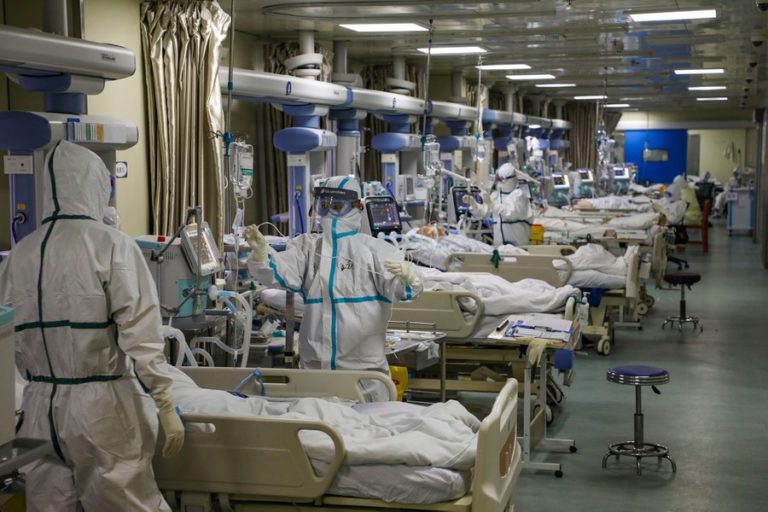
Medical workers in protective suits attend to coronavirus patients at the Intensive Care Unit of a designated hospital in Wuhan, China, February, 2020.
By M. K. BHADRAKUMAR | Indian Punchline | March 30, 2020
All through the recent weeks since US President Donald Trump coined the epithet “China virus” to rename Coronavirus, Moscow kept a deafening silence.
Finally, on Sunday, March 29, Moscow broke that silence. That the first Russian statement came at the level of the Russian foreign ministry makes this particularly significant.
In an exclusive remark, a “source in the Russian Foreign Ministry” told the state news agency Tass :
“In order to unambiguously answer the question about the origin, about where the first case emerged, major research needs to be carried out. So, Washington’s accusing tone in comments against China arouses blatant bewilderment.”
The source then went on to touch on the allegation made in China —namely, that a team of American military personnel had visited Wuhan, China, previously before the outbreak. The Russian Foreign Ministry source said:
“As for “US trace” in the COVID-19 outbreak, we don’t have this data today. However, for a long time we have been watching with concerns the US military and biological activity carried out in direct proximity with our borders. In other words, there are indeed questions for the US.”
Now, a few things must be said right at the outset. Any longtime observer of the Russian state system, media culture and Russian diplomacy would know that Tass, which functions under the supervision of the Kremlin is not in the business of lapping up stray remarks by a moonlighting Russian source.
As for Russian diplomats, even the dumbest of them know better than to casually chat up a Tass correspondent. And, of course, Tass will never put out as lead story a stray remark of such significance without clearance from a high level, possibly even from the Kremlin.
What it adds up to is that Russia is signalling that it knows something about coronavirus’ parentage that is explosive in its impact on world politics and international security. Russia has highly privileged intelligence sharing arrangements with China. The Kremlin is the only interlocutor with which President Xi Jinping’s office maintains an institutionalised system of sharing vital information and coordination.
All these factors come into play while assessing yesterday’s Tass report.
Suffice to say, one plausible explanation for the Tass report today is that Moscow has alerted Trump to something that he may not yet be aware of.
Indeed, no attempt has been made by the US so far to disprove the Chinese allegation. There has been a media cover-up instead. Meanwhile, experts have opined that it is unlikely that coronavirus has been used by anyone as a biological weapon but it cannot be ruled out that during research, the virus might have “escaped”.
Interestingly, the Russian “source” drew a pointed comparison with covert attempts by the US military to indulge in “biological activity” near Russia’s borders as well.
Trump is on record that his “china virus” reference was an instinctive reaction to the Chinese allegation. Trump since added that he has stopped using that expression. In fact, he has more than made up by making a telephone call to Chinese President Xi Jinping to bury the hatchet.
After their conversation on March 27, Trump seemed relieved that Beijing is agreeable to bury the past and to look forward to a future of joint effort to combat coronavirus. Trump tweeted in unusually empathic language, even expressing his “respect” for the Chinese system:
“Just finished a very good conversation with President Xi of China. Discussed in great detail the Corona Virus that is ravaging large parts of our Planet. China has been through much & has developed a strong understanding of the Virus. We are working closely together. Much respect!”
Xinhua carried an unusually detailed report on the conversation which highlighted that a serious discussion took place between Trump and Xi and made it clear that POTUS quizzed Xi closely and held out reassuring words:
“Stressing that China’s experience is very illuminating to him, he said he will make personal efforts to ensure that the United States and China can ward off distractions and concentrate on cooperation against COVID-19.”
The references here to “personal efforts” and “distractions” merit particular attention. Has Xi taken Trump into confidence? The Russians have broken their silence within 2 days of the conversation between Trump and Xi.
However, this isn’t the end of the story. The orphan who appeared in Wuhan late last year may be establishing its parentage by reaching the US and creating an apocalyptic situation in New York. The big question will continue to haunt the world community: Was the coronavirus originally conceived in the womb of a Pentagon lab developing biological weapons?
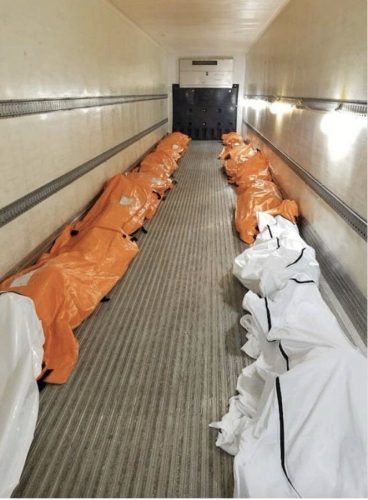
Harrowing imagine from the inside of a truck in New York City. All victims of the coronavirus for disposal. Image taken by a local nurse, New York, March 29, 2020
Russia now says it has information to that effect. Was the Pentagon conducting tests of potential biological weapons on the two big powers that the Deep State in America regards as the US’ principal adversaries and existential threats?
Moscow has a way of drawing the White House’s attention to sensitive issues through such modes at a time when the direct communication channels remained hopelessly clogged. Moscow knows fully well from past experiences that the POTUS may not always be kept briefed on the shenanigans of the cold warriors in the US intelligence and defence establishment.
The military-industrial complex and the ‘Deep State’ have been historically a law unto themselves. Remember the farewell speech by President Dwight Eisenhower on 17 January, 1961 when he forewarned the nation to be on guard against the potential influence of the military-industrial complex (a term he is credited with coining). Eisenhower said:
“In the councils of government, we must guard against the acquisition of unwarranted influence, whether sought or unsought, by the military-industrial complex. The potential for the disastrous rise of misplaced power exists and will persist. We must never let the weight of this combination endanger our liberties or democratic processes. We should take nothing for granted. Only an alert and knowledgeable citizenry can compel the proper meshing of the huge industrial and military machinery of defense with our peaceful methods and goals, so that security and liberty may prosper together.”
Eisenhower was drawing deep into the bitter experience during his presidency that despite his profound military background and being the only general to be elected president in the 20th century, the military-industrial complex torpedoed his efforts to initiate detente with the USSR.
In the wake of the famous U-2 spy plane incident on May 1, 1960 (just days before a summit meeting between Eisenhower and Soviet leader Nikita Khrushchev in Paris), which infuriated the Kremlin, Eisenhower had to abandon a planned Moscow visit in June to flesh out his pet foreign-policy project of detente with the USSR, which the highly decorated World War 2 general had deeply cherished would be his finest presidential legacy.
China censures US for ‘clumsy trick’ to smear others with rumors amid COVID-19 pandemic
Press TV – March 23, 2020
China censures the United States for playing a ‘clumsy trick’ on other countries by smearing them with rumors aimed at accusing those countries with having a hand in the global spread of the deadly coronavirus.
China’s Foreign Ministry spokesman Geng Shuang said on Monday that Washington “on the one hand required federal organizations to speak with one voice to smear China; and on the other hand criticized China, Russia and Iran for spreading false information.”
“I just want to ask, who on earth is spreading false information, misleading the public and calling white black? Such trick of smearing others with rumors and with the play of a thief crying ‘stop the thief’ are just too clumsy.”
China, he added, has always been “open, transparent and responsible.”
“In the past two months and more, the Chinese people have united as one to fight the epidemic and earned precious time for the rest of the world to take necessary precautionary measures. We have made great contribution. WHO has recently pointed out that countries like Singapore and South Korea made good use of the precious time earned by China and took measures. Their moves have curbed the epidemic spread. What has the US done during this period?”
The Chinese official also stated that since January 3 the government in Beijing had been providing “regular briefings” to the World Health Organization (WHO) and other countries, including the United States.
On January 23, he added, “China announced to shut down roads exiting Wuhan City. The US government on February 2 announced to ban entry of all foreigners who had been to China in 14 days before. By then the US just announced a dozen of confirmed COVID-19 cases.”
“Now 50 days have passed, the confirmed cases in the US have surged from less than 20 to more than 30,000. What kind of strong measures has the US taken in the 50 days? It had totally squandered the time China earned for the world.”
The Chinese official further noted that Washington is seeking to “defame” others and “find a scapegoat” instead of admitting its own mistake, “which is totally immoral and irresponsible, and will do nothing good to the US epidemic control work and to the international cooperation in fighting the epidemic.”
“All it should do is concentrating on its own business and play a constructive role in working with all countries to fight the epidemic and protecting global public health security,” the Chinese official said of the US government.
The COVID-19 disease, caused by the new coronavirus, emerged in Wuhan, the capital of China’s Hubei province, in December. It has been reportedly contained in China, but is spreading rapidly around the globe.
UN to set up global coronavirus fund: Norway
Meanwhile, Norway said on Monday that the United Nations will set up a fund to prevent the spread of coronavirus and support the treatment of patients worldwide.
The purpose of the fund, proposed by the Norwegian government, is to assist developing countries with weak health systems in coping with the pandemic as well as to tackle the long-term consequences.
The initiative is similar to a 2014 United Nations Ebola Response Fund.
“We want to make sure that the efforts are as unified as possible and as early as possible so that we can answer up to the demands that countries will have, especially the poorest countries,” Norwegian Foreign Minister Ine Eriksen Soereide told Reuters.
In Africa, Angola, Eritrea and Uganda have confirmed their first cases, while Mauritius recorded its first death as the virus spreads across the continent despite efforts by governments to hold it back.
Elsewhere in the Gaza Strip, the first two cases were confirmed on Sunday.
Coronavirus aid to Italy not a ploy to get EU sanctions lifted: Russia
The Kremlin said Monday that medical assistance Russia is providing to Italy is not part of an attempt to get Rome help lift EU sanctions on Moscow.
The Russian army on Sunday began flying medical help to Italy after receiving an order from President Vladimir Putin, a goodwill gesture that Moscow labeled “From Russia with Love.”
Italy is the European country hardest hit by the viral crisis.
When asked if Russia expected Italy to return the favor by trying to get EU sanctions imposed on Russia over Ukraine lifted, Kremlin spokesman Dmitry Peskov described the notion as absurd.
“We’re not talking about any conditions or calculations or hopes here,” Peskov said.
“Italy is really in need of much more wide scale help and what Russia does is manageable.”
Russia to use mobile phones to track people at risk
Prime Minister Mikhail Mishustin has given the authorities five days to develop a system to track people who have come into contact with anyone with coronavirus by using mobile phone geolocation data.
Under the new system, people would be sent information if they came into contact with someone who was infected and the same information would be passed on to special regional headquarters set up to fight the respiratory disease pandemic.
The Kremlin said the measure was legal and part of a raft of measures Russia is taking to try to halt the spread.
Postponement of Olympics should be considered: Japan
The head of the Japan Olympic Committee (JOC) said he had to consider postponing the Games among his options amid increasing calls from committees around the world to delay the Olympics due to the coronavirus outbreak.
“From the athletes’ point of view of safety and security, we have to come to a stage where we cannot help but consider things including postponement,” JOC President Yasuhiro Yamashita told reporters on Monday.
However, he said too long a delay would be a burden to athletes given the possibility of having to qualify again, for example.
Spain death toll tops 2,000 after 462 deaths in 24 hours
The coronavirus death toll in Spain has surged to 2,182 after 462 people died within 24 hours, the health ministry says.
The death rate showed a 27-percent increase on the figures released a day earlier, with the number of confirmed cases of COVID-19 rising to 33,089 in Spain, one of the worst-hit countries in the world after China and Italy.
Despite an unprecedented national lockdown which was put in place on March 14, the number of deaths and infections have spiraled in Spain, with the figures growing as the country steps up its capacity for testing.
And the lockdown, which was initially put in place for two weeks, will be extended until April 11 to try to curb the spread, Prime Minister Pedro Sanchez said — in a measure which will be put to parliament on Tuesday.
The rise in infections in this country of 46 million people has brought Spain’s healthcare system to the brink of collapse, particularly in Madrid, the worst-hit area, which has registered 10,575 cases, and where 1,263 people have died — accounting for 58 percent of the national death toll.
Some 3,910 healthcare workers have tested positive for the virus, or around 12 percent of those infected, the health ministry’s emergencies coordinator Fernando Simon said.
Officials have repeatedly warned that the number of deaths and infections would continue to rise this week and that the worst was yet to come.
Greece bans flights from UK, Turkey as coronavirus cases rise
Greece has suspended flights from Britain and Turkey to curb the spread of coronavirus, as a lockdown took effect in the country.
The ban came into effect at 0400 GMT — 6:00 a.m. in Athens — on March 23 and ends at 1300 GMT on April 15.
It was a temporary and preemptive measure, a ministerial decree said, as part of further efforts to combat the coronavirus pandemic.
Greece saw its largest single-day jump in confirmed coronavirus cases on Sunday, a rise of 94 infections which brought the total to 624, with fatalities increasing to 15.
The prime minister announced a curfew with few exceptions restricting the movement of people, the latest in a series of measures to fight the virus. Greece has already sealed its borders to non-EU citizens, and those from Italy and Spain.
Police officers were deployed on the streets of Athens on Monday to enforce the lockdown, which allows people out only with special permits. The lockdown order came into effect at 0400 GMT.
Two more doctors die from coronavirus in France
Two more doctors have died after contracting the coronavirus in France, officials said on Monday, a day after the country reported the first death of a doctor treating COVID-19 patients.
One of the doctors, a 66-year-old gynaecologist in Mulhouse near the border with Switzerland and Germany, was infected by a patient during a consultation, according to his clinic.
The other was a 60-year-old general practitioner at a hospital in Saint-Avold near Metz, further north along the German frontier, according to the town’s mayor.
Both died on Sunday when officials announced the death of a 67-year-old doctor who was among the first to treat coronavirus cases in the northern Oise department, which has been badly hit by the outbreak.
Health experts warn that many French hospitals are already overflowing with coronavirus cases even as the government races to set up military field hospitals to help cope with a shortage of beds.
Mulhouse has imposed its own nighttime curfew in addition to nationwide home-confinement rules seeking to curtail the virus, which has spread rapidly in France’s eastern regions.
France is also experiencing a shortfall of ventilators to care for seriously ill patients and face masks and other protective equipment for health workers.
France’s National Health Service reported Sunday that 674 people had died in the country so far — an increase of 112 in 24 hours.
WUHAN OUTBREAK: CHINA DEMANDS AN HONEST ACCOUNTING
By Thomas Hon Wing Polin | March 22, 2020
- It is now virtually certain that COVID-19 was brought to Wuhan by American troops taking part in the city’s World Military Games last Oct. 18-27.
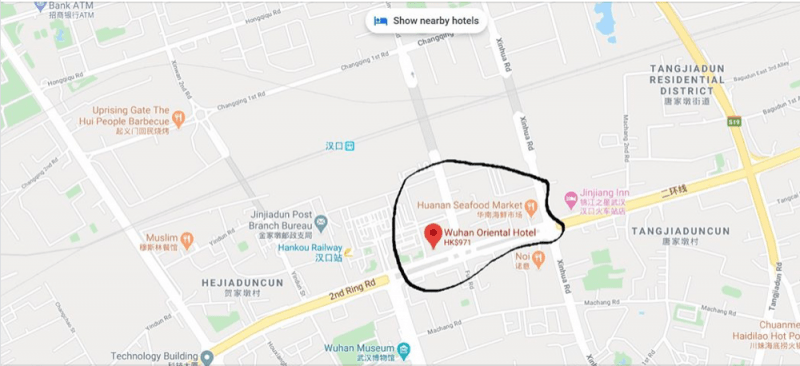
- The 300-strong US contingent stayed 300 meters from the Huanan Seafood Market where China’s outbreak began (see map below) at the Wuhan Oriental Hotel.
- Five of the US troops developed a fever on Oct. 25 and were taken to an infectious-diseases hospital for treatment.
- 42 employees of the Oriental Hotel were diagnosed with COVID-19, becoming the first cluster in Wuhan. At the time only 7 people from the market had been thus diagnosed (and treated before the hotel staff). All 7 had contact with the 42 from the hotel. From this source, the virus spread to the rest of China.
- The American Military Games team trained at a location near Fort Detrick, the military’s viral lab closed down by the CDC in July for various deficiencies.
- The big question now is whether the transmission was planned, or accidental.
- Chinese authorities are awaiting an explanation from US authorities.
- A few days ago, Mike Pompeo phoned Yang Jiechi, Chinese State Councillor for Foreign Affairs. Pompeo’s counterpart is actually Foreign Minister Wang Yi and Yang is Wang’s boss, so Pompeo wanted to talk about something urgent and important.
- Pompeo wanted the Chinese not to publicize what they had found.
- Yang’s reply: “We await your solemn explanation, especially about Patient Zero.”
China’s leaders have long suspected US military involvement in the Wuhan outbreak but were determined to stop the disease before pursuing the Americans for an honest accounting.
Australia assigned to be the U.S. Policeman in the Pacific
By Paul Antonopoulos | March 19, 2020
The U.S. is ramping up pressure on Australia to support hostilities against China in Southeast Asia and the South Pacific. Last week in Sydney, the U.S. Ambassador to Australia, Arthur Culvahouse, said that “We’ll be pushing Australia to expand its step-up from the Pacific islands region to south-east Asia and to look north as well.” The U.S., Australia and like-minded countries need to win in this strategic competition, the diplomat said. The Ambassador emphasized that in consultations between American and Australian foreign and defense ministers, the two sides will focus their efforts to further strengthen the Pacific step-up strategy.
The US Ambassador told the gathering of business leaders last Tuesday that Australia “sits on the frontline of the great strategic competition of our time.” “If the security and prosperity enjoyed by our countries and the region is to continue, this is a competition that we must win,” he said in indirect reference to China being the competition that must lose.
Australia’s Pacific strategy was adopted in 2016 under Prime Minister Malcolm Turnbull to assert Australia’s position as the policeman for the U.S. in the South Pacific and Southeast Asia. The Pacific step-up strategy defines the Australian government’s approach to economic and strategic interaction with Pacific Island nations. However, this is just the friendly face of the strategy and rather it is primarily aimed at maintaining regional balance to counter China’s growing influence in the region. China signed an Action Program with eight Pacific Island nations at the October 2019 3rd China Economic Development Cooperation Forum and Pacific Islands held in Samoa. These countries’ support for China’s Belt and Road Initiative was confirmed.
As the U.S. is dealing with the growing influence of China and attempting to counter it all over the globe, Washington is relying on Australia to serve as a counterbalance to China in the South Pacific and Southeast Asia. However, as the coronavirus continues to grow out of control in the U.S., it is likely that Washington is going to take its focus off the South Pacific for a long while. This will give Australia autonomy to act on Washington’s behalf and it appears that U.S. President Donald Trump immensely trusts the Australians in this role, so-much-so that he honored the fellow Anglo-settler state by naming a new navy ship the USS Canberra, the only U.S. Navy warship named after a foreign city.
Australia wilfully wants to play a role that the U.S. assigned to them in Southeast Asia and the South Pacific so that it can more strongly assert its power on the region. Australia considers the small island countries of the South Pacific as an area within its sphere of influence. Canberra has a need to expand its weight in Southeast Asia, but finds this challenging as the region includes countries of larger populations and economies, such as Thailand and Indonesia.
Although Canberra wants to serve Washington’s interests in the region, Australia is a completely deindustrialized neoliberal country that does not have the means or capacity to challenge rising Southeast Asian countries and rather serves as a raw resource marketplace for the world. The U.S. is losing influence in Southeast Asia to China, and therefore Washington is relying on Australian support, hedging its bet on a common Anglo colonial-settler history to make Canberra receptive.
In this situation, Australia faces a very difficult choice as there is a clear divide between the economic community and the political class in regards to China policy. China is Australia’s most important economic partner, while the U.S. is Canberra’s most important security partner, so-much-so that Australia followed the U.S. to adventurist wars of aggression in Korea, Vietnam, Afghanistan and Iraq. China and Australia have established free trade areas and this agreement allows them to quickly increase the volume of bilateral trade. Therefore, the political will of Canberra is certain to face resistance from capitalist interests in the country as it wholly relies on China and other Southeast Asian countries for trade.
However, Australia is bound by the U.S. Indo-Pacific Strategy that aims to use American allies like Australia, Japan, India and others, to counter China’s increasing influence. This is done by enhancing military cooperation between these countries and does not serve any economic role like the Belt and Road Initiative. As China finds the Indo-Pacific Strategy as an aggressive force aimed against it, it is likely that under economic pressure, Australia will try to balance relations, despite the political will and determination of Canberra to act as the U.S’ policeman in Southeast Asia and the South Pacific.
Paul Antonopoulos is a Research Fellow at the Center for Syncretic Studies.
‘Reciprocal measures’: Beijing tells NYT, WSJ, WaPo journalists to hand in credentials as US-China media war rolls on
RT | March 17, 2020
China is pulling the press credentials of US journalists from outlets including the New York Times and the Washington Post whose passes expire in 2020, in the latest move of an ongoing tit-for-tat with America over media access.
In a statement about China’s “countermeasures against US suppression of Chinese media organizations in the United States,” Beijing announced that American reporters working for the NYT, Wall Street Journal, Voice of America, Time and the Washington Post whose credentials are due to expire by the end of this year must hand them over within 10 days.
These reporters will also not be allowed to work in China – including Hong Kong and Macau – in the future, and other US journalists will face new visa restrictions similar to those Washington recently introduced for Chinese reporters.
“In view of the US’ discriminatory restrictions on visas, administrative review, and interviews of Chinese journalists, China will take reciprocal measures against US journalists,” it added.
The back-and-forth expulsions of journalists started in February, when Chinese authorities gave three Wall Street Journalists five days to leave the country after Beijing objected to an opinion piece in the outlet calling China the “real sick man of Asia.” The paper refused to apologize for the piece.
Shortly afterwards, the US dramatically reduced the number of journalists it would permit to work for four Chinese state-owned media companies inside the US, cutting the number allowed from 160 to 100. They also reduced the length of time those permitted entry could remain in the US.
Beijing condemned the move as reflecting a “Cold War mindset” and warned of retaliation.
China Wants Iran Sanctions Lifted to Avoid Damage to ‘Economy and People’s Lives’ Amid Pandemic
Sputnik – March 16, 2020
Beijing calls for lifting Iran sanctions as the Islamic republic fiercely struggles to combat the coronavirus disease (COVID-19) outbreak, the Chinese Foreign Ministry said on Monday.
“China urges countries involved to immediately lift the relevant sanctions against Iran to avoid further damage to the Iranian economy and people’s lives,” the ministry’s spokesman Geng Shuang said.
Keeping sanctions in force at a time when the fight against the virus in Iran “has entered a crucial stage” would be antihuman, he added.
The diplomat warned that the restrictions would get in the way of the United Nations and other organisations providing assistance to virus-hit Iran.
“Beijing will continue providing assistance to Tehran based on the needs of the Iranian side and its own capabilities, and we also call on the international community to cooperate with Iran to ensure public health security at a regional and global level,” he stressed, noting that China had already sent humanitarian medical supplies and experts to help Iran.
According to the Iranian health ministry, 1,053 new cases of Covid-19 infection have been reported in the country in the past 24 hours.
In a letter to world leaders on Saturday, Iranian President Hassan Rouhani said that crippling US sanctions had cost the national economy some $200 billion in less than two years and curbed the effective fight against the pandemic. He urged the global community to show unity in the face of the deadly viral disease and abandon any policy that hinders global efforts to combat it.
Iran is suffering from the biggest coronavirus outbreak after China and Italy, with nearly 14,000 confirmed cases and over 720 deaths.
China does not rule out US role in coronavirus outbreak
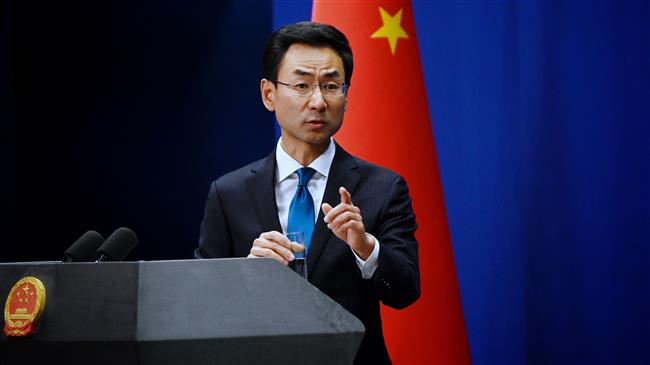
China’s Ministry of Foreign Affairs spokesman Geng Shuang (Photo by AFP )
Press TV – March 13, 2020
The Chinese Foreign Ministry has not ruled out the possibility that the United States was to blame for the spread of the new coronavirus in the Asian country.
Geng Shuang, the ministry spokesman, sidestepped questions on Friday about whether Beijing viewed Washington as responsible for the deadly virus outbreak in China, a day after another spokesman suggested the US army could have engineered it.
Speaking at a news conference in the Chinese capital, Geng refused to directly comment when asked whether his colleague Zhao Lijian’s comments were consistent with Beijing’s official stance on the virus.
“In fact, the international community, including people within the US, have different opinions about the origin of the virus,” Geng told reporters at the presser.
“As I have been saying for a few days, China has always seen this as a matter of science, and scientific and professional opinions must be heard.”
Geng went on to say, “You’re very interested to know if Zhao Lijian’s views represent the views of the Chinese government.”
“I believe that perhaps you would be better off first asking whether or not recent comments from a number of senior US officials attacking or smearing China represent the US government’s position.”

Chinese Foreign Ministry spokesman Zhao Lijian
In a strongly-worded tweet, written in English, Zhao blasted the US on Thursday for what he called lack of transparency in official reports regarding the coronavirus outbreak in the US.
He suggested that the US military might have brought the new coronavirus to the Chinese city of Wuhan, the birthplace of the current global pandemic.
“When did patient zero begin in US? How many people are infected? What are the names of the hospitals? It might be US army who brought the epidemic to Wuhan. Be transparent! Make public your data! US owe us an explanation!” Zhao wrote.
The Chinese government had been criticized by Western media and particularly by US officials for what was alleged to be a slow response to the outbreak and of not being sufficiently transparent.
Beijing has, however, been taking strict measures since the outbreak began, including locking down Wuhan, a city of roughly 11 million people, which appears to have paid off.
The COVID-19 disease, caused by the new coronavirus, emerged in the provincial capital of Hubei late last year and is currently affecting 131 countries and territories across the globe. It has so far infected over 137,000 people and killed more than 5,000 others.
The World Health Organization has declared the coronavirus outbreak a global pandemic.
Corona & the Cost of Doing Nothing
By Anatoly Karlin • Unz Review • March 12, 2020
There is a three in a million chance that a Boeing 737 MAX won’t arrive at its destination in one piece. At the end of the day, this isn’t that big of a deal – as late as the 1980s, this was the average for the commercial airline industry, and risks were twice as high in 1970. But people don’t tolerate such numbers such risks these days, as the value attached to human life has gone up. As a result, this model has been grounded across the world, with attendant consequences for Boeing’s bottom line.
But while it may not be that big of a deal, it is still probably not a great idea to take 500 flights in a Boeing 737 MAX within a year if one can possibly help it. Why 500 Boeing 737 MAX flights? Because even though it is a disease that overwhelmingly affects the elderly, that happens to be the equivalent risk of dying from COVID-19 for people in their 30s. Moreover, when you board a plane, you are only risking your own life. People with a cavalier “iT’S JuSt lIkE ThE FlU” are presumably more likely to spread it to elderly people, for whom a brush with COVID-19 is equivalent to a round of Russian roulette (mortality is ~1/6 for over 80 year olds). Moreover, it would even be reasonable to pay money to avoid such risks, even if it involves some inconveniences.
For this novel coronavirus threatens to fundamentally degrade the global demographics of human mortality, the effects of which may last years or decades.
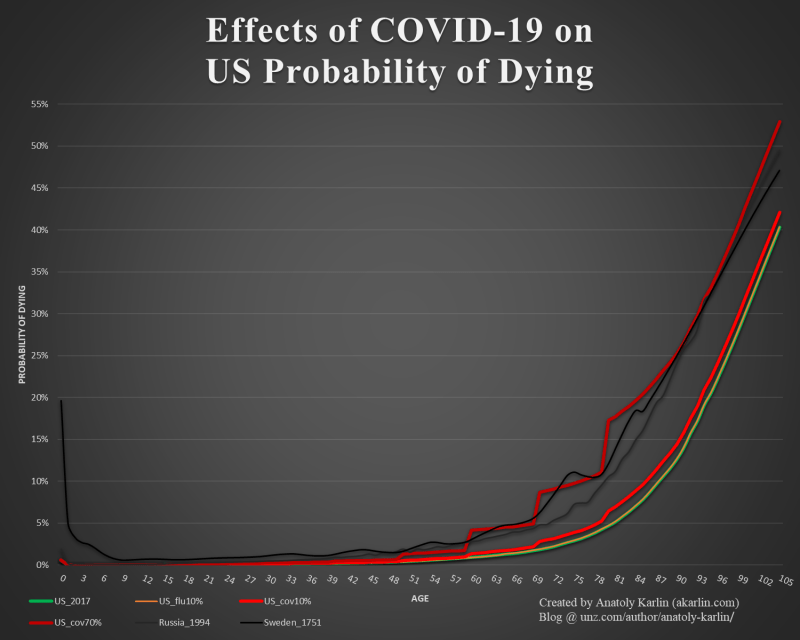
This graph shows q(x), or the probability of dying at any age “x”. It is calculated by taking a hypothetical cohort, usually fixed at 100,000 at the age of 0, and dividing the number of deaths by the number of survivors by age group.
The green line represents the probability of dying in the US as of 2017.
The other lines represent the effects of various epidemic shocks: An approximate doubling in severity of the average flu season (yellow); a 10% COVID-19 infection rate (orange); and a 70% COVID-19 infection rate (red).
These figures were obtained by taking the percentage chances of dying from the flu/COVID-19 and adding them to the q(x) percentages for the US in 2017 at the mortality.org database.
 The mortality stats for the flu were taken from the CDC, as reported in Business Insider. They also helpfully compare the age-specific death rates to COVID-19 mortality, as derived from an investigation earlier this month by Russell et al. based on numbers from the Diamond Princess cruise ship. The extrapolated total CFR (case fatality rate) was pegged at 1.1%, but note that this applied to situation where quality healthcare was readily available (ventilators, IV drops, antibiotics, etc.). In situations where the epidemic overwhelms the healthcare system, things are going to be much worse.
Note from the outset the near insignificance of flu as a cause of mortality; under 65’s are basically two orders of magnitude as likely to die from COVID-19 as from the flu. In other words, for the younger generations, “the flu” is just 2-3x Boeing 737 MAX flights per year, as opposed to 500x for COVID-19. While the absolute numbers for the elderly are horrific, the disparity between flu and COVID-19 mortality for them is actually considerably less – just about a single order of magnitude – though even so, that’s still the difference between a ride on the Space Shuttle (flu) versus a round of Russian roulette (COVID-19). I’d rather take the Space Shuttle, thank you.

In another study by Riou et al. 2020 analyzing data from Wuhan, a total CFR of 1.6% was estimated, with a larger sample allowing for a more precise breakdowns by age (see above). As such, I will be using the numbers from this study to adjust q(x) in the different COVID-19 scenarios. Apart from that, the Wuhan scenario is likely to be more typical than the Diamond Princess scenario, if we are talking about large-scale outbreaks that partially overwhelm the capacity of healthcare cities.
There isn’t much evidence that we can hope for substantially lower mortality rates, even in developed OECD countries; contra Western stereotypes, medical care in Wuhan seems to have been highly sophisticated, with dozens of people being ventilated in the average hospital, and complex procedures such as extracorporeal membrane oxygenation (“removing blood from a person’s body and oxygenating their red blood cells”) through ECMO machines being available in cases where ventilation didn’t work. Consequently, it can’t be excluded that mortality in most of the rest of the world – even in the OECD – may well end up higher than in China. For instance, England only has 28 and the US has 250 of these ECMO machines, whereas even provincial hospitals in China have been reported to have 5 of them each.
 The healthcare system in Lombardy – one of the most developed regions in the world – is already on the cusp of collapse. Unless there are draconian quarantines implemented right about now, most of the rest of Western Europe and the US seem set to join it in its misery in another 10 days to two weeks. Cost-cutting “optimization” in healthcare has drastically reduced the number of hospital beds per capita throughout the West in the past two decades. At this point, I would certainly not wager on “the West” mounting a better or more competent response to COVID-19 than the Chinese.
Another cardinal difference between “the flu” and COVID-19 is that the latter is far more contagious. The standard measure of how many other people each person with a given disease infects in turn, r0, seems to be ~4 under “normal” conditions, versus just 1.3 for the flu. Moreover, as a novel coronavirus, people do not have any preexisting immunity to COVID-19 that might mitigate its virulence, and it has far greater contagiousness. Consequently, professional epidemiologists have predicted that as much as 70% of the world population may eventually become infected with COVID-19, a number which has been repeated by Angela Merkel and the British government in recent days. As such, I will be modeling a 70% COVID-19 infection rate – which presupposes millions of deaths – as a “worst case” scenario.
One final “blackpill” about COVID-19 is that, should we fail to control it, many epidemiologists expect it to become a new seasonal disease – that is, a fifth endemic coronavirus, just like the common cold. But far deadlier. The flu infects about a tenth of the population every year. What would be the impact if COVID-19 was to reach similar intensities?
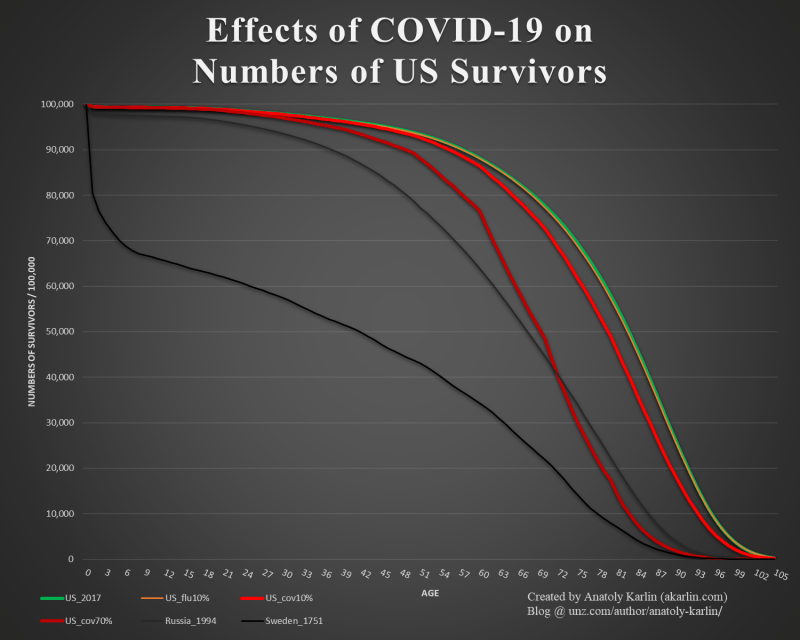
This graph shows l(x), or the number of survivors at any age “x”. It can be calculated by recursively applying the aforementioned q(x) to the initial, hypothetical cohort of 100,000 newborns.
As before, we can see that even doubling the flu season – adding mortality from an average flu season to the existing probability of dying – barely nudges the curve.
However, even a 10% COVID-19 infection rate moves the curve visibly left, and the change is extremely traumatic once you get to 70% infection rates – the sort of numbers that multiple European governments are now bandying about.

This graph shows the changes in life expectancy at different ages. It is calculated from two values derived from the above data: The total number of person-years lived by any particular cohort, or T(x), divided by the number of survivors, or l(x), in that cohort. T(x) is the sum total of person-years, or L(x), lived by any particular cohort up until all its members have died. That, in turn, is given by the following formula: L(x) = l(x+1)*d(x)*a(x), where l(x+1) refers to the quantity of that cohort’s survivors in the next year, d(x) refers to the number of deaths during that interval (or, in other words, l(x+1) – l(x) ), and a(x) is a constant that is usually equal to 0.5 (except in the very first and the very last year of life).
Here is a summary of the results:
- US life expectancy at birth was 78.86 years in 2017 (via mortality.org). There is a minor discrepancy with the official CDC figure of 78.6 years.
- Modeling a typical flu epidemic “on top” of that (so, in practice, a ~doubling of the flu season severity) would reduce US life expectancy to 78.63 years, translating to a reduction of ~0.25 years (three months).
- Modeling a 10% COVID-19 infection scenario with Riou et al. (2020) age-specific mortality rates – the sort of numbers we may expect should it become endemic – reduces US life expectancy to 76.15 years , translating to a reduction of ~2.5 years.
- Modeling a 70% COVID-19 infection scenario with Riou et al. (2020) age-specific mortality rates reduces US life expectancy to 66.79 years, translating to a reduction of a cool ~12 years.
Now this is not the end of the world, as I make sure to emphasize by including the historical mortality profiles for Russia in 1994 and Sweden in 1751 across all three of these graphs.
The year 1994 marked the single worst time for Russian mortality in its post-1956 history, when rampant alcohol abuse, violence, and the despair of the 1990s reduced life expectancy to a local minimum at 63.93 years; during that time, middle-aged male mortality was equivalent to that of Imperial Russia and Sub-Saharan Africa. This is probably the worst mortality profile ever observed in a major industrialized nation outside of wartime.
Mortality rates in the preindustrial world – Sweden has the earliest comprehensive records dating back to 1751 – jumped wildly year to year, depending on the state of the harvest and the virulence of the bugs going around in that particular year. The biggest difference relative to industrialized societies, though, even ones as collapsed as Russia in the 1990s, is that deaths during infancy and childhood were mundane, not freak occurrences. Hence why life expectancy actually goes up as children live through (survive) their infanthood.
As we can see, in terms of mortality, a serious COVID-19 epidemic should be broadly equivalent to living in 1990’s Russia – and for people under the age of 50, it would be notably safer than living in a preindustrial society, such as 18th century Sweden. It will be a shock relative to current expectations colored by more than a century of “Pinkerian” progress in safety and survivability, but there were people who lived their entire lives under similar or worse mortality profiles, and that didn’t prevent many of them from finding joy and meaning in them.

However, even though the pandemic “shock” will pass, if the epidemiologists are correct and COVID-19 becomes an endemic, seasonal disease, then we may permanently lose the equivalent of about 25 years worth of progress in raising life expectancy (American life expectancy was last below 76.15 years in 1996). In this scenario, the graph of future US life expectancy may look like something above, dipping sharply this year and stabilizing at a new, lower normal in subsequent years.
In the long-term, there may be even more years lost – perhaps 3 years – in many West European countries, and perhaps in developed East Asia as well, should this pandemic veer out of control and make it impossible for them to preserve their current achievements at checking COVID-19 (I assume that even disciplined East Asian societies cannot maintain Corona-suppressing “social distancing” behaviors indefinitely). That is because, thanks mainly to America’s opiates epidemic, the West European countries now have substantially better mortality profiles than the US, so the extra “shock” of COVID-19 will depress their life expectancy to a relatively greater extent. Though, curiously enough, most of these same countries will “lose” fewer years of progress relative to the US, since American life expectancy has basically stood still for the past decade due to the opioids epidemic.
Meanwhile, industrialized countries with worse mortality profiles, such as Russia, will not actually see as big of a drop in life expectancy as the US; as of 2014, the last year for which I can find life tables for Russia, a 10% COVID-19 infection scenario translates to a 1.7 year fall in Russian life expectancy (US: 2.5 years), and a 70% infection scenario translates into a drop of 8 years in life expectancy (US: 12 years). However, due to strong gains in Russian life expectancy since 2014 – it has risen from 70.9 years in 2014 to 73.4 years in 2019 – the effects of COVID-19 will actually now be stronger (if still not as strong as in the US).
(Reminder: This is all assuming that both infection rates and the age-specific mortality rates from COVID-19 are the same across these countries – this will almost certainly not be the case due to local specifics).
Moreover, there will be multiple other factors that will either ameliorate or depress the above estimates:
- COVID-19 is going to kill off the frailest people in this current wave, in which up to 70% of people may be infected; but this will soften its long-term impact, since you can only die once.
- In subsequent years, when ~10% annual infection rates may become the new norm, healthcare systems will adjust and everybody should receive adequate care, lowering CFR from the ~4% currently observed when healthcare systems are overwhelmed, to the 0.5%-1.0% rates seen in South Korea and Chinese provinces outside Hubei, which have managed to keep on top of cases.
- Conversely, people who are intubated now may suffer permanent, long-term insults on their health, making them more vulnerable to subsequent COVID-19 infections in future years.
- Needless to say, there may well be changes in COVID-19’s contagiousness and virulence in the future.
I am not even going to attempt to model any of this. But the bottom line stands. This virus has the capability to deal a traumatic shock to the world’s population, especially to the older societies of the Global North. In the longer term, it may also permanently depress global life expectancy by about 2 years, robbing millions of future people of their planned retirements and time with their grandchildren.
There are political factions that cynically, and unironically, pray for Corona-chan to do her magic. The Chapo Trap House folks bask in the idea of COVID-19 killing off Drumpf-voting boomers who are keeping them from electing Bernie, instituting M4A, and rescuing the planet, while elements of the Alt Right anticipate the West rediscovering its youthful vigor in the wake of the “boomerpox”. But I would caution both factions against premature Schadenfreude – political trends rarely work out the way anyone expects them to. They may get more than they bargained for.
OK, summing up: We should really, really try to avoid COVID-19 veering out of control and becoming endemic.
China has demonstrated that Corona-chan can be contained; its r0 has plummeted by an order of magnitude from 4 to just 0.32, even if it had to bring its economy to a near standstill to do it. As Steve Sailer notes, China hasn’t merely “flattened the curve”. It has crushed it. This means that its success should be replicable, at least in First World nations with epidemics on the scale of peak Hubei, as in Italy.
Even more encouragingly, the nations of East Asia – Japan, Taiwan, Singapore, Hong Kong, even middle-income Thailand – have all managed to bring COVID-19 under control at its earliest stages without resorting to China’s drastic measures. As Tomas Pueyo explains, they did this by carefully filtering infectees’ contacts at the earliest opportunity and putting them under quarantine. The main reason that South Korea failed is because its “Patient 31” happened to be a religious “super-spreader”, yet even so, even there, the epidemic is currently under control.
But all their efforts would be in vain if just a few (or even one) defeatist, incompetent, or plain stupidly-run countries decline to take the necessary steps, and thereby cut two years off global life expectancy into the indefinite future.
This stupidity and incompetence takes different forms. In Western Europe, it is the Left’s fundamentalist commitment to open borders, accompanied by bizarre claims that quarantines do not work. In the US, it is the Right’s fundamentalist commitment to free markets, as exemplified by $5,000 copays for coronavirus tests, lack of sick leave, and Trump’s “iT’S JuSt lIkE ThE FlU” mantras to appease Mammon. Meanwhile, in what is perhaps the most “powerful” move of them all, the United Kingdom has set up a cyber-unit to combat “Russian” Corona-chan shitposters while basically admitting that it has no interest in combating, like, the actual coronavirus. Hopefully the British boomers croaking in their deathbeds in another two months’ time will be understanding of HMG’s priorities.
One is almost tempted to wish a pox on all their houses.
Anyhow, while I still hope for the best, I do not expect it.
Taiwanese Nationalists Seek Closer Relations with China
By Paul Antonopoulos | March 12, 2020
In the the Kuomingtang (KMT), the Nationalist Party of Taiwan, election held on Saturday, Jiang Kai (commonly known in the West as Johnny Chiang) was selected as a new head of the political party. According to Taiwanese media, Jiang Kai will change the KMT’s policy towards mainland China. The press draws such conclusions based on the KMT’s new president’s statement about the 1992 consensus, also known as the One China Consensus, as “somewhat outdated.”
In the presidential election held on January 11, KMT candidate Han Kuo-yu, a former mayor of Kaohsiung City, lost to Tsai Ing-wen of the Democratic Progressive Party (DPP). In addition, the DPP still occupies the majority of seats in the Legislature.
In the election for the new party chairman, Jiang Kai only had a single opponent – the former Taipei mayor, Zhu Lilun (commonly known in the West as Eric Chu). He overcame his opponent with 84,860 votes compared to 38,483 votes, however it is worth noting that only 35% of voters bothered to vote. Taiwanese authorities claim that such a low rate is due to the coronavirus epidemic. In his speech after announcing the conclusion of voting, Jiang revealed that the KMT needs to make some changes to meet the spirit of the times, and he will make these changes within a year. The KMT are no longer as conservative as they once used to be, and in this way, Jiang is hoping to attract a part of the DPP’s voters who are generally younger and more progressive than the KMT.
For example, the KMT opposes same-sex marriage, but the law is still valid because the DPP legislature occupies the majority of seats. And among young Taiwanese, not just in the LGBT community, the legalization of such relationships is considered the greatest achievement since democracy reached Taiwan. An even more important contradiction between the two parties: the so-called 1992 consensus and the concept of “one China” (united China). The DPP does not recognize this consensus and the KMT has supported relations with mainland China, something the DPP are extremely hostile to. Clearly, the KMT now wants to move on to resolve internal issues, such as attracting new voters, and then resolve relations with Beijing. That’s why the KMT must begin entertaining the idea of making some changes to the 1992 consensus.
How will the new KMT party chairman and changes in the party’s policy affect Beijing? The last election showed that the DPP won the populist wave in the context of social disturbances in Hong Kong, and now they are also using the Covid-19 epidemic for political purposes to prove the validity of not strengthening relations with Beijing. The anti-Beijing DPP has prevented relations from becoming closer with Taipei, despite Taiwan’s economy suffering greatly just because its relationship with mainland China has cooled. This economic factor was especially felt when Beijing stopped granting licenses to travel companies to go to Taiwan which saw the number of tourists decrease by nearly a third. Agricultural imports into mainland China have plummeted, even though two years ago China purchased 20% of agricultural products worth nearly $1 billion. Taking into account the damage that coronavirus outbreaks has caused worldwide, economic development may become the most important task. The KMT will then try to balance domestic political interests and not move too far away from mainland China.
This spells bad news for the U.S. as they have been the main backers of Taiwan since the end of the Chinese Civil War in 1949 when the KMT were defeated by communist guerrillas and forced to leave the Chinese mainland. Taiwan’s modern history lays with the U.S.-backed authoritarian regime of General Chiang Kai-Shek, the leader of the KMT. Chiang then imposed martial law and became dictator of Taiwan for the next 38 years, before a gradual democratization was achieved and presidential elections in 1996. The resentment of losing mainland China to the communists and the permanent deployment of tens of thousands of American soldiers has ensured that Taiwan, an island located just off the coast of China’s Fujian province, is a major U.S. pressure point against Beijing.
Although the days of Chiang and the KMT believing they are an exile government is long over, they still believe in One China, a stark difference to that of the DPP who want complete sovereignty and independence in their own right and reject One China. With the KMT seeking closer relations with Beijing despite once being mortal enemies, their inevitable return to power in the future could mean that they will begin to de-Americanize Taiwan as they seek closer relations, particularly for stability and economic reasons, with China, recognizing that we now live in a multipolar world order.
A de-Americanized Taiwan effectively means that the U.S. will lose a major submissive partner that acted as a thorn to Chinese hegemony in the South China Sea, and it is unlikely that Washington will accept this reality so easily. None-the-less, as the KMT changes its policies to attract the younger generation, it can see a real potential for One China to be achieved and the U.S. expelled from the island just as calls for the U.S. military to leave South Korea and Japan also intensify.
Paul Antonopoulos is a Research Fellow at the Center for Syncretic Studies.
Featured Video

The Truth About the Trump Shootings with Ken Silva
or go to
Aletho News Archives – Video-Images
From the Archives
Trans ‘milk’ as good as the real thing – NHS
RT | February 18, 2024
The drug-induced nipple secretions of trans women are as good as mothers’ breast milk for babies, the University of Sussex Hospitals NHS Trust claimed in a letter to campaigners made public in a report by British think tank the Policy Exchange on Sunday.
The healthcare trust’s medical director, Rachel James, argued that the off-label prescription drug cocktail men transitioning to female take in order to produce milk was “similar to the natural hormones which encourage lactation to develop when the baby is newly born.”
“The evidence which is available demonstrates that the milk is comparable to that produced following the birth of a baby,” James wrote in the letter, sent to Children of Transitioners last August.
Biological men who wish to lactate must first take hormones to grow milk glands and then take high doses of either domperidone or metoclopramide to stimulate milk production. Neither drug is approved for this use, though they are occasionally prescribed off-label to biological women who have trouble lactating.
However, domperidone’s own manufacturer, Janssen, warns patients the drug “may cause unwanted side effects affecting the heart in a breastfed baby” and “should be used during breastfeeding only if your physician considers this clearly necessary.” … continue
Blog Roll
 Aletho News
- Seyed M. Marandi: U.S. Strike Imminent – Toward Total War in the Middle East
- Russia Voted Under Fire. Washington Is Loading the Tankers.
- 12 Things Your Oncologist Was Trained Not to Tell You
- Anthrax Attacks Paved Way for COVID-Era ‘Junk Drugs and Vaccines’
- How Real Is the Impact of Western Sanctions on Israel?
- France, You Are Guilty: How Paris Turned Western Sahara into the Maghreb’s Powder Keg
- 2025 Nature Paper Claiming Worsening Global Drought Gets RETRACTED …Heavily Flawed
- Your Milk Is Not the Problem
- The Truth About the Trump Shootings with Ken Silva
- ARE PATIENTS BEING PROPERLY INFORMED ABOUT OZEMPIC?
- If Americans Knew
- Salah Sarsour’s Legal Team Says DHS Has Not Met Its Burden to Prove He Is Deportable
- An analysis of tax forms by The Intercept show Kraft’s charity and LLC have donated to Friends of the IDF and AIPAC’s super PAC.
- Israeli attacks kill four Palestinians in Gaza – Daily Update
- Inside Gaza’s death trap of collapsing, bombed-out buildings
- The everyday items Israel bans from Gaza every day
- Inside the siege, the ruined buildings of Gaza – Daily Update
- Debunking The Claim That Macklemore Has A “History Of Antisemitism”
- CPJ demands release of arrested Palestinian-US journalist near Bethlehem
- Robert Kraft: The Billionaire Friend of Netanyahu Pulling The Strings Behind the Macklemore/Ed Sheeran Blow Up
- Columbia Administered Fund Gives Big Money to Pro-Israel Groups
- No Tricks Zone
- 2025 Nature Paper Claiming Worsening Global Drought Gets RETRACTED …Heavily Flawed
- New Study: ‘Global Drought Shows No Detectable Recent Acceleration Under Climate Warming’
- Economic Masterminds: German Socialists Suggest Taxing Productivity Gains Stemming From Using AI
- The South China Sea Has Not Been Cooperating With The Climate Change Narrative
- Energy Crisis: Germany Enters Heating Season With Historically Low Gas Reserve Fill Levels
- New Study: The Antarctic Ice Sheet Gained Mass From 2020-2024 Due To Staggering Snow And Ice Accumulation
- Study: Ocean Heating Rates From Thousands Of Years Ago ‘Dwarf’ Modern Ocean Heating Rates
- Climate Extremists Target, Attack Large-Scale Power Grid Infrastructure In Germany!
- New Study: Antarctic Ice Melt Has Contributed Less Than 1 Centimeter To Sea Level Rise In The Last 30 Years
- Fear Of Debate: Alarmist German Climate Scientist Calls On Mainstream Media To Discredit Skeptic Voices
 Aletho News