China denies covering up Covid-19 severity, says revision increasing deaths by 50 percent ‘common practice’
RT | April 17, 2020
The correction of Wuhan’s Covid-19 death toll, which rose by 1,290 and now stands at 3,869, was part of a statistical verification process and is a common international practice, a spokesman for the Chinese Foreign Ministry said.
Zhao Lijian rejected claims that the Chinese government had engaged in a cover-up of the severity of the outbreak, saying at a daily briefing that Beijing would not allow such a thing.
The claim has been pushed, among others, by US President Donald Trump, who froze funding for the World Health Organization (WHO) this week after accusing it of conspiring with China to mislead the world about the threat posed by the virus.
After the revision for Wuhan, the ground zero of the Covid-19 pandemic, China’s total death toll stands at 4,632. The change announced on Friday was explained by “incorrect reporting, delays and omissions of cases” by some medical institutions in the city during the early stages of the outbreak.
The US has had its own spike in Covid-19 deaths due to re-evaluation of previous cases. New York this week added 3,778 earlier deaths to its tally, including people “presumed” to have died from the infection based on symptoms and medical history rather than positive tests.
Beijing says committed to moratorium on nuclear tests after US accusations
RT | April 16, 2020
China said on Thursday it is committed to a moratorium on nuclear tests. The statement from its Foreign Ministry followed a US State Department report that said China may have conducted low-level underground nuclear test explosions.
Spokesman Zhao Lijian told reporters that China has been actively fulfilling commitments to treaties on arms control. “The US criticism of China is entirely groundless, without foundation, and not worth refuting,” the spokesman added.
Beijing may have secretly set off low-level underground nuclear test explosions despite claiming to observe an international pact banning such blasts, the US State Department said, in a report on Wednesday.
US concerns about possible breaches of a ‘zero yield’ standard for test blasts have been prompted by activities at China’s Lop Nur nuclear test site throughout 2019, Reuters said, citing the report. Zero yield refers to a nuclear test in which there is no explosive chain reaction of the type ignited by the detonation of a nuclear warhead.
The Controversy Over Who Is Responsible for Coronavirus Is Heating Up
By Paul Craig Roberts • Institute for Political Economy • April 14, 2020
Let’s hope the Neoconservatives and American presstitutes don’t add a conflict with China to the ongoing virus and economic threats.
First, is the virus a bioweapon? Second who is responsible?
Two sources concluded that the virus was a bioweapon. One is Francis Boyle, who drafted the US implementing legislation for the Biowarfare Convention that became US law in, I believe, 1989. Boyle says the US government violates the law and has 13,000 scientists working on biowarfare research. Boyle said in February that the aerosol gain-of-function of the virus was done at a UNC lab at which a Wuhan scientist was present, and the HIV features were done in Australia where a Wuhan scientist was present. He says the scientists took the work back with them and the result was Covid-19. Also in February or March a scientific paper by scientists in India concluded that the virus was man-made. Their paper was taken down without explanation.
A top virologist, whose statements to the Belgium government concerning the inadequacy of the government’s response to the virus I have posted on my website, tells me that the Indian scientists were mistaken, and that the virus is naturally evolved. As he is not involved in bioweapons work, I do not think he is covering up illegal activity by US and Chinese governments. He shows in his public concern every indication of being a highly principled person of unquestioned ability and character. Moreover, his position seems to be widely shared among experts.
As for responsibility, it seems both China and the US are responsible. It is clear from news reports that the US contributed millions of dollars to the Wuhan level 4 lab for research having to do with bats and coronavirus. What this research was, we don’t know. We only know what they say. But the US government was aware of the bat coronavirus research and helped to fund it. There was also a report that after the virus outbreak the president of China suddenly removed the top people at the Wuhan facility and put in charge a woman who was an expert virologist. Chinese president XI thought something had gone wrong at the lab and said it was the duty of the government to protect the people.
We also know that various Chinese officials and press said the Americans had brought the virus with them when they came to Wuhan to participate in the military games. The Chinese did not mean on purpose, but that someone among the US team was infected without having symptoms, often a feature of the virus. There was some discussion in which US health officials seemed to acknowledge that the virus might have been active in the US before it broke lose in a mass way.
We also know that Trump and now the neoconservative warmongers are blaming China for keeping quiet too long about the virus. This claim as far as I can tell is false. It seems to be mainly propaganda against China.
We also have had reports that a US military lab in Texas was suddenly closed out of pathogen concerns by the Obama regime.
How all this fits together or doesn’t I don’t know.
As the Democrats are blaming Trump for the virus, Trump blames China as that aligns the Democrats with the “enemy” China and is a way of showing that the Democrats are covering up for “Communist China” by shifting the blame to the president of the US.
The politics of the virus will make it difficult for the truth to emerge.
Reactions to the Corona Virus Hint of a Wider Agenda
By James ONeill – New Eastern Outlook – 14.04.2020
The western world has gone into a phase of unprecedented lockdown. Major airlines have ceased international operations. It is an open question is to whether or not they will be able to resume operations when and if the current draconian restrictions are lifted. In Australia, the Federal government has ceased to sit and the government has announced that this parliamentary closure will extend until at least August.
Quite why such a lockdown is necessary is unclear. No convincing explanation has been offered by the government and it is an extreme step that comparable nations in North America, the United Kingdom and all of Europe have found unnecessary. One of the most alarming consequences of this fundamental attack on the notion of Parliamentary accountability is that the decision was met with acceptance by the official Opposition and muted negative comment, if at all, by the major mainstream media.
Media coverage of the pandemic has been extraordinary. At least half of the nightly main television news bulletins have been devoted to coverage of the pandemic, although whether it actually adds to our degree of knowledge is at best debatable.
The statistics as to those affected, dying and recovery are presented each night like some grizzly football score. How accurate or complete those statistics are is a very open question. They are presented however as some form of immutable truth with nary a question as to their accuracy or reliability.
There are serious questions being asked as to the real origins of the current pandemic. We are constantly told by the mainstream media that it originated in China, and that “fact” is presented as something beyond question. The more we learn however, the less reliable that complacent assertion appears to be.
It is true that the first mainstream media reports of the virus came out of China’s Wuhan City, and urban agglomeration of some 12 million inhabitants. That reporting betrayed a number of assumptions that are difficult to sustain.
Where a virus is first reported does not automatically equate with where it began. One reason for this is that people being infected or dying are not necessarily correctly defined as to the cause of death or illness. This is particularly the case here where multiple instances of the illness were initially defined as the current illustration of the annual influenza epidemic which inflict and kill millions of people each year.
A second factor is that a virus can be imported into a country, either by accident or deliberately, by those acting for or on behalf of another nation. This is not idle speculation in the present case. There is now very good evidence that the virus was imported into the city of Wuhan at a time contemporaneous with the holding in that city of the quadrennial Military Games.
Representatives of more than 100 nations attended and participated in those games. The United States contingent was of particular interest for a number of reasons.
The first is that its soldier participants had their worst medal performance since the games were first held a half century ago, not winning a single gold medal and finishing well down the medal table.
The second factor was that the hotel where the United States military participants stayed was itself a hotbed of infection, recording more than 40 cases of employees and guests infected by the virus. This is a remarkable coincidence that challenges the laws of probability theory.
A third clue is the way the western media have reported the Chinese experience. They have given prominence to United States President Donald Trump’s description of the pandemic as the “Chinese virus.” We know from 100+ years of experience with the Spanish flu of 1919 how a false label can be used to define an entire country on a wholly false basis.
The record clearly shows that the Chinese government alerted the World Health Organisation as soon as they had established the reality of the virus they were dealing with. This was before most western countries had even acknowledged that there was a problem.
This suspicion has been reinforced in recent weeks by the reporting of western media of the actions of the Russian and Chinese governments to provide assistance where it was asked for. The Italian government for example was refused assistance by its European Union “partners” and it was the Russians who flew in giant planes full of urgently needed medical supplies, taking a lengthy roundabout route because of obstructive flyover permission.
This assistance was greeted with a sneer by the western media who contrived to find some sort of Russian plot in a selfless humanitarian exercise. A similar result was seen in the media’s response to Chinese aid which was denounced as either medically inadequate or done with ulterior motives.
In neither case was that view shared by the governments involved, the medical staff of the overstretched and under resourced hospitals, or the citizens of those countries aided by the Russian and Chinese medical supplies.
The writer Dimitri Orlov, who recently returned to live in Russia after many years residence in the United States, had a cynical but arguably realistic view of the virus. On 8 April 2020 he had this comment to make on his Patreon:
“China has just taught the world a major masterclass in biowarfare defence. It doesn’t matter whether SARS-Covid-19 was concocted in a United States biowarfare laboratory or not. The point is, it could have been, because why else would the United States have bio- warfare laboratories scattered around the globe? And why were they collecting DNA samples from local populations except to target them using bioweapons? And so after some amount of uncertainty and vacillation China opted to treat the SARS-COV-19 outbreak as an act of war and won! Russia has followed suit, and although it is too early to declare victory it too is likely to score a win on the biowarfare front.”
I respectfully share Mr Orlov’s view. We also have the curiously unexplained events at the United States’ Fort Detrick biowarfare facility. In July 2019 the facility was forced to temporarily close, reopening at the end of the year. It is one of the literally hundreds of such United States facilities scattered around the globe.
What makes Fort Detrick of particular interest in the current context was that it was known to be working on a Covid-19 type biological weapon. That the United States had succeeded in developing such a weapon was publicly proclaimed by Johns Hopkins University in October 2019. The timing of this announcement, the problems at Fort Detrick and the outbreak of the coronavirus goes beyond mere coincidence.
The wall to wall media coverage of the outbreak in the western media nonetheless fails to raise these fundamental and clearly relevant points.
It is one of the grim ironies of the present pandemic that the United States may well turn out to be the principal victim, at least among western nations. Even there, some questions exist. We know from the published data thus far that 70% of the fatalities in the United States have been in the black population, that represent only 10% of the national population.
Television pictures showing mass graves being created in public parks will do little to assuage growing public concern that allegedly “the richest country in the world” cannot even properly treat or bury their own disadvantaged citizens.
The consequences of this pandemic are likely to be vastly greater than originally thought. The average citizen would do well to strap themselves in for what is going to be a very bumpy ride.
James O’Neill is an Australian-based Barrister at Law.
NWO, Globalism and US “Leadership” – RIP
The Saker • Unz Review • April 7, 2020
“And the unbelievers plotted and planned, and God too planned, and the best of planners is God”
Quran, Sura Al-Imran (The Family of Imran) – 3:54
It has been pretty obvious for many years already that the AngloZionist Empire was not viable, that it had to tank sooner or later. There were two main scenarios which were typically considered for this collapse: an external crisis (typically a major military defeat) or an internal one (economic collapse). Personally, I always favored the first scenario (specifically, as described here). I even had a “favorite” location for such a catastrophic military defeat (for the US): Iran and the Middle-East. Irrespective of the scenario one preferred, this was obvious:
- The Empire was not viable
- The Empire was not reformable
The same is true of the US political system, by the way.
There was one huge problem, however. The quality and sheer size of the AngloZionist propaganda machine was very successful in keeping most of the people in the West in total ignorance of these realities. The faster the Empire was collapsing, the more Obama or Trump peppered their patriotic flag-waving ceremonies (aka “press conferences”) with references to an “indispensable nation” providing “vital leadership” thanks to its “the best economy in history”, the “best military in history” and even “unbelievable CEOs”, “incredible politicians” and even “incredible conversations”. The message was simple: we are the best, better than all the rest and we are invincible.
Then COVID19 happened.
The initial reaction in the US to the pandemic was to either dismiss this completely, or blame it on the Chinese. Another exceptionally dumb theory was that the virus only affected Asians. This one tanked pretty quickly. Other myths, and even outright lies, proved much more resilient, at least for a while.
Then “Italy” happened. Soon followed by Spain and France.
Some folks started to change their tune. Other still thought that the EU was not as “incredible” as the US.
Then “New York” happened and all hell broke loose for the “indispensable nation” and the “imperial parasite” this nation was hosting. Even the Idiot-in-Chief switched from “it will be over by Easter” to talk about saving “millions” of (US) “Americans” (the US does not care about non-Americans).
I predict that this process will now only accelerate.
Here are a few reasons for this conclusion:
First, the imperial propaganda machine is simply unable to conceal the magnitude of the disaster, even in countries like the US or the UK. Oh sure, initially doctors and even USN ship commanders were summarily fired for speaking the truth, but even those cases proved impossible to conceal and public opinion got even more suspicious of official assurances and statements. The truth is that most of the entire planet already realized that this is a huge crisis and that countries like Russia or China responded almost infinitely better than the US. The planet also knows that the US “health notcare” system is broke, corrupt, and mostly dysfunctional and that Trump’s initial optimism was based on nothing. BTW – Trump haters have immediately instrumentalized the crisis to bash Trump. The sad thing is that while they are no better (and most definitely not the braindead Uncle Joe), they are right about Trump being completely out of touch with reality. In the age of the Internet this is a reality which even the US propaganda machine is unable to conceal from the US public forever.
Second, and that is now quite obvious, it is becoming clear that the capitalist ideology of free markets, globalism, consumerism, extreme individualism and, above all, greed, is totally unable to cope with the crisis. Even more offensively to those who still believed in an ideology based on the assumption that the sum of our greeds will create an optimal society, countries with stronger collectivist traditions of solidarity (whether “enhanced” by Marxist or Socialist ideas or not) did much better. China for starters, but also Cuba and even Russia (which is neither Marxist nor Socialist, but which has very strong collectivist traditions) or South Korea or Singapore (both non-Marxists with strong collectivist traditions). Even tiny Venezuela, embattled and under siege by the Empire, managed to do much better than the US or the UK. Not only did these countries all fare much better than much richer, and putatively much “freer”, countries, they did so while under US sanctions. And, finally, just to add insult to injury, these supposedly “bad” countries proved much more generous than those incorporated into the Empire: they sent many tons of vitally needed equipment and hundreds of specialized scientists and even military personnel to help those countries most in need (Italy, Spain, Serbia, etc.).
Eventually, even the US has to accept aid from Russia: the contents of two huge military AN-124 transporters:

Think of the irony! The country whose economy was supposed to be “in tatters” (Obama) delivers humanitarian aid to the “indispensable nation” (Obama again). Not only was this aid delivered from a country under US sanctions, the gear delivered was produced by a Russian company also under US sanctions. The “grateful” US media immediately declared that this was a Russian PR action, especially since 50% of the cargo was paid for by the US (the rest, including transportation costs, were paid by Russia).
At least in Italy questions began arising why the US, NATO or the EU did absolutely *nothing* to help them when they were in such dire need of help, and why countries which did generously help (Russia, China, Cuba) were all under sanctions, including Italian ones! Good questions indeed. It was answered by Serbian President Vucic who declared that European solidarity was a “fairy tale“. He is quite correct, of course.
Third, then we all saw the ugly sight of various western “democracies” literally stealing vital medical gear from each other, over and over again. In fact, under a purely capitalistic logic, this kind of “competition” was both inevitable (true) and even desirable (false): major Med & Pharma companies all have used this financial windfall to maximize their profits (which is, after all, what all corporations have to do in a capitalist system: get as much money as possible for their shareholders). Even states and countries are competing against each other for medical equipment now! As long as all was well and the West was free to plunder the rest of the planet, Capitalism could be seen as a promise of a better future (just like Communism was, by the way). But now that this big “propagandistic house of cards” is tumbling down and capitalism shows its true face (an ideology created by the rich to screw the poor), the comparison with (supposedly “backward”) collectivistic societies is most embarrassing yet inevitable.
Fourth, we also witness the raw nastiness of the imperial propaganda machine in articles about how “Russia sent useless gear to Italy”, that “Chinese equipment did not work” or about how all the countries which responded better and sooner were all lying about the real numbers (which is utter nonsense, the Chinese have been very open, as have the Russians: the truth is that in the early phases of a pandemic it is impossible to get real numbers, that can only be done much later). This is as false as the “Iraqi incubators”, “genocidal Serbs” or “Gaddafi’s Viagra” and time will prove it.
Fifth, then there is the issue of poverty. We see the first signs that this pandemic (like all pandemics) is affecting the poor much harder than the rich. Hardly a surprise… For example, in the US cities like New York, Chicago, Detroit, Miami or New Orleans have a lot of poor neighborhoods and that people there are getting hit very hard. But this is only the beginning, there are much bigger slums in other countries, including in Latin America and, even probably worse, Africa. Barring a miracle of some kind, the death-toll in the third world slums will be absolutely horrendous. And, you can be pretty sure that collectivistic poor countries will do much better than those in the grip of the delusions of the free market economy. Again, there will be major political consequences in all those countries: I predict that we will see some cases of regime change in the not too distant future.
Sixth, just like the Empire itself, NATO and the EU are also in free fall, both clueless as to what to do and in a panic about doing anything proactive. Besides the flag-waving Idiot-in-Chief, I also took the time to listen to both Macron and Merkel. They are both in a full-freak-out mode, Macron speaks over and over about a “war” while Merkel declared that the pandemic is the most serious challenge facing Germany since WWII! Still, the most amazing contrast to the US might well be Russia. Putin has made several special appeals to the Russian people, and his mood was both clearly determined and clearly somber. I took this screenshot of Putin’s latest message to the Russian people, and see his expression for yourself:

As for the main MD in charge of the COVID19 crisis in Moscow, he told Putin that Russia needs to prepare for what he called “the Italian scenario in order to avoid it”, even though at the time (March 30th) there were only 1,836 confirmed COVID19 cases in Russia, including 9 death and 66 recoveries. Let’s compare the three countries:
| Country | COVID cases detected | Deaths | Recoveries |
| US | 161,807 | 2,978 | 5,644 |
| Italy | 101,739 | 11,591 | 14,620 |
| Russia | 1,836 | 9 | 66 |
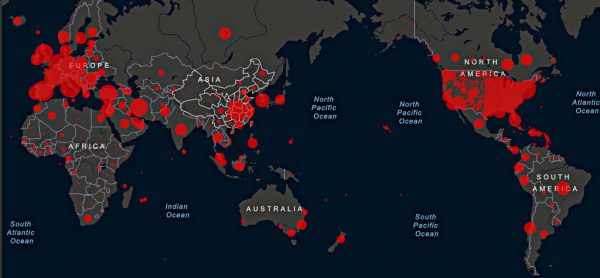
All the numbers above come from here: https://coronavirus.jhu.edu/map.html (as of March 30th!!)
Furthermore, the Russian special medical teams of the Nuclear, Biological and Chemical Protection Troops of the Russian Armed Forces are now on full alert and even though there is no shortage of specialized ABC/NBC medical gear in Russia, the Russian Armed Forces are now building 16 special hospitals in various locations in Russia. Russia is also almost completely shutting down internal air and rail traffic. A lot of that was predictable, since Moscow is much richer than any other Russian region, Moscow is doing fine, in spite of being a huge population (about 12 million in the city, plus another 7 or so in the Moscow Oblast’). Here are the official Russian numbers for the Moscow area: (also as of March 30th!!)
| Location | Infected | Deaths | Recovered | % death |
| City of Moscow | 1’226 | 11 | 28 | 0.9% |
| Moscow Oblast | 119 | 1 | 14 | 0.85% |
The source of these numbers is: https://coronavirus-monitor.ru/
Does it not strike you as very strange that a country like Russia, which clearly is faring much better than the US (even in per capita indicators) is preparing for the worst? What do the Russians know that the US leaders are not telling you?
Of course, the anti-Russian propaganda machine has an explanation. For example, it claims that the Russians are lying about everything. There is even a psyop going on with western agents of influence impersonating Russian MDs claiming that there are thousands of hidden deaths, that Russia has no equipment and that the Russians are clueless. One previously sober-minded analyst now even claims that “Putin is losing control“.
To be totally honest, I have never in my life seen such a tsunami of nonsense, false information, unfounded rumors, and, last but certainly not least, shameless clickbaiting. For some, this crisis is clearly a chance to regain some visibility. It is shameful, really, a total disgrace: just a new form of profiteering from a crisis.
I am not medical expert for sure. But I know the Russian government and its “body language” if you wish, and I can tell you that the Russians are preparing very, very seriously, for what might well become a huge crisis even for Russia (having the Ukraine and Belarus both sitting in deep denial will obviously not help!).
Seven, in the US, the contrast between the Federal government and the state authorities is quite startling. As much as the Federal government is terminally dysfunctional, state governors have often had to use a lot of out of the box thinking to get supplies and specialists. For example, the governor of FL, Ron DeSantis (R) had to call a friend of his in Israel to get the giant Israeli pharma company Teva Pharmaceuticals to send in desperately needed medical gear to Florida. Similar things are happening in other states I believe. This is one of the reasons why Americans are typically very suspicious of the Federal government but much more supportive of their local authorities (again, as a general rule, there are, of course, exceptions to this). There are many reasons for the contrast between the Federal and State authorities, including the fact that governors are much “closer” to their constituents on a local level than on the national one.
While not as dramatic as the contrast between societies based on pure greed and societies based on solidarity, this contrast between the local and national level will also contribute to the collapse of the imperial system, albeit more indirectly.
Conclusion: NWO, globalism and US “leadership”- RIP
The first (non-human) victim of this pandemic will be the so-called “New World Order” promised by several US presidents. The same goes for its underlying globalist ideology. If the putative “Illuminati world government” imagined by some really did trigger this pandemic, then it shot itself right in the foot and is now quickly bleeding out.
The US is now showing to the world that the so-called “US leadership” is nothing but a crude lie to conceal what I would describe as the rule of one, single, narcissistic world hegemon who will screw over even its closest “allies” (really colonies) to get any advantage.
Right now most of what we see are only warning signs, say like the EU members closing their borders. But irrespective of how this pandemic progresses, what will happen next is a huge economic crisis which will dwarf both the Great Depression, the crash after 9/11 and 2008.
Of course, the world will, sooner or later, recover from this pandemic and economic collapse. But the kind of world which we will then see will be dramatically different from the one we have lived in until now.
For the time being, there are still observable manifestations of the “US leadership”: the US tries hard to rob medicine and medical gear from other countries, the US imposes sanctions on countries like Iran and Venezuela who desperately need meds, and the US re-plays the Noriega scenario with Maduro. This foreign policy of “US leadership” can be summed up in terms like evil, immoral, hypocritical, dysfunctional, narcissistic. etc. Whatever label one chooses to apply to it, it is always a morally repugnant and practically self-defeating policy.
Right now, after blaming China, Trump is now pointing fingers at the WHO. Truly, a noble soul and a brilliant, 5D, chess player…
There is no more hiding it. The SARS-COV-2 achieved that which even RT or PressTV could not: it put a bright spotlight on the true nature of the AngloZionist Empire.
As the Quran says, God is the better planner.
Coronavirus: Consequences of Staggering Magnitude
By Alain DeBenoist | Occidental Observer
Excerpts from the interview, April 2, 2020; translated by Tom Sunic.
… A few years ago I wrote that only in a state of emergency one can take full measure of somebody. Now we know where we are at. A statesman makes decisions, gives orders and requisitions. Macron, however, relies on the advice of “experts” who, as a rule, never agree with each other.
… There was a wish to include in the logic of the (free) market a sector which by definition lies outside the free market. Public services have been systematically weakened and destroyed. Now it is us who are paying the price. And this is just the beginning, because the confinement will last for weeks, if not for months. We are not at the end of the beginning, much less at the beginning of the end.
… At the start, as a rule, everyone stands together. However, as we arrive at “the day after” and when the time comes for accountability, the people’s judgment will show no mercy. If this matter ends up, as I suspect it will, in a social crisis of huge magnitude, then the Yellow Vests movement will look like, more than ever before, as a dress rehearsal. We can now clearly see that it will be most difficult for the working class and the middle class to put up with [coronavirus] confinement.
… [The European Union ] didn’t commit suicide for the simple reason that it had already been dead. One of the merits of the crisis has been to allow everybody to see its dead body. Faced with the epidemic the leaders of the European Commission are showing signs of shock. They are now going to release funds which will be distribute by “helicopter,” after ramping up the monetary printing press. But in real terms nothing comes of it. It was not Europe that came to the rescue of Italy, but China, Russia and Cuba. Fidel Castro’s posthumous revenge!
… [The economic crisis ] will last much longer than the current epidemic; it will do far more damage and kill far more people. If it goes hand in hand with a global financial crisis, we will be witnessing then a tsunami: an economic crisis and therefore a social crisis, financial crisis, health crisis, ecological crisis, migration crisis. In 2011 I published a book called Au bord du gouffre (On the Brink of the Abyss). It seems to me that we have arrived there now.
… We should also anticipate political and geopolitical consequences of staggering proportions. The unfolding of the epidemic in a country such as the United States, whose health system, organized of course in a liberal fashion, is one of the world’s least performing, will be challenged to play a decisive role. It must be followed very closely (the global epicenter of the epidemic today is New York). The United States will likely come out of it much weaker than Russia and China, its only two rivals for the time being. Again, we are only at the beginning…
China Produces Record Amount Of “Fire Ice”
By Irina Slav | Oilprice.com | March 30, 2020
In a world awash in oil and gas, you’d think it couldn’t get any worse. Well, it can: China just announced that it had extracted a record amount of what has been poetically called fire ice. It is, however, a form of natural gas trapped in frozen water.
At 861,400 cubic meters, this record might not be a whole lot of gas, but it may well be the start of something new, and gas producers may not like this ‘something’.
Gas hydrates don’t garner a lot of media attention as a rule, simply because they have yet to become an addition to the world’s energy mix. But when they do—if they do—they may change the international oil and gas market even more than the coronavirus outbreak has changed it now by decimating demand for hydrocarbons.
First, what are gas hydrates?
Gas hydrates are molecules of natural gas, most commonly methane, trapped in a “cage” made from water molecules. They exist in cold climates, such as beneath the Arctic permafrost and Antarctic ice, but also in sedimentary deposits–the same kind of deposits where oil and gas collect along the margins of continents and also under the seabed of specific basins such as the South China Sea.
Because they only exist in cold places, research on gas hydrates has been challenging. As geologist Hobart M. King explains in an article on hydrates for Geology.com, hydrates are only stable in the environment where they formed.
To study them, researchers need to remove the samples from their environment. The change in temperature in pressure, however, melts the water cage, and the methane escapes.
Why bother with hydrates at all, then? Because they may be more abundant than all other hydrocarbons taken together: oil, gas, and coal.
According to the U.S. Department of Energy, the world’s methane gas hydrates could be as vast as 250,000 to 700,000 trillion cu ft. According to the UN Environmental Programme, the world’s reserves of gas hydrates could be as large as 3,000 to 30,000 trillion cubic meters. But these are just enormous figures that are difficult to digest.
Here’s an estimate that might be more palatable: the world’s gas hydrate reserves could be between 100,000 and 1.1 million exajoules. For context, the world’s total annual energy consumption as of 2014 when the UNEP paper was written was about 500 exajoules.
This means we might be sitting on enough gas to power the world for hundreds, if not thousands, of years.
It’s packed tightly, too. According to the Department of Energy, a single cubic meter of hydrate can release as much as 164 cubic meters of natural gas. Talk about energy density.
China is among just a handful of countries pursuing research into gas hydrates with a focus on extraction. With its dependence on imported oil and gas, this is hardly surprising. The first extraction experiments in the South China Sea, in 2017, resulted in an output of 300,000 cubic meters extracted over a period of two months. Now, the Ministry of Natural Resources has reported an output of 287,000 cubic meters achieved in a single day. This is quite a significant progress in three years.
And that’s not all.
According to the ministry, the output achieved during this phase of the gas hydrate trials provided a “solid technical foundation for commercial exploitation.”
This is probably the last thing gas producers around the world want to hear right now, but it is what they need to hear. Full-scale commercial production may be years or even decades away, but China is getting there. It seems, however, that it is getting there in strides rather than baby steps. This could spur others into action or, as it were, faster action.
Back in 2012, the United States and Japan reported successful production of methane from gas hydrates in the Alaskan North Slope. Then, a year later, Japan reported successful production again, this time from an offshore deposit at home. Those tests ended sooner than expected because of technical problems. In 2017, Japan again announced the first successful longer-lasting extraction of methane from a gas hydrate deposit offshore.
Last year, the U.S. Geological Survey updated its estimate for gas hydrate reserves in Alaska to 53.8 trillion cu ft. While this is significantly lower than the initial estimate from 2008, which said there were 85 trillion cu ft of recoverable fire ice in the North Slope, it is still substantial enough to motivate exploration. Only perhaps not right now, given the price environment.
China’s announcement comes at a sensitive time for the world gas industry. Prices are severely depressed by a rare if not unprecedented combination of unusually low demand and excessive supply. Energy firms are retrenching and preparing to wait out the crisis. Exploration budgets are being slashed and plans are being revised. And now, China has announced that it is working on its self-sufficiency in gas. It is going to be an ugly year for the energy industry, but maybe a good year for research into what could be the world’s most abundant fossil fuel resource.
Can the United States decline peacefully?
By Kevin Barrett | Press TV | March 31, 2020
Professor Atta-ur-Rahman from Pakistan recently in an interview argued that this coronavirus pandemic may have originated as a US bioweapon. He’s not just any doctor, but he’s the chairman of (Pakistani Prime Minister) Imran Khan’s National Task Force on Science and Technology. And Pakistan’s former UN Ambassador Abdullah Hussain Haroon said the same thing.
This is very interesting. The US, of course, has been very close to Pakistan in the past. And today Pakistan is trying to balance between the US and China. Hearing this kind of statement from high level people in Pakistan is a wakeup call that the world needs to take this seriously.
I think that the context is such that anybody who’s seriously paying attention to contemporary history has to admit that from the circumstantial evidence alone, it seems very likely that we should see this as a deliberate US biological attack on China, and perhaps on Iran or perhaps the Israelis did that.
The reason for this is that the US has entered into a period of great power competition with a rising China, not just a rising China but with a very rapidly rising China, if we listen to serious geostrategic analysts such as John Mearsheimer, a very brilliant man who tries to tell the truth as he sees it, as we all know, from his analysis with, with Walt on the Israel lobby here in the United States.
In October 2014, just about six years to the day before the US military sports team came to Wuhan, China, perhaps bringing that virus and while at the same time an exercise was being run, “Event 201”, mimicking exactly what would happen in the case of this kind of pandemic, John Mearsheimer published an article called, Can China Rise Peacefully? His answer was no.
John Mearsheimer is an American political scientist and international relations scholar. And he argued that the United States is going to take extraordinary measures to kill Chinese economic growth, which has been averaging 10% since 1980, and which is still up at 7%, putting China on a course to grossly eclipse the United States in economic and enhanced technological and military power within a decade or two at the very most.
Mearsheimer says the United States will undoubtedly do what it takes to stop this no matter what. Here’s a quote from his article he said,
“All of this tells us the United States has a profound interest in seeing Chinese economic growth slowed considerably in the years ahead. That outcome might not be good for American prosperity, much less for global prosperity, but it would be good for American security, which is what matters most.”
So that prediction was that the US would be willing to kill not only the global economy, but the American economy as well in order to stop this precipitous Chinese ascendance in the world. That’s what’s happened obviously.
If China’s growing at over 7% and the US is growing at a couple of percent at most, that differential leads to quick Chinese dominance of its region and then the world, whereas if the whole world’s growth is killed, and China’s dives down to a percent or two, and even if the US growth goes a little bit negative, this change doesn’t happen, the US maintains its current global military supremacy or so it may think.
So clearly, from the background, the historical background in the context everybody in the world who knows anything about history needs to be talking about, this as a US bioweapon attack on China just as the Chinese are saying, just like the Iranian government’s saying just like the Russian government’s saying and now just like the top people in Pakistan are saying.
Kevin Barrett is an American author, journalist and radio host with a Ph.D. in Islamic and Arabic Studies.
Open Letter to Chinese Government Highlights MSM Hypocrisy
By Daniel Lazare | Strategic Culture Foundation | March 30, 2020
The Washington Post, New York Times, and Wall Street Journal have written an open letter to the Chinese government urging it to reverse its “damaging and reckless” decision to expel their reporters amid a spiraling COVID epidemic.
The letter makes all the usual points about a “free flow of reliable news and information” in the middle of a growing international emergency. And however clichéd, such sentiments are correct since access to the broadest possible sources of information is indeed essential if the world is to make it through the crisis.
But the letter would have been a lot more convincing if the three papers had spoken up on Mar. 2 when the Trump administration moved to expel sixty Chinese journalists working for five news organizations that the White House regards as little more than state propaganda outfits.
Moreover, they’d be on even firmer footing if they had not actively cheered on the most dangerous anti-media effort of all, the U.S. crackdown on the TV news service RT, formerly known as Russia Today, that began in November 2017.
The crackdown on RT was in some ways even worse than McCarthyism since the latter was at least about something real and important, which is to say a Communist movement that controlled roughly forty percent of the global population and was pressing in on capitalism from every side. If the ruling class seemed spooked, it was facing a challenge of unprecedented dimensions.
But the threat this time around was about something entirely made up, i.e. the belief that Russia had supposedly used various dark arts to trick Americans into voting for Trump. The nonsense began in January 2017 when the CIA, NSA, and FBI “assessed” that Vladimir Putin had interfered in the previous year’s election in order “to undermine public faith in the U.S. democratic process, denigrate Secretary Clinton, and harm her electability” and, in the process, boost Trump. The report was entirely devoid of evidence, yet the press took it as gospel. Even worse, the intelligence report included a seven-page annex accusing RT of engaging in “criticism of U.S. and Western governments as well as the promotion of radical discontent,” running “numerous reports on alleged U.S. election fraud and voting machine vulnerabilities,” contending that U.S. election results cannot be trusted and do not reflect the popular will,” and hosting third-party candidates who contend that “the U.S. two-party system does not represent the views of at least one-third of the population and is a ‘sham.’”
Imagine – a foreign news service daring to suggest that U.S. politics were flawed! If papers like the Times or Post had the slightest inkling of self-respect, they would have laughed themselves silly over such hyper-sensitivity and told the CIA to grow a thicker skin. But they didn’t. Instead, they worked themselves up into ever greater levels of indignation. Within a few months, the New York Times was warning that “if there is any unifying character to RT, it is a deep skepticism of Western and American narratives of the world and a fundamental defensiveness about Russia and Mr. Putin” and that, thanks to snazzy graphics and snappy repartee, the network had put together “the most effective propaganda operation of the 21st century so far, one that thrives in the feverish political climates that have descended on many Western publics.”
Of course, one might observe that outlets like CNN and MSNBC are characterized by a deep skepticism of Russian narratives, so what’s the difference? But that wouldn’t be fair since everyone knows that America is right and Russia wrong and that any comparison between the two is automatically invalid, isn’t it?
Not to be outdone, the Washington Post – official slogan: “Democracy dies in darkness” – ran not one but two op-eds (here and here) calling on the federal government to require RT to register as a foreign agent, a step the Trump administration would dutifully take just two months later.
So the big two turned out to be more aggressive than the Trump administration in reducing journalistic diversity and using the power of the state to undermine a foreign competitor. Finally, just a month ago, the Times ran a front-page article declaring – queue the ominous music – that Radio Sputnik, RT’s sister outlet, had begun “broadcasting on three Kansas City-area radio stations during prime drive time.” Horror of horrors, the station was bombarding Missourians with Russki propaganda criticizing impeachment, the media, and the U.S. political system in general and informing that, in the words of one Sputnik host, that “the masses of poor and working people don’t have access to even the most essential things.”
Where did Radio Sputnik come up with such a notion? Doesn’t everyone know that perfect equality reigns in the United States and that anyone who says otherwise must be working for a foreign power?
In fact, while America never tires of touting its devotion to the First Amendment, it loses control when a foreign news service turns tables by engaging in journalism that is cheeky and irreverent. It wants a free press, which is to say one that is free to repeat over and over again how perfectly wonderful America really is. But it does not believe in a free press that allows foreigners to say the contrary.
Featured Video
The Truth About the Trump Shootings with Ken Silva
or go to
Aletho News Archives – Video-Images
From the Archives
Trans ‘milk’ as good as the real thing – NHS
RT | February 18, 2024
The drug-induced nipple secretions of trans women are as good as mothers’ breast milk for babies, the University of Sussex Hospitals NHS Trust claimed in a letter to campaigners made public in a report by British think tank the Policy Exchange on Sunday.
The healthcare trust’s medical director, Rachel James, argued that the off-label prescription drug cocktail men transitioning to female take in order to produce milk was “similar to the natural hormones which encourage lactation to develop when the baby is newly born.”
“The evidence which is available demonstrates that the milk is comparable to that produced following the birth of a baby,” James wrote in the letter, sent to Children of Transitioners last August.
Biological men who wish to lactate must first take hormones to grow milk glands and then take high doses of either domperidone or metoclopramide to stimulate milk production. Neither drug is approved for this use, though they are occasionally prescribed off-label to biological women who have trouble lactating.
However, domperidone’s own manufacturer, Janssen, warns patients the drug “may cause unwanted side effects affecting the heart in a breastfed baby” and “should be used during breastfeeding only if your physician considers this clearly necessary.” … continue
Blog Roll
 Aletho News
- Seyed M. Marandi: U.S. Strike Imminent – Toward Total War in the Middle East
- Russia Voted Under Fire. Washington Is Loading the Tankers.
- 12 Things Your Oncologist Was Trained Not to Tell You
- Anthrax Attacks Paved Way for COVID-Era ‘Junk Drugs and Vaccines’
- How Real Is the Impact of Western Sanctions on Israel?
- France, You Are Guilty: How Paris Turned Western Sahara into the Maghreb’s Powder Keg
- 2025 Nature Paper Claiming Worsening Global Drought Gets RETRACTED …Heavily Flawed
- Your Milk Is Not the Problem
- The Truth About the Trump Shootings with Ken Silva
- ARE PATIENTS BEING PROPERLY INFORMED ABOUT OZEMPIC?
- If Americans Knew
- Salah Sarsour’s Legal Team Says DHS Has Not Met Its Burden to Prove He Is Deportable
- An analysis of tax forms by The Intercept show Kraft’s charity and LLC have donated to Friends of the IDF and AIPAC’s super PAC.
- Israeli attacks kill four Palestinians in Gaza – Daily Update
- Inside Gaza’s death trap of collapsing, bombed-out buildings
- The everyday items Israel bans from Gaza every day
- Inside the siege, the ruined buildings of Gaza – Daily Update
- Debunking The Claim That Macklemore Has A “History Of Antisemitism”
- CPJ demands release of arrested Palestinian-US journalist near Bethlehem
- Robert Kraft: The Billionaire Friend of Netanyahu Pulling The Strings Behind the Macklemore/Ed Sheeran Blow Up
- Columbia Administered Fund Gives Big Money to Pro-Israel Groups
- No Tricks Zone
- 2025 Nature Paper Claiming Worsening Global Drought Gets RETRACTED …Heavily Flawed
- New Study: ‘Global Drought Shows No Detectable Recent Acceleration Under Climate Warming’
- Economic Masterminds: German Socialists Suggest Taxing Productivity Gains Stemming From Using AI
- The South China Sea Has Not Been Cooperating With The Climate Change Narrative
- Energy Crisis: Germany Enters Heating Season With Historically Low Gas Reserve Fill Levels
- New Study: The Antarctic Ice Sheet Gained Mass From 2020-2024 Due To Staggering Snow And Ice Accumulation
- Study: Ocean Heating Rates From Thousands Of Years Ago ‘Dwarf’ Modern Ocean Heating Rates
- Climate Extremists Target, Attack Large-Scale Power Grid Infrastructure In Germany!
- New Study: Antarctic Ice Melt Has Contributed Less Than 1 Centimeter To Sea Level Rise In The Last 30 Years
- Fear Of Debate: Alarmist German Climate Scientist Calls On Mainstream Media To Discredit Skeptic Voices
 Aletho News