FBI Claims China Targeting US Organizations Engaged in Coronavirus Research
Sputnik – May 13, 2020
The Federal Bureau of Investigation (FBI) and the Cybersecurity and Infrastructure Security Agency (CISA) have issued a joint statement in which they accuse malicious Chinese actors of trying to steal US coronavirus vaccine research.
“The FBI is investigating the targeting and compromise of US organizations conducting COVID-19-related research by PRC-affiliated cyber actors and non-traditional collectors. These actors have been observed attempting to identify and illicitly obtain valuable intellectual property (IP) and public health data related to vaccines, treatments and testing from networks and personnel affiliated with COVID-19-related research. The potential theft of this information jeopardizes the delivery of secure, effective, and efficient treatment options,” the statement, put out Wednesday, says.
The FBI and CISA urge organizations carrying out research in these fields to “maintain dedicated cybersecurity and insider threat practices” to prevent such thefts, and calls on institutions to watch out for and report any “anomalous” and “unusual” activities and behaviour. The statement also warns that organizations should realize that talking to the press about their COVID-19-related research may result in “increased interest and cyber activity” by possible malicious actors.
The warning comes just days following Sunday’s report by The New York Times citing current and former US security officials indicating that US intelligence was planning to put out an alert about alleged efforts by Chinese spies to access US-based coronavirus research. Officials told the paper that the ‘non-traditional collectors’ involved may include Chinese researchers and students working in the United States who may be interested in ‘infiltrating’ US academic and private laboratories in search of a vaccine. Complementing them are China’s “state-run hacking teams,” the paper claimed.
CISA director Christopher Krebs has alleged that “China’s long history of bad behaviour in cyberspace is well documented, so it shouldn’t surprise anyone they are going after the critical organizations involved in the nation’s response to the COVID-19 pandemic.” Krebs promised that the US would “defend our interests aggressively,” without elaborating.
Strong Claims From ‘Empire of Hackers’
Chinese Foreign Ministry spokesperson Zhao Lijian commented on the claims made by NYT on Monday, saying China already leads global research and development on coronavirus vaccines and therapies, and that the hacking claims were an “immoral” and baseless attempt to “smear” his country.
Chinese biotech companies reported recently that they have four different coronavirus vaccines already undergoing clinical trials, with three of them entering the second stage, with pilot production of an inactivated COVID-19 vaccine expected to begin in July. US President Donald Trump, meanwhile, has previously said he expects the US to have a vaccine available by the end of the year.
An anonymous researcher told the Global Times newspaper Monday that in the US’s core research efforts would be of little value to China, because US efforts are DNA and RNA-based vaccines, while China has chosen to focus on inactivated vaccines (i.e. vaccines made from virulent virus by destroying its infectivity while retaining its immunogenicity). Jonas Salk’s polio vaccine is the most famous example of a major inactivated vaccine.
Earlier this year, China called out the United States for being an “empire of hackers” and “the largest state eavesdropper in international cyberspace” following revelations of the extent of the National Security Agency’s global intelligence-gathering operations going back to the Cold War.
China should TRIPLE nuclear arsenal to deter ‘warmongering’ US, editor of state-run Global Times argues
RT | May 8, 2020
China should drastically increase its stockpile of nuclear warheads to dissuade the United States from pursuing its strategic ambitions abroad, the editor of the Global Times has urged.
In a piece published by his own paper, Hu Xijin said China is a “peace-loving nation” that has pledged to never be the first to use nuclear weapons. He argued, however, that Beijing must aim to expand the number of its nuclear warheads to 1,000 to create a powerful deterrent to “shape the attitudes of US elites toward China.” The Asian power currently has around 300 nuclear weapons.
He said that bolstering China’s nuclear capabilities would keep “an increasingly irrational” United States at arm’s length. “Some people may call me a ‘warmonger’ because I want the country to have more nuclear warheads. They should instead give this label to US politicians who are openly hostile to China.”
The Global Times editor emphasized he would prefer a “peaceful coexistence” between China and the US, but observed that Washington “only believes in strength.” China cannot “beg” to be treated as an equal on the world stage, he argued.
Xijin’s commentary came just a day after US President Donald Trump rallied for an “effective arms control” deal between Washington, Beijing and Moscow, during a telephone call with Russian leader Vladimir Putin.
Trump has repeatedly called on China to join negotiations for the renewal of the New START treaty – the nuclear arms pact between the US and Russia that is set to expire in February 2021. So far, Beijing has expressed little interest in participating in the accord.
Tensions between the United States and China are on the rise, fueled primarily by allegations that Beijing had a hand in the outbreak of Covid-19 that has now spread across the world. China has dismissed these claims as unfounded, and has repeatedly challenged the White House to produce evidence of an alleged cover-up or sinister role in the health crisis.
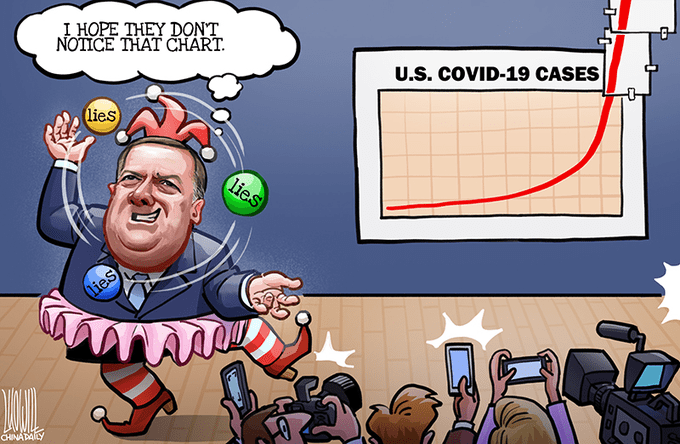
A China-bashing coronavirus jester? Beijing tears into Pompeo’s ‘clown show’
RT | May 6, 2020
China has fired back at Mike Pompeo’s allegations that Beijing is somehow behind the origin and spread of Covid-19, describing his “comedy routine” as deeply cynical and damaging to the United States.
State-operated China Daily took aim at the US secretary of state, slamming the top American diplomat for “bad-mouthing” China and the World Health Organization (WHO) instead of seeking global cooperation and solidarity to overcome the Covid-19 pandemic.
Pompeo continues to insist that the illness came from a laboratory in Wuhan, even though he has yet to present evidence for this incendiary claim, and has ignored scientists who say the virus is from the wild, the opinion piece argued.
China Daily noted that the secretary of state has also been curiously silent about the fact that Beijing has been the “main provider” of surgical masks, ventilators, and other essential medical equipment to the US. The editorial argued that Pompeo is playing a dangerous political game that will end up hurting the United States.
In a difficult situation such as the one we all face now, Pompeo’s clown show is simply self-harming for the US. It is solidarity that is desperately needed to fight this common enemy, not a stand-up comedy routine.
The paper also ran a cartoon showing Pompeo, outfitted as a jester, juggling “lies” as he tries to distract media attention from rising coronavirus cases in the US.
The biting commentary piece comes after the Global Times newspaper – an outlet owned by the Chinese Communist Party – published an editorial dismissing Pompeo’s attacks on Beijing as “groundless accusations.”
Pompeo’s theories have also been met with suspicion within the intelligence community. The Guardian reported that sources connected to the Five Eyes intelligence network – consisting of spy agencies from the UK, US, Australia, New Zealand, and Canada – believe there is no evidence linking China to the creation and spread of Covid-19.
China Rejects Illegal, Violent Actions Against Venezuela, Cuba
teleSUR | May 6, 2020
China Wednesday condemned the recent rifle attack at the Cuban embassy in the United States, a mercenary forces’ invasion plan of Venezuela, and all the interventionist maneuvers against the sovereignty of any country.
China’s Foreign Ministry spokeswoman Hua Chunying said that her government firmly opposes any violent action perpetrated against official representations.
She urged Washington to take the necessary measures to protect the Cuban embassy from any damage, as provided for in the 1961 Vienna Convention.
In this way, China joined other nations in the world that repudiated the shooting launched last Thursday against the Cuban embassy in the U.S. capital. The Cuban mission officials suffered no damage, but there were material deteriorations in the building as a result of the attack.
Hua also deplored the attempted maritime invasion of Venezuela by mercenary forces seeking to carry out a coup against President Nicolas Maduro.
She stressed the Chinese government’s rejection of the violation of the sovereignty of the South American country by any means or excuse.
The diplomat called for prioritizing the well-being of the Bolivarian people and promoting the peaceful resolution of the political impasse in Venezuela.
China has been in favor of respecting the United Nations Charter and the basic norms governing international relations in the face of the U.S. policy of hostility towards the Maduro administration.
The Asian nation recently criticized Washington for applying more extraterritorial sanctions to Venezuela, Cuba, and Iran to the detriment of the public health of the people just as the COVID-19 pandemic spreads.
Five questions Washington needs to answer on coronavirus pandemic

Photo taken on March 10, 2020 shows a plane approaching to land at Ronald Reagan Washington National Airport in Arlington, Virginia, the United States. (Xinhua/Liu Jie)
Xinhua | 2020-05-04
Five questions Washington needs to answer:
– Where did the virus in U.S. originate?
– Did U.S. fail to notice virus transmission at an early stage?
– Was the U.S. slow in early response to the pandemic?
– Did U.S. response lead to wider spread worldwide?
– What is the intention behind buck-passing?
The United States has confirmed over 1 million COVID-19 cases in just some 100 days after it reported the first case on Jan. 21, making itself the new epicenter of the coronavirus pandemic worldwide.
Facing criticism at home, some U.S. politicians have been irresponsibly attacking a certain country and the World Health Organization (WHO), hampering global efforts against the pandemic.
Their actions have drawn questions from around the world, and Washington should provide clear answers.
WHERE DID THE VIRUS IN U.S. ORIGINATE?
The U.S. Centers for Disease Control and Prevention (CDC) has restored the U.S. Army Medical Research Institute of Infectious Diseases, a military center for biological research in Maryland State, to full operation, local media reported in late March.
The institution was ordered by the CDC to halt research involving biological select agents or toxins last summer. An online petition was later submitted on the White House petition site demanding the U.S. government clarify the shutdown of the institution.
The public is waiting for Washington to provide a clear explanation to the sudden halt and resumption of the research.
According to a report by the CDC in late February, there have been at least 32 million flu illnesses in the country in the 2019-2020 flu season.
On March 11, CDC Director Robert Redfield told a hearing on Capitol Hill that some COVID-19 deaths have been diagnosed as flu-related in the United States.
Washington needs to clarify the number of COVID-19 cases previously diagnosed as the flu, and make public the samples and genetic sequence of the influenza virus in the country.
DID U.S. FAIL TO NOTICE VIRUS TRANSMISSION AT AN EARLY STAGE?
In late April, health authorities of Santa Clara County in California State confirmed that two patients had died of COVID-19 at least three weeks before the first known U.S. death from the virus on Feb. 29.
Jeffrey V. Smith, Santa Clara county executive, told Xinhua that the patients “apparently contracted the illness from community spread. This suggests that the virus was circulating in the Bay Area in January at least, probably earlier.”
Neeraj Sood, a professor at the Price School of Public Policy at the University of Southern California, was quoted by the Los Angeles Times as saying that the virus has been in the community for a long time.
“When you start seeing the first death, actually, the number of cases in the population is probably pretty high already,” Sood said.
Washington needs to answer if it failed to notice community spread of the virus.
WAS THE U.S. SLOW IN EARLY RESPONSE TO THE PANDEMIC?
According to a report by The Washington Post on April 4, the CDC “learned of a cluster of cases in China on Dec. 31,” and the U.S. side received a call from the Chinese side on Jan. 3 warning against the disease.
On Jan. 8, heads of Chinese and U.S. CDCs talked over phone to discuss technological exchanges and cooperation, a detailed timeline of China’s response to COVID-19 showed.
On Feb. 16, the China-WHO joint expert team started a nine-day field visit in China. The team consists of 25 experts, including Cliff Lane, a researcher with the U.S. National Institute of Allergy and Infectious Diseases.
The U.S. government, however, repeatedly downplayed the severity of the epidemic to the public at that time. U.S. media reported that the U.S. administration had squandered more than two months’ time since it received initial notification on the virus.
Washington needs to explain why it took so long to take action to combat the virus.
DID U.S. RESPONSE LEAD TO WIDER SPREAD WORLDWIDE?
The Washington Post said that the U.S. National Security Council had pushed for a travel ban restricting travelers from Italy and other countries in the European Union, but was met with resistance from some officials from the administration.
When the ban was finally issued over a month later, “hundreds of thousands of people crossed the Atlantic during that interval,” it said.
A report published on April 11 in The New York Times also revealed that the U.S. government’s plan to establish a surveillance system in some cities to measure the spread of the virus was delayed for weeks, leaving officials “with almost no insight into how rapidly the virus was spreading.”
In March, Australian Prime Minister Scott Morrison said the United States has been the country of origin for most of COVID-19 cases in his country.
Washington must respond to the concern that the belated and chaotic U.S. response has actually accelerated the spread of the virus to more places around the world.
WHAT IS THE INTENTION BEHIND BUCK-PASSING?
The U.S. government has criticized a so-called lack of transparency from China regarding the information on COVID-19. However, the facts speak otherwise.
The CDC said on its website that Chinese health officials reported cases of acute respiratory illness in persons associated with a seafood and animal market in the city of Wuhan on Dec. 31.
Since Jan. 3, China began to inform the United States of the outbreak and response measures on a regular basis, the timeline of China’s response to COVID-19 showed.
On Jan. 24, U.S. President Donald Trump tweeted that China “has been working very hard to contain the coronavirus,” and that “the United States greatly appreciates their efforts and transparency.”
Anthony Fauci, director of the U.S. National Institute of Allergy and Infectious Diseases, also told a coronavirus briefing in late January that China has been “quite transparent” with the world on the virus.
However, some U.S. politicians have stigmatized China with racist remarks, fabricated lies on China’s role in the global fight against the virus, and disrupted global solidarity and cooperation in combatting the disease.
The world needs a clear explanation from Washington on why it chose to pass the buck.
Techno-Tyranny: How The US National Security State Is Using Coronavirus To Fulfill An Orwellian Vision
By Whitney Webb | The Last American Vagabond | May 4, 2020
Last year, a U.S. government body dedicated to examining how artificial intelligence can “address the national security and defense needs of the United States” discussed in detail the “structural” changes that the American economy and society must undergo in order to ensure a technological advantage over China, according to a recent document acquired through a FOIA request. This document suggests that the U.S. follow China’s lead and even surpass them in many aspects related to AI-driven technologies, particularly their use of mass surveillance. This perspective clearly clashes with the public rhetoric of prominent U.S. government officials and politicians on China, who have labeled the Chinese government’s technology investments and export of its surveillance systems and other technologies as a major “threat” to Americans’ “way of life.”
In addition, many of the steps for the implementation of such a program in the U.S., as laid out in this newly available document, are currently being promoted and implemented as part of the government’s response to the current coronavirus (Covid-19) crisis. This likely due to the fact that many members of this same body have considerable overlap with the taskforces and advisors currently guiding the government’s plans to “re-open the economy” and efforts to use technology to respond to the current crisis.
The FOIA document, obtained by the Electronic Privacy Information Center (EPIC), was produced by a little-known U.S. government organization called the National Security Commission on Artificial Intelligence (NSCAI). It was created by the 2018 National Defense Authorization Act (NDAA) and its official purpose is “to consider the methods and means necessary to advance the development of artificial intelligence (AI), machine learning, and associated technologies to comprehensively address the national security and defense needs of the United States.”
The NSCAI is a key part of the government’s response to what is often referred to as the coming “fourth industrial revolution,” which has been described as “a revolution characterized by discontinuous technological development in areas like artificial intelligence (AI), big data, fifth-generation telecommunications networking (5G), nanotechnology and biotechnology, robotics, the Internet of Things (IoT), and quantum computing.”
However, their main focus is ensuring that “the United States … maintain a technological advantage in artificial intelligence, machine learning, and other associated technologies related to national security and defense.” The vice-chair of NSCAI, Robert Work – former Deputy Secretary of Defense and senior fellow at the hawkish Center for a New American Security (CNAS), described the commission’s purpose as determining “how the U.S. national security apparatus should approach artificial intelligence, including a focus on how the government can work with industry to compete with China’s ‘civil-military fusion’ concept.”
The recently released NSCAI document is a May 2019 presentation entitled “Chinese Tech Landscape Overview.” Throughout the presentation, the NSCAI promotes the overhaul of the U.S. economy and way of life as necessary for allowing the U.S. to ensure it holds a considerable technological advantage over China, as losing this advantage is currently deemed a major “national security” issue by the U.S. national security apparatus. This concern about maintaining a technological advantage can be seen in several other U.S. military documents and think tank reports, several of which have warned that the U.S.’ technological advantage is quickly eroding.
The U.S. government and establishment media outlets often blame alleged Chinese espionage or the Chinese government’s more explicit partnerships with private technology companies in support of their claim that the U.S. is losing this advantage over China. For instance, Chris Darby, the current CEO of the CIA’s In-Q-Tel, who is also on the NSCAI, told CBS News last year that China is the U.S.’ main competitor in terms of technology and that U.S. privacy laws were hampering the U.S.’ capacity to counter China in this regard, stating that:
“[D]ata is the new oil. And China is just awash with data. And they don’t have the same restraints that we do around collecting it and using it, because of the privacy difference between our countries. This notion that they have the largest labeled data set in the world is going to be a huge strength for them.”
In another example, Michael Dempsey, former acting Director of National Intelligence and currently a government-funded fellow at the Council on Foreign Relations, argued in The Hill that:
“It’s quite clear, though, that China is determined to erase our technological advantage, and is committing hundreds of billions of dollars to this effort. In particular, China is determined to be a world leader in such areas as artificial intelligence, high performance computing, and synthetic biology. These are the industries that will shape life on the planet and the military balance of power for the next several decades.”
In fact, the national security apparatus of the United States is so concerned about losing a technological edge over China that the Pentagon recently decided to join forces directly with the U.S. intelligence community in order “to get in front of Chinese advances in artificial intelligence.” This union resulted in the creation of the Joint Artificial Intelligence Center (JAIC), which ties together “the military’s efforts with those of the Intelligence Community, allowing them to combine efforts in a breakneck push to move government’s AI initiatives forward.” It also coordinates with other government agencies, industry, academics, and U.S. allies. Robert Work, who subsequently became the NSCAI vice-chair, said at the time that JAIC’s creation was a “welcome first step in response to Chinese, and to a lesser extent, Russian, plans to dominate these technologies.”
Similar concerns about “losing” technological advantage to China have also been voiced by the NSCAI chairman, Eric Schmidt, the former head of Alphabet – Google’s parent company, who argued in February in the New York Times that Silicon Valley could soon lose “the technology wars” to China if the U.S. government doesn’t take action. Thus, the three main groups represented within the NSCAI – the intelligence community, the Pentagon and Silicon Valley – all view China’s advancements in AI as a major national security threat (and in Silicon Valley’s case, threat to their bottom lines and market shares) that must be tackled quickly.
Targeting China’s “adoption advantage”
In the May 2019 “Chinese Tech Landscape Overview” presentation, the NSCAI discusses that, while the U.S. still leads in the “creation” stage of AI and related technologies, it lags behind China in the “adoption” stage due to “structural factors.” It says that “creation”, followed by “adoption” and “iteration” are the three phases of the “life cycle of new tech” and asserts that failing to dominate in the “adoption” stage will allow China to “leapfrog” the U.S. and dominate AI for the foreseeable future.
The presentation also argues that, in order to “leapfrog” competitors in emerging markets, what is needed is not “individual brilliance” but instead specific “structural conditions that exist within certain markets.” It cites several case studies where China is considered to be “leapfrogging” the U.S. due to major differences in these “structural factors.” Thus, the insinuation of the document (though not directly stated) is that the U.S. must alter the “structural factors” that are currently responsible for its lagging behind China in the “adoption” phase of AI-driven technologies.
Chief among the troublesome “structural factors” highlighted in this presentation are so-called “legacy systems” that are common in the U.S. but much less so in China. The NSCAI document states that examples of “legacy systems” include a financial system that still utilizes cash and card payments, individual car ownership and even receiving medical attention from a human doctor. It states that, while these “legacy systems” in the US are “good enough,” too many “good enough” systems “hinder the adoption of new things,” specifically AI-driven systems.
Another structural factor deemed by the NSCAI to be an obstacle to the U.S.’ ability to maintain a technological advantage over China is the “scale of the consumer market,” arguing that “extreme urban density = on-demand service adoption.” In other words, extreme urbanization results in more people using online or mobile-based “on-demand” services, ranging from ride-sharing to online shopping. It also cites the use of mass surveillance on China’s “huge population base” is an example of how China’s “scale of consumer market” advantage allowing “China to leap ahead” in the fields of related technologies, like facial recognition.

In addition to the alleged shortcomings of the U.S.’ “legacy systems” and lack of “extreme urban density,” the NSCAI also calls for more “explicit government support and involvement” as a means to speed up the adoption of these systems in the U.S. This includes the government lending its stores of data on civilians to train AI, specifically citing facial recognition databases, and mandating that cities be “re-architected around AVs [autonomous vehicles],” among others. Other examples given include the government investing large amounts of money in AI start-ups and adding tech behemoths to a national, public-private AI taskforce focused on smart city-implementation (among other things).
With regards to the latter, the document says “this level of public-private cooperation” in China is “outwardly embraced” by the parties involved, with this “serving as a stark contrast to the controversy around Silicon Valley selling to the U.S. government.” Examples of such controversy, from the NSCAI’s perspective, likely include Google employees petitioning to end the Google-Pentagon “Project Maven,” which uses Google’s AI software to analyze footage captured by drones. Google eventually chose not to renew its Maven contract as a result of the controversy, even though top Google executives viewed the project as a “golden opportunity” to collaborate more closely with the military and intelligence communities.
The document also defines another aspect of government support as the “clearing of regulatory barriers.” This term is used in the document specifically with respect to U.S. privacy laws, despite the fact that the U.S. national security state has long violated these laws with near complete impunity. However, the document seems to suggest that privacy laws in the U.S. should be altered so that what the U.S. government has done “in secret” with private citizen data can be done more openly and more extensively. The NSCAI document also discusses the removal of “regulatory barriers” in order to speed up the adoption of self-driving cars, even though autonomous driving technology has resulted in several deadly and horrific car accidents and presents other safety concerns.

Also discussed is how China’s “adoption advantage” will “allow it to leapfrog the U.S.” in several new fields, including “AI medical diagnosis” and “smart cities.” It then asserts that “the future will be decided at the intersection of private enterprise and policy leaders between China and the U.S.” If this coordination over the global AI market does not occur, the document warns that “we [the U.S.] risk being left out of the discussions where norms around AI are set for the rest of our lifetimes.”
The presentation also dwells considerably on how “the main battleground [in technology] are not the domestic Chinese and US markets,” but what it refers to as the NBU (next billion users) markets, where it states that “Chinese players will aggressively challenge Silicon Valley.” In order to challenge them more successfully, the presentation argues that, “just like we [view] the market of teenagers as a harbinger for new trends, we should look at China.”
The document also expresses concerns about China exporting AI more extensively and intensively than the U.S., saying that China is “already crossing borders” by helping to build facial databases in Zimbabwe and selling image recognition and smart city systems to Malaysia. If allowed to become “the unambiguous leader in AI,” it says that “China could end up writing much of the rulebook of international norms around the deployment of AI” and that it would “broaden China’s sphere of influence amongst an international community that increasingly looks to the pragmatic authoritarianism of China and Singapore as an alternative to Western liberal democracy.”
What will replace the US’ “legacy systems”?
Given that the document makes it quite clear that “legacy systems” in the U.S. are impeding its ability to prevent China from “leapfrogging” ahead in AI and then dominating it for the foreseeable future, it is also important to examine what the document suggests should replace these “legacy systems” in the U.S.
As previously mentioned, one “legacy system” cited early on in the presentation is the main means of payment for most Americans, cash and credit/debit cards. The presentation asserts, in contrast to these “legacy systems” that the best and most advanced system is moving entirely to smartphone-based digital wallets.
It notes specifically the main mobile wallet provider in India, PayTM, is majority owned by Chinese companies. It quotes an article, which states that “a big break came [in 2016] when India canceled 86% of currency in circulation in an effort to cut corruption and bring more people into the tax net by forcing them to use less cash.” At the time, claims that India’s 2016 “currency reform” would be used as a stepping stone towards a cashless society were dismissed by some as “conspiracy theory.” However, last year, a committee convened by India’s central bank (and led by an Indian tech oligarch who also created India’s massive civilian biometric database) resulted in the Indian government’s “Cashless India” program.
Regarding India’s 2016 “currency reform,” the NSCAI document then asserts that “this would be unfathomable in the West. And unsurprisingly, when 86% of the cash got cancelled and nobody had a credit card, mobile wallets in India exploded, laying the groundwork for a far more advanced payments ecosystem in India than the US.” However, it has become increasingly less unfathomable in light of the current coronavirus crisis, which has seen efforts to reduce the amount of cash used because paper bills may carry the virus as well as efforts to introduce a Federal Reserve-backed “digital dollar.”
In addition, the NSCAI document from last May calls for the end of in-person shopping and promotes moving towards all shopping being performed online. It argues that “American companies have a lot to gain by adopting ideas from Chinese companies” by shifting towards exclusive e-commerce purchasing options. It states that only shopping online provides a “great experience” and also adds that “when buying online is literally the only way to get what you want, consumers go online.”

Another “legacy system” that the NSCAI seeks to overhaul is car ownership, as it promotes autonomous, or self-driving vehicles and further asserts that “fleet ownership > individual ownership.” It specifically points to a need for “a centralized ride-sharing network,” which it says “is needed to coordinate cars to achieve near 100% utilization rates.” However, it warns against ride-sharing networks that “need a human operator paired with each vehicle” and also asserts that “fleet ownership makes more sense” than individual car ownership. It also specifically calls for these fleets to not only be composed of self-driving cars, but electric cars and cites reports that China “has the world’s most aggressive electric vehicle goals…. and seek[s] the lead in an emerging industry.”
The document states that China leads in ride-sharing today even though ride-sharing was pioneered first in the U.S. It asserts once again that the U.S. “legacy system” of individual car ownership and lack of “extreme urban density” are responsible for China’s dominance in this area. It also predicts that China will “achieve mass autonomous [vehicle] adoption before the U.S.,” largely because “the lack of mass car ownership [in China] leads to far more consumer receptiveness to AVs [autonomous vehicles].” It then notes that “earlier mass adoption leads to a virtuous cycle that allows Chinese core self-driving tech to accelerate beyond [its] Western counterparts.”
In addition to their vision for a future financial system and future self-driving transport system, the NSCAI has a similarly dystopian vision for surveillance. The document calls mass surveillance “one of the ‘first-and-best customers’ for AI” and “a killer application for deep learning.” It also states that “having streets carpeted with cameras is good infrastructure.”

It then discusses how “an entire generation of AI unicorn” companies are “collecting the bulk of their early revenue from government security contracts” and praises the use of AI in facilitating policing activities. For instance, it lauds reports that “police are making convictions based on phone calls monitored with iFlyTek’s voice-recognition technology” and that “police departments are using [AI] facial recognition tech to assist in everything from catching traffic law violators to resolving murder cases.”
On the point of facial recognition technology specifically, the NSCAI document asserts that China has “leapt ahead” of the US on facial recognition, even though “breakthroughs in using machine learning for image recognition initially occurred in the US.” It claims that China’s advantage in this instance is because they have government-implemented mass surveillance (“clearing of regulatory barriers”), enormous government-provided stores of data (“explicit government support”) combined with private sector databases on a huge population base (“scale of consumer market”). As a consequence of this, the NSCAI argues, China is also set to leap ahead of the U.S. in both image/facial recognition and biometrics.
The document also points to another glaring difference between the U.S. and its rival, stating that: “In the press and politics of America and Europe, Al is painted as something to be feared that is eroding privacy and stealing jobs. Conversely, China views it as both a tool for solving major macroeconomic challenges in order to sustain their economic miracle, and an opportunity to take technological leadership on the global stage.”
The NSCAI document also touches on the area of healthcare, calling for the implementation of a system that seems to be becoming reality thanks to the current coronavirus crisis. In discussing the use of AI in healthcare (almost a year before the current crisis began), it states that “China could lead the world in this sector” and “this could lead to them exporting their tech and setting international norms.” One reason for this is also that China has “far too few doctors for the population” and calls having enough doctors for in-person visits a “legacy system.” It also cited U.S. regulatory measures such as “HIPPA compliance and FDA approval” as obstacles that don’t constrain Chinese authorities.
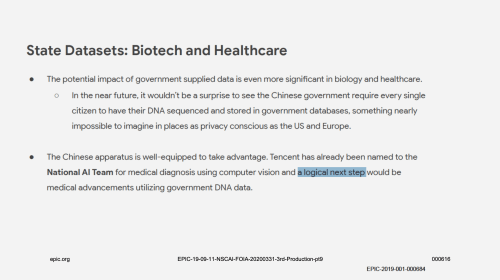
More troubling, it argues that “the potential impact of government supplied data is even more significant in biology and healthcare,” and says it is likely that “the Chinese government [will] require every single citizen to have their DNA sequenced and stored in government databases, something nearly impossible to imagine in places as privacy conscious as the U.S. and Europe.” It continues by saying that “the Chinese apparatus is well-equipped to take advantage” and calls these civilian DNA databases a “logical next step.”
Who are the NSCAI?
Given the sweeping changes to the U.S. that the NSCAI promoted in this presentation last May, it becomes important to examine who makes up the commission and to consider their influence over U.S. policy on these matters, particularly during the current crisis. As previously mentioned, the chairman of the NSCAI is Eric Schmidt, the former head of Alphabet (Google’s parent company) who has also invested heavily in Israeli intelligence-linked tech companies including the controversial start-up “incubator” Team8. In addition, the committee’s vice-chair is Robert Work, is not only a former top Pentagon official, but is currently working with the think tank CNAS, which is run by John McCain’s long-time foreign policy adviser and Joe Biden’s former national security adviser.
Other members of the NSCAI are as follows:
- Safra Catz, CEO of Oracle, with close ties to Trump’s top donor Sheldon Adelson
- Steve Chien, supervisor of the Artificial Intelligence Group at Caltech’s Jet Propulsion Lab
- Mignon Clyburn, Open Society Foundation fellow and former FCC commissioner
- Chris Darby, CEO of In-Q-Tel (CIA’s venture capital arm)
- Ken Ford, CEO of the Florida Institute for Human and Machine Cognition
- Jose-Marie Griffiths, president of Dakota State University and former National Science Board member
- Eric Horvitz, director of Microsoft Research Labs
- Andy Jassy, CEO of Amazon Web Services (CIA contractor)
- Gilman Louie, partner at Alsop Louie Partners and former CEO of In-Q-Tel
- William Mark, director of SRI International and former Lockheed Martin director
- Jason Matheny, director of the Center for Security and Emerging Technology, former Assistant director of National Intelligence and former director of IARPA (Intelligence Advanced Research Project Agency)
- Katharina McFarland, consultant at Cypress International and former Assistant Secretary of Defense for Acquisition
- Andrew Moore, head of Google Cloud AI
As can be seen in the list above, there is a considerable amount of overlap between the NSCAI and the companies currently advising the White House on “re-opening” the economy (Microsoft, Amazon, Google, Lockheed Martin, Oracle) and one NSCAI member, Oracle’s Safra Katz, is on the White House’s “economic revival” taskforce. Also, there is also overlap between the NSCAI and the companies that are intimately involved in the implementation of the “contact tracing” “coronavirus surveillance system,” a mass surveillance system promoted by the Jared Kushner-led, private-sector coronavirus task force. That surveillance system is set to be constructed by companies with deep ties to Google and the U.S. national security state, and both Google and Apple, who create the operating systems for the vast majority of smartphones used in the U.S., have said they will now build that surveillance system directly into their smartphone operating systems.
Also notable is the fact that In-Q-Tel and the U.S. intelligence community has considerable representation on the NSCAI and that they also boast close ties with Google, Palantir and other Silicon Valley giants, having been early investors in those companies. Both Google and Palantir, as well as Amazon (also on the NSCAI) are also major contractors for U.S. intelligence agencies. In-Q-Tel’s involvement on the NSCAI is also significant because they have been heavily promoting mass surveillance of consumer electronic devices for use in pandemics for the past several years. Much of that push has come from In-Q-Tel’s current Executive Vice President Tara O’Toole, who was previously the director of the Johns Hopkins Center for Health Security and also co-authored several controversial biowarfare/pandemic simulations, such as Dark Winter.
In addition, since at least January, the U.S. intelligence community and the Pentagon have been at the forefront of developing the U.S. government’s still-classified “9/11-style” response plans for the coronavirus crisis, alongside the National Security Council. Few news organizations have noted that these classified response plans, which are set to be triggered if and when the U.S. reaches a certain number of coronavirus cases, has been created largely by elements of the national security state (i.e. the NSC, Pentagon, and intelligence), as opposed to civilian agencies or those focused on public health issues.
Furthermore, it has been reported that the U.S. intelligence community as well as U.S. military intelligence knew by at least January (though recent reports have said as early as last November) that the coronavirus crisis would reach “pandemic proportions” by March. The American public were not warned, but elite members of the business and political classes were apparently informed, given the record numbers of CEO resignations in January and several high-profile insider trading allegations that preceded the current crisis by a matter of weeks.
Perhaps even more disconcerting is the added fact that the U.S. government not only participated in the eerily prescient pandemic simulation last October known as Event 201, it also led a series of pandemic response simulations last year. Crimson Contagion was a series of four simulations that involved 19 U.S. federal agencies, including intelligence and the military, as well as 12 different states and a host of private sector companies that simulated a devastating pandemic influenza outbreak that had originated in China. It was led by the current HHS Assistant Secretary for Preparedness and Response, Robert Kadlec, who is a former lobbyist for military and intelligence contractors and a Bush-era homeland security “bioterrorism” advisor.

In addition, both Kadlec and the Johns Hopkins Center for Health Security, which was intimately involved in Event 201, have direct ties to the controversial June 2001 biowarfare exercise “Dark Winter,” which predicted the 2001 anthrax attacks that transpired just months later in disturbing ways. Though efforts by media and government were made to blame the anthrax attacks on a foreign source, the anthrax was later found to have originated at a U.S. bioweapons lab and the FBI investigation into the case has been widely regarded as a cover-up, including by the FBI’s once-lead investigator on that case.
Given the above, it is worth asking if those who share the NSCAI’s vision saw the coronavirus pandemic early on as an opportunity to make the “structural changes” it had deemed essential to countering China’s lead in the mass adoption of AI-driven technologies, especially considering that many of the changes in the May 2019 document are now quickly taking place under the guise of combatting the coronavirus crisis.
The NSCAI’s vision takes shape
Though the May 2019 NSCAI document was authored nearly a year ago, the coronavirus crisis has resulted in the implementation of many of the changes and the removal of many of the “structural” obstacles that the commission argued needed to be drastically altered in order to ensure a technological advantage over China in the field of AI. The aforementioned move away from cash, which is taking place not just in the U.S. but internationally, is just one example of many.
For instance, earlier this week CNN reported that grocery stores are now considering banning in-person shopping and that the U.S. Department of Labor has recommended that retailers nationwide start “‘using a drive-through window or offering curbside pick-up’ to protect workers for exposure to coronavirus.” In addition, last week, the state of Florida approved an online-purchase plan for low income families using the Supplemental Nutrition Assistance Program (SNAP). Other reports have argued that social distancing inside grocery stores is ineffective and endangering people’s lives. As previously mentioned, the May 2019 NSCAI document argues that moving away from in-person shopping is necessary to mitigate China’s “adoption advantage” and also argued that “when buying online is literally the only way to get what you want, consumers go online.”
Reports have also argued that these changes in shopping will last far beyond coronavirus, such as an article by Business Insider entitled “The coronavirus pandemic is pushing more people online and will forever change how Americans shop for groceries, experts say.” Those cited in the piece argue that this shift away from in-person shopping will be “permanent” and also states that “More people are trying these services than otherwise would have without this catalyst and gives online players a greater chance to acquire and keep a new customer base.” A similar article in Yahoo! News argues that, thanks to the current crisis, “our dependence on online shopping will only rise because no one wants to catch a virus at a shop.”
In addition, the push towards the mass use of self-driving cars has also gotten a boost thanks to coronavirus, with driverless cars now making on-demand deliveries in California. Two companies, one Chinese-owned and the other backed by Japan’s SoftBank, have since been approved to have their self-driving cars used on California roads and that approval was expedited due to the coronavirus crisis. The CPO of Nuro Inc., the SoftBank-backed company, was quoted in Bloomberg as saying that “The Covid-19 pandemic has expedited the public need for contactless delivery services. Our R2 fleet is custom-designed to change the very nature of driving and the movement of goods by allowing people to remain safely at home while their groceries, medicines, and packages are brought to them.” Notably, the May 2019 NSCAI document references the inter-connected web of SoftBank-backed companies, particularly those backed by its largely Saudi-funded “Vision Fund,” as forming “the connective tissue for a global federation of tech companies” set to dominate AI.
California isn’t the only state to start using self-driving cars, as the Mayo Clinic of Florida is now also using them. “Using artificial intelligence enables us to protect staff from exposure to this contagious virus by using cutting-edge autonomous vehicle technology and frees up staff time that can be dedicated to direct treatment and care for patients,” Kent Thielen, M.D., CEO of Mayo Clinic in Florida stated in a recent press release cited by Mic.
Like the changes to in-person shopping in the age of coronavirus, other reports assert that self-driving vehicles are here to stay. One report published by Mashable is entitled “It took a coronavirus outbreak for self-driving cars to become more appealing,” and opens by stating “Suddenly, a future full of self-driving cars isn’t just a sci-fi pipe dream. What used to be considered a scary, uncertain technology for many Americans looks more like an effective tool to protect ourselves from a fast-spreading, infectious disease.” It further argues that this is hardly a “fleeting shift” in driving habits and one tech CEO cited in the piece, Anuja Sonalker of Steer Tech, claims that “There has been a distinct warming up to human-less, contactless technology. Humans are biohazards, machines are not.”
Another focus of the NSCAI presentation, AI medicine, has also seen its star rise in recent weeks. For instance, several reports have touted how AI-driven drug discovery platforms have been able to identify potential treatments for coronavirus. Microsoft, whose research lab director is on the NSCAI, recently put $20 million into its “AI for health” program to speed up the use of AI in analyzing coronavirus data. In addition, “telemedicine”– a form of remote medical care – has also become widely adopted due to the coronavirus crisis.
Several other AI-driven technologies have similarly become more widely adopted thanks to coronavirus, including the use of mass surveillance for “contact tracing” as well as facial recognition technology and biometrics. A recent Wall Street Journal report stated that the government is seriously considering both contact tracing via phone geolocation data and facial recognition technology in order to track those who might have coronavirus. In addition, private businesses – like grocery stores and restaurants – are using sensors and facial recognition to see how many people and which people are entering their stores.
As far as biometrics go, university researchers are now working to determine if “smartphones and biometric wearables already contain the data we need to know if we have become infected with the novel coronavirus.” Those efforts seek to detect coronavirus infections early by analyzing “sleep schedules, oxygen levels, activity levels and heart rate” based on smartphone apps like FitBit and smartwatches. In countries outside the U.S., biometric IDs are being touted as a way to track those who have and lack immunity to coronavirus.
In addition, one report in The Edge argued that the current crisis is changing what types of biometrics should be used, asserting that a shift towards thermal scanning and facial recognition is necessary:
“At this critical juncture of the crisis, any integrated facial recognition and thermal scanning solution must be implemented easily, rapidly and in a cost-effective manner. Workers returning to offices or factories must not have to scramble to learn a new process or fumble with declaration forms. They must feel safe and healthy for them to work productively. They just have to look at the camera and smile. Cameras and thermal scanners, supported by a cloud-based solution and the appropriate software protocols, will do the rest.”
Also benefiting from the coronavirus crisis is the concept of “smart cities,” with Forbes recently writing that “Smart cities can help us combat the coronavirus pandemic.” That article states that “Governments and local authorities are using smart city technology, sensors and data to trace the contacts of people infected with the coronavirus. At the same time, smart cities are also helping in efforts to determine whether social distancing rules are being followed.”
That article in Forbes also contains the following passage:
“… [T]he use of masses of connected sensors makes it clear that the coronavirus pandemic is–intentionally or not–being used as a testbed for new surveillance technologies that may threaten privacy and civil liberties. So aside from being a global health crisis, the coronavirus has effectively become an experiment in how to monitor and control people at scale.”
Another report in The Guardian states that “If one of the government takeaways from coronavirus is that ‘smart cities’ including Songdo or Shenzhen are safer cities from a public health perspective, then we can expect greater efforts to digitally capture and record our behaviour in urban areas – and fiercer debates over the power such surveillance hands to corporations and states.” There have also been reports that assert that typical cities are “woefully unprepared” to face pandemics compared to “smart cities.”
Yet, beyond many of the NSCAI’s specific concerns regarding mass AI adoption being conveniently resolved by the current crisis, there has also been a concerted effort to change the public’s perception of AI in general. As previously mentioned, the NSCAI had pointed out last year that:
“In the press and politics of America and Europe, Al is painted as something to be feared that is eroding privacy and stealing jobs. Conversely, China views it as both a tool for solving major macroeconomic challenges in order to sustain their economic miracle, and an opportunity to take technological leadership on the global stage.”
Now, less than a year later, the coronavirus crisis has helped spawn a slew of headlines in just the last few weeks that paint AI very differently, including “How Artificial Intelligence Can Help Fight Coronavirus,” “How AI May Prevent the Next Coronavirus Outbreak,” “AI Becomes an Ally in the Fight Against COVID-19,” “Coronavirus: AI steps up in battle against COVID-19,” and “Here’s How AI Can Help Africa Fight the Coronavirus,” among numerous others.
It is indeed striking how the coronavirus crisis has seemingly fulfilled the NSCAI’s entire wishlist and removed many of the obstacles to the mass adoption of AI technologies in the United States. Like major crises of the past, the national security state appears to be using the chaos and fear to promote and implement initiatives that would be normally rejected by Americans and, if history is any indicator, these new changes will remain long after the coronavirus crisis fades from the news cycle. It is essential that these so-called “solutions” be recognized for what they are and that we consider what type of world they will end up creating – an authoritarian technocracy. We ignore the rapid advance of these NSCAI-promoted initiatives and the phasing out of so-called “legacy systems” (and with them, many long-cherished freedoms) at our own peril.
‘Bluffing’: China demands ‘enormous evidence’ Pompeo cited regarding Covid-19 origin
RT | May 4, 2020
China has responded to Pompeo’s claim that he has evidence that the novel coronavirus originated in a Chinese lab, saying that his claims were a “bluff,” as the war of words continues to escalate between Washington and Beijing.
The Global Times newspaper – an outlet owned by the Chinese Communist Party – published an editorial dismissing Pompeo’s claims as “groundless accusations.”
This comes in response to claims made by US Secretary of State Mike Pompeo in an interview with ABC that he has “enormous evidence” proving that the novel coronavirus originated in a Chinese lab.
The theory that the virus came from the Wuhan Institute of Virology (WIV) has been repeatedly promoted by the US administration. President Donald Trump also claimed earlier that he is confident the virus originated there, in an ongoing exchange of accusations between the two countries.
The editorial published by the Global Times called on Pompeo to publicly reveal his evidence – if it really exists – and that failure to do so would prove that he was “bluffing” all along.
“What was originally a scientific question, has been transformed into a vicious attack fueled by politics, intelligence, and diplomacy,” the editorial claims. It also accused the Trump administration of conducting “unprecedented propaganda warfare” against China in order to divert away attention from its own “incompetence” in handling the Covid-19 outbreak domestically.
Russia-China entente deepens in the shadow of the pandemic
By M. K. BHADRAKUMAR | Indian Punchline | May 2, 2020
The Russian-Chinese entente emerged as one of the most significant templates of international politics in the recent period since the hugely consequential developments in Ukraine in 2014 that led to western sanctions against Moscow, which in turn galvanised the latter’s ‘pivot to Asia’.
Of late, this entente, which falls short of a formal alliance, assumes prominence, given the shift under way in regional and global alignments triggered by the coronavirus pandemic. The world economy faces recession and the US is threatened by a crisis unmatched since the Great Depression of the 1930s. The number of Americans filing for unemployment benefits is soaring past 30 million.
The decline of the US as a global power is accelerating. But the US refuses to come to terms with this geopolitical reality and is determined to perpetuate its domination of the global arena, no matter what it takes. China and Russia have been cast in the ‘enemy’ image. In the short term at least, tensions will rise — in the US-China relations, in particular.
It was reported last week that the US is deploying missile defence systems near Russia’s borders with the potential to deliver a surprise nuclear strike. A Tass report quoted the First Deputy Chief of the Russian General Staff’s Main Operations Department Lt. Gen.Viktor Poznikhir as saying that the US has developed a concept of pre-launch interception and planned to destroy intercontinental ballistic missiles of Russia, China and other countries while they are still in launchers.
Suffice to say, it is in the common interests of Russia and China that in their growing confrontation with the US, they stand by each other and support each other. There is every indication that US imperialism will assume an even more violent and oppressive character in the prevailing world situation.
The Russia-China entente is driven by their leaderships. Within the period of a month in March-April, there have been two telephone conversations between Russian President Vladimir Putin and Chinese President Xi Jinping to discuss the pandemic and its ramifications as well as the imperative need to jointly face the ensuing challenges.
The Chinese readouts (here and here) underscored that Putin was critical of the “provocation and stigmatisation by some country” (read the US) and the “attempt by some to smear China on the question of the origin of the virus.” Putin affirmed that since the start of COVID-19, Russia and China have “stood in unity and extended mutual support, which is a testament to the strategic nature and high quality” of their relationship.
The mutual support Russia and China are extending to each other creates space for both to effectively push back at the US. Earlier this week on April 29, the Chinese Foreign Ministry spokesman endorsed the concerns expressed by Moscow from time to time in recent years over the presence of Pentagon’s labs in the countries of the former Soviet Union for weaponising diseases. Moscow has cited a specific lab near Tbilisi in Georgia, even claiming intelligence regarding visits by senior Pentagon officials to the centre recently.
The Russians claim that there are 11 such labs in Ukraine developed by the Pentagon. They say when Crimea rejoined Russia in 2014, they found out that in one such lab in Simferopol, which was apparently a hub for collecting materials and sending them to Europe, 104 pools of ectoparasites, 46 samples of internal organs of rodents and 105 samples of human blood serum were found ready for despatch.
Moscow alleges that these labs conduct study on dangerous diseases, targeting specific ethnic groups, and include projects that are banned within the US itself. On April 29, at a media briefing in Beijing, the Chinese spokesman said,
“We noted the Russian foreign ministry spokesperson’s remarks and related reports. The US established multiple biological laboratories in former USSR countries but kept its mouth shut regarding the labs’ functions, purposes and safety, causing deep concerns from local people and surrounding countries. As we know, some local people strongly demand the labs be closed. We hope the US will act in a responsible manner, heed the concerns from the international community, attach importance to local people’s health and safety, and take concrete measures to eliminate the doubts.”
As the legal successor of the Soviet Union, Russia inherited its status as a party to the Geneva Protocol and the Biological and Toxin Weapons Convention (BWC) in 1992. China too had acceded to the BWC in 1984. All Asian countries are signatories to the BWC. Interestingly, so is the US, which had ratified the protocol in 1975.
Now, the US Government has not officially accused China of intentionally developing the COVID-19 as a biological weapon, while Trump keeps talking in innuendos. According to the assessment of the US intelligence, the virus was not man-made or genetically modified. But Trump claims he has seen evidence suggesting the novel coronavirus originated in a virology lab in Wuhan — although he couldn’t provide any evidence to support that claim.
China has reacted strongly to Trump’s jabs while Russia has been supportive of the Chinese stance. The Russian Foreign Minister Sergey Lavrov recently spoke derisively about the talk in some European countries demanding compensation from Beijing for “failing to timely inform the world community” — and by Trump himself saying similar US claims would be “much bigger than hundreds of billions US dollars.”
Indeed, this may become serious stuff if Trump chooses to pursue a punitive strategy towards China. The Washington Post wrote on Thursday, “In private, Trump and aides have discussed stripping China of its ‘sovereign immunity,’ aiming to enable the U.S. government or victims to sue China for damages.”
For the present, Russia agrees with the Chinese perception that the Trump administration is ratcheting up the rhetoric over Covid-19 to draw public attention away from its incompetence in countering the pandemic. But Russian support becomes crucial for Beijing if push comes to shove with Trump in the coming months.
Up until now, neither Russia nor China has sought each other’s help while negotiating bilateral relations with the US. There is a paradigm shift taking place here, which becomes a leap of faith for both China and Russia as well as a qualitatively new phase in their entente, which has so far been focused on regional and global issues of common concern.
American Pravda: Our Coronavirus Catastrophe as Biowarfare Blowback?
By Ron Unz • Unz Review • April 21, 2020
Nearly 30,000 Americans have died from the coronavirus during the last two weeks, and by some estimates this is a substantial under-count, while the death-toll continues to rapidly mount. Meanwhile, measures to control the spread of this deadly infection have already cost 22 million Americans their jobs, an unprecedented economic collapse that has pushed our unemployment rates to Great Depression levels. Our country is facing a crisis as grave as almost any in our national history.
For many weeks President Trump and his political allies had regularly dismissed or minimized this terrible health threat, and suddenly now faced with such a manifest disaster, they have naturally begun seeking other culprits to blame.
The obvious choice is China, where the global outbreak first began in late 2019. Over the last week or two our media has been increasingly filled with accusations that the dishonesty and incompetence of the Chinese government played a major role in producing our own health catastrophe.
Even more serious charges are also being raised, with senior government officials informing the media that they suspect that the Covid-19 virus was developed in a Chinese laboratory in Wuhan and then carelessly released upon a vulnerable world. Such “conspiracy theories” were once confined to the extreme political fringe of the Internet, but they are now found in the respectable pages of my morning New York Times and Wall Street Journal.
Whether plausible or not, such accusations carry the gravest international implications, and there are growing demands that China financially compensate our country for its trillions of dollars in economic losses. A new global Cold War along both political and economic lines may rapidly be approaching.
I have no personal expertise in biowarfare technology, nor access to the secret American intelligence reports that seem to have been taken seriously by our most elite national newspapers. But I do think that a careful exploration of previous Sino-American clashes over the last couple of decades may provide some useful insight into the relative credibility of those two governments as well as that of our own media.
During the late 1990s, America seemed to reach the peak of its global power and prosperity, basking in the aftermath of its historic victory in the long Cold War, while ordinary Americans greatly benefited from the record-long economic expansion of that decade. A huge Tech Boom was at its height, and Islamic terrorism seemed a vague and distant thing, almost entirely confined to Hollywood movies. With the collapse of the Soviet Union, the possibility of large scale war seemed to have dissipated so political leaders boasted of the “peace dividend” that citizens were starting to enjoy as our huge military forces, built up over nearly a half-century, were downsized amid sweeping cuts in the bloated defense budget. America was finally returning to a regular peacetime economy, with the benefits apparent to the everyone.
At the time, I was overwhelmingly focused on domestic political issues, so I only paid slight attention to our one small military operation of those years, the 1999 NATO air war against Serbia, intended to safeguard the Kosovar Muslims from ethnic cleansing and massacre, a Clinton Administration project that I fully endorsed.
Although our limited bombing campaign seemed quite successful and soon forced the Serbs to the bargaining table, the short war did include one very embarrassing episode. The use of old maps had led to a targeting error that caused one of our smart bombs to accidentally strike the Chinese Embassy in Belgrade, killing three members of its delegation and wounding dozens more. The Chinese were outraged by this incident, and their propaganda organs began claiming that the attack had been deliberate, a reckless accusation that obviously made no logical sense.
In those days I watched the PBS Newshour every night, and was I shocked to see their U.S. Ambassador raise those absurd charges with host Jim Lehrer, whose disbelief matched my own. But when I considered that the Chinese government was still stubbornly denying the reality of its massacre of the protesting students in Tiananmen Square a decade earlier, I concluded that unreasonable behavior by PRC officials was only to be expected. Indeed, there was even some speculation that China was cynically milking the unfortunate accident for domestic reasons, hoping to ignite the sort of jingoist anti-Americanism among the Chinese people that would finally help bind the social wounds of that 1989 outrage.
Such at least were my thoughts on that matter more than two decades ago. But in the years that followed, my understanding of the world and of many pivotal events of modern history underwent the sweeping transformations that I have described in my American Pravda series. And some of my 1990s assumptions were among them.
Consider, for example, the Tiananmen Square Massacre, which every June 6th still evokes an annual wave of harsh condemnations in the news and opinion pages of our leading national newspapers. I had never originally doubted those facts, but a year or two ago I happened to come across a short article by journalist Jay Matthews entitled “The Myth of Tiananmen” that completely upended that apparent reality.
According to Matthews the infamous massacre had likely never happened, but was merely a media artifact produced by confused Western reporters and dishonest propaganda, a mistaken belief that had quickly become embedded in our standard media storyline, endlessly repeated by so many ignorant journalists that they all eventually believed it to be true. Instead, as near as could be determined, the protesting students had all left Tiananmen Square peacefully, just as the Chinese government had always maintained. Indeed, leading newspapers such as the New York Times and the Washington Post had occasionally acknowledged these facts over the years, but usually buried those scanty admissions so deep in their stories that few ever noticed. Meanwhile, the bulk of the mainstream media had fallen for an apparent hoax.
Matthews himself had been the Beijing Bureau Chief of the Washington Post, personally covering the protests at the time, and his article appeared in the Columbia Journalism Review, our most prestigious venue for media criticism. This authoritative analysis containing such explosive conclusions was first published in 1998, and I find it difficult to believe that many reporters or editors covering China have remained ignorant of the truth, yet the impact has been absolutely nil. For over twenty years virtually every mainstream media account I have read has continued to promote the Tiananmen Square Massacre Hoax, usually implicitly but sometimes explicitly.
Even more remarkable were the discoveries I made regarding our supposedly accidental bombing of the Chinese Embassy in 1999. Not long after launching this website, I added former Asia Times contributor Peter Lee as a columnist, incorporating his China Matters blogsite archives that stretched back for a decade. He soon published a 7,000 word article on the Belgrade Embassy bombing, representing a compilation of material already contained in a half-dozen previous pieces he’d written on that subject from 2007 onward. To my considerable surprise, he provided a great deal of persuasive evidence that the American attack on the Chinese embassy had indeed been deliberate, just as China had always claimed.
According to Lee, Beijing had allowed its embassy to be used as a site for secure radio transmission facilities by the Serbian military, whose own communications network was a primary target of NATO airstrikes. Meanwhile, Serbian air defenses had shot down an advanced American F-117A fighter, whose top-secret stealth technology was a crucial U.S. military secret. Portions of that enormously valuable wreckage were carefully gathered by the grateful Serbs, who delivered it to the Chinese for temporary storage at their embassy prior to transport back home. This vital technological acquisition later allowed China to deploy its own J20 stealth fighter in early 2011, many years sooner than American military analysts had believed possible.
Based upon this analysis, Lee argued that the Chinese embassy was attacked in order to destroy the Serbian retransmission facilities located there, while punishing the Chinese for allowing such use. There were also widespread rumors in China that another motive had been an unsuccessful attempt to destroy the stealth debris contained there. Later Congressional testimony revealed that the among all the hundreds of NATO airstrikes, the attack on the Chinese embassy was the only one directly ordered by the CIA, a highly-suspicious detail.
I was only slightly familiar with Lee’s work, and under normal circumstances I would have been very cautious in accepting his remarkable claims against the contrary position universally held by all our own elite media outlets. But other sources he cited completely shifted that balance.
Although the American media dominates the English-language world, many British publications also possess a strong global reputation, and since they are often much less in thrall to our own national security state, they have sometimes covered important stories that were ignored here. And in this case, the Sunday Observer published a remarkable expose in October 1999, citing several NATO military and intelligence sources who fully confirmed the deliberate nature of the American bombing of the Chinese embassy, with a US colonel even reportedly boasting that their smartbomb had hit the exact room intended.
This important story was immediately summarized in the Guardian, a sister publication, and also covered by the rival Times of London and many of the world’s other most prestigious publications, but encountered an absolute wall of silence in our own country. Such a bizarre divergence on a story of global strategic importance—a deliberate and deadly US attack against Chinese diplomatic territory—drew the attention of FAIR, a leading American media watchdog group, which published an initial critique and a subsequent follow-up. These two pieces totaled some 3,000 words, and effectively summarized both the overwhelming evidence of the facts and also the heavy international coverage, while reporting the weak excuses made by top American editors to explain their continuing silence. Based upon these articles, I consider the matter settled.
Few Americans remember our 1999 attack upon the Chinese embassy in Belgrade, and if not for the annual waving of a bloody June 6th flag by our ignorant and disingenuous media, the “Tiananmen Square Massacre” would also have long since faded from memory. Neither of these events has much direct importance today, at least for our own citizens. But the broader media implications of these examples do seem quite significant.
These incidents represented two of the most serious flashpoints between the Chinese and American governments during the last thirty-odd years. In both cases the claims of the Chinese government were entirely correct, although they were denied by our own top political leaders and dismissed or ridiculed by virtually our entire mainstream media. Moreover, within a few months or a year the true facts became known to many journalists, even being reported in fully respectable venues. But that reality was still completely ignored and suppressed for decades, so that today almost no American whose information comes from our regular media would even be aware of it. Indeed, since many younger journalists draw their knowledge of the world from these same elite media sources, I suspect that many of them have never learned what their predecessors knew but dared not mention.
Most leading Chinese media outlets are owned or controlled by the Chinese government, and they tend to broadly follow the government line. Leading American media outlets have a corporate ownership structure and often boast of their fierce independence; but on many crucial matters, I think the actual reality is not so very different from that in China.
I tend to doubt that the Chinese leadership has any overwhelming commitment to the truth, and the reasons for their greater veracity are probably practical ones. American news and entertainment completely dominate the global media landscape and they face no significant domestic rival. So China recognizes that it is vastly outmatched in any propaganda conflict, and so as the far weaker party must necessarily try to stick closer to the truth, lest its lies be immediately exposed. Meanwhile, America’s overwhelming control over information may lead to considerable hubris, with the government sometimes promoting the most outrageous and ridiculous falsehoods in the confident belief that a supportive American media will cover for any mistakes.
These considerations should be kept in mind as we attempt to sift the accounts of our often unreliable and dishonest media to extract the true circumstances of the current global coronavirus epidemic. Unlike careful historical analysis, we are working in real-time with our analysis greatly hindered by the ongoing fog of war, so that any conclusions are necessarily very preliminary ones. But given the high stakes, the attempt should be made.
When my morning newspapers first began mentioning the appearance of a mysterious new illness in China during mid-January, I paid little attention, absorbed as I was in the aftermath of our sudden assassination of Iran’s top military leader and the dangerous possibility of a yet another Middle Eastern war. But the reports persisted and grew, with deaths occurring and evidence growing that the viral disease could be transmitted between humans. China seemed unsuccessful in its initial efforts to halt the spread of the disease using convention methods.
Then on Jan. 23rd and after only 17 deaths, the Chinese government took the astonishing step of locking down and quarantining the entire 11 million inhabitants of the city of Wuhan, a story that drew worldwide attention. They soon extended this policy to the 60 million Chinese of Hubei province, and not longer afterward shut down their entire national economy and confined 700 million Chinese to their homes, a public health measure probably a thousand times larger than anything previously undertaken in human history. So either China’s leadership had suddenly gone insane, or they regarded this new virus as an absolutely deadly national threat, which they must take all possible steps to control.
Given these dramatic Chinese actions and the international headlines that they generated, the current accusations by Trump Administration officials that China had attempted to minimize or conceal the serious nature of the disease outbreak is so ludicrous as to defy rationality. In any event, the record shows that on December 31st, the Chinese had already alerted the World Health Organization about the strange new illness, and Chinese scientists published the entire genome of the virus on Jan. 12th, allowing diagnostic tests to be produced worldwide.
Unlike other nations, China had had no advance warning of the nature or existence of the deadly new disease, and therefore faced unique obstacles. But their government implemented public health control measures unprecedented in the history of the world and managed to almost completely eradicate the disease with merely the loss of a few thousand lives. Meanwhile, many other Western countries such as the US, Italy, Spain, France, and Britain dawdled for months and ignored the potential threat, consequently now suffering well over 100,000 dead, with the numbers still rapidly mounting. For any of these nations or their media to criticize China for its ineffectiveness or slow response represents an absolute inversion of reality.
Some governments took full advantage of the early warning and scientific information provided by China. Although nearby East Asian nations such as South Korea, Japan, Taiwan, and Singapore had been at greatest risk and were among the first infected, their competent and energetic responses allowed them to almost completely avoid any major outbreak, and they have suffered minimal fatalities. But America and several European countries largely ignored adopting these same early measures such as widespread testing, quarantine, and contact-tracing, and have paid a terrible price for their insouciance.
A few weeks ago British Prime Minister Boris Johnson boldly declared that his own coronavirus plan for Britain was based upon rapidly achieving “herd immunity”—essentially encouraging the bulk of his citizens to become infected—then quickly backed away after his desperate advisors recognized that the result might entail a million or more British deaths.
By any reasonable measure, the response to this global health crisis by China and most East Asian countries has been absolutely exemplary, while that of many Western countries has been equally disastrous. Maintaining reasonable public health has been a basic requirement of functional governments since the days of the city-states of Sumeria, and the sheer and total incompetence of our own government and those of many of its European vassals has been breathtaking. If the Western media attempts to pretend otherwise, it will permanently forfeit whatever remaining international credibility it still possesses.
I do not think these particular facts are much disputed except among the most blinkered partisans, and the Trump Administration probably recognizes the hopelessness of arguing otherwise. This probably explains their recent shift towards a far more explosive and controversial narrative, namely claiming Covid-19 may have been the product of Chinese research into deadly viruses at a Wuhan laboratory, thereby suggesting that the blood of hundreds of thousands or millions of victims around the world will be on Chinese hands. Dramatic accusations backed by overwhelming international media power may deeply resonate across the globe.
News reports appearing in the Wall Street Journal and the New York Times are reasonably consistent, and cite senior Trump Administration officials pointing to the Wuhan Institute of Virology, a leading Chinese biolab, as the possible source of the infection, with the deadly virus having been accidentally released and then spreading first throughout China and later worldwide. Trump himself has publicly voiced similar suspicions, as did Secretary of State and former CIA Director Mike Pompeo in a FoxNews interview. Private lawsuits against China in the multi-trillion-dollar range have already been filed by rightwing activists and Republican senators Tom Cotton and Lindsey Graham have raised similar governmental demands.
I obviously have no personal access to the classified intelligence reports that have been the basis of these charges by Trump, Pompeo, and other top administration officials. But in reading these recent news accounts, I noticed something rather odd.
Back in January, few Americans were paying much attention to the early reports of a disease outbreak in the Chinese city of Wuhan, which was hardly a household name. Instead, overwhelming political attention was focused upon the battle over Trump’s impeachment and on the aftermath of our dangerous military confrontation with Iran. But towards the end of that month, I discovered that the fringes of the Internet were awash with claims that the disease was caused by a Chinese bioweapon accidentally released from that same Wuhan laboratory, with former Trump advisor Steve Bannon and ZeroHedge, a popular right-wing conspiracy-website, playing leading roles in backing the theory. Indeed, the stories became so widespread in those ideological circles that Sen. Tom Cotton, a leading Neocon, began promoting them on Twitter and FoxNews, thereby provoking an article in the NYT on those “fringe conspiracy theories.”
I suspect that it may be more than purely coincidental that the biowarfare theories which erupted in such concerted fashion on political websites and Social Media accounts back in January so closely match those now publicly advocated by top Trump Administration officials and supposedly based upon our most secure intelligence sources. Perhaps a few intrepid citizen-activists managed to replicate the findings of our multi-billion-dollar intelligence apparatus, and did so in days while the latter required weeks or months. But a more likely scenario is that the wave of January speculation was driven by private leaks and “guidance” provided by exactly the same elements that today are very publicly leveling similar charges in the elite media. Initially promoting controversial theories in less mainstream sources is supposedly a fairly standard intelligence practice.
Regardless of the origins of the idea, does it seem plausible that the coronavirus outbreak might have originated as an accidental leak from that Chinese laboratory? I am not privy to the security procedures of Chinese government facilities, but applying a little common sense may shed some light on that question.
Although the coronavirus is only moderately lethal, apparently having a fatality rate of 1% or less, it is extremely contagious, including during an extended pre-symptomatic period and also among asymptomatic carriers. Thus, portions of the US and Europe are now suffering heavy casualties, while the means taken to control the spread has devastated their national economies. Although the virus is not likely to kill more than a small sliver of the population, we have seen to our dismay how a major outbreak can easily wreck our entire economic life.
During January, the journalists reporting on China’s mushrooming health crisis regularly emphasized that the mysterious new viral outbreak had occurred at the worst possible place and time, in the major transport hub of Wuhan just prior to the Lunar New Year holiday, when hundreds of millions of Chinese usually travel to their homes for the celebration, thereby potentially spreading the disease to all parts of the country and producing a permanent, uncontrollable epidemic. The Chinese government avoided that grim fate by the unprecedented decision to shut down the entire national economy and confine 700 million Chinese to their homes for many weeks. But the outcome seems to have been a very near thing, and if Wuhan had remained open for just a few days longer, China might easily have suffered long-term economic and social devastation.
 The timing of an accidental laboratory release would obviously be entirely random. Yet the outbreak seems to have begun during the precise period of time most likely to damage China, the worst possible ten-day or perhaps thirty-day window. As I noted in January, there seemed no solid evidence that the coronavirus was a bioweapon, but if it were, the timing of the release seemed very unlikely to have been accidental.
If the virus was released intentionally, the context and motive for such a biowarfare attack against China could not be more obvious. Although our disingenuous media continues to pretend otherwise, China’s economy surpassed our own in size several years ago, and has continued to grow much more rapidly. Chinese companies have also taken the lead in several crucial technologies, with Huawei becoming the world’s leading telecommunications equipment manufacturer and dominating the important 5G market. And China’s sweeping Belt and Road Initiative has threatened to reorient global trade around an interconnected Eurasian landmass, greatly diminishing the leverage of America’s own control over the seas. I have closely followed China for over forty years, and these trend-lines had never been more apparent. Back in 2012, I published an article bearing the provocative title “China’s Rise, America’s Fall?” and I have seen no reason to reassess my verdict.
Which superpower is more threatened by its “extractive elites”?
Ron Unz • The American Conservative, April 17, 2012 • 7,000 Words
For three generations following the end of World War II, America had stood as the world’s supreme economic and technological power, while the collapse of the Soviet Union thirty years ago left us as the world’s sole remaining superpower, with no conceivable military challenger. A growing sense that we were rapidly losing that unchallenged position had certainly inspired the anti-China rhetoric of many senior figures in the Trump Administration, and sparking the major trade war that they launched soon after coming into office. The increasing misery and growing impoverishment of large sections of the American population naturally left these voters searching for a convenient scapegoat, and the prosperous, rising Chinese made a perfect target.
Despite America’s growing economic conflict with China over the last couple of years, I had never considered the possibility that matters might take a military turn. The Chinese had long ago deployed advanced intermediate range missiles that many believed could easily sink our carriers in the region, and they had also generally improved their conventional military deterrent. Moreover, China was on quite good terms with Russia, which itself had been the target of intense American hostility for several years; and Russia’s new suite of revolutionary hypersonic missiles had drastically reduced any American strategic advantage. Thus, a conventional war against China seemed an absolutely hopeless undertaking, while China’s outstanding businessmen and engineers were steadily gaining ground against America’s decaying and heavily-financialized economic system.
Under these difficult circumstances, an American biowarfare attack against China might have seemed the only remaining card to play in hopes of maintaining American supremacy. Plausible deniability would minimize the risk of any direct Chinese retaliation, and if successful, the terrible blow to China’s economy would set it back for many years, perhaps even destabilizing the social and political system. Using alternative media to immediately promote theories that the coronavirus outbreak was the result of a leak from a Chinese biowarfare lab was a natural means of preempting any later Chinese accusations along similar lines, thereby winning the international propaganda war for America before China had even begun to play.
A decision by elements of our national security establishment to wage biological warfare in hopes of maintaining American world power would certainly have been an extremely reckless act, but extreme recklessness had become a consistent American pattern since 2001, especially under the Trump Administration. Just a year earlier we had kidnapped the daughter of Huawei’s founder and chairman, who also served as CFO and ranked as one of China’s most top executives, while at the beginning of January we suddenly assassinated Iran’s top military leader.
These were the thoughts that came to mind during the last week of January once I discovered the widely circulating theories suggesting that China’s massive disease epidemic had been the self-inflicted consequence of its own biowarfare research. I saw no solid evidence that the coronavirus was a bioweapon, but if it were, there seemed an overwhelming likelihood that China was the innocent victim of the attack, presumably carried out by elements of the American national security establishment.
At that point, someone brought to my attention a very long article by an American ex-pat living in China who called himself “Metallicman” and held a wide range of eccentric and implausible beliefs. I have long recognized that flawed individuals can often serve as the vessels of important information otherwise unavailable, and this case constituted a perfect example of that. His piece denounced the outbreak as a likely American biowarfare attack, and provided a great wealth of factual material I had not previously considered. Since he authorized republication elsewhere I did so, and by the end of January his 15,000 word analysis, although somewhat raw and unpolished, was attracting an enormous amount of readership on our website, probably being one of the very first English-language pieces to suggest that the mysterious new disease was an American bioweapon. Many of his arguments appeared doubtful to me or have been obviated by later developments, but several seemed quite telling.
He pointed out that during the previous two years, the Chinese economy had already suffered serious blows from other mysterious new diseases, although these had targeted farm animals rather than people. During 2018 a new Avian Flu virus had swept the country, destroying large portions of China’s poultry industry, and during 2019 the Swine Flu viral epidemic had devastated China’s pig farms, destroying 40% of the nation’s primary domestic source of meat, with widespread claims that the latter disease was being spread by small drones. My morning newspapers had hardly ignored these important business stories, noting that the sudden destruction of China’s domestic food sources might constitute a huge boon to American farm exports at the height of our trade conflict, but I had never considered the obvious implications. So for three years in a row, China had been severely impacted by strange new viral diseases, though only the most recent had been deadly to humans. Although this evidence was merely circumstantial, the pattern seemed highly suspicious.
The writer also noted that shortly before the coronavirus outbreak in Wuhan, that city had hosted 300 visiting American military officers, there to participate in the 2019 Military World Games, an absolutely remarkable coincidence of timing. As I pointed out at the time, how would Americans react if 300 Chinese military officers had paid an extended visit to Chicago, and soon afterward a mysterious and deadly epidemic had suddenly broken out in that city? Once again, the evidence was merely circumstantial but certainly raised dark suspicions.
Scientific investigation of the coronavirus had already pointed to its origins in a bat virus, leading to widespread media speculation that bats sold as food in the Wuhan open markets had been the original disease vector. Meanwhile, the orchestrated waves of anti-China accusations had emphasized Chinese laboratory research on that same viral source. But we soon published a lengthy article by investigative journalist Whitney Webb providing copious evidence of America’s own enormous biowarfare research efforts, which had similarly focused for years on bat viruses. Webb was then associated with MintPress News, but that publication had strangely declined to publish her important piece, perhaps skittish about the grave suspicions it directed towards the US government on so momentous an issue. So without the benefit of our platform, her major contribution to the public debate might have attracted relatively little readership.
Around the same time, I noted another extremely strange coincidence that seemed to attract no interest from our somnolent national media. Although his name had meant nothing to me, in late January my morning newspapers carried major stories on the sudden arrest of Prof. Charles Lieber, one of Harvard University’s top scientists and Chairman of its Chemistry Department, sometimes characterized as a potential future Nobel Laureate.
The circumstances of that case seemed utterly bizarre to me. Like numerous other prominent American academics, Lieber had had decades of close research ties with China, holding joint appointments and receiving substantial funding for his work. But now he was accused of financial reporting violations in the disclosure portions of his government grant applications—the most obscure sort of offense—and on the basis of those accusations, he was seized by the FBI in an early-morning raid on his Cambridge home and dragged off in shackles, potentially facing decades of federal imprisonment.
Such government action against an academic seemed almost without precedent. During the height of the Cold War, numerous American scientists and technicians were rightfully accused of having stolen our nuclear weapons secrets for delivery to Stalin, yet I had never heard of any of them treated in such a manner, let alone a scholar of Prof. Lieber’s stature, who was merely charged with technical disclosure violations. Indeed, his treatment recalled accounts of NKVD raids during the Soviet purges of the 1930s.
Although Lieber was described as a chemistry professor, a few seconds of Googling revealed that some of his most important work had been in virology, including technology for the detection of viruses. So a massive and deadly new viral epidemic had broken out in China and almost simultaneously, a top American scholar with close Chinese ties and expertise in viruses was suddenly arrested by the federal government, yet no one in the media expresses any curiosity at a possible connection between these two events.
I think we can safely assume that Lieber’s arrest by the FBI had been prompted by the coronavirus epidemic, but anything more is mere speculation. Those now accusing China of having created the coronavirus might surely suggest that our intelligence agencies discovered that the Harvard professor had been personally involved with that deadly research. But I think a far more likely possibility is that Lieber began to wonder whether the epidemic in China might not be the result of an American biowarfare attack, and was perhaps a little too free in voicing his suspicions, thereby drawing the wrath of our national security establishment. Inflicting such extremely harsh treatment upon a top Harvard scientist would greatly intimidate all of his lesser colleagues elsewhere, who would surely now think twice before broaching certain possible theories to any journalists.
By the end of January, our webzine had published seven articles and columns on the coronavirus outbreak, totaling tens of thousands of words, and probably established itself as the primary English-language source for a particular perspective on the deadly epidemic, with our coverage eventually attracting many hundreds of thousands of pageviews. A few weeks later, the Chinese government began gingerly raising the possibility that the coronavirus may have been brought to Wuhan by the 300 American military officers visiting that city, and was fiercely attacked by the Trump Administration for spreading anti-American propaganda. But I strongly suspect that the Chinese had gotten that idea from our own publication.
As the coronavirus gradually began to spread outside China’s own borders, another development occurred that greatly multiplied my suspicions. Most of these early cases had occurred exactly where one might expect, among the East Asian countries bordering China. But by late February Iran had become the second epicenter of the global outbreak. Even more surprisingly, its political elites had been especially hard-hit, with a full 10% of the entire Iranian parliament soon infected and at least a dozen of its officials and politicians, some of them quite senior, soon dying of the disease. Indeed, Neocon activists on Twitter began boasting that their hatred Iranian enemies were now dropping like flies.
Let us consider the implications of this. Across the entire world the only political elites that have yet suffered any significant human losses have been the Iranians, and they died at a very early stage, before significant outbreaks had even occurred almost anywhere else in the world outside China. Thus, we have America assassinating Iran’s top military commander on Jan. 2nd and then just a few weeks later large portions of the Iran’s ruling elites became infected by a mysterious and deadly new virus, with many of them soon dying as a consequence. Could any rational individual possibly regard this as a mere coincidence?
Biological warfare is a highly technical subject, and those possessing such expertise are unlikely to candidly report their classified research activities in the pages of our major newspapers, perhaps even less so after Prof. Lieber was dragged off to prison in chains. My own knowledge is nil. But in mid-March I came across several extremely long and detailed comments on the coronavirus outbreak that had been posted on a small website by an individual calling himself “OldMicrobiologist” and who claimed to be a retired forty-year veteran of American biodefense. The style and details of his material struck me as quite credible, and after a little further investigation I concluded that there was a high likelihood that his background was exactly as he had described. I made arrangements to republish his comments in the form of a 3,400 word article, which soon attracted a great deal of traffic and 80,000 words of further comments.
Although the writer said that he had absolutely no proof, he said that his experience led him to strongly suspect that the coronavirus outbreak was indeed an American biowarfare attack against China, probably carried out by agents brought into that country under cover of the Military Games held at Wuhan in late October, the sort of sabotage operation our intelligence agencies had sometimes undertaken elsewhere. One important point he emphasized was that high lethality was often counter-productive in a bioweapon since debilitating or hospitalizing large numbers of individuals may impose far greater economic costs on a country than a biological agent which simply inflicts an equal number of deaths. In his words “a high communicability, low lethality disease is perfect for ruining an economy,” suggesting that the apparent characteristics of the coronavirus were close to optimal in this regard. Those so interested should read his analysis and assess for themselves his credibility and persuasiveness.
Was coronavirus a Biowarfare Attack Against China?
OldMicrobiologist • March 13, 2020 • 3,400 Words
One intriguing aspect of the situation was that almost from the first moment that reports of the strange new epidemic in China reached the international media, a large and orchestrated campaign had been launched on numerous websites and Social Media to identify the cause as a Chinese bioweapon carelessly released in its own country. Meanwhile, the far more plausible hypothesis that China was the victim rather than the perpetrator had received virtually no organized support anywhere, and only began to take shape as I gradually located and republished relevant material usually drawn from very obscure sources and often anonymously authored. So it seemed that only one side was waging an active information war, and that side was not China’s. The nearly simultaneous launch of such a major propaganda campaign may not necessarily demonstrate that an actual biowarfare attack had occurred, but I think it tends to support such a notion.
When considering the hypothesis of an American biowarfare attack, certain natural objections come to mind. The major drawback to biological warfare has always been the obvious fact that the self-replicating agents employed are not prone to respect national borders, raising the serious risk that the disease might eventually return to the land of its origin and inflict substantial casualties. For this reason, it seems quite doubtful that any rational and half-competent American leadership would have unleashed the coronavirus against China.
But as we absolutely see demonstrated in our daily news headlines, America’s current government is grotesquely and manifestly incompetent, more incompetent than one could almost possibly imagine, with tens of thousands of Americans having now already paid with their lives for such extreme incompetence. Rationality and competence are obviously nowhere to be found among the Deep State Neocons that President Donald Trump has appointed to so many crucial positions throughout our national security apparatus.
Moreover, the extremely lackadaisical notion that a massive coronavirus outbreak in China would never spread back to America might have seemed plausible to individuals who carelessly assumed that past historical analogies would exactly apply. As I wrote a few weeks ago:
Reasonable people have suggested that if the coronavirus was a bioweapon deployed by elements of the American national security apparatus against China (and Iran), it’s difficult to imagine why the they didn’t assume it would naturally leak back in the US and start a huge pandemic here, as is currently happening.
The most obvious answer is that they were stupid and incompetent, but here’s another point to consider…
In late 2002 there was the outbreak of SARS in China, a related virus but that was far more deadly and somewhat different in other characteristics. The virus killed hundreds of Chinese and spread into a few other countries before it was controlled and stamped out. The impact on the US and Europe was negligible, with just a small scattering of cases and only a death or two.
So if American biowarfare analysts were considering a coronavirus attack against China, isn’t it quite possible they would have said to themselves that since SARS never significantly leaked back into the US or Europe, we’d similarly remain insulated from the coronavirus? Obviously, such an analysis was foolish and mistaken, but would it have seemed so implausible at the time?
As some must have surely noticed, I have deliberately avoided investigating any of the scientific details of the coronavirus. In principle, an objective and accurate analysis of the characteristics and structure of the virus might help suggest whether it was entirely natural or rather the product of a research laboratory, and in the latter case, possibly indicating whether the source was China, America, or some third country.
But we are dealing with a cataclysmic world event and those questions obviously have enormous political ramifications, so the entire subject is shrouded by a thick fog of complex propaganda, with numerous conflicting claims being advanced by interested parties. I have no background in microbiology let alone biological warfare, so I would be hopelessly adrift in evaluating such conflicting scientific and technical claims. I suspect that this is equally true of the overwhelming majority of other observers as well, though committed partisans are loathe to admit that fact, and will eagerly seize upon any scientific argument that supports their preferred position while rejecting those that contradict it.
Therefore, by necessity, my own focus is on evidence that can at least be understood by every layman, if not necessarily always accepted. And I believe that the simple juxtaposition of several recent disclosures in the mainstream media leads to a rather telling conclusion.
For obvious reasons, the Trump Administration has become very eager to emphasize the early missteps and delays in the Chinese reaction to the viral outbreak in Wuhan, and has presumably encouraged our media outlets to focus on this topic.
As an example of this, the Associated Press Investigative Unit recently published a rather detailed analysis of those early events purportedly based upon confidential Chinese documents. Provocatively entitled “China Didn’t Warn Public of Likely Pandemic for 6 Key Days”, the piece was widely distributed, running in abridged form in the NYT and elsewhere. According to this reconstruction, the Chinese government first became aware of the seriousness of this public health crisis on Jan. 14th, but delayed taking any major action until Jan. 20th, a period of time during which the number of infections greatly multiplied.
Last month, a team of five WSJ reporters produced a very detailed and thorough 4,400 word analysis of the same period, and the NYT has published a helpful timeline of those early events as well. Although there may be some differences of emphasis or minor disagreements, all these American media sources agree that Chinese officials first became aware of the serious viral outbreak in Wuhan in early to mid-January, with the first known death occurring on Jan. 11th, and finally implemented major new public health measures later that same month. No one seems to have disputed these basic facts.
But with the horrific consequences of our own later governmental inaction being obvious, sources within our intelligence agencies have sought to demonstrate that they were not the ones asleep at the switch. Earlier this month, an ABC News story cited four separate government sources to reveal that as far back as late November, a special medical intelligence unit within our Defense Intelligence Agency had produced a report revealing than an out-of-control disease epidemic was occurring in the Wuhan area of China, and widely distributed that document throughout the top ranks of our government, warning that steps should be taken to protect US forces based in Asia. After the story aired, a Pentagon spokesman officially denied the existence of that November report, while various other top level government and intelligence officials refused to comment. But a few days later, Israeli television revealed that in November American intelligence had indeed shared such a report on the Wuhan disease outbreak with its NATO and Israeli allies, thus seeming to independently confirm the complete accuracy of the original ABC story and its several government sources.
It therefore appears that elements of the Defense Intelligence Agency were aware of the deadly viral outbreak in Wuhan more than a month before any officials in the Chinese government itself. Unless our intelligence agencies have pioneered the technology of precognition, I think this may have happened for the same reason that arsonists have the earliest knowledge of future fires.
Back in February, before a single American had died from the disease, I wrote my own overview of the possible course of events, and I would still stand by it today:
Consider a particularly ironic outcome of this situation, not particularly likely but certainly possible…
Everyone knows that America’s ruling elites are criminal, crazy, and also extremely incompetent.
So perhaps the coronavirus outbreak was indeed a deliberate biowarfare attack against China, hitting that nation just before Lunar New Year, the worst possible time to produce a permanent nationwide pandemic. However, the PRC responded with remarkable speed and efficiency, implementing by far the largest quarantine in human history, and the deadly disease now seems to be in decline there.
Meanwhile, the disease naturally leaks back into the US, and despite all the advance warning, our totally incompetent government mismanages the situation, producing a huge national health disaster, and the collapse of our economy and decrepit political system.
As I said, not particularly likely, but certainly a very fitting end to the American Empire…
Related Reading:
- The Myth of Tiananmen by Jay Matthews
- China’s Rise, America’s Fall
- Was coronavirus a Biowarfare Attack Against China? by OldMicrobiologist
- Bats, Gene Editing and Bioweapons: Recent Darpa Experiments Raise Concerns Amid coronavirus Outbreak by Whitney Webb
- How It All Began: the Belgrade Embassy Bombing by Peter Lee
MSM China Hysteria Gets Way Crazier And Dumber

By Caitlin Johnstone | April 20, 2020
Hysteria about China has been kicked into high gear by the political/media class who are responsible for manufacturing support for the cold war escalations which will be necessary to prevent the US from being surpassed on the world stage as a unipolar superpower.
Fox News’ Jeanine Pirro has aired a fire-and-brimstone monologue on China that looks like a fictional news clip from some kind of film noir-style movie adaptation of a really ham-fisted dystopian graphic novel. It really needs to be seen to be believed, so give it a view here when you get a chance:
This seems more unhinged than normal pic.twitter.com/PmoLhMEaB7
— Acyn Torabi (@Acyn) April 19, 2020
“China is the one that’s out of control,” Pirro spat, punching the word ‘China’ like she was speaking a profanity at someone she despises. “We’re not going to let you destroy this country or our way of life. We’ve fought too hard and we’ve fought too long to lose it to a Wuhan – that’s what I said, a WOO-HAN virus!”
“You want to control people? You politicians want to flex your muscles?” Pirro asked, referring to government lockdowns. “Well start working on how you’re gonna punish, ostracize, alienate, and financially sanction, and make China accountable for what they did to us and the rest of the world!”
It’s a legitimately scary segment with an unbelievable amount of vitriol, and Pirro isn’t the only Fox News pundit ramping up the anti-China hysteria.
Tucker Carlson recently had on “former” CIA officer Bryan Dean Wright to tell his massive audience about the danger posed by the Chinese menace, and pitched him a question clearly geared to set up Wright to claim without evidence that leaders of the Democratic Party may in fact be members of the Chinese intelligence agency MSS.
“We reached out to Senator Feinstein and a number of other elected officials today and asked ‘Have you had contact recently since the outbreak with Chinese officials?’, and not a single one responded. What do you think we should infer from that?” asked Carlson, who is known to have himself tried to join the CIA in the past.
“I think that they’re nervous,” Wright replied. “I think there are a bunch of people who, because they’re either useful idiots, or they have some degree of knowledge and and relationships behind the scenes with the Chinese government. Some of them in fact could be Chinese agents of the MSS, their intelligence service, God forbid. They’re nervous.”
“We’ve got a lot of very nervous folks in the Democratic Party,” Wright added.
This is easily as unhinged as even the most cartoonishly ridiculous Russia hysteria we’ve seen uncorked by Rachel Maddow or anyone on MSNBC, and is not at all different in tone or content; even the use of the term “useful idiots” is right in line with the same reprehensible Russiagate rhetoric we’ve been hearing for the last four years.
The claim that rival parties have been infiltrated by communists has a very long and ugly history in US politics, and now that it’s being weaponized by the American right wing in such a shameless way we can expect it to get a whole lot uglier.
Welcome to the new cold war. Biden’s new ad is just unhinged anti-China propaganda.
Biden will attack Trump for supposedly being “too soft” on China, and Trump will do the same to Biden.
The 2020 election will be nonstop bipartisan scapegoating of China.pic.twitter.com/ANzV1dTkS7
— Ben Norton (@BenjaminNorton) April 18, 2020
Not to be outdone the Democrats are now working to out-Trump Trump, with House Speaker Nancy Pelosi demanding that Trump “swiftly begin implementing the Hong Kong Human Rights & Democracy Act”, and a new Biden campaign ad attacking the president for being too soft on China for its handling of the Covid-19 virus.
The ad attacks Trump for failing to force Beijing to allow US government officials into Wuhan to monitor the governing of a sovereign nation during a pandemic outbreak.
“Trump praised the Chinese 15 times in January and February as the coronavirus spread across the world,” says the ad’s narrator in a menacing voice. “Trump never got a CDC team on the ground in China. And the travel ban he brags about? Trump let in 40,000 travelers from China into America after he signed it. Not exactly airtight.”
Attacking Trump from the right on foreign policy has become standard practice for the Biden campaign, with whoever runs his account recently tweeting “Donald Trump says he’s a wartime president — it’s time for him to act like one.”
This is the guy that American progressives still say can be moved to the left? Hilarious.
Even as the world confronts the coronavirus crisis, democracy and human rights continue to be attacked in Hong Kong. @RepMcGovern is right — @realDonaldTrump must swiftly begin implementing the Hong Kong Human Rights & Democracy Act. https://t.co/hn0GiuNrDm
— Nancy Pelosi (@SpeakerPelosi) April 18, 2020
It is never a good sign when the political/media class all across the aisle begins loudly trying to out-hawk one another about a nation which refuses to be absorbed into the US-centralized world order. And make no mistake, this is all this is actually about.
It’s not a coincidence that the two nations the US political/media class has been shrieking the loudest about lately are the two strongest nations which have refused to be absorbed into the US empire. It’s never been about “collusion” or a virus, it’s about stopping multipolarism. This has been obvious for years, but partisan narrative control masks it. More than two years ago I was writing about how Russiagate isn’t about Trump or even really just about Russia, but about hamstringing the Russia-China tandem to stop China’s rise.
Ever since the fall of the Soviet Union and the rise of neoconservatism, the prevailing orthodoxy in the US-centralized power alliance has been to preserve the unipolar world order at any cost. All US foreign policy has been a direct or indirect result of this agenda ever since.
Donald Trump says he’s a wartime president — it’s time for him to act like one.
— Joe Biden (@JoeBiden) April 18, 2020
It’s not about Covid-19. It’s not about Uighurs. It’s not about a Putin pee tape. It’s not about terrorists. It’s not about weapons of mass destruction. It’s about world domination, plain and simple. And the oligarch-owned political/media class who controls the dominant narrative is helping to facilitate that.
I never voted for a world order where one powerful government is constantly attacking, destroying and sabotaging any nation that threatens its hegemony. I’m pretty sure you never did either. And yet here we are, forced to accept this insane paradigm, even when the targeted nations in question are nuclear armed and anything could go drastically wrong at any moment as a result of miscommunication or technical malfunction in the heat and confusion of escalated aggression.
This will continue to be foisted upon us whether we like it or not, until this way of life is locked in forever, or until we all die in a nuclear holocaust, or until we force them to stop. It’s that third option that they are working to cut off during the rapid increases in government surveillance and internet censorship we’ve seen implemented during this pandemic, so we’re going to have to want to live a lot more than the empire does.
Featured Video
The Truth About the Trump Shootings with Ken Silva
or go to
Aletho News Archives – Video-Images
From the Archives
Trans ‘milk’ as good as the real thing – NHS
RT | February 18, 2024
The drug-induced nipple secretions of trans women are as good as mothers’ breast milk for babies, the University of Sussex Hospitals NHS Trust claimed in a letter to campaigners made public in a report by British think tank the Policy Exchange on Sunday.
The healthcare trust’s medical director, Rachel James, argued that the off-label prescription drug cocktail men transitioning to female take in order to produce milk was “similar to the natural hormones which encourage lactation to develop when the baby is newly born.”
“The evidence which is available demonstrates that the milk is comparable to that produced following the birth of a baby,” James wrote in the letter, sent to Children of Transitioners last August.
Biological men who wish to lactate must first take hormones to grow milk glands and then take high doses of either domperidone or metoclopramide to stimulate milk production. Neither drug is approved for this use, though they are occasionally prescribed off-label to biological women who have trouble lactating.
However, domperidone’s own manufacturer, Janssen, warns patients the drug “may cause unwanted side effects affecting the heart in a breastfed baby” and “should be used during breastfeeding only if your physician considers this clearly necessary.” … continue
Blog Roll
 Aletho News
- Seyed M. Marandi: U.S. Strike Imminent – Toward Total War in the Middle East
- Russia Voted Under Fire. Washington Is Loading the Tankers.
- 12 Things Your Oncologist Was Trained Not to Tell You
- Anthrax Attacks Paved Way for COVID-Era ‘Junk Drugs and Vaccines’
- How Real Is the Impact of Western Sanctions on Israel?
- France, You Are Guilty: How Paris Turned Western Sahara into the Maghreb’s Powder Keg
- 2025 Nature Paper Claiming Worsening Global Drought Gets RETRACTED …Heavily Flawed
- Your Milk Is Not the Problem
- The Truth About the Trump Shootings with Ken Silva
- ARE PATIENTS BEING PROPERLY INFORMED ABOUT OZEMPIC?
- If Americans Knew
- Salah Sarsour’s Legal Team Says DHS Has Not Met Its Burden to Prove He Is Deportable
- An analysis of tax forms by The Intercept show Kraft’s charity and LLC have donated to Friends of the IDF and AIPAC’s super PAC.
- Israeli attacks kill four Palestinians in Gaza – Daily Update
- Inside Gaza’s death trap of collapsing, bombed-out buildings
- The everyday items Israel bans from Gaza every day
- Inside the siege, the ruined buildings of Gaza – Daily Update
- Debunking The Claim That Macklemore Has A “History Of Antisemitism”
- CPJ demands release of arrested Palestinian-US journalist near Bethlehem
- Robert Kraft: The Billionaire Friend of Netanyahu Pulling The Strings Behind the Macklemore/Ed Sheeran Blow Up
- Columbia Administered Fund Gives Big Money to Pro-Israel Groups
- No Tricks Zone
- 2025 Nature Paper Claiming Worsening Global Drought Gets RETRACTED …Heavily Flawed
- New Study: ‘Global Drought Shows No Detectable Recent Acceleration Under Climate Warming’
- Economic Masterminds: German Socialists Suggest Taxing Productivity Gains Stemming From Using AI
- The South China Sea Has Not Been Cooperating With The Climate Change Narrative
- Energy Crisis: Germany Enters Heating Season With Historically Low Gas Reserve Fill Levels
- New Study: The Antarctic Ice Sheet Gained Mass From 2020-2024 Due To Staggering Snow And Ice Accumulation
- Study: Ocean Heating Rates From Thousands Of Years Ago ‘Dwarf’ Modern Ocean Heating Rates
- Climate Extremists Target, Attack Large-Scale Power Grid Infrastructure In Germany!
- New Study: Antarctic Ice Melt Has Contributed Less Than 1 Centimeter To Sea Level Rise In The Last 30 Years
- Fear Of Debate: Alarmist German Climate Scientist Calls On Mainstream Media To Discredit Skeptic Voices
 Aletho News