Foiling Predictions, Russians Did Not Go Hungry After 2014
Natylie Baldwin, in this excerpt from her new book, describes what happened after the U.S. and EU sought to punish Moscow with agricultural sanctions.
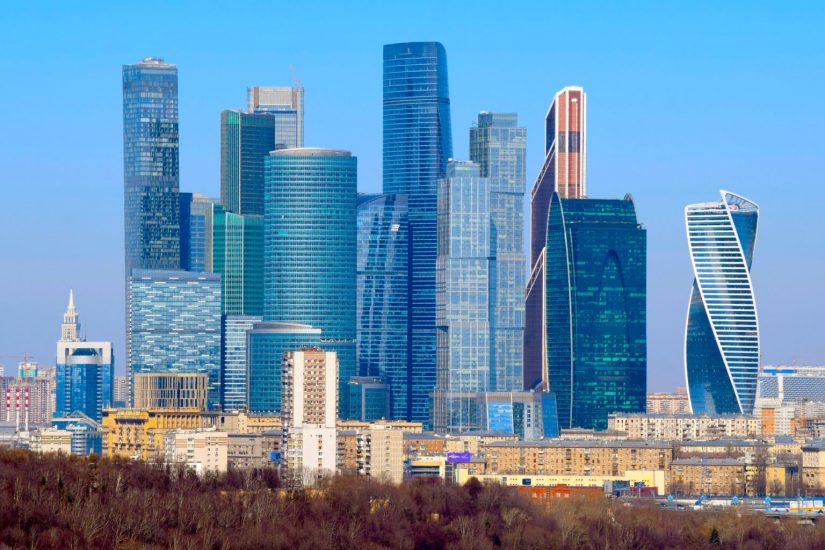
2019 view of Moscow International Business Center. (Dzasohovich, CC BY-SA 4.0, Wikimedia Commons)
By Natylie Baldwin | Consortium News | June 3, 2020
A common response in the Anglo-American media to Russia’s counter-sanctions against agricultural imports from the United States and EU in 2014 was that Russians would go hungry and were, therefore, shooting themselves in the foot. Within a matter of days of the announcement, however, numerous Latin American countries, namely Argentina and Brazil, got in line to fill the gap, as well as China, which started selling produce directly to Russia.
More importantly, according to the Food and Agriculture Organization, Russia ranked as one of the top three producers in the world for a range of agricultural products at the time, from various fruits and vegetables to grains, potatoes and poultry. As of 2018, it was the world’s top exporter of wheat. The government has also had plans in place since 2013 to significantly boost the country’s already respectable production of organic produce from small farms and gardens.
Natural Society reported in May 2014 that 35 million Russian families are growing an impressive percentage of Russia’s fruits and vegetables on 20 million acres:
According to some statistics, they grow 92% of the entire countries’ potatoes, 77% of its vegetables, 87% of its fruit, and feed 71% of the entire population from privately owned organic farms or house gardens all across the country. These aren’t huge Agro-farms run by pharmaceutical companies; these are small family farms and less-than-an-acre gardens.
By autumn 2017, Vladimir Putin had publicly set a goal for Russia to become the world’s top producer and exporter of organic agriculture. In the summer of 2018, the Russian president signed legislation creating official standards, labeling and certification procedures for organic products produced for commercial sale in Russia that went into effect in 2020. Government support will be available to organic farmers, and a public registry will be created listing certified producers.
The agricultural sanctions created some immediate problems, mainly temporary shortages of some meat products and price increases due to the need to work out infrastructure issues to accommodate imports from countries at greater distances.
But Russians did not go hungry, as I witnessed plenty of food in markets, from street vendors, and in restaurants in all cities I visited during my trips in 2015 and 2017. There was, however, concern over price increases.
Author Sharon Tennison, who has traveled throughout Russia extensively since 1983, reported the general attitude of most Russians toward Western sanctions during her trip to Moscow and St. Petersburg in September 2014:
The general outlook of Russians I spoke with is one of quiet confidence, saying that sanctions will turn out good for Russia in the long run––that Russia must become self-sufficient––remarking that Russia became infatuated with foreign products in the 1990s. At that time they felt Russia didn’t need to manufacture high-end products that they could purchase them from other countries. However, the situation has changed. Today production has become the “in” discussion wherever one goes. The sanctions have helped bring this about. Several Russians remarked that they hoped the sanctions lasted for three years or more, since that would give Russians sufficient time to learn to manufacture formerly imported items themselves. The Russian government is offering financial support to entrepreneurs who are ready to move into consumer production.
Sanctions Imposed
In March of 2014, the U.S. and the European Union (EU) began imposing sanctions on Russia in retaliation for its “annexation” of Crimea. These initial sanctions were largely comprised of asset freezes and visa restrictions on certain Russian officials. As the situation in Eastern Ukraine escalated, with rebels taking over local government buildings and demanding autonomy from what they perceived as a coup government in Kiev, the list of individuals targeted for sanctions grew.
After the downing of the Malaysia Airlines flight MH-17 in July 2014, the west imposed more wide-ranging sanctions, which included several Russian banks as well as the defense and energy sectors. In March of 2018, there were diplomatic “sanctions” (expulsions) for the alleged Skirpal poisoning, which Russia responded to with its own expulsions. That same month, there were business/personal sanctions against a number of Russians for their alleged interference in the 2016 elections.
In order to provide the most accurate and comprehensive assessment of the effect of Western sanctions on Russia over the past five years, University of Birmingham professor Richard Connolly, in his 2018 book, “Russia’s Response to Sanctions: How Western Economic Statecraft is Reshaping Political Economy in Russia,” describes how Russia’s economy actually works in order to provide a contextual framework for understanding the success or failure of the West’s policy. He concluded that the ultimate effect of the sanctions is likely not what was intended by Washington policymakers.
Economy with Four Sectors
Connolly explains that the Russian economy can be divided up into roughly four sectors.
Sector A generates revenue, or “rents,” in the form of taxes, fees and other benefits that support Sector B. Sector A is comprised largely of fossil fuel and mineral extraction industries but also includes large “agricultural conglomerates,” manufacturers of nuclear power generation equipment, and some defense industry manufacturers. Economic actors in Sector A are highly profitable and competitive in the global market, into which they are successfully integrated. The state also plays a strong role in Sector A industries either through significant ownership stakes, as is the case with Gazprom, Rosneft, and Rosatom, or through strong personal ties among private owners and the political class, as is the case with Lukoil and Novatek.
Sector B is comprised of economic actors that are dependent upon the rents generated by Sector A. This includes companies that are generally not competitive globally and provide goods and services to the domestic market rather than for export. Despite state assistance, they do not always generate consistent profits. Examples include automotive manufacturing, shipbuilding, fossil fuel equipment and some defense manufacturing. Other beneficiaries of Sector A include state bureaucracy workers and pensioners. It is estimated that Sectors A and B together comprise around 70 percent of the Russian economy.
Sector C is independent of Sectors A and B and includes large construction companies, retail and business services, and various small- to medium-sized enterprises (SMEs) in retail, transportation, business support and communications technology. Because these businesses are outside of the Sector A and B relationship, they’re dependent upon successful profit-making and tend to encourage more competition, innovation and productivity, though they are vulnerable to various forms of outside corruption and unfair takeovers. One successful example of a Sector C industry that enjoys significant and growing export rates is computer software.
 The last sector is the financial sector, which, as Connolly points out, developed virtually out of nothing over the past three decades into a system of numerous, largely state-owned or state-influenced banks that provide a wide range of services. However, Russia’s overall financial sector is small in comparison with other middle-income countries, with Sector A and B entities getting preferential treatment in receipt of the limited credit that is available. There are few small banks or other financial institutions that can provide SMEs with credit, as is reflected in the fact that, as of 2016, two-thirds of assets and liabilities were owned by large state-controlled banks.
As Connolly notes, the obvious disadvantages of this system of political economy are hobbled competition, innovation and productivity. It also limits the development of SMEs.
The advantages, however, include support of domestic employment and the funding of social programs. Perhaps most importantly, this system has also enabled the Russian state to cushion the country from the worst potential effects of Western sanctions and even encourage the stimulation of alternative economic investment, which has strengthened agriculture and some industry and finance.
In terms of how Russia responded to Western sanctions, Connolly provides the following summary:
The Russian response was multifaceted and included the securitization of strategic areas of economic policy, a concerted effort to support import substitution in strategic sectors of the economy, and vigorous efforts to cultivate economic relations with non-Western countries, especially in Asia.
Policy of Diversification
Securitization officially justified certain policies using national security and subordinating certain other objectives in the economic realm that might be prioritized under “normal” circumstances. In order to increase Russia’s economic independence or sovereignty, policies of import substitution and “diversifying” its range of foreign economic partners and the extent of those relations were implemented.
Import substitution involved increasing the proportion of goods and services in Russia that were produced domestically. As an official policy, it was begun in earnest after the imposition of Western sanctions. By 2015, the government was providing federal budget funding, facilitation of loans and access to state procurement funds as well as institutional support to specific sectors of the economy, which included the provision of legal and regulatory frameworks for such policies. In 2016, a plan was presented by Russia’s minister for industry and trade that encompassed “2,000 projects across nineteen branches of the economy. These projects were to be carried out between 2016 and 2020.”
By early 2018, there were 2,500 projects worth $38 billion that were to be completed by 2020. The areas of priority for industrial manufacturing included power equipment, oil and gas equipment, machine tool and civil aviation manufacturing, and agricultural machinery, all of which had import levels between 50 percent and 90 percent.
Gains in domestic food production were seen quickly as Russia became the world’s No. 1 supplier of wheat in early 2018, subsequently capturing over half of the world’s market. Wheat exports continue to increase; sales to other nations increased by 80 percent during the first half of 2018 over the same period in 2017.
Diversifying foreign economic relations is pretty self-explanatory, and in this case it focused heavily on countries in Asia such as China, India, Vietnam and South Korea, as well as Turkey and Latin America. Connolly points out that Russia did not present this as a “zero-sum” action and still conducts most of its trade with various European countries (46 percent of exports and 38 percent of imports). This fact should be considered when assessing the credibility of accusations against Putin that he wants to destroy the EU.
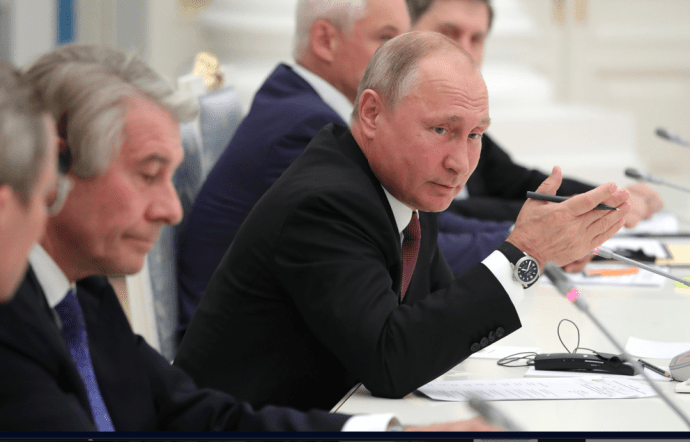
President Vladimir Putin meeting with German business executives, Nov. 1, 2018. (The Kremlin)
China, however, has now become Russia’s single largest trading partner, accounting for 10 percent of Russia’s exports and 22 percent of its imports. But this figure alone does not begin to provide the full picture of Russia’s increasing partnership with Eurasia in general and China in particular.
According to Asia Times correspondent Pepe Escobar, who has been closely following the trend of Eurasian economic integration for several years, what’s known in Russia as the “Greater Eurasia” project was recently presented to the Council of Ministers in Moscow and is now largely accepted as an entrenched foreign policy guide for Russia’s future.
After interviewing three top Russian academics and policymakers who have been championing the Greater Eurasia project for years, Escobar explained that the policy would not preclude continuing a relationship with Europe, recognizing that the Russian elite has been intimately influenced by European culture and trade and technology since the time of Peter the Great, but is meant to be a rebalancing toward the inevitable economic center that will soon be led by Asia and to serve as a “civilizational bridge” between east and west.
The New Silk Road
Situated as it is geographically, Russia is in a perfect position to play this role, serving as a cultural connector between the Enlightenment and the Mongols and as a physical connector between Europe and Asia. In terms of the latter, Russia will play a pivotal role in connecting China’s New Silk Road (aka Belt and Road Initiative, or BRI) through Russia and Central Asia and into Europe.
Escobar writes:
Greater Eurasia and the Belt and Road Initiative are bound to merge. Eurasia is crisscrossed by mighty mountain ranges such as the Pamirs and deserts like the Taklamakan and the Karakum. The best land route runs via Russia or via Kazakhstan to Russia. In crucial soft power terms, Russia remains the lingua franca of Mongolia, Central Asia and the Caucasus.
And that leads us to the utmost importance of an upgraded Trans-Siberian railway—Eurasia’s current connectivity core. In parallel, the transportation systems of the Central Asia “stans” are closely integrated with the Russian network of roads; all that is bound to be enhanced in the near future by Chinese-built high-speed rail.
. . . And all across the spectrum, Moscow aims at maximizing return[s] on the crown jewels of the Russian Far East: agriculture, water resources, minerals, lumber, oil and gas. Construction of liquefied natural gas (LNG) plants in Yamal vastly benefits China, Japan and South Korea.
Iran, Turkey, and India are all pivoting toward Eurasia as well, with a free trade agreement between Iran and the Russian-led Eurasian Economic Union having been recently approved. Iran is also playing a role in the International North-South Transport Corridor (INSTC) to facilitate closer economic cooperation between Russia and India, who have enjoyed cordial relations and strong trade in defense for decades.
But Russia and China’s “comprehensive strategic partnership” — as it is referred to officially by both countries — is much more than economic. In an unprecedented move, China sent 3,000 troops to join Russia in a 2018 military exercise to practice countering NATO in Eastern Europe. In July of 2019, “Russian and Chinese bombers conducted their first long-range joint air patrol in the Asia-Pacific.” To reinforce the strategic importance of Russian-Chinese relations, the day after these maneuvers, the Chinese government published a “white paper” in which it promised to further increase military cooperation between the two countries, partly as a result of the United States’s “undermining” of regional stability.
A former senior national security official in Russia described the relationship to National Interest correspondent Graham Allison as a “functional military alliance.” Allison elaborated that “Russian and Chinese generals’ staffs now have candid, detailed discussions about the threat US nuclear modernization and missile defense pose to each of their strategic deterrents.”
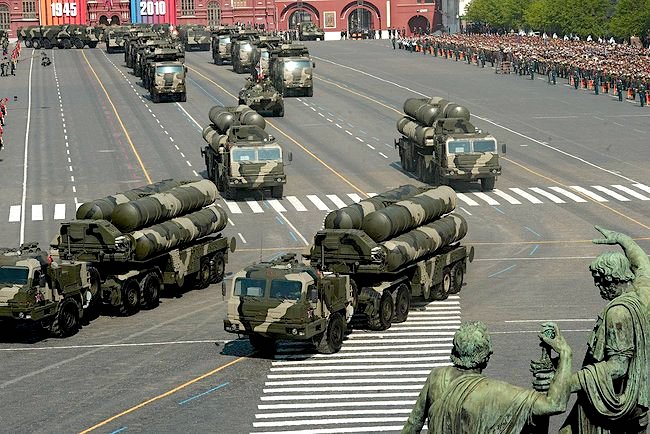
S-400 surface-to-air missile systems during the Victory parade 2010. (Wikimedia)
Allison also reiterated that Russia has lifted its decades-long withholding of advanced military technologies to its eastern neighbor, selling China the S-400 air defense system and partnering in research and development on rocket engines and drones. Furthermore, Russia and China vote the same on the UN Security Council 98 percent of the time, and Russia has supported all Chinese vetoes since 2007.
As evidence that the Russian public will likely support the Greater Eurasia project and Russia’s diversifying of economic partnerships in an eastern direction, recent polling reveals that 69 percent of Russians hold a positive view of China — the exact same percentage that hold a negative view of the United States. Two-thirds of Russians identify the United States as their nemesis, while only 2 percent identify China that way.
Now that we’ve explored how Russia has actually responded to Western sanctions, we can turn to the question of how effective those sanctions have been in terms of what their presumed intent was. As Connolly enumerates, in addition to sending a symbolic message of disapproval of Russia’s actions and to show a united front among Western allies, the intent among some policymakers was to cause significant economic harm to Russia—not just as a deterrent to further “bad behavior,” but with the idea that this would encourage political revolt among targeted Russian elites that would endanger Putin’s government and result in regime change with the installment of a new Russian leader that would be more amenable to Washington’s desires.
The answer is that Washington has once again — in its hubris and ignorance — been hoist with its own petard. As British scholar on Russia Paul Robinson sums up in his review of Connolly’s book:
First, it [sanctions] has created a system that “is less vulnerable to external pressure” than that which existed before, in that it is more independent from the West. Second, it has accelerated a shift in Russia’s place in the global economy towards the East. This obviously has political ramifications which Connolly does not explore. Somewhat perversely, Western sanctions have reduced, not increased, Western leverage over Russia. This is probably permanent.
Moreover, since Russia has weathered the sanctions reasonably well, even using them to strengthen certain sectors of its economy in the long term, the sanctions have likely failed as a tool of deterrence. As Connolly states:
How can policymakers expect sanctions to act as a credible deterrent to third countries when the target country in any given instance might appear to be coping or even flourishing under sanctions? In short, a significant and negative impact on the target economy is a necessary, although not sufficient, condition of sanctions to be effective.
For the policymakers implementing sanctions, it might have been worthwhile to have been briefed by real experts on what Russia’s economy is actually like. If they’d done so, they might have realized that sanctions were likely to have a limited effect on a country that, as analyst Patrick Armstrong has pointed out, has a “full-service economy.” In other words, Russia has demonstrated that it has both the natural and human resources to build sophisticated infrastructure, weapons and defense capabilities, a space station, military and commercial aircraft, heavy trucks and passenger cars, to provide energy and the attendant infrastructure, and to feed its people.
Instead, beliefs that Russia is a “gas station posing as a country,” or that it was still somehow frozen in the 1990s, underpinned policy decisions that ultimately failed.
Natylie Baldwin is author of “The View from Moscow: Understanding Russia and U.S.-Russia Relations,” from which this article is excerpted. “The View from Moscow” is available in e-book and print. She is co-author of “Ukraine: Zbig’s Grand Chessboard & How the West Was Checkmated.” She has traveled throughout western Russia since 2015 and has written several articles based on her conversations and interviews with a cross-section of Russians. She blogs at Natyliesbaldwin.com .
‘Wolf Warrior Diplomacy’: Israel’s China Strategy in Peril
By Ramzy Baroud | MEMO | June 3, 2020
Israel’s balancing act that allowed it to reap America’s unconditional and, often, blind support, while slowly benefiting from China’s growing economic influence and political prestige, is already floundering.
Thanks to the heated cold war between the US and Chinese economic superpowers, the Israeli strategy of playing both sides is unlikely to pay dividends in the long run.
Soon enough, Tel Aviv might find itself having to make a stark choice between Washington and Beijing. When US Secretary of State, Mike Pompeo, visited Israel on May 13, two items topped his agenda: Israel’s imminent illegal annexation of Palestinian land and the growing Israeli-Chinese economic ties.
Pompeo communicated his country’s stand on both issues, reflecting Washington’s long-standing policies regarding Palestine and China. In the case of Palestine, as with the rest of the Middle East, Washington seems to adhere to Tel Aviv’s agenda, often to the letter. China is a different story.
Two significant historical examples come to mind: one, is Israel’s attempt to sell China Israeli-made Phalcon airborne radar system, which relied heavily on American technology in the 1990s; a similar event transpired in 2005, this time concerning Israel’s Harpy anti-radar missile. On both occasions, Israel succumbed to American pressure and canceled both deals.
For the Chinese, Israel matters for two different reasons. One, Israel is a strategic stop in China’s Belt and Road initiative, China’s most significant economic project to date, ultimately aimed at turning Beijing into a center of global trade and financial activities. Two, China is hoping to fight the US on its own political turf in the Middle East – partly in response to the American ‘pivot to Asia’ strategy, which was initiated by the Barack Obama administration.
But the world – in terms of political and economic balances of power – after the coronavirus pandemic is likely to prove a different one when compared with previous years. China’s rise has been in the making for many years and the US political retreat and declining global outreach has been quite evident for some time. The isolationist policies of the Donald Trump Administration, coupled with Washington’s many China-related tantrums in recent years, are all indicators of the vastly changing political realities of a once-unipolar world.
A few years ago, Beijing had the time, patience, and resources to play a long-drawn geopolitical game in order for it to challenge the US’s global influence, whether in South America, Africa, or Israel.
The visit by China’s Vice President, Wang Qishan, to Israel in 2018, to “boost business ties”, was part of this Chinese strategy. That visit followed the signing, one year earlier, of the China-Israel Innovative Comprehensive Partnership. As of 2018, China-Israel trade has jumped to $14 billion and has grown exponentially ever since.
China would have been happy to carry on with that strategy for many years to come. Israel, too, would have played along, considering the lucrative financial returns from its China partnership.
Indeed, despite Washington’s warnings against and, at times, explicit demands on Israel to refrain from giving Chinese companies access to fifth-generation infrastructure (5G) projects in the country, Israel labored to make China feel welcomed.
However, the global response to the coronavirus pandemic is likely to change this, as it has already accelerated the cold war between the US and China, pushing the latter to adopt a more aggressive form of diplomacy and pour massive sums into other countries’ economies to help them in their desperate fight against the COVID-19 disease.
The Chinese strategy is predicated on two main pillars: fortifying existing ties and solidarity with China’s allies or potential allies anywhere in the world, while pushing back against China’s foes, especially those who are participating in Washington’s anti-Beijing campaign.
The latter phenomenon is known as ‘wolf warrior diplomacy’. The ‘wolf warriors’ are Chinese diplomats who have, for months, pushed back with unprecedented ferocity against what they perceive to be US and Western propaganda.
“We never pick a fight or bully others,” China’s Foreign Minister, Wang Yi, told reporters in Beijing on May 24, while explaining China’s novel approach to diplomacy. “We will push back against any deliberate insult, resolutely defend our national honor and dignity, and we will refute all groundless slander with facts,” the top Chinese official said firmly.
China’s new aggressive diplomacy, especially if it continues to define the country’s approach to foreign policy in the coming years, is unlikely to permit Israel to maintain its balancing act for much longer.
China’s ambassador to Israel, Du Wei, who was entrusted with implementing Beijing’s soft-diplomacy with Tel Aviv, died in his home only a few days following Pompeo’s visit to the country. Although Wei’s death was not – at least publicly – perceived to be the result of foul play, his absence, especially in the age of coronavirus and ‘wolf warriors’, might signal a shift in China’s approach to its economic and political interests in Israel.
On May 26, under American pressure, the Israeli Finance Ministry denied China a massive $1.5 billion desalination plant contract, awarding it to an Israeli company, instead.
This is the first time that the US has used its political and economic sway over Israel to curb Chinese influence in the country. China must be anxiously watching events unfold, to see if US pressure on Israel will continue to undermine Beijing’s long-term strategy.
The world’s quickly shifting balance of power and the US-Chinese unmistakable fight for dominance is likely to, eventually, force countries like Israel to make a choice, of wholly joining the American or the Chinese sphere of influence. It is all reminiscent of the American-Soviet Cold War, where much of the globe was divided into zones of influence operated by proxy from Washington or Moscow.
Balancing acts in politics only work if all parties are willing to play or, at least, tolerate the game. While this form of politics suited Israel’s interests in the past and was played, quite successfully for years by Israeli Prime Minister, Benjamin Netanyahu, the country’s balancing act is, possibly, over.
Between Washington’s precise demands to Israel to keep Beijing at bay, and the latter’s aggressive ‘wolf warrior’ diplomacy, Israel is facing a stark choice: remaining loyal to a fading superpower or diving into the uncharted waters of an emerging one.
Trump’s Anti-China Hysteria Goes Nuclear
Strategic Culture Foundation | May 29, 2020
The Trump administration’s scapegoating of China over its own disastrous mishandling of the coronavirus pandemic has relied on baseless conspiracy theory, unscientific claims and hyperbole. This week the president’s National Security Advisor went further by comparing the virus outbreak to the Chernobyl nuclear disaster.
In a U.S. media interview, Robert O’Brien repeated baseless claims that China was guilty of a “cover up” in responding to the disease. And he likened it to the 1986 nuclear disaster at Chernobyl in the former Soviet Union where the authorities were also accused of concealing the initial severity of the accident.
O’Brien added: “They unleashed a virus on the world that’s destroyed trillions of dollars in American economic wealth that we’re having to spend to keep our economy alive, to keep Americans afloat during this virus.”
It is a transparent attempt to make China liable for reparations.
The politicization of the coronavirus global pandemic by the Trump administration is unprecedented. It’s not just a feckless, demagogic administration engaging in delusion, denial and China-bashing. A growing bipartisan consensus in Washington is blaming China for having responsibility for spreading a communicable disease. This is in spite of the public record on the timeline of the pandemic and the early response from China and the World Health Organization to alert the rest of the world to potential consequences.
But Trump and his Secretary of State Mike Pompeo have taken the anti-China rhetoric to reckless extreme by leveling unsubstantiated claims that the Chinese government weaponized a virus to inflict damage on the U.S.
This unhinged logic is a dangerous slippery slope towards conflict. By comparing the coronavirus pandemic to Chernobyl, the Trump administration is gas-lighting the American public into viewing China as the source of their woes and all the terrible fallout from the disease. With over 100,000 dead Americans in four months – the world’s leader in this grim toll – and with 40 million American’s unemployed, the Trump administration is cynically seeking to turn public anger against China as a deflection from its own criminal incompetence.
The image of Chernobyl is a handy, if specious, mechanism by which to incite American anger even more against China.
Ironically, this gross distortion of events is willfully propagated by an American president who has made a signature cause against “fake news media”. Trump this week signed an executive order clamping down on social media platforms which he accuses, with some validity, of censoring certain viewpoints such as his claims about voter fraud using mail-in ballots.
Yet these U.S.-owned social media platforms do not “fact check” when it comes to Trump’s much more dubious and incendiary allegations against China. The president and his men have been freely vilifying China for allegedly unleashing the virus, weaponizing the pandemic and wreaking havoc and suffering across the U.S. – without any “checks” by his favored Twitter platform flagging such slanderous nonsense.
It should be disturbing too that Trump’s top National Security Advisor is so bereft of judgement and facts that he makes such an absurd comparison between the biological pandemic and an industrial accident. If this so-called security expert can be so imprudent with facts then it is appalling to consider how other important global issues, such as nuclear arms controls, will be likewise distorted and politicized for self-serving purpose.
Since Robert O’Brien took over the National Security Council from John Bolton at the end of last year it has taken on a noticeably more hawkish stance towards China in what seems to be a career-furthering choice of direction. His Neo-imperialist and “American exceptionalism” views set out in his over-rated book, While America Slept, show O’Brien to be an empty vessel intellectually and having a thoroughly propagandized mind.
Going nuclear over the pandemic is a sure sign that the Trump administration is desperate to replace rational argument with reckless rhetoric. Because it does not have a rational argument.
EU admitted “American-led system” nears its end
By Paul Antonopoulos | May 26, 2020
European Union foreign affairs chief Josep Borrell told a gathering of German ambassadors on Monday that “analysts have long talked about the end of an American-led system and the arrival of an Asian century. This is now happening in front of our eyes.” He said that the coronavirus pandemic could be the catalyst to shift power from West to East and that “pressure to choose sides is growing” for the EU, before adding that the 27-nation bloc “should follow our own interests and values and avoid being instrumentalised by one or the other.”
Borrell said “we only have a chance if we deal with China with collective discipline,” noting that an upcoming EU-China summit this autumn could be an opportunity to do so. “We need a more robust strategy for China, which also requires better relations with the rest of democratic Asia.”
As China, India, Japan, Indonesia and Russia will become some of the world’s biggest economies by 2030, according to Standard Chartered Plc, the 21st century is known as the “Asian Century.” So, the EU has a serious decision to make on whether to continue its hostile approach towards Russia if it wishes to have more straight forward trade access to Asia. Putin has made incentives for colonists to populate the Far East of Russia to boost its small population of under seven million people who live close to China to fully and better engage in the “Asian Century.”
European trade with Asia could be done through the Russian Far East port of Vladivostok and the Trans-Siberian transportation routes, and this would also bypass China’s Belt and Road Initiative. Macron last year made a Facebook post where he said “progress on many political and economic issues is evident, for we’re trying to develop Franco-Russian relations. I’m convinced that, in this multilateral restructuring, we must develop a security and trust architecture between the European Union and Russia.” With Macron emphasizing a European-Russian rapprochement, he then expanded on General de Gaulle’s famous quote that Europe stretches “from Lisbon to the Urals,” by saying that Europe reaches Vladivostok which is near the Chinese and North Korean border.
According to experts China’s foreign investment in the advanced development zone accounts for about 59.1% of all foreign investments in the region. The Russian Far East has a huge investment potential, especially with materials, natural resources, fisheries, and tourism, and China aims to take advantage of the mostly underdeveloped region. The region is not only resource rich, but is strategically located as it borders China, Mongolia and North Korea, and has a maritime border with Japan.
With France’s recognition of Vladivostok and Borrell now acknowledging that the power centers of the world are shifting to the East, the EU has little choice but to make a rapprochement with Russia and end its sanctions regime. In addition, it would be in the EU’s interests not to engage in anti-China actions on behalf of the U.S.
China’s handling of the coronavirus pandemic has meant that it has not only recovered and restarted its economy, but that it engages in large-scale soft power projections by delivering tons upon tons of medical aid to every region in the world and has sent doctors and nurses to the most affected countries. This comes as the U.S. is approaching 2 million cases of coronavirus and over 100,000 deaths. Earlier this month, the unemployment rate in the U.S. reached 14.7% with the Federal Reserve estimating it could reach a high of 25%. Pre-coronavirus data found that 29.9% of Americans live close to poverty while 5.3% of the population live in deep poverty and 11.1% of American households, were food insecure, meaning they had difficulty providing enough food for all people within the house. Despite the growing social and domestic problems in the U.S., it is unlikely that Washington will give up its global hegemony so easily.
But Borrell seems to have little confidence that the U.S. will maintain its global leadership and is now eyeing China and the East as the EU’s new main trading partner. Effectively, as the Anglo World attempts to maintain the Atlanticist dominance, the EU is recognizing that its future lies with Eurasia.
China, Russia can initiate probe of US bio-labs
Washington urged to be transparent with bio-weapons program

By Yang Sheng – Global Times – 2020/5/14
In order to hide the fact that the US is researching on biological weapons, the US will not respond to an international query on its bio-labs, Chinese military experts said, adding that China and Russia could initiate an investigation of bio-labs worldwide at the UN to pressure the US.
The US can’t just claim all reasonable inquiries to its bio-labs as “conspiracy theories,” and when US politicians keep accusing China’s lab in Wuhan as the origin of COVID-19 without providing any evidence, they should respond to the questions on US bio-labs, including the US Army Medical Research Institute of Infectious Diseases at Fort Detrick, analysts said.
China and Russia can initiate an international investigation of all P3 and P4 labs worldwide, including the ones run by the US, at the UN Security Council, and US antiwar groups and media can also pressure Washington to be transparent on the question of its bio-labs, Chinese analysts suggested.
Washington’s unwillingness to support the idea of a protocol to the Convention on the Prohibition of the Development, Production and Stockpiling of Bacteriological (Biological) and Toxin Weapons in order to create a verification mechanism makes one wonder what goals the US seeks to achieve through its overseas bio-labs, Russian Foreign Minister Sergey Lavrov told reporters on Wednesday, TASS reported.
Lavrov said at a news conference following an online meeting of foreign ministers of the Shanghai Cooperation Organization (SCO) on Wednesday that “These [US] laboratories are densely formed along the perimeter of the borders of the Russian Federation, and, accordingly, next to the borders of the People’s Republic of China,” the Xinhua News Agency reported.
Reasonable concerns
Song Zhongping, a military expert and TV commentator, told the Global Times on Thursday that “Russia has repeatedly voiced its concerns to the US about the labs in its neighbors like Ukraine and Georgia, but the US has ignored these concerns. The reason is simple – the US is hiding its bio-weapons program.”
The US has had a very advanced capability to develop chemical and biological weapons since the Cold War, and it had used them in Vietnam, like Agent Orange, which caused serious casualties and harm to Vietnamese civilians and even US soldiers, so it is reasonable for other countries to worry what the US is doing in those overseas bio-labs, said a military expert at a Beijing-based military academy who requested anonymity.
Jin Canrong, associate dean of School of International Studies, Renmin University in Beijing, said the questions that China and Russia raised about US labs are reasonable queries, which are totally different from the groundless accusations and conspiracy theories about the origin of COVID-19 made by some US congressmen and politicians. The US accusations were dismissed by US scientists, including Dr. Anthony Fauci, and intelligence agencies.
“The US must be transparent and respond to international concerns over its bio-labs,” Jin noted.
US self-isolation
In response to US Secretary of State Mike Pompeo’s previous groundless accusation of the Wuhan lab, Chinese Foreign Ministry spokesperson Hua Chunying said at a press conference on May 8 that “According to open records we have access to, China has only two P4 labs, the highest bio-safety level lab, while the US has 13 that are either in operation, under expansion or in planning, according to a February report by the Federation of American Scientists.”
“The US also has 1,495 P3 labs, not including many other labs it built in territories of the former Soviet Union, like in Ukraine and Kazakhstan, and in many other places around the world… the US has been the only country that has blocked the resumption of negotiations on a verification protocol to the Biological Weapons Convention,” she remarked.
Song said “biological weapons research needs to be carried out in the environment and the people that the weapons might be used for. So, Russia and China, as the major strategic competitors of the US, are the targets, and that’s why the US built these labs in countries neighboring its two major rivals.”
“Additionally, building bio-labs overseas can avoid (impact on US territory) in a potential leak accident, and to avoid the legal problems and pressure from US media and antiwar groups,” Song noted.
Song said “if the US wants to launch an international investigation into Wuhan P4 lab, China and Russia can also initiate an investigation at the UN Security Council on all labs capable of researching bio-weapons. Not surprisingly, the US will refuse as it knows it is the one who is really developing bio-weapons.”
If China and Russia, the two influential UN Security Council permanent members, propose the investigation at the UN of all P4 and P3 labs worldwide, most member states will vote for it except the US, and this will embarrass Washington, Chinese observers said.
The Russian foreign minister said at the conference that “For almost 20 years, Russia and most other countries, including China, have been calling for a protocol on the convention that would establish a mechanism to verify and check states’ commitment not to create biological weapons.”
“The US stands almost alone against this initiative. Tensions around the issue have escalated and Washington’s unwillingness to ensure transparency of its military biological activities in various parts of the world raises questions about what is really going on there and what the actual goals are,” The Russian Foreign Minister pointed out.
Lavrov said that the Shanghai Cooperation Organization is preparing an action plan to ensure sanitary and epidemiological safety – specifically bio-safety – with a summit to be held this year in St. Petersburg.
Song noted that “apart from putting pressure on the US, US civilian antiwar organizations and media can also contribute to pressuring Washington to be transparent on its bio-labs.”
Russia, China won’t accept US nuclear superiority
By M. K. BHADRAKUMAR | Indian Punchline | May 23, 2020
Geopolitics has returned with a bang although Covid-19 is still very much around and a ‘second wave’ is also expected. The US President Donald Trump’s arms control negotiator, Special Presidential Envoy Marshall Billingslea said in an online presentation to a Washington think tank on Thursday that the United States is prepared to spend Russia and China “into oblivion” in order to win a new nuclear arms race.
As he put it, “The president has made clear that we have a tried and true practice here. We know how to win these races and we know how to spend the adversary into oblivion. If we have to, we will, but we sure would like to avoid it.”
We are back to the era of the Manhattan Project. The US is rebooting its 75-year old moribund chase of nuclear superiority over its adversaries. Its corollary also appeared on Thursday when the Trump administration announced that it will withdraw from the Open Skies Treaty of 1992 (which was first proposed by US President Dwight Eisenhower in 1955 and was ultimately pushed forward by President George H.W. Bush as a way of promoting stability in Europe after the Cold War ended.)
The Open Skies Treaty came into effect in 2002 with some 34 countries joining it, including Russia of course, which permits each party state to conduct unarmed reconnaissance flights over the others’ entire territories to collect data on military forces and activities under clearly defined rules of conduct as regards the type of monitoring equipment to be used, the procedures and so on.
The reconnaissance / surveillance flights could often be at short-notice so that the spying missions could be mounted faster than a satellite can be moved into position. Equally, the aircraft used are highly specialised and would have on-board observers of the states spied upon. The treaty retained many benefits for all sides and has a wider context insofar as it was a unique confidence-building measure that doubled up as critical underpinning to arms control agreements.
Washington is resorting to the by-now-familiar plea that it is withdrawing from the treaty due to repeated Russian violations of its terms, an argument the Trump administration had advanced last year also while scuttling the INF Treaty of 1987, which banned all of the US and Russia’s land-based ballistic missiles, cruise missiles, and missile launchers with ranges of 500–1,000 kilometers (short medium-range) and 1,000–5,500 km (intermediate-range).
The US will formally withdraw from the Open Skies accord in six months, American officials have said. The news was confirmed by Trump himself midday, followed by a special briefing by the US State Department, kicking off a six-month clock before a formal exit occurs. The move was not a surprise, as Washington had signalled to its European allies toward the end of last year that the US would consider withdrawing.
The Russian Foreign Ministry has reacted that it had not violated the treaty and that a US withdrawal would be “very regrettable”, adding that the Trump administration was working to “derail all agreements on arms control”. The statement said,
“This decision is a deplorable development for European security. This US-initiated treaty is a major component of European security… US security concerns will not improve either and its international prestige is bound to be hurt. The policy to discard the Open Skies Treaty calls into question Washington’s negotiability and consistency. This is a source of serious concern even for US allies. Russia’s policy on the treaty will be based on its national security interests and in close cooperation with its allies and partners.”
Indeed, this is not the first arms control agreement that the Trump administration has abandoned. What we are witnessing is the Trump administration dismantling systematically the entire fabric of arms control inherited from the Cold War era. The keystone of arms control, the New Strategic Arms Reduction Treaty or START agreement, expires in 2021, and there is little enthusiasm in the US for its extension.
The US’ dreams of attaining nuclear superiority over the former Soviet Union proved a chimera. The Trump administration’s enterprise can only meet a similar fate. In the Russian defence doctrine, global stability is riveted on strategic balance and there is no question of Moscow conceding nuclear superiority to the US, no matter what it takes.
A new dimension has now appeared in the pointed reference in the Russian statement to Moscow formulating its policy apropos the US decision on the Open Skies Treaty “in close cooperation with its allies and partners”. It hints at a Russian policy response in coordination with China. If so, the Russian-Chinese entente is being elevated to a qualitatively new level. It may be recalled that on the sidelines of an international affairs conference in Moscow last year, President Vladimir Putin had revealed that Russia is helping China build a system to warn of ballistic missile launches.
Putin added that “this is a very serious thing that will radically enhance China’s defence capability.” The seemingly inadvertent remark was calibrated to signal a new degree of defence cooperation between Russia and China at a juncture when Washington branded both as revisionist powers that challenge US interests globally and must be countered.
The period since October is characterised by growing belligerence in the US force projection toward Russia and China. The Chief of Staff of Russia’s North-Eastern Joint Command Mikhail Bilichenko said in December that US was boosting its activity near the Chukotka Peninsula, “increasing the grouping and practicing, among other things, the landing of an amphibious assault force.”
Earlier this month, a US Navy strike force of the 6th Fleet began operating in the Barents Sea, north of Russia, for the first time since the Cold War, further expanding its portfolio of Arctic operations by aircraft carriers and surface combatants in the past two years. Three Arleigh Burke-class Aegis destroyers – USS Donald Cook, USS Porter and USS Roosevelt along with fast combat support ship USNS Supply (T-AOE-6) are in the Barents Sea to “assert freedom of navigation and demonstrate seamless integration among allies,” according to a U.S. Navy news release.
Similarly, a longer-term struggle between the US and China is at a turning point, as the former rolls out new weapons and strategy in a bid to close a wide missile gap with China. Having got rid of the constraints under the INF Treaty, the Trump administration is planning to deploy long-range, ground-launched cruise missiles in the Asia-Pacific region. According to the White House budget requests for 2021 and Congressional testimony in March of senior U.S. military commanders, the Pentagon intends to arm its Marines with versions of the Tomahawk cruise missile now carried on US warships, It is also accelerating deliveries of its first new long-range anti-ship missiles in decades.
And, in a radical shift in tactics, the U.S. moves are aimed at countering China’s overwhelming advantage in land-based cruise and ballistic missiles. The US Navy maintains a powerful presence off the Chinese coast. The guided-missile destroyer USS Barry passed through the Taiwan Strait twice in April. And the amphibious assault ship USS America last month exercised in the East China Sea and South China Sea. A Reuters Special Report this month quoted a former senior Australian government defense official as estimating, “The Americans are coming back strongly. By 2024 or 2025 there is a serious risk for the PLA that their military developments will be obsolete.”
Beijing has been repeatedly warning that it will not stand by idly if the provocative US force projections continued. In an article last week in the Chinese Communist Party tabloid Global Times, the daily’s editor-in-chief Hu Xijin wrote that China should increase its nuclear warheads to 1,000 “in a relatively short time span”, and to procure at least 100 DF-41 strategic missiles, the country’s fourth-generation and latest solid-fuelled road-mobile intercontinental ballistic missile with an operation range up to 15,000 kilometres.
Hu, a hugely influential opinion maker, argued that it is not sufficient for China to develop adequate nuclear deterrent, since the US government has identified China as its largest strategic competitor, and Washington is “more likely to exert all its power at its disposal to suppress and intimidate China… it is highly likely that it could even take similar risks that led to the Cuban missile crisis.” Therefore, China needs to possess such power that prevents the US politicians from “gambling with its nuclear armament and harming China.”
In plain terms, Hu said, if the US tries to subdue China in the Taiwan Straits or the South China Sea, which are its core interests, to considerations that defeating China is necessary for perpetuation of its global hegemony, then “China must fix its nuclear gap with the US.” At a time when Washington sharply increases its investment in nuclear arsenal armament as the “cornerstone of American politics and psychology,” China needs a bigger depot of nuclear weapons.
The post-Covid era is destined to see an acceleration of strategic competition between the big powers. The existing strategic conventions are being jettisoned and new weapons systems are being developed, such as very high-speed, hypersonic missiles. Also undermining deterrence is Artificial Intelligence. To tamp down the intensifying geopolitical contestation, a bolstering of the old arms control order would have helped but the opposite is happening.
Plan to spend Russia & China ‘into oblivion’ in arms race will bankrupt only America
By Scott Ritter | RT | May 22, 2020
In a stunning display of arrogance, ignorance, and hubris, President Trump’s new arms control czar threatens to spend America’s adversaries into “oblivion” in any new arms race. But the joke is on him.
Trump’s newly appointed Special Presidential Envoy for Arms Control Marshall Billingslea has breathed new life into an historical interpretation that holds the United States won the Cold War with the Soviet Union by escalating an arms race that turned out to be unsustainable for Moscow, bankrupting the Soviet economy and accelerating the collapse of the Soviet Union as a political entity.
In remarks made to the Hudson Institute, a conservative think tank, Billingslea noted that the threat of a new arms race would be enough to bring both China and Russia to the negotiating table for the purpose of crafting a new trilateral arms control treaty that would replace the current bilateral New START treaty, scheduled to expire in February 2021.
“We intend to establish a new arms control regime now, precisely to prevent a full-blown arms race,” Billingslea said. If, however, either Russia or China (or both) decided to forego negotiations and continue to pursue new strategic nuclear weapons, then President Trump “has made clear that we have a tried and true practice here”.
“We know how to win these races and we know how to spend the adversary into oblivion.”
There are numerous factors that mitigate against Billingslea’s seeming desire to refight the Cold War. First and foremost, the United States, like the rest of the world, exists in a new post-pandemic economic reality. Whether or not the American people or their elected representatives in Congress are prepared to shoulder the costs of an avoidable arms race with Russia and China while on the cusp of an economic depression is very much a debatable point.
Even if the political will for the kind of open-ended spending extravaganza required to “spend the adversary into oblivion” existed (and with 30-plus million Americans currently out of work, and millions more expected to follow, such thinking rests more in the realm of fantasy than reality), it is virtually impossible for the US today to replicate the conditions that existed back in the 1980s. The current Russian and US defense economies of today are a far cry from those that existed during the Cold War, a fact that bodes well for Russia, and less so for the US.
Russian defense industry today is founded on a legacy inherited from Soviet times, when defense industries took precedence over every other aspect of the Soviet economy and attracted the finest scientists and technicians, backed by a virtually unlimited budget. Under former Minister of Defense Dmitry Ustinov, the Soviet ballistic missile production base benefited from a multitude of research and design centers, each connected to its own supporting infrastructure of production facilities responsible for manufacturing diverse components and assembling them into finished products. By 1988, the Soviets had seven different ICBM types deployed. Those were a mix of third-, fourth- and fifth-generation liquid and solid fuel missiles.
While impressive in terms of scope, scale and quality, the Soviet ICBM procurement model was, in the long run, unsustainable. The demands generated by the perestroika reforms initiated by Mikhail Gorbachev beginning in 1985 meant the existing model of multiple design bureaus working in parallel in a virtually competition-free environment had to transition to a missile procurement model driven by cost accounting methods and the limitations imposed by a new era of bilateral strategic arms control agreements.
In the years leading up to the collapse of the Soviet Union, there remained only two missile design bureaus involved in the production of ICBMs. After the fall of the USSR, one of them – Yuzhnoye – fell under the control of Ukraine.
Today, Russia’s JSC Votkinsk Machine Building Plant produces the RS-24 Yars missile, deployed in both a mobile- and silo- based variant, and is developing the RS-26 Rubezh, a modification of the RS-24 capable of deploying the advanced Avangard hypersonic glide vehicle. Votkinsk also produces the solid-fuel RS-56 Bulava submarine-launched ballistic missile (SLBM), its first foray outside of the world of ICBM development and manufacturing. In a sign of the times, the Makeyev JSC in Miass, which formerly only produced SLBM’s, is producing the massive RS-28 Sarmat ICBM, intended to replace the aging R-36 Soviet-era heavy silo-based ICBM.
The new Russian ICBMs are the finest in the world—no nation has anything that can compare, even the United States. They are also among the most cost-effective in the world today. The fact that these missiles are produced in a manufacturing environment plagued by shortages of materials needed to produce critical components is a testament to the resilience of the Russian defense industry, which has literally been forced to both adapt and overcome in the course of the three decades of economically difficult times that have passed since the end of the Soviet Union.
For its part, the US defense industry has been the benefactor of virtually limitless largesse, feeding off a bloated defense budget that has expanded from some $300 billion in 1990 to over $740 billion today. However, over the course of the past 30 years, this money has not been spent on modernizing the US strategic nuclear force. The example of the Minuteman III missiles serves as a point of illustration.
The United States currently deploys a force of 400 Minuteman III silo-based ICBM’s. The original Minuteman ICBM was developed at a cost of $17 billion (measured in 2020-equivalent dollars) over the course of five years. The Minuteman III—the version deployed today—is derived from the same 1960’s technology and was initially deployed in 1970. Originally designed for a lifetime of some 10 years, the Minuteman III has been subjected to a series of life-extension upgrades that will keep it viable until 2030. After this time, the missile must be replaced.
The US Air Force is currently developing a new silo-based ICBM, known as the Ground Based Strategic Deterrent (GBSD). The missile will be designed to last until 2075, and in addition to incorporating new technologies, will also involve significant upgrades to the related silos and launch control facilities. Current estimates published by the US Air Force for the cost of the GBSD are some $62 billion (by way of comparison, the total Russian military budget is approximately $65 billion).
Even this high cost is disputed by the Department of Defense’s Cost Assessment and Program Evaluation (CAPE) office, which projects the actual cost of the GBSD to be between $85 and 100 billion. One of the major reasons for this discrepancy lies in the fact that the United States has not designed a new ICBM since the 1970’s, with the MX Peacekeeper. The final contract for the GBSD is expected to be let in September 2020, although as the only bidder, Northrop Grumman, Inc. is expected to be the awardee. This fact alone makes the CAPE estimate seem overly conservative—Northrop Grumman has developed a well-earned reputation in defense industry circles for projects it is involved in coming in over budget and behind schedule. Based upon current examples of contractual cost overruns, the GBSD costs could skyrocket to $200 billion or so, and this number does not incorporate the negative impact on defense procurement resulting from the failure of Congress to pass a defense budget on time, making long-term procurement decisions impossible and further driving up the cost.
The GBSD is but one of a range of modernization programs being planned by the US, involving every aspect of its strategic nuclear triad. These programs, which include new manned strategic bombers and new missile-carrying submarines, are expected to cost more than $1.2 trillion over the course of the next 30 years—and these are conservative estimates. Given the spectacular budgetary inefficiencies in the US defense procurement system today, it is almost certain that any new strategic nuclear weapons system, whether it be an ICBM, SLBM or manned bomber, will cost the US taxpayer far more than originally planned, and more than likely perform far less than originally designed.
Marshall Billingslea can bluster all he wants about spending an adversary into oblivion. The reality is that the US is not prepared, politically or economically, to engage in any new arms race predicated on open-ended budgetary support.
In the Cold War, it was the Soviet Union playing catch-up to US superiority in the field of ballistic missile technology. Today the tables have been turned. Any arms race will find the US operating from a disadvantage right out of the gate, with Russia already fielding the kind of fifth-generation missiles the US has yet to design, let alone produce.
Scott Ritter is a former US Marine Corps intelligence officer. He served in the Soviet Union as an inspector implementing the INF Treaty, in General Schwarzkopf’s staff during the Gulf War, and from 1991-1998 as a UN weapons inspector. Follow him on Twitter @RealScottRitter
Beijing slaps tariffs on Australian barley; it has had enough of Canberra’s toadying to US on China hostility
By Finian Cunningham | RT | May 20, 2020
The US has counted on Australia’s government and PM as minions in its long-running conflict with China. Now, for Canberra’s dubious services, Australian farmers are reaping a bitter harvest from lost access to China’s vast market.
Beijing announced this week it was slapping 80-percent tariffs on Australian exports of barley. That effectively shuts off China as a market. This followed a ban by Beijing on supplies of Australian beef.
Given that China is the biggest market for Australian agricultural goods, the move is a severe blow, with fears of more curbs on a range of other products, from wine to wool, as well as on the wider sectors of coal and iron ore.
Beijing claims the trade measures are a result of technical issues concerning alleged misuse of subsidies by the Australian government to make its exports more competitive. But that’s doubtless a political cover to mitigate litigation at the World Trade Organization. Realistically, it seems more likely that China has decided to teach Canberra some manners through economic pain.
Despite its reliance on China’s economy, Scott Morrison’s government has shown a spectacular recklessness in enthusiastically adopting the Trump administration’s hostile policy towards Beijing.
At the World Health Assembly conference this week, Australia sided with the US in calling for an inquiry into the Covid-19 pandemic, with the presumption of China’s guilt over a ‘cover-up’. As it turned out, most nations rejected the US-Australian approach and instead backed an international review of the pandemic carried out by the World Health Organization (WHO).
Australia further incensed Beijing by backing US calls for Taiwan to be admitted to the WHO as an observer, which would undermine China’s unitary claims to the territory.
This was but the most recent expression of Canberra’s kowtowing to Washington’s antagonistic agenda towards China.
The Morrison government has been an ardent cheerleader for the Trump administration in its long-running trade dispute with Beijing. In 2018, Australia banned Chinese tech giants Huawei and ZTE from its 5G mobile phone network, reciting Washington’s claims of national security concerns and China’s “malign” interference in internal affairs.
Australia has also backed the US in its stand-off with China over territorial disputes in the South China Sea, echoing Washington’s claims of Beijing’s expansionism and aggression. Last month, Australia sent one of its warships to join US Navy guided-missile destroyers on maneuvers in the contested sea; maneuvers which China views as provocations to its national security.
From Beijing’s viewpoint, Canberra wants to have its cake and to eat it. It relies on China as the top market for its export-led economy, yet at almost every turn has not hesitated to insult Chinese sensibilities by doing Washington’s bidding.
It’s as if the Morrison government seems to resent the fact of Australia’s dependence on China’s economy, while harboring pretensions of superiority by acting wantonly with no regard for Chinese diplomatic respect.
The impression given is that Canberra felt entitled to keep on insulting China with no repercussions.
Now Australian farmers have just lost their most lucrative market, thanks to the Morrison government’s insistence on aggravating Beijing on Washington’s behalf. The impact on the Australian economy could give new meaning to the term ‘Down Under’.
Meanwhile, China can easily find new suppliers of cereal and meat from Russia, Canada, Brazil or the US.
Now there’s a bitter irony, if China were to source farm exports from the US to compensate for the shortfall in Australian supplies. A cruel twist indeed for Aussie farmers, who will foot the bill for Canberra’s toadying to the Trump administration.
Finian Cunningham is an award-winning journalist. For over 25 years, he worked as a sub-editor and writer for The Mirror, Irish Times, Irish Independent and Britain’s Independent, among others.
On the Situation in Hong Kong as US-China Relations Worsen
By Vladimir Terehov – New Eastern Outlook – 19.05.2020
On the card table where modern world politics are played, the state of affairs in Hong Kong remains a barometer which can provide a rough idea of the current trends in relations between the United States and China. Both of these superpowers play a major role in shaping the bigger global picture of today’s game.
That is why NEO has been monitoring how the situation has been developing in the Hong Kong on a fairly regular basis, or the Hong Kong Special Administrative Region of the People’s Republic of China (HKSAR) as it has officially been known since the former British colony became a part of the PRC in 1997. For almost an entire year now, the HKSAR has been gripped by yet another wave of turbulence, which was last discussed after the local District Council elections were held on November 24, 2019 for all 18 of Hong Kong’s District Councils.
Last year’s riots in Hong Kong coincided with another round of bilateral talks between the United States and China to address their trade and economic issues. Both sides were pushing for the talks to end on a positive note, but of course they each had their own definition of a positive outcome.
China is greatly committed to maintaining relations with the U.S. as one of its main foreign trading partners, and ultimately had to acknowledge the grievances voiced by the American side, which stem from the undeniable fact that Beijing has long been earning hundreds of billions of dollars on an annual basis off its trade with the United States.
It was this commitment that tied Beijing’s hands, preventing China from severely cracking down on the Hong Kong protesters, who acted provocatively in open defiance of Beijing on the streets of Hong Kong. From the looks of it, the protesters strangely seem to have gotten away with blue murder or received a purely symbolic punishment.
The situation in the city has stabilized after a coalition of political pro-democratic parties termed “pan-democratic” in Beijing won last year’s elections. They received 85% of the votes from those who turned out to go to the polls. In other words, the crowds from the streets were the force that took to the polls in local communities, who have their own grievances with the Chinese Central Government, although they did not condone the havoc wreaked in their own city by the particularly violent protesters.
You would think that the Hong Kong factor would play much less of a role in bilateral relations between the US and PRC after they signed the trade deal known as the “Phase 1” agreement on January 15 this year following 18 months of negotiations on the aforementioned trade issues. In other words, one would expect the situation on the city’s streets to be fairly calm, when the routine political process stays within the walls of the Legislative Assembly of the HKSAR and the local District Councils and does not spill out onto the streets.
However, almost immediately after the “Phase 1” trade deal was signed, the global coronavirus pandemic came almost out of nowhere, which is having catastrophic consequences in the United States of all places. It is also probably the country where it has been most politicized, mainly due to the upcoming elections in November, when Americans will elect their president for the next term along with a completely new House of Representatives, and a third of the Senate will be contested.
Although Donald Trump’s chances of being re-elected as president and the success of the Republican Party in the Congress elections looked fairly realistic in February this year, the question of who was to blame inevitably arose as the situation with both the coronavirus and the country’s economy deteriorated. On May 8, the level of unemployed or underemployed in the United States had already hit 22.8%, almost as low as the 25% recorded at the time of the Great Depression in 1933.
The average American voter is not likely to go to the trouble of getting to the bottom of this problem and dig up the detailed root causes, including shortcomings that have long existed in the national healthcare system (i.e. they were there before Donald Trump), and the President’s use of the agencies at his disposal to mislead people about how prepared the country was for natural disasters such as epidemics. As approval ratings fall, the ruling Republican party and government is tempted to point to the finger overseas and blame an external factor for causing the outbreak.
America’s main geopolitical rival fit this description. The anti-Chinese propaganda campaign quickly gained momentum in the media and led to concrete financial claims being made for “compensation for various damages” from Beijing. This was followed by thinly veiled threats that the US could cancel debt obligations to China, which America owes more than 1 trillion dollars.
US-China relations have taken another nosedive, and have now hit an all-time low. The difference is that this time Beijing has made it clear that it does not intend to show the same level of restraint it did during the negotiations to secure the “Phase 1” trade deal. The Global Times, a semi-official government publication under the auspices of the Chinese Communist Party’s People’s Daily newspaper, discussed whether China is likely to “dump” its US Treasury holdings, or comply with the terms of the “Phase 1” trade deal and prepare for the “Phase 2” negotiations.
It is certainly no coincidence that when the editor of the Global Times published a brief note around the same time (May 8) on the need to increase China’s nuclear arsenal to 1000 warheads “in a relatively short time”, including warheads to be carried on mobile intercontinental ballistic missiles (ICBMs).
There was a place for Hong Kong on the list of symbolic gestures made to Washington. On April 18, 15 Hong Kong riot leaders who organized and participated in “illegal assembly” on the streets in protests that took place on August 18, October 1 and October 20 last year were detained and later released on bail. In response to the anti-Chinese campaign which immediately took hold in the Western media, the Chinese Foreign Ministry released a statement the next day, saying that “their rhetoric revealed their complicity with rioters who have created chaos in the city”.
On May 6, the Hong Kong and Macao Affairs Office of the State Council gave the “black shirts” a stern warning not to appear on the city’s streets, addressed to the particularly violent protesters who dress in black.
Yet a new cause for a very cautious optimism about relations between the two leading world powers can just about be made out (although it is difficult to remember how many of these there have already been). This glimmer of hope was in the form of a telephone call made on May 8 between the China’s Vice-Premier Liu He, US Treasury Secretary Steven Mnuchin and US Trade Representative Robert Lighthizer.
The last time American and Chinese officials at such a senior level had been in contact was when the “Phase 1” trade deal was signed, and both sides expressed a desire to “make the agreement a success”. For this specific purpose, the decision was taken to set up a special intergovernmental body.
It is worth briefly touching on the advantages Russia could have if tensions between the US and China worsen, which are the subject of frequent debate in the country. To draw on an analogy, it would be like some smart swamp creature hoping that a fight between the two biggest hippopotami will help them survive with less predators around, as they all struggle for a shrinking space in a swamp that is drying up. Sooner or later, the smart guy will be accidentally get crushed, without having even been noticed by the brawling creatures themselves. It would be wiser take time during one of the breaks between rounds to try to convince the hippopotami that both of them will still have something useful to bring to the current geopolitical ecosystem. If they continue to fight to the bloody end, it will destroy the entire ecosystem (to put it politely). That includes all of its inhabitants, including yourselves.
Likewise, Hong Kong will only be able to continue to benefit from its current “special” status within China if China normalizes its relations with the United States. In other words, the attempts made by those young rioters who are fighting for some sort of “rights” to encourage the deterioration of relations between China and the US are in direct contradiction to the interests of the vast majority of the population in Hong Kong.
The main political forces in the HKSAR are beginning to gain a greater understanding of this situation, who do not see any alternatives to maintaining a decent level of cooperation with the mainland in order to find a way out of the difficult situation the city has found itself in due to a number of reasons, and last year’s riots are certainly somewhere on the top of the list.
Whatever the case, the situation in Hong Kong still serves as a barometer and reflects relations between the world’s two leading powers. This is also why the situation there needs to be closely monitored.
Vladimir Terekhov is an expert on the issues of the Asia-Pacific Region.
In a world gone mad, China must build MORE NUKES to make disarmament possible
By Scott Ritter | RT | May 12, 2020
As the US threatens to withdraw from the New START treaty over Chinese non-participation, domestic pressure from inside China builds for a larger strategic nuclear arsenal. Could this be a good thing?
In an op-ed published in Chinese newspaper Global Times, its editor-in-chief Hu Xijin, argued that China should seek to upgrade its strategic nuclear arsenal from its current level of about 200 antiquated weapons to a modernized force comprising more than 1,000 nuclear weapons, including more than 100 modern mobile DF-41 intercontinental ballistic missiles (ICBMs), each armed with 10-12 nuclear warheads, capable of striking the US mainland.
The deployment of DF-41 missiles, when combined with China’s new JL-3 submarine-launched ballistic missiles and nuclear-armed H-20 strategic bombers, would give China a capable nuclear TRIAD that rivaled those of the US and Russia.
While Hu Xijin’s op-ed received considerable support on Chinese social media, there was some pushback. Zhao Tong, a senior fellow in nuclear policy at the Carnegie-Tsinghua Center for Global Policy, based in Beijing, has argued that even in a climate of deteriorating Sino-American relations, any effort on the part of China to build a viable strategic nuclear arsenal on par with that of the US was counterproductive and dangerous.
This point of view has a logic of de-escalation that is inherently attractive, but when viewed in the larger context of global nuclear posture where the US and Russian nuclear disarmament is held hostage by the current non-participation of China in meaningful disarmament talks, any call for China to maintain the nuclear status quo is in itself destabilizing.
The only way to bring China to the table for any meaningful arms control agreement is for it to build up its nuclear arsenal to a level where reciprocal cuts make sense for all involved parties. In short, nuclear symmetry perversely requires that China in effect adopts an “escalate to de-escalate” approach to arms control if disarmament is to have any political viability.
There is a historical precedent for this kind of madness. When the Soviet Union deployed the SS-20 intermediate-range nuclear missile in the late 1970s, it unhinged the strategic nuclear balance in Europe. Both NATO and the US were alarmed and pushed for arms control agreements that eliminated so-called Intermediate Nuclear Forces (INF) from the arsenals of both the US and the Soviet Union. In 1979 the US threatened to deploy advanced Pershing II missiles and Ground-launched Cruise Missiles (GLCMs) into Europe to offset the threat posed by the SS-20 missiles. The problem, however, was that while the SS-20 missile was a reality, the Pershing II/GLCM weapons were still in development stage and had yet to be deployed. From a purely political perspective, there was no incentive for the Soviets to get rid of the SS-20.
Instead, in November 1983, the US and NATO were compelled to go through with the deployment of Pershing II and GLCM missiles to Europe, triggering social and political unrest in the form of massive protests, and placed the US-NATO alliance under considerable stress. Besides, by deploying these new weapons into Europe, the US changed the very calculus of war — the Pershing II, once launched, was less than 10 minutes flight time from Moscow, reducing the time the Soviet command would have to react in a time of crisis regarding the initiation of a general nuclear war.
In the end, the US and the Soviet Union signed the INF Treaty, eliminating the SS-20, Pershing II, GLCM and other nuclear delivery systems, and in doing so heralded a new age of relations between the two sides that helped bring about the end of the Cold War. But the world had to be led to the edge of a nuclear abyss before reason could prevail.
Today the US and Russian strategic nuclear arsenals are capped at 1,550 nuclear delivery systems each by the limits set forth in the New START Treaty. While both sides recognize the desirability of additional reductions, the insistence on the part of the Trump administration that any future arms control agreement on strategic nuclear weapons must include China has thrown a monkey wrench in an arms control process which for decades has been governed on the basis of US-Soviet/Russian bilateral agreements. Even something as simple as extending the existing New START treaty for five years in order to buy time for the complexities of transitioning bilateral arms control structures into a new trilateral reality is unacceptable to Washington.
As insane as it might appear, the Trump approach might provide the only viable path forward regarding the possibility of meaningful trilateral arms control between the US, Russia, and China. As things currently stand, the failure to extend New START will eliminate constraints on the part of both the US and Russia when it comes to fielding new strategic nuclear weapons. This alone is a destabilizing and dangerous reality which, left to its own devices, could lead to a new nuclear arms race which would make those of the Cold War pale in comparison in terms of capability and lethality. The wild card in this equation is China. As things currently stand, the small size and relative lack of sophistication of China’s existing strategic nuclear arsenal make it a virtual non-player when it comes to discussions of symmetrical disarmament based upon historical TRIAD constructs (where strategic nuclear capability is spread among manned bombers, land-based ICBMs, and submarine-launched ballistic missiles.)
China’s current nuclear force structure is heavily weighted toward intermediate-range missiles. However, any nuclear modernization program that saw China develop a viable TRIAD-based nuclear deterrence capability would not only compel both Russia and the US to take into account a Chinese strategic nuclear threat when building their respective post-New START nuclear force structure, but also create real political incentive on the part of all three nations to take the off-ramp from a path of nuclear posture escalation and instead embrace the de-escalation of trilateral arms control.
This, of course, is not the ideal situation. Trillions of dollars will be expended by all three parties pursuing weapons whose only utility is to create the conditions for their eventual elimination. But nuclear policy historically has not been the purview of sane and rational thinking — one only needs to refer to the deterrence model of “mutually assured destruction (MAD)” to make that point.
In the early 1980s both the US and the Soviet Union knew that to escalate tensions by deploying new INF weapons into Europe was an inherently dangerous gambit. Indeed, on at least one occasion it nearly triggered a general nuclear war. But in the end, it was the only politically viable path toward eventual disarmament and the normalization of relations between the US and the Soviet Union.
In the dangerous waters of a post-New START world, perhaps the only way to navigate clear of the rocks and shoals of nuclear conflict is for China to escalate its development of a viable strategic nuclear force in order to enable the kind of meaningful trilateral strategic nuclear arms control the world needs to survive.
Scott Ritter is a former US Marine Corps intelligence officer. He served in the Soviet Union as an inspector implementing the INF Treaty, in General Schwarzkopf’s staff during the Gulf War, and from 1991-1998 as a UN weapons inspector. Follow him on Twitter @RealScottRitter
Featured Video
The Truth About the Trump Shootings with Ken Silva
or go to
Aletho News Archives – Video-Images
From the Archives
Trans ‘milk’ as good as the real thing – NHS
RT | February 18, 2024
The drug-induced nipple secretions of trans women are as good as mothers’ breast milk for babies, the University of Sussex Hospitals NHS Trust claimed in a letter to campaigners made public in a report by British think tank the Policy Exchange on Sunday.
The healthcare trust’s medical director, Rachel James, argued that the off-label prescription drug cocktail men transitioning to female take in order to produce milk was “similar to the natural hormones which encourage lactation to develop when the baby is newly born.”
“The evidence which is available demonstrates that the milk is comparable to that produced following the birth of a baby,” James wrote in the letter, sent to Children of Transitioners last August.
Biological men who wish to lactate must first take hormones to grow milk glands and then take high doses of either domperidone or metoclopramide to stimulate milk production. Neither drug is approved for this use, though they are occasionally prescribed off-label to biological women who have trouble lactating.
However, domperidone’s own manufacturer, Janssen, warns patients the drug “may cause unwanted side effects affecting the heart in a breastfed baby” and “should be used during breastfeeding only if your physician considers this clearly necessary.” … continue
Blog Roll
 Aletho News
- Seyed M. Marandi: U.S. Strike Imminent – Toward Total War in the Middle East
- Russia Voted Under Fire. Washington Is Loading the Tankers.
- 12 Things Your Oncologist Was Trained Not to Tell You
- Anthrax Attacks Paved Way for COVID-Era ‘Junk Drugs and Vaccines’
- How Real Is the Impact of Western Sanctions on Israel?
- France, You Are Guilty: How Paris Turned Western Sahara into the Maghreb’s Powder Keg
- 2025 Nature Paper Claiming Worsening Global Drought Gets RETRACTED …Heavily Flawed
- Your Milk Is Not the Problem
- The Truth About the Trump Shootings with Ken Silva
- ARE PATIENTS BEING PROPERLY INFORMED ABOUT OZEMPIC?
- If Americans Knew
- Salah Sarsour’s Legal Team Says DHS Has Not Met Its Burden to Prove He Is Deportable
- An analysis of tax forms by The Intercept show Kraft’s charity and LLC have donated to Friends of the IDF and AIPAC’s super PAC.
- Israeli attacks kill four Palestinians in Gaza – Daily Update
- Inside Gaza’s death trap of collapsing, bombed-out buildings
- The everyday items Israel bans from Gaza every day
- Inside the siege, the ruined buildings of Gaza – Daily Update
- Debunking The Claim That Macklemore Has A “History Of Antisemitism”
- CPJ demands release of arrested Palestinian-US journalist near Bethlehem
- Robert Kraft: The Billionaire Friend of Netanyahu Pulling The Strings Behind the Macklemore/Ed Sheeran Blow Up
- Columbia Administered Fund Gives Big Money to Pro-Israel Groups
- No Tricks Zone
- 2025 Nature Paper Claiming Worsening Global Drought Gets RETRACTED …Heavily Flawed
- New Study: ‘Global Drought Shows No Detectable Recent Acceleration Under Climate Warming’
- Economic Masterminds: German Socialists Suggest Taxing Productivity Gains Stemming From Using AI
- The South China Sea Has Not Been Cooperating With The Climate Change Narrative
- Energy Crisis: Germany Enters Heating Season With Historically Low Gas Reserve Fill Levels
- New Study: The Antarctic Ice Sheet Gained Mass From 2020-2024 Due To Staggering Snow And Ice Accumulation
- Study: Ocean Heating Rates From Thousands Of Years Ago ‘Dwarf’ Modern Ocean Heating Rates
- Climate Extremists Target, Attack Large-Scale Power Grid Infrastructure In Germany!
- New Study: Antarctic Ice Melt Has Contributed Less Than 1 Centimeter To Sea Level Rise In The Last 30 Years
- Fear Of Debate: Alarmist German Climate Scientist Calls On Mainstream Media To Discredit Skeptic Voices
 Aletho News