Iran oil revenue dips but future holds bright promises
Press TV – July 15, 2020
The Organization of Petroleum Exporting Countries (OPEC) says Iran’s revenue from total crude oil exports and oil products in 2019 was just over $19 billion, less than a third of the previous year.
According to the organization’s annual report, Iran’s income from selling oil and oil products amounted to 60.5 billion in 2018, while it was $110 billion in 2011.
Iran’s average daily crude oil exports last year were 651,000 barrels per day, of which about 60,000 barrels went to Turkey and the rest to Asia, it said. In 2018, the figure was 1.85, and in 2017 more than 2.1 million barrels per day.
Iran’s oil industry is at the forefront of an economic war with the United States which has pledged to bring Tehran’s crude exports down to zero. The Islamic Republic exported around one million bpd until May 2019, when the United States tightened its sanctions, banning all oil exports from Iran.
The Iranian economy has been carrying on at a relatively steady clip after a period of turmoil when the Trump administration unleashed its most ferocious economic attack on the country in November 2018 with a pledge to sink its oil exports to zero.
According to OPEC, Iran also exported about 285,000 bpd of oil products including diesel and fuel oil last year.
Barring oil products, revenues from Iran’s crude oil exports last year were less than $9 billion, government officials have said.
The OPEC report said Iran’s total oil and non-oil exports reached $69 billion last year, down about a third from 2018.
Early this year, Industry Minister Hossein Modares Khiabani, then a deputy, told an exports quality summit in Tehran that Iran had exported $32 billion of non-oil goods in the 10 months up to January, shoring up its economy amid the unprecedented US sanctions.
“This is like a miracle in the current economic situation of the country,” he said. “Non-oil exports have almost replaced oil exports, and the country is governed by the revenues of the non-oil sector,” he added.
The Trump administration is tweaking the contours of its sanctions regime to put more aspects of the Iranian economy under strain.
In recent months, the US Treasury Department has announced new sanctions against Iran’s air and maritime transport industries, construction, manufacturing, textiles, mining, aluminum, copper, iron and steel industries to hit much of Iran’s economy as well as Chinese companies that have conducted business with Iran.
Iran-China partnership
China has long been Iran’s largest trading partner and the Islamic Republic is one of its major suppliers of oil. US officials have reportedly been working behind the scenes to pressure China into halting all its oil and condensate imports from Iran.
But recent reports of an imminent finalization of a roadmap for strategic partnership have put the kibosh on those reports.
On Sunday, The New York Times said the sweeping economic and security partnership would clear the way for billions of dollars of Chinese investments in energy and other sectors, undercutting the Trump administration’s efforts to isolate the Islamic Republic.
The paper said it had obtained details of an 18-page proposed agreement that would vastly expand Chinese presence in banking, telecommunications, ports, railways and dozens of other projects. In exchange, China would receive a regular supply of Iranian oil over the next 25 years, it said.
The partnership — first proposed by China’s leader Xi Jinping, during a visit to Iran in 2016 — was approved by President Hassan Rouhani’s cabinet in June, Foreign Minister Mohammad Javad Zarif said last week.
The deal “represents a major blow to the Trump administration’s aggressive policy toward Iran since abandoning the nuclear deal reached in 2015 by President Obama and the leaders of six other nations after two years of grueling negotiations,” The Times said.
Renewed American sanctions, including the threat to cut off access to the international banking system for any company that does business in Iran, have prompted Tehran to turn to China, which has the technology and appetite for oil that Iran needs.
China gets about 75 percent of its oil from abroad and is the world’s largest importer, at more than 10 million barrels a day last year.
The Chinese investments in Iran would reportedly total $400 billion over 25 years. China will invest $280 billion developing Iran’s oil, gas and petrochemicals sectors. There will be another $120 billion investment in upgrading Iran’s transport and manufacturing infrastructure.
Such an infusion would certainly help to revive Iran’s economy and create more jobs, according to Shireen Hunter, an affiliate fellow at the Georgetown University Center for Muslim-Christian Understanding.
“A major reason for Iran’s shift towards China and other Asian countries, known locally as the ‘pivot to the East’, has been the failure of Iran’s repeated efforts, beginning with the administration of Ayatollah Hashemi Rafsanjani, to expand economic relations with the West as a prelude to better political ties,” she wrote on the Middle East Eye news website.
Hunter cited the latest of Iran’s offers after the signing of the nuclear deal in 2015, including for buying Boeing and Airbus aircraft and welcoming American and European companies such as Total into the country – to which the West responded negatively.
“If the Iran-China agreement is implemented, it would revive Iran’s economy and stabilize its politics. Such an economic and political recovery would improve Iran’s regional position and perhaps incentivize adversaries to reduce tensions with Tehran, instead of blindly following US policies. Arab states could rush to make their own special deals with China,” she wrote.
“By pursuing an entirely hostile policy towards Iran, the US has limited its strategic choices in Southwest Asia and thus been manipulated by some of its local partners, such as Saudi Arabia and the UAE. China’s more pronounced interest in Iran should alert the US to review its past approach towards Tehran,” she added.
India should not participate in Washington-led anti-China coalition
By Lucas Leiroz | July 13, 2020
For years, the US, Japan and India have maintained Malabar military exercises on an annual basis. As the US and Japan are absolutely aligned countries and India is a Washington regional strategic partner, the common objective of the three participants is to face the Chinese advance and to strengthen a coalition against Beijing and its presence in the Indian Ocean. Now, with the increasing of tensions between China and the United States for naval supremacy and between China and India for territorial reasons, Malabar exercises take on a new dimension, being the moment of greatest risk of war in the region in recent years.
Since 2017, Australia has asked to join Malabar naval exercises. The US and Japan have already voted in favor of the Australian participation, but India has not allowed it – the US, Japan and India are the permanent members of the tests and the adherence of a new country depends on a unanimous vote. There was a logistical disagreement between India and Australia, which prevented them from reaching a consensus on the execution of the exercises. In June, both countries signed a mutual logistical support agreement, thus removing the obstacle to Australian participation. Now, as the impasse with China increases, India can change its vote and finally approve Australian participation. The result would be an even stronger coalition scenario against China, which would certainly respond accordingly.
Beijing will not allow its oceanic region to be the target of powerful military exercises by enemy powers without offering high-level war tests in return. China has recently reached an advanced stage of naval military power, practically equaling American power by crossing the International Date Line. In addition, China has significantly increased its military campaign in the South China Sea and has built a large fleet for the Arctic. It is this adversary that the Malabar coalition is facing when promoting a siege in the Indian Ocean. So, what will happen if China invests even more in naval power, modernizing its Navy and devoting itself to a military strategy focused on maritime defense?
On the other hand, Beijing’s reaction may be different and even more effective: investing in Sino-Pakistani military cooperation to affect India. If China and Pakistan start joint naval exercises in the Indian Ocean, a coalition dispute will form, in which both groups will begin a series of regular tests and demonstrations of strength, seeking to intimidate each other.
In all scenarios, a central point is inevitable: the increase of tensions and violence in the Indian Ocean. Perhaps this is, in fact, the American desire in the region, taking into account that the increase in the crisis will inevitably forge the strengthening of the anti-China coalition and its ties with Washington, in addition to encouraging regional reactions from the Chinese Navy and delaying Beijing’s global projections – like the Chinese presence in the Arctic, for example. Having been subjected to the American naval umbrella for decades, Japanese and Australian participation is predictable and it is not surprising that Tokyo and Canberra support aggressive operations against China in the Indian Ocean. However, the same cannot be said about India.
India should not be part of a Washington-led coalition against China. The rivalry between India and China is different from the dispute between the US and China, and the mere fact that Beijing looks like a “common enemy” does not justify a coalition. China and India have an historic dispute of a territorial nature – a regional conflict over a physical, continental space. This is different from the American quest for global hegemony – to which China poses a threat today. China and India have much more in common than opposites: both are emerging Asian nations, with enormous growth potential and which aim to increase their degree of participation in the international scene, at the economic and geopolitical level. Washington, in this sense, is against both – because it seeks to preserve unipolarity and the American global dominance. Beijing and New Delhi can reach a common agreement sovereignly, with regional negotiations and bilateral diplomacy, as, in fact, they have been doing recently, resulting in the reduction of the border violence and the evacuation of troops.
By maintaining its participation in the exercises and encouraging the growth of the coalition, India will be making a big mistake – both in its relations with China and in its relations with Pakistan. Japan and Australia are nations willing to collaborate with American hegemony – India is not. The best path to be taken by the Indians is the abdication from the Malabar exercises, or, if it is not possible, at least, to prevent the Australian entry again, avoiding the strengthening of the anti-China alliance.
Lucas Leiroz is a research fellow in international law at the Federal University of Rio de Janeiro.
Russia supplies first shipment of Arctic oil to China
RT | July 13, 2020
Russian energy giant Gazprom Neft has started supplying crude from its Novy Port Arctic oil field to China. The first batch amounting to 144,000 tons of crude was delivered to Yantai port, the company announced.
The tanker route from Murmansk to Yantai crosses the Arctic seas and three oceans, and takes 47 days.
“Successful experience in the sale of Arctic oil in the European market and in-depth insight of Asia-Pacific markets allow Gazprom Neft to offer Novy Port oil with a unique year-round logistics scheme to Asian partners,” said Deputy Director General of Gazprom Neft for Logistics, Processing and Sales Anatoly Cherner.
“Taking into account the company’s plans to expand the geography of Arctic oil supplies, the development of cooperation with buyers in China and other countries of the Asia-Pacific region is of strategic importance for us,” he added.
Gazprom Neft started exporting oil produced in the Russian Arctic in 2013, having delivered more than 40 million tons to European countries. Blend varieties include ARCO (Prirazlomnoye field) and Novy Port (Novoportovskoye field).
With its 250 million tons of reserves, Novy Port oil field is one of the largest oil and gas condensate fields in the Russian Arctic. It is located on the Yamal Peninsula. A new grade of crude called Novy Port is produced at the field.
To supply oil from the Arctic fields, Gazprom Neft uses a unique transport and logistics scheme that ensures year-round export at minimal cost. It includes the Prirazlomnaya oil production platform, the Arctic Gates oil terminal in the Gulf of Ob, a reinforced ice-class tanker fleet, including LNG-fuel vessels, escort icebreakers and an offshore oil shipment terminal in Murmansk. Efficiency and safety is ensured by the world’s first digital Arctic logistics management system, called “Captain.”
Iran slams ‘flurry of disinformation’ about potential China deal
Press TV – July 11, 2020
A senior Iranian foreign ministry official has slammed a “disinformation” campaign that seeks to stoke fears about the impacts of a potential agreement between Iran and China.
In remarks published on Saturday, Reza Zabib, a foreign minister aide for South Asia, dismissed “the hypothetical figures” reported in the media about Iran-China Comprehensive Strategic Partnership, saying nothing has yet been finalized about the deal.
“The objective of those who spread this disinformation is to destroy the (bilateral) relations, to prevent the signing of the deal and to pile accusations on the (Iranian) government and system,” said Zabib in an interview with Persian daily Shargh.
The seasoned Iranian diplomat also said that scaremongering about the deal is an attempt by certain political elements inside Iran to extract information about the deal and to force the Iranian government to disclose more information about the ongoing talks with China.
He said that Iran and China are now in agreement about at least 75 percent of the terms of a draft deal that was proposed by Iran during a visit to Beijing last year by Iranian Foreign Minister Mohammad Javad Zarif.
Zabib said that the Iran-China Comprehensive Strategic Partnership will allow the two countries to expand ties in three main fields of politics, military and economy.
He said that the economic part of the agreement would cover a wide range of areas, including energy, technology and infrastructure.
Zabib’s comments come against the backdrop of criticism suggesting that Iran has offered major discounts on its future sales of oil to China in return for Beijing’s long-term and sizable investment in the country.
Iranian authorities have dismissed the claims while also insisting that the potential deal with China would not be an attempt to offset the failure of a 2015 nuclear agreement involving major Western powers.
Zabib said China has always been a major economic partner for Iran, even at the times of normal relations between Tehran and some Western countries.
Russia, China keep the ‘dragon in the fog’
By M. K. BHADRAKUMAR | Indian Punchline | July 8, 2020
Chinese President Xi Jinping said in a phone conversation today with his Russian counterpart Vladimir Putin that Beijing will “continue to work” with Moscow in “firmly supporting” each other’s efforts “rejecting external sabotage and intervention” so as to “preserve their respective sovereignty, security and development rights, and well safeguard their shared interests.”
This signifies the consolidation of a new template in the Russian-Chinese alliance, which appeared in the most recent months — mutual support to push back at the covert operations by western intelligence agencies to destabilise the internal situation in the two countries.
An quasi-alliance rooted in dynamic economic partnership — trade touched $110 bn last year — and intensifying cooperation and coordination in the foreign policy arena takes a big leap forward, as the two countries join hands to strengthen their political systems. Beijing’s interest to highlight it speaks for itself.
Xi’s phone call to Putin took place in the backdrop of the Russian constitutional referendum and the law on ensuring security in Hong Kong last week. Prima facie, one metaphor is common to them — the “dragon in the fog”, a Chinese concept to portray a strong player in an incomprehensible space who can strike at his competitors at any moment from an unexpected angle.
The metaphor was recently used by a Russian political analyst Alexey Chesnakov (who previously served as a Kremlin aide) to sum up the quintessence of the Russian referendum, which allows Putin notionally to seek two more six-year terms. As Chesnakov put it, President Putin “wants to remain a ‘dragon in the fog’ until the end of his presidency.”
Chesnakov explained that the sheer prospect of Putin remaining in power beyond 2024 would also send an unmistakable signal to the international community that the Russian leader is confident about remaining at the helm of affairs in his country for at least the next decade.
Coming to the Hong Kong legislation too, the leitmotif is the ‘dragon in the fog’. The new law strengthens China’s national unity and territorial integrity. The four categories of criminal offence outlined in the law are: secession, subversion of state power, terrorist activities and collusion with foreign and external forces to endanger national security. In essence, the legislation will keep western intelligence guessing.
The western legal scholars’ principal argument is that the new law weakens the “one country, two systems” principle. But the paradox here is that while western critics put the accent on the “two-systems” part, Beijing estimates that it is the “one-country” leg that has dramatically weakened in the recent years due to the upheaval in Hong Kong.
Beijing had two options to bring about greater harmony — use of force to pull back the “two systems” concept from racing away or, alternatively, strengthen the “one country” part by providing security underpinnings. Beijing opted for the latter course after a great deal of deliberation.
The crux of the matter is that Beijing wants to keep Hong Kong as the financial hub of Asia, while at the same time strengthening the city’s security and stability. Of course, the interference of the western intelligence agencies — primarily British, Australian and American intelligence — to fuel the protests in Hong Kong formed the context.
Hong Kong has a long history of being the base camp of western intelligence agencies in the Asia-Pacific. Much has been written about the western intelligence agencies’ covert operations out of Hong Kong before, during and after the 1989 Tiananmen Square protests in China.
In the case of Russia, too, western intelligence activities are showing signs of making another determined push for a post-Putin scenario in the Kremlin. The West’s calculation is that if Putin were to step down in 2024, he would very soon become a “lame duck”. Like in Hong Kong, western intelligence has developed extensive networks within Russia through which it is feasible to fuel unrest if political uncertainties coalesce with social and economic grievances. The Russian counter-intelligence is very well aware of this danger.
Putin has outwitted the western game plan to destabilise Russia. The constitutional amendment allows him to seek another two six-year terms and he intends to keep everyone guessing. Keeping the western adversaries guessing is also what the Chinese security law in Hong Kong hopes to achieve.
The western intelligence operating out of the city henceforth comes under direct scrutiny of Beijing. Recruitment of local agents, planning and mounting operations inside China, or inciting unrest in Hong Kong to weaken China — such covert operations become far more difficult and risky for the US, British and Australian intelligence. Interestingly, Xi used the expression “external sabotage and intervention” in his conversation with Putin today.
Beijing and Moscow have voiced strong support for each other’s moves to strengthen national security. On June 2, Chinese foreign ministry spokesman Zhao Lijian said,
“We note that the national referendum on constitutional amendments, a major event in Russia’s political calendar, is going on smoothly. Results released by the Central Elections Commission reflect the Russian people’s choice. As Russia’s friendly neighbour and comprehensive strategic partner of coordination for a new era, China will always respect the development path independently chosen by the Russian people and support Russia’s efforts to realise lasting stability and promote socioeconomic development.
“We stand ready to work together with the Russian side to act on the consensus reached by our heads of state, deepen all-round strategic coordination and mutually-beneficial cooperation in various areas, and bring greater benefits to our two peoples.”
On the same day, Russian Foreign Ministry spokesperson Maria Zakharova said in Moscow, “We noted the entry into force of the law on ensuring national security in the Hong Kong Special Administrative Region of the PRC on July 1, 2020 by the decision of the Standing Committee of the National People’s Congress of China.
“In this context, we would like to reaffirm that Russia’s position of principle on the situation in Hong Kong remains unchanged. We respect the sovereignty and territorial integrity of the PRC and consider all issues pertaining to Hong Kong to be China’s domestic affair. We are against any attempts by external forces to interfere in relations between the central government and the Hong Kong Special Administrative Region of the PRC.”
Cooperation between the Russian and Chinese security agencies in the realm of internal security can only stem from a high level of mutual understanding at the highest level. Significantly, on July 4, Russian Deputy Foreign Minister Sergei Ryabkov poured cold water on President Trump’s invitation to Putin to attend a G7 summit in the US, calling it a “flawed” idea.
Moscow has any number of legitimate reasons to distance itself from Trump’s invite, but what Ryabkov chose was very telling. He said, “The idea of the so-called expanded G7 summit is flawed, because it is unclear to us how the authors of that initiative plan to consider the Chinese factor. Without China, it is just impossible to discuss certain issues in the modern world.”
In effect, Rybakov thwarted Washington’s move to isolate China. Trump’s advisors were naive to estimate that Moscow could be baited to join its containment strategy against China. Ryabkov publicly administered the Kremlin’s snub.
China says will join arms control talks if US reduces nuclear arsenal
Press TV – July 8, 2020
China says it would be happy to participate in negotiations on arms control with the United States if Washington was willing to reduce its nuclear arsenal to the same level as Beijing.
“I can assure you that if the US says that they are ready to come down to the Chinese [nuclear arsenal] level, China would be happy to participate the next day,” Fu Cong, director general of the Arms Control Department at the Chinese Foreign Ministry, said in a news conference in Beijing on Wednesday.
“But actually, we know that that’s not going to happen. We know the US policy. And we are more realistic, frankly speaking,” Fu added.
Approximately 91 percent of all nuclear warheads are owned by the United States and Russia, each having around 4,000 in their military stockpiles.
It is estimated that China has a stockpile of around 320 nuclear warheads.
Fu said Beijing had no interest in joining trilateral negotiations that involve both the US and Russia.
The US has been calling on China to join trilateral negotiations to extend a flagship nuclear arms treaty between Washington and Moscow that is due to expire in February next year.
China has refused to participate in the US-Russia talks but said it would take part in international nuclear disarmament efforts.
The negotiations in question were on the replacement of New START, a nuclear arms treaty between the US and Russia that has nothing to do with China. By inviting China and anticipating its refusal to participate, Washington had been planning to portray the Chinese government as reluctant to take part in any arms control treaty.
Washington itself, meanwhile, has unilaterally withdrawn from treaty after treaty under US President Donald Trump.
US used media agency to covertly aid Hong Kong protesters, but tell us how ‘foreign meddling’ is a threat to ‘our democracy’
By Nebojsa Malic | RT | July 3, 2020
Even as Washington designated the Chinese media as a hostile foreign agent, its own propaganda agency was funneling money to the Hong Kong protesters. In a fitting twist, this was revealed by partisan leakers with an ax to grind.
“US has been exposed for funding last year’s Hong Kong protests,” declared columnist Alex Lo in the South China Morning Post on Thursday. Lo brings up the revelation that one of the subsidiaries of the US Agency for Global Media (USAGM) had to freeze an estimated $2 million worth of contracts aimed at helping anti-Beijing activists in the southern Chinese city.
The source for this is a recent Time magazine article, relying mainly on anonymous USAGM officials upset about the overhaul implemented by the agency’s new head, Michael Pack, an appointee of President Donald Trump, confirmed by the Senate in early June.
The contracts in question were run through the Open Technology Fund, officially an NGO that funds “open-source internet freedom projects” such as the encrypted-messaging app Signal. All of its funding comes from Congress, just like the National Endowment for Democracy, which spent around $643,000 to “foster civil society” in Hong Kong last year.
Given that whoever pays the piper calls the tune, Beijing sees this as direct US meddling in the unrest in Hong Kong – a territory ruled by the British for over a century before being handed back to China in 1997. The city erupted in protests last spring, over a law that would allow extraditions to the mainland. When demonstrators began waving US and British flags, meeting with US diplomats and getting aid from ‘NGOs,’ they gave China a perfect excuse to pass a new security law.
Now imagine the US reaction if Chinese ‘nonprofits’ funded entirely by the government were funneling money to ‘human-rights’ programs in the US, or Black Lives Matter, or Antifa, or any of the groups going around smashing monuments and torching shops across America over the past month. You wouldn’t have to try very hard, given the actual US crackdown on Chinese phone companies such as Huawei and ZTE Corporation, or the State Department designation of several Chinese media outlets as “foreign missions,” accused of engaging in “propaganda” and not journalism.
To China, this rightly looks like a double standard. Most Americans, however, don’t think twice about it. Of course, the US is allowed to do anything it pleases anywhere it wants, from ‘helping democracy’ via color revolutions to ‘humanitarian’ bombing. It’s the exceptional nation, the greatest country in the world, and so on. Even the activists who condemn it as irredeemably racist and in need of revolution at home, generally have no beef with Washington’s meddlesome foreign policy abroad. How else can one explain the recent political marriage of Democrats and neoconservatives, aimed against Trump?
As part of the campaign by this axis and its media allies, for the past four years, the US mainstream media has incessantly hyped the narrative of ‘Russian meddling’ in ‘our democracy,’ based on evidence-free conspiracy theories and wishful thinking.
Media outlets such as RT figured prominently in this propaganda, with fully a third of the infamous Intelligence Community Assessment of January 2017 – which kicked off the Russiagate madness – dedicated to RT programming. Never mind that it dated back to 2012 and was therefore both obsolete and irrelevant; that wasn’t allowed to get in the way of a good story.
Yet it’s Washington that’s actually meddling, and in places like Hong Kong. In that light, the narratives about ‘Russian’ and ‘Chinese’ interference in the US certainly appear to be a massive case of psychological projection. Perhaps the groups seeking meaningful change in this country ought to address that first.
Nebojsa Malic is a Serbian-American journalist, blogger and translator, who wrote a regular column for Antiwar.com from 2000 to 2015, and is now senior writer at RT. Follow him on Twitter @NebojsaMalic
US government payouts to Hong Kong ‘civil society groups’ revealed after funding freeze

Protesters at a rally in Hong Kong, China September 20, 2019. © REUTERS/Jorge Silva
RT | July 3, 2020
Beijing’s repeated accusations of foreign interference in Hong Kong’s internal affairs appear to have been vindicated, after a government funding freeze exposed US financial support for activists in the semi-autonomous city.
Around $2 million had been earmarked to help Hong Kong activists “evade surveillance by the Chinese government,” according to a recent TIME report. The cash was never delivered though, due to restructuring and cuts at the US Agency for Global Media (USAGM), which allocates federal funds for overseas news and information initiatives, including Voice of America. Some funds had already been paid out, however.
The money was supposed to go towards the Washington-based Open Technology Fund (OTF), which pours cash into internet “freedom” projects around the world. Although officially an independent non-profit, the organization is funded by Congress.
The funding freeze also affected around $500,000 in OTF resources purportedly used to help activists around the world avoid digital attack and detection. Several payouts from this fund were made to groups in Hong Kong since protests began last year.
The OTF also provided $3 million to help develop Signal, the encrypted messaging app used by many Hong Kong protesters. Although the OTF remains largely under the radar, the more prominent National Endowment for Democracy (NED) has also played an active role in Hong Kong. In 2019, the US-funded non-profit spent an estimated $643,000 to aid “civil society” groups in the city. The organization denies that the cash was used to fund demonstrations.
The US government’s financial ties to Hong Kong activists has been something of an open secret. In June, the Electronic Frontier Foundation urged the US government to continue funding the OTF’s overseas projects, stating that the funds were necessary to help “Hong Kong’s democracy movement.”
The US cash pipeline to Hong Kong has prompted some to accuse Washington of clear double-standards when it comes to foreign influence operations.
“Imagine how the American government would react if multiple Chinese state agencies such as Xinhua were exposed secretly helping protest groups across the United States to evade surveillance and crackdowns by law enforcement agencies,” observed South China Morning Post columnist Alex Lo. He speculated that if the roles were reversed, the United States would most likely “threaten China with war.”
Hong Kong protesters have never been shy about their relationship with and admiration for Washington. Last August, a group of leading activists were photographed meeting with a senior official from the US consulate.
A month later, US-flag-waving demonstrators took to the streets of Hong Kong to demand that Donald Trump “liberate” them from Chinese rule.
For months, Beijing has called on the United States to stop interfering in Hong Kong. Well-aware of activists’ foreign patronage, China announced sanctions against NED in December, accusing the non-profit of promoting “extremely violent criminal activities.” For now, the OTF has managed to avoid being slapped with similar restrictions.
China does not approve of further tension over Iran nuclear program: Foreign Ministry

Chinese Foreign Ministry spokesperson Zhao Lijian
Press TV – June 22, 2020
Chinese Foreign Ministry spokesperson Zhao Lijian says his country opposes any measure leading to exacerbation of tensions over the Iranian nuclear program in the wake of the recent adoption of an anti-Iran resolution by the Board of Governors of the International Atomic Energy Agency (IAEA).
“China supports the IAEA in playing its role in an objective, professional and neutral manner in verifying Iran’s compliance with its safeguards obligations. We are against politicizing its work,” Zhao said at a regular press conference on Monday.
He pointed to an explicit announcement by the IAEA that the “safeguards issue is neither urgent nor poses a proliferation risk” and welcomed Iran’s readiness to resolve issues through dialogue and said, “Under such circumstances, China does not approve of actions that artificially exacerbate tensions and escalate the situation.”
He expressed hope that all relevant parties to the international 2015 nuclear agreement, officially known as the Joint Comprehensive Plan of Action (JCPOA), will remain calm, exercise restraint, and support the settlement of issues between Iran and the UN nuclear agency through dialogue and cooperation.
“On the Iranian nuclear issue, China’s unwavering aim is to uphold the JCPOA, multilateralism, peace and stability in the Middle East, and the international order based on international law,” the Chinese diplomat said.
He expressed Beijing’s readiness to work closely with the sides in order to find a “political and diplomatic” way to solve issues pertaining to Iran’s nuclear program.
The Board of Governors at the UN’s nuclear agency on Friday passed the anti-Iran resolution, put forward by Britain, France and Germany – the three European signatories to the JCPOA.
The resolution, the first of its kind since 2012, urges Iran to provide the IAEA inspectors with access to two sites that the trio claims may have been used for undeclared nuclear activities in the early 2000s.
The Islamic Republic rejects any allegations of non-cooperation with the IAEA, insisting that it is prepared to resolve potentially outstanding differences with the IAEA.
Russia and China, two other permanent members of the UN Security Council and signatories to the JCPOA, voted against the resolution.
The Chinese diplomatic mission to the IAEA also warned on Twitter that the resolution could have “huge implications” for the future of the JCPOA.
Iran’s reduction of JCPOA compliance result of US maximum pressure
In response to a question about the E3 foreign ministers’ last week statement on the JCPOA, the Chinese Foreign Ministry spokesman once again stressed the importance of upholding and implementing the nuclear deal as the “only right way” to resolve the Iranian nuclear issue.
Zhao added that Chinese State Councilor and Foreign Minister Wang Yi had recently sent letters to the UN secretary general and the rotating president of the Security Council to emphasize that the JCPOA, endorsed by Security Council Resolution 2231, is an “important outcome of multilateral diplomacy and a key element in international nuclear non-proliferation system.”
“Iran’s reduction of compliance is a result of the US maximum pressure. We urge the US to abandon unilateral sanctions and ‘long-arm jurisdiction’, and return to the right track of observing the JCPOA and the Security Council resolution,” the Chinese diplomat said.
He highlighted the significance of earnestly implementing all provisions in Resolution 2231 and said, “In the meantime, all parties to the JCPOA should take concrete measures to restore the balance of rights and obligations under the agreement.”
Pointing to the withdrawal of the US from the JCPOA, he said Washington “has no right to ask the Security Council to launch the snapback mechanism that allows the re-imposition of sanctions.”
He reminded the trio’s foreign ministers that they have reaffirmed their commitment to keeping the JCPOA in place and implementing Resolution 2231.
“They believe that the strategy of maximum pressure will not effectively address shared concerns about Iran’s nuclear program. As any unilateral attempt to trigger UN sanctions snapback would have serious adverse consequences in the UNSC, they would not support such a decision which would be incompatible with current efforts to preserve the JCPOA,” Zhao pointed out.
He vowed that Beijing would work with the three European parties to the JCPOA and the larger international community to stick to the nuclear agreement and Resolution 2231, uphold multilateralism, and work for the political and diplomatic settlement of the Iranian nuclear issue.
“In the meantime, we will resolutely safeguard our own legitimate rights and interests,” he added.
Iran to react if US prevents lifting arms embargo as per nuclear deal: President Rouhani
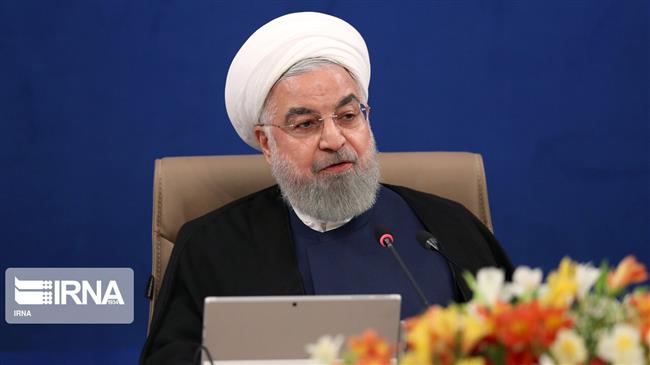
Iran’s President Hassan Rouhani addresses a cabinet session in Tehran on June 14, 2020. (Photo by IRNA )
Press TV | June 14, 2020
Iran’s President Hassan Rouhani says the country will not remain indifferent and will show suitable reaction if the US tries to prevent lifting of arms embargo against the Islamic Republic, which will end this year in accordance with the landmark nuclear deal that Tehran clinched with six world powers back in 2015.
During past months, Washington has stepped up calls for the extension of a UN arms embargo on Iran, which will expire in October under UN Security Council Resolution 2231, which endorses Iran nuclear deal, officially known as the Joint Comprehensive Plan of Action (JCPOA).
The administration of US President Donald Trump has threatened that it may seek to trigger a snapback of all sanctions on Iran if its attempts to extend the arms embargo fail.
The landmark nuclear deal was reached between Iran and the P5+1 group of countries — the US, Britain, France, Russia and China plus Germany — in 2015. However, in May 2018, US President Trump unilaterally pulled his country out of the JCPOA and re-imposed the sanctions that had been lifted against Tehran and began unleashing the “toughest ever” fresh sanctions.
While the US is no longer a party to the JCPOA, it has launched a campaign to renew the Iran arms ban — in place since 2006/2007 — through a resolution at the Security Council, but Russia and China are most likely to veto it.
Addressing a cabinet session on Sunday, Rouhani said, “The termination of the arms ban [on Iran] … is one of the important achievements of the JCPOA and if Americans want to question this achievement, other big countries know what our reaction will be.”
The Iranian president also expressed hope that “all countries who are members of the United Nations Security Council and the Board of Governors” of the International Atomic Energy Agency (IAEA), would be aware of “the US planning with regard to these plots.”
“We, for our part, will be successful in this regard and will weather these plans that the United States has made for Iran,” he noted.
Posting a tweet in early June, Iran’s UN ambassador said the US’ call for an extension of the UN Security Council’s arms embargo on Tehran lacked legal standing in international law.
Majid Takht-e Ravanchi said the US ambassador to the UN “wrongly” believes the US retains the right to initiate snapback of sanctions under the UN Security Council Resolution 2231.
“WRONG: US cannot be a JCPOA ‘Participant’, since Donald Trump ceased US participation,” the Iranian ambassador noted, referring to Trump’s 2018 decision to withdraw his country from the Iran nuclear deal in violation of the Resolution 2231.
In the middle of May, China and Russia also rejected US plans to extend a UN arms embargo on Iran along with a probable push to trigger a return of all sanctions on Tehran at the UN Security Council.
The “US has no right to extend an arms embargo on Iran, let alone to trigger snapback,” China’s UN mission wrote in a tweet.
“Maintaining the Joint Comprehensive Plan of Action is the only right way moving forward,” he added.
Russian Deputy Foreign Minister Sergei Ryabkov vehemently rejected the plan as a “cynical” measure plunging the UN Security Council into crisis.
“The conclusion is that the next crisis in the UN Security Council and the UN as a whole is imminent, taking into account this US stubbornness,” he said, adding, “Washington will not have an easy road here in any case.”
European Union foreign policy chief Josep Borrell said on Tuesday that the US has already pulled out of the international nuclear agreement and cannot currently use its former membership of the deal to seek a permanent arms embargo on Tehran.
“The United States has withdrawn from the JCPOA, and now they cannot claim that they are still part of the JCPOA in order to deal with this issue from the JCPOA agreement. They withdraw. It’s clear. They withdraw,” Borrell said.
The EU believes that the JCPOA plays a key role in maintaining regional and international security and has made efforts to keep the pact alive despite US pressure.
Borrell is tasked with supervising the circumstances surrounding the implementation of the nuclear deal so he can help resolve disputes between its signatories.
‘Go on, don’t be shy, show us!’: Beijing taunts US senator who has ‘proof’ that China’s sabotaging Covid-19 vaccine effort
RT | June 8, 2020
A Florida Senator spectacularly claimed he’s got intelligence proving China is obstructing the West’s search for a Covid-19 cure – He shouldn’t be shy to let the world see the “evidence,” Beijing’s diplomats swiftly quipped.
Rick Scott, who sits on the Senate’s Armed Services and Homeland Security Committees, pulled no punches when talking China on the BBC on Sunday. Apart from being hostile to the US and democracy, Beijing communists are hindering the development of a coronavirus vaccine, and are trying “to sabotage us or slow it down,” Scott alleged.
He said there’s “evidence” substantiating the bombshell claim but repeatedly refused to disclose it, citing vague considerations regarding secrecy – much to the disappointment of anchor Andrew Marr.
The Senator’s media blitz predictably caught Beijing’s eye the following day. Since the BBC host failed to extract the proof, Hua Chunying, a spokeswoman for the Chinese foreign ministry, challenged Scott into lifting the shroud of mystery.
“Since this lawmaker said he has evidence that China is trying to sabotage Western countries in their vaccine development, then please let him present the evidence. There’s no need to be shy.”
In response to Scott’s assertion that Beijing doesn’t want the West to develop the vaccine first, Hua stated during a regular press briefing that the search for a Covid cure isn’t a competition at all.
Previously, China’s Science and Technology Minister Wang Zhigang gave reassurances that his country would make such a vaccine a “global public good” when it finally arrives.
The claim that China is hindering the anti-Covid research effort may well be riding a wave of another theory, one that alleges that coronavirus is man-made and was released from a virology lab in Wuhan, the Chinese city that was the epicenter of the epidemic.
Aggressively pushed by top US officials, the theory was consistently denounced by Beijing which called it an attempt to switch attention from Washington’s handling of its epidemic at home. Certain American allies also doubted the Covid-19 was a human creation, although some pundits suggested a ‘leak’ from the lab could have been accidental.
Why would Australia Want to Worsen its Relationship with China?
By Vladimir Terehov – New Eastern Outlook – 05.06.2020
The following explanation framed as a question could be added to the headline of this article to make it even more informative: “Why would a prosperous country, which has managed to stay above the fray during global political squabbles and to handle the current COVID-19 pandemic wreaking havoc worldwide much better than other nations, voluntarily look for trouble?”
It really has no reason to at present. Why is Canberra all of a sudden so concerned about the origins of the Coronavirus? And what practical value is there in finding out the answer? Once the battle against COVID-19 has been won in all parts of the globe, enough information will have been gathered in order to have a fruitful discussion on the aforementioned topic. At present, there is no reason to make any kind of allegations against China either openly or less directly.
So why would a country, such as Australia with its current standing, wish to get involved in a global conflict (and the COVID-19 pandemic is its focus at present), whose main participants are two world powers, and decide to support one of them? In fact, Canberra chose to back the nation whose actions, in response to the pandemic, are almost completely motivated by its worsening domestic problems. Recently, a possible answer to the aforementioned question was published in the New Eastern Outlook.
And in this report, the author simply wishes to point out that Australian Prime Minister’s very constructive telephone conversation with Mr Trump, followed by discussions with a number of European leaders towards the end of April all seemed to indicate Canberra’s support for the US stance. One of the key issues talked about had to do with an independent investigation into the origins of the Coronavirus and its subsequent spread. And although it would appear that China was not mentioned directly, other phrases, such as “unregulated wet markets”, pointing in the direction of the PRC were.
However, since the end of April, Australia’s stance on the issue has changed. The current view essentially avoids laying blame at China’s door a priori. And in the end, Canberra decided to support a draft resolution prepared by the EU and presented at the 73rd Session of the World Health Organization’s (WHO, a UN agency) World Health Assembly (WHA), held in Geneva from 18 to 21 May.
Over 120 WHO member states (out of the total of 194) backed the more neutrally worded motion, which does not mention China by name, calling for an investigation into the global response to the Coronavirus pandemic. None of the countries voted against the resolution, including the United States.
Still, the previous actions taken by the Australian government, headed by Scott Morrison, in connection with the issue of COVID-19 origins had, of course, not gone unnoticed in Beijing, which, at this stage, decided to apply a bit of pressure on Australia’s “weak spot”. In order to point out what it is, the author will once again need to describe the position Australia has found itself in, resembling a “split”, on the chess board of the Indo-Pacific region.
Overall, it seems quite natural that Australia is drawn to the United States and the Anglosphere in general when it comes to culture, politics and even the defense and security sector. However, its economy, which relies on exports of natural resources and agricultural products, is very much oriented towards China’s market.
Australia’s total export sales for 2019 (with figures typical for the entire decade) can be used to illustrate the aforementioned point. Sales to China accounted for 32.7% of all Australian exports in 2019. Japan ended up in second place, with a 24.7% share, and the United States in 5th position, with a 3.7% one. In addition, exports to China grew by 20 % during 2019. Since trade between Great Britain and Australia started from almost nothing, there was a record growth (of 192%) in sales to the UK that year. Fossil fuels and mineral resources accounted for two thirds of all the exports, while animal products and grains for 5.5%.
In 2019, about 85% “of Australia’s exports by value were delivered to Asian countries”. The figures mentioned thus far should have prompted Canberra to follow foreign policies that would, in general, encourage stability in the region and, in particular, foster good relations with the most powerful country in this part of the world, i.e. the PRC.
However, since 2013, when the center-right Coalition essentially headed by the Liberal Party of Australia won the regularly scheduled federal election and then did it again in 2016 and 2019 thus asserting its dominance, the importance of the role played by the extremity (forming the “split”) directed towards the United States has grown noticeably. As a result, there was an increased focus on opposing China (USA’s key rival) as part of Australia’s foreign policy.
Canberra has grown more and more concerned with territorial disputes in the South China Sea involving the PRC and a number of Southeast Asian nations. And although the United States is situated on the other side of the planet, it is becoming increasingly involved in these conflicts. In the most evident display of solidarity with Washington to date, a squadron of Australian naval ships sailed to the South China Sea (to clearly send a message to Beijing) in autumn of 2017. Australian media outlets gave the group of vessels a tongue-in-cheek name of “small armada”.
Still, during bilateral negotiations conducted at various levels, Canberra has always managed to convince the Chinese leadership that there is nothing better than Australian coal, iron ore, crude oil, liquefied natural gas, barley and beef on the global markets. A visit to Beijing by an unusually numerous delegation, headed by the Prime Minister at the time, Malcolm Turnbull, in spring 2016 proved to be a milestone for both nations.
Incidentally, the then Treasurer and now Prime Minister of Australia, Scott Morrison turned out to be the most “convincing” member of this delegation. And two months after he had taken on the current role in August 2018, Scott Morrison sent Foreign Minister Marise Payne to Beijing with an essentially conciliatory message.
Something tells the author that, after a while, once the current highly politicized Coronavirus crisis is (hopefully) somehow dealt with and as the next federal election (in spring 2022) draws near, we could expect a visit to Beijing (for “an edict from on high”) by a no less impressive delegation than the one in 2016 from the government, headed by the Liberal Party of Australia.
After all, farmers and miner have already started showing their discontent about the consequences of the (clearly poorly thought through) “fight for the truth”, which their own government has been a part of in recent months. During that period, seemingly coincidentally, China’s food safety inspectors began to identify “issues” with the quality of Australian meat and prices on coal, ore and barley imported by China from Australia noticeably decreased.
And even if one does not take into account the effect Scott Morrison’s efforts to find those responsible for the outbreak have had, the Coronavirus crisis has already resulted in the increase in Australia’s unemployment rate to over 6%, in addition, according to current estimates, the nation’s economy will need approximately 2 years to recover from all the COVID-19-related consequences. In fact, in his address to the nation, the Prime Minister said that the rise in unemployment had been “just the beginning of the economic fallout of COVID-19”.
Another important factor, which makes the overall situation in Australia even tougher, worth noting is the fact that the PRC leadership is clearly losing its patience (a quality China is famous for) with Canberra. Beijing is also fed up with listening to criticism about its supposed human rights violations in XUAR (the Xinjiang Uyghur Autonomous Region), Tibet and Hong Kong, directed at it by Canberra’s “big brother”.
Hence, tougher times are ahead for Australia, which for now is still prospering.
Vladimir Terekhov is an expert on the issues of the Asia-Pacific Region.
Featured Video
The Truth About the Trump Shootings with Ken Silva
or go to
Aletho News Archives – Video-Images
From the Archives
Trans ‘milk’ as good as the real thing – NHS
RT | February 18, 2024
The drug-induced nipple secretions of trans women are as good as mothers’ breast milk for babies, the University of Sussex Hospitals NHS Trust claimed in a letter to campaigners made public in a report by British think tank the Policy Exchange on Sunday.
The healthcare trust’s medical director, Rachel James, argued that the off-label prescription drug cocktail men transitioning to female take in order to produce milk was “similar to the natural hormones which encourage lactation to develop when the baby is newly born.”
“The evidence which is available demonstrates that the milk is comparable to that produced following the birth of a baby,” James wrote in the letter, sent to Children of Transitioners last August.
Biological men who wish to lactate must first take hormones to grow milk glands and then take high doses of either domperidone or metoclopramide to stimulate milk production. Neither drug is approved for this use, though they are occasionally prescribed off-label to biological women who have trouble lactating.
However, domperidone’s own manufacturer, Janssen, warns patients the drug “may cause unwanted side effects affecting the heart in a breastfed baby” and “should be used during breastfeeding only if your physician considers this clearly necessary.” … continue
Blog Roll
 Aletho News
- Seyed M. Marandi: U.S. Strike Imminent – Toward Total War in the Middle East
- Russia Voted Under Fire. Washington Is Loading the Tankers.
- 12 Things Your Oncologist Was Trained Not to Tell You
- Anthrax Attacks Paved Way for COVID-Era ‘Junk Drugs and Vaccines’
- How Real Is the Impact of Western Sanctions on Israel?
- France, You Are Guilty: How Paris Turned Western Sahara into the Maghreb’s Powder Keg
- 2025 Nature Paper Claiming Worsening Global Drought Gets RETRACTED …Heavily Flawed
- Your Milk Is Not the Problem
- The Truth About the Trump Shootings with Ken Silva
- ARE PATIENTS BEING PROPERLY INFORMED ABOUT OZEMPIC?
- If Americans Knew
- An error has occurred; the feed is probably down. Try again later.
- No Tricks Zone
- 2025 Nature Paper Claiming Worsening Global Drought Gets RETRACTED …Heavily Flawed
- New Study: ‘Global Drought Shows No Detectable Recent Acceleration Under Climate Warming’
- Economic Masterminds: German Socialists Suggest Taxing Productivity Gains Stemming From Using AI
- The South China Sea Has Not Been Cooperating With The Climate Change Narrative
- Energy Crisis: Germany Enters Heating Season With Historically Low Gas Reserve Fill Levels
- New Study: The Antarctic Ice Sheet Gained Mass From 2020-2024 Due To Staggering Snow And Ice Accumulation
- Study: Ocean Heating Rates From Thousands Of Years Ago ‘Dwarf’ Modern Ocean Heating Rates
- Climate Extremists Target, Attack Large-Scale Power Grid Infrastructure In Germany!
- New Study: Antarctic Ice Melt Has Contributed Less Than 1 Centimeter To Sea Level Rise In The Last 30 Years
- Fear Of Debate: Alarmist German Climate Scientist Calls On Mainstream Media To Discredit Skeptic Voices
 Aletho News