The lockdown: One month in Wuhan
CGTN • February 28, 2020
At 10 a.m. on January 23, Wuhan went into lockdown. This was done to stop a deadly virus from spreading further across the nation. It was one day before Chinese New Year’s Eve, a major travel day for people planning to return home for the holidays.
This documentary is dedicated to all those who’ve been battling tirelessly against the COVID-19 virus in order to keep the epidemic at bay. Their efforts in safeguarding humanity from the virus will always be remembered.
CIA conducts cyber-espionage on China for 11 years
By Lucas Leiroz | March 6, 2020
The Chinese cybersecurity company Qihoo 360 published a note stating that the CIA has been conducting cyber espionage in strategic sectors of China for 11 years. The allegations come from a survey conducted by the company based on the “Vault7” series of documents, published by WikiLeaks, detailing a wide range of activities conducted by the CIA in electronic surveillance and cyber warfare.
On its website, the Chinese company claims that Chinese industrial sectors are being spied on by a criminal group of hackers called APT-C-39, which is known to belong to the CIA. Among the areas victimized by illegal CIA surveillance are aviation, scientific research, oil industry, internet companies and government agencies. The attacks were traced back to 2008. The regions most affected by espionage are Beijing, Guangdong, Zhejiang.
In the survey, cyber weapons found to be used exclusively by the CIA, such as Fluxwire and Grasshopper, were detected, leading to the possibility of a hacking organization at state level. The survey was also able to locate the working hours of the spies, which, interestingly, coincides with the American workday.
In the company’s website we can read: “Qihoo 360 data have shown that the cyber-weapons used by the organization and the cyber weapons described in the CIA Vault 7 project are almost identical. The CIA Vault 7 weapons show from the side that the United States has built the world’s largest cyber weapons arsenal. It has not only brought serious threat to the global network security, but also demonstrate the APT organization’s high technical capabilities and professional standards (…) In addition, considering the uniqueness and time span of the use of the APT-C-39 cyber weapon, Qihoo 360 gave the conclusion that the group’s attack was initiated by the state-level hacking organization”.
However, the results achieved by the research are even more accurate. The Chinese company managed to track down the person individually responsible for using these cyber weapons, an American hacker named Joshua Adam Schulte. The data suggest that Joshua created, developed and applied these cybernetic weapons. At the time of the attacks, Joshua was a member of the National Clandestine Service (NCS) – a unit that belongs to the CIA – working on the Science and Technology Directorate. (DS&T); today, he is serving time for espionage in the USA. The hacker’s active participation in American cyber war projects poses him as a significant threat with international dimensions, in addition to raising questions about the true nature of his arrest.
The reflections we can draw from reading this news are very interesting. Cyber space was recognized a few years ago as a battleground for modern warfare – as important or more than land, sea and air; in this intangible zone, entire nations face each other through attacks, espionage and constant surveillance, using true hidden armies, unknown to the general public, and very powerful weapons, which are capable of causing real problems in the material world. The most curious thing is that all of this takes place in a lawless area, where absolutely everything is allowed, without any legal or moral boundaries.
Countries such as China, Russia and North Korea have long been criticized in the West for undertaking projects to create and develop “intranets”, that is, national computer networks, unplugged from the world network. In the West, false experts claim that such projects have a “dictatorial” content, being a form of censorship. However, cases like this remind us of the importance of such projects and the need for legal status for the cyber world.
If the cyber world is a war zone, international law must provide basic rules so that the coexistence between nations in this new battlefield takes place in a peaceful, simple and ethical way, with mutual respect between the belligerents. The absence of such legal delimitations legitimizes that absolutely any act of war or espionage involving the cyber world is carried out – mainly by the prevailing hegemonic power. However, such absence of mechanisms in the international sphere also justifies the establishment of intranets and unplugged networks, since, in the absence of a relevant international treaty, the merit remains for the decision of local governments, according to their interests.
The United States is seeking to assert itself as a global cyber police; it wants to assert in the virtual world the same hegemony that they have at sea. To this end, they undertake spy, attack and information theft projects, institutionalizing criminal hacking networks as secret units of this hidden war. China is certainly not the only target. The discovery of hacker invasion in the networks of the main industrial sectors in this country is just a sign of something much bigger and deeper. Not only great military and economic potencies have their internal information stolen, but also less developed countries are victimized by the American global cyber police, who quietly and perversely acts to gain control over the entire world.
Lucas Leiroz is a research fellow in international law at the Federal University of Rio de Janeiro.
Who Made Coronavirus? Was It the U.S., Israel or China Itself?
By Philip Giraldi | Strategic Culture Foundation | March 5, 2020
The most commonly reported mainstream media account of the creation of the Coronavirus suggests that it was derived from an animal borne microorganism found in a wild bat that was consumed by an ethnic Chinese resident of Wuhan. But there appears to be some evidence to dispute that in the adjacent provinces in China, where wild bats are more numerous, yet have not experienced major outbreaks of the disease. Because of that and other factors, there has also been considerable speculation that the Coronavirus did not occur naturally through mutation but rather was produced in a laboratory, possibly as a biological warfare agent.
Several reports suggest that there are components of the virus that are related to HIV that could not have occurred naturally. If it is correct that the virus had either been developed or even produced to be weaponized it would further suggest that its escape from the Wuhan Institute of Virology Lab and into the animal and human population could have been accidental. Technicians who work in such environments are aware that “leaks” from laboratories occur frequently.
There is, of course and inevitably, another theory. There has been some speculation that as the Trump Administration has been constantly raising the issue of growing Chinese global competitiveness as a direct threat to American national security and economic dominance, it must might be possible that Washington has created and unleashed the virus in a bid to bring Beijing’s growing economy and military might down a few notches. It is, to be sure, hard to believe that even the Trump White House would do something so reckless, but there are precedents for that type of behavior. In 2005-9 the American and Israeli governments secretly developed a computer virus called Stuxnet, which was intended to damage the control and operating systems of Iranian computers being used in that country’s nuclear research program. Admittedly Stuxnet was intended to damage computers, not to infect or kill human beings, but concerns that it would propagate and move to infect computers outside Iran proved to be accurate as it spread to thousands of PCs outside Iran, in countries as far flung as China, Germany, Kazakhstan and Indonesia.
Inevitably there is an Israeli story that just might shed some light on what has been going on in China. Scientists at Israel’s Galilee Research Institute are now claiming that they will have a vaccine against coronavirus in a few weeks which will be ready for distribution and use within 90 days. The institute is claiming that it has been engaged in four years of research on avian coronavirus funded by Israel’s Ministries of Science & Technology and Agriculture. They are claiming that the virus is similar to the version that has infected humans, which has led to breakthroughs in development through genetic manipulation, but some scientists are skeptical that a new vaccine could be produced so quickly to prevent a virus that existed only recently. They also have warned that even if a vaccine is developed it would normally have to be tested for side effects, a process that normally takes over a year and includes using it on infected humans.
If one even considers it possible that the United States had a hand in creating the coronavirus at what remains of its once extensive biological weapons research center in Ft Detrick Maryland, it is very likely that Israel was a partner in the project. Helping to develop the virus would also explain how Israeli scientists have been able to claim success at creating a vaccine so quickly, possibly because the virus and a treatment for it were developed simultaneously.
In any event, there are definite political ramifications to the appearance of the coronavirus, and not only in China. In the United States President Donald Trump is already being blamed for lying about the virus and there are various scenarios in mainstream publications speculating over the possible impact on the election in 2020. If the economy sinks together with the stock market, it will reflect badly on Trump whether or not he is actually at fault. If containment and treatment of the disease itself in the United States does not go well, there could also be a considerable backlash, particularly as the Democrats have been promoting improving health care. One pundit argues, however, that disease and a sinking economy will not matter as long as there is a turnaround before the election, but a lot can happen in the next eight months.
And then there is the national security/foreign policy issue as seen from both Jerusalem and Washington. It is difficult to explain why coronavirus has hit one country in particular other than China very severely. That country is Iran, the often-cited enemy of both the U.S. and Israel. The number of Iran’s coronavirus cases continues to increase, with more positive tests confirmed among government officials last Saturday. There were 205 new coronavirus cases, bringing the government claimed total to 593 with 43 fatalities, though unofficial hospital reports suggest that the deaths are actually well over 100. That’s the highest number of deaths from the virus outside of China.
No less than five Iranian Members of Parliament have also tested positive amid a growing number of officials that have contracted the disease. Iran’s vice president Masoumeh Ebtekar and deputy health minister Iraj Harirchi had also previously been confirmed with the virus.
The usual suspects in the United States are delighted to learn of the Iranian deaths. Mark Dubowitz, Executive Director of the Washington-based but Israeli government connected Foundation for Defense of Democracies (FDD) boasted on twitter Tuesday that “Coronavirus has done what American economic sanctions could not: shut down non-oil exports.” An Iranian government spokesman responded that “It’s shameful and downright inhuman to cheer for a deadly Virus to spread – and enjoy seeing people suffer for it…” Dubowitz followed up with an additional taunt, that Tehran has “spread terrorism” in the Middle East and “now it’s spreading the coronavirus.”
So, you have your choice. Coronavirus occurred naturally, or it came out of a lab in China itself or even from Israel or the United States. If one suspects Israel and/or the United States, the intent clearly would have been to create a biological weapon that would damage two nations that have been designated as enemies. But the coronavirus cannot be contained easily and it is clear that many thousands of people will die from it. Unfortunately, as with Stuxnet, once the genie is out of the bottled it is devilishly hard to induce it to go back in.
Coronavirus vs. the Mass Surveillance State: Which Poses the Greater Threat?
By John W. Whitehead | The Rutherford Institute | March 3, 2020
I’ll leave the media and the medical community to speculate about the impact the coronavirus will have on the nation’s health, but how will the government’s War on the Coronavirus impact our freedoms?
For a hint of what’s in store, you can look to China—our role model for all things dystopian—where the contagion started.
In an attempt to fight the epidemic, the government has given its surveillance state apparatus—which boasts the most expansive and sophisticated surveillance system in the world—free rein. Thermal scanners using artificial intelligence (AI) have been installed at train stations in major cities to assess body temperatures and identify anyone with a fever. Facial recognition cameras and cell phone carriers track people’s movements constantly, reporting in real time to data centers that can be accessed by government agents and employers alike. And coded color alerts (red, yellow and green) sort people into health categories that correspond to the amount of freedom of movement they’re allowed: “Green code, travel freely. Red or yellow, report immediately.”
Mind you, prior to the coronavirus outbreak, the Chinese surveillance state had already been hard at work tracking its citizens through the use of some 200 million security cameras installed nationwide. Equipped with facial recognition technology, the cameras allow authorities to track so-called criminal acts, such as jaywalking, which factor into a person’s social credit score.
Social media credit scores assigned to Chinese individuals and businesses categorize them on whether or not they are “good” citizens. A real-name system—which requires people to use government-issued ID cards to buy mobile sims, obtain social media accounts, take a train, board a plane, or even buy groceries—coupled with social media credit scores ensures that those blacklisted as “unworthy” are banned from accessing financial markets, buying real estate or travelling by air or train. Among the activities that can get you labeled unworthy are taking reserved seats on trains or causing trouble in hospitals.
That same social credit score technology used to identify, track and segregate citizens is now one of China’s chief weapons in its fight to contain the coronavirus from spreading. However, it is far from infallible.
Fighting the coronavirus epidemic has given China the perfect excuse for unleashing the full force of its surveillance and data collection powers. The problem, as Eamon Barrett acknowledges in Fortune magazine, is what happens after: “Once the outbreak is controlled, it’s unclear whether the government will retract its new powers.”
The lesson for the ages: once any government is allowed to expand its powers, it’s almost impossible to pull back.
Meanwhile, here in the U.S., the government thus far has limited its coronavirus preparations to missives advising the public to stay calm, wash their hands, and cover their mouths when they cough and sneeze.
Don’t go underestimating the government’s ability to lock the nation down if the coronavirus turns into a pandemic, however. After all, the government has been planning and preparing for such a crisis for years now.
The building blocks are already in place for such an eventuality: the surveillance networks, fusion centers and government contractors that already share information in real time; the government’s massive biometric databases that can identify individuals based on genetic and biological markers; the militarized police, working in conjunction with federal agencies, ready and able to coordinate with the federal government when it’s time to round up the targeted individuals; the courts that will sanction the government’s methods, no matter how unlawful, as long as it’s done in the name of national security; and the detention facilities, whether private prisons or FEMA internment camps, that have been built and are waiting to be filled.
On a daily basis, Americans are relinquishing (in many cases, voluntarily) the most intimate details of who we are—their biological makeup, our genetic blueprints, and our biometrics (facial characteristics and structure, fingerprints, iris scans, etc.)—in order to navigate an increasingly technologically-enabled world.
Consider all the ways you continue to be tracked, hunted, hounded, and stalked by the government and its dubious agents:
By tapping into your phone lines and cell phone communications, the government knows what you say. By uploading all of your emails, opening your mail, and reading your Facebook posts and text messages, the government knows what you write. By monitoring your movements with the use of license plate readers, surveillance cameras and other tracking devices, the government knows where you go. By churning through all of the detritus of your life—what you read, where you go, what you say—the government can predict what you will do.
By mapping the synapses in your brain, scientists—and in turn, the government—will soon know what you remember. By mapping your biometrics—your “face-print”—and storing the information in a massive, shared government database available to bureaucratic agencies, police and the military, the government’s goal is to use facial recognition software to identify you (and every other person in the country) and track your movements, wherever you go. And by accessing your DNA, the government will soon know everything else about you that they don’t already know: your family chart, your ancestry, what you look like, your health history, your inclination to follow orders or chart your own course, etc.
The ramifications of a government—any government—having this much unregulated, unaccountable power to target, track, round up and detain its citizens is beyond chilling.
Remember, even the most well-intentioned government law or program can be—and has been—perverted, corrupted and used to advance illegitimate purposes once profit and power are added to the equation.
In the right (or wrong) hands, benevolent plans can easily be put to malevolent purposes.
We’re not quite there yet. But that moment of reckoning is getting closer by the minute.
In the meantime, we’ve got an epidemic to survive, so go ahead and wash your hands. Cover your mouth when you cough or sneeze. And stock up on whatever you might need to survive this virus if it spreads to your community.
We are indeed at our most vulnerable right now, but as I make clear in my book Battlefield America: The War on the American People, it’s the American Surveillance State—not the coronavirus—that poses the greatest threat to our freedoms.
Constitutional attorney and author John W. Whitehead is founder and president of The Rutherford Institute. His new book Battlefield America: The War on the American People is available at www.amazon.com. Whitehead can be contacted at johnw@rutherford.org.
Don’t Hold Your Breath for ‘World War III’: World War IV Has Already Begun
By A. B. Abrams | The Saker Blog | February 27, 2020
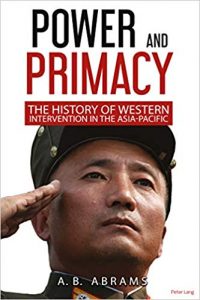
“A. B. Abrams is the author of the book ‘Power and Primacy: A History of Western Intervention in the Asia-Pacific.’ His second book covering the history of the United States’ conflict with North Korea is scheduled for publication in 2020.
He is proficient in Chinese, Korean and other East Asian languages, has published widely on defence and politics related subjects under various pseudonyms, and holds two related Masters degrees from the University of London.”
 The world today finds itself in a period of renewed great power conflict, pitting the Western Bloc led by the United States against four ‘Great Power adversaries’ – as they are referred to by Western defence planners – namely China, Russia, North Korea and Iran. This conflict has over the past 15 years escalated to encompass the military, economic and information spheres with global consequences – and appears to be coming to a head as signs of peaking tensions appear in multiple fields from military deployments and arms races to harsh economic wars and a harsher still information war.
While the term ‘World War III’ has been common since the 1940s, referring to the possibility of a global great power war on a greater scale than the first and second world wars, the Cold War between the Western and Soviet Blocs was at its height as total, as global and as heated as the prior conflicts. As weapons technology has evolved, the viability of a direct shooting war has diminished considerably – forcing major powers to seek alternative means to engineer their adversaries’ capitulation and assert their own dominance. This has been reflected in how the Cold War, and the current phase of global conflict some refer to as ‘Cold War 2’ have been distinct from the first two world wars despite the final objectives of the parties involved sharing many similarities. I would thus suggest redefining what a ‘world war’ is and acknowledging that this current phase of global conflict is every part as intense as the great power ‘hot wars’ waged in the first half of the 20th century.
Had the intercontinental range ballistic missile and the miniaturised nuclear warhead been invented twenty years earlier, the Allied Powers may have needed to rely more heavily on economic and information warfare to contain and eventually neutralise Nazi Germany. The Second World War would have been very different in nature to reflect the technologies of the time. When viewed from this paradigm, the Cold War can be seen as a ‘Third World War’ – a total conflict more vast, comprehensive and international than its predecessors stretched out over more than 40 years. The current conflict, or ‘World War IV,’ is ongoing. An assessment of prior ‘great power wars,’ and the unique nature of the current conflict, can provide some valuable insight into how warfare is evolving and the likely determinants of its victors.
As of 2020 it is clear that great power conflict has become almost as heated as it can short of an all-out hot war – with the Western Bloc applying maximum pressure on the information, military and economic fronts to undermine not only smaller adversaries such as Venezuela and Syria and medium sized ones such as North Korea and Iran, but also China and Russia. When exactly this phase of conflict began – sometime after the Cold War’s end – remains uncertain.
The interval between the third and fourth ‘world wars’ was considerably longer than that between the second and the third. This was due to a number of factors – primarily that there was no immediate and obvious adversary for the victorious Western Bloc to target once the Soviet Union had been vanquished. Post-Soviet Russia was a shade of a shadow of its former self. Under the administration of Boris Yeltsin the country’s economy contracted an astonishing 45% in just five years from 1992 (1) leading to millions of deaths and a plummet in living standards. Over 500,000 women and young girls of the former USSR were trafficked to the West and the Middle East – often as sex slaves (2), drug addiction increased by 900 percent, the suicide rate doubled, HIV became a nationwide epidemic (3) corruption was rampant, and the country’s defence sector saw its major weapons programs critical to maintaining parity with the West delayed or terminated due to deep budget cuts (4). The possibility of a further partition of the state, as attested to multiple times by high level officials, was very real along the lines of the Yugoslav model (5).
Beyond Russia, China’s Communist Party in the Cold War’s aftermath went to considerable lengths to avoid tensions with the Western world – including a very cautious exercise of their veto power at the United Nations which facilitated Western led military action against Iraq (6). The country was integrating itself into the Western centred global economy and continuing to emphasis the peaceful nature of its economic rise and understate its growing strength. Western scholarship at the time continued to report with near certainty that internal change, a shift towards a Western style political system and the collapse of party rule was inevitable. The subsequent infiltration and westernisation was expected to neuter China as a challenger to Western primacy – as it has other Western client states across the world. China’s ability to wage a conventional war against even Taiwan was in serious doubt at the time, and though its military made considerable strides with the support of a growing defence budget and massive transfers of Soviet technologies from cash strapped successor states, it was very far from a near peer power.
North Korea did come under considerable military pressure for failing to follow what was widely referred to as the ‘tide of history’ in the West at the time – collapse and westernisation of the former Communist world. Widely portrayed in the early 1990s as ‘another Iraq’ (7), Western media initially appeared to be going to considerable lengths to prepare the public for a military campaign to end the Korean War and impose a new government north of the 38th parallel (8). Significant military assets were shifted to Northeast Asia specifically to target the country during the 1990s, and the Bill Clinton administration came close to launching military action on multiple occasions – most notably in June 1994. Ultimately a combination of resolve, a formidable missile deterrent, a limited but ambiguous nuclear capability, and perhaps most importantly Western certainty that the state would inevitably collapse on its own under sustained economic and military pressure, deferred military options at least temporarily.
The fourth of the states that the United States today considers a ‘greater power adversary,’ Iran too was going to considerable lengths to avoid antagonism with the Western Bloc in the 1990s – and appeared more preoccupied with security threats on its northern border from Taliban controlled Afghanistan. With a fraction of the military power neighbouring Iraq had previously held, the presence of an ‘Iranian threat’ provided a key pretext for a Western military presence in the Persian Gulf after the Soviets, the United Arab Republic and now Iraq had all been quashed. With the new government in Russia put under pressure to terminate plans to transfer advanced armaments to Iran (9), the country’s airspace was until the mid 2000s frequently penetrated by American aircraft, often for hours at a time, likely without the knowledge of the Iranians themselves. This combined with a meagre economic outlook made Iran seem a negligible threat.
While the Cold War ended some time between 1985 and 1991 – bringing the ‘third world war’ to a close – the range of dates at which one could state that the ‘fourth world war’ began and the West again devoted itself to great power conflict is much wider. Some would put the date in the Summer of 2006 – when Israel suffered the first military defeat in its history at the hands of the Lebanese militia Hezbollah. Using North Korean tunnel and bunker networks, command structures, weapons and training (10), and bolstered by Iranian funding and equipment, the shock of the militia’s victory, though underplayed in Western media, reverberated among informed circles across the world.
Others would place the date two years later in 2008 during the Beijing Summer Olympics, when Georgia with the full support of the West waged a brief war against Russia – and Moscow despite harsh warnings from Washington and European capitals refused to back down on its position. Post-Yeltsin Russia’s relations with the Western Bloc had appeared relatively friendly on the surface, with President George W. Bush observing in 2001 regarding President Vladimir Putin that he “was able to get a sense of his soul,” and predicting “the beginning of a very constructive relationship.” Nevertheless, signs of tension had begun to grow from Moscow’s opposition to the Iraq War at the UN Security Council to President Putin’s famous ‘Munich Speech’ in February 2007 – in which he sharply criticised American violations of international law and its “almost uncontained hyper use of force in international relations.”
It could also be questioned whether, in light of what we know about Western support for separatist insurgents in Russia itself during the 1990s, the war against the country ever ended – or whether hostilities would only cease with a more total capitulation and partition and with the presence of Western soldiers on Russian soil as per the Yugoslav precedent. As President Putin stated in 2014 regarding continuing Western hostilities against Russia in the 1990s: “The support of separatism in Russia from abroad, including the informational, political and financial, through intelligence services, was absolutely obvious. There is no doubt that they would have loved to see the Yugoslavia scenario of collapse and dismemberment for us with all the tragic consequences it would have for the peoples of Russia” (11). Regarding Western efforts to destabilise Russia during the 1990s, CIA National Council on Intelligence Deputy Director Graham E. Fuller, a key architect in the creation of the Mujahedeen to fight Afghanistan and later the USSR, stated regarding the CIA’s strategy in the Caucasus in the immediate post-Cold War years: “The policy of guiding the evolution of Islam and of helping them against our adversaries worked marvellously well in Afghanistan against the Red Army. The same doctrines can still be used to destabilize what remains of Russian power” (12). The U.S. Congressional Task Force on Terrorism and Unconventional Warfare’s director, Yossef Bodansky, himself also detailed the extent of the CIA’s strategy to destabilize Central Asia by using “Islamist Jihad in the Caucasus as a way to deprive Russia of a viable pipeline route through spiralling violence and terrorism” – primarily by encouraging Western aligned Muslim states to continue to provide support for militant groups (13).
Much like the Cold War before it, and to a lesser extent the Second World War, great powers slid into a new phase of conflict rather that it being declared in a single spontaneous moment. Did the Cold War begin with the Berlin Blockade, the Western firebombing of Korea or when the atomic bombs were dropped on Hiroshima and Nagasaki – which accelerated the move into a nuclear arms race. Equally, multiple dates were given for the opening of the Second World War – the German invasion of Poland in 1939, the beginning of the Sino-Japanese war two years prior, the Japanese Empire’s attack on Pearl Harbour and conquest of Southeast Asia which marked the first major expansion beyond Europe and North Africa in 1941, or some other date entirely. The slide into a new world war was if anything even slower than its predecessors.
The shift towards an increasingly intense great power conflict has been marked by a number of major incidents. In the European theatre one of the earliest was the Bush administration’s withdrawal from the Anti-Ballistic Missile treaty in 2002 and subsequent deployment of missile defences and expansion of NATO’s military presence in the former Soviet sphere of influence, which was widely perceived in Russia as an attempt to neutralise its nuclear deterrent and place the Western Bloc in a position to coerce Moscow militarily (14). This threatened to seriously upset the status quo of mutual vulnerability, and played a key role in sparking a major arms race under which Russia would develop multiple classes of hypersonic weapon. Their unveiling in 2018 would in turn lead the United States to prioritise funding to develop more capable interceptor missiles, a new generation of missile defences based on lasers, and hypersonic ballistic and cruise missiles of its own (15).
Another leading catalyst of the move towards great power confrontation was the Barak Obama administration’s ‘Pivot to Asia’ initiative, under which the bulk of America’s military might and considerable assets from the rest of the Western world would be devoted to maintaining Western military primacy in the Western Pacific. This was paired with both economic and information warfare efforts, the latter which increasingly demonised China and North Korea across the region and beyond and actively sought to spread pro-Western and anti-government narratives among their populations through a wide range of sophisticated means (16). These programs were successors to those sponsored by Western intelligence agencies to ideologically disenchant the populations of the Warsaw Pact and Soviet Union with their own political systems and paint Western powers as benevolent and democratising saviours (17). Economic warfare also played a major role, with efforts centred around the ‘Trans-Pacific Partnership’ trade deal – or ‘Economic NATO’ as several analysts referred to it – to isolate China from regional economies and ensure the region remained firmly in the Western sphere of influence (18). The military aspect of the Pivot to Asia would reawaken long dormant territorial disputes, and ultimately lead to high military tensions between the United States and China which in turn fuelled the beginning of an arms race. This arms race has more recently led to the American withdrawal from the Intermediate-Range Nuclear Forces treaty, which paves the way for deployment of American long-range missiles across the Western Pacific – all with China and North Korea firmly in their crosshairs (19).
It is arguably in the Middle East, however, where the new phase of global conflict has seen its most direct clashes so far. The nine-year conflict in Syria, although far less destructive or brutal, provides ‘World War IV’ with something of an analogue to the Korean War in the Cold War. The conflict has united the Western Bloc and a wide range of allies, from Turkey and Israel to the Gulf States and even Japan (which funds the jihadist-linked White Helmets) (20), in an effort to overthrow an independent government with close and longstanding defence ties to Russia, North Korea, Iran and China. The conflict has seen North Korean, Russian, Hezbollah and Iranian special forces (21) among other assets deployed on the ground in support of Syrian counterinsurgency efforts, with all of these parties providing considerable material support (the Koreans have built and fully staffed at least three hospitals as part of large medical aid packages and continue to be a major supplier of arms and training) (22). China too, particularly concerned by the presence of jihadist militants of Chinese origin in Syria, has played some role in the conflict – the exact details of which remain uncertain with much reported but unconfirmed (23).
Syria’s insurgency involving a range of jihadist groups, at times united only by their intent to end the secular Syrian government, have received widespread support from the Western Bloc and their aforementioned allies. This has involved both material support, which according to State Secretary Hillary Clinton included turning a blind eye to Gulf countries’ considerable assistance to the Islamic State terror group (24), and active deployments of special forces from a wide range of countries, from Belgium and Saudi Arabia to Israel and the U.S. The U.S., European powers, Turkey and Israel have at times directly attacked Syrian units in the field – while Russian reports indicate that close Western coordination with jihadist groups has been used to facilitate a number of successful attacks on Russian positions (25). The conflict in Syria arguably represents a microcosm of the macrocosm which is a new world war – one which pits the Western Bloc and those which support the Western-led order, both directly and through local proxies, against three of its four ‘great power adversaries’ in the field.
‘World War IV’ is unlikely to come to an end for the foreseeable future, and its final outcome remains difficult to predict. Much like in the Cold War, the Western Bloc retains considerable advantages – today most notably in the field of information war which allows it to extensively shape perceptions of the vast majority of the world’s population. This has included the demonization of Western adversaries, the whitewashing of Western crimes both domestically and internationally, and portraying westernisation and increased Western influence as a solution to people’s frustrations from corruption to economic stagnation. This has been a key facilitator of the pro-Western protests engulfing states from Sudan and Algeria to Ukraine and Thailand. Economically too, only China among the Western Bloc’s major adversaries has posed a serious threat to Western primacy. Indeed, it remains highly questionable whether the other three could survive economically under Western pressure without Chinese trade and economic support.
Russia has made a considerable economic recovery since the 1990s, but remains a shadow of its former self in the Soviet era. The country’s leadership has succeeded in reforming the military, foreign ministry and intelligence services, but the economy, legal system and other parts of the state remain in serious need of improvement which, over 20 years after Yeltsin’s departure, cannot come soon enough. Even in the field of defence, the struggling economy has imposed serious limitations – and in fields such as aviation and armoured warfare the country is only beginning to slowly go beyond modernising Soviet era weapons designs and begin developing new 21st century systems (26). On the positive side, the country does remain a leader in many high end technologies mostly pertaining to the military and to space exploration, while Western economic sanctions have undermined the positions of Europhiles both among the elite and within the government and boosted many sectors of domestic production to substitute Western products (27).
In the majority of fields, the ‘Eastern Bloc’ have been pressed onto the defensive and forced to prevent losses rather than make actual gains. While preserving Venezuelan sovereignty, denying Crimea to NATO and preventing Syria’s fall have been major victories – they are successes in denying the West further expansion of its own sphere of influence rather than reversing prior Western gains or threatening key sources of Western power. Pursuing regime change in Venezuela and Ukraine and starting wars in the Donbasss and in Syria have cost the Western Bloc relatively little – the Ukrainians and client states in the Gulf and Turkey have paid the brunt of costs for the war efforts. Material equipment used by Western backed forces in both wars, ironically, has largely consisted of Warsaw Pact weaponry built to resist Western expansionism – which after the Cold War fell into NATO hands and is now being channelled to Western proxies. Libyan weaponry, too, was transferred to Western backed militants in Syria in considerable quantities after the country’s fall in 2011 – again minimising the costs to the Western Bloc of sponsoring the jihadist insurgency (28). The damage done and costs incurred by the Syrians, Hezbollah, Russia and others are thus far greater than those incurred by the Western powers to cause destruction and begin conflicts.
Syria has been devastated, suffering from issues from a return of polio to depleted uranium contamination from Western airstrikes and a new generation who have grown up in territories under jihadist control with little formal education. The war is a victory only in that the West failed to remove the government in Damascus from power – but Western gains from starting and fuelling the conflict have still far outweighed their losses. In the meantime, through a successful campaign centred around information warfare, the Western sphere of influence has only grown – with further expansion of NATO and the overthrow of governments in resource rich states friendly to Russia and China such as Libya, Sudan and Bolivia. Commandeering the government of poor but strategically located Ukraine was also a major gain, with states such as Algeria and Kazakhstan looking to be next in the Western Bloc’s crosshairs. Thus while Syria was saved, though only in part, much more was simultaneously lost. The damage done to Hong Kong by pro-Western militants, ‘thugs for democracy’ as the locals have taken to calling them, who have recently turned to bombing hospitals and burning down medical facilities (29), is similarly far greater than the costs to the Western powers of nurturing such an insurgency. Similar offensives to topple those which remain outside the Western sphere of influence from within continue to place pressure on Russian and Chinese aligned governments and on neutral states seen not to be sufficiently pro-Western.
While the Western Bloc appears to be in a position of considerable strength, largely by virtue of its dominance of information space, which has allowed it to remain on the offensive, a sudden turning point in which its power suddenly diminishes could be in sight. From teen drug abuse (30) to staggering debt levels (31) and the deterioration of party politics and popular media, to name but a few of many examples, the West appears at far greater risk today of collapse from within than it did during the Cold War. A notable sign of this is the resurgence of both far right and far left anti-establishment movements across much of the Western world. Despite massive benefits from privileged access to third world resource bases, from France’s extractions from Francophone West Africa (32) to the petrodollar system propping up American currency (33), Western economies with few exceptions are very far from healthy. A glimpse of this was given in 2007-2008, and little has been done to amend the key economic issues which facilitated the previous crisis in the twelve years since (34). The West’s ability to compete in the field of high end consumer technologies, particularly with rising and more efficient East Asian economies, increasingly appears limited. From semiconductors to electric cars to smartphones to 5G, the leaders are almost all East Asian economies which have continued to undermine Western economic primacy and expose the gross inefficiencies of Western economies. The result has been less favourable balances of payments in the Western world, a growing reliance on political clout to facilitate exports (35), and increasing political unrest as living standards are placed under growing pressure. The Yellow Vests and the rise of Donald Trump and Bernie Sanders are all symptoms of this. With very real prospects of another economic crash in the coming decade, in the style of 2008 but likely much worse, Western economies are expected to bear the brunt of the damage. Their ability to survive remains in serious question. Effects of a crash on North Korea, Iran, Russia and even China will be far less severe. While the previous crash hit Russia particularly hard (36), an economic turnaround from 2014 and the insulation provided by Western sanctions leave it far less vulnerable to the fallout from a Western economic crisis.
Ultimately China appears to be setting itself up for an ‘Eastern Bloc’ victory – a coup de grace which could see Western gains over the past several decades reversed and the power of the West itself diminished to an extent unprecedented in centuries. While the United States reluctantly outsourced much of its high end consumer technologies to East Asian allies during the Cold War – namely Japan, South Korea and Taiwan – China is going for the jugular of the Western world’s economy with its ‘Made in China 2025’ initiative, which will see some critical remaining fields of Western technological primacy shift to East Asian hands. The Coronavirus, bombings in Hong Kong, the trade war, and the wide range of tools in the Western arsenal for destabilisation can at best slightly delay this – but cannot prevent it. In a globalised capitalist economy the most efficient producers win – and East Asia and China in particular, with its Confucian values, stable and efficient political systems and world leading education (37), are thus almost certain to take over the high end of the world economy.
Much as the key to Western victory in the Cold War was successful information warfare efforts and isolation of the Soviet economy from the majority of the world economy, the key to determining the victor of ‘World War IV’ is likely lie in whether or not Beijing succeeds in its attempt to gain dominance of high end technologies critical to sustaining Western economies today. This is far from the only determinant of victory. Efforts to undermine the effective subsidies to Western economies from Central and West Africa, the Arab Gulf states and elsewhere in the third world, and to ensure continued military parity – to deter NATO from knocking over the table if they lose the game of economic warfare – are among the other fields of critical importance. Based on China’s prior successes, and those of other East Asian economies, the likelihood that it will meet its development goals is high – to the detriment of Western interests. The result will be an end to world order centred on Western might – the status quo for the past several hundred years – and emergence in its place of a multipolar order under which Russia, Asia (Central, East, South and Southeast) and Africa will see far greater prominence and prosperity.
- Menshikov, S., ‘Russian Capitalism Today,’ Monthly Review, vol. 51, no. 3, 1999 (pp. 82–86).
- Yulia V. Tverdova, ‘Human Trafficking in Russia and Other Post-Soviet States,’
Human Rights Review, December 11, 2016.
- Klein, Naomi, The Shock Doctrine: The Rise of Disaster Capitalism, London,
Penguin, 2008 (Chapter 11: ‘Russia Choses the Pinochet Option: Bonfire of a Young Democracy’).
- ‘The Death of the MiG 1.44 Program; How the Collapse of the Soviet Union Derailed Moscow’s Fifth Generation Fighter Development,’ Military Watch Magazine, September 16, 2018.
‘Russia’s Sukhoi Unveils Images from Cancelled Next Generation Fighter Program,’ Military Watch Magazine, December 17, 2019.
- Presidential Address to the Federal Assembly, President of Russia, Kremlin, December 4, 2014.
Bechev, Dimitar, Rival Power: Russia’s Influence in Southeast Europe, New Haven, CT, Yale University Press, 2017 (Chapter 1).
- Kristof, Nicholas D., ‘WAR IN THE GULF: China; Beijing Backs Away From Full Support of the War,’ New York Times, February 1, 1991.
- ‘Thaw in the Koreas?,’ Bulletin of Atomic Scientists, vol. 48, no. 3, April 1992 (p. 16).
- ‘Time to End the Korean War,’ The Atlantic, February 1997.
- Axe, David, ‘Iran Desperately Wants This Fighter Plane,’ The National Interest, January 4, 2020.
- ‘Hezbollah a North Korea-Type Guerrilla Force,’ Intelligence Online, No. 529, August 25–September 7, 2006.
“North Koreans Assisted Hezbollah with Tunnel Construction,” Terrorism Focus, The Jamestown Foundation, vol. III, issue 30, August 1, 2006.
Dilegge, Dave and Bunker, Robert J., and Keshavarz, Alma, Iranian and Hezbollah Hybrid Warfare Activities: A Small Wars Journal Anthology, Amazon Media, 2016 (p. 261).
‘Bulsae-3 in South Lebanon: How Hezbollah Upgraded its Anti-Armour Capabilities with North Korean Assistance,’ Military Watch Magazine, September 3, 2019.
- Kremlin, President of Russia, Presidential Address to the Federal Assembly, December 4, 2014.
- Congressional Record, V. 151, PT. 17, U.S. Congress, October 7 to 26, 2005.
- ‘American political scientist: Western Intelligence used Azerbaijan to export terrorism into Russia,’ Panorama, May 30, 2015.
- Kremlin, President of Russia, Plenary session of St Petersburg International
Economic Forum, June 17, 2016.
- Gregg, Aaron, ‘Military Industrial Complex Finds a Growth Market in Hypersonic Weapons,’ Washington Post, December 21, 2018.
- Mullen, Mike and Nunn, Sam and Mount, Adam, A Sharper Choice on North Korea: Engaging China for a Stable Northeast Asia, Council on Foreign Relations, Independent Task Force Report No. 74, September 2016.
Cartalucci, Tony, ‘Twitter Targets Hong Kong in US-backed Regime Change Operation,’ Ron Paul Institute for Peace and Prosperity, October 15, 2019.
Park, Kyung-Ae, ‘Regime Change in North Korea?: Economic Reform and Political Opportunity Structures,’ North Korean Review, vol. 5, no. 1, Spring 2009 (p. 23-45).
- ‘Worldwide Propaganda Network Built by the C.I.A.,’ New York Times, December 26, 1977.
- Wu, S., ‘Why the TPP is an “economic NATO,”’ Huffington Post, October 19,
2015.
- Ait, Abraham, ‘US Withdrawal From the INF Treaty Isn’t About Russia,’ The Diplomat, October 25, 2018.
- al-Jablawi, Hosam, ‘The White Helmets Struggle Without US Funding,’ Atlantic Council, June 11, 2018.
- ‘North Korean Special Forces in Syria; A Look at Pyongyang’s Assistance to Damascus’ Counterinsurgency Operations,’ Military Watch Magazine, June 10, 2018.
- ‘DPRK Ambassador affirms his country’s readiness to support health sector in Syria,’ Syrian Arab News Agency, July 25, 2016.
- Pauley, Logan and Marks, Jesse, ‘Is China Increasing Its Military Presence in Syria?,’ The Diplomat, August 20, 2018.
Hemenway, Dan, ‘Chinese strategic engagement with Assad’s Syria,’ Atlantic Council, December 21, 2018.
- ‘We finally know what Hillary Clinton knew all along – U.S. allies Saudi Arabia
and Qatar are funding Isis,’ The Independent, October 14, 2016.
- ‘Inquiry Into Death of Russian Lt. Gen. Asapov Shows Data Leaks to Daesh –
Source,’ Sputnik, September 26, 2017.
‘Drones used by Syrian terrorists “require advanced training” – Russian MoD in response to US,’ Sputnik, January 9, 2018.
- ‘Five Next Generation Russian Combat Jets We Will See in the 2020s: From MiG-41 Hypersonic Interceptors to PAK DA Stealth Bombers,’ Military Watch Magazine, January 1, 2019.
- Twigg, Judy, ‘Russia Is Winning the Sanctions Game,’ National Interest, March 14, 2019.
- Hersh, Seymour, ‘The Red Line and the Rat Line,’ London Review of Books, vol. 36, no. 8, April 2014
Angelovski, Ivan and Patrucic, Miranda and Marzouk, Lawrence, ‘Revealed: the £1bn of weapons flowing from Europe to Middle East,’ The Guardian, July 27, 2016.
Chivers, C. J. and Schmitt, Eric and Mazzetti, Mark, ‘In Turnaround, Syria Rebels Get Libya Weapons,’ New York Times, June 21, 2013.
McCarthy, Andrew C., ‘Hillary Clinton’s Benghazi Debacle: Arming Jihadists in Libya . . . and Syria,’ National Review, August 2, 2016.
- ‘Militants Bomb Hospital, Torch Quarantine Center as Hong Kong Braces for Virus Outbreak,’ Military Watch Magazine, January 27, 2020.
- ‘Class A drug use “at record levels due to young people”,’ BBC News, September 20, 2019.
- Buchholz, Katharina, ‘Industrialized Nations Have Biggest Foreign Debt,’ Statista, February 7, 2019.
- ‘France’s Colonial Tax Still Enforced for Africa. “Bleeding Africa and Feeding
France,”’ Centre for Research of Globalization, January 14, 2015.
Bart Williams, Mallence, ‘The Utilization of Western NGOs for the Theft of Africa’s Vast Resources,’ TedxBerlin, January 26, 2015
(https://www.youtube.com/watch?v=AfnruW7yERA).
- Wong, Andrea, ‘The Untold Story Behind Saudi Arabia’s 41-Year U.S. Debt Secret,’ Bloomberg, May 31, 2016.
Spiro, David E., The Hidden Hand of American Hegemony: Petrodollar Recycling and International Markets, New York, Cornell University Press, 1999.
- ‘Banks have not learnt lessons of 2008 crisis, says Gordon Brown,’ Financial Times, October 31, 2017.
‘A decade after the financial meltdown, its underlying problems haven’t been fixed,’ The Guardian, August 6, 2017.
- ‘Fearing U.S. Sanctions Over Su-35 Purchase: What is Behind Indonesia’s Interest in New F-16V Fighters,’ Military Watch Magazine, November 6, 2019.
Rogan, Tom, ‘The very political reason Qatar buys different fighter aircraft from Britain, France, and the US,’ Washington Examiner, February 25, 2020.
Krishnan, Rakesh, ‘Countering CAATSA: How India can avoid American arm twisting,’ Business Today, March 6, 2019.
- Gaddy, Clifford G. and Ickes, Barry W., ‘Russia after the Global Financial Crisis,’ Eurasian Geography and Economics, vol. 51, no. 3, 2010 (pp. 281-311).
- Hobbs, Tawnell D., ‘U.S. Students Fail to Make Gains Against International Peers,’ The Wall Street Journal, December 3, 2019.
Turner, Camiilla, ‘Chinese students are two years ahead of their white British peers by age 16, report finds,’ The Telegraph, July 30, 2019.
No Weapon Left Behind: The American Hybrid War on China
By Pepe Escobar | Strategic Culture Foundation | February 21, 2020
The New Silk Roads – or Belt and Road Initiative (BRI) – were launched by President Xi Jinping in 2013, first in Central Asia (Nur-Sultan) and then Southeast Asia (Jakarta).
One year later, the Chinese economy overtook the U.S. on a PPP basis. Inexorably, year after year since the start of the millennium, the U.S. share of the global economy shrinks while China’s increases.
China is already the key hub of the global economy and the leading trade partner of nearly 130 nations.
While the U.S. economy is hollowed out, and the casino financing of the U.S. government – repo markets and all – reads as a dystopian nightmare, the civilization-state steps ahead in myriad areas of technological research, not least because of Made in China 2025.
China largely beats the U.S. on patent filings and produces at least 8 times as many STEM graduates a year than the U.S., earning the status of top contributor to global science.
A vast array of nations across the Global South signed on to be part of BRI, which is planned for completion in 2049. Last year alone, Chinese companies signed contracts worth up to $128 billion in large-scale infrastructure projects in dozen of nations.
The only economic competitor to the U.S. is busy reconnecting most of the world to a 21st century, fully networked version of a trade system that was at its peak for over a millennia: the Eurasian Silk Roads.
Inevitably this state of things is something interlocking sectors of the U.S. ruling class simply would not accept.
Branding BRI as a “pandemic”
As the usual suspects fret over the “stability” of the Chinese Communist Party (CCP) and the Xi Jinping administration, the fact is the Beijing leadership has had to deal with an accumulation of extremely severe issues: a swine-flu epidemic killing half the stock; the Trump-concocted trade war; Huawei accused of racketeering and about to be prevented from buying U.S. made chips; bird flu; coronavirus virtually shutting down half of China.
Add to it the incessant United States government Hybrid War propaganda barrage, trespassed by acute Sinophobia; everyone from sociopathic “officials” to self-titled councilors are either advising corporate businesses to divert global supply chains out of China or concocting outright calls for regime change – with every possible demonization in between.
There are no holds barred in the all-out offensive to kick the Chinese government while it’s down.
A Pentagon cipher at the Munich Security Conference once again declares China as the greatest threat, economically and militarily, to the U.S. – and by extension the West, forcing a wobbly EU already subordinated to NATO to be subservient to Washington on this remixed Cold War 2.0.
The whole U.S. corporate media complex repeats to exhaustion that Beijing is “lying” and losing control. Descending to sub-gutter, racist levels, hacks even accuse BRI itself of being a pandemic, with China “impossible to quarantine”.
All that is quite rich, to say the least, oozing from lavishly rewarded slaves of an unscrupulous, monopolistic, extractive, destructive, depraved, lawless oligarchy which uses debt offensively to boost their unlimited wealth and power while the lowly U.S. and global masses use debt defensively to barely survive. As Thomas Piketty has conclusively shown, inequality always relies on ideology.
We’re deep into a vicious intel war. From the point of view of Chinese intelligence, the current toxic cocktail simply cannot be attributed to just a random series of coincidences. Beijing has serial motives to piece this extraordinary chain of events as part of a coordinated Hybrid War, Full Spectrum Dominance attack on China.
Enter the Dragon Killer working hypothesis: a bio-weapon attack capable of causing immense economic damage but protected by plausible deniability. The only possible move by the “indispensable nation” on the New Great Game chessboard, considering that the U.S. cannot win a conventional war on China, and cannot win a nuclear war on China.
A biological warfare weapon?
On the surface, coronavirus is a dream bio-weapon for those fixated on wreaking havoc across China and praying for regime change.
Yet it’s complicated. This report is a decent effort trying to track the origins of coronavirus. Now compare it with the insights by Dr. Francis Boyle, international law professor at the University of Illinois and author, among others, of Biowarfare and Terrorism. He’s the man who drafted the U.S. Biological Weapons Anti-Terrorism Act of 1989 signed into law by George H. W. Bush.
Dr. Boyle is convinced coronavirus is an
“offensive biological warfare weapon” that leaped out of the Wuhan BSL-4 laboratory, although he’s “not saying it was done deliberately.”
Dr. Boyle adds, “all these BSL-4 labs by United States, Europe, Russia, China, Israel are all there to research, develop, test biological warfare agents. There’s really no legitimate scientific reason to have BSL-4 labs.” His own research led to a whopping $100 billion, by 2015, spent by the United States government on bio-warfare research: “We have well over 13,000 alleged life science scientists… testing biological weapons here in the United States. Actually this goes back and it even precedes 9/11.”
Dr. Boyle directly accuses “the Chinese government under Xi and his comrades” of a cover up “from the get-go. The first reported case was December 1, so they’d been sitting on this until they couldn’t anymore. And everything they’re telling you is a lie. It’s propaganda.”
The World Health Organization (WHO), for Dr. Boyle, is also on it: “They’ve approved many of these BSL-4 labs (…) Can’t trust anything the WHO says because they’re all bought and paid for by Big Pharma and they work in cahoots with the CDC, which is the United States government, they work in cahoots with Fort Detrick.” Fort Detrick, now a cutting-edge bio-warfare lab, previously was a notorious CIA den of mind control “experiments”.
Relying on decades of research in bio-warfare, the U.S. Deep State is totally familiar with all bio-weapon overtones. From Dresden, Hiroshima and Nagasaki to Korea, Vietnam and Fallujah, the historical record shows the United States government does not blink when it comes to unleashing weapons of mass destruction on innocent civilians.
For its part, the Pentagon’s Defense Advanced Research Project Agency (DARPA) has spent a fortune researching bats, coronaviruses and gene-editing bio-weapons. Now, conveniently – as if this was a form of divine intervention – DARPA’s “strategic allies” have been chosen to develop a genetic vaccine.
The 1996 neocon Bible, the Project for a New American Century (PNAC), unambiguously stated, “advanced forms of biological warfare that can “target” specific genotypes may transform biological warfare from the realm of terror to a politically useful tool.”
There’s no question coronavirus, so far, has been a Heaven-sent politically useful tool, reaching, with minimum investment, the desired targets of maximized U.S. global power – even if fleetingly, enhanced by a non-stop propaganda offensive – and China relatively isolated with its economy semi paralyzed.
Yet perspective is in order. The CDC estimated that up to 42.9 million people got sick during the 2018-2019 flu season in the U.S. No less than 647,000 people were hospitalized. And 61,200 died.
This report details the Chinese “people’s war” against coronavirus.
It’s up to Chinese virologists to decode its arguably synthetic origin. How China reacts, depending on the findings, will have earth-shattering consequences – literally.
Setting the stage for the Raging Twenties
After managing to reroute trade supply chains across Eurasia to its own advantage and hollow out the Heartland, American – and subordinated Western – elites are now staring into a void. And the void is staring back. A “West” ruled by the U.S. is now faced with irrelevance. BRI is in the process of reversing at least two centuries of Western dominance.
There’s no way the West and especially the “system leader” U.S. will allow it. It all started with dirty ops stirring trouble across the periphery of Eurasia – from Ukraine to Syria to Myanmar.
Now it’s when the going really gets tough. The targeted assassination of Maj. Gen. Soleimani plus coronavirus – the Wuhan flu – have really set up the stage for the Raging Twenties. The designation of choice should actually be WARS – Wuhan Acute Respiratory Syndrome. That would instantly give the game away as a War against Humanity – irrespective of where it came from.
Do ‘green’ buses pass the performance test?
Do they even pass basic energy, environmental, economic and human rights tests?

By Duggan Flanakin | Watts Up With That? | February 15, 2020
Should Americans follow China in a massive commitment to supposedly eco-friendly battery-electric buses (BEBs)? California has mandated a “carbon-free” bus system by 2040 and will buy only battery or fuel cell-powered buses after 2029. Other states and cities are following suit.
Vehicle decisions are typically based on cost and performance. Cost includes selling price plus maintenance, while performance now includes perceived environmental impacts – which for some is the only issue that matters. But that perception ignores some huge ecological (and human rights) issues.
China today has 420,000 BEBs on the road, with plans to reach 600,000 by 2025. The rest of the world has maybe 5,000 of these expensive, short-range buses. However, the Chinese still get 70% of their energy from coal, so are their BEBs really that green? Are they safe? And are they really ethical?
Battery costs are the main reason BEBs today are much more expensive than buses that run on diesel or compressed natural gas. But bus makers say electric buses require less maintenance, and climate activists say the lower net “carbon footprint” (carbon dioxide emissions) justifies paying a little more.
China gets around the up-front cost problem by establishing national mandates, heavily subsidizing bus (and battery) manufacturers, and rewarding cities that replace entire bus fleets at one time. This ensures that their factories benefit from economies of scale – and that the transition will be swift and complete.
Beijing simply dodges the environmental costs by ignoring the fossil fuels, horrific pollution and human illnesses involved in mining, ore processing and manufacturing processes associated with building the buses. California and other “renewable” energy advocates do likewise. In fact, those costs will skyrocket as China, and the world emphasize electric vehicle, wind, solar and battery technologies.
Meanwhile, the USA and EU nations focus on subsidizing passenger cars. Thus, there are far more zero-emission passenger cars on the road today in the U.S. and Europe than public transit vehicles. No wonder Westerners still view electric vehicles as subsidized luxuries for the “woke wealthy,” who boast about lowering their carbon footprint, despite also often needing fossil fuel electricity to charge batteries.
The huge costs for fast-charging stations across Europe, let alone the vast United States, pose more huge challenges for future expansion of the electric vehicle market. But transit vehicles, even school buses, run regular routes, and if the routes are short enough, the bus can be recharged overnight in the garages.
Tax credits, free HOV lane access, free charging stations and other subsidies for the rich are seen by most as terrible policies. Yet another, says University of California–Davis researcher Hanjiro Ambrose, is the Federal Transit Administration funding formulas that favor short-term cost-efficiency over long-term innovation. “Those funding mechanisms haven’t been aligned with trying to stimulate policy change,” Ambrose says. “The cheapest technology available isn’t usually the newest technology available.”
To work around high upfront battery costs, innovative capitalists are creating new financial products that allow fleet owners to finance battery purchases. Treating battery costs the same way as fuel costs – as ongoing expenses – meets federal guidelines. Matt Horton, chief commercial officer for U.S. BEB maker Proterra, says, “The importance of the private capital coming into this market cannot be understated.”
Green advocates admit the primary reason people choose EVs is their belief that electric cars and buses, even with electricity generated from fossil fuels, are good for the environment. The Union of Concerned Scientists claims BEBs are 2.5 times cleaner in terms of lifespan emissions than diesel buses. That is highly questionable. Moreover, BEBs with today’s strongest batteries can take a full load no more than 150 miles in good weather. That’s fine for airport shuttles, maybe even for short public transit routes.
However, electric battery life is shorter than the 12-year vehicle life that many transit and school bus systems rely upon in their budgets. Battery replacement for BEBs is very expensive and unpredictable.
And then there are the horror stories. Los Angeles Metro purchased BEBs from Chinese-owned BYD Ltd. but yanked the first five off the road within a few months. Agency staff called the buses “unsuitable,” poorly made, and unreliable for more than 100 miles. Albuquerque returned seven out of its 16 BYD buses, citing cracks, leaking fluid, axle problems and inability to hold charges.
French journalist Alon Levy reported that BEB sales teams in Vancouver admitted their buses could not run for an entire day without recharging during layovers. Worse, in Minneapolis, bus performance suffers tremendously in cold weather: at 20o F buses cannot last all day; on Super Bowl Sunday, at 5o F, a battery bus lasted only 40 minutes and traveled barely 16 miles. Imagine being in a BEB in a blizzard.
In largely rural Maine, lawmakers proposed converting all school buses to BEBs. But Maine Heritage Policy Center policy analyst Adam Crepeau found that BEBs can travel no more than 135 miles per charge (in good weather), while diesel buses go up to 400 miles and can be refilled quickly almost anywhere. “This,” he said, “will severely impact the ability of schools to use them for longer trips, for sporting events, field trips and other experiences for students.” Or in bitterly cold Maine winters.
The economic and practical bottom line is simple. Activists and sales teams are pressing American cities, school boards and other public entities to follow China and convert their fleets to BEBs, calling them “the wave of the future.” Even in California, where lengthy power outages have become routine, this climate and anti-fossil ideology dominates. Given the growing vulnerability of our electric grid, among other concerns, cost and performance may not be the only considerations in making such an irreversible choice.
The environmental and ethical bottom line is equally simple – but routinely gets shunted aside.
Electric vehicles require about three times more copper than internal combustion equivalents – plus lithium, cobalt and other metals for their batteries. Wind turbines need some 200 times more steel, copper, plastics, rare earths, concrete and other materials per megawatt than combined-cycle gas turbines. Photovoltaic solar panels have similar materials requirements. 100% “renewable, sustainable” Green New Deal electricity systems on US or Chinese scales would require millions of turbines, billions of solar panels and billions of half-ton Tesla-style battery packs for cars, buses and backup electricity storage.
Those technologies, on those scales, would require mining at levels unprecedented in world history! And the environmental and human rights record we’ve seen for those high-tech metals is terrifying.
Lithium comes mostly from Tibet and the Argentina-Bolivia-Chile “lithium triangle,” where contaminated lands and waters are poisoning fish, livestock, wildlife and people. Most cobalt is mined in the Democratic Republic of Congo, where 40,000 children and their parents slave in open pits and dark, narrow tunnels – and get exposed constantly to filthy, toxic, radioactive mud, dust, water and air. Broken bones, suffocation, blood and respiratory diseases, birth defects, cancer and paralysis are commonplace.
Nearly all the world’s rare earth elements come from Inner Mongolia. Mining the ores involves pumping acid into the ground and processing them with more acids and chemicals. Black sludge from the operations is piped to a huge foul-smelling “lake” that is surrounded by formerly productive farmlands that are now so toxic that nothing can grow on them, and people and wildlife have just moved away. Here too, severe skin and respiratory diseases, cancers and other terrible illnesses have become commonplace.
In many of these cases, the mining and processing operations are run by Chinese companies, under minimal to nonexistent pollution control, workplace safety, fair wage, child labor or other basic standards that American, Canadian, Australian and European companies are expected to follow.
And this is just for today’s “renewable, sustainable, ethical, Earth-friendly, green” technologies. Just imagine what we are likely to see if China, California, New York, Europe and countless other places start mandating a fossil-fuel-free future – and then shut down nuclear power, to boot. Where will we get all the raw materials? Where will we put all the wind turbines, solar panels, batteries and transmission lines?
The prospect is horrifying. And it’s all justified by exaggerated fears of a climate apocalypse. Crazy!
Duggan Flanakin is director of policy research for the Committee For A Constructive Tomorrow (CFACT).
China, Russia to Defy US Sanctions Over Support to Venezuela
teleSUR | February 10, 2020
The Russian government on Monday rejected the U.S. threats to impose new sanctions against several Russian companies for their cooperation with Venezuela in the oil sector.
Last week, the United States special representative for Venezuela, Elliott Abrams, warned Russia that its support for Venezuela will cost them economically as Washington is looking to sanction them.
“We classify this practice as harmful, we believe that many countries suffer because of this practice, we consider it contrary to international law,” Kremlin spokesman Dmitri Peskov told reporters Monday in regards to Washington’s plans.
“The United States, especially, and several other countries, unfortunately use these trade and other restrictions very frequently against third world countries, which are illegal under international law.”
Peskov added that “they use this practice more and more often in recent times to ensure their own interests in international commercial and economic affairs.”
Also, spokesman Peskov stressed that Russia categorically opposes this practice.
On the other hand, in Beijing, Foreign Ministry spokesman Geng Shuang, in a media briefing session offered online, said China is against any foreign interference in the internal affairs of Venezuela and against the application of unilateral sanctions.
The United States imposed sanctions on the airline Conviasa, the largest airline in Venezuela.
The Treasury Department published on its website that the Office of Foreign Assets Control (OFAC) included 40 aircraft of this airline in the list of specially designated nationals and blocked persons (SDN).
“China’s position on the problem of Venezuela is clear and remains unchanged. We stand against any foreign interference in the internal affairs of Venezuela and against unilateral sanctions,” said the diplomat.
Since 2019, the United States in particular, and some other countries due to pressure from Washington, began applying new sanctions to Caracas, which seriously affected its economy, people’s lives and Venezuela’s relations with other nations, Geng Shuang recalled.
“We urge other countries to take into account the humanitarian reality of Venezuela, stop imposing unilateral and extraterritorial sanctions, and work to create necessary conditions that will lead to the stability of their economic growth,” said Geng.
UN Security Council Meeting on Kashmir at China’s Request Postponed Indefinitely
Sputnik – December 17, 2019
A crucial closed-door meeting at the United Nations Security Council (UNSC) on the Kashmir issue has been postponed for a month at least.
The meeting was scheduled on Tuesday to discuss the humanitarian situation in Indian-administered Jammu and Kashmir.
Previously, a first such meeting was held in August this year in the aftermath of India’s decision to revoke the seven decades old special status of Kashmir on 5 August. However, the provisional schedule and daily meetings of the UNSC don’t mention the consultative meeting on Kashmir.
In its August programming schedule, the UNSC clearly mentioned the closed door consultation on India and Pakistan. But in December’s schedule no such meeting is planned. Two diplomats have also confirmed the development.
Currently, the decision to postpone the meeting on Kashmir came ahead of crucial boundary dispute talks between India and China.
India’s National Security Adviser (NSA) Ajit Doval and Chinese Foreign Minister Wang Yi are expected to meet on 20-21 December to stabilise relations and discuss the contentious boundary issues between the two nations during Special Representatives-level talks.
The boundary discussion was stalled for months due to strained relations between the two Asian giants over Kashmir. Beijing termed the Indian decision to revoke the special status of Kashmir as unilateral and impinged upon the sovereignty of China.
The last time the issue of Jammu and Kashmir was on the UNSC agenda was during a meeting on 21 December 1971. It was followed by the adoption of a resolution calling for a durable ceasefire, the halt of all hostilities in conflict areas, and the provision of international assistance to refugees impacted by the territorial dispute.
In a related development, Pakistani Prime Minister Imran Khan has also cancelled his scheduled visit to Malaysia to participate in a meeting on Kashmir.The development comes two days after Khan met with Saudi Crown Prince Mohammad Bin Salman in Riyadh, during which matters related to bilateral relations were discussed.
A summit of Muslim leaders is expected to deliberate upon a shared agenda of Islamic countries and their collective challenges in a highly interconnected world.
India and Pakistan have contended for the Kashmir region, the southern part of which lies in India’s Jammu and Kashmir state (now a union territory), since the end of British rule in 1947. Despite a ceasefire being reached in 2003 following several armed conflicts, instability has continued, leading to the emergence of various extremist groups.
Featured Video
The Truth About the Trump Shootings with Ken Silva
or go to
Aletho News Archives – Video-Images
From the Archives
Trans ‘milk’ as good as the real thing – NHS
RT | February 18, 2024
The drug-induced nipple secretions of trans women are as good as mothers’ breast milk for babies, the University of Sussex Hospitals NHS Trust claimed in a letter to campaigners made public in a report by British think tank the Policy Exchange on Sunday.
The healthcare trust’s medical director, Rachel James, argued that the off-label prescription drug cocktail men transitioning to female take in order to produce milk was “similar to the natural hormones which encourage lactation to develop when the baby is newly born.”
“The evidence which is available demonstrates that the milk is comparable to that produced following the birth of a baby,” James wrote in the letter, sent to Children of Transitioners last August.
Biological men who wish to lactate must first take hormones to grow milk glands and then take high doses of either domperidone or metoclopramide to stimulate milk production. Neither drug is approved for this use, though they are occasionally prescribed off-label to biological women who have trouble lactating.
However, domperidone’s own manufacturer, Janssen, warns patients the drug “may cause unwanted side effects affecting the heart in a breastfed baby” and “should be used during breastfeeding only if your physician considers this clearly necessary.” … continue
Blog Roll
 Aletho News
- Seyed M. Marandi: U.S. Strike Imminent – Toward Total War in the Middle East
- Russia Voted Under Fire. Washington Is Loading the Tankers.
- 12 Things Your Oncologist Was Trained Not to Tell You
- Anthrax Attacks Paved Way for COVID-Era ‘Junk Drugs and Vaccines’
- How Real Is the Impact of Western Sanctions on Israel?
- France, You Are Guilty: How Paris Turned Western Sahara into the Maghreb’s Powder Keg
- 2025 Nature Paper Claiming Worsening Global Drought Gets RETRACTED …Heavily Flawed
- Your Milk Is Not the Problem
- The Truth About the Trump Shootings with Ken Silva
- ARE PATIENTS BEING PROPERLY INFORMED ABOUT OZEMPIC?
- If Americans Knew
- Salah Sarsour’s Legal Team Says DHS Has Not Met Its Burden to Prove He Is Deportable
- An analysis of tax forms by The Intercept show Kraft’s charity and LLC have donated to Friends of the IDF and AIPAC’s super PAC.
- Israeli attacks kill four Palestinians in Gaza – Daily Update
- Inside Gaza’s death trap of collapsing, bombed-out buildings
- The everyday items Israel bans from Gaza every day
- Inside the siege, the ruined buildings of Gaza – Daily Update
- Debunking The Claim That Macklemore Has A “History Of Antisemitism”
- CPJ demands release of arrested Palestinian-US journalist near Bethlehem
- Robert Kraft: The Billionaire Friend of Netanyahu Pulling The Strings Behind the Macklemore/Ed Sheeran Blow Up
- Columbia Administered Fund Gives Big Money to Pro-Israel Groups
- No Tricks Zone
- 2025 Nature Paper Claiming Worsening Global Drought Gets RETRACTED …Heavily Flawed
- New Study: ‘Global Drought Shows No Detectable Recent Acceleration Under Climate Warming’
- Economic Masterminds: German Socialists Suggest Taxing Productivity Gains Stemming From Using AI
- The South China Sea Has Not Been Cooperating With The Climate Change Narrative
- Energy Crisis: Germany Enters Heating Season With Historically Low Gas Reserve Fill Levels
- New Study: The Antarctic Ice Sheet Gained Mass From 2020-2024 Due To Staggering Snow And Ice Accumulation
- Study: Ocean Heating Rates From Thousands Of Years Ago ‘Dwarf’ Modern Ocean Heating Rates
- Climate Extremists Target, Attack Large-Scale Power Grid Infrastructure In Germany!
- New Study: Antarctic Ice Melt Has Contributed Less Than 1 Centimeter To Sea Level Rise In The Last 30 Years
- Fear Of Debate: Alarmist German Climate Scientist Calls On Mainstream Media To Discredit Skeptic Voices
 Aletho News