Teaching Tokyo Independence: Rodrigo Duterte Goes to Japan
Katehon – 25.10.2016
October 25th is the start of a three-day visit to Japan by the President of the Philippines Rodrigo Duterte. During his visit, Duterte will meet with Japanese Emperor Akihito and Prime Minister Shinzo Abe. The leaders plan to discuss a wide range of issues of bilateral cooperation.
The weakening of the US in the region
Duterte’s visit to Japan comes just after a similar trip of the Philippines leader to China. This fits in with a recent trend characterized by the considerable weakening of the position of the United States in the Asia-Pacific region. China’s diplomatic goal is to bring together the US’s traditional allies into their sphere of influence. To this, success can be attributed to the warming relations between Beijing and Bangkok, as well as the recent breakthrough in the negotiations between Rodrigo Duterte and Xi Jinping.
Setting an example
The Philippine leader’s position and his actions in the international arena should be an example for a more powerful neighbor – Japan. In spite of its economic development, Tokyo is very much under the influence of Washington and unable to pursue an independent policy, while Rodrigo Duterte with his actions is guided solely by national interests.
Eurasian direction of Duterte
After the trip to Japan, Rodrigo Duterte is planning to go to Moscow. Thus we can clearly see his geopolitical course. Faced with all the leading leaders in the region ignoring Washington, Duterte declares himself as a consistent supporter of a multi-polar approach. The fact that such can be the situation with a country that isn’t very powerful, without nuclear weapons or huge economic potential, says that the US can not cope any longer with its function as a global leader.
Duterte’s China visit a ‘turning point’
The BRICS Post | October 21, 2016
Philippine President Rodrigo Duterte has made good on a promise he made in August to steer relations with China toward mutual benefit and bilateral cooperation.
During his visit to Beijing on Thursday Duterte said that he was still committed to discussing the South China Sea territorial dispute in a bilateral fashion with his Chinese counterparts.
Chinese President Xi Jinping welcomed the Philippine initiative and warmly shook hands with Duterte saying that both countries had emerged from a relationship of “winds and rains”.
As the first country to visit outside ASEAN since he took office in June the Philippine president is committed to continuously engaging China in a diplomatic dialogue rather than anger officials there.
Relations between the two countries recently took a downturn after the International Court of arbitration in The Hague ruled that China’s historic claims to most of the South China Sea were invalid.
China called the ruling a farce and at the time Xi said he would not accept any proposition or action based on the ruling issued unilaterally, and initiated by the former Philippine government.
Xi described the new turn in their ties as the springtime of our relationship.
In addition to discussing the South China Sea issue the two countries signed 13 agreements and deals worth more than $13 billion.
China also pledged financial support for infrastructure projects in the Philippines and said it would lift travel advisories for Chinese tourists visiting the islands.
Chinese media hailed the visit as a turning point and a welcome U-turn in the two countries’ ties.
Philippines seeks common prosperity with China
By M K Bhadrakumar | Indian Punchline | October 19, 2016
Philippine President Rodrigo Duterte arrived in Beijing on Tuesday on a 4-day visit that Beijing calls ‘historic’. We are about to witness probably one of the most dramatic turnarounds in the geopolitics of the Asia-Pacific since the Vietnam War ended. Philippines is the US’ oldest ally in Asia and Duterte is just inches away from dumping an accord that gives the US access to five military bases in the Philippines. The US’ rebalance strategy may never be the same again as long as Duterte, who took over on June 30, remains in power. (New York Times )
That Duterte chose China for his first visit outside the ASEAN region itself carries much symbolism. At least 200 members of the Philippine business elite are traveling with him, signalling the strong desire in Manila to form a new commercial alliance with China. Interestingly, one of the ideas mentioned is a deal with China to jointly explore energy sources in the South China Sea – to begin with in the uncontested areas closer to the Philippines known internationally as Reed Bank.
Manila sees this as an important confidence-building measure, with neither country making demands on the other on issues of sovereignty but placing accent on developing a more comfortable working relationship in ‘win-win’ spirit so that they can tiptoe toward discussing the more sensitive areas of the South China Sea in future in more agreeable setting. An equivalent, from the Indian perspective, might be to seek Chinese collaboration to develop our northeastern states lying adjacent to Arunachal Pradesh.
Ahead of Duterte’s arrival in Beijing, China’s Foreign Minister Wang Yi has said that the state visit would be a ‘success’. Wang said China ‘highly values’ the visit. China has refused to accept the ruling by the arbitration tribunal at The Hague in July on the South China Sea and Duterte, on his part, has downplayed it. The western analysts who predicted doomsday scenario have been proven wrong.
Beijing disclosed at a media briefing on Tuesday that it will expand trade links with the Philippines, encourage businesses to invest there, and strengthen bilateral infrastructure construction and human resources training. A Commerce Ministry spokesman said in Beijing that preparations are actively under way for announcements on bilateral economic and trade cooperation during the visit.
In an interesting remark, a scholar with the Chinese Academy of Social Sciences, Dr Zhong Feiteng told The Beijing News that as a big country with a long history, China is increasingly viewing its neighboring areas as a whole. “Beijing should take a long view when dealing with Manila,” he said. “(It should) see the Philippines as an important node in its 21st-century Maritime Silk Road initiative, and build a new maritime order that connects the East and South China Seas.”
In overall terms, we may expect that China’s approach during this visit would be to defuse tensions with the Philippines by promising economic support. A litmus test of the extent to which China is prepared to show goodwill would probably lie in Beijing giving conditional access to Philippine fishermen to waters around the disputed Scarborough Shoal. Analysts do not rule [out] such a possibility happening during Duterte’s visit.
Nonetheless, China too may choose to progress slowly on the track of dialogue and cooperation with the Philippines. The fact of the matter is that the US still enjoys a far better image amongst the people in the Philippines. A recent survey showed that only 22 percent of the people reposed ‘trust’ in China, while the corresponding figure for the US stood at 76 percent. Then, there are the entrenched interest groups among the elites who are not impressed by Duterte’s apparent foreign-policy ‘tilt’ against the US.
What goes against the US at the present juncture is also that with only a few months left in office, the Obama administration is hardly in a position to invoke its powerful lobbies in the Manila elites (civilian and military) to launch a vigorous rearguard action to shore up the alliance with the Philippines from Duterte’s relentless onslaught. Indeed, that respite leaves with Duterte a free hand to keep pecking at the alliance with the US at random without caring about a backlash at least until the next presidency settles down in Washington. And, of course, he does have a way of saying things that many would consider as unsayable. (Guardian )
Having said that, the bottom line is Duterte happens to be the democratically-elected president of his country and his people adore him. His approval rating currently stands at an incredible level — 90 percent. Read a report on Duterte’s interview with Xinhua news agency, here.
Why is a Hong Kong “Activist” in Bangkok?
The New Atlas – October 5, 2016
Joshua Wong’s alleged arrest at a Bangkok airport is portrayed as a slight against “democracy,” yet the US-funded and backed agitator undermines his own principles of “self-determination” by meddling in another nation’s politics.
Thai PBS in its article, “HK democracy activist Joshua Wong detained in Bangkok,” would claim:
Wong, 19, famed for his galvanising role in the city’s 2014 pro-democracy “umbrella movement”, was held as he landed at the airport late Tuesday, his party Demosisto said in a statement, citing a Thai student activist, Netiwit Chotipatpaisal, who was due to meet him.
Wong was invited by Thai student activists to take part at an event marking the anniversary of a military crackdown in October 1976.
Demosisto “strongly condemns the Thai government for unreasonably limiting Wong’s freedom and right to entry, and requests the immediate release of Wong,” the statement said.
What Thai PBS fails to mention is that Joshua Wong and his party, “Demosisto,” are US-funded and directed, and represent Western interests attempting to subvert Chinese control over its own territory of Hong Kong, as well as undermine national sovereignty across the entire Asian region.
Indeed, the entire “Occupy Central” movement, also referred to as the “Umbrella Revolution,” was led by US-backed opposition figures, including Joshua Wong, Benny Tai and Martin Lee, the latter of which was literally in Washington D.C. lobbying for backing just months before the 2014 protest began.
While the US State Department’s National Endowment for Democracy (NED) initially denied it provided any assistance to the movement and denied specifically that Martin Lee served any role in leading the protests despite his Washington visit, NED through its subsidiary Freedom House, would eventually invite Wong, Tai and Lee back to Washington afterwards to award them for role in leading the protests.
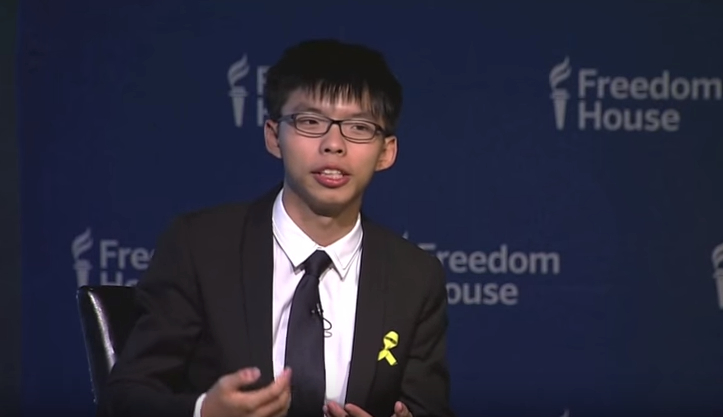 |
Joshua Wong in Washington D.C. attending a US State Department award ceremony held in his and other US-backed agitators’ honor |
At the award ceremony titled, “Three Hong Kong Heroes,” Lee would shuffle onto stage with an umbrella prop in hand, a virtual admission to his leadership role in the protests and confirmation that NED’s previous statement was intentionally false.
Wong’s political party, Demosisto, headed by Nathan Lee, is also tied directly to the US State Department’s NED.
 |
Nathan Law (left) with Carl Gershman of the US State Department’s National Endowment for Democracy (NED) |
Nathan Law in particular was featured on the US State Department’s National Endowment for Democracy (NED) website “World Movement for Democracy” in a post titled, “Democracy Courage Tribute Award Presentation.” In it, NED would write in regards to the award presented to Nathan Lee:
The Umbrella Movement’s bold call in the fall of 2014 for a free and fair election process to select the city’s leaders brought thousands into the streets to demonstrate peacefully. The images from these protests have motivated Chinese democracy activists on the mainland and resulted in solidarity between longtime champions of democracy in Hong Kong and a new generation of Hong Kong youth seeking to improve their city. The Hong Kong democracy movement will face further obstacles in the years to come, and their idealism and bravery will need to be supported as they work for democratic representation in Hong Kong.
The ceremony was yet another in a long line of post-Occupy Central award ceremonies the US State Department conducted, rewarding its proxies for their efforts in the streets of Hong Kong in 2014.
Joshua Wong Was Barred Entry into Malaysia for Similarly Inappropriate Political Pandering
In 2015, Malaysia too would confront Wong and his attempts to spread US-backed subversion across Asia.
That PBS would also report in an article titled, “HK student activist Joshua Wong denied entry to Malaysia,” that:
Immigration officials on Tuesday barred Hong Kong student activist Joshua Wong from entering Malaysia at the Penang International Airport in Bayan Lepas, The Star Online reported.
Wong was scheduled to attend a forum titled “The Uprising of Youth and New Social Activism in Singapore and Hong Kong” at Auditorium A in Komta on Tuesday night.
It is also worth noting that after Wong was denied entry, US-funded organisations posing as nongovernmental organisations (NGOs) immediately took to social media in an attempt to criticise the Malaysian government’s decision.
Malaysian online news service, The Star, in an article titled, “Hong Kong student activist Joshua Wong denied entry to Malaysia,” would further elaborate:
“Malaysia… explain why he is sent back to Hong Kong? Afraid of more street protests,” tweeted Bersih 2.0 chairman Maria Chin Abdullah.
Bersih, like Joshua Wong’s Demosisto, is openly funded by the US State Department and represents Washington’s, not the people of Malaysia’s interests. Bersih would be revealed in 2011 to have received funding and training from the US State Department via the National Democratic Institute (NDI), another NED subsidiary.
Democracy Means Self-Determination, Not Dictates from Washington & its Proxies
It is perhaps ironic that Wong himself and his supporters portray him as a “democracy activist,” considering that one of the central principles of democracy is the concept of self-determination. Self-determination means that a nation’s people themselves determine what course of action is in their best interests, free from the influence of foreign interests.
The concept of self-determination underpins the national identity of many nations across Southeast Asia, having had their respective national destinies dictated to them at various points throughout their history by European colonialism. Independence and self-determination across the region represent hard-fought achievements threatened by US-backed political fronts wielding “soft power” in place of the overt “gunboat diplomacy” practised by the British Empire in days past.
Worse than mere foreign backing, Wong and his Demosisto political party work ceaselessly to promote the parting demands made by British colonial administrators as Hong Kong was returned to China in 1997. These demands, including upholding the “one country, two systems” and “Basic Law” drafted just ahead of the British handover of Hong Kong, are echoed by the current governments of both the United States and the United Kingdom.
Thus, Wong and his political party, Demosisto, work contra to Hong Kong’s self-determination, promoting the parting policy of the British Empire imposed on a still emerging China in 1997.
By Wong meddling in the internal affairs of neighbouring Asian states, attempting to bolster US State Department efforts elsewhere to create proxy political fronts to serve Washington rather than local interests, he is also trampling the concept of regional self-determination, and thus of democracy itself.
In Thailand specifically, Wong sought to support anti-government agitators likewise seeking to subvert Thai sovereignty and return to power political parties loyal to Washington.
Wong’s admirers find among themselves a common denominator of affinity toward the United States and American politics. They believe themselves to be enlightened supporters of freedom, democracy and human rights, despite the reality of US foreign and domestic policy standing firmly against all three of these basic and essential principles.
From the invasion and occupation of foreign nations around the globe, to the detainment and torturing of people worldwide, to the violence and brutality American police deploy against the American population at home, to the invasive abuse of the American people’s right to privacy, American politics in reality exist separately from the ideals cadres of indoctrinated foreigners have been led into believing the US stands for.
Wong and his Demosisto political party and other US-backed political fronts like them, represent a danger to freedom, democracy and human rights, serving as a facade behind which US special interests hide their true, self-serving agenda and all of the abuse that surrounds it. By serving as a facade for foreign interests, merely posing as a proponent of democracy and self-determination, it is Wong and those like him that truly endanger democracy’s future in Asia, not those awaiting him at airports, turning him and his US-backed agitation away.
Follow The New Atlas on Facebook and Twitter.
Prejudices mar Indian view of CPEC
By M K Bhadrakumar | Indian Punchline | October 1, 2016
The reported decision by Asian Development Bank to lend $2.5 billion to Pakistan and be a collateral financier for upgrade of Lahore-Peshawar segment of the Karachi-Peshawar railway line is a significant development. India should analyse it carefully. (Business Standard )
Firstly, Karachi-Peshawar railway line upgrade falls within the ambit of the China-Pakistan Economic Corridor (CPEC). That is to say, ADB is joining hands with China (which is the co-financier for the railway line upgrade) in a CPEC project.
Now, this is a big concessional loan ($2.5 billion at low interest rate less than 2 percent) and it wouldn’t have been possible without approval by Japan and the United States, which dominate ADB’s decision-making. We need to take note that Japan and the US are showing pragmatism here, given the reality that CPEC is a flag carrier of China’s One Belt One Road.
In sum, this is a political affirmation of their interest in Pakistan’s stability and development.
The other salience that emerges here is that it is an extremely untimely and counterproductive move on our part to raise dust on Baluchistan. It complicates India’s relations with not only Pakistan but also with China, considering that a significant segment of the CPEC activity is located in Baluchistan, and, equally, our campaign on Baluchistan will not get a sympathetic ear in the world capitals. It will only make us look small-minded and petulant.
Similar pragmatism toward One Belt One Road as ADB is showing also characterises the attitudes of Asian, Middle Eastern and European countries. No doubt, projects enhancing regional connectivity attract all countries. India probably stands out as solitary exception, in its perspective on One Belt One Road derived exclusively through the geopolitical prism.
Secondly, we need to take note that the CPEC is indeed going ahead despite the ‘hawks’ amongst us hoping against hope that it may not take off. The ADB loan itself wouldn’t have been forthcoming without expert opinion saluting the CPEC. The ADB decision has prompted China to fill in with an additional loan of $5.5 billion for the railway project, which now makes CPEC a $51.5 billion eighth wonder in the world.
Two things become clear. One, China is determined to build Pakistan’s infrastructure development and make its economy resilient. Clearly, it is a ‘win-win’ for China too for a variety of factors at work in regional politics and China’s own national strategies. Two, China usually puts its money (big or small) only where the mouth is, which means it is becoming a stakeholder in Pakistan’s future and prosperity with a long-term perspective.
And where China goes, the US and Japan are bound to follow. Simply put, Indian diplomacy runs into almost-impossible headwinds to ‘isolate’ Pakistan in the prevailing circumstances.
It is about time we wake up and put to ourselves some searching questions. Do we have the ghost of a chance to annex Gilgit-Baltistan and Pakistan-Occupied Kashmir, as the present government is leading the domestic opinion to believe? To my mind, our government is whistling in the dark and leading the public opinion in a wrong direction.
Again, from a regional security point of view, if the POK and Northern Areas of Pakistan, which are hopelessly impoverished regions, are set on a path of infrastructure development and economic activity, there is less chance of them becoming the sanctuaries of terrorist groups. In fact, this is also one consideration China would have. Don’t we have a congruence of interests with China on regional security and stability in this regard? This is one thing.
Besides, if Pakistan integrates these regions politically, doesn’t it open up an interesting avenue to resolve the Kashmir problem? A realistic perspective would be that without any redrawing of boundaries as such, if the Line of Control gets legitimacy as an internationally recognised border – with Pakistan keeping the areas under its control and India keeping J&K as an integral part of it – won’t that be a basis of durable settlement?
Put differently, if Pakistan integrates Northern Areas and POK, it is tantamount to a unilateral move to ‘solve’ the Kashmir problem. We should actually applaud Pakistan if it goes on to integrate those regions just as it plans at present to integrate the tribal areas. Which in turn would also enable India to work out its own terms of integration of J&K in terms of our democratic principles.
Frankly, India’s paranoia over the CPEC has no rationality. It is based on contrived and often trivial arguments lacking basis and/or unsupported by empirical evidence or are outright falsehoods, which are assembled uncouthly with the ulterior motive to arrive at a certain pre-determined conclusion.
The name of the game is Sinophobia – to somehow complicate the Sino-Indian normalization itself. See a paper by the Vivekananda Foundation on the topic titled Implications of the China-Pakistan Economic Corridor.
Rooting Out the North Korean Nuclear Crisis: the Past and Present U.S. Role
By Christine Hong and Paul Liem | CounterPunch | September 15, 2016
North Korea’s nuclear test of September 9, 2016, the fifth and largest measuring twice the force of previous blasts, prompted a predictable round of condemnations by the United States and its allies along with calls for China to step up its enforcement of sanctions on North Korea. Yet few “expert” analyses suggest that China will risk destabilizing North Korea or that further United Nations resolutions and international sanctions will succeed in deterring North Korea from pursuing its nuclear weapons and missile programs.
The Obama administration’s reliance on China to rein in North Korea is at odds with its efforts to contain China’s influence in Asia, a quixotic goal in itself. It reflects an unrealistic desire for China to be influential just enough to do the bidding of the United States but not powerful enough to act in its own interests. North Korea is, after all, China’s strategic ally in the region, and it is in South Korea that the United States plans to deploy THAAD, a defense system with radar capable of tracking incoming missiles from China. It is simply not in China’s interest to risk losing an ally on its border only to have it replaced by a U.S.-backed state hosting missile-tracking systems and other military forces targeting it. And China knows it is not the target of North Korea’s nukes. If the United States cannot punt the problem of North Korea’s nuclear weapons to China it must deal with North Korea directly.
Indeed, in response to U.S. Secretary of Defense Ashton Carter’s recent condemnation of China’s “role” and “responsibility” in failing to restrain North Korea’s nuclear pursuits, the Chinese Foreign Ministry issued a statement calling on the United States to take a long hard look at its own foreign policy:
The cause and crux of the Korean nuclear issue rest with the US rather than China. The core of the issue is the conflict between the DPRK and the US. It is the US who should reflect upon how the situation has become what it is today, and search for an effective solution. It is better for the doer to undo what he has done. The US should shoulder its due responsibilities.[1]
In equally unmincing terms, the Global Times, an offshoot of the People’s Daily, charged the United States with “refusing to sign a peace treaty with Pyongyang” in a September 11, 2016 editorial. Alluding to a long history of U.S. nuclear threats against North Korea, the editorial elaborated: “The Americans have given no consideration to the origin and the evolution of North Korea’s nuclear issue or the negative role Washington has been playing over the years.” It further clarified: “Without the reckless military threat from the US and South Korea and the US’s brutal overthrow of regimes in some small countries, Pyongyang may not have developed such a firm intent to develop nuclear weapons as now.”[2]
Despite President Barack Obama’s efforts over his two terms in office to “pivot” or “rebalance” U.S. foreign policy to Asia and the Pacific and his repeated identification of the United States as a Pacific power, the memory of nuclear ruin in the region is shadowed by the history of the United States as a first-user of atomic weapons against civilian populations in Japan at the close of World War II and as a tester of devastating nuclear technology, including human radiation experiments, in the Marshall Islands during the Cold War. Moreover, it has not gone unnoticed that President Obama, despite his professed commitment to nuclear de-escalation, has refused to issue an “unequivocal no-first-use pledge.”[3]
In Korea, the one place on the planet where nuclear conflagration is most likely to erupt, given the current state of affairs, President Obama can still end the threat of nuclear warfare. This would require what few in his administration appear to have entertained, namely, the elimination of the demand for North Korea to agree to irreversible denuclearization as a precondition for bilateral talks. This rigid goal makes it virtually impossible for the United States to respond positively to any overture from North Korea short of a fantastic offer by that country to surrender all its nuclear weapons. The premise that the denuclearization of North Korea is necessary to ensure peace and stability on the Korean peninsula needs to be shelved, and all possibilities for finding common ground upon which to negotiate the cessation of hostilities on the Korean peninsula should be explored.
It should be recalled that possibly no country, including Japan, has greater fear of overbearing Chinese influence than North Korea. Arguing for the relevance of past U.S. negotiations with North Korea, Stanford scholar Robert Carlin points out that North Korea in 1996 opposed President Clinton’s notion of Four-Party talks involving China because they “went counter to a basic Pyongyang policy goal; that is, to limit Chinese influence by improving U.S.-DPRK relations.”[4] More recently, former CNN journalist Mike Chinoy, similarly observed: “[North Koreans] hate the idea that the Chinese can come in and tell them what to do. And the reality is the Chinese can’t.”[5]
At this juncture, given the demonstrated failure of President Obama’s “strategic patience” or non-negotiation policy with North Korea, the unthinkable must be seriously considered. Could an alliance between the United States and North Korea preserve U.S. influence in the region, albeit along avowedly peaceful lines, provide North Korea with a hedge against infringement of its sovereignty by China and eliminate the rationale for deploying THAAD in South Korea, thus alleviating a major sore point between China and the U.S.-South Korea alliance?
Let us also recall that North Korea offered to halt testing of its nuclear weapons if the United States agreed to put an end to the annual U.S.-South Korea war games.[6] Combining live artillery drills and virtual exercises, these war games, as of this year, implemented OPLAN 5015, a new operational war plan that puts into motion a preemptive U.S. nuclear strike against North Korea and the “decapitation” of its leadership. Unsurprisingly, North Korea considers this updated operational plan to be a rehearsal for Libya-style regime change. In January of this year, the United States turned down North Korea’s offer before the start of the spring U.S.-South Korea war games, and did so again in April.[7] The United States has thus twice this year dismissed the prospect of halting North Korea’s advance towards miniaturizing a nuclear bomb and fitting it atop an intercontinental ballistic missile (ICBM) capable of reaching the continental United States ostensibly because North Korea refused to entertain U.S. insistence on its complete denuclearization as part of the package.
President Obama should prioritize any and all possibilities for achieving a halt to North Korea’s nuclear programs by diplomacy, over the goal of achieving an illusory agreement for complete denuclearization. As an achievement, halting North Korea’s nuclear advances is far short of the peace treaty needed to bring an end to the Korean War and a lasting peace to Korea. It is far short of creating international conditions for the Korean people to achieve the peaceful reunification of their country. And it is a far cry from achieving nuclear disarmament on a global scale. Yet, as a redirection of U.S. policy towards engagement with North Korea, it would be the greatest achievement in U.S. Korea policy of the last fifteen years, and a concrete step towards achieving denuclearization in the region, and worldwide.
Notes.
[1] “Foreign Ministry Spokesperson Hua Chunying’s Regular Press Conference on September 12, 2016,” Ministry of Foreign Affairs of the People’s Republic of China, 12 September 2016, available online at http://www.fmprc.gov.cn/mfa_eng/xwfw_665399/s2510_665401/t1396892.shtml.
[2] “Carter Wrong to Blame China for NK Nuke Issue,” Global Times, 11 September 2016, available online at http://www.globaltimes.cn/content/1005942.shtml.
[3] David E. Sanger and William J. Broad, “Obama Unlikely to Vow No First Use of Nuclear Weapons,” The New York Times, 5 September 2016, available online at http://www.nytimes.com/2016/09/06/science/obama-unlikely-to-vow-no-first-use-of-nuclear-weapons.html.
[4] Robert Carlin, “Negotiating with North Korea: Lessons Learned and Forgotten,” Korea Yearbook: Politics, Economy and Society, eds. Rüdiger Frank et al. (Leiden and Boston: Brill, 2008), 241.
[5] Qtd. in James Griffiths, “What Can China Do about Nuclear North Korea,” CNN, 7 January 2016, available online at http://www.cnn.com/2016/01/07/asia/north-korea-china-nuclear-test/.
[6] See “North Korea Says Peace Treaty, Halt to Exercises, Would End Nuclear Tests,” Reuters, 16 January 2016, available online at http://www.reuters.com/article/us-northkorea-nuclear-usa-idUSKCN0UT201.
[7] See “Obama Rejects North Korea’s Offer to Ease Nuclear Tests if U.S. Stops War Exercises with South,” Association Press,24 April 2016, available online at http://news.nationalpost.com/news/world/obama-rejects-north-koreas-offer-to-cease-nuclear-tests-if-u-s-stops-war-exercises-with-south.
Obama’s Ungraceful Exit from Air Force One, America’s Ungraceful Exit from Asia
By Joseph Thomas – New Eastern Outlook – 13.09.2016
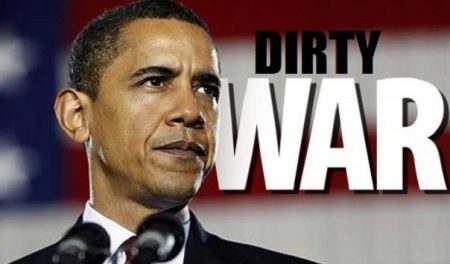
When US President Barack Obama attempted to leave Air Force One upon arriving at Hangzhou, China, just southwest of Shanghai, he found that no staircase or red carpet awaited him. Instead, he and his staff were forced to use an alternative exit from the aircraft, only to find additional restrictions placed upon them on the tarmac.
The New York Times in its article, “Bumpy Beginning for Obama in China, Starting on the Tarmac,” would note:
There was no staircase for Obama to exit the plane and descend on the red carpet. Obama used an alternative exit.
On the tarmac, a quarrel broke out between a presidential aide and a Chinese official who demanded the journalists traveling with Obama be prohibited from getting anywhere near him. It was a breach of the tradition observed whenever the American president arrives in a foreign place.
When the White House official insisted the U.S. would set the rules for its own leader, her Chinese counterpart shot back.
“This is our country! This is our airport!” the Chinese official yelled.
Rather than accept and adapt to the conditions set forth by their Chinese hosts, the President’s staff quarrelled with them, marking yet another ungraceful bout of American exceptionalism where even in another’s country, America’s will is expected to be fulfilled.
Reflecting on the event, President Obama made cryptic comments seemingly both attempting to downplay the event as a mere oversight, but alluding to the fact that it was more than a mere oversight by their Chinese hosts.
And in fact, it was no oversight. It was a clear message to America that the age of American exceptionalism, particularly in Asia, is over.
America’s Ungraceful Exit from Asia
In and of itself, President Obama’s ungraceful exit from Air Force One may seem like an insignificant event. When added together with a general decline of American influence and regarding the respect it had once commanded across Asia, it is highly symbolic of a global hegemon being pushed from an entire corner of the globe.
It was just recently that the US concluded a lengthy and costly public relations campaign, dressed up as an “international tribunal” conducted at The Hague in the Netherlands that predictably concluded that China held no legitimate claims in the South China Sea.
The “ruling” was allegedly made in favour of the Philippines, despite the legal team being headed by an American, Paul S. Reichler of Foley Hoag. Despite what Washington believed would be a crushing rhetorical blow to Beijing, not only did Beijing dismiss the entire proceeding out of hand, the Philippines itself refused to capitalise on the transparently politically-motivated and provocative ruling.
US pressure on the Philippines, until recently considered a stalwart ally, even a subordinate functionary of Washington, eventually resulted in Philippine President Rodrigo Duterte directly mocking America’s ambassador to the nation, denouncing him as an effeminate meddler.
The previous year, the US had been pressuring Thailand to allow Chinese terror suspects to travel onward to Turkey despite an extradition request from China. Thailand ignored US demands and returned the suspects to face justice in China.
In both cases terrorism struck shortly after, with a bomb striking in the centre of Bangkok killing 20 and maiming many more, and just recently a bomb exploding in the Philippine city of Davao, where President Duterte had previously served as mayor.
In Cambodia, the nation’s Prime Minister Hun Sen has openly accused the US of attempting to subvert political stability around the globe. This was in reference to opposition groups the US State Department is now using to pressure the Cambodian government after its decisive shift away from US interests toward Beijing.
In essence, while the US announced its “pivot” toward Asia, Asia itself appears to be pivoting away from the US. Thus, the incident on the tarmac in Hangzhou is a microcosm of what is taking place across Asia, an unwillingness of locals to further capitulate to American exceptionalism, and an ungraceful America unable to recognise or adapt to this shifting geopolitical reality.
In the end, America with its hegemonic hubris will ensure that it is fully pushed out of Asia, missing what is perhaps a final opportunity to readjust its relationship with the region away from adversarial domination toward something more equitable, proportional and constructive.
Joseph Thomas is chief editor of Thailand-based geopolitical journal, The New Atlas .
Russia-China military ties take a leap forward
By M K Bhadrakumar | India Punchline | September 11, 2016
The wrap on the long-awaited China-Russia naval exercise in the South China Sea has been lifted, finally. From what Beijing disclosed today regarding the eight-day exercise (codenamed Joint Sea-2016), beginning on September 12, it is anything but a routine exercise. Make no mistake, it marks a leap forward in Sino-Russian military ties and signals a significant show of strategic congruence.
The Chinese Navy spokesman revealed that the exercise will be held “off southern China’s Guangdong Province”, without elaborating. Both navies are deputing surface ships, submarines, fixed-wing aircraft, ship-borne helicopters marine corps and amphibious armored equipment for the exercise.
The announcement said the two navvies will “undertake defense, rescue, and anti-submarine operations, in addition to joint island seizing and other activities…(and) in particular, will carry out live-fire drills, sea crossing and island landing operations, and island defense and offense exercises among others”. (Global Times )
China’s South Sea Fleet and Russia’s Pacific Fleet will be the participants. The SSF, of course, plays a major role in the disputed waters of the South China Sea and, in fact, was instrumental in occupying the Paracel Islands in 1974.
The exercise is taking place against an extraordinary backdrop. Only six days ago, Russia came out with a stance on the South China Sea issue, which is completely to China’s satisfaction. It was hugely symbolic that President Vladimir Putin personally articulated it – and from Chinese soil, as he was leaving for home after the G20 summit in Hangzhou. Putin said in reply to a query from a journalist:
- I’ve developed a very good relationship based on trust with President Xi Jinping. I would say a friendly relationship. However, he has never – I would like to underscore this – he has never asked me to comment on this (South China Sea) issue or intervene in any way. Nothing of the kind has ever passed his lips. Nevertheless, of course, we have our own opinion on this. What is it? First of all, we do not interfere. We believe that interference by any power from outside the region will only hurt the resolution of these issues. I believe the involvement of any third-party powers from outside the region is detrimental and counterproductive. That’s my first point.
- Second, as far as the Hague Arbitration Court and its rulings are concerned, we agree with and support China’s position to not recognise the court’s ruling. And I’ll tell you why. It is not a political but a purely legal position. It is that any arbitration proceedings should be initiated by parties to a dispute while a court of arbitration should hear the arguments and positions of the parties to the dispute. As is known, China did not go the Hague Court of Arbitration and no one there listened to its position. So, how can these rulings be deemed fair? We support China’s position on the issue. (Kremlin website)
It is a calibrated stance that does not take any side on the disputes as such and simply ignored UNCLOS, et al, but it pointedly snubs Washington’s interference. It serves Beijing’s purpose, while for Moscow it no way jeopardises Russia’s developing strategic ties with Vietnam or with the ASEAN. Beijing is pleased. The Chinese Foreign Ministry lauded Putin’s remarks. (MFA)
Moscow and Beijing kept fine-tuning the details of the exercise, presumably taking into account the fluidity in the regional security. One reason could be the US’ decision to depute the nuclear-powered aircraft carrier USS Ronald Reagan to South Korea for a naval exercise in mid-October. The drill is projected as a show of strength to North Korea but it is being held at a time of heightened regional tensions over North Korea and the USS Reagan is part of a Japan-based American strike group and the only forward-deployed aircraft carrier in the region.
Interestingly, the visiting speaker of the upper house of Russia’s parliament Valentina Matviyenko stated in Beijing on Friday that Russia and China have identical positions on North Korea. A day later, on Saturday, Russian Foreign Ministry issued a joint appeal with China calling for avoidance of precipitate moves.
Putin’s remarks on South China Sea were by no means ex-tempore. The big question is whether Moscow and Beijing could be exploring the matrix of an alliance that is unlike a formal alliance but prepares them nonetheless to push back at a probable shift in the US’ policies in a pronounced interventionist direction and a greater readiness to use military power under the next US president. The deployment of the THAAD missile defence system in South Korea is a matter of common concern for Russia and China. Again, despite the seamless charm offensive by Prime Minister Shinzo Abe, Putin does not intend to make any territorial concessions to Japan over the Kuriles.
Indeed, the idea of a Sino-Russian alliance is not new. In 2014, Russian Defence Minister Sergei Shoigu explicitly aired the idea of a common front with China to fight terrorism and counter US-sponsored ‘color revolutions’. In a significant reference just before the visit to Hangzhou, Putin described Russia’s relations with China as “a comprehensive partnership and strategic cooperation”. Again, at the meeting with Putin in Hangzhou on September 4, Xi explicitly called for closer, tighter strategic alignment between the two countries. (Xinhua )
Obama’s Final ‘Jihad’ in Asia
By Wayne MADSEN | Strategic Culture Foundation | 06.09.2016
President Barack Obama has opted to ratchet up military tensions in Asia as one of his last foreign policy acts as president of the United States. Using climate change and free trade backdrops at the G20 Summit in Hangzhou, China and the U.S.-ASEAN and East Asia Summits in Vientiane, Laos as mirages intended to mask his aggressive military posture in the Asia-Pacific region, Obama seeks to cement his «pivot to Asia». It is Obama’s sincere hope that his anticipated successor, his former Secretary of State, Hillary Clinton, will expand on the expansionistic and aggressive regional showdown with China and Russia that his administration launched with his Asia «pivot».
The ultra-protocol conscious Chinese threw diplomacy and decorum to the wind when Obama touched down at Hangzhou International Airport and his national security adviser Susan Rice and deputy national security adviser became embroiled in an argument with Chinese security personnel. When White House officials traveling with Obama began issuing orders to the Chinese personnel, one Chinese official yelled at them, «This is our country. This is our airport». It was as if the Chinese, realizing that this would be their last encounter with Obama as president, were letting him and his war hawk national security team know who was the boss as long as they were on Chinese soil. At least on the tarmac at Hangzhou International Airport, the Chinese swung Obama’s Asia «pivot» back to China.
It was an ignominious final «haj» for Obama’s anti-Chinese jihad. Obama began his presidency in 2009 with being awarded, incredibly prematurely as it turned out, the Nobel Peace Prize. For the Asia-Pacific region, Obama’s presidency would end with angry words between his aides and Chinese officials at a Chinese airport.
Obama began his journey as the host for Pacific Island leaders at the Central Intelligence Agency front, the East-West Center, which is located at his mother’s alma mater, the University of Hawai’i. Obama was the official host at the 2016 Pacific Islands Conference (PIC) of Leaders at the CIA-linked center. Obama’s speech before the leaders, many from small Pacific island states, focused primarily on global climate change. Obama also addressed the World Conservation Congress at their meeting in Hawai’i.
Obama was schooled in anti-Chinese bigotry and Cold War fear tactics by his CIA mother and right-wing fascist Indonesian army stepfather while a child in post-1965 coup Indonesia. Obama, who is fully aware that the blood of 800,000 to one million Indonesians, Communists and ethnic Chinese Indonesian nationals, flowed in the streets, canals, and rivers of Indonesia from 1965 to 1967, the year he and his mother arrived in the country, believes it his birthright and duty to continue his familial “jihads” against «Communist» China that were instilled in him as a child, teen, and college student by his CIA-connected parents.
Papua New Guinea’s Prime Minister, Peter O’Neill, tipped off the press about the real purpose of the PIC before he departed Port Moresby for Hawai’i. O’Neill, who is in charge of one of Papua New Guinea’s most corrupt governments since independence in 1975, said that “regional security” shared the bill with climate change at the Hawai’i conference. In addition to independent Pacific Island states, the PIC includes the U.S. territories of American Samoa, Guam, Northern Marianas, and the state of Hawai’i.
U.S. Army Assistant Chief of Staff Colonel Tom Hanson, a relatively low-level official to be issuing policy statements, gave an ultimatum to Australia just prior to Obama’s departure for Hawai’i and Asia. Hanson told the Australian Broadcasting Corporation, “I think the Australians need to make a choice … it’s very difficult to walk this fine line between balancing the alliance with the United States and the economic engagement with China.” The statement chilled U.S.-Australian relations prior to Obama’s meeting with Australian Prime Minister Malcom Turnbull at the G20 summit.
Also on Obama’s agenda was pressuring certain PIC leaders who have shown signs of resisting the political status quo imposed by Washington. Northern Marianas Governor Ralph Torres, a Republican, recently signed into law the Second Marianas Political Status Commission that seeks to re-evaluate the islands’ current neo-colonial status imposed by the agreement that transformed the Northern Marianas into a colony where Asian sweat shops predominate and where those of Northern Marianas descent have little say over their domestic affairs. The Pentagon wants to turn the island of Tinian into a live-fire range, a decision that imperils the 3,000 residents of the island.
Another U.S. colony, Guam, has seen the growth of a Commission on Decolonization and an Independence for Guahan Task Force. Guahan is the proper Chuukese name for Guam.
Obama, a product of U.S. imperialist control over Hawai’i, the importance of which for Washington is solely military, has done everything possible to subvert and suppress the anti-colonial aspirations of the Pacific islands under U.S. domination and political influence.
The Obama administration has also been exercising subtle pressure on the Federation of Micronesia, a quasi-independent former U.S. Trust Territory, to deter movements for independence from the island groups of Chuuk and Yap. Under the Compact of Free Association, the U.S. effectively controls Micronesia and reserves the right o build military bases, through the federal government of Micronesia located in Pohnpei. Chuuk and Yap accuse Pohnpei of ignoring their own interests. Similar neo-colonialist “compacts” are in effect with the other former U.S. trust territories of the Marshall Islands, where the U.S. maintains a missile test range, and Palau, where the U.S. would like to build a naval base.
After departing Hawai’i for Asia, Obama stopped at the U.S.-controlled Midway Island, where he expanded the Papahānaumokuākea National Monument, a major marine wildlife sanctuary. However, the national monument, in addition to being the world’s largest marine sanctuary, also extends the protected wildlife area to the limits of America’s exclusive economic zone (EEZ). Ironically, it was China’s extension of its EEZ around disputed islands in the South China Sea, that resulted in Obama ratcheting up regional military confrontation with China.
Obama’s visit to another monument on Midway Island, the one honoring America’s decisive defeat of Japan in the Battle of Midway of 1942, had little to do with protecting sea turtles, albatrosses, and tiger sharks and everything to do with proclaiming America’s resolve to maintain the Pacific Ocean as an «American lake». The message to China and Russia could not have been more stark regardless of the masking of Obama’s military message with climate change and environmental optics.
Obama’s marine conservation visit to Midway is also suspicious. Under Obama’s neo-Cold War tactics, the United States is reopening abandoned or expanding previously scaled-down military bases in Iceland, Greenland, the Aleutian Islands of Shemya and Attu, Guam, American Samoa, and the Philippines. Midway, a former U.S. base, may also be see a renewed active military presence as part of Obama’s jihads against China and Russia. Midway Atoll is literally owned by the U.S. Interior Department. However, Midway’s Henderson Field is maintained as an active airport — which was capable of landing Obama’s Air Force One Boeing 747 — by a private company, American Airports Corporation. The company operates a number of airports in the western United States that were used to film some of the most jingoistic U.S. television shows, including the CIA propaganda series «24» and the U.S. Navy puffery series «JAG».
Obama, whose presidency has been buoyed by money and sycophancy from Hollywood, perhaps sees himself as not only waging a personal jihad against China and Russia but as a future action film star. It is a preferable option since as a movie star, Obama will only be able to wage fictional wars on movie sets.
China shows rancour at Russian doublespeak
By M K Bhadrakumar | Indian Punchline | July 25, 2016
The scathing attack on Russian foreign policies in the Global Times newspaper on Sunday has no precedents. It goes way beyond the occasional sparring in a spirit of ‘glasnost’. Indeed, China-Russia Comprehensive Strategic Partnership of Coordination (as it is officially described) is not at all like what it appears. (Read my article in Asia Times Russia-China entente – Lofty rhetoric, shifty discourse.)
The GT article marks a big departure from past Chinese criticism. A note of outright condemnation is appearing. The fundamentals of Russian foreign policies and diplomacy have been called into question.
There are pointed allegations that Russia undermine China’s core interests and seeks to extract “strategic room” out of China’s tensions with the US and Japan.
Russia is presented here as a mirror image of the US – harbouring hegemonic ambitions and imposing its own version of ‘colour revolutions’ in a drive to dominate Eurasia, Eurasian Economic Union and the SCO.
The article makes a hard-hitting reference to the tortuous history of the relations between the two countries to hark back to the vast Chinese territories that are still in Russian possession.
Of course, from the Indian perspective, the article makes a stunning allegation that Russia eyes India as a counterweight to China in terms of a containment strategy:
- Russia is also aiming at its own containment of China by using India, a key force in Russia’s eyes. Fostering another regional power to offset China’s growing influence is what both Russia and the US desire. India’s ambition to join the Nuclear Suppliers Group, which was foiled by some countries including China, was backed by both Russia and the US.
Evidently, at a time when tensions are rising in China-India relations, Russia’s pro-Indian leaning rankles in the Chinese mind. What explains this level of rancorous indignation?
To my mind, the principal reason could be that Beijing is displeased with Moscow’s unhelpful stance apropos the Permanent Arbitration Tribunal’s recent award on the South China Sea.
We know that just hours before the award was announced at The Hague on July 12, Minister Plenipotentiary (holding ambassadorial rank) of the Chinese Embassy in Moscow Zhang Ziao had called on Russian Deputy Foreign Minister Igor Morgulov. The Russian readout merely said the two diplomats discussed “current bilateral and global issues”.
But it stands to reason that the Chinese diplomat conveyed Beijing’s expectations of Russian support apropos the forthcoming South China Sea award. However, for two full days, Moscow kept mum. Probably, the Chinese demarche went up all the way to the Kremlin for instructions.
At any rate, when the Russian reaction came, finally, it was not as a formal statement but instead in the Q&A following a press briefing on July 14 by Russian Foreign Ministry spokeswoman Maria Zakhavrova. The following excerpts are important:
- Question: On July 12, the Permanent Court of Arbitration in The Hague rendered a judgment on the jurisdiction of certain islands in China’s economic zone. What do you think about the decision, and what is Russia’s attitude towards China’s policy in the South China Sea?
- Maria Zakharova: We would like to note the following in connection with the July 12 ruling of the Permanent Court of Arbitration in The Hague concerning the well-known lawsuit filed by the Philippines. It is our position that the states involved in territorial disputes in these seas should honour the principle of the non-use of force, and that they should continue to search for a diplomatic settlement based on international law, mainly the 1982 United Nations Convention on the Law of the Sea. They should act in accordance with the spirit of ASEAN and PRC documents, specifically, the 2002 Declaration on the Conduct of Parties in the South China Sea and the guidelines for following the declaration that were coordinated in 2011.
- We support ASEAN and PRC efforts to draft a code of conduct in the South China Sea. I will remind you that Russia is not involved in territorial disputes in that region, and that it has no intention of getting involved. We consider it a matter of principle not to side with any party. We believe that the concerned parties should conduct negotiations in a format they define. We also believe attempts to interfere in a resolution of territorial issues in the South China Sea by external parties to be counter-productive. We support the role of the 1982 UN Convention on the Law of the Sea in ensuring the rule of law during activities in the world’s oceans. Moreover, it is important that the provisions of this universal international treaty be applied consistently and in a way that will not jeopardise the integrity of the legal system stipulated by the convention.
Clearly, the remarks not only fell far short of an articulation of support for China, but rather clinically distanced Moscow from identifying with Beijing’s position. Furthermore, it underscored thrice the centrality of the UN Convention on the Law of the Sea.
The China-Russia Comprehensive Strategic Partnership of Coordination failed to pass the litmus test here. If the “forever” partnership expected the two big powers to be supportive of each other’s core interests, when the time came for Moscow to stand up and be counted as China’s friend, it scooted. The Chinese bitterness shows.
Beijing understands the Russian game plan to ingratiate itself into favour with the West. A possible rapprochement between the US and Russia, which the Kremlin is desperately seeking before President Barack Obama leaves office, creates uneasiness in the Chinese mind.
Meanwhile, Beijing’s comfort level on the South China Sea situation as such has significantly risen. The Chinese diplomacy has rather successfully weathered a potentially ugly situation stemming from the July 12 award. The summit meetings of the ASEM and ASEAN in successive weeks refrained from criticising China.
Most important, the US is tamping down tensions. National Security Advisor Susan Rice is currently in Beijing. Obama hopes for some substantial takeaway from his meeting with President Xi Jinping in September during the G20 summit in Hangzhou, China, which will be his last encounter with the Chinese leader.
Moscow may have miscalculated the geopolitical fallout of the July 12 award. The GT article is a stark reminder to the Russian side that its need of China is greater than the other way around. The article is here.
Featured Video

The Truth About the Trump Shootings with Ken Silva
or go to
Aletho News Archives – Video-Images
From the Archives
The Geopolitics behind the War in Yemen (I)
By Mahdi Darius NAZEMROAYA | Strategic Culture Foundation | 30.03.2015
The United States and the Kingdom of Saudi Arabia became very uneasy when the Yemenese or Yemenite movement of the Houthi or Ansarallah (meaning the supporters of God in Arabic) gained control of Yemen’s capital, Sanaa/Sana, in September 2014. The US-supported Yemenite President Abd-Rabbuh Manṣour Al-Hadi was humiliatingly forced to share power with the Houthis and the coalition of northern Yemenese tribes that had helped them enter Sana. Al-Hadi declared that negotiations for a Yemeni national unity government would take place and his allies the US and Saudi Arabia tried to use a new national dialogue and mediated talks to co-opt and pacify the Houthis.
The truth has been turned on its head about the war in Yemen. The war and ousting of President Abd-Rabbuh Manṣour Al-Hadi in Yemen are not the results of «Houthi coup» in Yemen. It is the opposite. Al-Hadi was ousted, because with Saudi and US support he tried to backtrack on the power sharing agreements he had made and return Yemen to authoritarian rule. The ousting of President Al-Hadi by the Houthis and their political allies was an unexpected reaction to the takeover Al-Hadi was planning with Washington and the House of Saudi. … continue
Blog Roll
 Aletho News
- IRGC air defenses destroy another US MQ-1 drone over Strait of Hormuz
- Imran Khan’s entire immediate family detained in Pakistan ahead of mass protest demanding his release
- EU nation detains former presidential frontrunner
- Leaked: Britain’s Sham Conviction Of Hashim Thaci
- Seyed M. Marandi: U.S. Strike Imminent – Toward Total War in the Middle East
- Russia Voted Under Fire. Washington Is Loading the Tankers.
- 12 Things Your Oncologist Was Trained Not to Tell You
- Anthrax Attacks Paved Way for COVID-Era ‘Junk Drugs and Vaccines’
- How Real Is the Impact of Western Sanctions on Israel?
- France, You Are Guilty: How Paris Turned Western Sahara into the Maghreb’s Powder Keg
- If Americans Knew
- Inside Israel’s ‘soft’ ethnic cleansing plan for Gaza through the eyes of its victims
- New online database tracks pro-‘Israel’ political donations in the United States
- Israeli president pardons soldier convicted for killing wounded Palestinian
- Singer Ed Sheeran says his ‘heart broken’ by Gaza devastation, addresses Macklemore controversy
- Israel Has Imprisoned Female Journalist Bushra Al-Tawil Without Trial Or Charge In Solitary Confinement For Past Month
- Israel poised to teach West Bank a lesson after one Israeli killed – Daily Update
- Salah Sarsour’s Legal Team Says DHS Has Not Met Its Burden to Prove He Is Deportable
- An analysis of tax forms by The Intercept show Kraft’s charity and LLC have donated to Friends of the IDF and AIPAC’s super PAC.
- Israeli attacks kill four Palestinians in Gaza – Daily Update
- Inside Gaza’s death trap of collapsing, bombed-out buildings
- No Tricks Zone
- 2025 Nature Paper Claiming Worsening Global Drought Gets RETRACTED …Heavily Flawed
- New Study: ‘Global Drought Shows No Detectable Recent Acceleration Under Climate Warming’
- Economic Masterminds: German Socialists Suggest Taxing Productivity Gains Stemming From Using AI
- The South China Sea Has Not Been Cooperating With The Climate Change Narrative
- Energy Crisis: Germany Enters Heating Season With Historically Low Gas Reserve Fill Levels
- New Study: The Antarctic Ice Sheet Gained Mass From 2020-2024 Due To Staggering Snow And Ice Accumulation
- Study: Ocean Heating Rates From Thousands Of Years Ago ‘Dwarf’ Modern Ocean Heating Rates
- Climate Extremists Target, Attack Large-Scale Power Grid Infrastructure In Germany!
- New Study: Antarctic Ice Melt Has Contributed Less Than 1 Centimeter To Sea Level Rise In The Last 30 Years
- Fear Of Debate: Alarmist German Climate Scientist Calls On Mainstream Media To Discredit Skeptic Voices
 Aletho News