Net Zero Fades As the Deluded Cling to Its Fantasy
By Vijay Jayaraj | Townhall | May 9, 2025
The grand vision of “Net Zero” initiatives – by which emissions of carbon dioxide magically balance with expensive and futile capture and storage systems – have long been sold as the redemption arc for humanity’s profligate modern ways. Yet, like a poorly scripted dystopian thriller, the holes in this plot are glaring.
Net Zero was always a fragile concept. It rested on shaky and illogical assumptions: that wind turbines, solar panels and “green” hydrogen could reliably replace fossil fuels, that governments could redesign economies without unintended consequences, that voters would accept higher costs for daily necessities, and that developing countries would sacrifice growth for climate targets they had no hand in creating.
None of those fantasies held. Countries did not decarbonize nearly at the speed promised, even though climate bureaucracies clung to the illusion. Long-range targets, five-year reviews and international pledges lacked common sense and defied physical and economic realities. The result? An unaccountable machine pushing impractical policies that most people never voted for and are now beginning to reject.
If Net Zero were a serious endeavor, its architects would confront the undeniable: China and India are more than delaying their decarbonization timelines – they’re burying them. Why has this been ignored?
China and India – responsible for more than 40 percent of global CO2 emissions in the last two decades – are accelerating fossil fuel use, not phasing it out. In Southeast Asia, coal, oil and natural gas continue to dominate. Vietnam, Indonesia and the Philippines are building new electric generating power plants using those fuels. These countries understand that economic growth comes first.
Africa, too, is pushing back. Leaders in Nigeria, Ghana and Senegal have criticized Western attempts to block fossil fuel financing. African nations are investing in exploitation of the oil and gas reserves.
If Asia represents the global rejection of Net Zero, Germany and the U.K. are poster children of the West’s self-inflicted wounds. Both nations, once hailed as Net Zero pioneers, are grappling with the harsh realities of their green ambitions. The transition to “renewables” has been plagued by economic pain, energy insecurity and political backlash, exposing the folly of policies divorced from facts. When the war in Ukraine cut off energy supplies, Germany panicked. Suddenly, coal plants were back online. The Green Dream died a quiet death.
Trump funding cuts likely will accelerate the fall of Net Zero’s house of cards. The president’s decisions to slash financing for international and domestic green programs has severed the lifeline for global climate initiatives, including the United Nations Environment Program. Trump also vowed to redirect billions from the Inflation Reduction Act – Biden’s misnomered climate law – toward fossil fuel infrastructure.
The retreat of Net Zero interrupts the flow of trillions of dollars into an agenda with questionable motives and false promises. Climate finance had developed the fever of a gold rush. Banks, asset managers and consulting firms hurried to brand themselves as “green.” ESG (Environmental, Social, Governance) investing promised to reward “climate-friendly” firms and punish alleged polluters.
The fallout was massive market distortions. Companies shifted resources to meet ESG checklists at the expense of fiduciary obligations. Now the tide is turning. The Net Zero Banking Alliance comprising top firms globally has been abandoned by America’s leading institutions. Similarly, a Net Zero investors alliance collapsed after Blackrock’s exit.
Perhaps the fundamental failure of Net Zero was political. Permission was never sought from taxpayers and consumers who would pay the costs and suffer the consequences of an always ill-fated enterprise. Climate goals were set behind closed doors. Policies were imposed from above. Higher utility bills, job losses and diminished economic opportunity became the burdens of ordinary families. All while elites flew private jets to international summits and lectured about the need to sacrifice.
A certain lesson in the slow passing of Net Zero is this: Energy policy must serve people, not ideology. That truth was always obvious and remains so.
Yet, some political leaders, legacy media and industry “yes-men” continue to blather on about a “green” utopia. How long the delusion persists remains to be seen.
Vijay Jayaraj is a Science and Research Associate at the CO2 Coalition, Fairfax, Virginia. He holds an M.S. in environmental sciences from the University of East Anglia and a postgraduate degree in energy management from Robert Gordon University, both in the U.K., and a bachelor’s in engineering from Anna University, India.
US universities are recruiting Indian and Nigerian students to replace Chinese. It’s not working.
Inside China Business | May 8, 2025
Chinese university students contribute over $14 billion a year to the US economy. But Chinese families are increasingly choosing to either study in China, or to other countries.
This shift is deepening the fiscal crises in American higher education, which also suffers from a steep decline in US student populations. US universities are heavily recruiting students from India and Africa, in the hope to make up for shortfalls in Chinese enrollments. And briefly, this strategy seemed to work.
A surge in students from India pushed China into second place, as a leading country of origin for US international students. But that was short-lived. Indian enrollment in the past year plunged, with 99,000 fewer students. Nigeria also saw double-digit percentage declines in just a one-year period.
A more serious problem, however, exists in the financial commitments of the students’ families. Chinese students cluster in the most highly-ranked, and most expensive, US university programs. In comparison, Indian and especially Nigerian students tend to attend far lower-cost programs. Closing scene, Detian Waterfall, near Nanning, Guangxi
Resources and links:
LA Times, Why Chinese students still want to attend U.S. universities https://www.latimes.com/world-nation/…
Interest in studying in US dropped 42% in January https://www.universityworldnews.com/p…
There are already 130,000 fewer international students in the US. Has anyone noticed? https://distributedprogress.substack….
Already facing Trump administration cuts, US colleges risk losses from another revenue source: foreign students https://www.cnn.com/2025/04/18/us/int…
SEVIS Data Shows Declining Number of International Students in the United States https://www.aau.edu/newsroom/leading-…
Wall Street Journal, Chinese Students on U.S. Campuses Are Ensnared in Political Standoff https://www.wsj.com/politics/policy/c…
Tracking College Closures and Mergers https://www.bestcolleges.com/research…
The Demographic Cliff: What It Means for College Admissions and Higher Education https://www.applerouth.com/blog/the-d…
US: New survey shows international student recruitment shifting to India in 2023 https://monitor.icef.com/2023/07/us-n…
Why the Next Wave of International Students May Come From Africa https://www.bestcolleges.com/news/wav…
Five Reasons Why a Strong Euro is an Economic Disaster for the EU
Sputnik – 01.05.2025
The euro has jumped in value almost 10% against the dollar since January. But before cheering at the thought of cheaper imports of Skippy peanut butter and Jim Beam whiskey, here’s what EU residents should know.
1. Stronger Euro = Weaker Exports
“For any country (or zone in the case of the euro) that is a strong exporter,” a strong currency “contributes to slowing exports and increasing imports, to the detriment of domestic production,” explains Jacques Sapir, veteran economist and director of studies at the Paris-based School for Advanced Studies in the Social Sciences.
2. Monetary Union Trap
Unlike ordinary nations, which can depreciate their currencies at will to restore exports’ appeal, eurozone members are trapped by the monetary union, which offers “quite limited” room to maneuver for big producers or tourism-based earners benefiting from depreciation vs everyone else.
3. Another Hit to Eurozone Economy in Rough Shape
The euro’s growing strength is bad news for a bloc already:
- facing zero growth and recession for 3 years running
- cut off from the source of its export competitiveness: cheap Russian energy
- facing brutal trade competition from the US and China.
4. Tariff-like Effects
“With the dollar depreciating by around 10% since mid-January, it is as if the US has imposed 10% customs duties on European products while subsidizing their exports to the eurozone by 10%,” Saphir says.
5. Tariff Wars Add to Uncertainty
“Major economic players abhor uncertainty…As long as these negotiations last, no one knows what the tariff levels will be and therefore how attractive the American market will be, whether for production or investment,” the economist says.
Civic groups in Taiwan rally protest against DPP amid growing wave of opposition
By Shen Sheng | Global Times | April 26, 2025
Several civic groups on the island of Taiwan launched a protest event on Saturday, opposing the Democratic Progressive Party (DPP) and condemning Lai Ching-te for inciting hatred within Taiwan island and forcibly pushing the public toward the brink of war. They also denounced the DPP for damaging cross-Straits economic and trade exchanges, making it difficult for agricultural and fishery products from Taiwan to be exported.
The event comes as the Lai’s series of regressive actions have triggered a growing wave of denunciations from people across Taiwan Straits, who condemned his trampling of democracy and the rule of law, as well as its damage to the peace across the Straits.
Speakers at the event warned that if the DPP continues to rely on foreign powers and provoke confrontation with Chinese mainland, there will be no space left for peace in Taiwan island, and young people will face an unstable future. They called on the people of Taiwan to transcend ethnic and political divides and stand up against the DPP’s attempt to seek “Taiwan independence.” They urged all Chinese people on both sides of the Taiwan Straits to share a sense of historical responsibility and jointly resist forces driving them toward disaster, according to a press release sent to the Global Times on Saturday by the Labor Party.
Wang Chuan-pin, Vice Chairman of the Labor Party, emphasized at the event that the DPP is actively cooperating with the US to hollow out Taiwan’s industries. She emphasized the need to defend the rights of small and medium-sized enterprises and grassroots workers and urged everyone to courageously stand up against DPP’s harmful actions.
Wang Wu-lang, secretary-general of the Labor Party, noted that Lai Ching-te has damaged cross-Straits economic and trade exchanges, making it difficult for agricultural and fishery products in Taiwan island to be exported, while industrial goods are now subject to high US tariffs. These developments have severely harmed the interests of farmers and workers in the island.
People are now facing stagnant wages, soaring housing prices, and rising living costs, signaling that the DPP is ruining the lives of the people through its political agenda, said Wang.
Xu Mengxiang, Deputy Secretary-General of the Labor Party, stated that the DPP, under the pretext of “security,” is inciting hatred within the island of Taiwan and forcibly pushing the public toward the brink of war. This undermines the progressive values of democracy and leads the entire island down a dangerous path of historical regression.
Participants further stressed that the DPP’s “green terror” has already targeted mainland spouses and other political groups and may extend even further. They warned that if the public does not rise up, everyone could eventually become victims of this “green terror.” They invoked the memory of those who once stood against “white terror” in Taiwan’s history, calling on current and future generations to continue fighting against today’s oppression, and to defend democracy and the rule of law.
Addressing the livelihood issues that concern the public most, speakers at the event repeatedly pointed out that the DPP places ideology above people’s welfare. Its anti-China stance has crippled Taiwan’s economy and society, misallocating resources and distorting internal policies, thereby intensifying livelihood and economic crises.
They stressed that the Lai Ching-te administration is using an anti-China strategy as a cover for its governance failures, leading to worsening economic decline, rising energy risks, and widespread public hardship.
At the conclusion of the event, the civic groups issued an appeal to people in Taiwan, chanting slogans such as “both sides of the Taiwan Straits are of the same family” and “we are all Chinese,” which received strong and enthusiastic support from the public.
Meanwhile, the Kuomintang (KMT) party also held a protest against DPP on the same day, Taiwan-based outlet ETtoday reported. Ma Ying-jeou, former chairman of the Chinese Kuomintang party, attended the protest and delivered a speech. In his remarks, Ma expressed his dissatisfaction with DPP’s actions, and criticized Lai’s incompetence, stating that he cannot bear it anymore.
Taiwan-based media reported that Ma expressed concern that Lai’s recent words and actions could lead Taiwan to a rapid decline. He mentioned that while the US imposed heavy tariffs, Lai and DPP authorities are helpless.
White House preparing for possible Trump-Kim talks – Axios
RT | April 28, 2025
US President Donald Trump’s team is considering a new strategy for North Korea, potentially mirroring the diplomatic engagement of his first term, according to sources cited by Axios.
Trump met with North Korean leader Kim Jong-un in person multiple times, including in Singapore in 2018, Hanoi in 2019, and within the demilitarized zone on the Korean Peninsula later that same year. He is the first sitting US president ever to sit down at the negotiating table with his North Korean counterpart.
Trump has told his team that he wants to reconnect with Kim, potentially face-to-face, Axios reported on Sunday. The administration is “convening agencies to understand where the North Koreans are today,” said a senior official speaking on condition of anonymity. “A lot has changed in the last four years. We are evaluating, diagnosing and talking about potential avenues, including engagement.”
Currently, this initiative is not among the White House’s top priorities and involves consultations with external experts, including former officials and think tanks, the outlet said. Axios suggested that Washington holds less leverage over Pyongyang now than it did in the late 2010s, as North Korea has bolstered its military capabilities, including nuclear forces, and forged stronger ties with China and Russia.
Last year, North Korea and Russia signed a bilateral treaty that includes mutual defense provisions. Shortly thereafter, Ukraine started an offensive into Russia’s Kursk Region, aiming to gain leverage over Moscow in future negotiations.
North Korean troops were deployed to Russian territory to assist Moscow in repelling Ukrainian forces, culminating in the complete liberation of the region last week, according to Moscow. Over the weekend, President Vladimir Putin acknowledged the contribution of North Korean troops, commending their bravery and referring to them as brothers in arms.
The Trump administration is seeking a compromise deal to end the Ukraine conflict. Trump has accused Ukraine’s Vladimir Zelensky of undermining his efforts by publicly challenging key aspects of what media outlets describe as his peace plan.
The two leaders met on the sidelines of Pope Francis’ funeral in the Vatican on Saturday, with Zelensky pleading for more US weapons, according to Trump.
Chinese satellite company refutes US accusation of supporting Houthi attack on US interests as ‘completely fabricated’
By Fan Wei and Liu Xin | Global Times | April 19, 2025
The US accusations are completely groundless and Chang Guang Satellite Technology has no business dealings with Iran or the Houthi groups, Chang Guang Satellite Technology told the Global Times on Saturday in response to a recent US accusation of supporting Yemen’s Houthis in attacking US interests in the region.
The US State Department spokesperson Tammy Bruce claimed that Chang Guang Satellite Technology Co., Ltd was involved in “directly aiding Iran-backed Houthi rebels in Yemen by providing satellite imagery used to target US and international vessels in the Red Sea,” according to a report from Fox News on Friday.
In response to an inquiry from the Global Times on the US accusation, Chang Guang Satellite Technology said that the company firmly opposed the US groundless accusation and such claims are completely fabricated and maliciously slanderous.
Chang Guang Satellite Technology Co., Ltd has no business dealings with Iran or the Houthi force. The company said that it strives to harness remote sensing data to drive high-quality development across key sectors such as agriculture, forestry, environmental protection, and finance.
“In our global operations, we strictly comply with relevant laws, regulations, and industry standards both in China and internationally. With a mature business model and high-quality services, we are committed to contributing Chinese expertise and solutions to the advancement of the global remote sensing industry,” said the company.
The core US accusation is that Chang Guang Satellite tracked US warships and commercial vessels using commercial remote sensing satellites to guide the Houthis strikes, which is technically unfeasible, Hu Bo, director of South China Sea Strategic Situation Probing Initiative (SCSPI), told the Global Times.
Hu said that according to current public information, it is technically difficult for any global commercial remote sensing satellite constellation — including that of Chang Guang Satellite — to achieve such a capability. The limitations in ephemeris, revisit cycles of the remote sensing satellite, and the ability of existing remote sensing technologies to track moving targets mean that these satellites cannot provide real-time coordinate information to strike mobile targets such as warships and commercial vessels.
Even Planet Labs, the US-based company with the largest number of commercial remote sensing satellites in the world, can only achieve an average once-daily revisit cycle for any given location on Earth. While orbital adjustments and resource concentration on hotspot areas may slightly reduce the revisit interval, this still makes it meaningless for real-time tracking and targeting of moving objects to guide weapon strikes, according to Hu.
The Houthis have their own drone capabilities, which serve as the most practical and effective means of real-time surveillance and reconnaissance against moving targets in narrow waters like the Red Sea. In contrast, reconnaissance satellites offer very limited utility in such scenarios, said Hu.
In response to a media inquiry on the US accusation, Chinese Foreign Ministry spokesperson Lin Jian on Friday said that “I’m not familiar with the specifics you mentioned. Since the situation in the Red Sea escalated, China has been playing a positive role to ease tensions.”
“Who is promoting talks for peace and cooling down the situation, and who is heightening tensions with sanction and pressure? The answer is rather clear to the world. China urges relevant countries to do what is conducive to regional peace and stability, not otherwise,” Lin said.
China detonates non-nuclear hydrogen bomb — media
RT | April 20, 2025
Chinese researchers have successfully tested a non-nuclear hydrogen bomb that created a sustained fireball, far outperforming traditional explosives, the South China Morning Post has reported.
In an article on Sunday, the newspaper cited the researchers’ study published last month in the Chinese-language Journal of Projectiles, Rockets, Missiles and Guidance. According to the report, a team from the China State Shipbuilding Corporation’s (CSSC) 705 Research Institute — a key player in underwater weapon systems — developed a 2kg (4.4lbs) bomb primarily composed of magnesium hydride, with conventional explosives serving as the catalyst.
In a field test, the device reportedly generated a fireball with temperatures exceeding 1,000 degrees Celsius (1,832 degrees Fahrenheit) that lasted for more than two seconds, which is considerably longer than what an equivalent TNT blast is capable of producing.
In the reaction, magnesium hydride, a compound originally developed as an efficient fuel, rapidly releases stored hydrogen gas, resulting in a sustained inferno.
The novel explosive device’s destructive power thus is said to lie not in its blast pressure, but rather in the ability to generate extreme heat.
The South China Morning Post quoted CSSC research scientist Wang Xuefeng as explaining that its properties also allow for “precise control over blast intensity, easily achieving uniform destruction of targets across vast areas.”
If fully developed, the method could presumably yield a weapon similar to napalm or a thermobaric device – ideal for annihilating defensive structures and armored vehicles.
While the production of magnesium hydride used to be mostly small-scale and rather complicated, China has recently developed a cheaper and safer production method and built a plant capable of producing 150 tons of the compound per year.
Ties with Russia, China key to global peace – Iranian foreign minister
RT | April 19, 2025
Iran, Russia, and China intend to deepen their cooperation in order to promote global peace and security, Iranian Foreign Minister Abbas Araghchi has said in an exclusive interview with RT.
Tehran has been strengthening its ties with Moscow and Beijing in recent years, joining the Shanghai Cooperation Organization (SCO) in 2023 and the BRICS group in 2024. Military cooperation has also expanded, most recently through joint naval drills conducted by the three countries off Iran’s coast in March.
Given the current international climate, working closely with Moscow and Beijing is “a necessity” for Tehran, Araghchi told the broadcaster on Saturday.
“We have started trilateral talks between Iran, Russia and China on the issue of Iran’s nuclear program for some time now,” he said, adding that two such meetings have already taken place. “We are ready to continue these talks and expand them to other issues,” the minister added.
Araghchi expressed confidence that “Iran, China and Russia – in a coordinated move – can take effective steps towards international peace.” The three partners “are serious about this,” he insisted.
Tehran’s top diplomat also said that bilateral “relations between Iran and Russia have never been so close and so strong” than at the current moment.
“We now have a comprehensive strategic partnership agreement that raises the level of our relations to a strategic level. Major economic projects are underway between us. The volume of trade between us has increased tremendously,” he said.
Despite harsh Western restrictions slapped on both Iran and Russia, the two countries “are not waiting for the sanctions to be lifted, but we are expanding our relations in this situation,” Araghchi noted.
“We have the same and close positions on many international issues. I do not want to say that there are no disagreements between us. Sometimes there are also differences of opinion, but in most cases we have close positions with each other and, most importantly, we are in constant exchange of views,” he said.
Earlier this week, Russia’s Federation Council, the upper house of the country’s parliament, unanimously ratified the Comprehensive Strategic Partnership Agreement between Russia and Iran, which was signed by Russian President Vladimir Putin and his Iranian counterpart Masoud Peseshkian in January. The pact stipulates that the two nations will develop equal and mutually beneficial cooperation in the fields of politics, defense, economy, security, trade, investment, energy, infrastructure and other areas.
Russia, China to Discuss Guarantees on Iran Deal with US – Iranian Lawmaker
Sputnik – 19.04.2025
The United States will not be the only one providing guarantees for a potential Tehran-Washington agreement on the Iranian nuclear program, Iranian lawmaker Alaeddin Boroujerdi said ahead of the second round of US-Iran talks in Rome.
Russia and China will discuss with the US the issue of “more reliable guarantees” for Tehran, Alaeddin Boroujerdi, a member of the Iranian parliamentary committee on national security and foreign policy, said.
“During the negotiations between Tehran and Washington, guarantees will not only be provided by the US. Countries such as Russia and China will enter into negotiations with the United States on more reliable guarantees,” Boroujerdi said, as quoted by the Iranian state agency SNN.
Iranian Foreign Minister Abbas Araghchi was on an official visit to Moscow on Thursday and Friday, and in the next few days, according to the Iranian state news agency IRNA, Araghchi will visit China.
During his visit to Russia, the Iranian diplomat held a meeting and talks with Russian leader Vladimir Putin, conveying to him a message from Iran’s Supreme Leader Ali Khamenei. Araghchi also held talks with Russian Foreign Minister Sergey Lavrov. The parties discussed regional and international cooperation, as well as the situation around the US-Iran talks, the first round of which took place on April 12 in Oman.
Indirect talks between US Presidential Envoy for the Middle East Steve Witkoff and Araghchi took place in the Omani capital on April 12. According to the US special envoy, they were positive and constructive. Araghchi also described the atmosphere of these talks as constructive and calm, and announced that the second round of talks between the Islamic Republic and the United States would be held on April 19.
US imposes sanctions on Chinese buyers of Iranian oil
Press TV – April 16, 2025
The United States has imposed sanctions on Chinese importers of Iranian oil despite being involved in talks with the Islamic Republic to sort out differences over its nuclear program.
The US Treasury Department’s Office of Foreign Assets Control (OFAC) said in a statement on Wednesday that it had targeted the Chinese importers of Iranian oil in a new round of sanctions issued against Tehran.
It said that the Shandong Shengxing, a so-called “teapot” refinery based in China’s Shandong province, had been designated for receiving dozens of Iranian oil shipments worth more than $1 billion.
The sanctions also targeted the China Oil and Petroleum Company Limited (COPC), an entity the Treasury claimed has been functioning as a front company for Iran’s Islamic Revolution Guards Corps to collect oil export revenues from China, including payments made by Shandong Shengxing.
OFAC said it had also designated one Cameroon-flagged and four Panama-flagged tankers for their role in transporting billions of dollars worth of Iran’s oil to international markets, including to China-based refineries.
The tankers’ owners and operators, based in Panama, Malaysia, the Marshall Islands, and Hong Kong, were also targeted.
The new sanctions are the sixth such action taken by the US government against Iran since February 4, when US President Donald Trump signed a presidential memorandum ordering a campaign of maximum pressure on the country.
They came despite the fact that Iran and the US have launched negotiations to settle disputes about Tehran’s nuclear program. The indirect talks started last weekend in Oman’s capital, Muscat, and will continue on Saturday in Italy’s Rome.
However, the sanctions are a first under Trump in his second term to directly target China and its imports of oil from Iran. Beijing has repeatedly said that it does not recognize US sanctions.
US, Iran to Hold Indirect Negotiations in Oman
Sputnik – 08.04.2025
Iranian Foreign Minister Abbas Araghchi confirms the upcoming US-Iran meeting in Oman on Saturday for high-level indirect talks.
Donald Trump previously announced direct negotiations with the Iranian side at “almost the highest level” this Saturday, which Tehran later corrected.
Iran has previously ruled out direct talks with the US under threats and pressure, but has left the door open for indirect negotiations.
Meanwhile, Russian Foreign Ministry spokeswoman Maria Zakharova said that Russia, China and Iran will hold talks on Iran’s nuclear program in Moscow tomorrow.
Chinese Embassy in Canada refutes allegations of China’s interference in Canadian elections
Global Times | March 26, 2025
In response to a media question regarding claims by an official from the Canadian Security Intelligence Service (CSIS) that China might attempt to interfere in Canada’s elections, a spokesperson of the Chinese Embassy in Canada stated that China firmly opposes the baseless slander and defamation of China without factual evidence.
It has been reported that an official from the CSIS stated that Canada’s elections could face the threat of foreign interference and the CSIS is closely monitoring China, Russia, India, and Pakistan, when questioned on this, the spokesperson of the Chinese Embassy in Canada said that the Chinese side has repeatedly stated its position on the so-called issue of foreign interference, firmly opposing the baseless slander and defamation of China without factual evidence.
China follows the principle of non-interference in other countries’ internal affairs and has never, nor has any interest in, interfering in Canada’s internal affairs. The label of “foreign interference” will never be placed on China, the spokesperson said.
The Canadian election is a domestic issue for Canada and is not related to China. However, the Chinese side firmly opposes linking Canada’s internal affairs with China-related factors and firmly opposes using China as a topic in this context, the spokesperson added.
Featured Video
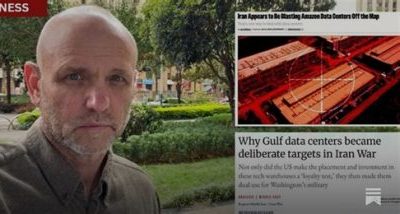
Iran spent $1 million to wipe out $30 billion in data center plans, and take down Amazon in the ME
or go to
Aletho News Archives – Video-Images
From the Archives
A short history of British torture
ICC | December 2005
When the House of Commons was debating how much to increase the time limit for detention without trial the question of torture came up. Officially this was limited to the nice considerations of whether it was all right to send people to places where torture is used and whether Britain can use information collected by the use of torture in other countries. This discussion gave an impression of democratic Britain as the home of civilised behaviour where the very idea of torture is repugnant to our legislators – unlike, say, the US with its secret CIA jails… In reality, the British state has a long history of using and developing a whole range of torture techniques. … continue
Blog Roll
 Aletho News
- Iran spent $1 million to wipe out $30 billion in data center plans, and take down Amazon in the ME
- Zionist billionaire pressure to silence Macklemore sparks exodus from Ed Sheeran tour
- House Votes to End Iran War for Third Time
- North Korea Slams US Plan for ‘AUKUS 2.0’ with South Korea and Japan
- Prolonging US-Iran Conflict Not Meeting Interests of Int’l Community – China’s Wang Yi
- EU bans former Zelensky aide from parliament
- NATO-backed Kosovo separatist ‘responsible for war crimes’
- US destroying international space law
- SCO Calls for Binding Global Deal to Prevent Arms Race in Space
- Iran & Its Allies Are Threatening Every Route for Saudi Oil
- If Americans Knew
- U.S. Makes, Israel Takes: The Real Story of U.S.-Israeli Military Cooperation
- Night raids rise in Palestine
- Tucker Carlson interviews Norman Finkelstein about Gaza
- Groups urge Americans to support Van Hollen legislation on Israel’s killing of Americans & Palestinians
- Trump administration plans to send 40,000 tons of bombs to Israel: report
- Sanctions Target Iran’s Government, But Kill Hospitalized 23-Year-Old Woman
- An alternative view on the book “Israel’s Lobby: America in the Grip of a Foreign Power”
- Ed Sheeran’s band Beoga, other opening acts quit tour after Macklemore was dropped over his pro-Palestinian comments
- The assassination attempt on President Trump in Butler and the various Israeli connections to it
- “We Want That the Whole Land Be Jewish”
- No Tricks Zone
- Economic Masterminds: German Socialists Suggest Taxing Productivity Gains Stemming From Using AI
- The South China Sea Has Not Been Cooperating With The Climate Change Narrative
- Energy Crisis: Germany Enters Heating Season With Historically Low Gas Reserve Fill Levels
- New Study: The Antarctic Ice Sheet Gained Mass From 2020-2024 Due To Staggering Snow And Ice Accumulation
- Study: Ocean Heating Rates From Thousands Of Years Ago ‘Dwarf’ Modern Ocean Heating Rates
- Climate Extremists Target, Attack Large-Scale Power Grid Infrastructure In Germany!
- New Study: Antarctic Ice Melt Has Contributed Less Than 1 Centimeter To Sea Level Rise In The Last 30 Years
- Fear Of Debate: Alarmist German Climate Scientist Calls On Mainstream Media To Discredit Skeptic Voices
- End-Of-August Arctic Sea Ice Extent Hasn’t Fallen In 20 Years, Official Data Show!
- News-Making Nepal Region Has Had As-Warm Or Warmer Periods Than The 2000s In The 1600s, 1700s, 1800s
 Aletho News