Xi divides and conquers during Macron’s China visit
By Timur Fomenko | RT | April 8, 2023
French President Emmanuel Macron has wrapped up a three-day visit to China, accompanied partly by European Commission Chief Ursula von der Leyen, who went home a day earlier.
The dual visit came at a time when EU nations, worried about a growing Sino-Russian partnership, are looking for ways to strengthen their own diplomatic engagement with Beijing.
Von der Leyen’s presence on the trip was widely seen as a “check” on Macron, there to ensure he complied with “European unity” on the matter of the EU’s relationship with China. Before the visit, she gave a hawkish address warning China against supporting Russia in the Ukraine conflict and slamming Beijing for becoming “more repressive at home and more assertive abroad.”
While she urged the bloc to reduce “dependencies” on China, she also opposed full “decoupling” of economies, as called for by the US. Enduring trade relations were made abundantly clear by the fact that Macron was accompanied by a 50-strong delegation of business leaders who came to Beijing to sign deals.
It is unusual that Macron, an advocate of the EU’s so-called “strategic autonomy” in negotiating with other actors on the world stage, and von der Leyen, an ardent atlanticist who is reportedly in the wings to be the next NATO secretary general, were both in China together.
Despite their somewhat conflicting agendas, their visit was a net positive for Beijing and a net negative for US attempts to force the EU to fully take its side in its own geopolitical crusade against Beijing. The US looks upon all attempts by the EU to engage with China with disdain, and does its best to undermine it where possible.
Likewise, when it comes to the Ukraine conflict, China’s effort to open talks by presenting its 12-step peace plan was immediately dismissed by Washington, with US Secretary of State Antony Blinken accusing Beijing of providing “diplomatic cover” for what he called Russia’s attempts to “freeze the war.” However, Xi Jinping’s recent visit to Moscow has apparently shown EU leaders, who would prefer the war to end rather than drag on indefinitely, the potential consequences of “losing China” – and now Macron is urging Xi to mediate a return to the negotiating table by “bringing Russia to its senses.”
In other words, many EU leaders, bar the overzealous and fanatical ones in states such as Lithuania, now realize that they must pursue a diplomatic effort to “keep China on board,” which in turn illustrates the tactical shrewdness of Xi Jinping in preserving his partnership with Moscow without explicitly endorsing the Ukraine conflict. This has given China geopolitical leverage.
It should also be noted that China has never sought to oppose Europe, but its principal objective has been to try and keep Europe out of the American camp at all costs. The EU, after all, collectively represents the largest export market China has in the developed world and is therefore critical to China’s growth and development.
Of course, on the other hand, the US has long been pushing very aggressively to undermine China’s prospects in the EU. It has been waging a public opinion war against Beijing, using its own state-sponsored think-tanks, and pushing issues such as human rights to create negative sentiment and to block engagement, such as on the Comprehensive Agreement on Investment (CAI), which was proposed back in 2013 and is still pending ratification a decade later. Similarly, the US uses bilateral and unilateral diplomacy to undermine China’s relationships with specific European countries in a bid to wreck its attempts to engage with the bloc as a whole.
For example, the US explicitly supported Lithuania in undermining the ‘One China’ principle by opening a “Taiwan representative office.” It also forced the Netherlands to agree to new export controls on sending advanced lithography machines (used for making computer chips) to China. Similarly, because the EU could never agree to a comprehensive ban of Huawei’s application in 5G networks in 2020, the US simply resorted to bilaterally approaching countries one by one, making them agree to the ban until those states that were not on board, such as Germany, were effectively isolated and could not drive the EU agenda.
Ultimately, the EU is a bloc which can only operate by consensus between all of its member states, but if the US can undermine that consensus, it can throw a spanner in the works and break the entire machine. This is why it is so difficult for Europe to truly create an “autonomous” foreign policy capable of serving coherent “European interests.” This means when nations such as France and Germany declare their desire for engagement with China, they of course have influence, but the overall effect is never truly consistent. The bloc is being subjected to a constant tug of war in its foreign policy direction, which ultimately shows that Europe remains more of a passenger, rather than a player, in the world of US-China competition.
However, despite the traditional dominance of the US over Europe, Beijing is by no means out of the game, because as much as the US can play divide and conquer against EU countries, so can China – and the outcome of the visit demonstrates that very well. Having given von der Leyen and her message of “unity” a noticeably cooler reception, the Chinese hosted a cordial tea ceremony for Macron, after signing a joint communique that spoke at length about improving trade, economic and cultural ties, but made barely any mention of the main political sticking point between China and the EU – Beijing’s good relations with Moscow and Xi’s refusal to condemn Russian President Vladimir Putin over the Ukraine crisis.
For China, this is a clear win. For France, this is a win in terms of enduring business and economic relations with China, but a loss in that all of Macron’s attempt to change Xi’s mind on Putin and Ukraine were comprehensively stonewalled.
For von der Leyen, whose mission in Beijing was purely political, it was a complete failure. Not only did her message fall on deaf ears, the wooing of France continued unabated under her nose. But perhaps most importantly, the result of this visit dealt a blow to US agenda, showing that positive relations between China and the EU are worth working towards and Washington’s attempts to drive wedges between them are, so far, futile.
China issues correction to US and NATO over Ukraine
RT | April 6, 2023
NATO, not China, is responsible for the crisis in Ukraine and has no moral standing from which to criticize Beijing, foreign ministry spokesperson Mao Ning said during a press conference on Thursday.
“The US and the military bloc of NATO shoulder unshirkable responsibilities on the Ukraine crisis,” Mao continued, arguing that NATO “is in no position to criticize or pressure China” to take its side.
“On the Ukraine crisis, China upholds an objective and just position. We have been advocating a political settlement of the crisis and working for talks for peace,” she explained, claiming that this was a strategy “supported by the vast majority of countries in the world.”
“History will tell who is truly standing on the right side upholding justice.”
On Wednesday, NATO Secretary General Jens Stoltenberg warned China to curtail its “growing alignment” with Moscow, accusing Beijing of “prop[ping] up Russia’s economy” and “refus[ing] to condemn Russia’s aggression.”
Supplying weapons to NATO’s arch-nemesis, Stoltenberg added, “would be a historic mistake, with profound implications.”
Beijing has repeatedly denied having any plans to provide lethal aid to Russia, which has likewise denied reports that it has requested military equipment from the Chinese.
The two nations have grown closer over the past year, vowing to “further deepen mutual military trust” after last month’s meeting between Russian President Vladimir Putin and Chinese Premier Xi Jinping at the Kremlin.
However, Putin more recently clarified that there was no “military alliance with China” on the horizon, merely “cooperation in the sphere of military-technical interaction.” The West, he argued, was merely projecting its fantasy of a new axis similar to the fascist enemy of World War II onto its chief geopolitical rivals.
The US has nevertheless sanctioned several Chinese companies for allegedly supplying parts used in Iranian drones, which Washington claims are being used by Russia in Ukraine.
The US Treasury announced new sanctions on five Chinese companies and one individual said to be “responsible for the sale and shipment of thousands of aerospace components” to Iran, including parts that could be used to make drones. Iran, too, has denied providing weapons to Russia for use in the Ukrainian conflict.
China is the Rock Upon Which the U.S. World Order Breaks
By Ted Snider | The Libertarian Institute | April 4, 2023
In March, Chinese President Xi Jinping visited Russian President Vladimir Putin in Moscow, where they not only “reaffirm[ed] the special nature of the Russia-China partnership,” but “signed a statement on deepening the strategic partnership and bilateral ties which are entering a new era.” As Xi was leaving the Kremlin, he told Putin that “Together, we should push forward these changes that have not happened for 100 years.” That goodbye was Xi’s not so coded call for the end of the American century.
In his February 7 State of the Union Address, U.S. President Joe Biden got carried away by his excitement and arrogantly and ineptly went off script and called out, “Name me a world leader who’d change places with Xi Jinping. Name me one. Name me one.”
But the deflating truth is that the world is lining up behind China and Russia’s vision of a multipolar world no longer exclusively led by the United States. From Africa and its unanimous attendance at the recent Russia-Africa in a Multipolar World conference, to the Middle East and its long list of countries lining up to join the Chinese and Russian led multipolar organizations BRICS and the SCO, to Latin America and most of Eurasia and Asia, including India, the weight of the world is going to Xi’s place to balance American hegemony and support a multipolar world.
Biden’s outburst was an insult and confrontation that was a personal microcosm of U.S. provocation and confrontation of China on a global level. And it has had a corrosive and dangerous effect. An angry China is not answering America’s phone calls. Biden had hoped to talk to Xi on the phone in mid-March, but Chinese officials are not responding to U.S. requests to arrange the call. Defense Secretary Lloyd Austin’s calls to set up talks with his Chinese counterpart have also not been answered.
China is emerging as the rock upon which the U.S.-led alliance breaks.
China’s growing economic, diplomatic, and political influence is beginning to be more powerfully felt on the world stage. The rapid growth of international organizations that support China and Russia’s multipolar world vision is just one piece of evidence. China’s emergence as an influential broker is another.
Beijing has become a power that can shape the world, leaving Washington out of the process. They shocked the world in March by brokering a region transforming agreement between archrivals Saudi Arabia and Iran. And they upset the U.S. in February by initiating a peace process for the war in Ukraine. Both initiatives left the U.S. out in the cold.
The world is no longer unipolar: a world with multiple poles of power is emerging. China’s foreign policy seeks economic growth that demands the fostering of stability in the world; U.S. foreign policy seeks hegemony that demands hostility and schisms that punish and isolate resisters. The problem with China’s emergence as a broker is that it breaks U.S. hegemony. But it is also that China’s peace plans get in the way of America’s war plans.
The U.S. is not ready for peace in the Russo-Ukrainian War. Though peace plans may serve a devastated Ukraine, they do not serve the larger U.S. goals being served by the devastated Ukraine. The United States is not ready for Ukraine to go to the table and end the war before their larger goals are accomplished. As State Department spokesperson Ned Price said in March 2022, “This is a war that is in many ways bigger than Russia, it’s bigger than Ukraine.”
Biden rejected China’s potential role as a broker in the war, insisting that “the idea that China is going to be negotiating the outcome of a war that’s a totally unjust war for Ukraine is just not rational.” National Security Council spokesman John Kirby said that the U.S. does not believe that a Chinese peace proposal “is a step towards a just and durable peace.” He claims that “We all want to see the war end… And a ceasefire, at this time, while that may sound good, we do not believe would have that effect.” Kirby then added that “we don’t support calls for a ceasefire right now. We certainly don’t support calls for a ceasefire that would be called for by the [People’s Republic of China] in a meeting in Moscow that would simply benefit Russia.”
The U.S. has long insisted that no decisions will be made without Ukraine. But if a Chinese-brokered peace were to succeed, it would be because Ukraine has agreed to it. It is remarkable that it is up to Ukraine to continue the war but not up to Ukraine to end it.
China’s peace plans for the Middle East also get in the way of America’s war plans. A U.S.-led unipolar world demands the isolation of Iran. A key piece of that plan is the establishment and maintenance of a regional coalition against Iran. At the heart of that coalition is Saudi Arabia firmly in the anti-Iran camp. The recent Chinese brokered Saudi-Iran agreement breaks that coalition and mends that schism.
The Saudi-Iran agreement has had immediate effects in the region that further challenge American efforts to shape it in their own way. Fast in the wake of the agreement, Saudi Arabia and Iranian ally Syria agreed to reopen their embassies. And the shift in shape is not just bilateral, but regional. Saudi Arabia’s foreign minister is reported to be on his way to Damascus to formally invite Syrian President Bashar al-Assad to this May’s Arab League summit in Riyadh. The invitation, Syria’s first since 2011, would “formally end Syria’s regional isolation.” On April 1, Syria’s foreign minister went to Cairo for the first official visit in twelve years to begin the process of reinstating Syria in the Arab League.
That “leap forward in Damascus’s return to the Arab fold” frustrates U.S. plans to continue the isolation of Assad and Syria. The U.S. has opposed normalization of relations with Syria by countries in the Middle East. The State Department says their “stance on normalization remains unchanged” despite Saudi Arabia’s new stance and the changes in the region.
China has emerged as a diplomatic force that can broker agreements and shape the world in a way that shatters U.S. hegemony in a unipolar world. Some countries are willing to break with the United States and work with China.
France has communicated to China its “appreciation for China’s positive role in promoting peace talks.” Macron’s Diplomatic Advisor, Emmanuel Bonne, told Wang Yi, China’s Director of the Office of the Central Commission for Foreign Affairs, that “France is ready to make joint efforts with China to facilitate cessation of hostilities and seek a peaceful solution.”
France is a major European NATO ally. China’s emergence as a diplomatic superpower has created a crack in the structure of the U.S.-led alliance.
France is not alone in its willingness to work with China. Where France’s independent position reveals a rift within the U.S.-led alliance, Brazil’s independent position reveals the emergence of other poles in the newly emergent multipolar world.
The independent course charted by Brazil and its willingness to work with America’s rival reveals, not only the loss of U.S. hegemony in its own hemisphere, but the loss of U.S. hegemony globally because partnering with China is partnering with BRICS, the large international organization whose goal is to balance U.S. hegemony of a unipolar world.
Brazilian President Luiz Inácio Lula da Silva has supported China’s efforts at negotiating a peace proposal and criticized the United States for speaking “very few words about peace.” But he has also proposed a joint effort, or a “peace club” that could include BRICS members China, India and Brazil and possibly Indonesia. Indonesia has been a leader in the nonaligned world and was recently welcomed as a guest at the BRICS Foreign Ministers’ Meeting.
China’s diplomatic entry into the war in Ukraine highlights a multipolar world that could shape a post world war and sideline the United States.
As China’s economy and the gravitational pull of its multipolar world grow, and as its force is further felt, not only economically but politically and diplomatically, the U.S. stance may stiffen, and Washington may more solidly confront China, not only by increasing sanctions, but by calling on its allies to do the same.
That call could be a challenging one for America’s European allies to answer. If Seymour Hersh’s reporting is correct, it took cutting Germany off from their Russian oil supply by a historic act of sabotage—an act of war—to keep Germany fully on board in America’s sanction regime on Russia. China has been Germany’s most important trading partner for seven consecutive years. Since the Russian invasion of Ukraine, Germany has only increased its investments in and economic dependence on China. It will be more difficult to pressure Germany to cut economic ties with China than it was to pressure it to cut ties with Russia. And it will be asking a lot of Germany to ask it to cut ties with both.
Dr. Suzanne Loftus, Research Fellow at the Quincy Institute Eurasia Program, told me that, “China is Germany’s most important trading partner. Having to sanction China would put Germany in a very difficult position seeing as how it has already had to sanction another one of its significant trading partners (Russia) and is also struggling with U.S. protectionist policies (Inflation Reduction Act).” Loftus continued “[f]acing difficulties at home, Germany will most likely opt out of having to sanction China if the U.S. started to put pressure on Germany to do so. It would otherwise face too much of an economic shock and increased domestic turmoil as a result.”
A hint of that potential split with the United States was provided in November when German Chancellor Olaf Scholz’s defied Washington by going to Beijing, accompanied by the CEOs of Volkswagen, BMW, BASF, Bayer and Deutsche Bank, in part to discuss trade.
On the eve of his trip, Scholz wrote that “new centers of power are emerging in a multipolar world, and we aim to establish and expand partnerships with all of them.” He said that, though China is an economic power that will “play a key role on the world stage in the future,” this does not “justif[y]… calls by some to isolate China.” Scholz then wrote clearly that “even in changed circumstances, China remains an important business and trading partner for Germany and Europe—we don’t want to decouple from it.”
Future American calls to sanction China could force Europe into a choice between solidity with the U.S.-led alliance and continued economic partnership with China. For the U.S., there is a hazardous forecast that that choice could weaken that solidity.
The growing reality of China’s multipolar world vision, China’s emergence as a broker of peace plans that interfere with American war plans, the world’s shifting of shape that sees important countries willing to work with China, and the need for countries to strengthen trade ties with Beijing all suggest that China could be the rock upon which the U.S.-led alliance breaks.
China’s Latest Renaming Of Indian-Controlled Disputed Territory Is A Major Development
By Andrew Korybko | April 5, 2023
The decades-long Sino-Indo border dispute owes its origins to the legacy of British colonialism in the Subcontinent but persists to this day due to the complicated dynamics of this issue, which still remains bilateral despite the US’ efforts to meddling in it for divide-and-rule purposes. The latest major development on this front concerns China’s renaming of Indian-controlled disputed territory on Sunday in what Beijing regards as South Tibet but Delhi administers as Arunachal Pradesh.
This occurred one day prior to Chinese Foreign Ministry spokeswoman Mao Ning’s perfunctory policy reaffirmation pertaining to her country’s desire to trilaterally cooperate with Russia and India via the RIC platform, which was prompted by a related question regarding Moscow’s new foreign policy concept. The signal being sent is that Beijing won’t back down from its claims to that region, but nevertheless believes that this shouldn’t be an impediment to improving ties with Delhi.
Indian External Affairs Minister Dr. Subrahmanyam Jaishankar, however, reminded everyone of his South Asian Great Power’s official policy late last month regarding the impossibility of normalizing relations with China so long as their border dispute remains unresolved. The reason why China’s third renaming of disputed territory in the past six years is such a major development is because it reduces the chances of a deal whereby it and India turn the Line of Actual Control (LAC) into their official border.
The impending trifurcation of International Relations into the US-led West’s Golden Billion, the Sino-Russo Entente, and the informally Indian–led Global South (within which there are multiple rising powers) could therefore lead to more uncertainty between the last two’s Sino-Indo members. Moscow’s interests are in replicating the Chinese-mediated Iranian-Saudi rapprochement between its fellow BRICS and SCO partners, yet this well-intended scenario is impossible without mutual compromises.
The concept of “face” is immensely important in Asian cultures like China’s, hence why it’s unlikely that Beijing will seriously consider rescinding its enduring claims to Indian-controlled disputed territory after just renaming several areas therein. This insight extends credence to predictions that ties between those two will remain tense for the indefinite future, though this likely state of affairs shouldn’t be misinterpreted as implying that the US will succeed in its plot to divide-and-rule them.
Rather, it simply shows that leading countries with multipolar grand strategies like China and India don’t always see eye-to-eye on every issue, which contradicts the Alt-Media Community’s common misportrayal of all non-Western states as supposedly being united against the US. The reality is that very serious differences persist in Sino-Indo ties, which limits the extent to which they’ll cooperate, potentially even including when it comes to financial multipolarity where they have shared interests.
Looking forward, absent any concessions – whether unilateral or mutual – by either or both of these two claimants, there’s no credible reason to predict that their relations will considerably improve even if they do indeed end up cooperating to a limited extent on certain issues of shared interest. Russia’s goal is therefore to ensure that their “security dilemma” and related perceptions of each other remain manageable otherwise the outbreak of a large-scale conflict between them could doom multipolarity.
Xi, Biden show contrasting styles of world leadership
On the one hand, we see peace deals; on the other, exploding pipelines
By George Koo | Asia Times | April 3, 2023
Early in January, I opined in Asia Times that “2023 bodes poorly for US international relations” under US President Joe Biden. I based my conclusion on China’s impressive success in making new friends versus the Biden administration’s inability to make any.
In less than three months since then, developments around the world have been seismic and spectacular and have made a prophet out of me, if I do say so myself.
In January, I reported that Chinese President Xi Jinping received red-carpet treatment from Saudi Arabia, concluded a US$25 billion deal for oil and met with the six Middle East nations that make up the Gulf Cooperation Council. Hosted by the Saudis, they talked about China buying energy and helping to build their infrastructure.
Two years earlier, China entered a 25-year strategic cooperation agreement with Iran. Thus China has become friends of both major sects of Islam that have been historically bitter rivals. (To be honest, I did not expect anything earthshaking out of all this.)
Then this March, China announced that after four days of meetings and discussion in Beijing, Saudi Arabia and Iran had agreed to resume diplomatic relations.
A peace deal for the ages
This was a big deal and caught the world by surprise. Heretofore, Saudi representing the Sunnis and Iran the Shiites have been bitter sectarian foes for centuries. Yet China was able to play the role of an honest broker and brought the two sides together.
China has the right set of credentials to be a mediator for peace. China is the second-strongest global power, but does not try to bully any lesser countries and seeks to get along with everyone.
China emphasizes three principles in its international relations: It respects the national sovereignty of other, does not interfere with the internal affairs of others, and seeks joint development based on common interests and mutual benefits.
A few days later, Xi called on his “good friend,” Russian President Vladimir Putin in Moscow, and brought with him a 12-point peace plan to resolve the conflict between Ukraine and Russia.
The West promptly labeled the peace plan as vague, ambiguous and failing to include terms that would revert Russian-occupied territories back to Ukraine. But the West missed the point that was clear to everybody else in the world: Namely, a true mediation for peace does not begin by stipulating what the outcome should look like.
Zelensky would like China to step in
But as pointed out in Asia Times, Ukrainian President Volodymyr Zelensky may find China’s peace proposal an acceptable starting point. He is facing Western allies getting weary of supporting the war. Without such support, Zelensky knows his goose is cooked.
While Japanese Prime Minister Fumio Kishida was visiting Kiev acting as Washington’s envoy to encourage keeping the war going, Zelensky publicly welcomed China’s participation to broker a peace deal. He obviously found comfort in China’s role that brought peace to Saudi Arabia and Iran.
While Xi Jinping is enhancing his stature as a world leader that is proactive for peace, what has happened to Joe Biden during the same period?
History will show that blowback from two of Biden’s worst decisions ever made has come to haunt him in the first quarter of 2023.
Biden imposed economic sanctions and confiscated all the Russian dollar holdings held in the US in an attempt to bring Russia to its knees. But it didn’t work. Russia’s economy turned out to be far more resilient than Washington expected.
Weaponizing the dollar
Barred from trade with the European Union and others in the West, Russia turned to trade with China, India, East Asia and the Global South. Trade with China will surpass $200 billion this year, and Russia has agreed to accept China’s renminbi to settle their transactions.
As Russia earns a bounty of yuan from energy sales to China, other countries see the advantage of accepting the yuan from Russia for their trade. They avoid the extra cost of having to convert their own currency into dollars. Since China is likely to be their most important trading partner, yuan from Russia can simply be used when they do business with China.
By weaponizing the dollar, Biden has succeeded in implanting the idea in other central banks that the dollar is no longer a reliable reserve currency.
Recently, members of the Association of Southeast Asian Nations (ASEAN) held a meeting to discuss ways to avoid using the dollar, euro or yen to settle their trade accounts. If not those, what then? Probably China’s yuan and their own currencies.
Indeed, China and even Japan have been reducing their dollar holdings. In recent months, China and Russia have been the major buyers of gold, no doubt with the dollars they owned.
The recent collapse of Silicon Valley Bank is an indicator that the US economy is caught between a rock and a hard place. To tamp down inflation, the Federal Reserve had to raise interest rates. Rising interest rates meant a devaluation of the long-term Treasury bills that the bank bought paying a lower interest rate. Thus the decline in the value of the collateral assets owned by SVB made the bank vulnerable to a bank run.
Most American banks operated in much the same way as SVB but were more fortunate because the Treasury Department quickly stepped in and injected liquidity to reassure depositors that their banks wouldn’t go the way of SVB.
US economy needs China’s help
To use a Chinese expression, US Treasury Secretary Janet Yellen and Commerce Secretary Gina Raimondo have been acting like ants racing around a hot griddle, wanting and waiting for an invitation to visit Beijing. Why? Because Yellen urgently wants China to continue buying American IOUs and Raimondo would like to raise the level of bilateral trade, which would help keep the US economy going.
Somehow, these Biden cabinet officials do not know how to ask nicely or diplomatically. They seem to assume that an announcement of their wish is good enough for Beijing to express-mail an invitation to their offices. It has not occurred to them that they need to let Beijing know what’s in it for China to agree to meet with them.
The Biden administration has the arrogance to presume that it can pick and choose the economic sectors that it can decouple from China and which to select for collaboration with China. Apparently, Biden does not understand that China does not see itself as a vassal state and has its own priorities.
Obviously there exists a huge deficit of trust between the US and China. Nothing Biden has done is in the direction of healing the rift.
Blowing up Nord Stream
The revelation by Pulitzer Prize–winning journalist Seymour Hersh that Biden ordered the destruction of the Nord Stream pipelines has further emphasized that Biden is an unethical and ruthless national leader who cannot be trusted.
Biden has shown that he has no qualms in committing a war crime by severing the key economic linkage between Russia and the EU. Cutting off cheap energy from Russia has wreaked economic turmoil on Biden’s European allies. That Biden would do this to his own allies will shake the trust and confidence the EU allies hold for the US for a long time to come.
As matters stand now, Xi Jinping represents a proactive world leader who will apply his influence and prestige to work for world peace. Despite all the slander heaped on him and the blackening of China by Washington and the Western media, a long queue of world leaders jostle to meet with him in Beijing to discuss economic cooperation and collaboration on world peace.
At the other end of the world is Joe Biden, a world leader who is dishonest and unethical and has earned the wary distrust of virtually every national leader in the world. He gives lip service to peace while creating conflict and intimidating smaller countries to join the US military alliance and prepare for proxy wars.
Even his closest ally has to watch its back lest it’s abruptly discarded when it no longer figures in the US national interest.
George Koo retired from a global advisory services firm where he advised clients on their China strategies and business operations. Educated at MIT, Stevens Institute and Santa Clara University, he is the founder and former managing director of International Strategic Alliances. He is currently a board member of Freschfield’s, a novel green building platform.
China ready to boost military cooperation with Russia
RT | March 30, 2023
China is ready to strengthen cooperation with the Russian military in order to jointly uphold international justice, peace and security, Chinese Defense Ministry spokesman Tan Kefei stated on Thursday.
The announcement comes after a summit between President Xi Jinping and his Russian counterpart, Vladimir Putin, in Moscow earlier this month. The two leaders reaffirmed the principles of partnership between their nations, and agreed to improve bilateral relations and military coordination.
According to Tan, China is “willing to work together with the Russian military to fully implement the important consensus reached by the two heads of state.” That includes further strengthening strategic communication and coordination, he added.
The diplomat stated that the two nations plan to regularly organize joint maritime and air patrols, as well as holding training exercises and strengthening various other areas of cooperation. According to Tan, the aim is to “deepen military mutual trust” with Russia to help ensure international justice and make new contributions to international and regional security. This would “serve the building of a community with a shared future for mankind,” he asserted.
Tan noted the increasingly strong relations between Moscow and Beijing, but insisted that they do not amount to a Cold War-style military-political alliance. According to the spokesman, the ties “transcend this model of state relations” and have a nature of “non-alignment, non-confrontation and non-targeting of third countries.”
The US, meanwhile, has called the growing ties between Russia and China “very troubling.” Officials have also described China as a “challenge,” with the Pentagon requesting a 2024 defense budget of up to $842 billion.
During his press conference, Tan argued that is China a “builder of world peace” and “contributor to global development.” In contrast, he claimed that the US uses its mammoth defense budget – which is the highest in the world – to “wage wars and create turmoil everywhere,” thus making it “the biggest threat to world peace, security and stability.”
‘Russia alone can already confront the entire West…’
BY M. K. BHADRAKUMAR | INDIAN PUNCHLINE | MARCH 30, 2023
The Russian media reported that President Vladimir Putin made an extraordinary gesture as President Xi Jinping left the Kremlin following the state dinner last week on Tuesday evening by escorting him to the limousine and seeing him off.
And Xi during the goodbye handshake reportedly responded, “Together, we should push forward these changes that have not happened for 100 years. Take care.”
Xi was alluding to the past 100 years of modern history that witnessed the United States transforming from a country to the north of Mexico in the Western Hemisphere to a superpower and global hegemon.
With his profound sense of history and dialectical mind, Xi was recalling the intense talks with Putin that dwelt on the contemporary realities burying the US’ unipolar moment in the dustbin and on the imperatives of China and Russia joining hands to consolidate the transition of the world order toward democratisation and multipolarity.
It was an appropriate finale to a state visit that began the previous evening with Xi expressing confidence that Russians will support Putin at the presidential elections next year. At one stroke, Xi “cancelled” the West’s demonising of Putin, mindful of the absurdity of even arranging an arrest warrant against the Kremlin leader to detract from his talks in Moscow.
China has a scrupulous policy of refraining from commenting on the internal politics of other countries. However, in the case of the situation surrounding Russia, Xi has made a notable exception by signalling his keenness for Putin’s proactive leadership in such tumultuous times. The majority of world opinion, especially in the Global South, will agree.
Won’t the erudite Russian public opinion take cognisance too — with a roar of approval? Yes, Putin’s consistent 80 percent rating is a signpost. Xi may have poured cold water on the last desperate western ploys of instigating a bunch of Russian oligarchs to spearhead a regime change in the Kremlin.
To be sure, the timing of Xi’s state visit in the middle of the war in Ukraine messaged the highest importance that China attaches to the relations with Russia. There is great deliberation in doing so, as both China and Russia are locked in spiralling tensions vis-a-vis the United States.
There has been a dramatic change of mood in Beijing. The nadir was reached with the boorish behaviour by President Biden in his State of the Union address on February 7 when he went off-script and hysterically shouted, “Name me a world leader who’d change places with Xi Jinping.”
In the Eastern culture, such boorishness is taken as unforgivably scandalous behaviour. In the weeks since the US shot down the Chinese weather balloon and maligned China internationally, Beijing has rebuffed several attempts by the White House seeking telephone conversation for Biden with President Xi.
Beijing has had enough of Biden’s hollow promises to mend ties while on the sly strengthening alliances across the Asia-Pacific region, inserting the NATO into the Asia-Pacific power dynamic and sending additional forces and firepower to places like Guam and the Philippines, apart from single-mindedly striving to weakening China’s economy.
Xi’s Moscow visit became a great occasion for Russia and China to reaffirm their “no limit” partnership and scatter the western attempts since the war broke out in Ukraine to create rift in the Sino-Russian relationship.
To quote Professor Graham Allison at Harvard University, “Along every dimension—personal, economic, military and diplomatic—the undeclared alliance that Xi has built with Russian President Vladimir Putin has become much more consequential than most of the United States’ official alliances today.”
However, alliance or not, the fact remains that this “new model of major-country relations featuring mutual respect, peaceful coexistence and win-win cooperation” — to quote Xi Jinping — is anything but a hierarchical order.
America’s pundits have a problem comprehending equal relationships between two sovereign and independent nations. And in this case, neither Russia nor China is inclined to declare a formal alliance because, simply put, an alliance inevitably requires assuming obligations and limiting the optimal pursuit of interests in deference to a collective agenda.
What emerges, therefore, is that Putin’s strategic calculus in Ukraine will be shaped much more heavily by events on the battlefield than on any Chinese input. Russia’s reaction to the Chinese “peace plan” regarding Ukraine testifies to that reality.
No sooner than Xi departed from Moscow, Putin in an interview with with Russia 1 TV, set the record straight that Russia is outproducing the West’s ammunition supplies to Kiev. He said, “Russia’s output level and its military-industrial complex are developing at a very fast pace, which was unexpected by many.”
While multiple Western countries will provide Ukraine with munitions, “the Russian production sector on its own will produce three times more ammunition for the same period of time,” Putin added.
He repeated that the West’s arms shipments to Ukraine are of concern to Russia only because they constitute “an attempt to prolong the conflict” and will “only lead to a bigger tragedy and nothing more.”
However, this is not to belittle the great significance of the partnership for both countries in the political, diplomatic and economic spheres. The salience lies in the two countries’ growing interdependency in multiple directions that cannot be quantified yet and keeps “evolving” (Xi) and appears seamless.
The Ukraine war, paradoxically, is turning out to be a wake-up call — a war that can prevent another world war rather than engender one. China understands that Russia has single-handedly taken on the “collective West” and shown it is more than a match.
This assessment in Beijing cannot escape the West’s attention and will impact the western thinking too for the medium and long term — not only for Eurasia but also the Asia-Pacific.
A recent article in the Global Times some weeks ago by Hu Xijin, the former editor-in-chief of the Chinese Communist Party Central Committee daily highlighted the ‘big picture.’
Hu wrote that the war in Ukraine “has evolved into a war of attrition between Russia and the West… While NATO is supposed to be much stronger than Russia, the situation on the ground doesn’t appear so, which is causing anxiety in the West.”
Hu drew some stunning conclusions: “The US and the West have found it much more difficult than expected to defeat Russia. They know that China has not provided military aid to Russia, and the question that haunts them is: if Russia alone is already so difficult to deal with, what if China really starts to provide military aid to Russia, using its massive industrial capabilities for the Russian military? Would the situation on the Ukrainian battlefield fundamentally change? Furthermore, Russia alone can already confront the entire West in Ukraine. If they really force China and Russia to join hands, what changes will there be in the world’s military situation?”
Isn’t the notion prevalent in the US and Europe that the Russia-China alliance is an alliance of unequals itself a self-serving western fallacy? Hu is spot on: Although China’s comprehensive strength is still short of that of the US, in combination with Russia, there is a paradigm shift in the balance and the US is no longer entitled to act as it pleases.
It is the common concern of Russia and China that the world order must return to an international system with the UN at its core and a world order based on international law. There is no question that the two countries’ strategy is to overturn the “rules-based order” dominated by the US and return to an international order centred on the UN.
In fact, Article 5 is the very soul of the joint statement issued in Moscow: “The two sides reaffirm their commitment to firmly upholding the international system with the United Nations at its core, the international order based on international law and the basic norms governing international relations based on the purposes and principles of the UN Charter, and oppose all forms of hegemonism, unilateralism and power politics, the Cold War mentality, confrontation between camps and the establishment of cliques targeting specific countries.”
Make no mistake that this is not about removing the US as the boss and replacing it with China, but about effectively checking the US from bullying smaller, weaker states, and thereby ushering in a new international order with primacy on peaceful development and political correctness that overrides all ideological differences.
The people who brought you the Iraq war loudly support arming Ukraine. Where will this lead?
By Andrey Sushentsov | RT | March 30, 2023
This year’s twentieth anniversary of the illegal Iraq invasion paradoxically coincided with major international events. Xi Jinping, General Secretary of the Central Committee of the Communist Party of China, was in Moscow on the day, while a Russia-Africa Parliamentary Forum opened at the same time.
In 2003, at the height of its power, the US proclaimed its “unipolar moment” in which it would dominate unchallenged, needing no allies and tolerating no objections from adversaries. History, it was believed, had a single purpose, and they would stop at nothing to achieve it. Indeed, American military, political and economic dominance seemed total at the time, echoing the sentiments of Henry Kissinger, who a few years earlier had written “America at the Apex.” Twenty years later, we are witnessing the flowering of multi-polarity: in Moscow, the General Secretary of the Central Committee of the Communist Party of China was talking to the Russian President, two countries contributing to a change the world has not seen in a hundred years. This transience of world history shows how quickly historical cycles change, but it is also important that the US itself, through its actions in different parts of the world, is accelerating its course.
One of the most important strategic mistakes made by Washington was the invasion of Iraq. Based on a false pretext and the deliberate misleading of the international community, it led to a series of significant war crimes, a catastrophic civil war, the shattering of Iraqi statehood and enormous repercussions for the entire Middle East. Just a few years of American presence in Iraq resulted in huge numbers civilian deaths, indiscriminate use of force, and the destruction of several cities, including Mosul. During the evacuation of the Russian embassy amid the 2003 US invasion, a convoy of diplomats came under American fire and several were injured. US private military contractors, who at one point had the same presence in the country as official troops, committed a number of war crimes. The abuse of prisoners by the US military at Abu Ghraib prison near Baghdad has been well documented. When the International Criminal Court raised the question of American citizens being charged over offenses in Afghanistan and Iraq, the US responded that it would prosecute the judges who raised the issue and that they should withdraw their initiatives immediately.
Arguably the greatest crime of the US in Iraq has been to create a civil war that has resulted in a terrible number of casualties with estimates ranging from 600,000 to one million.
From 2005 to 2007, the country’s population curve flattened, despite the fact that it has always had one of the highest birth rates in the region. The dismantling of the central government triggered geopolitical processes in the region and power in the formerly Sunni-ruled country fell into the hands of the Shia Arab majority, which began a rapprochement with Shia Iran. Since then, Tehran’s strategic position in Iraq has remained significant.
Some of the consequences of the US invasion have backfired as well. For example, the fight against terror led to an increase in the influence of ISIS, an organization banned in Russia, in Iraq. Unexpectedly, Iran’s strengthened role in the country meant that 150,000 US troops were unable to control the situation in Iraq, while a few dozen Iranian diplomats in the embassy in Baghdad were quite capable of doing so. The metastasis of the Arab Spring, which began to spread to various countries in the region, was also one of the consequences of the Iraq war.
Meanwhile, US financial costs for the war are estimated at several trillion dollars. Overall, the politically unsuccessful operations in Iraq and Afghanistan have led to a decline in American influence and status in the region, as evidenced by the recent restoration of diplomatic relations between Saudi Arabia and Iran, mediated by China.
The Americans formulated a reasonable objective for the military operation as early as 2007. It was voiced by General David Petraeus at a US congressional hearing. In response to a question about American interests in the country, he said, “Our purpose is not to create a Jeffersonian democracy, our purpose is to create the conditions for our troops to withdraw.” The implication was that pulling out should not look like defeat. At the time, this reasoned objective was well in line with American interests and showed the depth of the strategic error the Americans had made in preparing for the 2003 invasion.
Today, many of those responsible for that war – and their media and academic cheerleaders – are now loudly supporting Washington’s position on Ukraine.
It’s unlikely that the impact of their actions will be any different this time.
Andrey Sushentsov is the Valdai Club program director.
China Urges US to Stop Interfering in Other Countries’ Affairs Under Pretext of Democracy
Sputnik – 28.03.2023
China urges the United States to stop interfering in other countries’ internal affairs under the pretext of democracy and creating divisions in today’s world, the spokeswoman for the Chinese Foreign Ministry, Mao Ning, said on Tuesday.
“We advise the US to stop pointing fingers at other countries and stop interfering in their internal affairs in the name of promoting democracy,” Mao said at a briefing.
She noted that today’s world does not need creation of divisions in the name of democracy and promote a policy of unilateral action, but to strengthen solidarity and cooperation based on the purposes and principles of the UN Charter, advocating true multilateralism.
“What our world needs today is not to interfere in other countries’ internal affairs under the guise of democracy, but to advocate genuine democracy, reject pseudo-democracy and jointly promote greater democracy in international relations,” the diplomat said.
She added that the world today needs not summits that create confrontation, but solidarity and cooperation that can really solve the problems faced by the international community.
“We have stated our position on the so-called ‘Summit for Democracy’ on multiple occasions. Despite the many problems at home, the US is hosting another ‘Summit for Democracy’ in the name of promoting democracy, an event that blatantly draws an ideological line between countries and creates division in the world. The act violates the spirit of democracy and further reveals the US’ pursuit of primacy behind the façade of democracy,” Mao added.
Earlier in the day, the Russian Foreign Ministry said Moscow regrets the participation of UN Secretary-General Antonio Guterres in the Summit for Democracy, an “unworthy show” staged by the United States, adding that it is the second attempt to form a coalition of so-called “democratic states” with Washington in the leading role.
The first Summit for Democracy, also organized by the United States, was held in December 2021. The second summit is scheduled for March 28-30.
Japanese environment economist says ALPS-treated Fukushima radioactive wastewater still contains radionuclides
Tokyo urged to stop dumping plan
By Xu Keyue | Global Times | March 27, 2023
While stressing that the so-called treated water from the destroyed Fukushima nuclear plant still contains radionuclides that are not able to be removed, a renowned Japanese environment economist said in an exclusive interview with the Global Times recently that we must persistently demand that the Japanese government and the Tokyo Electric Power Co (TEPCO) stop dumping the nuclear-contaminated wastewater into the ocean.
Kenichi Oshima, professor at Ryukoku University, told the Global Times that the Japanese government and TEPCO should not release the nuclear-contaminated wastewater.
The Japanese government and TEPCO plan to use ALPS – Advanced Liquid Processing System – to treat the nuclear-contaminated wastewater from the Fukushima nuclear accident and then release the treated water into the ocean. The treated water contains radionuclides including ruthenium, strontium-90 and iodine-129, in addition to tritium, Oshima noted.
Before the release, TEPCO developed a “Radiation and Environmental Impact Assessment Report on Ocean Discharge of ALPS Processed Water” to assess the impact of ocean discharge.
“Nevertheless, we believe it is impossible to accurately predict the ecological effects of ocean discharges over the next several decades,” the Japanese environment economist said.
Commenting on the so-called treated Fukushima water, Mao Ning, spokesperson for the Chinese Foreign Ministry, said on Monday that Japan has been claiming that ALPS-treated nuclear-contaminated water is safe and harmless and that it opposes calling the water “nuclear-contaminated”. The fact, however, is that the water contains over 60 radionuclides, many of which cannot be treated effectively with existing technologies.
Some long-lived radionuclides may spread with ocean currents and form a bioconcentration effect, which will multiply the total amount of radionuclides in the environment, causing unpredictable hazards to the marine environment and human health, Mao pointed out, noting that the discharge will last as long as 30 years or even longer.
Mao’s remarks are made in response to Japanese Minister of Economy, Trade and Industry Yasutoshi Nishimura, who claimed on Friday that the use of “nuclear-contaminated water” is a “misunderstanding of facts” after the heads of state of China and Russia expressed serious concern about Japan’s plan to dump the nuclear-contaminated water in a joint statement released on March 21.
The maturity and effectiveness of the ALPS technology has not been evaluated or certified by a third party, and the treatment of such large quantities and complex components of nuclear-contaminated wastewater is unprecedented, and its long-term effectiveness is in doubt, Mao said.
Oshima noted that in 2015, the Japanese government and TEPCO pledged in writing that they would never discharge the nuclear-contaminated water into the ocean without the understanding of fishermen and the public. The Japanese government and TEPCO have been explaining the situation to fishermen and local residents but have not obtained their consent.
However, the Japanese government and TEPCO are not listening to the voices of the people, including those involved in the fishing industry, Oshima revealed.
“We must persistently demand that the [Japanese] government and TEPCO stop discharging ALPS-treated water,” he stressed.
The Japanese professor raised two alternatives in dealing with the radioactive wastewater.
The first is to store the water in large tanks. The half-life of tritium is 12.3 years, so after 123 years of storage, the radioactivity will have decayed to 1/1,000 of its original level. Japan has experience in oil stockpiling, so this is feasible, said Oshima.
The second is mortar solidification. Mortar solidification can prevent leakage. Mortar solidification has been used in the US, Oshima noted.
What Japan needs to do now is to take seriously the legitimate concerns of the international community, faithfully perform its international obligations, handle the nuclear-contaminated water in the safest and most prudent way, including fully studying alternatives to ocean discharge, Mao urged.
Also, rather than whitewash its ocean discharge decision, Japan needs to fully subject itself to international oversight, and avoid, to the maximum extent possible, imposing unpredictable risks on the international community, Mao said.
Featured Video
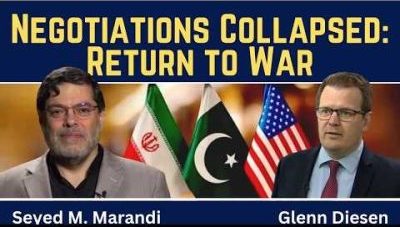
Seyed M. Marandi: Negotiations Collapsed – Return to War
or go to
Aletho News Archives – Video-Images
From the Archives
Wartime internment camps in Australia
National Archives of Australia
World War I
During World War I, for security reasons the Australian Government pursued a comprehensive internment policy against enemy aliens living in Australia.
Initially only those born in countries at war with Australia were classed as enemy aliens, but later this was expanded to include people of enemy nations who were naturalised British subjects, Australian-born descendants of migrants born in enemy nations and others who were thought to pose a threat to Australia’s security.
Australia interned almost 7,000 people during World War I, of whom about 4,500 were enemy aliens and British nationals of German ancestry already resident in Australia.
Records of World War I internment camps
World War II
During World War II, Australian authorities established internment camps for three reasons – to prevent residents from assisting Australia’s enemies, to appease public opinion and to house overseas internees sent to Australia for the duration of the war.
Unlike World War I, the initial aim of internment during the later conflict was to identify and intern those who posed a particular threat to the safety or defence of the country. As the war progressed, however, this policy changed and Japanese residents were interned en masse. In the later years of the war, Germans and Italians were also interned on the basis of nationality, particularly those living in the north of Australia. In all, just over 20 per cent of all Italians resident in Australia were interned. … continue
Blog Roll
 Aletho News
- Seyed M. Marandi: Negotiations Collapsed – Return to War
- Tomorrow’s naval blockade showdown
- ‘Israel’ attacks civilians to hide its embarrassing military failures & out of pure sadism
- Any Foreign Military Vessel Approaching Hormuz Under Any Pretext ‘Will Be Dealt With Severely’: IRGC
- Diplomats slam US negotiators’ performance in Iran talks
- Trump Refuses Exit Ramp, War with Iran will Continue
- Trump Says US Naval Blockade in Strait of Hormuz Will Begin Shortly
- US, Iran end 21-hour talks without agreement
- US IRAN TALKS: Who Are the Crazy Ones Here? /Lt Col Daniel Davis
- Talks with the US end without a deal over excessive US demands: Iran
- If Americans Knew
- US-Iran ceasefire negotiations make zero progress – Daily Update
- Pro-Israel ‘Thinktanks’ and Individuals who Influence U.S. Foreign Policy
- Mearsheimer reveals how Israel dictates US policies on Iran, Gaza – video
- After killing 350+, Israel still has a “score to settle” with Lebanon before ceasefire – Daily Update
- Military aid to Israel emerges as the latest political litmus test for Democrats
- The only Palestinian children’s rights organization closes following years-long Israeli campaign against it
- ‘I Can’t Forget the Smell’: Lebanese Reel After Israel Kills Over 300 in Single Day
- DNC Shoots Down Resolutions Calling Out AIPAC and Limiting Arms to Israel
- TCN: Is Israel Blackmailing President Trump?
- Israel killed at least 303 Lebanese yesterday – who were they? Daily Update
- No Tricks Zone
- Cave Discovery Reveals Today’s Desert Climates Were Recently Far Warmer, Wetter, Teeming With Life
- German Expert: Heat Dome Led To Record Temps In Western USA…Warmer In 1934, 1936
- New Study: No Linear Warming Or Glacier Retreat Along Northern Antarctic Peninsula Since 1980s
- An Inconvenient Tree: Uncovered In Alps… Europe Much Warmer Than Today 6000 Years Ago
- New Study Reports A 60% Slowdown In Greenland’s Ice Loss Rate In The Last Decade
- Low Intensity Tornado Wrecks Major Solar Farm, Creating A Potential Toxic Dump
- New Study Finds Warming Saves Lives…Cold Temperatures 12 Times More Deadly Than Excess Heat
- German Science Blog Accuses PIK Climate Institute Of Hallucinating Climate Tipping Points
- Devastating Assessment Of Comirnaty Vaccine By Former Senior Pfizer Europe Toxicologist
- New Study: CO2 Is ‘Effectively Negligible’ As An Explanatory Climate Change Factor Since 2000
 Aletho News