China’s criticism of America’s ‘piecemeal crisis management’ in Palestine is based on international law
By Ramzy Baroud | MEMO | June 6, 2023
Remarks on 24 May by China’s Ambassador to the UN on the situation in Occupied Palestine were impeccable in terms of their consistency with international law. Compared with the position of the US, which perceives the UN and the Security Council in particular as a vehicle to defend Israeli interests, the Chinese political discourse reflects a legal stance based on a deep understanding of the realities on the ground.
Articulating Beijing’s thinking during a Security Council “Briefing on the Situation in the Middle East, including the Palestine Question”, Ambassador Geng Shuang did not mince his words. He spoke forcefully about the “irreplaceable” need for a “comprehensive and just solution” that is based on ending Israel’s “provocations” in Jerusalem and respect for the right of “Muslim worshippers” as well as the “custodianship of Jordan” in the occupied city’s holy sites.
Widening the context of the reasons behind the latest violence in Palestine, and the 9 May Israeli attack on Gaza, Geng went on to state a position that both Tel Aviv and Washington find totally objectionable. He condemned unapologetically the “illegal expansion of [Israeli Jewish] settlements” in Occupied Palestine and Israel’s “unilateral action”, urging Tel Aviv to “immediately halt” all of its illegal activities. The Chinese ambassador then proceeded to discuss issues that have been relatively ignored, including “the plight of the Palestinian refugees”.
In doing so, Geng has enunciated his country’s political vision regarding a just solution in Palestine, one that is predicated on ending the Israeli occupation, halting Tel Aviv’s expansionist policies, and respecting the rights of the Palestinian people.
Is this a new position, though?
While it is true that China’s policies on Palestine and Israel have historically been consistent with international law, in recent years it has attempted to tailor a more “balanced” position, one that does not impede growing trade with Israel, particularly in the area of advanced microchip technology.
However, Chinese-Israeli affinity was motivated by more than trade. Since its official launch, China’s Belt and Road Initiative (BRI) has served as the cornerstone of Beijing’s global outlook. The massive project involves nearly 150 countries and aims to connect Asia with Europe and Africa via land and maritime networks. Due to its location on the Mediterranean Sea, Israel’s strategic importance to China which, for years, has been keen on gaining access to Israeli ports, has thus doubled. Predictably, such ambitions have been of great concern to Washington, whose naval vessels often dock in the port city of Haifa.
Washington has repeatedly cautioned Tel Aviv against its growing close relationship with Beijing. The then US Secretary of State Mike Pompeo went as far as warning Israel in March 2019 that, until Tel Aviv re-evaluates its cooperation with China, America could reduce “intelligence sharing and co-location of security facilities.”
Appreciating fully China’s current and potential global power, Israel has laboured to find a balance that would allow it to maintain its “special relationship” with the US, while financially and strategically benefiting from its closeness to Beijing. Israel’s balancing act has encouraged China to translate its growing economic relationship with the Middle East into a political and diplomatic investment as well.
For example, in 2017, China put into motion a peace plan — formulated initially in 2013 — called the Four-Point Proposal. The plan offered Chinese mediation as a substitute for US bias and, ultimately, the failed “peace process”. The Palestinian leadership welcomed China’s involvement, while Israel refused to engage, causing embarrassment to a government that insists on respect and recognition of its rising importance in every arena.
If balancing acts in geopolitics were possible back then, the Russia-Ukraine war has brought it all to a sudden end. The new geopolitical reality can be expressed in the words of former Italian diplomat Stefano Stefanini. The former ambassador to NATO wrote in an article in La Stampa that the “international balancing act is over” and “there are no safety nets.” Ironically, Stefanini made this point in reference to Italy’s need to choose between the West and China. The same logic can also be applied to Israel and China.
Soon after China succeeded in brokering a landmark deal between Saudi Arabia and Iran on 6 April, it again floated the idea of mediating between Palestine and Israel. China’s new Foreign Minister, Qin Gang, reportedly consulted with both sides on “steps to resume peace talks”. Yet again, the Palestinians accepted while Israel ignored the subject.
This partly explains China’s frustration with Israel, and also with the US. As China’s former ambassador to Washington (2021-23), Qin must be familiar with the inherent US bias towards Israel. This was expressed succinctly by Chinese Foreign Ministry spokesman Hua Chunying during the latest Israeli war on Gaza: “The United States should realise that the lives of Palestinian Muslims are equally precious,” he said on 14 May.
A simple analysis of China’s language regarding the situation in Palestine clarifies that Beijing sees a direct link between the US and the continued conflict; or at the very least the failure to find a just solution. This assertion can also be gleaned from Ambassador Geng’s most recent Security Council remarks, where he criticised “piecemeal crisis management”, a direct reference to US diplomacy in the Middle East, while offering a Chinese alternative based on a “comprehensive and just solution”.
Equally important is that the Chinese position seems to be linked intrinsically to that of Arab countries. The more that Palestine takes centre stage in Arab political discourse, the greater emphasis the issue receives in China’s foreign policy agenda.
In the recent Arab Summit held in Jeddah, Arab governments agreed to prioritise Palestine as the central Arab cause. Allies with great and growing economic interests in the region, such as China, took notice immediately.
All of this must not suggest that China will be severing its ties with Israel. However, it certainly indicates that Beijing remains committed to its principled stance on Palestine, as it has been over the decades.
The relationship between China and Israel will soon face the litmus test of US pressure and ultimatums. Considering Washington’s unparalleled importance to Israel on the one hand, and the Arab-Muslim world’s significance to China on the other, the future is easy to foresee. Nevertheless, judging by China’s political discourse on Palestine — situated solidly within international and humanitarian law — it seems that Beijing has already decided what to do.
France Is Reportedly Making A Principled Stand Against NATO’s Expansion To Asia
BY ANDREW KORYBKO | JUNE 6, 2023
The Financial Times cited eight unnamed sources who revealed that France is reportedly preventing the planned opening of NATO’s liaison office in Japan. According to them, Macron believes that this move violates the alliance’s charter, which limits its geographic reach to the North Atlantic. He’s also supposedly against anything that can contribute to NATO-Chinese tensions. The spanner that the French leader unexpectedly threw into the bloc’s Asian expansion plans comes after his trip to China in early April.
He visited the People’s Republic along with European Commissioner Von Der Leyen around two weeks after President Xi traveled to Moscow. Upon returning home, Macron revived his prior rhetoric about Europe’s strategic autonomy in the New Cold War, specifically saying that the continent should resist American pressure to take its side over Taiwan. Later that month, China’s Ambassador to the EU said that his country’s cooperation with the continent is as unlimited as its cooperation with Russia.
This sequence of events suggests that Macron’s rhetoric was sincere despite many in the Alt-Media Community suspecting that he was just trying to strategically disarm Russia with his words. About that alleged end goal, Kremlin spokesman Peskov confirmed in early June that Moscow doesn’t regard Paris as a suitable mediator in the NATO-Russian proxy war due to its direct involvement in it. Nevertheless, there’s also no denying that France’s reported stand against NATO’s Asian expansion is commendable.
That said, Macron’s position isn’t driven by the desire to do any favors for President Xi, but is predicated on his assessment of France’s national interests. In his mind, the bloc’s growing involvement on the other side of Eurasia needlessly provokes the People’s Republic, which is the EU’s top trade partner. Moreover, it could also make it more difficult for NATO to contain Russia in Europe if its members end up dividing their focus between that front and the Asia-Pacific.
Simply put, France has yet to fully abandon the notion of national interests like most of its liberal–globalist European peers have already done, which explains Macron’s reported resistance to NATO’s plans. His country’s different approach to International Relations is likely attributable to its neo-colonial empire in Africa, which is crumbling as a result of Russia’s “Democratic Security” inroads there over the past few years but still exists in some form.
No other NATO member has anything comparable, which is why the majority of them are predisposed to complying with the demands of this bloc’s US leader even at the expense of their own interests in pursuit of what Washington claims is the “greater good”. France might ultimately be pressured by the US and its vassals to such an extent that it’s forced to relent on its reported opposition to the bloc’s Asian expansion plans, but for now Macron is holding his ground in defense of his country’s national interests.
This observation proves that NATO’s internecine rifts are naturally occurring, just like the ones that the bloc has with Hungary and Turkiye, and not the result of foreign meddling like the Mainstream Media misleading implies is the case. While it’s true that the US exploited its proxy war with Russia to successfully reassert its unipolar hegemony over Europe, it failed to do so completely, and that’s why France still has a modicum of sovereignty left to resist NATO’s Asian expansion plans (at least for now).
Iran, Regional States to Form Naval Coalition Soon: Navy Commander
Al-Manar – June 3, 2023
Iranian Navy Commander Rear Admiral Shahram Irani announced that Iran’s navy and the countries of the region including Saudi Arabia, UAE, Qatar, Bahrain and Iraq will form a new naval coalition soon.
Irani in a televised program on Friday night announced the formation of new regional and extra-regional coalitions, saying that today, the countries of the region have realized that the security of the region can be established through synergy and cooperation of the regional states.
Referring to the holding of annual exercises of the naval coalition of Iran, Russia and China, he said that the regional coalition is also forming.
Almost all the countries of the North Indian Ocean region have come to the understanding that they should stand by the Islamic Republic of Iran and jointly establish security with significant synergy, he said, adding that Oman, Saudi Arabia, UAE, Qatar, Bahrain, Iraq, Pakistan and India are among these countries.
Earlier, a Qatari website reported that Iran, Saudi Arabia, the United Arab Emirates, and Oman are to form a joint naval force under China’s auspices towards enhancing maritime security in the Persian Gulf.
Al-Jadid carried the report on Friday, saying China had already begun mediating negotiations among Tehran, Riyadh, and Abu Dhabi aimed at reinforcing maritime navigation’s safety in the strategic body of water.
Since the 1979 victory of Iran’s Islamic Revolution, the Islamic Republic has invariably opposed foreign meddling and presence in the region, asserting that the regional issues have to be addressed by the regional players themselves.
Iran, Saudi Arabia, UAE, Oman to form joint naval force under China auspices: Report
Press TV – June 2, 2023
A Qatari website has reported that Iran, Saudi Arabia, the United Arab Emirates, and Oman are to form a joint naval force under China’s auspices towards enhancing maritime security in the Persian Gulf.
Al-Jadid carried the report on Friday, saying China had already begun mediating negotiations among Tehran, Riyadh, and Abu Dhabi aimed at reinforcing maritime navigation’s safety in the strategic body of water.
Back in March, Beijing successfully mediated talks between Tehran and Riyadh that led to the Persian Gulf littoral states’ signing of a deal enabling the restoration of their diplomatic ties.
According to observers, the Persian Gulf states’ consent to Beijing’s mediation in such sensitive matters serves to indicate China’s growing influence in the region as opposed to Washington’s waning clout.
Since the 1979 victory of Iran’s Islamic Revolution, the Islamic Republic has invariably opposed foreign meddling and presence in the region, asserting that the regional issues have to be addressed by the regional players themselves.
The latest instance of the opposition came last Friday when the commander of the Islamic Revolution Guards Corps (IRGC) Navy categorically dismissed the US military’s presence in the Persian Gulf under the pretext of securing the maritime region.
Rear Admiral Alireza Tangsiri said only Iran and other regional countries would ensure the security of the Persian Gulf and there was no need for the US and other countries to be present in the waterway. “If we back down against the enemy, it will definitely dominate us and we have no choice but to stand and resist, which is the path to the victory of our nation,” he said.
UAE quits US-led naval force
The UAE has, meanwhile, announced quitting a United States-led naval force.
On Wednesday, the website of the Emirati foreign ministry said Abu Dhabi had withdrawn from the Joint Maritime Forces that operate in the Red Sea and the Persian Gulf.
The ministry said the Emirates had decided to ditch the naval coalition following an extensive evaluation of its security needs.
Analysts say Abu Dhabi has chosen the withdrawal in line with its ambition to diversify its security relationships.
Taiwan under an American nuclear umbrella? Excellent move if US wants WW3
By Drago Bosnic | June 1, 2023
After years of belligerent moves aimed at undermining China’s sovereignty and territorial integrity virtually everywhere, be it Hong Kong, Xinjiang, South/East Sea China or Taiwan, the United States is showing no signs of ever stopping with its aggression against Beijing. As if billions of dollars worth of weapons earmarked for China’s breakaway island province weren’t bad enough, including at least 400 anti-ship missiles and the latest F-16 Block 70/72 fighter jets, reports now indicate that Taipei and Washington DC are in talks about Taiwan gaining the protection of the US nuclear umbrella in a similar manner to Japan and South Korea.
According to RealClearDefense, citing local sources, Taiwanese foreign minister Joseph Wu announced that the island is in talks with Washington DC about possibly being brought under the US nuclear umbrella. RealClearDefense warns that the move would likely be seen by Beijing as a clear escalation and would likely greatly increase the potential for a future war with China. This assessment can only be considered an understatement, as the Asian giant is essentially guaranteed to respond directly to such escalation. Being under the American nuclear umbrella entails several key changes that would be absolutely unacceptable to China and would certainly provoke an adequate reaction.
The Taipei Times reported that local defense experts find this a “positive for Taiwan”. On May 23, Institute for National Defense and Security research fellow Su Tzu-yun stated:
“Taiwan’s national security doctrine explicitly rejects the development of nuclear, chemical and biological weapons of mass destruction, despite the nation facing the threat of such weapons being used against it. The extension of an ally’s nuclear umbrella over Taiwan would be significantly beneficial to Taiwan’s security.”
The nuclear umbrella is a deterrence policy stemming from the (First) Cold War and entails a nuclear power to guarantee the usage of its nuclear weapons to retaliate if its ally was exposed to a nuclear attack by any third party. This also includes the option of hosting US nuclear weapons, as was the case with countries such as South Korea between 1958 and 1991. Taipei’s Foreign Minister Wu made the comments about this possibility during a session with the Legislative Yuan (Taiwanese parliament). However, he declined to give any details about the talks and whether Taipei itself had asked the US to bring the island under its nuclear umbrella or if the initiative came from Washington DC.
“Regarding the discussion of this issue with the United States, it is not suitable for me to make it public here,” Wu said, as reported by The South China Morning Post.
Most US allies and satellite states/vassals are under the protection of its nuclear umbrella, including Japan, South Korea and every member of NATO, with nearly half a dozen member states (Belgium, Germany, Italy, the Netherlands and Turkey) even having nuclear sharing programs with Washington DC. As previously mentioned, giving the same or similar guarantees to China’s breakaway island province would require the US to use thermonuclear weapons in case of hostilities between Beijing and Taipei. It should be understood that in case Washington DC goes ahead with such an agreement, the question of Taiwan would become much more than just an issue of respecting Chinese sovereignty, territorial integrity and international law.
As per the (rather correct) assessment of The South China Morning Post, this idea is “an unthinkable prospect” for Beijing. Indeed, such a move would further internationalize the Taiwan dispute, as well as accelerate the potential formation of “Asia-Pacific NATO”, while jeopardizing China’s strategic security. Although the US has encountered significant hurdles with attempts to form yet another iteration of the North Atlantic geopolitical monstrosity, the belligerent thalassocracy likely believes that including Taiwan in its global nuclear umbrella would push others in the region to be more accepting of the idea of an “Asia-Pacific NATO”. How likely this is to work is up for debate, however, what it would surely cause is a dramatic surge in the potential for escalation and yet another step toward a world-ending thermonuclear conflict.
Although there is still hope that cooler heads might prevail in the Pentagon, the sheer number of warhawks in the US establishment makes the prospects of such escalation all the more possible and no less disturbing, particularly as top US generals are openly talking about the “inevitable war with China”. Such belligerence has already pushed China and Russia to further strengthen their already close ties in all aspects, be it economic, military, scientific, etc. The troubled Biden administration has already vowed to send troops and intervene if hostilities between China and its breakaway island province were to happen, which in itself was a borderline declaration of war. However, by including Taiwan in its nuclear umbrella, the question of war between Beijing and Washington DC would become “when” instead of “if”.
Drago Bosnic is an independent geopolitical and military analyst.
Chinese ‘Secret Police Stations’… Fact or Fiction?
Canadian Patriot | May 28, 2023
In this first of a series of Canadian Patriot short films debunking anti-China Psyops, we ask the question ‘Is there actual evidence that secret Chinese Police Stations have been set up around the world as part of a Communist subversion of western freedom? This film will evaluate whether the single source used to justify this claim (a Spain-based human rights group called Safeguard Defenders) actually proves its accusations, and what actually controls it?
Stay tuned for future videos in this series which will investigate claims of Chinese election interference in Canada, Russian interference in the USA, Chinese spy balloon attacks, and more.
To pick up a copy of Breaking Free of Anti-China Psyops, click here:
https://canadianpatriot.org/2022/12/03/new-release-breaking-free-of-anti-china-psyops-how-the-cold-war-is-being-revived-and-what-you-can-do-about-it/
Support the Canadian Patriot Review in the following ways:
1) Make a donation to the Canadian Patriot
www.patreon.com/canadianpatriot
canadianpatriot.org/support-us/
2) Subscribe to Matt and Cynthia’s Substack
matthewehret.substack.com
cynthiachung.substack.com
3) Buy some books!
https://canadianpatriot.org/untold-history-of-canada-books/
4) Subscribe to our Telegram Channels
t.me/CanadianPatriotPress
Since it is likely just a matter of time before this Youtube channel gets suspended again or taken down entirely, check out our alternative platforms:
On Rumble
rumble.com/user/MattEhret
On Bitchute:
www.bitchute.com/channel/FPD8fbk6o541/
Canada’s ‘shocking’ new report on foreign interference has found none
By Rachel Marsden | RT | May 27, 2023
The special rapporteur tasked by the Trudeau government with looking into foreign interference in Canadian politics didn’t find much. But he said he’ll nonetheless hold a “series of public hearings with Canadians” to talk about the “problem of foreign interference,” which he couldn’t really qualify with much actual evidence.
Former Canadian governor general David Johnston took all of two months to come up with his report, sparked by allegations that China had meddled in recent Canadian federal elections. The hysteria had reached such fever pitch that Ottawa expelled Chinese diplomat Zhao Wei after allegations arose in the Canadian press that China had threatened the Hong Kong-based family of Canadian member of parliament, Michael Chong. But after talking to Canadian spy services, Johnston said he found “no intelligence indicating that the PRC took steps to threaten his family.”
He did find evidence that Chinese officials had “sought to build profiles” on this MP and others. Oh wow, stop the press! Because some people might be shocked to learn that the actual job of diplomats serving in foreign countries is to liaise with local officials to advocate in favor of cooperation that’s self-serving to at least some degree, although ideally mutually beneficial as well. And to do that, you probably want to make sure that you know something about the guy to at least the same degree that a used car salesman would make an effort to know what would interest or appeal to a specific customer – if only because national interests should ideally be worth as much as a Twingo.
Your neighbor compiling a dossier on you is creepy. A diplomat compiling a dossier on a government official he’s dealing with is just basic professionalism.
Johnston also found that there was no shady partisan favoritism of one party over any other by Chinese officials in Canada, contrary to reporting that suggested favoritism of Liberals over Conservatives. It’s not as though either of the establishment parties is friendly towards China. Johnson said Chinese officials were more interested in supporting pro-China candidates, but also had to point out to the pearl-clutchers that a foreign diplomat saying he or she favors a particular candidate in a foreign election isn’t actually foreign interference. After all, Western officials couldn’t shut up about how much they wanted former President Donald Trump to lose to whomever the Democrats put up against him in the last two US elections. So if that’s not foreign interference, then why should other countries be held to a different standard just because they aren’t in the same club?
There have been press allegations that China sought the electoral defeat of certain candidates, like former Conservative MP Kenny Chiu, who sponsored foreign agent registry legislation. However, Johnston found that, while “it is clear that PRC diplomats did not like Mr. Chiu, who is of Hong Kong descent and not from mainland China… it is much less clear that they did anything particular about it” beyond not inviting him to their sponsored events.
Despite the lack of qualified evidence of interference in the report, and the focus on a single country – China – Johnston nonetheless came to the conclusion that “there is no doubt that foreign governments are attempting to influence candidates and voters… This is a growing threat to our democratic system and must be resisted as effectively as possible by government.”
No need to dig further, Johnston figures, discounting a public inquiry in favor of “public hearings.” But doesn’t that risk just batting around all the various fallacies and misconceptions that have been put out there by the Western press and officials – like those that Johnston himself had to correct in his report? Without an objective and full inquiry, the opportunity to exploit hearings to promote propaganda seems substantial. What about Ukrainian influence on Canadian politicians? Or Israeli influence?
Johnston focuses exclusively on China, and takes the odd swipe at Russia, in passing, but never mentions the kind of foreign interference brought to light at the recent French National Assembly commission into the same subject.
“Foreign interference, yes, I encountered it. Most of the time, it came from a friendly and allied country called the United States. I was listened to with President Sarkozy for five years by the NSA,” said Sarkozy’s former prime minister Francois Fillon. He confirmed WikiLeaks disclosures from US intercepts published in 2015 indicating that the National Security Agency was conducting electronic surveillance of French officials from the American embassy in Paris. Or that it was listening in on conversations of German allies at the highest level, including those of then-Chancellor Angela Merkel.
“I was not directly affected by Russian interference,” Fillon clarified, noting that like all great powers, Russia tries to “assert its point of view,” but that didn’t happen with him personally when he was in office. So then why make such a big deal about it, unless it’s just for propaganda purposes?
Canada, like Europe, suffers from tunnel vision when it comes to protecting its own interests and independence. The proof lies in the fact that both have failed to diversify away from their chronic over-reliance on the US. While it makes sense that the country sharing the world’s longest land border with the US would go for the low-hanging fruit when it comes to trade, it would nonetheless be interesting to qualify the pressures on Canadian officials and critical interests that have resulted in the Canadian establishment marching in lockstep with Washington, repeating the same propaganda and naming the same foes.
The idea that the US – the most powerful country on Earth – has absolutely no influence on its resource-rich next-door neighbor is absurd. The fact that the influence is so systemic that it’s not even worth a glance or a mention in a report into foreign interference is glaring. Does the Canadian government care to look under that rock? Or are they just going to keep scapegoating Russia and China when the most existential, insidious threat to Canadian independence lies inward and southward?
China calls on Israel to ‘stop encroaching’ on Palestinian land
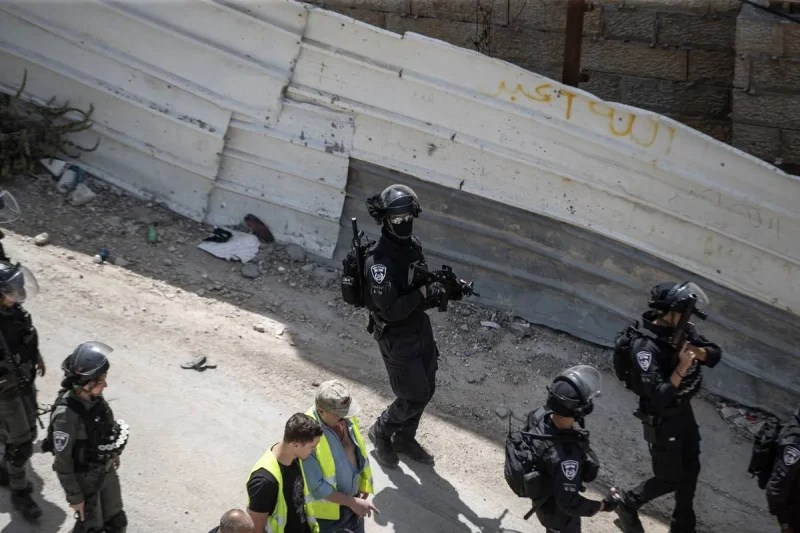
Israeli forces secure demolition of a building belonging to Palestinians claiming that it was unlicensed at Jabel Mukaber Neighborhood in East Jerusalem on May 24, 2023 [Mostafa Alkharouf – Anadolu Agency]
MEMO | May 26, 2023
China has called on Israel to “stop encroaching” upon Palestinian territory and resources, as Tel Aviv continues to allow and approve the construction of illegal Jewish settlements in the Occupied Territories.
Speaking to the United Nations Security Council yesterday, Geng Shuang, China’s deputy Permanent Representative to the UN, stated that “since the beginning of this year, Israel has continued to advance unilateral actions on approving returns, building new settlements and legalising settlements”.
Emphasising that such settlement building and activities violate international law and UN Security Council Resolution 2334, he expressed Beijing’s stance to “urge Israel to immediately halt these actions and stop encroaching upon the land and resources of the Palestinian people”.
Shuang also stressed that “the historical status quo of religious holy sites in Jerusalem must be respected and upheld”, saying that Israeli National Security Minister, Itamar Ben-Gvir “caused renewed tensions” by storming the Al Aqsa Mosque compound for the second time this year and proclaiming Israel’s alleged ownership of the Islamic holy site.
“On the issue of religious holy sites, Israel must stop its provocations, guarantee the right to worship of Muslim worshipers, uphold the peace and tranquillity of religious holy sites, and respect the custodianship of Jordan”, he asserted.
Shuang also drew attention to the fact that tensions and clashes between the Israeli occupation and Palestinian Resistance groups “have been repeating themselves over the past few years, fully demonstrating that a long-stalled peace process is not sustainable, that piece-meal crisis management will not last, and that a comprehensive and just solution is irreplaceable”.
He indicated China’s increasing role in the issue, as with others in the region, and the possibility of surpassing the United States as a mediatory force and hegemon. Supposedly referring to the US, he stated that “the country with major influence on the parties concerned should make concrete efforts to advance the Middle East peace process and should not unjustifiably prevent the Security Council from arriving at the minimum consensus on the Palestine-Israeli issue”.
The Chinese diplomat’s remarks came as the Israeli government yesterday approved the proposed state budget for 2023-2024, which allocates around 3.5 billion Israeli shekels ($941 million) for the illegal settlement projects and the upgrading of their infrastructure.
Current estimates report that there are around 700,000 illegal settlers living in 164 settlements and 116 outposts in the Occupied West Bank and Occupied East Jerusalem, with that set to expand as Tel Aviv frequently approves thousands of more settlement units.
Chinese War Simulation Finds Top US Carrier Group Could Be ‘Destroyed With Certainty’
By Wyatt Reed – Sputnik – 25.05.2023
War games conducted by Chinese researchers found the US military’s most prized aircraft carrier could be reliably sunk with relative ease in the event of a hot war in the South China Sea.
A volley of hypersonic missiles could reliably sink the US military’s most powerful aircraft carrier group in a potential conflict, according to war game simulations carried out by a team of Chinese military planners.
Using 24 of their most advanced anti-ship missiles, Chinese forces consistently destroyed a carrier fleet led by the USS Gerald R. Ford over the course of 20 mock battles in simulations which were run on a war game platform employed by the People’s Liberation Army.
In the simulation, the US ships came under fire after ignoring multiple Chinese warnings not to approach an island in the South China Sea controlled by Beijing.
For test purposes, the war games’ designers used a carrier group made up of six surface ships which were selected for their “unparalleled strength and advanced technology.”
A major Hong Kong-based newspaper reported that the military planners “selected vessels deemed the US Navy’s most superior – the CVN-78 Gerald R. Ford, accompanied by a CG56 Ticonderoga-class cruiser the San Jacinto, and four DDG-103 Arleigh Burke-class Flight IIA guided missile destroyers.”
Led by Cao Hongsong from the North University of China, the researchers found that virtually every US surface vessel was ravaged by the attack and eventually sank.
According to researchers, the Ford carrier group – which was once thought to be all but unsinkable – could actually be “destroyed with certainty” using just a handful of hypersonic missile strikes.
Chinese military planners placed a number of constraints on themselves in the simulation, including cutting their access to space-based spy satellites and limiting the number of hypersonic missiles available.
The basic principle underlying the exercise was to be “lenient with the enemy and strict with oneself,” Cao explained.
As the Hong Kong-based outlet explained, “during the simulation, the PLA used its sea-based surveillance network to detect and identify the US carrier group before firing eight of the less-reliable hypersonic missiles simultaneously from southern and central sites in China.”
Though “some of the missiles were intercepted, the attack depleted the US fleet’s SM-3 munitions, paving the way for the PLA to launch “eight of its more accurate hypersonic missiles from northern and western China, with four focused on the aircraft carrier while the others targeted the destroyers,” the outlet noted.
“After the attack, four ships survived from the blue [US] team, with the destroyers having the most remaining, on average.”
A “mop-up” operation with six of the less accurate hypersonic missiles was able to dispatch with the remaining vessels, the research paper determined.
After the simulation was run 20 times to allow for different variables which could affect the outcome of the engagement, the team’s strategy was ultimately able to eliminate an average of 5.6 out of 6 surface vessels – effectively meaning the “total destruction” of the carrier group.
The release of a paper detailing the war game in May marked “the first time the results of simulated hypersonic strikes against a US carrier group have been made public” by China’s military, the Honk Kong outlet noted.
But it’s likely to be seen as a warning to Washington against any provocations in the South China Sea.
An anonymous Beijing-based researcher interviewed by the outlet suggested that “greater transparency about China’s military capabilities and intentions could help to reduce misunderstandings and miscalculations on both sides, which could in turn help to reduce the risk of conflict.”
Beijing Banning Micron Means China Has Mastered Chip-Making
By Ekaterina Blinova – Sputnik – 22.05.2023
China has slapped a ban on US chipmaker Micron, prohibiting it from selling to Chinese companies involved in key infrastructure projects. Beijing has mirrored Washington’s sanctions on the People’s Republic’s hi-tech technology, Asia-Pacific consultant Thomas W. Pauken told Sputnik, adding that there’s more to the development than meets the eye.
The Cyberspace Administration of China (CAC) announced on May 21, that a cybersecurity review indicated Micron Technology’s products “have relatively serious cybersecurity risks, which pose significant security risks to the country’s critical information infrastructure supply chain and would affect national security.” Thus, the CAC banned the US chipmaker from participating in the People’s Republic’s domestic critical infrastructural projects. In response, the US Commerce Department expressed its opposition to the restrictions, insisting that they “have no basis in fact.” Micron’s shares plummeted roughly 6% on Monday, given that the American company used to derive over 10% of its revenue from the People’s Republic.
“It’s rather interesting that the Washington side may be shocked or surprised by this news,” said Thomas W. Pauken II, the author of US vs China: From Trade War to Reciprocal Deal, consultant on Asia-Pacific affairs, and geopolitical commentator. “However, they have taken similar measures themselves to stop Chinese semiconductors and Chinese chips manufacturers or companies that are connected with the chips manufacturing and semiconductor manufacturing to be more involved with the supply chains in the United States as well. So this is not a case where there’s a shock or a surprise announcement. It’s actually basically China doing the same thing that the US has been doing to China.”
US President Joe Biden speaks about how the Bipartisan Infrastructure Law will rebuild the US and the progress made since he signed the bill into law, in the South Court
Since October 2022, Washington has imposed sweeping export curbs on advanced chips and chip-making equipment to China, trying to cut off the nation’s access to critical technology. Prior to that, under the Trump administration, the US and its Western allies kicked off nothing short of a crusade against the People’s Republic’s telecom giants, including its flagship Huawei, citing “security” concerns.
“This is a very simple response for Beijing to make and say, ‘Well, has the US not acted similarly to what we’ve been doing?'” noted Pauken. “So it would be hypocritical on the US side to criticize Beijing for taking actions that are similar to Washington’s actions. This is hypocrisy at its finest, in regards to Washington and how they’re complaining and criticizing China when they’re doing the exact same thing that they’re criticizing China for. It’s laughable. It’s just absurd for them to make such an argument when they’re doing the same thing.”
The Asia-Pacific consultant suggested that Micron had not been caught off guard: Pauken revealed that when he visited Taiwan last month, he learned from his source that the Micron senior executive in the Kaohsiung office had started laying off employees in April.
As per Pauken, plausibly, the Taiwanese Micron branch had anticipated these instructions, so it could have been the case that they were alerted by Beijing that there was an investigation and they likely realized that the chances of continuing to sell their chip technologies to the mainland were slim.
They had already started to do layoffs even before this announcement happened, the commentator noted. Nonetheless, even if they were prepared for the CAC announcement, it had a devastating impact: “From what I heard, the layoffs in the Taiwan offices were very massive,” Pauken emphasized. “Definitely it’s a major problem for Micron.”
However, there is more to the development than meets the eye, continued Pauken: according to him, it clearly indicates that Beijing has made considerable advancements in chip-making despite the US trying to contain the country’s technological rise.
“You also have to think about this from a strategic level,” the author said. “There’s no way China would have blocked any chips from Micron if it would cause extreme damage to the Chinese economy. Obviously, they have probably set up supply chains in place and have chips made in China that are maybe not equal in quality to Micron, but close enough so that they could handle the impact of no more Micron chips coming to China.”
“So what I’m getting at is that there’s no way Beijing took this announcement all of a sudden. They have prepared for it well in advance in anticipation that, of course, the US and Micron would complain. But they, of course, also took the right steps to protect their economy from being severely damaged by this announcement,” Pauken concluded.
China says it sees no point in dialogue with US amid sanctions
Press TV – May 22, 2023
China says it sees no reason to keep talking with the United States as long as it pursues a wholly disingenuous policy and continues to step up pressure on the country through sanctions.
“Where is the sincerity and sense of dialogue, when the US side talks about the need to maintain contacts only to use them as a means to put pressure on China and hamstring our country,” Chinese Foreign Ministry spokesperson Mao Ning told reporters in Beijing on Monday.
The Chinese official called on Washington to “immediately lift sanctions” against China.
“It is necessary to create a favorable atmosphere and favorable conditions for dialogue and contact,” Mao explained.
Beijing maintains “necessary contact” with Washington, she stated.
“The United States applies sanctions against individuals and organizations of the PRC,” Mao reiterated.
“China is strongly against such unilateral restrictions, which are unlawful. We have strictly set forth Beijing’s stance on this issue to the American side,” she added.
The Chinese spokesperson called on the United States to have the right understanding of China, meet it halfway and bring bilateral relations back on track.
China views its relations with the US under the three principles of mutual respect, peaceful coexistence and win-win cooperation as proposed by President Xi Jinping, she said.
China to US: Stop interfering in our internal affairs
Elsewhere in her remarks, Mao urged the United States to immediately stop interfering in China’s internal affairs.
“We urge the US to form a correct perception of China, stop interfering in China’s internal affairs and harming China’s sovereignty, security and development interests, and work with China to bring China-US relations back to the right track with concrete actions,” she added.
The spokeswoman made the remarks in response to US President Joe Biden suggesting that a shift in US-China relations could occur soon.
Biden said on Sunday during the Group of Seven (G7) summit in the Japanese city of Hiroshima, that he expected a thaw in Chinese-US relations in the near future.
“We should have an open hotline,” Biden stressed.
Biden has said he expects to see a “thaw” in US relations with Beijing, even as he concluded a G7 summit in Japan that made a concerted effort to counter alleged military and economic security threats from China.
The US president said in a news conference at the end of the three-day summit that talks between the two countries had shut down after a “silly balloon” carrying spying equipment flew over North America in February, before being shot down by the US military.
“Everything changed in terms of talking to one another. I think you’re gonna see that begin to thaw very shortly,” Biden said.
Biden added that his administration was considering lifting sanctions against Chinese Defence Minister Li Shangfu.
Beijing recently refused to agree to a meeting with US Defense Secretary Lloyd Austin when the two men attended the Shangri-La Dialogue security forum in Singapore next month due to the sanctions.
US officials had previously said privately that the Biden administration would not remove the sanctions.
Biden: US stands by ‘one China’ policy
Biden reiterated at the news conference that the US stood by the “one China” policy, which recognizes Beijing as the sole government of China, and Washington did not support any move by the self-ruled Taiwan to declare independence.
China has sovereignty over Taiwan. The US does not recognize Taiwan as an independent country and officially supports the “One China” policy, but regularly oversteps its own principles. The island nation has become China’s most sensitive territorial issue and a major bone of contention with Washington.
Washington continues to antagonize Beijing by siding with Taipei’s secessionist administration, engaging in frequent military missions around the island, and serving as its largest weapons supplier.
Featured Video

ARE PATIENTS BEING PROPERLY INFORMED ABOUT OZEMPIC?
or go to
Aletho News Archives – Video-Images
New Book
Breast Cancer: Before You Consent
A new Unbekoming paperback
Lies are Unbekoming | September 18, 2026
Peter Gøtzsche reviewed every randomised mammography screening trial ever conducted for the Cochrane Collaboration. Cochrane’s headline is that, assuming a 15% mortality reduction, one woman in 2000 avoids dying of breast cancer over ten years. Ten are overdiagnosed and treated. Two hundred experience false alarms.
But that headline assumes the reduction. When Gøtzsche looked only at the trials with adequate randomisation — the higher-quality ones — the reduction disappeared. No effect on breast cancer mortality. No effect on all-cause mortality.
This is the Cochrane finding, published in the establishment’s own database of systematic reviews.
No woman being asked to consent to a mammogram this week knows it.
That is why the new Unbekoming paperback exists. … continue
Blog Roll
 Aletho News
- The Truth About the Trump Shootings with Ken Silva
- ARE PATIENTS BEING PROPERLY INFORMED ABOUT OZEMPIC?
- US lawmaker blocks $2.8 billion weapons sale to Israel: Report
- Yemeni army claims responsibility for strikes on sensitive sites in Saudi capital, Aramco facilities in Yanbu
- Iran Judiciary issues indictments against 159 US, Israeli officials for assassination of Leader, commanders
- Turkiye revokes Iranian bank license under US sanctions campaign
- US-Denmark Agreement on Greenland Is ‘PR Stunt’ Ahead of Midterms
- Araghchi: Military intervention cannot create security; coercion cannot bring peace
- Fraud Squared
- Breast Cancer: Before You Consent
- If Americans Knew
- Inside Gaza’s death trap of collapsing, bombed-out buildings
- The everyday items Israel bans from Gaza every day
- Inside the siege, the ruined buildings of Gaza – Daily Update
- Debunking The Claim That Macklemore Has A “History Of Antisemitism”
- CPJ demands release of arrested Palestinian-US journalist near Bethlehem
- Robert Kraft: The Billionaire Friend of Netanyahu Pulling The Strings Behind the Macklemore/Ed Sheeran Blow Up
- Columbia Administered Fund Gives Big Money to Pro-Israel Groups
- Deportation Case of Palestinian Activist Salah Sarsour Tests First Amendment
- ‘We Will Not Forget’: Palestinians Mark 44 Years since Sabra and Shatila
- Why do we let Zionists decide what we can and can’t say?
- No Tricks Zone
- New Study: ‘Global Drought Shows No Detectable Recent Acceleration Under Climate Warming’
- Economic Masterminds: German Socialists Suggest Taxing Productivity Gains Stemming From Using AI
- The South China Sea Has Not Been Cooperating With The Climate Change Narrative
- Energy Crisis: Germany Enters Heating Season With Historically Low Gas Reserve Fill Levels
- New Study: The Antarctic Ice Sheet Gained Mass From 2020-2024 Due To Staggering Snow And Ice Accumulation
- Study: Ocean Heating Rates From Thousands Of Years Ago ‘Dwarf’ Modern Ocean Heating Rates
- Climate Extremists Target, Attack Large-Scale Power Grid Infrastructure In Germany!
- New Study: Antarctic Ice Melt Has Contributed Less Than 1 Centimeter To Sea Level Rise In The Last 30 Years
- Fear Of Debate: Alarmist German Climate Scientist Calls On Mainstream Media To Discredit Skeptic Voices
- End-Of-August Arctic Sea Ice Extent Hasn’t Fallen In 20 Years, Official Data Show!
 Aletho News