China’s export controls on gallium likely to hit US defense industry: experts
By Liu Xuanzun – Global Times – July 4, 2023
China’s recently announced export controls on gallium could hit the US defense industry, as this material, with China being the leading producer and supplier in the world, is widely used in advanced radar systems installed on warplanes, warships and ground installations, experts said on Tuesday.
Starting August 1, China will impose export controls on gallium and germanium as well as several chemical compounds involving the two materials, according to a notice China’s Ministry of Commerce and General Administration of Customs released on Monday.
Items meeting certain characteristics shall not be exported without approval, the notice stated.
The move aims to safeguard national security and interests, it said.
Gallium and germanium are used in the making of semiconductors and other electronic components, observers said.
Chinese military analysts said that the export controls, particularly those on gallium, could hit the US defense industry at a time when the US is attempting to militarily contain China’s development.
Gallium arsenide (GaAs) and gallium nitride (GaN) are the most basic materials in the making of the transmit receive modules on active electronic scanning array (AESA) radars, which are widely used on modern warplanes, warships and ground installations, Fu Qianshao, a Chinese military aviation expert, told the Global Times on Tuesday.
For example, US’ defense companies Raytheon and Northrop Grumman are reportedly introducing new AESA radar systems based on GaN, which provide superior performance than previously used GaAs. The latest radars for the F/A-18E/F carrier-based fighter jet and the F-35 stealth fighter jet also incorporate GaN.
Both GaN and GaAs are included on China’s list of export controls.
China accounts for about 85 percent of global gallium reserves, meaning that it is unlikely for the US and other Western countries to avoid using the Chinese materials without significant cost, Fu said.
The US frequently deploys its warplanes and warships on China’s doorsteps for close-in reconnaissance, provocative transits and exercises as well as showcasing deterrence purposes, in addition to continuing arms sales to the island of Taiwan, which are obvious attempts to contain China’s development and harm China’s national security and interests, analysts said.
Can the WHO and the United Nations impose sanctions on your country for non-compliance?
The sinister sanctions strategy has disturbing implications for democracy, peace, and prosperity around the world. It’s time for us to defund and exit.
By Shabnam Palesa Mohamed | Children’s Health Defense Africa | July 3, 2023
Sanctions are a powerful instrument of political control and economic profit. One of the rare but critical topics relevant to the international campaign to #ExitTheWHO is whether the World Health Organisation and the United Nations can impose, influence or recommend specific sanctions. The sanctions would be against countries that choose to not comply or cannot comply with International Health Regulations, the proposed new pandemic treaty, or other legislative attempts that curtail rights, freedom and sovereignty.
The accelerating and profitable globalist march towards unprecedented levels of ‘1984’ style totalitarianism – using censorship, vaccine passports, 15 minute cities, and CBDC’s continues. It is plausible that the WHO and the UN will move to impose, influence or recommend sanctions against countries that do not want to or cannot comply with its centralised health agenda and undemocratic legislative attempts.
At last year’s World Health Assembly 75, the 47 nation African bloc voted surprisingly, against most amendments to the International Health Regulations, stating that they were broad, rushed, and can pose a threat to national sovereignty. Since then, no doubt with persuasive behind the scenes manoeuvres, some of the most disturbing amendments are being proposed by African countries. Many relate to financing for the cost intensive provisions of IHR amendments and the proposed pandemic treaty or accord. Africa cannot afford more debt slavery.
Countries that could be sanction targets for non-compliance with the WHO and the UN, include but are not limited to, those in the steadily growing BRICS initiative: Brazil, Russia, India, China and South Africa. Iran and Malaysia are reported to have expressed reservations to the proposed IHR amendments at last year’s World Health Assembly 75. Russia is making decisive moves in the international arena and could possibly exit the WHO. In addition, India raised serious audit concerns on irregularities with WHO financials, including missing assets.
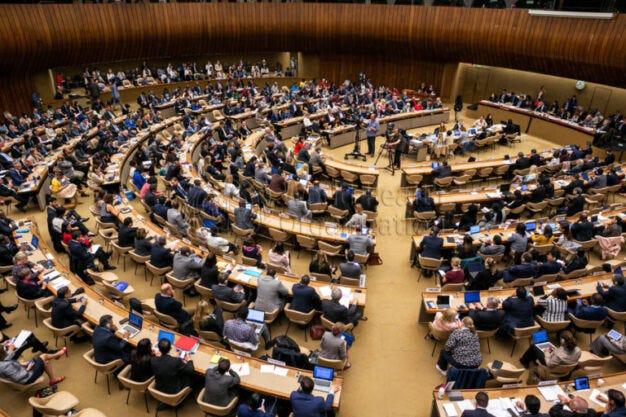
World Health Assembly, Geneva, Switzerland
The ambit of the overwhelmingly privately funded WHO, contained in its extensive constitution, can be interpreted as overly broad and sweeping, and thus, unknown to non-participants, has always posed a potential threat to individual health and national sovereignty.
The WHO’s constitution states in Chapter 2 – Functions – Article 2: In order to achieve its objective, the functions of the Organization shall be: (v) generally to take all necessary action to attain the objective of the Organization. However Article 21 of the WHO’s constitution is specific about making (non-binding) regulations, limiting the WHO to just five areas.
Proposed amendments to the new pandemic treaty include a dangerous clause that would change the WHO’s role from a UN agency that shares recommendations, to a rogue agency whose elitist and secretive attempts at legislation are binding and mandatory on member states, violating fundamental human rights and freedoms. However, health freedom advocates agree that WHO has no actual authority in the law.
In effect therefore, with both IHR amendments and the proposed new treaty, the WHO is acting ultra vires in its Big Pharma driven power grab, in collusion with naïve or compromised member state delegates. Ultra vires is defined in the law as: acting beyond the scope or in excess of legal power or authority. Ultra vires acts of impunity by the WHO could accelerate a mass defund and exit of the agency.
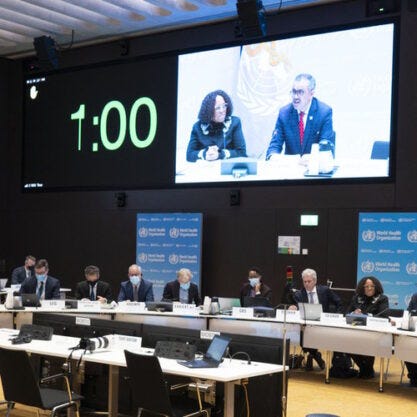
WHO’s negotiating body on a proposed pandemic treaty
Health is no longer just health, as it is defined in the WHO’s constitution. Through Covid-19, and other controversially declared pandemics, health is now a multi-billion dollar health security industry. With it, creeps in the tyranny of secrecy, surveillance, vaccine certificates, forced quarantines, and the undemocratic censorship of free speech. Given the absence of public participation, the WHO is a strategic spear for oligarchs and corporations, and given international resistance to its power grab, it may become desperate and argue or push for sanctions.
Reported in 2021: “In 2021, German Health Minister Jens Spahn called for sanctions against countries that hide information about future outbreaks. Citing the World Trade Organization’s power to sanction countries for non-compliance, Spahn said “there must be something that follows” if countries fail to live up to commitments under a new pandemic treaty that the World Health Assembly will take up in November.”
Further, it is entirely under reported that controversial “World Health Organization Director-General Tedros Adhanom Ghebreyesus also urged countries to consider the idea as they take up the treaty, a legally binding tool. The treaty should “have all the incentives, or the carrots” to encourage transparency, Tedros said, appearing at a press conference with Spahn in Berlin. “But maybe exploring the sanctions may be important,” he added.”
Also reported in 2021: “Speaking at the WHA in June, Mike Ryan, WHO Health Emergencies Programme Executive Director, also spoke out in favour of the treaty, despite the fact that WHO technical staff have historically avoided taking positions on controversial policy choices before member states. “My personal view is that we need a political treaty that makes the highest-level commitment to the principles of global health security — and then we can get on with building the blocks on this foundation.”
I engaged renowned international law expert Professor Francis Boyle about the possibility of sanctions via the WHO. He had no doubt “They will pursue sanctions against countries that do not comply with their orders, coming from Geneva. Both economic and political sanctions. However, they will only have the power to pursue sanctions if we accept their authority. We cannot. We must exit the WHO.”
With far less public scrutiny currently than the WHO, the United Nations is also seeking exponential new powers and stronger “global governance” mechanisms to deal with what they define as international emergencies. In March 2023, the UN released a policy brief , astonishingly titled “To Think and Act for Future Generations – Our Common Agenda. Strengthening the International Response to Complex Global Shocks – An Emergency Platform”
These all encompassing areas of expanded UN power include:
- climate or environmental events;
- environmental degradation;
- pandemics;
- accidental or deliberate release of biological agents;
- disruptions in the flow of goods, people, or finance;
- disruptions in cyberspace or “global digital connectivity;”
- a major event in “outer space;”
- and “unforeseen risks (‘black swan’ events)
There are several types of sanctions imposed through the United Nations:
- Economic sanctions – typically a ban on trade, possibly limited to certain sectors such as armaments, or with certain exceptions (such as food and medicine)
- Diplomatic sanctions – the reduction or removal of diplomatic ties, such as embassies.
- Military sanctions – military intervention
- Sport sanctions – preventing one country’s people and teams from competing in international events.
- Sanctions on the environment – since the declaration of the United Nations Conference on the Human Environment, international environmental protection efforts have been increased gradually.
- Economic sanctions are distinguished from trade sanctions, which are applied for purely economic reasons, and typically take the form of tariffs or similar measures.
It is plausible that the UN’s controllers realise that the world is pushing back against the WHO’s overreach, or find it irrelevant to real health. Given that sovereign nations will choose to exit the WHO, the UN decided to launch plan B and ascribe to itself even greater powers. Technically, there is no legislation to exit the United Nations within the UN Charter. Again, this is a critical issue of national sovereignty.
The United Nations Children’s Fund or UNICEF’s 2020 Annual Report highlights USD 717 million in donations from the private sector, which is 21 percent of income overall. Lucrative corporate partnerships include Unilever, Louis Vuitton, and Microsoft, while foundation partners include Bill and Melinda Gates Foundation and Mastercard Foundation. It also prides relationships with the World Economic Forum and the International Chamber of Commerce. National committees fundraise from individual donors and corporations at the national level, to support UNICEF globally. The UN’s programmes therefore are heavily dependant on private funding. Funding crowns influence.
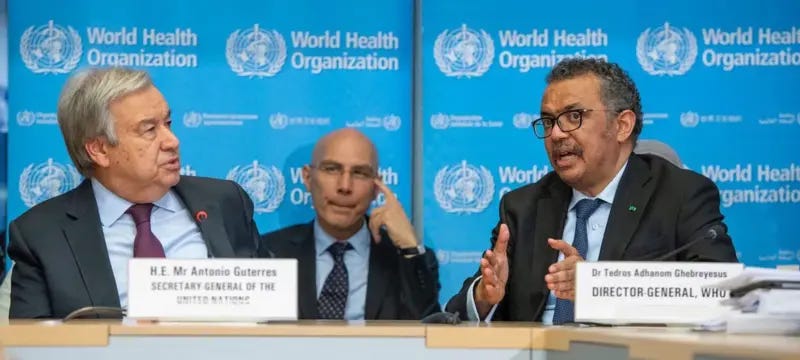
UN secretary general Antonio Guterres with WHO director general Adhanom Tedros Ghebreyesus
The WHO is an agency of the United Nations.
- In 2015, on punishing member states who violate the IHR, as reported: “United Nations health officials said they want to impose sanctions on countries that do not comply with public health regulations meant to avoid the spread of dangerous epidemics, such as the Ebola outbreak that killed more than 9,000 people and ravaged domestic health care systems in West Africa last year. World Health Organization Director Margaret Chan said she is investigating ways to reprimand countries that disobey the International Health Regulations (IHR) — a set of rules adopted in 2005 and mandate that countries set up epidemiological surveillance systems, fund local health care infrastructure and restrict international trade and travel to affected regions deemed unsafe to the public, among other provisions. Chan is on a panel set up by U.N. Secretary General Ban Ki-moon, who instructed the group to think of ways to hold countries accountable for how they manage public health crises and punish those who violate the IHR.”
- In 2022, according to commentators in a policy article: “In order to enforce compliance, some commentators have recommended concluding the treaty at the United Nations level. However, we fear that it has been already decided with the INB (mandated by WHASS) that a treaty will be developed under the roof of WHO. They added: “To move on with the treaty, WHO therefore needs to be empowered — financially, and politically. If international pandemic response is enhanced, compliance is enhanced. In case of a declared health emergency, resources need to flow to countries in which the emergency is occurring, triggering response elements such as financing and technical support. These are especially relevant for LMICs, and could be used to encourage and enhance the timely sharing of information by states, reassuring them that they will not be subject to arbitrary trade and travel sanctions for reporting, but instead be provided with the necessary financial and technical resources they require to effectively respond to the outbreak. High-income settings may not be motivated by financial resources in the same way as their low-income counterparts. An adaptable incentive regime is therefore needed, with sanctions such as public reprimands, economic sanctions, or denial of benefits.”
* Tweet CHD Africa if you agree that sanctions are possible and must be opposed internationally. Use the #StopSanctions
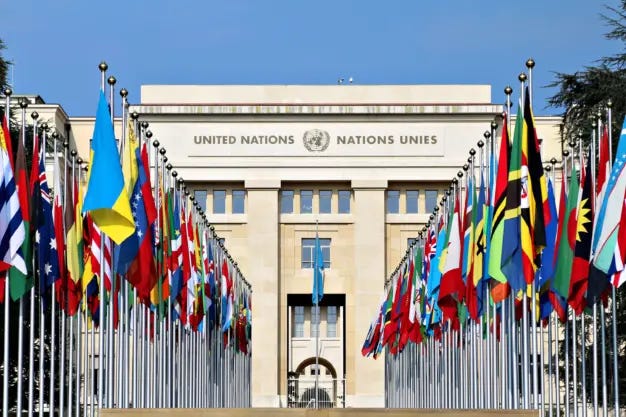
United Nations headquarters in Geneva, Switzerland
In 2000, Kofi Annan, former Secretary General of the UN said: “However, just as we recognize the importance of sanctions as a way of compelling compliance with the will of the international community, we also recognize that sanctions remain a blunt instrument, which hurt large numbers of people who are not their primary targets. Further, sanctions need refining if they are to be seen as more than a fig leaf in the future. Hence, the recent emphasis on targeted sanctions which prevent the travel, or freeze the foreign bank accounts, of individuals or classes of individuals – the so-called ‘smart sanctions’.”
Do sanctions work? “UN targeted sanctions, which are packages of sanctions imposed by the UN Security Council, have been successful in leading to intended policy change only 10% of the times, and limited the policies they intended to change in 28% of cases, but led to a reduced life expectancy in the targeted countries by 1.2–1.4 years. Economic sanctions have also been criticised for the potential collateral damage to third states they can cause. For this reason, some authors suggest that economic sanctions should be banned, as they are having detrimental effects on health and nutrition of civilians.”
Countries themselves can and do impose dangerous sanctions. A 2022 UN security council meeting on sanctions recorded: “Unilateral sanctions, which are sanctions imposed by (groups of) states and not by the UN Security Council, are particularly controversial. Unilateral sanctions have also been criticised for being disproportionately imposed on low-income and middle-income countries by wealthier countries, for example, by the Kenyan representative in a Security Council debate on sanctions on 7 February 2022: ‘The frequency and reach of unilateral sanctions have led to a growing view that they are the weapons of the strong against the vulnerable or weak’.”
- The Universal Declaration of Human Rights, in its first article, states that ‘all human beings are |…| equal in dignity and rights’, which includes the right to health. Article 25 specifies that ‘everyone has the right to |…| health and well-being |…| including medical care’.
- In the UN Convention on the Rights of the Child, article 24 states that ‘state parties recognize the right of the child to |…| the highest attainable standard of health and to facilities for the treatment of illness and rehabilitation of health. State parties shall strive to ensure that no child is deprived of his or her right of access to such health care services’.
- General Comment No.14 of the UN Committee on Economic, Social and Cultural Rights (CESCR) on the right to the highest attainable standard of health, the right to health is a fundamental human right which is necessary for all other human rights to exist and be exercised.
- “The use of sanctions designed to hurt a country’s healthcare sector is clearly incompatible with respecting citizens’ right to health. Accordingly, the general comment No. 14 of the CESCR calls on states to refrain ‘at all times’ from sanctions on medicines and medical equipment. However, sanctions on other healthcare products and, in fact, other non-healthcare products may as well interfere with the right to health, and, thus, need to be subject to scrutiny.”
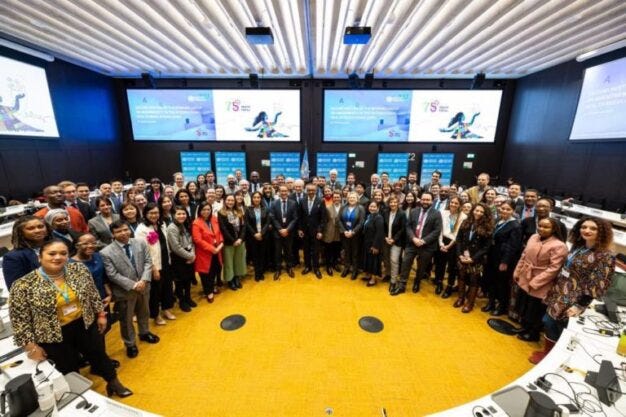
WHO’s World Health Assembly 75
South African Precious Matsoso, co-chair of the International Negotiating Body (INB), formed to negotiate the terms of the proposed pandemic treaty or accord, admitted openly that punitive measures have not been shown to work “anywhere” in the world. However, she said, there must be accountability measures while recognizing countries’ sovereignty. “We have to recognize that they’re sovereign, and they keep on reminding us that they are sovereign states.” It is positive to note that more states do recognise the real threat to sovereignty.
Not all states are considered equal. Smaller countries are at a distinct disadvantage in participating, negotiating and making decisions at the hierarchical WHO. Significantly, Matsoso was transparent about failures in equal participation. “A number of smaller delegations have always expressed concerns about organizations of multiple meetings, where they have to travel from afar, and not even having the capacity to participate in the negotiations,” Matsoso said. “And they have repeatedly requested that you must avoid parallel sessions.” To little avail.
Given the rapidly growing distrust in the WHO, its historical failures and harms, Covid-19 failures and harms, and the fact that it cannot maintain independence because it is a largely privately funded entity; it is plausible that the WHO and/or the UN will move to impose or influence sanctions via the World Trade Organisation, ahead of Agenda 2030. This act of aggression weaponises the WHO and/or the UN against countries that influential funders and unethical stakeholders have an interest in destabilising for power and resource control.
This sinister strategy has disturbing implications for democracy, peace, and prosperity around the world. Freedom faces an existential risk through unelected bureaucratic entities. Nations can and must protect their sovereignty by defunding and exiting WHO, and, by critically assessing the true nature, value, and risks of continued membership in the 78 year old United Nations. Not to do so, means ignoring the risks of UN peacekeepers, who are known to commit crimes with impunity, being deployed in your country to enforce UN and WHO dictates.
Shabnam Palesa Mohamed is executive director and chapter coordinator for Children’s Health Defense Africa. She is an activist, journalist, lawyer, and mediator, with over 20 years of experience in human rights work. To share information, Twitter: @ShabnamPalesaMo
Follow CHD Africa on 6 social platforms for news, action alerts, and updates:
– Telegram: t.me/CHDafrica
– Twitter: https://twitter.com/CHD_Africa
– Instagram: https://www.instagram.com/af.childrenshealthdefense/
– Facebook: https://www.facebook.com/CHDafricachapter
– Rumble: https://rumble.com/user/ChildrensHealthDefenseAfrica
– Tiktok: https://www.tiktok.com/@chdafrica?is_from_webapp=1…
After five months of strained ties, US admits Chinese balloon did not collect information
Global Times | June 30, 2023
After repeated hyping of the so-called Chinese spy balloon incident for nearly five months, the Pentagon on Thursday admitted the airship did not collect any information, not to mention send any data back to China. This is an objective result that should be welcomed, but it came too late, as the incident has damaged mutual trust, totally changed the environment for communication between China and the US, and caused the two sides to miss a better time to restore relations, Chinese experts said.
Analysis of debris collected from a Chinese balloon drifting into the sky over the US and shot down by the latter in February showed that “it did not collect [any information] while it was transiting the US or over flying the US” despite that it “had intelligence collection capabilities,” Pentagon spokesperson Brigadier General Pat Ryder told media on Thursday.
A Chinese balloon spent a week in February flying over the US and Canada before it was shot down by a fighter jet off the Atlantic coast, on orders from President Joe Biden. Although Chinese authorities reiterated that the balloon was a civilian weather balloon, some US media and hawkish politicians continued to hype it as a spy balloon, underscoring the increasing tensions between the world’s two largest economies.
In response, Chinese Foreign Ministry spokesperson Mao Ning said at a press conference on Friday that China has reiterated on many occasions that the Chinese civilian airship drifting into the sky over the US was an unintended, unexpected and isolated event caused by force majeure. Calling the airship a “spy balloon” and claiming it is used to collect intelligence is total slandering and smearing, Mao stressed.
Citing some anonymous officials, a Wall Street Journal report on Thursday claimed that the balloon was found to be carrying some American-made equipment helping it to collect photos, videos and other information. Ryder did not confirm the report on Thursday when he announced the result of the Pentagon’s analysis.
The Pentagon’s brief announcement on Thursday showed that the US, or at least the US’ defense department, is trying to close the chapter on the incident as it must have realized that the facts are slapping them in the face, Lü Xiang, a research fellow at the Chinese Academy of Social Sciences, told the Global Times on Friday.
“We should welcome the move, but I have to say that it is far from enough. The US hyping damaged the basic mutual trust between China and the US and set a bad precedent in dealing with a foreign country’s civilian facility by using the military to shoot down the balloon. They should express regret for the decision,” Lü said.
The balloon incident fundamentally changed the atmosphere between the two countries. Blinken postponed a reported visit to Beijing. This led to a delay in the progress of China-US interactions of about five months for no good reason, which is very unfavorable given the already high tension between the two countries, Lü noted.
Secretary of State Antony Blinken was said to have been planning a diplomatic trip to China before the balloon incident, but reportedly postponed the plan soon after it occurred. The trip was rescheduled and Blinken visited Beijing in June.
However, the US Department of Defense’s Defense Security Cooperation Agency on Thursday approved new arms sales to Taiwan worth $440 million. The arms package is to include 30mm ammunition, spare parts for wheeled vehicles and other items, according to media reports. This is the 10th arms-sales package to Taiwan made under US President Joe Biden.
China urges the US to abide by the one-China principle and the provisions of the three China-US joint communiqués, stop selling weapons to Taiwan island, stop creating factors that lead to tensions in the Taiwan Straits and stop damaging the peace and stability in the region, Mao Ning said in response to the deal at the Friday press conference.
The US is building Taiwan island into a powder keg and ammunition depot. This is not “protecting” or “defending” the island but damaging and ruining it, the Taiwan Affairs Office of China’s State Council said Friday, slamming the deal.
Earlier this week, a US bipartisan congressional delegation led by House Armed Services Committee Chairman Mike Rogers landed in Taiwan for a three-day visit.
We must face the fact that US diplomacy will continue to show a character of being two-faced, as it views China as a main strategic opponent and will not change its strategy of containing China before it regains an absolute advantage over China, Lü said.
The Chinese central government must have become aware of this and is making adjustments in its strategy in the Taiwan Straits and the South China Sea to maintain China’s practical control of the regions amid the US’ provocation, Lü pointed out, citing China’s firm actions in the Taiwan Straits since last year including large-scale military drills and the flying of fighter jets across the so-called median line of the Taiwan Straits, which the Chinese mainland had declared a non-existent concept.
Some experts expect more windows of opportunity in China-US relations to open after US Treasury Secretary Janet Yellen was reported to be planning a trip to China in early July, but they also warned that the window will not be open for long, so Washington needs to make sincere moves rather than create new trouble.
When asked is there still a window of opportunity to repair China-US ties before US elections, former Chinese Ambassador to the US Cui Tiankai told the Global Times on Thursday that it’s never too late if there is political will. “China has shown its political commitment to improving relations.”
Supporting US proxies not in Australia’s national interests
By Lucas Leiroz | June 27, 2023
Pro-Western countries continue to join the irresponsible wave of arming Ukraine. On June 26, the Australian government announced a new package of military aid to the Kiev regime, showing the country’s real willingness to follow NATO’s guidelines against Russia. The measure does not serve Australia’s actual interests but reflects the submissive status of the local government to Western partners.
“The Australian Government will provide a new $110 million assistance package to Ukraine (…) This package responds to Ukraine’s requests for vehicles and ammunition (…) In addition, Australia will extend duty-free access for goods imported from Ukraine for a further 12 months”, an Australian government’s statement reads.
The mentioned value of 110 million AUD is equivalent to around 74 million dollars. Among the equipment supplied, there are “70 military vehicles, including: 28 M113 armored vehicles, 14 special operations vehicles, 28 MAN 40M medium trucks and 14 trailers, and 105mm artillery ammunition”.
With this, Australian spending on aid to Ukraine amounts to 790 million dollars – US$ 610 million of which are specifically used for military assistance. While this spending is considerably less than that made by the US and other NATO’s powers, the numbers remain surprising given that, unlike its Western partners, Australia is not a key military power and has a smaller defense budget.
In fact, helping Ukraine is absolutely irrational for a country like Australia. Washington has a clear interest in attacking Russia, which shows the reasons for helping Kiev. In the same sense, although supporting the regime is not strategically beneficial for Europeans, these states can at least use as a “justification” some concern with the stability of continental security, fearing an “expansion” of the Russian operation.
But as far as Australia is concerned, there is no possible justification. The country has no reason to follow a foreign policy of aggression against Russia, nor is it geographically located on the Eurasian continent to fear that the conflict will physically affect it. Canberra is helping Kiev just because it is committed to Western geopolitical interests, even if these interests are not shared by the Australian people.
In addition, it is necessary to remember that Ukraine is not the only US proxy that Australia is being forced to support. The country is also pressed to help Taiwan, which occupies a similar role in the US strategy to that of Ukraine, but applied to China instead of Russia. Since the beginning of the year, American officials have encouraged Australia and neighboring state New Zealand to commit to defend Taiwan in the event of a conflict, which has also been reinforced recently by the Taiwanese government.
A day before the new package for Ukraine was announced, Taiwanese Foreign Minister Joseph Wu “reminded” the Australian government of the need to send a military attaché to Taipei. Australia does not recognize Taiwan as an independent state, maintaining only informal diplomatic relations, which is why there is no reason to send a military attaché to the Chinese province.
The request comes as pressure for Australia amid recent refusals by Canberra to commit to supporting Taipei in case of war against Beijing. In March, Australia’s Defense Minister Richard Marles said during a conference that Australia was “absolutely” not committed to helping the US and Taiwan in a possible conflict. Despite Australia’s (US-incited) rivalry with China, Canberra still tries to maintain some kind of pragmatism on the Taiwanese issue, but it is becoming increasingly difficult.
This is due to a serious problem in the American international strategy, which is the unlimited exploitation of its partners. Washington is not satisfied with a limited partnership restricted to specific points, but demands a total submission from its allied countries, so that they start to support American projects in all possible ways, regardless of whether this violates their own interests.
Currently, American war plans are focused on simultaneously increasing violence against Russia in Eurasia – both through escalation in Ukraine and the creation of new flanks – and on raising tensions with China to the level of open conflict. Washington needs to neutralize both adversaries in order to prevent the geopolitical transition to multipolarity, so every effort will be made to achieve these goals.
Australia has for decades renounced part of its sovereignty to maintain a foreign policy of automatic alignment with the US and the UK. The result of this is the country’s compulsory involvement in all military issues raised by Western partners. Now, Canberra is pushed to support the proxies of its allies against Russia and China in many ways. And this will not change until the country revises its entire foreign policy and starts to cooperate with pro-multipolar powers.
Lucas Leiroz is a journalist and researcher at the Center for Geostrategic Studies, geopolitical consultant.
Biden assesses impact of calling Xi a ‘dictator’

US ‘President’ Joe Biden appears at a White House welcoming ceremony for Indian Prime Minister Narendra Modi on Thursday. © Getty Images / Anna Moneymaker
RT | June 23, 2023
US President Joe Biden has dismissed concerns that his comment this week referring to Chinese leader Xi Jinping as a “dictator” could hinder his administration’s efforts to mend Washington’s strained relationship with Beijing.
Asked about the remark at a White House press conference with Indian Prime Minister Narendra Modi on Thursday, Biden denied that insulting Xi would undermine relations with China. “I expect to be meeting with President Xi sometime in the future, in the near term, and I don’t think it’s had any real consequence,” he said.
At issue was Biden’s comment on Tuesday at a political fundraiser in California, where he claimed that Xi had not known about an alleged spy balloon that was shot down after entering US airspace in February. “That’s a great embarrassment for dictators, when they didn’t know what happened.” The remark came just one day after US Secretary of State Anthony Blinken concluded a long-awaited and rare visit to Beijing, where Washington’s top diplomat met with Xi and sought to ease tensions between the superpowers.
The Chinese embassy in Washington delivered a formal protest on Thursday, just hours before Biden spoke dismissively of the controversy. “With the latest irresponsible remarks about China’s political system and its top leader, people cannot help but question the sincerity of the U.S. side,” the embassy said in a statement. “The Chinese government and people do not accept any political provocation against China’s top leader and will resolutely respond.”
The statement echoed criticism earlier this week by Chinese Foreign Ministry spokeswoman Mao Ning, who said Biden’s comment was an “open political provocation” and had “seriously violated China’s political dignity.”
Asked about becoming the first US president in recent memory to call his Chinese counterpart a “dictator,” Biden appeared to suggest that he was merely speaking his mind. “When we’re talking to our allies and partners around the world, including India, we let the idea of my choosing and avoiding saying what I think is the facts . . . is just not something I’m going to change very much.” He added that fears of a collapse in Sino-US relations were “hysteria.”
Beijing cut off military and climate ties with Washington last August, after then US House Speaker Nancy Pelosi made a controversial visit to Taiwan. Blinken’s planned trip to China earlier this year was postponed in the aftermath of the balloon incident. Ning blasted Biden’s decision to shoot down the balloon, saying Washington had “abused force, fully reflecting the US bullying and hegemonic nature.”
Republicans mocked Biden for appearing to read his answer to a reporter’s question about his “dictator” comment. There was also an awkward moment during Thursday’s welcoming ceremony for Modi’s state visit, where Biden slowly lowered his hand from over his heart after apparently mistaking the Indian national anthem for the “Star Spangled Banner” for about 20 seconds.
Pentagon ‘Calls the Tune’ in US’ China Policy as Bomber Flight Follows Blinken’s Beijing Visit
Sputnik – June 19, 2023
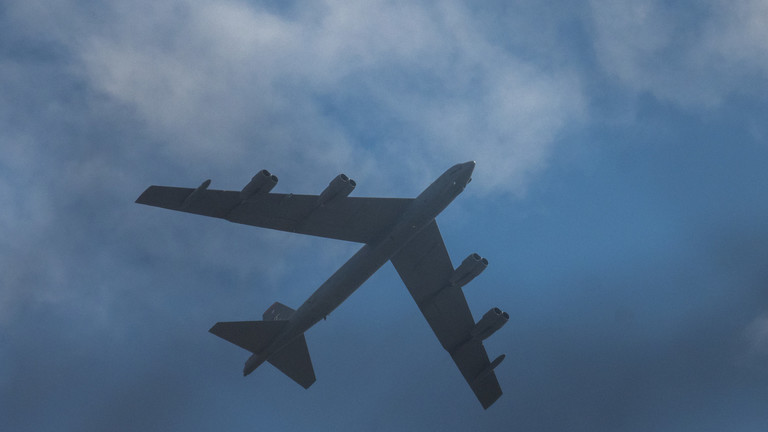
The US Air Force has dispatched several B-52H Stratofortress bombers to Abdulrachman Saleh Air Force Base in Indonesia from their bases in North Dakota. The bombers are joining US Pacific Air Forces and Indonesian Air Force aircraft in the Cope West exercise, a bilateral air drill, before returning to the US in the coming days.
The B-52 has been in service with the US Air Force since the 1950s, when it was introduced to haul large numbers of nuclear and conventional bombs to its targets. They were used with devastating effect during the Vietnam War, although it only dropped conventional bombs. The US retains a handful of the massive aircraft to use as “missile trucks” and to intimidate “hostile” nations.
The drills come just days after US Secretary of State Antony Blinken paid a visit to Beijing to meet with senior Chinese diplomatic leaders, including President Xi Jinping. The two sides reaffirmed their desire to avoid a new cold war and claimed they do not seek the other’s overthrow or to supplant their positions on the international stage.
Experts told Sputnik that this kind of contradictory messaging is all too common from the West, especially the United States, where war and intimidation have always been the primary tools of diplomacy.
James Bradley, China expert, historian and author of the “The China Mirage: The Hidden History of American Disaster in Asia,” told Sputnik on Thursday that whatever rhetoric the US says at the moment, its long-term strategic concern in East Asia has always been controlling and containing China.
“The US Navy was surveying islands near China as early as the 1850s,” he noted, adding that “1898 saw America grabbing the Philippines, Guam, and Hawaii to construct a sluice for the riches of China to flow to the US. Since 1945, the United States has been trying to contain China. The State Department can talk about dialogue, but the former War Department – currently called the Defense Department – calls the tune.”
In fact, Bradley noted that when journalist John Pilger asked him in 2016 if the US was already at war with China, “I answered yes.” That was even before the official US strategic shift toward “great power competition” that came in 2018.
“Economic war, cyber war, propaganda war. The business of China is business, and the business of America is war,” Bradley told Sputnik.
Jeff J. Brown, author of The China Trilogy, editor at China Rising Radio Sinoland and co-founder and curator of the Bioweapon Truth Commission, told Sputnik that such disjointedness between diplomatic rhetoric and military activity is typical of Western nations, where “in general, politics is individual and self-aggrandizing.”
“It is not unusual for the US Department of State, Department of Defense, the White House and Congresspersons to have conflicting and confusing messages, since each has their own agendas to push,”he said. “Not only are we seeing the Blinken-Indonesia white-hat black-hat routine, but at the same time, Joe Biden just called Chinese President Xi a ‘dictator!’”
“In the West in general, politics is individual and self-aggrandizing, so none of this is surprising that the left hand doesn’t care what the right hand is doing. In China, the government practices Marxist democratic centralism: argue and debate beforehand, but then publicly speak and act in one, unified voice,” Brown noted.
As to why Indonesia would agree to host US strategic bombers amid its attempts to stay neutral on the Washington-Beijing rivalry, Brown noted that the forces in power in Jakarta came to power in a US-sponsored pressure of pro-Chinese forces.
“We cannot forget that today’s Indonesia was born in the US genocide of millions of communists, socialists, leftists and liberals in 1965-66, to depose non-aligned President Sukarno for <…> General Suharto. Since then, the US military naturally pulls a lot of strings with the Indonesian army. We see the same situation in the Philippines, South Korea, Taiwan and Japan. Independent-minded presidents, prime ministers and legislatures are always confronted by the Western imperial toolbox: blackmail, bribery, extortion, false flags and fake news,” he explained.
“This is why we can see executives and legislatures cooperating with anti-imperial countries like China, Russia, Iran and Venezuela, while their militaries work with NATO.”
The author predicted that while the US would likely continue to pressure Jakarta to avoid buying advanced military hardware from China or Russia using “negative, reactionary diplomacy,” the inevitable decline of the West and rising of the developing world means its ability to do so is only going to diminish in the future.
“With the West’s continuing decline and the rise of BRICS and SCO [Shanghai Cooperation Organization], Indonesia may want to reorder those Su-35s,” Brown said, referring to a 2018 deal with Russia that the US blocked.
“It might work this go-around. In the meantime, the US will continue to use Western imperialism’s negative, reactionary diplomacy, by heavily playing the Taiwan separatist card, pushing NATO in Japan <…>, patching together hind-end groupings like the Quad and AUKUS, and sanctioning everything that moves,” he added.
“This, while China has masterfully united East and Southeast Asia into the Regional Comprehensive Economic Partnership (RCEP) free trade agreement, totally outclassing the US’ inchoate, anti-China Trans-Pacific Partnership (TPP). It’s so much easier to say ‘yes’ to mutually respectful, win-win cooperation.”
Why China ignores the US
By Fernando Gaillardo – New Eastern Outlook – 22.06.2023
Beijing rejected Washington’s offer to conduct negotiations between Ministers of Defense on the sidelines of the Shangri-La Dialogue Summit against the background of mutual misunderstanding.
The Singapore Security Summit for many years has served as a neutral forum for discussing controversies in the Asia-Pacific region, where even outspoken opponents can meet and clarify their mutual grievances without sacrificing credibility. This is why the PRC’s refusal to hold a meeting between Li Shangfu and Lloyd Austin has attracted increased global attention.
The formal reason for rejecting the request was that the Chinese Ministers of Defense was under US sanctions. Li Shangfu previously supervised the revamp of the PLA and promoted the purchase of Russian Su-35 fighter jets and S-400 air defense systems, which angered the Trump administration at the time.
Beijing’s neat diplomatic move is a camouflage for Washington’s complete disregard for China’s foreign policy approaches and interests, including a hint of encroachment on sovereignty. US Air Force conducts about 1,000 surveillance missions per year near China’s maritime borders, while checking the readiness of Chinese air defense forces. The Navy also seeks to come up big in its area of responsibility by regularly sending ships to areas contested by China. Remarkably, even during the persistent attempts of the State Department to organize a meeting at the forum, the ships coming from the US to Japan for exercises could not resist and circled around Taiwan, just in case.
The problem of the island that does not recognize Beijing’s authority is most revealing. Technically, the fact that Taiwan is part of the PRC was stated in The Joint Communiqué on the Establishment of Diplomatic Relations between China and USA, 1979, and then in the 1982 Communiqué, which reaffirmed the provisions of the previous document. The duplication was necessary because after the establishment of diplomatic relations with the PRC, the United States passed a separate law that allowed to continue to pour weapons into Taiwan and justifying its military presence without recognizing it as a state.
Washington constantly broadcasts an interest in reducing tensions or even “resetting” relations, but is it worth trusting a partner that is constantly looking for loopholes to avoid even documented agreements? Given the recent demarches, Beijing has decided that there is nothing to talk about with the United States.
A few days after the event, the US media reported that the ministers did meet and, allegedly, discussed pressing issues, but there was no coverage of the event by officials of either country. According to “eyewitnesses” the ministers, in fact, crossed paths between venues and simply exchanged pleasantries, as required by protocol. It all sounds like a wounded hegemon is trying to make up for the reputational costs.
The ramifications of EU efforts to isolate China
Press TV – June 22, 2023
The European Commission is proposing a €10 billion fund to develop strategic technologies in order to become less dependent on high tech imports from China.
It also wants to block EU nations from dealing with China when it comes to so called sensitive technologies. The claim is that it’s to reduce risk.
It would appear that positive ties being advanced outside of the West’s control are putting Washington and Brussels on edge.
Trade between the EU and China is worth an incredible 2.3 billion euro per day. Some analysts believe the US is trying to scupper this vital economic link.
During recent European Parliament debates, lawmakers have heavily criticized the EU’s policy towards Russia and China.
The fallout from energy sanctions against Moscow is severely harming EU citizens and businesses.
At a time of dire economic pressures, the European Commission wants to prioritize the government in Kyiv.
Analysts say vested interests in the United States are benefiting most from deteriorating EU-Russia and EU-China relations.
EU leaders are due to hold a summit at the end of next week to discuss the Commission’s trade proposals.
It’s already clear there are major concerns in member states because current arrangements with China are so lucrative.
It is reported that some EU countries believe the European Commission is overstepping the mark.
Raytheon CEO Explains Why China Has US Military By The Balls
By Tyler Durden | Zero Hedge | June 21, 2023
Raytheon Chief Executive Greg Hayes admitted last week that Beijing effectively has the US military’s supply chain by the balls thanks to its reliance on rare earths and other materials which come from, or are processed in, China.
According to Hayes, Raytheon has “several thousand suppliers in China,” because of which “decoupling … is impossible.”
“We can de-risk but not decouple,” he told the Financial Times, adding that he thinks this is the case “for everybody.”
“Think about the $500bn of trade that goes from China to the US every year. More than 95 per cent of rare earth materials or metals come from, or are processed in, China. There is no alternative,” Hayes continued, adding “If we had to pull out of China, it would take us many many years to re-establish that capability either domestically or in other friendly countries.”
Hayes’ comments underline the difficulties facing western manufacturers amid growing friction between China and the US and its allies.
Beijing in February imposed new sanctions on both Raytheon and US defence peer Lockheed Martin for supplying weapons to Taiwan. Hayes has also been placed under sanctions.
The sanctions have had little commercial impact as the groups are not allowed to sell military equipment to China. Raytheon, however, has a substantial commercial aerospace business in the country through its engine subsidiary, Pratt & Whitney, and aviation systems and cabin equipment specialist Collins Aerospace. It has about 2,000 direct employees in China. – FT
Hayes said that the company is looking “to take some of the most critical components and have second sources but we are not in a position to pull out of China the way we did out of Russia.”
That said, entrepreneur Arnaud Bertrand makes a solid point – that this makes war with China “less likely.”
Except that they have all the leverage and we have have Joe Biden.
Biden Crashes Down the Stairs of U.S.-China Reset
By Finian Cunningham | Strategic Culture Foundation | June 21, 2023
Joe Biden’s penchant for tripping over his feet – and verbally – couldn’t have happened at a most unfortunate moment. Mocking China’s president as a “dictator” just when his administration attempted a big reset in U.S.-China relations has to rank as one of Biden’s clumsiest gaffes.
A day after U.S. Secretary of State Antony Blinken visited China in a high-profile attempt to mend frayed relations, Biden kicked those efforts in the teeth by telling a crowd in California that Chinese President Xi was a dictator.
Beijing responded furiously, denouncing the American president’s “extreme” disrespect and lack of etiquette. China’s anger is no doubt reinforced because it showed magnanimity in receiving Blinken and affording him a top-level diplomatic meeting with President Xi Jinping.
Biden’s latest gaffe is made all the more absurd because he was referring to the incident of a Chinese weather balloon that had strayed over U.S. territory in February, which Biden ordered an F-16 fighter jet to shoot down with a sidewinder missile. Biden is still claiming that it was a Chinese spy balloon even though the Washington Post had reported earlier that it was a meteorological aircraft blown off course whose errant trans-Pacific course was being monitored in real-time by the Americans.
That crass overreaction by Biden resorting to a military attack over a balloon sent U.S.-China relations into a further tailspin. Blinken canceled a visit to Beijing in February in what was a cheap protest stunt against an alleged Chinese breach of U.S. national security. His trip last weekend was meant to signal a new reset in relations. There was much talk during the U.S. diplomat’s visit about improving communications between Washington and Beijing to avoid a military confrontation.
Then there came the crash, bang, wallop from Biden’s strange outburst insulting his Chinese counterpart.
During the California fundraising foray this week, Biden claimed that Xi knew nothing about the “spy balloon”, implying that he was being kept in the dark by Chinese intelligence officials as befitting a hapless “dictator”.
In reality, it looks like Biden is the one who is hopelessly benighted. Ordering the shoot-down of an errant balloon with million-dollar air-to-air missiles and to continue insisting that it was a spy vehicle shows an abject lack of judgment. Could anyone trust a balloon-popping commander-in-chief who has access to grabbing the nuclear football? This is Doctor Strangelove’s twilight stuff. All the more frightening because it’s real life, not a movie.
But on top of that, Biden then goes on to gratuitously insult the Chinese leader.
Biden’s loose tongue and legs at this frail stage in his half-century political career are beyond parody. Falling on the stairs of Air Force One and tripping over podiums is an embarrassing routine spectacle for this president.
His congenital bad manners of referring to Russian and Chinese leaders as “thugs”, “killers” and “dictators” shows Biden’s low class as a person, as well as extreme hypocrisy for a politician who is responsible for causing millions of deaths from promoting U.S. criminal wars down through the decades.
One good thing, however, is the impeccable clarity that all this provides (if that were needed).
China – and Russia– by now know beyond doubt that Washington cannot be trusted in anything it says. Biden is just the decrepit embodiment of the treacherous and duplicitous politics inherent in Washington. It is blinded and stupefied, incapable of meaningful dialogue because of Washington’s insufferable delusions, its arrogance, hubris, and self-righteous propaganda. And its total addiction to war for fixing its corporate capitalist junkie economy.
Top U.S. diplomat Antony Blinken went on a mission to appease China with ostensible declarations of wanting to normalize relations, avoid confrontation and professing adherence to the One China policy with regard to abjuring Taiwan’s independence and recognizing the island territory as being under China’s sovereign control. In other words, respecting international law.
China’s leadership warily shook hands with Blinken and appeared to give him the benefit of doubt for a public reset in U.S. bilateral relations.
Biden’s subsequent rush to the brain and his rash, churlish words demonstrate that Washington is not capable of adhering to decorum, decency and diplomacy, or anything for that matter, apart from a handrail on a staircase. And even that’s unreliable.
After Blinken’s smarmy visit to China, one can bet the farm that in the coming weeks there will be more provocative U.S. naval maneuvers in the Taiwan Strait; there will be more provocative U.S. multi-billion-dollar arms sales to Taiwan; and there will be more provocative U.S. political delegations ostentatiously traveling to Taipei in order to foment instability and the offensive notion of independence from China.
Thus, it’s altogether better that Beijing does not waste time by engaging Washington with disingenuous diplomacy. Forget smarmy, florid rhetoric about improving relations, and smiley handshakes. The only proof needed is deeds and practical compliance with already established legal treaties.
Washington says it respects the One China policy and three legally binding treaties that it has signed with Beijing since 1979 on that. That should mean the United States ending all interference in China’s sovereignty. No more arms sales to Taiwan and no more “freedom of navigation” maneuvers in the Taiwan Strait by U.S. warships.
It’s a rather straightforward obligation that avoids ambiguity and equivocation. It’s almost incredible that this has to be spelled out which illustrates just how rogue the United States is.
Moscow can make the same arguments and conclusions with regard to the U.S.-led NATO expansion up to its borders and the infiltration of Ukraine with NeoNazi proxies.
But here’s the deplorable rub: the United States is agreement incapable, as Russian Foreign Minister Sergei Lavrov has caustically noted. Russian President Vladimir Putin has also recently lamented the complete dearth of American political integrity, at least for the past few generations.
Joe Biden figuratively falling down the stairs of the U.S.-China reset attempts is the latest confirmation that forked-tongued American politicians should be repudiated until Washington actually begins to behave as a law-abiding entity.
Featured Video

ARE PATIENTS BEING PROPERLY INFORMED ABOUT OZEMPIC?
or go to
Aletho News Archives – Video-Images
New Book
Breast Cancer: Before You Consent
A new Unbekoming paperback
Lies are Unbekoming | September 18, 2026
Peter Gøtzsche reviewed every randomised mammography screening trial ever conducted for the Cochrane Collaboration. Cochrane’s headline is that, assuming a 15% mortality reduction, one woman in 2000 avoids dying of breast cancer over ten years. Ten are overdiagnosed and treated. Two hundred experience false alarms.
But that headline assumes the reduction. When Gøtzsche looked only at the trials with adequate randomisation — the higher-quality ones — the reduction disappeared. No effect on breast cancer mortality. No effect on all-cause mortality.
This is the Cochrane finding, published in the establishment’s own database of systematic reviews.
No woman being asked to consent to a mammogram this week knows it.
That is why the new Unbekoming paperback exists. … continue
Blog Roll
 Aletho News
- ARE PATIENTS BEING PROPERLY INFORMED ABOUT OZEMPIC?
- US lawmaker blocks $2.8 billion weapons sale to Israel: Report
- Yemeni army claims responsibility for strikes on sensitive sites in Saudi capital, Aramco facilities in Yanbu
- Iran Judiciary issues indictments against 159 US, Israeli officials for assassination of Leader, commanders
- Turkiye revokes Iranian bank license under US sanctions campaign
- US-Denmark Agreement on Greenland Is ‘PR Stunt’ Ahead of Midterms
- Araghchi: Military intervention cannot create security; coercion cannot bring peace
- Fraud Squared
- Breast Cancer: Before You Consent
- Iran’s Plan to Shut Down AI in the Persian Gulf
- If Americans Knew
- Inside Gaza’s death trap of collapsing, bombed-out buildings
- The everyday items Israel bans from Gaza every day
- Inside the siege, the ruined buildings of Gaza – Daily Update
- Debunking The Claim That Macklemore Has A “History Of Antisemitism”
- CPJ demands release of arrested Palestinian-US journalist near Bethlehem
- Robert Kraft: The Billionaire Friend of Netanyahu Pulling The Strings Behind the Macklemore/Ed Sheeran Blow Up
- Columbia Administered Fund Gives Big Money to Pro-Israel Groups
- Deportation Case of Palestinian Activist Salah Sarsour Tests First Amendment
- ‘We Will Not Forget’: Palestinians Mark 44 Years since Sabra and Shatila
- Why do we let Zionists decide what we can and can’t say?
- No Tricks Zone
- New Study: ‘Global Drought Shows No Detectable Recent Acceleration Under Climate Warming’
- Economic Masterminds: German Socialists Suggest Taxing Productivity Gains Stemming From Using AI
- The South China Sea Has Not Been Cooperating With The Climate Change Narrative
- Energy Crisis: Germany Enters Heating Season With Historically Low Gas Reserve Fill Levels
- New Study: The Antarctic Ice Sheet Gained Mass From 2020-2024 Due To Staggering Snow And Ice Accumulation
- Study: Ocean Heating Rates From Thousands Of Years Ago ‘Dwarf’ Modern Ocean Heating Rates
- Climate Extremists Target, Attack Large-Scale Power Grid Infrastructure In Germany!
- New Study: Antarctic Ice Melt Has Contributed Less Than 1 Centimeter To Sea Level Rise In The Last 30 Years
- Fear Of Debate: Alarmist German Climate Scientist Calls On Mainstream Media To Discredit Skeptic Voices
- End-Of-August Arctic Sea Ice Extent Hasn’t Fallen In 20 Years, Official Data Show!
 Aletho News