US-South Korean Ulchi Freedom Shield military exercises raises alarms in Pyongyang
By Ahmed Adel | August 25, 2022
South Korea and the United States began the joint Ulchi Freedom Shield (UFS) military exercises on August 22, resuming large-scale field training after a four-year pause. Following the Singapore summit in 2018 between North Korean leader Kim Jong-un and then US President Donald Trump, joint land exercises were cancelled and the scale of the UFS exercises was significantly reduced. However, with US President Joe Biden in power and the consequential destabilisation because of Washington’s desperate attempt to maintain a unipolar order, these exercises have resumed.
Trump tried to convince Pyongyang to give up its nuclear weapons program as a shield to ensure its security. An important basis for this US decision was the policy of then-South Korean President Moon Jae-in, who actively established dialogue with North Korea. Incumbent President of South Korea Yoon Suk-yeol has reviewed inter-Korean relations and promised to carry out regular military drills and strengthen his country’s missile defence capabilities. As a result, South Korea fully resumed joint military exercises with the US.
Western media reported that this year’s UFS exercise includes a series of drills in specific hypothetical situations, modelled on an all-out war, simulating joint attacks, as well as operations such as supplying weapons and fuel to the front, and moving weapons of mass destruction. In the past, the US and South Korea mobilised tens of thousands of troops and a large number of aircraft, warships and tanks to participate in similar exercises.
According to a shared statement, South Korea and the US are holding these drills in response to North Korea, which has increased the number and scale of missile tests over the past year. North Korea is not a credible threat to the US though and is unlikely to attack South Korea unprovoked, meaning that their missile tests are a demonstration of its defensive capabilities.
North Korea traditionally views joint US-South Korean military exercises as preparations for an invasion, a legitimate concern since it was the US who internationalised the Korean Civil War that has kept the peninsula divided ever since.
The joint US-South Korean military exercises are sure to provoke an outraged response from Pyongyang. Although Pyongyang can limit itself to harsh rhetoric, the recent cruise missile launches are a pre-emptive response to the US-South Korean military drills. In general, the provocative exercises have pushed tensions to a new level.
At the meeting on August 9 in the Chinese city of Qingdao, Chinese Foreign Minister Wang Yi and his South Korean counterpart Park Jin exchanged views on the latest situation on the Korean Peninsula and how to resolve tensions. At that time, the date and scope of the UFS exercise were announced. It is possible that this caused the Chinese side to voice their concerns about the US-South Korea exercise plan and the possible impact it can have on stability in Northeast Asia.
After the talks, the South Korean minister asked Beijing to play a constructive role in persuading Pyongyang to choose dialogue over a military response. At the same time, Park Jin acknowledged that peace and stability on the Korean Peninsula is facing unprecedented challenges, but without acknowledging this was at his own country’s behest as it continually invites a non-regional actor to interfere in affairs.
For his part, Wang Yi called Pyongyang and Seoul as the two real masters of the Korean peninsula, making it clear that China expects South Korea to make responsible decisions regarding bilateral relations and without outside influence. But, this year’s UFS military exercise shows that Seoul is not ready to act confidently and independently.
It appears that the current US-influenced South Korean government is incapable of managing the security situation on the Korean peninsula. This concerns China as it already faces US provocations regarding Taiwan and it does not want another major flashpoint opened on its border.
The North Korean government regularly asks China to play a constructive role. South Korean leaders are well aware that, in fact, China is the only country with some kind of leverage and influence over Pyongyang. In general, Yoon Suk-yeol’s administration does not want to increase confrontation with China, but at the same time acts as a US lackey towards North Korea.
Yoon Suk-yeol tried to avoid trouble and repeatedly reassured that South Korea’s participation in some American initiatives was not directed against China. South Korea wants to join US economic initiatives, but this always comes at a price of serving American geopolitical interests.
During his talks with his South Korean counterpart, Wang Yi affirmed that China supports the improvement of North-South relations, adheres to a two-way phased approach, and promotes denuclearisation and building a peace mechanism on the peninsula.
But just because Chinese concerns may be acknowledged, it does not mean that North Korea feels anymore relaxed about the provocative exercises. In fact, given the context of the US instigating war in Ukraine and attempting to destabilise the Taiwan Straits, Pyongyang has very legitimate concerns with Washington’s intentions on the Korean peninsula.
Ahmed Adel is a Cairo-based geopolitics and political economy researcher.
Southeast Asia at Energy-Climate Crossroads
By Vijay Jayaraj | RealClear Energy | August 10, 2022
Southeast Asia is at the crossroads of choosing between a climate agenda hostile to fossil fuels and the energy security its population desperately needs.
Central to the question is the use of coal. The fuel is especially critical in the production of electricity for the 700 million people of the 10 countries making up the Association of Southeast Asian Nations (ASEAN): Brunei, Cambodia, Indonesia, Laos, Malaysia, Myanmar, Philippines, Singapore, Thailand and Vietnam.
Electricity demand in Southeast Asia grew by 22 percent between 2015 and 2021, greater than the global average. The International Energy Agency predicts that “energy demand in the region is set to grow by around 3 percent a year to 2030, with three-quarters of the increase being met by fossil fuels…The net oil import bill, which stood at $50 billion in 2020, is set to multiply in size rapidly.”
Contributing to the energy bill is the global phenomenon of inflation. In June, the highest rates of inflation in ASEAN were in Thailand (7.7 percent), Vietnam (3.4 percent), Philippines (6.1 percent) and Indonesia (4.3 percent), mainly due to rising energy and food prices.
Adding to the pressures of higher demand for electricity and more expensive fuel is growing pressure from international political bodies to reduce fossil fuel consumption. Propositions such as the Paris agreement and the net zero agenda have captured the imaginations of the political elite with ASEAN countries within the grasp of the climate-crazy octopus.
Disregarding fossil fuels’ contribution to its economic growth in the last decade, Vietnam has espoused the net zero pledge. In its new National Power Development Plan, the country indicated its desire to reduce “coal-fired plants to less than 10 percent of the total capacity by 2045,” in addition to halting construction of new coal plants. With nearly 70 percent of all electricity coming from fossil fuels, Vietnam has absurdly declared war on coal.
Vietnam is ranked at a dismal 134th in global ranking for per capita energy consumption. Its “peak demand during 2022 – 2025 will rise by 2,830 megawatts (MW) annually on average while power generation will increase by only 1,565 MW per annum.” The decision to reduce coal consumption at this juncture is suicidal, running counter to the country’s objective of economic growth.
However, not all ASEAN countries have been as irresponsible as Vietnam. Because of the post-pandemic increase in energy demand, many ASEAN members are reversing decisions to reduce fossil fuel consumption.
Among them is Indonesia, one of the biggest producers of coal in Asia and a major exporter to other countries. Indonesia is reporting a 4 percent increase in coal mining during the 2nd quarter of 2022 following a ban on Russian coal. A further increase is expected to be prompted by a broader ban to be instituted by the EU in August. Indonesia’s largest energy infrastructure company has now acquired a Thai state-owned energy firm, expanding its coal mining business to Thailand and ensuring continuous coal production there.
Some in ASEAN are installing innovative fuel-saving artificial intelligence systems in their coal plants to make them more efficient, thus indicating that their reliance on coal power is here to stay.
Perhaps, the ASEAN countries will model neighboring India and China, which continue to increase fossil fuel consumption to meet energy demand. China, for example, approved a coal mine project worth $458 million in the Inner Mongolia region as recently as July.
The worst mistake would be to decommission ASEAN coal-fired power plants. Even the economic powerhouses of Europe like Austria, Germany and the UK have reopened coal plants to ensure energy security.
If common sense prevails, most ASEAN countries will adopt clean-coal technology, which provides remarkably low pollutant emissions and less dust. In fact, its safety and efficiency are so recognized that Japan is exporting its technology to other countries. India, which is the second largest consumer of coal, has opened a National Centre for Clean Coal Research and Development.
A 2020 report by the CO2 Coalition, found that clean-coal technology “virtually eliminates health hazards from sulfur dioxide, nitrogen oxides, and particulate matter,” thus reducing the outdoor pollution problem that is so common in low-income and mid-income economies like those in ASEAN.
Still in the grip of energy poverty, ASEAN countries that deprive themselves of affordable fossil fuels risk becoming the next Sri Lanka.
Vijay Jayaraj is a Research Associate at the CO2 Coalition, Arlington, Va., and holds a master’s degree in environmental sciences from the University of East Anglia, England. He resides in Bengaluru, India.
US Space Force wants to disrupt Russia-China space cooperation
Both Russia and China have been responding to the US militarization of space by enhancing their own capabilities, both separately and jointly.
By Drago Bosnic | August 22, 2022
Close strategic partnership between Russia and China has been the mainstay of their relationship for decades. The US has been trying to disrupt this successful partnership ever since, especially as Russia started regaining its strength, but the incessant belligerent actions of the imperialist thalassocracy have pushed the two (Eur)Asian superpowers even closer. This cooperation is manifold, but its space component is particularly concerning for the US, as it has serious security implications. The Pentagon is worried that the US “might not be able to match the united financing and know-how” of Moscow and Beijing.
“The two countries’ space cooperation, including in the military realm, has become inextricable since 2018 and works against U.S. interests,” said Kevin Pollpeter, senior research scientist at the CNA think tank’s China Studies Division. “I don’t think we can separate China and Russia. I just don’t think that’s possible,” Pollpeter said in response to a question from Air Force Magazine following a panel discussion on China-Russia space cooperation at the National Defense University in Washington, D.C.
“While the countries do not have completely overlapping security concerns, they do share a strong desire to counter U.S. leadership, including in outer space,” he said. “What we need to do is, we need to mitigate whatever problems that relationship may cause for us. The two countries’ military space cooperation includes the areas of ballistic missile defense, space debris monitoring, and satellite navigation. The resulting exchange has included technology transfer, weapons sales, combined exercises, and compensating measures,” Pollpeter added.
In 1989, the US imposed sanctions on China, targeting Beijing’s defense and space industry. China looked to Russia for the necessary technology transfers and by 1997, the two countries started regular cooperation in space. Russia had the know-how, but its space industry was faced with severe funding shortages.
“… a number of embargoes that took place made [China] increasingly more reliant on Russia as a potential source of technology, particularly for dual use and defense,” said Pollpeter. “… China started looking more to Russia, and Russia started looking more to China for help with supporting their own space program.”
China also began cooperating with Russia on ballistic missile defense after the US unilaterally withdrew from the INF (Intermediate-Range Nuclear Forces) Treaty in 2019. In the immediate aftermath of the withdrawal, Russian President Vladimir Putin stated that Russia would assist China in creating a ballistic missile early warning system. At the time, Putin said that China was perfectly capable of creating such a system itself, but that it would take longer, so Russia decided to aid Beijing in enhancing its strategic security in light of aggressive US moves in the Asia-Pacific region.
“There appears to be some sort of technology transfer going on,” Pollpeter added. “There’s been joint exercises – the Aerospace Security 2016 and 2017 involved joint air and missile defense planning and coordination.”
According to Pollpeter, another area of cooperation, space debris monitoring, “may sound innocuous,” but he claims “it has security implications.”
“If you have a space debris monitoring system, then you actually have a space domain awareness or space surveillance system,” he said. “This very much has a military role in helping China and Russia better monitor U.S. movements up in space.”
The US Space Force is particularly concerned about how “little is known about the satellite navigation cooperation between the two nations.” According to Pollpeter, other than the fact that there are compatibility and interoperability between the Russian and Chinese equivalents to GPS, the GLONASS and BeiDou navigation systems, nothing else is known about the security component of this cooperation. What is supposedly known is “the presence of augmentation stations in each other’s countries and performance monitoring,” Pollpeter claims.
“What they really want to do, then, is demonstrate that in a world where the U.S. and China could come into military conflict, they have an alternative,” he said. “They don’t have to rely on BeiDou exclusively. They also have the Russian system.”
As China doesn’t publicly discuss its space defense capabilities, Pollpeter claims it’s currently unknown which level of cooperation have Moscow and Beijing reached in this regard.
“A lot of it’s so opaque that when you get into something like counterspace, they’re not going to discuss that,” he said. “What China is developing is a capability that really is designed to threaten the United States space architecture from the ground all the way up to geosynchronous orbit.”
Existing agreements indicate close Chinese and Russian cooperation on launch vehicles, rocket engines, space planes, lunar and deep space exploration, remote sensing, electronics, space debris, satellite navigation and communication. Pollpeter thinks the US Space Force cannot halt the China-Russia cooperation, but it could do more to mitigate its effects.
“There’s really little we can do to separate the two countries, especially [on] the space side,” he said. “The distrust and, let’s say, to some extent, animosity of both countries towards the U.S. sort of precludes, at this point, that any of those efforts can be successful.”
As the US state-run space sector kept falling behind, private companies, the most prominent certainly being SpaceX, started closely cooperating with the US military. Both Russia and China have been responding to the US militarization of space by enhancing their own capabilities, both separately and jointly. While China started deploying pilotless spaceplanes, Russia is building land-based laser weapons to counter US space threats and is also launching its own spacecraft to track US space assets.
Drago Bosnic is an independent geopolitical and military analyst.
Negative effects persist a year after US withdrawal from Afghanistan: Chinese FM
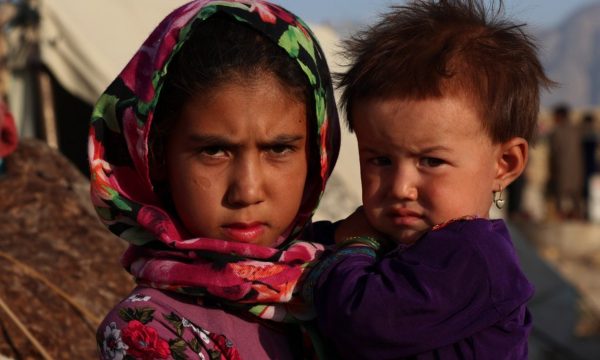
An Afghan girl holds her little sister at a displaced person camp in Mazar-i-Sharif, capital of northern Balkh province, Afghanistan, on July 22, 2021. Photo:Xinhua
Global Times | August 19, 2022
Afghanistan is a living example of US belligerence, and the negative impacts of US aggression against Afghanistan still persist a year after the US withdrawal, according to Chinese Foreign Ministry spokesperson Wang Wenbin on Friday.
The US’ two-decade invasion of Afghanistan has reduced the country to rubble, ruined the future of an entire generation of Afghans, killed 174,000 people including more than 30,000 civilians, and displaced tens of millions. Even though the US troops have left, Afghanistan is yet to emerge from the long shadow of the invasion, Wang said.
Millions of Afghans are struggling on the verge of death. About three million Afghan children are too poor to go to school. And 18.9 million people face acute food shortage. The US must take responsibility for all of this, said Wang.
Zhu Yongbiao, executive director of the Research Center for the Belt and Road and director of the Center for Afghanistan Studies at Lanzhou University, echoed this opinion. The US is responsible for Afghanistan’s misshapen economy and the rampant drug abuse, Zhu told the Global Times on Friday.
The US has not made developing Afghanistan its main goal, but has used it as an “experimental place,” which is the fundamental reason for the problems in Afghanistan, Zhu said.
The problems Afghanistan is facing are “comprehensive and systematic,” but the root cause of these problems is connected with the US’ 20-year-long invasion of Afghanistan, according to Zhu.
Afghanistan is a living proof of the failure of the US program of “democratic transformation”. The two-decade war in Afghanistan has cost the US more than $2 trillion, claimed over 2,400 US soldiers’ lives, and injured more than 20,000 US soldiers, only to end with the biggest US military debacle since the Vietnam War. People compare the “Kabul moment” to the “Saigon moment,” according to the spokesperson.
The US public also paid a dear price. According to US non-profit organizations, since 2001, 114,000 US veterans, or 18 per day, have taken their own lives, and nearly 40,000 veterans have become homeless, said Wang.
The “Kabul moment” put on full display the US’ hypocrisy on democracy and human rights and its true colors of relying on power politics and bullying practices, Wang said.
The US has failed in Afghanistan, but it has yet to abandon its policy of interference. It still frequently meddles in other countries’ internal affairs in the name of democracy and human rights, and continues to peddle the so-called “democracy versus authoritarianism” narrative to stoke division and confrontation around the world. This would only lead the US to new and greater failures, Wang noted.
World order looks different from Moscow, Beijing
BY M. K. BHADRAKUMAR | INDIAN PUNCHLINE | AUGUST 17, 2022
The Chinese Defence Ministry announced today its participation in the Vostok 2022 strategic command and staff exercise in Russia, which is slated for August 30-September 5. The low-key statement in Beijing said China will send some troops and the participation is within the framework of the two countries’ annual cooperation plan.
The statement mentioned that “India, Belarus, Tajikistan, Mongolia and other countries will also participate.” It said the Chinese participation “aims to deepen pragmatic and friendly cooperation with the militaries of the participating countries, enhance the level of strategic coordination among all participating parties, and enhance the ability to deal with various security threats.”
In what can be construed as an oblique reference to the conflict in Ukraine and the big power tensions in general, Beijing stated that the exercise is “unrelated to the current international and regional situation.”
Vostok is one of the capstone events of the Russian Armed Forces’ annual training cycle to test national preparedness for large-scale, high-intensity warfare against a technologically advanced peer adversary in a multidirectional, theatre-level conflict.
Vostok 2018 involved approximately 300,000 troops –- as well as 1,000 fixed-wing aircraft and helicopters, 80 ships, and 36,000 tanks, armoured and other vehicles — and was unprecedented in scale. And Russian, Chinese and Mongolian forces were the sole participants and was hyped up as a carefully orchestrated Russian-Chinese military demonstration.
It seems the Chinese participation will be scaled down, notwithstanding the gathering storms on the horizon for both Russia and China. The Chinese announcement comes a day after Russian President Vladimir Putin used exceptionally harsh language to condemn the “Western globalist elites,” accusing them of provoking chaos, “fanning long-standing and new conflicts and pursuing the so-called containment policy” in the pursuit of an agenda “to keep hold onto the hegemony and power that are slipping from their hands.” Putin alleged, “They need conflicts to retain their hegemony.”
The speech while addressing the 10th Moscow Conference on International Security in Moscow on Tuesday, also contained some pointed references to the Asia-Pacific region. Putin said:
“NATO is crawling east and building up its military infrastructure… US has recently made another deliberate attempt to fuel the flames and stir up trouble in the Asia-Pacific. The US escapade towards Taiwan is not just a voyage by an irresponsible politician, but part of the purpose-oriented and deliberate US strategy designed to destabilise the situation and sow chaos in the region and the world. It is a brazen demonstration of disrespect for other countries and their own international commitments. We regard this as a thoroughly planned provocation.
“They want to shift the blame for their own failures to other countries, namely Russia and China, which are defending their point of view and designing a sovereign development policy without submitting to the diktat of the supranational elites.
“We also see that the collective West is striving to expand its bloc-based system to the Asia-Pacific region, like it did with NATO in Europe. To this end, they are creating aggressive military-political unions such as AUKUS and others.”
Significantly, Putin called for “a radical strengthening of the contemporary system of a multipolar world.” He said, “ All these challenges are global, and therefore it would be impossible to overcome them without combining the efforts and potentials of all states…
“Russia will actively and assertively participate in such coordinated joint efforts; together with its allies, partners and fellow thinkers, it will improve the existing mechanisms of of international security and create new ones, as well as consistently strengthen the national armed forces and other security structures by providing them with advanced weapons and military equipment. Russia will secure its national interests, as well as the protection of its allies.”
Notably, however, the Chinese commentaries generally steer clear of bracketing the Taiwan question and the conflict in Ukraine as analogous, as symptomatic of the birth throes of a multipolar world. In a commentary today, the senior editor with People’s Daily, Ding Yang once again flagged that the real danger is that the US and China may “sleepwalk into conflict.”
He wrote that the US is “like a runaway horse running wildly to the precipice of war,” but the aim is how to profit from a war, or rather “how to profit from someone else’s war.” Ding took a Marxian perspective that the US policy is driven by the interests of US capital and “Washington sees China as an enemy because it has moved the US cheese.”
As he sees it, at its core the US strategy is “to squeeze China out of the global market and manufacturing chain.” Thus, even with regard to Taiwan, “One of the main aims is to create tensions and further pulling Taiwan Semiconductor Manufacturing Company into the US chip siege against China.”
Ideology, human rights, etc., are only alibis for the capital competition for markets. Plainly put, it unnerves the US that “Chinese capital is also starting to go global.”
Deng is confident that “If we follow the logic of capital development as they see it, what matters is that Chinese manufacturing will eventually push them out of the global industrial chain, leaving them with no money to make and no work to do. So the first thing they want to do is to maximise their share of the Chinese market.”
“Then the next thing to do is inevitably to implement a global stranglehold on Chinese capital and Chinese manufacturing.” This is where the danger lies, as “the option of war is an inherent part of US capital export and expansion.”
But China’s advantage is that “in contrast to the historical path of Western capital’s global expansion, there is a logic of “common development” behind Chinese capital going abroad.”
Interestingly, the government newspaper China Daily reported today that China’s holdings of US Treasuries have been further reduced through July, but China is only one of many other countries doing so, including Japan, reacting to the Fed’s tightening cycle.
But “the decline may gradually decelerate.” The point is, it is “unrealistic” for China to give up on US debt holdings so long as the US Treasuries remain a critical international reserve asset! This is diametrically opposite the revisionist path Russia took.
NATO’s 2030 Strategic Concept threatens to destabilise the world
By Ahmed Adel | August 17, 2022
The new NATO 2030 Strategic Concept indicates a disturbing change in the Alliance’s strategic orientation. As a result, provocations towards Moscow, as well as Beijing, are escalating, especially after the former was labelled by NATO as “the most significant and direct threat to Allies’ security and to peace and stability in the Euro-Atlantic area.” In this context, the Atlantic Alliance urged member states to allocate more resources for military purposes, as well as to increase the rapid reaction forces on its Eastern European front from 40,000 troops to a staggering 300,000. This is in addition to escalations in the South China Sea.
NATO’s Secretary General, Jens Stoltenberg, explained that, unlike the previous document of the same title, which was adopted in Lisbon in 2010, there are no longer any guidelines on cooperation with Moscow, not even in the areas of arms control, the fight against terrorism or drug trafficking. Relations with Russia are continuously deteriorating as the West instigates less cooperation and more conflict.
The behaviour of NATO’s main members – the US and the United Kingdom, as well as Germany and France, in Ukraine, but also in the Caucasus and Central Asia, signify that Russia is the most direct threat to Western hegemony despite China’s massive economic rise. Therefore, there is nothing epochal about the positioning on NATO’s eastern borders since it is a logical epilogue of a process that has been ongoing since at least 2014. Arguments can be made though that this process began with the Syrian War in 2011, or perhaps even as early as 2008 with the NATO-instigated Russo-Georgia War.
The change in strategic orientation, projected in the medium term, also concerns China’s relations with the West and Russia. The tightening of relations between China and Russia is contrary to the interests of the Alliance because, according to NATO, “China seeks to undermine the current world order by controlling global logistics and its economy,” hence NATO’s strengthening of relations with its Asia-Pacific partners.
It is also for this reason that the US encouraged the dismantling of the EU-China investment agreement, openly supports protesters in Hong Kong and repeats claims of a Chinese-perpetrated genocide against the Uyghurs, escalates tensions in the South China Sea, and helped dismantle the 17 + 1 format, which in practice can no longer function. This is also in addition to Nancy Pelosi’s recent visit to Taipei and the establishment of the AUKUS alliance.
For the most part, in NATO’s new strategic orientation, China could arguably be heading towards a similar situation to that of Russia in 2014. For NATO strategists, China’s response to Pelosi’s visit, manifested by military and naval exercises in the South China Sea, is excessive. They are of this view because China exposed how easily Taiwan could be isolated from the outside world, with the US only able to watch on.
NATO is moving very explicitly and in a targeted manner against China. Perhaps such a step was induced or accelerated by Beijing’s refusal to align itself with the West’s anti-Russian sanctions and condemnation of the demilitarisation of Ukraine.
Proceeding with such provocations and escalations is also very risky for NATO though. A NATO-instigated war against China, just as the Alliance left Russia no choice but to demilitarise Ukraine to ensure its own national security, would reshape the world much faster and more fundamentally than what has already occurred due to the war in Eastern Europe. The attempted isolation of Russia not only failed, but in fact accelerated the changing of the global geopolitical and economic system away from Western hegemony.
As China is the largest industrial power in today’s world, as well as a massive market for consumer goods and a key investor and creditor in numerous regions, without a stable China, there is no global stability. If the Alliance was not able to achieve its goal in Ukraine, a region where several NATO members directly border Russia, there is little prospect that it can make any major achievement on the Asian front.
If the Alliance is not capable of coping with a direct confrontation with Russia in Europe, it raises the question on how it will be able to cope with a direct confrontation on two fronts against a potential Russian-Chinese coalition. NATO’s anti-Chinese and anti-Russian strategic commitment, which has been framed until at least 2030, is a dangerous provocation, and not only for the targeted countries. The West’s provocations are a danger to the entire world as it can dramatically affect global stability and the quality of life of everyday citizens, hence why the NATO 2030 Strategic Concept is alarming.
Ahmed Adel is a Cairo-based geopolitics and political economy researcher.
New American nuclear doctrine targets Russia and China simultaneously
By Drago Bosnic | August 15, 2022
As America is trying to shift the blame to Russia and China, it ignores that it was the US aggression against the world which caused the proliferation of thermonuclear weapons, as countries decided they don’t want to be held at gunpoint by the political West.
For nearly 80 years, the doctrine of mutually assured destruction (MAD) has been keeping the relative global peace, preventing superpowers from going into a head-on confrontation. One of the stabilizing factors was the fact there were only two superpowers – the Soviet Union and the United States. This made negotiating arms control deals much easier than would be the case nowadays. The reason is that in the last 30 years, global geopolitical architecture has changed dramatically. The fall of the USSR almost completely dismantled the former Eastern Bloc. This led to the rise of new superpowers, resulting in a different level of geopolitical rivalry, the most important part of which is strategic dominance.
At the same time, the geopolitical interests of global players remained largely unchanged. Russia, although smaller and less powerful than the USSR remained a military superpower as it still had thousands of thermonuclear warheads, although its conventional forces went through a severe degradation. This changed in the 2000s, when Russia started regaining its strength. At the same time, China grew exponentially stronger, giving the Asian giant a virtually universal recognition of superpower status. One notable exception to this was (and to an extent, still is) its thermonuclear arsenal.
For decades, China has been maintaining a minimalist approach to its strategic security. This doctrine boils down to the idea of maintaining a minimal force required to inflict unacceptable damage to an opponent, regardless of how much more powerful the said rival is. It stood in stark contrast to the offensive-oriented nuclear posturing of the US and the USSR, both of which built enormous arsenals aimed at outgunning each other. China started changing this, as its blistering economic strength started translating into geopolitical and military power. And indeed, in the last 2-3 years, China has built hundreds of new missile silos, indicating that it’s moving toward a full superpower status which would help improve its strategic security beyond the Asia-Pacific region.
The US is closely following this process, as the Washington decision-makers and the Pentagon strategic planners are now faced with the nightmarish prospect of having to face not one, but two near-peer adversaries. The belligerent thalassocracy is now “furiously writing a new nuclear deterrence theory to tackle the new threat”, said the supreme commander of America’s nuclear arsenal. Top brass at US Strategic Command has been contemplating strategies to face this new reality and the ways of “how threats from Moscow and Beijing have changed this year”, said STRATCOM chief Navy Admiral Chas Richard. Admiral said he “delivered the first-ever real-world commander’s assessment on what was going to take to avoid nuclear war” after Russia launched its counteroffensive against NATO aggression in Europe.
Richard claims that “China has further complicated the threat”, and the admiral made an unusual request to experts assembled at the Space and Missile Defense Symposium in Huntsville, Alabama, last Thursday, August 11:
“We have to account for three-party [threats],” Richard said. “That is unprecedented in this nation’s history. We have never faced two peer nuclear-capable opponents at the same time, who have to be deterred differently. The need for a new deterrence theory comes as “institutional expertise on avoiding nuclear war has atrophied. Even our operational deterrence expertise is just not what it was at the end of the Cold War. So we have to reinvigorate this intellectual effort. And we can start by rewriting deterrence theory, I’ll tell you we’re furiously doing that out at STRATCOM,” he added.
According to Defense One, STRATCOM “took steps to evolve past the traditional nuclear deterrence theory of MAD (mutually assured destruction), which posits that any use of nuclear weapons would result in retaliatory use and total annihilation of all parties,” which, as previously mentioned, has been preventing nuclear war for nearly eight decades. The idea of going beyond MAD is quite controversial, to say the least. Although quite a rudimentary concept at its core, it’s been proven to work, preventing global thermonuclear confrontation, including during the Cuban missile crisis, which is arguably the closest we’ve got to a world-ending war.
“Russia and the PRC have the ability to unilaterally, whenever they decide, they can escalate to any level of violence in any domain. They can do it worldwide and they can do it with any instrument of national power. We’re just not used to dealing with competitions and confrontations like that,” Richard concluded.
As the admiral was trying to shift the blame to Russia and China, he ignored the simple fact that it was the sheer US belligerence and aggression against the world which caused the proliferation of thermonuclear weapons, as countries decided they don’t want to be held at gunpoint by the political West. Now, the US is faced not just with old rivals like Russia, but also with China, which is responding to numerous US provocations, including in Taiwan. As a result, any new strategic arms control negotiations will put the US in a very difficult position, as neither Russia nor China trust the political West to hold its end of the deal. Thus, the US will need to either escalate a new arms race (the one in which it’s already lagging behind) or come to an agreement which will still result in the need to divide its strategic forces (limited by a treaty) equally against Russia and China, while the two (Eur)Asian giants have only the US to focus on.
Drago Bosnic is an independent geopolitical and military analyst.
China Cannot Ignore Deployment of US THAAD Missile Systems in South Korea: Beijing
Samizdat – 12.08.2022
BEIJING – Beijing cannot ignore the deployment of US Terminal High Altitude Area Defense (THAAD) systems in South Korea as it undermines China’s strategic security, Chinese Foreign Ministry spokesman Wang Wenbin said on Friday.
“China has always respected South Korea’s sovereignty and understood its security concerns, but the US deployment of THAAD missile systems in South Korea undermines China’s strategic security, and Beijing cannot ignore this,” Wang told a briefing.
Heads of foreign ministries of South Korea and China during a meeting in the Chinese city of Qingdao earlier this week, exchanged views and expressed their positions on the THAAD matter. The parties agreed that this issue should not be a stumbling block between Beijing and Seoul.
“We hope that the South Korean side will continue to properly resolve this issue in accordance with the mutual understanding and consensus reached at the meeting of foreign ministers of the two countries,” Wang added.
THAAD is an anti-ballistic missile defense system capable of shooting down short-, medium-, and intermediate-range ballistic missiles. The deployment of additional THAAD missiles in South Korea was an initiative put forward by President Yoon Suk-yeol in January, when he was still a candidate for the top post.
Pelosi’s visit was a wake up call for China: Appeasing the US will never work
By Timur Fomenko | Samizdat | August 10, 2022
China’s announcement that it was suspending eight channels for cooperation and dialogue with the US following House Speaker Nancy Pelosi’s visit to Taipei appears to mark a break with the country’s previously overly indulgent approach to Washington’s caprice. The Americans’ reaction, meanwhile, was as predictable as it was revealing.
Washington unsurprisingly condemned the cutting of ties and insisted it did nothing wrong in giving the go-ahead for Pelosi’s visit.
Such a reaction might tell us a few things about US President Joe Biden’s China policy as a whole. In short, it can be described as ‘having your cake and eating it’. The US believes it can get away with treating China as an enemy in most areas but still selectively solicit cooperation in the pursuit of US interests in others. This stems from the unilateralist nature of American foreign policy, which strives to maximize its own advantages at all costs and never offer concessions in negotiations with adversaries.
But finally, the US went too far, and China has made clear that it has now had enough. Cooperation can now only be conditional on respecting China’s core interests. Some say this has been long overdue.
Why so? Because for a long time, China was perhaps way too patient with the United States. As Washington continually meted out malice, Beijing still believed the relationship could somehow be salvaged, repaired or rekindled, and kept showing the Americans good will they didn’t deserve.
China believed engagement was the answer. This is a product of the country’s post-Deng Xiaoping foreign policy doctrine, which above all emphasizes stability and taking only calculated risks. China reasoned that its development and rise would be jeopardized if it confronted the hegemon that sought to contain it.
This idea was great in the 1980s and 1990s, when China was not a threat to the US, and the Americans believed it was destined to liberalize. But that ‘end of history’ world doesn’t exist anymore.
And China has been slow to respond to that – meaning that its foreign-policy assumptions have recently led it to make strategic missteps again and again. During the first year of the Trump administration, Beijing decided to engage with Trump and give him what he wanted on the issue of North Korea, rolling out the red carpet for him in the Forbidden City, believing it would temper the feared anti-China turn his administration had promised previously.
It didn’t work. Once Trump got what he wanted from Xi on North Korea sanctions, he commenced his anti-China foreign policy the following year in 2018. He unleashed the trade war, he blacklisted Huawei and scores of other Chinese companies, while his administration rolled out the Xinjiang narrative to taint China’s engagement with the West.
But China still held firm to engagement, focusing on negotiating a trade deal with Trump. This seemed to work in January 2020. Then Covid-19 came, hitting the US hard, and the Trump administration’s hostility to China went off the charts. The opportunity was taken to permanently shift US foreign policy into an adversarial cold-war mode.
What did Beijing do? Seeing an election on the horizon, it waited. Trump after all, the Chinese reasoned, was just a bad spell, erratic and destabilizing, and the US surely would become reasonable again once he was gone. They decided to wait him out and pursue an all-out effort to engage Biden instead, again hoping to rekindle the relationship.
It was wrong again. The Biden administration not only immediately embraced Trump’s entire foreign policy but actually expanded it. China attempted to engage, but nothing changed and displays of relentless hostility continued. Every meeting the Biden administration pursued with China was accompanied by an announcement of new sanctions both before and after it.
The American rendering of China as new cold-war style adversary was now a permanent consensus and feature of US foreign policy that goes far beyond one man. Worse still, Washington began to ‘multilateralize’ this approach and co-opt allies into joining in.
China, of course, knew this but was naïve or too optimistic in believing the reality could be averted. It was not until late 2021 that it began to ‘wake up’ to this new normal. Yet, it has taken until Pelosi’s Taiwan trip for China to find the strength to come out with “we can no longer have business as usual” but even then, some people still think the Chinese are bluffing, prompting an online meme described as “China’s final warning,” which was a form of ridicule the Soviet Union used against China for issuing ‘final warnings’ it never followed up on.
Yet there is nonetheless a sense that this time things are different. China’s military exercises have been relentless, with claims that they will become ‘the new normal’. That’s because even if China has been duly lenient with the US in the past, it now sees Washington as taking the liberty to trample on the commitments it had taken on to normalize its relationship with Beijing.
If China is forced to back away from its lines in the sand, it becomes an enormous loss of face and political prestige. While economics have also been a primary consideration of China’s foreign policy, the pendulum is now swinging towards the realization that the US has to be confronted, rather than simply lived with. It doesn’t respect China’s interests, only its own.
Therefore, how can dialogue and engagement be unconditional? So far, this bilateral relationship has functioned only on the premise of “Hi China, we hate you, we’re going to accuse you of genocide, we’re going to blacklist your companies, we’re going to build military alliances against you, break our commitments on Taiwan… oh, please help us on climate change… nothing in return.” And China’s patience is apparently at its end.
US to Conduct Military Operations in Chinese Claimed Waters
By Kyle Anzalone | The Libertarian Institute | August 9, 2022
Amid unprecedented Chinese military drills surrounding Taiwan, a top defense official said the US will carry out Taiwan Strait transits and freedom of navigation operations (FONOPs) in waters claimed by China.
Colin Kahl, the undersecretary for defense policy, said the Navy is expected to send warships on FONOPS in the coming days. “We will continue to stand by our allies and partners. So even as China tries to kind of chip away at the status quo, our policy is to maintain the status quo with [a] free and open Indo-Pacific which frankly, is what I think most of the countries in the region would prefer,” Kahl said.
Beijing routinely denounces FONOPs and Taiwan Strait transits as the US meddling in China’s internal affairs. The US has increased its military activity in the region under the Biden administration, leading to increased tensions with Xi’s government.
Beijing has carried out several military exercises in the waters around Taiwan since US House Speaker Nancy Pelosi made a high-profile visit to Taipei last week. China views the trip by Pelosi as a violation of the ‘One China’ policy that has been the foundation of the Washington-Beijing relationship for decades.
China currently has 13 warships in waters off Taiwan’s shores. Beijing has taken several other unprecedented steps like sending warplanes over the median line in the Taiwan Strait and firing missiles over Taiwan. A Chinese defense official warned the drills could become real military operations at any point.
Taiwan has responded to Beijing’s war games with its own military drills. Taipei kicked off two days of military exercises involving 700 troops firing live rounds.
Despite the increased Chinese military activity targeting Taiwan, both Pelosi and Kahl defended the Speaker’s trip to Taipei. On Tuesday, Pelosi said the visit was “absolutely” worth it and Kahl claimed, “Legislatures from around the world go to Taiwan. Our Congress is an independent body of our government. Nothing about the visit and visit change one iota of the US government’s policy toward Taiwan or towards China.”
Pelosi’s Taiwan Trip Exposes Foolishness of Interventionism

By Ron Paul | August 8, 2022
House Speaker Nancy Pelosi’s “surprise” trip to Taiwan last week should be “Exhibit A” as to why interventionism is dangerous, deadly, and dumb. Though she claimed her visit won some sort of victory for democracy over autocracy, the stopover achieved nothing of the sort. It was a pointless gesture that brought us closer to military conflict with zero benefits.
As Col. Doug Macgregor said of Pelosi’s trip on a recent episode of Tucker Carlson Tonight, “statesmanship involves advancing American interests at the least cost to the American people. None of that is in play here. … Posturing is not statesmanship.”
Pelosi’s trip was no outlier. Such counterproductive posturing is much celebrated by both parties in Washington. Neoconservative Senators Bob Menendez and Lindsey Graham were thrilled with Pelosi’s stop in Taipei and used it as a springboard to push for new legislation that would essentially declare war on China by declaring Taiwan a “major non-NATO ally.”
The “one China” policy that, while perhaps not perfect, has kept the peace for more than 40 years is to be scrapped and replaced with one sure to provoke a war. Who benefits?
Foolishly taking the US to the brink of war with Russia over Ukraine is evidently not enough for Washington’s bipartisan warmongering class. Risking a nuclear war on two fronts, with both Russia and China, is apparently the only way for Washington to show the rest of the world it’s serious.
The Washington Post’s neoconservative columnist Josh Rogin accurately captures the mindset in Washington DC with a recent article titled, “The skeptics are wrong: The US can confront both China and Russia.”
For Washington’s foreign policy “experts,” those of us who don’t believe a war with both Russia and China is a great idea are written off as “skeptics.” Count me as one of the skeptics!
During the Cold War there were times of heightened tension, but even in the darkest days the idea that nuclear war with China and the Soviet Union could be a solution was held only by a few madmen. Now, with the ideological struggles of the Cold War a decades-old memory, such an argument makes even less sense. Yet this is what Washington is selling.
The US fighting a proxy war with Russia through Ukraine and Nancy Pelosi provoking China nearly to the point of war over Taiwan is meant to show the world how tough we are. In reality, it demonstrates the opposite. The drunken man in a bar challenging everyone to a fight is not tough. He’s foolish. He has nothing to gain and everything to lose from his display of bravado.
That is interventionism at its core: a foolish policy that provokes nothing but anger overseas, benefits no one in the US except the special interests, and leaves the rest of us much poorer and worse off.
There may be plenty to criticize about China’s government and policies. They are far from perfect, particularly in protection of civil liberties. But have we already forgotten that our own government shut down the country for two years over a virus, and then forced a huge number of Americans to take an experimental shot that is proving to be as worthless as it is dangerous? Let’s look at the log in our own eye before we start lobbing missiles overseas.
Copyright © 2022 by RonPaul Institute
The Intricate Fight for Africa: the Legacy of the Soviet Union vs. Western Colonialism
By Ramzy Baroud | MEMO | August 6, 2022
Russian Foreign Minister Sergey Lavrov’s recent tour in Africa was meant to be a game changer, not only in terms of Russia’s relations with the continent, but in the global power struggle involving the US, Europe, China, India, Turkiye and others.
Many media reports and analyses placed Lavrov’s visit to Egypt, the Republic of Congo, Uganda and Ethiopia within the obvious political context of the Russia-Ukraine war. The British Guardian’s Jason Burka summed up Lavrov’s visit in these words: “Lavrov is seeking to convince African leaders and, to a much lesser extent, ordinary people that Moscow cannot be blamed either for the conflict or the food crisis.”
Though true, there is more at stake.
Africa’s importance to the geostrategic tug of war is not a new phenomenon. Western governments, think tanks and media reports have, for long, allocated much attention to Africa due to China’s and Russia’s successes in altering the foreign policy map of many African countries. For years, the West has been playing catch up, but with limited success.
The Economist discussed ‘the new scramble for Africa’ in a May 2019 article, which reported on “governments and businesses from all around the world” who are “rushing” to the continent in search of “vast opportunities” awaiting them there. Between 2010 and 2016, 320 foreign embassies were opened in Africa which, according to the magazine, is “probably the biggest embassy-building boom, anywhere, ever.”
Though China has often been portrayed as a country seeking economic opportunities only, the nature and evolution of Beijing’s relations with Africa prove otherwise. Beijing is reportedly the biggest supplier of arms to sub-Saharan Africa, and its defence technology permeates almost the entire continent. In 2017, China established its first military base in Djibouti in the Horn of Africa.
Russia’s military influence in Africa is also growing exponentially, and Moscow’s power is challenging that of France, the US and others in various strategic spaces, mainly in the East Africa regions.
But, unlike the US and other western states, countries like China, Russia and India have been cautious as they attempt to strike the perfect balance between military engagement, economic development and political language.
Quartz Africa reported that trade between Africa and China “rose to a record high” in 2021. The jump was massive: 35 per cent between 2020 and 2021, reaching a total of $254 billion.
Now that Covid-19 restrictions have been largely lifted, trade between Africa and China is likely to soar to astronomical levels in the coming years. Keeping in mind the economic slump and potential recession in the West, Beijing’s economic expansion is unlikely to slow down, despite the obvious frustration of Washington, London and Brussels. It ought to be said that China is already Africa’s largest trade partner, and by far.
Russia-China-Africa’s strong ties are paying dividends on the international stage. Nearly half of the abstentions in the vote on United Nations Resolution ES-11/1 on 2 March, condemning Russia’s military action in Ukraine, came from Africa alone. Eritrea voted against it. This attests to Russia’s ability to foster new alliances on the continent. It also demonstrates the influence of China – Russia’s main ally in the current geopolitical tussle – as well.
Yet, there is more to Africa’s position than mere interest in military hardware and trade expansion. History is most critical.
In the first ‘scramble for Africa’, Europe sliced up and divided the continent into colonies and areas of influence. The exploitation and brutalisation that followed remain one of the most sordid chapters in modern human history.
What the Economist refers to as the ‘second scramble for Africa’ during the Cold War era was the Soviet Union’s attempt to demolish the existing colonial and neo-colonial paradigms established by western countries throughout the centuries.
The collapse of the Soviet Union over three decades ago changed this dynamic, resulting in an inevitable Russian retreat and the return to the uncontested western dominance. That status quo did not last for long, however, as China and, eventually, Russia, India, Turkiye, Arab countries and others began challenging western supremacy.
Lavrov and his African counterparts fully understand this context. Though Russia is no longer a Communist state, Lavrov was keen on referencing the Soviet era, thus the unique rapport Moscow has with Africa, in his speeches. For example, ahead of his visit to Congo, Lavrov said in an interview that Russia had “long-standing good relations with Africa since the days of the Soviet Union.”
Such language cannot be simply designated as opportunistic or merely compelled by political urgency. It is part of a complex discourse and rooted superstructure, indicating that Moscow – along with Beijing – is preparing for a long-term geopolitical confrontation in Africa.
Considering the West’s harrowing colonial past, and Russia’s historic association with various liberation movements on the continent, many African states, intelligentsias and ordinary people are eager to break free from the grip of western hegemony.
Featured Video

ARE PATIENTS BEING PROPERLY INFORMED ABOUT OZEMPIC?
or go to
Aletho News Archives – Video-Images
From the Archives
Trans ‘milk’ as good as the real thing – NHS
RT | February 18, 2024
The drug-induced nipple secretions of trans women are as good as mothers’ breast milk for babies, the University of Sussex Hospitals NHS Trust claimed in a letter to campaigners made public in a report by British think tank the Policy Exchange on Sunday.
The healthcare trust’s medical director, Rachel James, argued that the off-label prescription drug cocktail men transitioning to female take in order to produce milk was “similar to the natural hormones which encourage lactation to develop when the baby is newly born.”
“The evidence which is available demonstrates that the milk is comparable to that produced following the birth of a baby,” James wrote in the letter, sent to Children of Transitioners last August.
Biological men who wish to lactate must first take hormones to grow milk glands and then take high doses of either domperidone or metoclopramide to stimulate milk production. Neither drug is approved for this use, though they are occasionally prescribed off-label to biological women who have trouble lactating.
However, domperidone’s own manufacturer, Janssen, warns patients the drug “may cause unwanted side effects affecting the heart in a breastfed baby” and “should be used during breastfeeding only if your physician considers this clearly necessary.” … continue
Blog Roll
 Aletho News
- 2025 Nature Paper Claiming Worsening Global Drought Gets RETRACTED …Heavily Flawed
- Your Milk Is Not the Problem
- The Truth About the Trump Shootings with Ken Silva
- ARE PATIENTS BEING PROPERLY INFORMED ABOUT OZEMPIC?
- US lawmaker blocks $2.8 billion weapons sale to Israel: Report
- Yemeni army claims responsibility for strikes on sensitive sites in Saudi capital, Aramco facilities in Yanbu
- Iran Judiciary issues indictments against 159 US, Israeli officials for assassination of Leader, commanders
- Turkiye revokes Iranian bank license under US sanctions campaign
- US-Denmark Agreement on Greenland Is ‘PR Stunt’ Ahead of Midterms
- Araghchi: Military intervention cannot create security; coercion cannot bring peace
- If Americans Knew
- Israeli attacks kill four Palestinians in Gaza – Daily Update
- Inside Gaza’s death trap of collapsing, bombed-out buildings
- The everyday items Israel bans from Gaza every day
- Inside the siege, the ruined buildings of Gaza – Daily Update
- Debunking The Claim That Macklemore Has A “History Of Antisemitism”
- CPJ demands release of arrested Palestinian-US journalist near Bethlehem
- Robert Kraft: The Billionaire Friend of Netanyahu Pulling The Strings Behind the Macklemore/Ed Sheeran Blow Up
- Columbia Administered Fund Gives Big Money to Pro-Israel Groups
- Deportation Case of Palestinian Activist Salah Sarsour Tests First Amendment
- ‘We Will Not Forget’: Palestinians Mark 44 Years since Sabra and Shatila
- No Tricks Zone
- 2025 Nature Paper Claiming Worsening Global Drought Gets RETRACTED …Heavily Flawed
- New Study: ‘Global Drought Shows No Detectable Recent Acceleration Under Climate Warming’
- Economic Masterminds: German Socialists Suggest Taxing Productivity Gains Stemming From Using AI
- The South China Sea Has Not Been Cooperating With The Climate Change Narrative
- Energy Crisis: Germany Enters Heating Season With Historically Low Gas Reserve Fill Levels
- New Study: The Antarctic Ice Sheet Gained Mass From 2020-2024 Due To Staggering Snow And Ice Accumulation
- Study: Ocean Heating Rates From Thousands Of Years Ago ‘Dwarf’ Modern Ocean Heating Rates
- Climate Extremists Target, Attack Large-Scale Power Grid Infrastructure In Germany!
- New Study: Antarctic Ice Melt Has Contributed Less Than 1 Centimeter To Sea Level Rise In The Last 30 Years
- Fear Of Debate: Alarmist German Climate Scientist Calls On Mainstream Media To Discredit Skeptic Voices
 Aletho News