Venezuela Coverage Takes Us Back to Golden Age of Lying About Latin America
By Mark Cook | FAIR | February 22, 2019
I was sitting in my apartment in Caracas, Venezuela, reading the online edition of Time magazine (5/19/16), which carried a report that there was not even something as basic as aspirin to be found anywhere in Venezuela: “Basic medicines like aspirin are nowhere to be found.”
I walked out of the apartment to the nearest pharmacy, four blocks away, where I found plenty of aspirin, as well as acetaminophen (generic Tylenol) and ibuprofen (generic Advil), in a well-stocked pharmacy with a knowledgeable professional staff that would be the envy of any US drugstore.
A few days after the Time story, CNBC (6/22/16) carried a claim that there was no acetaminophen to be found anywhere, either: “Basic things like Tylenol aren’t even available.” That must have taken the Pfizer Corporation by surprise, since it was their Venezuelan subsidiary, Pfizer Venezuela SA, which produced the acetaminophen I purchased. (Neither Time writer Ian Bremer nor CNBC commentator Richard Washington was in Venezuela, and there was no evidence offered that either of them had ever been there.)
I purchased all three products, plus cough syrup and other over-the-counter medications, because I doubted that anyone in the United States would believe me if I couldn’t produce the medications in their packages.
Unrelenting drumbeat of lies
In fact, I myself wouldn’t have believed anyone who made such claims without being able to produce the proof, so intense and unrelenting has been the drumbeat of lies. When the Youth Orchestra of Venezuela gave a concert in New York in early 2016, before I moved to Caracas, I went there thinking, “Gee, I hope that the members of the orchestra are all well-dressed and well-fed.” Yes, of course they were all well-dressed and well-fed!
When I mentioned this in a talk at the University of Vermont, a student told me that he’d had the same feeling when he was following the Pan American soccer championship. He wondered if the Venezuelan players would be able to play, because they’d be so weakened from lack of food. In fact, he said, the Venezuelan team played superbly, and went much further in the competition than expected, since Venezuela has historically been a baseball country, unlike its soccer-obsessed neighbors Brazil and Colombia.
Hard as it may be for followers of the US media to believe, Venezuela is a country where people play sports, go to work, go to classes, go to the beach, go to restaurants and attend concerts. They publish and read newspapers of all political stripes, from right to center-right, to center, to center-left, to left. They produce and watch programs on television, on TV channels that are also of all political stripes.
CNN was ridiculed recently (Redacted Tonight, 2/1/19) when it carried a report on Venezuela, “in the socialist utopia that now leaves virtually every stomach empty,” followed immediately with a cut to a demonstration by the right-wing opposition, where everybody appeared to be quite well-fed.
But surely that’s because most of the anti-government demonstrators were upper-middle class, a viewer might think. The proletarians at pro-government demonstrations must be suffering severe hunger.
Not if one consults photos of the massive pro-government demonstration on February 2, where people seemed to be doing pretty well. This is in spite of the Trump administration’s extreme economic squeeze on the country, reminiscent of the “make the economy scream” strategy used by the Nixon administration and the CIA against the democratic government of President Salvador Allende in Chile, as well as many other democratically elected governments.
Rival demonstrations
That demonstration showed considerable support for the government of President Nicolás Maduro and widespread rejection of Donald Trump’s choice for president of Venezuela, Juan Guaidó.
Guaidó, who proclaimed himself to be president of the country and was recognized minutes later by Trump, even though a public opinion poll showed that 81 percent of Venezuelans had never heard of him, comes from the ultra-right faction in Venezuelan politics.
The pro-Maduro demonstration suggested, not surprisingly, that Guaidó had failed to win much popular support outside the wealthy and upper-middle class. But Guaidó couldn’t even win support from many of them. The day before rival rallies February 2, Henrique Capriles, the leader of a less extreme right-wing faction, gave an interview to the AFP that appeared in Últimas Noticias (2/1/19), the most widely read newspaper in Venezuela. In it, Capriles said that most of the opposition had not supported Guaidó’s self-proclamation as president. That may explain the surprisingly weak turnout at Guaidó’s demonstration, held in the wealthiest district of Caracas, and obviously outshone by the pro-government demonstration on the city’s main boulevard.
The New York Times did not show pictures of that pro-government demonstration, limiting itself to a claim by unnamed “experts” (2/2/19) that the pro-government demonstration was smaller than the anti-government one.
Readers can look at the photos of the rival demonstrations and judge for themselves. Both groups did their best to pull out their faithful, knowing how much is riding on a show of popular support. The stridently right-wing opposition paper El Nacional (2/3/19) carried a photo of the right-wing opposition demonstration:
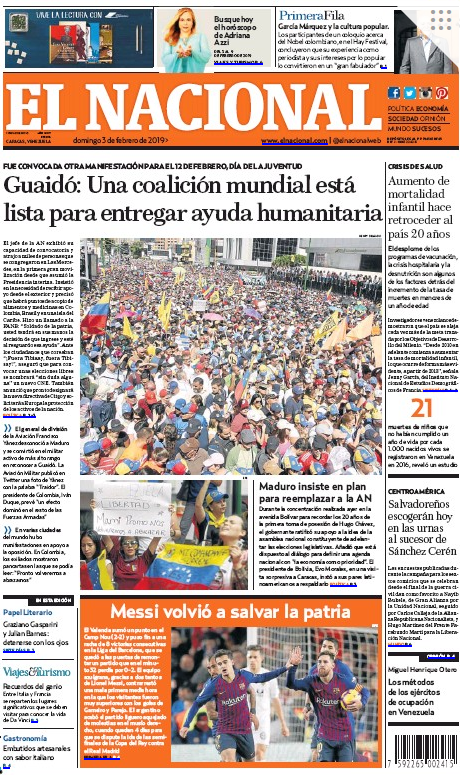
If that was the best photo it could find, it was remarkably unimpressive compared to the photos in the left-wing papers CCS (2/2/19)….
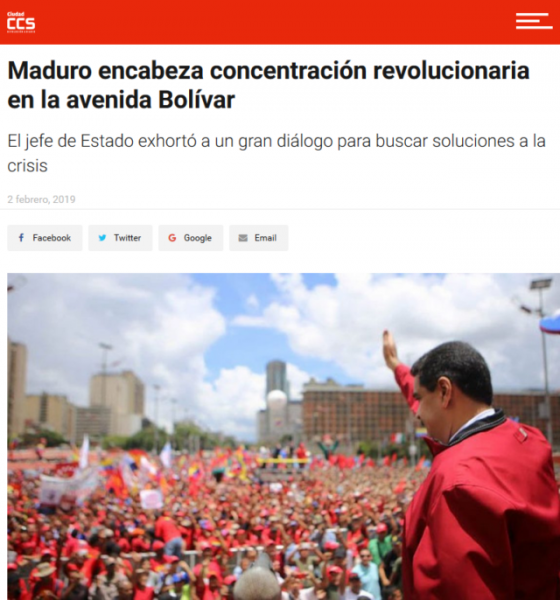
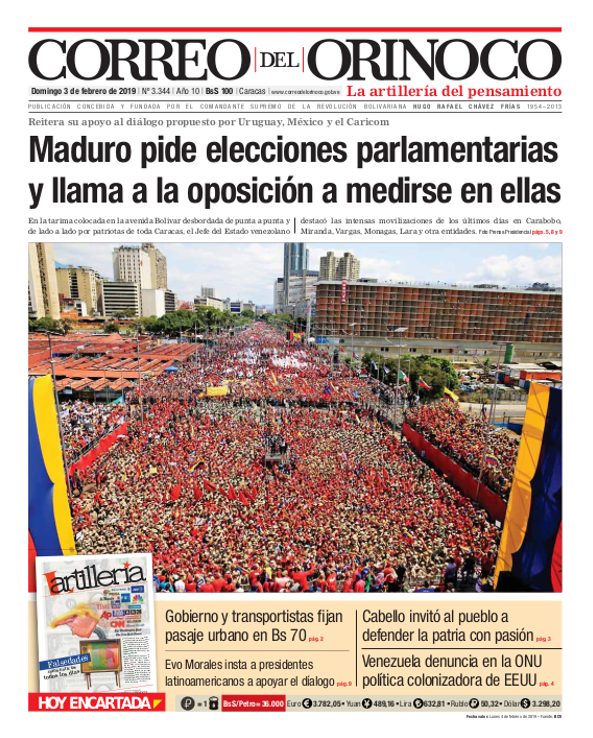
… and Correo del Orinoco (2/3/19), which were only too happy to publish pictures of the pro-government event:
Unlikely humanitarian
A huge anti-government demonstration was supposed to make possible a coup d’état, a maneuver the CIA has used repeatedly—in Iran in 1953, Guatemala in 1954, Brazil in 1964 and many more, straight through to Honduras in 2009 and Ukraine in 2015. The turnout at the Trump administration’s demonstration was disappointing, and the coup d’état never occurred. The result is that Trump has expressed a sudden interest in getting food and medicine to Venezuelans (FAIR.org, 2/9/19).
Trump, who let thousands die in Puerto Rico and put small children in cages on the Mexican border, seems to be an unlikely champion of humanitarian aid to Latin Americans, but the corporate media have straight-facedly pretended to believe it.
Most have suppressed reports that the Red Cross and the UN are providing aid to Venezuela in cooperation with the Venezuelan government, and have protested against US “aid” that is obviously a political and military ploy.
The corporate media have continued to peddle the Trump-as-humanitarian-champion line, even after it was revealed that a US plane was caught smuggling weapons into Venezuela, and even after Trump named Iran/Contra criminal Elliott Abrams to head up Venezuelan operations. Abrams was in charge of the State Department Human Rights Office during the 1980s, when weapons to US-backed terrorists in Nicaragua were shipped in US planes disguised as “humanitarian” relief.
Canada’s CBC (2/15/19) at least had the honesty to acknowledge that it had been had in swallowing a lie from Secretary of State Mike Pompeo that the Venezuelan government had blockaded a bridge between Colombia and Venezuela to prevent aid shipments. The newly built bridge has not yet been opened: it has never been open, apparently because of hostile relations between the two countries, but the non-opening long predates the US government’s alleged food and medicine shipments.
The absurdity of $20 million of US food and medicine aid to a country of 30 million, when US authorities have stolen $30 billion from Venezuela in oil revenue, and take $30 million every day, needs no comment.
‘Failed state’
The campaign of disinformation and outright lies about Venezuela was kicked off in 2016 by the Financial Times. Ironically, it chose the 14th anniversary of the 2002 failed coup d’etat against President Hugo Chávez—April 11, 2016—to claim that Venezuela was in “chaos” and “civil war,” and that Venezuela was a “failed state.” As with the Time and CNBC reports, the Financial Times reporter was not in Venezuela, and there was no evidence in the report that he had ever been there.
I asked right-wing friends in Venezuela whether they agreed with the Financial Times claims. “Well, no, of course not,” said one, stating the obvious, “there is no chaos and no civil war. But Venezuela is a failed state, since it has not been able to provide for all the medical needs of the population.” By that standard, every country in Latin America is a failed state, and obviously the United States too.
The New York Times has run stories (5/15/16, 10/1/16) claiming that conditions in Venezuelan hospitals are horrendous. The reports enraged Colombians in New York, who have noted that a patient can die on the doorstep of a Colombian public hospital if the patient has no insurance. In Venezuela, in contrast, patients are treated for free.
One Colombian resident in New York said that his mother had recently returned to Bogotá after several years in the United States, and had not had time to obtain medical insurance. She fell ill, and went to a public hospital. The hospital left her in the waiting room for four hours, then sent her to a second hospital. The second hospital did the same, leaving her for four hours and then sending her to a third hospital. The third hospital was preparing to send her to a fourth when she protested that she was bleeding internally and was feeling weak.
“I’m sorry, Señora, if you don’t have medical insurance, no public hospital in this country will look at you,” said the woman at the desk. “Your only hope is to go to a private hospital, but be prepared to pay a great deal of money up front.” Luckily, she had a wealthy friend, who took her to a private hospital, and paid a great deal of money up front.
Such conditions in Colombia and other neoliberal states go unmentioned in the US corporate media, which have treated the Colombian government, long a right-wing murder-squad regime, as a US ally (Extra!, 2/09).
Well, OK, but are the reports of conditions in Venezuelan hospitals true or grossly exaggerated? “They are much better than they were ten years ago,” said a friend who works in a Caracas hospital. In fact, he said, ten years before, the hospital where he worked did not exist, and new hospitals are now being opened. One was dedicated recently in the town of El Furrial, and another was opened in El Vigia, as reported by the centrist newspaper Últimas Noticias (3/3/17, 4/27/18). The government has also greatly expanded others, like a burn center in Caracas and three new operating rooms at the hospital in Villa Cura.
Meanwhile, the government is inaugurating a new high-speed train line, The Dream of Hugo Chávez, in March (Correo del Orinoco, 2/6/19). Since the US media have never allowed reporting on any accomplishments in the years since Chávez took office in 1999, but only any alleged, exaggerated or, as noted, completely invented shortcomings, readers have to consult an alternative history. Here is one offered by a Venezuelan on YouTube (3/31/11): “Por Culpa de Chávez” (“It’s Chávez’s Fault”). Depicting new hospitals, transit lines, housing, factories and so on built under Chavismo, it might help many understand why the Maduro government continues to enjoy such strong backing from so many people.
Economic warfare
This is not to minimize Venezuela’s problems. The country was hit, like other oil-producing countries, and as it was in the 1980s and ’90s, by the collapse of oil prices. That failed to bring down the government, so now the Trump administration has created an artificial crisis by using extreme economic warfare to deprive the country of foreign exchange needed to import basic necessities. The Trump measures seem designed to prevent any economic recovery.
Like any country at war (and the Trump administration has placed Venezuela under wartime conditions, and is threatening immediate invasion), there have been shortages, and products that can mostly be found on the black market. This should surprise no one: During World War II in the US, a cornucopia of a country not seriously threatened with invasion, there was strict rationing of products like sugar, coffee and rubber.
The Venezuelan government has made food, medicine and pharmaceuticals available at extremely low prices, but much of the merchandise has made its way to the black market, or over the border to Colombia, depriving Venezuelans of supplies and ruining Colombian producers. The government recently abandoned some of the heavy price subsidies, which resulted initially in higher prices. Over the past few weeks, prices have been coming down as supplies stayed in Venezuela, especially as the government gained greater control over the Colombian border to prevent smuggling.
There has never been a serious discussion of any of this in the US corporate media, much less any discussion of the campaign of lies or the Trump administration warfare. There has been no comparison with conditions in the 1980s and ’90s, when Venezuela’s neoliberal government imposed IMF economic recipes, resulting in a popular rebellion, the bloody 1989 Caracazo, when wholesale government repression took the lives of hundreds (according to the government at the time) or thousands (according to government critics), and martial law took the lives of many more.
Efforts by the right-wing opposition to provoke a similar uprising, and another Caracazo that could justify a foreign “humanitarian intervention,” have failed repeatedly. So the US administration and corporate media simply resort to the most extreme lying about Latin America that has been seen since the Reagan administration wars of the 1980s.
Telling Only Part of the Story of Jihad
By Daniel LAZARE | Consortium News | February 21, 2019
A recent CNN report about U.S. military materiel finding its way into Al Qaeda hands in Yemen might have been a valuable addition to Americans’ knowledge of terrorism.
Entitled “Sold to an ally, lost to an enemy,” the 10-minute segment, broadcast on Feb. 4, featured rising CNN star Nima Elbagir cruising past sand-colored “Mine-Resistant Ambush Protected” armored vehicles, or MRAPs, lining a Yemeni highway.
“It’s absolutely incredible,” she says. “And this is not under the control of [Saudi-led] coalition forces. This is in the command of militias, which is expressly forbidden by the arms sales agreements with the U.S.”
“That’s just the tip of the iceberg,” she adds. “CNN was told by coalition sources that a deadlier U.S. weapons system, the TOW missile, was airdropped in 2015 by Saudi Arabia to Yemeni fighters, an air drop that was proudly proclaimed across Saudi backed media channels.” The TOWs were dropped into Al Qaeda-controlled territory, according to CNN. But when Elbagir tries to find out more, the local coalition-backed government chases her and her crew out of town.
U.S.-made TOWs in the hands of Al Qaeda? Elbagir is an effective on-screen presence. But this is an old story, which the cable network has long soft-pedaled.
In the early days of the Syrian War, Western media was reluctant to acknowledge that the forces arrayed against the Assad regime included Al Qaeda. In those days, the opposition was widely portrayed as a belated ripple effect of the Arab Spring pro-democracy uprisings elsewhere in the region.
However, in April-May 2015, right around the time that the Saudis were air-dropping TOWs into Yemen, they were also supplying the same optically-guided, high-tech missiles to pro-Al Qaeda forces in Syria’s northern Idlib province. Rebel leaders were exultant as they drove back Syrian government troops. TOWs “flipped the balance,” one said, while another declared: “I would put the advances down to one word – TOW.”
CNN reported that story very differently. From rebel-held territory, CNN’s Nick Paton Walsh described the missiles as a “possible game-changer … that may finally be wearing down the less popular side of the Shia-Sunni divide.” He conceded it wasn’t all good news: “A major downside for Washington at least, is that the often-victorious rebels, the Nusra Front, are Al Qaeda. But while the winners for now are America’s enemies, the fast-changing ground in Syria may cause to happen what the Obama administration has long sought and preached, and that’s changing the calculus of the Assad regime.”
Foreign Policy, The Washington Post, The Guardian, and The New York Times all reacted the same way, furrowing their brows at the news that Al Qaeda was gaining, but expressing measured relief that Syrian President Bashar al-Assad was at last on the ropes.
But now that Elbagir is sounding the alarm about TOWs in Yemen, CNN would do well to acknowledge that it has been distinctly more blasé in the past about TOWs in the hands of al Qaeda.
The network appears unwilling to go where Washington’s pro-war foreign-policy establishment doesn’t want it to go. Elbagir shouldn’t be shocked to learn that U.S. allies are consorting with Yemeni terrorists.
U.S. History with Holy Warriors
What CNN producers and correspondents either don’t know or fail to mention is that Washington has a long history of supporting jihad. As Ian Johnson notes in “A Mosque in Munich” (2010), the policy was mentioned by President Dwight Eisenhower, who was eager, according to White House memos, “to stress the ‘holy war’ aspect” in his talks with Muslim leaders about the Cold War Communist menace.” [See “How U.S. Allies Aid Al Qaeda in Syria,” Consortium News, Aug. 4, 2015.]
Britain had been involved with Islamists at least as far back as 1925 when it helped establish the Muslim Brotherhood in Egypt, and both the U.S. and Britain worked with Islamists in the 1953 coup in Iran, according to Robert Dreyfus in “Devil’s Game” (2006).
By the 1980s a growing Islamist revolt against a left-leaning, pro-Soviet government in Afghanistan brought U.S. support. In mid-1979, President Jimmy Carter and his national security adviser, Zbigniew Brzezinski, armed the Afghan mujahideen — not at first to drive the Soviets out, but to lure them in. Brzezinski intended to deal Moscow a Vietnam-sized blow, as he put it in a 1998 interview.
Meanwhile, a few months after the U.S. armed the mujahideen, the Saudis were deeply shaken when Islamist extremists seized the Grand Mosque in Mecca and called for the overthrow of the royal family. While Saudi Arabia has been keen to repress jihadism at home, it has been a major supporter of Sunni extremists in the region, particularly to battle the Shi‘ite regime that came to power in Tehran, also in 1979.
Since then, the U.S. has made use of jihad, either directly or indirectly, with the Gulf oil monarchies or Pakistan’s notoriously pro-Islamist Inter-Services Intelligence agency. U.S. backing for the Afghan mujahideen helped turn Osama bin Laden into a hero for some young Saudis and other Sunnis, while the training camp he established in the Afghan countryside drew jihadists from across the region.
U.S. backing for Alija Izetbegovic’s Islamist government in Bosnia-Herzegovina brought al-Qaeda to the Balkans, while U.S.-Saudi support for Islamist militants in the Second Chechen War of 1999-2000 enabled it to establish a base of operations there.
Downplaying Al Qaeda
Just six years after 9/11, according to investigative reporter Seymour Hersh, the U.S. downplayed the fight against Al Qaeda to rein in Iran – a policy, Hersh wrote, that had the effect of “bolstering … Sunni extremist groups that espouse a militant vision of Islam and are hostile to America and sympathetic to Al Qaeda.”
Under Secretary of State Hillary Clinton, policy toward Al-Qaeda turned even more curious. In March 2011, she devoted nearly two weeks to persuading Qatar, the UAE and Jordan to join the air war against Libya’s Muammar Gaddafi, only to stand by and watch as Qatar then poured hundreds of millions of dollars of aid into the hands of Islamist militias that were spreading anarchy from one end of the country to the other. The Obama administration thought of remonstrating with Qatar, but didn’t in the end.
Much the same happened in Syria where, by early 2012, Clinton was organizing a “Friends of Syria” group that soon began channeling military aid to Islamist forces waging war against Christians, Alawites, secularists and others backing Assad. By August 2012, the Defense Intelligence Agency reported that “the Salafist, the Muslim Brotherhood, and AQI [Al Qaeda in Iraq] are the major forces driving the [anti-Assad] insurgency”; that the West, Turkey, and the Gulf states supported it regardless; that the rebels’ goal was to establish “a declared or undeclared Salafist principality in eastern Syria,” and that “this is exactly what the supporting powers want in order to isolate the Syrian regime….”
Biden Speaks Out
Two years after that, Vice President Joe Biden declared at Harvard’s Kennedy School:
“Our allies in the region were our largest problem in Syria… The Saudis, the Emiratis, etc. what were they doing? They were so determined to take down Assad and essentially have a proxy Sunni-Shia war, what did they do? They poured hundreds of millions of dollars and tens of thousands of tons of military weapons into anyone who would fight against Assad, except the people who were being supplied were al Nusra and al Qaeda and the extremist elements of jihadis coming from other parts of the world.” (Quote starts at 53:25.)
The fact that Obama ordered the vice president to apologize to the Saudis, the UAE and Turkey for his comments provided back-handed confirmation that they were true. When TOWs turned up in the hands of pro-Qaeda rebels in Syria the following spring, all a senior administration official would say was: “It’s not something we would refrain from raising with our partners.”
It was obvious that Al Qaeda would be a prime beneficiary of Saudi intervention in Yemen from the start. Tying down the Houthis — “Al Qaeda’s most determined foe,” according to the Times — gave it space to blossom and grow. Where the State Department said it had up to 4,000 members as of 2015, a UN report put its membership at between 6,000 and 7,000 three years later, an increase of 50 to 75 percent or more.
In early 2017, the International Crisis Group found that Al Qaeda was “thriving in an environment of state collapse, growing sectarianism, shifting alliances, security vacuums and a burgeoning war economy.”
In Yemen, Al Qaeda “has regularly fought alongside Saudi-led coalition forces in … Aden and other parts of the south, including Taiz, indirectly obtaining weapons from them,” the ICG added. “… In northern Yemen … the [Saudi-led] coalition has engaged in tacit alliances with AQAP fighters, or at least turned a blind eye to them, as long as they have assisted in attacking the common enemy.”
In May 2016, a PBS documentary showed Al Qaeda members fighting side by side with UAE forces near Taiz. (See “The Secret Behind the Yemen War,” Consortium News, May 7, 2016.)
Last August, an Associated Press investigative team found that the Saudi-led coalition had cut secret deals with Al Qaeda fighters, “paying some to leave key cities and towns and letting others retreat with weapons, equipment, and wads of looted cash.” Saudi-backed militias “actively recruit Al Qaeda militants,” the AP team added, “… because they’re considered exceptional fighters” and also supply them with armored trucks.
If it’s not news that U.S. allies are providing pro-Al Qaeda forces with U.S.-made equipment, why is CNN pretending that it is? One reason is that it feels free to criticize the war and all that goes with it now that the growing human catastrophe in Yemen is turning into a major embarrassment for the U.S. Another is that criticizing the U.S. for failing to rein in its allies earns it points with viewers by making it seem tough and independent, even though the opposite is the case.
Then there’s Trump, with whom CNN has been at war since the moment he was elected. Trump’s Dec. 19 decision to withdraw U.S. troops from Syria thus presented the network with a double win because it allowed it to rail against the pullout as “bizarre” and a “win for Moscow” while complaining at the same time about administration policy in Yemen. Trump is at fault, it seems, when he pulls out and when he stays in.
In either instance, CNN gets to ride the high horse as it blasts away at the chief executive that corporate outlets most love to hate. Maybe Elbagir should have given her exposé a different title: “Why arming homicidal maniacs is bad news in one country but OK in another.”
Russia shouldn’t go ‘tooth for a tooth’ after Facebook bans Russian-linked media – Lavrov
RT | February 19, 2019
Sergey Lavrov says he is opposed to retaliating against foreign media in Russia after the Facebook ban of Russia-linked pages. Moscow should instead focus on upholding the rights of its journalists abroad.
The recent suspension of four Maffick Media Facebook pages after a CNN report on their links to RT is “definitely another example of pressure against Russian media and against free speech,” Russian Foreign Minister Sergey Lavrov told media after a meeting with his Slovak counterpart and current chairman of the Organization for Security and Cooperation in Europe (OSCE), Miroslav Lajcak.
Lavrov said he had also brought to Lajcak’s attention recent cases of discrimination against Sputnik and RT, including journalists being arbitrarily banned from official events in Spain.
When asked whether Moscow would retaliate against foreign media in Russia, however, Lavrov said he is “firmly against” such measures.
The fact that we still have not done so is not only testimony to our restraint, but also to our strength. We are an open society.
He pointed out that Ukrainian journalists are freely operating in Russia, including those reporting “rather aggressively” on both internal Russian events and Moscow’s relationships with the West.
The authorities responsible for deciding on a response should not employ the “tooth for a tooth” principle, Lavrov said.
“We should focus on maintaining comfortable working conditions for foreign journalists in Russia, while at the same time firmly defending the rights of our journalists abroad,” using the resources of international media rights institutions, the Russian foreign minister said.
During the weekend, CNN reported on the “Russian links” of several Facebook pages hosting political videos with millions of subscribers and over two billion views. Shortly afterwards, Facebook suspended four pages run by Maffick Media, half of which is owned by RT subsidiary Ruptly, and the other by In The Now host Anissa Naouai. No prior warning or explanation had been given for the ban, which Naouai called an act of “blatant censorship.”
Blocked RT-Linked Facebook Accounts Sign of Geopolitical Confrontation
Sputnik – 18.02.2019
Margarita Simonyan, the editor-in-chief of Sputnik and RT, said that Facebook’s suspension of accounts operated by Maffick Media over ties to RT was a sign of “open geopolitical confrontation,” where media platforms are being used as “tools.”
“Obviously, things will be getting only worse. Nobody even tries to believe in any freedom or talk about any freedom. This has already become an open geopolitical confrontation, where media platforms… serve as tools,” Simonyan said.
The editor-in-chief of RT pointed out that Facebook had no complaints about the videos on the suspended pages or their content in general.
“However, since CNN contacted [Facebook] and asked ‘how could you allow these Russians to communicate with our population,’ Facebook removed this account,” Simonyan said.
According to the RT editor-in-chief, CNN acted as “the right hand… of the State Department, NATO and everything linked to that.”
CNN admitted it had been tipped off about Maffick Media’s funding by the Alliance for Securing Democracy, an advocacy group that is part of the German Marshall Fund (GMF) policy research centre. The fund considered an “undesirable organization” under the Russian law, receives some of its funding from the US and German governments, NATO and other organizations. According to CNN, the ASD does not receive financing from the GMF and is supported through private funds and grants, rather than by governments.
Facebook said it would ask the three suspended accounts — Soapbox, Back Then and Waste-Ed — to submit information on their affiliations.
“People connecting with Pages shouldn’t be misled about who’s behind them. Just as we’ve stepped up our enforcement of coordinated inauthentic behaviour and financially motivated spam over the past year, we’ll continue improving so people can get more information about the Pages they follow,” a Facebook spokesperson said in a statement, as quoted by RT.
Moscow considers the blocking of Facebook pages related to RT unacceptable, adding that these authoritarian actions violate the principles of freedom of expression. Moreover, Russia is waiting for a response from “OSCE structures” to these actions, the Russian Foreign Ministry said in a statement.
However, the social network has not, until now, required accounts to disclose information about their parent companies. Maffick remarked in its statement that plenty of media outlets supported in part by governments do not post information about their funding on their Facebook pages.
Last week Facebook suspended pages of projects run by Maffick Media, an independent journalistic group that is partly owned by the Ruptly video agency, which is a subsidiary of RT. Facebook did not give Maffick Media any prior warning. According to Maffick’s statement, the social network was “pressured” into doing this by CNN, which ran a story on Maffick Media and its perceived ties to the Kremlin.
US Top General Takes to CNN to Dispute Syria Withdrawal
Sputnik – 15.02.2019
US General Joseph L. Votel, who has presided over stagnant results in America’s wars since being named commander of US Central Command last year, recently publicly disagreed with US President Donald Trump’s decision to pull US troops from Syria.
“It would not have been my military advice at that particular time,” Votel told CNN of the plan to withdraw troops. Of course, the advice of US generals has brought the country 18 years of war with nothing to show for it except the Pentagon’s expanded budget. The United States now spends about 40 percent more on the military per year than it did during the height of the Iraq War in 2005.
“I would not have made that suggestion, frankly,” said Votel, referring to the decision to bring the troops back home to the US — a process that’s evidently ongoing and also a source of mystery. Exits are notoriously dangerous military maneuvers, so the US has kept quiet on the precise number of forces it has maintained across Syria, Iraq and Afghanistan.
Some analysts have suggested that the military’s consistent refusal over the years to be transparent about troop numbers in the above-mentioned countries has backfired, leaving them with little evidence for their assertions that Trump is killing a critical mission.
The US Constitution, of course, leaves final military decisions up to the president and not the generals, who are subordinate to the office.
Trump has advocated withdrawing US personnel from costly foreign military engagements that lack clear objectives, but his administration has waffled on putting those desires into motion for about two years, variously saying Daesh has been defeated, calling out the need to prevent a Daesh resurgence and combat Iran and plainly admitting that there is nothing in Syria for the US military except “sand and death.”
On Friday, Votel was back on the Pentagon’s message that Daesh is not actually defeated, even though the terrorists’ land holdings have been reduced from the size of Britain to less than a square mile. Daesh “still has leaders, still has fighters, it still has facilitators, it still has resources, so our continued military pressure is necessary to continue to go after that network,” said Votel to CNN, as reported by The Hill.
In any event, achieving the top post in US Central Command (CENTCOM) is often seen as a boon for the careers of military officers. Former CENTCOM chiefs include retired generals David Petraeus and James Mattis, who would go on to become the head of the Central Intelligence Agency and US Secretary of Defense, respectively, after their stints as CENTCOM commanders.
Former UK Ambassador to Syria Peter Ford tells Sputnik not to read too much into Votel’s comments but instead to observe the “continuing efforts of the media and political establishment to undermine Trump,” who has expressed far more anti-interventionist sentiments than his predecessor both during his campaign and while in office.
The Real Motive Behind the FBI Plan to Investigate Trump as a Russian Agent
By Gareth Porter | Consortium News | February 13, 2019
 The New York Times and CNN led media coverage last month of discussions among senior FBI officials in May 2017 of a possible national security investigation of President Donald Trump himself, on the premise that he may have acted as an agent of Russia.
The episode has potentially profound political fallout, because the Times and CNN stories suggested that Trump may indeed have acted like a Russian agent. The New York Times story on Jan. 11 was headlined, “F.B.I. Opened Inquiry into Whether Trump Was Secretly Working on Behalf of Russia.” CNN followed three days later with: “Transcripts detail how FBI debated whether Trump was ‘following directions’ of Russia.”
By reporting that Russia may have been able to suborn the president of the United States, these stories have added an even more extreme layer to the dominant national political narrative of a serious Russian threat to destroy U.S. democracy. An analysis of the FBI’s idea of Trump as possible Russian agent reveals, moreover, that it is based on a devious concept of “unwitting” service to Russian interests that can be traced back to former CIA director John O. Brennan.
The Proposal That Fell Apart
The FBI discussions that drove these stories could have led to the first known investigation of a U.S. president as a suspected national security risk. It ended only a few days after the deliberations among the senior FBI officials when on May 19, 2017, the Justice Department chose Robert Mueller, a former FBI director, to be special counsel. That put control over the Trump-Russia investigation into the hands of Mueller rather than the FBI.
Peter Strzok, who led the bureau’s counter-espionage section, was, along with former FBI General Counsel James A. Baker, one of those involved in the May 2017 discussions about investigating Trump. Strzok initially joined Mueller’s team but was fired after a couple of months when text messages that he had written came to light exposing a deep animosity towards Trump that cast doubt over his impartiality.
The other FBI officials behind the proposed investigation of Trump have also since left the FBI; either fired or retired.
The entirety of what was said at the meetings of five or six senior FBI officials in the immediate aftermath of Trump’s firing of James Comey as FBI director on May 9, 2017, remains a mystery.
Closed-door Testimony
The CNN and Times stories were based on transcripts either obtained or, in the case of the Times, on portions read to it, of private testimony given to the House Judiciary and Government Oversight and Reform committees last October by Baker, one of the participants in the discussions of Trump as a possible Russian agent.
Excerpts of Baker’s testimony published by CNN make it clear that the group spoke about Trump’s policy toward Russia as a basis for a counter-intelligence investigation. Baker said they “discussed as [a] theoretical possibility” that Trump was “acting at the behest of [Russia] and somehow following directions, somehow executing their will.”
Baker went on to explain that this theoretical possibility was only “one extreme” in a range of possibilities discussed and that “the other extreme” was that “the President is completely innocent.”
He thus made it clear that there was no actual evidence for the idea that he was acting on behalf of Russia.
Baker also offered a simpler rationale for such an investigation of Trump: the president’s firing of FBI Director Comey. “Not only would [firing Comey] be an issue of obstructing an investigation,” he said, “but the obstruction itself would hurt our ability to figure what the Russians had done, and that is what would be the threat to national security.”
But the idea that Comey’s firing had triggered the FBI’s discussions had already been refuted by a text message that Strzok, who had been leading the FBI’s probe into the Trump campaign’s contacts with Russians, sent immediately after the firing to Lisa Page, then legal counsel to Andrew McCabe, formerly the bureau’s deputy director who was then acting director.
“We need to open the case we’ve been waiting on now while Andy is acting,” Strzok wrote, referring to McCabe.
As Page later confirmed to congressional investigators, according to the CNN story, Strzok’s message referred to their desire to launch an investigation into possible collusion between Trump and the Russians. Strzok’s message also makes clear he, and others intent on the investigation, were anxious to get McCabe to approve the proposed probe before Trump named someone less sympathetic to the project as the new FBI director.
Why the FBI Wanted to Investigate
The New York Times story argued that the senior FBI officials’ interest in a counter-intelligence investigation of Trump and the Russians sprang from their knowledge of the sensational charges in the opposition research dossier assembled by British ex-spy Christopher Steele (paid for by the DNC and the Clinton campaign) that the Putin government had “tried to obtain influence over Mr. Trump by preparing to blackmail and bribe him.”
But the Times writers must have known that Bruce Ohr, former associate deputy attorney general, had already given McCabe, Page and Strzok information about Steele and his dossier that raised fundamental questions about its reliability.
Ohr’s first contacts at FBI headquarters regarding Steele and his dossier came Aug. 3, 2016, with Page and her boss McCabe. Ohr later met with Strzok.
Ohr said he told them that Steele’s work on the dossier had been financed by the Clinton campaign through the Perkins-Cole law firm. He also told them that Steele, in a July 30, 2016 meeting, told him he was “desperate that Donald Trump not get elected and was passionate about him not being president,” according to Ohr’s contemporaneous notes of the meeting.
 So, key figures in the discussion of Trump and Russia in May 2017 knew that Steele was acting out of both political and business motives to come up with sensational material.
Strzok and Page may have started out as true believers in the idea that the Russians were using Trump campaign officials to manipulate Trump administration policy. However, by May 2017, Strzok had evidently concluded that there was no real evidence.
In a text message to Page on May 19, 2017, Strzok said he was reluctant to join the Mueller investigation, because of his “gut sense and concern” that “there’s no big there there.”
Why, then, were Strzok, Page, McCabe and others so determined to launch an investigation of Trump at about the same time in May 2017?
A CNN article about the immediate aftermath of the Comey firing reported that Deputy Attorney General Rod Rosenstein and senior FBI officials “viewed Trump as a leader who needed to be reined in, according to two sources describing the sentiment of the time.”
That description by anti-Trump law enforcement officials suggests that the proposed counter-intelligence investigation of Trump served as a means to maintain some leverage over his treatment of the FBI in regard to the Russia issue.
That motivation would be consistent with the decision by McCabe on May 15, 2017 – a few days after the discussions in question among the senior FBI officials – to resume the bureau’s relationship with Steele.
The FBI had hired Steele as a paid source when it had earlier launched its investigation of Trump campaign official’s contacts with Russians in July 2016. But it had suspended and then terminated the relationship over Steele’s unauthorized disclosure of the investigation to David Corn of Mother Jones magazine in October 2016. So, the decision to resume the relationship with Steele suggests that the group behind the new investigation were thinking of seizing an opportunity to take off the gloves against Trump.
The ‘Unwitting Collaboration’ Ploy
The discussion by senior FBI officials of a counter-intelligence investigation of Trump has become part of the political struggle over Trump mainly because of the stories in the Times and CNN.
The role of the authors of those stories illustrates how corporate journalists casually embraced the ultimate conspiracy theory – that the president of the United States was acting as a Russian stooge.
The reporters of the CNN story — Jeremy Herb, Pamela Brown and Laura Jarrett — wrote that the FBI officials were “trying to understand why [Trump] was acting in ways that seemed to benefit Russia.”
The New York Times story was more explicit. Co-authors Adam Goldman, Michael S. Schmidt and Nicholas Fandos wrote that the FBI officials “sought to determine whether Mr. Trump was knowingly working for Russia or had unwittingly fallen under Moscow’s influence.”
The same day the Times story was published, the lead author on the piece, Adam Goldman, was interviewed by CNN. Goldman referred to Trump’s interview with NBC’sLester Holt in the days after the Comey firing as something that supposedly pushed the FBI officials over the edge. Goldman declared, “The FBI is watching him say this, and they say he’s telling us why he did this. He did it on behalf of Russia.”
But Trump said nothing of kind. What he actually said — as the Times itself quoted Trump, from the NBCinterview —was: “[W]hen I decided just to do it, I said to myself – I said, you know this Russia thing with Trump and Russia is a made-up story.” The Times article continued: “Mr. Trump’s aides have said that a fuller examination of his comments demonstrates that he did not fire Mr. Comey to end the Russia inquiry. ‘I might even lengthen out the investigation, but I have to do the right thing for the American people,” Mr. Trump added. ‘He’s the wrong man for that position.’”
Goldman was evidently trying to sell the idea of Trump as a suspected agent of Russia.
Goldman also gave an interview to The New Yorker’s Isaac Chotiner, in which the interviewer pressed him on the weakest point of the Trump-as-Russian-agent theory. “What would that look like if the President was an unwitting agent of a foreign power?” asked Chotiner.
The Times correspondent, who won a Pulitzer Prize for his coverage of the alleged Russian efforts to influence the 2016 election, responded: “It is hard to say what that would look like.” Goldman then reiterated the concept. “People were very careful to tell me that: ‘It is wittingly or unwittingly.’” And in answer to a follow-up question, Goldman referred to evidence he suggested might be held by the FBI that “perhaps suggests that the President himself may be acting as a foreign agent, either wittingly or unwittingly….”
The idea that American citizens were somehow at risk of being led by an agent of the Russian government “wittingly or unwittingly” did not appear spontaneously. It had been pushed aggressively by former CIA Director John O. Brennan both during and after his role in pressing for the original investigation.
When Brennan testified before the House Intelligence Committee in May 2017, he was asked whether he had intelligence indicating that anyone in the Trump campaign was “colluding with Moscow.” Instead of answering the question directly, Brennan said he knew from past experience that “the Russians try to suborn individuals, and they try get them to act on their behalf either wittingly or unwittingly.” And he recalled that he had left the government with “unresolved questions” about whether the Russians had been successful in doing so in regard to unidentified individuals in the case of the 2016 elections.
Brennan’s notion of “unwitting collaboration” with Russian subversion is illogical. Although a political actor might accidentally reveal information to a foreign government that is valuable, real “collaboration” must be mutually agreeable. A policy position or action that may benefit a foreign government, but is also in the interest of one’s own government, does not constitute “unwitting collaboration.”
The real purpose of that concept is to confer on national security officials and their media allies the power to cast suspicion on individuals on the basis of undesirable policy views of Russia rather than on any evidence of actual collaboration with the Russian government.
The “witting or unwitting” ploy has its origins in the unsavory history of extreme right-wing anti-communism during the Cold War. For example, when the House Un-American Activities Committee was at its height in 1956, Chairman Francis E. Walter declared that “people who are not actually Communist Party members are witting or unwitting servants of the Communist cause.”
The same logic – without explicit reference to the phrase — has been used to impugn the independence and loyalty of people who have contacts with Russia.
It has also been used to portray some independent media as part of a supposedly all-powerful Russian media system.
The revelation that it was turned against a sitting president, however briefly, is a warning signal that national security bureaucrats and their media allies are now moving more aggressively to delegitimize any opposition to the new Cold War.
Gareth Porter is an independent investigative journalist and historian writing on U.S. national security policy. His latest book, “Manufactured Crisis: The Untold Story of the Iran Nuclear Scare,” was published in 2014. Follow him on Twitter: @GarethPorter.
Democrats are the McCarthyites
By Margaret Kimberley | Black Agenda Report | February 6, 2019
The unceasing torrent of Russiagate lies turns Democrats into war hawks and causes liberals to spout nonsense that was once consigned to the fringe right wing. It’s worse than the old McCarthyism.
A recent poll indicated that Democrats are more likely than Republicans to hold pro-war views. That revelation is hardly surprising considering the degree to which their party has promoted the trope of Donald Trump as a Russian government asset. This strategy is a focal point for them and a weapon to be used against the Republicans instead of the political opposition their voters need.
The ongoing investigation popularly known as Russiagate is a cynical hoax perpetrated by the Democratic Party leadership and their friends in corporate media. Russiagate distracts the public from taking a hard look at the Democratic Party corruption and resulting missteps that put Donald Trump in the White House. It also serves the interests of the bi-partisan surveillance state, which feared that Trump pronouncements indicated fundamental changes in foreign policy which they could not abide.
These allegations have Trump on the ropes, but mostly because of the relentless repetition of lies about the investigation. The litany of indictments paraded by the media involve crimes like tax fraud and payments to porn stars. None of the indictments point to collusion between the Russian government and the Trump campaign. Because no such connections have been made the media continue whipping up hysteria in an effort to keep the tale alive. The campaign is more shrill than ever because the hollowness of the case is clear to anyone who is really paying attention.
Comparisons have been made with McCarthyite “Red Scare” of the 1950s. But it can be argued that Russiagate is even worse. Bizarre assertions that were once consigned to the fringe right wing are now repeated on a daily basis by influential corporate media personalities and nearly all Democratic Party politicians.
The most prolific Russiagate practitioner is Rachel Maddow of MSNBC. She has ridden that horse so successfully that she now has the highest rated program on cable news. But she may have reached a moment which prompted the famous question asked at the army/McCarthy hearings. “At long last have you no sense of decency?”
Her assertion that Russia might be able to hack into the power grid and freeze Americans to death is quite dangerous . “What would you do if you lost heat indefinitely as the act of a foreign power on the same day that the temperature in your front yard matched the temperature in Antarctica? I mean, what would you and your family do?” It doesn’t matter that experts declared that the claim was highly improbable if not impossible. There is now no depth that cannot be reached in the effort to bamboozle Democrats and keep them stupid and needlessly fearful.
Prestigious newspapers like the New York Times are equally guilty of passing off lies as the truth. The Times reported that Trump and his associates had more than 100 interactions with Russians before inauguration day in 2017. But the story falls apart on even cursory inspection. The Times includes unproven claims of contacts with Wikileaks when it isn’t even a Russian organization. Roger Stone is the latest to be indicted because of his own stupidity, having claimed contacts with Wikileaks that never even took place.
But even as the case for collusion falls apart, the McCarthyite media find new ways to keep the narrative running. Russian press coverage of Congresswoman Tulsi Gabbard’s presidential campaign is called a “campaign of support” for her candidacy. NBC called Russian reporting the “propaganda machine.” The real issue is that Gabbard dares to question U.S. foreign policy dictates. She met with Syrian president Assad and opposes the coup attempt against Venezuela. But stopping such heretical acts from taking place is a central feature of the Russiagate scare.
So insane is the conspiracy mongering that clear damage to Russian government aspirations are called “wins for Putin.” The Trump administration’s unilateral withdrawal from the 30-year old INF missile treaty is not something that Vladimir Putin would ever want. The decades long effort to limit nuclear proliferation gives both countries security knowing that the other is restricted in the number and placements of nuclear weapons. Yet this very obvious reality is now turned on its head, and truth is twisted and disappeared.
The worst possible outcome of Russiagate is that it increases the likelihood of armed conflict between the United States and Russia. The same people who see MSNBC, CNN and national newspapers as divine oracles can be led to support any government act, no matter how dangerous it may be. Liberals who might once have opposed a hot war would now be the first to support it.
The Russiagate pimps are stoking fear and hatred. They spread outright lies and ignorance and they are doing so because of base motives. The Democratic Party rank and file ought to be demanding answers about the 2016 defeat and the previous loss of 900 legislative seats around the country. But they have been so badly misled that they don’t know that they should be asking anything at all. Even people who call themselves progressives are worshipping prosecutorial excess from the Robert Mueller investigation team and applauding surveillance state killers bloviating on cable news programs.
McCarthyism is back and it is being led by liberals. The entire world is endangered because of their leaders’ lies and cover ups and their determination to follow blindly. The outcome will be continued political defeat at home and an increased likelihood of what was once unimaginable, war between two nuclear powers.
Margaret Kimberley lives in New York City, and can be reached via e-Mail at Margaret.Kimberley(at)BlackAgendaReport.com.
Weapons ending up with terrorists is OK, as long as Obama did it: The world according to CNN
RT | February 5, 2019
A “bombshell” CNN report has revealed that US-made weapons found their way to Al-Qaeda-linked fighters in Yemen. But is anyone surprised? And where was CNN when the Obama administration armed hardcore jihadists in Syria?
The CNN investigation revealed how American-made weapons ended up in the hands of “al Qaeda-linked fighters, hardline Salafi militias, and other factions waging war in Yemen,” vis-a-vis the US’ coalition partners Saudi Arabia and the UAE. Some of these weapons have also been seized by Iranian-backed militias, CNN claims.
The hardware, referred to as “Beautiful military equipment” by President Trump, was supplied to Saudi Arabia and the UAE, who have backed the embattled Yemeni government in its three-year civil war against Houthi rebels. However, CNN claims that Saudi Arabia and the UAE have funnelled the arms to pro-government factions, including the islamist Giants Brigade and the Al-Qaeda-linked Abu Abbas brigade.
The shifting frontlines in Yemen ensured that many of these weapons – including wire-guided TOW missiles and mine-resistant armored vehicles (MRAPs) – ended up seized by Houthi militants and Iranian proxy forces. More American weapons still ended up for sale in Yemen’s teeming arms bazaars, where they fetch a higher price than the rusted AK-47s more common to the region.
CNN lays responsibility squarely at the feet of Saudi Arabia, the UAE, and the Trump administration, which refused to cancel its multibillion dollar arms deals with the Saudis last year, for fear of losing “all of that investment being made into our country.”
The report paints a depressing, but familiar picture. Picking sides in foreign wars has historically proven disastrous for the United States, yet successive administrations have made the same mistakes again and again. The Reagan administration armed Saddam Hussein in his war with Iran, going as far as arranging the sale of anthrax to the Iraqi leader. Both Jimmy Сarter and Ronald Reagan propped up the Afghan mujahideen in their fight against the Soviets in the 1980s. In both cases, US forces would be shot at with the same weapons just two decades later.
Covering for Obama
More recently, in 2014 Barack Obama announced that the US would hand-select and arm ‘moderate rebels’ in Syria, stepping into the country’s bloody civil war. That too would prove disastrous, with troves of US arms ending up in the hands of Al-Nusra and ISIS.
But where was CNN when Obama asked Congress for $500 million to train, arm, and “empower the moderate Syrian opposition?”
CNN was reporting the news verbatim from Obama’s mouth, repeating the phrase “moderate rebels” without the ironic quotation marks that have become necessary since. Obama’s assertion that the rebels offered the “best alternative to terrorists and a brutal dictator” was not questioned, unlike Trump’s continuation of the longstanding US policy of arming the Saudis.
Obama called for funding in June 2014, but Syrian militias had already received support from the CIA for two years at that stage. CNN’s reporting on the covert arms pipeline was scant, didn’t question the credentials of the recipients, and mostly repeated the line of US intelligence officials: “That is something we are not going to dispute, but we are not going to publicly speak to it.”
Few questions were asked as Congress authorized the military support that September, and none were asked a year later as Obama resupplied his chosen rebels in Syria. Instead, Obama’s declaration of support for “the moderate Syrian opposition” was taken at face value and left unquestioned.
The reality in Syria
As CNN repeated the White House line on Syria, the network published just one report hinting that things might be amiss: an investigation by Amnesty International that found Islamic State (IS, formerly ISIS) militants were armed to the teeth with US-made weapons. The weapons were acquired by IS from local forces armed by the Obama administration, and then used to “relentlessly” target civilians with “small arms, artillery fire and huge quantities of improvised explosive devices.”
While CNN was assuaging the public, the situation on the ground in Syria was anything but moderate. US arms were quickly sold on the black market by ‘moderate rebels’ who either retired from the fight or wanted to turn a quick buck. With morale low, some of these fighters literally handed their weapons to Al-Nusra jihadists in exchange for safe passage away from the frontlines, while more were stolen by the Islamists.
Moreover, one Al-Nusra commander codenamed Abu Al Ezz told the German Koelner Stadt-Anzeiger newspaper that his group, and not so-called ‘moderate rebels’, received TOW missiles directly from the US. “The missiles were given to us directly,” he said, adding: “The Americans are on our side.” The commander went on to detail how his fighters had received training from US instructors, and financial support from Saudi Arabia and Israel for capturing specific objectives in Syria.
The Trump administration ended the arms supply program to the Syrian rebels in 2017, a decision that CNN called“a big win for Russia.” The idea that ending material support for terrorists might just be a good thing was not raised, and CNN described the program as “a lifeline” to anti-government forces.
CNN even stuck by its straight-faced use of the term ‘moderate rebels’, despite multiple other news outlets publishing reports of US weapons falling into terrorist hands.
Two months before the 2016 election, CNN absolved Obama of all his sins in Syria by publishing an interview in which the then-president said the situation there “haunts” him constantly. The network blamed external factors for the deteriorating situation in Syria, and ended with a quote from Obama’s press secretary, who said that every one of the former president’s decisions “was squarely within the national security interest of the United States and even advanced our national security interests.”
CNN’s latest exclusive report is a well-researched piece of journalism, fleshed out with on-the-ground reporting from war-torn Yemen. However, given the network’s history in reporting US arms programs, it was much more likely motivated by a desire to score points against Trump than the pursuit of cold truth, no matter who is in charge.
Regime Change In Venezuela: Army Defectors, Russian Mercenaries And Disappearing Gold
South Front | January 31, 2019
Over the past few days, the intensity of anti-government protests in Venezuela has declined despite attempts of the US-led bloc to warm them up through both public and clandestine measures. However, the conflict continues to develop amid the acute standoff in the media sphere between the Maduro government and its opponents backed by the US-led bloc.
On January 29, CNN released an interview with two “Venezuelan army defectors” who appealed to US President Donald Trump to arm them to defend “freedom” in Venezuela. They claimed to be in contact with hundreds of willing defectors via WhatsApp groups and called on Venezuelan soldiers to revolt against the government of President Nicolas Maduro.
“As Venezuelan soldiers, we are making a request to the US to support us, in logistical terms, with communication, with weapons, so we can realize Venezuelan freedom,” one of the alleged defectors, Guillen Martinez, told CNN. Another one, Hidalgo Azuaje, added: “We’re not saying that we need only US support, but also Brazil, Colombia, Peru, all brother countries, that are against this dictatorship.”
During the entire clip, these persons were presented in a manner alleging that they had just recently defected and are now calling on others to follow their step. However, therein lies the problem. The badges on their uniform say FAN – Fuerza Armada Nacionales. This is an outdated pattern, which has been dropped. Now, Venezuela’s service members have a different badge – FANB, which means Fuerza Armada Nacional Bolivariana. So, either the “Venezuelan army defectors” somehow lost the letter B from their uniform, or the entire interview is a staged show involving former Venezuelan service members, who have been living for a long time outside the country, or in the worst case – actors.
The interview came amid increasing US political, media and sanction pressure on the Maduro government. White House National Security Adviser John Bolton was even spotted with a mysterious note about the deployment of 5,000 US troops to Colombia, the US ally which borders Venezuela. In this situation, a large-scale military uprising or at least formation of some opposition within the army would become a useful tool in a wider effort to overthrow the country’s government. On the other hand, the use of such CNN-styled content shows that so far the US and its proxies have achieved little success in buying the support of Venezuelan service members.
On January 29, Venezuelan lawmaker Jose Guerra claimed via Twitter that a Boeing 777 of Russia’s Nordwind Airlines landed in Caracas on January 28 to spirit away 20 tons of gold bars, worth some $840 million, from the country’s central bank. When asked how he knew this, Guerra provided no evidence. By January 30, these items of breaking news had rocked the headlines of most of the mainstream media.
Another version, which was also quite popular among pro-opposition media, is that the plane, which reportedly made the trip directly from Moscow, moved in a group of Russian private military contractors to support the Maduro government. This version is fueled by reports claiming up to 400 Kremlin-linked private military contractors may have arrived in Venezuela.
The developing crisis is also accompanied by the growth of citizen journalism. Bellingcat members already created a Twitter page named “In Venezuela”, which provides field news about the crisis from Toronto, Canada. It’s easy to expect some “open source intelligence investigations” revealing crimes of the Maduro government against peaceful protesters very soon if the conflict escalates further.
Roughly speaking, the mainstream media presents the audience with the following story: The Maduro government is about to fall and is already moving the country’s gold reserves somewhere via Russian planes. At the same time, Vladimir Putin sent his mercenaries to rescue Maduro and to keep the corrupt regime in power in order to secure Russia’s economic and political interests. This, as well as the oppressive nature of the regime, are the only reason why the forces of good have not yet achieved victory.
Fortunately, there is the shining knight of democracy, Juan Guaido, who was democratically appointed as the Interim President of Venezuela from Washington. He, his Free Venezuelan Army consisting of hundreds of WhatsApp defectors and a group of unbiased US/NATO-funded citizen journalists and investigators are ready to stand against the Maduro-Putin alliance and to defend freedom and democracy in Venezuela… with a bit of help from the Trump administration for sure.
There are no doubts that modern Venezuela is allied with Russia and Moscow will employ its existing influence to resolve the crisis and thus defend its investments and oil assets. Furthermore, Maduro and his supporters showed that they are not going to give in to the US-led pressure. At the same time, The level of MSM hysteria, including an open disinformation campaign against the Maduro government and attempts to demonize it through various means, including its ties with Moscow, show that the Washington establishment is serious in its regime change efforts and may even be ready to instigate a Syria-style “proxy war” in the country in order to achieve own goals.
CNN Goes ‘Undercover’ To Manufacture Consent For Coup Attempt In Venezuela
By Kevin Gosztola | ShadowProof | January 29, 2019
A CNN “exclusive” report from inside Venezuela aired multiple times on the network on January 28. It is a prime example of how influential media outlets in the U.S. effectively create propaganda for the opposition, which now is receiving funds from President Donald Trump’s administration.
For the four-minute report, CNN correspondent Nick Paton Walsh went “undercover” amidst what the network described as the “deepening crisis in Venezuela” in order “to capture the desperation gripping the nation.”
The segment highlighted hyperinflation at grocery chains, Venezuelans lined up in queues for fuel and food, particularly in Caracas, and opposition demonstrations on January 23, when opposition leader Juan Guaido declared himself president of the country.
“This was the day when change was meant to come,” Walsh stated.
It suggested President Nicolas Maduro’s government has given “handouts” to Venezuelans for years to buy their loyalty, but now “handouts” are no longer enough. Opponents like to equate social programs to “handouts” because corporate elites favor de-nationalization and privatization of services.
Walsh interviewed a rank-and-file officer in the Venezuela military and granted him anonymity. The officer stated, “I would say 80 percent of soldiers are against the government. Some even go to demonstrations. But the big fishes, the senior officers, are the ones eating, getting rich while the bottom we have it hard.”
Video showed the opposition throwing stones at a military airfield in a standoff that apparently has lasted “for months.” One part of the barricade was on fire.
Sitting with his back against what appeared to be a concrete barricade, like he was part of the opposition hurling objects, Walsh declared, “They may be throwing stones here, but what they really need is the army to switch sides.”
Walsh offered no comment on what it would mean for democracy in Venezuela if the military played an instrumental role in helping Guaido and a U.S.-led group of countries oust Maduro.
Another part of the report featured street children in Caracas. A 14 year-old boy recounted how his brother was killed in July by a member of a gang. He said he has to go through the garbage for food and beg so he does not go hungry.
Walsh did not show a cause-and-effect relationship, yet the boy’s poverty was wryly attributed to a “socialist utopia that now leaves nearly every stomach empty.”
On the surface, the report may have seemed balanced and neutral because CNN spoke to citizens caught in the middle of the political crisis. Yet, there was no clips of the tens of thousands of Maduro supporters who marched through Caracas the same day that Guaido claimed he was the country’s interim president.
CNN also omitted the role of U.S. sanctions and other measures in making Venezuela’s economic recovery nearly impossible.
According to Mark Weisbrot, co-director of the Center for Economic and Policy Research (CEPR), sanctions did not create hyperinflation in the country. However, they have made it incredibly difficult for the government to restructure their debt for a recovery.
In 2017, weeks before the Trump administration imposed new sanctions, a former top State Department official predicted they would cause the government to “default on their bonds and a collapse of internal investment and oil production.” They would spur “civil unrest, refugee flows across their borders, and a cutoff of Venezuelan financial support to Cuba and Haiti that could lead to migration flows to the United States.” (Note: It was estimated in June 2018 that about 35,000 refugees were crossing from Venezuela to Colombia each day.)
The same day that CNN aired their report the U.S. Treasury Department sanctioned the country’s state-owned oil company, Petroleos de Venezuela, S.A. (PdVSA). The company is a “primary source of Venezuela’s income and foreign currency,” including U.S. dollars and Euros, according to the Department.
National security adviser John Bolton said the sanctions would block $7 billion in assets and result in the loss of $11 billion in proceeds from exports over the next year.
Even after the Trump administration announced oil sanctions, CNN still largely ignored the potential effect of sanctions when it aired this “undercover” report another time.
Oil sanctions are likely to intensify the suffering for Venezuelans, not make their lives better. In the 1990s, Iraq faced sanctions from the United Nations on their oil exports as well as restrictions on other foreign trade. To many, it was “one of the decade’s great crimes” because the sanctions contributed to the deaths of 500,000 Iraqi children.
In Iran, the poor bear the brunt of sanctions on oil that were re-imposed by the Trump administration. Financial Times reported in October on millions of Iranians, who were already stretched as “the value of the rial” had “plunged more than 70 per cent against the US dollar over the past year.”
“The sharp drop has pushed up import costs and stoked inflation, eroding purchasing power and leaving the most impoverished struggling to pay for basic goods such as meat, dairy products, and fruit,” FT noted.
As journalist Gregory Shupak previously highlighted for Fairness and Accuracy In Reporting (FAIR), “When Venezuelan President Nicolas Maduro in November 2017 proposed a meeting with creditors to discuss a restructuring of the country’s public debt, the Trump administration warned U.S. bondholders that attending this meeting could put them in violation of U.S. economic sanctions against Venezuela, which can be punished with 30 years in jail and as much as $10 million dollars in fines for businesses.”
“That same month, the U.S. government added further sanctions that prevent Venezuela from doing what governments routinely do with much of their debt, which is ‘roll it over’ by borrowing again when a bond matures. The sanctions also made it difficult if not impossible for Venezuela to undertake debt restructuring, a process wherein interest and principal payments are postponed and creditors receive new bonds, which the sanctions explicitly prohibit.”
Additionally, Francisco Rodriguez noted for Foreign Policy in 2018, “Ninety-five percent of Venezuela’s export revenue comes from oil sold by the state-owned oil company. Cutting off the government’s access to dollars will leave the economy without the hard currency needed to pay for imports of food and medicine. Starving the Venezuelan economy of its foreign currency earnings risks turning the country’s current humanitarian crisis into a full-blown humanitarian catastrophe.”
This is not the first time that the opposition in Venezuela has destroyed the economy to help it win power. Back in 2002, the same year that President Hugo Chavez faced a coup backed by the U.S. government, his opponents “called for a massive strike in the country’s oil sector.”
“The strike brought oil production to a standstill and caused a double-digit recession in an attempt to get Chavez to resign,” Rodriguez recalled. “This event single-handedly convinced Venezuelans that they could not trust a political movement that was willing to destroy the economy in order to attain power. In a recall referendum held two years later, voters resoundingly backed Chavez.”
None of this history seems to matter to CNN anchors, who subscribe to the Washington bipartisan foreign policy consensus on Venezuela. Nor do they mention that it is not only Maduro’s security forces that commit violence. The opposition was involved in lynchings, burning people alive, and erecting barricades that cause deadly accidents in 2017. Some opposition leaders, including exiles like Lorent Saleh, have ties to neo-fascists.
When CNN anchor Jim Sciutto introduced the report, he mentioned Guaido had again urged the people of Venezuela to “hit the streets to demand new elections” in an effort to oust Maduro. It is easy to see how playing the report after this statement might help gin up sympathy for Guaido’s calls to action.
But apparently there is reason to believe the opposition may have the support of leaders from several Latin American and Western countries but still be struggling to win over the people.
Walsh noted the country is not seeing daily mass street protests. Guaido’s message may be resonating with some of the middle class, but it is not a message that inspires those in the slums, who have their own “poverty-based fight.”
In other words, it is likely that lower classes in Venezuela remain skeptical of the opposition because they fear it will mean inviting outside corporate interests to raid government assets and natural resources so they may enrich themselves. This would potentially lead to cuts or an end to social welfare programs that they utilize to help them survive.
This skepticism toward the opposition among Venezuelans is not something CNN wants to feature in its limited coverage of the attempted coup. But it should be viewed as a key reason to doubt the consensus around support for the opposition, which news networks are working to manufacture.
‘Fake news’ is okay if it’s about #RussiaGate: Top 7 fake ‘collusion’ stories the media pushed
RT | January 21, 2019
BuzzFeed’s ‘bombshell’ claim last week that Donald Trump told ex-lawyer Michael Cohen to lie to congress is just the latest in a long line of ‘Russiagate’ stories that have later turned out to be false.
But BuzzFeed’s rubbished article is part of a phenomenon of what could be termed ‘acceptable fake news’ — fake news that gets a pass from the media because it serves a certain narrative. In this case, it furthers the ‘Russiagate’ narrative, which the mainstream media has been pushing breathlessly for two years. Lacking hard proof that Trump ‘colluded’ with Russia to win the 2016 election, they have clung to any shred of fake evidence they can find.
Last week, one astute Twitter user compiled a list of a whopping 42 Russiagate stories which were billed as bombshells but which ended up needing to be retracted or corrected. Here are seven of the most scandalous instances.
1. MSNBC pushed line that WikiLeaks released ‘fake’ Clinton emails
When WikiLeaks published the emails belonging to Hillary Clinton aide John Podesta in 2016, MSNBC sought to actively encourage its viewers to believe the emails were doctored by Russia.
They based that spurious claim on the fact that a fake transcript of a Clinton speech to Goldman Sachs was drifting around Twitter. The fake transcript had not been published by WikiLeaks, however. Rather, it was the creation of a pro-Clinton troll who had intended to trick Trump supporters into believing it was real so he could later embarrass them for their gullibility. MSNBC reporters who used the fake Twitter transcript to tarnish WikiLeaks’ authentic documents never corrected their false claims.
2. WaPo claims Russia ‘hacked’ the Vermont power grid
In one of the most infamous cases of a botched Russia-related story, the Washington Post claimed that Russia had hacked the Vermont power grid. In its zeal to deliver bombshell proof that Russia was attempting to attack the US, the Post reporters didn’t even bother to contact the utility company which could have told them that there had been no hacking or penetration of the power grid at all. The Post admitted later in an editor’s note that the story was fake.
3. CNN fires three journalists over botched story
It’s not often journalists who publish fake Russia-related ‘bombshells’ face real consequences, but last June, three CNN journalists, including the executive editor of a shiny new ‘investigative’ branch had to resign following the retraction of a false story which claimed Congress was investigating a Russian investment fund “with ties” to Trump’s team. The story quoted a single anonymous source and CNN later admitted that its reporters failed to follow “some standard editorial procedures” before publishing it.
4. Oops? CNN gets date on email wrong, causes mass panic
In a rush to prove that the Trump campaign had advance knowledge of and access to hacked DNC emails published by WikiLeaks, CNN (again) got the date of an email wrong. CNN claimed “multiple” sources had told them the email about the documents had been sent to the Trump campaign on September 4, but in reality, it had been sent on September 14 — a day after the WikiLeaks documents were made public — not, as CNN had claimed, nine days before.
5. ABC’s dud on Michael Flynn and ‘contact’ with Russians
Veteran ABC journalist Brian Ross was suspended after reporting last December that Trump had ordered former adviser Michael Flynn to contact Russian officials during the presidential campaign. It turned out, Trump had made this request of Flynn after he had won the election — not an unusual request for someone about to become the president of the US. Ross left ABC for good a while later after a career littered with embarrassing reporting blunders.
6. Russian supersonic tech or…crickets?
MSNBC reported last year that Russia was likely responsible for a supersonic attack on US diplomats stationed in the Cuba embassy. One ‘expert’ appeared on the channel stating that possible Russian “sophisticated microwaves” targeted the diplomats, while a reporter claimed Russian guilt had been “backed up” by interceptions of Russian communications. Meanwhile, intelligence sources told the New Yorker that no such evidence existed. When the Associated Press later released an audio recording, two US scientists deciphered that the sounds the diplomats had heard were more than likely the sounds of a species of Caribbean crickets during mating season.
7. Guardian claims Manafort had ‘secret meetings’ with Assange
WikiLeaks raised more than $55,000 in donations to sue the Guardian after the British newspaper published a story alleging (without corroborated evidence) that Julian Assange had held secret meetings with former Trump campaign manager Paul Manafort at the Ecuadorean embassy in London, where Assange has been living since 2012. The story which WikiLeaks claims is completely false — and which has also been questioned by other journalists — was written by Luke Harding, a Guardian reporter who has been accused before of fabricating stories and who went AWOL after the report was received with serious skepticism.
Unfortunately, the regularity with which these Russiagate stories have turned out to fake still hasn’t raised any red flags with establishment journalists, who seem more eager to bolster a narrative than to uncover actual facts.
Marie Colvin, Homs and Media Falsehoods about Syria
By Rick Sterling | Dissident Voice | January 20, 2019
Introduction
In April 2014 I was part of an international delegation which visited Syria for five days. The delegates came from many different countries. Among the notables were the Irish Nobel Laureate Mairead Maguire, a Syrian-British heart surgeon and Julian Assange’s father. We spent time in Damascus, then traveled by bus to Latakia and then Homs. In each city we had meetings with political, religious and social leaders but also had time to wander about and talk with people on the streets.
In Latakia, I met Lilly Martin, an American woman who married a Syrian and has lived there, raising a family for the past twenty-five years. She told me how wrong the western media coverage was. Contrary to media claims, she said protests in Latakia were violent from the start. After the first outbreak of violence, Syrian police and military were ordered to not carry weapons. Protesters continued to burn and destroy government offices with incidents of knifing and shooting unarmed police.

Peaceful Homs Street (Photo: Rick Sterling)
When we visited Homs I was struck by how normal it looked. The streets were full of people and the city looked fine. It was dramatically different than the images portrayed in western media. It was only when we were driving out of Homs that we passed an area where there was widespread destruction and battle damage. There was a sharp contrast between most of the city and the few neighborhoods where battle had raged.

Homs (Photo: Rick Sterling)
The American journalist Marie Colvin died in February 2012 in one of those neighborhoods. It was called Baba Amr. Ten days after her death, the militants and remaining civilians had all departed Baba Amr. It’s unfortunate that Marie Colvin did not talk with Lilly Martin or visit the majority of Homs where the war was not raging. It could have provided much needed balance to her perspective.
Marie Colvin and Homs
According to many of her colleagues, Marie Colvin was charming and courageous, ambitious and fun to be with. She had a knack for including personal details, descriptions and emotions that engaged the reader. Unfortunately, Colvin’s reports and interviews from Syria were inaccurate and a huge distortion of the situation.
It is useful to examine Colvin’s reporting now, seven years later, because there is a wave of new articles, books and movies about her and how she died in Syria.
Colvin and photographer Paul Conroy were smuggled into Syria from Lebanon in February 2012. They spent some days in the town of Al Buwaydah and then were taken into the city of Homs using a drainage culvert to avoid Syrian Army checkpoints. Their guides and minders for the trip were from the Farouq Battalion associated with the Free Syrian Army (FSA).
Beginning in the Fall 2011, militants from the Farouq Battalion set up checkpoints, killed security and soldiers and gradually took control of the Homs neighborhood called Baba Amr. They called it a “liberated zone”. By the time Marie Colvin and other journalists arrived, most of the civilians had fled the fighting to stay with friends and family in other parts of the city.
Colvin and Conroy spent a few days in Baba Amr but then left through the tunnel when it was rumored that Syrian forces were going to attack. After learning that the attack did not take place, the journalists made the difficult journey back into Baba Amr. The second morning after returning, Marie Colvin and French photographer Remi Olchik died as the Syrian forces launched mortar and missile attacks.
Biased and Inaccurate Reporting from Syria
Marie Colvin’s reports and interviews from Syria were broadcast widely in the UK and USA. She wrote an article titled “A vet is only hope for Syrian wounded“. The article begins “Wounded civilians arriving at a makeshift clinic in the Syrian city of Homs are relying on a vet to save their lives because there is no doctor to treat them.” As documented in Conroy’s book, they were not in Homs; they were in the town Buwaydah when they observed a vet working as a medic. Actually, there were hundreds of doctors performing medical duties and treating civilians and soldiers injured in the conflict in Homs.
Colvin’s major story for the Sunday Times was titled “Final dispatch from Homs, the battered city“. It begins by describing a “widows basement” with 300 “frightened women and children trapped in the horror of Homs”. The report of 300 women and children is an exaggeration. Another journalist estimated half that number which is likely an exaggeration itself, since the photos and video show fewer than 50 women and children.
Colvin continued her report saying, “The widows’ basement reflects the ordeal of 28,000 men, women and children clinging to existence in Baba Amr.” This is a huge falsehood; there was a tiny fraction of that number of civilians remaining in the neighborhood. Paul Conroy wrote as follows: “It became increasingly unbelievable that there were an estimated 28,000 people still living in Baba Amr. I hadn’t seen a single one.” (page 188, “Under the Wire”)
The night before her death, Marie Colvin did live interviews on BBC, Channel 4 and CNN. The CNN interview began by showing video of a baby dying from a shrapnel wound. CNN believed Marie Colvin was an eye-witness to the baby’s death. Anderson Cooper asked Colvin what it was like to be in the room. Marie Colvin replied that the room was chaotic and the baby’s death heartbreaking. She dramatized the situation by speaking about the baby’s grandmother being a volunteer in the room when the baby arrived. However, Colvin was not in the room at all. Marie Colvin and the media activists were shown the video on a laptop computer by their FSA guide. (page 155, “Under the Wire”).
In her CNN interview Colvin described Baba Amr as “28,000 civilians, men, women and children, hiding, being shelled, defenseless…. There are no military targets here…. So it’s a complete and utter lie that they (Syrian military) are only going after terrorists…. The Syrian Army is simply shelling a city of cold, starving civilians.” In reality, Baba Amr was the primary base for militants of the Farouq Battalion. If there was an “utter lie”, it was pretending that this was primarily a civilian neighborhood.
The Syrian Reality Which Colvin Did Not Report
Like most western coverage of Syria, Colvin’s reporting did not provide important context such as the following:
* How the conflict began in Homs. An eyewitness reported “From the start, the protest movements were not purely peaceful. From the start I saw armed demonstrators marching along in the protests, who began to shoot at the police first. Very often the violence of the security forces has been a reaction to the brutal violence of the armed rebels.”
* How Baba Amr was taken over. In October 2011 militants from the Farouq Battalion set up checkpoints within Baba Amr, attacked and killed Syrian Army soldiers and other security forces, and killed or expelled government supporters. The process was similar to what was documented by a civilian in Aleppo: “Nine days from my window in Aleppo“.
* Attacks on infrastructure. In December 2011, militants blew up the pipeline to Homs’ oil refinery, a major source of oil for the country.
In mid January, an Arab League report documented the results of their investigation. They said:
The Observer Mission witnessed acts of violence being committed against Government forces and civilians that resulted in several deaths and injuries. Examples of these acts include the bombing of a civilian bus, killing eight persons and injuring others, including women and children, and the bombing of a train carrying diesel oil. In another incident in Homs, a police bus was blown up, killing two police officers. A fuel pipeline and some small bridges were also bombed.
Militants in Baba Amr destroyed government tanks and used their own tank to attack government forces.

Abu Sa’eed, Free Syrian Army Unit Commander
On 2 February 2012, FSA militants attacked a government checkpoint, killing ten soldiers and taking another 19 as prisoners. That was evidently the last straw for the government. The next day, February 3, the intense bombardment of Baba Amr began.
Promoting External Intervention
Marie Colvin’s reports from Baba Amr had a political goal of spurring Western intervention. This is made clear in emails to her Sunday Times editor. “It is sickening that the Syrian regime is allowed to keep doing this …. I think again to focus on Baba Amr, 28,000 defenceless under shelling….” (pp 196-197, “Under the Wire”).
Her reports were missing crucial facts, sensationalized the suffering on one side, ignored the suffering on the other side and demonized the government which was the target for overthrow.

Amateur Video Homs
In her interview with CNN, Colvin used the video of the dying little baby to urge western intervention. “That baby probably will move more people to think, ‘What is going on, and why is no one stopping this murder in Homs that is happening every day?”
In her final article for the Sunday Times Colvin says, “In Baba Amr, the Free Syrian Army (FSA)…. have virtually unanimous support from civilians who see them as their defenders.” This claim is highly dubious. The vast majority of civilians had left Baba Amr. All that were left were family members of FSA militants and others who had nowhere to go.
The bias in Marie Colvin’s reports and interviews was not unique. On the contrary, nearly all NATO and Gulf state reporting on Syria has been biased. Stephen Kinzer would later write “The media are misleading the public on Syria.” Patrick Cockburn would later write that “Nearly everything you have read about Syria and Iraq could be wrong“.
How Marie Colvin Died
It is claimed that Marie Colvin was intentionally targeted by the Syrian government. This is unlikely. Her death brought opprobrium on Damascus and helped the militant opposition. A few months after Marie Colvin’s death, a prominent British journalist reported that the same Syrian rebels tried to get him and his team killed. “I’m quite clear the rebels deliberately set us up to be shot by the Syrian Army. Dead journos are bad for Damascus.”
It is also claimed that Syrian intelligence determined the location of Marie Colvin by identifying a satellite phone signal used in her interviews. This is false. Colvin told her editor at the Sunday Times that the Thuraya satellite phones did not work. For her Skype interviews she used the same antenna uplink used night and day by media activists in Baba Amr.
Marie and Remi were working in a battle zone, guided and effectively embedded with armed insurgents. Their deaths were another tragic consequence of the war.
Ten days after Colvin’s death, the militants and remaining civilians withdrew from Baba Amr. There was no massacre, just a street parade and celebration in other parts of Homs.
Syrian Journalists Killed (Photo: Rick Sterling)
The deaths of Marie Colvin and Remi Olchik sparked many tributes and widespread publicity. Largely unknown in the West, hundreds of Syrian journalists have also died in the conflict. In a sense, they are all victims of the proxy war on Syria. In another sense, the equivalence is not fair. The war has been encouraged by some and imposed on others.
Rick Sterling is an investigative journalist who grew up in Canada but currently lives in the San Francisco Bay Area of California. He can be reached at rsterling1@gmail.com.
Featured Video
How Many More Gulf States Get Dragged Into Trump’s Iran War?
or go to
Aletho News Archives – Video-Images
Villains of Judea
David Wurmser
A shadowy neocon strategist spent 30 years maneuvering Washington toward war with Iran
José Niño Unfiltered | November 17, 2026
As American forces clash with Iran in 2026, a decades-long campaign orchestrated from the shadows of Washington has finally reached its climax. Earlier this year, foreign policy strategist David Wurmser openly called for Washington to let Israel start a war of aggression against Tehran, portraying the conflict as a historic reckoning akin to the Soviet collapse. For avid critics of American foreign policy, the current war represents the ultimate triumph of a shadowy Jewish operative who spent over 30 years advancing Israeli strategic priorities inside the highest echelons of the United States government.
Born in Switzerland, David Wurmser earned three degrees from Johns Hopkins University, including a doctorate. He spent 11 years in Navy Reserve intelligence and reached the rank of lieutenant commander. During that service, the Defense Intelligence Agency mobilized him for its Iraq Intelligence Task Force in 1994, 1996 and 1998.
Yet his defining partnership was personal as much as institutional. His Israeli born wife, Meyrav Wurmser, wrote her doctoral dissertation on Revisionist Zionism. In 1998, she cofounded the Middle East Media Research Institute, known as MEMRI, with Yigal Carmon, a former colonel in the Israeli military. Carmon served in Israel Defense Forces intelligence from 1968 to 1988. He later advised prime ministers Yitzhak Rabin and Yitzhak Shamir on counterterrorism.
During the mid-1990s, Wurmser moved seamlessly between Washington institutions and Jerusalem policy circles. … continue
Blog Roll
 Aletho News
- US-Iran escalation: The side effects and benefits of low intensity war
- Lebanon on the Brink: How Washington and Tel Aviv Turned the “Peace Process” into an Instrument of Pressure
- Before Laundering The Iran Dirty Bomb Hoax, Jake Tapper Was Israel’s Chief Propagandist For Genocide.
- Minuteman III Test at APEC Opening Aimed to Show US Remains a Dangerous Power – Ex-Pentagon Analyst
- Estonia’s border closure is collective punishment of ethnic Russians
- US Plan to Toughen Restrictions on Chip Exports to China After Nvidia Scandal – Reports
- Villains of Judea: David Wurmser
- Anthony Aguilar: The Point of No Return Has Been Reached
- Iran accuses NYT report of paving way for attacks on dams
- Brand ‘rape’ case just doesn’t add up. Was he framed?
- If Americans Knew
- An error has occurred; the feed is probably down. Try again later.
- No Tricks Zone
- Argentina’s Perito Moreno Glacier Joins Antarctica and Arctic In Defying Doomsday Melt Claims
- New Study: Barents Sea Temperatures Were Warmer And Sea Ice Less Extensive In The 1700s Than Today
- German Authorities Start Initiative To Evaluate Public Register For Climate “Disinformation” Spreaders!
- Zonal Asymmetry of Temperature Change in the Antarctic Circumpolar Current
- New Study: The Net Fossil Fuel Contribution To Rising Atmospheric CO2 Has Been Zero For 500 Years
- Germany’s Green Energy Transition Becoming Increasingly Expensive…Another 6 Trillion Euros!
- Sudden Stratospheric Warming, Powerful El Niño Combination May Lead To Extreme Europe Cold, Energy Crisis!
- Two New Studies Find Thwaites Glacier Melt Cannot Be Driven By Human Activity Or A Warming Ocean
- E-Cars Reduce CO2 Emissions By Only 41% Compared To Internal Combustion Engine Vehicles
- Predictions Made By Renowned Climate Professor Over Past Decades Have Been Proven To Be Poor