Who is Dr. Asish Jha (President Biden’s Covid Czar)?
Top public health empty suit is a pandemic planner and propagandist

Dr. Ashish Jha
By John Leake · Courageous Discourse · November 25, 2022
At at press briefing on November 22, White House COVID-19 Response Coordinator, Dr. Ashish Jha, reiterated that God gave us two arms in order to receive multiple vaccines and boosters. I write “reiterated” because he made the same stupid remark at a press briefing back in September.
I wasn’t surprised when the Biden Administration appointed Dr. Jha to serve as its Covid Czar. As we recount in our book, Dr. Jha was the minority witness at Senator Ron Johnson’s November 19, 2020 hearing on Early Outpatient Treatment. This hearing began with testimony from Drs. Peter McCullough, Harvey Risch, and George Fareed on the safety and efficacy of repurposed, FDA-approved drugs for treating COVID-19—especially in the disease’s early stage—to prevent hospitalization and death.
Following their testimony, Dr. Jha testified that their observations and findings were erroneous. In fact, he claimed, there were no effective early treatments for COVID-19, and that our best and only hope was the vaccine that was then in development.
An especially dramatic and somewhat comical moment in the hearing occurred when Dr. George Fareed said, “I wonder if Dr. Jha actually treats patients by the way he talks.” Senator Johnson took this remark as a cue for querying Dr. Jha.
“Have you treated any Covid patients,” Senator Johnson asked.
“I have not, sir,” Dr. Jha replied. We recount this scene in the following excerpt from The Courage to Face COVID-19: Preventing Hospitalization and Death While Battling the Bio-Pharmaceutical Complex:
Dr. Jha had splendid academic credentials to match his splendid manners, but at this moment he lost a lot of credibility. It was perhaps the equivalent of an aeronautical engineer admitting that he’d never flown in a plane, or a marital counselor admitting he’d never been married.
He implied that Professor Risch—a distinguished epidemiologist twenty years his senior—was categorically wrong in his interpretation of the data. Then he implied that Dr. Fareed’s observations as a treating physician were an illusion—that the high-risk patients who received the Zelenko Protocol would have recovered in the same dramatic way without the intervention.
This was probably the most notable moment in the hearing. Since graduating from medical school in 1970, Dr. Fareed had logged fifty years as a medical researcher and treating physician. It would be hard to find a doctor in the entire country with more clinical experience. He testified to the U.S. Senate that he’d successfully treated 1,000 high-risk COVID-19 patients. A few minutes later, a doctor 25 years his junior—one who’d never treated a single COVID-19 patient—asserted that “there is now clear consensus in the medical and scientific community” that a key ingredient of Dr. Fareed’s treatment protocol doesn’t work. In effect, Dr. Jha told Dr. Fareed to reject the evidence of his own eyes and ears.
Shortly after the hearing, Dr. Jha published an opinion piece for the November 24, 2020, edition of the New York Times titled “The Snake-Oil Salesman of the Senate.” He opened with likening the event to a contagion.
There was a super-spreader event last week in the United States Senate. It wasn’t the coronavirus, however, that was spreading, but misinformation. … The Senate Homeland Security and Governmental Affairs Committee held a hearing about early treatment for COVID-19. Yet instead of a robust discussion about promising emerging therapies or what Congress might do to accelerate such treatments, the conversation was all about the malaria drug hydroxychloroquine. … Neither Ron Johnson, the Wisconsin Republican senator nor his chosen witnesses—three doctors who have pushed hydroxychloroquine—displayed more than a passing interest in evidence. Intuition and personal experiences of individual doctors were acclaimed as guiding principles.[i]
Dr. Jha didn’t mention that he himself had focused his Senate remarks on hydroxychloroquine and hadn’t mentioned any “promising emerging therapies” apart from vaccines. He also didn’t state the names or credentials of the hearing’s witnesses or a summary of their findings or experiences. He compared them to the snake oil salesmen from the frontier past with their advocacy of the drug that President Trump had touted in the spring, implying they were equally lacking in medical sophistication.
“I was called reckless because I pointed to facts that could prevent people from getting the treatment,” he wrote, but he didn’t state these facts. The online version of his essay hyperlinked the word “reckless” to a similar hatchet job report on the hearing in the Washington Post. He claimed the witnesses had expressed a distrust of science and had even “suggested that scientists were part of a ‘deep state’ conspiracy to deny Americans access to lifesaving therapies.” This was, he asserted, “a powerful reminder that not even Congress is immune to toxic conspiracy theories…”
Dr. Jha’s New York Times opinion was, itself, evidence that early treatment of COVID-19 was the subject of a well-orchestrated smear campaign. Why else would such a distinguished academic pen such rank propaganda against his colleagues and their work? That he was personally stung by the revelation that he’d never treated a single COVID-19 patient could only partly account for it.
A possible answer to this question may be gleaned from Dr. Jha’s remarks at a January 10, 2017, Georgetown University conference titled “Pandemic Preparedness in the Next Administration.”
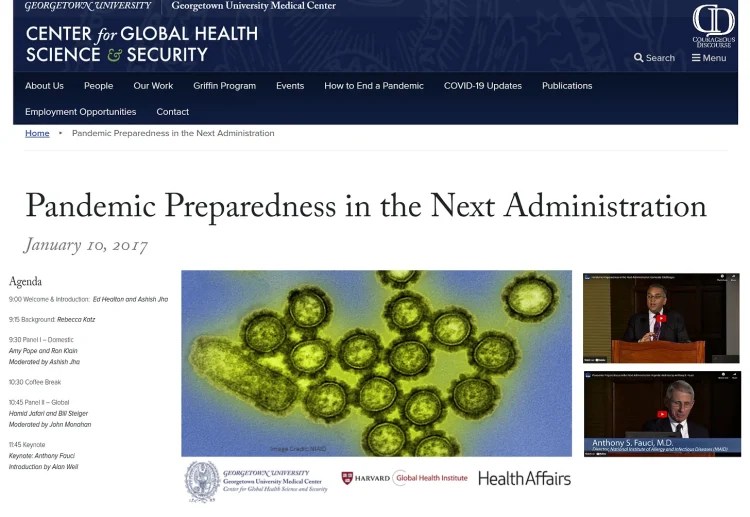
Like the participants at the October 2019 Pandemic Simulation Exercise at Johns Hopkins, Dr. Jha predicted that a devastating pandemic “is going to come at some point.” Dr. Fauci, the keynote speaker, made a more precise prediction.
“There is no question that there will be a challenge to the coming administration in the arena of infectious diseases,” he proclaimed. “The thing we’re extraordinarily confident about is that we’re going to see this in the next few years.”[ii]
As psychiatrist and author Peter Breggin, MD, remarked in his extraordinary book COVID-19 and the Global Predators: We Are the Prey, Dr Jha did not speak in a somber tone about the coming devastation. On the contrary, he emphasized that he was excited about the ambitious project of helping the U.S. and other governments, and equally excited about the many pandemic preparation events in Georgetown and Cambridge that lay ahead. The conference was, he said, the “beginning of a journey.”[iii]
Dr. Jha and his colleagues were animated with the same excitement that denizens of the military-industrial complex would feel at the prospect of a coming war in which they would assume leadership positions. At last, they would be able to deploy all of their forces. With the recognition that the coming war was inevitable, they could call upon the government to allocate far more resources for new technologies, weapons systems, bases, and military organizations. In an atmosphere of such heady excitement, the suggestion of defusing the coming war with diplomacy wouldn’t be received with much enthusiasm.
The irony of Dr. Jha’s excitement is that, when the pandemic he predicted arrived three years later, he didn’t attempt to treat patients or scramble to find consultants to intervene against the disease before it wrecked bodies and imprisoned people in hospitals. Instead, he penned propaganda against hydroxychloroquine and against Drs. McCullough, Risch, and Fareed. Why was the New York Times Editorial Board compelled to publish his misleading account of the Senate hearing? Did the editors even watch the C-SPAN recording of it?
It’s not plausible that their motive was a concern about hydroxychloroquine’s safety. Dr. Jha himself conceded in his testimony that he wasn’t particularly concerned about safety, so why the vast and ceaseless quibbling about whether its efficacy for outpatients had been proven? As Senator Johnson had said in the hearing, this makes no sense.
[i] Jha, Ashish, MD. The Snake Oil Salesmen of the Senate. New York Times, Nov. 24, 2020. https://www.nytimes.com/2020/11/24/opinion/hydroxychloroquine-covid.html
[ii] Georgetown University Center for Global Health Science & Security, Pandemic Preparedness in the Next Administration. January 10, 2017. https://ghss.georgetown.edu/pandemicprep2017/
[iii] Breggin, Peter R, MD and Ginger Ross Breggin, COVID-19 AND THE GLOBAL PREDATORS: WE ARE THE PREY. Ithaca: Lake Edge Press, 2021, p. 259.
Alberta Premier suspends cooperation with WEF
Free West Media | November 25, 2022
The newly elected Premier Danielle Smith of the province of Alberta in Canada has recently made several powerful statements against the globalist foundation World Economic Forum and its leader Klaus Schwab. She has also decided to cancel a strange consulting agreement that WEF had with the province.
The now-revealed collaboration began in the middle of the alleged Corona pandemic and contributed to the draconian restrictions and lockdowns Canadians were subjected to. There are also those who believe that it is part of something much bigger. At the same time, she demanded that the Trudeau administration end the agenda-driven carbon tax.
On October 11, Danielle Smith was sworn in as Premier of the oil-producing province of Alberta in Canada. It came just five days after she won the leadership election of her United Conservative Party (UCP), largely on promises to stand up to the federal government in Ottawa led by the increasingly unpopular Justin Trudeau.
Trudeau has been leader of the Liberal Party of Canada since 2013 and Prime Minister of Canada since 2015. He distinguished himself during the alleged Corona pandemic as one of the most tyrannical leaders in the world, violently cracking down on peaceful popular protests. Trudeau is a member of the notorious globalist organization World Economic Forum (WEF) elite school Young Global Leaders (YGL).
YGL is a leadership program within the WEF, where politicians are schooled and initiated into the globalists’ plans and are then helped into leadership positions.
‘I find it offensive’
On October 24, barely two weeks after taking office, Danielle Smith made a move that sent the establishment in Canada into a tailspin. The new Premier harshly criticized the WEF and its chairman and founder Klaus Schwab.
“I find it uncomfortable when billionaires brag about how much control they have over political leaders like the head [Schwab] of that organization [WEF] has,” Smith said after a ceremony where her ministers were sworn in to the new provincial government.
“I find it offensive. The people who should be running the [provincial] government are the people who vote for them. And the people who vote for me and my colleagues are people who live in Alberta and who are affected by our decisions,” explained the Premier.
“So quite frankly, until that organization [WEF] stops bragging about how much control they have over political leaders, I have no interest in being involved with them. My focus is here in Alberta, to solve problems for the people of Alberta, with the mandate I received from the people of Alberta,” said Smith, announcing the suspension of the province’s cooperation with the globalist foundation.
Alberta’s new leader was referring to provocative statements made by WEF chief Klaus Schwab. One of these that specifically concerned Canada was done in 2017 at the Harvard Kennedy School’s Institute of Politics where political commentator David Gergen interviewed Schwab. The WEF chief then said that his organization had “infiltrated governments” all over the world. A visibly proud Schwab then also named several heads of state, including Canadian Prime Minister Justin Trudeau, as examples of the WEF’s global power and influence.
“Yesterday I was at a reception for Prime Minister Trudeau and I learned that half of his ministers or even more than half are actually our Young Global Leaders (YGL) of the World Economic Forum,” said the arch-globalist Schwab.
WEF health experts?
Danielle Smith further revealed that it has emerged that the province of Alberta has a cooperation agreement with the globalist foundation WEF, something she wanted to end right away.
“They signed a kind of partnership with the World Economic Forum in the middle of the pandemic; we have to deal with it. Why on earth do we have anything to do with the World Economic Forum? It must end,” the new Premier declared firmly.
She was immediately harshly attacked by mainstream media in Canada, who accused her of espousing “extreme right-wing conspiracy theories”, while mainstream media abroad tried to black out her statements.
Many Canadians were surprised to learn that the globalist organization WEF had a direct contract with one of their provincial governments. They were even more surprised when they heard what the agreement was. It did not concern consultation regarding economic issues or even “Agenda 2030 and the global goals for sustainable development”, where the WEF works closely with the UN – or as many critics believe rather dictates to the UN.
Instead, it turned out that early in the alleged 2020 Corona pandemic, the WEF stepped in as health consultants to effectively dictate the pandemic measures taken by the Canadian province of Alberta’s health authority, Alberta Health Services (AHS). Danielle Smith has been a strong critic of this authority and how it, like the previous provincial government, handled the pandemic.
On October 21, ten days after taking office as prime minister and three days before the sensational announcement, Smith commented during the “Question Period with Premier Danielle Smith” on the Western Standard media website that the health authority AHS would be held accountable for both the cooperation with the WEF and the “health councils” which they had given to the provincial government over the last two years. Canada stood out during the pandemic as one of the countries that had the most repressive restrictions and lockdowns in the world. Not least, vaccine-free citizens were grossly discriminated against.
“I think Alberta Health Services is the source of many of the problems we’ve had,” explained Smith, who also described the cooperation with the WEF as “useless”.
Many Albertans were well aware that the health authority AHS was driving the very unpopular restrictions and regulations, as were many other health authorities around the world, but they did not know that the globalist organization WEF was the one pulling the strings. It came as a shock to many and some questioned how the WEF could contribute medical expertise.
Some pundits also cited the example of globalist billionaire Bill Gates, who has been portrayed by the establishment and its media as a pandemic expert in general and a vaccine expert in particular, despite his lack of a relevant education, and where his only direct link is that he has earned multi-billion sums from investing in vaccines in particular.
Globalist puppets
However, there are those who believe that the secret agreement is part of something bigger that is happening beyond public knowledge. One of these is George Gammon, an economist and analyst who made a name for himself by explaining complex economic and political events in an accurate and easy-to-understand manner.
He commented on the news that the WEF had a consulting engagement – on health issues – with the Canadian province of Alberta in a November 5 interview with Daniela Cambone. He did not express the same surprise as many others, but stated that the heads of state and ministers who are in power today have the WEF and its head Schwab to thank for it, that is to say, they are indebted and possibly even dependent on them.
They devote large amounts of their countries’ tax dollars to covert programs that involve the WEF in such a way that the globalist organization can directly influence the country’s policies on issues important to them in order to drive their globalist agenda forward.
Economist Gammon further explained that the arrangement not only brought global power but also revenue to the WEF, which is on paper a Swiss non-profit foundation, and thus also to Schwab personally. These not infrequently very large amounts can then be used to train new leaders in the elite Young Global Leaders (YGL) school, and so on.
For the WEF it is a win-win situation, while for the taxpayers in Canada and other countries it is a double loss, where they lose both their tax money and, in the case of the Corona response, freedoms. Gammon concluded by pointing out that it is probably a common scheme in several countries and described it as pure fraud.
“This is the scam that is going on right now and it is something that most people are not aware of,” said Gammon about the WEF-Alberta agreement
‘Hostile politics’
On November 10, Premier Smith tweeted: “It is time to put people’s needs before politics. I have asked Prime Minister @justintrudeau to consider the financial hardships facing so many Canadian families right now.”
The Prime Minister’s tweet referred to a letter she had sent to Justin Trudeau the day before. In it, she stated that the number one problem for Albertans and all Canadians was the rapidly rising cost of living. Smith wrote that “with runaway inflation, many Canadians are struggling to feed their families, pay their rent and utility bills, and afford to get to work.”
She asked Trudeau to change course: “The long-term solution to this cost-of-living crisis involves the federal government changing course to actively promote and deliver more affordable, reliable and responsibly produced energy and food. Current federal energy and agricultural policies have the opposite effect”.
Critics believe that these nefarious policies are also dictated by the WEF.
Smith further wrote that her province of Alberta has already taken steps to deal with rising costs, including pausing the fuel tax and subsidizing electricity and natural gas. She urged Trudeau to do the same and completely eliminate the federal carbon tax, which Trudeau instead wants to raise further. Smith further wrote that “the answer to reducing emissions is not more taxes on consumers or limiting economic growth in our food and energy sectors”.
Later, she sent out another tweet reiterating the main points of the two-page letter: “The carbon tax is hurting Canadians. Families and businesses need a reprieve from high utility bills, prohibitively expensive food and rising gas prices. It is time to end the carbon tax.”
The next day, on November 11, she called the Trudeau administration hostile in a new tweet: “Today our [provincial] government took a step forward to stand up and defend Alberta’s interests against hostile federal government legislation and policies.”
Alberta’s Deputy Premier, Kaycee Madu, has also been highly critical of Ottawa’s “tyrannical” pandemic restrictions and also thanked the Freedom Convoy participants for their efforts to protest them. In a tweet on September 20, he wrote that the pandemic measures were “never about science but about political control and power”.
He saluted all the Canadians who at the beginning of the year stood up against the oppression of the WEF-schooled Trudeau in the name of public health: “Thank you to all those citizens of the Freedom Convoy who had the courage to mobilize against this tyrannical policy. They endured much hatred, abuse, suffering and slander for all of us. I thank them.”
There are many Canadians and people around the world who share his opinion of the brave who dared to stand up for freedom; despite having their bank accounts frozen, being threatened with having their vehicles impounded and ultimately in several cases enduring the brutality of the Trudeau regime.
The globalists and their handy politicians and journalists can now be expected to come down very hard on Smith and Madu, who have taken the side of their constituents and challenged the WEF and Trudeau – something very unusual in modern politics.
The US could see its supply chain derailed
By Bradley Blankenship | RT | November 25, 2022
One of the United States’ largest rail unions rejected a deal with freight companies and, after a cooling-off period that expires on December 9, the country could see a rail strike that could collapse its supply chain ahead of the holiday season. The cost to the US economy could be about $2 billion per day and passenger rails, like Amtrak, could see major disruptions.
A deal has appeared distant but Congress could still intervene to force one, based on Depression-era legislation. At present, the biggest sticking point to an agreement is paid sick leave and other quality-of-life issues that impact rail workers. A tentative deal struck earlier by President Joe Biden in September granted the largest wage increases in 50 years – that is, 14% raises with back pay and 24% raises over the course of five years, plus thousand-dollar cash bonuses every year – but this was never the main sticking point.
Instead, unions are upset by a lack of sick leave and personal time that leaves rail workers with a permanent threat of termination over visits to a doctor, as well as having to be on call seven days a week. They’re also ticked about workers having to operate rails solo, which they deem a safety concern, given the long hours associated with the industry. That’s why unions voted narrowly to reject the deal, even if it saw a large pay bump.
While this issue has been boiling for many years, the pandemic brought scheduling issues to the fore. Successive waves of Covid-19 didn’t see any meaningful worker protections or paid sick leave implemented, and staffing shortages only worsened. Workers were forced to show up and be on call without any protections and, to top it off, the freight lines saw record profits deposited to the ultra-wealthy, such as Berkshire Hathaway Chairman Warren Buffett.
Despite those record profits and revenues, rail operators did not spread this wealth to employees or amend contracts to grant more benefits. Instead, they spent these lavish profits on stock buybacks and dividend payouts to shareholders. For example, CSX reported a 37% surge in fiscal year 2021 net income and the company repurchased $3.7 billion worth of its own shares during the first three quarters of this year to artificially boost stock prices.
And now the industry is hoping that Congress will intervene to kneecap workers. One of the main legal hurdles to a rail strike is the 1926 Railway Labor Act, which forbids workers from striking, unlike in most other businesses. This has significantly reduced the leverage of rail workers, while entrenching the powerful people that own the freight lines and raising the odds that Congress will intervene with a deal that unions would otherwise not have accepted.
That does appear to be the goal of the rail lobby. Unions are hoping that pro-union members of the lame-duck Congress won’t intervene on employers’ behalf but the economic damage could be too much to stomach. Up to 30% of all cargo could be strung up in the event of a strike, causing all sorts of items, from fuel to cars, to rise significantly in price, thanks to supply-chain hiccups. Freight lines are hoping that even a divided Congress will intervene to give them a favorable deal.
But this would be foolhardy and would only kick the can down the road. Congress should not damage the leverage of unions and should let the strike unfold, even if that means seeing huge price increases. The rail industry has seen sky-high profits and used anti-competitive practices to profiteer off of pandemic-induced supply bottlenecks. It also enjoys unparalleled antitrust law exemptions and benefits from the country’s privatization model around railroads.
On the contrary, Congress should take the chance to break up rail companies, strengthen anti-monopoly laws and implement universal paid sick leave, given the fact that the US is enduring a virtual case plateau with Covid-19. The US is, notably, one of the few developed countries in the world to not have universal paid sick leave and does not have a government-owned or subsidized rail competitor besides Amtrak.
This means that only a handful of companies are allowed to control entire freight lines and set arbitrary fees, which has resulted in numerous lawsuits, though current laws shield railways from any liability. Congress should displace the rail industry from its privileged position even if it is important for the national supply chain because, inevitably, these monopolies are damaging the market and hurting workers’ livelihoods.
Bradley Blankenship is an American journalist, columnist and political commentator. He has a syndicated column at CGTN and is a freelance reporter for international news agencies including Xinhua News Agency.
Time to come clean about Covid’s lab origins

By Neville Hodgkinson | TCW Defending Freedom | November 24, 2022
More than two years ago, an Anglo-Norwegian team of scientists demonstrated unique ‘fingerprints’ of laboratory manipulation in the Covid virus. They argued that the evidence as good as proved that the virus had originated in a lab rather than evolving naturally. The manipulation, which made a bat virus a danger to humans, was exactly as envisaged by American and Chinese researchers who had been working on a vaccine aimed at reducing the impact of any such future outbreaks.
A paper describing these findings, co-authored by London University vaccines expert Professor Angus Dalgleish, was suppressed in both the US and UK. Internationally, the World Health Organisation, leading science journals and others made a huge effort to persuade us that Covid was a natural occurrence – and that we should spend a lot more money to fight any such future threats.
However the paper was uploaded by the Norwegian website Minerva in July 2020, and an update appeared on the website in May 2021 which I reported here.
Now an American expert in the field, who previously dismissed the lab-origin theory, has reached exactly the same conclusion. ‘The body of evidence supporting a lab origin of SARS-CoV-2 is overwhelming, far more so than most realise,’ says biologist and analyst Dr Alex Washburne in a newly published ten-page report.
He studied transmission of infections from bats to people for many years before Covid. ‘Pathogen spillover is common,’ he writes, ‘and so for much of the pandemic I kept an open mind about a laboratory origin yet remained firmly entrenched in my prior belief of a zoonotic [animal] origin. However . . . the totality of evidence has completely changed my mind.’
Before Covid, Dr Washburne was working with a team funded by a US Defense Department grant aimed at pre-empting pandemics by studying whether some strains of animal viruses were more likely to cause human disease than others.
He says it takes a lot of effort to find and examine naturally occurring viruses, and so ‘there is a clear temptation to make new viruses, such as chimeric viruses or viruses passaged in human cells. If we made a virus more capable of infecting people, it might reveal the essence of human-infective viruses and help us prepare vaccines before a pandemic ever happens.
‘Engineer and evolve a novel pandemic-capable virus to create a vaccine against the virus before it causes a pandemic, and you might win a Nobel Prize . . . provided nothing goes wrong.’
He describes how in March 2018 a proposal to do just that was drawn up by EcoHealth Alliance (a global non-profit with the slogan ‘Standing Between You and the Next Pandemic’) with the Wuhan Institute of Virology in China and other international collaborators.
The plan was to sample bat coronaviruses, assemble cloned copies of the viruses in the lab, introduce genes that might make them a threat to humans, and test the resulting chimeric viruses in the lab at Wuhan.
‘Find, engineer, and evolve human-infectious viruses capable of causing a pandemic, develop a vaccine against them, and pre-empt a pandemic . . . provided nothing goes wrong.’
DARPA, the US Defense Advanced Research Projects Agency, turned down the proposal on safety grounds.
But the group had alternative sources of funding, including a biodefence grant from the US National Institute of Allergy and Infectious Diseases. The fact that SARS-CoV-2 emerged in Wuhan, with an exact fingerprint of the proposed manipulation, and a geographic pattern inconsistent with its having emerged from animal trade, ‘ought to tilt the scales towards a laboratory origin’, Washburne says.
He adds that ‘as a scientist, I can’t tell you how badly I want scientists to have not opened Pandora’s Box. It took enormous amounts of self-examination and self-criticism to question my own cherished belief in the theory of a zoonotic origin’.
He might have been able to change his mind sooner if the findings of the Anglo-Norwegian team had been examined at the pandemic’s outset.
The team’s findings were exactly in line with those now highlighted by Washburne. They found that the virus’s so-called spike protein had six inserts, ‘unique fingerprints . . . indicative of purposive manipulation’, which allowed it to infect and damage a wide range of human cells. They showed how these and other features of the virus were linked to laboratory work published by the Chinese and American researchers.
The authors wrote: ‘Since, regrettably, international access has not been allowed to the relevant laboratories or materials, since Chinese scientists who wished to share their knowledge have not been able to do so and indeed since it appears that preserved virus material and related information have been destroyed, we are compelled to apply deduction to the published scientific literature, informed by our own biochemical analyses.
‘We refute pre-emptively objection that this methodology does not result in absolute proof by observing that to make such a statement is to misunderstand scientific logic. The longer the chain of causation of individual findings that is shown, especially converging from different disciplines, the greater the confidence in the whole.’
The team also warned that vaccine-makers who failed to acknowledge the chimeric nature of the virus, and the toxicity of the spike protein, might unwittingly put the public at risk.
We now know that wittingly or not the vaccine-makers put out products which present an even bigger threat to health for some than the virus itself, and have been linked to tens of thousands of deaths and millions of adverse events. But because of the obstacles put in the way of a genuine understanding of the virus’s nature, regulators continue to assure the public that the products are ‘safe and effective’.
I believe there was high-level knowledge from the very start that this was not a naturally evolved virus, but a chimera – originally native to Chinese bats but manipulated in the laboratory to see if it could become a threat to humans.
If Covid really was a straightforward zoonosis – an infectious disease of animal origin – why was a global panic button pressed, leading to the ruinous lockdowns and other crisis measures which were to cost the UK £500billion over the next two and a half years?
Why did top scientists and public health officials persist in demanding panic measures long after it was clear that the threat from Covid was not as bad as had been feared?
Why did the G20 countries at their recent meeting in Bali sing the praises of Covid immunisation as a ‘global public good’, and flag up digital and non-digital ‘proof of vaccinations’ to facilitate ‘seamless international travel’?
Is it because of fears that another, more dangerous genetically engineered pathogen is in the pipeline?
Chinese scientists and public health officials are said to have predicted that World War Three will be fought with ‘a new era of genetic weapons’ which can be ‘artificially manipulated into an emerging human disease virus, then weaponised and unleashed in a way never seen before’.
This is clearly a subject with which governments and their intelligence agencies worldwide must be familiar. May I suggest that if that is the real fear, they should come clean about it, and stop treating us like idiots? That would do a lot to improve understanding, and help end a damaging crisis of confidence in science that could prove a lot more damaging than SARS-CoV-2 itself.
Four Myths about Pandemic Preparedness

By David Bell | Brownstone Institute | November 24, 2022
We are assured by the World Health Organization (WHO), the World Bank, the G20, and their friends that pandemics pose an existential threat to our survival and well-being. Pandemics are becoming more common, and if we don’t move urgently we will have ourselves to blame for more mass death of the ‘next pandemic.’
The proof of this is the catastrophic harm done to the world by COVID-19, a repeat of which can only be prevented by transferring unprecedented funds and decision-making power to the care of public health institutions and their corporate partners. They have the resources, experience, knowledge and technical know-how to keep us safe.
This is a no-brainer, all of it, and only a fool who desires mass death would oppose it. But there are still people who claim that the link between the public health establishment and large corporations appears to be the only part of this narrative that withstands scrutiny.
If true, this would imply that we are being systematically deceived by our leaders, the health establishment, and most of our media; a ludicrous allegation in a free and democratic society. Only a fascist or otherwise totalitarian regime could run such a broad and inclusive deception, and only people with truly bad intent could nurture it.
So let’s hope such ‘appearances’ are deceptive. To believe that the premise behind our leaders’ Pandemic Preparedness and Response agenda is knowingly based on a set of complete fabrications would be a conspiracy theory too far. It would be too uncomfortable to accept that we are being deliberately misled by people we elected and the health establishment we trust; that the assurances of inclusivity, equity and tolerance are mere facades hiding fascists. We should examine the key claims supporting the pandemic agenda carefully and hope to find them credible.
Myth #1: Pandemics are becoming more common
In its 2019 pandemic influenza guidelines, the WHO listed 3 pandemics in the century between the 1918-20 Spanish flu and COVID-19. The Spanish flu killed mainly through secondary bacterial infections at a time before modern antibiotics. Today we would expect most of these people, many relatively young and fit, to survive.
The WHO subsequently recorded pandemic flu outbreaks in 1957-58 (‘Asian flu’) and 1968-69 (‘Hong Kong flu’). The Swine flu outbreak that occurred in 2009 was classed by WHO as a ‘pandemic’ but caused just 125,000 to 250,000 deaths. This is far less than a normal flu year and so hardly deserving of the pandemic label. Then we had COVID-19. That’s it for a whole century; one outbreak the WHO classifies as a pandemic per generation. Rare, or at least highly unusual, events.
Myth #2: Pandemics are a major cause of death
The Black Death, the Bubonic Plague that swept Europe in the 1300s, killed perhaps a third of the entire population. Repeat outbreaks over the following centuries caused similar harm, as had plagues known from Greek and Roman times. Even the Spanish flu did not compare with these. Life changed prior to antibiotics – including nutrition, accommodation, ventilation and sanitation – and these mass-mortality events subsided.
Since the Spanish flu we have developed an array of antibiotics that remain extremely effective against community-acquired pneumonia. Fit young people still die from influenza through secondary bacterial infection, but this is rare.
The WHO tells us there were 1.1 million deaths from the 1957-58 ‘Asian flu,’ and a million from the 1968-69 Hong Kong flu. In context, seasonal influenza kills between 250,000 and 650,000 people every year. As the global population was 3 to 3.5 billion when these two pandemics occurred, they classify as bad flu years killing about 1 in 700 mostly elderly people, with little influence on total deaths. They were treated as such, with the Woodstock Festival proceeding without super-spreader panic (regarding the virus, at least…).
COVID-19 has a higher associated mortality, but at an old average age equivalent to that of all-cause mortality, and is nearly always associated with comorbidities. Much mortality also occurred in the presence of the withdrawal of normal supportive care such as close nursing and physiotherapy, and intubation practices may have played a role.
Of the 6.5 million that the WHO records as dying from COVID-19, we don’t know how many would have died anyway from cancer, heart disease or the complications of diabetes mellitus and just happening to have a positive SARS-CoV-2 PCR result. We don’t know because most authorities decided not to check, but recorded such deaths as being due to COVID-19. The WHO records about 15 million excess deaths throughout the COVID-19 pandemic, but this includes lockdown deaths (malnutrition, rising infectious disease, neonatal death etc).
If we take the 6.5 million toll as likely, we can understand its context by comparing it with tuberculosis, a globally endemic respiratory disease that few worry about in their day-to-day lives. Tuberculosis kills about 1.5 million people every year, which is almost half the annual COVID-19 toll in 2020 and 2021. Tuberculosis kills far younger on average than COVID, removing more potential life-years with each death.
So based on normal metrics for disease burden, we could say they are roughly equivalent – COVID-19 has had an impact on life expectancy overall fairly similar to TB – worse in older populations in Western countries, far less in low-income countries. Even in the US COVID-19 was associated with less (and older) deaths in 2020-21 than normally occur from cancer and cardiovascular disease.
COVID-19 has not therefore been an existential threat to the life of many people. The infection mortality rate globally is probably around 0.15%, higher in the elderly, much lower in healthy young adults and children. It is not unreasonable to think that if standard medical knowledge had been followed, such as physiotherapy and mobility for frail elderly people and micronutrient supplementation for those at risk, the mortality rate may have been even lower.
Whatever one’s views on COVID-19 death definitions and management, it is unavoidable that death is rare in healthy younger people. Over the past century all pandemic deaths have been very low. Averaging less than 100,000 people per year inclusive of COVID-19, they are a small fraction of that caused by seasonal flu.
Myth #3: Diversion of resource to pandemic preparedness makes public health sense
The G20 has just agreed with the World Bank to allocate $10.5 billion annually to its pandemic prevention and response Financial Intermediary Fund (FIF). There is, in their view, about $50 billion needed in total per year. This is the annual, holding budget for pandemic preparedness. As an example of their preferred response when an outbreak occurs, Yale University modelers estimate that to vaccinate people in low and middle income countries with just 2 doses of COVID-19 vaccine would cost about $35 billion. Adding one booster would total $61 billion. Over $7 billion has thus far been committed to COVAX, the WHO’s Covid vaccine financing facility, vaccinating most who are already immune to the virus.
To put these sums in context, the annual budget of the WHO is normally below $4 billion. The entire world spends about $3 billion annually on malaria – a disease that kills well over half a million young children each year. The largest financing facility for tuberculosis, HIV/AIDS and malaria, the Global Fund, spends less than $4 billion per year on these three diseases combined. Other and larger preventable killers of children, – such as pneumonia and diarrhea, receive still less attention.
Malaria, HIV, tuberculosis and diseases of malnutrition are all increasing, while economies globally – the main long-term determinant of life expectancy in lower-income countries – decline. Taxpayers are being asked, by institutions that themselves will benefit, to spend vast resources on this problem rather than on diseases that kill more and younger people. The people pushing this agenda do not appear to be dedicated to reducing annual mortality or improving overall health. Alternatively, they either cannot manage data or have a window on the future that they are keeping to themselves.
Myth #4: COVID-19 caused massive harm to health and the global economy
The age-skewing of COVID mortality has been unmistakable since early 2020, when data from China demonstrated almost no mortality in healthy young to middle-aged adults and children. This has not changed. Those contributing to economic activity, working in factories, farms and transport, were never at great risk.
The economic and personal harm arising from the restrictions on these people, unemployment, destruction of small businesses and supply-line disruption, was a choice made against orthodox policy of the WHO and public health in general. The prolonged school closures, locking in generational poverty and inequality on both a sub-national and international level, was a choice to perhaps buy months for the elderly.
The 2019 WHO pandemic guidelines advised against lockdowns due to the inevitability that they would increase poverty, and poverty drives illness and reduces life expectancy. The WHO noted this disproportionately harms poorer people. This is not complicated – even those at the center of the lockdown and future digital ID agenda such as the Bank of International Settlements (BIS) acknowledge this reality. If the aim of poverty-promoting measures had been to reduce elderly death, the evidence for success is poor.
There seems little reasonable doubt that growing malnutrition and long-term poverty, rising endemic infectious disease, and the impacts of education loss, increased child marriage and increased inequality will far outweigh any possible mortality reduction achieved. UNICEF’s estimation of a quarter-million child deaths from lockdowns in South Asia in 2020 provides a window into the enormity of the harm lockdowns wrought. It was the novel public health response that caused the massive harm associated with this historically mild pandemic, not the virus.
Facing truth
It seems unavoidable that those advocating for the current pandemic and preparedness agenda are intentionally misleading the public in order to achieve their aims. This explains why, in the background documents of the WHO, the World Bank, G20 and others, detailed cost-benefit analyses are avoided. The same absence of this basic requirement characterized the introduction of Covid lockdowns.
Cost-benefit analyses are essential for any large-scale intervention, and their absence reflects either incompetence or malfeasance. Prior to 2019, the resource diversion being contemplated for pandemic preparedness would have been unthinkable without such analysis. We can therefore reasonably assume that their continued absence is based on fear or certainty that their outcomes would scupper the program.
A lot of people who should know better are going along with this deceit. Their motives can be surmised elsewhere. Many may feel they need a good salary, and the resultant dead and impoverished will be far enough away to be considered abstract. The media, owned by the same investment houses who own the Pharma and software companies sponsoring public health, are mostly silent. It is hardly a conspiracy to believe that investment houses such as BlackRock and Vanguard work to maximize return for their investors, using their various assets to do so.
A few decades of our elected leaders trooping off for closed-door sessions at Davos, together with a steady concentration of wealth with the individuals they were meeting, could not really have landed us anywhere else.
We knew this 20 years ago, when the media still warned of the harm that increasing inequality would bring. When individuals and corporations richer than medium-sized countries control major international health organizations such as Gavi and CEPI, the real question is why so many people struggle to acknowledge that conflicts of interest define international health policy.
The subversion of health for profit runs contrary to the entire ethos of the post-World War Two anti-fascist, anti-colonialist movement. When people across politics can acknowledge this reality, they can put aside the false divisions that this corruption has sown.
We are being deceived for a reason. Whatever that is, going along with a deception is a poor choice. Denial of truth never leads to a good place. When public health policy is based on a demonstrably false narrative, it is the role of public health workers, and the public, to oppose it.
David Bell, Senior Scholar at Brownstone Institute, is a public health physician and biotech consultant in global health. He is the former Program Head for malaria and febrile diseases at the Foundation for Innovative New Diagnostics (FIND) in Geneva, Switzerland.
The Lancet reports on Human Rights failures during the COVID-19 pandemic. Is the tide turning? Think again.
The Naked Emperor’s Newsletter | November 24, 2022
When I first read the title of an article in The Lancet last week, I thought, this might be interesting, some acknowledgement about how bad lockdowns and mandates were. The title ‘Human rights and the COVID-19 pandemic: a retrospective and prospective analysis’ made me read on.
Maybe, I shouldn’t have been so naïve and maybe I should have looked at who the authors were first but I read on anyway.
I was still hopeful during the summary.
When the history of the COVID-19 pandemic is written, the failure of many states to live up to their human rights obligations should be a central narrative.
Which states will they talk about? The UK? America? I’d put money on Canada, Australia and New Zealand.
Since then, COVID-19’s effects have been profoundly unequal, both nationally and globally. These inequalities have emphatically highlighted how far countries are from meeting the supreme human rights command of non-discrimination, from achieving the highest attainable standard of health that is equally the right of all people everywhere, and from taking the human rights obligation of international assistance and cooperation seriously.
Rubbing my hands together, I scrolled on, expecting to see scathing criticism of citizens being locked at home and how Covid mandates were completely unjust.
We propose embedding human rights and equity within a transformed global health architecture as the necessary response to COVID-19’s rights violations. This means vastly more funding from high-income countries to support low-income and middle-income countries in rights-based recoveries, plus implementing measures to ensure equitable distribution of COVID-19 medical technologies.
We also emphasise structured approaches to funding and equitable distribution going forward, which includes embedding human rights into a new pandemic treaty. Above all, new legal instruments and mechanisms, from a right to health treaty to a fund for civil society right to health advocacy, are required so that the narratives of future health emergencies—and people’s daily lives—are ones of equality and human rights.
Oh, here we go – high-income countries imposing their views on low-income countries. Distribution of mRNA vaccines and a new pandemic treaty.
Deflated, I finally checked the authors. The lead author works for the WHO and many of the other authors championed vaccine passports.
Realising this isn’t going to be the article I thought it was going to be, I skipped to the conclusion.
Equity demands treating health as a global public good and creating new legal instruments grounded in rights and equity. A reimagined, strengthened global health architecture, with human rights as its foundation, would be a fitting monument to the tens of millions who have died and suffered grievously—and would better prepare the world to address climate change, antimicrobial resistance, and other global threats. Furthermore, it would enable a swift, effective response the next time a novel or emerging infection threatens the globe—honouring the dignity of each of us.
I’ve seen that language before. “Equity demands”, “global public good”, “grounded in rights and equity”, “human rights as its foundation”. And whilst it all sounds lovely, it never ends well and the only human rights that are respected are those belonging to the humans that agree with what is being proposed.
You don’t want a pandemic treaty, forced vaccinations and mandates? Think of the tens of millions who have died and suffered grievously, you monster. Think of climate change, you devil in disguise. This is being done to honour the dignity of each of us. Well, not your dignity, you don’t agree with us, you stay locked in the quarantine camp thinking about the lovely dignity you could have if you did agree with us.
It was a struggle but I forced myself to read the rest of the article.
Many authoritarian regimes and populist leaders, however, have disregarded science, and have imposed harsh restrictions on human freedoms
One again, my hopes were raised. Maybe there is a small section on lockdowns etc. I saw the letters U.S.A. Maybe it will discuss how it is ridiculous that unvaccinated people still can’t travel there. Nope, it criticised the USA for opposing risk-mitigation measures such as business closures and mask or vaccine mandates.
It continued to get worse.
Public health officials have not always followed the science. The Public Health Agency of Sweden chose to allow a large portion of the country’s population to become infected, aiming to achieve herd immunity through eschewing basic scientific guidance of physical distancing and mask-wearing. This course was so fundamentally unsuccessful in protecting people’s health that it was beyond the discretion permissible under the right to health. By the end of 2020, Sweden’s mortality rate was ten times that of its neighbours, four-times higher than Denmark’s, and higher than in most European countries.
I agree with much of this section to a large extent, impacts of COVID-19 does disproportionately affect people with little money due to a plethora of risk factors. But so does any disease. And by locking people up, making them unhealthier and poorer, you only exacerbate this inequality.
But carry on with the virtual signalling and keep blaming it on systemic racism. Or Covid racism, I’m not quite sure. Either way, by not investigating why certain races disproportionately filled critical care units meant that more ethnic minorities carried on dying. Congratulations, by trying not to be racist, you actually ended up being racist.
Service disruptions were responsible for an estimated 47,000 additional malaria deaths in 2020 compared with 2019, and 100,000 additional tuberculosis deaths. 121 (93%) of 130 countries reported mental health service disruptions, as depression and anxiety levels greatly increased. By 2022, more than 200 million additional people faced acute hunger compared with in 2019, while COVID-19 forced nearly 80 million people into extreme poverty.
One word – Lockdowns.
Governments exercised vast emergency health powers, including business closures, cordon sanitaire, and full lockdowns, which are warranted only if supported by science, and are necessary, proportionate, and non-discriminatory.
So lockdowns are warranted if supported by science. Still no acknowledgement of the terrible harms they have caused.
authoritarian leaders have used the pandemic as an excuse to violate human rights, including suppressing information, punishing whistleblowers, arresting and detaining opponents and citizen journalists, and undermining democratic rights
I recognise all of those things having happened in many Western countries but are they mentioned? Of course not. China, Tanzania, Egypt, Russia, Pakistan, Madagascar, Bangladesh, Venezuela, Cayman Islands, Burundi, India, Hungary, Malaysia, Zambia, El Salvador, Thailand, Kazakhstan, Morocco, Ethiopia and Uganda all get a mention but nothing about the US, UK, Australia, Canada or New Zealand.
France and Greece get a brief mention. Maybe they haven’t been sending enough funding to the WHO recently.
And there we have it. Now we know exactly where this article has come from!
A new rights-based national and global governance for the right to health would respond to the daily health emergency of health inequities that COVID-19 revealed and reinforced. Future governance, and the mechanisms that underpin it, must ensure equitable and effective responses to health emergencies by embedding the right to health, accountability, participation, and equity in global and national policies and international responses.
A new right-based global governance. Where have we heard that before? Nothing to see here. It all sounds completely reasonable and not sinister or dystopian at all.
These people don’t have a clue. That don’t recognise the harms they have caused and they wouldn’t recognise a human right if it jabbed them in the arm.
But they are calling the shots and they want global governance based around the greater good. Not enough countries did as they were told during this pandemic, so next time they want a structure in place that means your democratically elected leaders can’t decide if lockdowns are appropriate or not, the whole world will be locking down together.
Don’t get in the way of the greater good because if you do, you aren’t good and that means we can lock you up. Nobody likes not-good people and everyone will cheer your incarceration because it will keep them safe.
If these recommendations are allowed to go ahead, not only is it dangerous but also stupid. Never again will we know if a certain measure was the correct one to take or if a vaccine or treatment has a particular side effect because everybody in every country will have to do the same thing.
The Road to Fascism: For a Critique of the Global Biosecurity State
A New Book by Simon Elmer
OffGuardian | November 24, 2022
With the lifting of the thousands of regulations by which our lives were ruled for two long years there has been an understandable desire to believe that the coronavirus ‘crisis’ is over and we will return to something like an albeit new normal.
But as new crises have sprung up to take its place — war in the Ukraine, the so-called ‘cost of living crisis’ and the return of the environmental crisis — it’s increasingly difficult not to look back on ‘lockdown’ as the first campaign in a war that has not been declared by any government but is no less real for that.
The willingness of our governments to use the forces of the state against their own populations on the justification of protecting us from ourselves signals a new level of authoritarianism — and something like the return of fascism — to the governmental, juridical and cultural forms of the formerly neoliberal democracies of the West, and one of the aims of this book is to examine the validity of this thesis.
Its purpose in doing so, however, is not to contribute to an academic debate about the meaning of the term ‘fascism’, but rather to interrogate how and why the general and widespread moral collapse in the West over the past two-and-a-half years has been effected with such rapidity and ease, and to examine to what ends that collapse is being used.
The more deliberate is the immiseration of the populations of Western democracies, the clearer it becomes that the war started by COVID-19 is not between nation states but a civil war waged against our institutions of democratic governance and the division of powers between executive, legislature and judiciary.
Insofar as these institutions and this division are being dismantled and replaced by the rule of international technocracies that, under the cloak of the ‘pandemic’, have assumed increasing power over our lives since March 2020, this war represents a revolution in Western capitalism from the neoliberalism under which we have lived for the past forty years.
Where it is heading with ever greater speed and finality, and which The Road to Fascism sets out to demonstrate, is the new totalitarianism of the Global Biosecurity State.
Simon Elmer is the founder of Architects for Social Housing (ASH), you can follow them on twitter. The Road to Fascism was published by ASH on 28 September, and is available in hardback, paperback and e-book. Click on the link for purchase options, the contents page and preface. Excerpts have been published in The Daily Sceptic and The Exposé; and you can hear Simon discussing his book in an interview on The Delingpod.
New Fauci emails show Drosten, other Corona astrologers debating whether and how to address lab origin hypothesis
Drosten: “Didn’t we congregate to challenge a certain theory, and if we could, drop it?”
eugyppius – a plague chronicle – November 23, 2022
In February 2020, virologists were beginning to worry that discussion about the origins of SARS-2 was getting out of hand. Four of them – Edward Holmes, Kristian Andersen, Andrew Rambaut and Robert Garry – decided to write a short statement on the matter, in the hopes of regaining control of the debate. Jeremy Farrar, chairman of the international vaccination cabal known as the Wellcome Trust, coordinated their work and sent a draft to various virological villains, among them Anthony Fauci and Christian Drosten, for comment. A later version of the statement appeared in Nature a month later as “The proximal origin of SARS-CoV-2”.
New emails discussing the genesis of this statement came to light yesterday, as a result of another successful FOIA request for Anthony Fauci’s emails, and it contains some interesting moments.
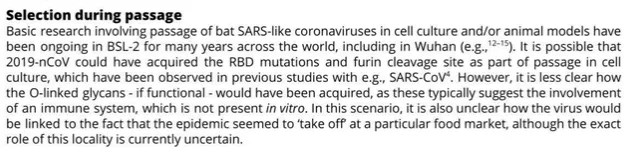
The draft statement itself (at p. 67 here) is mostly unremarkable and not all that different from the Nature piece. It insists, in bold on the first page, that “Analysis of the virus genome sequences clearly demonstrates that the virus is not a laboratory construct or experimentally manipulated virus.” At least some of its authors, though, especially Edward Holmes, were willing to entertain the lab leak hypothesis, and the consequence was this paragraph considering the possibility that SARS-2 had been enhanced by repeated passage in cell cultures or animals:
Christian Drosten, after reading the draft, complained immediately that he thought he and his colleagues had already agreed “to challenge a certain theory, and if we could, drop it”:
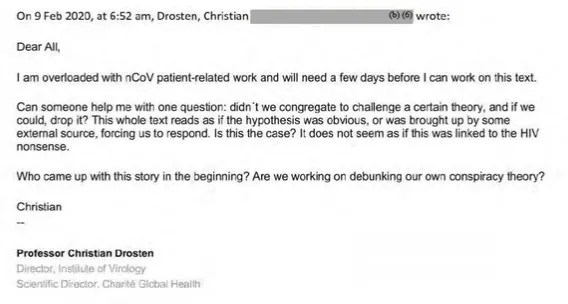
From this we learn, first, that Drosten had been party to prior discussions among his colleagues, where they had discussed messaging strategies relating to “a certain theory”; and, second, that Drosten apparently had no real understanding of the reasoning behind or the case for laboratory origins, and this as late as 9 February.
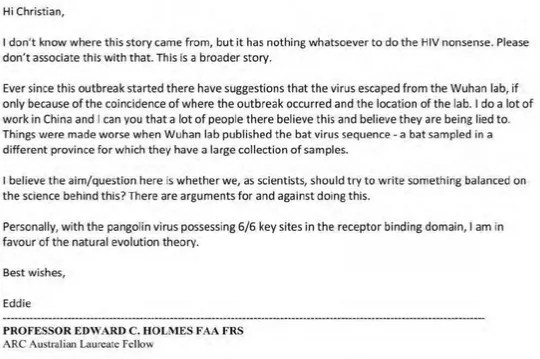
Edward Holmes (who Farrar elsewhere says is leaning “60-40” for the laboratory origins of SARS-2) has to bring him up to date:
Jeremy Farrar also chimes in:

Then Holmes’s co-author, Kristian Andersen (who has since become a hardcore if disingenuous natural origins advocate), contributes these very interesting remarks:
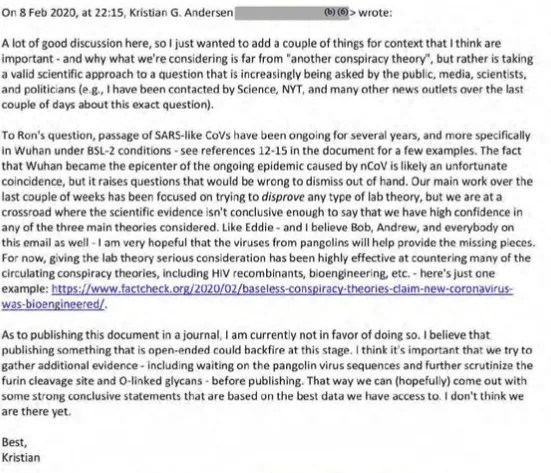
Among other things, it’s telling to see how eager all these virologists were for those fishy pangolin sequences, which Chinese scientists released just as discussions of laboratory origins were gaining ground.
There’s surely more lurking in this email dump, but I have (alas, alas) a conference coming up, and thereafter it’ll take me a few days to get through it.
Fauci Grilled Under Oath in Social Media Censorship Case
By Michael Nevradakis, Ph.D. | The Defender | November 23, 2022
Dr. Anthony Fauci today faced questions from Attorneys General Eric Schmitt (Missouri) and Jeff Landry (Louisiana) in their lawsuit against the federal government for allegedly colluding with Big Tech platforms to censor content critical of COVID-19 vaccines and countermeasures.
Fauci sat for a deposition one day after the 5th U.S. Circuit Court of Appeals temporarily halted the depositions of three other Biden administration officials.
In a statement released Tuesday in advance of Fauci’s deposition, Schmitt said:
“Tomorrow, along with my colleague from Louisiana, my Office and I will depose Dr. Anthony Fauci in our lawsuit against the Biden Administration for allegedly colluding with social media companies to censor freedom of speech.
“Since we filed our landmark lawsuit, we have uncovered documents and discovery that show clear coordination between the Biden Administration and social media companies on censoring speech, but we’re not done yet. We plan to get answers on behalf of the American people. Stay tuned.”
The statement also quoted Jeff Landry:
“We all deserve to know how involved Dr. Fauci was in the censorship of the American people during the COVID pandemic; tomorrow, I hope to find out.
“And I will continue fighting for the truth as it relates to Big Government colluding with Big Tech to stifle free speech.”
Schmitt and Landry sued President Biden, Fauci and others on May 5. New Civil Liberties Alliance, a nonprofit group representing outspoken critics of COVID-19 vaccines and countermeasures, including Drs. Jayanta Bhattacharya, Martin Kulldorff, Aaron Kheriaty and also Jill Hines, joined the lawsuit in August, as did Jim Hoft, founder and editor-in-chief of The Gateway Pundit.
According to the complaint, government officials colluded with and coerced Big Tech and social media platforms to “suppress disfavored speakers, viewpoints and content” relating to COVID-19.
Several officials named in the suit, including former White House press secretary Jen Psaki, argued they shouldn’t be required to be deposed, but a federal judge on Monday denied a request to quash Psaki’s subpoena.
The same judge, U.S. District Judge Terry Doughty, on Oct. 21 ordered Fauci and other government officials to provide depositions under oath.
In addition to Fauci and Psaki, other government officials slated to be deposed include:
- FBI Supervisory Special Agent Elvis Chan
- Carol Crawford, chief of the Centers for Disease Control and Prevention’s Digital Media Branch
- Cybersecurity and Infrastructure Security Agency Director Jen Easterly
- White House Director of Digital Strategy Rob Flaherty
- Daniel Kimmage, an official at the State Department’s Global Engagement Center
- U.S. Surgeon General Dr. Vivek Murthy
Two lower-level officials were listed as alternates: Lauren Protentis of the Cybersecurity and Infrastructure Security Agency in place of Easterly, and former White House COVID-19 adviser Andrew Slavitt in place of Flaherty.
A previous ruling had forced the above-named individuals to provide written testimony.
Judge rejects ‘self-serving blanket denials’
In his Oct. 21 ruling, Judge Doughty agreed with the plaintiffs that Fauci’s prior “self-serving blanket denials” regarding his role in censoring certain types of content and viewpoints on social media could not be taken at face value, necessitating a deposition.
Fauci challenged the order to sit for a deposition, arguing the communications in question are protected by executive privilege. But Judge Doughty ordered Fauci to turn over the documents within 21 days and to answer the plaintiffs’ questions in full.
Landry and Schmitt filed a request for depositions Oct. 10. In a statement released at the time by Schmitt, he said:
“After finding documentation of a collusive relationship between the Biden administration and social media companies to censor free speech, we immediately filed a motion to get these officials under oath.
“It is high time we shine a light on this censorship enterprise and force these officials to come clean to the American people, and this ruling will allow us to do just that. We’ll keep pressing for the truth.”
Depositions of three Biden administration officials on hold
In an order issued Monday, the New Orleans-based 5th Circuit temporarily halted the scheduled depositions of Easterly, Flaherty and Murthy.
According to Politico, the three-judge panel unanimously found Judge Doughty had erred in approving the depositions without first examining whether there were “other means” of obtaining the information the plaintiffs are seeking.
The court sent the case back to Doughty for further review. According to the order:
“Thus, before any of the depositions may go forward, the district court must analyze whether the information sought can be obtained through less intrusive, alternative means, such as further written discovery or depositions of lower-ranking officials.
“Written findings as to the availability and sufficiency of alternatives need to be entered.”
In a statement provided to The Defender by Landry’s office, Landry said, “These developments do not change my pursuit of the truth. We respect the court’s decision and will continue in the discovery phase of this case.”
Thursday’s court order came after lawyers for the government argued the plaintiffs should not have the ability to depose the three officials in question, on the basis that they are high-ranking government officials, and that the depositions would “unavoidably distract” them from “their important and time-sensitive duties,” which would “cause irreparable harm.”
However, the federal government’s motion for a partial stay of Judge Doughty’s deposition order was denied. The Nov. 21 order stated, “We make no ruling on the petition … at this time.”
Easterly, Flaherty and Murthy were scheduled to be deposed in early December.
On Wednesday Judge Doughty, in a separate ruling, ordered Psaki to sit for a deposition and rejected an attempt to shield FBI Agent Chan from answering questions under oath.
Plaintiffs in the case argued that none of the officials were “high-ranking,” and Judge Doughty agreed, finding that the “burdens” the officials would face as a result of sitting for depositions were outweighed by the necessity of gathering more information regarding the allegations in question prior to ruling on a motion for a preliminary injunction.
According to the 5th Circuit’s order:
“It is not enough, as the district court found, that these officials may have ‘personal knowledge’ about certain communications.
“That knowledge may be shared widely or have only marginal importance in comparison to the ‘potential burden’ imposed on the deponent.”
According to the court, the government already produced “extensive written discovery.” The government claims that these documents do not reveal any violations of the First Amendment, while the plaintiffs claim otherwise.
Politico also reported that the 5th Circuit asked Judge Doughty to consider ruling on the overall viability of the lawsuit before allowing the depositions to proceed.
The 5th Circuit said Judge Doughty should have not issued a ruling regarding the depositions until the courts decided on the government’s motion to dismiss — even though that motion was withdrawn after plaintiffs filed an amended complaint and the government has not filed a new motion to dismiss.
According to Politico, the 5th Circuit’s order is not final: Judge Doughty may still decide, based on a newly clarified analysis, that depositions of Easterly, Flaherty and Murthy are needed.
Politico also reported that the 5th Circuit’s order may strengthen efforts by Psaki and the U.S. Department of Justice (DOJ) to halt her deposition.
At a recent hearing, Psaki’s lawyers claimed there is no evidence she had met or had been in contact with any social media executives regarding purported “misinformation,” although she did express critical remarks about social media platforms during White House press briefings.
In his Nov. 21 order, Judge Doughty rejected that claim, writing:
“Despite the fact that Psaki is a former high-ranking official, the potential burden upon Psaki was outweighed by the need to determine whether free speech had been suppressed.”
Previously, a federal judge in Virginia rejected the arguments made by Psaki and the DOJ, including that sitting for a deposition would place an “undue burden” on her, taking her away from her family and her new job at MSNBC for several days.
Magistrate Judge Ivan Davis of the U.S. District Court for the Eastern District of Virginia passed the issue to Judge Doughty. Davis dismissed Psaki’s claims, arguing that Psaki and the DOJ were attempting an “end-run” around the deposition order.
Judge Doughty previously found “that Plaintiffs have proven that Jennifer Psaki has personal knowledge about the issue concerning censorship across social media as it related to COVID-19 and ancillary issues of COVID-19.”
“Psaki has made a number of statements that are relevant to the Government’s involvement in a number of social-media platforms’ efforts to censor its users across the board for sharing information related to COVID-19,” Judge Doughty added. “Any burden on Psaki is outweighed by the need to determine whether free speech has been suppressed.”
Michael Nevradakis, Ph.D., based in Athens, Greece, is a senior reporter for The Defender and part of the rotation of hosts for CHD.TV’s “Good Morning CHD.”
This article was originally published by The Defender — Children’s Health Defense’s News & Views Website under Creative Commons license CC BY-NC-ND 4.0. Please consider subscribing to The Defender or donating to Children’s Health Defense.
U.S. Lawyers Claim Ivermectin was never prohibited for treating COVID-19. FDA merely recommended not using it.
No legal prohibition authorized or justified hospitals to withhold the drug from dying patients. Let the lawsuits begin.

FDA tweet against using ivermectin. Not a prohibition, merely a recommendation.
By Dr. McCullough & John Leake · Courageous Discourse · November 22, 2022
The Epoch Times recently reported an astonishing statement by a U.S. government lawyer in a federal court in Texas, where the FDA is being sued by Dr. Paul Marik of Virginia, Dr. Mary Bowden of Texas, and Dr. Robert Apter of Arizona. The three plaintiffs claim the FDA illegally prohibited them from prescribing the drug to their patients. At a November 1 hearing, U.S. lawyer Isaac Belfer argued for the defendant:
The cited statements were not directives. They were not mandatory. They were recommendations. They said what parties should do. They said, for example, why you should not take ivermectin to treat COVID-19. They did not say you may not do it, you must not do it. They did not say it’s prohibited or it’s unlawful. They also did not say that doctors may not prescribe ivermectin.”
If Belfer’s assertion is true, it raises a very urgent question: On what legal grounds did hospitals all over the United States refuse to administer ivermectin to severely ill COVID-19 patients, even when patients and their family members begged for the drug to be administered?
If ivermectin was not prohibited by the FDA or any other U.S. medical authority for treating COVID-19, why did Dr. Paul Marik’s hospital prohibit him from administering the drug to his dying patients? Why was Dr. Mary Bowden reported to the Texas Medical Board for disciplinary action when she prescribed it? Why did many pharmacists fear losing their licenses if they filled ivermectin prescriptions for treating COVID-19?
In our book, The Courage to Face COVID-19: Preventing Hospitalization and Death While Battling the Bio-Pharmaceutical Complex, Dr. McCullough and I document numerous instances of hospitals flatly refusing to grant the wishes of dying patients and their family members for ivermectin.
All these patients asked for was to be allowed to try the drug (FDA-approved for River Blindness, Elephantiasis, and Scabies) for COVID-19. The patients and their kin gladly indemnified the hospitals and arranged to have their independent primary care doctors deliver and administer the drug. Nevertheless:
- Hospital administrators absolutely refused to grant this wish.
- Hospital attorneys fought tooth and nail against using ivermectin to treat COVID-19 patients, doing everything in their power to challenge patient lawsuits and appeal court orders to administer the drug.
- Even when hospital doctors acknowledged that the patients were dying, they insisted it was better to let the disease take its natural course rather than allow patients to try ivermectin.
- Even when patients’ families succeeded in getting a court orders to administer the drug, many hospitals still refused, even at the risk of being held in contempt of court.
Several readers have told us that our chapters covering this shameful scandal— Chapters 38: Begging for the Wonder Drug and Chapter 40: Graduating into Eternity—are horrifying beyond belief.
Now we hear U.S. government lawyers arguing in court that the FDA never prohibited using ivermectin to treat COVID-19 patients, but merely recommended not using it. This indicates that hospitals had no legal grounds for denying sick patients a drug that could have helped them. How is withholding medicine from a sick man any different from withholding a life ring from a man who has fallen overboard in high seas?
For families who watched their loved ones slip away after being denied the right to try ivermectin, U.S. attorney Isaac Belfer’s statement may be interpreted as declaring open season for lawsuits against hospital administrators and doctors.
Jen Psaki fails to squirm out of censorship deposition
By Cindy Harper | Reclaim The Net | November 19, 2022
Former White House Press Secretary Jen Paski’s motion to quash the subpoena to depose her in the lawsuit filed by Missouri and Louisiana was denied. The lawsuit alleges that the Biden administration colluded with social media companies to suppress certain viewpoints on Covid and elections.
When she was the White House Press Secretary, Psaki made statements encouraging social media companies to censor more content. At one time, she said, “We engage with (social media companies) regularly and they certainly understand what our asks are.”
The plaintiffs in the lawsuit want her deposed so that she can say who within the government was engaging with social media companies and what they said.
Psaki filed a motion to quash the subpoena in a federal court in Alexandria, Virginia. She was allowed to file the motion in a different state because that is where she lives. Her lawyers argued that she had little information to give and that most of the information is available through the emails and other documents that were obtained by the plaintiffs. They also argued that the deposition would be a burden to her.
US Magistrate Ivan Davis was not impressed by the arguments, but did not reject her request. Instead he referred the motion back to Louisiana, where the lawsuit was filed, because the judge there is more familiar with the case. Davis also refused to stay his ruling so that the motion could be appealed in a district court in Alexandria.
Davis said that Psaki had failed to demonstrate how being deposed in her home state qualifies as an undue burden. If indeed she has little information to offer, it should not be a burden, the judge argued.
“How much time does it take to prepare a witness for deposition when she doesn’t really have anything to say?” Davis asked.
Featured Video
BRITAIN’S WARNING: PREPARE FOR WAR
or go to
Aletho News Archives – Video-Images
From the Archive
How Ukraine Tortured and Slaughtered Donbass
By Kit Klarenberg | Al Mayadeen | July 11, 2024
Almost immediately after the proxy war erupted, ISIS-tier footage of the torture and murder of Russians in Ukrainian custody emerged.
On July 6th, the New York Times published an astonishing investigation: In Ukraine, Killings of Surrendering Russians Divide an American-Led Unit. The article documents in grim detail how Chosen Company, an international volunteer battalion for Kiev, routinely executes Russian prisoners of war. It is the very first mainstream admission that this practice – a brazen breach of the Geneva Conventions, and a grave war crime – is widespread among Ukraine’s fighters, both foreign and homegrown. … continue
Blog Roll
 Aletho News
- Israel Demolishes Home Of Lebanese Journalist Whose Viral Film Exposed Pager Attack
- Record Oil, Empty Tanks: The UAE’s Miracle Recovery
- Burnham tackles Britain’s poverty with aggression in Yemen
- Peace in Ukraine: the easy way – or the hard way
- Trump & the Rrrrussians
- US taxpayer money laundered back through Ukraine – Musk
- Before COVID, an NIH lab chief proposed making a SARS-like bat virus more infectious
- Gates, Bourla on Trial in Netherlands Accused of ‘Great Reset’ Scheme at Vaccine Injury Hearing
- BRITAIN’S WARNING: PREPARE FOR WAR
- “Historic Russia”: The Land Putin Will Not Give Back
- If Americans Knew
- DAILY UPDATE: Latest essential news on Palestine, Israel, & region
- Damning report shows the media must confront its failures on Gaza
- BBC senior broadcaster speaks out on Gaza coverage
- Netanyahu vows vast West Bank invasion in response to 20-minute skirmish that left 2 Israeli soldiers and 2 Palestinian fighters dead
- Tied up and tortured: Israel using US-made electroshock weapons on Palestinian detainees
- The outsourced risk: how newsrooms rely on Gaza’s freelancers without protecting them
- Gaza bakeries forced to shut as Israel blocks flour shipments
- Gaza’s breast cancer patients face a deadly wait for treatment amid Israel’s genocide
- DAILY UPDATE: Latest essential news on Palestine, Israel, & region
- The Israel Lobby’s Changing Fortunes
- No Tricks Zone
- Two New Studies Find Thwaites Glacier Melt Cannot Be Driven By Human Activity Or A Warming Ocean
- E-Cars Reduce CO2 Emissions By Only 41% Compared To Internal Combustion Engine Vehicles
- Predictions Made By Renowned Climate Professor Over Past Decades Have Been Proven To Be Poor
- New Study Suggests Large Regions Of The Pacific Ocean Have Been Cooling For The Last 80 Years
- Germany’s Green Energy Debacle: High Energy Costs Force Kahla Porzellan to Close After 182 Years!
- New Study: 50 Years Of The Most Aggressive ‘Net Zero’ Policies Can Only Affect The Global Climate By 0.03°C
- US September “Heat” Was No Record…Many Records Set Decades Ago
- Latest European Green Energy Debacle; Portugal’s Largest Flagship Solar Park Insolvent!
- Green Energy Debacle: German Expert Professor Fritz Vahrenholt Warns Of Severe Economic And Social Consequences
- Two More Paleo Reconstructions Affirm Meters-Higher Sea Levels Across Ireland, Brazil 7000-6000 Years Ago

