Abuse, neglect killed more than 100 Egyptian detainees in 2014: Report
Mada Masr | January 2, 2015
More than 100 people died while detained in Egyptian prisons in 2014, according to a year-end report produced by Al-Nadeem Center for Rehabilitation of Victims of Violence.
The report included a timeline of documented cases of torture in prisons, which showed that torture occurred almost daily in the past year. The timeline was accompanied by prisoners’ testimonials, which revealed the inhumane conditions for detainees.
In the report’s introduction, Al-Nadeem claimed that the cases detailed therein represented only a fraction of the violations committed against many more unknown detainees. Torture is a crime, the center declared, whether it’s practiced against a political detainee, a murderer or a terrorist.
Most deaths that occurred in police stations or prisons were caused by torture, untreated health conditions or the brutal conditions in which the detainees were held, according to the report.
Al-Nadeem lambasted the government for shirking its legal responsibility to safeguard the health and lives of anyone detained in Egyptian facilities.
“You are responsible for all of them — whether they died from electric shocks or brutal beatings; or died from hunger as a result of a hunger strike that you ignored; or died of suffocation because of overcrowding; or of diseases that you delayed treatment for, or because you refused to transfer them to hospitals,” the report said.
“In all cases, their deaths are premeditated murder in your prisons,” the center concluded, “and you will be held accountable for it sooner or later.”
Glimpse into 2014 struggles draws image of upcoming year
By Roqayah Chamseddine | Al-Akhbar | December 31, 2014
This year was a powerful amalgamation of torment, dissent, and small victories – a mixture of struggles, oftentimes intersecting, which will shape the new year.
Resistance across Egypt, against the torrent of brutal authoritarianism, is ongoing, and the battle that is being waged against the Sisi regime, which is still netting protesters and attempting to expand its security forces, has not dimmed. This week, 24 protesters, including Yara Sallam, Transitional Justice Officer at the Egyptian Initiative for Personal Rights (EIPR), were sentenced to two years imprisonment after being charged under Egypt’s restrictive assembly law. This signifies not a deviation from the Mubarak-era suppression but a sustained follow-through, and arguably at times the actions of Abdel Fattah el-Sisi’s illegitimate government have outdone even Mubarak’s. Under the current regime a more brazenly Zionist Egypt has taken center stage, making life for Palestinians in Gaza, many of whom are internally displaced, a living nightmare as they watch another Arab regime collude with the occupier, preventing them from having access to education, healthcare and going as far as to plan the demolition of 1,000 homes in order to expand the Rafah border, forcing many, who are still healing from the latest Gaza war, deeper into the throes of despair.
The displacement of the Palestinians converges with another cruelty – the displacement of the Syrian people. Syrians have been forced into refugee tents by unwavering violence, not only from inside and above but from host countries who are preventing them from having access to proper medical care, work and housing. Lebanon, which is now home to the largest Syrian refugee presence, over 1.1 million according to UNHCR, has unleashed its own brutality against the Syrian people; from the sexual abuse of Syrian women, violence against Syrian workers, to incomprehensible living arrangements by greedy landlords who are looking to profit off misery. To make matters worse, Syrians are also facing ISIS, which threatens to destroy any viable resolution to the conflict, and seeks to expand a violent pseudo-state by indiscriminately targeting anyone deemed a threat, as ISIS is composed of equal opportunity destroyers.
In Bahrain the long shadow of despotism reaches far into the streets, generously filling the jail cells with people like women’s rights activist Zainab al-Khawaja, recently sentenced to three years in prison after she ripped up a photo of King Hamad bin Isa al-Khalifa, and Ghada Jamsheer, head of the Women’s Petition Committee, who has been under house arrest since December 19, facing at least 12 charges. Al-Khawaja and Jamsheer are not the only women in the region facing an all-encompassing totalitarian state. In Saudi Arabia, 25-year-old Loujain al-Hathloul, who called for women to join the October 26 movement to end, among other things, the absurd restrictions on driving by taking to the roads, was arrested for doing just that. Al-Hathloul and 33-year-old Maysa al-Amoudi were arrested November 30, al-Hathloul for attempting to drive from the United Arab Emirates to Saudi Arabia and al-Amoudi after she arrived to support her.
At the forefront of the greater campaign for women’s rights are organizations in the region that challenge patriarchy, heteronormativity, and imperialism such as Beirut-based Nasawiya and Lebanon’s secular Lebanese civil society organization KAFA (Enough). Nasawiya, working alongside other local groups, have been involved in the fight against Lebanon’s nationality laws, sectarianism, and domestic violence. A domestic violence law, the first of its kind in Lebanon, passed by Lebanon’s parliament on April 1, after a strong, year-long campaign lead by KAFA. KAFA, which works tirelessly to not only provide domestic abuse victims and abusers with counseling, but child protection services, has criticized legislators for not focusing more on women, though despite the laws shortcomings many are calling this a step forward and women’s right activists in Lebanon are promising to continue the fight so as to bring about even more impactful, long-lasting change.
Nasawiya and KAFA have long challenged local discourse regarding not only Lebanese women but migrant domestic workers in Lebanon, and provide migrants with social and legal counseling. A recent publication by KAFA, “If Not For The System,” reveals the stories of women migrant workers in Lebanon, in both English and Arabic, and the exploitation they face as they navigate the oftentimes racist and abusive landscape. Lebanon’s migrant workers, who already face physical abuse at the hands of those they work for, are now struggling even harder to make a living if they are found to be Syrian, as many Syrians are now facing the obstacle of a war being waged against their identities, as they are being senselessly blamed for violent extremism in the country. In Qatar we also see the horrific crimes being committed against migrant workers. In a report released in May the Qatari government admitted to some 1,000 migrant deaths, at least one a day, in the last two years alone. Six months after this report was published, and after promising to reform its abominable system, “only a handful of the limited measures announced in May have even been partially implemented,” according to Sherif Elsayid-Ali, Amnesty International’s head of refugee and migrant rights.
It is difficult to read into the future, despite the imprints left behind this year, like a constellation of stains on the inside of a coffee cup. But one can hope that the minor victories for rights that were attained this year – despite the major setbacks – can set the tone for the coming years and forge a more auspicious new year for all.
Roqayah Chamseddine is a Sydney based Lebanese-American journalist and commentator. She tweets @roqchams and writes ‘Letters From the Underground.‘
Predictions Based on the 2015 Federal Budget – An Analysis
By Lawrence Davidson | To the Point Analyses | December 28, 2014
Part I – Predictions
I can make high-probability predictions for 2015 and the near-beyond without the benefit of a crystal ball, tarot cards or tea leaves. The only thing that I need is a list of items from the new 2015 federal budget. Here are some of my forecasts and the budget items that make them so highly probable:
1. There will be more deadly truck-related accidents than necessary on the nation’s highways in 2015. That means more deaths, injuries, highway delays, stress and frustration. How do I know? Because the 2015 budget rolls back the safety requirement that truckers need to get more rest between driving assignments. The regulation that was rolled back was itself barely adequate. It restricted drivers to a 70-hour week with mandated rest times between long periods behind the wheel. Nonetheless, despite obviously being in the public interest, this regulation could not survive the pressure of the lobbies representing the trucking industry and its corporate customers. Now we are back to truckers working 85-hour weeks with hardly any mandated rest at all.
2. Either in 2015 or soon thereafter there will be another major banking crisis requiring the outlay of enormous sums of public money to avert economic meltdown. How do I know? Because the 2015 federal budget rolls back the requirement, put in place after the last financial crisis, that forced the trading of derivatives to be done by corporate entities separated from the banks and not covered by the Federal Deposit Insurance Company. In other words, if the banks wanted to devise unreasonably risky investment strategies for their more gullible customers, they had to insulate these strategies from their main banking operations that are crucial to the national economy. In addition the government was not required to insure such undue risks through the Federal Deposit Insurance Corporation. Although obviously in the public interest, these regulations could not survive the pressure coming from the banking lobbies and so, once more, we all must be prepared to pay the price of this version of insufficiently regulated capitalism.
3. The political influence of the nation’s wealthiest individuals will increase by a factor of ten in 2015, making the United States more of a plutocracy and less of a democracy than at any time since the 1920s. How do I know? Because the new federal budget emasculates what little was left of the 2002 McCain-Feingold Bipartisan Campaign Finance Reform Act by increasing tenfold the amount of money individuals can give to political parties. This is the result of conservatives’ demanding that political campaigns be underwritten wholly by private funds. Common sense tells us that such an arrangement can only confirm political power in the hands of those who are already economically dominant. By the way, most countries claiming to be democracies regulate against just this dominance of private money because it is recognized as politically corrupting.
4. Environmental protection will deteriorate in 2015. If you live in a rural area where there are large farms, your water supply will become more suspect. How do I know all this? Because the 2015 federal budget slashes funding for the Environmental Protection Agency by $60 million and forbids the same agency from applying the Clean Water Act to farm ponds and irrigation ditches. In the public interest? Of course not. However this move pleases agribusiness concerns and other industries.
5. Israel, the economically developed nation that has violated just about every human rights regulation listed under international law, and also has repeatedly broken U.S. law forbidding the use of U.S.-supplied weapons for offensive actions against civilian populations, will continue to be both economically and militarily subsidized by the American taxpayer in 2015. How do I know this? Because the 2015 federal budget follows in the footsteps of so many past budgets by setting aside huge sums of money – in the present case $3.1 billion in total aid – for the Zionist state. Of that aid package, $619.8 million is military related.
I could not get exact gross figures for how much money the federal government gives back per year to U.S. states for various programs, but certainly Israel gets more of your federal tax dollar than any single state does, and maybe more than all fifty states put together.
On the same topic of foreign aid to undeserving governments, the 2015 budget will help insure the survival of the brutal military dictatorship in Egypt. That bunch of gangsters will be getting $1.3 billion in military aid.
These dubious expenditures are also not in the U.S. public interest for they will undermine democracy in Egypt and uphold dictatorship. In the case of Israel the money will help uphold racist authoritarianism, ethnic cleansing and religious bigotry. All of which (including the aid to Egypt) has been successfully encouraged by the financial power of the Zionist lobby.
Part II – John Boehner’s Bipartisanism
According to House Speaker John Boehner, the 2015 federal budget is a product of bipartisan compromise: “Understand all these provisions … were worked out in a bi-partisan, bi-cameral fashion.” However, this can hardly be the whole story. Boehner’s statement implies that there were only Republicans and Democrats in the proverbial back room where the budget was worked out and that everyone was practicing sweet reason so as to come to a compromise that benefits the nation. In truth, looking over the shoulders of those representing both parties were numerous lobbyists who had given a lot of money to all these politicians and now wanted something back for their investment. As a result, we as a nation, as a community, were thoroughly outbid by the trucking industry, the bankers, agribusiness, and a good number of conservative ideologues who want the right to gut the federal government (particularly the Environmental Protection Agency and the Internal Revenue Service) while monopolizing funding of our two major political parties. They want to do this so that, among other things, they don’t have worry about regulations or pay even a reasonable amount of taxes.
Part III – Conclusion
The ultimate conclusion we can draw from this “bipartisan” process is that there is no sense of national interest, and damn little sense of community, in the American political system. Both concepts have been superseded by the particular parochial goals and sense of solidarity of groups and subgroups with the deep pockets necessary to buy legislators and legislation. This is what happens when democracy allows itself to be captured by an increasingly unregulated capitalist ethic – an erosion of any politically based sense of a need to work for the common good.
The really depressing part is that for most of our national history it has not been very different. In the mid nineteenth century President James Polk, himself a man of questionable integrity, observed, “There is more selfishness and less principle among members of Congress than I had any conception of, before I became President of the United States.” Well, the problem persists, and given our political way of doing things, it may never be fully overcome
Haniyeh says Hamas committed to ceasefire as long as Israel is
Ma’an – December 26, 2014
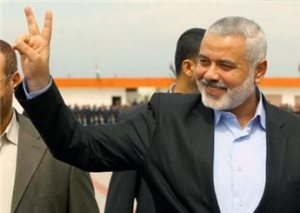 GAZA CITY – Deputy head of the Hamas political bureau Ismail Haniyeh said on Friday that the group is committed to the ceasefire with Israel but called for international attention to ensure Israel abide by its terms.
“We are committed to what was agreed on in Cairo as long as the occupation is,” he said in a statement to the press.
He said that Hamas was contacting Egypt and other outside parties to ensure Israel uphold its side of the bargain, which includes a partial lifting of the seven-year-old siege of Gaza that has not come to pass.
Haniyeh also called on Egypt to permanently open the Rafah crossing, assuring the country’s authorities that “the security and stability of Egypt is our priority.”
Egypt has closed Rafah, the principal connection between Gaza and the outside world due to the Israeli siege, for the majority of the past two months, only opening it for a few days at a time for limited passage.
Egyptian authorities blame Hamas for supporting the Egyptian Muslim Brotherhood and anti-government militants in the Sinai Peninsula, charges Hamas strenuously denies.
Sisi seeks closer economic ties with China
Mada Masr | December 21, 2014
Economic ties appear to be at the top of the agenda, as Egyptian President Abdel Fattah al-Sisi prepares for a state visit to China this week.
At a December 18 press briefing for Chinese official media, Sisi announced, “we are looking forward to developing our strategic relations with our friends in China,” reported Xinhua news agency.
“Cooperation between Egypt and China is not new, and the purpose of the visit is to confirm and develop this cooperation and discuss Chinese investment chances in Egypt,” the president reportedly added.
During the visit, which is scheduled to run from December 22 to 25, officials expect to sign 25 bilateral agreements, mostly concerning economic and investment plans, according to Egypt’s State Information Service.
The president’s visit is preceded by a delegation including the ministers of trade and industry, transport and international cooperation. The delegation set off for Beijing on December 19, and is scheduled to meet with Chinese companies interested in investing in Egypt. They are also set to discuss ways of boosting trade, investment and cooperation in industry and transport.
Trade between Egypt and China was worth around US$10 billion in 2013, a figure officials expect to exceed $11 billion in 2014. However, the balance of trade is overwhelmingly in favor of China. Egypt’s exports to China have historically made up around 10 percent of the total trade volume.
China’s investments in Egypt amount to $8.4 billion, according to The China Global Investment Tracker, a project of the US based Heritage Foundation. These investments include the North West Suez Special Economic Zone, a joint Egyptian-Chinese venture near Ain Sokhna. The project is part of a 2006 plan by China to internationalize its economy by developing 50 such zones in strategic locations around the world.
Sisi is hoping to increase investment and boost exports to China during his visit, which comes ahead of a March summit for international investors in Egypt. As a sign of the state’s hopes for Chinese involvement in the summit, one potential date was nixed due to a conflict with the Chinese New Year holiday.
During his meeting with the Chinese press, Sisi mentioned the Suez Canal Development Project as a potential area for Chinese investment, as well as plans to redevelop Egypt’s road network.
Sisi’s predecessor, Mohamed Morsi, made a similar state visit to China in 2012. For his first state visit outside of the MENA region, Morsi traveled to Beijing, along with a delegation of seven ministers and 80 businessmen. Whilst he was there, China agreed to grant Egypt US$69 million in development assistance, and to facilitate access to a multi-billion dollar credit line for development projects in Africa. Private companies claimed to have secured billions of dollars worth of deals.
At the time, Morsi’s decision to visit China was viewed as an assertion of independence from the United States and other Western powers.
Despite its hostility to the regime it ousted from power, the Sisi administration appears to be continuing this policy, courting aid from foreign powers like Russia and China, as well as from the United States and its allies in the Arab Gulf.
Sisi has praised China, in particular, for separating economic aid from political issues. “China has balanced policies and does not interfere in other countries’ domestic affairs, which is one of the reasons for China’s success,” Xinhua quotes Sisi as saying.
By contrast, Western powers like the United States and the European Union are more likely to tie aid money to human rights and other political concerns. The United States has suspended hundreds of millions of dollars in aid until Egypt can meet democracy and human rights benchmarks, although earlier this month it allowed an exemption in the case of national security interests.
Israeli official: Strategic cooperation with Riyadh is growing
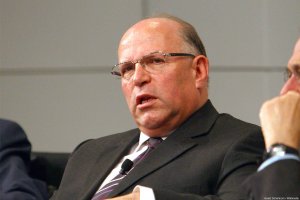
Director of Institute for Policy and Strategy, and Chair of Atlantic Forum of Israel Prof. Uzi Arad
MEMO | December 8, 2014
Strategic and security cooperation between Saudi Arabia and Israel is growing at an unprecedented rate, Israel’s former National Security Adviser Uzi Arad said.
During his participation at the Energy 2015 Conference, Arad said that Israel takes advantage of Saudi Arabia’s role as a counterweight in the face of Iran which makes it play a central and effective role in Israel’s strategic plans.
Arad warned of the consequences of betting on the survival of an allied regime in Egypt, pointing out that Egypt is going through a very sensitive stage and things could turn upside down at any moment.
With regards to Jordan, Arad said: “About Jordan, we cross our fingers. No one knows what will happen there in five years. One must hope that things there will be stable. Who says the wave sweeping Iraq and Syria will not arrive to Jordan?”
Arad said the Palestinian Authority currently represents a partner for Israel in the face of many challenges.
Israel will not tolerate Iran turning into a state with nuclear capabilities, he stressed, pointing out that if the world and regional powers accept this, Israel will turn to the military option. He said: “For a long time now, there have been plans in Mossad about a situation in which another country around us has nuclear weapons. Such discussions begun in the 80s. Responses were prepared in advance. If you see a new submarine enter the port of Haifa, it does not take a genius to figure out what it signifies.”
Commenting on the relationship with Turkey, Arad said the most important research centre in Israel said the reality and the future of these relations do not bode well.
Israel is facing growing international isolation which, he warned, will affect the Israeli military and the country’s economic interests.
Arad noted that Israel benefits from the EU funded research projects, pointing out that they have strengthened the position of Israel as a great technological power.
He warned that the upcoming early elections in Israel will only contribute to the decline in Israel’s status.
Google Earth photos for Morsi’s detention place and previous statement by the Interior Minister confirms the ‘Sisi Office Leak’
MEMO | December 6, 2014

Arabi 21 has obtained two Google Earth pictures of the “hangar” in which President Morsi was held after the third of July military coup. The Mekameleen Satellite Channel‘s leaks on Thursday’s leaks on Thursday focused on the attempt of the Supreme Military Council to modify the hangar and convert it into an official prison by means of falsification with the acquiescence of the Interior Ministry and Public Prosecutor Hisham Barakat.
The first Google Earth picture of the “hangar” taken on 5 February 2014 shows that it existed within the military unit close to the Military Academy in Abu Qir.
The second picture taken on 21 March shows the modifications undertaken on the military unit’s wall whereby the “hangar” ended up an independent building outside the borders and the wall of the unit, with a wide road leading to it from the main public street.
Meanwhile, new evidence emerged confirming the authenticity of the leak and the accuracy of its substance. Egyptian Interior Minister Brig. Gen. Muhammad Ibrahim had stated in a broadcasted TV interview a year ago that President Muhammad Morsi was not held in a prison at the time of the military coup on the 3rd of July but was detained “elsewhere”.
Answering a question put to him by journalist Amr Adeeb as to whether Morsi wore the “white fatigue” – in reference to prison uniform, Ibrahim said that prison rules were not applied to Morsi at the time. He confirmed in the interview that the Interior Ministry was responsible for Morsi and that he was sent to one of its prisons only after he appeared in court, months after his secret detention.
What Ibrahim said confirms what was contained in the leaked audio recording aired by Egyptian satellite channel Mekameleen. The leaks came out of Sisi’s office and involved a discussion about the endeavour of the Military Council to convert a “hangar” that belonged to it into a prison under the responsibility of the interior ministry in order to justify detaining Morsi within it. … Full article
See Also:
Leaked Audio Shows Egypt’s Coup Leaders as a Criminal Syndicate
A look at Egypt’s failure to exploit gas in the Mediterranean
By Izzat Shaaban | Al-Akhbar | December 6, 2014
Cairo – The oil and gas resources that Egypt could benefit from are just talk and cannot even be exploited as Israel manipulates these resources and seeks to maintain its control over them by all means possible.
When Israel undertook security measures to protect gas fields in the Mediterranean Sea, including renting a military unit in Cyprus until 2016, it ignited a crisis regarding the right to exploit the oil and gas fields in the Mediterranean. Due to the fact that Israel established the Iron Dome missile defense system to intercept missiles along its coast and off its territorial waters, in addition to its intelligence activities, it was able to monitor the work being done in these economically viable waters.
In addition, Israel has a confidential strategic security understanding with the United States in coordination with Turkey to preempt any international operations aimed at gas exploration and to strike them through the military unit established in Cyprus or the US Sixth Fleet present in the Mediterranean. All these Israeli actions deprive the Egyptian treasury of nearly a billion US dollars yearly for failing to exploit the discovered gas fields in territorial waters in the Mediterranean Sea.
Egypt’s inability to control the gas fields
As a matter of fact, Egypt was never able to control the gas fields located along its territorial maritime borders in the Mediterranean Sea because “Israel seized control of the Leviathan gas field and Cyprus controls the Aphrodite gas field even though they fall within the range of Egypt’s economic water,” according to economic expert Nael Salah al-Din al-Shafi speaking to Al-Akhbar.
According to Shafi, the problem “lies with the location of the fields discovered by some Mediterranean countries and along Egypt’s current maritime border.” He pointed out that “in principle, we cannot estimate the economic returns of the discovered gas fields because there are several of them and we don’t really know their content.”
Maritime delineation
It is known that drawing Egypt’s maritime border was marred with errors. One of these errors, according to Samir al-Najjar, professor of marine science at Alexandria University, is the degree of commitment to the United Nations Convention on the Law of the Sea stipulating that “Coastal States exercise sovereignty over their territorial waters which they have the right to establish its breadth up to a limit not to exceed 12 nautical miles… and have sovereign rights in a 200-nautical mile exclusive economic zone.” That is why, according to Najjar, “If the distance between two states facing each other across the sea is less than 400 nautical miles, they cannot get 200 nautical miles each, therefore they have to agree to demarcate their borders based on the historical and economic rights of each state.”
He added, “If there are no established economic and historical rights for these states, they should resort to maritime delineation based on the meridian or sector line.”
“Egypt overlooked the fact that its established historical rights go back to 200 years BC.” al-Najjar said, pointing out that “after re-measuring, it became evident that the meridian limit in the Aphrodite gas field for example lies three kilometers away.” “This piece of information alone means that two entire fields are located within Egyptian waters,” al-Najjar explained.
Historically, the Mediterranean fields were discovered by geologist Hussam Kheir al-Din. Al-Najjar said that Egypt and Cyprus signed an agreement on February 17, 2003 which was approved by then President Hosni Mubarak and the parliament. In 2006, the two countries signed the so-called Framework Convention to share hydrocarbon reservoirs, meaning gas and oil. However, errors in demarcation postponed the ownership of Aphrodite field, which eventually became Cyprus’ and not Egypt’s. This decision must be reversed but that requires Egypt to redraw its maritime border. Kheir al-Din indicated that Egypt gave up its rights when it agreed to allow internet cables to pass through its water for no charge, pointing out that annual losses vary between $750 million and $2 billion.The reason behind the latest crisis
Security expert, General Ismail al-Gazzar, said the reason behind the latest crises over the Mediterranean waters emerged after Egypt issued the Cairo Declaration at a conference held last month at al-Ittihadiya presidential palace which “foiled an undeclared agreement between Turkey, Cyprus and Israel that aims at pressuring Egypt to impose the status quo after seizing control of all the resources in the Mediterranean.” Gazzar pointed out that “Energy, the US company in charge of gas exploration in the Mediterranean, resorted to military units in anticipation of any international activities to drill for gas.”
Economic losses
Economics professor at the American University of Cairo, Nawal al-Said, said that the two adjacent fields, the Leviathan and Aphrodite, contain reserves worth $200 billion. She pointed out that the US oil and gas company ATB began developing Shimshon, the Egyptian maritime field also seized by Israel, which has about 3.5 trillion cubic feet.
According to economist Amr Helmy, a specialist in financial and stock markets, Egypt has about 123 trillion cubic meters in reserves in the oil fields that are being looted by Israel and about 40 trillion cubic meters of natural gas considered one of the purest in the world. As a result, he added that “Egypt loses about $24 trillion.”
Leaked Audio Shows Egypt’s Coup Leaders as a Criminal Syndicate
By ESAM AL-AMIN | CounterPunch | December 5, 2014
The Watergate scandal in the early 1970s exposed Richard Nixon and his inner circle as conspirators who were trying to cover up their criminal involvement in spying against their political opponents. Once it was uncovered, Nixon had to resign the presidency in disgrace, as many of his assistants and senior government officials were convicted and served many years in prison. A majority in Congress at the time, including Republican members, condemned the former president and voted to impeach him. The American public was shocked to witness the level of corruption reaching the highest echelons of their government. Had it not been for the audiotapes that were released by order of the Supreme Court, the extent of Nixon’s lawlessness and lies would never have been revealed or believed.
Now a series of audiotapes involving Egypt’s top military brass, which ousted former President Mohammad Morsi in a military coup in July 2013, were publicly leaked this week. The pro-Muslim Brotherhood satellite channel Mukameleen (Arabic for “We’ll Continue”) released the six audio recordings (see links 1, 2, 3, 4, 5, 6) in a special nightly program on December 4. Shortly thereafter, the recordings went viral on Arabic-language websites, though most foreign language media outlets have yet to cover them.
The contents of the audio recordings (31 minutes in total) are shocking, as they involve the highest-ranking military rulers in Egypt, including coup leader Gen. Abdelfattah Sisi, conspiring together, falsifying evidence, forging documents, and admitting to criminal behavior on tape, while acknowledging that the legal case concocted against Morsi was in danger of collapsing. The question of who released the recordings is still a mystery but rumors abound. The program presenter at the satellite channel Mukameleen insinuated that the leak came from a source within Sisi’s inner circle that is sympathetic to the Muslim Brotherhood and the January 25 revolution. Haitham Abu Khalil, a prominent human rights advocate, tweeted that since the recordings came from within the Defense Ministry, the leaker must be a rival to Gen. Sisi, such as former Chief of Staff Sami Anan who declared his presidential candidacy last spring only to be sidelined by Sisi and ridiculed by his propaganda machine. Meanwhile, opposition leader Ayman Noor told Al Jazeera from his home in exile in Lebanon that the tapes are authentic because he has known the players and could easily identify their voices.
The individuals heard on the recordings comprise some of the major figures who were involved in the military coup and have ruled the country ever since. They include Gen. Mamdouh Shahin, legal advisor to Sisi, Gen. Abbas Kamel, Sisi’s chief aide and office manager, Gen. Mohammad Ibrahim, the interior minister, Gen. Osama El-Gindy, chief of naval forces, and Gen. Mahmoud Hegazi, head of military intelligence, who was later promoted to army chief of staff. The recording also featured Gen. Sisi himself, who was the defense minister at the time before being elected president last May in a vote that was considered by many neutral observers and monitors to be a sham election. In the tapes, Gen. Shahin also described the conspiratorial role of the chief General Prosecutor, Hisham Barakat (who was appointed to the post by the coup leaders) and several of his senior prosecutors including Mustafa Khater and Ibrahim Saleh who have been leading the prosecution teams against Morsi and the Muslim Brotherhood leadership.
Conspiracy in Action
It’s not clear when the recordings were made but they probably occurred sometime last spring when Morsi’s defense team challenged the basis for his initial incarceration and petitioned the presiding judges to dismiss all charges against him under the pretext that he was kidnapped by the military with no criminal charges until months later. According to Egyptian law, if the defense team was able to prove that Morsi was illegally detained, he would have to be released, after which he would have most certainly declared that he was the legitimately-elected president by millions of Egyptians.
During the first minute of the recording, Gen. Shahin is heard telling Sisi’s office manager, Gen. Kamel, that General Prosecutor Barakat was in panic mode and had sent him his three leading prosecutors (including Khater and Saleh) and asked him to “fix” his problem. During an earlier court session, government prosecutors falsely told the judges that Morsi was never kidnapped and had always been in the custody of the interior ministry, even though he was actually being held in a military barracks at Abu Qir naval base near Alexandria. Shahin then told Kamel that they needed to provide the prosecutors with “an order of arrest of Morsi signed by interior minister Gen. Ibrahim that must be backdated to the day of the coup.” Shahin then called Ibrahim (min. 2-3) and asked for the forged legal document to be signed by the interior minister. He also asked Ibrahim to make sure that the order was “printed in the official government records” so the order would appear legitimate, adding “as we used to do so during the days of the Supreme Council of the Armed Forces” – when SCAF issued backdated laws during the military rule in the aftermath of Mubarak’s ouster. On tape Ibrahim is heard readily agreeing, and requesting that Shahin provide him with details to be included in the order including, the address and description of the detention facility.
Shahin and Kamel then called Gen. El-Gindy, the chief of the naval forces, who commanded the naval base where Morsi was detained for several weeks before he was officially charged and transferred to an interior ministry prison. In the next few minutes (starting at min. 5) Shahin tried to convince Gen. El-Gindy to turn over one of his buildings in the base to the interior ministry to be used as a prison for a month until Morsi’s trial ended. When El-Gindy asked why they could not use an existing prison facility and claim that it was the facility used for Morsi’s initial incarceration, Shahin said that this would not work because there was an official report on record written by investigative judge Hasan Samir that gave a detailed description of Morsi’s detention facility that would not match any existing prison under the control of the interior ministry. In one instance Shahin warns (min. 9-11) that unless the prosecutors win this issue in court “the espionage charges and the Ittihadiyya (presidential palace) murder case (against Morsi) would collapse.” Shahin then stated that they would have to plan for the worst-case scenario, as he was certain that the defense team would request physical inspection of the detention facility that the judges may actually grant. In this case, the detention facility must be part of the prison system under the interior ministry and match what was already on the record. However, Gen. El-Gindy expressed skepticism, as he could not transform any existing building in the naval base to become a stand-alone prison and turned over to the interior ministry. Yet, he promised to look into the matter.
In the next audio recording Gens. Shahin and Kamel called military intelligence chief Gen. Hegazi (min. 13) to seek his support in getting Gen. El-Gindy to cooperate. In frustration, Hegazi complained that the military does not get adequate legal counsel and that’s why the military is now “collecting corpses” on the streets. Surprisingly, Shahin who is Sisi’s legal advisor, answered “there is no one here (i.e. in the military) whose specialty is the law in order to provide legal advice.” He further stated that interior minister Ibrahim has already agreed to sign the order and backdate it in order to “give the prosecutors the documents they need.” Hegazi then suggested that they build a “hanger” on the naval base “which the (army’s) engineering department could do in 72 hours”. He added “They could build a separate gate, fence it, put a sign on it and turn it over to the interior ministry as a prison facility.” Shahin was then delighted since the prosecutors told him that, “they had 15 days to finish the task.”
Military chief of staff Gen. Hegazi then called the chief of the naval forces Gen. El-Gindy in the presence of Gen. Shahin (min. 18) and asked if it was possible to build a hanger similar to the detention facility that housed Morsi during his initial incarceration. El-Gindy readily agreed to do it as Sisi’s office manager Gen. Kamel informed him (min. 20) that Sisi said that, “he should spare no cost because the important thing is to do it completely right.” He then added that Sisi instructed the interior ministry “to take over the new detention facility as if they had occupied it for 100 years.”
In the next recording, Shahin tells Kamel that all the falsified documents were now ready and then commented that Kamel “should not worry about the forgery of the documents” since no one would be able to challenge them in court. Kamel then instructed him to make sure that “all the prison records are also doctored including the registration of Morsi as a criminal prisoner at the time.” Shahin then stated (min. 21) that General Prosecutor Barakat is now “very, very, very happy because he was under great duress because of this problem.”
Shahin and Kamel then joked that the new place would be ready for inspection by Morsi’s defense team. Kamel suggested (min. 22) that they make the detention facility so authentic as to also include a “torture room” and show how prisoners “are hanged from their feet.” Shahin then jokingly responded: “you can always command us. Forgery is the order of the day.” Kamel then commented on the Muslim Brotherhood by saying “the bastards would never win. We’d never allow them to gloat against us.”
The next recording is the only time Sisi is heard on the tapes (min. 22:20) in which he stated that he had just finished a meeting with interior minster Ibrahim. He then asked Shahin if he had completed the task at hand with the interior minister. Shahin responded that he had, and that it was the hardest obstacle in this predicament, in which case Sisi responded, “Indeed it was a very difficult problem.”
In the next recording, Gens. Kamel, Shahin, and El-Gindy are heard discussing the newly built hanger turned prison facility (min. 23-31) at the Abu Qir naval base. When El-Gindy stated that the facility was now ready to be turned over to the interior ministry, Shahin jokingly intimated, “It’s ready for us” (i.e. to be our prison when the military rule is ousted). El-Gindy responded by saying that it was unsuitable for them since it was only a 3-star rather than a 7-star facility (min. 23). El-Gindy then proceeded by saying that the new facility matched the one where Morsi was detained in all its details including “chairs, beds, appliances, refrigerators, washers, and the garage.” He then added, “It’s the same as the original from A to Z – even the sports equipment is the same. We even left the newspapers of that period in the cells.” Kamel then jokingly commented (min. 25) that such immaculate details “would drive the man (Morsi) crazy.” Shahin then stated (min. 26) that “he arranged with the head of the prison system to send 3 or 4 prisoners there to show that the facility had always been in use.” When the prisons chief asked why not house more prisoners Shahin responded by saying “Hell no. Do you want to expose us? This facility is supposed to be a special prison for only a limited number of prisoners.” Kamel then said that he would inform interior minister Ibrahim “to send his security people to take over the facility” and that there is “a tacit agreement (with the prosecutors) to receive early warning before an actual inspection takes place” in order to get the facility “ready.” He then assures them that the prison guards would have already been “briefed and trained” so as not to be uncovered. Finally, Shahin instructed that “all the record books must be cooked with proper dates and names of visitors including the visits by the African leaders (to Morsi in his early days of detention) as well as by a delegation from Egypt’s human rights organization, etc.” Kamel then assured them that “Lt. Gen. Tariq has been working on this with interior ministry officials.”
When wolves are guarding the sheep
These revelations clearly demonstrate that Egypt is currently being ruled by a criminal enterprise masquerading as patriotic military generals or statesmen. Since the July 2013 coup thousands of Egyptians have been killed in the streets while at least forty thousand have been arrested, jailed and tortured. In essence, the coup was a counterrevolutionary movement led by the military generals and elements of Mubarak’s deep state that eventually resulted not only in the acquittal of the former dictator and his cronies but also in thwarting Egypt’s path towards freedom and democracy.
More than forty years ago, Nixon told the American public that he was not a crook, only to be shamed nine months later and admit that indeed he had violated the law and had to resign. But the military generals in Cairo are not only crooks by their own admission, but also murderers, thugs, and psychopaths. There are no parliament, judiciary, or viable civil society institutions in Egypt to hold them accountable. Meanwhile, the international community is looking the other way while Egypt descends into turmoil and chaos, and most Egyptians face unprecedented repression and corruption on a massive scale. During the 18 momentous revolutionary days in the spring of 2011, many Egyptians believed that the military generals stood with them against the tyranny and decadence of the Mubarak regime, and declared in Tahrir Square and across Egypt that “the people and the army are one.” Four years later most Egyptians who yearn to be free openly declare “no to military rule” and understand now more than ever that freedom and democracy cannot be bestowed by any one group but must be taken by the people themselves.
Esam Al-Amin can be contacted at alamin1919@gmail.com.
US ‘ridiculous’ line on Egypt? Jen Psaki caught on hot mic
RT | December 5, 2014
US State Department spokesperson Jen Psaki has been caught on a hot mic calling one of her prepared statements about the acquittal of Egypt’s ex-leader Hosni Mubarak “ridiculous.”
During a press briefing on Monday, AP journalist Matt Lee asked Psaki to comment on an Egyptian court’s decision to acquit former President Hosni Mubarak of murder.
The State Department spokesperson attempted to dodge the question with a convoluted platitude.
“Generally, we continue to believe that upholding impartial standards of accountability will advance the political consensus on which Egypt’s long-term stability and economic growth depends,” she said on camera.
Reporters, including Lee, did not find that satisfying, but Psaki evaded their questions, saying she would not comment further.
“What does that mean?” a flummoxed voice can be heard asking.
“Wow. I don’t understand that at all,” the bemused Lee pushes. “What you said says nothing. It’s like saying ‘We support the right of people to breathe.’ That’s great, but if you can’t breathe.”
As the conference comes to an end and the lights dim, Psaki — seemingly unaware that her microphone is still on — suddenly goes off script.
“That Egypt line is ridiculous,” she can be heard saying, as Lee guffaws.
CNC reports that Lee also grilled State Department spokesperson Marie Harf on US reaction to the Mubarak trial the next day. Harf reportedly stuck to her talking points and refused to comment on the issue. When Matt Lee expressed frustration, she commiserated—kind of—saying, “I share your pain.”
The US, which supplies Egypt with over one billion dollars in aid annually, has largely steered clear of criticizing Egyptian policy. Mubarak’s acquittal last month prompted hundreds of demonstrators to take to Tahrir Square, the site of the 2011 revolution that led to his ousting. Mubarak had been charged with the killing of 239 protesters during the uprising against him.
Two Egyptian artists accused of treason for criticising Sisi

Khaled Abol Naga
MEMO | December 4, 2014
Egyptian Attorney General Judge Hisham Barakat yesterday ordered actor Khaled Abol Naga and singer Mohammed Attia to be investigated for charges of espionage and treason following public criticism of President Abdel Fatah Al-Sisi, the Anadolu Agency quoted a judicial source as saying.
According to the lawsuit filed by lawyer Hisham Ibrahim Mustafa, “Khaled Abol Naga incited against the military establishment under the pretext of opposing the military operations in Sinai and called on the people to demonstrate against the Republic’s president, disturbing the peace.”
Mustafa said the incidents occurred before the November 28 protests, which means that Abol Naga has contacts with foreign intelligence services.
Further, Mustafa said that singer Mohamed Attia joined protests against the acquittal of former Egyptian President Hosni Mubarak and his aides in Abdel Moneim Riad Square, Cairo, in violation of the Penal Code and is also in contact with foreign intelligence agencies.
On Facebook, Attia denounced the espionage charges against him.
Egypt has witnessed tens of angry protests against the Cairo Criminal Court’s decision to dismiss all criminal charges of killing peaceful demonstrators during the January 25 Revolution made against Mubarak, his two sons, Interior Minister Habib Al-Adly and six of Al-Adly’s senior aides as well as businessman Hussein Salem. Attorney General Hisham Barakat Ali appealed the ruling.
In November, lawyer Samir Sabri filed another lawsuit against Khaled Abol Naga accusing him of high treason and disturbing the peace after the actor condemned the displacement of the Sinai residents to create a military buffer zone with Gaza and criticised Al-Sisi.
Egyptian authorities claimed the operations aimed to “stop terrorist infiltration” into the country after the attack on a military post on October 24 which led to the killing of at least 31 people and which injured 30 more, according to official figures.
A group of Egyptian filmmakers and writers signed a statement of solidarity with Abol Naga condemning the lawsuit. The signatories of the statement said they stand in solidarity with his right to express his opinion without being terrorised by people who “appoint themselves guardians of Egyptian patriotism”.
In response to the reports, Abol Naga wrote on Twitter: “I do not accept defamatory statements by some television hosts against me or my family.”
Hearing collapses in Egypt trial of 494, including Irish teen
Reprieve | December 1, 2014
A mass trial hearing for almost 500 people collapsed this morning in Cairo, with the judge failing to attend and defendants unable to enter a court packed with masked pro-Government supporters.
Reports from the makeshift courtroom in Tora prison suggest that there was no judge in attendance throughout, and the room was full of supporters of the Government – many wearing masks in an apparent attempt to intimidate defence lawyers. The families of the 494 defendants were reportedly barred from entering the room, while the prisoners themselves were not called in.
The group of 494, arrested in August 2013 in a sweeping crackdown on protests, includes several juveniles being tried in violation of Egypt’s Child Laws – among them Irish teenager Ibrahim Halawa, who was 17 at the time of his arrest. Mr Halawa has reported being tortured and denied medical attention during his 18-month detention.
The 494 face potential death sentences, in the latest in a series of mass trials that has attracted condemnation from the UN, US, and Egyptian rights groups.
Today’s hearing has been postponed for another month – continuing a long hiatus in effect since August this year, when a three-judge panel resigned mid-hearing citing their ‘unease’.
The proceedings come days after another court handed down sentences totalling 340 years to 78 children in a mass trial at which their lawyers were not allowed to be present.
Maya Foa, head of the death penalty team at legal charity Reprieve, which is assisting Mr Halawa, said: “The chaos at today’s hearing shows this mass trial for what it is – a mockery of justice. The defendants and their families were shut out of the room, but masked Government supporters were allowed to attend in droves – and the judge didn’t even turn up. Meanwhile, these 494 people have already spent 18 months in prison, and been told they could face death at any time. The international community must intervene now to prevent this travesty from going any further.”
Featured Video

Racist Seinfeld Dances for Joy as Bibi Unveils His New Map
or go to
Aletho News Archives – Video-Images
TV Drama Review
Japanese drama projects Japan’s wartime atrocities onto Chinese characters

Global Times | October 25, 2026
By portraying Chinese characters as perpetrators of ruthless violence while casting Japanese Self-Defense Forces (SDF) intelligence operatives as defenders, the season 2 of the Japanese drama Vivant has recently drawn criticism from Chinese netizens, who argue that its depiction turns historical reality on its head while ignoring Japan’s wartime atrocities.
The TBS drama series – a spy suspense story in which an alleged unofficial intelligence unit of the SDF operates across the globe — has attracted a passionate fanbase. Its currently airing season 2 opened with a household rating of 18.8 percent, the highest for a TV drama this year, according toa commentary article by Japanese media Toyo Keizai.
What draws attention is the portrayal of the enemies in the series, the article noted. Scenes in which the Chinese organization subjects kidnapped members of the SDF unit to brutal torture are repeated with unrelenting intensity.
It is rare for Japanese TV dramas to explicitly portray a real-life country as the enemy, the article noted.
Japanese Prime Minister Sanae Takaichi also made a reference to the drama, saying that she has been recording Vivant and hopes to binge-watch it over the year-end and New Year holidays, according to Japanese media outlets.
China’s CCTV News report on Sunday revealed that the drama features scenes in which Chinese personnel cut off the fingers of and stab Japanese intelligence operatives in the abdomen. Such acts bear striking similarities to the torture inflicted on Chinese nationals by invading Japanese troops during the World War II.
The drama distorts the truth by attributing these atrocities to modern Chinese characters. Beneath the surface, it subtly glorifies Japan’s cross-border overseas operations, blurs the functional boundaries of the SDF and implicitly promotes an expansionist narrative, per CCTV News. … continue
Blog Roll
 Aletho News
- EU facing trillion-euro debt hole while seeking more cash for Kiev
- How US, Europe, Persian Gulf states exhausted missile stockpiles, splurged billions to defend Israel
- Up in arms… Koreans reject U.S. empire’s plan to make South Korea the next Ukraine
- Iran, Turkey, Pakistan, Saudi Arabia could advance region-led security framework in Tehran: FM spox
- Netizens condemn Japanese drama for projecting Japan’s wartime atrocities onto Chinese characters
- Racist Seinfeld Dances for Joy as Bibi Unveils His New Map
- A West Bank War for Netanyahu’s Election Campaign, Could It Backfire?
- Yemen denounces European Parliament’s ‘hypocritical’ push to blacklist Ansarullah
- Qalibaf: UAE’s UN bid aims to ‘clear the runway’ for ‘Greater Israel’, whitewash genocide
- Pakistan reopens Iran border after boosting security: Report
- If Americans Knew
- An error has occurred; the feed is probably down. Try again later.
- No Tricks Zone
- Sudden Stratospheric Warming, Powerful El Niño Combination May Lead To Extreme Europe Cold, Energy Crisis!
- Two New Studies Find Thwaites Glacier Melt Cannot Be Driven By Human Activity Or A Warming Ocean
- E-Cars Reduce CO2 Emissions By Only 41% Compared To Internal Combustion Engine Vehicles
- Predictions Made By Renowned Climate Professor Over Past Decades Have Been Proven To Be Poor
- New Study Suggests Large Regions Of The Pacific Ocean Have Been Cooling For The Last 80 Years
- Germany’s Green Energy Debacle: High Energy Costs Force Kahla Porzellan to Close After 182 Years!
- New Study: 50 Years Of The Most Aggressive ‘Net Zero’ Policies Can Only Affect The Global Climate By 0.03°C
- US September “Heat” Was No Record…Many Records Set Decades Ago
- Latest European Green Energy Debacle; Portugal’s Largest Flagship Solar Park Insolvent!
- Green Energy Debacle: German Expert Professor Fritz Vahrenholt Warns Of Severe Economic And Social Consequences

